洪 民憙 (Hong Minhee) :nonbinary:'s avatar

洪 民憙 (Hong Minhee) :nonbinary:

@hongminhee@hollo.social

1,109 following1,901 followers

An intersectionalist, feminist, and socialist living in Seoul (UTC+09:00). @tokolovesme's spouse. Who's behind @fedify, @hollo, and @botkit. Write some free software in , , , & . They/them.

서울에 사는 交叉女性主義者이자 社會主義者. 金剛兔(@tokolovesme)의 配偶者. @fedify, @hollo, @botkit 메인테이너. , , , 等으로 自由 소프트웨어 만듦.

()

Pinned

@hongminhee@hollo.social

Hello! I'm Hong Minhee (洪 民憙), an open source software engineer in my late 30s, living in Seoul, Korea. I'm bisexual and non-binary (they/them), and an enthusiastic advocate of free/open source software and the fediverse.

I work full-time on @fedify, an ActivityPub server framework in TypeScript, funded by @sovtechfund. I'm also the creator of @hollo, a single-user ActivityPub microblog; @botkit, an ActivityPub bot framework; Hackers' Pub, a fediverse platform for software developers; and LogTape, a logging library for JavaScript and TypeScript.

I have a long interest in East Asian languages (CJK) and Unicode. I post mostly in English here, though occasionally in Japanese or in mixed-script Korean (國漢文混用體), a traditional writing style that interleaves Chinese characters with the native Korean alphabet. Wanting to write in that style was actually one of the reasons I joined the fediverse. Feel free to talk to me in English, Korean, Japanese, or even Literary Chinese!

en.wikipedia.org

Korean mixed script - Wikipedia

Pinned

はじめまして!ソウル在住の30代後半のオープンソースソフトウェアエンジニア、洪 民憙ホン・ミンヒと申します。バイセクシュアル(bisexual)・ノンバイナリー(non-binary)で、自由・オープンソースソフトウェア(F/OSS)とフェディバース(fediverse)の熱烈な支持者です。

STF(@sovtechfund)の支援を受け、TypeScript用ActivityPubサーバーフレームワーク「@fedify」の開発に専念しています。他にも、おひとり様向けのActivityPubマイクロブログ「@hollo」、ActivityPubボットフレームワーク「@botkit」、ソフトウェア開発者向けフェディバースプラットフォームHackers' Pub、JavaScript・TypeScript用ロギングライブラリLogTapeなどの制作者でもあります。

東アジア言語(いわゆるCJK)とUnicodeにも興味があります。このアカウントでは主に英語で投稿していますが、時々日本語や国漢文混用体(漢字ハングル混じり文)の韓国語でも書いています。実はこの文体で書きたくてフェディバースを始めた、という経緯もあります。日本語、英語、韓国語、漢文でも気軽に話しかけてください!

speakerdeck.com

国漢文混用体からHolloまで

本発表では、韓国語の「国漢文混用体」(漢字ハングル混じり文)を自分のフェディバース投稿に実装したいという小さな目標から始まった旅路を共有します。 この目標を達成するために、ActivityPubのJSON-LDの複雑さやHTTP Signatures、WebFingerなどの仕様を理解する必要性に…

Pinned

安寧(안녕)하세요! 저는 서울에 살고 있는 30() 後半(후반)의 오픈 소스 소프트웨어 엔지니어 洪民憙(홍민희)입니다. 兩性愛者(양성애자)(bisexual)이자 논바이너리(non-binary)이며, 自由(자유)·오픈 소스 소프트웨어(F/OSS)와 聯合宇宙(연합우주)(fediverse)의 熱烈(열렬)支持者(지지자)이기도 합니다.

STF(@sovtechfund)의 支援(지원)을 받아 TypeScript() ActivityPub 서버 프레임워크 @fedify 開發(개발)專業(전업)으로 ()하고 있습니다. 그 ()에도 싱글 유저() ActivityPub 마이크로블로그 @hollo, ActivityPub 봇 프레임워크 @botkit, 소프트웨어 開發者(개발자)를 위한 聯合宇宙(연합우주) 플랫폼 Hackers' Pub, JavaScript·TypeScript() 로깅 라이브러리 LogTape ()製作者(제작자)이기도 합니다.

()아시아 言語(언어)(이른바 CJK)와 Unicode에도 關心(관심)이 많습니다. 이 計定(계정)에서는 ()英語(영어)로 포스팅하지만, 때때로 日本語(일본어)國漢文混用體(국한문 혼용체) 韓國語(한국어)로도 씁니다. 聯合宇宙(연합우주)에 오게 된 動機(동기) () 하나가 바로 國漢文混用體(국한문 혼용체)로 글을 쓰고 싶었기 때문이기도 하고요. 韓國語(한국어), 英語(영어), 日本語(일본어), 아니면 漢文(한문)으로도 말을 걸어주세요!

logtape.org

LogTape

Unobtrusive logging library with zero dependencies—library-first design for Deno, Node.js, Bun, browsers, and edge functions

@hongminhee@hollo.social

日本語で“software enginner”とか“software programmer”を普通は何と呼びますか?

  • ソフトウェアエンジニア12 (34%)
  • システムエンジニア4 (11%)
  • プログラマー11 (31%)
  • ソフトウェア開発者7 (20%)
  • その他(ご意見はコメントで)1 (3%)
@hongminhee@hollo.social

日本語(일본어) 제대로 배우기 ()부터 日本(일본) 音樂(음악)을 좋아했는데, 日本(일본) 가면 音盤店(음반점) 돌아다니면서 CD 모으는 게 趣味(취미)라서 賣臺(매대)에서 아티스트 이름 찾느라 좋아하는 아티스트 이름은 다 韓國(한국) 漢字音(한자음)으로 외우고 있다.

  • 山下야마시타達郎다쓰로 → 산하달랑
  • 角松가도마쓰敏生도시키 → 각송민생

… 이런 식. ㅋㅋㅋ

@hongminhee@hollo.social

每年(매년) 이맘때에는 藤井후지이たけし다케시 先生(선생)의 칼럼 〈冥福(명복)을 빌지 마라〉를 읽어 본다.

抑鬱(억울)한 죽음은
떠돌아야 두려움이 된다.

움푹 팬 눈구멍에 깃든 怨恨(원한)
寃鬼(원귀)가 되어 나라를 넘쳐라.

記憶(기억)되는 記憶(기억)이 있는 ()
아아 記憶(기억)이 있는 ()
뒤집을 수 없는 反證(반증)은 깊은 記憶(기억) 속의 것.

감을 눈이 없는 죽은 자의 죽음이다.

埋葬(매장)하지 마라 사람들아,
冥福(명복)을 빌지 마라.

hani.co.kr

[세상 읽기] 명복을 빌지 마라 / 후지이 다케시

4월 초에 처음으로 단원고를 찾아갔다. 1년이 지나서야 찾아간 안산 고잔동의 봄날은 1년 전에도 그랬을 것처럼 조용하고 따스했다. 꽃들과 메시지들만 가득한 2학년 교실을 둘러보고 유가족분의 이야기를 듣기 위해 이동하다가 천변에 걸린 노란 현수막에 적힌 한 글귀가 감상에

@pkgupdt@hl.pkgu.net

벌써 11년이 흘렀습니다. 세월호 희생자분들의 명복을 빕니다. 유족분들의 아픔이 조금이나마 덜어지는 세상이 되도록 함께 하겠습니다.

@kodingwarrior@silicon.moe

뭔가 이거 만들다보니까 fedify를 이용한 sns 만들기 스타터킷 같은게 만들어지면 좋을 것 같음.

* 노트 작성
* 팔로/언팔
* 타임라인
* 프로필
* 블락/블락해제

이런 것들이 미리 구현은 되어있고 나머지 기능은 요령껏 채우면 되는

@hongminhee@hollo.social

@thx 흠, 【表紙(표지)】랑 헷갈려서 그런 걸까요? 그렇다기에는 【鑑賞(감상)】이나 【感想(감상)】 같은 말은 서로 헷갈릴 수 있는데도 잘 쓰는데 말이죠… 🤔

@hongminhee@hollo.social

Fedifyはそろそろ局所最適(local optimum)に達した感じ。APIを大幅に改編しない限り、新たに追加する事はあまり残っていない。そろそろFedify 2.0の準備が必要か。🤔

@firesidefedi@audio.firesidefedi.live
Dansup - Pixelfed, Loops, Sup, etc
On today's episode we talk with Dansup. Creator of Pixelfed, Loops, Sup and so much more. Thank you again to Dansup for talking with me.

audio.firesidefedi.live

Dansup - Pixelfed, Loops, Sup, etc

Welcome Fedi Friends to the episode 10 of Fireside Fedi! I’m your host ozoned. Fireside Fedi is a show about folks within the Fediverse. If you’re seeing this, you are a part of the Fediverse. I’m very EXCITED about my guest today. I’m so excited I took a shower, shaved my head and face, wore my BEST t-shirt and shorts, and I even brushed my teeth! TO be fair I do all those things daily and I was out doing yard work earlier and needed a shower, BUT if I hadn’t, I still would have done it for my guest! With me today is Dansup! Dansup is “just a guy from canada building things for the fediverse”. No one big. You probably don’t even know him … oh wait … I’m being told he’s made a few things and that he’s “an aspiring astronaut, community creator and determined dreamer. - Currently building Pixelfed.org, an ethical and federated photo sharing platform powered by ActivityPub..” https://dansup.com/ https://mastodon.social/@dansup https://github.com/dansup/ https://pixelfed.org/ https://pixelfed.social/pixelfed https://joinloops.org/ https://loops.video/ https://pixelfed.social/loops https://fedidb.org/ https://mastodon.social/@fedidb https://www.kickstarter.com/projects/pixelfed/pixelfed-foundation-2024-real-ethical-social-networks https://pixelfed.social/supapp?fs=1 https://fediverse.info/ https://pubkit.net/ https://www.patreon.com/dansup https://opencollective.com/pixelfed https://liberapay.com/pixelfed https://fediversity.eu/ https://jortage.com/ https://botkit.fedify.dev/

@tesaguri@fedibird.com

lists.w3.org/Archives/Public/p

> […] having spoken with folks who provide services to extremely marginalized trans sex workers who do street work, it was not uncommon for them to either be robbed and have their only phone taken or to need to sell the device to make ends meet. (And no, they didn't have other devices)
> If our social networking apps suddenly require users to securely store private key material and ensure that is not lost, then we're going to be excluding not insignificant portions of society from social networking apps.

これは目から鱗だった

lists.w3.org

Re: Major Security Issue with AP: Server-Stored Private Keys in ActivityPub from emelia on 2025-04-12 (public-swicg@w3.org from April 2025)

@noellabo@fedibird.com

お気に入りのQrunchがサービス終了してからは、はてなブログPro使ってます(というほど書いてませんが)。

まぁ、有料ブログ使っていくべきじゃないかなーと思うわけです。

それはそれとして、最近Hacker's Pubを試させて貰う機会を得ました。少しだけ招待できるので、ほしい人は言ってください。

@hongminhee@hollo.social

Don't build from scratch! It's complex. See why using the framework is the smarter way to develop for the fediverse in my new post:

https://hackers.pub/@hongminhee/2025/why-use-fedify

hackers.pub

Ditch the DIY Drama: Why Use Fedify Instead of Building ActivityPub from Scratch?

So, you're captivated by the fediverse—the decentralized social web powered by protocols like ActivityPub. Maybe you're dreaming of building the next great federated app, a unique space connected to Mastodon, Lemmy, Pixelfed, and more. The temptation to dive deep and implement ActivityPub yourself, from the ground up, is strong. Total control, right? Understanding every byte? Sounds cool! But hold on a sec. Before you embark on that epic quest, let's talk reality. Implementing ActivityPub correctly isn't just one task; it's like juggling several complex standards while riding a unicycle… blindfolded. It’s hard. That's where Fedify comes in. It's a TypeScript framework designed to handle the gnarliest parts of ActivityPub development, letting you focus on what makes your app special, not reinventing the federation wheel. This post will break down the common headaches of DIY ActivityPub implementation and show how Fedify acts as the super-powered pain reliever, starting with the very foundation of how data is represented.Challenge #1: Data Modeling—Speaking ActivityStreams & JSON-LD Fluently At its core, ActivityPub relies on the ActivityStreams 2.0 vocabulary to describe actions and objects, and it uses JSON-LD as the syntax to encode this vocabulary. While powerful, this combination introduces significant complexity right from the start. First, understanding and correctly using the vast ActivityStreams vocabulary itself is a hurdle. You need to model everything—posts (Note, Article), profiles (Person, Organization), actions (Create, Follow, Like, Announce)—using the precise terms and properties defined in the specification. Manual JSON construction is tedious and prone to errors. Second, JSON-LD, the encoding layer, has specific rules that make direct JSON manipulation surprisingly tricky:Missing vs. Empty Array: In JSON-LD, a property being absent is often semantically identical to it being present with an empty array. Your application logic needs to treat these cases equally when checking for values. For example, these two Note objects mean the same thing regarding the name property:// No name property{ "@context": "https://www.w3.org/ns/activitystreams", "type": "Note", "content": "…"}// Equivalent to:{ "@context": "https://www.w3.org/ns/activitystreams", "type": "Note", "name": [], "content": "…"}Single Value vs. Array: Similarly, a property holding a single value directly is often equivalent to it holding a single-element array containing that value. Your code must anticipate both representations for the same meaning, like for the content property here:// Single value{ "@context": "https://www.w3.org/ns/activitystreams", "type": "Note", "content": "Hello"}// Equivalent to:{ "@context": "https://www.w3.org/ns/activitystreams", "type": "Note", "content": ["Hello"]}Object Reference vs. Embedded Object: Properties can contain either the full JSON-LD object embedded directly or just a URI string referencing that object. Your application needs to be prepared to fetch the object's data if only a URI is given (a process called dereferencing). These two Announce activities are semantically equivalent (assuming the URIs resolve correctly):{ "@context": "https://www.w3.org/ns/activitystreams", "type": "Announce", // Embedded objects: "actor": { "type": "Person", "id": "http://sally.example.org/", "name": "Sally" }, "object": { "type": "Arrive", "id": "https://sally.example.com/arrive", /* ... */ }}// Equivalent to:{ "@context": "https://www.w3.org/ns/activitystreams", "type": "Announce", // URI references: "actor": "http://sally.example.org/", "object": "https://sally.example.com/arrive"}<Attempting to manually handle all these vocabulary rules and JSON-LD variations consistently across your application inevitably leads to verbose, complex, and fragile code, ripe for subtle bugs that break federation. Fedify tackles this entire data modeling challenge with its comprehensive, type-safe Activity Vocabulary API. It provides TypeScript classes for ActivityStreams types and common extensions, giving you autocompletion and compile-time safety. Crucially, these classes internally manage all the tricky JSON-LD nuances. Fedify's property accessors present a consistent interface—non-functional properties (like tags) always return arrays, functional properties (like content) always return single values or null. It handles object references versus embedded objects seamlessly through dereferencing accessors (like activity.getActor()) which automatically fetch remote objects via URI when needed—a feature known as property hydration. With Fedify, you work with a clean, predictable TypeScript API, letting the framework handle the messy details of AS vocabulary and JSON-LD encoding.Challenge #2: Discovery & Identity—Finding Your Actors Once you can model data, you need to make your actors discoverable. This primarily involves the WebFinger protocol (RFC 7033). You'd need to build a server endpoint at /.well-known/webfinger capable of parsing resource queries (like acct: URIs), validating the requested domain against your server, and responding with a precisely formatted JSON Resource Descriptor (JRD). This JRD must include specific links, like a self link pointing to the actor's ActivityPub ID using the correct media type. Getting any part of this wrong can make your actors invisible. Fedify simplifies this significantly. It automatically handles WebFinger requests based on the actor information you provide through its setActorDispatcher() method. Fedify generates the correct JRD response. If you need more advanced control, like mapping user-facing handles to internal identifiers, you can easily register mapHandle() or mapAlias() callbacks. You focus on defining your actors; Fedify handles making them discoverable.// Example: Define how to find actorsfederation.setActorDispatcher( "/users/{username}", async (ctx, username) => { /* ... */ });// Now GET /.well-known/webfinger?resource=acct:username@your.domain just works!<Challenge #3: Core ActivityPub Mechanics—Handling Requests and Collections Serving actor profiles requires careful content negotiation. A request for an actor's ID needs JSON-LD for machine clients (Accept: application/activity+json) but HTML for browsers (Accept: text/html). Handling incoming activities at the inbox endpoint involves validating POST requests, verifying cryptographic signatures, parsing the payload, preventing duplicates (idempotency), and routing based on activity type. Implementing collections (outbox, followers, etc.) with correct pagination adds another layer. Fedify streamlines all of this. Its core request handler (via Federation.fetch() or framework adapters like @fedify/express) manages content negotiation. You define actors with setActorDispatcher() and web pages with your framework (Hono, Express, SvelteKit, etc.)—Fedify routes appropriately. For the inbox, setInboxListeners() lets you define handlers per activity type (e.g., .on(Follow, ...)), while Fedify automatically handles validation, signature verification, parsing, and idempotency checks using its KV Store. Collection implementation is simplified via dispatchers (e.g., setFollowersDispatcher()); you provide logic to fetch a page of data, and Fedify constructs the correct Collection or CollectionPage with pagination.// Define inbox handlersfederation.setInboxListeners("/inbox", "/users/{handle}/inbox") .on(Follow, async (ctx, follow) => { /* Handle follow */ }) .on(Undo, async (ctx, undo) => { /* Handle undo */ });// Define followers collection logicfederation.setFollowersDispatcher( "/users/{handle}/followers", async (ctx, handle, cursor) => { /* ... */ });<Challenge #4: Reliable Delivery & Asynchronous Processing—Sending Activities Robustly Sending an activity requires more than a simple POST. Networks fail, servers go down. You need robust failure handling and retry logic (ideally with backoff). Processing incoming activities synchronously can block your server. Efficiently broadcasting to many followers (fan-out) requires background processing and using shared inboxes where possible. Fedify addresses reliability and scalability using its MessageQueue abstraction. When configured (highly recommended), Context.sendActivity() enqueues delivery tasks. Background workers handle sending with automatic retries based on configurable policies (like outboxRetryPolicy). Fedify supports various queue backends (Deno KV, Redis, PostgreSQL, AMQP). For high-traffic fan-out, Fedify uses an optimized two-stage mechanism to distribute the load efficiently.// Configure Fedify with a persistent queue (e.g., Deno KV)const federation = createFederation({ queue: new DenoKvMessageQueue(/* ... */), // ...});// Sending is now reliable and non-blockingawait ctx.sendActivity({ handle: "myUser" }, recipient, someActivity);<Challenge #5: Security—Avoiding Common Pitfalls Securing an ActivityPub server is critical. You need to implement HTTP Signatures (draft-cavage-http-signatures-12) for server-to-server authentication—a complex process. You might also need Linked Data Signatures (LDS) or Object Integrity Proofs (OIP) based on FEP-8b32 for data integrity and compatibility. Managing cryptographic keys securely is essential. Lastly, fetching remote resources risks Server-Side Request Forgery (SSRF) if not validated properly. Fedify is designed with security in mind. It automatically handles the creation and verification of HTTP Signatures, LDS, and OIP, provided you supply keys via setKeyPairsDispatcher. It includes key management utilities. Crucially, Fedify's default document loader includes built-in SSRF protection, blocking requests to private IPs unless explicitly allowed.Challenge #6: Interoperability & Maintenance—Playing Nicely with Others The fediverse is diverse. Different servers have quirks. Ensuring compatibility requires testing and adaptation. Standards evolve with new Federation Enhancement Proposals (FEPs). You also need protocols like NodeInfo to advertise server capabilities. Fedify aims for broad interoperability and is actively maintained. It includes features like ActivityTransformers to smooth over implementation differences. NodeInfo support is built-in via setNodeInfoDispatcher.Challenge #7: Developer Experience—Actually Building Your App Beyond the protocol, building any server involves setup, testing, and debugging. With federation, debugging becomes harder—was the message malformed? Was the signature wrong? Is the remote server down? Is it a compatibility quirk? Good tooling is essential. Fedify enhances the developer experience significantly. Being built with TypeScript, it offers excellent type safety and editor auto-completion. The fedify CLI is a powerful companion designed to streamline common development tasks. You can quickly scaffold a new project tailored to your chosen runtime and web framework using fedify init. For debugging interactions and verifying data, fedify lookup is invaluable. It lets you inspect how any remote actor or object appears from the outside by performing WebFinger discovery and fetching the object's data. Fedify then displays the parsed object structure and properties directly in your terminal. For example, running:$ fedify lookup @fedify-example@fedify-blog.deno.dev<Will first show progress messages and then output the structured representation of the actor, similar to this:// Output of fedify lookup command (shows parsed object structure)Person { id: URL "https://fedify-blog.deno.dev/users/fedify-example", name: "Fedify Example Blog", published: 2024-03-03T13:18:11.857Z, // Simplified timestamp summary: "This blog is powered by Fedify, a fediverse server framework.", url: URL "https://fedify-blog.deno.dev/", preferredUsername: "fedify-example", publicKey: CryptographicKey { id: URL "https://fedify-blog.deno.dev/users/fedify-example#main-key", owner: URL "https://fedify-blog.deno.dev/users/fedify-example", publicKey: CryptoKey { /* ... CryptoKey details ... */ } }, // ... other properties like inbox, outbox, followers, endpoints ...}<This allows you to easily check how data is structured or troubleshoot why an interaction might be failing by seeing the actual properties Fedify parsed. Testing outgoing activities from your application during development is made much easier with fedify inbox. Running the command starts a temporary local server that acts as a publicly accessible inbox, displaying key information about the temporary actor it creates for receiving messages:$ fedify inbox✔ The ephemeral ActivityPub server is up and running: https://<unique_id>.lhr.life/✔ Sent follow request to @<some_test_account>@activitypub.academy.╭───────────────┬─────────────────────────────────────────╮│ Actor handle: │ i@<unique_id>.lhr.life │├───────────────┼─────────────────────────────────────────┤│ Actor URI: │ https://<unique_id>.lhr.life/i │├───────────────┼─────────────────────────────────────────┤│ Actor inbox: │ https://<unique_id>.lhr.life/i/inbox │├───────────────┼─────────────────────────────────────────┤│ Shared inbox: │ https://<unique_id>.lhr.life/inbox │╰───────────────┴─────────────────────────────────────────╯Web interface available at: http://localhost:8000/<You then configure your developing application to send an activity to the Actor inbox or Shared inbox URI provided. When an activity arrives, fedify inbox only prints a summary table to your console indicating that a request was received:╭────────────────┬─────────────────────────────────────╮│ Request #: │ 2 │├────────────────┼─────────────────────────────────────┤│ Activity type: │ Follow │├────────────────┼─────────────────────────────────────┤│ HTTP request: │ POST /i/inbox │├────────────────┼─────────────────────────────────────┤│ HTTP response: │ 202 │├────────────────┼─────────────────────────────────────┤│ Details │ https://<unique_id>.lhr.life/r/2 │╰────────────────┴─────────────────────────────────────╯<Crucially, the detailed information about the received request—including the full headers (like Signature), the request body (the Activity JSON), and the signature verification status—is only available in the web interface provided by fedify inbox. This web UI allows you to thoroughly inspect incoming activities during development.The Fedify Inbox web UI is where you view detailed activity information.<When you need to test interactions with the live fediverse from your local machine beyond just sending, fedify tunnel can securely expose your entire local development server temporarily. This suite of tools significantly eases the process of building and debugging federated applications.Conclusion: Build Features, Not Plumbing Implementing the ActivityPub suite of protocols from scratch is an incredibly complex and time-consuming undertaking. It involves deep dives into multiple technical specifications, cryptographic signing, security hardening, and navigating the nuances of a diverse ecosystem. While educational, it dramatically slows down the process of building the actual, unique features of your federated application. Fedify offers a well-architected, secure, and type-safe foundation, handling the intricacies of federation for you—data modeling, discovery, core mechanics, delivery, security, and interoperability. It lets you focus on your application's unique value and user experience. Stop wrestling with low-level protocol details and start building your vision for the fediverse faster and more reliably. Give Fedify a try! Getting started is straightforward. First, install the Fedify CLI using your preferred method. Once installed, create a new project template by running fedify init your-project-name. Check out the Fedify tutorials and Fedify manual to learn more. Happy federating!

@hongminhee@hackers.pub

So, you're captivated by the fediverse—the decentralized social web powered by protocols like ActivityPub. Maybe you're dreaming of building the next great federated app, a unique space connected to Mastodon, Lemmy, Pixelfed, and more. The temptation to dive deep and implement ActivityPub yourself, from the ground up, is strong. Total control, right? Understanding every byte? Sounds cool!

But hold on a sec. Before you embark on that epic quest, let's talk reality. Implementing ActivityPub correctly isn't just one task; it's like juggling several complex standards while riding a unicycle… blindfolded. It’s hard.

That's where Fedify comes in. It's a TypeScript framework designed to handle the gnarliest parts of ActivityPub development, letting you focus on what makes your app special, not reinventing the federation wheel.

This post will break down the common headaches of DIY ActivityPub implementation and show how Fedify acts as the super-powered pain reliever, starting with the very foundation of how data is represented.

Challenge #1: Data Modeling—Speaking ActivityStreams & JSON-LD Fluently

At its core, ActivityPub relies on the ActivityStreams 2.0 vocabulary to describe actions and objects, and it uses JSON-LD as the syntax to encode this vocabulary. While powerful, this combination introduces significant complexity right from the start.

First, understanding and correctly using the vast ActivityStreams vocabulary itself is a hurdle. You need to model everything—posts (Note, Article), profiles (Person, Organization), actions (Create, Follow, Like, Announce)—using the precise terms and properties defined in the specification. Manual JSON construction is tedious and prone to errors.

Second, JSON-LD, the encoding layer, has specific rules that make direct JSON manipulation surprisingly tricky:

  • Missing vs. Empty Array: In JSON-LD, a property being absent is often semantically identical to it being present with an empty array. Your application logic needs to treat these cases equally when checking for values. For example, these two Note objects mean the same thing regarding the name property:
    // No name property
    {
      "@context": "https://www.w3.org/ns/activitystreams",
      "type": "Note",
      "content": ""
    }
    // Equivalent to:
    {
      "@context": "https://www.w3.org/ns/activitystreams",
      "type": "Note",
      "name": [],
      "content": ""
    }
  • Single Value vs. Array: Similarly, a property holding a single value directly is often equivalent to it holding a single-element array containing that value. Your code must anticipate both representations for the same meaning, like for the content property here:
    // Single value
    {
      "@context": "https://www.w3.org/ns/activitystreams",
      "type": "Note",
      "content": "Hello"
    }
    // Equivalent to:
    {
      "@context": "https://www.w3.org/ns/activitystreams",
      "type": "Note",
      "content": ["Hello"]
    }
  • Object Reference vs. Embedded Object: Properties can contain either the full JSON-LD object embedded directly or just a URI string referencing that object. Your application needs to be prepared to fetch the object's data if only a URI is given (a process called dereferencing). These two Announce activities are semantically equivalent (assuming the URIs resolve correctly):
    {
      "@context": "https://www.w3.org/ns/activitystreams",
      "type": "Announce",
      // Embedded objects:
      "actor": {
        "type": "Person",
        "id": "http://sally.example.org/",
        "name": "Sally"
      },
      "object": {
        "type": "Arrive",
        "id": "https://sally.example.com/arrive",
        /* ... */
      }
    }
    // Equivalent to:
    {
      "@context":
      "https://www.w3.org/ns/activitystreams",
      "type": "Announce",
      // URI references:
      "actor": "http://sally.example.org/",
      "object": "https://sally.example.com/arrive"
    }

Attempting to manually handle all these vocabulary rules and JSON-LD variations consistently across your application inevitably leads to verbose, complex, and fragile code, ripe for subtle bugs that break federation.

Fedify tackles this entire data modeling challenge with its comprehensive, type-safe Activity Vocabulary API. It provides TypeScript classes for ActivityStreams types and common extensions, giving you autocompletion and compile-time safety. Crucially, these classes internally manage all the tricky JSON-LD nuances. Fedify's property accessors present a consistent interface—non-functional properties (like tags) always return arrays, functional properties (like content) always return single values or null. It handles object references versus embedded objects seamlessly through dereferencing accessors (like activity.getActor()) which automatically fetch remote objects via URI when needed—a feature known as property hydration. With Fedify, you work with a clean, predictable TypeScript API, letting the framework handle the messy details of AS vocabulary and JSON-LD encoding.

Challenge #2: Discovery & Identity—Finding Your Actors

Once you can model data, you need to make your actors discoverable. This primarily involves the WebFinger protocol (RFC 7033). You'd need to build a server endpoint at /.well-known/webfinger capable of parsing resource queries (like acct: URIs), validating the requested domain against your server, and responding with a precisely formatted JSON Resource Descriptor (JRD). This JRD must include specific links, like a self link pointing to the actor's ActivityPub ID using the correct media type. Getting any part of this wrong can make your actors invisible.

Fedify simplifies this significantly. It automatically handles WebFinger requests based on the actor information you provide through its setActorDispatcher() method. Fedify generates the correct JRD response. If you need more advanced control, like mapping user-facing handles to internal identifiers, you can easily register mapHandle() or mapAlias() callbacks. You focus on defining your actors; Fedify handles making them discoverable.

// Example: Define how to find actors
federation.setActorDispatcher(
  "/users/{username}",
  async (ctx, username) => { /* ... */ }
);
// Now GET /.well-known/webfinger?resource=acct:username@your.domain just works!

Challenge #3: Core ActivityPub Mechanics—Handling Requests and Collections

Serving actor profiles requires careful content negotiation. A request for an actor's ID needs JSON-LD for machine clients (Accept: application/activity+json) but HTML for browsers (Accept: text/html). Handling incoming activities at the inbox endpoint involves validating POST requests, verifying cryptographic signatures, parsing the payload, preventing duplicates (idempotency), and routing based on activity type. Implementing collections (outbox, followers, etc.) with correct pagination adds another layer.

Fedify streamlines all of this. Its core request handler (via Federation.fetch() or framework adapters like @fedify/express) manages content negotiation. You define actors with setActorDispatcher() and web pages with your framework (Hono, Express, SvelteKit, etc.)—Fedify routes appropriately. For the inbox, setInboxListeners() lets you define handlers per activity type (e.g., .on(Follow, ...)), while Fedify automatically handles validation, signature verification, parsing, and idempotency checks using its KV Store. Collection implementation is simplified via dispatchers (e.g., setFollowersDispatcher()); you provide logic to fetch a page of data, and Fedify constructs the correct Collection or CollectionPage with pagination.

// Define inbox handlers
federation.setInboxListeners("/inbox", "/users/{handle}/inbox")
  .on(Follow, async (ctx, follow) => { /* Handle follow */ })
  .on(Undo, async (ctx, undo) => { /* Handle undo */ });

// Define followers collection logic
federation.setFollowersDispatcher(
  "/users/{handle}/followers",
  async (ctx, handle, cursor) => { /* ... */ }
);

Challenge #4: Reliable Delivery & Asynchronous Processing—Sending Activities Robustly

Sending an activity requires more than a simple POST. Networks fail, servers go down. You need robust failure handling and retry logic (ideally with backoff). Processing incoming activities synchronously can block your server. Efficiently broadcasting to many followers (fan-out) requires background processing and using shared inboxes where possible.

Fedify addresses reliability and scalability using its MessageQueue abstraction. When configured (highly recommended), Context.sendActivity() enqueues delivery tasks. Background workers handle sending with automatic retries based on configurable policies (like outboxRetryPolicy). Fedify supports various queue backends (Deno KV, Redis, PostgreSQL, AMQP). For high-traffic fan-out, Fedify uses an optimized two-stage mechanism to distribute the load efficiently.

// Configure Fedify with a persistent queue (e.g., Deno KV)
const federation = createFederation({
  queue: new DenoKvMessageQueue(/* ... */),
  // ...
});
// Sending is now reliable and non-blocking
await ctx.sendActivity({ handle: "myUser" }, recipient, someActivity);

Challenge #5: Security—Avoiding Common Pitfalls

Securing an ActivityPub server is critical. You need to implement HTTP Signatures (draft-cavage-http-signatures-12) for server-to-server authentication—a complex process. You might also need Linked Data Signatures (LDS) or Object Integrity Proofs (OIP) based on FEP-8b32 for data integrity and compatibility. Managing cryptographic keys securely is essential. Lastly, fetching remote resources risks Server-Side Request Forgery (SSRF) if not validated properly.

Fedify is designed with security in mind. It automatically handles the creation and verification of HTTP Signatures, LDS, and OIP, provided you supply keys via setKeyPairsDispatcher(). It includes key management utilities. Crucially, Fedify's default document loader includes built-in SSRF protection, blocking requests to private IPs unless explicitly allowed.

Challenge #6: Interoperability & Maintenance—Playing Nicely with Others

The fediverse is diverse. Different servers have quirks. Ensuring compatibility requires testing and adaptation. Standards evolve with new Federation Enhancement Proposals (FEPs). You also need protocols like NodeInfo to advertise server capabilities.

Fedify aims for broad interoperability and is actively maintained. It includes features like ActivityTransformers to smooth over implementation differences. NodeInfo support is built-in via setNodeInfoDispatcher().

Challenge #7: Developer Experience—Actually Building Your App

Beyond the protocol, building any server involves setup, testing, and debugging. With federation, debugging becomes harder—was the message malformed? Was the signature wrong? Is the remote server down? Is it a compatibility quirk? Good tooling is essential.

Fedify enhances the developer experience significantly. Being built with TypeScript, it offers excellent type safety and editor auto-completion. The fedify CLI is a powerful companion designed to streamline common development tasks.

You can quickly scaffold a new project tailored to your chosen runtime and web framework using fedify init.

For debugging interactions and verifying data, fedify lookup is invaluable. It lets you inspect how any remote actor or object appears from the outside by performing WebFinger discovery and fetching the object's data. Fedify then displays the parsed object structure and properties directly in your terminal. For example, running:

$ fedify lookup @fedify-example@fedify-blog.deno.dev

Will first show progress messages and then output the structured representation of the actor, similar to this:

// Output of fedify lookup command (shows parsed object structure)
Person {
  id: URL "https://fedify-blog.deno.dev/users/fedify-example",
  name: "Fedify Example Blog",
  published: 2024-03-03T13:18:11.857Z, // Simplified timestamp
  summary: "This blog is powered by Fedify, a fediverse server framework.",
  url: URL "https://fedify-blog.deno.dev/",
  preferredUsername: "fedify-example",
  publicKey: CryptographicKey {
    id: URL "https://fedify-blog.deno.dev/users/fedify-example#main-key",
    owner: URL "https://fedify-blog.deno.dev/users/fedify-example",
    publicKey: CryptoKey { /* ... CryptoKey details ... */ }
  },
  // ... other properties like inbox, outbox, followers, endpoints ...
}

This allows you to easily check how data is structured or troubleshoot why an interaction might be failing by seeing the actual properties Fedify parsed.

Testing outgoing activities from your application during development is made much easier with fedify inbox. Running the command starts a temporary local server that acts as a publicly accessible inbox, displaying key information about the temporary actor it creates for receiving messages:

$ fedify inbox
✔ The ephemeral ActivityPub server is up and running: https://<unique_id>.lhr.life/
✔ Sent follow request to @<some_test_account>@activitypub.academy.
╭───────────────┬─────────────────────────────────────────╮
│ Actor handle: │ i@<unique_id>.lhr.life                  │
├───────────────┼─────────────────────────────────────────┤
│   Actor URI:  │ https://<unique_id>.lhr.life/i          │
├───────────────┼─────────────────────────────────────────┤
│  Actor inbox: │ https://<unique_id>.lhr.life/i/inbox    │
├───────────────┼─────────────────────────────────────────┤
│ Shared inbox: │ https://<unique_id>.lhr.life/inbox      │
╰───────────────┴─────────────────────────────────────────╯

Web interface available at: http://localhost:8000/

You then configure your developing application to send an activity to the Actor inbox or Shared inbox URI provided. When an activity arrives, fedify inbox only prints a summary table to your console indicating that a request was received:

╭────────────────┬─────────────────────────────────────╮
│     Request #: │ 2                                   │
├────────────────┼─────────────────────────────────────┤
│ Activity type: │ Follow                              │
├────────────────┼─────────────────────────────────────┤
│  HTTP request: │ POST /i/inbox                       │
├────────────────┼─────────────────────────────────────┤
│ HTTP response: │ 202                                 │
├────────────────┼─────────────────────────────────────┤
│       Details  │ https://<unique_id>.lhr.life/r/2    │
╰────────────────┴─────────────────────────────────────╯

Crucially, the detailed information about the received request—including the full headers (like Signature), the request body (the Activity JSON), and the signature verification status—is only available in the web interface provided by fedify inbox. This web UI allows you to thoroughly inspect incoming activities during development.

Screenshot of the Fedify Inbox web interface showing received activities and their details.
The Fedify Inbox web UI is where you view detailed activity information.

When you need to test interactions with the live fediverse from your local machine beyond just sending, fedify tunnel can securely expose your entire local development server temporarily. This suite of tools significantly eases the process of building and debugging federated applications.

Conclusion: Build Features, Not Plumbing

Implementing the ActivityPub suite of protocols from scratch is an incredibly complex and time-consuming undertaking. It involves deep dives into multiple technical specifications, cryptographic signing, security hardening, and navigating the nuances of a diverse ecosystem. While educational, it dramatically slows down the process of building the actual, unique features of your federated application.

Fedify offers a well-architected, secure, and type-safe foundation, handling the intricacies of federation for you—data modeling, discovery, core mechanics, delivery, security, and interoperability. It lets you focus on your application's unique value and user experience. Stop wrestling with low-level protocol details and start building your vision for the fediverse faster and more reliably. Give Fedify a try!

Getting started is straightforward. First, install the Fedify CLI using your preferred method. Once installed, create a new project template by running fedify init your-project-name.


Check out the Fedify tutorials and Fedify manual to learn more. Happy federating!

fedify.dev

Federation | Fedify

The Federation object is the main entry point of the Fedify library. This section explains the key features of the Federation object.

@lobsters@mastodon.social

Ditch the DIY Drama: Why Use Fedify Instead of Building ActivityPub from Scratch? lobste.rs/s/ebab2d
hackers.pub/@hongminhee/2025/w

hackers.pub

Ditch the DIY Drama: Why Use Fedify Instead of Building ActivityPub from Scratch?

So, you're captivated by the fediverse—the decentralized social web powered by protocols like ActivityPub. Maybe you're dreaming of building the next great federated app, a unique space connected to Mastodon, Lemmy, Pixelfed, and more. The temptation to dive deep and implement ActivityPub yourself, from the ground up, is strong. Total control, right? Understanding every byte? Sounds cool! But hold on a sec. Before you embark on that epic quest, let's talk reality. Implementing ActivityPub correctly isn't just one task; it's like juggling several complex standards while riding a unicycle… blindfolded. It’s hard. That's where Fedify comes in. It's a TypeScript framework designed to handle the gnarliest parts of ActivityPub development, letting you focus on what makes your app special, not reinventing the federation wheel. This post will break down the common headaches of DIY ActivityPub implementation and show how Fedify acts as the super-powered pain reliever, starting with the very foundation of how data is represented.Challenge #1: Data Modeling—Speaking ActivityStreams & JSON-LD Fluently At its core, ActivityPub relies on the ActivityStreams 2.0 vocabulary to describe actions and objects, and it uses JSON-LD as the syntax to encode this vocabulary. While powerful, this combination introduces significant complexity right from the start. First, understanding and correctly using the vast ActivityStreams vocabulary itself is a hurdle. You need to model everything—posts (Note, Article), profiles (Person, Organization), actions (Create, Follow, Like, Announce)—using the precise terms and properties defined in the specification. Manual JSON construction is tedious and prone to errors. Second, JSON-LD, the encoding layer, has specific rules that make direct JSON manipulation surprisingly tricky:Missing vs. Empty Array: In JSON-LD, a property being absent is often semantically identical to it being present with an empty array. Your application logic needs to treat these cases equally when checking for values. For example, these two Note objects mean the same thing regarding the name property:// No name property{ "@context": "https://www.w3.org/ns/activitystreams", "type": "Note", "content": "…"}// Equivalent to:{ "@context": "https://www.w3.org/ns/activitystreams", "type": "Note", "name": [], "content": "…"}Single Value vs. Array: Similarly, a property holding a single value directly is often equivalent to it holding a single-element array containing that value. Your code must anticipate both representations for the same meaning, like for the content property here:// Single value{ "@context": "https://www.w3.org/ns/activitystreams", "type": "Note", "content": "Hello"}// Equivalent to:{ "@context": "https://www.w3.org/ns/activitystreams", "type": "Note", "content": ["Hello"]}Object Reference vs. Embedded Object: Properties can contain either the full JSON-LD object embedded directly or just a URI string referencing that object. Your application needs to be prepared to fetch the object's data if only a URI is given (a process called dereferencing). These two Announce activities are semantically equivalent (assuming the URIs resolve correctly):{ "@context": "https://www.w3.org/ns/activitystreams", "type": "Announce", // Embedded objects: "actor": { "type": "Person", "id": "http://sally.example.org/", "name": "Sally" }, "object": { "type": "Arrive", "id": "https://sally.example.com/arrive", /* ... */ }}// Equivalent to:{ "@context": "https://www.w3.org/ns/activitystreams", "type": "Announce", // URI references: "actor": "http://sally.example.org/", "object": "https://sally.example.com/arrive"}<Attempting to manually handle all these vocabulary rules and JSON-LD variations consistently across your application inevitably leads to verbose, complex, and fragile code, ripe for subtle bugs that break federation. Fedify tackles this entire data modeling challenge with its comprehensive, type-safe Activity Vocabulary API. It provides TypeScript classes for ActivityStreams types and common extensions, giving you autocompletion and compile-time safety. Crucially, these classes internally manage all the tricky JSON-LD nuances. Fedify's property accessors present a consistent interface—non-functional properties (like tags) always return arrays, functional properties (like content) always return single values or null. It handles object references versus embedded objects seamlessly through dereferencing accessors (like activity.getActor()) which automatically fetch remote objects via URI when needed—a feature known as property hydration. With Fedify, you work with a clean, predictable TypeScript API, letting the framework handle the messy details of AS vocabulary and JSON-LD encoding.Challenge #2: Discovery & Identity—Finding Your Actors Once you can model data, you need to make your actors discoverable. This primarily involves the WebFinger protocol (RFC 7033). You'd need to build a server endpoint at /.well-known/webfinger capable of parsing resource queries (like acct: URIs), validating the requested domain against your server, and responding with a precisely formatted JSON Resource Descriptor (JRD). This JRD must include specific links, like a self link pointing to the actor's ActivityPub ID using the correct media type. Getting any part of this wrong can make your actors invisible. Fedify simplifies this significantly. It automatically handles WebFinger requests based on the actor information you provide through its setActorDispatcher() method. Fedify generates the correct JRD response. If you need more advanced control, like mapping user-facing handles to internal identifiers, you can easily register mapHandle() or mapAlias() callbacks. You focus on defining your actors; Fedify handles making them discoverable.// Example: Define how to find actorsfederation.setActorDispatcher( "/users/{username}", async (ctx, username) => { /* ... */ });// Now GET /.well-known/webfinger?resource=acct:username@your.domain just works!<Challenge #3: Core ActivityPub Mechanics—Handling Requests and Collections Serving actor profiles requires careful content negotiation. A request for an actor's ID needs JSON-LD for machine clients (Accept: application/activity+json) but HTML for browsers (Accept: text/html). Handling incoming activities at the inbox endpoint involves validating POST requests, verifying cryptographic signatures, parsing the payload, preventing duplicates (idempotency), and routing based on activity type. Implementing collections (outbox, followers, etc.) with correct pagination adds another layer. Fedify streamlines all of this. Its core request handler (via Federation.fetch() or framework adapters like @fedify/express) manages content negotiation. You define actors with setActorDispatcher() and web pages with your framework (Hono, Express, SvelteKit, etc.)—Fedify routes appropriately. For the inbox, setInboxListeners() lets you define handlers per activity type (e.g., .on(Follow, ...)), while Fedify automatically handles validation, signature verification, parsing, and idempotency checks using its KV Store. Collection implementation is simplified via dispatchers (e.g., setFollowersDispatcher()); you provide logic to fetch a page of data, and Fedify constructs the correct Collection or CollectionPage with pagination.// Define inbox handlersfederation.setInboxListeners("/inbox", "/users/{handle}/inbox") .on(Follow, async (ctx, follow) => { /* Handle follow */ }) .on(Undo, async (ctx, undo) => { /* Handle undo */ });// Define followers collection logicfederation.setFollowersDispatcher( "/users/{handle}/followers", async (ctx, handle, cursor) => { /* ... */ });<Challenge #4: Reliable Delivery & Asynchronous Processing—Sending Activities Robustly Sending an activity requires more than a simple POST. Networks fail, servers go down. You need robust failure handling and retry logic (ideally with backoff). Processing incoming activities synchronously can block your server. Efficiently broadcasting to many followers (fan-out) requires background processing and using shared inboxes where possible. Fedify addresses reliability and scalability using its MessageQueue abstraction. When configured (highly recommended), Context.sendActivity() enqueues delivery tasks. Background workers handle sending with automatic retries based on configurable policies (like outboxRetryPolicy). Fedify supports various queue backends (Deno KV, Redis, PostgreSQL, AMQP). For high-traffic fan-out, Fedify uses an optimized two-stage mechanism to distribute the load efficiently.// Configure Fedify with a persistent queue (e.g., Deno KV)const federation = createFederation({ queue: new DenoKvMessageQueue(/* ... */), // ...});// Sending is now reliable and non-blockingawait ctx.sendActivity({ handle: "myUser" }, recipient, someActivity);<Challenge #5: Security—Avoiding Common Pitfalls Securing an ActivityPub server is critical. You need to implement HTTP Signatures (draft-cavage-http-signatures-12) for server-to-server authentication—a complex process. You might also need Linked Data Signatures (LDS) or Object Integrity Proofs (OIP) based on FEP-8b32 for data integrity and compatibility. Managing cryptographic keys securely is essential. Lastly, fetching remote resources risks Server-Side Request Forgery (SSRF) if not validated properly. Fedify is designed with security in mind. It automatically handles the creation and verification of HTTP Signatures, LDS, and OIP, provided you supply keys via setKeyPairsDispatcher(). It includes key management utilities. Crucially, Fedify's default document loader includes built-in SSRF protection, blocking requests to private IPs unless explicitly allowed.Challenge #6: Interoperability & Maintenance—Playing Nicely with Others The fediverse is diverse. Different servers have quirks. Ensuring compatibility requires testing and adaptation. Standards evolve with new Federation Enhancement Proposals (FEPs). You also need protocols like NodeInfo to advertise server capabilities. Fedify aims for broad interoperability and is actively maintained. It includes features like ActivityTransformers to smooth over implementation differences. NodeInfo support is built-in via setNodeInfoDispatcher().Challenge #7: Developer Experience—Actually Building Your App Beyond the protocol, building any server involves setup, testing, and debugging. With federation, debugging becomes harder—was the message malformed? Was the signature wrong? Is the remote server down? Is it a compatibility quirk? Good tooling is essential. Fedify enhances the developer experience significantly. Being built with TypeScript, it offers excellent type safety and editor auto-completion. The fedify CLI is a powerful companion designed to streamline common development tasks. You can quickly scaffold a new project tailored to your chosen runtime and web framework using fedify init. For debugging interactions and verifying data, fedify lookup is invaluable. It lets you inspect how any remote actor or object appears from the outside by performing WebFinger discovery and fetching the object's data. Fedify then displays the parsed object structure and properties directly in your terminal. For example, running:$ fedify lookup @fedify-example@fedify-blog.deno.dev<Will first show progress messages and then output the structured representation of the actor, similar to this:// Output of fedify lookup command (shows parsed object structure)Person { id: URL "https://fedify-blog.deno.dev/users/fedify-example", name: "Fedify Example Blog", published: 2024-03-03T13:18:11.857Z, // Simplified timestamp summary: "This blog is powered by Fedify, a fediverse server framework.", url: URL "https://fedify-blog.deno.dev/", preferredUsername: "fedify-example", publicKey: CryptographicKey { id: URL "https://fedify-blog.deno.dev/users/fedify-example#main-key", owner: URL "https://fedify-blog.deno.dev/users/fedify-example", publicKey: CryptoKey { /* ... CryptoKey details ... */ } }, // ... other properties like inbox, outbox, followers, endpoints ...}<This allows you to easily check how data is structured or troubleshoot why an interaction might be failing by seeing the actual properties Fedify parsed. Testing outgoing activities from your application during development is made much easier with fedify inbox. Running the command starts a temporary local server that acts as a publicly accessible inbox, displaying key information about the temporary actor it creates for receiving messages:$ fedify inbox✔ The ephemeral ActivityPub server is up and running: https://<unique_id>.lhr.life/✔ Sent follow request to @<some_test_account>@activitypub.academy.╭───────────────┬─────────────────────────────────────────╮│ Actor handle: │ i@<unique_id>.lhr.life │├───────────────┼─────────────────────────────────────────┤│ Actor URI: │ https://<unique_id>.lhr.life/i │├───────────────┼─────────────────────────────────────────┤│ Actor inbox: │ https://<unique_id>.lhr.life/i/inbox │├───────────────┼─────────────────────────────────────────┤│ Shared inbox: │ https://<unique_id>.lhr.life/inbox │╰───────────────┴─────────────────────────────────────────╯Web interface available at: http://localhost:8000/<You then configure your developing application to send an activity to the Actor inbox or Shared inbox URI provided. When an activity arrives, fedify inbox only prints a summary table to your console indicating that a request was received:╭────────────────┬─────────────────────────────────────╮│ Request #: │ 2 │├────────────────┼─────────────────────────────────────┤│ Activity type: │ Follow │├────────────────┼─────────────────────────────────────┤│ HTTP request: │ POST /i/inbox │├────────────────┼─────────────────────────────────────┤│ HTTP response: │ 202 │├────────────────┼─────────────────────────────────────┤│ Details │ https://<unique_id>.lhr.life/r/2 │╰────────────────┴─────────────────────────────────────╯<Crucially, the detailed information about the received request—including the full headers (like Signature), the request body (the Activity JSON), and the signature verification status—is only available in the web interface provided by fedify inbox. This web UI allows you to thoroughly inspect incoming activities during development.The Fedify Inbox web UI is where you view detailed activity information.<When you need to test interactions with the live fediverse from your local machine beyond just sending, fedify tunnel can securely expose your entire local development server temporarily. This suite of tools significantly eases the process of building and debugging federated applications.Conclusion: Build Features, Not Plumbing Implementing the ActivityPub suite of protocols from scratch is an incredibly complex and time-consuming undertaking. It involves deep dives into multiple technical specifications, cryptographic signing, security hardening, and navigating the nuances of a diverse ecosystem. While educational, it dramatically slows down the process of building the actual, unique features of your federated application. Fedify offers a well-architected, secure, and type-safe foundation, handling the intricacies of federation for you—data modeling, discovery, core mechanics, delivery, security, and interoperability. It lets you focus on your application's unique value and user experience. Stop wrestling with low-level protocol details and start building your vision for the fediverse faster and more reliably. Give Fedify a try! Getting started is straightforward. First, install the Fedify CLI using your preferred method. Once installed, create a new project template by running fedify init your-project-name. Check out the Fedify tutorials and Fedify manual to learn more. Happy federating!

@hongminhee@hackers.pub

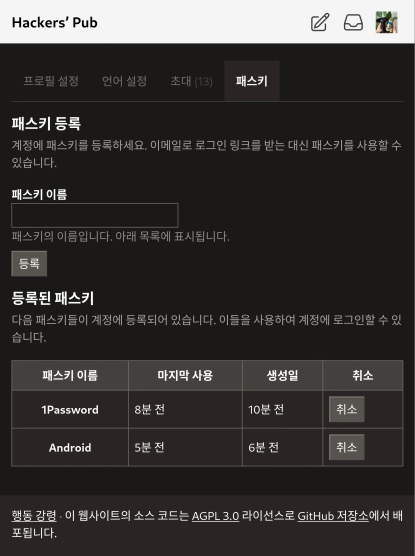
지금까지 Hackers' Pub은 반드시 이메일을 통해 로그인 링크를 수신하는 식으로만 로그인이 가능했는데, 사실은 많이 번거로웠죠?

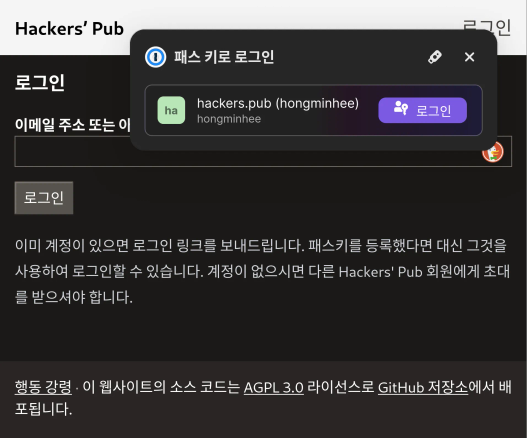
이를 해결하기 위해 Hackers' Pub에 패스키 기능을 추가했습니다. 패스키 추가는 설정패스키 페이지에서 할 수 있으며, 패스키가 등록된 기기 및 브라우저에서는 로그인 페이지에서 자동적으로 패스키를 사용할 것인지 묻는 창이 뜨게 됩니다.

Hackers' Pub의 패스키 설정 페이지. 위쪽에는 패스키 등록을 위한 폼이, 아래쪽에는 등록된 패스키를 나열한 표가 보인다.
ALT text

Hackers' Pub의 패스키 설정 페이지. 위쪽에는 패스키 등록을 위한 폼이, 아래쪽에는 등록된 패스키를 나열한 표가 보인다.

Hackers' Pub의 로그인 페이지. 우측 상단에 패스키를 사용하여 로그인할 것인지 묻는 창이 보인다.
ALT text

Hackers' Pub의 로그인 페이지. 우측 상단에 패스키를 사용하여 로그인할 것인지 묻는 창이 보인다.

@hongminhee@hollo.social

Don't build from scratch! It's complex. See why using the framework is the smarter way to develop for the fediverse in my new post:

https://hackers.pub/@hongminhee/2025/why-use-fedify

hackers.pub

Ditch the DIY Drama: Why Use Fedify Instead of Building ActivityPub from Scratch?

So, you're captivated by the fediverse—the decentralized social web powered by protocols like ActivityPub. Maybe you're dreaming of building the next great federated app, a unique space connected to Mastodon, Lemmy, Pixelfed, and more. The temptation to dive deep and implement ActivityPub yourself, from the ground up, is strong. Total control, right? Understanding every byte? Sounds cool! But hold on a sec. Before you embark on that epic quest, let's talk reality. Implementing ActivityPub correctly isn't just one task; it's like juggling several complex standards while riding a unicycle… blindfolded. It’s hard. That's where Fedify comes in. It's a TypeScript framework designed to handle the gnarliest parts of ActivityPub development, letting you focus on what makes your app special, not reinventing the federation wheel. This post will break down the common headaches of DIY ActivityPub implementation and show how Fedify acts as the super-powered pain reliever, starting with the very foundation of how data is represented.Challenge #1: Data Modeling—Speaking ActivityStreams & JSON-LD Fluently At its core, ActivityPub relies on the ActivityStreams 2.0 vocabulary to describe actions and objects, and it uses JSON-LD as the syntax to encode this vocabulary. While powerful, this combination introduces significant complexity right from the start. First, understanding and correctly using the vast ActivityStreams vocabulary itself is a hurdle. You need to model everything—posts (Note, Article), profiles (Person, Organization), actions (Create, Follow, Like, Announce)—using the precise terms and properties defined in the specification. Manual JSON construction is tedious and prone to errors. Second, JSON-LD, the encoding layer, has specific rules that make direct JSON manipulation surprisingly tricky:Missing vs. Empty Array: In JSON-LD, a property being absent is often semantically identical to it being present with an empty array. Your application logic needs to treat these cases equally when checking for values. For example, these two Note objects mean the same thing regarding the name property:// No name property{ "@context": "https://www.w3.org/ns/activitystreams", "type": "Note", "content": "…"}// Equivalent to:{ "@context": "https://www.w3.org/ns/activitystreams", "type": "Note", "name": [], "content": "…"}Single Value vs. Array: Similarly, a property holding a single value directly is often equivalent to it holding a single-element array containing that value. Your code must anticipate both representations for the same meaning, like for the content property here:// Single value{ "@context": "https://www.w3.org/ns/activitystreams", "type": "Note", "content": "Hello"}// Equivalent to:{ "@context": "https://www.w3.org/ns/activitystreams", "type": "Note", "content": ["Hello"]}Object Reference vs. Embedded Object: Properties can contain either the full JSON-LD object embedded directly or just a URI string referencing that object. Your application needs to be prepared to fetch the object's data if only a URI is given (a process called dereferencing). These two Announce activities are semantically equivalent (assuming the URIs resolve correctly):{ "@context": "https://www.w3.org/ns/activitystreams", "type": "Announce", // Embedded objects: "actor": { "type": "Person", "id": "http://sally.example.org/", "name": "Sally" }, "object": { "type": "Arrive", "id": "https://sally.example.com/arrive", /* ... */ }}// Equivalent to:{ "@context": "https://www.w3.org/ns/activitystreams", "type": "Announce", // URI references: "actor": "http://sally.example.org/", "object": "https://sally.example.com/arrive"}<Attempting to manually handle all these vocabulary rules and JSON-LD variations consistently across your application inevitably leads to verbose, complex, and fragile code, ripe for subtle bugs that break federation. Fedify tackles this entire data modeling challenge with its comprehensive, type-safe Activity Vocabulary API. It provides TypeScript classes for ActivityStreams types and common extensions, giving you autocompletion and compile-time safety. Crucially, these classes internally manage all the tricky JSON-LD nuances. Fedify's property accessors present a consistent interface—non-functional properties (like tags) always return arrays, functional properties (like content) always return single values or null. It handles object references versus embedded objects seamlessly through dereferencing accessors (like activity.getActor()) which automatically fetch remote objects via URI when needed—a feature known as property hydration. With Fedify, you work with a clean, predictable TypeScript API, letting the framework handle the messy details of AS vocabulary and JSON-LD encoding.Challenge #2: Discovery & Identity—Finding Your Actors Once you can model data, you need to make your actors discoverable. This primarily involves the WebFinger protocol (RFC 7033). You'd need to build a server endpoint at /.well-known/webfinger capable of parsing resource queries (like acct: URIs), validating the requested domain against your server, and responding with a precisely formatted JSON Resource Descriptor (JRD). This JRD must include specific links, like a self link pointing to the actor's ActivityPub ID using the correct media type. Getting any part of this wrong can make your actors invisible. Fedify simplifies this significantly. It automatically handles WebFinger requests based on the actor information you provide through its setActorDispatcher() method. Fedify generates the correct JRD response. If you need more advanced control, like mapping user-facing handles to internal identifiers, you can easily register mapHandle() or mapAlias() callbacks. You focus on defining your actors; Fedify handles making them discoverable.// Example: Define how to find actorsfederation.setActorDispatcher( "/users/{username}", async (ctx, username) => { /* ... */ });// Now GET /.well-known/webfinger?resource=acct:username@your.domain just works!<Challenge #3: Core ActivityPub Mechanics—Handling Requests and Collections Serving actor profiles requires careful content negotiation. A request for an actor's ID needs JSON-LD for machine clients (Accept: application/activity+json) but HTML for browsers (Accept: text/html). Handling incoming activities at the inbox endpoint involves validating POST requests, verifying cryptographic signatures, parsing the payload, preventing duplicates (idempotency), and routing based on activity type. Implementing collections (outbox, followers, etc.) with correct pagination adds another layer. Fedify streamlines all of this. Its core request handler (via Federation.fetch() or framework adapters like @fedify/express) manages content negotiation. You define actors with setActorDispatcher() and web pages with your framework (Hono, Express, SvelteKit, etc.)—Fedify routes appropriately. For the inbox, setInboxListeners() lets you define handlers per activity type (e.g., .on(Follow, ...)), while Fedify automatically handles validation, signature verification, parsing, and idempotency checks using its KV Store. Collection implementation is simplified via dispatchers (e.g., setFollowersDispatcher()); you provide logic to fetch a page of data, and Fedify constructs the correct Collection or CollectionPage with pagination.// Define inbox handlersfederation.setInboxListeners("/inbox", "/users/{handle}/inbox") .on(Follow, async (ctx, follow) => { /* Handle follow */ }) .on(Undo, async (ctx, undo) => { /* Handle undo */ });// Define followers collection logicfederation.setFollowersDispatcher( "/users/{handle}/followers", async (ctx, handle, cursor) => { /* ... */ });<Challenge #4: Reliable Delivery & Asynchronous Processing—Sending Activities Robustly Sending an activity requires more than a simple POST. Networks fail, servers go down. You need robust failure handling and retry logic (ideally with backoff). Processing incoming activities synchronously can block your server. Efficiently broadcasting to many followers (fan-out) requires background processing and using shared inboxes where possible. Fedify addresses reliability and scalability using its MessageQueue abstraction. When configured (highly recommended), Context.sendActivity() enqueues delivery tasks. Background workers handle sending with automatic retries based on configurable policies (like outboxRetryPolicy). Fedify supports various queue backends (Deno KV, Redis, PostgreSQL, AMQP). For high-traffic fan-out, Fedify uses an optimized two-stage mechanism to distribute the load efficiently.// Configure Fedify with a persistent queue (e.g., Deno KV)const federation = createFederation({ queue: new DenoKvMessageQueue(/* ... */), // ...});// Sending is now reliable and non-blockingawait ctx.sendActivity({ handle: "myUser" }, recipient, someActivity);<Challenge #5: Security—Avoiding Common Pitfalls Securing an ActivityPub server is critical. You need to implement HTTP Signatures (draft-cavage-http-signatures-12) for server-to-server authentication—a complex process. You might also need Linked Data Signatures (LDS) or Object Integrity Proofs (OIP) based on FEP-8b32 for data integrity and compatibility. Managing cryptographic keys securely is essential. Lastly, fetching remote resources risks Server-Side Request Forgery (SSRF) if not validated properly. Fedify is designed with security in mind. It automatically handles the creation and verification of HTTP Signatures, LDS, and OIP, provided you supply keys via setKeyPairsDispatcher. It includes key management utilities. Crucially, Fedify's default document loader includes built-in SSRF protection, blocking requests to private IPs unless explicitly allowed.Challenge #6: Interoperability & Maintenance—Playing Nicely with Others The fediverse is diverse. Different servers have quirks. Ensuring compatibility requires testing and adaptation. Standards evolve with new Federation Enhancement Proposals (FEPs). You also need protocols like NodeInfo to advertise server capabilities. Fedify aims for broad interoperability and is actively maintained. It includes features like ActivityTransformers to smooth over implementation differences. NodeInfo support is built-in via setNodeInfoDispatcher.Challenge #7: Developer Experience—Actually Building Your App Beyond the protocol, building any server involves setup, testing, and debugging. With federation, debugging becomes harder—was the message malformed? Was the signature wrong? Is the remote server down? Is it a compatibility quirk? Good tooling is essential. Fedify enhances the developer experience significantly. Being built with TypeScript, it offers excellent type safety and editor auto-completion. The fedify CLI is a powerful companion designed to streamline common development tasks. You can quickly scaffold a new project tailored to your chosen runtime and web framework using fedify init. For debugging interactions and verifying data, fedify lookup is invaluable. It lets you inspect how any remote actor or object appears from the outside by performing WebFinger discovery and fetching the object's data. Fedify then displays the parsed object structure and properties directly in your terminal. For example, running:$ fedify lookup @fedify-example@fedify-blog.deno.dev<Will first show progress messages and then output the structured representation of the actor, similar to this:// Output of fedify lookup command (shows parsed object structure)Person { id: URL "https://fedify-blog.deno.dev/users/fedify-example", name: "Fedify Example Blog", published: 2024-03-03T13:18:11.857Z, // Simplified timestamp summary: "This blog is powered by Fedify, a fediverse server framework.", url: URL "https://fedify-blog.deno.dev/", preferredUsername: "fedify-example", publicKey: CryptographicKey { id: URL "https://fedify-blog.deno.dev/users/fedify-example#main-key", owner: URL "https://fedify-blog.deno.dev/users/fedify-example", publicKey: CryptoKey { /* ... CryptoKey details ... */ } }, // ... other properties like inbox, outbox, followers, endpoints ...}<This allows you to easily check how data is structured or troubleshoot why an interaction might be failing by seeing the actual properties Fedify parsed. Testing outgoing activities from your application during development is made much easier with fedify inbox. Running the command starts a temporary local server that acts as a publicly accessible inbox, displaying key information about the temporary actor it creates for receiving messages:$ fedify inbox✔ The ephemeral ActivityPub server is up and running: https://<unique_id>.lhr.life/✔ Sent follow request to @<some_test_account>@activitypub.academy.╭───────────────┬─────────────────────────────────────────╮│ Actor handle: │ i@<unique_id>.lhr.life │├───────────────┼─────────────────────────────────────────┤│ Actor URI: │ https://<unique_id>.lhr.life/i │├───────────────┼─────────────────────────────────────────┤│ Actor inbox: │ https://<unique_id>.lhr.life/i/inbox │├───────────────┼─────────────────────────────────────────┤│ Shared inbox: │ https://<unique_id>.lhr.life/inbox │╰───────────────┴─────────────────────────────────────────╯Web interface available at: http://localhost:8000/<You then configure your developing application to send an activity to the Actor inbox or Shared inbox URI provided. When an activity arrives, fedify inbox only prints a summary table to your console indicating that a request was received:╭────────────────┬─────────────────────────────────────╮│ Request #: │ 2 │├────────────────┼─────────────────────────────────────┤│ Activity type: │ Follow │├────────────────┼─────────────────────────────────────┤│ HTTP request: │ POST /i/inbox │├────────────────┼─────────────────────────────────────┤│ HTTP response: │ 202 │├────────────────┼─────────────────────────────────────┤│ Details │ https://<unique_id>.lhr.life/r/2 │╰────────────────┴─────────────────────────────────────╯<Crucially, the detailed information about the received request—including the full headers (like Signature), the request body (the Activity JSON), and the signature verification status—is only available in the web interface provided by fedify inbox. This web UI allows you to thoroughly inspect incoming activities during development.The Fedify Inbox web UI is where you view detailed activity information.<When you need to test interactions with the live fediverse from your local machine beyond just sending, fedify tunnel can securely expose your entire local development server temporarily. This suite of tools significantly eases the process of building and debugging federated applications.Conclusion: Build Features, Not Plumbing Implementing the ActivityPub suite of protocols from scratch is an incredibly complex and time-consuming undertaking. It involves deep dives into multiple technical specifications, cryptographic signing, security hardening, and navigating the nuances of a diverse ecosystem. While educational, it dramatically slows down the process of building the actual, unique features of your federated application. Fedify offers a well-architected, secure, and type-safe foundation, handling the intricacies of federation for you—data modeling, discovery, core mechanics, delivery, security, and interoperability. It lets you focus on your application's unique value and user experience. Stop wrestling with low-level protocol details and start building your vision for the fediverse faster and more reliably. Give Fedify a try! Getting started is straightforward. First, install the Fedify CLI using your preferred method. Once installed, create a new project template by running fedify init your-project-name. Check out the Fedify tutorials and Fedify manual to learn more. Happy federating!

@hongminhee@hackers.pub

So, you're captivated by the fediverse—the decentralized social web powered by protocols like ActivityPub. Maybe you're dreaming of building the next great federated app, a unique space connected to Mastodon, Lemmy, Pixelfed, and more. The temptation to dive deep and implement ActivityPub yourself, from the ground up, is strong. Total control, right? Understanding every byte? Sounds cool!

But hold on a sec. Before you embark on that epic quest, let's talk reality. Implementing ActivityPub correctly isn't just one task; it's like juggling several complex standards while riding a unicycle… blindfolded. It’s hard.

That's where Fedify comes in. It's a TypeScript framework designed to handle the gnarliest parts of ActivityPub development, letting you focus on what makes your app special, not reinventing the federation wheel.

This post will break down the common headaches of DIY ActivityPub implementation and show how Fedify acts as the super-powered pain reliever, starting with the very foundation of how data is represented.

Challenge #1: Data Modeling—Speaking ActivityStreams & JSON-LD Fluently

At its core, ActivityPub relies on the ActivityStreams 2.0 vocabulary to describe actions and objects, and it uses JSON-LD as the syntax to encode this vocabulary. While powerful, this combination introduces significant complexity right from the start.

First, understanding and correctly using the vast ActivityStreams vocabulary itself is a hurdle. You need to model everything—posts (Note, Article), profiles (Person, Organization), actions (Create, Follow, Like, Announce)—using the precise terms and properties defined in the specification. Manual JSON construction is tedious and prone to errors.

Second, JSON-LD, the encoding layer, has specific rules that make direct JSON manipulation surprisingly tricky:

  • Missing vs. Empty Array: In JSON-LD, a property being absent is often semantically identical to it being present with an empty array. Your application logic needs to treat these cases equally when checking for values. For example, these two Note objects mean the same thing regarding the name property:
    // No name property
    {
      "@context": "https://www.w3.org/ns/activitystreams",
      "type": "Note",
      "content": ""
    }
    // Equivalent to:
    {
      "@context": "https://www.w3.org/ns/activitystreams",
      "type": "Note",
      "name": [],
      "content": ""
    }
  • Single Value vs. Array: Similarly, a property holding a single value directly is often equivalent to it holding a single-element array containing that value. Your code must anticipate both representations for the same meaning, like for the content property here:
    // Single value
    {
      "@context": "https://www.w3.org/ns/activitystreams",
      "type": "Note",
      "content": "Hello"
    }
    // Equivalent to:
    {
      "@context": "https://www.w3.org/ns/activitystreams",
      "type": "Note",
      "content": ["Hello"]
    }
  • Object Reference vs. Embedded Object: Properties can contain either the full JSON-LD object embedded directly or just a URI string referencing that object. Your application needs to be prepared to fetch the object's data if only a URI is given (a process called dereferencing). These two Announce activities are semantically equivalent (assuming the URIs resolve correctly):
    {
      "@context": "https://www.w3.org/ns/activitystreams",
      "type": "Announce",
      // Embedded objects:
      "actor": {
        "type": "Person",
        "id": "http://sally.example.org/",
        "name": "Sally"
      },
      "object": {
        "type": "Arrive",
        "id": "https://sally.example.com/arrive",
        /* ... */
      }
    }
    // Equivalent to:
    {
      "@context":
      "https://www.w3.org/ns/activitystreams",
      "type": "Announce",
      // URI references:
      "actor": "http://sally.example.org/",
      "object": "https://sally.example.com/arrive"
    }

Attempting to manually handle all these vocabulary rules and JSON-LD variations consistently across your application inevitably leads to verbose, complex, and fragile code, ripe for subtle bugs that break federation.

Fedify tackles this entire data modeling challenge with its comprehensive, type-safe Activity Vocabulary API. It provides TypeScript classes for ActivityStreams types and common extensions, giving you autocompletion and compile-time safety. Crucially, these classes internally manage all the tricky JSON-LD nuances. Fedify's property accessors present a consistent interface—non-functional properties (like tags) always return arrays, functional properties (like content) always return single values or null. It handles object references versus embedded objects seamlessly through dereferencing accessors (like activity.getActor()) which automatically fetch remote objects via URI when needed—a feature known as property hydration. With Fedify, you work with a clean, predictable TypeScript API, letting the framework handle the messy details of AS vocabulary and JSON-LD encoding.

Challenge #2: Discovery & Identity—Finding Your Actors

Once you can model data, you need to make your actors discoverable. This primarily involves the WebFinger protocol (RFC 7033). You'd need to build a server endpoint at /.well-known/webfinger capable of parsing resource queries (like acct: URIs), validating the requested domain against your server, and responding with a precisely formatted JSON Resource Descriptor (JRD). This JRD must include specific links, like a self link pointing to the actor's ActivityPub ID using the correct media type. Getting any part of this wrong can make your actors invisible.

Fedify simplifies this significantly. It automatically handles WebFinger requests based on the actor information you provide through its setActorDispatcher() method. Fedify generates the correct JRD response. If you need more advanced control, like mapping user-facing handles to internal identifiers, you can easily register mapHandle() or mapAlias() callbacks. You focus on defining your actors; Fedify handles making them discoverable.

// Example: Define how to find actors
federation.setActorDispatcher(
  "/users/{username}",
  async (ctx, username) => { /* ... */ }
);
// Now GET /.well-known/webfinger?resource=acct:username@your.domain just works!

Challenge #3: Core ActivityPub Mechanics—Handling Requests and Collections

Serving actor profiles requires careful content negotiation. A request for an actor's ID needs JSON-LD for machine clients (Accept: application/activity+json) but HTML for browsers (Accept: text/html). Handling incoming activities at the inbox endpoint involves validating POST requests, verifying cryptographic signatures, parsing the payload, preventing duplicates (idempotency), and routing based on activity type. Implementing collections (outbox, followers, etc.) with correct pagination adds another layer.

Fedify streamlines all of this. Its core request handler (via Federation.fetch() or framework adapters like @fedify/express) manages content negotiation. You define actors with setActorDispatcher() and web pages with your framework (Hono, Express, SvelteKit, etc.)—Fedify routes appropriately. For the inbox, setInboxListeners() lets you define handlers per activity type (e.g., .on(Follow, ...)), while Fedify automatically handles validation, signature verification, parsing, and idempotency checks using its KV Store. Collection implementation is simplified via dispatchers (e.g., setFollowersDispatcher()); you provide logic to fetch a page of data, and Fedify constructs the correct Collection or CollectionPage with pagination.

// Define inbox handlers
federation.setInboxListeners("/inbox", "/users/{handle}/inbox")
  .on(Follow, async (ctx, follow) => { /* Handle follow */ })
  .on(Undo, async (ctx, undo) => { /* Handle undo */ });

// Define followers collection logic
federation.setFollowersDispatcher(
  "/users/{handle}/followers",
  async (ctx, handle, cursor) => { /* ... */ }
);

Challenge #4: Reliable Delivery & Asynchronous Processing—Sending Activities Robustly

Sending an activity requires more than a simple POST. Networks fail, servers go down. You need robust failure handling and retry logic (ideally with backoff). Processing incoming activities synchronously can block your server. Efficiently broadcasting to many followers (fan-out) requires background processing and using shared inboxes where possible.

Fedify addresses reliability and scalability using its MessageQueue abstraction. When configured (highly recommended), Context.sendActivity() enqueues delivery tasks. Background workers handle sending with automatic retries based on configurable policies (like outboxRetryPolicy). Fedify supports various queue backends (Deno KV, Redis, PostgreSQL, AMQP). For high-traffic fan-out, Fedify uses an optimized two-stage mechanism to distribute the load efficiently.

// Configure Fedify with a persistent queue (e.g., Deno KV)
const federation = createFederation({
  queue: new DenoKvMessageQueue(/* ... */),
  // ...
});
// Sending is now reliable and non-blocking
await ctx.sendActivity({ handle: "myUser" }, recipient, someActivity);

Challenge #5: Security—Avoiding Common Pitfalls

Securing an ActivityPub server is critical. You need to implement HTTP Signatures (draft-cavage-http-signatures-12) for server-to-server authentication—a complex process. You might also need Linked Data Signatures (LDS) or Object Integrity Proofs (OIP) based on FEP-8b32 for data integrity and compatibility. Managing cryptographic keys securely is essential. Lastly, fetching remote resources risks Server-Side Request Forgery (SSRF) if not validated properly.

Fedify is designed with security in mind. It automatically handles the creation and verification of HTTP Signatures, LDS, and OIP, provided you supply keys via setKeyPairsDispatcher(). It includes key management utilities. Crucially, Fedify's default document loader includes built-in SSRF protection, blocking requests to private IPs unless explicitly allowed.

Challenge #6: Interoperability & Maintenance—Playing Nicely with Others

The fediverse is diverse. Different servers have quirks. Ensuring compatibility requires testing and adaptation. Standards evolve with new Federation Enhancement Proposals (FEPs). You also need protocols like NodeInfo to advertise server capabilities.

Fedify aims for broad interoperability and is actively maintained. It includes features like ActivityTransformers to smooth over implementation differences. NodeInfo support is built-in via setNodeInfoDispatcher().

Challenge #7: Developer Experience—Actually Building Your App

Beyond the protocol, building any server involves setup, testing, and debugging. With federation, debugging becomes harder—was the message malformed? Was the signature wrong? Is the remote server down? Is it a compatibility quirk? Good tooling is essential.

Fedify enhances the developer experience significantly. Being built with TypeScript, it offers excellent type safety and editor auto-completion. The fedify CLI is a powerful companion designed to streamline common development tasks.

You can quickly scaffold a new project tailored to your chosen runtime and web framework using fedify init.

For debugging interactions and verifying data, fedify lookup is invaluable. It lets you inspect how any remote actor or object appears from the outside by performing WebFinger discovery and fetching the object's data. Fedify then displays the parsed object structure and properties directly in your terminal. For example, running:

$ fedify lookup @fedify-example@fedify-blog.deno.dev

Will first show progress messages and then output the structured representation of the actor, similar to this:

// Output of fedify lookup command (shows parsed object structure)
Person {
  id: URL "https://fedify-blog.deno.dev/users/fedify-example",
  name: "Fedify Example Blog",
  published: 2024-03-03T13:18:11.857Z, // Simplified timestamp
  summary: "This blog is powered by Fedify, a fediverse server framework.",
  url: URL "https://fedify-blog.deno.dev/",
  preferredUsername: "fedify-example",
  publicKey: CryptographicKey {
    id: URL "https://fedify-blog.deno.dev/users/fedify-example#main-key",
    owner: URL "https://fedify-blog.deno.dev/users/fedify-example",
    publicKey: CryptoKey { /* ... CryptoKey details ... */ }
  },
  // ... other properties like inbox, outbox, followers, endpoints ...
}

This allows you to easily check how data is structured or troubleshoot why an interaction might be failing by seeing the actual properties Fedify parsed.

Testing outgoing activities from your application during development is made much easier with fedify inbox. Running the command starts a temporary local server that acts as a publicly accessible inbox, displaying key information about the temporary actor it creates for receiving messages:

$ fedify inbox
✔ The ephemeral ActivityPub server is up and running: https://<unique_id>.lhr.life/
✔ Sent follow request to @<some_test_account>@activitypub.academy.
╭───────────────┬─────────────────────────────────────────╮
│ Actor handle: │ i@<unique_id>.lhr.life                  │
├───────────────┼─────────────────────────────────────────┤
│   Actor URI:  │ https://<unique_id>.lhr.life/i          │
├───────────────┼─────────────────────────────────────────┤
│  Actor inbox: │ https://<unique_id>.lhr.life/i/inbox    │
├───────────────┼─────────────────────────────────────────┤
│ Shared inbox: │ https://<unique_id>.lhr.life/inbox      │
╰───────────────┴─────────────────────────────────────────╯

Web interface available at: http://localhost:8000/

You then configure your developing application to send an activity to the Actor inbox or Shared inbox URI provided. When an activity arrives, fedify inbox only prints a summary table to your console indicating that a request was received:

╭────────────────┬─────────────────────────────────────╮
│     Request #: │ 2                                   │
├────────────────┼─────────────────────────────────────┤
│ Activity type: │ Follow                              │
├────────────────┼─────────────────────────────────────┤
│  HTTP request: │ POST /i/inbox                       │
├────────────────┼─────────────────────────────────────┤
│ HTTP response: │ 202                                 │
├────────────────┼─────────────────────────────────────┤
│       Details  │ https://<unique_id>.lhr.life/r/2    │
╰────────────────┴─────────────────────────────────────╯

Crucially, the detailed information about the received request—including the full headers (like Signature), the request body (the Activity JSON), and the signature verification status—is only available in the web interface provided by fedify inbox. This web UI allows you to thoroughly inspect incoming activities during development.

Screenshot of the Fedify Inbox web interface showing received activities and their details.
The Fedify Inbox web UI is where you view detailed activity information.

When you need to test interactions with the live fediverse from your local machine beyond just sending, fedify tunnel can securely expose your entire local development server temporarily. This suite of tools significantly eases the process of building and debugging federated applications.

Conclusion: Build Features, Not Plumbing

Implementing the ActivityPub suite of protocols from scratch is an incredibly complex and time-consuming undertaking. It involves deep dives into multiple technical specifications, cryptographic signing, security hardening, and navigating the nuances of a diverse ecosystem. While educational, it dramatically slows down the process of building the actual, unique features of your federated application.

Fedify offers a well-architected, secure, and type-safe foundation, handling the intricacies of federation for you—data modeling, discovery, core mechanics, delivery, security, and interoperability. It lets you focus on your application's unique value and user experience. Stop wrestling with low-level protocol details and start building your vision for the fediverse faster and more reliably. Give Fedify a try!

Getting started is straightforward. First, install the Fedify CLI using your preferred method. Once installed, create a new project template by running fedify init your-project-name.

Check out the Fedify tutorials and Fedify manual to learn more. Happy federating!

fedify.dev

Federation | Fedify

The Federation object is the main entry point of the Fedify library. This section explains the key features of the Federation object.