Hello! I'm Hong Minhee (洪 民憙), an open source software engineer in my late 30s, living in Seoul, Korea. I'm bisexual and non-binary (they/them), and an enthusiastic advocate of free/open source software and the fediverse.
I work full-time on @fedify, an ActivityPub server framework in TypeScript, funded by @sovtechfund. I'm also the creator of @hollo, a single-user ActivityPub microblog; @botkit, an ActivityPub bot framework; Hackers' Pub, a fediverse platform for software developers; and LogTape, a logging library for JavaScript and TypeScript.
I have a long interest in East Asian languages (CJK) and Unicode. I post mostly in English here, though occasionally in Japanese or in mixed-script Korean (國漢文混用體), a traditional writing style that interleaves Chinese characters with the native Korean alphabet. Wanting to write in that style was actually one of the reasons I joined the fediverse. Feel free to talk to me in English, Korean, Japanese, or even Literary Chinese!
安寧하세요! 저는 서울에 살고 있는 30代 後半의 오픈 소스 소프트웨어 엔지니어 洪民憙입니다. 兩性愛者(bisexual)이자 논바이너리(non-binary)이며, 自由·오픈 소스 소프트웨어(F/OSS)와 聯合宇宙(fediverse)의 熱烈한 支持者이기도 합니다.
STF(@sovtechfund)의 支援을 받아 TypeScript用 ActivityPub 서버 프레임워크 @fedify 開發에 專業으로 任하고 있습니다. 그 外에도 싱글 유저用 ActivityPub 마이크로블로그 @hollo, ActivityPub 봇 프레임워크 @botkit, 소프트웨어 開發者를 위한 聯合宇宙 플랫폼 Hackers' Pub, JavaScript·TypeScript用 로깅 라이브러리 LogTape 等의 製作者이기도 합니다.
東아시아 言語(이른바 CJK)와 Unicode에도 關心이 많습니다. 이 計定에서는 主로 英語로 포스팅하지만, 때때로 日本語나 國漢文混用體 韓國語로도 씁니다. 聯合宇宙에 오게 된 動機 中 하나가 바로 國漢文混用體로 글을 쓰고 싶었기 때문이기도 하고요. 韓國語, 英語, 日本語, 아니면 漢文으로도 말을 걸어주세요!
So, you're captivated by the fediverse—the decentralized social web powered by protocols like ActivityPub. Maybe you're dreaming of building the next great federated app, a unique space connected to Mastodon, Lemmy, Pixelfed, and more. The temptation to dive deep and implement ActivityPub yourself, from the ground up, is strong. Total control, right? Understanding every byte? Sounds cool!
But hold on a sec. Before you embark on that epic quest, let's talk reality. Implementing ActivityPub correctly isn't just one task; it's like juggling several complex standards while riding a unicycle… blindfolded. It’s hard.
That's where Fedify comes in. It's a TypeScript framework designed to handle the gnarliest parts of ActivityPub development, letting you focus on what makes your app special, not reinventing the federation wheel.
This post will break down the common headaches of DIY ActivityPub implementation and show how Fedify acts as the super-powered pain reliever, starting with the very foundation of how data is represented.
Challenge #1: Data Modeling—Speaking ActivityStreams & JSON-LD Fluently
At its core, ActivityPub relies on the ActivityStreams 2.0 vocabulary to describe actions and objects, and it uses JSON-LD as the syntax to encode this vocabulary. While powerful, this combination introduces significant complexity right from the start.
First, understanding and correctly using the vast ActivityStreams vocabulary itself is a hurdle. You need to model everything—posts (Note, Article), profiles (Person, Organization), actions (Create, Follow, Like, Announce)—using the precise terms and properties defined in the specification. Manual JSON construction is tedious and prone to errors.
Second, JSON-LD, the encoding layer, has specific rules that make direct JSON manipulation surprisingly tricky:
Missing vs. Empty Array: In JSON-LD, a property being absent is often semantically identical to it being present with an empty array. Your application logic needs to treat these cases equally when checking for values. For example, these two Note objects mean the same thing regarding the name property:
// No name property{ "@context": "https://www.w3.org/ns/activitystreams", "type": "Note", "content": "…"}
Single Value vs. Array: Similarly, a property holding a single value directly is often equivalent to it holding a single-element array containing that value. Your code must anticipate both representations for the same meaning, like for the content property here:
// Single value{ "@context": "https://www.w3.org/ns/activitystreams", "type": "Note", "content": "Hello"}
Object Reference vs. Embedded Object: Properties can contain either the full JSON-LD object embedded directly or just a URI string referencing that object. Your application needs to be prepared to fetch the object's data if only a URI is given (a process called dereferencing). These two Announce activities are semantically equivalent (assuming the URIs resolve correctly):
Attempting to manually handle all these vocabulary rules and JSON-LD variations consistently across your application inevitably leads to verbose, complex, and fragile code, ripe for subtle bugs that break federation.
Fedify tackles this entire data modeling challenge with its comprehensive, type-safe Activity Vocabulary API. It provides TypeScript classes for ActivityStreams types and common extensions, giving you autocompletion and compile-time safety. Crucially, these classes internally manage all the tricky JSON-LD nuances. Fedify's property accessors present a consistent interface—non-functional properties (like tags) always return arrays, functional properties (like content) always return single values or null. It handles object references versus embedded objects seamlessly through dereferencing accessors (like activity.getActor()) which automatically fetch remote objects via URI when needed—a feature known as property hydration. With Fedify, you work with a clean, predictable TypeScript API, letting the framework handle the messy details of AS vocabulary and JSON-LD encoding.
Challenge #2: Discovery & Identity—Finding Your Actors
Once you can model data, you need to make your actors discoverable. This primarily involves the WebFinger protocol (RFC 7033). You'd need to build a server endpoint at /.well-known/webfinger capable of parsing resource queries (like acct: URIs), validating the requested domain against your server, and responding with a precisely formatted JSON Resource Descriptor (JRD). This JRD must include specific links, like a self link pointing to the actor's ActivityPub ID using the correct media type. Getting any part of this wrong can make your actors invisible.
Fedify simplifies this significantly. It automatically handles WebFinger requests based on the actor information you provide through its setActorDispatcher() method. Fedify generates the correct JRD response. If you need more advanced control, like mapping user-facing handles to internal identifiers, you can easily register mapHandle() or mapAlias() callbacks. You focus on defining your actors; Fedify handles making them discoverable.
// Example: Define how to find actorsfederation.setActorDispatcher( "/users/{username}", async (ctx, username) => { /* ... */ });// Now GET /.well-known/webfinger?resource=acct:username@your.domain just works!
Challenge #3: Core ActivityPub Mechanics—Handling Requests and Collections
Serving actor profiles requires careful content negotiation. A request for an actor's ID needs JSON-LD for machine clients (Accept: application/activity+json) but HTML for browsers (Accept: text/html). Handling incoming activities at the inbox endpoint involves validating POST requests, verifying cryptographic signatures, parsing the payload, preventing duplicates (idempotency), and routing based on activity type. Implementing collections (outbox, followers, etc.) with correct pagination adds another layer.
Fedify streamlines all of this. Its core request handler (via Federation.fetch() or framework adapters like @fedify/express) manages content negotiation. You define actors with setActorDispatcher() and web pages with your framework (Hono, Express, SvelteKit, etc.)—Fedify routes appropriately. For the inbox, setInboxListeners() lets you define handlers per activity type (e.g., .on(Follow, ...)), while Fedify automatically handles validation, signature verification, parsing, and idempotency checks using its KV Store. Collection implementation is simplified via dispatchers (e.g., setFollowersDispatcher()); you provide logic to fetch a page of data, and Fedify constructs the correct Collection or CollectionPage with pagination.
Sending an activity requires more than a simple POST. Networks fail, servers go down. You need robust failure handling and retry logic (ideally with backoff). Processing incoming activities synchronously can block your server. Efficiently broadcasting to many followers (fan-out) requires background processing and using shared inboxes where possible.
Fedify addresses reliability and scalability using its MessageQueue abstraction. When configured (highly recommended), Context.sendActivity() enqueues delivery tasks. Background workers handle sending with automatic retries based on configurable policies (like outboxRetryPolicy). Fedify supports various queue backends (Deno KV, Redis, PostgreSQL, AMQP). For high-traffic fan-out, Fedify uses an optimized two-stage mechanism to distribute the load efficiently.
// Configure Fedify with a persistent queue (e.g., Deno KV)const federation = createFederation({ queue: new DenoKvMessageQueue(/* ... */), // ...});// Sending is now reliable and non-blockingawait ctx.sendActivity({ handle: "myUser" }, recipient, someActivity);
Fedify is designed with security in mind. It automatically handles the creation and verification of HTTP Signatures, LDS, and OIP, provided you supply keys via setKeyPairsDispatcher(). It includes key management utilities. Crucially, Fedify's default document loader includes built-in SSRF protection, blocking requests to private IPs unless explicitly allowed.
Challenge #6: Interoperability & Maintenance—Playing Nicely with Others
The fediverse is diverse. Different servers have quirks. Ensuring compatibility requires testing and adaptation. Standards evolve with new Federation Enhancement Proposals (FEPs). You also need protocols like NodeInfo to advertise server capabilities.
Fedify aims for broad interoperability and is actively maintained. It includes features like ActivityTransformers to smooth over implementation differences. NodeInfo support is built-in via setNodeInfoDispatcher().
Challenge #7: Developer Experience—Actually Building Your App
Beyond the protocol, building any server involves setup, testing, and debugging. With federation, debugging becomes harder—was the message malformed? Was the signature wrong? Is the remote server down? Is it a compatibility quirk? Good tooling is essential.
Fedify enhances the developer experience significantly. Being built with TypeScript, it offers excellent type safety and editor auto-completion. The fedify CLI is a powerful companion designed to streamline common development tasks.
You can quickly scaffold a new project tailored to your chosen runtime and web framework using fedify init.
For debugging interactions and verifying data, fedify lookup is invaluable. It lets you inspect how any remote actor or object appears from the outside by performing WebFinger discovery and fetching the object's data. Fedify then displays the parsed object structure and properties directly in your terminal. For example, running:
Will first show progress messages and then output the structured representation of the actor, similar to this:
// Output of fedify lookup command (shows parsed object structure)Person { id: URL "https://fedify-blog.deno.dev/users/fedify-example", name: "Fedify Example Blog", published: 2024-03-03T13:18:11.857Z, // Simplified timestamp summary: "This blog is powered by Fedify, a fediverse server framework.", url: URL "https://fedify-blog.deno.dev/", preferredUsername: "fedify-example", publicKey: CryptographicKey { id: URL "https://fedify-blog.deno.dev/users/fedify-example#main-key", owner: URL "https://fedify-blog.deno.dev/users/fedify-example", publicKey: CryptoKey { /* ... CryptoKey details ... */ } }, // ... other properties like inbox, outbox, followers, endpoints ...}
This allows you to easily check how data is structured or troubleshoot why an interaction might be failing by seeing the actual properties Fedify parsed.
Testing outgoing activities from your application during development is made much easier with fedify inbox. Running the command starts a temporary local server that acts as a publicly accessible inbox, displaying key information about the temporary actor it creates for receiving messages:
$ fedify inbox✔ The ephemeral ActivityPub server is up and running: https://<unique_id>.lhr.life/✔ Sent follow request to @<some_test_account>@activitypub.academy.╭───────────────┬─────────────────────────────────────────╮│ Actor handle: │ i@<unique_id>.lhr.life │├───────────────┼─────────────────────────────────────────┤│ Actor URI: │ https://<unique_id>.lhr.life/i │├───────────────┼─────────────────────────────────────────┤│ Actor inbox: │ https://<unique_id>.lhr.life/i/inbox │├───────────────┼─────────────────────────────────────────┤│ Shared inbox: │ https://<unique_id>.lhr.life/inbox │╰───────────────┴─────────────────────────────────────────╯Web interface available at: http://localhost:8000/
You then configure your developing application to send an activity to the Actor inbox or Shared inbox URI provided. When an activity arrives, fedify inboxonly prints a summary table to your console indicating that a request was received:
Crucially, the detailed information about the received request—including the full headers (like Signature), the request body (the Activity JSON), and the signature verification status—is only available in the web interface provided by fedify inbox. This web UI allows you to thoroughly inspect incoming activities during development.
The Fedify Inbox web UI is where you view detailed activity information.
When you need to test interactions with the live fediverse from your local machine beyond just sending, fedify tunnel can securely expose your entire local development server temporarily. This suite of tools significantly eases the process of building and debugging federated applications.
Conclusion: Build Features, Not Plumbing
Implementing the ActivityPub suite of protocols from scratch is an incredibly complex and time-consuming undertaking. It involves deep dives into multiple technical specifications, cryptographic signing, security hardening, and navigating the nuances of a diverse ecosystem. While educational, it dramatically slows down the process of building the actual, unique features of your federated application.
Fedify offers a well-architected, secure, and type-safe foundation, handling the intricacies of federation for you—data modeling, discovery, core mechanics, delivery, security, and interoperability. It lets you focus on your application's unique value and user experience. Stop wrestling with low-level protocol details and start building your vision for the fediverse faster and more reliably. Give Fedify a try!
Getting started is straightforward. First, install the Fedify CLI using your preferred method. Once installed, create a new project template by running fedify init your-project-name.
So, you're captivated by the fediverse—the decentralized social web powered by protocols like ActivityPub. Maybe you're dreaming of building the next great federated app, a unique space connected to Mastodon, Lemmy, Pixelfed, and more. The temptation to dive deep and implement ActivityPub yourself, from the ground up, is strong. Total control, right? Understanding every byte? Sounds cool!
But hold on a sec. Before you embark on that epic quest, let's talk reality. Implementing ActivityPub correctly isn't just one task; it's like juggling several complex standards while riding a unicycle… blindfolded. It’s hard.
That's where Fedify comes in. It's a TypeScript framework designed to handle the gnarliest parts of ActivityPub development, letting you focus on what makes your app special, not reinventing the federation wheel.
This post will break down the common headaches of DIY ActivityPub implementation and show how Fedify acts as the super-powered pain reliever, starting with the very foundation of how data is represented.
Challenge #1: Data Modeling—Speaking ActivityStreams & JSON-LD Fluently
At its core, ActivityPub relies on the ActivityStreams 2.0 vocabulary to describe actions and objects, and it uses JSON-LD as the syntax to encode this vocabulary. While powerful, this combination introduces significant complexity right from the start.
First, understanding and correctly using the vast ActivityStreams vocabulary itself is a hurdle. You need to model everything—posts (Note, Article), profiles (Person, Organization), actions (Create, Follow, Like, Announce)—using the precise terms and properties defined in the specification. Manual JSON construction is tedious and prone to errors.
Second, JSON-LD, the encoding layer, has specific rules that make direct JSON manipulation surprisingly tricky:
Missing vs. Empty Array: In JSON-LD, a property being absent is often semantically identical to it being present with an empty array. Your application logic needs to treat these cases equally when checking for values. For example, these two Note objects mean the same thing regarding the name property:
// No name property{ "@context": "https://www.w3.org/ns/activitystreams", "type": "Note", "content": "…"}
Single Value vs. Array: Similarly, a property holding a single value directly is often equivalent to it holding a single-element array containing that value. Your code must anticipate both representations for the same meaning, like for the content property here:
// Single value{ "@context": "https://www.w3.org/ns/activitystreams", "type": "Note", "content": "Hello"}
Object Reference vs. Embedded Object: Properties can contain either the full JSON-LD object embedded directly or just a URI string referencing that object. Your application needs to be prepared to fetch the object's data if only a URI is given (a process called dereferencing). These two Announce activities are semantically equivalent (assuming the URIs resolve correctly):
Attempting to manually handle all these vocabulary rules and JSON-LD variations consistently across your application inevitably leads to verbose, complex, and fragile code, ripe for subtle bugs that break federation.
Fedify tackles this entire data modeling challenge with its comprehensive, type-safe Activity Vocabulary API. It provides TypeScript classes for ActivityStreams types and common extensions, giving you autocompletion and compile-time safety. Crucially, these classes internally manage all the tricky JSON-LD nuances. Fedify's property accessors present a consistent interface—non-functional properties (like tags) always return arrays, functional properties (like content) always return single values or null. It handles object references versus embedded objects seamlessly through dereferencing accessors (like activity.getActor()) which automatically fetch remote objects via URI when needed—a feature known as property hydration. With Fedify, you work with a clean, predictable TypeScript API, letting the framework handle the messy details of AS vocabulary and JSON-LD encoding.
Challenge #2: Discovery & Identity—Finding Your Actors
Once you can model data, you need to make your actors discoverable. This primarily involves the WebFinger protocol (RFC 7033). You'd need to build a server endpoint at /.well-known/webfinger capable of parsing resource queries (like acct: URIs), validating the requested domain against your server, and responding with a precisely formatted JSON Resource Descriptor (JRD). This JRD must include specific links, like a self link pointing to the actor's ActivityPub ID using the correct media type. Getting any part of this wrong can make your actors invisible.
Fedify simplifies this significantly. It automatically handles WebFinger requests based on the actor information you provide through its setActorDispatcher() method. Fedify generates the correct JRD response. If you need more advanced control, like mapping user-facing handles to internal identifiers, you can easily register mapHandle() or mapAlias() callbacks. You focus on defining your actors; Fedify handles making them discoverable.
// Example: Define how to find actorsfederation.setActorDispatcher( "/users/{username}", async (ctx, username) => { /* ... */ });// Now GET /.well-known/webfinger?resource=acct:username@your.domain just works!
Challenge #3: Core ActivityPub Mechanics—Handling Requests and Collections
Serving actor profiles requires careful content negotiation. A request for an actor's ID needs JSON-LD for machine clients (Accept: application/activity+json) but HTML for browsers (Accept: text/html). Handling incoming activities at the inbox endpoint involves validating POST requests, verifying cryptographic signatures, parsing the payload, preventing duplicates (idempotency), and routing based on activity type. Implementing collections (outbox, followers, etc.) with correct pagination adds another layer.
Fedify streamlines all of this. Its core request handler (via Federation.fetch() or framework adapters like @fedify/express) manages content negotiation. You define actors with setActorDispatcher() and web pages with your framework (Hono, Express, SvelteKit, etc.)—Fedify routes appropriately. For the inbox, setInboxListeners() lets you define handlers per activity type (e.g., .on(Follow, ...)), while Fedify automatically handles validation, signature verification, parsing, and idempotency checks using its KV Store. Collection implementation is simplified via dispatchers (e.g., setFollowersDispatcher()); you provide logic to fetch a page of data, and Fedify constructs the correct Collection or CollectionPage with pagination.
Sending an activity requires more than a simple POST. Networks fail, servers go down. You need robust failure handling and retry logic (ideally with backoff). Processing incoming activities synchronously can block your server. Efficiently broadcasting to many followers (fan-out) requires background processing and using shared inboxes where possible.
Fedify addresses reliability and scalability using its MessageQueue abstraction. When configured (highly recommended), Context.sendActivity() enqueues delivery tasks. Background workers handle sending with automatic retries based on configurable policies (like outboxRetryPolicy). Fedify supports various queue backends (Deno KV, Redis, PostgreSQL, AMQP). For high-traffic fan-out, Fedify uses an optimized two-stage mechanism to distribute the load efficiently.
// Configure Fedify with a persistent queue (e.g., Deno KV)const federation = createFederation({ queue: new DenoKvMessageQueue(/* ... */), // ...});// Sending is now reliable and non-blockingawait ctx.sendActivity({ handle: "myUser" }, recipient, someActivity);
Fedify is designed with security in mind. It automatically handles the creation and verification of HTTP Signatures, LDS, and OIP, provided you supply keys via setKeyPairsDispatcher(). It includes key management utilities. Crucially, Fedify's default document loader includes built-in SSRF protection, blocking requests to private IPs unless explicitly allowed.
Challenge #6: Interoperability & Maintenance—Playing Nicely with Others
The fediverse is diverse. Different servers have quirks. Ensuring compatibility requires testing and adaptation. Standards evolve with new Federation Enhancement Proposals (FEPs). You also need protocols like NodeInfo to advertise server capabilities.
Fedify aims for broad interoperability and is actively maintained. It includes features like ActivityTransformers to smooth over implementation differences. NodeInfo support is built-in via setNodeInfoDispatcher().
Challenge #7: Developer Experience—Actually Building Your App
Beyond the protocol, building any server involves setup, testing, and debugging. With federation, debugging becomes harder—was the message malformed? Was the signature wrong? Is the remote server down? Is it a compatibility quirk? Good tooling is essential.
Fedify enhances the developer experience significantly. Being built with TypeScript, it offers excellent type safety and editor auto-completion. The fedify CLI is a powerful companion designed to streamline common development tasks.
You can quickly scaffold a new project tailored to your chosen runtime and web framework using fedify init.
For debugging interactions and verifying data, fedify lookup is invaluable. It lets you inspect how any remote actor or object appears from the outside by performing WebFinger discovery and fetching the object's data. Fedify then displays the parsed object structure and properties directly in your terminal. For example, running:
Will first show progress messages and then output the structured representation of the actor, similar to this:
// Output of fedify lookup command (shows parsed object structure)Person { id: URL "https://fedify-blog.deno.dev/users/fedify-example", name: "Fedify Example Blog", published: 2024-03-03T13:18:11.857Z, // Simplified timestamp summary: "This blog is powered by Fedify, a fediverse server framework.", url: URL "https://fedify-blog.deno.dev/", preferredUsername: "fedify-example", publicKey: CryptographicKey { id: URL "https://fedify-blog.deno.dev/users/fedify-example#main-key", owner: URL "https://fedify-blog.deno.dev/users/fedify-example", publicKey: CryptoKey { /* ... CryptoKey details ... */ } }, // ... other properties like inbox, outbox, followers, endpoints ...}
This allows you to easily check how data is structured or troubleshoot why an interaction might be failing by seeing the actual properties Fedify parsed.
Testing outgoing activities from your application during development is made much easier with fedify inbox. Running the command starts a temporary local server that acts as a publicly accessible inbox, displaying key information about the temporary actor it creates for receiving messages:
$ fedify inbox✔ The ephemeral ActivityPub server is up and running: https://<unique_id>.lhr.life/✔ Sent follow request to @<some_test_account>@activitypub.academy.╭───────────────┬─────────────────────────────────────────╮│ Actor handle: │ i@<unique_id>.lhr.life │├───────────────┼─────────────────────────────────────────┤│ Actor URI: │ https://<unique_id>.lhr.life/i │├───────────────┼─────────────────────────────────────────┤│ Actor inbox: │ https://<unique_id>.lhr.life/i/inbox │├───────────────┼─────────────────────────────────────────┤│ Shared inbox: │ https://<unique_id>.lhr.life/inbox │╰───────────────┴─────────────────────────────────────────╯Web interface available at: http://localhost:8000/
You then configure your developing application to send an activity to the Actor inbox or Shared inbox URI provided. When an activity arrives, fedify inboxonly prints a summary table to your console indicating that a request was received:
Crucially, the detailed information about the received request—including the full headers (like Signature), the request body (the Activity JSON), and the signature verification status—is only available in the web interface provided by fedify inbox. This web UI allows you to thoroughly inspect incoming activities during development.
The Fedify Inbox web UI is where you view detailed activity information.
When you need to test interactions with the live fediverse from your local machine beyond just sending, fedify tunnel can securely expose your entire local development server temporarily. This suite of tools significantly eases the process of building and debugging federated applications.
Conclusion: Build Features, Not Plumbing
Implementing the ActivityPub suite of protocols from scratch is an incredibly complex and time-consuming undertaking. It involves deep dives into multiple technical specifications, cryptographic signing, security hardening, and navigating the nuances of a diverse ecosystem. While educational, it dramatically slows down the process of building the actual, unique features of your federated application.
Fedify offers a well-architected, secure, and type-safe foundation, handling the intricacies of federation for you—data modeling, discovery, core mechanics, delivery, security, and interoperability. It lets you focus on your application's unique value and user experience. Stop wrestling with low-level protocol details and start building your vision for the fediverse faster and more reliably. Give Fedify a try!
Getting started is straightforward. First, install the Fedify CLI using your preferred method. Once installed, create a new project template by running fedify init your-project-name.
Excited to share that @pbzweihander has created fediday.org—a new website dedicated to Fediverse Day! The site celebrates April 11th as Federated Fediverse Day, which originated from conversations in the Korean fediverse community. Visit the site to learn about the background of this initiative and discover other important dates in the fediverse calendar. If you'd like to add a special date, you can contribute through the GitHub repository!
Fetching remote #ActivityPub objects or actors often involves handling #WebFinger lookups, content negotiation, and then parsing potentially untyped JSON.
With #Fedify, it's much simpler: use Context.lookupObject(). Pass it a URI (e.g., https://instance.tld/users/alice) or a handle (e.g., @alice@instance.tld), and Fedify handles the lookup and content negotiation automatically.
The real power comes from the return value: a type-safe Activity Vocabulary object, not just raw JSON. This allows you to confidently access properties and methods directly. For example, you can safely traverse account moves using .getSuccessor() like this:
let actor = await ctx.lookupObject("@alice@instance.tld");
while (isActor(actor)) {
  const successor = await actor.getSuccessor();
  if (successor == null) break;
  actor = successor;
}
// actor now holds the latest account after moves
Excited to share that @pbzweihander has created fediday.org—a new website dedicated to Fediverse Day! The site celebrates April 11th as Federated Fediverse Day, which originated from conversations in the Korean fediverse community. Visit the site to learn about the background of this initiative and discover other important dates in the fediverse calendar. If you'd like to add a special date, you can contribute through the GitHub repository!
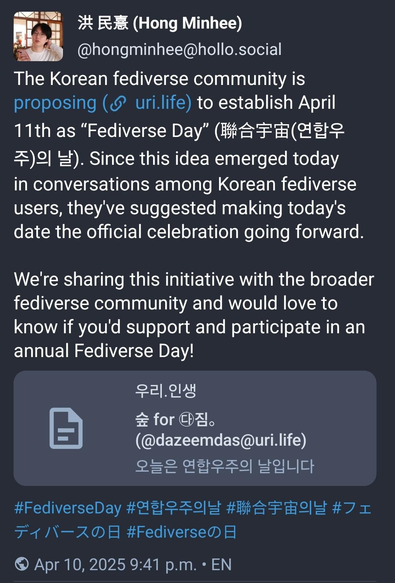
The Korean fediverse community is proposing to establish April 11th as “Fediverse Day” (聯合宇宙의 날). Since this idea emerged today in conversations among Korean fediverse users, they've suggested making today's date the official celebration going forward.
We're sharing this initiative with the broader fediverse community and would love to know if you'd support and participate in an annual Fediverse Day!