洪 民憙 (Hong Minhee) :nonbinary:'s avatar

洪 民憙 (Hong Minhee) :nonbinary:

@hongminhee@hollo.social

1,109 following1,902 followers

An intersectionalist, feminist, and socialist living in Seoul (UTC+09:00). @tokolovesme's spouse. Who's behind @fedify, @hollo, and @botkit. Write some free software in , , , & . They/them.

서울에 사는 交叉女性主義者이자 社會主義者. 金剛兔(@tokolovesme)의 配偶者. @fedify, @hollo, @botkit 메인테이너. , , , 等으로 自由 소프트웨어 만듦.

()

Pinned

@hongminhee@hollo.social

Hello! I'm Hong Minhee (洪 民憙), an open source software engineer in my late 30s, living in Seoul, Korea. I'm bisexual and non-binary (they/them), and an enthusiastic advocate of free/open source software and the fediverse.

I work full-time on @fedify, an ActivityPub server framework in TypeScript, funded by @sovtechfund. I'm also the creator of @hollo, a single-user ActivityPub microblog; @botkit, an ActivityPub bot framework; Hackers' Pub, a fediverse platform for software developers; and LogTape, a logging library for JavaScript and TypeScript.

I have a long interest in East Asian languages (CJK) and Unicode. I post mostly in English here, though occasionally in Japanese or in mixed-script Korean (國漢文混用體), a traditional writing style that interleaves Chinese characters with the native Korean alphabet. Wanting to write in that style was actually one of the reasons I joined the fediverse. Feel free to talk to me in English, Korean, Japanese, or even Literary Chinese!

en.wikipedia.org

Korean mixed script - Wikipedia

Pinned

はじめまして!ソウル在住の30代後半のオープンソースソフトウェアエンジニア、洪 民憙ホン・ミンヒと申します。バイセクシュアル(bisexual)・ノンバイナリー(non-binary)で、自由・オープンソースソフトウェア(F/OSS)とフェディバース(fediverse)の熱烈な支持者です。

STF(@sovtechfund)の支援を受け、TypeScript用ActivityPubサーバーフレームワーク「@fedify」の開発に専念しています。他にも、おひとり様向けのActivityPubマイクロブログ「@hollo」、ActivityPubボットフレームワーク「@botkit」、ソフトウェア開発者向けフェディバースプラットフォームHackers' Pub、JavaScript・TypeScript用ロギングライブラリLogTapeなどの制作者でもあります。

東アジア言語(いわゆるCJK)とUnicodeにも興味があります。このアカウントでは主に英語で投稿していますが、時々日本語や国漢文混用体(漢字ハングル混じり文)の韓国語でも書いています。実はこの文体で書きたくてフェディバースを始めた、という経緯もあります。日本語、英語、韓国語、漢文でも気軽に話しかけてください!

speakerdeck.com

国漢文混用体からHolloまで

本発表では、韓国語の「国漢文混用体」(漢字ハングル混じり文)を自分のフェディバース投稿に実装したいという小さな目標から始まった旅路を共有します。 この目標を達成するために、ActivityPubのJSON-LDの複雑さやHTTP Signatures、WebFingerなどの仕様を理解する必要性に…

Pinned

安寧(안녕)하세요! 저는 서울에 살고 있는 30() 後半(후반)의 오픈 소스 소프트웨어 엔지니어 洪民憙(홍민희)입니다. 兩性愛者(양성애자)(bisexual)이자 논바이너리(non-binary)이며, 自由(자유)·오픈 소스 소프트웨어(F/OSS)와 聯合宇宙(연합우주)(fediverse)의 熱烈(열렬)支持者(지지자)이기도 합니다.

STF(@sovtechfund)의 支援(지원)을 받아 TypeScript() ActivityPub 서버 프레임워크 @fedify 開發(개발)專業(전업)으로 ()하고 있습니다. 그 ()에도 싱글 유저() ActivityPub 마이크로블로그 @hollo, ActivityPub 봇 프레임워크 @botkit, 소프트웨어 開發者(개발자)를 위한 聯合宇宙(연합우주) 플랫폼 Hackers' Pub, JavaScript·TypeScript() 로깅 라이브러리 LogTape ()製作者(제작자)이기도 합니다.

()아시아 言語(언어)(이른바 CJK)와 Unicode에도 關心(관심)이 많습니다. 이 計定(계정)에서는 ()英語(영어)로 포스팅하지만, 때때로 日本語(일본어)國漢文混用體(국한문 혼용체) 韓國語(한국어)로도 씁니다. 聯合宇宙(연합우주)에 오게 된 動機(동기) () 하나가 바로 國漢文混用體(국한문 혼용체)로 글을 쓰고 싶었기 때문이기도 하고요. 韓國語(한국어), 英語(영어), 日本語(일본어), 아니면 漢文(한문)으로도 말을 걸어주세요!

logtape.org

LogTape

Unobtrusive logging library with zero dependencies—library-first design for Deno, Node.js, Bun, browsers, and edge functions

@linear@hackers.pub

오늘의 일기

  • hackers.pub 첫 포스트!
  • 첫 수영 수업을 다녀왔다. 전날 밤에 악몽 꿀 정도로 긴장했는데 다행히 가서 음파음파 잘 하고 왔다. (..)
  • SNS 여러 개는 도저히 못 쓰겠다는 결론을 내리고 블루스카이 탈퇴.
  • 스마트폰 사용 시간을 줄이기 위해 디스플레이를 흑백으로 바꿨다.
  • 과연 올해야말로 블로그 대통합을 이룰 수 있을 것인가? 네이버 블로그에 쌓여 있는 글을 모두 나만의 정적 웹사이트로 옮기고 애매하게 둥둥 떠 있는 github pages 는 없애는 게 목표.

Got an interesting question today about 's outgoing design!

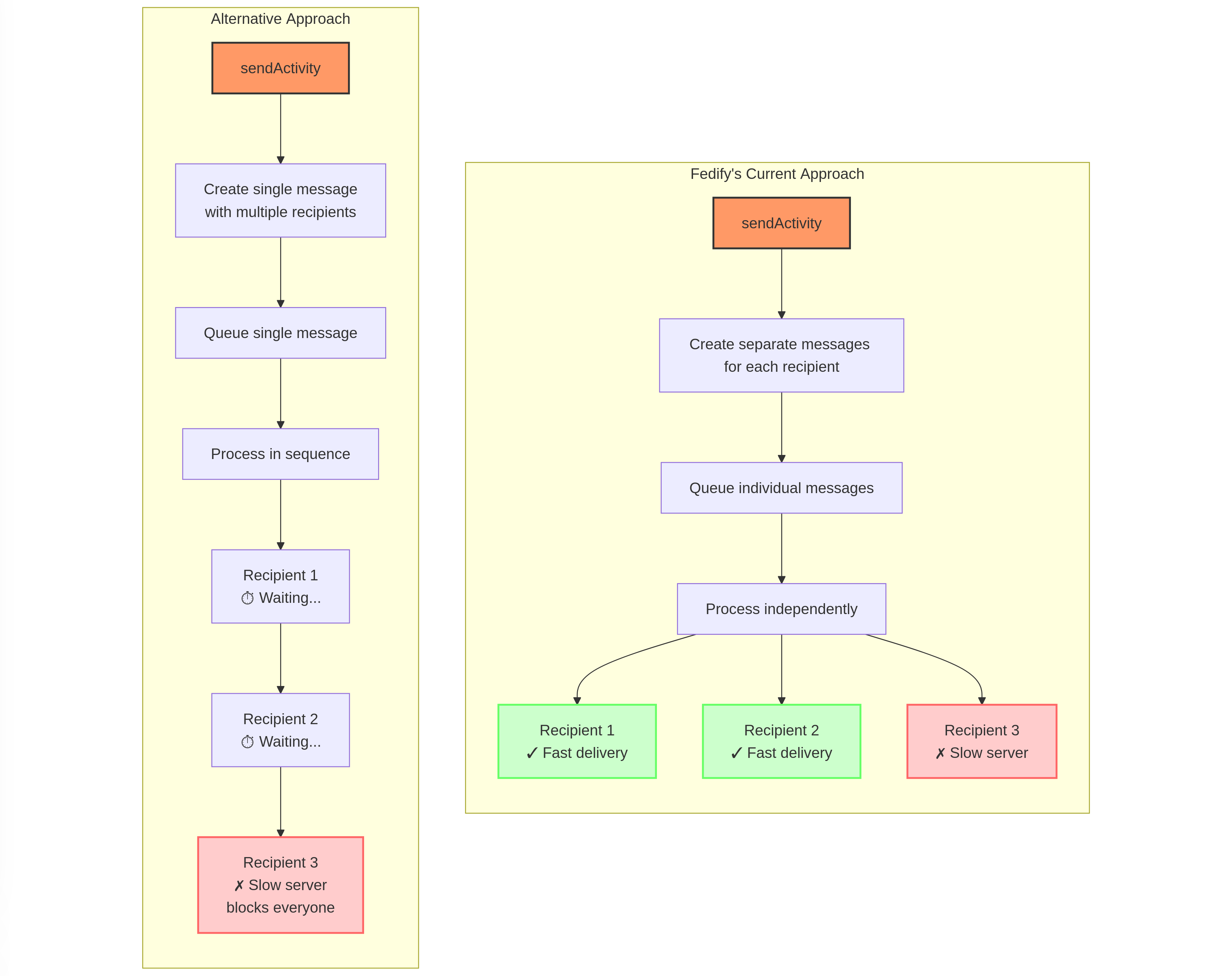
Some users noticed we create separate queue messages for each recipient inbox rather than queuing a single message and handling the splitting later. There's a good reason for this approach.

In the , server response times vary dramatically—some respond quickly, others slowly, and some might be temporarily down. If we processed deliveries in a single task, the entire batch would be held up by the slowest server in the group.

By creating individual queue items for each recipient:

  • Fast servers get messages delivered promptly
  • Slow servers don't delay delivery to others
  • Failed deliveries can be retried independently
  • Your UI remains responsive while deliveries happen in the background

It's a classic trade-off: we generate more queue messages, but gain better resilience and user experience in return.

This is particularly important in federated networks where server behavior is unpredictable and outside our control. We'd rather optimize for making sure your posts reach their destinations as quickly as possible!

What other aspects of Fedify's design would you like to hear about? Let us know!

A flowchart comparing two approaches to message queue design. The top half shows “Fedify's Current Approach” where a single sendActivity call creates separate messages for each recipient, which are individually queued and processed independently. This results in fast delivery to working recipients while slow servers only affect their own delivery. The bottom half shows an “Alternative Approach” where sendActivity creates a single message with multiple recipients, queued as one item, and processed sequentially. This results in all recipients waiting for each delivery to complete, with slow servers blocking everyone in the queue.
ALT text

A flowchart comparing two approaches to message queue design. The top half shows “Fedify's Current Approach” where a single sendActivity call creates separate messages for each recipient, which are individually queued and processed independently. This results in fast delivery to working recipients while slow servers only affect their own delivery. The bottom half shows an “Alternative Approach” where sendActivity creates a single message with multiple recipients, queued as one item, and processed sequentially. This results in all recipients waiting for each delivery to complete, with slow servers blocking everyone in the queue.

@mdn@mastodon.social

블스하는분들 https://bsky.app/profile/ap.brid.gy 이계정 살포시 팔로만 해주시면 저같이 변방에서 마스토돈 미스키하는 사람들도 여러분의 잼얘를 볼수가 있습니다

변방의 연합우주 유저를 위해 널리널리퍼뜨려주세요

bsky.app

Bridgy Fed for the fediverse (@ap.brid.gy)

Bridgy Fed (https://fed.brid.gy/) bot user for the fediverse. To bridge your Bluesky account to the fediverse, follow this account. To ask a fediverse user to bridge their account, send their address (eg @user@instance) to this account in a chat message.…

바에서 나치를 내쫓지 않으면 나치 바가 된다는 말이 있는데 남성사회도 그렇다. 남자한테는 해가 되지 않는다는 이유로 여성혐오 내뿜는 한심한 남자들을 그냥 방치한 결과가 온갖 여성혐오로 물든 나치바 남성사회인 것이다. 남성에 대한 일반화고 자시고 불평을 할 게 아니라 있는 힘껏 바에서 나치를 몰아내야 한다.

@hongminhee@hollo.social

日本語では【放棄】も【抛棄】も同じ「ほうき」という読み方なので、区別せずに使う事が多い様に思う。しかし、韓国語ではそれぞれ【放棄パンギ】と【抛棄ポギ】で読み方が違う為、ニュアンスを区別して使う。【放棄】は義務が有るにも係わらず見捨てたり、出来るにも係わらず面倒で見捨てたりするニュアンスが強く、【抛棄】はどうしても見捨てるしかなくて断念するというニュアンスが強い。

https://hollo.social/@hongminhee/01957f56-9cdb-7f73-9b10-4bf38493b73f

hollo.social

아무래도 Hackers' Pub을 개밥먹기 하려면 @h…

아무래도 Hackers' Pub을 개밥먹기 하려면 @hongminhee@hackers.pub 쪽을 메인 어카운트로 써야할 것 같은데, 이쪽도 이쪽대로 Hollo를 개밥먹기 하기 爲해 쓰고 있어서 둘 다 抛棄할 수 없다… 😇

@hongminhee@hollo.social

아무래도 Hackers' Pub을 개밥먹기 하려면 @hongminhee 쪽을 메인 어카운트로 써야할 것 같은데, 이쪽도 이쪽대로 Hollo를 개밥먹기 하기 ()해 쓰고 있어서 둘 다 抛棄(포기)할 수 없다… 😇

@hongminhee@hollo.social

아무래도 Hackers' Pub을 개밥먹기 하려면 @hongminhee 쪽을 메인 어카운트로 써야할 것 같은데, 이쪽도 이쪽대로 Hollo를 개밥먹기 하기 ()해 쓰고 있어서 둘 다 抛棄(포기)할 수 없다… 😇

@sanityinc@hachyderm.io · Reply to 洪 民憙 (Hong Minhee) :nonbinary:

@hongminhee Agree with most of this, but it's slightly unfair to compare the syntaxes, when "let*" in ocaml can make it look closer to Haskell's "do" blocks. After all, "do" is simply (a nice) syntactic sugar for those same chained binds and lambdas, and you could write the Haskell in that style too. Fwiw, I've gone in the other direction over time, from Haskell to Ocaml, partly because the typeclasses make type inference harder and the resulting compiler errors so much less clear.

@hboon@mastodon.social · Reply to Hwee-Boon Yar

@cheeaun @hongminhee ...Both of them are game-changers, but Claude Code is agentic and the UI is much more polished. I plan to use it much more, but it's going to be quite expensive— I imagine at least 100 to a few hundreds a month.

@hboon@mastodon.social · Reply to Hwee-Boon Yar

@cheeaun @hongminhee
When I started out, I tried running both tasks in both Aider and Claude Code and the latter is often at least 2x more expensive but it usually does what I want it to do and when it doesn't, I don't spend too much trying to convince it; I manually fix it instead. It also seems to know better what tools I use or my preferences compared to Aider despite using the same model.

@hboon@mastodon.social · Reply to Chee Aun 🤔

@cheeaun @hongminhee I've only tried Cursor a little because I tried VS Code a few times over the years but I couldn't get into it and hence Cursor (due to vim), so I can't compare it directly to Cursor.

I used aider.chat (with 3.7 Sonnet) with Neovim and WebStorm. It has a composer-ish (but not agentic) and cmd-K like modes. I have started using Claude Code much more recently and it has replaced the composer part of my workflow, but I still use Aider for the cmd-K part.

aider.chat

Home

aider is AI pair programming in your terminal

@dai@hackers.pub

@hongminhee さんに招待をいただきました。よろしくです。

@geeknews_bot@sns.lemondouble.com

하스켈과 OCaml의 모나드 접근 방식 비교
------------------------------
## Haskell의 모나드: 우아한 추상화
- 모나드는 단순히
Promise와 유사한 개념이 아닌 강력한 추상화 도구
-
Monad 타입클래스를 통해 다양한 컨텍스트(Maybe, [], IO, State)에서 코드 재사용
- 제네릭 함수(예:
sequence, mapM)가 모든 모나드에서 활용 가능
-
do 표기법으로 가독성 높은…
------------------------------
https://news.hada.io/topic?id=19664&utm_source=googlechat&utm_medium=bot&utm_campaign=1834

news.hada.io

하스켈과 OCaml의 모나드 접근 방식 비교 | GeekNews

Haskell의 모나드: 우아한 추상화모나드는 단순히 Promise와 유사한 개념이 아닌 강력한 추상화 도구Monad 타입클래스를 통해 다양한 컨텍스트(Maybe, [], IO, State)에서 코드 재사용제네릭 함수(예: sequence, mapM)가 모든 모나드에서 활용 가능do 표기법으로 가독성 높은 코드 작성 가능하나의 패턴으로 다양한 계산 맥락을

またまた世界にモナドの解説が増えてしまいました。😅 今回はHaskellとOCamlのアプローチを比較して、型クラスがどれだけ重要な違いを齎すかに就いて書いてみました。JavaScriptのPromiseと比べる譬えは半分しか真実を語っていないんですよね…

https://hackers.pub/@hongminhee/2025/monads

hackers.pub

Monads: Beyond Simple Analogies—Reflections on Functional Programming Paradigms

While exploring functional programming languages, I've been reflecting on how different communities approach similar concepts. One pattern that seems particularly fascinating is how Haskell and OCaml communities differ in their embrace of monads as an abstraction tool. The Elegant Power of Monads in Haskell It's common to hear monads explained through analogies to concepts like JavaScript's Promise or jQuery chains. While these comparisons provide an entry point, they might miss what makes monads truly beautiful and powerful in Haskell's ecosystem. The real strength appears to lie in the Monad typeclass itself. This elegant abstraction allows for creating generic functions and types that work with any type that shares the monad property. This seems to offer a profound unification of concepts that might initially appear unrelated: You can write code once that works across many contexts (Maybe, [], IO, State, etc.) Generic functions like sequence, mapM, and others become available across all monadic types The same patterns and mental models apply consistently across different computational contexts For example, a simple conditional function like this works beautifully in any monadic context: whenM :: Monad m => m Bool -> m () -> m () whenM condition action = do result <- condition if result then action else return () Whether dealing with potentially missing values, asynchronous operations, or state transformations, the same function can be employed without modification. There's something genuinely satisfying about this level of abstraction and reuse. OCaml's Different Approach Interestingly, the OCaml community seems less enthusiastic about monads as a primary abstraction tool. This might stem from several factors related to language design: Structural Differences OCaml lacks built-in typeclass support, relying instead on its module system and functors. While powerful in its own right, this approach might not make monad abstractions feel as natural or convenient: (* OCaml monad implementation requires more boilerplate *) module type MONAD = sig type 'a t val return : 'a -> 'a t val bind : 'a t -> ('a -> 'b t) -> 'b t end module OptionMonad : MONAD with type 'a t = 'a option = struct type 'a t = 'a option let return x = Some x let bind m f = match m with | None -> None | Some x -> f x end OCaml also doesn't offer syntactic sugar like Haskell's do notation, which makes monadic code in Haskell considerably more readable and expressive: -- Haskell's elegant do notation userInfo = do name <- getLine age <- readLn return (name, age) Compared to the more verbose OCaml equivalent: let user_info = get_line >>= fun name -> read_ln >>= fun age -> return (name, age) The readability difference becomes even more pronounced in more complex monadic operations. Philosophical Differences Beyond syntax, the languages differ in their fundamental approach to effects: Haskell is purely functional, making monads essential for managing effects in a principled way OCaml permits direct side effects, often making monadic abstractions optional This allows OCaml programmers to write more direct code when appropriate: (* Direct style in OCaml *) let get_user_info () = print_string "Name: "; let name = read_line () in print_string "Age: "; let age = int_of_string (read_line ()) in (name, age) OCaml's approach might favor pragmatism and directness in many cases, with programmers often preferring: Direct use of option and result types Module-level abstractions through functors Continuation-passing style when needed While this directness can be beneficial for immediate readability, it might come at the cost of some of the elegant uniformity that Haskell's monadic approach provides. Reflections on Language Design These differences highlight how programming language design shapes the idioms and patterns that emerge within their communities. Neither approach is objectively superior—they represent different philosophies about abstraction, explicitness, and the role of the type system. Haskell's approach encourages a high level of abstraction and consistency across different computational contexts, which can feel particularly satisfying when working with complex, interconnected systems. There's something intellectually pleasing about solving a problem once and having that solution generalize across many contexts. OCaml often favors more direct solutions that might be easier to reason about locally, though potentially at the cost of less uniformity across the codebase. This approach has its own virtues, particularly for systems where immediate comprehensibility is paramount. After working with both paradigms, I find myself drawn to the consistent abstractions that Haskell's approach provides, while still appreciating the pragmatic clarity that OCaml can offer in certain situations. The typeclasses and syntactic support in Haskell seem to unlock a particularly elegant way of structuring code that, while perhaps requiring a steeper initial learning curve, offers a uniquely satisfying programming experience. What patterns have you noticed in how different programming language communities approach similar problems? And have you found yourself drawn to the elegant abstractions of Haskell or the pragmatic approach of OCaml?


@hongminhee@hackers.pub

While exploring functional programming languages, I've been reflecting on how different communities approach similar concepts. One pattern that seems particularly fascinating is how Haskell and OCaml communities differ in their embrace of monads as an abstraction tool.

The Elegant Power of Monads in Haskell

It's common to hear monads explained through analogies to concepts like JavaScript's Promise or jQuery chains. While these comparisons provide an entry point, they might miss what makes monads truly beautiful and powerful in Haskell's ecosystem.

The real strength appears to lie in the Monad typeclass itself. This elegant abstraction allows for creating generic functions and types that work with any type that shares the monad property. This seems to offer a profound unification of concepts that might initially appear unrelated:

  • You can write code once that works across many contexts (Maybe, [], IO, State, etc.)
  • Generic functions like sequence, mapM, and others become available across all monadic types
  • The same patterns and mental models apply consistently across different computational contexts

For example, a simple conditional function like this works beautifully in any monadic context:

whenM :: Monad m => m Bool -> m () -> m ()
whenM condition action = do
  result <- condition
  if result then action else return ()

Whether dealing with potentially missing values, asynchronous operations, or state transformations, the same function can be employed without modification. There's something genuinely satisfying about this level of abstraction and reuse.

OCaml's Different Approach

Interestingly, the OCaml community seems less enthusiastic about monads as a primary abstraction tool. This might stem from several factors related to language design:

Structural Differences

OCaml lacks built-in typeclass support, relying instead on its module system and functors. While powerful in its own right, this approach might not make monad abstractions feel as natural or convenient:

(* OCaml monad implementation requires more boilerplate *)
module type MONAD = sig
  type 'a t
  val return : 'a -> 'a t
  val bind : 'a t -> ('a -> 'b t) -> 'b t
end

module OptionMonad : MONAD with type 'a t = 'a option = struct
  type 'a t = 'a option
  let return x = Some x
  let bind m f = match m with
    | None -> None
    | Some x -> f x
end

OCaml also doesn't offer syntactic sugar like Haskell's do notation, which makes monadic code in Haskell considerably more readable and expressive:

-- Haskell's elegant do notation
userInfo = do
  name <- getLine
  age <- readLn
  return (name, age)

Compared to the more verbose OCaml equivalent:

let user_info =
  get_line >>= fun name ->
  read_ln >>= fun age ->
  return (name, age)

The readability difference becomes even more pronounced in more complex monadic operations.

Philosophical Differences

Beyond syntax, the languages differ in their fundamental approach to effects:

  • Haskell is purely functional, making monads essential for managing effects in a principled way
  • OCaml permits direct side effects, often making monadic abstractions optional

This allows OCaml programmers to write more direct code when appropriate:

(* Direct style in OCaml *)
let get_user_info () =
  print_string "Name: ";
  let name = read_line () in
  print_string "Age: ";
  let age = int_of_string (read_line ()) in
  (name, age)

OCaml's approach might favor pragmatism and directness in many cases, with programmers often preferring:

  • Direct use of option and result types
  • Module-level abstractions through functors
  • Continuation-passing style when needed

While this directness can be beneficial for immediate readability, it might come at the cost of some of the elegant uniformity that Haskell's monadic approach provides.

Reflections on Language Design

These differences highlight how programming language design shapes the idioms and patterns that emerge within their communities. Neither approach is objectively superior—they represent different philosophies about abstraction, explicitness, and the role of the type system.

Haskell's approach encourages a high level of abstraction and consistency across different computational contexts, which can feel particularly satisfying when working with complex, interconnected systems. There's something intellectually pleasing about solving a problem once and having that solution generalize across many contexts.

OCaml often favors more direct solutions that might be easier to reason about locally, though potentially at the cost of less uniformity across the codebase. This approach has its own virtues, particularly for systems where immediate comprehensibility is paramount.

After working with both paradigms, I find myself drawn to the consistent abstractions that Haskell's approach provides, while still appreciating the pragmatic clarity that OCaml can offer in certain situations. The typeclasses and syntactic support in Haskell seem to unlock a particularly elegant way of structuring code that, while perhaps requiring a steeper initial learning curve, offers a uniquely satisfying programming experience.

What patterns have you noticed in how different programming language communities approach similar problems? And have you found yourself drawn to the elegant abstractions of Haskell or the pragmatic approach of OCaml?

世上(세상)에 또 하나의 모나드 글을 追加(추가)해 버렸습니다. 😂 그런데 이제 Haskell과 OCaml의 어프로치를 比較(비교)하여 타입클래스가 어떻게 두 言語(언어)의 패턴을 다르게 만들었는지 說明(설명)을 곁들인…

https://hackers.pub/@hongminhee/2025/monads

hackers.pub

Monads: Beyond Simple Analogies—Reflections on Functional Programming Paradigms

While exploring functional programming languages, I've been reflecting on how different communities approach similar concepts. One pattern that seems particularly fascinating is how Haskell and OCaml communities differ in their embrace of monads as an abstraction tool. The Elegant Power of Monads in Haskell It's common to hear monads explained through analogies to concepts like JavaScript's Promise or jQuery chains. While these comparisons provide an entry point, they might miss what makes monads truly beautiful and powerful in Haskell's ecosystem. The real strength appears to lie in the Monad typeclass itself. This elegant abstraction allows for creating generic functions and types that work with any type that shares the monad property. This seems to offer a profound unification of concepts that might initially appear unrelated: You can write code once that works across many contexts (Maybe, [], IO, State, etc.) Generic functions like sequence, mapM, and others become available across all monadic types The same patterns and mental models apply consistently across different computational contexts For example, a simple conditional function like this works beautifully in any monadic context: whenM :: Monad m => m Bool -> m () -> m () whenM condition action = do result <- condition if result then action else return () Whether dealing with potentially missing values, asynchronous operations, or state transformations, the same function can be employed without modification. There's something genuinely satisfying about this level of abstraction and reuse. OCaml's Different Approach Interestingly, the OCaml community seems less enthusiastic about monads as a primary abstraction tool. This might stem from several factors related to language design: Structural Differences OCaml lacks built-in typeclass support, relying instead on its module system and functors. While powerful in its own right, this approach might not make monad abstractions feel as natural or convenient: (* OCaml monad implementation requires more boilerplate *) module type MONAD = sig type 'a t val return : 'a -> 'a t val bind : 'a t -> ('a -> 'b t) -> 'b t end module OptionMonad : MONAD with type 'a t = 'a option = struct type 'a t = 'a option let return x = Some x let bind m f = match m with | None -> None | Some x -> f x end OCaml also doesn't offer syntactic sugar like Haskell's do notation, which makes monadic code in Haskell considerably more readable and expressive: -- Haskell's elegant do notation userInfo = do name <- getLine age <- readLn return (name, age) Compared to the more verbose OCaml equivalent: let user_info = get_line >>= fun name -> read_ln >>= fun age -> return (name, age) The readability difference becomes even more pronounced in more complex monadic operations. Philosophical Differences Beyond syntax, the languages differ in their fundamental approach to effects: Haskell is purely functional, making monads essential for managing effects in a principled way OCaml permits direct side effects, often making monadic abstractions optional This allows OCaml programmers to write more direct code when appropriate: (* Direct style in OCaml *) let get_user_info () = print_string "Name: "; let name = read_line () in print_string "Age: "; let age = int_of_string (read_line ()) in (name, age) OCaml's approach might favor pragmatism and directness in many cases, with programmers often preferring: Direct use of option and result types Module-level abstractions through functors Continuation-passing style when needed While this directness can be beneficial for immediate readability, it might come at the cost of some of the elegant uniformity that Haskell's monadic approach provides. Reflections on Language Design These differences highlight how programming language design shapes the idioms and patterns that emerge within their communities. Neither approach is objectively superior—they represent different philosophies about abstraction, explicitness, and the role of the type system. Haskell's approach encourages a high level of abstraction and consistency across different computational contexts, which can feel particularly satisfying when working with complex, interconnected systems. There's something intellectually pleasing about solving a problem once and having that solution generalize across many contexts. OCaml often favors more direct solutions that might be easier to reason about locally, though potentially at the cost of less uniformity across the codebase. This approach has its own virtues, particularly for systems where immediate comprehensibility is paramount. After working with both paradigms, I find myself drawn to the consistent abstractions that Haskell's approach provides, while still appreciating the pragmatic clarity that OCaml can offer in certain situations. The typeclasses and syntactic support in Haskell seem to unlock a particularly elegant way of structuring code that, while perhaps requiring a steeper initial learning curve, offers a uniquely satisfying programming experience. What patterns have you noticed in how different programming language communities approach similar problems? And have you found yourself drawn to the elegant abstractions of Haskell or the pragmatic approach of OCaml?

@hongminhee@hackers.pub

While exploring functional programming languages, I've been reflecting on how different communities approach similar concepts. One pattern that seems particularly fascinating is how Haskell and OCaml communities differ in their embrace of monads as an abstraction tool.

The Elegant Power of Monads in Haskell

It's common to hear monads explained through analogies to concepts like JavaScript's Promise or jQuery chains. While these comparisons provide an entry point, they might miss what makes monads truly beautiful and powerful in Haskell's ecosystem.

The real strength appears to lie in the Monad typeclass itself. This elegant abstraction allows for creating generic functions and types that work with any type that shares the monad property. This seems to offer a profound unification of concepts that might initially appear unrelated:

  • You can write code once that works across many contexts (Maybe, [], IO, State, etc.)
  • Generic functions like sequence, mapM, and others become available across all monadic types
  • The same patterns and mental models apply consistently across different computational contexts

For example, a simple conditional function like this works beautifully in any monadic context:

whenM :: Monad m => m Bool -> m () -> m ()
whenM condition action = do
  result <- condition
  if result then action else return ()

Whether dealing with potentially missing values, asynchronous operations, or state transformations, the same function can be employed without modification. There's something genuinely satisfying about this level of abstraction and reuse.

OCaml's Different Approach

Interestingly, the OCaml community seems less enthusiastic about monads as a primary abstraction tool. This might stem from several factors related to language design:

Structural Differences

OCaml lacks built-in typeclass support, relying instead on its module system and functors. While powerful in its own right, this approach might not make monad abstractions feel as natural or convenient:

(* OCaml monad implementation requires more boilerplate *)
module type MONAD = sig
  type 'a t
  val return : 'a -> 'a t
  val bind : 'a t -> ('a -> 'b t) -> 'b t
end

module OptionMonad : MONAD with type 'a t = 'a option = struct
  type 'a t = 'a option
  let return x = Some x
  let bind m f = match m with
    | None -> None
    | Some x -> f x
end

OCaml also doesn't offer syntactic sugar like Haskell's do notation, which makes monadic code in Haskell considerably more readable and expressive:

-- Haskell's elegant do notation
userInfo = do
  name <- getLine
  age <- readLn
  return (name, age)

Compared to the more verbose OCaml equivalent:

let user_info =
  get_line >>= fun name ->
  read_ln >>= fun age ->
  return (name, age)

The readability difference becomes even more pronounced in more complex monadic operations.

Philosophical Differences

Beyond syntax, the languages differ in their fundamental approach to effects:

  • Haskell is purely functional, making monads essential for managing effects in a principled way
  • OCaml permits direct side effects, often making monadic abstractions optional

This allows OCaml programmers to write more direct code when appropriate:

(* Direct style in OCaml *)
let get_user_info () =
  print_string "Name: ";
  let name = read_line () in
  print_string "Age: ";
  let age = int_of_string (read_line ()) in
  (name, age)

OCaml's approach might favor pragmatism and directness in many cases, with programmers often preferring:

  • Direct use of option and result types
  • Module-level abstractions through functors
  • Continuation-passing style when needed

While this directness can be beneficial for immediate readability, it might come at the cost of some of the elegant uniformity that Haskell's monadic approach provides.

Reflections on Language Design

These differences highlight how programming language design shapes the idioms and patterns that emerge within their communities. Neither approach is objectively superior—they represent different philosophies about abstraction, explicitness, and the role of the type system.

Haskell's approach encourages a high level of abstraction and consistency across different computational contexts, which can feel particularly satisfying when working with complex, interconnected systems. There's something intellectually pleasing about solving a problem once and having that solution generalize across many contexts.

OCaml often favors more direct solutions that might be easier to reason about locally, though potentially at the cost of less uniformity across the codebase. This approach has its own virtues, particularly for systems where immediate comprehensibility is paramount.

After working with both paradigms, I find myself drawn to the consistent abstractions that Haskell's approach provides, while still appreciating the pragmatic clarity that OCaml can offer in certain situations. The typeclasses and syntactic support in Haskell seem to unlock a particularly elegant way of structuring code that, while perhaps requiring a steeper initial learning curve, offers a uniquely satisfying programming experience.

What patterns have you noticed in how different programming language communities approach similar problems? And have you found yourself drawn to the elegant abstractions of Haskell or the pragmatic approach of OCaml?
@hongminhee@hollo.social

Just what the internet needed: another attempt to explain ! 🙄 But this time I'm comparing and approaches to show why make all the difference. Turns out those JavaScript Promise analogies only tell half the story…

https://hackers.pub/@hongminhee/2025/monads

hackers.pub

Monads: Beyond Simple Analogies—Reflections on Functional Programming Paradigms

While exploring functional programming languages, I've been reflecting on how different communities approach similar concepts. One pattern that seems particularly fascinating is how Haskell and OCaml communities differ in their embrace of monads as an abstraction tool. The Elegant Power of Monads in Haskell It's common to hear monads explained through analogies to concepts like JavaScript's Promise or jQuery chains. While these comparisons provide an entry point, they might miss what makes monads truly beautiful and powerful in Haskell's ecosystem. The real strength appears to lie in the Monad typeclass itself. This elegant abstraction allows for creating generic functions and types that work with any type that shares the monad property. This seems to offer a profound unification of concepts that might initially appear unrelated: You can write code once that works across many contexts (Maybe, [], IO, State, etc.) Generic functions like sequence, mapM, and others become available across all monadic types The same patterns and mental models apply consistently across different computational contexts For example, a simple conditional function like this works beautifully in any monadic context: whenM :: Monad m => m Bool -> m () -> m () whenM condition action = do result <- condition if result then action else return () Whether dealing with potentially missing values, asynchronous operations, or state transformations, the same function can be employed without modification. There's something genuinely satisfying about this level of abstraction and reuse. OCaml's Different Approach Interestingly, the OCaml community seems less enthusiastic about monads as a primary abstraction tool. This might stem from several factors related to language design: Structural Differences OCaml lacks built-in typeclass support, relying instead on its module system and functors. While powerful in its own right, this approach might not make monad abstractions feel as natural or convenient: (* OCaml monad implementation requires more boilerplate *) module type MONAD = sig type 'a t val return : 'a -> 'a t val bind : 'a t -> ('a -> 'b t) -> 'b t end module OptionMonad : MONAD with type 'a t = 'a option = struct type 'a t = 'a option let return x = Some x let bind m f = match m with | None -> None | Some x -> f x end OCaml also doesn't offer syntactic sugar like Haskell's do notation, which makes monadic code in Haskell considerably more readable and expressive: -- Haskell's elegant do notation userInfo = do name <- getLine age <- readLn return (name, age) Compared to the more verbose OCaml equivalent: let user_info = get_line >>= fun name -> read_ln >>= fun age -> return (name, age) The readability difference becomes even more pronounced in more complex monadic operations. Philosophical Differences Beyond syntax, the languages differ in their fundamental approach to effects: Haskell is purely functional, making monads essential for managing effects in a principled way OCaml permits direct side effects, often making monadic abstractions optional This allows OCaml programmers to write more direct code when appropriate: (* Direct style in OCaml *) let get_user_info () = print_string "Name: "; let name = read_line () in print_string "Age: "; let age = int_of_string (read_line ()) in (name, age) OCaml's approach might favor pragmatism and directness in many cases, with programmers often preferring: Direct use of option and result types Module-level abstractions through functors Continuation-passing style when needed While this directness can be beneficial for immediate readability, it might come at the cost of some of the elegant uniformity that Haskell's monadic approach provides. Reflections on Language Design These differences highlight how programming language design shapes the idioms and patterns that emerge within their communities. Neither approach is objectively superior—they represent different philosophies about abstraction, explicitness, and the role of the type system. Haskell's approach encourages a high level of abstraction and consistency across different computational contexts, which can feel particularly satisfying when working with complex, interconnected systems. There's something intellectually pleasing about solving a problem once and having that solution generalize across many contexts. OCaml often favors more direct solutions that might be easier to reason about locally, though potentially at the cost of less uniformity across the codebase. This approach has its own virtues, particularly for systems where immediate comprehensibility is paramount. After working with both paradigms, I find myself drawn to the consistent abstractions that Haskell's approach provides, while still appreciating the pragmatic clarity that OCaml can offer in certain situations. The typeclasses and syntactic support in Haskell seem to unlock a particularly elegant way of structuring code that, while perhaps requiring a steeper initial learning curve, offers a uniquely satisfying programming experience. What patterns have you noticed in how different programming language communities approach similar problems? And have you found yourself drawn to the elegant abstractions of Haskell or the pragmatic approach of OCaml?
@hongminhee@hackers.pub

While exploring functional programming languages, I've been reflecting on how different communities approach similar concepts. One pattern that seems particularly fascinating is how Haskell and OCaml communities differ in their embrace of monads as an abstraction tool.

The Elegant Power of Monads in Haskell

It's common to hear monads explained through analogies to concepts like JavaScript's Promise or jQuery chains. While these comparisons provide an entry point, they might miss what makes monads truly beautiful and powerful in Haskell's ecosystem.

The real strength appears to lie in the Monad typeclass itself. This elegant abstraction allows for creating generic functions and types that work with any type that shares the monad property. This seems to offer a profound unification of concepts that might initially appear unrelated:

  • You can write code once that works across many contexts (Maybe, [], IO, State, etc.)
  • Generic functions like sequence, mapM, and others become available across all monadic types
  • The same patterns and mental models apply consistently across different computational contexts

For example, a simple conditional function like this works beautifully in any monadic context:

whenM :: Monad m => m Bool -> m () -> m ()
whenM condition action = do
  result <- condition
  if result then action else return ()

Whether dealing with potentially missing values, asynchronous operations, or state transformations, the same function can be employed without modification. There's something genuinely satisfying about this level of abstraction and reuse.

OCaml's Different Approach

Interestingly, the OCaml community seems less enthusiastic about monads as a primary abstraction tool. This might stem from several factors related to language design:

Structural Differences

OCaml lacks built-in typeclass support, relying instead on its module system and functors. While powerful in its own right, this approach might not make monad abstractions feel as natural or convenient:

(* OCaml monad implementation requires more boilerplate *)
module type MONAD = sig
  type 'a t
  val return : 'a -> 'a t
  val bind : 'a t -> ('a -> 'b t) -> 'b t
end

module OptionMonad : MONAD with type 'a t = 'a option = struct
  type 'a t = 'a option
  let return x = Some x
  let bind m f = match m with
    | None -> None
    | Some x -> f x
end

OCaml also doesn't offer syntactic sugar like Haskell's do notation, which makes monadic code in Haskell considerably more readable and expressive:

-- Haskell's elegant do notation
userInfo = do
  name <- getLine
  age <- readLn
  return (name, age)

Compared to the more verbose OCaml equivalent:

let user_info =
  get_line >>= fun name ->
  read_ln >>= fun age ->
  return (name, age)

The readability difference becomes even more pronounced in more complex monadic operations.

Philosophical Differences

Beyond syntax, the languages differ in their fundamental approach to effects:

  • Haskell is purely functional, making monads essential for managing effects in a principled way
  • OCaml permits direct side effects, often making monadic abstractions optional

This allows OCaml programmers to write more direct code when appropriate:

(* Direct style in OCaml *)
let get_user_info () =
  print_string "Name: ";
  let name = read_line () in
  print_string "Age: ";
  let age = int_of_string (read_line ()) in
  (name, age)

OCaml's approach might favor pragmatism and directness in many cases, with programmers often preferring:

  • Direct use of option and result types
  • Module-level abstractions through functors
  • Continuation-passing style when needed

While this directness can be beneficial for immediate readability, it might come at the cost of some of the elegant uniformity that Haskell's monadic approach provides.

Reflections on Language Design

These differences highlight how programming language design shapes the idioms and patterns that emerge within their communities. Neither approach is objectively superior—they represent different philosophies about abstraction, explicitness, and the role of the type system.

Haskell's approach encourages a high level of abstraction and consistency across different computational contexts, which can feel particularly satisfying when working with complex, interconnected systems. There's something intellectually pleasing about solving a problem once and having that solution generalize across many contexts.

OCaml often favors more direct solutions that might be easier to reason about locally, though potentially at the cost of less uniformity across the codebase. This approach has its own virtues, particularly for systems where immediate comprehensibility is paramount.

After working with both paradigms, I find myself drawn to the consistent abstractions that Haskell's approach provides, while still appreciating the pragmatic clarity that OCaml can offer in certain situations. The typeclasses and syntactic support in Haskell seem to unlock a particularly elegant way of structuring code that, while perhaps requiring a steeper initial learning curve, offers a uniquely satisfying programming experience.

What patterns have you noticed in how different programming language communities approach similar problems? And have you found yourself drawn to the elegant abstractions of Haskell or the pragmatic approach of OCaml?

@hongminhee@hackers.pub

While exploring functional programming languages, I've been reflecting on how different communities approach similar concepts. One pattern that seems particularly fascinating is how Haskell and OCaml communities differ in their embrace of monads as an abstraction tool.

The Elegant Power of Monads in Haskell

It's common to hear monads explained through analogies to concepts like JavaScript's Promise or jQuery chains. While these comparisons provide an entry point, they might miss what makes monads truly beautiful and powerful in Haskell's ecosystem.

The real strength appears to lie in the Monad typeclass itself. This elegant abstraction allows for creating generic functions and types that work with any type that shares the monad property. This seems to offer a profound unification of concepts that might initially appear unrelated:

  • You can write code once that works across many contexts (Maybe, [], IO, State, etc.)
  • Generic functions like sequence, mapM, and others become available across all monadic types
  • The same patterns and mental models apply consistently across different computational contexts

For example, a simple conditional function like this works beautifully in any monadic context:

whenM :: Monad m => m Bool -> m () -> m ()
whenM condition action = do
  result <- condition
  if result then action else return ()

Whether dealing with potentially missing values, asynchronous operations, or state transformations, the same function can be employed without modification. There's something genuinely satisfying about this level of abstraction and reuse.

OCaml's Different Approach

Interestingly, the OCaml community seems less enthusiastic about monads as a primary abstraction tool. This might stem from several factors related to language design:

Structural Differences

OCaml lacks built-in typeclass support, relying instead on its module system and functors. While powerful in its own right, this approach might not make monad abstractions feel as natural or convenient:

(* OCaml monad implementation requires more boilerplate *)
module type MONAD = sig
  type 'a t
  val return : 'a -> 'a t
  val bind : 'a t -> ('a -> 'b t) -> 'b t
end

module OptionMonad : MONAD with type 'a t = 'a option = struct
  type 'a t = 'a option
  let return x = Some x
  let bind m f = match m with
    | None -> None
    | Some x -> f x
end

OCaml also doesn't offer syntactic sugar like Haskell's do notation, which makes monadic code in Haskell considerably more readable and expressive:

-- Haskell's elegant do notation
userInfo = do
  name <- getLine
  age <- readLn
  return (name, age)

Compared to the more verbose OCaml equivalent:

let user_info =
  get_line >>= fun name ->
  read_ln >>= fun age ->
  return (name, age)

The readability difference becomes even more pronounced in more complex monadic operations.

Philosophical Differences

Beyond syntax, the languages differ in their fundamental approach to effects:

  • Haskell is purely functional, making monads essential for managing effects in a principled way
  • OCaml permits direct side effects, often making monadic abstractions optional

This allows OCaml programmers to write more direct code when appropriate:

(* Direct style in OCaml *)
let get_user_info () =
  print_string "Name: ";
  let name = read_line () in
  print_string "Age: ";
  let age = int_of_string (read_line ()) in
  (name, age)

OCaml's approach might favor pragmatism and directness in many cases, with programmers often preferring:

  • Direct use of option and result types
  • Module-level abstractions through functors
  • Continuation-passing style when needed

While this directness can be beneficial for immediate readability, it might come at the cost of some of the elegant uniformity that Haskell's monadic approach provides.

Reflections on Language Design

These differences highlight how programming language design shapes the idioms and patterns that emerge within their communities. Neither approach is objectively superior—they represent different philosophies about abstraction, explicitness, and the role of the type system.

Haskell's approach encourages a high level of abstraction and consistency across different computational contexts, which can feel particularly satisfying when working with complex, interconnected systems. There's something intellectually pleasing about solving a problem once and having that solution generalize across many contexts.

OCaml often favors more direct solutions that might be easier to reason about locally, though potentially at the cost of less uniformity across the codebase. This approach has its own virtues, particularly for systems where immediate comprehensibility is paramount.

After working with both paradigms, I find myself drawn to the consistent abstractions that Haskell's approach provides, while still appreciating the pragmatic clarity that OCaml can offer in certain situations. The typeclasses and syntactic support in Haskell seem to unlock a particularly elegant way of structuring code that, while perhaps requiring a steeper initial learning curve, offers a uniquely satisfying programming experience.

What patterns have you noticed in how different programming language communities approach similar problems? And have you found yourself drawn to the elegant abstractions of Haskell or the pragmatic approach of OCaml?

@hongminhee@hackers.pub · Reply to 洪 民憙 (Hong Minhee)

プロフィールページにフィルターを追加した。ノートだけを見たり、共有した物だけを見たり、記事だけを見たりする事が出来る。

Hackers' Pubのプロフィールページに新しく追加されたフィルターのタブ
ALT text

Hackers' Pubのプロフィールページに新しく追加されたフィルターのタブ