
Zef Hemel
@zef@social.zef.pub
A few notes on why #SilverBullet recently migrated from #Deno to #Node https://community.silverbullet.md/t/migrating-silverbullet-plugs-from-deno-to-node/3957/7?u=zef
@zef@social.zef.pub
A few notes on why #SilverBullet recently migrated from #Deno to #Node https://community.silverbullet.md/t/migrating-silverbullet-plugs-from-deno-to-node/3957/7?u=zef

@jobsfordevelopers@mastodon.world
Aircall is hiring Senior Software Engineer
🔧 #typescript #react #node #aws #seniorengineer
🌎 San Francisco, California
⏰ Full-time
🏢 Aircall
Job details https://jobsfordevelopers.com/jobs/senior-software-engineer-at-aircall-io-jan-29-2026-49a466?utm_source=mastodon.world&utm_medium=social&utm_campaign=posting
#jobalert #jobsearch #hiring
@jobsfordevelopers@mastodon.world
EcoCart is hiring Principal Software Engineer
🔧 #python #typescript #react #node #aws #principalengineer
🌎 Remote; San Francisco, California
⏰ Full-time
🏢 EcoCart
Job details https://jobsfordevelopers.com/jobs/principal-software-engineer-at-ecocart-apr-29-2024-ba7116?utm_source=mastodon.world&utm_medium=social&utm_campaign=posting
#jobalert #jobsearch #hiring
@jobsfordevelopers@mastodon.world
Discord is hiring Senior Software Engineer - Web Platform
🔧 #golang #javascript #kotlin #python #rust #swift #typescript #react #reactnative #node #cicd #seniorengineer
🌎 San Francisco, Bay Area
⏰ Full-time
🏢 Discord
Job details https://jobsfordevelopers.com/jobs/senior-software-engineer-web-platform-at-discord-com-feb-4-2026-f1df4b?utm_source=mastodon.world&utm_medium=social&utm_campaign=posting
#jobalert #jobsearch #hiring
@jobsfordevelopers@mastodon.world
Tipalti is hiring Senior Full-Stack Engineer
🔧 #javascript #typescript #react #node #rest #aws #mongodb #seniorengineer
🌎 London, United Kingdom
⏰ Full-time
🏢 Tipalti
Job details https://jobsfordevelopers.com/jobs/senior-full-stack-engineer-at-tipalti-com-mar-18-2026-8cfec6?utm_source=mastodon.world&utm_medium=social&utm_campaign=posting
#jobalert #jobsearch #hiring
@jobsfordevelopers@mastodon.world
Tipalti is hiring Senior Full-Stack Engineer
🔧 #javascript #typescript #react #node #rest #aws #mongodb #seniorengineer
🌎 London, United Kingdom
⏰ Full-time
🏢 Tipalti
Job details https://jobsfordevelopers.com/jobs/senior-full-stack-engineer-at-tipalti-com-mar-18-2026-8cfec6?utm_source=mastodon.world&utm_medium=social&utm_campaign=posting
#jobalert #jobsearch #hiring
@jobsfordevelopers@mastodon.world
Discord is hiring Senior Software Engineer - Web Platform
🔧 #golang #javascript #kotlin #python #rust #swift #typescript #react #reactnative #node #cicd #seniorengineer
🌎 San Francisco, Bay Area
⏰ Full-time
🏢 Discord
Job details https://jobsfordevelopers.com/jobs/senior-software-engineer-web-platform-at-discord-com-feb-4-2026-f1df4b?utm_source=mastodon.world&utm_medium=social&utm_campaign=posting
#jobalert #jobsearch #hiring
@jobsfordevelopers@mastodon.world
EcoCart is hiring Principal Software Engineer
🔧 #python #typescript #react #node #aws #principalengineer
🌎 Remote; San Francisco, California
⏰ Full-time
🏢 EcoCart
Job details https://jobsfordevelopers.com/jobs/principal-software-engineer-at-ecocart-apr-29-2024-ba7116?utm_source=mastodon.world&utm_medium=social&utm_campaign=posting
#jobalert #jobsearch #hiring
@jobsfordevelopers@mastodon.world
Aircall is hiring Senior Software Engineer
🔧 #typescript #react #node #aws #seniorengineer
🌎 San Francisco, California
⏰ Full-time
🏢 Aircall
Job details https://jobsfordevelopers.com/jobs/senior-software-engineer-at-aircall-io-jan-29-2026-49a466?utm_source=mastodon.world&utm_medium=social&utm_campaign=posting
#jobalert #jobsearch #hiring


@hongminhee@hollo.social
#Optique 1.0.0 is out! If you build #CLI tools with #TypeScript, it might be worth a look.
I started it because I wanted a TypeScript CLI parser that felt more like optparse-applicative than the usual builder-style APIs. You build up small typed parsers, compose them, and TypeScript infers the result. It handles subcommands, option dependencies, shell completion, and man pages, and it runs on #Deno, #Node.js, and #Bun.
For 1.0 I added @optique/env, so env vars can fill in missing flags, and @optique/inquirer, so missing values can fall back to Inquirer.js prompts. I also cleaned up a lot of awkward API edges and fixed a long backlog of completion bugs across five shells.
Packages are on JSR and npm.
@hongminhee@hollo.social
#Optique 1.0.0 is out! If you build #CLI tools with #TypeScript, it might be worth a look.
I started it because I wanted a TypeScript CLI parser that felt more like optparse-applicative than the usual builder-style APIs. You build up small typed parsers, compose them, and TypeScript infers the result. It handles subcommands, option dependencies, shell completion, and man pages, and it runs on #Deno, #Node.js, and #Bun.
For 1.0 I added @optique/env, so env vars can fill in missing flags, and @optique/inquirer, so missing values can fall back to Inquirer.js prompts. I also cleaned up a lot of awkward API edges and fixed a long backlog of completion bugs across five shells.
Packages are on JSR and npm.
@hongminhee@hollo.social
#Optique 1.0.0 is out! If you build #CLI tools with #TypeScript, it might be worth a look.
I started it because I wanted a TypeScript CLI parser that felt more like optparse-applicative than the usual builder-style APIs. You build up small typed parsers, compose them, and TypeScript infers the result. It handles subcommands, option dependencies, shell completion, and man pages, and it runs on #Deno, #Node.js, and #Bun.
For 1.0 I added @optique/env, so env vars can fill in missing flags, and @optique/inquirer, so missing values can fall back to Inquirer.js prompts. I also cleaned up a lot of awkward API edges and fixed a long backlog of completion bugs across five shells.
Packages are on JSR and npm.


@botkit@hollo.social
We're excited to announce the release of BotKit 0.3.0! This release marks a significant milestone as #BotKit now supports #Node.js alongside #Deno, making it accessible to a wider audience. The minimum required Node.js version is 22.0.0. This dual-runtime support means you can now choose your preferred #JavaScript runtime while building #ActivityPub #bots with the same powerful BotKit APIs.
One of the most requested features has landed: poll support! You can now create interactive polls in your #bot messages, allowing followers to vote on questions with single or multiple-choice options. Polls are represented as ActivityPub Question objects with proper expiration times, and your bot can react to votes through the new onVote event handler. This feature enhances engagement possibilities and brings BotKit to feature parity with major #fediverse platforms like Mastodon and Misskey.
// Create a poll with multiple choices
await session.publish(text`What's your favorite programming language?`, {
  class: Question,
  poll: {
    multiple: true,  // Allow multiple selections
    options: ["JavaScript", "TypeScript", "Python", "Rust"],
    endTime: Temporal.Now.instant().add({ hours: 24 }),
  },
});

// Handle votes
bot.onVote = async (session, vote) => {
  console.log(`${vote.actor} voted for "${vote.option}"`);
};
The web frontend has been enhanced with a new followers page, thanks to the contribution from Hyeonseo Kim (@gaebalgom)! The /followers route now displays a paginated list of your bot's followers, and the follower count on the main profile page is now clickable, providing better visibility into your bot's audience. This improvement makes the web interface more complete and user-friendly.
For developers looking for alternative storage backends, we've introduced the SqliteRepository through the new @fedify/botkit-sqlite package. This provides a production-ready SQLite-based storage solution with ACID compliance, write-ahead logging (WAL) for optimal performance, and proper indexing. Additionally, the new @fedify/botkit/repository module offers MemoryCachedRepository for adding an in-memory cache layer on top of any repository implementation, improving read performance for frequently accessed data.
This release also includes an important security update: we've upgraded to #Fedify 1.8.8, ensuring your bots stay secure and compatible with the latest ActivityPub standards. The repository pattern has been expanded with new interfaces and types like RepositoryGetMessagesOptions, RepositoryGetFollowersOptions, and proper support for polls storage through the KvStoreRepositoryPrefixes.polls option, providing more flexibility for custom implementations.

@fedify@hollo.social
Fedify is an #ActivityPub server framework in #TypeScript & #JavaScript. It aims to eliminate the complexity and redundant boilerplate code when building a federated server app, so that you can focus on your business logic and user experience.
The key features it provides currently are:
If you're curious, take a look at the #Fedify website! There's comprehensive docs, a demo, a tutorial, example code, and more:
@fedify@hollo.social
Fedify is an #ActivityPub server framework in #TypeScript & #JavaScript. It aims to eliminate the complexity and redundant boilerplate code when building a federated server app, so that you can focus on your business logic and user experience.
The key features it provides currently are:
If you're curious, take a look at the #Fedify website! There's comprehensive docs, a demo, a tutorial, example code, and more:
@fedify@hollo.social
Fedify is an #ActivityPub server framework in #TypeScript & #JavaScript. It aims to eliminate the complexity and redundant boilerplate code when building a federated server app, so that you can focus on your business logic and user experience.
The key features it provides currently are:
If you're curious, take a look at the #Fedify website! There's comprehensive docs, a demo, a tutorial, example code, and more:
@fedify@hollo.social
Fedify is an #ActivityPub server framework in #TypeScript & #JavaScript. It aims to eliminate the complexity and redundant boilerplate code when building a federated server app, so that you can focus on your business logic and user experience.
The key features it provides currently are:
If you're curious, take a look at the #Fedify website! There's comprehensive docs, a demo, a tutorial, example code, and more:

@stefan@stefanbohacek.online
Does anyone have experience using the i18n node.js package? I could really use some help fixing this issue with incorrect language being detected:
https://github.com/jointhefediverse-net/jointhefediverse.net/issues/99
#node #NodeJS #i18n #internationalization #WebDev #WebDevHelp
@hongminhee@hollo.social
Hongdown 0.2.0 is out! Hongdown is an opinionated #Markdown formatter written in #Rust, and this release brings #WebAssembly support, so you can now use it as a library in #Node.js, #Bun, #Deno, and browsers.
New features:
"straight" → “curly”)Try it in the browser: https://dahlia.github.io/hongdown/
Release notes: https://github.com/dahlia/hongdown/discussions/10
@hongminhee@hollo.social
Hongdown 0.2.0 is out! Hongdown is an opinionated #Markdown formatter written in #Rust, and this release brings #WebAssembly support, so you can now use it as a library in #Node.js, #Bun, #Deno, and browsers.
New features:
"straight" → “curly”)Try it in the browser: https://dahlia.github.io/hongdown/
Release notes: https://github.com/dahlia/hongdown/discussions/10

@chris@nutmeg.social
Bun was bought by Anthropic. For #web devs, it's now:
#Node - OpenJS (non-profit)
vs
#Deno - Deno Land Inc (for-profit)
vs
#Bun - Anthropic (for-profit valued at $350 billion)
https://www.anthropic.com/news/anthropic-acquires-bun-as-claude-code-reaches-usd1b-milestone
@botkit@hollo.social
#BotKit is a #TypeScript framework for building #ActivityPub bots. The difference from typical Mastodon/Misskey bots? Your bot runs as its own independent server—no platform account needed.
This means no character limits, no rate limiting headaches, no API restrictions.
bot.onMention = async (session, message) => {
  await message.reply(text`Hi, ${message.actor}!`);
};
The ActivityPub stuff (federation, HTTP Signatures, delivery queues) is handled by #Fedify under the hood. You just write your bot logic.
@botkit@hollo.social
#BotKit is a #TypeScript framework for building #ActivityPub bots. The difference from typical Mastodon/Misskey bots? Your bot runs as its own independent server—no platform account needed.
This means no character limits, no rate limiting headaches, no API restrictions.
bot.onMention = async (session, message) => {
  await message.reply(text`Hi, ${message.actor}!`);
};
The ActivityPub stuff (federation, HTTP Signatures, delivery queues) is handled by #Fedify under the hood. You just write your bot logic.
@botkit@hollo.social
#BotKit is a #TypeScript framework for building #ActivityPub bots. The difference from typical Mastodon/Misskey bots? Your bot runs as its own independent server—no platform account needed.
This means no character limits, no rate limiting headaches, no API restrictions.
bot.onMention = async (session, message) => {
  await message.reply(text`Hi, ${message.actor}!`);
};
The ActivityPub stuff (federation, HTTP Signatures, delivery queues) is handled by #Fedify under the hood. You just write your bot logic.
@botkit@hollo.social
#BotKit is a #TypeScript framework for building #ActivityPub bots. The difference from typical Mastodon/Misskey bots? Your bot runs as its own independent server—no platform account needed.
This means no character limits, no rate limiting headaches, no API restrictions.
bot.onMention = async (session, message) => {
  await message.reply(text`Hi, ${message.actor}!`);
};
The ActivityPub stuff (federation, HTTP Signatures, delivery queues) is handled by #Fedify under the hood. You just write your bot logic.
@botkit@hollo.social
#BotKit is a #TypeScript framework for building #ActivityPub bots. The difference from typical Mastodon/Misskey bots? Your bot runs as its own independent server—no platform account needed.
This means no character limits, no rate limiting headaches, no API restrictions.
bot.onMention = async (session, message) => {
  await message.reply(text`Hi, ${message.actor}!`);
};
The ActivityPub stuff (federation, HTTP Signatures, delivery queues) is handled by #Fedify under the hood. You just write your bot logic.
@botkit@hollo.social
#BotKit is a #TypeScript framework for building #ActivityPub bots. The difference from typical Mastodon/Misskey bots? Your bot runs as its own independent server—no platform account needed.
This means no character limits, no rate limiting headaches, no API restrictions.
bot.onMention = async (session, message) => {
  await message.reply(text`Hi, ${message.actor}!`);
};
The ActivityPub stuff (federation, HTTP Signatures, delivery queues) is handled by #Fedify under the hood. You just write your bot logic.
@botkit@hollo.social
#BotKit is a #TypeScript framework for building #ActivityPub bots. The difference from typical Mastodon/Misskey bots? Your bot runs as its own independent server—no platform account needed.
This means no character limits, no rate limiting headaches, no API restrictions.
bot.onMention = async (session, message) => {
  await message.reply(text`Hi, ${message.actor}!`);
};
The ActivityPub stuff (federation, HTTP Signatures, delivery queues) is handled by #Fedify under the hood. You just write your bot logic.
@botkit@hollo.social
#BotKit is a #TypeScript framework for building #ActivityPub bots. The difference from typical Mastodon/Misskey bots? Your bot runs as its own independent server—no platform account needed.
This means no character limits, no rate limiting headaches, no API restrictions.
bot.onMention = async (session, message) => {
  await message.reply(text`Hi, ${message.actor}!`);
};
The ActivityPub stuff (federation, HTTP Signatures, delivery queues) is handled by #Fedify under the hood. You just write your bot logic.
@botkit@hollo.social · Reply to BotKit by Fedify :botkit:'s post
BotKit은 ActivityPub 봇을 만드는 #TypeScript 프레임워크입니다. 일반적인 Mastodon/Misskey 봇과 다른 점은, 봇 자체가 독립된 서버로 돌아간다는 겁니다. 플랫폼 계정이 필요 없습니다.
글자 수 제한도 없고, API 호출 제한에 시달릴 일도 없습니다.
bot.onMention = async (session, message) => {
  await message.reply(text`안녕하세요, ${message.actor}님!`);
};
연합(federation), HTTP Signatures, 메시지 전달 같은 #ActivityPub 관련 처리는 Fedify가 알아서 해줍니다. 봇 로직만 짜면 되는 거죠.
@botkit@hollo.social
#BotKit is a #TypeScript framework for building #ActivityPub bots. The difference from typical Mastodon/Misskey bots? Your bot runs as its own independent server—no platform account needed.
This means no character limits, no rate limiting headaches, no API restrictions.
bot.onMention = async (session, message) => {
  await message.reply(text`Hi, ${message.actor}!`);
};
The ActivityPub stuff (federation, HTTP Signatures, delivery queues) is handled by #Fedify under the hood. You just write your bot logic.
@botkit@hollo.social
#BotKit is a #TypeScript framework for building #ActivityPub bots. The difference from typical Mastodon/Misskey bots? Your bot runs as its own independent server—no platform account needed.
This means no character limits, no rate limiting headaches, no API restrictions.
bot.onMention = async (session, message) => {
  await message.reply(text`Hi, ${message.actor}!`);
};
The ActivityPub stuff (federation, HTTP Signatures, delivery queues) is handled by #Fedify under the hood. You just write your bot logic.
@botkit@hollo.social · Reply to BotKit by Fedify :botkit:'s post
BotKit은 ActivityPub 봇을 만드는 #TypeScript 프레임워크입니다. 일반적인 Mastodon/Misskey 봇과 다른 점은, 봇 자체가 독립된 서버로 돌아간다는 겁니다. 플랫폼 계정이 필요 없습니다.
글자 수 제한도 없고, API 호출 제한에 시달릴 일도 없습니다.
bot.onMention = async (session, message) => {
  await message.reply(text`안녕하세요, ${message.actor}님!`);
};
연합(federation), HTTP Signatures, 메시지 전달 같은 #ActivityPub 관련 처리는 Fedify가 알아서 해줍니다. 봇 로직만 짜면 되는 거죠.
@botkit@hollo.social
#BotKit is a #TypeScript framework for building #ActivityPub bots. The difference from typical Mastodon/Misskey bots? Your bot runs as its own independent server—no platform account needed.
This means no character limits, no rate limiting headaches, no API restrictions.
bot.onMention = async (session, message) => {
  await message.reply(text`Hi, ${message.actor}!`);
};
The ActivityPub stuff (federation, HTTP Signatures, delivery queues) is handled by #Fedify under the hood. You just write your bot logic.
@botkit@hollo.social
#BotKit is a #TypeScript framework for building #ActivityPub bots. The difference from typical Mastodon/Misskey bots? Your bot runs as its own independent server—no platform account needed.
This means no character limits, no rate limiting headaches, no API restrictions.
bot.onMention = async (session, message) => {
  await message.reply(text`Hi, ${message.actor}!`);
};
The ActivityPub stuff (federation, HTTP Signatures, delivery queues) is handled by #Fedify under the hood. You just write your bot logic.
@botkit@hollo.social · Reply to BotKit by Fedify :botkit:'s post
BotKit은 ActivityPub 봇을 만드는 #TypeScript 프레임워크입니다. 일반적인 Mastodon/Misskey 봇과 다른 점은, 봇 자체가 독립된 서버로 돌아간다는 겁니다. 플랫폼 계정이 필요 없습니다.
글자 수 제한도 없고, API 호출 제한에 시달릴 일도 없습니다.
bot.onMention = async (session, message) => {
  await message.reply(text`안녕하세요, ${message.actor}님!`);
};
연합(federation), HTTP Signatures, 메시지 전달 같은 #ActivityPub 관련 처리는 Fedify가 알아서 해줍니다. 봇 로직만 짜면 되는 거죠.
@botkit@hollo.social
#BotKit is a #TypeScript framework for building #ActivityPub bots. The difference from typical Mastodon/Misskey bots? Your bot runs as its own independent server—no platform account needed.
This means no character limits, no rate limiting headaches, no API restrictions.
bot.onMention = async (session, message) => {
  await message.reply(text`Hi, ${message.actor}!`);
};
The ActivityPub stuff (federation, HTTP Signatures, delivery queues) is handled by #Fedify under the hood. You just write your bot logic.

@zkat@toot.cat
@fedify@hollo.social
Fedify is an #ActivityPub server framework in #TypeScript & #JavaScript. It aims to eliminate the complexity and redundant boilerplate code when building a federated server app, so that you can focus on your business logic and user experience.
The key features it provides currently are:
If you're curious, take a look at the #Fedify website! There's comprehensive docs, a demo, a tutorial, example code, and more:
@fedify@hollo.social
Exciting news for #Fedify developers! We've just landed a major milestone for Fedify 2.0—the #CLI now runs natively on #Node.js and #Bun, not just #Deno (#456). If you install @fedify/cli@2.0.0-dev.1761 from npm, you'll get actual JavaScript that executes directly in your runtime, no more pre-compiled binaries from deno compile. This is part of our broader transition to Optique, a new cross-runtime CLI framework we've developed specifically for Fedify's needs (#374).
This change means a more natural development experience regardless of your #JavaScript runtime preference. Node.js developers can now run the CLI tools directly through their familiar ecosystem, and the same goes for Bun users. While Fedify 2.0 isn't released yet, we're excited to share this progress with the community—feel free to try out the dev version and let us know how it works for you!
@fedify@hollo.social
Exciting news for #Fedify developers! We've just landed a major milestone for Fedify 2.0—the #CLI now runs natively on #Node.js and #Bun, not just #Deno (#456). If you install @fedify/cli@2.0.0-dev.1761 from npm, you'll get actual JavaScript that executes directly in your runtime, no more pre-compiled binaries from deno compile. This is part of our broader transition to Optique, a new cross-runtime CLI framework we've developed specifically for Fedify's needs (#374).
This change means a more natural development experience regardless of your #JavaScript runtime preference. Node.js developers can now run the CLI tools directly through their familiar ecosystem, and the same goes for Bun users. While Fedify 2.0 isn't released yet, we're excited to share this progress with the community—feel free to try out the dev version and let us know how it works for you!
@fedify@hollo.social
Exciting news for #Fedify developers! We've just landed a major milestone for Fedify 2.0—the #CLI now runs natively on #Node.js and #Bun, not just #Deno (#456). If you install @fedify/cli@2.0.0-dev.1761 from npm, you'll get actual JavaScript that executes directly in your runtime, no more pre-compiled binaries from deno compile. This is part of our broader transition to Optique, a new cross-runtime CLI framework we've developed specifically for Fedify's needs (#374).
This change means a more natural development experience regardless of your #JavaScript runtime preference. Node.js developers can now run the CLI tools directly through their familiar ecosystem, and the same goes for Bun users. While Fedify 2.0 isn't released yet, we're excited to share this progress with the community—feel free to try out the dev version and let us know how it works for you!
@fedify@hollo.social
Exciting news for #Fedify developers! We've just landed a major milestone for Fedify 2.0—the #CLI now runs natively on #Node.js and #Bun, not just #Deno (#456). If you install @fedify/cli@2.0.0-dev.1761 from npm, you'll get actual JavaScript that executes directly in your runtime, no more pre-compiled binaries from deno compile. This is part of our broader transition to Optique, a new cross-runtime CLI framework we've developed specifically for Fedify's needs (#374).
This change means a more natural development experience regardless of your #JavaScript runtime preference. Node.js developers can now run the CLI tools directly through their familiar ecosystem, and the same goes for Bun users. While Fedify 2.0 isn't released yet, we're excited to share this progress with the community—feel free to try out the dev version and let us know how it works for you!
@fedify@hollo.social
Exciting news for #Fedify developers! We've just landed a major milestone for Fedify 2.0—the #CLI now runs natively on #Node.js and #Bun, not just #Deno (#456). If you install @fedify/cli@2.0.0-dev.1761 from npm, you'll get actual JavaScript that executes directly in your runtime, no more pre-compiled binaries from deno compile. This is part of our broader transition to Optique, a new cross-runtime CLI framework we've developed specifically for Fedify's needs (#374).
This change means a more natural development experience regardless of your #JavaScript runtime preference. Node.js developers can now run the CLI tools directly through their familiar ecosystem, and the same goes for Bun users. While Fedify 2.0 isn't released yet, we're excited to share this progress with the community—feel free to try out the dev version and let us know how it works for you!
@fedify@hollo.social
Exciting news for #Fedify developers! We've just landed a major milestone for Fedify 2.0—the #CLI now runs natively on #Node.js and #Bun, not just #Deno (#456). If you install @fedify/cli@2.0.0-dev.1761 from npm, you'll get actual JavaScript that executes directly in your runtime, no more pre-compiled binaries from deno compile. This is part of our broader transition to Optique, a new cross-runtime CLI framework we've developed specifically for Fedify's needs (#374).
This change means a more natural development experience regardless of your #JavaScript runtime preference. Node.js developers can now run the CLI tools directly through their familiar ecosystem, and the same goes for Bun users. While Fedify 2.0 isn't released yet, we're excited to share this progress with the community—feel free to try out the dev version and let us know how it works for you!
@fedify@hollo.social
Exciting news for #Fedify developers! We've just landed a major milestone for Fedify 2.0—the #CLI now runs natively on #Node.js and #Bun, not just #Deno (#456). If you install @fedify/cli@2.0.0-dev.1761 from npm, you'll get actual JavaScript that executes directly in your runtime, no more pre-compiled binaries from deno compile. This is part of our broader transition to Optique, a new cross-runtime CLI framework we've developed specifically for Fedify's needs (#374).
This change means a more natural development experience regardless of your #JavaScript runtime preference. Node.js developers can now run the CLI tools directly through their familiar ecosystem, and the same goes for Bun users. While Fedify 2.0 isn't released yet, we're excited to share this progress with the community—feel free to try out the dev version and let us know how it works for you!
@fedify@hollo.social
Exciting news for #Fedify developers! We've just landed a major milestone for Fedify 2.0—the #CLI now runs natively on #Node.js and #Bun, not just #Deno (#456). If you install @fedify/cli@2.0.0-dev.1761 from npm, you'll get actual JavaScript that executes directly in your runtime, no more pre-compiled binaries from deno compile. This is part of our broader transition to Optique, a new cross-runtime CLI framework we've developed specifically for Fedify's needs (#374).
This change means a more natural development experience regardless of your #JavaScript runtime preference. Node.js developers can now run the CLI tools directly through their familiar ecosystem, and the same goes for Bun users. While Fedify 2.0 isn't released yet, we're excited to share this progress with the community—feel free to try out the dev version and let us know how it works for you!
@fedify@hollo.social
Exciting news for #Fedify developers! We've just landed a major milestone for Fedify 2.0—the #CLI now runs natively on #Node.js and #Bun, not just #Deno (#456). If you install @fedify/cli@2.0.0-dev.1761 from npm, you'll get actual JavaScript that executes directly in your runtime, no more pre-compiled binaries from deno compile. This is part of our broader transition to Optique, a new cross-runtime CLI framework we've developed specifically for Fedify's needs (#374).
This change means a more natural development experience regardless of your #JavaScript runtime preference. Node.js developers can now run the CLI tools directly through their familiar ecosystem, and the same goes for Bun users. While Fedify 2.0 isn't released yet, we're excited to share this progress with the community—feel free to try out the dev version and let us know how it works for you!
@fedify@hollo.social
Exciting news for #Fedify developers! We've just landed a major milestone for Fedify 2.0—the #CLI now runs natively on #Node.js and #Bun, not just #Deno (#456). If you install @fedify/cli@2.0.0-dev.1761 from npm, you'll get actual JavaScript that executes directly in your runtime, no more pre-compiled binaries from deno compile. This is part of our broader transition to Optique, a new cross-runtime CLI framework we've developed specifically for Fedify's needs (#374).
This change means a more natural development experience regardless of your #JavaScript runtime preference. Node.js developers can now run the CLI tools directly through their familiar ecosystem, and the same goes for Bun users. While Fedify 2.0 isn't released yet, we're excited to share this progress with the community—feel free to try out the dev version and let us know how it works for you!
@fedify@hollo.social
Exciting news for #Fedify developers! We've just landed a major milestone for Fedify 2.0—the #CLI now runs natively on #Node.js and #Bun, not just #Deno (#456). If you install @fedify/cli@2.0.0-dev.1761 from npm, you'll get actual JavaScript that executes directly in your runtime, no more pre-compiled binaries from deno compile. This is part of our broader transition to Optique, a new cross-runtime CLI framework we've developed specifically for Fedify's needs (#374).
This change means a more natural development experience regardless of your #JavaScript runtime preference. Node.js developers can now run the CLI tools directly through their familiar ecosystem, and the same goes for Bun users. While Fedify 2.0 isn't released yet, we're excited to share this progress with the community—feel free to try out the dev version and let us know how it works for you!
@fedify@hollo.social
Exciting news for #Fedify developers! We've just landed a major milestone for Fedify 2.0—the #CLI now runs natively on #Node.js and #Bun, not just #Deno (#456). If you install @fedify/cli@2.0.0-dev.1761 from npm, you'll get actual JavaScript that executes directly in your runtime, no more pre-compiled binaries from deno compile. This is part of our broader transition to Optique, a new cross-runtime CLI framework we've developed specifically for Fedify's needs (#374).
This change means a more natural development experience regardless of your #JavaScript runtime preference. Node.js developers can now run the CLI tools directly through their familiar ecosystem, and the same goes for Bun users. While Fedify 2.0 isn't released yet, we're excited to share this progress with the community—feel free to try out the dev version and let us know how it works for you!

@iamwaseem@mastodon.social
It's been some weeks with npm exploits. But there is a fix, Deno's limited permissions can help here.
https://deno.com/blog/deno-protects-npm-exploits
@iamwaseem@mastodon.social
It's been some weeks with npm exploits. But there is a fix, Deno's limited permissions can help here.
https://deno.com/blog/deno-protects-npm-exploits
@iamwaseem@mastodon.social
It's been some weeks with npm exploits. But there is a fix, Deno's limited permissions can help here.
https://deno.com/blog/deno-protects-npm-exploits

@cryptadamist@universeodon.com
Ω🪬Ω
#FediAlgo (the customizable timeline algorithm / filtering system for your Mastodon feed) v1.2.2 is deployed now. Has a switch that makes sure any #hashtags / users / etc. that you follow are displayed as filter options even if they don't meet the minimum number of recent toots threshold.
Also a bunch of bug fixes and small improvements.
* Try it here: https://michelcrypt4d4mus.github.io/fedialgo_demo_app_foryoufeed/
* Code: https://github.com/michelcrypt4d4mus/fedialgo_demo_app_foryoufeed
* Video of FediAlgo in action (slightly outdated): https://universeodon.com/@cryptadamist/114395249311910522
#activitypub #algorithm #algorithmicFeed #algorithmicTimeline #Fedi #FediTips #FediTools #Fediverse #Feed #FOSS #GoToSocial #hashtag #hashtags #javascript #MastoAdmin #Mastodon #MastodonApi #mastohelp #mastojs #node #nodejs #opensource #socialmedia #SocialWeb #timeline #TL #typescript #webdev

@cryptadamist@universeodon.com
Ω🪬Ω
#FediAlgo (the customizable timeline algorithm / filtering system for your Mastodon feed) v1.2.2 is deployed now. Has a switch that makes sure any #hashtags / users / etc. that you follow are displayed as filter options even if they don't meet the minimum number of recent toots threshold.
Also a bunch of bug fixes and small improvements.
* Try it here: https://michelcrypt4d4mus.github.io/fedialgo_demo_app_foryoufeed/
* Code: https://github.com/michelcrypt4d4mus/fedialgo_demo_app_foryoufeed
* Video of FediAlgo in action (slightly outdated): https://universeodon.com/@cryptadamist/114395249311910522
#activitypub #algorithm #algorithmicFeed #algorithmicTimeline #Fedi #FediTips #FediTools #Fediverse #Feed #FOSS #GoToSocial #hashtag #hashtags #javascript #MastoAdmin #Mastodon #MastodonApi #mastohelp #mastojs #node #nodejs #opensource #socialmedia #SocialWeb #timeline #TL #typescript #webdev
@cryptadamist@universeodon.com
Ω🪬Ω
#FediAlgo (the customizable timeline algorithm / filtering system for your Mastodon feed) v1.2.2 is deployed now. Has a switch that makes sure any #hashtags / users / etc. that you follow are displayed as filter options even if they don't meet the minimum number of recent toots threshold.
Also a bunch of bug fixes and small improvements.
* Try it here: https://michelcrypt4d4mus.github.io/fedialgo_demo_app_foryoufeed/
* Code: https://github.com/michelcrypt4d4mus/fedialgo_demo_app_foryoufeed
* Video of FediAlgo in action (slightly outdated): https://universeodon.com/@cryptadamist/114395249311910522
#activitypub #algorithm #algorithmicFeed #algorithmicTimeline #Fedi #FediTips #FediTools #Fediverse #Feed #FOSS #GoToSocial #hashtag #hashtags #javascript #MastoAdmin #Mastodon #MastodonApi #mastohelp #mastojs #node #nodejs #opensource #socialmedia #SocialWeb #timeline #TL #typescript #webdev
@cryptadamist@universeodon.com
Ω🪬Ω
#FediAlgo (the customizable timeline algorithm / filtering system for your Mastodon feed) v1.2.2 is deployed now. Has a switch that makes sure any #hashtags / users / etc. that you follow are displayed as filter options even if they don't meet the minimum number of recent toots threshold.
Also a bunch of bug fixes and small improvements.
* Try it here: https://michelcrypt4d4mus.github.io/fedialgo_demo_app_foryoufeed/
* Code: https://github.com/michelcrypt4d4mus/fedialgo_demo_app_foryoufeed
* Video of FediAlgo in action (slightly outdated): https://universeodon.com/@cryptadamist/114395249311910522
#activitypub #algorithm #algorithmicFeed #algorithmicTimeline #Fedi #FediTips #FediTools #Fediverse #Feed #FOSS #GoToSocial #hashtag #hashtags #javascript #MastoAdmin #Mastodon #MastodonApi #mastohelp #mastojs #node #nodejs #opensource #socialmedia #SocialWeb #timeline #TL #typescript #webdev

@reynardsec@infosec.exchange
A grumpy ItSec guy walks through the office when he overhears an exchange of words.
devops0: Two containers went rogue last night and starved the whole host.
devops1: What are we supposed to do?
ItSec (walking by): Set limits. It's not rocket science. Docker exposes cgroup controls for CPU, memory, I/O and PIDs. Use them.
The point is: availability is part of security too. Linux control groups allow you to cap, isolate and observe resource usage, which is exactly how Docker enforces container limits for CPU, memory, block I/O and process counts [1]. Let's make it tangible with a small lab. We'll spin a container, install stress-ng, and watch limits in action.
# On the Docker host
docker run -itd --name ubuntu-limits ubuntu:22.04
docker exec -it ubuntu-limits bash

# Inside the container
apt update && apt install -y stress-ng
stress-ng --version
Check how many cores you see, then drive them.
# Inside the container
nproc

# For my host nproc returns 4
stress-ng --cpu 4 --cpu-load 100 --timeout 30s
In another terminal, watch usage from the host.
docker stats
Now clamp CPU for the running container and see the throttle take effect.
docker update ubuntu-limits --cpus=1
docker stats
The --cpus flag is a wrapper over the Linux CFS period/quota; --cpus=1 caps the container at roughly one core worth of time on a multi‑core host.
Memory limits are similar. First tighten RAM and swap, then try to over‑allocate in the container.
# On the host
docker update ubuntu-limits --memory=128m --memory-swap=256m
docker stats
# Inside the container: stays under the cap
stress-ng --vm 1 --vm-bytes 100M --timeout 30s --vm-keep

# Inside the container: tries to exceed; you may see reclaim/pressure instead of success
stress-ng --vm 1 --vm-bytes 300M --timeout 30s --vm-keep
A few memory details matter. --memory is the hard ceiling; --memory-swap controls total RAM+swap available. Setting swap equal to memory disables swap for that container; leaving it unset often allows swap equal to the memory limit; setting -1 allows unlimited swap up to what the host provides.
docker run -it --rm \
  --name demo \
  --cpus=1 \
  --memory=256m \
  --memory-swap=256m \
  --pids-limit=25 \
  ubuntu:22.04 bash
For plain docker compose (non‑Swarm), set service‑level attributes. The Compose Services reference explicitly supports cpus, mem_limit, memswap_limit and pids_limit on services [2].
services:
  api:
    image: ubuntu:22.04
    command: ["sleep","infinity"]
    cpus: "1"              # 50% of one CPU equivalent
    mem_limit: "256m"      # hard RAM limit
    memswap_limit: "256m"  # RAM+swap; equal to mem_limit disables swap
    pids_limit: 50         # max processes inside the container
[1] https://docs.docker.com/engine/containers/resource_constraints/
[2] https://docs.docker.com/reference/compose-file/services/
For more grumpy stories visit:
1) https://infosec.exchange/@reynardsec/115093791930794699
2) https://infosec.exchange/@reynardsec/115048607028444198
3) https://infosec.exchange/@reynardsec/115014440095793678
4) https://infosec.exchange/@reynardsec/114912792051851956
5) https://infosec.exchange/@reynardsec/115133293060285123
6) https://infosec.exchange/@reynardsec/115178689445065785
#appsec #devops #programming #webdev #docker #containers #cybersecurity #infosec #cloud #sysadmin #sysops #java #php #javascript #node

@reynardsec@infosec.exchange
A grumpy ItSec guy walks through the office when he overhears an exchange of words.
devops0: Two containers went rogue last night and starved the whole host.
devops1: What are we supposed to do?
ItSec (walking by): Set limits. It's not rocket science. Docker exposes cgroup controls for CPU, memory, I/O and PIDs. Use them.
The point is: availability is part of security too. Linux control groups allow you to cap, isolate and observe resource usage, which is exactly how Docker enforces container limits for CPU, memory, block I/O and process counts [1]. Let's make it tangible with a small lab. We'll spin a container, install stress-ng, and watch limits in action.
# On the Docker host
docker run -itd --name ubuntu-limits ubuntu:22.04
docker exec -it ubuntu-limits bash

# Inside the container
apt update && apt install -y stress-ng
stress-ng --version
Check how many cores you see, then drive them.
# Inside the container
nproc

# For my host nproc returns 4
stress-ng --cpu 4 --cpu-load 100 --timeout 30s
In another terminal, watch usage from the host.
docker stats
Now clamp CPU for the running container and see the throttle take effect.
docker update ubuntu-limits --cpus=1
docker stats
The --cpus flag is a wrapper over the Linux CFS period/quota; --cpus=1 caps the container at roughly one core worth of time on a multi‑core host.
Memory limits are similar. First tighten RAM and swap, then try to over‑allocate in the container.
# On the host
docker update ubuntu-limits --memory=128m --memory-swap=256m
docker stats
# Inside the container: stays under the cap
stress-ng --vm 1 --vm-bytes 100M --timeout 30s --vm-keep

# Inside the container: tries to exceed; you may see reclaim/pressure instead of success
stress-ng --vm 1 --vm-bytes 300M --timeout 30s --vm-keep
A few memory details matter. --memory is the hard ceiling; --memory-swap controls total RAM+swap available. Setting swap equal to memory disables swap for that container; leaving it unset often allows swap equal to the memory limit; setting -1 allows unlimited swap up to what the host provides.
docker run -it --rm \
  --name demo \
  --cpus=1 \
  --memory=256m \
  --memory-swap=256m \
  --pids-limit=25 \
  ubuntu:22.04 bash
For plain docker compose (non‑Swarm), set service‑level attributes. The Compose Services reference explicitly supports cpus, mem_limit, memswap_limit and pids_limit on services [2].
services:
  api:
    image: ubuntu:22.04
    command: ["sleep","infinity"]
    cpus: "1"              # 50% of one CPU equivalent
    mem_limit: "256m"      # hard RAM limit
    memswap_limit: "256m"  # RAM+swap; equal to mem_limit disables swap
    pids_limit: 50         # max processes inside the container
[1] https://docs.docker.com/engine/containers/resource_constraints/
[2] https://docs.docker.com/reference/compose-file/services/
For more grumpy stories visit:
1) https://infosec.exchange/@reynardsec/115093791930794699
2) https://infosec.exchange/@reynardsec/115048607028444198
3) https://infosec.exchange/@reynardsec/115014440095793678
4) https://infosec.exchange/@reynardsec/114912792051851956
5) https://infosec.exchange/@reynardsec/115133293060285123
6) https://infosec.exchange/@reynardsec/115178689445065785
#appsec #devops #programming #webdev #docker #containers #cybersecurity #infosec #cloud #sysadmin #sysops #java #php #javascript #node

@dsilverz@calckey.world
#NPM from #Node.js ended up in the hands of Microsoft.
#RubyGems from #Ruby ended up in the hands of a nazi libertarian.
It feels like #OSS and #FOSS are being attacked on a daily basis.
Do anyone have information regarding #PyPi from #Python, is it also compromised? As far as I know, PyPi stopped working with pip search ("Use the browser") and the website needs JS to function (because it uses some PoW browser checking), so using Lynx or elinks as a sysadmin on a terminal-only machine in order to search for Python packages have been a no-no. Wonder how much it's due to similar phenomenon going on with Ruby and Node.js ecosystems.
@hongminhee@hollo.social
Big update for our type-safe combinatorial #CLI parser for #TypeScript:
showDefault: automatic default value displayThe help text has never looked this good!

@hongminhee@hackers.pub
We're excited to announce Optique 0.4.0, which brings significant improvements to help text organization, enhanced documentation capabilities, and introduces comprehensive Temporal API support.
Optique is a type-safe combinatorial CLI parser for TypeScript that makes building command-line interfaces intuitive and maintainable. This release focuses on making your CLI applications more user-friendly and maintainable.
One of the most visible improvements in Optique 0.4.0 is the enhanced help text organization. You can now label and group your options more effectively, making complex CLIs much more approachable for users.
The merge() combinator now accepts an optional label parameter, solving
a common pain point where developers had to choose between clean code structure
and organized help output:
// Before: unlabeled merged options appeared scattered
const config = merge(connectionOptions, performanceOptions);

// Now: group related options under a clear section
const config = merge(
  "Server Configuration",  // New label parameter
  connectionOptions,
  performanceOptions
);
This simple addition makes a huge difference in help text readability, especially for CLIs with many options spread across multiple reusable modules.
The resulting help output clearly organizes options under
the Server Configuration section:
Demo app showcasing labeled merge groups
Usage: demo-merge.ts --host STRING --port INTEGER --timeout INTEGER --retries
       INTEGER

Server Configuration:
  --host STRING               Server hostname or IP address
  --port INTEGER              Port number for the connection
  --timeout INTEGER           Connection timeout in seconds
--retries INTEGER Number of retry attemptsgroup() combinator For cases where merge() doesn't apply, the new group()
combinator lets you wrap any parser with a documentation label:
// Group mutually exclusive options under a clear section
const outputFormat = group(
  "Output Format",
  or(
    map(flag("--json"), () => "json"),
    map(flag("--yaml"), () => "yaml"),
    map(flag("--xml"), () => "xml"),
  )
);
This is particularly useful for organizing mutually exclusive flags, multiple inputs, or any parser that doesn't natively support labeling. The resulting help text becomes much more scannable and user-friendly.
Here's how the grouped output format options appear in the help text:
Demo app showcasing group combinator
Usage: demo-group.ts --json
       demo-group.ts --yaml
       demo-group.ts --xml

Output Format:
  --json                      Output in JSON format
  --yaml                      Output in YAML format
--xml Output in XML formatOptique 0.4.0 introduces comprehensive documentation fields that can be added
directly through the run() function, eliminating the need to modify parser
definitions for documentation purposes.
Both @optique/core/facade and @optique/run now support brief,
description, and footer options through the run() function:
import { run } from "@optique/run";
import { message } from "@optique/core/message";

const result = run(parser, {
  brief: message`A powerful data processing tool`,
  description: message`This tool provides comprehensive data processing capabilities with support for multiple formats and transformations. It can handle JSON, YAML, and CSV files with automatic format detection.`,
  footer: message`Examples:
  myapp process data.json --format yaml
  myapp validate config.toml --strict

For more information, visit https://example.com/docs`,
  help: "option"
});
These documentation fields appear in both help output and error messages (when configured), providing consistent context throughout your CLI's user experience.
The complete help output demonstrates the rich documentation features with brief description, detailed explanation, option descriptions, default values, and footer information:
A powerful data processing tool
Usage: demo-rich-docs.ts [--port INTEGER] [--format STRING] --verbose STRING

This tool provides comprehensive data processing capabilities with support for
multiple formats and transformations. It can handle JSON, YAML, and CSV files
with automatic format detection.

  --port INTEGER              Server port number [3000]
  --format STRING             Output format [json]
  --verbose STRING            Verbosity level

Examples:
  myapp process data.json --format yaml
  myapp validate config.toml --strict

For more information, visit https://example.com/docs
These documentation fields appear in both help output and error messages (when configured), providing consistent context throughout your CLI's user experience.
A frequently requested feature is now available: showing default values
directly in help text. Enable this with the new showDefault option when
using withDefault():
const parser = object({
  port: withDefault(
    option("--port", integer(), { description: message`Server port number` }),
    3000,
  ),
  format: withDefault(
    option("--format", string(), { description: message`Output format` }),
    "json",
  ),
});

run(parser, { showDefault: true });

// Or with custom formatting:
run(parser, {
  showDefault: {
    prefix: " (default: ",
    suffix: ")"
  }  // Shows: --port (default: 3000)
});
Default values are automatically dimmed when colors are enabled, making them visually distinct while remaining readable.
The help output shows default values clearly marked next to each option:
Usage: demo-defaults.ts [--port INTEGER] [--format STRING]

  --port INTEGER              Server port number [3000]
  --format STRING             Output format [json]
Optique 0.4.0 introduces a new package, @optique/temporal, providing comprehensive support for the modern Temporal API. This brings type-safe parsing for dates, times, durations, and time zones:
import { instant, duration, zonedDateTime } from "@optique/temporal";
import { option } from "@optique/core/parser";

const parser = object({
  // Parse ISO 8601 timestamps
  timestamp: option("--at", instant()),

  // Parse durations like "PT30M" or "P1DT2H"
  timeout: option("--timeout", duration()),

  // Parse zoned datetime with timezone info
  meeting: option("--meeting", zonedDateTime()),
});
The temporal parsers return native Temporal objects with full functionality:
const result = parse(timestampArg, ["2023-12-25T10:30:00Z"]);
if (result.success) {
  const instant = result.value;
  console.log(`UTC: ${instant.toString()}`);
  console.log(`Seoul: ${instant.toZonedDateTimeISO("Asia/Seoul")}`);
}
Install the new package with:
npm add @optique/temporalThe merge() combinator now supports up to 10 parsers (previously 5), and
the tuple() parser has improved type inference using TypeScript's const
type parameter. These enhancements enable more complex CLI structures while
maintaining perfect type safety.
While we've maintained backward compatibility for most APIs, there are a few changes to be aware of:
Parser.getDocFragments() method now uses DocState<TState> instead
of direct state values (only affects custom parser implementations)merge() combinator now enforces stricter type
constraints at compile time, rejecting non-object-producing parsersFor a complete list of changes, bug fixes, and improvements, see the full changelog.
Check out the updated documentation:
merge() and group() usageUpgrade to Optique 0.4.0:
npm update @optique/core @optique/run
# or
deno add jsr:@optique/core@^0.4.0 jsr:@optique/run@^0.4.0
Add temporal support (optional):
npm add @optique/temporal
# or
deno add jsr:@optique/temporal
We hope these improvements make building CLI applications with Optique even more enjoyable. As always, we welcome your feedback and contributions on GitHub.
@hongminhee@hollo.social
Big update for our type-safe combinatorial #CLI parser for #TypeScript:
showDefault: automatic default value displayThe help text has never looked this good!
@hongminhee@hackers.pub
We're excited to announce Optique 0.4.0, which brings significant improvements to help text organization, enhanced documentation capabilities, and introduces comprehensive Temporal API support.
Optique is a type-safe combinatorial CLI parser for TypeScript that makes building command-line interfaces intuitive and maintainable. This release focuses on making your CLI applications more user-friendly and maintainable.
One of the most visible improvements in Optique 0.4.0 is the enhanced help text organization. You can now label and group your options more effectively, making complex CLIs much more approachable for users.
The merge() combinator now accepts an optional label parameter, solving
a common pain point where developers had to choose between clean code structure
and organized help output:
// Before: unlabeled merged options appeared scattered
const config = merge(connectionOptions, performanceOptions);

// Now: group related options under a clear section
const config = merge(
  "Server Configuration",  // New label parameter
  connectionOptions,
  performanceOptions
);
This simple addition makes a huge difference in help text readability, especially for CLIs with many options spread across multiple reusable modules.
The resulting help output clearly organizes options under
the Server Configuration section:
Demo app showcasing labeled merge groups
Usage: demo-merge.ts --host STRING --port INTEGER --timeout INTEGER --retries
       INTEGER

Server Configuration:
  --host STRING               Server hostname or IP address
  --port INTEGER              Port number for the connection
  --timeout INTEGER           Connection timeout in seconds
--retries INTEGER Number of retry attemptsgroup() combinator For cases where merge() doesn't apply, the new group()
combinator lets you wrap any parser with a documentation label:
// Group mutually exclusive options under a clear section
const outputFormat = group(
  "Output Format",
  or(
    map(flag("--json"), () => "json"),
    map(flag("--yaml"), () => "yaml"),
    map(flag("--xml"), () => "xml"),
  )
);
This is particularly useful for organizing mutually exclusive flags, multiple inputs, or any parser that doesn't natively support labeling. The resulting help text becomes much more scannable and user-friendly.
Here's how the grouped output format options appear in the help text:
Demo app showcasing group combinator
Usage: demo-group.ts --json
       demo-group.ts --yaml
       demo-group.ts --xml

Output Format:
  --json                      Output in JSON format
  --yaml                      Output in YAML format
--xml Output in XML formatOptique 0.4.0 introduces comprehensive documentation fields that can be added
directly through the run() function, eliminating the need to modify parser
definitions for documentation purposes.
Both @optique/core/facade and @optique/run now support brief,
description, and footer options through the run() function:
import { run } from "@optique/run";
import { message } from "@optique/core/message";

const result = run(parser, {
  brief: message`A powerful data processing tool`,
  description: message`This tool provides comprehensive data processing capabilities with support for multiple formats and transformations. It can handle JSON, YAML, and CSV files with automatic format detection.`,
  footer: message`Examples:
  myapp process data.json --format yaml
  myapp validate config.toml --strict

For more information, visit https://example.com/docs`,
  help: "option"
});
These documentation fields appear in both help output and error messages (when configured), providing consistent context throughout your CLI's user experience.
The complete help output demonstrates the rich documentation features with brief description, detailed explanation, option descriptions, default values, and footer information:
A powerful data processing tool
Usage: demo-rich-docs.ts [--port INTEGER] [--format STRING] --verbose STRING

This tool provides comprehensive data processing capabilities with support for
multiple formats and transformations. It can handle JSON, YAML, and CSV files
with automatic format detection.

  --port INTEGER              Server port number [3000]
  --format STRING             Output format [json]
  --verbose STRING            Verbosity level

Examples:
  myapp process data.json --format yaml
  myapp validate config.toml --strict

For more information, visit https://example.com/docs
These documentation fields appear in both help output and error messages (when configured), providing consistent context throughout your CLI's user experience.
A frequently requested feature is now available: showing default values
directly in help text. Enable this with the new showDefault option when
using withDefault():
const parser = object({
  port: withDefault(
    option("--port", integer(), { description: message`Server port number` }),
    3000,
  ),
  format: withDefault(
    option("--format", string(), { description: message`Output format` }),
    "json",
  ),
});

run(parser, { showDefault: true });

// Or with custom formatting:
run(parser, {
  showDefault: {
    prefix: " (default: ",
    suffix: ")"
  }  // Shows: --port (default: 3000)
});
Default values are automatically dimmed when colors are enabled, making them visually distinct while remaining readable.
The help output shows default values clearly marked next to each option:
Usage: demo-defaults.ts [--port INTEGER] [--format STRING]

  --port INTEGER              Server port number [3000]
  --format STRING             Output format [json]
Optique 0.4.0 introduces a new package, @optique/temporal, providing comprehensive support for the modern Temporal API. This brings type-safe parsing for dates, times, durations, and time zones:
import { instant, duration, zonedDateTime } from "@optique/temporal";
import { option } from "@optique/core/parser";

const parser = object({
  // Parse ISO 8601 timestamps
  timestamp: option("--at", instant()),

  // Parse durations like "PT30M" or "P1DT2H"
  timeout: option("--timeout", duration()),

  // Parse zoned datetime with timezone info
  meeting: option("--meeting", zonedDateTime()),
});
The temporal parsers return native Temporal objects with full functionality:
const result = parse(timestampArg, ["2023-12-25T10:30:00Z"]);
if (result.success) {
  const instant = result.value;
  console.log(`UTC: ${instant.toString()}`);
  console.log(`Seoul: ${instant.toZonedDateTimeISO("Asia/Seoul")}`);
}
Install the new package with:
npm add @optique/temporalThe merge() combinator now supports up to 10 parsers (previously 5), and
the tuple() parser has improved type inference using TypeScript's const
type parameter. These enhancements enable more complex CLI structures while
maintaining perfect type safety.
While we've maintained backward compatibility for most APIs, there are a few changes to be aware of:
Parser.getDocFragments() method now uses DocState<TState> instead
of direct state values (only affects custom parser implementations)merge() combinator now enforces stricter type
constraints at compile time, rejecting non-object-producing parsersFor a complete list of changes, bug fixes, and improvements, see the full changelog.
Check out the updated documentation:
merge() and group() usageUpgrade to Optique 0.4.0:
npm update @optique/core @optique/run
# or
deno add jsr:@optique/core@^0.4.0 jsr:@optique/run@^0.4.0
Add temporal support (optional):
npm add @optique/temporal
# or
deno add jsr:@optique/temporal
We hope these improvements make building CLI applications with Optique even more enjoyable. As always, we welcome your feedback and contributions on GitHub.
@hongminhee@hollo.social
Big update for our type-safe combinatorial #CLI parser for #TypeScript:
showDefault: automatic default value displayThe help text has never looked this good!
@hongminhee@hackers.pub
We're excited to announce Optique 0.4.0, which brings significant improvements to help text organization, enhanced documentation capabilities, and introduces comprehensive Temporal API support.
Optique is a type-safe combinatorial CLI parser for TypeScript that makes building command-line interfaces intuitive and maintainable. This release focuses on making your CLI applications more user-friendly and maintainable.
One of the most visible improvements in Optique 0.4.0 is the enhanced help text organization. You can now label and group your options more effectively, making complex CLIs much more approachable for users.
The merge() combinator now accepts an optional label parameter, solving
a common pain point where developers had to choose between clean code structure
and organized help output:
// Before: unlabeled merged options appeared scattered
const config = merge(connectionOptions, performanceOptions);

// Now: group related options under a clear section
const config = merge(
  "Server Configuration",  // New label parameter
  connectionOptions,
  performanceOptions
);
This simple addition makes a huge difference in help text readability, especially for CLIs with many options spread across multiple reusable modules.
The resulting help output clearly organizes options under
the Server Configuration section:
Demo app showcasing labeled merge groups
Usage: demo-merge.ts --host STRING --port INTEGER --timeout INTEGER --retries
       INTEGER

Server Configuration:
  --host STRING               Server hostname or IP address
  --port INTEGER              Port number for the connection
  --timeout INTEGER           Connection timeout in seconds
--retries INTEGER Number of retry attemptsgroup() combinator For cases where merge() doesn't apply, the new group()
combinator lets you wrap any parser with a documentation label:
// Group mutually exclusive options under a clear section
const outputFormat = group(
  "Output Format",
  or(
    map(flag("--json"), () => "json"),
    map(flag("--yaml"), () => "yaml"),
    map(flag("--xml"), () => "xml"),
  )
);
This is particularly useful for organizing mutually exclusive flags, multiple inputs, or any parser that doesn't natively support labeling. The resulting help text becomes much more scannable and user-friendly.
Here's how the grouped output format options appear in the help text:
Demo app showcasing group combinator
Usage: demo-group.ts --json
       demo-group.ts --yaml
       demo-group.ts --xml

Output Format:
  --json                      Output in JSON format
  --yaml                      Output in YAML format
--xml Output in XML formatOptique 0.4.0 introduces comprehensive documentation fields that can be added
directly through the run() function, eliminating the need to modify parser
definitions for documentation purposes.
Both @optique/core/facade and @optique/run now support brief,
description, and footer options through the run() function:
import { run } from "@optique/run";
import { message } from "@optique/core/message";

const result = run(parser, {
  brief: message`A powerful data processing tool`,
  description: message`This tool provides comprehensive data processing capabilities with support for multiple formats and transformations. It can handle JSON, YAML, and CSV files with automatic format detection.`,
  footer: message`Examples:
  myapp process data.json --format yaml
  myapp validate config.toml --strict

For more information, visit https://example.com/docs`,
  help: "option"
});
These documentation fields appear in both help output and error messages (when configured), providing consistent context throughout your CLI's user experience.
The complete help output demonstrates the rich documentation features with brief description, detailed explanation, option descriptions, default values, and footer information:
A powerful data processing tool
Usage: demo-rich-docs.ts [--port INTEGER] [--format STRING] --verbose STRING

This tool provides comprehensive data processing capabilities with support for
multiple formats and transformations. It can handle JSON, YAML, and CSV files
with automatic format detection.

  --port INTEGER              Server port number [3000]
  --format STRING             Output format [json]
  --verbose STRING            Verbosity level

Examples:
  myapp process data.json --format yaml
  myapp validate config.toml --strict

For more information, visit https://example.com/docs
These documentation fields appear in both help output and error messages (when configured), providing consistent context throughout your CLI's user experience.
A frequently requested feature is now available: showing default values
directly in help text. Enable this with the new showDefault option when
using withDefault():
const parser = object({
  port: withDefault(
    option("--port", integer(), { description: message`Server port number` }),
    3000,
  ),
  format: withDefault(
    option("--format", string(), { description: message`Output format` }),
    "json",
  ),
});

run(parser, { showDefault: true });

// Or with custom formatting:
run(parser, {
  showDefault: {
    prefix: " (default: ",
    suffix: ")"
  }  // Shows: --port (default: 3000)
});
Default values are automatically dimmed when colors are enabled, making them visually distinct while remaining readable.
The help output shows default values clearly marked next to each option:
Usage: demo-defaults.ts [--port INTEGER] [--format STRING]

  --port INTEGER              Server port number [3000]
  --format STRING             Output format [json]
Optique 0.4.0 introduces a new package, @optique/temporal, providing comprehensive support for the modern Temporal API. This brings type-safe parsing for dates, times, durations, and time zones:
import { instant, duration, zonedDateTime } from "@optique/temporal";
import { option } from "@optique/core/parser";

const parser = object({
  // Parse ISO 8601 timestamps
  timestamp: option("--at", instant()),

  // Parse durations like "PT30M" or "P1DT2H"
  timeout: option("--timeout", duration()),

  // Parse zoned datetime with timezone info
  meeting: option("--meeting", zonedDateTime()),
});
The temporal parsers return native Temporal objects with full functionality:
const result = parse(timestampArg, ["2023-12-25T10:30:00Z"]);
if (result.success) {
  const instant = result.value;
  console.log(`UTC: ${instant.toString()}`);
  console.log(`Seoul: ${instant.toZonedDateTimeISO("Asia/Seoul")}`);
}
Install the new package with:
npm add @optique/temporalThe merge() combinator now supports up to 10 parsers (previously 5), and
the tuple() parser has improved type inference using TypeScript's const
type parameter. These enhancements enable more complex CLI structures while
maintaining perfect type safety.
While we've maintained backward compatibility for most APIs, there are a few changes to be aware of:
Parser.getDocFragments() method now uses DocState<TState> instead
of direct state values (only affects custom parser implementations)merge() combinator now enforces stricter type
constraints at compile time, rejecting non-object-producing parsersFor a complete list of changes, bug fixes, and improvements, see the full changelog.
Check out the updated documentation:
merge() and group() usageUpgrade to Optique 0.4.0:
npm update @optique/core @optique/run
# or
deno add jsr:@optique/core@^0.4.0 jsr:@optique/run@^0.4.0
Add temporal support (optional):
npm add @optique/temporal
# or
deno add jsr:@optique/temporal
We hope these improvements make building CLI applications with Optique even more enjoyable. As always, we welcome your feedback and contributions on GitHub.
@botkit@hollo.social
We're excited to announce the release of BotKit 0.3.0! This release marks a significant milestone as #BotKit now supports #Node.js alongside #Deno, making it accessible to a wider audience. The minimum required Node.js version is 22.0.0. This dual-runtime support means you can now choose your preferred #JavaScript runtime while building #ActivityPub #bots with the same powerful BotKit APIs.
One of the most requested features has landed: poll support! You can now create interactive polls in your #bot messages, allowing followers to vote on questions with single or multiple-choice options. Polls are represented as ActivityPub Question objects with proper expiration times, and your bot can react to votes through the new onVote event handler. This feature enhances engagement possibilities and brings BotKit to feature parity with major #fediverse platforms like Mastodon and Misskey.
// Create a poll with multiple choices
await session.publish(text`What's your favorite programming language?`, {
  class: Question,
  poll: {
    multiple: true,  // Allow multiple selections
    options: ["JavaScript", "TypeScript", "Python", "Rust"],
    endTime: Temporal.Now.instant().add({ hours: 24 }),
  },
});

// Handle votes
bot.onVote = async (session, vote) => {
  console.log(`${vote.actor} voted for "${vote.option}"`);
};
The web frontend has been enhanced with a new followers page, thanks to the contribution from Hyeonseo Kim (@gaebalgom)! The /followers route now displays a paginated list of your bot's followers, and the follower count on the main profile page is now clickable, providing better visibility into your bot's audience. This improvement makes the web interface more complete and user-friendly.
For developers looking for alternative storage backends, we've introduced the SqliteRepository through the new @fedify/botkit-sqlite package. This provides a production-ready SQLite-based storage solution with ACID compliance, write-ahead logging (WAL) for optimal performance, and proper indexing. Additionally, the new @fedify/botkit/repository module offers MemoryCachedRepository for adding an in-memory cache layer on top of any repository implementation, improving read performance for frequently accessed data.
This release also includes an important security update: we've upgraded to #Fedify 1.8.8, ensuring your bots stay secure and compatible with the latest ActivityPub standards. The repository pattern has been expanded with new interfaces and types like RepositoryGetMessagesOptions, RepositoryGetFollowersOptions, and proper support for polls storage through the KvStoreRepositoryPrefixes.polls option, providing more flexibility for custom implementations.
@botkit@hollo.social
We're excited to announce the release of BotKit 0.3.0! This release marks a significant milestone as #BotKit now supports #Node.js alongside #Deno, making it accessible to a wider audience. The minimum required Node.js version is 22.0.0. This dual-runtime support means you can now choose your preferred #JavaScript runtime while building #ActivityPub #bots with the same powerful BotKit APIs.
One of the most requested features has landed: poll support! You can now create interactive polls in your #bot messages, allowing followers to vote on questions with single or multiple-choice options. Polls are represented as ActivityPub Question objects with proper expiration times, and your bot can react to votes through the new onVote event handler. This feature enhances engagement possibilities and brings BotKit to feature parity with major #fediverse platforms like Mastodon and Misskey.
// Create a poll with multiple choices
await session.publish(text`What's your favorite programming language?`, {
  class: Question,
  poll: {
    multiple: true,  // Allow multiple selections
    options: ["JavaScript", "TypeScript", "Python", "Rust"],
    endTime: Temporal.Now.instant().add({ hours: 24 }),
  },
});

// Handle votes
bot.onVote = async (session, vote) => {
  console.log(`${vote.actor} voted for "${vote.option}"`);
};
The web frontend has been enhanced with a new followers page, thanks to the contribution from Hyeonseo Kim (@gaebalgom)! The /followers route now displays a paginated list of your bot's followers, and the follower count on the main profile page is now clickable, providing better visibility into your bot's audience. This improvement makes the web interface more complete and user-friendly.
For developers looking for alternative storage backends, we've introduced the SqliteRepository through the new @fedify/botkit-sqlite package. This provides a production-ready SQLite-based storage solution with ACID compliance, write-ahead logging (WAL) for optimal performance, and proper indexing. Additionally, the new @fedify/botkit/repository module offers MemoryCachedRepository for adding an in-memory cache layer on top of any repository implementation, improving read performance for frequently accessed data.
This release also includes an important security update: we've upgraded to #Fedify 1.8.8, ensuring your bots stay secure and compatible with the latest ActivityPub standards. The repository pattern has been expanded with new interfaces and types like RepositoryGetMessagesOptions, RepositoryGetFollowersOptions, and proper support for polls storage through the KvStoreRepositoryPrefixes.polls option, providing more flexibility for custom implementations.
@botkit@hollo.social
We're excited to announce the release of BotKit 0.3.0! This release marks a significant milestone as #BotKit now supports #Node.js alongside #Deno, making it accessible to a wider audience. The minimum required Node.js version is 22.0.0. This dual-runtime support means you can now choose your preferred #JavaScript runtime while building #ActivityPub #bots with the same powerful BotKit APIs.
One of the most requested features has landed: poll support! You can now create interactive polls in your #bot messages, allowing followers to vote on questions with single or multiple-choice options. Polls are represented as ActivityPub Question objects with proper expiration times, and your bot can react to votes through the new onVote event handler. This feature enhances engagement possibilities and brings BotKit to feature parity with major #fediverse platforms like Mastodon and Misskey.
// Create a poll with multiple choices
await session.publish(text`What's your favorite programming language?`, {
  class: Question,
  poll: {
    multiple: true,  // Allow multiple selections
    options: ["JavaScript", "TypeScript", "Python", "Rust"],
    endTime: Temporal.Now.instant().add({ hours: 24 }),
  },
});

// Handle votes
bot.onVote = async (session, vote) => {
  console.log(`${vote.actor} voted for "${vote.option}"`);
};
The web frontend has been enhanced with a new followers page, thanks to the contribution from Hyeonseo Kim (@gaebalgom)! The /followers route now displays a paginated list of your bot's followers, and the follower count on the main profile page is now clickable, providing better visibility into your bot's audience. This improvement makes the web interface more complete and user-friendly.
For developers looking for alternative storage backends, we've introduced the SqliteRepository through the new @fedify/botkit-sqlite package. This provides a production-ready SQLite-based storage solution with ACID compliance, write-ahead logging (WAL) for optimal performance, and proper indexing. Additionally, the new @fedify/botkit/repository module offers MemoryCachedRepository for adding an in-memory cache layer on top of any repository implementation, improving read performance for frequently accessed data.
This release also includes an important security update: we've upgraded to #Fedify 1.8.8, ensuring your bots stay secure and compatible with the latest ActivityPub standards. The repository pattern has been expanded with new interfaces and types like RepositoryGetMessagesOptions, RepositoryGetFollowersOptions, and proper support for polls storage through the KvStoreRepositoryPrefixes.polls option, providing more flexibility for custom implementations.
@botkit@hollo.social
We're excited to announce the release of BotKit 0.3.0! This release marks a significant milestone as #BotKit now supports #Node.js alongside #Deno, making it accessible to a wider audience. The minimum required Node.js version is 22.0.0. This dual-runtime support means you can now choose your preferred #JavaScript runtime while building #ActivityPub #bots with the same powerful BotKit APIs.
One of the most requested features has landed: poll support! You can now create interactive polls in your #bot messages, allowing followers to vote on questions with single or multiple-choice options. Polls are represented as ActivityPub Question objects with proper expiration times, and your bot can react to votes through the new onVote event handler. This feature enhances engagement possibilities and brings BotKit to feature parity with major #fediverse platforms like Mastodon and Misskey.
// Create a poll with multiple choices
await session.publish(text`What's your favorite programming language?`, {
  class: Question,
  poll: {
    multiple: true,  // Allow multiple selections
    options: ["JavaScript", "TypeScript", "Python", "Rust"],
    endTime: Temporal.Now.instant().add({ hours: 24 }),
  },
});

// Handle votes
bot.onVote = async (session, vote) => {
  console.log(`${vote.actor} voted for "${vote.option}"`);
};
The web frontend has been enhanced with a new followers page, thanks to the contribution from Hyeonseo Kim (@gaebalgom)! The /followers route now displays a paginated list of your bot's followers, and the follower count on the main profile page is now clickable, providing better visibility into your bot's audience. This improvement makes the web interface more complete and user-friendly.
For developers looking for alternative storage backends, we've introduced the SqliteRepository through the new @fedify/botkit-sqlite package. This provides a production-ready SQLite-based storage solution with ACID compliance, write-ahead logging (WAL) for optimal performance, and proper indexing. Additionally, the new @fedify/botkit/repository module offers MemoryCachedRepository for adding an in-memory cache layer on top of any repository implementation, improving read performance for frequently accessed data.
This release also includes an important security update: we've upgraded to #Fedify 1.8.8, ensuring your bots stay secure and compatible with the latest ActivityPub standards. The repository pattern has been expanded with new interfaces and types like RepositoryGetMessagesOptions, RepositoryGetFollowersOptions, and proper support for polls storage through the KvStoreRepositoryPrefixes.polls option, providing more flexibility for custom implementations.
@botkit@hollo.social
We're excited to announce the release of BotKit 0.3.0! This release marks a significant milestone as #BotKit now supports #Node.js alongside #Deno, making it accessible to a wider audience. The minimum required Node.js version is 22.0.0. This dual-runtime support means you can now choose your preferred #JavaScript runtime while building #ActivityPub #bots with the same powerful BotKit APIs.
One of the most requested features has landed: poll support! You can now create interactive polls in your #bot messages, allowing followers to vote on questions with single or multiple-choice options. Polls are represented as ActivityPub Question objects with proper expiration times, and your bot can react to votes through the new onVote event handler. This feature enhances engagement possibilities and brings BotKit to feature parity with major #fediverse platforms like Mastodon and Misskey.
// Create a poll with multiple choices
await session.publish(text`What's your favorite programming language?`, {
  class: Question,
  poll: {
    multiple: true,  // Allow multiple selections
    options: ["JavaScript", "TypeScript", "Python", "Rust"],
    endTime: Temporal.Now.instant().add({ hours: 24 }),
  },
});

// Handle votes
bot.onVote = async (session, vote) => {
  console.log(`${vote.actor} voted for "${vote.option}"`);
};
The web frontend has been enhanced with a new followers page, thanks to the contribution from Hyeonseo Kim (@gaebalgom)! The /followers route now displays a paginated list of your bot's followers, and the follower count on the main profile page is now clickable, providing better visibility into your bot's audience. This improvement makes the web interface more complete and user-friendly.
For developers looking for alternative storage backends, we've introduced the SqliteRepository through the new @fedify/botkit-sqlite package. This provides a production-ready SQLite-based storage solution with ACID compliance, write-ahead logging (WAL) for optimal performance, and proper indexing. Additionally, the new @fedify/botkit/repository module offers MemoryCachedRepository for adding an in-memory cache layer on top of any repository implementation, improving read performance for frequently accessed data.
This release also includes an important security update: we've upgraded to #Fedify 1.8.8, ensuring your bots stay secure and compatible with the latest ActivityPub standards. The repository pattern has been expanded with new interfaces and types like RepositoryGetMessagesOptions, RepositoryGetFollowersOptions, and proper support for polls storage through the KvStoreRepositoryPrefixes.polls option, providing more flexibility for custom implementations.
@botkit@hollo.social
We're excited to announce the release of BotKit 0.3.0! This release marks a significant milestone as #BotKit now supports #Node.js alongside #Deno, making it accessible to a wider audience. The minimum required Node.js version is 22.0.0. This dual-runtime support means you can now choose your preferred #JavaScript runtime while building #ActivityPub #bots with the same powerful BotKit APIs.
One of the most requested features has landed: poll support! You can now create interactive polls in your #bot messages, allowing followers to vote on questions with single or multiple-choice options. Polls are represented as ActivityPub Question objects with proper expiration times, and your bot can react to votes through the new onVote event handler. This feature enhances engagement possibilities and brings BotKit to feature parity with major #fediverse platforms like Mastodon and Misskey.
// Create a poll with multiple choices
await session.publish(text`What's your favorite programming language?`, {
  class: Question,
  poll: {
    multiple: true,  // Allow multiple selections
    options: ["JavaScript", "TypeScript", "Python", "Rust"],
    endTime: Temporal.Now.instant().add({ hours: 24 }),
  },
});

// Handle votes
bot.onVote = async (session, vote) => {
  console.log(`${vote.actor} voted for "${vote.option}"`);
};
The web frontend has been enhanced with a new followers page, thanks to the contribution from Hyeonseo Kim (@gaebalgom)! The /followers route now displays a paginated list of your bot's followers, and the follower count on the main profile page is now clickable, providing better visibility into your bot's audience. This improvement makes the web interface more complete and user-friendly.
For developers looking for alternative storage backends, we've introduced the SqliteRepository through the new @fedify/botkit-sqlite package. This provides a production-ready SQLite-based storage solution with ACID compliance, write-ahead logging (WAL) for optimal performance, and proper indexing. Additionally, the new @fedify/botkit/repository module offers MemoryCachedRepository for adding an in-memory cache layer on top of any repository implementation, improving read performance for frequently accessed data.
This release also includes an important security update: we've upgraded to #Fedify 1.8.8, ensuring your bots stay secure and compatible with the latest ActivityPub standards. The repository pattern has been expanded with new interfaces and types like RepositoryGetMessagesOptions, RepositoryGetFollowersOptions, and proper support for polls storage through the KvStoreRepositoryPrefixes.polls option, providing more flexibility for custom implementations.
@botkit@hollo.social
We're excited to announce the release of BotKit 0.3.0! This release marks a significant milestone as #BotKit now supports #Node.js alongside #Deno, making it accessible to a wider audience. The minimum required Node.js version is 22.0.0. This dual-runtime support means you can now choose your preferred #JavaScript runtime while building #ActivityPub #bots with the same powerful BotKit APIs.
One of the most requested features has landed: poll support! You can now create interactive polls in your #bot messages, allowing followers to vote on questions with single or multiple-choice options. Polls are represented as ActivityPub Question objects with proper expiration times, and your bot can react to votes through the new onVote event handler. This feature enhances engagement possibilities and brings BotKit to feature parity with major #fediverse platforms like Mastodon and Misskey.
// Create a poll with multiple choices
await session.publish(text`What's your favorite programming language?`, {
  class: Question,
  poll: {
    multiple: true,  // Allow multiple selections
    options: ["JavaScript", "TypeScript", "Python", "Rust"],
    endTime: Temporal.Now.instant().add({ hours: 24 }),
  },
});

// Handle votes
bot.onVote = async (session, vote) => {
  console.log(`${vote.actor} voted for "${vote.option}"`);
};
The web frontend has been enhanced with a new followers page, thanks to the contribution from Hyeonseo Kim (@gaebalgom)! The /followers route now displays a paginated list of your bot's followers, and the follower count on the main profile page is now clickable, providing better visibility into your bot's audience. This improvement makes the web interface more complete and user-friendly.
For developers looking for alternative storage backends, we've introduced the SqliteRepository through the new @fedify/botkit-sqlite package. This provides a production-ready SQLite-based storage solution with ACID compliance, write-ahead logging (WAL) for optimal performance, and proper indexing. Additionally, the new @fedify/botkit/repository module offers MemoryCachedRepository for adding an in-memory cache layer on top of any repository implementation, improving read performance for frequently accessed data.
This release also includes an important security update: we've upgraded to #Fedify 1.8.8, ensuring your bots stay secure and compatible with the latest ActivityPub standards. The repository pattern has been expanded with new interfaces and types like RepositoryGetMessagesOptions, RepositoryGetFollowersOptions, and proper support for polls storage through the KvStoreRepositoryPrefixes.polls option, providing more flexibility for custom implementations.
@botkit@hollo.social
We're excited to announce the release of BotKit 0.3.0! This release marks a significant milestone as #BotKit now supports #Node.js alongside #Deno, making it accessible to a wider audience. The minimum required Node.js version is 22.0.0. This dual-runtime support means you can now choose your preferred #JavaScript runtime while building #ActivityPub #bots with the same powerful BotKit APIs.
One of the most requested features has landed: poll support! You can now create interactive polls in your #bot messages, allowing followers to vote on questions with single or multiple-choice options. Polls are represented as ActivityPub Question objects with proper expiration times, and your bot can react to votes through the new onVote event handler. This feature enhances engagement possibilities and brings BotKit to feature parity with major #fediverse platforms like Mastodon and Misskey.
// Create a poll with multiple choices
await session.publish(text`What's your favorite programming language?`, {
  class: Question,
  poll: {
    multiple: true,  // Allow multiple selections
    options: ["JavaScript", "TypeScript", "Python", "Rust"],
    endTime: Temporal.Now.instant().add({ hours: 24 }),
  },
});

// Handle votes
bot.onVote = async (session, vote) => {
  console.log(`${vote.actor} voted for "${vote.option}"`);
};
The web frontend has been enhanced with a new followers page, thanks to the contribution from Hyeonseo Kim (@gaebalgom)! The /followers route now displays a paginated list of your bot's followers, and the follower count on the main profile page is now clickable, providing better visibility into your bot's audience. This improvement makes the web interface more complete and user-friendly.
For developers looking for alternative storage backends, we've introduced the SqliteRepository through the new @fedify/botkit-sqlite package. This provides a production-ready SQLite-based storage solution with ACID compliance, write-ahead logging (WAL) for optimal performance, and proper indexing. Additionally, the new @fedify/botkit/repository module offers MemoryCachedRepository for adding an in-memory cache layer on top of any repository implementation, improving read performance for frequently accessed data.
This release also includes an important security update: we've upgraded to #Fedify 1.8.8, ensuring your bots stay secure and compatible with the latest ActivityPub standards. The repository pattern has been expanded with new interfaces and types like RepositoryGetMessagesOptions, RepositoryGetFollowersOptions, and proper support for polls storage through the KvStoreRepositoryPrefixes.polls option, providing more flexibility for custom implementations.
@fedify@hollo.social
Fedify is an #ActivityPub server framework in #TypeScript & #JavaScript. It aims to eliminate the complexity and redundant boilerplate code when building a federated server app, so that you can focus on your business logic and user experience.
The key features it provides currently are:
If you're curious, take a look at the #Fedify website! There's comprehensive docs, a demo, a tutorial, example code, and more:
@hongminhee@hollo.social
Introducing #Upyo!
A simple, cross-runtime email library that works seamlessly on #Deno, #Node.js, #Bun, and edge functions. Zero dependencies, unified API, and excellent testability with built-in mock transport.
Switch between #SMTP, #Mailgun, #SendGrid without changing your code. Available on #JSR & #npm!
@hongminhee@hollo.social
Introducing #Upyo!
A simple, cross-runtime email library that works seamlessly on #Deno, #Node.js, #Bun, and edge functions. Zero dependencies, unified API, and excellent testability with built-in mock transport.
Switch between #SMTP, #Mailgun, #SendGrid without changing your code. Available on #JSR & #npm!
@hongminhee@hollo.social
Introducing #Upyo!
A simple, cross-runtime email library that works seamlessly on #Deno, #Node.js, #Bun, and edge functions. Zero dependencies, unified API, and excellent testability with built-in mock transport.
Switch between #SMTP, #Mailgun, #SendGrid without changing your code. Available on #JSR & #npm!
@hongminhee@hollo.social
Introducing #Upyo!
A simple, cross-runtime email library that works seamlessly on #Deno, #Node.js, #Bun, and edge functions. Zero dependencies, unified API, and excellent testability with built-in mock transport.
Switch between #SMTP, #Mailgun, #SendGrid without changing your code. Available on #JSR & #npm!
@hongminhee@hollo.social
Introducing #Upyo!
A simple, cross-runtime email library that works seamlessly on #Deno, #Node.js, #Bun, and edge functions. Zero dependencies, unified API, and excellent testability with built-in mock transport.
Switch between #SMTP, #Mailgun, #SendGrid without changing your code. Available on #JSR & #npm!
@hongminhee@hollo.social
Introducing #Upyo!
A simple, cross-runtime email library that works seamlessly on #Deno, #Node.js, #Bun, and edge functions. Zero dependencies, unified API, and excellent testability with built-in mock transport.
Switch between #SMTP, #Mailgun, #SendGrid without changing your code. Available on #JSR & #npm!
@hongminhee@hollo.social
Introducing #Upyo!
A simple, cross-runtime email library that works seamlessly on #Deno, #Node.js, #Bun, and edge functions. Zero dependencies, unified API, and excellent testability with built-in mock transport.
Switch between #SMTP, #Mailgun, #SendGrid without changing your code. Available on #JSR & #npm!
@hongminhee@hollo.social
Introducing #Upyo!
A simple, cross-runtime email library that works seamlessly on #Deno, #Node.js, #Bun, and edge functions. Zero dependencies, unified API, and excellent testability with built-in mock transport.
Switch between #SMTP, #Mailgun, #SendGrid without changing your code. Available on #JSR & #npm!
@hongminhee@hollo.social
Introducing #Upyo!
A simple, cross-runtime email library that works seamlessly on #Deno, #Node.js, #Bun, and edge functions. Zero dependencies, unified API, and excellent testability with built-in mock transport.
Switch between #SMTP, #Mailgun, #SendGrid without changing your code. Available on #JSR & #npm!
@hongminhee@hollo.social
Introducing #Upyo!
A simple, cross-runtime email library that works seamlessly on #Deno, #Node.js, #Bun, and edge functions. Zero dependencies, unified API, and excellent testability with built-in mock transport.
Switch between #SMTP, #Mailgun, #SendGrid without changing your code. Available on #JSR & #npm!
@hongminhee@hollo.social
Introducing #Upyo!
A simple, cross-runtime email library that works seamlessly on #Deno, #Node.js, #Bun, and edge functions. Zero dependencies, unified API, and excellent testability with built-in mock transport.
Switch between #SMTP, #Mailgun, #SendGrid without changing your code. Available on #JSR & #npm!
@hongminhee@hollo.social
Introducing #Upyo!
A simple, cross-runtime email library that works seamlessly on #Deno, #Node.js, #Bun, and edge functions. Zero dependencies, unified API, and excellent testability with built-in mock transport.
Switch between #SMTP, #Mailgun, #SendGrid without changing your code. Available on #JSR & #npm!

@yamanoku@hollo.yamanoku.net
a11y MCP を作成して登壇までした話 #Node.js - Qiita
@botkit@hollo.social
We're pleased to announce that #Node.js support has been merged and will be available in #BotKit 0.3.0.
Now you can build your #ActivityPub bots with both #Deno and Node.js, giving you more flexibility in choosing your preferred runtime environment.
Stay tuned for BotKit 0.3.0!
@botkit@hollo.social
We're pleased to announce that #Node.js support has been merged and will be available in #BotKit 0.3.0.
Now you can build your #ActivityPub bots with both #Deno and Node.js, giving you more flexibility in choosing your preferred runtime environment.
Stay tuned for BotKit 0.3.0!
@botkit@hollo.social
We're pleased to announce that #Node.js support has been merged and will be available in #BotKit 0.3.0.
Now you can build your #ActivityPub bots with both #Deno and Node.js, giving you more flexibility in choosing your preferred runtime environment.
Stay tuned for BotKit 0.3.0!
@botkit@hollo.social
We're pleased to announce that #Node.js support has been merged and will be available in #BotKit 0.3.0.
Now you can build your #ActivityPub bots with both #Deno and Node.js, giving you more flexibility in choosing your preferred runtime environment.
Stay tuned for BotKit 0.3.0!
@botkit@hollo.social
We're pleased to announce that #Node.js support has been merged and will be available in #BotKit 0.3.0.
Now you can build your #ActivityPub bots with both #Deno and Node.js, giving you more flexibility in choosing your preferred runtime environment.
Stay tuned for BotKit 0.3.0!
@botkit@hollo.social
We're pleased to announce that #Node.js support has been merged and will be available in #BotKit 0.3.0.
Now you can build your #ActivityPub bots with both #Deno and Node.js, giving you more flexibility in choosing your preferred runtime environment.
Stay tuned for BotKit 0.3.0!
@botkit@hollo.social
We're pleased to announce that #Node.js support has been merged and will be available in #BotKit 0.3.0.
Now you can build your #ActivityPub bots with both #Deno and Node.js, giving you more flexibility in choosing your preferred runtime environment.
Stay tuned for BotKit 0.3.0!
@botkit@hollo.social
We're pleased to announce that #Node.js support has been merged and will be available in #BotKit 0.3.0.
Now you can build your #ActivityPub bots with both #Deno and Node.js, giving you more flexibility in choosing your preferred runtime environment.
Stay tuned for BotKit 0.3.0!
@cryptadamist@universeodon.com
Ω🪬Ω
new release of #Fedialgo, the customizable timeline algorithm / filtering system for your Mastodon feed, counts the number of times each hashtag appears in your timeline even if people don't use a "#" character to give you a better sense of what people are talking about in the Fediverse.
there's a little bit of art vs. science here because some strings are disqualified from this kind of counting (e.g. a word like "the" should not be counted even if some maniac decided to make it a hashtag) so let me know if you see any weirdly high counts.
* Link: https://michelcrypt4d4mus.github.io/fedialgo_demo_app_foryoufeed/
* Code: https://github.com/michelcrypt4d4mus/fedialgo_demo_app_foryoufeed
* Video of FediAlgo in action: https://universeodon.com/@cryptadamist/114395249311910522
#activitypub #algorithm #algorithmicFeed #algorithmicTimeline #Fedi #FediTips #FediTools #Fediverse #Feed #FOSS #Masto #MastoAdmin #Mastodon #mastohelp #MastoJS #nodejs #node #opensource #SocialWeb #timeline #TL #webdev #hashtag #typescript #hashtags
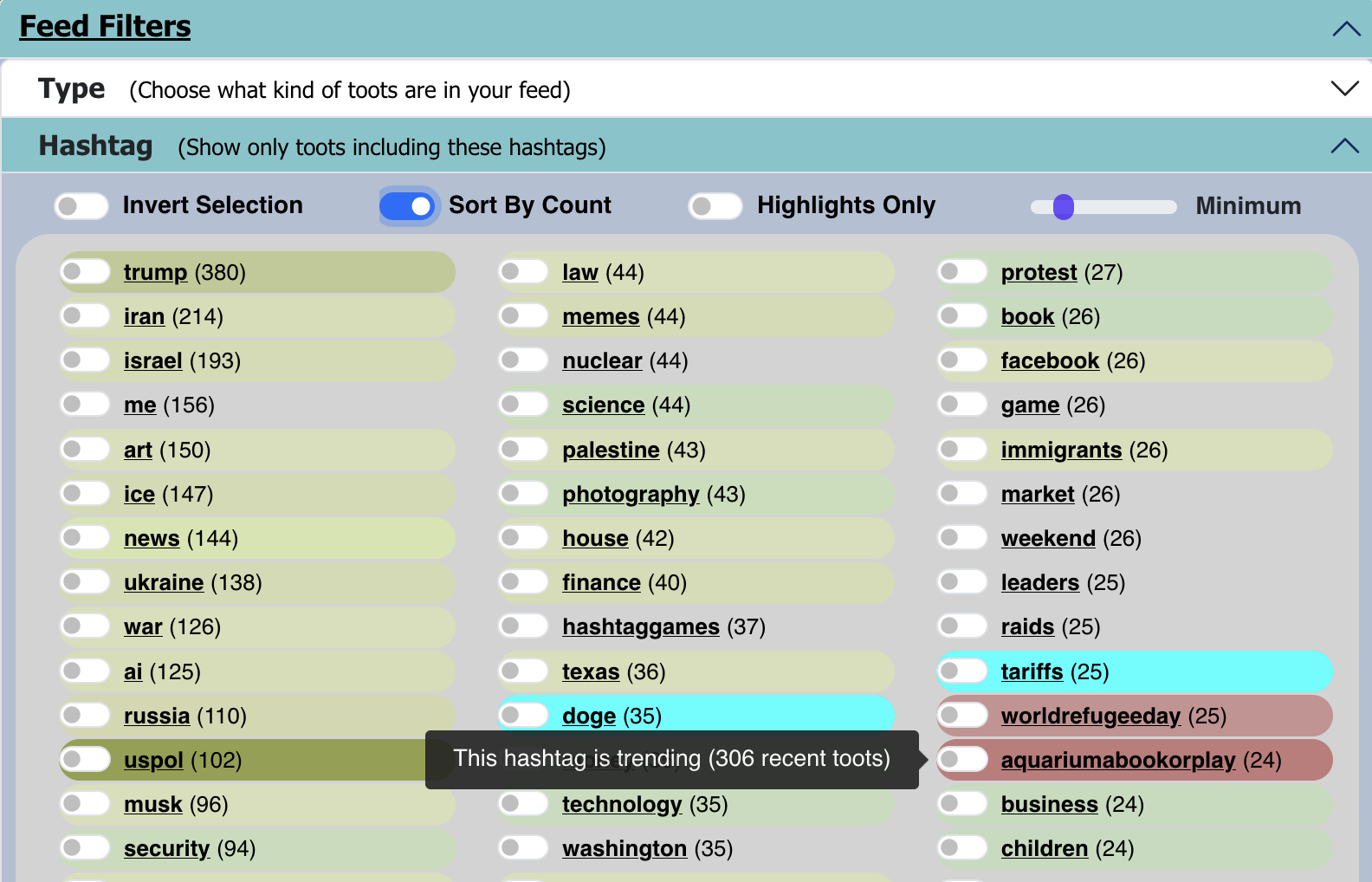
@cryptadamist@universeodon.com
Ω🪬Ω
new release of #Fedialgo, the customizable timeline algorithm / filtering system for your Mastodon feed, counts the number of times each hashtag appears in your timeline even if people don't use a "#" character to give you a better sense of what people are talking about in the Fediverse.
there's a little bit of art vs. science here because some strings are disqualified from this kind of counting (e.g. a word like "the" should not be counted even if some maniac decided to make it a hashtag) so let me know if you see any weirdly high counts.
* Link: https://michelcrypt4d4mus.github.io/fedialgo_demo_app_foryoufeed/
* Code: https://github.com/michelcrypt4d4mus/fedialgo_demo_app_foryoufeed
* Video of FediAlgo in action: https://universeodon.com/@cryptadamist/114395249311910522
#activitypub #algorithm #algorithmicFeed #algorithmicTimeline #Fedi #FediTips #FediTools #Fediverse #Feed #FOSS #Masto #MastoAdmin #Mastodon #mastohelp #MastoJS #nodejs #node #opensource #SocialWeb #timeline #TL #webdev #hashtag #typescript #hashtags
@cryptadamist@universeodon.com
Ω🪬Ω
new release of #Fedialgo, the customizable timeline algorithm / filtering system for your Mastodon feed, counts the number of times each hashtag appears in your timeline even if people don't use a "#" character to give you a better sense of what people are talking about in the Fediverse.
there's a little bit of art vs. science here because some strings are disqualified from this kind of counting (e.g. a word like "the" should not be counted even if some maniac decided to make it a hashtag) so let me know if you see any weirdly high counts.
* Link: https://michelcrypt4d4mus.github.io/fedialgo_demo_app_foryoufeed/
* Code: https://github.com/michelcrypt4d4mus/fedialgo_demo_app_foryoufeed
* Video of FediAlgo in action: https://universeodon.com/@cryptadamist/114395249311910522
#activitypub #algorithm #algorithmicFeed #algorithmicTimeline #Fedi #FediTips #FediTools #Fediverse #Feed #FOSS #Masto #MastoAdmin #Mastodon #mastohelp #MastoJS #nodejs #node #opensource #SocialWeb #timeline #TL #webdev #hashtag #typescript #hashtags

@greg@aus.social
@hongminhee@hollo.social
Anyone here have experience using @vitest with @deno_land, or setting up a unit test suite that works on #Deno, #Node.js, and #Bun?
@hongminhee@hollo.social
Anyone here have experience using @vitest with @deno_land, or setting up a unit test suite that works on #Deno, #Node.js, and #Bun?
@hongminhee@hollo.social
Anyone here have experience using @vitest with @deno_land, or setting up a unit test suite that works on #Deno, #Node.js, and #Bun?
@cryptadamist@universeodon.com
The fine @michael has deployed the #FediAlgo demo app to a place where you can test out the customizable algorithm + filtering system for your home timeline with nothing more than a web browser. You can find it here:
Here's a video of the FediAlgo demo in action (there's a few new features since the video): https://universeodon.com/@cryptadamist/114395249311910522
cc: @rolle @paige @LaurensHof
#FediTools #FediTips #Fediverse #Mastodon #activitypub #mastohelp #Fedi #foss #nodejs #opensource #MastoAdmin #SocialWeb #Feed #timeline #algorithmicFeed #algorithmicTimeline #TL #algorithm #node #nodejs
@cryptadamist@universeodon.com
The fine @michael has deployed the #FediAlgo demo app to a place where you can test out the customizable algorithm + filtering system for your home timeline with nothing more than a web browser. You can find it here:
Here's a video of the FediAlgo demo in action (there's a few new features since the video): https://universeodon.com/@cryptadamist/114395249311910522
cc: @rolle @paige @LaurensHof
#FediTools #FediTips #Fediverse #Mastodon #activitypub #mastohelp #Fedi #foss #nodejs #opensource #MastoAdmin #SocialWeb #Feed #timeline #algorithmicFeed #algorithmicTimeline #TL #algorithm #node #nodejs
@cryptadamist@universeodon.com
The fine @michael has deployed the #FediAlgo demo app to a place where you can test out the customizable algorithm + filtering system for your home timeline with nothing more than a web browser. You can find it here:
Here's a video of the FediAlgo demo in action (there's a few new features since the video): https://universeodon.com/@cryptadamist/114395249311910522
cc: @rolle @paige @LaurensHof
#FediTools #FediTips #Fediverse #Mastodon #activitypub #mastohelp #Fedi #foss #nodejs #opensource #MastoAdmin #SocialWeb #Feed #timeline #algorithmicFeed #algorithmicTimeline #TL #algorithm #node #nodejs
@cryptadamist@universeodon.com
The fine @michael has deployed the #FediAlgo demo app to a place where you can test out the customizable algorithm + filtering system for your home timeline with nothing more than a web browser. You can find it here:
Here's a video of the FediAlgo demo in action (there's a few new features since the video): https://universeodon.com/@cryptadamist/114395249311910522
cc: @rolle @paige @LaurensHof
#FediTools #FediTips #Fediverse #Mastodon #activitypub #mastohelp #Fedi #foss #nodejs #opensource #MastoAdmin #SocialWeb #Feed #timeline #algorithmicFeed #algorithmicTimeline #TL #algorithm #node #nodejs
@cryptadamist@universeodon.com
The FediAlgo hashtag filter section now highlights any hashtags you've posted about recently.
Interestingly the most I've used the app the more I've found feed filtering gets a ton of mileage for me. It's a huge change of pace to be able to instantly flip between whatever people are talking about on the Fediverse. Not really something you can do on any other social media platform I'm aware of.
* video of FediAlgo + link: https://universeodon.com/@cryptadamist/114395249311910522
#FediTools #FediTips #Fediverse #Mastodon #activitypub #mastohelp #Fedi #foss #nodejs #opensource #MastoAdmin #SocialWeb #Feed #timeline #algorithmicFeed #algorithmicTimeline #TL #algorithm #node #nodejs #hashtag #hashtaggames
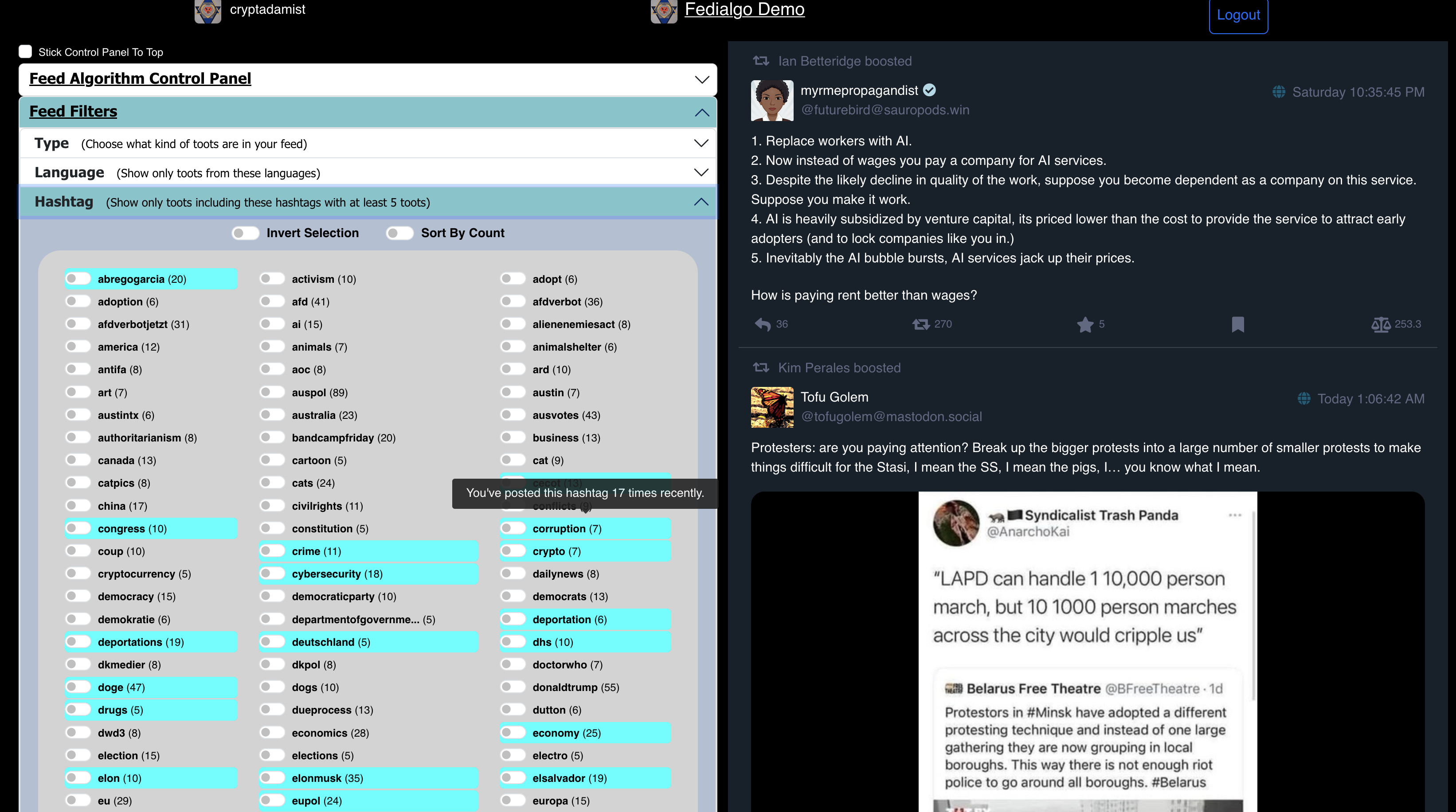
@cryptadamist@universeodon.com
The FediAlgo hashtag filter section now highlights any hashtags you've posted about recently.
Interestingly the most I've used the app the more I've found feed filtering gets a ton of mileage for me. It's a huge change of pace to be able to instantly flip between whatever people are talking about on the Fediverse. Not really something you can do on any other social media platform I'm aware of.
* video of FediAlgo + link: https://universeodon.com/@cryptadamist/114395249311910522
#FediTools #FediTips #Fediverse #Mastodon #activitypub #mastohelp #Fedi #foss #nodejs #opensource #MastoAdmin #SocialWeb #Feed #timeline #algorithmicFeed #algorithmicTimeline #TL #algorithm #node #nodejs #hashtag #hashtaggames
@cryptadamist@universeodon.com
Ω🪬Ω
New release of #FediAlgo (customizable #algorithm for your #Mastodon timeline) has a couple of cool features:
1. Configuration presets (so you can easily put discussions or trending toots at the top of your #timeline without fiddling with the individual settings)
2. A "What's Trending" section that will show you the top trending hashtags, links, and posts scraped from 30 or so of the most popular Mastodon servers
All the old features like filtering for particular languages / hashtags / users or a minimum number of replies / boosts / etc. are still there.
* Usable demo: https://michelcrypt4d4mus.github.io/fedialgo_demo_app_foryoufeed/
* Code: https://github.com/michelcrypt4d4mus/fedialgo_demo_app_foryoufeed
* Library: https://github.com/michelcrypt4d4mus/fedialgo
#FediTools #FediTips #Fediverse #Mastodon #activitypub #mastohelp #Fedi #foss #nodejs #opensource #MastoAdmin #Feed #timeline #algorithmicFeed #algorithmicTimeline #TL #algorithm #node #nodejs
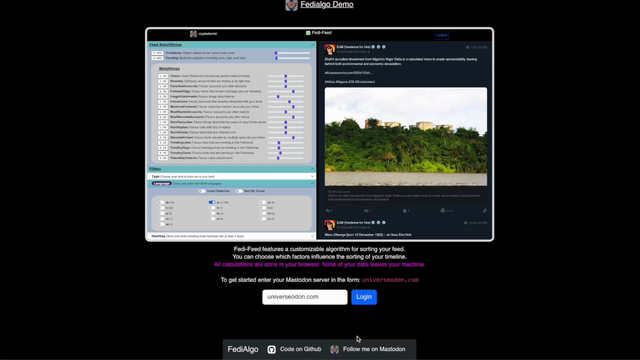
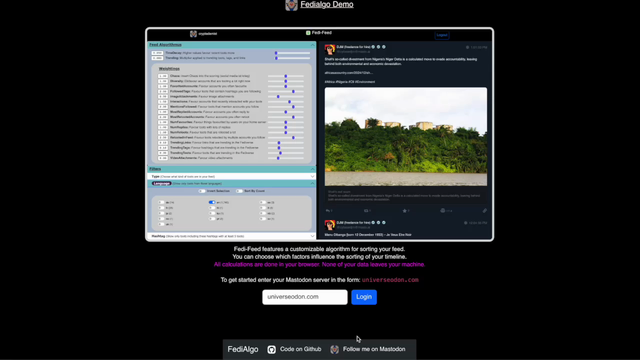
@cryptadamist@universeodon.com
Ω🪬Ω
New release of #FediAlgo (customizable #algorithm for your #Mastodon timeline) has a couple of cool features:
1. Configuration presets (so you can easily put discussions or trending toots at the top of your #timeline without fiddling with the individual settings)
2. A "What's Trending" section that will show you the top trending hashtags, links, and posts scraped from 30 or so of the most popular Mastodon servers
All the old features like filtering for particular languages / hashtags / users or a minimum number of replies / boosts / etc. are still there.
* Usable demo: https://michelcrypt4d4mus.github.io/fedialgo_demo_app_foryoufeed/
* Code: https://github.com/michelcrypt4d4mus/fedialgo_demo_app_foryoufeed
* Library: https://github.com/michelcrypt4d4mus/fedialgo
#FediTools #FediTips #Fediverse #Mastodon #activitypub #mastohelp #Fedi #foss #nodejs #opensource #MastoAdmin #Feed #timeline #algorithmicFeed #algorithmicTimeline #TL #algorithm #node #nodejs
@cryptadamist@universeodon.com
Ω🪬Ω
New release of #FediAlgo (customizable #algorithm for your #Mastodon timeline) has a couple of cool features:
1. Configuration presets (so you can easily put discussions or trending toots at the top of your #timeline without fiddling with the individual settings)
2. A "What's Trending" section that will show you the top trending hashtags, links, and posts scraped from 30 or so of the most popular Mastodon servers
All the old features like filtering for particular languages / hashtags / users or a minimum number of replies / boosts / etc. are still there.
* Usable demo: https://michelcrypt4d4mus.github.io/fedialgo_demo_app_foryoufeed/
* Code: https://github.com/michelcrypt4d4mus/fedialgo_demo_app_foryoufeed
* Library: https://github.com/michelcrypt4d4mus/fedialgo
#FediTools #FediTips #Fediverse #Mastodon #activitypub #mastohelp #Fedi #foss #nodejs #opensource #MastoAdmin #Feed #timeline #algorithmicFeed #algorithmicTimeline #TL #algorithm #node #nodejs
@cryptadamist@universeodon.com
Ω🪬Ω
New release of #FediAlgo (customizable #algorithm for your #Mastodon timeline) has a couple of cool features:
1. Configuration presets (so you can easily put discussions or trending toots at the top of your #timeline without fiddling with the individual settings)
2. A "What's Trending" section that will show you the top trending hashtags, links, and posts scraped from 30 or so of the most popular Mastodon servers
All the old features like filtering for particular languages / hashtags / users or a minimum number of replies / boosts / etc. are still there.
* Usable demo: https://michelcrypt4d4mus.github.io/fedialgo_demo_app_foryoufeed/
* Code: https://github.com/michelcrypt4d4mus/fedialgo_demo_app_foryoufeed
* Library: https://github.com/michelcrypt4d4mus/fedialgo
#FediTools #FediTips #Fediverse #Mastodon #activitypub #mastohelp #Fedi #foss #nodejs #opensource #MastoAdmin #Feed #timeline #algorithmicFeed #algorithmicTimeline #TL #algorithm #node #nodejs

@arnelson@fosstodon.org
Another library frustration: is there a standard Make-like task runner tool for #Node? 10 years ago Grunt and Gulp were standard for this, but they're horribly out of date now and not compatible with ES6 imports. There are tools in other languages, like go-task, but I can't find anything similar in JS.
@fedify@hollo.social
Fedify is an #ActivityPub server framework in #TypeScript & #JavaScript. It aims to eliminate the complexity and redundant boilerplate code when building a federated server app, so that you can focus on your business logic and user experience.
The key features it provides currently are:
If you're curious, take a look at the #Fedify website! There's comprehensive docs, a demo, a tutorial, example code, and more:

@s1r83r@pataterie.ca

@tjdraper@phpc.social
I've worked with dates and times in several programming languages, and I have to say that the best is easily PHP (since the big refactor in, what was it, 5.6?).
The worst is easily Javascript.
@tjdraper@phpc.social
I've worked with dates and times in several programming languages, and I have to say that the best is easily PHP (since the big refactor in, what was it, 5.6?).
The worst is easily Javascript.

@adingbatponder@fosstodon.org · Reply to Shadow Heart's post
@Sh4d0w_H34rt @bunbloc Oh, sorry, was not clear. I was thinking of a #mastodon instance solely over #reticulum using #LXMF and not via any other protocol, to make it a bit special and to provide superb chat rooms or group chats and fill that current gap. #reticulum allows for images of course. Would work very well indeed perhaps. Was wondering how much code would need changing to #mastodon to port it to a #reticulum #node #nomad server ...
@fedify@hollo.social
Fedify is an #ActivityPub server framework in #TypeScript & #JavaScript. It aims to eliminate the complexity and redundant boilerplate code when building a federated server app, so that you can focus on your business logic and user experience.
The key features it provides currently are:
If you're curious, take a look at the #Fedify website! There's comprehensive docs, a demo, a tutorial, example code, and more:
@fedify@hollo.social
Fedify is an #ActivityPub server framework in #TypeScript & #JavaScript. It aims to eliminate the complexity and redundant boilerplate code when building a federated server app, so that you can focus on your business logic and user experience.
The key features it provides currently are:
If you're curious, take a look at the #Fedify website! There's comprehensive docs, a demo, a tutorial, example code, and more:

@sc0v0ne@mastodon.social
FREE BOOKS LINUX AND SHELL SCRIPTING
- https://linuxcommand.org/tlcl.php
- https://bmansoori.ir/book/Linux%20for%20Beginners%20by%20Jason%20Cannon%20.pdf
- https://flaviocopes.pages.dev/books/linux-commands-handbook.pdf
- http://kroah.com/lkn/
- https://linuxfromscratch.org/lfs/downloads/stable/LFS-12.2-SYSV-BOOK.pdf
#python #rust #c #c++ #machinelearning #deeplearning #ai #developer #dev #devsecops #devops #mlops #learn #learning #focus #study #git #gitlab #github #codeberg #software #statistics #pandas #numpy #tensorflow #pytorch #jax #linux #popos #mint #deno #node #ubuntu
@sc0v0ne@mastodon.social
FREE BOOKS LINUX AND SHELL SCRIPTING
- https://tldp.org/LDP/Bash-Beginners-Guide/Bash-Beginners-Guide.pdf
- https://lamed-oti.com/school/rl/os/linux_unix/Korn%20Shell%20User%20and%20Programming%20Manual.pdf
- https://theswissbay.ch/pdf/Books/Computer%20science/O%27Reilly/ten-steps-to-linux-survival.pdf
- https://drago1234.github.io/Surviving_kits/data/2021_summer/Linux-101-Hacks.pdf
- https://idris.lecturer.pens.ac.id/files/kon_jarkom/Teach%20Yourself%20Shell%20Programming%20in%2024%20Hours.pdf
#python #rust #c #c++ #machinelearning #deeplearning #ai #developer #dev #devsecops #devops #mlops #learn #learning #focus #study #git #gitlab #github #codeberg #software #statistics #pandas #numpy #tensorflow #pytorch #jax #huggingface #linux #popos #mint #deno #node #ubuntu
@sc0v0ne@mastodon.social
FREE BOOKS LINUX AND SHELL SCRIPTING
- https://tldp.org/LDP/Bash-Beginners-Guide/Bash-Beginners-Guide.pdf
- https://lamed-oti.com/school/rl/os/linux_unix/Korn%20Shell%20User%20and%20Programming%20Manual.pdf
- https://theswissbay.ch/pdf/Books/Computer%20science/O%27Reilly/ten-steps-to-linux-survival.pdf
- https://drago1234.github.io/Surviving_kits/data/2021_summer/Linux-101-Hacks.pdf
- https://idris.lecturer.pens.ac.id/files/kon_jarkom/Teach%20Yourself%20Shell%20Programming%20in%2024%20Hours.pdf
#python #rust #c #c++ #machinelearning #deeplearning #ai #developer #dev #devsecops #devops #mlops #learn #learning #focus #study #git #gitlab #github #codeberg #software #statistics #pandas #numpy #tensorflow #pytorch #jax #huggingface #linux #popos #mint #deno #node #ubuntu
@sc0v0ne@mastodon.social
FREE BOOKS LINUX AND SHELL SCRIPTING
- https://linuxcommand.org/tlcl.php
- https://bmansoori.ir/book/Linux%20for%20Beginners%20by%20Jason%20Cannon%20.pdf
- https://flaviocopes.pages.dev/books/linux-commands-handbook.pdf
- http://kroah.com/lkn/
- https://linuxfromscratch.org/lfs/downloads/stable/LFS-12.2-SYSV-BOOK.pdf
#python #rust #c #c++ #machinelearning #deeplearning #ai #developer #dev #devsecops #devops #mlops #learn #learning #focus #study #git #gitlab #github #codeberg #software #statistics #pandas #numpy #tensorflow #pytorch #jax #linux #popos #mint #deno #node #ubuntu
@adingbatponder@fosstodon.org · Reply to nullagent's post
@nullagent Video about how to make a #meshcore #node work
How to build and #flash Meshcore #repeater #firmware | #heltecv3 V3
https://www.youtube.com/watch?v=WJvg6dt13hk
Takes you through the software side using #VisualStudio on a #macos device by the look of it
( Note the #meshcore code is out https://github.com/ripplebiz/MeshCore )
22-1-2025

@deno_land@fosstodon.org
Deno 2.1.6 has been released
- Correct handling of compilerOptions.types
- Better handling of npm package types
- Improvements to node:fs FileHandle
- Make deno outdated more robust
Run `deno upgrade` to get it
@deno_land@fosstodon.org
Deno 2.1.6 has been released
- Correct handling of compilerOptions.types
- Better handling of npm package types
- Improvements to node:fs FileHandle
- Make deno outdated more robust
Run `deno upgrade` to get it
@deno_land@fosstodon.org
Deno 2.1.6 has been released
- Correct handling of compilerOptions.types
- Better handling of npm package types
- Improvements to node:fs FileHandle
- Make deno outdated more robust
Run `deno upgrade` to get it
@deno_land@fosstodon.org
Deno 2.1.6 has been released
- Correct handling of compilerOptions.types
- Better handling of npm package types
- Improvements to node:fs FileHandle
- Make deno outdated more robust
Run `deno upgrade` to get it
@deno_land@fosstodon.org
Deno 🤝️ Nuxt.js

@deno_land@fosstodon.org
Deno 🤝️ Nuxt.js
@deno_land@fosstodon.org
Deno 🤝️ Nuxt.js
@deno_land@fosstodon.org
Deno 2.1.5 just landed —
▸ new QUIC API
▸ improved Discord.js compatibility
▸ better tasks support in workspaces
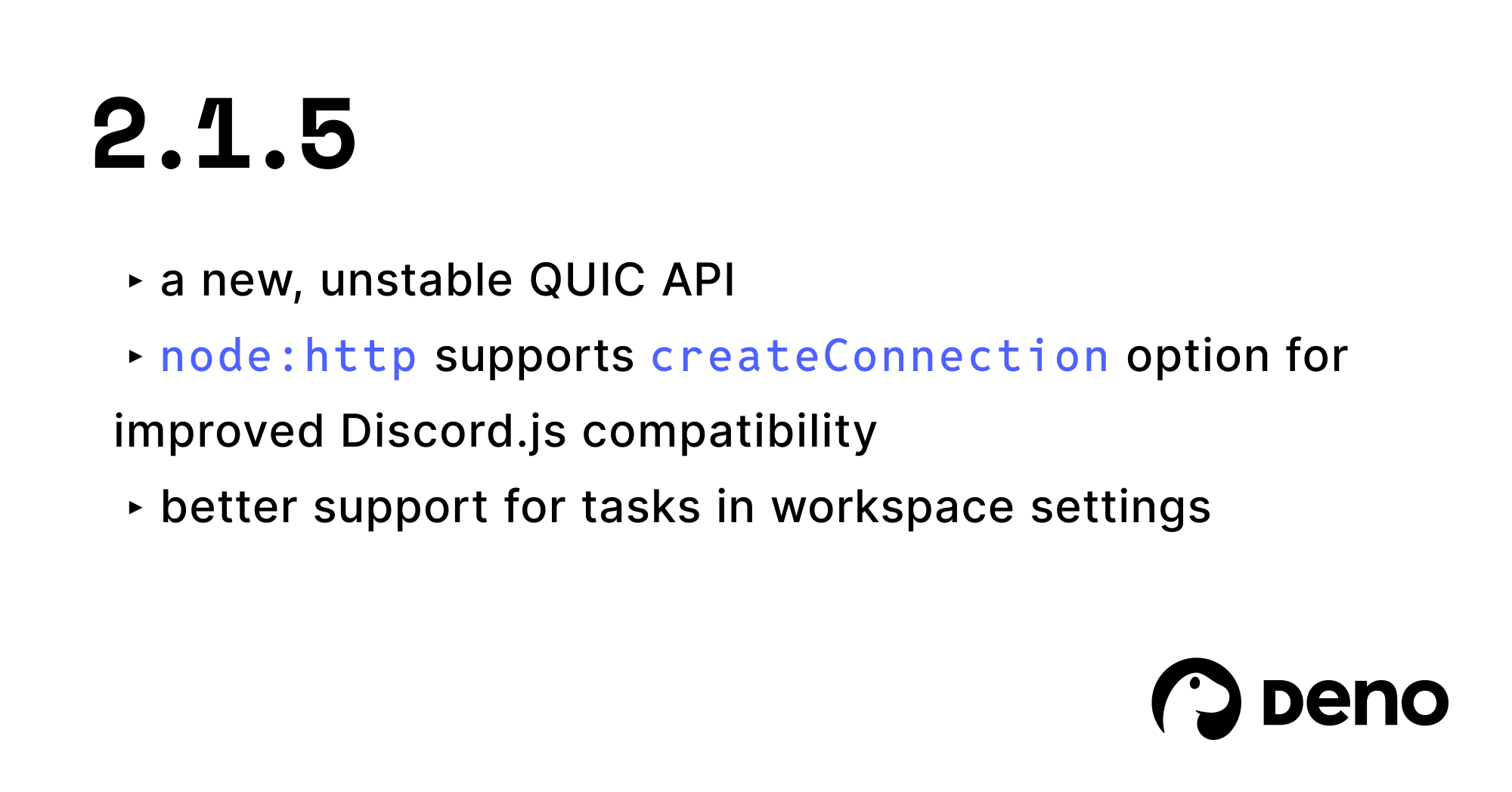
@deno_land@fosstodon.org
Deno 2.1.5 just landed —
▸ new QUIC API
▸ improved Discord.js compatibility
▸ better tasks support in workspaces
@deno_land@fosstodon.org
Deno 2.1.5 just landed —
▸ new QUIC API
▸ improved Discord.js compatibility
▸ better tasks support in workspaces
@deno_land@fosstodon.org
Deno 2.1.5 just landed —
▸ new QUIC API
▸ improved Discord.js compatibility
▸ better tasks support in workspaces
@deno_land@fosstodon.org
Deno is committed to web standards - that's why we co-founded WinterCG two years ago. Today marks the next step in that journey: WinterCG moves to Ecma International as technical comittee 55 (TC55).
Goodbye WinterCG, welcome WinterTC!
@deno_land@fosstodon.org
Deno is committed to web standards - that's why we co-founded WinterCG two years ago. Today marks the next step in that journey: WinterCG moves to Ecma International as technical comittee 55 (TC55).
Goodbye WinterCG, welcome WinterTC!
@deno_land@fosstodon.org
Deno 2.1.5 just landed —
▸ new QUIC API
▸ improved Discord.js compatibility
▸ better tasks support in workspaces
@deno_land@fosstodon.org
Deno is committed to web standards - that's why we co-founded WinterCG two years ago. Today marks the next step in that journey: WinterCG moves to Ecma International as technical comittee 55 (TC55).
Goodbye WinterCG, welcome WinterTC!
@deno_land@fosstodon.org
Deno is committed to web standards - that's why we co-founded WinterCG two years ago. Today marks the next step in that journey: WinterCG moves to Ecma International as technical comittee 55 (TC55).
Goodbye WinterCG, welcome WinterTC!
@hongminhee@hollo.social
I'm troubleshooting a mysterious TypeError: fetch failed exception when using #Node.js's built-in fetch() function. When I make the same request in #Deno or #Bun, it responds fine. Anyone know why this only happens in Node.js?
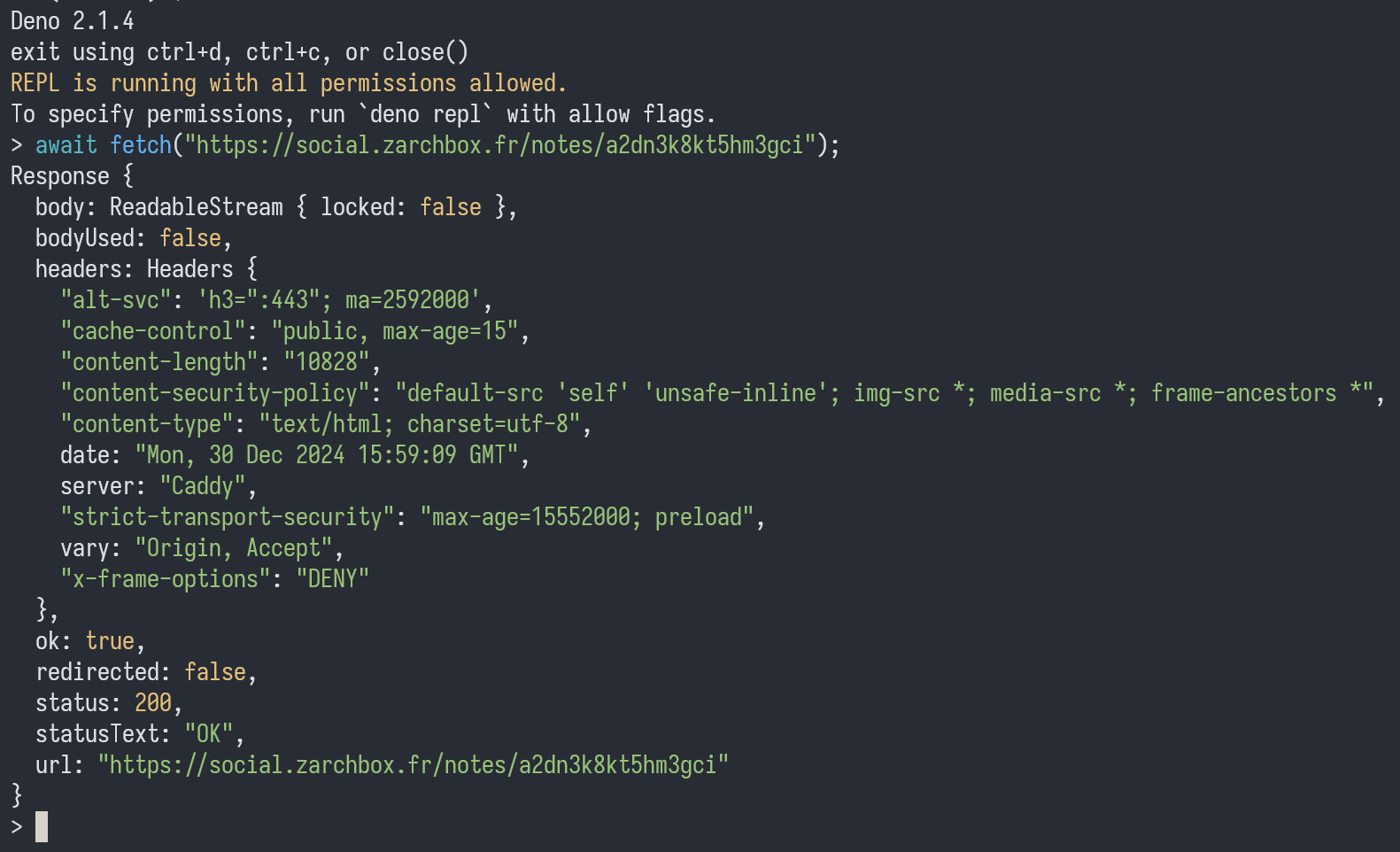
![Welcome to Bun v1.1.42
Type ".help" for more information.
[!] Please note that the REPL implementation is still experimental!
Don't consider it to be representative of the stability or behavior of Bun overall.
> await fetch("https://social.zarchbox.fr/notes/a2dn3k8kt5hm3gci");
Response {}
>](https://media.social.fedify.dev/media/0194184f-62bb-7468-9bd6-213301cd830e/original.png)
![Welcome to Node.js v23.5.0.
Type ".help" for more information.
> await fetch("https://social.zarchbox.fr/notes/a2dn3k8kt5hm3gci");
Uncaught TypeError: fetch failed
at node:internal/deps/undici/undici:13484:13
at process.processTicksAndRejections (node:internal/process/task_queues:105:5)
at async REPL1:1:33 {
[cause]: AggregateError [ETIMEDOUT]:
at internalConnectMultiple (node:net:1139:18)
at internalConnectMultiple (node:net:1215:5)
at Timeout.internalConnectMultipleTimeout (node:net:1739:5)
at listOnTimeout (node:internal/timers:616:11)
at process.processTimers (node:internal/timers:549:7) {
code: 'ETIMEDOUT',
[errors]: [ [Error], [Error] ]
}
}
>](https://media.social.fedify.dev/media/01941850-da6a-7e93-acc0-1a1b6f54dde0/original.png)
@deno_land@fosstodon.org
Participating in Advent of Code 🎄?
Use Deno and win some exclusive prizes 🎁️ 👀️
https://deno.com/blog/advent-of-code-2024
#deno #node #javascript #typescript #webdevelopment #adventofcode

@blake@infosec.town


@hollo@hollo.social · Reply to Hollo :hollo:'s post
Okay, testing #Hollo with #Node.js is cruising along. It's consuming up to 3 GB of memory at peak times, but that's a huge improvement over Hollo with #Bun, which was consuming over 8 GB of memory at peak times.
So, yes, starting with Hollo 0.4.0, we'll use Node.js instead of Bun!
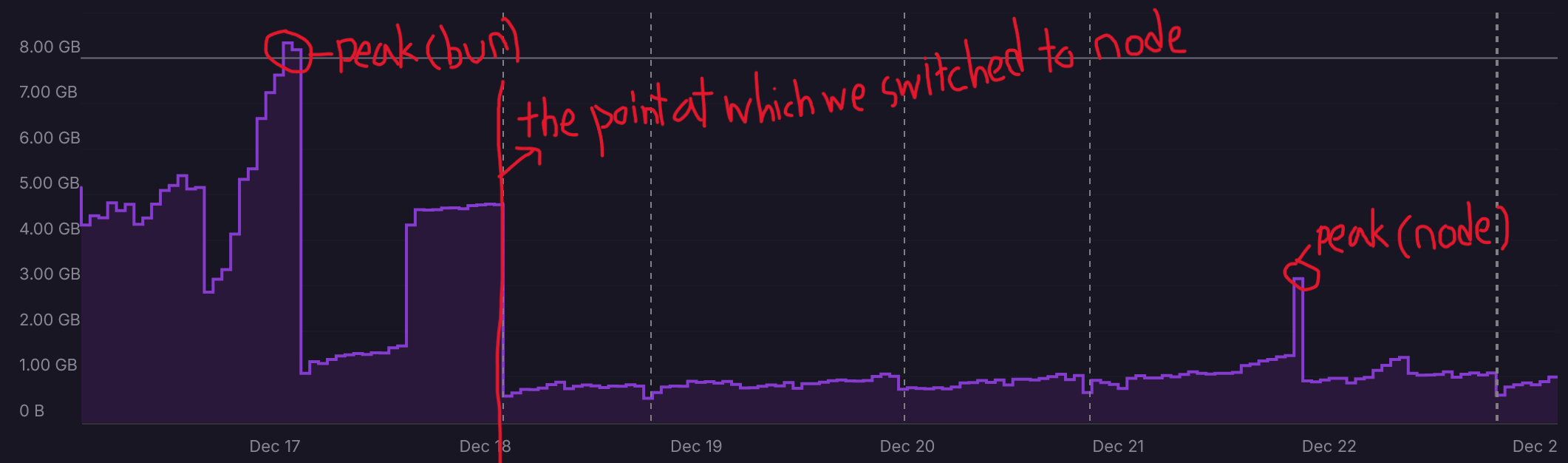

@realestninja@social.linux.pizza
@hollo@hollo.social
#Hollo is currently testing #Node.js instead of #Bun. (In fact, the hollo.social server is already running on Node.js!) If this test is successful, starting with the next release, Hollo will be powered by Node.js instead of Bun.
The main reason for switching to Node.js is to optimize memory usage. As you can see in the graph image below, Node.js uses significantly less memory than Bun. With this switch, Hollo is expected to be even more lightweight than before!
Are you interested in trying out the Node.js version of Hollo early? Try to pull ghcr.io/dahlia/hollo:0.4.0-dev.290!

@deno_land@fosstodon.org
Deno 🤝️ @qwikdev
https://docs.deno.com/examples/qwik_tutorial/
#deno #node #javascript #typescript #webdev #nodejs #webdevelopment

@deno_land@fosstodon.org
Deno can now finally be installed through npm!
npm install -g deno
npx deno eval -p 1+2
@deno_land@fosstodon.org
Interested in contributing to Deno?
Check out Divy's talk on Deno internals and op2: https://www.youtube.com/watch?v=vINOqgn_ik8
@deno_land@fosstodon.org
Easily check for outdated dependencies with `deno outdated` 👇️
@deno_land@fosstodon.org
this wren wants to remind you that Deno permission flags have shorthands

@cryptadamist@universeodon.com
Ω⚙️Ω
New features for #FediAlgo, the customizable #algorithm for your Mastodon timeline:
🪓 Live filtering based on #hashtag (inclusive and exclusive)
#️⃣ Seed your timeline with toots from anywhere in the Fediverse that contain trending tags (#SouthKorea and #UnitedHealth have been big lately)
🔥 Icons to inform you whether a toot is from an account you follow, a hashtag you follow, or is trending (and if so, why it's trending)
⚖️ Weight based on retoots, replies, age, etc.
国 Filter on language
I kind of find it hard to look at Mastodon without it at this point. The installable demo can be found here: https://github.com/michelcrypt4d4mus/fedialgo_demo_app_foryoufeed
Also available as a NodeJS package built on #Masto.
Here's a video of the demo app:
#FediTools #FediTips #Fediverse #Mastodon #activitypub #mastohelp #Fedi #foss #nodejs #opensource #MastoAdmin #SocialWeb #Feed #timeline #algorithmicFeed #node
@deno_land@fosstodon.org
Did you know you can host your Next.js app on Deno Deploy in just a few steps? Here's how👇️
@deno_land@fosstodon.org
Participating in Advent of Code 🎄?
Use Deno and win some exclusive prizes 🎁️ 👀️
https://deno.com/blog/advent-of-code-2024
#deno #node #javascript #typescript #webdevelopment #adventofcode

@hongminhee@fosstodon.org · Reply to 洪 民憙 (Hong Minhee)'s post
@deno_land@fosstodon.org
It's done. Now it’s your turn, Oracle.
We’ve submitted a formal petition to cancel the JavaScript trademark: it is generic, Oracle has abandoned it, and Oracle committed fraud on the USPTO during the last trademark renewal.
Oracle has until January 4th to respond, or the case will go into default, which will result in the trademark being canceled.
It's time to #FreeJavaScript.
@cryptadamist@universeodon.com
Ω⚠️🐘⚠️Ω
I did some hacking at @pkreissel's implementation of a customizable algorithm for your Mastodon feed. I fixed some bugs and added a few features but maybe most importantly I streamlined the process of installing and running the demo app so you can experience the magic of his invention reshaping your Mastodon timeline for yourself with ease.
Seriously everything about having an algorithm adjust my feed to make sure I see stuff I might otherwise have missed has made my Mastodon experience like 1,000x better. The fact that it's (extremely) granularly customizable is the icing on the cake.
Setup should be trivial for anyone vaguely familiar with the command line. Even if you're scared of the command line you should be able to copy/paste the 3 commands listed in the installation instructions, all of which are in the GitHub repo:
https://github.com/michelcrypt4d4mus/fedialgo_demo_app_foryoufeed
#Fediverse #feditips #Mastodon #FOSS #opensource #nodejs #node #Feditools #activitypub #mastohelp #algorithm #Fedi #socialmedia
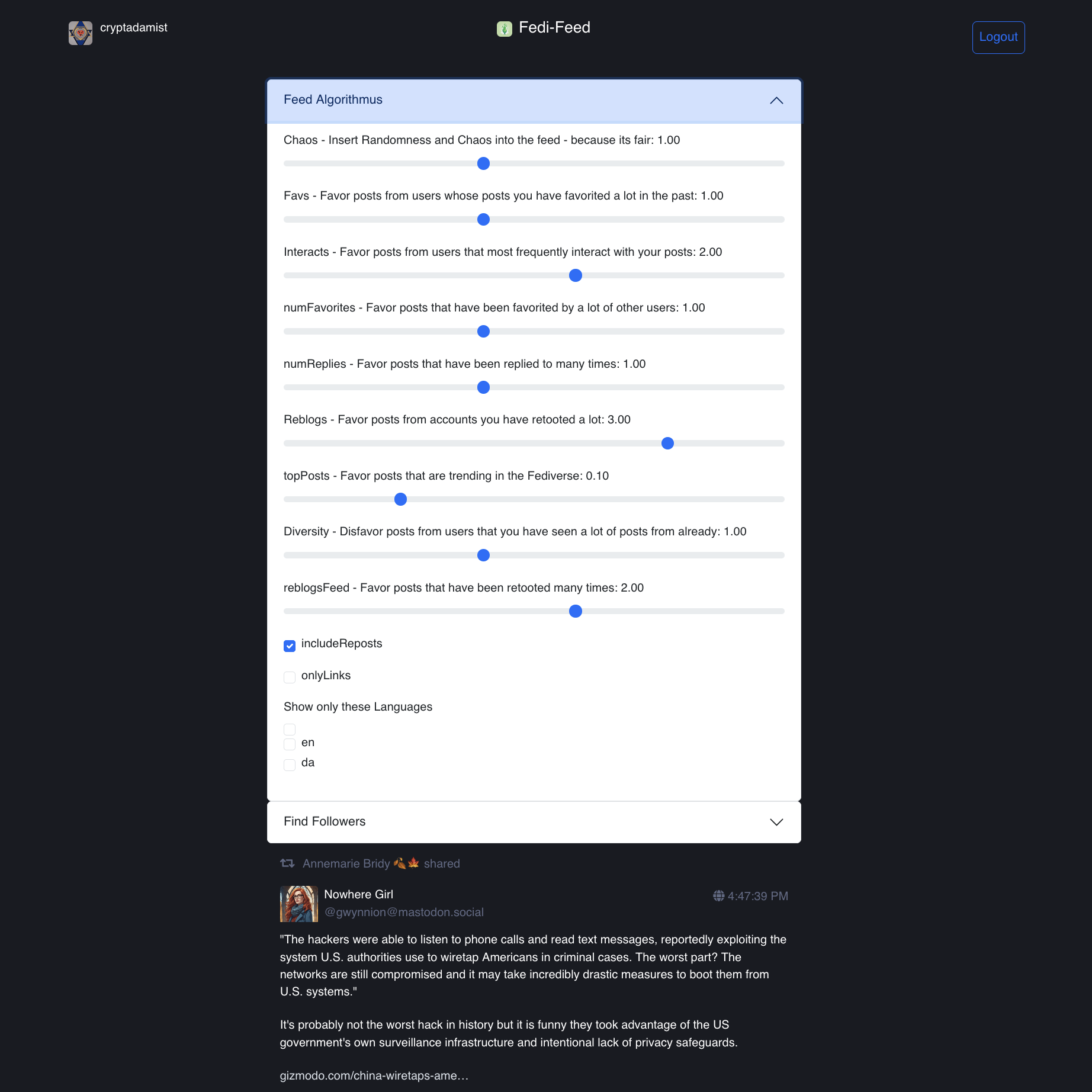
@deno_land@fosstodon.org
Deno 2.1 is out 🎉️
✈️️ first class Wasm support
🌳️ Long Term Support branch
⭐️ Improved dependency management
and much more!
#deno #node #javascript #nodejs #typescript #webdev #npm #wasm
@hongminhee@fosstodon.org · Reply to 洪 民憙 (Hong Minhee)'s post
Okay. While #Sentry SDK for #Node.js supports #OpenTelemetry integration, Sentry SDK for #Deno does not.
@hongminhee@fosstodon.org
Does anyone have experience integrating Spans measured using the #OpenTelemetry API with #Sentry in #Node.js or #Deno?
According to the docs in the Sentry SDK, OpenTelemetry integration is out of the box and doesn't require any configuration, but Spans instrumented using the OpenTelemetry API are ignored. Spans made with the Sentry API are working fine.
https://docs.sentry.io/platforms/javascript/guides/node/opentelemetry/
@deno_land@fosstodon.org
@deno_land@fosstodon.org
Deno is a JavaScript package manager with more flexibility:
📦️ npm and JSR
🛠️️ package.json and deno.json
👟️ fast
@deno_land@fosstodon.org
Want to modernize legacy JavaScript?
One way is to convert CommonJS code to ESM 👇️
@deno_land@fosstodon.org
Programming should be simple

@deno_land@fosstodon.org
4 years after Deno 1.0, the next generation of JavaScript is ready for production at scale.
Deno 2 is out today
🐢 Fully backwards compatible with Node and npm
📦 Package management and node_modules and package.json
📅 Long term support

@deno_land@fosstodon.org
Deno 2 is not yet released, but we've made many️ updates to the release candidate 👇️
@deno_land@fosstodon.org
The 🦕️ is out of the bag...
@hongminhee@fosstodon.org
If you've been avoiding #JavaScript & #TypeScript due to the complexity of the #Node.js ecosystem, give #Deno a try. Everything is simplified and you can start coding right away without having to set up a development environment.
@deno_land@fosstodon.org
Deno 2 Release Candidate has dropped:
‣ Add `process` global variable, remove `window`
‣ Improve dep management
‣ Permission system updates
‣ Many stabilizations
‣ Better CommonJS support
‣ Test documentation with `deno test --doc`
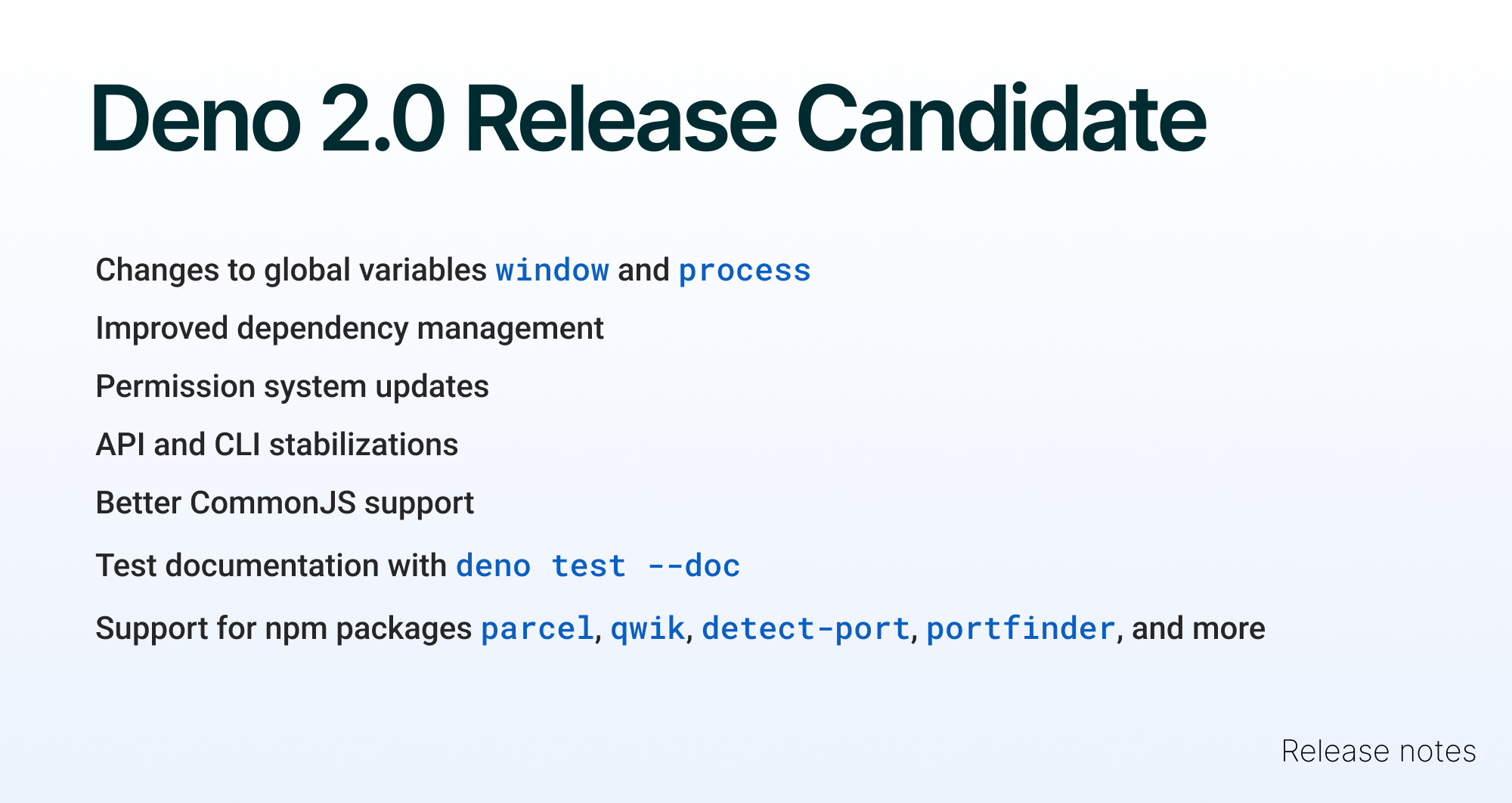
@fedify@hollo.social
#Fedify started out exclusively for #Deno, but now also supports #Node.js and #Bun. However, the #logo we created in the early days still features the character from Deno. Should Fedify change its logo now?
| Option | Voters |
|---|---|
| Yes, because it's misleading. | 5 (28%) |
| A logo is a logo, no need to change it. | 13 (72%) |
@hongminhee@fosstodon.org
@hongminhee@fosstodon.org
@deno_land@fosstodon.org
Curious about how the JSR logo and website design came together? 🤔️
Here's a 👀️ into our design process.
https://deno.com/blog/designing-jsr
#deno #node #javascript #typescript #webdevelopment #npm #jsr
@fedify@hollo.social
Fedifyは、TypeScriptとJavaScriptで書かれたActivityPubサーバーフレームワークです。分散型のソーシャルネットワークを構築するためのサーバーアプリケーションを作る際の複雑さと冗長なコードを排除し、ビジネスロジックとユーザー体験の開発に集中できるようにすることを目指しています。
現在提供している主な機能は以下の通りです:
興味がある方は、Fedifyのウェブサイトをご覧ください!包括的なドキュメント、デモ、チュートリアル、サンプルコードなどが用意されています:
#Fedify #TypeScript #JavaScript #ActivityPub #NodeInfo #Node #Deno #Bun #fedidev

@kur0den0010@chpk.kur0den.net
生成AIを信用しすぎてハルシネーションに引っかかった話 #Node.js
https://qiita.com/suzuyu0115/items/d6137ac2894d9b0d5385
@hongminhee@fosstodon.org
Version 0.5.0 of #LogTape, the zero-dependency #logging library for #Deno, #Node.js, #Bun, edge functions, and browsers, has been released! The main additions include:
• Contexts
• ANSI color formatter
• Comprehensive docs
• A few API conveniences
LogTape v0.5.0 is available from JSR and npm:
• JSR: https://jsr.io/@logtape/logtape@0.5.0
• npm: https://www.npmjs.com/package/@logtape/logtape/v/0.5.0
In addition, a new website with documentation has been launched, so please check it out!
@hongminhee@fosstodon.org · Reply to Pablo Berganza (he/him)'s post
@deno_land@fosstodon.org
Hosting on Deno Deploy just got more performant with beta Web Cache API support:
🚀 sub-millisecond read latency
🚅 multi Gbps write throughput
💾 unbounded storage
https://deno.com/blog/deploy-cache-api
#deno #node #javascript #typescript #webdevelopment #serverless

@deno_land@fosstodon.org
Deno 1.46 is not only the last 1.x release, but also one of the biggest:
- Simpler CLI
- Multi-threaded web servers
- HTML, CSS, YAML support in `deno fmt`
- Better Node/npm compat (support for playwright, google-cloud, etc.)
and much more 👇️
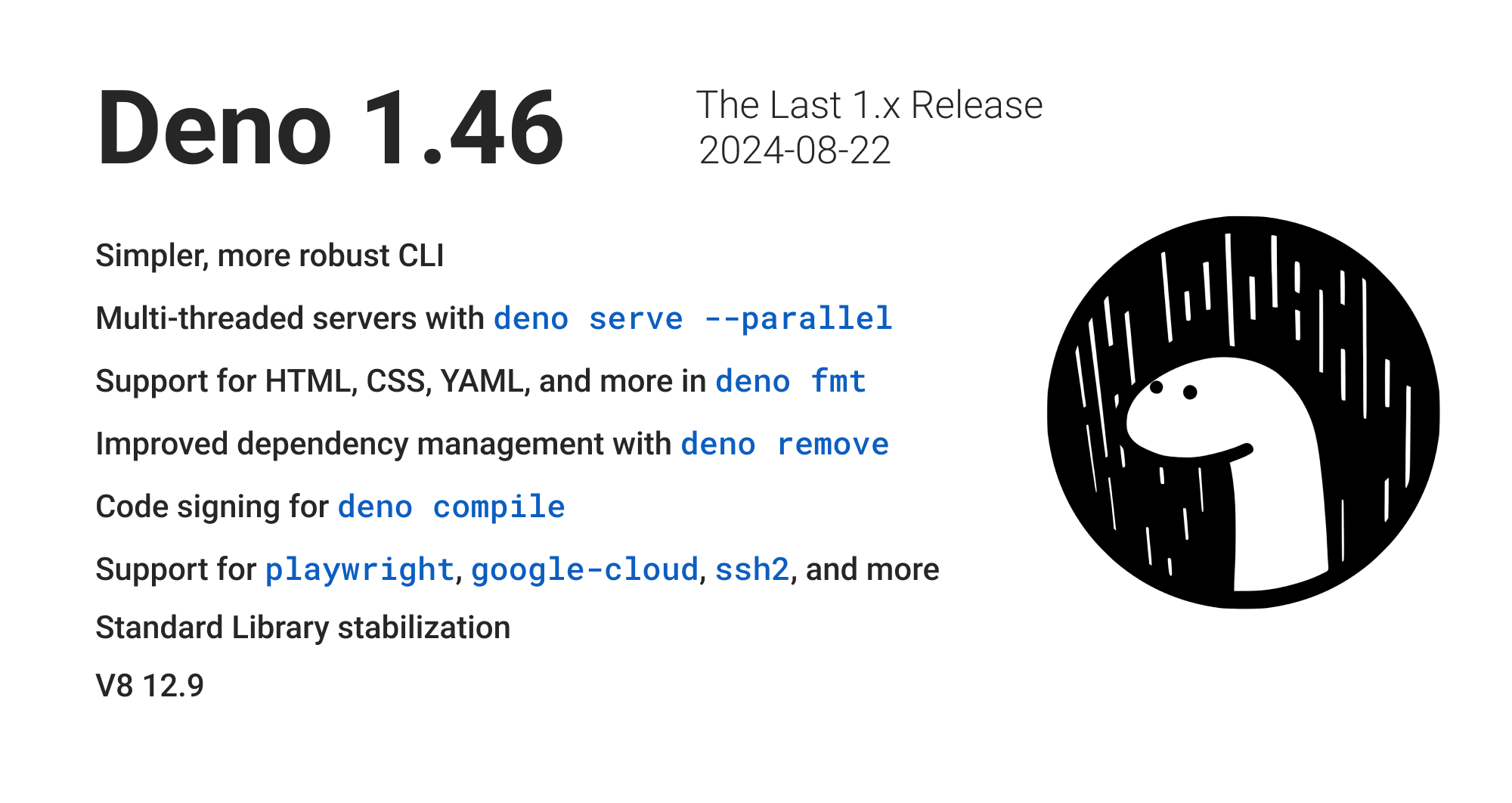

@qaqelol@toots.niark.nexus
I found a cool web tool to reduce images file size, its called #Squoosh ✨
It works well and makes it easy to compare images, plus its #OpenSource (and free) !
@fedify@hollo.social
@hongminhee@fosstodon.org
この記事を読むと、自分もHolloでBunの代わりにNode.jsを使うべきなのかなーと。
@hongminhee@fosstodon.org
#LogTape is a logging library for #JavaScript and #TypeScript. It provides a simple and flexible logging system that is easy to use and easy to extend. The highlights of LogTape are:
• Zero dependencies
• Designed to be used in libraries as well as apps
• Supports virtually every runtime: #Node.js, #Deno, #Bun, edge functions, and browsers
• Structured logging
• Logger categories (names) are hierarchical
• Dead simple sink (destination) interface
@hongminhee@fosstodon.org
I'm unsure whether to adopt an emerging JavaScript runtime like #Bun or #Deno for #Fedify's tutorial, or stick with traditional #Node.js. 🤔
If I choose Bun/Deno, it comes with built-in #TypeScript support, hot reloading, and a fetch-style HTTP server, so I don't have to explain much about it, but I need to deal with installing Bun/Deno itself.
On the other hand, Node.js can be assumed to be already installed on the reader's system, but they will need to set up TypeScript, hot reloading, etc.
| Option | Voters |
|---|---|
| Bun | 0 (0%) |
| Deno | 0 (0%) |
| Node.js | 0 (0%) |
@hongminhee@fosstodon.org
I wish the #Temporal API would be built into #Node.js and #Bun as well.

@kirch@tilde.zone
I am a human, I can sign something for you from https://keybase.io/jkirchartz if you'd like
Here is a list of my interests, in no particular order.
#art #history #retro #music #pocketmusic #gameboy #android #chiptunes #bots #ML #AI #guitar #mandolin #busking #streetphotography #streetart #stickerart #magic #webdesign #webdevelopment #uspolitics #dsa #zen #scifi #php #bash #python #javascript #node #automation #discordia #education
@deno_land@fosstodon.org
Deno is known for its HTTP imports, but we've found it's insufficient for larger projects. This post explains the situation and how we've improved it.
@deno_land@fosstodon.org
std/data-structures, common data structures including red-black trees and binary heaps, is now stabilized at v1 on JSR
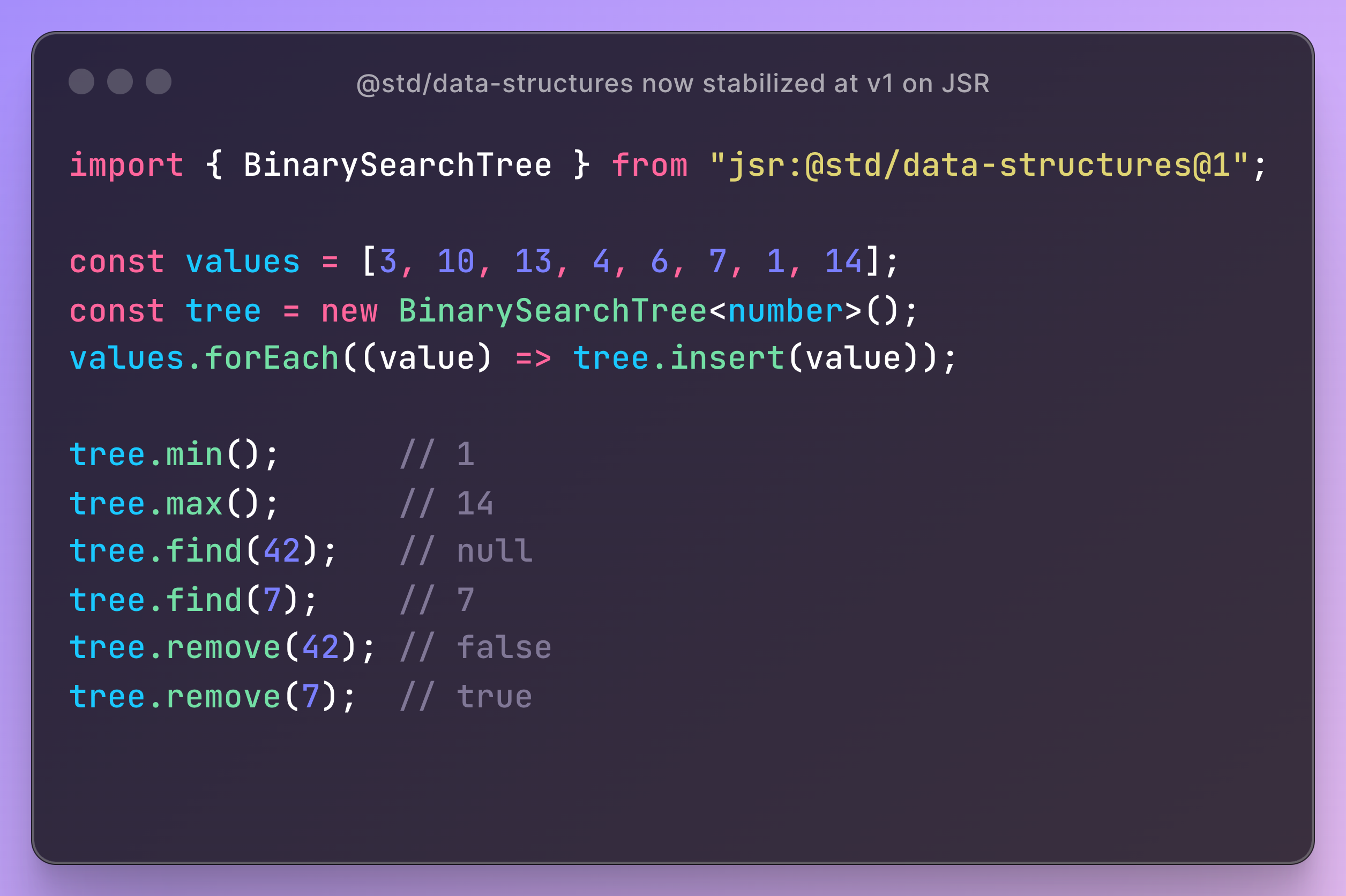

@wraptile@fosstodon.org
#Deno and #Bun people are putting an incredible amount of work modernizing server side js.
The energy is reminding me of early day #Python - so many new tools made with proper care behind rather than most of NodeJS ecosystem which is just glued together with band-aids and staples :blobcatgrimacing:
That being said, after working with Deno for the past week it still feels a bit too bleeding edge though it does work with #jupyter!

@kidsan@hachyderm.io
I find myself in that uncomfortable situation like many others who work in tech lately, and will be looking at a layoff in the next few months. If anyone is aware of cool jobs in Germany, probably remote-first, working with #Go (or even #rustlang #python #node ) please reach out. I have ~9 years of backend experience and consider myself someone who gets shit done. #fedihire
@deno_land@fosstodon.org
🚀 Deno 1.45 is released!
‣ Workspace and monorepo support
‣ Node.js compat improvements
‣ Updates to deno install
‣ deno init --lib
‣ deno vendor deprecation
‣ Standard Library stabilization
‣ V8 12.7 and TypeScript 5.5
Release notes: https://deno.com/blog/v1.45

@cube_drone@mastodon.social
An #introduction.
I'm a backend #node developer in #vancouver, I've been running #vrchat 's backend (badly) since about 2016 (when it was just me). Now it's loads more people!
Most of what I post is not serious or thoughtful. I like my #bengal #cat, I used to make #comics (I'm an extremely mediocre artist) and now perform micro-acts of forgettable #gamedev when I get the chance. I like #boardgames and #alcohol and #coffee and #cooking and #restaurants.

@hongminhee@todon.eu
#LogTape is a logging library for #JavaScript and #TypeScript. It provides a simple and flexible logging system that is easy to use and easy to extend. The highlights of LogTape are:
• Zero dependencies
• Designed to be used in libraries as well as apps
• Supports virtually every runtime: #Node.js, #Deno, #Bun, edge functions, and browsers
• Structured logging
• Logger categories (names) are hierarchical
• Dead simple sink (destination) interface
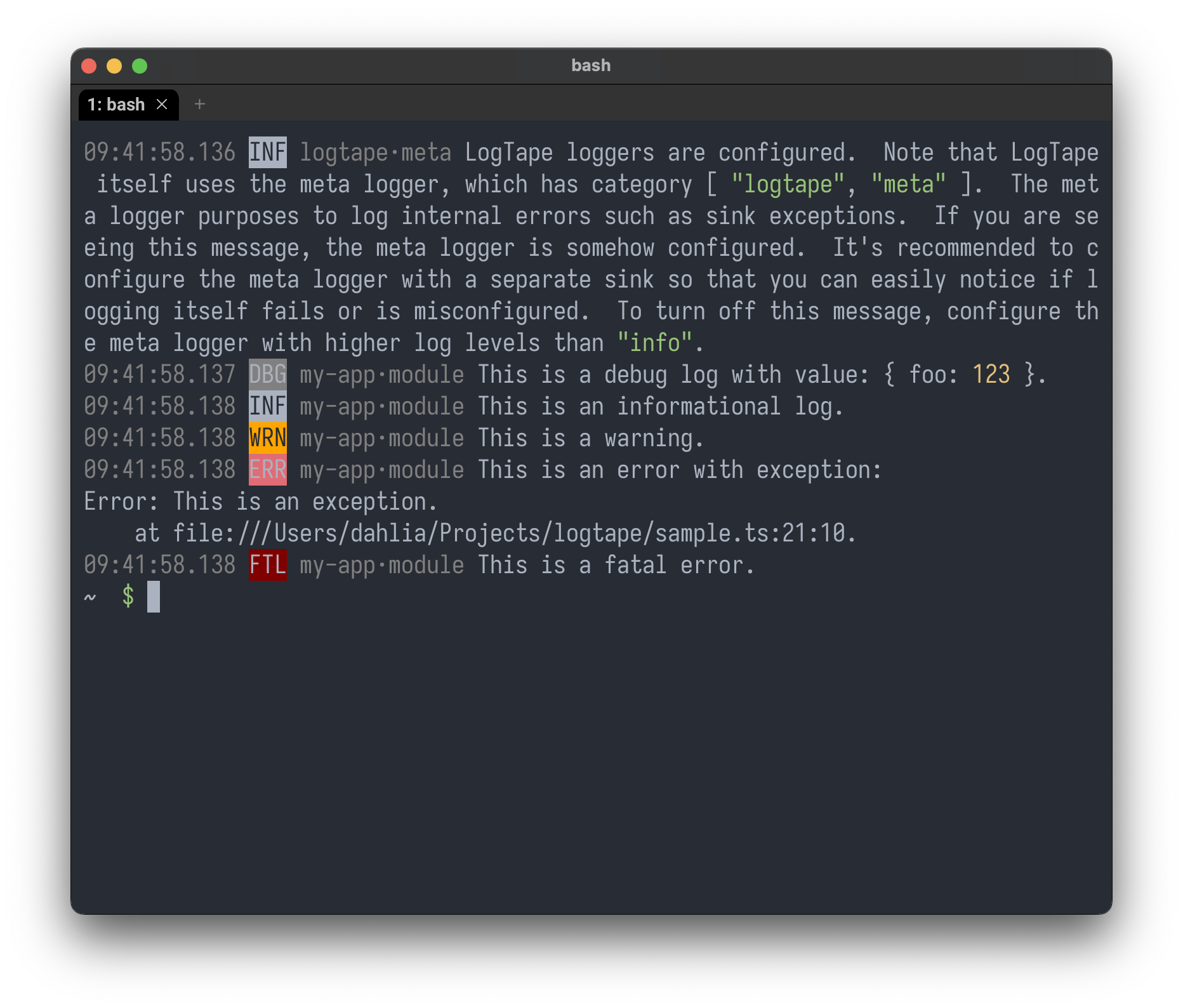
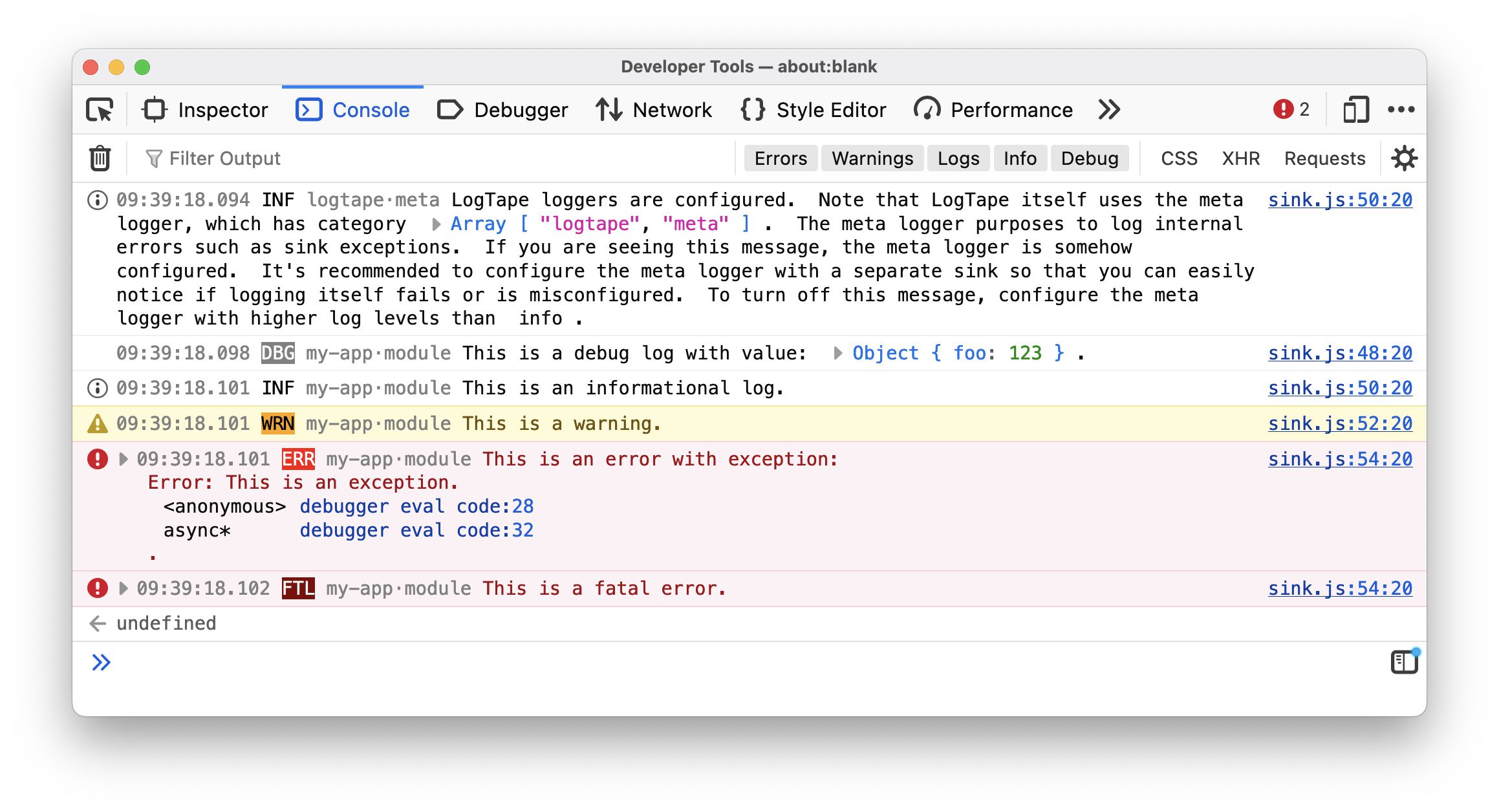
@hongminhee@fosstodon.org
@hongminhee@todon.eu
#Fedify is an #ActivityPub server framework in #TypeScript & #JavaScript. It aims to eliminate the complexity and redundant boilerplate code when building a federated server app, so that you can focus on your business logic and user experience.
The key features it provides currently are:
• Type-safe objects for Activity Vocabulary (including some vendor-specific extensions)
• #WebFinger client and server
• HTTP Signatures
• Middleware for handling webhooks
• #NodeInfo protocol
• #Node.js, #Deno, and #Bun support
• CLI toolchain for testing and debugging
If you're curious, take a look at the Fedify website! There's comprehensive docs, a demo, a tutorial, example code, and more:
@fedify@hollo.social
#Fedify has supported optional queuing for outgoing activities, with two built-in message queue backends: InProcessMessageQueue, which is suitable for development, and DenoKvMessageQueue, which is only available in Deno.
Fedify has also had two built-in cache backends, MemoryKvStore, which is suitable for development, and DenoKvStore, which is only available in Deno.
Now, however, by installing the @fedify/redis package, you can use #Redis as both a message queue backend and a cache backend! Unlike DenoKvMessageQueue and DenoKvStore, it's also available for #Node.js and #Bun.
This feature was made possible with the support of @ghost.
@fedify@hollo.social
Fedify is an #ActivityPub server framework in #TypeScript & #JavaScript. It aims to eliminate the complexity and redundant boilerplate code when building a federated server app, so that you can focus on your business logic and user experience.
The key features it provides currently are:
If you're curious, take a look at the #Fedify website! There's comprehensive docs, a demo, a tutorial, example code, and more:

@pasimako@mastodon.social
How to set up TypeScript with ESLint & Prettier in Node.js from scratch
https://ubuverse.com/setting-up-typescript-with-eslint-prettier/

@ology@fosstodon.org

@martiell@infosec.exchange
Hello, I'm Martin. 👋 Here's a quick #introduction:
🏴 Live in #Edinburgh, #Scotland
🏛 Working for the Scottish Government
🌍 Building www.gov.scot and www.mygov.scot
🎲 #Software Engineer / #Infrastructure / #Devops
☁️ Deploying on #AWS
☕️ Developing with #Java, #Node, #Python