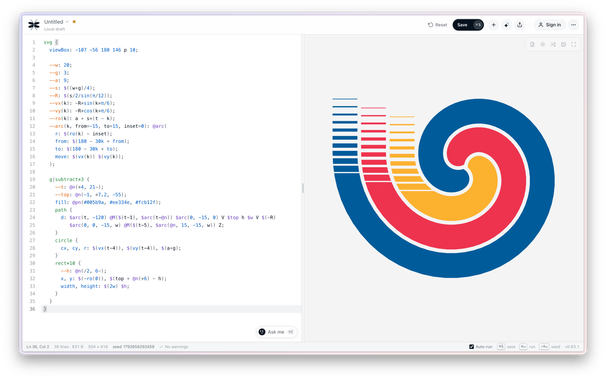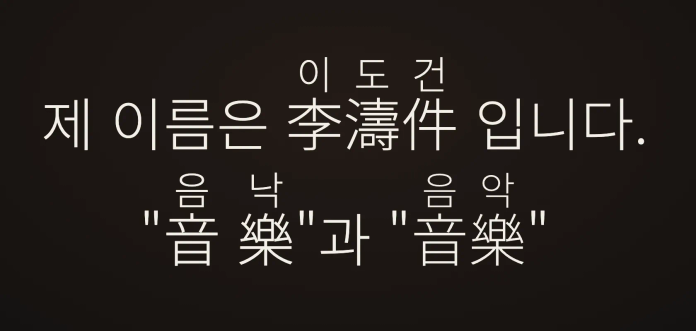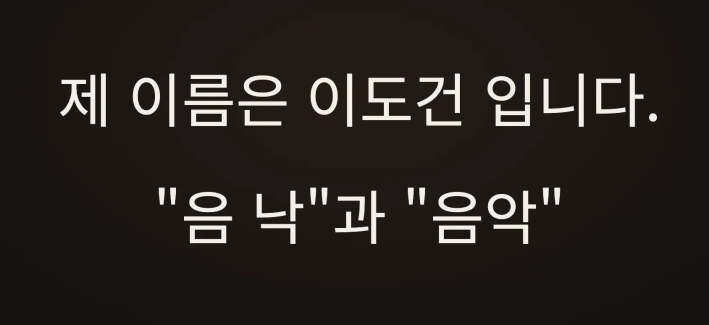



그러고 보면 最近 數年間의 소프트웨어 開發은 거의 다 國漢文混用을 하겠다는 動機에서 始作한 것들이구나…

洪 民憙 (Hong Minhee) 
@hongminhee@hollo.social
1,083 following1,898 followers
An intersectionalist, feminist, and socialist living in Seoul (UTC+09:00). @tokolovesme's spouse. Who's behind @fedify, @hollo, and @botkit. Write some free software in #TypeScript, #Haskell, #Rust, & #Python. They/them.
서울에 사는 交叉女性主義者이자 社會主義者. 金剛兔(@tokolovesme)의 配偶者. @fedify, @hollo, @botkit 메인테이너. #TypeScript, #Haskell, #Rust, #Python 等으로 自由 소프트웨어 만듦.
- Website
- Hackers' Pub
@kodingwarrior 아주 좋은 생각입니다 👏
So on my ONI instance that I've been use as an alternative fediverse profile for myself for about two years, the full storage used is about 3.4G, but out of that there's 2.5G containing mostly the Delete activities of mastodon.social. Crazy.
Shipped and live now: Inbound MOVE handling for ActivityPub in Ghost
So if an account you're following moves somewhere new, Ghost will automatically drop the old account handle and follow the new one.
This is pt2 of adding migration support.
Pt1 was migrating external socialweb profiles into Ghost. Pt3 will be adding outbound migration to move socialweb profile out of Ghost.
Okay, I need to add support for Video objects to Hollo so that users can share or like videos posted on PeerTube. I can't believe I'm only just thinking of this now!
I can't explain how excited I am to be able to speak with @evan@cosocial.ca tomorrow, May 27th at 14:00 US Eastern time (UTC-4).
If you don't know Evan, he is co-editor of ActivityPub, the W3C standard for decentralized social networking used by platforms such as #Mastodon , #Bonfire , #GoToSocial , #Peertube , #Owncast , #Loops , #PixelFed , #Emissary , #Fedify , #FlohMarkt , #Lemmy , #Piefed , #WriteFreely , #Friendica , #GNUSocial , #Threads , #NodeBB , #Funkwhale , #Gancio , #Mobilizon , #BookWyrm , and MANY MANY MANY MORE + whatever YOU create next!
I've been speaking with folks and they've given him a very special nickname. You'll have to tune in tomorrow of catch the #VOD to catch it.
#livestream stream.firesidefedi.live
#vodcast tubefree.org/@firesidefedi
Or follow everything directly with @ozoned@stream.firesidefedi.live and @firesidefedi@tubefree.org
And follow @when@freestreamers.btfree.org for listings of future episodes!
Hackers' Pub now allows you to follow hashtags, and it's deeply integrated with tags.pub!
tags.pub
tags.pub
Hackers' Pub 새 프런트엔드(web-next)에서 해시태그를 팔로할 수 있게 되었습니다. 해시태그를 팔로하면 팔로하지 않은 계정에서 쓴 콘텐츠여도 해당 해시태그가 붙어 있을 경우 피드에 뜨게 됩니다. 또한, 기술적으로는 tags.pub과 연동되어 있어서, 연합우주(fediverse) 전체적으로 해당 해시태그를 추적할 수 있게 되어 있습니다. 참고로 자신이 어떤 해시태그를 팔로하는지는 다른 사람에게 공개되지 않습니다.
해시태그를 팔로하려면 검색창에 #해시태그_이름으로 검색하신 뒤, 검색 결과에서 팔로 버튼을 누르시면 됩니다. 또한, “사이드바에 추가” 버튼까지 누르시면, 좌측 사이드바에서 타임라인 섹션 맨 아래쪽에 해당 해시태그가 추가되어 언제나 쉽게 접근 가능해집니다.
ある
Fedifyで自作のActivityPubサーバーソフトを作ってみるワークショップを開いたら、需要は多少あるかな…?
Fedify로 自作 ActivityPub 서버 소프트웨어를 만들어 보는 워크숍을 開催한다면 需要가 좀 있으려나…?
I first ran into Gentoo in high school, about twenty years ago. I told an upperclassman that I wanted to learn Linux, and he told me to install Gentoo from stage1. His only advice was to print the handbook before starting, because I wasn't going to have a browser in my pocket once the install went wrong.
I had no idea what I was getting into. For almost two weeks, I basically didn't have a working home PC. Every day was the same: fight with the install at night, go to school the next morning, read docs on the school computers, ask him what I'd broken, then go home and try again.
At some point it clicked. By the end I had accidentally learned what a chroot was, how to build a kernel badly, why /etc/fstab mattered, and how easy it was to make a machine not boot. I also picked up Vim somewhere in that stretch, and never stopped.
I don't run Gentoo anymore, but I'm still grateful for those two weeks.
Lately I've been thinking about how #Gentoo is perceived by people. So often they're stuck in the "ricer" mindset: Gentoo is being built from source, so it must be ZOMG fast. And if it isn't, then what's the point?
If I were to make four points for Gentoo (to stop myself from making more), they would be:
1. Gentoo is independent.
There is no company behind Gentoo. There is no business plan. It's made and maintained by volunteers. Driven by passion and not profit incentive. And we want to keep it that way.
2. Gentoo aims to be secure.
We are maintaining our own infrastructure to reduce the risk of being hijacked. We're securing our distribution channels and mirrors using OpenPGP. We're only using Codeberg (which we really appreciate) and GitHub as mirrors (with OpenPGP commit signatures) and contribution channels. We have a dedicated security team, who works with the developers to keep packages free of vulnerabilities and our users informed.
3. Gentoo is made by humans.
We banned LLM contributions two years ago, and never regretted it. We didn't "wait and see", we took decisive action, and if we got left behind, it's only for the better. Unfortunately, in today's LLM-ridden world we can't stop slop software from being packaged in Gentoo without sacrificing our commitment to keep packages up to date, but we try to keep the worst offenders (like copywashed chardet) at bay.
4. Gentoo supports sustainability.
This may sound ironic when so many of us build everything from source, but we're actually trying to make computing sustainable. Gentoo's source-first nature makes it inherently flexible. We try our best to support a plethora of older and less common hardware. We go against the flow and still try to provide a workable system on hardware that is not supported by Rust or V8. And on top of that, we do our best to provide binary packages for a variety of configurations.
Of course, that's not all. I want Gentoo to be reliable and stable, to be oriented towards privacy by default, to be welcome and respectful.
And all these things ultimately depend on people working on Gentoo, and contributing to Gentoo. We always need more people that share these principles and want to help us achieve them.
What do you appreciate in Gentoo?
Lately I've been thinking about how #Gentoo is perceived by people. So often they're stuck in the "ricer" mindset: Gentoo is being built from source, so it must be ZOMG fast. And if it isn't, then what's the point?
If I were to make four points for Gentoo (to stop myself from making more), they would be:
1. Gentoo is independent.
There is no company behind Gentoo. There is no business plan. It's made and maintained by volunteers. Driven by passion and not profit incentive. And we want to keep it that way.
2. Gentoo aims to be secure.
We are maintaining our own infrastructure to reduce the risk of being hijacked. We're securing our distribution channels and mirrors using OpenPGP. We're only using Codeberg (which we really appreciate) and GitHub as mirrors (with OpenPGP commit signatures) and contribution channels. We have a dedicated security team, who works with the developers to keep packages free of vulnerabilities and our users informed.
3. Gentoo is made by humans.
We banned LLM contributions two years ago, and never regretted it. We didn't "wait and see", we took decisive action, and if we got left behind, it's only for the better. Unfortunately, in today's LLM-ridden world we can't stop slop software from being packaged in Gentoo without sacrificing our commitment to keep packages up to date, but we try to keep the worst offenders (like copywashed chardet) at bay.
4. Gentoo supports sustainability.
This may sound ironic when so many of us build everything from source, but we're actually trying to make computing sustainable. Gentoo's source-first nature makes it inherently flexible. We try our best to support a plethora of older and less common hardware. We go against the flow and still try to provide a workable system on hardware that is not supported by Rust or V8. And on top of that, we do our best to provide binary packages for a variety of configurations.
Of course, that's not all. I want Gentoo to be reliable and stable, to be oriented towards privacy by default, to be welcome and respectful.
And all these things ultimately depend on people working on Gentoo, and contributing to Gentoo. We always need more people that share these principles and want to help us achieve them.
What do you appreciate in Gentoo?
Run your own decentralized social platform on shared hosting or a tiny VPS WITHOUT Redis, PostgreSQL, or complex infrastructure.
What it makes so special to me? It looks awesome, comes with a great admin web interface and does not require a VPS instance where it can also be operated on a cheap shared hosting systems. By the given requirements, it also easily runs on a #RaspberryPI and all kind of systems, including #FreeBSD, #OpenBSD, #Illumos and more!
This all makes it perfect to everyone and even beginners to run their own instance. With relay support (e.g., fedi-relay.gyptazy.com) it even can consume and post content over non-directly connected instances in the #fediworld!
Kudos to the author of Starling: @df@s.dfaria.eu
More information:
GitHub project: https://github.com/dfaria-eu/Starling
My blog post: https://gyptazy.com/blog/starling-simple-fediverse-server/
#fedi #fediwall #opensource #decentralized #social #socialmedia #alternatives #mastodon
I'm trying to use Nicolium for my Hollo instance, and it seems to work well!
I'm enjoying using Nicolium https://web.nicolium.app/ a MastoAPI front end.
It has some nice design choices!
I'm enjoying using Nicolium https://web.nicolium.app/ a MastoAPI front end.
It has some nice design choices!
Oh! I didn't mention this here yet, but I've been on a bit of a shipping spree:
Yesterday I published a fairly stable version of light-my-websocket, which does request injection testing for websockets, inspired by light-my-request.
https://npmx.dev/package/light-my-websocket
Later today I'll be publishing a package to assist with setting up an initial package release to configure OIDC Trusted Publishing and staged publishing.
npmx.dev
light-my-websocket - npmx
Like light-my-request, but for WebSockets — synthetic in-process upgrade for testing servers without binding a port.
The pressure via @andrewnez https://lobste.rs/s/dw02ye #culture #programming
https://daniel.haxx.se/blog/2026/05/26/the-pressure/
daniel.haxx.se
The pressure
I'm doing Open Source primarily because I love it. The social aspects, the for-the-good angle and for the challenge of engineering this to work for everyone. I also do it because it is my full-time job and getting food on the table and provide for my family is not unimportant. It may come as a … Continue reading The pressure →
The pressure
for us in the #curl project right now
daniel.haxx.se
The pressure
I'm doing Open Source primarily because I love it. The social aspects, the for-the-good angle and for the challenge of engineering this to work for everyone. I also do it because it is my full-time job and getting food on the table and provide for my family is not unimportant. It may come as a … Continue reading The pressure →
@hongminhee TIL about ReactOS, funny to read the wiki that ReactOS's name is from an IRC chat's dissatisfied "react"ion to Microsoft's monopoly on the PC market.
That was 1998. People were tired of Windows even before the year 2000.
Also interesting to see a couple OS's that attempted to combine Linux and Windows into a single super OS.
Longene (https://wikipedia.org/wiki/Longene)
coLinux (https://wikipedia.org/wiki/Cooperative_Linux)
Both projects were abandoned 10+ years ago.
en.wikipedia.org
Cooperative Linux - Wikipedia
China's online banking has exactly the same issue
there was even a campaign endorsed by the FSF but it went nowhere
those "security plugins" are not just activex browser plugins though, usually they are rootkits
fsf.org
China: Support Bill Xu's campaign opposing proprietary banking requirements — Free Software Foundation — Working together for free software
@ianthetechie Yeah, I actually did use Windows inside a VM! No way I was gonna let it mess up my precious system. 😂 But still, the whole experience of using Windows just sucked.
@Brett_E_Carlock Thank you! 🥰
@derralf I heard ReactOS has been in development for 30 years now, but it sounds like it's still pretty much a bleeding-edge experience. Thanks for sharing your thoughts! I think I'll try installing it on a VM first and play around with it.
@Brett_E_Carlock Thanks for sharing your experience. I should give it a try in a VM too!
@hongminhee I couldn't daily it on my hardware, but it is definitely usable, especially in a VM context.
I'd put it below HaikuOS in terms of daily-driver readiness on hardware, but that is rapidly changing these days. It is advancing really quickly of late.
I've never actually used ReactOS before. Has anyone here tried it? How is it? Is it usable?
Sometimes I have to use Windows (because of South Korea's notorious internet banking issues), and it stresses me out every single time. I really hope ReactOS gets better soon.
If you are working on Fediverse software, you might have heard about FEP-8a8e, which is an upcoming standard to unitize how events (as in gatherings of people) are shared via ActivityPub.
I'm currently working on a cool new validation tool that is supposed to help developers write correct implementations of this standard:
https://validate.event-federation.eu/
🧵1/7

ALT text
A screenshot from https://validate.event-federation.eu/ Verify your ActivityStreams Event object for FEP-8a8e compliance FEP-8a8e is a standardisation attempt about the way the Fediverse talks about Events. Enter any URL or JSON here... ...or pick one of these examples: « Discover Hoop Dance - Workshop fiir FLINTA* only from the Mobilizon instance fomobremen.info « BIGG EGG + COMPUTER + LIFELINE + JAVA from the Gancio instance montreal.askapunk.net + FOSDEM - BOF/Unconference: Shaping the Future of Events and Calendars in the Fediverse from the event- federation.eu website using the ActivityPub Plugin for Gatherpress