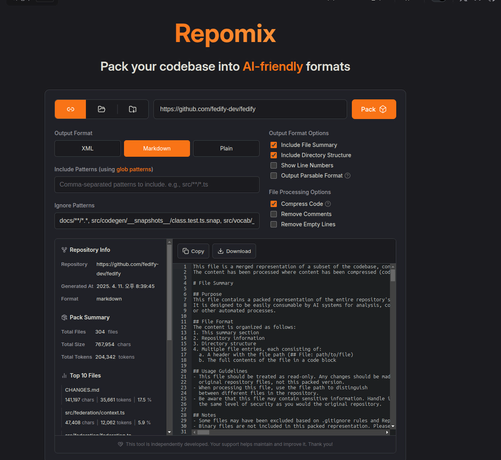
Fedify is a TypeScript library for building federated server apps powered by ActivityPub and other standards, so-called fediverse. It aims to eliminate the complexity and redundant boilerplate code when building a federated server app, so that you can focus on your business logic and user experience.
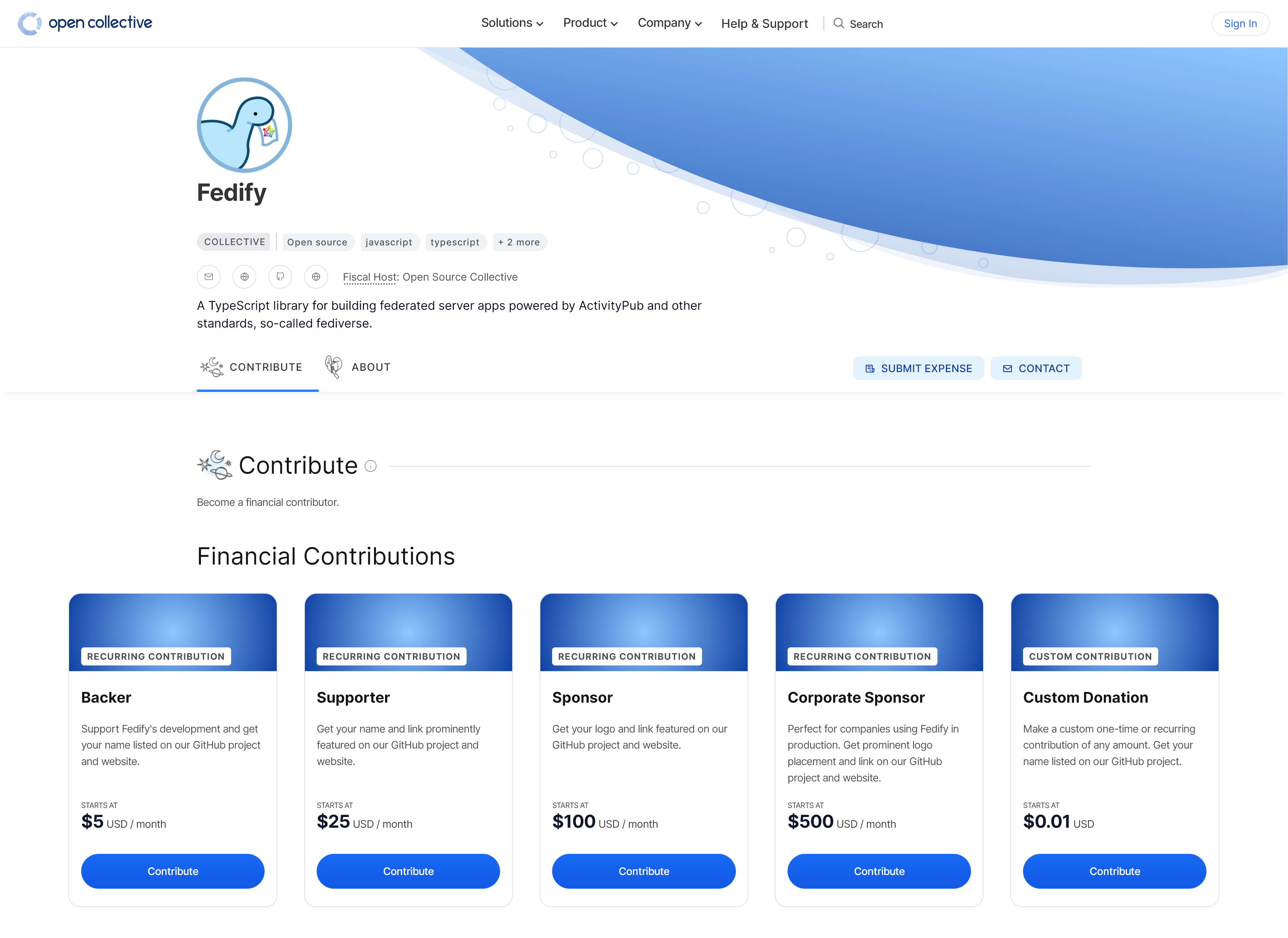
Fedify's Open Collective page showing the project logo, description as “A TypeScript library for building federated server apps powered by ActivityPub and other standards”, and five contribution tiers starting from $5/month Backer to $500/month Corporate Sponsor, with custom contribution options available.
Fedify is an #ActivityPub server framework in #TypeScript & #JavaScript. It aims to eliminate the complexity and redundant boilerplate code when building a federated server app, so that you can focus on your business logic and user experience.
The key features it provides currently are:
Type-safe objects for Activity Vocabulary (including some vendor-specific extensions)
I should suck it up and learn to program properly in TypeScript. There's a growing list of software that I'd like to use and extend that uses TypeScript (Obsidian, Lume, Fedify), not to mention its utility for web programming. The language itself is pretty good, though I'm not thrilled by a lot of the tooling and ecosystem around it. Hopefully there's a way of writing usable code in it that keeps the messiness at bay.
Show GN: 나만의 연합우주(fediverse) 마이크로블로그 만들기 ------------------------------ 이 튜토리얼은 [Fedify] 라이브러리를 사용하여 [ActivityPub] 프로토콜 기반의 마이크로블로그 서비스를 구현하는 방법을 설명합니다. ActivityPub은 다양한 소셜 네트워크 서비스들이 서로 연동될 수 있게 해주는 분산형 소셜 네트워킹 프로토콜로, 이를 통해 [Mastodon], [Misskey] 같은 서비스와 상호작용할 수 있는 독… ------------------------------ https://news.hada.io/topic?id=20508&utm_source=googlechat&utm_medium=bot&utm_campaign=1834
Hey folks! We're excited to share a preview of a new API coming in #Fedify 1.6 that should make structuring larger federated apps much cleaner: FederationBuilder.
As your Fedify applications grow, you might encounter circular dependency issues when registering dispatchers and listeners across multiple files. The new FederationBuilder pattern helps solve this by separating the configuration phase from instantiation.
Instead of this:
// federation.ts
import { createFederation } from "@fedify/fedify";

export const federation = createFederation<AppContext>({
  kv: new DbKvStore(),
  queue: new RedisMessageQueue(),
  // Other options...
});

// Now we need to import this federation instance in other files
// to register dispatchers and listeners...
You can now do this:
// builder.ts
import { createFederationBuilder } from "@fedify/fedify";

export const builder = createFederationBuilder<AppContext>();

// other files can import and configure this builder...
// actors.ts
import { builder } from "./builder.ts";
import { Person } from "@fedify/fedify";

builder.setActorDispatcher("/users/{handle}", async (ctx, handle) => {
  // Actor implementation
});
// main.ts — Only create the Federation instance at startup
import { builder } from "./builder.ts";

// Build the Federation object with actual dependencies
export const federation = await builder.build({
  kv: new DbKvStore(),
  queue: new RedisMessageQueue(),
  // Other options...
});
This pattern helps avoid circular dependencies and makes your code more modular. Each part of your app can configure the builder without needing the actual Federation instance.
The full documentation will be available when 1.6 is released, but we wanted to share this early with our community. Looking forward to your feedback when it lands!
Want to try it right now? You can install the development version from JSR or npm:
# Deno
deno add jsr:@fedify/fedify@1.6.0-dev.777+1206cb01

# Node.js
npm add @fedify/fedify@1.6.0-dev.777

# Bun
bun add @fedify/fedify@1.6.0-dev.777
Hey folks! We're excited to share a preview of a new API coming in #Fedify 1.6 that should make structuring larger federated apps much cleaner: FederationBuilder.
As your Fedify applications grow, you might encounter circular dependency issues when registering dispatchers and listeners across multiple files. The new FederationBuilder pattern helps solve this by separating the configuration phase from instantiation.
Instead of this:
// federation.ts
import { createFederation } from "@fedify/fedify";

export const federation = createFederation<AppContext>({
  kv: new DbKvStore(),
  queue: new RedisMessageQueue(),
  // Other options...
});

// Now we need to import this federation instance in other files
// to register dispatchers and listeners...
You can now do this:
// builder.ts
import { createFederationBuilder } from "@fedify/fedify";

export const builder = createFederationBuilder<AppContext>();

// other files can import and configure this builder...
// actors.ts
import { builder } from "./builder.ts";
import { Person } from "@fedify/fedify";

builder.setActorDispatcher("/users/{handle}", async (ctx, handle) => {
  // Actor implementation
});
// main.ts — Only create the Federation instance at startup
import { builder } from "./builder.ts";

// Build the Federation object with actual dependencies
export const federation = await builder.build({
  kv: new DbKvStore(),
  queue: new RedisMessageQueue(),
  // Other options...
});
This pattern helps avoid circular dependencies and makes your code more modular. Each part of your app can configure the builder without needing the actual Federation instance.
The full documentation will be available when 1.6 is released, but we wanted to share this early with our community. Looking forward to your feedback when it lands!
Want to try it right now? You can install the development version from JSR or npm:
# Deno
deno add jsr:@fedify/fedify@1.6.0-dev.777+1206cb01

# Node.js
npm add @fedify/fedify@1.6.0-dev.777

# Bun
bun add @fedify/fedify@1.6.0-dev.777
In case you weren't aware, #Fedify has both #Discord and #Matrix communities where you can get help, discuss features, or just chat about #ActivityPub and federated social networks.
As social networks build walls, Fedify creates critical infrastructure for an open web. Their tools simplify federation protocols, making decentralized communication accessible.
Don't build #ActivityPub from scratch! It's complex. See why using the #Fedify framework is the smarter way to develop for the fediverse in my new post:
So, you're captivated by the fediverse—the decentralized social web powered by protocols like ActivityPub. Maybe you're dreaming of building the next great federated app, a unique space connected to Mastodon, Lemmy, Pixelfed, and more. The temptation to dive deep and implement ActivityPub yourself, from the ground up, is strong. Total control, right? Understanding every byte? Sounds cool!
But hold on a sec. Before you embark on that epic quest, let's talk reality. Implementing ActivityPub correctly isn't just one task; it's like juggling several complex standards while riding a unicycle… blindfolded. It’s hard.
That's where Fedify comes in. It's a TypeScript framework designed to handle the gnarliest parts of ActivityPub development, letting you focus on what makes your app special, not reinventing the federation wheel.
This post will break down the common headaches of DIY ActivityPub implementation and show how Fedify acts as the super-powered pain reliever, starting with the very foundation of how data is represented.
Challenge #1: Data Modeling—Speaking ActivityStreams & JSON-LD Fluently
At its core, ActivityPub relies on the ActivityStreams 2.0 vocabulary to describe actions and objects, and it uses JSON-LD as the syntax to encode this vocabulary. While powerful, this combination introduces significant complexity right from the start.
First, understanding and correctly using the vast ActivityStreams vocabulary itself is a hurdle. You need to model everything—posts (Note, Article), profiles (Person, Organization), actions (Create, Follow, Like, Announce)—using the precise terms and properties defined in the specification. Manual JSON construction is tedious and prone to errors.
Second, JSON-LD, the encoding layer, has specific rules that make direct JSON manipulation surprisingly tricky:
Missing vs. Empty Array: In JSON-LD, a property being absent is often semantically identical to it being present with an empty array. Your application logic needs to treat these cases equally when checking for values. For example, these two Note objects mean the same thing regarding the name property:
// No name property{ "@context": "https://www.w3.org/ns/activitystreams", "type": "Note", "content": "…"}
Single Value vs. Array: Similarly, a property holding a single value directly is often equivalent to it holding a single-element array containing that value. Your code must anticipate both representations for the same meaning, like for the content property here:
// Single value{ "@context": "https://www.w3.org/ns/activitystreams", "type": "Note", "content": "Hello"}
Object Reference vs. Embedded Object: Properties can contain either the full JSON-LD object embedded directly or just a URI string referencing that object. Your application needs to be prepared to fetch the object's data if only a URI is given (a process called dereferencing). These two Announce activities are semantically equivalent (assuming the URIs resolve correctly):
Attempting to manually handle all these vocabulary rules and JSON-LD variations consistently across your application inevitably leads to verbose, complex, and fragile code, ripe for subtle bugs that break federation.
Fedify tackles this entire data modeling challenge with its comprehensive, type-safe Activity Vocabulary API. It provides TypeScript classes for ActivityStreams types and common extensions, giving you autocompletion and compile-time safety. Crucially, these classes internally manage all the tricky JSON-LD nuances. Fedify's property accessors present a consistent interface—non-functional properties (like tags) always return arrays, functional properties (like content) always return single values or null. It handles object references versus embedded objects seamlessly through dereferencing accessors (like activity.getActor()) which automatically fetch remote objects via URI when needed—a feature known as property hydration. With Fedify, you work with a clean, predictable TypeScript API, letting the framework handle the messy details of AS vocabulary and JSON-LD encoding.
Challenge #2: Discovery & Identity—Finding Your Actors
Once you can model data, you need to make your actors discoverable. This primarily involves the WebFinger protocol (RFC 7033). You'd need to build a server endpoint at /.well-known/webfinger capable of parsing resource queries (like acct: URIs), validating the requested domain against your server, and responding with a precisely formatted JSON Resource Descriptor (JRD). This JRD must include specific links, like a self link pointing to the actor's ActivityPub ID using the correct media type. Getting any part of this wrong can make your actors invisible.
Fedify simplifies this significantly. It automatically handles WebFinger requests based on the actor information you provide through its setActorDispatcher() method. Fedify generates the correct JRD response. If you need more advanced control, like mapping user-facing handles to internal identifiers, you can easily register mapHandle() or mapAlias() callbacks. You focus on defining your actors; Fedify handles making them discoverable.
// Example: Define how to find actorsfederation.setActorDispatcher( "/users/{username}", async (ctx, username) => { /* ... */ });// Now GET /.well-known/webfinger?resource=acct:username@your.domain just works!
Challenge #3: Core ActivityPub Mechanics—Handling Requests and Collections
Serving actor profiles requires careful content negotiation. A request for an actor's ID needs JSON-LD for machine clients (Accept: application/activity+json) but HTML for browsers (Accept: text/html). Handling incoming activities at the inbox endpoint involves validating POST requests, verifying cryptographic signatures, parsing the payload, preventing duplicates (idempotency), and routing based on activity type. Implementing collections (outbox, followers, etc.) with correct pagination adds another layer.
Fedify streamlines all of this. Its core request handler (via Federation.fetch() or framework adapters like @fedify/express) manages content negotiation. You define actors with setActorDispatcher() and web pages with your framework (Hono, Express, SvelteKit, etc.)—Fedify routes appropriately. For the inbox, setInboxListeners() lets you define handlers per activity type (e.g., .on(Follow, ...)), while Fedify automatically handles validation, signature verification, parsing, and idempotency checks using its KV Store. Collection implementation is simplified via dispatchers (e.g., setFollowersDispatcher()); you provide logic to fetch a page of data, and Fedify constructs the correct Collection or CollectionPage with pagination.
Sending an activity requires more than a simple POST. Networks fail, servers go down. You need robust failure handling and retry logic (ideally with backoff). Processing incoming activities synchronously can block your server. Efficiently broadcasting to many followers (fan-out) requires background processing and using shared inboxes where possible.
Fedify addresses reliability and scalability using its MessageQueue abstraction. When configured (highly recommended), Context.sendActivity() enqueues delivery tasks. Background workers handle sending with automatic retries based on configurable policies (like outboxRetryPolicy). Fedify supports various queue backends (Deno KV, Redis, PostgreSQL, AMQP). For high-traffic fan-out, Fedify uses an optimized two-stage mechanism to distribute the load efficiently.
// Configure Fedify with a persistent queue (e.g., Deno KV)const federation = createFederation({ queue: new DenoKvMessageQueue(/* ... */), // ...});// Sending is now reliable and non-blockingawait ctx.sendActivity({ handle: "myUser" }, recipient, someActivity);
Fedify is designed with security in mind. It automatically handles the creation and verification of HTTP Signatures, LDS, and OIP, provided you supply keys via setKeyPairsDispatcher(). It includes key management utilities. Crucially, Fedify's default document loader includes built-in SSRF protection, blocking requests to private IPs unless explicitly allowed.
Challenge #6: Interoperability & Maintenance—Playing Nicely with Others
The fediverse is diverse. Different servers have quirks. Ensuring compatibility requires testing and adaptation. Standards evolve with new Federation Enhancement Proposals (FEPs). You also need protocols like NodeInfo to advertise server capabilities.
Fedify aims for broad interoperability and is actively maintained. It includes features like ActivityTransformers to smooth over implementation differences. NodeInfo support is built-in via setNodeInfoDispatcher().
Challenge #7: Developer Experience—Actually Building Your App
Beyond the protocol, building any server involves setup, testing, and debugging. With federation, debugging becomes harder—was the message malformed? Was the signature wrong? Is the remote server down? Is it a compatibility quirk? Good tooling is essential.
Fedify enhances the developer experience significantly. Being built with TypeScript, it offers excellent type safety and editor auto-completion. The fedify CLI is a powerful companion designed to streamline common development tasks.
You can quickly scaffold a new project tailored to your chosen runtime and web framework using fedify init.
For debugging interactions and verifying data, fedify lookup is invaluable. It lets you inspect how any remote actor or object appears from the outside by performing WebFinger discovery and fetching the object's data. Fedify then displays the parsed object structure and properties directly in your terminal. For example, running:
Will first show progress messages and then output the structured representation of the actor, similar to this:
// Output of fedify lookup command (shows parsed object structure)Person { id: URL "https://fedify-blog.deno.dev/users/fedify-example", name: "Fedify Example Blog", published: 2024-03-03T13:18:11.857Z, // Simplified timestamp summary: "This blog is powered by Fedify, a fediverse server framework.", url: URL "https://fedify-blog.deno.dev/", preferredUsername: "fedify-example", publicKey: CryptographicKey { id: URL "https://fedify-blog.deno.dev/users/fedify-example#main-key", owner: URL "https://fedify-blog.deno.dev/users/fedify-example", publicKey: CryptoKey { /* ... CryptoKey details ... */ } }, // ... other properties like inbox, outbox, followers, endpoints ...}
This allows you to easily check how data is structured or troubleshoot why an interaction might be failing by seeing the actual properties Fedify parsed.
Testing outgoing activities from your application during development is made much easier with fedify inbox. Running the command starts a temporary local server that acts as a publicly accessible inbox, displaying key information about the temporary actor it creates for receiving messages:
$ fedify inbox✔ The ephemeral ActivityPub server is up and running: https://<unique_id>.lhr.life/✔ Sent follow request to @<some_test_account>@activitypub.academy.╭───────────────┬─────────────────────────────────────────╮│ Actor handle: │ i@<unique_id>.lhr.life │├───────────────┼─────────────────────────────────────────┤│ Actor URI: │ https://<unique_id>.lhr.life/i │├───────────────┼─────────────────────────────────────────┤│ Actor inbox: │ https://<unique_id>.lhr.life/i/inbox │├───────────────┼─────────────────────────────────────────┤│ Shared inbox: │ https://<unique_id>.lhr.life/inbox │╰───────────────┴─────────────────────────────────────────╯Web interface available at: http://localhost:8000/
You then configure your developing application to send an activity to the Actor inbox or Shared inbox URI provided. When an activity arrives, fedify inboxonly prints a summary table to your console indicating that a request was received:
Crucially, the detailed information about the received request—including the full headers (like Signature), the request body (the Activity JSON), and the signature verification status—is only available in the web interface provided by fedify inbox. This web UI allows you to thoroughly inspect incoming activities during development.
The Fedify Inbox web UI is where you view detailed activity information.
When you need to test interactions with the live fediverse from your local machine beyond just sending, fedify tunnel can securely expose your entire local development server temporarily. This suite of tools significantly eases the process of building and debugging federated applications.
Conclusion: Build Features, Not Plumbing
Implementing the ActivityPub suite of protocols from scratch is an incredibly complex and time-consuming undertaking. It involves deep dives into multiple technical specifications, cryptographic signing, security hardening, and navigating the nuances of a diverse ecosystem. While educational, it dramatically slows down the process of building the actual, unique features of your federated application.
Fedify offers a well-architected, secure, and type-safe foundation, handling the intricacies of federation for you—data modeling, discovery, core mechanics, delivery, security, and interoperability. It lets you focus on your application's unique value and user experience. Stop wrestling with low-level protocol details and start building your vision for the fediverse faster and more reliably. Give Fedify a try!
Getting started is straightforward. First, install the Fedify CLI using your preferred method. Once installed, create a new project template by running fedify init your-project-name.
So, you're captivated by the fediverse—the decentralized social web powered by protocols like ActivityPub. Maybe you're dreaming of building the next great federated app, a unique space connected to Mastodon, Lemmy, Pixelfed, and more. The temptation to dive deep and implement ActivityPub yourself, from the ground up, is strong. Total control, right? Understanding every byte? Sounds cool!
But hold on a sec. Before you embark on that epic quest, let's talk reality. Implementing ActivityPub correctly isn't just one task; it's like juggling several complex standards while riding a unicycle… blindfolded. It’s hard.
That's where Fedify comes in. It's a TypeScript framework designed to handle the gnarliest parts of ActivityPub development, letting you focus on what makes your app special, not reinventing the federation wheel.
This post will break down the common headaches of DIY ActivityPub implementation and show how Fedify acts as the super-powered pain reliever, starting with the very foundation of how data is represented.
Challenge #1: Data Modeling—Speaking ActivityStreams & JSON-LD Fluently
At its core, ActivityPub relies on the ActivityStreams 2.0 vocabulary to describe actions and objects, and it uses JSON-LD as the syntax to encode this vocabulary. While powerful, this combination introduces significant complexity right from the start.
First, understanding and correctly using the vast ActivityStreams vocabulary itself is a hurdle. You need to model everything—posts (Note, Article), profiles (Person, Organization), actions (Create, Follow, Like, Announce)—using the precise terms and properties defined in the specification. Manual JSON construction is tedious and prone to errors.
Second, JSON-LD, the encoding layer, has specific rules that make direct JSON manipulation surprisingly tricky:
Missing vs. Empty Array: In JSON-LD, a property being absent is often semantically identical to it being present with an empty array. Your application logic needs to treat these cases equally when checking for values. For example, these two Note objects mean the same thing regarding the name property:
// No name property{ "@context": "https://www.w3.org/ns/activitystreams", "type": "Note", "content": "…"}
Single Value vs. Array: Similarly, a property holding a single value directly is often equivalent to it holding a single-element array containing that value. Your code must anticipate both representations for the same meaning, like for the content property here:
// Single value{ "@context": "https://www.w3.org/ns/activitystreams", "type": "Note", "content": "Hello"}
Object Reference vs. Embedded Object: Properties can contain either the full JSON-LD object embedded directly or just a URI string referencing that object. Your application needs to be prepared to fetch the object's data if only a URI is given (a process called dereferencing). These two Announce activities are semantically equivalent (assuming the URIs resolve correctly):
Attempting to manually handle all these vocabulary rules and JSON-LD variations consistently across your application inevitably leads to verbose, complex, and fragile code, ripe for subtle bugs that break federation.
Fedify tackles this entire data modeling challenge with its comprehensive, type-safe Activity Vocabulary API. It provides TypeScript classes for ActivityStreams types and common extensions, giving you autocompletion and compile-time safety. Crucially, these classes internally manage all the tricky JSON-LD nuances. Fedify's property accessors present a consistent interface—non-functional properties (like tags) always return arrays, functional properties (like content) always return single values or null. It handles object references versus embedded objects seamlessly through dereferencing accessors (like activity.getActor()) which automatically fetch remote objects via URI when needed—a feature known as property hydration. With Fedify, you work with a clean, predictable TypeScript API, letting the framework handle the messy details of AS vocabulary and JSON-LD encoding.
Challenge #2: Discovery & Identity—Finding Your Actors
Once you can model data, you need to make your actors discoverable. This primarily involves the WebFinger protocol (RFC 7033). You'd need to build a server endpoint at /.well-known/webfinger capable of parsing resource queries (like acct: URIs), validating the requested domain against your server, and responding with a precisely formatted JSON Resource Descriptor (JRD). This JRD must include specific links, like a self link pointing to the actor's ActivityPub ID using the correct media type. Getting any part of this wrong can make your actors invisible.
Fedify simplifies this significantly. It automatically handles WebFinger requests based on the actor information you provide through its setActorDispatcher() method. Fedify generates the correct JRD response. If you need more advanced control, like mapping user-facing handles to internal identifiers, you can easily register mapHandle() or mapAlias() callbacks. You focus on defining your actors; Fedify handles making them discoverable.
// Example: Define how to find actorsfederation.setActorDispatcher( "/users/{username}", async (ctx, username) => { /* ... */ });// Now GET /.well-known/webfinger?resource=acct:username@your.domain just works!
Challenge #3: Core ActivityPub Mechanics—Handling Requests and Collections
Serving actor profiles requires careful content negotiation. A request for an actor's ID needs JSON-LD for machine clients (Accept: application/activity+json) but HTML for browsers (Accept: text/html). Handling incoming activities at the inbox endpoint involves validating POST requests, verifying cryptographic signatures, parsing the payload, preventing duplicates (idempotency), and routing based on activity type. Implementing collections (outbox, followers, etc.) with correct pagination adds another layer.
Fedify streamlines all of this. Its core request handler (via Federation.fetch() or framework adapters like @fedify/express) manages content negotiation. You define actors with setActorDispatcher() and web pages with your framework (Hono, Express, SvelteKit, etc.)—Fedify routes appropriately. For the inbox, setInboxListeners() lets you define handlers per activity type (e.g., .on(Follow, ...)), while Fedify automatically handles validation, signature verification, parsing, and idempotency checks using its KV Store. Collection implementation is simplified via dispatchers (e.g., setFollowersDispatcher()); you provide logic to fetch a page of data, and Fedify constructs the correct Collection or CollectionPage with pagination.
Sending an activity requires more than a simple POST. Networks fail, servers go down. You need robust failure handling and retry logic (ideally with backoff). Processing incoming activities synchronously can block your server. Efficiently broadcasting to many followers (fan-out) requires background processing and using shared inboxes where possible.
Fedify addresses reliability and scalability using its MessageQueue abstraction. When configured (highly recommended), Context.sendActivity() enqueues delivery tasks. Background workers handle sending with automatic retries based on configurable policies (like outboxRetryPolicy). Fedify supports various queue backends (Deno KV, Redis, PostgreSQL, AMQP). For high-traffic fan-out, Fedify uses an optimized two-stage mechanism to distribute the load efficiently.
// Configure Fedify with a persistent queue (e.g., Deno KV)const federation = createFederation({ queue: new DenoKvMessageQueue(/* ... */), // ...});// Sending is now reliable and non-blockingawait ctx.sendActivity({ handle: "myUser" }, recipient, someActivity);
Fedify is designed with security in mind. It automatically handles the creation and verification of HTTP Signatures, LDS, and OIP, provided you supply keys via setKeyPairsDispatcher(). It includes key management utilities. Crucially, Fedify's default document loader includes built-in SSRF protection, blocking requests to private IPs unless explicitly allowed.
Challenge #6: Interoperability & Maintenance—Playing Nicely with Others
The fediverse is diverse. Different servers have quirks. Ensuring compatibility requires testing and adaptation. Standards evolve with new Federation Enhancement Proposals (FEPs). You also need protocols like NodeInfo to advertise server capabilities.
Fedify aims for broad interoperability and is actively maintained. It includes features like ActivityTransformers to smooth over implementation differences. NodeInfo support is built-in via setNodeInfoDispatcher().
Challenge #7: Developer Experience—Actually Building Your App
Beyond the protocol, building any server involves setup, testing, and debugging. With federation, debugging becomes harder—was the message malformed? Was the signature wrong? Is the remote server down? Is it a compatibility quirk? Good tooling is essential.
Fedify enhances the developer experience significantly. Being built with TypeScript, it offers excellent type safety and editor auto-completion. The fedify CLI is a powerful companion designed to streamline common development tasks.
You can quickly scaffold a new project tailored to your chosen runtime and web framework using fedify init.
For debugging interactions and verifying data, fedify lookup is invaluable. It lets you inspect how any remote actor or object appears from the outside by performing WebFinger discovery and fetching the object's data. Fedify then displays the parsed object structure and properties directly in your terminal. For example, running:
Will first show progress messages and then output the structured representation of the actor, similar to this:
// Output of fedify lookup command (shows parsed object structure)Person { id: URL "https://fedify-blog.deno.dev/users/fedify-example", name: "Fedify Example Blog", published: 2024-03-03T13:18:11.857Z, // Simplified timestamp summary: "This blog is powered by Fedify, a fediverse server framework.", url: URL "https://fedify-blog.deno.dev/", preferredUsername: "fedify-example", publicKey: CryptographicKey { id: URL "https://fedify-blog.deno.dev/users/fedify-example#main-key", owner: URL "https://fedify-blog.deno.dev/users/fedify-example", publicKey: CryptoKey { /* ... CryptoKey details ... */ } }, // ... other properties like inbox, outbox, followers, endpoints ...}
This allows you to easily check how data is structured or troubleshoot why an interaction might be failing by seeing the actual properties Fedify parsed.
Testing outgoing activities from your application during development is made much easier with fedify inbox. Running the command starts a temporary local server that acts as a publicly accessible inbox, displaying key information about the temporary actor it creates for receiving messages:
$ fedify inbox✔ The ephemeral ActivityPub server is up and running: https://<unique_id>.lhr.life/✔ Sent follow request to @<some_test_account>@activitypub.academy.╭───────────────┬─────────────────────────────────────────╮│ Actor handle: │ i@<unique_id>.lhr.life │├───────────────┼─────────────────────────────────────────┤│ Actor URI: │ https://<unique_id>.lhr.life/i │├───────────────┼─────────────────────────────────────────┤│ Actor inbox: │ https://<unique_id>.lhr.life/i/inbox │├───────────────┼─────────────────────────────────────────┤│ Shared inbox: │ https://<unique_id>.lhr.life/inbox │╰───────────────┴─────────────────────────────────────────╯Web interface available at: http://localhost:8000/
You then configure your developing application to send an activity to the Actor inbox or Shared inbox URI provided. When an activity arrives, fedify inboxonly prints a summary table to your console indicating that a request was received:
Crucially, the detailed information about the received request—including the full headers (like Signature), the request body (the Activity JSON), and the signature verification status—is only available in the web interface provided by fedify inbox. This web UI allows you to thoroughly inspect incoming activities during development.
The Fedify Inbox web UI is where you view detailed activity information.
When you need to test interactions with the live fediverse from your local machine beyond just sending, fedify tunnel can securely expose your entire local development server temporarily. This suite of tools significantly eases the process of building and debugging federated applications.
Conclusion: Build Features, Not Plumbing
Implementing the ActivityPub suite of protocols from scratch is an incredibly complex and time-consuming undertaking. It involves deep dives into multiple technical specifications, cryptographic signing, security hardening, and navigating the nuances of a diverse ecosystem. While educational, it dramatically slows down the process of building the actual, unique features of your federated application.
Fedify offers a well-architected, secure, and type-safe foundation, handling the intricacies of federation for you—data modeling, discovery, core mechanics, delivery, security, and interoperability. It lets you focus on your application's unique value and user experience. Stop wrestling with low-level protocol details and start building your vision for the fediverse faster and more reliably. Give Fedify a try!
Getting started is straightforward. First, install the Fedify CLI using your preferred method. Once installed, create a new project template by running fedify init your-project-name.
Fetching remote #ActivityPub objects or actors often involves handling #WebFinger lookups, content negotiation, and then parsing potentially untyped JSON.
With #Fedify, it's much simpler: use Context.lookupObject(). Pass it a URI (e.g., https://instance.tld/users/alice) or a handle (e.g., @alice@instance.tld), and Fedify handles the lookup and content negotiation automatically.
The real power comes from the return value: a type-safe Activity Vocabulary object, not just raw JSON. This allows you to confidently access properties and methods directly. For example, you can safely traverse account moves using .getSuccessor() like this:
let actor = await ctx.lookupObject("@alice@instance.tld");
while (isActor(actor)) {
  const successor = await actor.getSuccessor();
  if (successor == null) break;
  actor = successor;
}
// actor now holds the latest account after moves
This is a significant milestone for our project, and we're deeply grateful to @johnonolan and the entire Ghost team for their support and recognition of our work in the #ActivityPub ecosystem.
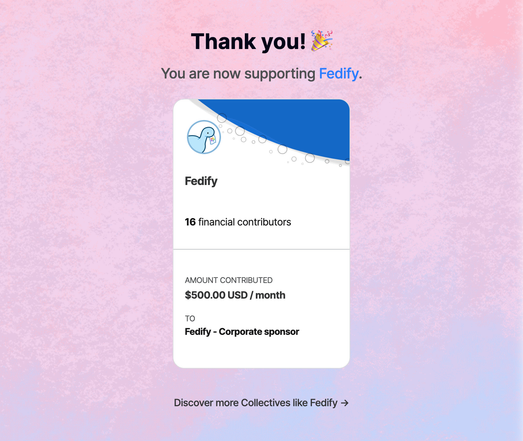
Ghost's social web integration built on #Fedify is a perfect example of how open standards can connect different publishing platforms in the fediverse. Their backing over the past months has been invaluable, and this formal sponsorship will help ensure Fedify remains sustainable as we continue to develop and improve the framework.
If you're building with ActivityPub or interested in federated applications, please consider joining Ghost in supporting open source development through our Open Collective:
Every contribution, no matter the size, helps us maintain and enhance the tools that make the fediverse more accessible to developers. Thank you for being part of this journey with us! ❤️
Ghost's social web integration is built on the fantastic work of @hongminhee and the Fedify.dev framework.
We've been backing work on the project for 6 months or so, and now we're thrilled to be formal sponsor of the project on Open Collective!
If you're building with Fedify and ActivityPub, please consider joining us to keep helping to make great open source work sustainable ❤️ Every little helps
This is a significant milestone for our project, and we're deeply grateful to @johnonolan and the entire Ghost team for their support and recognition of our work in the #ActivityPub ecosystem.
Ghost's social web integration built on #Fedify is a perfect example of how open standards can connect different publishing platforms in the fediverse. Their backing over the past months has been invaluable, and this formal sponsorship will help ensure Fedify remains sustainable as we continue to develop and improve the framework.
If you're building with ActivityPub or interested in federated applications, please consider joining Ghost in supporting open source development through our Open Collective:
Every contribution, no matter the size, helps us maintain and enhance the tools that make the fediverse more accessible to developers. Thank you for being part of this journey with us! ❤️
Ghost's social web integration is built on the fantastic work of @hongminhee and the Fedify.dev framework.
We've been backing work on the project for 6 months or so, and now we're thrilled to be formal sponsor of the project on Open Collective!
If you're building with Fedify and ActivityPub, please consider joining us to keep helping to make great open source work sustainable ❤️ Every little helps
Ghost's social web integration is built on the fantastic work of @hongminhee and the Fedify.dev framework.
We've been backing work on the project for 6 months or so, and now we're thrilled to be formal sponsor of the project on Open Collective!
If you're building with Fedify and ActivityPub, please consider joining us to keep helping to make great open source work sustainable ❤️ Every little helps
We're excited to announce the release of Fedify 1.5.0! This version brings several significant improvements to performance, configurability, and developer experience. Let's dive into what's new:
Two-Stage Fan-out Architecture for Efficient Activity Delivery
#Fedify now implements a smart fan-out mechanism for delivering activities to large audiences. This change is particularly valuable for accounts with many followers. When sending activities to many recipients, Fedify now creates a single consolidated message containing the activity payload and recipient list, which a background worker then processes to re-enqueue individual delivery tasks.
This architectural improvement delivers several benefits: Context.sendActivity() returns almost instantly even with thousands of recipients, memory consumption is dramatically reduced by avoiding payload duplication, UI responsiveness improves since web requests complete quickly, and the system maintains reliability with independent retry logic for each delivery.
For specific requirements, we've added a new fanout option with three settings:
// Configuring fan-out behavior
await ctx.sendActivity(
  { identifier: "alice" },
  recipients,
  activity,
  { fanout: "auto" }  // Default: automatic based on recipient count
  // Other options: "skip" (never use fan-out) or "force" (always use fan-out)
);
Canonical Origin Support for Multi-Domain Setups
You can now explicitly configure a canonical origin for your server, which is especially useful for multi-domain setups. This feature allows you to set different domains for WebFinger handles and #ActivityPub URIs, configured through the new origin option in createFederation(). This enhancement prevents unexpected URL construction when requests bypass proxies and improves security by ensuring consistent domain usage.
const federation = createFederation({
  // Use example.com for handles but ap.example.com for ActivityPub URIs
  origin: {
    handleHost: "example.com",
    webOrigin: "https://ap.example.com",
  },
  // Other options...
});
Optional Followers Collection Synchronization
Followers collection synchronization (FEP-8fcf) is now opt-in rather than automatic. This feature must now be explicitly enabled through the syncCollection option, giving developers more control over when to include followers collection digests. This change improves network efficiency by reducing unnecessary synchronization traffic.
Key format support has been expanded for better interoperability. Fedify now accepts PEM-PKCS#1 format in addition to PEM-SPKI for RSA public keys. We've added importPkcs1() and importPem() functions for additional flexibility, which improves compatibility with a wider range of ActivityPub implementations.
Improved Key Selection Logic
The key selection process is now more intelligent. The fetchKey() function can now select the public key of an actor if keyId has no fragment and the actor has only one public key. This enhancement simplifies key handling in common scenarios and provides better compatibility with implementations that don't specify fragment identifiers.
New Authorization Options
Authorization handling has been enhanced with new options for the RequestContext.getSignedKey() and getSignedKeyOwner() methods. This provides more flexible control over authentication and authorization flows. We've deprecated older parameter-based approaches in favor of the more flexible method-based approach.
Efficient Bulk Message Queueing
Message queue performance is improved with bulk operations. We've added an optional enqueueMany() method to the MessageQueue interface, enabling efficient queueing of multiple messages in a single operation. This reduces overhead when processing batches of activities. All our message queue implementations have been updated to support this new operation:
If you're using any of these packages, make sure to update them alongside Fedify to take advantage of the more efficient bulk message queueing.
CLI Improvements
The Fedify command-line tools have been enhanced with an improved web interface for the fedify inbox command. We've added the Fedify logo with the cute dinosaur at the top of the page and made it easier to copy the fediverse handle of the ephemeral actor. We've also fixed issues with the web interface when installed via deno install from JSR.
Additional Improvements and Bug Fixes
Updated dependencies, including @js-temporal/polyfill to 0.5.0 for Node.js and Bun
Fixed bundler errors with uri-template-router on Rollup
Improved error handling and logging for document loader when KV store operations fail
Added more log messages using the LogTape library
Internalized the multibase package for better maintenance and compatibility
For the complete list of changes, please refer to the changelog.
To update to Fedify 1.5.0, run:
# For Deno
deno add jsr:@fedify/fedify@1.5.0

# For npm
npm  add     @fedify/fedify@1.5.0

# For Bun
bun  add     @fedify/fedify@1.5.0
Thank you to all contributors who helped make this release possible!
I had trouble finding good resources explaining ActivityPub, but after reading through the Fedify docs from start to finish, I feel like I've actually digested it.
We're excited to announce the release of Fedify 1.5.0! This version brings several significant improvements to performance, configurability, and developer experience. Let's dive into what's new:
Two-Stage Fan-out Architecture for Efficient Activity Delivery
#Fedify now implements a smart fan-out mechanism for delivering activities to large audiences. This change is particularly valuable for accounts with many followers. When sending activities to many recipients, Fedify now creates a single consolidated message containing the activity payload and recipient list, which a background worker then processes to re-enqueue individual delivery tasks.
This architectural improvement delivers several benefits: Context.sendActivity() returns almost instantly even with thousands of recipients, memory consumption is dramatically reduced by avoiding payload duplication, UI responsiveness improves since web requests complete quickly, and the system maintains reliability with independent retry logic for each delivery.
For specific requirements, we've added a new fanout option with three settings:
// Configuring fan-out behavior
await ctx.sendActivity(
  { identifier: "alice" },
  recipients,
  activity,
  { fanout: "auto" }  // Default: automatic based on recipient count
  // Other options: "skip" (never use fan-out) or "force" (always use fan-out)
);
Canonical Origin Support for Multi-Domain Setups
You can now explicitly configure a canonical origin for your server, which is especially useful for multi-domain setups. This feature allows you to set different domains for WebFinger handles and #ActivityPub URIs, configured through the new origin option in createFederation(). This enhancement prevents unexpected URL construction when requests bypass proxies and improves security by ensuring consistent domain usage.
const federation = createFederation({
  // Use example.com for handles but ap.example.com for ActivityPub URIs
  origin: {
    handleHost: "example.com",
    webOrigin: "https://ap.example.com",
  },
  // Other options...
});
Optional Followers Collection Synchronization
Followers collection synchronization (FEP-8fcf) is now opt-in rather than automatic. This feature must now be explicitly enabled through the syncCollection option, giving developers more control over when to include followers collection digests. This change improves network efficiency by reducing unnecessary synchronization traffic.
Key format support has been expanded for better interoperability. Fedify now accepts PEM-PKCS#1 format in addition to PEM-SPKI for RSA public keys. We've added importPkcs1() and importPem() functions for additional flexibility, which improves compatibility with a wider range of ActivityPub implementations.
Improved Key Selection Logic
The key selection process is now more intelligent. The fetchKey() function can now select the public key of an actor if keyId has no fragment and the actor has only one public key. This enhancement simplifies key handling in common scenarios and provides better compatibility with implementations that don't specify fragment identifiers.
New Authorization Options
Authorization handling has been enhanced with new options for the RequestContext.getSignedKey() and getSignedKeyOwner() methods. This provides more flexible control over authentication and authorization flows. We've deprecated older parameter-based approaches in favor of the more flexible method-based approach.
Efficient Bulk Message Queueing
Message queue performance is improved with bulk operations. We've added an optional enqueueMany() method to the MessageQueue interface, enabling efficient queueing of multiple messages in a single operation. This reduces overhead when processing batches of activities. All our message queue implementations have been updated to support this new operation:
If you're using any of these packages, make sure to update them alongside Fedify to take advantage of the more efficient bulk message queueing.
CLI Improvements
The Fedify command-line tools have been enhanced with an improved web interface for the fedify inbox command. We've added the Fedify logo with the cute dinosaur at the top of the page and made it easier to copy the fediverse handle of the ephemeral actor. We've also fixed issues with the web interface when installed via deno install from JSR.
Additional Improvements and Bug Fixes
Updated dependencies, including @js-temporal/polyfill to 0.5.0 for Node.js and Bun
Fixed bundler errors with uri-template-router on Rollup
Improved error handling and logging for document loader when KV store operations fail
Added more log messages using the LogTape library
Internalized the multibase package for better maintenance and compatibility
For the complete list of changes, please refer to the changelog.
To update to Fedify 1.5.0, run:
# For Deno
deno add jsr:@fedify/fedify@1.5.0

# For npm
npm  add     @fedify/fedify@1.5.0

# For Bun
bun  add     @fedify/fedify@1.5.0
Thank you to all contributors who helped make this release possible!