Fedify: ActivityPub server framework's avatar

Fedify: ActivityPub server framework

@fedify@hollo.social

9 following1,147 followers

:fedify: Fedify is a TypeScript library for building federated server apps powered by ActivityPub and other standards, so-called fediverse. It aims to eliminate the complexity and redundant boilerplate code when building a federated server app, so that you can focus on your business logic and user experience.

Pinned

🎉 Excited to announce that is now on Open Collective! Support the project's development starting at:

  • Backer (from $5/mo)
  • Supporter (from $25/mo)
  • Sponsor (from $100/mo)
  • Corporate Sponsor (from $500/mo)
  • Custom donations welcome

Your support will help us maintain and improve Fedify. Check it out here:

https://opencollective.com/fedify

:fedify:

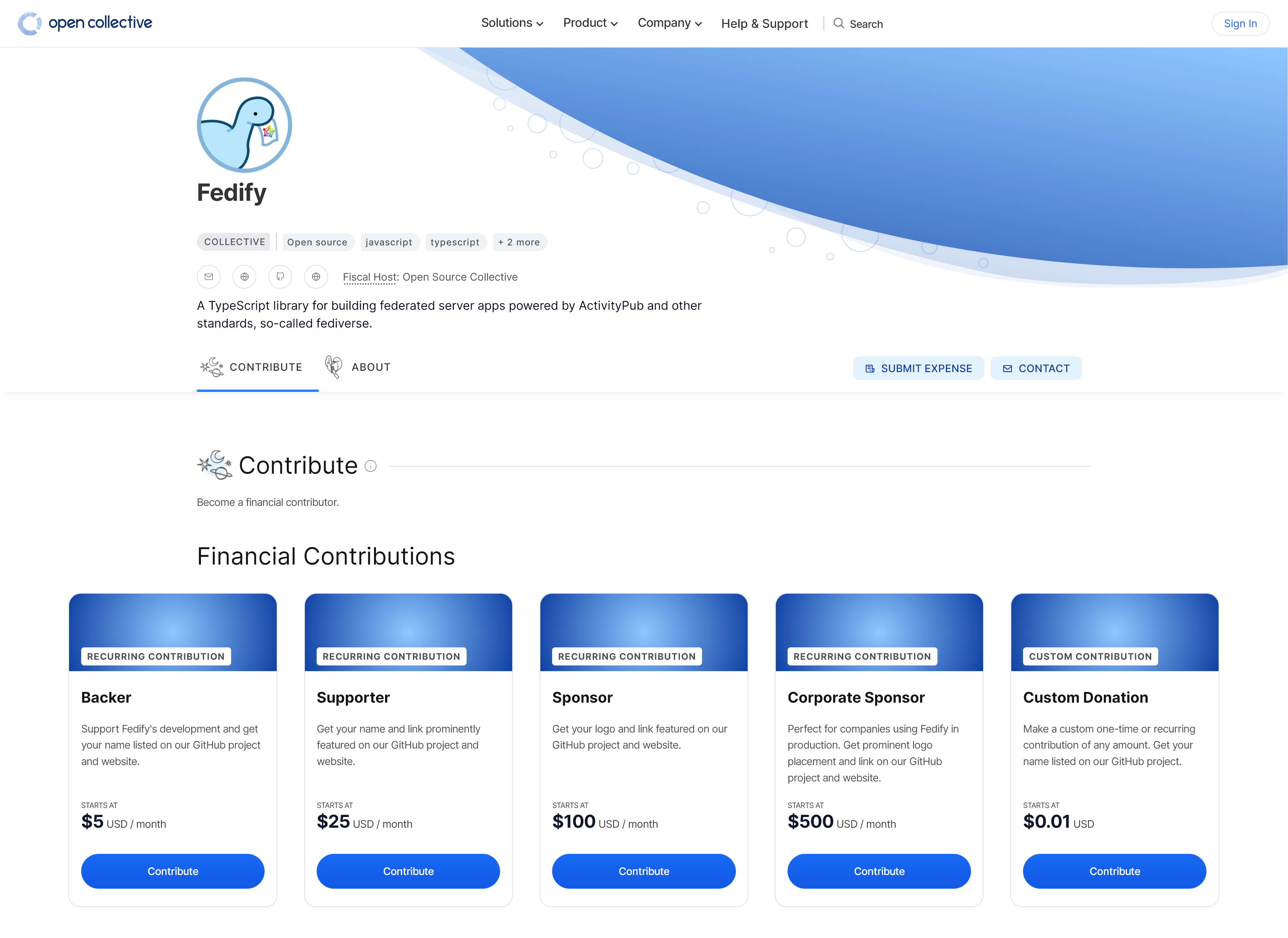
Fedify's Open Collective page showing the project logo, description as “A TypeScript library for building federated server apps powered by ActivityPub and other standards”, and five contribution tiers starting from $5/month Backer to $500/month Corporate Sponsor, with custom contribution options available.
ALT text

Fedify's Open Collective page showing the project logo, description as “A TypeScript library for building federated server apps powered by ActivityPub and other standards”, and five contribution tiers starting from $5/month Backer to $500/month Corporate Sponsor, with custom contribution options available.

Pinned

Fedify is an server framework in & . It aims to eliminate the complexity and redundant boilerplate code when building a federated server app, so that you can focus on your business logic and user experience.

The key features it provides currently are:

If you're curious, take a look at the website! There's comprehensive docs, a demo, a tutorial, example code, and more:

https://fedify.dev/

@vint@mastodon.ml

@FiFachik @rf Для тех, кто хочет потестить федерирование для своего бложика с поддержкой , могу только посоветовать . Там есть встроенная команда для подключения к сервису на выбор, который может дать временный домен для тестирования.

@hongminhee@fedibird.com

ActivityPubのサーバーフレームワークであるFedifyがついに最初の正規バージョンである1.0.0をリリースしました!

zenn.dev/hongminhee/articles/c
QT: hollo.social/@fedify/019229e7-
[参照]

Fedify, an ActivityPub framework, has finally released its first stable version, 1.0.0! Here are key changes:

Deprecation of the term handle

From this version, the term handle across Fedify will only be used to refer to fediverse handles (e.g., @hongminhee@fosstodon.org). An actor's internal unique ID (e.g., b379dbdc-3b4f-4ef4-88c2-fc25632d1c22) is referred to as an identifier, and the WebFinger name (e.g., hongminhee) is referred to as a username.

The term handle in the API will be maintained for a while for backward compatibility, but deprecation warnings will be logged, and it is planned to be removed in the future.

For more details, please refer to the related documentation.

Linked Data Signatures

Linked Data Signatures is an outdated standard, but it's still relied upon by major fediverse implementations such as Mastodon.

In addition to HTTP Signatures and Object Integrity Proofs, Fedify now supports Linked Data Signatures from this version, thus supporting all types of signature methods used in the fediverse. This makes Fedify an ActivityPub implementation with the best interoperability.

However, Fedify users don't need to do anything special to use Linked Data Signatures. If an incoming activity has Linked Data Signatures, it automatically verifies the signature, and all outgoing activities will have signatures in three formats: HTTP Signatures, Linked Data Signatures, and Object Integrity Proofs.

For more details, please refer to the related documentation.

Activity forwarding

From this version, you can forward activities received in the inbox to other actors using the InboxContext.forwardActivity() method.

At first glance, you might think that you could just resend an activity received in the inbox using the Context.sendActivity() method. However, if you do this, the original signature is removed before the activity is delivered to the inbox, and when sending it, the signature of the forwarding actor is attached instead, causing the receiving side of the forwarded activity to not trust it.

On the other hand, when using the InboxContext.forwardActivity() method, the activity is forwarded with the original signature preserved, avoiding this problem. (Of course, the original activity itself must be signed with Linked Data Signatures or Object Integrity Proofs.)

For more details, please refer to the related documentation.

Sending Delete(Application) on fedify inbox termination

From this version, fedify inbox will send a Delete(Application) activity to all peer servers it encountered when terminated. This is typically an activity sent when deleting an account, which will help prevent residual data related to temporary actors from remaining on other servers.

PostgreSQL drivers

The @fedify/postgres package, which implements PostgreSQL drivers for the KvStore and MessageQueue interfaces, has been released alongside this version.

The PostgreSQL driver is a backend that can be sufficiently used in production, especially recommended for projects already using PostgreSQL.

Additionally, an option to select the PostgreSQL driver has been added to the fedify init command.

Celebrating Fedify 1.0.0

With the release of version 1.0.0, Fedify will now maintain API backward compatibility as much as possible. (Of course, in the long term, there may be a 2.0.0 that breaks backward compatibility.) This should be good news for those who have been hesitant to use Fedify because there hasn't been a stable version until now!

So, hoping that more services will support ActivityPub in the future, I conclude this post!

@quillmatiq@mastodon.social

If you're a hands-on learner and want to learn how to build for ActivityPub, I urge you to try out @fedify.

The documentation alone is a great way to understand the underlying mechanics, and you'll be prototyping ideas in no time. I've been using it for the last few months and can't recommend it enough.

They just launched their first stable release: fedify.dev/

s/o to @hongminhee for this fantastic resource.

Fedify, an ActivityPub framework, has finally released its first stable version, 1.0.0! Here are key changes:

Deprecation of the term handle

From this version, the term handle across Fedify will only be used to refer to fediverse handles (e.g., @hongminhee@fosstodon.org). An actor's internal unique ID (e.g., b379dbdc-3b4f-4ef4-88c2-fc25632d1c22) is referred to as an identifier, and the WebFinger name (e.g., hongminhee) is referred to as a username.

The term handle in the API will be maintained for a while for backward compatibility, but deprecation warnings will be logged, and it is planned to be removed in the future.

For more details, please refer to the related documentation.

Linked Data Signatures

Linked Data Signatures is an outdated standard, but it's still relied upon by major fediverse implementations such as Mastodon.

In addition to HTTP Signatures and Object Integrity Proofs, Fedify now supports Linked Data Signatures from this version, thus supporting all types of signature methods used in the fediverse. This makes Fedify an ActivityPub implementation with the best interoperability.

However, Fedify users don't need to do anything special to use Linked Data Signatures. If an incoming activity has Linked Data Signatures, it automatically verifies the signature, and all outgoing activities will have signatures in three formats: HTTP Signatures, Linked Data Signatures, and Object Integrity Proofs.

For more details, please refer to the related documentation.

Activity forwarding

From this version, you can forward activities received in the inbox to other actors using the InboxContext.forwardActivity() method.

At first glance, you might think that you could just resend an activity received in the inbox using the Context.sendActivity() method. However, if you do this, the original signature is removed before the activity is delivered to the inbox, and when sending it, the signature of the forwarding actor is attached instead, causing the receiving side of the forwarded activity to not trust it.

On the other hand, when using the InboxContext.forwardActivity() method, the activity is forwarded with the original signature preserved, avoiding this problem. (Of course, the original activity itself must be signed with Linked Data Signatures or Object Integrity Proofs.)

For more details, please refer to the related documentation.

Sending Delete(Application) on fedify inbox termination

From this version, fedify inbox will send a Delete(Application) activity to all peer servers it encountered when terminated. This is typically an activity sent when deleting an account, which will help prevent residual data related to temporary actors from remaining on other servers.

PostgreSQL drivers

The @fedify/postgres package, which implements PostgreSQL drivers for the KvStore and MessageQueue interfaces, has been released alongside this version.

The PostgreSQL driver is a backend that can be sufficiently used in production, especially recommended for projects already using PostgreSQL.

Additionally, an option to select the PostgreSQL driver has been added to the fedify init command.

Celebrating Fedify 1.0.0

With the release of version 1.0.0, Fedify will now maintain API backward compatibility as much as possible. (Of course, in the long term, there may be a 2.0.0 that breaks backward compatibility.) This should be good news for those who have been hesitant to use Fedify because there hasn't been a stable version until now!

So, hoping that more services will support ActivityPub in the future, I conclude this post!

@okpierre@mastodon.social

activitypub typescript server framework called Fedify announces first stable release. It is being used by the open source Ghost CMS platform. Can't wait to see what other apps are created with Fedify

Github repo here: github.com/dahlia/fedify/relea

activitypub typescript server framework called Fedify announces first stable release. It is being used by the open source Ghost CMS platform. Can't wait to see what other apps are created with Fedify

Github repo here: https://github.com/dahlia/fedify/releases/tag/1.0.0
ALT text

activitypub typescript server framework called Fedify announces first stable release. It is being used by the open source Ghost CMS platform. Can't wait to see what other apps are created with Fedify Github repo here: https://github.com/dahlia/fedify/releases/tag/1.0.0

Fedify, an ActivityPub framework, has finally released its first stable version, 1.0.0! Here are key changes:

Deprecation of the term handle

From this version, the term handle across Fedify will only be used to refer to fediverse handles (e.g., @hongminhee@fosstodon.org). An actor's internal unique ID (e.g., b379dbdc-3b4f-4ef4-88c2-fc25632d1c22) is referred to as an identifier, and the WebFinger name (e.g., hongminhee) is referred to as a username.

The term handle in the API will be maintained for a while for backward compatibility, but deprecation warnings will be logged, and it is planned to be removed in the future.

For more details, please refer to the related documentation.

Linked Data Signatures

Linked Data Signatures is an outdated standard, but it's still relied upon by major fediverse implementations such as Mastodon.

In addition to HTTP Signatures and Object Integrity Proofs, Fedify now supports Linked Data Signatures from this version, thus supporting all types of signature methods used in the fediverse. This makes Fedify an ActivityPub implementation with the best interoperability.

However, Fedify users don't need to do anything special to use Linked Data Signatures. If an incoming activity has Linked Data Signatures, it automatically verifies the signature, and all outgoing activities will have signatures in three formats: HTTP Signatures, Linked Data Signatures, and Object Integrity Proofs.

For more details, please refer to the related documentation.

Activity forwarding

From this version, you can forward activities received in the inbox to other actors using the InboxContext.forwardActivity() method.

At first glance, you might think that you could just resend an activity received in the inbox using the Context.sendActivity() method. However, if you do this, the original signature is removed before the activity is delivered to the inbox, and when sending it, the signature of the forwarding actor is attached instead, causing the receiving side of the forwarded activity to not trust it.

On the other hand, when using the InboxContext.forwardActivity() method, the activity is forwarded with the original signature preserved, avoiding this problem. (Of course, the original activity itself must be signed with Linked Data Signatures or Object Integrity Proofs.)

For more details, please refer to the related documentation.

Sending Delete(Application) on fedify inbox termination

From this version, fedify inbox will send a Delete(Application) activity to all peer servers it encountered when terminated. This is typically an activity sent when deleting an account, which will help prevent residual data related to temporary actors from remaining on other servers.

PostgreSQL drivers

The @fedify/postgres package, which implements PostgreSQL drivers for the KvStore and MessageQueue interfaces, has been released alongside this version.

The PostgreSQL driver is a backend that can be sufficiently used in production, especially recommended for projects already using PostgreSQL.

Additionally, an option to select the PostgreSQL driver has been added to the fedify init command.

Celebrating Fedify 1.0.0

With the release of version 1.0.0, Fedify will now maintain API backward compatibility as much as possible. (Of course, in the long term, there may be a 2.0.0 that breaks backward compatibility.) This should be good news for those who have been hesitant to use Fedify because there hasn't been a stable version until now!

So, hoping that more services will support ActivityPub in the future, I conclude this post!

@thisismissem@hachyderm.io

I'm quietly really pleased with having been the mover for this change in @fedify.

Too many ActivityPub servers have put usernames in Actor URLs and it creates a complete mess when wanting to allow users to change their usernames, and created other confusion when you had non-user Actors that you wish to federate.

Here's the PR that prompted the change: github.com/dahlia/fedify/pull/
hollo.social/@fedify/01920e31-

Starting with v1.0.0, the term handle throughout Fedify will only be used to refer to a fediverse handle (e.g., @hongminhee@fosstodon.org). An actor's internal unique ID (e.g., b379dbdc-3b4f-4ef4-88c2-fc25632d1c22) will be referred to as identifier and a WebFinger name (e.g., hongminhee) will be referred to as username. The term handle in the API will be retained for the time being for backwards compatibility, but a deprecation warning will be logged and will be deprecated in the future.

@samsethi@podcastindex.social · Reply to Sean Tilley

1/3 @deadsuperhero As someone new to developing ActivityPub apps the poor documentation was a big turn off. @fedify have done a great job in making it easier to build new apps and their documentation is much better. The new book by @evan is also a great read for new AP developers.

However given that the Activity Vocab was defined way back in 2017 by the W3C and Mastodon the biggest AP client still doesn't support all the verbs is a disappointment. e.g summary, listen etc.

@deadsuperhero@social.wedistribute.org · Reply to Darius Kazemi

@darius Fedify is super cool. I’ve been eyeing it for some future projects, just gotta get better at JavaScript 😅

It’s pretty wild, though, that you can totally take this library, and spin up a working Fediverse app with it. Having to do all of the federation stuff from scratch seems like it would be a nightmare.