We're jumping on a plane and heading to Perugia for #IJF26
This year, we're looking forward to talking to even more people in the world of journalism who believe in community and protecting news values. We hope that they can see the future of the Social Web is a solution for journalists.
At our lunch event, we'll be highlighting combined efforts across the Open Social Web, including both AP and ATProto. We hope it's a success!
ALT text detailsA graphic which shows the Newsmast Foundation team, Michael Foster (Director & Co-Founder), Saskia Welch (Head of Community), Ben Parker (Editor), Mariana Borges (Project Coordinator). It says they're going to attend the International Journalism Festival, Perugia 15-18 April.
We're jumping on a plane and heading to Perugia for #IJF26
This year, we're looking forward to talking to even more people in the world of journalism who believe in community and protecting news values. We hope that they can see the future of the Social Web is a solution for journalists.
At our lunch event, we'll be highlighting combined efforts across the Open Social Web, including both AP and ATProto. We hope it's a success!
ALT text detailsA graphic which shows the Newsmast Foundation team, Michael Foster (Director & Co-Founder), Saskia Welch (Head of Community), Ben Parker (Editor), Mariana Borges (Project Coordinator). It says they're going to attend the International Journalism Festival, Perugia 15-18 April.
In this rushed world of ours, do you still have #time on your hands here and there? And love spending it on building and nurturing our sustainable and safe #fedi gardens?
Do you want be more deeply involved in weaving delightful #SocialFabric? Play a part in #SocialWeb future?
The #FEP Process as well as the #W3C#SocialCG, the two major standardization bodies that drive #fediverse future, are inclusive and open to anyone to contribute their 2 cents.
ALT text detailsImage with a call-to-action to "Join the FEP do-ocracy today. Help make peopleverse happen! There are vacancies for Commons custodians of the fediverse. Ping the FEP team and ask where you can volunteer". The call is followed by the image of a Delft-blue wisdom tile, with the quoted text "If we all did our part, our wicked problems would dissolve". Below 2 cent emoji's and a quote are displayed "Invest in your dreams to make them happen", the credo of the Social coding SEE model Social coding commons follows to assure Sustainable ecosystem evolution. Both quotes are named "Urgent platitutes" by Anold Schrijver, social coder.
Either revival and course correction to the original #ActivityPub protocol power and promise. With the potential to #ReimagineSocial.
Or keep current track with fedi-we-have. Be content with a few great and reasonably popular app platforms. Surely some more to come. But with a messy wire protocol that stifles #innovation and isn't future-proof.
This special thought provoker is based on personal reflection and 8 years of #commoning. Deliberately exposed to the inherent unsustainability of the #FOSS movement. Burning privilege by spending my savings.
Goal: 1st-hand experience to learn the #social dynamics that make a #commons tick.
There are certainly issues. I wrote a long thought piece on social experience and travels in #ActivityPub space and with a call-for-reflection to anyone to ponder #fediverse's Future of #SocialNetworking..
Either revival and course correction to the original #ActivityPub protocol power and promise. With the potential to #ReimagineSocial.
Or keep current track with fedi-we-have. Be content with a few great and reasonably popular app platforms. Surely some more to come. But with a messy wire protocol that stifles #innovation and isn't future-proof.
This special thought provoker is based on personal reflection and 8 years of #commoning. Deliberately exposed to the inherent unsustainability of the #FOSS movement. Burning privilege by spending my savings.
Goal: 1st-hand experience to learn the #social dynamics that make a #commons tick.
The #CFP for the Fediverse & Social Web track at COSCUP 2026 (Taipei, Aug 8–9) is now open! If you're working on #ActivityPub, the #fediverse, or anything in the open social web space, we'd love to hear from you. The deadline is May 9. #COSCUP is free to attend.
Read it in other languages: 日本語 (Japanese), 한국어 (Korean).
FediDev KR and FediLUG (Japan) are pleased to announce the Fediverse & Social Web track at COSCUP 2026, and invite participants to submit proposals for talks.
COSCUP (Conference for Open Source Coders, Users, and Promoters) is a free, community-run open source conference held annually in Taipei, Taiwan. Think FOSDEM, but in East Asia. This year it takes place August 8–9 at the National Taiwan University of Science and Technology, and is co-hosted with UbuCon Asia 2026.
The Fediverse & Social Web track runs for a full day, six hours in total. It is the first dedicated fediverse track at a major open source conference in East Asia, and we hope it becomes a regular gathering point for the fediverse community in the region.
Format
The default talk length is 30 minutes. If you need more or less time, note your preferred length when submitting.
Topics
We welcome proposals on anything related to the fediverse and the open social web, including:
Implementations of ActivityPub or related protocols
Clients for ActivityPub-enabled software
Libraries, toolkits, and frameworks for fediverse development
You can write your proposal in English or Chinese. COSCUP publishes session descriptions bilingually in English and Chinese, but that translation happens after acceptance; you don't need to provide both languages when submitting.
All sessions will be recorded and released under CC BY-SA 4.0. If your talk contains material that cannot be recorded or released under those terms, please note this in your submission.
The #CFP for the Fediverse & Social Web track at COSCUP 2026 (Taipei, Aug 8–9) is now open! If you're working on #ActivityPub, the #fediverse, or anything in the open social web space, we'd love to hear from you. The deadline is May 9. #COSCUP is free to attend.
Read it in other languages: 日本語 (Japanese), 한국어 (Korean).
FediDev KR and FediLUG (Japan) are pleased to announce the Fediverse & Social Web track at COSCUP 2026, and invite participants to submit proposals for talks.
COSCUP (Conference for Open Source Coders, Users, and Promoters) is a free, community-run open source conference held annually in Taipei, Taiwan. Think FOSDEM, but in East Asia. This year it takes place August 8–9 at the National Taiwan University of Science and Technology, and is co-hosted with UbuCon Asia 2026.
The Fediverse & Social Web track runs for a full day, six hours in total. It is the first dedicated fediverse track at a major open source conference in East Asia, and we hope it becomes a regular gathering point for the fediverse community in the region.
Format
The default talk length is 30 minutes. If you need more or less time, note your preferred length when submitting.
Topics
We welcome proposals on anything related to the fediverse and the open social web, including:
Implementations of ActivityPub or related protocols
Clients for ActivityPub-enabled software
Libraries, toolkits, and frameworks for fediverse development
You can write your proposal in English or Chinese. COSCUP publishes session descriptions bilingually in English and Chinese, but that translation happens after acceptance; you don't need to provide both languages when submitting.
All sessions will be recorded and released under CC BY-SA 4.0. If your talk contains material that cannot be recorded or released under those terms, please note this in your submission.
My personal thanks goes out to the many people that helped me stick around in this great #ActivityPub space full of fedizens.
Especially grateful I am, for their consistent support during many yeas, towards the @EUCommission who with @ngi and @nlnet made a BIG difference to where the fediverse stands today.
I hope for further improvement to the #funding facilities that are available to #FOSS and #SocialWeb cocreators, and look expectedly to upcoming changes in the #HorizonEU grant programs and their alignment to our fediverse developer ecosystem.
PS. You can find my definition of #BreadcrumbFunding in the "Challenges of standardization" section of my blog post, right before the call to ideation.
My personal thanks goes out to the many people that helped me stick around in this great #ActivityPub space full of fedizens.
Especially grateful I am, for their consistent support during many yeas, towards the @EUCommission who with @ngi and @nlnet made a BIG difference to where the fediverse stands today.
I hope for further improvement to the #funding facilities that are available to #FOSS and #SocialWeb cocreators, and look expectedly to upcoming changes in the #HorizonEU grant programs and their alignment to our fediverse developer ecosystem.
PS. You can find my definition of #BreadcrumbFunding in the "Challenges of standardization" section of my blog post, right before the call to ideation.
In this rushed world of ours, do you still have #time on your hands here and there? And love spending it on building and nurturing our sustainable and safe #fedi gardens?
Do you want be more deeply involved in weaving delightful #SocialFabric? Play a part in #SocialWeb future?
The #FEP Process as well as the #W3C#SocialCG, the two major standardization bodies that drive #fediverse future, are inclusive and open to anyone to contribute their 2 cents.
ALT text detailsImage with a call-to-action to "Join the FEP do-ocracy today. Help make peopleverse happen! There are vacancies for Commons custodians of the fediverse. Ping the FEP team and ask where you can volunteer". The call is followed by the image of a Delft-blue wisdom tile, with the quoted text "If we all did our part, our wicked problems would dissolve". Below 2 cent emoji's and a quote are displayed "Invest in your dreams to make them happen", the credo of the Social coding SEE model Social coding commons follows to assure Sustainable ecosystem evolution. Both quotes are named "Urgent platitutes" by Anold Schrijver, social coder.
The #CFP for the Fediverse & Social Web track at COSCUP 2026 (Taipei, Aug 8–9) is now open! If you're working on #ActivityPub, the #fediverse, or anything in the open social web space, we'd love to hear from you. The deadline is May 9. #COSCUP is free to attend.
Read it in other languages: 日本語 (Japanese), 한국어 (Korean).
FediDev KR and FediLUG (Japan) are pleased to announce the Fediverse & Social Web track at COSCUP 2026, and invite participants to submit proposals for talks.
COSCUP (Conference for Open Source Coders, Users, and Promoters) is a free, community-run open source conference held annually in Taipei, Taiwan. Think FOSDEM, but in East Asia. This year it takes place August 8–9 at the National Taiwan University of Science and Technology, and is co-hosted with UbuCon Asia 2026.
The Fediverse & Social Web track runs for a full day, six hours in total. It is the first dedicated fediverse track at a major open source conference in East Asia, and we hope it becomes a regular gathering point for the fediverse community in the region.
Format
The default talk length is 30 minutes. If you need more or less time, note your preferred length when submitting.
Topics
We welcome proposals on anything related to the fediverse and the open social web, including:
Implementations of ActivityPub or related protocols
Clients for ActivityPub-enabled software
Libraries, toolkits, and frameworks for fediverse development
You can write your proposal in English or Chinese. COSCUP publishes session descriptions bilingually in English and Chinese, but that translation happens after acceptance; you don't need to provide both languages when submitting.
All sessions will be recorded and released under CC BY-SA 4.0. If your talk contains material that cannot be recorded or released under those terms, please note this in your submission.
In follow-up to "Grassroots fediverse evolution", which tells the tale of my 8 year social experience in the commons of #FOSS and #ActivityPub fedi, I am preparing another article, called "Paradox of emergent chaordic commons", which is a factor to take into account for ensuring Sustainable ecosystem evolution (SEE).
The pillars of the #fediverse, which I honor in my article, @evan and @silverpill are doing fabulous work. But it is also work that more people should do, the chores should be more fairly delegated and balanced between all commons participants.
#CommonsJanitoring. There's a saying that starts with "If we all did our part" which in #SX forms a key tenet. Proactive ecosystem participation should be duly rewarded for the commons to become more sustainable.
ALT text detailsThe diagram shows an exponential 'value creation' graph, with on the X-access the progress of evolution along the solution path. Below the axis the various lifecycle stages of the fediverse service delivery lifecycle are listed: Inception, Ideation, Realization, Delivery, Experience. Rate of value creation & aggregation of the social supply line depends on participation rate.
On the Y-axis is the Potential of the solution design, where value-add of investment in the solution depends on how emergent design leads to desired outcomes. It is not easily perceived as it exists mostly still in emergent space.
Diagram has 3 quadrants. On the bottom left the participation zone is where prolonged Investment is asked, while only little value can be demonstrated in the field. The biggest part above the participation / investment zone is the anticipation zone, where we dream and find possibilities and related opportunities that may have great potential. Expectation mismatch is a risk as the emergent value is stil invisble to most people.
The paradox is solved at an inflection point along the evolution axis of the solution, called appropriately 'the paradox of emergence' point, when actual value is demonstrated by positive societal impact that grows via SX feedback loops. This is the solution zone, the full right side of the diagram, where value creation can grow exponentially and dreams turn to their realization. Now there are sustainability risks to healthy evolution to monitor well.
ALT text detailsDelft-blue wisdom tile, reading "If we all did our part, our wicked problems would dissolve".
ALT text detailsSnapshot from a fediverse bot profile reading: "If you DO NOT want a post boosted use #nobot in the post. Add #NoBots to your profile bio to stop all boosts for any tag.
The article #ActivityPub, the Good, the Bad, and the Ugly by Dominik Chrástecký highlights a number of examples of #ProtocolDecay, a topic I also address in the call-for-reflection article Grassroots fediverse evolution ..
Either revival and course correction to the original #ActivityPub protocol power and promise. With the potential to #ReimagineSocial.
Or keep current track with fedi-we-have. Be content with a few great and reasonably popular app platforms. Surely some more to come. But with a messy wire protocol that stifles #innovation and isn't future-proof.
This special thought provoker is based on personal reflection and 8 years of #commoning. Deliberately exposed to the inherent unsustainability of the #FOSS movement. Burning privilege by spending my savings.
Goal: 1st-hand experience to learn the #social dynamics that make a #commons tick.
ALT text detailsSnapshot from a fediverse bot profile reading: "If you DO NOT want a post boosted use #nobot in the post. Add #NoBots to your profile bio to stop all boosts for any tag.
@woozle the article was described as "fairly long thinkpiece" by @Profpatsch which with 53 min. read time is an understatement of "fairly long" where it comes to typical online content.
Thank you for taking the time and ponder things! I think that is the most important. We are all so pragmatic and want to have quick results. And our society is asking to be hurried. Everything is urgent. All is in peril. But giving in to that urge is a trap, that makes us weaker as mankind to face our wickedest problems.
Besides "Hammock driven development" mentioned in the article, #Emergence is key. And emergence is WEIRD and fascinating. I just tooted about it in..
I used #SolidProject just to contrast a totally opposite approach to how fedi evolves: Fully formal #OpenStandards driven, but with risk to evolve into a 'standards maze' without ecosystem support.
#Mastodon Foundation is a new development. Hopefully they care beyond the app.
Can you influence and steer emergence and evolution? Some people like me, with Social experience design think so. Another person is Richard D. Bartlett known from #Loomio who also is behind #Microsolidarity, which I was reminded of the other day. Have a look for yourself..
Our Fediverse & Social Web track has been accepted for @COSCUP 2026 (Taipei, Aug 8–9)! We'll have a full day—six hours—to fill with talks on the #fediverse, #ActivityPub, and the open social web.
The CFP for speakers isn't open yet, but we'll announce it here when it is. Stay tuned!
🔮 What is *much* more relevant in #Bluesky vs AP is WHY ❔ Bluesky + ATProto gets the bigger uptake, despite compromising on #moral and #ethical values and #principles we hold dear.
Knowing the answers to that is where #opportunity for strategic action comes from. And subsequently following what you may call #FocusedPragmatism instead of just 'wild-coding' the chaotic #fedi with countless independent, uncoordinated "Show, don't tells" of yet more code to shove onto the #BigBallOfMud that fediverse-we-have increasingly represents.
ALT text detailsPeopleverse ?
How do you #ReimagineSocial ?
Do you dare to dream? Then Dream.
Do you dare to play? Then Play.
Can you imagine a peopleverse ?
Then let The journey begin.
@woozle the article was described as "fairly long thinkpiece" by @Profpatsch which with 53 min. read time is an understatement of "fairly long" where it comes to typical online content.
Thank you for taking the time and ponder things! I think that is the most important. We are all so pragmatic and want to have quick results. And our society is asking to be hurried. Everything is urgent. All is in peril. But giving in to that urge is a trap, that makes us weaker as mankind to face our wickedest problems.
Besides "Hammock driven development" mentioned in the article, #Emergence is key. And emergence is WEIRD and fascinating. I just tooted about it in..
I used #SolidProject just to contrast a totally opposite approach to how fedi evolves: Fully formal #OpenStandards driven, but with risk to evolve into a 'standards maze' without ecosystem support.
#Mastodon Foundation is a new development. Hopefully they care beyond the app.
Can you influence and steer emergence and evolution? Some people like me, with Social experience design think so. Another person is Richard D. Bartlett known from #Loomio who also is behind #Microsolidarity, which I was reminded of the other day. Have a look for yourself..
Can you influence and steer emergence and evolution? Some people like me, with Social experience design think so. Another person is Richard D. Bartlett known from #Loomio who also is behind #Microsolidarity, which I was reminded of the other day. Have a look for yourself..
Either revival and course correction to the original #ActivityPub protocol power and promise. With the potential to #ReimagineSocial.
Or keep current track with fedi-we-have. Be content with a few great and reasonably popular app platforms. Surely some more to come. But with a messy wire protocol that stifles #innovation and isn't future-proof.
This special thought provoker is based on personal reflection and 8 years of #commoning. Deliberately exposed to the inherent unsustainability of the #FOSS movement. Burning privilege by spending my savings.
Goal: 1st-hand experience to learn the #social dynamics that make a #commons tick.
Brilliant to see such a thoughtful report, backed by @EUCommission reference the power of decentralised social networks as we move towards digital sovereignty in the EU!
If you're looking for some interesting reading, check it out 👇
Brilliant to see such a thoughtful report, backed by @EUCommission reference the power of decentralised social networks as we move towards digital sovereignty in the EU!
If you're looking for some interesting reading, check it out 👇
ALT text detailsA screenshot of a Newsmast Foundation client app. It shows a Threads account profile, with the Threads symbol besides the display name.
ALT text detailsA screenshot of a Newsmast Foundation client app. It shows a Bluesky account profile, with the Bluesky blue butterfly symbol besides the display name.
ALT text detailsA screenshot of a Newsmast Foundation client app. It shows a Threads account profile, with the Threads symbol besides the display name.
ALT text detailsA screenshot of a Newsmast Foundation client app. It shows a Bluesky account profile, with the Bluesky blue butterfly symbol besides the display name.
ALT text detailsPeopleverse ?
How do you #ReimagineSocial ?
Do you dare to dream? Then Dream.
Do you dare to play? Then Play.
Can you imagine a peopleverse ?
Then let The journey begin.
Not sure if I have time to respond today, but just wanted to note that this aligns with the general interest and focus of Social experience design (SX) at https://coding.social which I elaborate on as a hobby, and perhaps one day my job.
The disadvantage of microblogging is how ephemeral it is, but the advantage is reach. Should you be interested you are welcome to share results on the social coding forum, which serves as a note-taking tool: https://discuss.coding.social
The #CFP for the Fediverse & Social Web track at COSCUP 2026 (Taipei, Aug 8–9) is now open! If you're working on #ActivityPub, the #fediverse, or anything in the open social web space, we'd love to hear from you. The deadline is May 9. #COSCUP is free to attend.
Read it in other languages: 日本語 (Japanese), 한국어 (Korean).
FediDev KR and FediLUG (Japan) are pleased to announce the Fediverse & Social Web track at COSCUP 2026, and invite participants to submit proposals for talks.
COSCUP (Conference for Open Source Coders, Users, and Promoters) is a free, community-run open source conference held annually in Taipei, Taiwan. Think FOSDEM, but in East Asia. This year it takes place August 8–9 at the National Taiwan University of Science and Technology, and is co-hosted with UbuCon Asia 2026.
The Fediverse & Social Web track runs for a full day, six hours in total. It is the first dedicated fediverse track at a major open source conference in East Asia, and we hope it becomes a regular gathering point for the fediverse community in the region.
Format
The default talk length is 30 minutes. If you need more or less time, note your preferred length when submitting.
Topics
We welcome proposals on anything related to the fediverse and the open social web, including:
Implementations of ActivityPub or related protocols
Clients for ActivityPub-enabled software
Libraries, toolkits, and frameworks for fediverse development
You can write your proposal in English or Chinese. COSCUP publishes session descriptions bilingually in English and Chinese, but that translation happens after acceptance; you don't need to provide both languages when submitting.
All sessions will be recorded and released under CC BY-SA 4.0. If your talk contains material that cannot be recorded or released under those terms, please note this in your submission.
The #CFP for the Fediverse & Social Web track at COSCUP 2026 (Taipei, Aug 8–9) is now open! If you're working on #ActivityPub, the #fediverse, or anything in the open social web space, we'd love to hear from you. The deadline is May 9. #COSCUP is free to attend.
Read it in other languages: 日本語 (Japanese), 한국어 (Korean).
FediDev KR and FediLUG (Japan) are pleased to announce the Fediverse & Social Web track at COSCUP 2026, and invite participants to submit proposals for talks.
COSCUP (Conference for Open Source Coders, Users, and Promoters) is a free, community-run open source conference held annually in Taipei, Taiwan. Think FOSDEM, but in East Asia. This year it takes place August 8–9 at the National Taiwan University of Science and Technology, and is co-hosted with UbuCon Asia 2026.
The Fediverse & Social Web track runs for a full day, six hours in total. It is the first dedicated fediverse track at a major open source conference in East Asia, and we hope it becomes a regular gathering point for the fediverse community in the region.
Format
The default talk length is 30 minutes. If you need more or less time, note your preferred length when submitting.
Topics
We welcome proposals on anything related to the fediverse and the open social web, including:
Implementations of ActivityPub or related protocols
Clients for ActivityPub-enabled software
Libraries, toolkits, and frameworks for fediverse development
You can write your proposal in English or Chinese. COSCUP publishes session descriptions bilingually in English and Chinese, but that translation happens after acceptance; you don't need to provide both languages when submitting.
All sessions will be recorded and released under CC BY-SA 4.0. If your talk contains material that cannot be recorded or released under those terms, please note this in your submission.
There are interesting paradigm shifts possible today, which result in great opportunities to break the browser oligopoly, and SaaS + cloud vendor hegemony of Web 2.0 with its Rube Goldberg technology stack.
Since my hobby (it doesn't earn income yet) involves elaborating #SX methodology as a Social experience designer, I thought it interesting to add my follow-up from that perspective..
I have a #Discourse forum that runs on a subscription, graciously sponsored, and a couple other self-hosted Discourse forums running on VPS'es that incur costs.
The HTML static export should be able to run on Codeberg Pages or GH Pages, or from anywhere that can run a basic website.
Having the forum's information structure represented minimally in the HTML content structure is most important. The theming could be like https://csszengarden.com starting with a single default layout.
Discourse has various ways to do an export, but they're all involved procedures. Over the years I noticed many forums that just disappeared, popping out of existence, their contents forever lost. Not sure how other forum softwares handle 'end of life' of a community.
PS. #SX - a methodology focused on the intersection between #FOSS, #SocialWeb, and the #Commons - uses the notion of a Free software development lifecycle, and preps for end-of-life in final "Dispersal" stage.
ActivityPub outboxes are the new RSS / Atom / WebFeed.
You can just read from them to get a JSON feed of someone's posts.
I.e., you do NOT have to implement the full suite of Fediverse protocols, or Follow, or run your own server, or anything else to get someone's posts on the Fediverse — just read from their outbox.
The #CFP for the Fediverse & Social Web track at COSCUP 2026 (Taipei, Aug 8–9) is now open! If you're working on #ActivityPub, the #fediverse, or anything in the open social web space, we'd love to hear from you. The deadline is May 9. #COSCUP is free to attend.
Read it in other languages: 日本語 (Japanese), 한국어 (Korean).
FediDev KR and FediLUG (Japan) are pleased to announce the Fediverse & Social Web track at COSCUP 2026, and invite participants to submit proposals for talks.
COSCUP (Conference for Open Source Coders, Users, and Promoters) is a free, community-run open source conference held annually in Taipei, Taiwan. Think FOSDEM, but in East Asia. This year it takes place August 8–9 at the National Taiwan University of Science and Technology, and is co-hosted with UbuCon Asia 2026.
The Fediverse & Social Web track runs for a full day, six hours in total. It is the first dedicated fediverse track at a major open source conference in East Asia, and we hope it becomes a regular gathering point for the fediverse community in the region.
Format
The default talk length is 30 minutes. If you need more or less time, note your preferred length when submitting.
Topics
We welcome proposals on anything related to the fediverse and the open social web, including:
Implementations of ActivityPub or related protocols
Clients for ActivityPub-enabled software
Libraries, toolkits, and frameworks for fediverse development
You can write your proposal in English or Chinese. COSCUP publishes session descriptions bilingually in English and Chinese, but that translation happens after acceptance; you don't need to provide both languages when submitting.
All sessions will be recorded and released under CC BY-SA 4.0. If your talk contains material that cannot be recorded or released under those terms, please note this in your submission.
The #CFP for the Fediverse & Social Web track at COSCUP 2026 (Taipei, Aug 8–9) is now open! If you're working on #ActivityPub, the #fediverse, or anything in the open social web space, we'd love to hear from you. The deadline is May 9. #COSCUP is free to attend.
Read it in other languages: 日本語 (Japanese), 한국어 (Korean).
FediDev KR and FediLUG (Japan) are pleased to announce the Fediverse & Social Web track at COSCUP 2026, and invite participants to submit proposals for talks.
COSCUP (Conference for Open Source Coders, Users, and Promoters) is a free, community-run open source conference held annually in Taipei, Taiwan. Think FOSDEM, but in East Asia. This year it takes place August 8–9 at the National Taiwan University of Science and Technology, and is co-hosted with UbuCon Asia 2026.
The Fediverse & Social Web track runs for a full day, six hours in total. It is the first dedicated fediverse track at a major open source conference in East Asia, and we hope it becomes a regular gathering point for the fediverse community in the region.
Format
The default talk length is 30 minutes. If you need more or less time, note your preferred length when submitting.
Topics
We welcome proposals on anything related to the fediverse and the open social web, including:
Implementations of ActivityPub or related protocols
Clients for ActivityPub-enabled software
Libraries, toolkits, and frameworks for fediverse development
You can write your proposal in English or Chinese. COSCUP publishes session descriptions bilingually in English and Chinese, but that translation happens after acceptance; you don't need to provide both languages when submitting.
All sessions will be recorded and released under CC BY-SA 4.0. If your talk contains material that cannot be recorded or released under those terms, please note this in your submission.
The #CFP for the Fediverse & Social Web track at COSCUP 2026 (Taipei, Aug 8–9) is now open! If you're working on #ActivityPub, the #fediverse, or anything in the open social web space, we'd love to hear from you. The deadline is May 9. #COSCUP is free to attend.
Read it in other languages: 日本語 (Japanese), 한국어 (Korean).
FediDev KR and FediLUG (Japan) are pleased to announce the Fediverse & Social Web track at COSCUP 2026, and invite participants to submit proposals for talks.
COSCUP (Conference for Open Source Coders, Users, and Promoters) is a free, community-run open source conference held annually in Taipei, Taiwan. Think FOSDEM, but in East Asia. This year it takes place August 8–9 at the National Taiwan University of Science and Technology, and is co-hosted with UbuCon Asia 2026.
The Fediverse & Social Web track runs for a full day, six hours in total. It is the first dedicated fediverse track at a major open source conference in East Asia, and we hope it becomes a regular gathering point for the fediverse community in the region.
Format
The default talk length is 30 minutes. If you need more or less time, note your preferred length when submitting.
Topics
We welcome proposals on anything related to the fediverse and the open social web, including:
Implementations of ActivityPub or related protocols
Clients for ActivityPub-enabled software
Libraries, toolkits, and frameworks for fediverse development
You can write your proposal in English or Chinese. COSCUP publishes session descriptions bilingually in English and Chinese, but that translation happens after acceptance; you don't need to provide both languages when submitting.
All sessions will be recorded and released under CC BY-SA 4.0. If your talk contains material that cannot be recorded or released under those terms, please note this in your submission.
The #CFP for the Fediverse & Social Web track at COSCUP 2026 (Taipei, Aug 8–9) is now open! If you're working on #ActivityPub, the #fediverse, or anything in the open social web space, we'd love to hear from you. The deadline is May 9. #COSCUP is free to attend.
Read it in other languages: 日本語 (Japanese), 한국어 (Korean).
FediDev KR and FediLUG (Japan) are pleased to announce the Fediverse & Social Web track at COSCUP 2026, and invite participants to submit proposals for talks.
COSCUP (Conference for Open Source Coders, Users, and Promoters) is a free, community-run open source conference held annually in Taipei, Taiwan. Think FOSDEM, but in East Asia. This year it takes place August 8–9 at the National Taiwan University of Science and Technology, and is co-hosted with UbuCon Asia 2026.
The Fediverse & Social Web track runs for a full day, six hours in total. It is the first dedicated fediverse track at a major open source conference in East Asia, and we hope it becomes a regular gathering point for the fediverse community in the region.
Format
The default talk length is 30 minutes. If you need more or less time, note your preferred length when submitting.
Topics
We welcome proposals on anything related to the fediverse and the open social web, including:
Implementations of ActivityPub or related protocols
Clients for ActivityPub-enabled software
Libraries, toolkits, and frameworks for fediverse development
You can write your proposal in English or Chinese. COSCUP publishes session descriptions bilingually in English and Chinese, but that translation happens after acceptance; you don't need to provide both languages when submitting.
All sessions will be recorded and released under CC BY-SA 4.0. If your talk contains material that cannot be recorded or released under those terms, please note this in your submission.
The #CFP for the Fediverse & Social Web track at COSCUP 2026 (Taipei, Aug 8–9) is now open! If you're working on #ActivityPub, the #fediverse, or anything in the open social web space, we'd love to hear from you. The deadline is May 9. #COSCUP is free to attend.
Read it in other languages: 日本語 (Japanese), 한국어 (Korean).
FediDev KR and FediLUG (Japan) are pleased to announce the Fediverse & Social Web track at COSCUP 2026, and invite participants to submit proposals for talks.
COSCUP (Conference for Open Source Coders, Users, and Promoters) is a free, community-run open source conference held annually in Taipei, Taiwan. Think FOSDEM, but in East Asia. This year it takes place August 8–9 at the National Taiwan University of Science and Technology, and is co-hosted with UbuCon Asia 2026.
The Fediverse & Social Web track runs for a full day, six hours in total. It is the first dedicated fediverse track at a major open source conference in East Asia, and we hope it becomes a regular gathering point for the fediverse community in the region.
Format
The default talk length is 30 minutes. If you need more or less time, note your preferred length when submitting.
Topics
We welcome proposals on anything related to the fediverse and the open social web, including:
Implementations of ActivityPub or related protocols
Clients for ActivityPub-enabled software
Libraries, toolkits, and frameworks for fediverse development
You can write your proposal in English or Chinese. COSCUP publishes session descriptions bilingually in English and Chinese, but that translation happens after acceptance; you don't need to provide both languages when submitting.
All sessions will be recorded and released under CC BY-SA 4.0. If your talk contains material that cannot be recorded or released under those terms, please note this in your submission.
Graphical interfaces are documentation with buttons.
The web is the documentation layer of the internet. Hyperlinking makes it documentation with buttons. So the web is also the native graphical interface of the net.
Webmail made email the first social layer of the web.
The fediverse adds another social layer to the web. As does the matrix network.
The #CFP for the Fediverse & Social Web track at COSCUP 2026 (Taipei, Aug 8–9) is now open! If you're working on #ActivityPub, the #fediverse, or anything in the open social web space, we'd love to hear from you. The deadline is May 9. #COSCUP is free to attend.
Read it in other languages: 日本語 (Japanese), 한국어 (Korean).
FediDev KR and FediLUG (Japan) are pleased to announce the Fediverse & Social Web track at COSCUP 2026, and invite participants to submit proposals for talks.
COSCUP (Conference for Open Source Coders, Users, and Promoters) is a free, community-run open source conference held annually in Taipei, Taiwan. Think FOSDEM, but in East Asia. This year it takes place August 8–9 at the National Taiwan University of Science and Technology, and is co-hosted with UbuCon Asia 2026.
The Fediverse & Social Web track runs for a full day, six hours in total. It is the first dedicated fediverse track at a major open source conference in East Asia, and we hope it becomes a regular gathering point for the fediverse community in the region.
Format
The default talk length is 30 minutes. If you need more or less time, note your preferred length when submitting.
Topics
We welcome proposals on anything related to the fediverse and the open social web, including:
Implementations of ActivityPub or related protocols
Clients for ActivityPub-enabled software
Libraries, toolkits, and frameworks for fediverse development
You can write your proposal in English or Chinese. COSCUP publishes session descriptions bilingually in English and Chinese, but that translation happens after acceptance; you don't need to provide both languages when submitting.
All sessions will be recorded and released under CC BY-SA 4.0. If your talk contains material that cannot be recorded or released under those terms, please note this in your submission.
The #CFP for the Fediverse & Social Web track at COSCUP 2026 (Taipei, Aug 8–9) is now open! If you're working on #ActivityPub, the #fediverse, or anything in the open social web space, we'd love to hear from you. The deadline is May 9. #COSCUP is free to attend.
Read it in other languages: 日本語 (Japanese), 한국어 (Korean).
FediDev KR and FediLUG (Japan) are pleased to announce the Fediverse & Social Web track at COSCUP 2026, and invite participants to submit proposals for talks.
COSCUP (Conference for Open Source Coders, Users, and Promoters) is a free, community-run open source conference held annually in Taipei, Taiwan. Think FOSDEM, but in East Asia. This year it takes place August 8–9 at the National Taiwan University of Science and Technology, and is co-hosted with UbuCon Asia 2026.
The Fediverse & Social Web track runs for a full day, six hours in total. It is the first dedicated fediverse track at a major open source conference in East Asia, and we hope it becomes a regular gathering point for the fediverse community in the region.
Format
The default talk length is 30 minutes. If you need more or less time, note your preferred length when submitting.
Topics
We welcome proposals on anything related to the fediverse and the open social web, including:
Implementations of ActivityPub or related protocols
Clients for ActivityPub-enabled software
Libraries, toolkits, and frameworks for fediverse development
You can write your proposal in English or Chinese. COSCUP publishes session descriptions bilingually in English and Chinese, but that translation happens after acceptance; you don't need to provide both languages when submitting.
All sessions will be recorded and released under CC BY-SA 4.0. If your talk contains material that cannot be recorded or released under those terms, please note this in your submission.
The #CFP for the Fediverse & Social Web track at COSCUP 2026 (Taipei, Aug 8–9) is now open! If you're working on #ActivityPub, the #fediverse, or anything in the open social web space, we'd love to hear from you. The deadline is May 9. #COSCUP is free to attend.
Read it in other languages: 日本語 (Japanese), 한국어 (Korean).
FediDev KR and FediLUG (Japan) are pleased to announce the Fediverse & Social Web track at COSCUP 2026, and invite participants to submit proposals for talks.
COSCUP (Conference for Open Source Coders, Users, and Promoters) is a free, community-run open source conference held annually in Taipei, Taiwan. Think FOSDEM, but in East Asia. This year it takes place August 8–9 at the National Taiwan University of Science and Technology, and is co-hosted with UbuCon Asia 2026.
The Fediverse & Social Web track runs for a full day, six hours in total. It is the first dedicated fediverse track at a major open source conference in East Asia, and we hope it becomes a regular gathering point for the fediverse community in the region.
Format
The default talk length is 30 minutes. If you need more or less time, note your preferred length when submitting.
Topics
We welcome proposals on anything related to the fediverse and the open social web, including:
Implementations of ActivityPub or related protocols
Clients for ActivityPub-enabled software
Libraries, toolkits, and frameworks for fediverse development
You can write your proposal in English or Chinese. COSCUP publishes session descriptions bilingually in English and Chinese, but that translation happens after acceptance; you don't need to provide both languages when submitting.
All sessions will be recorded and released under CC BY-SA 4.0. If your talk contains material that cannot be recorded or released under those terms, please note this in your submission.
I recommend everybody read Tribe by Sebastian Junger. It talks about how humans need a sense of shared purpose more than anything else. That we look back on when we struggled together for a higher collective goal as the most rewarding times in our lives.
That's what building the fedi is today. #SocialWeb
I recommend everybody read Tribe by Sebastian Junger. It talks about how humans need a sense of shared purpose more than anything else. That we look back on when we struggled together for a higher collective goal as the most rewarding times in our lives.
That's what building the fedi is today. #SocialWeb
ALT text detailsScreenshot of the Account Settings page showing my main Surf account on top and my connected Atmosphere and fediverse accounts in two columns below.
A brief explanation of each accounts, my profile images, and buttons for disconnecting accounts or making one of the other primary are also included on the page.
The #CFP for the Fediverse & Social Web track at COSCUP 2026 (Taipei, Aug 8–9) is now open! If you're working on #ActivityPub, the #fediverse, or anything in the open social web space, we'd love to hear from you. The deadline is May 9. #COSCUP is free to attend.
Read it in other languages: 日本語 (Japanese), 한국어 (Korean).
FediDev KR and FediLUG (Japan) are pleased to announce the Fediverse & Social Web track at COSCUP 2026, and invite participants to submit proposals for talks.
COSCUP (Conference for Open Source Coders, Users, and Promoters) is a free, community-run open source conference held annually in Taipei, Taiwan. Think FOSDEM, but in East Asia. This year it takes place August 8–9 at the National Taiwan University of Science and Technology, and is co-hosted with UbuCon Asia 2026.
The Fediverse & Social Web track runs for a full day, six hours in total. It is the first dedicated fediverse track at a major open source conference in East Asia, and we hope it becomes a regular gathering point for the fediverse community in the region.
Format
The default talk length is 30 minutes. If you need more or less time, note your preferred length when submitting.
Topics
We welcome proposals on anything related to the fediverse and the open social web, including:
Implementations of ActivityPub or related protocols
Clients for ActivityPub-enabled software
Libraries, toolkits, and frameworks for fediverse development
You can write your proposal in English or Chinese. COSCUP publishes session descriptions bilingually in English and Chinese, but that translation happens after acceptance; you don't need to provide both languages when submitting.
All sessions will be recorded and released under CC BY-SA 4.0. If your talk contains material that cannot be recorded or released under those terms, please note this in your submission.
The #CFP for the Fediverse & Social Web track at COSCUP 2026 (Taipei, Aug 8–9) is now open! If you're working on #ActivityPub, the #fediverse, or anything in the open social web space, we'd love to hear from you. The deadline is May 9. #COSCUP is free to attend.
Read it in other languages: 日本語 (Japanese), 한국어 (Korean).
FediDev KR and FediLUG (Japan) are pleased to announce the Fediverse & Social Web track at COSCUP 2026, and invite participants to submit proposals for talks.
COSCUP (Conference for Open Source Coders, Users, and Promoters) is a free, community-run open source conference held annually in Taipei, Taiwan. Think FOSDEM, but in East Asia. This year it takes place August 8–9 at the National Taiwan University of Science and Technology, and is co-hosted with UbuCon Asia 2026.
The Fediverse & Social Web track runs for a full day, six hours in total. It is the first dedicated fediverse track at a major open source conference in East Asia, and we hope it becomes a regular gathering point for the fediverse community in the region.
Format
The default talk length is 30 minutes. If you need more or less time, note your preferred length when submitting.
Topics
We welcome proposals on anything related to the fediverse and the open social web, including:
Implementations of ActivityPub or related protocols
Clients for ActivityPub-enabled software
Libraries, toolkits, and frameworks for fediverse development
You can write your proposal in English or Chinese. COSCUP publishes session descriptions bilingually in English and Chinese, but that translation happens after acceptance; you don't need to provide both languages when submitting.
All sessions will be recorded and released under CC BY-SA 4.0. If your talk contains material that cannot be recorded or released under those terms, please note this in your submission.
The #CFP for the Fediverse & Social Web track at COSCUP 2026 (Taipei, Aug 8–9) is now open! If you're working on #ActivityPub, the #fediverse, or anything in the open social web space, we'd love to hear from you. The deadline is May 9. #COSCUP is free to attend.
Read it in other languages: 日本語 (Japanese), 한국어 (Korean).
FediDev KR and FediLUG (Japan) are pleased to announce the Fediverse & Social Web track at COSCUP 2026, and invite participants to submit proposals for talks.
COSCUP (Conference for Open Source Coders, Users, and Promoters) is a free, community-run open source conference held annually in Taipei, Taiwan. Think FOSDEM, but in East Asia. This year it takes place August 8–9 at the National Taiwan University of Science and Technology, and is co-hosted with UbuCon Asia 2026.
The Fediverse & Social Web track runs for a full day, six hours in total. It is the first dedicated fediverse track at a major open source conference in East Asia, and we hope it becomes a regular gathering point for the fediverse community in the region.
Format
The default talk length is 30 minutes. If you need more or less time, note your preferred length when submitting.
Topics
We welcome proposals on anything related to the fediverse and the open social web, including:
Implementations of ActivityPub or related protocols
Clients for ActivityPub-enabled software
Libraries, toolkits, and frameworks for fediverse development
You can write your proposal in English or Chinese. COSCUP publishes session descriptions bilingually in English and Chinese, but that translation happens after acceptance; you don't need to provide both languages when submitting.
All sessions will be recorded and released under CC BY-SA 4.0. If your talk contains material that cannot be recorded or released under those terms, please note this in your submission.
ALT text detailsAn A4 size page with a black and white image of a forest stretched across a hillside.
Over the image, text reads: Building Trust in the Open. How Open Social Can Help Journalism Rebuild Community and Trust. Ben Werdmuller. For the Newsmast Foundation, ONA26.
ALT text detailsAn A4 size page with a black and white image of a forest stretched across a hillside.
Over the image, text reads: Building Trust in the Open. How Open Social Can Help Journalism Rebuild Community and Trust. Ben Werdmuller. For the Newsmast Foundation, ONA26.
Our Fediverse & Social Web track has been accepted for @COSCUP 2026 (Taipei, Aug 8–9)! We'll have a full day—six hours—to fill with talks on the #fediverse, #ActivityPub, and the open social web.
The CFP for speakers isn't open yet, but we'll announce it here when it is. Stay tuned!
The #CFP for the Fediverse & Social Web track at COSCUP 2026 (Taipei, Aug 8–9) is now open! If you're working on #ActivityPub, the #fediverse, or anything in the open social web space, we'd love to hear from you. The deadline is May 9. #COSCUP is free to attend.
Read it in other languages: 日本語 (Japanese), 한국어 (Korean).
FediDev KR and FediLUG (Japan) are pleased to announce the Fediverse & Social Web track at COSCUP 2026, and invite participants to submit proposals for talks.
COSCUP (Conference for Open Source Coders, Users, and Promoters) is a free, community-run open source conference held annually in Taipei, Taiwan. Think FOSDEM, but in East Asia. This year it takes place August 8–9 at the National Taiwan University of Science and Technology, and is co-hosted with UbuCon Asia 2026.
The Fediverse & Social Web track runs for a full day, six hours in total. It is the first dedicated fediverse track at a major open source conference in East Asia, and we hope it becomes a regular gathering point for the fediverse community in the region.
Format
The default talk length is 30 minutes. If you need more or less time, note your preferred length when submitting.
Topics
We welcome proposals on anything related to the fediverse and the open social web, including:
Implementations of ActivityPub or related protocols
Clients for ActivityPub-enabled software
Libraries, toolkits, and frameworks for fediverse development
You can write your proposal in English or Chinese. COSCUP publishes session descriptions bilingually in English and Chinese, but that translation happens after acceptance; you don't need to provide both languages when submitting.
All sessions will be recorded and released under CC BY-SA 4.0. If your talk contains material that cannot be recorded or released under those terms, please note this in your submission.
The #CFP for the Fediverse & Social Web track at COSCUP 2026 (Taipei, Aug 8–9) is now open! If you're working on #ActivityPub, the #fediverse, or anything in the open social web space, we'd love to hear from you. The deadline is May 9. #COSCUP is free to attend.
Read it in other languages: 日本語 (Japanese), 한국어 (Korean).
FediDev KR and FediLUG (Japan) are pleased to announce the Fediverse & Social Web track at COSCUP 2026, and invite participants to submit proposals for talks.
COSCUP (Conference for Open Source Coders, Users, and Promoters) is a free, community-run open source conference held annually in Taipei, Taiwan. Think FOSDEM, but in East Asia. This year it takes place August 8–9 at the National Taiwan University of Science and Technology, and is co-hosted with UbuCon Asia 2026.
The Fediverse & Social Web track runs for a full day, six hours in total. It is the first dedicated fediverse track at a major open source conference in East Asia, and we hope it becomes a regular gathering point for the fediverse community in the region.
Format
The default talk length is 30 minutes. If you need more or less time, note your preferred length when submitting.
Topics
We welcome proposals on anything related to the fediverse and the open social web, including:
Implementations of ActivityPub or related protocols
Clients for ActivityPub-enabled software
Libraries, toolkits, and frameworks for fediverse development
You can write your proposal in English or Chinese. COSCUP publishes session descriptions bilingually in English and Chinese, but that translation happens after acceptance; you don't need to provide both languages when submitting.
All sessions will be recorded and released under CC BY-SA 4.0. If your talk contains material that cannot be recorded or released under those terms, please note this in your submission.
The #CFP for the Fediverse & Social Web track at COSCUP 2026 (Taipei, Aug 8–9) is now open! If you're working on #ActivityPub, the #fediverse, or anything in the open social web space, we'd love to hear from you. The deadline is May 9. #COSCUP is free to attend.
Read it in other languages: 日本語 (Japanese), 한국어 (Korean).
FediDev KR and FediLUG (Japan) are pleased to announce the Fediverse & Social Web track at COSCUP 2026, and invite participants to submit proposals for talks.
COSCUP (Conference for Open Source Coders, Users, and Promoters) is a free, community-run open source conference held annually in Taipei, Taiwan. Think FOSDEM, but in East Asia. This year it takes place August 8–9 at the National Taiwan University of Science and Technology, and is co-hosted with UbuCon Asia 2026.
The Fediverse & Social Web track runs for a full day, six hours in total. It is the first dedicated fediverse track at a major open source conference in East Asia, and we hope it becomes a regular gathering point for the fediverse community in the region.
Format
The default talk length is 30 minutes. If you need more or less time, note your preferred length when submitting.
Topics
We welcome proposals on anything related to the fediverse and the open social web, including:
Implementations of ActivityPub or related protocols
Clients for ActivityPub-enabled software
Libraries, toolkits, and frameworks for fediverse development
You can write your proposal in English or Chinese. COSCUP publishes session descriptions bilingually in English and Chinese, but that translation happens after acceptance; you don't need to provide both languages when submitting.
All sessions will be recorded and released under CC BY-SA 4.0. If your talk contains material that cannot be recorded or released under those terms, please note this in your submission.
The #CFP for the Fediverse & Social Web track at COSCUP 2026 (Taipei, Aug 8–9) is now open! If you're working on #ActivityPub, the #fediverse, or anything in the open social web space, we'd love to hear from you. The deadline is May 9. #COSCUP is free to attend.
Read it in other languages: 日本語 (Japanese), 한국어 (Korean).
FediDev KR and FediLUG (Japan) are pleased to announce the Fediverse & Social Web track at COSCUP 2026, and invite participants to submit proposals for talks.
COSCUP (Conference for Open Source Coders, Users, and Promoters) is a free, community-run open source conference held annually in Taipei, Taiwan. Think FOSDEM, but in East Asia. This year it takes place August 8–9 at the National Taiwan University of Science and Technology, and is co-hosted with UbuCon Asia 2026.
The Fediverse & Social Web track runs for a full day, six hours in total. It is the first dedicated fediverse track at a major open source conference in East Asia, and we hope it becomes a regular gathering point for the fediverse community in the region.
Format
The default talk length is 30 minutes. If you need more or less time, note your preferred length when submitting.
Topics
We welcome proposals on anything related to the fediverse and the open social web, including:
Implementations of ActivityPub or related protocols
Clients for ActivityPub-enabled software
Libraries, toolkits, and frameworks for fediverse development
You can write your proposal in English or Chinese. COSCUP publishes session descriptions bilingually in English and Chinese, but that translation happens after acceptance; you don't need to provide both languages when submitting.
All sessions will be recorded and released under CC BY-SA 4.0. If your talk contains material that cannot be recorded or released under those terms, please note this in your submission.
The #CFP for the Fediverse & Social Web track at COSCUP 2026 (Taipei, Aug 8–9) is now open! If you're working on #ActivityPub, the #fediverse, or anything in the open social web space, we'd love to hear from you. The deadline is May 9. #COSCUP is free to attend.
Read it in other languages: 日本語 (Japanese), 한국어 (Korean).
FediDev KR and FediLUG (Japan) are pleased to announce the Fediverse & Social Web track at COSCUP 2026, and invite participants to submit proposals for talks.
COSCUP (Conference for Open Source Coders, Users, and Promoters) is a free, community-run open source conference held annually in Taipei, Taiwan. Think FOSDEM, but in East Asia. This year it takes place August 8–9 at the National Taiwan University of Science and Technology, and is co-hosted with UbuCon Asia 2026.
The Fediverse & Social Web track runs for a full day, six hours in total. It is the first dedicated fediverse track at a major open source conference in East Asia, and we hope it becomes a regular gathering point for the fediverse community in the region.
Format
The default talk length is 30 minutes. If you need more or less time, note your preferred length when submitting.
Topics
We welcome proposals on anything related to the fediverse and the open social web, including:
Implementations of ActivityPub or related protocols
Clients for ActivityPub-enabled software
Libraries, toolkits, and frameworks for fediverse development
You can write your proposal in English or Chinese. COSCUP publishes session descriptions bilingually in English and Chinese, but that translation happens after acceptance; you don't need to provide both languages when submitting.
All sessions will be recorded and released under CC BY-SA 4.0. If your talk contains material that cannot be recorded or released under those terms, please note this in your submission.
The #CFP for the Fediverse & Social Web track at COSCUP 2026 (Taipei, Aug 8–9) is now open! If you're working on #ActivityPub, the #fediverse, or anything in the open social web space, we'd love to hear from you. The deadline is May 9. #COSCUP is free to attend.
Read it in other languages: 日本語 (Japanese), 한국어 (Korean).
FediDev KR and FediLUG (Japan) are pleased to announce the Fediverse & Social Web track at COSCUP 2026, and invite participants to submit proposals for talks.
COSCUP (Conference for Open Source Coders, Users, and Promoters) is a free, community-run open source conference held annually in Taipei, Taiwan. Think FOSDEM, but in East Asia. This year it takes place August 8–9 at the National Taiwan University of Science and Technology, and is co-hosted with UbuCon Asia 2026.
The Fediverse & Social Web track runs for a full day, six hours in total. It is the first dedicated fediverse track at a major open source conference in East Asia, and we hope it becomes a regular gathering point for the fediverse community in the region.
Format
The default talk length is 30 minutes. If you need more or less time, note your preferred length when submitting.
Topics
We welcome proposals on anything related to the fediverse and the open social web, including:
Implementations of ActivityPub or related protocols
Clients for ActivityPub-enabled software
Libraries, toolkits, and frameworks for fediverse development
You can write your proposal in English or Chinese. COSCUP publishes session descriptions bilingually in English and Chinese, but that translation happens after acceptance; you don't need to provide both languages when submitting.
All sessions will be recorded and released under CC BY-SA 4.0. If your talk contains material that cannot be recorded or released under those terms, please note this in your submission.
The #CFP for the Fediverse & Social Web track at COSCUP 2026 (Taipei, Aug 8–9) is now open! If you're working on #ActivityPub, the #fediverse, or anything in the open social web space, we'd love to hear from you. The deadline is May 9. #COSCUP is free to attend.
Read it in other languages: 日本語 (Japanese), 한국어 (Korean).
FediDev KR and FediLUG (Japan) are pleased to announce the Fediverse & Social Web track at COSCUP 2026, and invite participants to submit proposals for talks.
COSCUP (Conference for Open Source Coders, Users, and Promoters) is a free, community-run open source conference held annually in Taipei, Taiwan. Think FOSDEM, but in East Asia. This year it takes place August 8–9 at the National Taiwan University of Science and Technology, and is co-hosted with UbuCon Asia 2026.
The Fediverse & Social Web track runs for a full day, six hours in total. It is the first dedicated fediverse track at a major open source conference in East Asia, and we hope it becomes a regular gathering point for the fediverse community in the region.
Format
The default talk length is 30 minutes. If you need more or less time, note your preferred length when submitting.
Topics
We welcome proposals on anything related to the fediverse and the open social web, including:
Implementations of ActivityPub or related protocols
Clients for ActivityPub-enabled software
Libraries, toolkits, and frameworks for fediverse development
You can write your proposal in English or Chinese. COSCUP publishes session descriptions bilingually in English and Chinese, but that translation happens after acceptance; you don't need to provide both languages when submitting.
All sessions will be recorded and released under CC BY-SA 4.0. If your talk contains material that cannot be recorded or released under those terms, please note this in your submission.
The #CFP for the Fediverse & Social Web track at COSCUP 2026 (Taipei, Aug 8–9) is now open! If you're working on #ActivityPub, the #fediverse, or anything in the open social web space, we'd love to hear from you. The deadline is May 9. #COSCUP is free to attend.
Read it in other languages: 日本語 (Japanese), 한국어 (Korean).
FediDev KR and FediLUG (Japan) are pleased to announce the Fediverse & Social Web track at COSCUP 2026, and invite participants to submit proposals for talks.
COSCUP (Conference for Open Source Coders, Users, and Promoters) is a free, community-run open source conference held annually in Taipei, Taiwan. Think FOSDEM, but in East Asia. This year it takes place August 8–9 at the National Taiwan University of Science and Technology, and is co-hosted with UbuCon Asia 2026.
The Fediverse & Social Web track runs for a full day, six hours in total. It is the first dedicated fediverse track at a major open source conference in East Asia, and we hope it becomes a regular gathering point for the fediverse community in the region.
Format
The default talk length is 30 minutes. If you need more or less time, note your preferred length when submitting.
Topics
We welcome proposals on anything related to the fediverse and the open social web, including:
Implementations of ActivityPub or related protocols
Clients for ActivityPub-enabled software
Libraries, toolkits, and frameworks for fediverse development
You can write your proposal in English or Chinese. COSCUP publishes session descriptions bilingually in English and Chinese, but that translation happens after acceptance; you don't need to provide both languages when submitting.
All sessions will be recorded and released under CC BY-SA 4.0. If your talk contains material that cannot be recorded or released under those terms, please note this in your submission.
The #CFP for the Fediverse & Social Web track at COSCUP 2026 (Taipei, Aug 8–9) is now open! If you're working on #ActivityPub, the #fediverse, or anything in the open social web space, we'd love to hear from you. The deadline is May 9. #COSCUP is free to attend.
Read it in other languages: 日本語 (Japanese), 한국어 (Korean).
FediDev KR and FediLUG (Japan) are pleased to announce the Fediverse & Social Web track at COSCUP 2026, and invite participants to submit proposals for talks.
COSCUP (Conference for Open Source Coders, Users, and Promoters) is a free, community-run open source conference held annually in Taipei, Taiwan. Think FOSDEM, but in East Asia. This year it takes place August 8–9 at the National Taiwan University of Science and Technology, and is co-hosted with UbuCon Asia 2026.
The Fediverse & Social Web track runs for a full day, six hours in total. It is the first dedicated fediverse track at a major open source conference in East Asia, and we hope it becomes a regular gathering point for the fediverse community in the region.
Format
The default talk length is 30 minutes. If you need more or less time, note your preferred length when submitting.
Topics
We welcome proposals on anything related to the fediverse and the open social web, including:
Implementations of ActivityPub or related protocols
Clients for ActivityPub-enabled software
Libraries, toolkits, and frameworks for fediverse development
You can write your proposal in English or Chinese. COSCUP publishes session descriptions bilingually in English and Chinese, but that translation happens after acceptance; you don't need to provide both languages when submitting.
All sessions will be recorded and released under CC BY-SA 4.0. If your talk contains material that cannot be recorded or released under those terms, please note this in your submission.
The #CFP for the Fediverse & Social Web track at COSCUP 2026 (Taipei, Aug 8–9) is now open! If you're working on #ActivityPub, the #fediverse, or anything in the open social web space, we'd love to hear from you. The deadline is May 9. #COSCUP is free to attend.
Read it in other languages: 日本語 (Japanese), 한국어 (Korean).
FediDev KR and FediLUG (Japan) are pleased to announce the Fediverse & Social Web track at COSCUP 2026, and invite participants to submit proposals for talks.
COSCUP (Conference for Open Source Coders, Users, and Promoters) is a free, community-run open source conference held annually in Taipei, Taiwan. Think FOSDEM, but in East Asia. This year it takes place August 8–9 at the National Taiwan University of Science and Technology, and is co-hosted with UbuCon Asia 2026.
The Fediverse & Social Web track runs for a full day, six hours in total. It is the first dedicated fediverse track at a major open source conference in East Asia, and we hope it becomes a regular gathering point for the fediverse community in the region.
Format
The default talk length is 30 minutes. If you need more or less time, note your preferred length when submitting.
Topics
We welcome proposals on anything related to the fediverse and the open social web, including:
Implementations of ActivityPub or related protocols
Clients for ActivityPub-enabled software
Libraries, toolkits, and frameworks for fediverse development
You can write your proposal in English or Chinese. COSCUP publishes session descriptions bilingually in English and Chinese, but that translation happens after acceptance; you don't need to provide both languages when submitting.
All sessions will be recorded and released under CC BY-SA 4.0. If your talk contains material that cannot be recorded or released under those terms, please note this in your submission.
The #CFP for the Fediverse & Social Web track at COSCUP 2026 (Taipei, Aug 8–9) is now open! If you're working on #ActivityPub, the #fediverse, or anything in the open social web space, we'd love to hear from you. The deadline is May 9. #COSCUP is free to attend.
Read it in other languages: 日本語 (Japanese), 한국어 (Korean).
FediDev KR and FediLUG (Japan) are pleased to announce the Fediverse & Social Web track at COSCUP 2026, and invite participants to submit proposals for talks.
COSCUP (Conference for Open Source Coders, Users, and Promoters) is a free, community-run open source conference held annually in Taipei, Taiwan. Think FOSDEM, but in East Asia. This year it takes place August 8–9 at the National Taiwan University of Science and Technology, and is co-hosted with UbuCon Asia 2026.
The Fediverse & Social Web track runs for a full day, six hours in total. It is the first dedicated fediverse track at a major open source conference in East Asia, and we hope it becomes a regular gathering point for the fediverse community in the region.
Format
The default talk length is 30 minutes. If you need more or less time, note your preferred length when submitting.
Topics
We welcome proposals on anything related to the fediverse and the open social web, including:
Implementations of ActivityPub or related protocols
Clients for ActivityPub-enabled software
Libraries, toolkits, and frameworks for fediverse development
You can write your proposal in English or Chinese. COSCUP publishes session descriptions bilingually in English and Chinese, but that translation happens after acceptance; you don't need to provide both languages when submitting.
All sessions will be recorded and released under CC BY-SA 4.0. If your talk contains material that cannot be recorded or released under those terms, please note this in your submission.
The #CFP for the Fediverse & Social Web track at COSCUP 2026 (Taipei, Aug 8–9) is now open! If you're working on #ActivityPub, the #fediverse, or anything in the open social web space, we'd love to hear from you. The deadline is May 9. #COSCUP is free to attend.
Read it in other languages: 日本語 (Japanese), 한국어 (Korean).
FediDev KR and FediLUG (Japan) are pleased to announce the Fediverse & Social Web track at COSCUP 2026, and invite participants to submit proposals for talks.
COSCUP (Conference for Open Source Coders, Users, and Promoters) is a free, community-run open source conference held annually in Taipei, Taiwan. Think FOSDEM, but in East Asia. This year it takes place August 8–9 at the National Taiwan University of Science and Technology, and is co-hosted with UbuCon Asia 2026.
The Fediverse & Social Web track runs for a full day, six hours in total. It is the first dedicated fediverse track at a major open source conference in East Asia, and we hope it becomes a regular gathering point for the fediverse community in the region.
Format
The default talk length is 30 minutes. If you need more or less time, note your preferred length when submitting.
Topics
We welcome proposals on anything related to the fediverse and the open social web, including:
Implementations of ActivityPub or related protocols
Clients for ActivityPub-enabled software
Libraries, toolkits, and frameworks for fediverse development
You can write your proposal in English or Chinese. COSCUP publishes session descriptions bilingually in English and Chinese, but that translation happens after acceptance; you don't need to provide both languages when submitting.
All sessions will be recorded and released under CC BY-SA 4.0. If your talk contains material that cannot be recorded or released under those terms, please note this in your submission.
The #CFP for the Fediverse & Social Web track at COSCUP 2026 (Taipei, Aug 8–9) is now open! If you're working on #ActivityPub, the #fediverse, or anything in the open social web space, we'd love to hear from you. The deadline is May 9. #COSCUP is free to attend.
Read it in other languages: 日本語 (Japanese), 한국어 (Korean).
FediDev KR and FediLUG (Japan) are pleased to announce the Fediverse & Social Web track at COSCUP 2026, and invite participants to submit proposals for talks.
COSCUP (Conference for Open Source Coders, Users, and Promoters) is a free, community-run open source conference held annually in Taipei, Taiwan. Think FOSDEM, but in East Asia. This year it takes place August 8–9 at the National Taiwan University of Science and Technology, and is co-hosted with UbuCon Asia 2026.
The Fediverse & Social Web track runs for a full day, six hours in total. It is the first dedicated fediverse track at a major open source conference in East Asia, and we hope it becomes a regular gathering point for the fediverse community in the region.
Format
The default talk length is 30 minutes. If you need more or less time, note your preferred length when submitting.
Topics
We welcome proposals on anything related to the fediverse and the open social web, including:
Implementations of ActivityPub or related protocols
Clients for ActivityPub-enabled software
Libraries, toolkits, and frameworks for fediverse development
You can write your proposal in English or Chinese. COSCUP publishes session descriptions bilingually in English and Chinese, but that translation happens after acceptance; you don't need to provide both languages when submitting.
All sessions will be recorded and released under CC BY-SA 4.0. If your talk contains material that cannot be recorded or released under those terms, please note this in your submission.
The #CFP for the Fediverse & Social Web track at COSCUP 2026 (Taipei, Aug 8–9) is now open! If you're working on #ActivityPub, the #fediverse, or anything in the open social web space, we'd love to hear from you. The deadline is May 9. #COSCUP is free to attend.
Read it in other languages: 日本語 (Japanese), 한국어 (Korean).
FediDev KR and FediLUG (Japan) are pleased to announce the Fediverse & Social Web track at COSCUP 2026, and invite participants to submit proposals for talks.
COSCUP (Conference for Open Source Coders, Users, and Promoters) is a free, community-run open source conference held annually in Taipei, Taiwan. Think FOSDEM, but in East Asia. This year it takes place August 8–9 at the National Taiwan University of Science and Technology, and is co-hosted with UbuCon Asia 2026.
The Fediverse & Social Web track runs for a full day, six hours in total. It is the first dedicated fediverse track at a major open source conference in East Asia, and we hope it becomes a regular gathering point for the fediverse community in the region.
Format
The default talk length is 30 minutes. If you need more or less time, note your preferred length when submitting.
Topics
We welcome proposals on anything related to the fediverse and the open social web, including:
Implementations of ActivityPub or related protocols
Clients for ActivityPub-enabled software
Libraries, toolkits, and frameworks for fediverse development
You can write your proposal in English or Chinese. COSCUP publishes session descriptions bilingually in English and Chinese, but that translation happens after acceptance; you don't need to provide both languages when submitting.
All sessions will be recorded and released under CC BY-SA 4.0. If your talk contains material that cannot be recorded or released under those terms, please note this in your submission.
The #CFP for the Fediverse & Social Web track at COSCUP 2026 (Taipei, Aug 8–9) is now open! If you're working on #ActivityPub, the #fediverse, or anything in the open social web space, we'd love to hear from you. The deadline is May 9. #COSCUP is free to attend.
Read it in other languages: 日本語 (Japanese), 한국어 (Korean).
FediDev KR and FediLUG (Japan) are pleased to announce the Fediverse & Social Web track at COSCUP 2026, and invite participants to submit proposals for talks.
COSCUP (Conference for Open Source Coders, Users, and Promoters) is a free, community-run open source conference held annually in Taipei, Taiwan. Think FOSDEM, but in East Asia. This year it takes place August 8–9 at the National Taiwan University of Science and Technology, and is co-hosted with UbuCon Asia 2026.
The Fediverse & Social Web track runs for a full day, six hours in total. It is the first dedicated fediverse track at a major open source conference in East Asia, and we hope it becomes a regular gathering point for the fediverse community in the region.
Format
The default talk length is 30 minutes. If you need more or less time, note your preferred length when submitting.
Topics
We welcome proposals on anything related to the fediverse and the open social web, including:
Implementations of ActivityPub or related protocols
Clients for ActivityPub-enabled software
Libraries, toolkits, and frameworks for fediverse development
You can write your proposal in English or Chinese. COSCUP publishes session descriptions bilingually in English and Chinese, but that translation happens after acceptance; you don't need to provide both languages when submitting.
All sessions will be recorded and released under CC BY-SA 4.0. If your talk contains material that cannot be recorded or released under those terms, please note this in your submission.
The #CFP for the Fediverse & Social Web track at COSCUP 2026 (Taipei, Aug 8–9) is now open! If you're working on #ActivityPub, the #fediverse, or anything in the open social web space, we'd love to hear from you. The deadline is May 9. #COSCUP is free to attend.
Read it in other languages: 日本語 (Japanese), 한국어 (Korean).
FediDev KR and FediLUG (Japan) are pleased to announce the Fediverse & Social Web track at COSCUP 2026, and invite participants to submit proposals for talks.
COSCUP (Conference for Open Source Coders, Users, and Promoters) is a free, community-run open source conference held annually in Taipei, Taiwan. Think FOSDEM, but in East Asia. This year it takes place August 8–9 at the National Taiwan University of Science and Technology, and is co-hosted with UbuCon Asia 2026.
The Fediverse & Social Web track runs for a full day, six hours in total. It is the first dedicated fediverse track at a major open source conference in East Asia, and we hope it becomes a regular gathering point for the fediverse community in the region.
Format
The default talk length is 30 minutes. If you need more or less time, note your preferred length when submitting.
Topics
We welcome proposals on anything related to the fediverse and the open social web, including:
Implementations of ActivityPub or related protocols
Clients for ActivityPub-enabled software
Libraries, toolkits, and frameworks for fediverse development
You can write your proposal in English or Chinese. COSCUP publishes session descriptions bilingually in English and Chinese, but that translation happens after acceptance; you don't need to provide both languages when submitting.
All sessions will be recorded and released under CC BY-SA 4.0. If your talk contains material that cannot be recorded or released under those terms, please note this in your submission.
The #CFP for the Fediverse & Social Web track at COSCUP 2026 (Taipei, Aug 8–9) is now open! If you're working on #ActivityPub, the #fediverse, or anything in the open social web space, we'd love to hear from you. The deadline is May 9. #COSCUP is free to attend.
Read it in other languages: 日本語 (Japanese), 한국어 (Korean).
FediDev KR and FediLUG (Japan) are pleased to announce the Fediverse & Social Web track at COSCUP 2026, and invite participants to submit proposals for talks.
COSCUP (Conference for Open Source Coders, Users, and Promoters) is a free, community-run open source conference held annually in Taipei, Taiwan. Think FOSDEM, but in East Asia. This year it takes place August 8–9 at the National Taiwan University of Science and Technology, and is co-hosted with UbuCon Asia 2026.
The Fediverse & Social Web track runs for a full day, six hours in total. It is the first dedicated fediverse track at a major open source conference in East Asia, and we hope it becomes a regular gathering point for the fediverse community in the region.
Format
The default talk length is 30 minutes. If you need more or less time, note your preferred length when submitting.
Topics
We welcome proposals on anything related to the fediverse and the open social web, including:
Implementations of ActivityPub or related protocols
Clients for ActivityPub-enabled software
Libraries, toolkits, and frameworks for fediverse development
You can write your proposal in English or Chinese. COSCUP publishes session descriptions bilingually in English and Chinese, but that translation happens after acceptance; you don't need to provide both languages when submitting.
All sessions will be recorded and released under CC BY-SA 4.0. If your talk contains material that cannot be recorded or released under those terms, please note this in your submission.
@houba yes, totally. The license is but a small tool in the toolbox. Some actors are repelled by #copyleft, but still we have this open kitchen then, where they learn all the recipes and let #FOSS folks explore the market for them on the cheap.
In a separate branch I mentioned the concept of "commons based" as a way forward, where the #SocialWeb and #PersonalSocialNetworking form the collaboration environments for cocreation..
The chaotic commons is big. How do we foster chaordic organization, so that FOSS projects and initiatives are encouraged to pay attention beyond their direct scope, to dedicate collectively to the health of the ecosystem and key enabling technologies such as #ActivityPub that they rely upon?
I agree. To enforce spirit and word implies a level of control that the commons has / retains. SX considers "commons based" to be a state where sustainable evolution and healthy natural growth can be assured i.e. commons based is the place-to-be.
Things start with a minimization of access to the bad actors / players, and subsequently design and deliver services that are less attractive to them. Stripping the benefits for the bad actor, not just at the software level, but at participation level i.e. the processes around software (co)creation. Change the fitness formula in the commons to work against the bad actor.
One important aspect is Trust, and related, Trustworthiness that trust builds over time. Our hypercapitalist society is increasingly built on mistrust.
Coding is social. What is very interesting is that social networking is much broader than social media. It constitutes *all* human interaction. So here online we should be able to have commons based social web.
Today is the first day of #ONA26 and we have something exciting to share...
Building Trust in the Open, written by @ben and published by the Newsmast Foundation. An in depth look into how open social protocols can help journalism rebuild community and trust.
ALT text detailsAn A4 size page with a black and white image of a forest stretched across a hillside.
Over the image, text reads: Building Trust in the Open. How Open Social Can Help Journalism Rebuild Community and Trust. Ben Werdmuller. For the Newsmast Foundation, ONA26.
Last week, I posted a question on Mastodon to check if people are using @elk. We got a massive response and some interesting insights. In this video I go through the data and what it means for the future of Elk.
Last week, I posted a question on Mastodon to check if people are using @elk. We got a massive response and some interesting insights. In this video I go through the data and what it means for the future of Elk.
@houba yes, totally. The license is but a small tool in the toolbox. Some actors are repelled by #copyleft, but still we have this open kitchen then, where they learn all the recipes and let #FOSS folks explore the market for them on the cheap.
In a separate branch I mentioned the concept of "commons based" as a way forward, where the #SocialWeb and #PersonalSocialNetworking form the collaboration environments for cocreation..
The chaotic commons is big. How do we foster chaordic organization, so that FOSS projects and initiatives are encouraged to pay attention beyond their direct scope, to dedicate collectively to the health of the ecosystem and key enabling technologies such as #ActivityPub that they rely upon?
I agree. To enforce spirit and word implies a level of control that the commons has / retains. SX considers "commons based" to be a state where sustainable evolution and healthy natural growth can be assured i.e. commons based is the place-to-be.
Things start with a minimization of access to the bad actors / players, and subsequently design and deliver services that are less attractive to them. Stripping the benefits for the bad actor, not just at the software level, but at participation level i.e. the processes around software (co)creation. Change the fitness formula in the commons to work against the bad actor.
One important aspect is Trust, and related, Trustworthiness that trust builds over time. Our hypercapitalist society is increasingly built on mistrust.
Coding is social. What is very interesting is that social networking is much broader than social media. It constitutes *all* human interaction. So here online we should be able to have commons based social web.
Today is the first day of #ONA26 and we have something exciting to share...
Building Trust in the Open, written by @ben and published by the Newsmast Foundation. An in depth look into how open social protocols can help journalism rebuild community and trust.
ALT text detailsAn A4 size page with a black and white image of a forest stretched across a hillside.
Over the image, text reads: Building Trust in the Open. How Open Social Can Help Journalism Rebuild Community and Trust. Ben Werdmuller. For the Newsmast Foundation, ONA26.
Last week, I posted a question on Mastodon to check if people are using @elk. We got a massive response and some interesting insights. In this video I go through the data and what it means for the future of Elk.
Last week, I posted a question on Mastodon to check if people are using @elk. We got a massive response and some interesting insights. In this video I go through the data and what it means for the future of Elk.
Last week, I posted a question on Mastodon to check if people are using @elk. We got a massive response and some interesting insights. In this video I go through the data and what it means for the future of Elk.
Our Fediverse & Social Web track has been accepted for @COSCUP 2026 (Taipei, Aug 8–9)! We'll have a full day—six hours—to fill with talks on the #fediverse, #ActivityPub, and the open social web.
The CFP for speakers isn't open yet, but we'll announce it here when it is. Stay tuned!
Next week, we'll be at the Online News Association's annual conference 🗞️
@michael will be joined by @jaz as they look to introduce news audiences in the US to the power of the Social Web through their own custom news + social apps.
In a time where trustworthy journalism is critical but under more threat than ever, democratic social platforms offer an outstanding opportunity for journalists to take control of the truth.
ALT text detailsAn image of Chicago river with a skyline filled by skyscrapers. Over the image is a black and white photograph of a smiling man wearing glasses.
The text on the image reads: ONA26 Chicago March 30-April 1. Michael Foster. Co-founder and director Newsmast Foundation.
ALT text detailsAn image of Chicago river with a skyline filled by skyscrapers. Over the image is a black and white photograph of a man wearing glasses and a flat cap. He is talking animatedly. On his t-shirt Tŵt branding can be seen.
The text on the image reads: ONA26 Chicago March 30-April 1. Jaz-Michael King. Commercial Advisor. Newsmast Foundation.
Surf is going to #AtmosphereConf! Don't miss @mike's "Feeds are the new websites" lightning talk at 3.10pm on Saturday, March 28 — we can't wait to see you there!
Surf is going to #AtmosphereConf! Don't miss @mike's "Feeds are the new websites" lightning talk at 3.10pm on Saturday, March 28 — we can't wait to see you there!
Surf is going to #AtmosphereConf! Don't miss @mike's "Feeds are the new websites" lightning talk at 3.10pm on Saturday, March 28 — we can't wait to see you there!
Surf is going to #AtmosphereConf! Don't miss @mike's "Feeds are the new websites" lightning talk at 3.10pm on Saturday, March 28 — we can't wait to see you there!
"The Open Social Awards celebrate technology that makes the social internet work for everyone. We believe the future of open social will be strongest when it’s shaped by people from a wide range of backgrounds, perspectives, and lived experiences."
They're looking for projects that launched in the last 3 years, and winners will receive 1x€10k/2x€5k.
"The Open Social Awards celebrate technology that makes the social internet work for everyone. We believe the future of open social will be strongest when it’s shaped by people from a wide range of backgrounds, perspectives, and lived experiences."
They're looking for projects that launched in the last 3 years, and winners will receive 1x€10k/2x€5k.
"The Open Social Awards celebrate technology that makes the social internet work for everyone. We believe the future of open social will be strongest when it’s shaped by people from a wide range of backgrounds, perspectives, and lived experiences."
They're looking for projects that launched in the last 3 years, and winners will receive 1x€10k/2x€5k.
Our Fediverse & Social Web track has been accepted for @COSCUP 2026 (Taipei, Aug 8–9)! We'll have a full day—six hours—to fill with talks on the #fediverse, #ActivityPub, and the open social web.
The CFP for speakers isn't open yet, but we'll announce it here when it is. Stay tuned!
Our Fediverse & Social Web track has been accepted for @COSCUP 2026 (Taipei, Aug 8–9)! We'll have a full day—six hours—to fill with talks on the #fediverse, #ActivityPub, and the open social web.
The CFP for speakers isn't open yet, but we'll announce it here when it is. Stay tuned!
Next week, we'll be at the Online News Association's annual conference 🗞️
@michael will be joined by @jaz as they look to introduce news audiences in the US to the power of the Social Web through their own custom news + social apps.
In a time where trustworthy journalism is critical but under more threat than ever, democratic social platforms offer an outstanding opportunity for journalists to take control of the truth.
ALT text detailsAn image of Chicago river with a skyline filled by skyscrapers. Over the image is a black and white photograph of a smiling man wearing glasses.
The text on the image reads: ONA26 Chicago March 30-April 1. Michael Foster. Co-founder and director Newsmast Foundation.
ALT text detailsAn image of Chicago river with a skyline filled by skyscrapers. Over the image is a black and white photograph of a man wearing glasses and a flat cap. He is talking animatedly. On his t-shirt Tŵt branding can be seen.
The text on the image reads: ONA26 Chicago March 30-April 1. Jaz-Michael King. Commercial Advisor. Newsmast Foundation.
Our Fediverse & Social Web track has been accepted for @COSCUP 2026 (Taipei, Aug 8–9)! We'll have a full day—six hours—to fill with talks on the #fediverse, #ActivityPub, and the open social web.
The CFP for speakers isn't open yet, but we'll announce it here when it is. Stay tuned!
Our Fediverse & Social Web track has been accepted for @COSCUP 2026 (Taipei, Aug 8–9)! We'll have a full day—six hours—to fill with talks on the #fediverse, #ActivityPub, and the open social web.
The CFP for speakers isn't open yet, but we'll announce it here when it is. Stay tuned!
I've been saying for a while that we need something like FediCon in East Asia. A dedicated conference is still a stretch, but I've been thinking about a smaller step:
@COSCUP 2026 (Taipei, Aug 8–9) is accepting proposals for community tracks. It might be worth trying to open a Social Web track there—something in the spirit of the Social Web devroom at FOSDEM.
Nothing is decided yet, but if you're working on #ActivityPub, the #fediverse, or anything in the social web space and might be interested in speaking (or co-organizing), I'd love to hear from you.
Our Fediverse & Social Web track has been accepted for @COSCUP 2026 (Taipei, Aug 8–9)! We'll have a full day—six hours—to fill with talks on the #fediverse, #ActivityPub, and the open social web.
The CFP for speakers isn't open yet, but we'll announce it here when it is. Stay tuned!
I've been saying for a while that we need something like FediCon in East Asia. A dedicated conference is still a stretch, but I've been thinking about a smaller step:
@COSCUP 2026 (Taipei, Aug 8–9) is accepting proposals for community tracks. It might be worth trying to open a Social Web track there—something in the spirit of the Social Web devroom at FOSDEM.
Nothing is decided yet, but if you're working on #ActivityPub, the #fediverse, or anything in the social web space and might be interested in speaking (or co-organizing), I'd love to hear from you.
Our Fediverse & Social Web track has been accepted for @COSCUP 2026 (Taipei, Aug 8–9)! We'll have a full day—six hours—to fill with talks on the #fediverse, #ActivityPub, and the open social web.
The CFP for speakers isn't open yet, but we'll announce it here when it is. Stay tuned!
Our Fediverse & Social Web track has been accepted for @COSCUP 2026 (Taipei, Aug 8–9)! We'll have a full day—six hours—to fill with talks on the #fediverse, #ActivityPub, and the open social web.
The CFP for speakers isn't open yet, but we'll announce it here when it is. Stay tuned!
I've been saying for a while that we need something like FediCon in East Asia. A dedicated conference is still a stretch, but I've been thinking about a smaller step:
@COSCUP 2026 (Taipei, Aug 8–9) is accepting proposals for community tracks. It might be worth trying to open a Social Web track there—something in the spirit of the Social Web devroom at FOSDEM.
Nothing is decided yet, but if you're working on #ActivityPub, the #fediverse, or anything in the social web space and might be interested in speaking (or co-organizing), I'd love to hear from you.
I've been saying for a while that we need something like FediCon in East Asia. A dedicated conference is still a stretch, but I've been thinking about a smaller step:
@COSCUP 2026 (Taipei, Aug 8–9) is accepting proposals for community tracks. It might be worth trying to open a Social Web track there—something in the spirit of the Social Web devroom at FOSDEM.
Nothing is decided yet, but if you're working on #ActivityPub, the #fediverse, or anything in the social web space and might be interested in speaking (or co-organizing), I'd love to hear from you.
Our Fediverse & Social Web track has been accepted for @COSCUP 2026 (Taipei, Aug 8–9)! We'll have a full day—six hours—to fill with talks on the #fediverse, #ActivityPub, and the open social web.
The CFP for speakers isn't open yet, but we'll announce it here when it is. Stay tuned!
Our Fediverse & Social Web track has been accepted for @COSCUP 2026 (Taipei, Aug 8–9)! We'll have a full day—six hours—to fill with talks on the #fediverse, #ActivityPub, and the open social web.
The CFP for speakers isn't open yet, but we'll announce it here when it is. Stay tuned!
Our Fediverse & Social Web track has been accepted for @COSCUP 2026 (Taipei, Aug 8–9)! We'll have a full day—six hours—to fill with talks on the #fediverse, #ActivityPub, and the open social web.
The CFP for speakers isn't open yet, but we'll announce it here when it is. Stay tuned!
Our Fediverse & Social Web track has been accepted for @COSCUP 2026 (Taipei, Aug 8–9)! We'll have a full day—six hours—to fill with talks on the #fediverse, #ActivityPub, and the open social web.
The CFP for speakers isn't open yet, but we'll announce it here when it is. Stay tuned!
Our Fediverse & Social Web track has been accepted for @COSCUP 2026 (Taipei, Aug 8–9)! We'll have a full day—six hours—to fill with talks on the #fediverse, #ActivityPub, and the open social web.
The CFP for speakers isn't open yet, but we'll announce it here when it is. Stay tuned!
Our Fediverse & Social Web track has been accepted for @COSCUP 2026 (Taipei, Aug 8–9)! We'll have a full day—six hours—to fill with talks on the #fediverse, #ActivityPub, and the open social web.
The CFP for speakers isn't open yet, but we'll announce it here when it is. Stay tuned!
Our Fediverse & Social Web track has been accepted for @COSCUP 2026 (Taipei, Aug 8–9)! We'll have a full day—six hours—to fill with talks on the #fediverse, #ActivityPub, and the open social web.
The CFP for speakers isn't open yet, but we'll announce it here when it is. Stay tuned!
Our Fediverse & Social Web track has been accepted for @COSCUP 2026 (Taipei, Aug 8–9)! We'll have a full day—six hours—to fill with talks on the #fediverse, #ActivityPub, and the open social web.
The CFP for speakers isn't open yet, but we'll announce it here when it is. Stay tuned!
Our Fediverse & Social Web track has been accepted for @COSCUP 2026 (Taipei, Aug 8–9)! We'll have a full day—six hours—to fill with talks on the #fediverse, #ActivityPub, and the open social web.
The CFP for speakers isn't open yet, but we'll announce it here when it is. Stay tuned!
Our Fediverse & Social Web track has been accepted for @COSCUP 2026 (Taipei, Aug 8–9)! We'll have a full day—six hours—to fill with talks on the #fediverse, #ActivityPub, and the open social web.
The CFP for speakers isn't open yet, but we'll announce it here when it is. Stay tuned!
tags.pub is a new service under development by the Social Web Foundation. It is a global hashtag server -- it lets you follow a hashtag across the Fediverse. There's lots of information on the tags.pub home page, and I (Evan) did a talk about tags.pub at FOSDEM 2026. This blog post answers some basics about tags.pub.
To follow a hashtag globally, search for a user with that name at tags.pub, like <a rel="mention" class="u-url mention" href="https://tags.pub/user/example">@example</a> for the #example hashtag. Follow that account, and it will share all the […]
tags.pub is a new service under development by the Social Web Foundation. It is a global hashtag server — it lets you follow a hashtag across the Fediverse. There’s lots of information on the tags.pub home page, and I (Evan) did a talk about tags.pub at FOSDEM 2026. This blog post answers some basics about tags.pub.
To follow a hashtag globally, search for a user with that name at tags.pub, like @example for the #example hashtag. Follow that account, and it will share all the content it sees with that hashtag to you. If you unfollow the account, it should stop sharing to you. The usernames only have letters and numbers in them, and they only go up to 64 characters.
To share your content with tags.pub, search for and follow the @_followback account. It will follow you back (thus the name) and your public posts will be shared by the hashtag accounts on tags.pub. If you unfollow the follow back account, it will unfollow you back, and your content will no longer be shared.
You can connect a whole server to tags.pub by using the relay interface. Add https://tags.pub/user/_____relay_____/inbox (Mastodon) or https://tags.pub/user/_____relay_____ (Pleroma) to your server relays. This is a one-way pipe — your server will send public posts to tags.pub, but tags.pub won’t send all its public data back to you. Instead, your users should follow hashtag accounts to get specific feeds.
We respect your agency. If your server is connected to tags.pub and you don’t want it to boost your content, add #NoTagsPub to your bio. If you already have #NoBots, that should be plenty. You’ll still be able to follow tags.pub hashtag accounts. If you don’t want to see or be seen by tags.pub at all, you can block the domain ‘tags.pub’ entirely.
Becoming the ‘global’ hashtag server is a goal. We are still ramping up, and there are a lot of people and servers that are not yet connected.
tags.pub is developed and operated by Social Web Foundation. We are a US non-profit. The servers are located in Beauharnois, Quebec, Canada in a data centre run by OVHCloud, a French corporation. We try to keep the data storage to the absolute minimum necessary to provide the hashtag sharing service. There is no search index, and we don’t archive your content. The code is Free and Open Source software under the AGPL-v3.
If you have a feature request, or a bug report, please add a GitHub issue. If you have a private comment or question, please use our contact form.
tags.pub is a new service under development by the Social Web Foundation. It is a global hashtag server -- it lets you follow a hashtag across the Fediverse. There's lots of information on the tags.pub home page, and I (Evan) did a talk about tags.pub at FOSDEM 2026. This blog post answers some basics about tags.pub.
To follow a hashtag globally, search for a user with that name at tags.pub, like <a rel="mention" class="u-url mention" href="https://tags.pub/user/example">@example</a> for the #example hashtag. Follow that account, and it will share all the […]
tags.pub is a new service under development by the Social Web Foundation. It is a global hashtag server — it lets you follow a hashtag across the Fediverse. There’s lots of information on the tags.pub home page, and I (Evan) did a talk about tags.pub at FOSDEM 2026. This blog post answers some basics about tags.pub.
To follow a hashtag globally, search for a user with that name at tags.pub, like @example for the #example hashtag. Follow that account, and it will share all the content it sees with that hashtag to you. If you unfollow the account, it should stop sharing to you. The usernames only have letters and numbers in them, and they only go up to 64 characters.
To share your content with tags.pub, search for and follow the @_followback account. It will follow you back (thus the name) and your public posts will be shared by the hashtag accounts on tags.pub. If you unfollow the follow back account, it will unfollow you back, and your content will no longer be shared.
You can connect a whole server to tags.pub by using the relay interface. Add https://tags.pub/user/_____relay_____/inbox (Mastodon) or https://tags.pub/user/_____relay_____ (Pleroma) to your server relays. This is a one-way pipe — your server will send public posts to tags.pub, but tags.pub won’t send all its public data back to you. Instead, your users should follow hashtag accounts to get specific feeds.
We respect your agency. If your server is connected to tags.pub and you don’t want it to boost your content, add #NoTagsPub to your bio. If you already have #NoBots, that should be plenty. You’ll still be able to follow tags.pub hashtag accounts. If you don’t want to see or be seen by tags.pub at all, you can block the domain ‘tags.pub’ entirely.
Becoming the ‘global’ hashtag server is a goal. We are still ramping up, and there are a lot of people and servers that are not yet connected.
tags.pub is developed and operated by Social Web Foundation. We are a US non-profit. The servers are located in Beauharnois, Quebec, Canada in a data centre run by OVHCloud, a French corporation. We try to keep the data storage to the absolute minimum necessary to provide the hashtag sharing service. There is no search index, and we don’t archive your content. The code is Free and Open Source software under the AGPL-v3.
If you have a feature request, or a bug report, please add a GitHub issue. If you have a private comment or question, please use our contact form.
It's an honour to announce that @jaz has joined the Newsmast Foundation as Commercial Advisor 👏
Jaz has supported the Newsmast Foundation since we first joined the Social Web. He's one of a small handful who realised the vision of our charity and believed in it from the start.
We can't wait to see how his experience helps us shape the future of Newsmast as we deliver our Apps for Change programme and help more communities join the Social Web.
ALT text detailsA black and white image of a bearded man wearing glasses, a flat cap, and a t-shirt which reads tŵt.cymru/toot.wales.
Text around the image reads: Newsmast Foundation. Jaz-Michael King. Commercial Advisor.
It's an honour to announce that @jaz has joined the Newsmast Foundation as Commercial Advisor 👏
Jaz has supported the Newsmast Foundation since we first joined the Social Web. He's one of a small handful who realised the vision of our charity and believed in it from the start.
We can't wait to see how his experience helps us shape the future of Newsmast as we deliver our Apps for Change programme and help more communities join the Social Web.
ALT text detailsA black and white image of a bearded man wearing glasses, a flat cap, and a t-shirt which reads tŵt.cymru/toot.wales.
Text around the image reads: Newsmast Foundation. Jaz-Michael King. Commercial Advisor.
Imho they are strengths, for sure. The spec shortcomings, protocol decay, and chaotic commons' inability to address them weigh up to a certain amount of resilience in the ecosystem that manages to grow *despite* these drawbacks. And also #ATProto simply by being better specified, documented, and accessible to implementers, has led to such uptake of the de facto standard, that it has become a lightning rod for the kinds of commercial attention we rather avoid for the fediverse (generally speaking).
However, we can do better than chaotic commons, and foster chaordic organization around ecoysystem formation, such that one day we can say that #ActivityPub is truly "commons based", i.e. people are in control, by the people for the people, and able to sustainably evolve and grow naturally.
Chaordic organization is quite fascinating, and it aligns to the social dynamics that are at play on the fediverse between people..
Imho they are strengths, for sure. The spec shortcomings, protocol decay, and chaotic commons' inability to address them weigh up to a certain amount of resilience in the ecosystem that manages to grow *despite* these drawbacks. And also #ATProto simply by being better specified, documented, and accessible to implementers, has led to such uptake of the de facto standard, that it has become a lightning rod for the kinds of commercial attention we rather avoid for the fediverse (generally speaking).
However, we can do better than chaotic commons, and foster chaordic organization around ecoysystem formation, such that one day we can say that #ActivityPub is truly "commons based", i.e. people are in control, by the people for the people, and able to sustainably evolve and grow naturally.
Chaordic organization is quite fascinating, and it aligns to the social dynamics that are at play on the fediverse between people..
It's finally here! The new Newsmast Foundation website 🎉
Our new website focuses on our Apps for Change programme which is bringing real values-aligned organisations and groups to the Social Web.
It's a big change from our original website with an increased focus on actions and solutions to protect information sharing ecosystems on social media.
Very elaborate notes, thanks for sharing. On #fediverse I read this, and totally agree:
> there is this huge gulf between people who design these systems and the people who will use these systems.
There are follow-up notes about maintenance and #moderation, and how volunteers burn out on upholding the always-on instances that #ActivityPub requires.
Interest areas where Social coding commons focuses. The fediverse by itself is just tech, created in a technosphere. Tech that should ultimately fulfill social needs of the people using it. In the sociosphere.
Social experience design #SX focuses on the intersection of #SocialWeb, #SustainableFOSS, and the #commons that creates it and relies on it. #Sustainability is a core principle, sustainable evolution and natural growth are objectives.
Moderation is but one of many #governance patterns that works at certain scales. SX is focused on overarching formation of #ChaordicOrganization.
Very elaborate notes, thanks for sharing. On #fediverse I read this, and totally agree:
> there is this huge gulf between people who design these systems and the people who will use these systems.
There are follow-up notes about maintenance and #moderation, and how volunteers burn out on upholding the always-on instances that #ActivityPub requires.
Interest areas where Social coding commons focuses. The fediverse by itself is just tech, created in a technosphere. Tech that should ultimately fulfill social needs of the people using it. In the sociosphere.
Social experience design #SX focuses on the intersection of #SocialWeb, #SustainableFOSS, and the #commons that creates it and relies on it. #Sustainability is a core principle, sustainable evolution and natural growth are objectives.
Moderation is but one of many #governance patterns that works at certain scales. SX is focused on overarching formation of #ChaordicOrganization.
It's finally here! The new Newsmast Foundation website 🎉
Our new website focuses on our Apps for Change programme which is bringing real values-aligned organisations and groups to the Social Web.
It's a big change from our original website with an increased focus on actions and solutions to protect information sharing ecosystems on social media.
tags.pub is a new service under development by the Social Web Foundation. It is a global hashtag server -- it lets you follow a hashtag across the Fediverse. There's lots of information on the tags.pub home page, and I (Evan) did a talk about tags.pub at FOSDEM 2026. This blog post answers some basics about tags.pub.
To follow a hashtag globally, search for a user with that name at tags.pub, like <a rel="mention" class="u-url mention" href="https://tags.pub/user/example">@example</a> for the #example hashtag. Follow that account, and it will share all the […]
tags.pub is a new service under development by the Social Web Foundation. It is a global hashtag server — it lets you follow a hashtag across the Fediverse. There’s lots of information on the tags.pub home page, and I (Evan) did a talk about tags.pub at FOSDEM 2026. This blog post answers some basics about tags.pub.
To follow a hashtag globally, search for a user with that name at tags.pub, like @example for the #example hashtag. Follow that account, and it will share all the content it sees with that hashtag to you. If you unfollow the account, it should stop sharing to you. The usernames only have letters and numbers in them, and they only go up to 64 characters.
To share your content with tags.pub, search for and follow the @_followback account. It will follow you back (thus the name) and your public posts will be shared by the hashtag accounts on tags.pub. If you unfollow the follow back account, it will unfollow you back, and your content will no longer be shared.
You can connect a whole server to tags.pub by using the relay interface. Add https://tags.pub/user/_____relay_____/inbox (Mastodon) or https://tags.pub/user/_____relay_____ (Pleroma) to your server relays. This is a one-way pipe — your server will send public posts to tags.pub, but tags.pub won’t send all its public data back to you. Instead, your users should follow hashtag accounts to get specific feeds.
We respect your agency. If your server is connected to tags.pub and you don’t want it to boost your content, add #NoTagsPub to your bio. If you already have #NoBots, that should be plenty. You’ll still be able to follow tags.pub hashtag accounts. If you don’t want to see or be seen by tags.pub at all, you can block the domain ‘tags.pub’ entirely.
Becoming the ‘global’ hashtag server is a goal. We are still ramping up, and there are a lot of people and servers that are not yet connected.
tags.pub is developed and operated by Social Web Foundation. We are a US non-profit. The servers are located in Beauharnois, Quebec, Canada in a data centre run by OVHCloud, a French corporation. We try to keep the data storage to the absolute minimum necessary to provide the hashtag sharing service. There is no search index, and we don’t archive your content. The code is Free and Open Source software under the AGPL-v3.
If you have a feature request, or a bug report, please add a GitHub issue. If you have a private comment or question, please use our contact form.
tags.pub is a new service under development by the Social Web Foundation. It is a global hashtag server -- it lets you follow a hashtag across the Fediverse. There's lots of information on the tags.pub home page, and I (Evan) did a talk about tags.pub at FOSDEM 2026. This blog post answers some basics about tags.pub.
To follow a hashtag globally, search for a user with that name at tags.pub, like <a rel="mention" class="u-url mention" href="https://tags.pub/user/example">@example</a> for the #example hashtag. Follow that account, and it will share all the […]
tags.pub is a new service under development by the Social Web Foundation. It is a global hashtag server — it lets you follow a hashtag across the Fediverse. There’s lots of information on the tags.pub home page, and I (Evan) did a talk about tags.pub at FOSDEM 2026. This blog post answers some basics about tags.pub.
To follow a hashtag globally, search for a user with that name at tags.pub, like @example for the #example hashtag. Follow that account, and it will share all the content it sees with that hashtag to you. If you unfollow the account, it should stop sharing to you. The usernames only have letters and numbers in them, and they only go up to 64 characters.
To share your content with tags.pub, search for and follow the @_followback account. It will follow you back (thus the name) and your public posts will be shared by the hashtag accounts on tags.pub. If you unfollow the follow back account, it will unfollow you back, and your content will no longer be shared.
You can connect a whole server to tags.pub by using the relay interface. Add https://tags.pub/user/_____relay_____/inbox (Mastodon) or https://tags.pub/user/_____relay_____ (Pleroma) to your server relays. This is a one-way pipe — your server will send public posts to tags.pub, but tags.pub won’t send all its public data back to you. Instead, your users should follow hashtag accounts to get specific feeds.
We respect your agency. If your server is connected to tags.pub and you don’t want it to boost your content, add #NoTagsPub to your bio. If you already have #NoBots, that should be plenty. You’ll still be able to follow tags.pub hashtag accounts. If you don’t want to see or be seen by tags.pub at all, you can block the domain ‘tags.pub’ entirely.
Becoming the ‘global’ hashtag server is a goal. We are still ramping up, and there are a lot of people and servers that are not yet connected.
tags.pub is developed and operated by Social Web Foundation. We are a US non-profit. The servers are located in Beauharnois, Quebec, Canada in a data centre run by OVHCloud, a French corporation. We try to keep the data storage to the absolute minimum necessary to provide the hashtag sharing service. There is no search index, and we don’t archive your content. The code is Free and Open Source software under the AGPL-v3.
If you have a feature request, or a bug report, please add a GitHub issue. If you have a private comment or question, please use our contact form.
tags.pub is a new service under development by the Social Web Foundation. It is a global hashtag server -- it lets you follow a hashtag across the Fediverse. There's lots of information on the tags.pub home page, and I (Evan) did a talk about tags.pub at FOSDEM 2026. This blog post answers some basics about tags.pub.
To follow a hashtag globally, search for a user with that name at tags.pub, like <a rel="mention" class="u-url mention" href="https://tags.pub/user/example">@example</a> for the #example hashtag. Follow that account, and it will share all the […]
tags.pub is a new service under development by the Social Web Foundation. It is a global hashtag server — it lets you follow a hashtag across the Fediverse. There’s lots of information on the tags.pub home page, and I (Evan) did a talk about tags.pub at FOSDEM 2026. This blog post answers some basics about tags.pub.
To follow a hashtag globally, search for a user with that name at tags.pub, like @example for the #example hashtag. Follow that account, and it will share all the content it sees with that hashtag to you. If you unfollow the account, it should stop sharing to you. The usernames only have letters and numbers in them, and they only go up to 64 characters.
To share your content with tags.pub, search for and follow the @_followback account. It will follow you back (thus the name) and your public posts will be shared by the hashtag accounts on tags.pub. If you unfollow the follow back account, it will unfollow you back, and your content will no longer be shared.
You can connect a whole server to tags.pub by using the relay interface. Add https://tags.pub/user/_____relay_____/inbox (Mastodon) or https://tags.pub/user/_____relay_____ (Pleroma) to your server relays. This is a one-way pipe — your server will send public posts to tags.pub, but tags.pub won’t send all its public data back to you. Instead, your users should follow hashtag accounts to get specific feeds.
We respect your agency. If your server is connected to tags.pub and you don’t want it to boost your content, add #NoTagsPub to your bio. If you already have #NoBots, that should be plenty. You’ll still be able to follow tags.pub hashtag accounts. If you don’t want to see or be seen by tags.pub at all, you can block the domain ‘tags.pub’ entirely.
Becoming the ‘global’ hashtag server is a goal. We are still ramping up, and there are a lot of people and servers that are not yet connected.
tags.pub is developed and operated by Social Web Foundation. We are a US non-profit. The servers are located in Beauharnois, Quebec, Canada in a data centre run by OVHCloud, a French corporation. We try to keep the data storage to the absolute minimum necessary to provide the hashtag sharing service. There is no search index, and we don’t archive your content. The code is Free and Open Source software under the AGPL-v3.
If you have a feature request, or a bug report, please add a GitHub issue. If you have a private comment or question, please use our contact form.
tags.pub is a new service under development by the Social Web Foundation. It is a global hashtag server -- it lets you follow a hashtag across the Fediverse. There's lots of information on the tags.pub home page, and I (Evan) did a talk about tags.pub at FOSDEM 2026. This blog post answers some basics about tags.pub.
To follow a hashtag globally, search for a user with that name at tags.pub, like <a rel="mention" class="u-url mention" href="https://tags.pub/user/example">@example</a> for the #example hashtag. Follow that account, and it will share all the […]
tags.pub is a new service under development by the Social Web Foundation. It is a global hashtag server — it lets you follow a hashtag across the Fediverse. There’s lots of information on the tags.pub home page, and I (Evan) did a talk about tags.pub at FOSDEM 2026. This blog post answers some basics about tags.pub.
To follow a hashtag globally, search for a user with that name at tags.pub, like @example for the #example hashtag. Follow that account, and it will share all the content it sees with that hashtag to you. If you unfollow the account, it should stop sharing to you. The usernames only have letters and numbers in them, and they only go up to 64 characters.
To share your content with tags.pub, search for and follow the @_followback account. It will follow you back (thus the name) and your public posts will be shared by the hashtag accounts on tags.pub. If you unfollow the follow back account, it will unfollow you back, and your content will no longer be shared.
You can connect a whole server to tags.pub by using the relay interface. Add https://tags.pub/user/_____relay_____/inbox (Mastodon) or https://tags.pub/user/_____relay_____ (Pleroma) to your server relays. This is a one-way pipe — your server will send public posts to tags.pub, but tags.pub won’t send all its public data back to you. Instead, your users should follow hashtag accounts to get specific feeds.
We respect your agency. If your server is connected to tags.pub and you don’t want it to boost your content, add #NoTagsPub to your bio. If you already have #NoBots, that should be plenty. You’ll still be able to follow tags.pub hashtag accounts. If you don’t want to see or be seen by tags.pub at all, you can block the domain ‘tags.pub’ entirely.
Becoming the ‘global’ hashtag server is a goal. We are still ramping up, and there are a lot of people and servers that are not yet connected.
tags.pub is developed and operated by Social Web Foundation. We are a US non-profit. The servers are located in Beauharnois, Quebec, Canada in a data centre run by OVHCloud, a French corporation. We try to keep the data storage to the absolute minimum necessary to provide the hashtag sharing service. There is no search index, and we don’t archive your content. The code is Free and Open Source software under the AGPL-v3.
If you have a feature request, or a bug report, please add a GitHub issue. If you have a private comment or question, please use our contact form.
Etiquetar el món (descentralitzat) ara és més fàcil. 🏷️ La Social Web Foundation presenta Tags.pub. El futur de la descoberta a #ActivityPub es veu brillant. ✨
tags.pub is a new service under development by the Social Web Foundation. It is a global hashtag server -- it lets you follow a hashtag across the Fediverse. There's lots of information on the tags.pub home page, and I (Evan) did a talk about tags.pub at FOSDEM 2026. This blog post answers some basics about tags.pub.
To follow a hashtag globally, search for a user with that name at tags.pub, like <a rel="mention" class="u-url mention" href="https://tags.pub/user/example">@example</a> for the #example hashtag. Follow that account, and it will share all the […]
tags.pub is a new service under development by the Social Web Foundation. It is a global hashtag server — it lets you follow a hashtag across the Fediverse. There’s lots of information on the tags.pub home page, and I (Evan) did a talk about tags.pub at FOSDEM 2026. This blog post answers some basics about tags.pub.
To follow a hashtag globally, search for a user with that name at tags.pub, like @example for the #example hashtag. Follow that account, and it will share all the content it sees with that hashtag to you. If you unfollow the account, it should stop sharing to you. The usernames only have letters and numbers in them, and they only go up to 64 characters.
To share your content with tags.pub, search for and follow the @_followback account. It will follow you back (thus the name) and your public posts will be shared by the hashtag accounts on tags.pub. If you unfollow the follow back account, it will unfollow you back, and your content will no longer be shared.
You can connect a whole server to tags.pub by using the relay interface. Add https://tags.pub/user/_____relay_____/inbox (Mastodon) or https://tags.pub/user/_____relay_____ (Pleroma) to your server relays. This is a one-way pipe — your server will send public posts to tags.pub, but tags.pub won’t send all its public data back to you. Instead, your users should follow hashtag accounts to get specific feeds.
We respect your agency. If your server is connected to tags.pub and you don’t want it to boost your content, add #NoTagsPub to your bio. If you already have #NoBots, that should be plenty. You’ll still be able to follow tags.pub hashtag accounts. If you don’t want to see or be seen by tags.pub at all, you can block the domain ‘tags.pub’ entirely.
Becoming the ‘global’ hashtag server is a goal. We are still ramping up, and there are a lot of people and servers that are not yet connected.
tags.pub is developed and operated by Social Web Foundation. We are a US non-profit. The servers are located in Beauharnois, Quebec, Canada in a data centre run by OVHCloud, a French corporation. We try to keep the data storage to the absolute minimum necessary to provide the hashtag sharing service. There is no search index, and we don’t archive your content. The code is Free and Open Source software under the AGPL-v3.
If you have a feature request, or a bug report, please add a GitHub issue. If you have a private comment or question, please use our contact form.
Etiquetar el món (descentralitzat) ara és més fàcil. 🏷️ La Social Web Foundation presenta Tags.pub. El futur de la descoberta a #ActivityPub es veu brillant. ✨
tags.pub is a new service under development by the Social Web Foundation. It is a global hashtag server -- it lets you follow a hashtag across the Fediverse. There's lots of information on the tags.pub home page, and I (Evan) did a talk about tags.pub at FOSDEM 2026. This blog post answers some basics about tags.pub.
To follow a hashtag globally, search for a user with that name at tags.pub, like <a rel="mention" class="u-url mention" href="https://tags.pub/user/example">@example</a> for the #example hashtag. Follow that account, and it will share all the […]
tags.pub is a new service under development by the Social Web Foundation. It is a global hashtag server — it lets you follow a hashtag across the Fediverse. There’s lots of information on the tags.pub home page, and I (Evan) did a talk about tags.pub at FOSDEM 2026. This blog post answers some basics about tags.pub.
To follow a hashtag globally, search for a user with that name at tags.pub, like @example for the #example hashtag. Follow that account, and it will share all the content it sees with that hashtag to you. If you unfollow the account, it should stop sharing to you. The usernames only have letters and numbers in them, and they only go up to 64 characters.
To share your content with tags.pub, search for and follow the @_followback account. It will follow you back (thus the name) and your public posts will be shared by the hashtag accounts on tags.pub. If you unfollow the follow back account, it will unfollow you back, and your content will no longer be shared.
You can connect a whole server to tags.pub by using the relay interface. Add https://tags.pub/user/_____relay_____/inbox (Mastodon) or https://tags.pub/user/_____relay_____ (Pleroma) to your server relays. This is a one-way pipe — your server will send public posts to tags.pub, but tags.pub won’t send all its public data back to you. Instead, your users should follow hashtag accounts to get specific feeds.
We respect your agency. If your server is connected to tags.pub and you don’t want it to boost your content, add #NoTagsPub to your bio. If you already have #NoBots, that should be plenty. You’ll still be able to follow tags.pub hashtag accounts. If you don’t want to see or be seen by tags.pub at all, you can block the domain ‘tags.pub’ entirely.
Becoming the ‘global’ hashtag server is a goal. We are still ramping up, and there are a lot of people and servers that are not yet connected.
tags.pub is developed and operated by Social Web Foundation. We are a US non-profit. The servers are located in Beauharnois, Quebec, Canada in a data centre run by OVHCloud, a French corporation. We try to keep the data storage to the absolute minimum necessary to provide the hashtag sharing service. There is no search index, and we don’t archive your content. The code is Free and Open Source software under the AGPL-v3.
If you have a feature request, or a bug report, please add a GitHub issue. If you have a private comment or question, please use our contact form.
tags.pub is a new service under development by the Social Web Foundation. It is a global hashtag server -- it lets you follow a hashtag across the Fediverse. There's lots of information on the tags.pub home page, and I (Evan) did a talk about tags.pub at FOSDEM 2026. This blog post answers some basics about tags.pub.
To follow a hashtag globally, search for a user with that name at tags.pub, like <a rel="mention" class="u-url mention" href="https://tags.pub/user/example">@example</a> for the #example hashtag. Follow that account, and it will share all the […]
tags.pub is a new service under development by the Social Web Foundation. It is a global hashtag server — it lets you follow a hashtag across the Fediverse. There’s lots of information on the tags.pub home page, and I (Evan) did a talk about tags.pub at FOSDEM 2026. This blog post answers some basics about tags.pub.
To follow a hashtag globally, search for a user with that name at tags.pub, like @example for the #example hashtag. Follow that account, and it will share all the content it sees with that hashtag to you. If you unfollow the account, it should stop sharing to you. The usernames only have letters and numbers in them, and they only go up to 64 characters.
To share your content with tags.pub, search for and follow the @_followback account. It will follow you back (thus the name) and your public posts will be shared by the hashtag accounts on tags.pub. If you unfollow the follow back account, it will unfollow you back, and your content will no longer be shared.
You can connect a whole server to tags.pub by using the relay interface. Add https://tags.pub/user/_____relay_____/inbox (Mastodon) or https://tags.pub/user/_____relay_____ (Pleroma) to your server relays. This is a one-way pipe — your server will send public posts to tags.pub, but tags.pub won’t send all its public data back to you. Instead, your users should follow hashtag accounts to get specific feeds.
We respect your agency. If your server is connected to tags.pub and you don’t want it to boost your content, add #NoTagsPub to your bio. If you already have #NoBots, that should be plenty. You’ll still be able to follow tags.pub hashtag accounts. If you don’t want to see or be seen by tags.pub at all, you can block the domain ‘tags.pub’ entirely.
Becoming the ‘global’ hashtag server is a goal. We are still ramping up, and there are a lot of people and servers that are not yet connected.
tags.pub is developed and operated by Social Web Foundation. We are a US non-profit. The servers are located in Beauharnois, Quebec, Canada in a data centre run by OVHCloud, a French corporation. We try to keep the data storage to the absolute minimum necessary to provide the hashtag sharing service. There is no search index, and we don’t archive your content. The code is Free and Open Source software under the AGPL-v3.
If you have a feature request, or a bug report, please add a GitHub issue. If you have a private comment or question, please use our contact form.
tags.pub is a new service under development by the Social Web Foundation. It is a global hashtag server -- it lets you follow a hashtag across the Fediverse. There's lots of information on the tags.pub home page, and I (Evan) did a talk about tags.pub at FOSDEM 2026. This blog post answers some basics about tags.pub.
To follow a hashtag globally, search for a user with that name at tags.pub, like <a rel="mention" class="u-url mention" href="https://tags.pub/user/example">@example</a> for the #example hashtag. Follow that account, and it will share all the […]
tags.pub is a new service under development by the Social Web Foundation. It is a global hashtag server — it lets you follow a hashtag across the Fediverse. There’s lots of information on the tags.pub home page, and I (Evan) did a talk about tags.pub at FOSDEM 2026. This blog post answers some basics about tags.pub.
To follow a hashtag globally, search for a user with that name at tags.pub, like @example for the #example hashtag. Follow that account, and it will share all the content it sees with that hashtag to you. If you unfollow the account, it should stop sharing to you. The usernames only have letters and numbers in them, and they only go up to 64 characters.
To share your content with tags.pub, search for and follow the @_followback account. It will follow you back (thus the name) and your public posts will be shared by the hashtag accounts on tags.pub. If you unfollow the follow back account, it will unfollow you back, and your content will no longer be shared.
You can connect a whole server to tags.pub by using the relay interface. Add https://tags.pub/user/_____relay_____/inbox (Mastodon) or https://tags.pub/user/_____relay_____ (Pleroma) to your server relays. This is a one-way pipe — your server will send public posts to tags.pub, but tags.pub won’t send all its public data back to you. Instead, your users should follow hashtag accounts to get specific feeds.
We respect your agency. If your server is connected to tags.pub and you don’t want it to boost your content, add #NoTagsPub to your bio. If you already have #NoBots, that should be plenty. You’ll still be able to follow tags.pub hashtag accounts. If you don’t want to see or be seen by tags.pub at all, you can block the domain ‘tags.pub’ entirely.
Becoming the ‘global’ hashtag server is a goal. We are still ramping up, and there are a lot of people and servers that are not yet connected.
tags.pub is developed and operated by Social Web Foundation. We are a US non-profit. The servers are located in Beauharnois, Quebec, Canada in a data centre run by OVHCloud, a French corporation. We try to keep the data storage to the absolute minimum necessary to provide the hashtag sharing service. There is no search index, and we don’t archive your content. The code is Free and Open Source software under the AGPL-v3.
If you have a feature request, or a bug report, please add a GitHub issue. If you have a private comment or question, please use our contact form.
tags.pub is a new service under development by the Social Web Foundation. It is a global hashtag server -- it lets you follow a hashtag across the Fediverse. There's lots of information on the tags.pub home page, and I (Evan) did a talk about tags.pub at FOSDEM 2026. This blog post answers some basics about tags.pub.
To follow a hashtag globally, search for a user with that name at tags.pub, like <a rel="mention" class="u-url mention" href="https://tags.pub/user/example">@example</a> for the #example hashtag. Follow that account, and it will share all the […]
tags.pub is a new service under development by the Social Web Foundation. It is a global hashtag server — it lets you follow a hashtag across the Fediverse. There’s lots of information on the tags.pub home page, and I (Evan) did a talk about tags.pub at FOSDEM 2026. This blog post answers some basics about tags.pub.
To follow a hashtag globally, search for a user with that name at tags.pub, like @example for the #example hashtag. Follow that account, and it will share all the content it sees with that hashtag to you. If you unfollow the account, it should stop sharing to you. The usernames only have letters and numbers in them, and they only go up to 64 characters.
To share your content with tags.pub, search for and follow the @_followback account. It will follow you back (thus the name) and your public posts will be shared by the hashtag accounts on tags.pub. If you unfollow the follow back account, it will unfollow you back, and your content will no longer be shared.
You can connect a whole server to tags.pub by using the relay interface. Add https://tags.pub/user/_____relay_____/inbox (Mastodon) or https://tags.pub/user/_____relay_____ (Pleroma) to your server relays. This is a one-way pipe — your server will send public posts to tags.pub, but tags.pub won’t send all its public data back to you. Instead, your users should follow hashtag accounts to get specific feeds.
We respect your agency. If your server is connected to tags.pub and you don’t want it to boost your content, add #NoTagsPub to your bio. If you already have #NoBots, that should be plenty. You’ll still be able to follow tags.pub hashtag accounts. If you don’t want to see or be seen by tags.pub at all, you can block the domain ‘tags.pub’ entirely.
Becoming the ‘global’ hashtag server is a goal. We are still ramping up, and there are a lot of people and servers that are not yet connected.
tags.pub is developed and operated by Social Web Foundation. We are a US non-profit. The servers are located in Beauharnois, Quebec, Canada in a data centre run by OVHCloud, a French corporation. We try to keep the data storage to the absolute minimum necessary to provide the hashtag sharing service. There is no search index, and we don’t archive your content. The code is Free and Open Source software under the AGPL-v3.
If you have a feature request, or a bug report, please add a GitHub issue. If you have a private comment or question, please use our contact form.
tags.pub is a new service under development by the Social Web Foundation. It is a global hashtag server -- it lets you follow a hashtag across the Fediverse. There's lots of information on the tags.pub home page, and I (Evan) did a talk about tags.pub at FOSDEM 2026. This blog post answers some basics about tags.pub.
To follow a hashtag globally, search for a user with that name at tags.pub, like <a rel="mention" class="u-url mention" href="https://tags.pub/user/example">@example</a> for the #example hashtag. Follow that account, and it will share all the […]
tags.pub is a new service under development by the Social Web Foundation. It is a global hashtag server — it lets you follow a hashtag across the Fediverse. There’s lots of information on the tags.pub home page, and I (Evan) did a talk about tags.pub at FOSDEM 2026. This blog post answers some basics about tags.pub.
To follow a hashtag globally, search for a user with that name at tags.pub, like @example for the #example hashtag. Follow that account, and it will share all the content it sees with that hashtag to you. If you unfollow the account, it should stop sharing to you. The usernames only have letters and numbers in them, and they only go up to 64 characters.
To share your content with tags.pub, search for and follow the @_followback account. It will follow you back (thus the name) and your public posts will be shared by the hashtag accounts on tags.pub. If you unfollow the follow back account, it will unfollow you back, and your content will no longer be shared.
You can connect a whole server to tags.pub by using the relay interface. Add https://tags.pub/user/_____relay_____/inbox (Mastodon) or https://tags.pub/user/_____relay_____ (Pleroma) to your server relays. This is a one-way pipe — your server will send public posts to tags.pub, but tags.pub won’t send all its public data back to you. Instead, your users should follow hashtag accounts to get specific feeds.
We respect your agency. If your server is connected to tags.pub and you don’t want it to boost your content, add #NoTagsPub to your bio. If you already have #NoBots, that should be plenty. You’ll still be able to follow tags.pub hashtag accounts. If you don’t want to see or be seen by tags.pub at all, you can block the domain ‘tags.pub’ entirely.
Becoming the ‘global’ hashtag server is a goal. We are still ramping up, and there are a lot of people and servers that are not yet connected.
tags.pub is developed and operated by Social Web Foundation. We are a US non-profit. The servers are located in Beauharnois, Quebec, Canada in a data centre run by OVHCloud, a French corporation. We try to keep the data storage to the absolute minimum necessary to provide the hashtag sharing service. There is no search index, and we don’t archive your content. The code is Free and Open Source software under the AGPL-v3.
If you have a feature request, or a bug report, please add a GitHub issue. If you have a private comment or question, please use our contact form.
tags.pub is a new service under development by the Social Web Foundation. It is a global hashtag server -- it lets you follow a hashtag across the Fediverse. There's lots of information on the tags.pub home page, and I (Evan) did a talk about tags.pub at FOSDEM 2026. This blog post answers some basics about tags.pub.
To follow a hashtag globally, search for a user with that name at tags.pub, like <a rel="mention" class="u-url mention" href="https://tags.pub/user/example">@example</a> for the #example hashtag. Follow that account, and it will share all the […]
tags.pub is a new service under development by the Social Web Foundation. It is a global hashtag server — it lets you follow a hashtag across the Fediverse. There’s lots of information on the tags.pub home page, and I (Evan) did a talk about tags.pub at FOSDEM 2026. This blog post answers some basics about tags.pub.
To follow a hashtag globally, search for a user with that name at tags.pub, like @example for the #example hashtag. Follow that account, and it will share all the content it sees with that hashtag to you. If you unfollow the account, it should stop sharing to you. The usernames only have letters and numbers in them, and they only go up to 64 characters.
To share your content with tags.pub, search for and follow the @_followback account. It will follow you back (thus the name) and your public posts will be shared by the hashtag accounts on tags.pub. If you unfollow the follow back account, it will unfollow you back, and your content will no longer be shared.
You can connect a whole server to tags.pub by using the relay interface. Add https://tags.pub/user/_____relay_____/inbox (Mastodon) or https://tags.pub/user/_____relay_____ (Pleroma) to your server relays. This is a one-way pipe — your server will send public posts to tags.pub, but tags.pub won’t send all its public data back to you. Instead, your users should follow hashtag accounts to get specific feeds.
We respect your agency. If your server is connected to tags.pub and you don’t want it to boost your content, add #NoTagsPub to your bio. If you already have #NoBots, that should be plenty. You’ll still be able to follow tags.pub hashtag accounts. If you don’t want to see or be seen by tags.pub at all, you can block the domain ‘tags.pub’ entirely.
Becoming the ‘global’ hashtag server is a goal. We are still ramping up, and there are a lot of people and servers that are not yet connected.
tags.pub is developed and operated by Social Web Foundation. We are a US non-profit. The servers are located in Beauharnois, Quebec, Canada in a data centre run by OVHCloud, a French corporation. We try to keep the data storage to the absolute minimum necessary to provide the hashtag sharing service. There is no search index, and we don’t archive your content. The code is Free and Open Source software under the AGPL-v3.
If you have a feature request, or a bug report, please add a GitHub issue. If you have a private comment or question, please use our contact form.
ALT text detailsAn image from the Disney TV show Andor. It shows Cassian Andor, a man with shoulder length dark hair, hiding with his back against the wall as two Stormtroopers pass by in the distance.
Over the image, text reads "Join the resistance".
ALT text detailsAn image from the Disney TV show Andor. It shows Cassian Andor, a man with shoulder length dark hair, hiding with his back against the wall as two Stormtroopers pass by in the distance.
Over the image, text reads "Join the resistance".
Update: we've decided to go ahead and submit the CFP to @COSCUP 2026. The track will be called Fediverse & Social Web—think FOSDEM's Social Web devroom, but in Taipei. #COSCUP is free to attend, like FOSDEM.
If the track is accepted, would you be interested in coming to Taipei (Aug 8–9) to give a talk?
I've been saying for a while that we need something like FediCon in East Asia. A dedicated conference is still a stretch, but I've been thinking about a smaller step:
@COSCUP 2026 (Taipei, Aug 8–9) is accepting proposals for community tracks. It might be worth trying to open a Social Web track there—something in the spirit of the Social Web devroom at FOSDEM.
Nothing is decided yet, but if you're working on #ActivityPub, the #fediverse, or anything in the social web space and might be interested in speaking (or co-organizing), I'd love to hear from you.
"Public institutions are funded by taxpayers' money: their communications serve public interests and should be open to all - without the need of creating social media accounts on proprietary, for-profit closed systems. This is especially salient for European governmental communications: isn’t it absurd that they would require social media accounts owned and run by U.S. based companies?"
Update: we've decided to go ahead and submit the CFP to @COSCUP 2026. The track will be called Fediverse & Social Web—think FOSDEM's Social Web devroom, but in Taipei. #COSCUP is free to attend, like FOSDEM.
If the track is accepted, would you be interested in coming to Taipei (Aug 8–9) to give a talk?
I've been saying for a while that we need something like FediCon in East Asia. A dedicated conference is still a stretch, but I've been thinking about a smaller step:
@COSCUP 2026 (Taipei, Aug 8–9) is accepting proposals for community tracks. It might be worth trying to open a Social Web track there—something in the spirit of the Social Web devroom at FOSDEM.
Nothing is decided yet, but if you're working on #ActivityPub, the #fediverse, or anything in the social web space and might be interested in speaking (or co-organizing), I'd love to hear from you.
Update: we've decided to go ahead and submit the CFP to @COSCUP 2026. The track will be called Fediverse & Social Web—think FOSDEM's Social Web devroom, but in Taipei. #COSCUP is free to attend, like FOSDEM.
If the track is accepted, would you be interested in coming to Taipei (Aug 8–9) to give a talk?
I've been saying for a while that we need something like FediCon in East Asia. A dedicated conference is still a stretch, but I've been thinking about a smaller step:
@COSCUP 2026 (Taipei, Aug 8–9) is accepting proposals for community tracks. It might be worth trying to open a Social Web track there—something in the spirit of the Social Web devroom at FOSDEM.
Nothing is decided yet, but if you're working on #ActivityPub, the #fediverse, or anything in the social web space and might be interested in speaking (or co-organizing), I'd love to hear from you.
Update: we've decided to go ahead and submit the CFP to @COSCUP 2026. The track will be called Fediverse & Social Web—think FOSDEM's Social Web devroom, but in Taipei. #COSCUP is free to attend, like FOSDEM.
If the track is accepted, would you be interested in coming to Taipei (Aug 8–9) to give a talk?
I've been saying for a while that we need something like FediCon in East Asia. A dedicated conference is still a stretch, but I've been thinking about a smaller step:
@COSCUP 2026 (Taipei, Aug 8–9) is accepting proposals for community tracks. It might be worth trying to open a Social Web track there—something in the spirit of the Social Web devroom at FOSDEM.
Nothing is decided yet, but if you're working on #ActivityPub, the #fediverse, or anything in the social web space and might be interested in speaking (or co-organizing), I'd love to hear from you.
Update: we've decided to go ahead and submit the CFP to @COSCUP 2026. The track will be called Fediverse & Social Web—think FOSDEM's Social Web devroom, but in Taipei. #COSCUP is free to attend, like FOSDEM.
If the track is accepted, would you be interested in coming to Taipei (Aug 8–9) to give a talk?
I've been saying for a while that we need something like FediCon in East Asia. A dedicated conference is still a stretch, but I've been thinking about a smaller step:
@COSCUP 2026 (Taipei, Aug 8–9) is accepting proposals for community tracks. It might be worth trying to open a Social Web track there—something in the spirit of the Social Web devroom at FOSDEM.
Nothing is decided yet, but if you're working on #ActivityPub, the #fediverse, or anything in the social web space and might be interested in speaking (or co-organizing), I'd love to hear from you.
Update: we've decided to go ahead and submit the CFP to @COSCUP 2026. The track will be called Fediverse & Social Web—think FOSDEM's Social Web devroom, but in Taipei. #COSCUP is free to attend, like FOSDEM.
If the track is accepted, would you be interested in coming to Taipei (Aug 8–9) to give a talk?
I've been saying for a while that we need something like FediCon in East Asia. A dedicated conference is still a stretch, but I've been thinking about a smaller step:
@COSCUP 2026 (Taipei, Aug 8–9) is accepting proposals for community tracks. It might be worth trying to open a Social Web track there—something in the spirit of the Social Web devroom at FOSDEM.
Nothing is decided yet, but if you're working on #ActivityPub, the #fediverse, or anything in the social web space and might be interested in speaking (or co-organizing), I'd love to hear from you.
Update: we've decided to go ahead and submit the CFP to @COSCUP 2026. The track will be called Fediverse & Social Web—think FOSDEM's Social Web devroom, but in Taipei. #COSCUP is free to attend, like FOSDEM.
If the track is accepted, would you be interested in coming to Taipei (Aug 8–9) to give a talk?
I've been saying for a while that we need something like FediCon in East Asia. A dedicated conference is still a stretch, but I've been thinking about a smaller step:
@COSCUP 2026 (Taipei, Aug 8–9) is accepting proposals for community tracks. It might be worth trying to open a Social Web track there—something in the spirit of the Social Web devroom at FOSDEM.
Nothing is decided yet, but if you're working on #ActivityPub, the #fediverse, or anything in the social web space and might be interested in speaking (or co-organizing), I'd love to hear from you.
Update: we've decided to go ahead and submit the CFP to @COSCUP 2026. The track will be called Fediverse & Social Web—think FOSDEM's Social Web devroom, but in Taipei. #COSCUP is free to attend, like FOSDEM.
If the track is accepted, would you be interested in coming to Taipei (Aug 8–9) to give a talk?
I've been saying for a while that we need something like FediCon in East Asia. A dedicated conference is still a stretch, but I've been thinking about a smaller step:
@COSCUP 2026 (Taipei, Aug 8–9) is accepting proposals for community tracks. It might be worth trying to open a Social Web track there—something in the spirit of the Social Web devroom at FOSDEM.
Nothing is decided yet, but if you're working on #ActivityPub, the #fediverse, or anything in the social web space and might be interested in speaking (or co-organizing), I'd love to hear from you.
Update: we've decided to go ahead and submit the CFP to @COSCUP 2026. The track will be called Fediverse & Social Web—think FOSDEM's Social Web devroom, but in Taipei. #COSCUP is free to attend, like FOSDEM.
If the track is accepted, would you be interested in coming to Taipei (Aug 8–9) to give a talk?
I've been saying for a while that we need something like FediCon in East Asia. A dedicated conference is still a stretch, but I've been thinking about a smaller step:
@COSCUP 2026 (Taipei, Aug 8–9) is accepting proposals for community tracks. It might be worth trying to open a Social Web track there—something in the spirit of the Social Web devroom at FOSDEM.
Nothing is decided yet, but if you're working on #ActivityPub, the #fediverse, or anything in the social web space and might be interested in speaking (or co-organizing), I'd love to hear from you.
Update: we've decided to go ahead and submit the CFP to @COSCUP 2026. The track will be called Fediverse & Social Web—think FOSDEM's Social Web devroom, but in Taipei. #COSCUP is free to attend, like FOSDEM.
If the track is accepted, would you be interested in coming to Taipei (Aug 8–9) to give a talk?
I've been saying for a while that we need something like FediCon in East Asia. A dedicated conference is still a stretch, but I've been thinking about a smaller step:
@COSCUP 2026 (Taipei, Aug 8–9) is accepting proposals for community tracks. It might be worth trying to open a Social Web track there—something in the spirit of the Social Web devroom at FOSDEM.
Nothing is decided yet, but if you're working on #ActivityPub, the #fediverse, or anything in the social web space and might be interested in speaking (or co-organizing), I'd love to hear from you.
Update: we've decided to go ahead and submit the CFP to @COSCUP 2026. The track will be called Fediverse & Social Web—think FOSDEM's Social Web devroom, but in Taipei. #COSCUP is free to attend, like FOSDEM.
If the track is accepted, would you be interested in coming to Taipei (Aug 8–9) to give a talk?
I've been saying for a while that we need something like FediCon in East Asia. A dedicated conference is still a stretch, but I've been thinking about a smaller step:
@COSCUP 2026 (Taipei, Aug 8–9) is accepting proposals for community tracks. It might be worth trying to open a Social Web track there—something in the spirit of the Social Web devroom at FOSDEM.
Nothing is decided yet, but if you're working on #ActivityPub, the #fediverse, or anything in the social web space and might be interested in speaking (or co-organizing), I'd love to hear from you.
Update: we've decided to go ahead and submit the CFP to @COSCUP 2026. The track will be called Fediverse & Social Web—think FOSDEM's Social Web devroom, but in Taipei. #COSCUP is free to attend, like FOSDEM.
If the track is accepted, would you be interested in coming to Taipei (Aug 8–9) to give a talk?
I've been saying for a while that we need something like FediCon in East Asia. A dedicated conference is still a stretch, but I've been thinking about a smaller step:
@COSCUP 2026 (Taipei, Aug 8–9) is accepting proposals for community tracks. It might be worth trying to open a Social Web track there—something in the spirit of the Social Web devroom at FOSDEM.
Nothing is decided yet, but if you're working on #ActivityPub, the #fediverse, or anything in the social web space and might be interested in speaking (or co-organizing), I'd love to hear from you.
Update: we've decided to go ahead and submit the CFP to @COSCUP 2026. The track will be called Fediverse & Social Web—think FOSDEM's Social Web devroom, but in Taipei. #COSCUP is free to attend, like FOSDEM.
If the track is accepted, would you be interested in coming to Taipei (Aug 8–9) to give a talk?
I've been saying for a while that we need something like FediCon in East Asia. A dedicated conference is still a stretch, but I've been thinking about a smaller step:
@COSCUP 2026 (Taipei, Aug 8–9) is accepting proposals for community tracks. It might be worth trying to open a Social Web track there—something in the spirit of the Social Web devroom at FOSDEM.
Nothing is decided yet, but if you're working on #ActivityPub, the #fediverse, or anything in the social web space and might be interested in speaking (or co-organizing), I'd love to hear from you.
Update: we've decided to go ahead and submit the CFP to @COSCUP 2026. The track will be called Fediverse & Social Web—think FOSDEM's Social Web devroom, but in Taipei. #COSCUP is free to attend, like FOSDEM.
If the track is accepted, would you be interested in coming to Taipei (Aug 8–9) to give a talk?
I've been saying for a while that we need something like FediCon in East Asia. A dedicated conference is still a stretch, but I've been thinking about a smaller step:
@COSCUP 2026 (Taipei, Aug 8–9) is accepting proposals for community tracks. It might be worth trying to open a Social Web track there—something in the spirit of the Social Web devroom at FOSDEM.
Nothing is decided yet, but if you're working on #ActivityPub, the #fediverse, or anything in the social web space and might be interested in speaking (or co-organizing), I'd love to hear from you.
Update: we've decided to go ahead and submit the CFP to @COSCUP 2026. The track will be called Fediverse & Social Web—think FOSDEM's Social Web devroom, but in Taipei. #COSCUP is free to attend, like FOSDEM.
If the track is accepted, would you be interested in coming to Taipei (Aug 8–9) to give a talk?
I've been saying for a while that we need something like FediCon in East Asia. A dedicated conference is still a stretch, but I've been thinking about a smaller step:
@COSCUP 2026 (Taipei, Aug 8–9) is accepting proposals for community tracks. It might be worth trying to open a Social Web track there—something in the spirit of the Social Web devroom at FOSDEM.
Nothing is decided yet, but if you're working on #ActivityPub, the #fediverse, or anything in the social web space and might be interested in speaking (or co-organizing), I'd love to hear from you.
Update: we've decided to go ahead and submit the CFP to @COSCUP 2026. The track will be called Fediverse & Social Web—think FOSDEM's Social Web devroom, but in Taipei. #COSCUP is free to attend, like FOSDEM.
If the track is accepted, would you be interested in coming to Taipei (Aug 8–9) to give a talk?
I've been saying for a while that we need something like FediCon in East Asia. A dedicated conference is still a stretch, but I've been thinking about a smaller step:
@COSCUP 2026 (Taipei, Aug 8–9) is accepting proposals for community tracks. It might be worth trying to open a Social Web track there—something in the spirit of the Social Web devroom at FOSDEM.
Nothing is decided yet, but if you're working on #ActivityPub, the #fediverse, or anything in the social web space and might be interested in speaking (or co-organizing), I'd love to hear from you.
Update: we've decided to go ahead and submit the CFP to @COSCUP 2026. The track will be called Fediverse & Social Web—think FOSDEM's Social Web devroom, but in Taipei. #COSCUP is free to attend, like FOSDEM.
If the track is accepted, would you be interested in coming to Taipei (Aug 8–9) to give a talk?
I've been saying for a while that we need something like FediCon in East Asia. A dedicated conference is still a stretch, but I've been thinking about a smaller step:
@COSCUP 2026 (Taipei, Aug 8–9) is accepting proposals for community tracks. It might be worth trying to open a Social Web track there—something in the spirit of the Social Web devroom at FOSDEM.
Nothing is decided yet, but if you're working on #ActivityPub, the #fediverse, or anything in the social web space and might be interested in speaking (or co-organizing), I'd love to hear from you.
Update: we've decided to go ahead and submit the CFP to @COSCUP 2026. The track will be called Fediverse & Social Web—think FOSDEM's Social Web devroom, but in Taipei. #COSCUP is free to attend, like FOSDEM.
If the track is accepted, would you be interested in coming to Taipei (Aug 8–9) to give a talk?
I've been saying for a while that we need something like FediCon in East Asia. A dedicated conference is still a stretch, but I've been thinking about a smaller step:
@COSCUP 2026 (Taipei, Aug 8–9) is accepting proposals for community tracks. It might be worth trying to open a Social Web track there—something in the spirit of the Social Web devroom at FOSDEM.
Nothing is decided yet, but if you're working on #ActivityPub, the #fediverse, or anything in the social web space and might be interested in speaking (or co-organizing), I'd love to hear from you.
@applepine yes. I held this poll a couple days ago, with delightful results on the social experience of the current #fediverse: Dispersed cozy villages with here and there a bustling city..
That is a great outcome, and something to cherish and protect.
Currently I feel the slow growth of the #ActivityPub fediverse is healthy and natural growth we can cope with. And #Bluesky being the lightning rod for corporate attention, borrows more time to mature and evolve.
The #SocialWeb dynamics will totally change if the technology adoption lifecycle gets beyond early adopter phase, and 1,000's of commercial vendors start to launch products in this new market space that we, pioneers, made available to them.
The question is whether we can handle that. I think currently we cannot and we have to hand over fedi's fate to the market and hope for the best.
Update: we've decided to go ahead and submit the CFP to @COSCUP 2026. The track will be called Fediverse & Social Web—think FOSDEM's Social Web devroom, but in Taipei. #COSCUP is free to attend, like FOSDEM.
If the track is accepted, would you be interested in coming to Taipei (Aug 8–9) to give a talk?
I've been saying for a while that we need something like FediCon in East Asia. A dedicated conference is still a stretch, but I've been thinking about a smaller step:
@COSCUP 2026 (Taipei, Aug 8–9) is accepting proposals for community tracks. It might be worth trying to open a Social Web track there—something in the spirit of the Social Web devroom at FOSDEM.
Nothing is decided yet, but if you're working on #ActivityPub, the #fediverse, or anything in the social web space and might be interested in speaking (or co-organizing), I'd love to hear from you.
Update: we've decided to go ahead and submit the CFP to @COSCUP 2026. The track will be called Fediverse & Social Web—think FOSDEM's Social Web devroom, but in Taipei. #COSCUP is free to attend, like FOSDEM.
If the track is accepted, would you be interested in coming to Taipei (Aug 8–9) to give a talk?
I've been saying for a while that we need something like FediCon in East Asia. A dedicated conference is still a stretch, but I've been thinking about a smaller step:
@COSCUP 2026 (Taipei, Aug 8–9) is accepting proposals for community tracks. It might be worth trying to open a Social Web track there—something in the spirit of the Social Web devroom at FOSDEM.
Nothing is decided yet, but if you're working on #ActivityPub, the #fediverse, or anything in the social web space and might be interested in speaking (or co-organizing), I'd love to hear from you.
Update: we've decided to go ahead and submit the CFP to @COSCUP 2026. The track will be called Fediverse & Social Web—think FOSDEM's Social Web devroom, but in Taipei. #COSCUP is free to attend, like FOSDEM.
If the track is accepted, would you be interested in coming to Taipei (Aug 8–9) to give a talk?
I've been saying for a while that we need something like FediCon in East Asia. A dedicated conference is still a stretch, but I've been thinking about a smaller step:
@COSCUP 2026 (Taipei, Aug 8–9) is accepting proposals for community tracks. It might be worth trying to open a Social Web track there—something in the spirit of the Social Web devroom at FOSDEM.
Nothing is decided yet, but if you're working on #ActivityPub, the #fediverse, or anything in the social web space and might be interested in speaking (or co-organizing), I'd love to hear from you.
Update: we've decided to go ahead and submit the CFP to @COSCUP 2026. The track will be called Fediverse & Social Web—think FOSDEM's Social Web devroom, but in Taipei. #COSCUP is free to attend, like FOSDEM.
If the track is accepted, would you be interested in coming to Taipei (Aug 8–9) to give a talk?
I've been saying for a while that we need something like FediCon in East Asia. A dedicated conference is still a stretch, but I've been thinking about a smaller step:
@COSCUP 2026 (Taipei, Aug 8–9) is accepting proposals for community tracks. It might be worth trying to open a Social Web track there—something in the spirit of the Social Web devroom at FOSDEM.
Nothing is decided yet, but if you're working on #ActivityPub, the #fediverse, or anything in the social web space and might be interested in speaking (or co-organizing), I'd love to hear from you.
Update: we've decided to go ahead and submit the CFP to @COSCUP 2026. The track will be called Fediverse & Social Web—think FOSDEM's Social Web devroom, but in Taipei. #COSCUP is free to attend, like FOSDEM.
If the track is accepted, would you be interested in coming to Taipei (Aug 8–9) to give a talk?
I've been saying for a while that we need something like FediCon in East Asia. A dedicated conference is still a stretch, but I've been thinking about a smaller step:
@COSCUP 2026 (Taipei, Aug 8–9) is accepting proposals for community tracks. It might be worth trying to open a Social Web track there—something in the spirit of the Social Web devroom at FOSDEM.
Nothing is decided yet, but if you're working on #ActivityPub, the #fediverse, or anything in the social web space and might be interested in speaking (or co-organizing), I'd love to hear from you.
Update: we've decided to go ahead and submit the CFP to @COSCUP 2026. The track will be called Fediverse & Social Web—think FOSDEM's Social Web devroom, but in Taipei. #COSCUP is free to attend, like FOSDEM.
If the track is accepted, would you be interested in coming to Taipei (Aug 8–9) to give a talk?
I've been saying for a while that we need something like FediCon in East Asia. A dedicated conference is still a stretch, but I've been thinking about a smaller step:
@COSCUP 2026 (Taipei, Aug 8–9) is accepting proposals for community tracks. It might be worth trying to open a Social Web track there—something in the spirit of the Social Web devroom at FOSDEM.
Nothing is decided yet, but if you're working on #ActivityPub, the #fediverse, or anything in the social web space and might be interested in speaking (or co-organizing), I'd love to hear from you.
Update: we've decided to go ahead and submit the CFP to @COSCUP 2026. The track will be called Fediverse & Social Web—think FOSDEM's Social Web devroom, but in Taipei. #COSCUP is free to attend, like FOSDEM.
If the track is accepted, would you be interested in coming to Taipei (Aug 8–9) to give a talk?
I've been saying for a while that we need something like FediCon in East Asia. A dedicated conference is still a stretch, but I've been thinking about a smaller step:
@COSCUP 2026 (Taipei, Aug 8–9) is accepting proposals for community tracks. It might be worth trying to open a Social Web track there—something in the spirit of the Social Web devroom at FOSDEM.
Nothing is decided yet, but if you're working on #ActivityPub, the #fediverse, or anything in the social web space and might be interested in speaking (or co-organizing), I'd love to hear from you.
Update: we've decided to go ahead and submit the CFP to @COSCUP 2026. The track will be called Fediverse & Social Web—think FOSDEM's Social Web devroom, but in Taipei. #COSCUP is free to attend, like FOSDEM.
If the track is accepted, would you be interested in coming to Taipei (Aug 8–9) to give a talk?
I've been saying for a while that we need something like FediCon in East Asia. A dedicated conference is still a stretch, but I've been thinking about a smaller step:
@COSCUP 2026 (Taipei, Aug 8–9) is accepting proposals for community tracks. It might be worth trying to open a Social Web track there—something in the spirit of the Social Web devroom at FOSDEM.
Nothing is decided yet, but if you're working on #ActivityPub, the #fediverse, or anything in the social web space and might be interested in speaking (or co-organizing), I'd love to hear from you.
Update: we've decided to go ahead and submit the CFP to @COSCUP 2026. The track will be called Fediverse & Social Web—think FOSDEM's Social Web devroom, but in Taipei. #COSCUP is free to attend, like FOSDEM.
If the track is accepted, would you be interested in coming to Taipei (Aug 8–9) to give a talk?
I've been saying for a while that we need something like FediCon in East Asia. A dedicated conference is still a stretch, but I've been thinking about a smaller step:
@COSCUP 2026 (Taipei, Aug 8–9) is accepting proposals for community tracks. It might be worth trying to open a Social Web track there—something in the spirit of the Social Web devroom at FOSDEM.
Nothing is decided yet, but if you're working on #ActivityPub, the #fediverse, or anything in the social web space and might be interested in speaking (or co-organizing), I'd love to hear from you.
Update: we've decided to go ahead and submit the CFP to @COSCUP 2026. The track will be called Fediverse & Social Web—think FOSDEM's Social Web devroom, but in Taipei. #COSCUP is free to attend, like FOSDEM.
If the track is accepted, would you be interested in coming to Taipei (Aug 8–9) to give a talk?
I've been saying for a while that we need something like FediCon in East Asia. A dedicated conference is still a stretch, but I've been thinking about a smaller step:
@COSCUP 2026 (Taipei, Aug 8–9) is accepting proposals for community tracks. It might be worth trying to open a Social Web track there—something in the spirit of the Social Web devroom at FOSDEM.
Nothing is decided yet, but if you're working on #ActivityPub, the #fediverse, or anything in the social web space and might be interested in speaking (or co-organizing), I'd love to hear from you.
Update: we've decided to go ahead and submit the CFP to @COSCUP 2026. The track will be called Fediverse & Social Web—think FOSDEM's Social Web devroom, but in Taipei. #COSCUP is free to attend, like FOSDEM.
If the track is accepted, would you be interested in coming to Taipei (Aug 8–9) to give a talk?
I've been saying for a while that we need something like FediCon in East Asia. A dedicated conference is still a stretch, but I've been thinking about a smaller step:
@COSCUP 2026 (Taipei, Aug 8–9) is accepting proposals for community tracks. It might be worth trying to open a Social Web track there—something in the spirit of the Social Web devroom at FOSDEM.
Nothing is decided yet, but if you're working on #ActivityPub, the #fediverse, or anything in the social web space and might be interested in speaking (or co-organizing), I'd love to hear from you.
Update: we've decided to go ahead and submit the CFP to @COSCUP 2026. The track will be called Fediverse & Social Web—think FOSDEM's Social Web devroom, but in Taipei. #COSCUP is free to attend, like FOSDEM.
If the track is accepted, would you be interested in coming to Taipei (Aug 8–9) to give a talk?
I've been saying for a while that we need something like FediCon in East Asia. A dedicated conference is still a stretch, but I've been thinking about a smaller step:
@COSCUP 2026 (Taipei, Aug 8–9) is accepting proposals for community tracks. It might be worth trying to open a Social Web track there—something in the spirit of the Social Web devroom at FOSDEM.
Nothing is decided yet, but if you're working on #ActivityPub, the #fediverse, or anything in the social web space and might be interested in speaking (or co-organizing), I'd love to hear from you.
@applepine yes. I held this poll a couple days ago, with delightful results on the social experience of the current #fediverse: Dispersed cozy villages with here and there a bustling city..
That is a great outcome, and something to cherish and protect.
Currently I feel the slow growth of the #ActivityPub fediverse is healthy and natural growth we can cope with. And #Bluesky being the lightning rod for corporate attention, borrows more time to mature and evolve.
The #SocialWeb dynamics will totally change if the technology adoption lifecycle gets beyond early adopter phase, and 1,000's of commercial vendors start to launch products in this new market space that we, pioneers, made available to them.
The question is whether we can handle that. I think currently we cannot and we have to hand over fedi's fate to the market and hope for the best.
Together with @waag we are happy to announce the 6th edition of the PublicSpaces Conference. This year, we will focus on the impact of technology on our democracy.
Through keynotes, panel discussions, workshops, and art, we will explore how the digital public space can be shaped based on democratic values.
I've been saying for a while that we need something like FediCon in East Asia. A dedicated conference is still a stretch, but I've been thinking about a smaller step:
@COSCUP 2026 (Taipei, Aug 8–9) is accepting proposals for community tracks. It might be worth trying to open a Social Web track there—something in the spirit of the Social Web devroom at FOSDEM.
Nothing is decided yet, but if you're working on #ActivityPub, the #fediverse, or anything in the social web space and might be interested in speaking (or co-organizing), I'd love to hear from you.
I've been saying for a while that we need something like FediCon in East Asia. A dedicated conference is still a stretch, but I've been thinking about a smaller step:
@COSCUP 2026 (Taipei, Aug 8–9) is accepting proposals for community tracks. It might be worth trying to open a Social Web track there—something in the spirit of the Social Web devroom at FOSDEM.
Nothing is decided yet, but if you're working on #ActivityPub, the #fediverse, or anything in the social web space and might be interested in speaking (or co-organizing), I'd love to hear from you.
I've been saying for a while that we need something like FediCon in East Asia. A dedicated conference is still a stretch, but I've been thinking about a smaller step:
@COSCUP 2026 (Taipei, Aug 8–9) is accepting proposals for community tracks. It might be worth trying to open a Social Web track there—something in the spirit of the Social Web devroom at FOSDEM.
Nothing is decided yet, but if you're working on #ActivityPub, the #fediverse, or anything in the social web space and might be interested in speaking (or co-organizing), I'd love to hear from you.
I've been saying for a while that we need something like FediCon in East Asia. A dedicated conference is still a stretch, but I've been thinking about a smaller step:
@COSCUP 2026 (Taipei, Aug 8–9) is accepting proposals for community tracks. It might be worth trying to open a Social Web track there—something in the spirit of the Social Web devroom at FOSDEM.
Nothing is decided yet, but if you're working on #ActivityPub, the #fediverse, or anything in the social web space and might be interested in speaking (or co-organizing), I'd love to hear from you.
I've been saying for a while that we need something like FediCon in East Asia. A dedicated conference is still a stretch, but I've been thinking about a smaller step:
@COSCUP 2026 (Taipei, Aug 8–9) is accepting proposals for community tracks. It might be worth trying to open a Social Web track there—something in the spirit of the Social Web devroom at FOSDEM.
Nothing is decided yet, but if you're working on #ActivityPub, the #fediverse, or anything in the social web space and might be interested in speaking (or co-organizing), I'd love to hear from you.
I've been saying for a while that we need something like FediCon in East Asia. A dedicated conference is still a stretch, but I've been thinking about a smaller step:
@COSCUP 2026 (Taipei, Aug 8–9) is accepting proposals for community tracks. It might be worth trying to open a Social Web track there—something in the spirit of the Social Web devroom at FOSDEM.
Nothing is decided yet, but if you're working on #ActivityPub, the #fediverse, or anything in the social web space and might be interested in speaking (or co-organizing), I'd love to hear from you.
I've been saying for a while that we need something like FediCon in East Asia. A dedicated conference is still a stretch, but I've been thinking about a smaller step:
@COSCUP 2026 (Taipei, Aug 8–9) is accepting proposals for community tracks. It might be worth trying to open a Social Web track there—something in the spirit of the Social Web devroom at FOSDEM.
Nothing is decided yet, but if you're working on #ActivityPub, the #fediverse, or anything in the social web space and might be interested in speaking (or co-organizing), I'd love to hear from you.
As you know I am proponent to emphasize the social aspects more, to drive healthy evolution of the #SocialWeb.
The app-centric #fediverse is a pure technosphere, where a tech-first approach deals with getting app features to the next app, and the #ActivityPub protocol matures via post-facto 'follow-the-leader' #interoperability. What happens in the sociosphere between people using the tech is de-facto of secondary concern, and apps are tweaked to try to deal with externalities. The resulting social landscape has become one of neighboring app kingdoms with guarded borders separating them. Everyone speaks microblog to each other, albeit with thick accents, hard to understand. The fediverse is social *because* of the people, and despite of the tech, that still severely restrains them.
It would be nice if the track name not just indicated a technology name. E.g. https://coding.social uses:
I'm thinking of proposing a #fediverse/social web community track at @COSCUP 2026 (Aug 8–9, Taipei)—think FOSDEM's Social Web devroom, but in East Asia. Before I submit the CFP, I'd love to get a sense of what to call it. What do you think?
I'm thinking of proposing a #fediverse/social web community track at @COSCUP 2026 (Aug 8–9, Taipei)—think FOSDEM's Social Web devroom, but in East Asia. Before I submit the CFP, I'd love to get a sense of what to call it. What do you think?
I'm thinking of proposing a #fediverse/social web community track at @COSCUP 2026 (Aug 8–9, Taipei)—think FOSDEM's Social Web devroom, but in East Asia. Before I submit the CFP, I'd love to get a sense of what to call it. What do you think?
I'm thinking of proposing a #fediverse/social web community track at @COSCUP 2026 (Aug 8–9, Taipei)—think FOSDEM's Social Web devroom, but in East Asia. Before I submit the CFP, I'd love to get a sense of what to call it. What do you think?
I'm thinking of proposing a #fediverse/social web community track at @COSCUP 2026 (Aug 8–9, Taipei)—think FOSDEM's Social Web devroom, but in East Asia. Before I submit the CFP, I'd love to get a sense of what to call it. What do you think?
I'm thinking of proposing a #fediverse/social web community track at @COSCUP 2026 (Aug 8–9, Taipei)—think FOSDEM's Social Web devroom, but in East Asia. Before I submit the CFP, I'd love to get a sense of what to call it. What do you think?
I'm thinking of proposing a #fediverse/social web community track at @COSCUP 2026 (Aug 8–9, Taipei)—think FOSDEM's Social Web devroom, but in East Asia. Before I submit the CFP, I'd love to get a sense of what to call it. What do you think?
I mean he's right but can't people see how this will keep people from using fedi? my congressman Casten is probably the most prolific user of fedi in the US government.
I'm thinking of proposing a #fediverse/social web community track at @COSCUP 2026 (Aug 8–9, Taipei)—think FOSDEM's Social Web devroom, but in East Asia. Before I submit the CFP, I'd love to get a sense of what to call it. What do you think?
I'm thinking of proposing a #fediverse/social web community track at @COSCUP 2026 (Aug 8–9, Taipei)—think FOSDEM's Social Web devroom, but in East Asia. Before I submit the CFP, I'd love to get a sense of what to call it. What do you think?
I'm thinking of proposing a #fediverse/social web community track at @COSCUP 2026 (Aug 8–9, Taipei)—think FOSDEM's Social Web devroom, but in East Asia. Before I submit the CFP, I'd love to get a sense of what to call it. What do you think?
I'm thinking of proposing a #fediverse/social web community track at @COSCUP 2026 (Aug 8–9, Taipei)—think FOSDEM's Social Web devroom, but in East Asia. Before I submit the CFP, I'd love to get a sense of what to call it. What do you think?
I'm thinking of proposing a #fediverse/social web community track at @COSCUP 2026 (Aug 8–9, Taipei)—think FOSDEM's Social Web devroom, but in East Asia. Before I submit the CFP, I'd love to get a sense of what to call it. What do you think?
I'm thinking of proposing a #fediverse/social web community track at @COSCUP 2026 (Aug 8–9, Taipei)—think FOSDEM's Social Web devroom, but in East Asia. Before I submit the CFP, I'd love to get a sense of what to call it. What do you think?
I'm thinking of proposing a #fediverse/social web community track at @COSCUP 2026 (Aug 8–9, Taipei)—think FOSDEM's Social Web devroom, but in East Asia. Before I submit the CFP, I'd love to get a sense of what to call it. What do you think?
I'm thinking of proposing a #fediverse/social web community track at @COSCUP 2026 (Aug 8–9, Taipei)—think FOSDEM's Social Web devroom, but in East Asia. Before I submit the CFP, I'd love to get a sense of what to call it. What do you think?
I'm thinking of proposing a #fediverse/social web community track at @COSCUP 2026 (Aug 8–9, Taipei)—think FOSDEM's Social Web devroom, but in East Asia. Before I submit the CFP, I'd love to get a sense of what to call it. What do you think?
I'm thinking of proposing a #fediverse/social web community track at @COSCUP 2026 (Aug 8–9, Taipei)—think FOSDEM's Social Web devroom, but in East Asia. Before I submit the CFP, I'd love to get a sense of what to call it. What do you think?
I'm thinking of proposing a #fediverse/social web community track at @COSCUP 2026 (Aug 8–9, Taipei)—think FOSDEM's Social Web devroom, but in East Asia. Before I submit the CFP, I'd love to get a sense of what to call it. What do you think?
I'm thinking of proposing a #fediverse/social web community track at @COSCUP 2026 (Aug 8–9, Taipei)—think FOSDEM's Social Web devroom, but in East Asia. Before I submit the CFP, I'd love to get a sense of what to call it. What do you think?
As you know I am proponent to emphasize the social aspects more, to drive healthy evolution of the #SocialWeb.
The app-centric #fediverse is a pure technosphere, where a tech-first approach deals with getting app features to the next app, and the #ActivityPub protocol matures via post-facto 'follow-the-leader' #interoperability. What happens in the sociosphere between people using the tech is de-facto of secondary concern, and apps are tweaked to try to deal with externalities. The resulting social landscape has become one of neighboring app kingdoms with guarded borders separating them. Everyone speaks microblog to each other, albeit with thick accents, hard to understand. The fediverse is social *because* of the people, and despite of the tech, that still severely restrains them.
It would be nice if the track name not just indicated a technology name. E.g. https://coding.social uses:
I'm thinking of proposing a #fediverse/social web community track at @COSCUP 2026 (Aug 8–9, Taipei)—think FOSDEM's Social Web devroom, but in East Asia. Before I submit the CFP, I'd love to get a sense of what to call it. What do you think?
I'm thinking of proposing a #fediverse/social web community track at @COSCUP 2026 (Aug 8–9, Taipei)—think FOSDEM's Social Web devroom, but in East Asia. Before I submit the CFP, I'd love to get a sense of what to call it. What do you think?
I'm thinking of proposing a #fediverse/social web community track at @COSCUP 2026 (Aug 8–9, Taipei)—think FOSDEM's Social Web devroom, but in East Asia. Before I submit the CFP, I'd love to get a sense of what to call it. What do you think?
I'm thinking of proposing a #fediverse/social web community track at @COSCUP 2026 (Aug 8–9, Taipei)—think FOSDEM's Social Web devroom, but in East Asia. Before I submit the CFP, I'd love to get a sense of what to call it. What do you think?
I'm thinking of proposing a #fediverse/social web community track at @COSCUP 2026 (Aug 8–9, Taipei)—think FOSDEM's Social Web devroom, but in East Asia. Before I submit the CFP, I'd love to get a sense of what to call it. What do you think?
I'm thinking of proposing a #fediverse/social web community track at @COSCUP 2026 (Aug 8–9, Taipei)—think FOSDEM's Social Web devroom, but in East Asia. Before I submit the CFP, I'd love to get a sense of what to call it. What do you think?
I'm thinking of proposing a #fediverse/social web community track at @COSCUP 2026 (Aug 8–9, Taipei)—think FOSDEM's Social Web devroom, but in East Asia. Before I submit the CFP, I'd love to get a sense of what to call it. What do you think?
I've been saying for a while that we need something like FediCon in East Asia. A dedicated conference is still a stretch, but I've been thinking about a smaller step:
@COSCUP 2026 (Taipei, Aug 8–9) is accepting proposals for community tracks. It might be worth trying to open a Social Web track there—something in the spirit of the Social Web devroom at FOSDEM.
Nothing is decided yet, but if you're working on #ActivityPub, the #fediverse, or anything in the social web space and might be interested in speaking (or co-organizing), I'd love to hear from you.
A #SocialMedia landscape of small villages, scattered with occasional larger cities, is the general perception thus far and that is a wonderful difference when contrasting to corporate ad-driven influencer-dominated platforms we have today.
It would be nice if some of the people who voted Ghost Town gave their impression and needs they have wrt the fediverse.. cc @mikeymikey
Also ghost-towners, check out @FediThing reply to the poll's thread:
Even more remarkable is the near complete absence of the #ActivityPub developer community in mingling in the social side of the discussion.
To learn how #fedizens actually *experience* this here fediverse. A #fediverse which results from them tying their apps together, to hopefully get more than the sum of individual parts. By means of facilitating #interoperability, technically speaking. But it involves more than getting that feature across the wire to the next app.
There's exists a clear gap between #sociosphere and #technosphere, where the latter must serve the former to bring real solutions. Otherwise it is all apps and not much seamless social fabric to navigate. No peopleverse anywhere in sight. Just apps and users of them.
The apps see great success, and I enjoy their use a lot. But I don't see a future for the app-centric fediverse where it comes to providing mankind the future of #SocialNetworking.
The current fediverse is an evolutionary dead-end for 2 reasons:
1. It has painted itself in a small niche of decentralizing typical social media use cases, by means of post-facto interop and the introduction of protocol decay.
2. Lacking a proper grassroots standardization process, and with the primary mechanism for fediverse extension being only post-facto interoperability, there is no way out.
Congratulations to the early adopters, who managed to "cross the chasm" with their own app platforms. It took true grit to become deep #ActivityPub experts, and plug holes needed for your app, but you have made it. Post-facto interop works in your favor now. You are unrestrained to productively add more features in your app, and put them on the fedi wire for others to deal with.
To avoid fedi to become less and less attractive to newcomers, we must now consider:
“Why do we want to grow the open social web, and for whom?” -- @ben
With quote posts we are able to shape our own micro #wiki's within our timelines and those of others, buld social graphs (technosphere) and navigate social fabric (socioshere) ..
What might we be be able to weave if the #ActivityPub#LinkedData aspects were used to their full extent and benefit?
@johannab I for my part are very happy you find this interesting. Addressing the social side is not the most popular among developer-heavy crowds :)
Feel welcome to participate in our matrix channels or forum. The latter serves as a note-taking tool, or - under SX definition - as a commons based prosperity vault, aggregating value over time as people leave their 2 cents.
Note the SX Mindfulness principle of Social coding commons.. the movement moves, or it pauses awaiting value aggregation by the next participant. Timeless. Everything hinges on proactive participation (and on the basis of intrinsic motivation following Hedonic peer production principles).
I am mentioning, as at the moment the movement is slow-moving, since I am looking for income to sustain my work in the commons. In other words I must let the SX Sustainability principle prevail now :)
Here a link to the core principles of Social experience design:
Yet another great #FediForum! Thanks, @mmasnick and @j12t for organizing yesterday's un-workshop "Growing the Open Social Web", and @anca for analysing all submissions!
Thank you also to everyone who shared feedback and ideas on my pitch, exactly the kind of exchange I was looking forward to :). #Fediverse#SocialWeb
Yet another great #FediForum! Thanks, @mmasnick and @j12t for organizing yesterday's un-workshop "Growing the Open Social Web", and @anca for analysing all submissions!
Thank you also to everyone who shared feedback and ideas on my pitch, exactly the kind of exchange I was looking forward to :). #Fediverse#SocialWeb
I think we also have to be careful and gauge the extent to which we get informed on problems by the way we shaped our own bubble / echo chamber over time.
Today for instance I sent a poll and got astoundingly and delightful positive responses on how people experience #fediverse..
I intend to follow up with another poll. But the poll results already show a new paradigm of social networking that #fediverse which Social experience design calls #PersonalSocialNetworking. On the fedi you are in control over your own #SocialExperience by carefully curating your social graph.
With quote posts we are able to shape our own micro #wiki's within our timelines and those of others, buld social graphs (technosphere) and navigate social fabric (socioshere) ..
What might we be be able to weave if the #ActivityPub#LinkedData aspects were used to their full extent and benefit?
Een sidestep.. Het valt me op dat bijna niemand op de fediverse meer boost. Een boost is een schaars goed, en op zich is dat een gunstige ontwikkeling die aansluit bi het Personal social networking paradigma van SX. Maar voor orgs en mensen die een goede boodschap willen overdragen naar een groter publiek, zoals ook CEDO, is het geen goede zaak. Er moet een goede balans zijn, waarbij ook non-profits en actie groepen het gevoel hebben nut te behalen dmv campagnes i.p.v. tijdrovende friend-of-a-friend netwerk opbouw.
A #SocialMedia landscape of small villages, scattered with occasional larger cities, is the general perception thus far and that is a wonderful difference when contrasting to corporate ad-driven influencer-dominated platforms we have today.
It would be nice if some of the people who voted Ghost Town gave their impression and needs they have wrt the fediverse.. cc @mikeymikey
Also ghost-towners, check out @FediThing reply to the poll's thread:
ICYMI, @fediforum's Growing the Open Social Web unworkshop took place today. Catch up on everything that happened via @tchambers's FediForum Surf feed.
ICYMI, @fediforum's Growing the Open Social Web unworkshop took place today. Catch up on everything that happened via @tchambers's FediForum Surf feed.
ICYMI, @fediforum's Growing the Open Social Web unworkshop took place today. Catch up on everything that happened via @tchambers's FediForum Surf feed.
Even more than Gleam community the AS/AP based fediverse faces existential threats where it comes to the promise to lead us towards "the future of social networking", a peopleverse. And #AI poses high danger risks that must be known, so we can anticipate and mitigate them timely.
But above all we have to find ways to constructively collaborate with each in this chaotic grassroots environment we are part of.
#Collaboration and #cocreation at scale, organic growth and sustainable evolution are applied research areas of Social coding commons, where participants add value while working on their own solutions, following their self-interests in alignment with those of other people
To folks who are interested in the general subject matter I addressed above, I recommend watching the talk given by Michiel Leenaars of @nlnet at #FOSDEM last month:
"FOSS in times of war, scarcity and (adversarial) AI" by @michiel
Whatever we think of #AI / #LLM mad hype cycle, we have to deal with its rushed and inhumane dumping of the technology into global human society.
#CALMculture is a strategic approach to that allows activist voices to have the most impact in dealing with the dangers of disruptive technology introductions, and focuses beyond berating people and demanding sacrifice ("don't use, or else.."), to creating a process that helps win people over and work together on best outcomes and in direction of solutions.
#CALM stands for Constructive activism-led movements, such as Social coding commons. Coding is social, and #SocialCoding the holistic approach to ensure that.
Social coding commons evolves Social experience design or #SX, solution development for grassroots movements, supported by the #SocialWeb.
In the thread below I copied a post to #Gleam's community with a suggestion to ponder about best outcomes from current and ongoing AI disruption, and deal with risks.
I think we also have to be careful and gauge the extent to which we get informed on problems by the way we shaped our own bubble / echo chamber over time.
Today for instance I sent a poll and got astoundingly and delightful positive responses on how people experience #fediverse..
I intend to follow up with another poll. But the poll results already show a new paradigm of social networking that #fediverse which Social experience design calls #PersonalSocialNetworking. On the fedi you are in control over your own #SocialExperience by carefully curating your social graph.
Saskia Welch @saskia from @newsmast is presenting @qlub’s mobile apps as a use case. 📱 An excellent lead-in to the 5PM presentation by Philippe Larose Cadieux @meadmin CEO and Co-founder of #Qlub… 👀
Our next speaker Paige Saunders @paige is the founder of @info and CEO of @fedihost He shares his experience funding his work in the #Fediverse, presenting how Canadian Civil used fediverse tools to build a self-hosted funding platform in less than a week.
We now talk about community building in decentralized social media with Saskia Welch @saskia Head of Social & Community at @newsmast She explores how the Newsmast Foundation facilitates access to the open #SocialWeb for organizations and communities that share common values.
Our final talk of the day, and certainly not the least, features Philippe Larose Cadieux @meadmin CEO and Co-Founder of @qlub a Quebec-based social network built on #Mastodon that welcomed over 30,000 new users to the #Fediverse in just a few weeks. He shares the foundations the team built and the next steps toward making #Qlub a sustainable and sovereign network for #Quebec. We’re also celebrating Qlub’s 1st anniversary! 🎉
The #FOSDEM talk from @haubles and myself about Mastodon’s upcoming community governance plans; our vision, mission and values; and updates to the server recommendations, is now available to watch. I was honoured to be asked to co-present this session.
More to come on all of these topics over the coming weeks, on our blog and on the main project account.
I’ll be posting about the other sessions from the #SocialWeb Devroom over the next few weeks, as well.
I've been saying for a while that we need something like FediCon in East Asia. A dedicated conference is still a stretch, but I've been thinking about a smaller step:
@COSCUP 2026 (Taipei, Aug 8–9) is accepting proposals for community tracks. It might be worth trying to open a Social Web track there—something in the spirit of the Social Web devroom at FOSDEM.
Nothing is decided yet, but if you're working on #ActivityPub, the #fediverse, or anything in the social web space and might be interested in speaking (or co-organizing), I'd love to hear from you.
I've been saying for a while that we need something like FediCon in East Asia. A dedicated conference is still a stretch, but I've been thinking about a smaller step:
@COSCUP 2026 (Taipei, Aug 8–9) is accepting proposals for community tracks. It might be worth trying to open a Social Web track there—something in the spirit of the Social Web devroom at FOSDEM.
Nothing is decided yet, but if you're working on #ActivityPub, the #fediverse, or anything in the social web space and might be interested in speaking (or co-organizing), I'd love to hear from you.
I've been saying for a while that we need something like FediCon in East Asia. A dedicated conference is still a stretch, but I've been thinking about a smaller step:
@COSCUP 2026 (Taipei, Aug 8–9) is accepting proposals for community tracks. It might be worth trying to open a Social Web track there—something in the spirit of the Social Web devroom at FOSDEM.
Nothing is decided yet, but if you're working on #ActivityPub, the #fediverse, or anything in the social web space and might be interested in speaking (or co-organizing), I'd love to hear from you.
I've been saying for a while that we need something like FediCon in East Asia. A dedicated conference is still a stretch, but I've been thinking about a smaller step:
@COSCUP 2026 (Taipei, Aug 8–9) is accepting proposals for community tracks. It might be worth trying to open a Social Web track there—something in the spirit of the Social Web devroom at FOSDEM.
Nothing is decided yet, but if you're working on #ActivityPub, the #fediverse, or anything in the social web space and might be interested in speaking (or co-organizing), I'd love to hear from you.
I've been saying for a while that we need something like FediCon in East Asia. A dedicated conference is still a stretch, but I've been thinking about a smaller step:
@COSCUP 2026 (Taipei, Aug 8–9) is accepting proposals for community tracks. It might be worth trying to open a Social Web track there—something in the spirit of the Social Web devroom at FOSDEM.
Nothing is decided yet, but if you're working on #ActivityPub, the #fediverse, or anything in the social web space and might be interested in speaking (or co-organizing), I'd love to hear from you.
I've been saying for a while that we need something like FediCon in East Asia. A dedicated conference is still a stretch, but I've been thinking about a smaller step:
@COSCUP 2026 (Taipei, Aug 8–9) is accepting proposals for community tracks. It might be worth trying to open a Social Web track there—something in the spirit of the Social Web devroom at FOSDEM.
Nothing is decided yet, but if you're working on #ActivityPub, the #fediverse, or anything in the social web space and might be interested in speaking (or co-organizing), I'd love to hear from you.
I've been saying for a while that we need something like FediCon in East Asia. A dedicated conference is still a stretch, but I've been thinking about a smaller step:
@COSCUP 2026 (Taipei, Aug 8–9) is accepting proposals for community tracks. It might be worth trying to open a Social Web track there—something in the spirit of the Social Web devroom at FOSDEM.
Nothing is decided yet, but if you're working on #ActivityPub, the #fediverse, or anything in the social web space and might be interested in speaking (or co-organizing), I'd love to hear from you.
I've been saying for a while that we need something like FediCon in East Asia. A dedicated conference is still a stretch, but I've been thinking about a smaller step:
@COSCUP 2026 (Taipei, Aug 8–9) is accepting proposals for community tracks. It might be worth trying to open a Social Web track there—something in the spirit of the Social Web devroom at FOSDEM.
Nothing is decided yet, but if you're working on #ActivityPub, the #fediverse, or anything in the social web space and might be interested in speaking (or co-organizing), I'd love to hear from you.
I've been saying for a while that we need something like FediCon in East Asia. A dedicated conference is still a stretch, but I've been thinking about a smaller step:
@COSCUP 2026 (Taipei, Aug 8–9) is accepting proposals for community tracks. It might be worth trying to open a Social Web track there—something in the spirit of the Social Web devroom at FOSDEM.
Nothing is decided yet, but if you're working on #ActivityPub, the #fediverse, or anything in the social web space and might be interested in speaking (or co-organizing), I'd love to hear from you.
I've been saying for a while that we need something like FediCon in East Asia. A dedicated conference is still a stretch, but I've been thinking about a smaller step:
@COSCUP 2026 (Taipei, Aug 8–9) is accepting proposals for community tracks. It might be worth trying to open a Social Web track there—something in the spirit of the Social Web devroom at FOSDEM.
Nothing is decided yet, but if you're working on #ActivityPub, the #fediverse, or anything in the social web space and might be interested in speaking (or co-organizing), I'd love to hear from you.
I've been saying for a while that we need something like FediCon in East Asia. A dedicated conference is still a stretch, but I've been thinking about a smaller step:
@COSCUP 2026 (Taipei, Aug 8–9) is accepting proposals for community tracks. It might be worth trying to open a Social Web track there—something in the spirit of the Social Web devroom at FOSDEM.
Nothing is decided yet, but if you're working on #ActivityPub, the #fediverse, or anything in the social web space and might be interested in speaking (or co-organizing), I'd love to hear from you.
I've been saying for a while that we need something like FediCon in East Asia. A dedicated conference is still a stretch, but I've been thinking about a smaller step:
@COSCUP 2026 (Taipei, Aug 8–9) is accepting proposals for community tracks. It might be worth trying to open a Social Web track there—something in the spirit of the Social Web devroom at FOSDEM.
Nothing is decided yet, but if you're working on #ActivityPub, the #fediverse, or anything in the social web space and might be interested in speaking (or co-organizing), I'd love to hear from you.
I've been saying for a while that we need something like FediCon in East Asia. A dedicated conference is still a stretch, but I've been thinking about a smaller step:
@COSCUP 2026 (Taipei, Aug 8–9) is accepting proposals for community tracks. It might be worth trying to open a Social Web track there—something in the spirit of the Social Web devroom at FOSDEM.
Nothing is decided yet, but if you're working on #ActivityPub, the #fediverse, or anything in the social web space and might be interested in speaking (or co-organizing), I'd love to hear from you.
I've been saying for a while that we need something like FediCon in East Asia. A dedicated conference is still a stretch, but I've been thinking about a smaller step:
@COSCUP 2026 (Taipei, Aug 8–9) is accepting proposals for community tracks. It might be worth trying to open a Social Web track there—something in the spirit of the Social Web devroom at FOSDEM.
Nothing is decided yet, but if you're working on #ActivityPub, the #fediverse, or anything in the social web space and might be interested in speaking (or co-organizing), I'd love to hear from you.
I've been saying for a while that we need something like FediCon in East Asia. A dedicated conference is still a stretch, but I've been thinking about a smaller step:
@COSCUP 2026 (Taipei, Aug 8–9) is accepting proposals for community tracks. It might be worth trying to open a Social Web track there—something in the spirit of the Social Web devroom at FOSDEM.
Nothing is decided yet, but if you're working on #ActivityPub, the #fediverse, or anything in the social web space and might be interested in speaking (or co-organizing), I'd love to hear from you.
I've been saying for a while that we need something like FediCon in East Asia. A dedicated conference is still a stretch, but I've been thinking about a smaller step:
@COSCUP 2026 (Taipei, Aug 8–9) is accepting proposals for community tracks. It might be worth trying to open a Social Web track there—something in the spirit of the Social Web devroom at FOSDEM.
Nothing is decided yet, but if you're working on #ActivityPub, the #fediverse, or anything in the social web space and might be interested in speaking (or co-organizing), I'd love to hear from you.
I've been saying for a while that we need something like FediCon in East Asia. A dedicated conference is still a stretch, but I've been thinking about a smaller step:
@COSCUP 2026 (Taipei, Aug 8–9) is accepting proposals for community tracks. It might be worth trying to open a Social Web track there—something in the spirit of the Social Web devroom at FOSDEM.
Nothing is decided yet, but if you're working on #ActivityPub, the #fediverse, or anything in the social web space and might be interested in speaking (or co-organizing), I'd love to hear from you.
I've been saying for a while that we need something like FediCon in East Asia. A dedicated conference is still a stretch, but I've been thinking about a smaller step:
@COSCUP 2026 (Taipei, Aug 8–9) is accepting proposals for community tracks. It might be worth trying to open a Social Web track there—something in the spirit of the Social Web devroom at FOSDEM.
Nothing is decided yet, but if you're working on #ActivityPub, the #fediverse, or anything in the social web space and might be interested in speaking (or co-organizing), I'd love to hear from you.
I've been saying for a while that we need something like FediCon in East Asia. A dedicated conference is still a stretch, but I've been thinking about a smaller step:
@COSCUP 2026 (Taipei, Aug 8–9) is accepting proposals for community tracks. It might be worth trying to open a Social Web track there—something in the spirit of the Social Web devroom at FOSDEM.
Nothing is decided yet, but if you're working on #ActivityPub, the #fediverse, or anything in the social web space and might be interested in speaking (or co-organizing), I'd love to hear from you.
Noting a small likely unintentional side effect of the ability to edit #Microblog posts on the fediverse..
It enables would-be influencers to use that as a growth-hacking tactic in their arsenal. Whereby editing a post some time after it was published, will serve to remind all people who interacted with it before (by receiving the 'edited' notification). And for those who only favorited another stimulus and opportunity to boost the post as well.
Noting a small likely unintentional side effect of the ability to edit #Microblog posts on the fediverse..
It enables would-be influencers to use that as a growth-hacking tactic in their arsenal. Whereby editing a post some time after it was published, will serve to remind all people who interacted with it before (by receiving the 'edited' notification). And for those who only favorited another stimulus and opportunity to boost the post as well.
What’s New - Author Attribution Improvements - Retention of feed position when navigating from posts/articles
Bug Fixes - Quote Post Linking actually happens - Swiping between feeds more reliable - Explore links open in app browser - Double tap to jump to top of feed works again
What’s New - Author Attribution Improvements - Retention of feed position when navigating from posts/articles
Bug Fixes - Quote Post Linking actually happens - Swiping between feeds more reliable - Explore links open in app browser - Double tap to jump to top of feed works again
For Protosocial I was musing on a role for the Profile in modeling identity. Protosocial emphasizes the actor-based nature of #ActivityPub and folllows the actor model in general.
Though these are just showerthoughts atm, a #SX solution on the wire is represented with an Application actor, which can be introspected to find the #SocialWeb services it offers, and these are accessible as service actors.
The Protosocial fediverse is an actor-based service-oriented distributed messaging architecture, combined with a linked data social and knowledge graph distributed data store.
A person should be able to have as many identities as they wish, some anonymous, some pseudonymous, some fully verified. These are all Person actors.
All actors have an ActorID, but they only identify the actor objects themself. The Profile would be a verifiable identity statement. A contextual visitor's card to pass along.
Anyone asked where the #ActivityPub dev community’s communication went to, can let a broad beaming smile come to their face, svivel their eyes skywards, then make a broad gesture with their arms, and exclaim solemnly “To the fediverse, my friend. To the fediverse”. And the dotted clouds high above in the steel blue sky will smile back at them, wave and gesture, and sing in a non-melodious cacophony “Here we are, come join us”.
And so we all do. It is a sight to behold. 🥹
Or with a tad less sarcasm, you might also say: Even though it is a medium that is not up to the task of holding a grassroots open-standards based ecosystem together, #Microblogging#SocialMedia has become the preferred channel for communication in the app-centric #fediverse. Majority of dev happens in the federated cloud and is driven by app owners.
Though luckily there is also a minority of ecosystem atmosphere custodians who help study the weather patterns of the future #SocialWeb.
ALT text detailsClouds in the sky, with a radiant sun.
Our final talk of the day, and certainly not the least, features Philippe Larose Cadieux @meadmin CEO and Co-Founder of @qlub a Quebec-based social network built on #Mastodon that welcomed over 30,000 new users to the #Fediverse in just a few weeks. He shares the foundations the team built and the next steps toward making #Qlub a sustainable and sovereign network for #Quebec. We’re also celebrating Qlub’s 1st anniversary! 🎉
Our final talk of the day, and certainly not the least, features Philippe Larose Cadieux @meadmin CEO and Co-Founder of @qlub a Quebec-based social network built on #Mastodon that welcomed over 30,000 new users to the #Fediverse in just a few weeks. He shares the foundations the team built and the next steps toward making #Qlub a sustainable and sovereign network for #Quebec. We’re also celebrating Qlub’s 1st anniversary! 🎉
Our final talk of the day, and certainly not the least, features Philippe Larose Cadieux @meadmin CEO and Co-Founder of @qlub a Quebec-based social network built on #Mastodon that welcomed over 30,000 new users to the #Fediverse in just a few weeks. He shares the foundations the team built and the next steps toward making #Qlub a sustainable and sovereign network for #Quebec. We’re also celebrating Qlub’s 1st anniversary! 🎉
Now on stage, the man who published the very first post on the #SocialWeb in May 2008 and is often called the father of the #Fediverse: Evan Prodromou @evan Co-author of the #ActivityPub protocol at @swf He presents the structure and dynamics of the social web, including the benefits and disadvantages of this architecture, the products and protocols, people and organizations involved in its development.
Saskia Welch @saskia from @newsmast is presenting @qlub’s mobile apps as a use case. 📱 An excellent lead-in to the 5PM presentation by Philippe Larose Cadieux @meadmin CEO and Co-founder of #Qlub… 👀
We now talk about community building in decentralized social media with Saskia Welch @saskia Head of Social & Community at @newsmast She explores how the Newsmast Foundation facilitates access to the open #SocialWeb for organizations and communities that share common values.
Our next speaker Paige Saunders @paige is the founder of @info and CEO of @fedihost He shares his experience funding his work in the #Fediverse, presenting how Canadian Civil used fediverse tools to build a self-hosted funding platform in less than a week.
Moving on with our next speaker Julian Lam @julian who shows how forums help overcome infinite scrolling news feeds. He's the co-founder of @nodebb, an open-source community forum platform with built-in #ActivityPub support, connecting traditional forums to the #SocialWeb.
We open the conference with bestselling author and leading voice on #DigitalRights, #InternetFreedom and the fight against #Enshittification: Cory Doctorow @pluralistic Joining us from London, UK, he speaks about sovereignty, the post-American future of the Internet, and how #Canada can rebuild its technology sector.
Live with Christine Lemmer-Webber @cwebber Co-founder of @spritely and Co-author of the #ActivityPub protocol. A reflection on key questions: How do we build a social internet in a time of social conflict? How far are we from a #SocialWeb we want, what is the #Fediverse doing well today, and how do we get to where we should go?
Live with Christine Lemmer-Webber @cwebber Co-founder of @spritely and Co-author of the #ActivityPub protocol. A reflection on key questions: How do we build a social internet in a time of social conflict? How far are we from a #SocialWeb we want, what is the #Fediverse doing well today, and how do we get to where we should go?
I'm all for user IDs that don't look like email addresses and that don't change when you switch servers, but AFAIK using a URL doesn't mean that going to that URL will give you their social media account. We need a new convention.
We open the conference with bestselling author and leading voice on #DigitalRights, #InternetFreedom and the fight against #Enshittification: Cory Doctorow @pluralistic Joining us from London, UK, he speaks about sovereignty, the post-American future of the Internet, and how #Canada can rebuild its technology sector.
Social coding commons at https://coding.social considers the online #SocialNetwork to offer a person integral social experiences. As they navigate the #SocialWeb their needs are satisfied by interoperable solutions, provided by apps and services that are delivered to the network. Social experience design #SX drives both the evolution of the technology base, as well as evolution of the ecosystem responsible for cocreating it. This results in a social-first approach focused on service delivery.
Current app-centric #fediverse follows a tech-first maturity model where app needs are leading. Individual app's requirements and features are source of truth, and secondary concern is 'pushing that on the wire'. Apps evolve as siloes independently of each other, and deal with interop issues later (and all the time, a continuous process as there is no real standard way).
So this merging will be very hard. The #ActivityPub API offers opportunity to improve ecosystem development methods.
Social coding commons at https://coding.social considers the online #SocialNetwork to offer a person integral social experiences. As they navigate the #SocialWeb their needs are satisfied by interoperable solutions, provided by apps and services that are delivered to the network. Social experience design #SX drives both the evolution of the technology base, as well as evolution of the ecosystem responsible for cocreating it. This results in a social-first approach focused on service delivery.
Current app-centric #fediverse follows a tech-first maturity model where app needs are leading. Individual app's requirements and features are source of truth, and secondary concern is 'pushing that on the wire'. Apps evolve as siloes independently of each other, and deal with interop issues later (and all the time, a continuous process as there is no real standard way).
So this merging will be very hard. The #ActivityPub API offers opportunity to improve ecosystem development methods.
Tomorrow, members of our team will be in Montreal, Canada for FediMTL! 🇨🇦
@saskia will be giving a talk on the Newsmast Foundation's work to grow the Social Web and provide digital space for communities and organisations. Especially our friends in Quebec, who we've partnered with to bring a dedicated @qlub app!
If you're in the area, we'd love to see you there 🧡
There are a couple of really great #IETF documents on protocol design and maintenance. You often see me mentioning protocol decay, which is only a paragraph in the splendid #RFC9413 Maintaining Robust Protocols.
The next section for instance is on detrimental ecosystem effects if you are either too stricly enforcing standards or are too laissez faire about them.
I recreated an old diagram in Excalidraw that I spread about a couple years ago, and made it a bit more informative. Explanation can be found in the #AltText
ALT text detailsDiagram. Interoperability in practice. A chart with a horizontal axis that goes in 2 directions. On the left it moves towards chaotic grassroots growth, and on the right side towards open standards adoption. The Y-axis indicates level of complexity. The center indicates a low level of complexity.
On the left side of the axis we first find the ActivityPub open standard, with a relatively low complexity level. However the prevailing method to evolving the ecosystem is driven by post facto interoperability, where tech debt and protocol decay is introduced and accepted, which must be refactored and evolve alongside the open standard. Since this doesn’t happen, the fediverse grassroots environment is shifting more to the left into non-lineary increasing accidental complexity. Deviating more and more from the ActivityPub standard and the promise that it holds to offer the Future of Social networking.
On the right side, to contrast against fediverse, we find the Solid Project led by Sir Tim Berners-Lee, which is based on a whole range of W3C Linked Data related open standards and draft documents. There is no grassroots movement that drives progress, but a steering committee. Progress is restrained by open standards adoption and support. Higher levels of interoperability require more rigour and formal standardization, and this also leads to non-linear growth of, in this case, engineered complexity. Solution developers have to wait for many standards to mature, leading to inertia.
Btw. #GrassrootsStandards and standardization processes (such as the #FEP process) are a topic of Social coding commons and Social experience design, and we have a multi-author blog at https://coding.social ..
If you wish you might publish these results there as a report to spread about.
Detecting issues early, and future problems can be anticipated and prepared for. And it allows people to make informed technology decisions and weigh the pros and cons, the risks.
There are currently all kinds of typical tech ideology and protocol wars being waged, yet the answer to "Should I use this technology?" always starts with "It depends.."
I am in the #ActivityPub camp for many of the reasons mentioned in the article. At the same time I am a multi-protocol #SocialWeb proponent. Use whatever works best to satisfy needs and forms a solution.
The article also rightfully states that you are not safe from re-centralization risks and corporate capture with any protocol. Esp. not based on the protocol alone.
Did we ever honestly investigate risks to our #fediverse? What if we get big uptake, adoption, billions of fedizens? What shape will that take. Will it bring us "true social"?
I recreated an old diagram in Excalidraw that I spread about a couple years ago, and made it a bit more informative. Explanation can be found in the #AltText
ALT text detailsDiagram. Interoperability in practice. A chart with a horizontal axis that goes in 2 directions. On the left it moves towards chaotic grassroots growth, and on the right side towards open standards adoption. The Y-axis indicates level of complexity. The center indicates a low level of complexity.
On the left side of the axis we first find the ActivityPub open standard, with a relatively low complexity level. However the prevailing method to evolving the ecosystem is driven by post facto interoperability, where tech debt and protocol decay is introduced and accepted, which must be refactored and evolve alongside the open standard. Since this doesn’t happen, the fediverse grassroots environment is shifting more to the left into non-lineary increasing accidental complexity. Deviating more and more from the ActivityPub standard and the promise that it holds to offer the Future of Social networking.
On the right side, to contrast against fediverse, we find the Solid Project led by Sir Tim Berners-Lee, which is based on a whole range of W3C Linked Data related open standards and draft documents. There is no grassroots movement that drives progress, but a steering committee. Progress is restrained by open standards adoption and support. Higher levels of interoperability require more rigour and formal standardization, and this also leads to non-linear growth of, in this case, engineered complexity. Solution developers have to wait for many standards to mature, leading to inertia.
ALT text detailsA sleek tablet displayed against a dark gradient background shows a news app in dark mode. On the left side of the screen, a feed features posts from Al Jazeera, including a photo of collapsed buildings with the headline about Pakistan carrying out strikes in Afghanistan, and another post with an image of Donald Trump speaking at a podium about a tariff ruling. On the right side of the app interface, a mostly empty panel reads “Select an Article,” prompting the user to tap a post to read more. The image appears to showcase the app’s split-screen layout and article selection feature, highlighting a clean, modern design built for browsing and deep dives into news stories.
ALT text detailsA sleek tablet displayed against a dark gradient background shows a news app in dark mode. On the left side of the screen, a feed features posts from Al Jazeera, including a photo of collapsed buildings with the headline about Pakistan carrying out strikes in Afghanistan, and another post with an image of Donald Trump speaking at a podium about a tariff ruling. On the right side of the app interface, a mostly empty panel reads “Select an Article,” prompting the user to tap a post to read more. The image appears to showcase the app’s split-screen layout and article selection feature, highlighting a clean, modern design built for browsing and deep dives into news stories.
ALT text detailsA sleek tablet displayed against a dark gradient background shows a news app in dark mode. On the left side of the screen, a feed features posts from Al Jazeera, including a photo of collapsed buildings with the headline about Pakistan carrying out strikes in Afghanistan, and another post with an image of Donald Trump speaking at a podium about a tariff ruling. On the right side of the app interface, a mostly empty panel reads “Select an Article,” prompting the user to tap a post to read more. The image appears to showcase the app’s split-screen layout and article selection feature, highlighting a clean, modern design built for browsing and deep dives into news stories.
Detecting issues early, and future problems can be anticipated and prepared for. And it allows people to make informed technology decisions and weigh the pros and cons, the risks.
There are currently all kinds of typical tech ideology and protocol wars being waged, yet the answer to "Should I use this technology?" always starts with "It depends.."
I am in the #ActivityPub camp for many of the reasons mentioned in the article. At the same time I am a multi-protocol #SocialWeb proponent. Use whatever works best to satisfy needs and forms a solution.
The article also rightfully states that you are not safe from re-centralization risks and corporate capture with any protocol. Esp. not based on the protocol alone.
Did we ever honestly investigate risks to our #fediverse? What if we get big uptake, adoption, billions of fedizens? What shape will that take. Will it bring us "true social"?
I'm looking for references, concepts, projects, research paper. (∗𖧹𖼓𖧹∗)
I want to explore the intersection of nostalgic web spaces, personalization and social virtual gathering. What comes to my mind is neocities but I'm sure there's more! Just don't know where to look. thank u! <3
The third in our blog post series is by @haubles - sharing our work and ideas around how to grow and nurture the community, for everyone. #Mastodon#Fediverse#SocialWeb
@ben wrote a good article "Growing the open social web" for FediForum.
It poses this *essential* question: Why do we want to grow the open social web and for whom?
While the question is crucial when considering the future of social networking and the role of online technologies in society, it is not a question that is being addressed in any significant way. Our social web and fediverse "just happens", emerging from this chaotic cauldron of mostly technical discussions about which features to put in apps, how to connect one app to the next, and which social web technology or app is better than others.
Ben makes an appeal for creating good protocols, where the real value is, but only if we can share ownership of them. I 100% agree with the points in the article.
But how do we get there? What is this ownership? How do we achieve it, and subsequently retain it? I wrote down some some thoughts in a blog post.
The third in our blog post series is by @haubles - sharing our work and ideas around how to grow and nurture the community, for everyone. #Mastodon#Fediverse#SocialWeb
The third in our blog post series is by @haubles - sharing our work and ideas around how to grow and nurture the community, for everyone. #Mastodon#Fediverse#SocialWeb
The third in our blog post series is by @haubles - sharing our work and ideas around how to grow and nurture the community, for everyone. #Mastodon#Fediverse#SocialWeb
Unfortunately there's a new threat, and it was addressed in the #FOSDEM keynote speech by @michiel of @nlnet .. and that is the mad dash to incorporate #AI into everything and vibe-code stuff together in a heartbeat.
I think this is particular bad for the fediverse #SocialWeb still lacking its robust foundations. The #LLM's will have no problem figuring out how to mix'n mash the existing protocol decay and tech debt into new applications that are rushed into production. Finally non-protocol-experts are enable on the ecosystem and can onboard themselves without involving themselves in endless plumbing of the most low-level technical implemention details of #ActivityPub devs.
But the ecosystem will rot and decay as a result of it. Furthermore if a slew of AI-generated fedi apps are launched in quick succession and some of them find good uptake (until they break in unexpected ways), it will serve to attract unwanted corporate attention I'm afraid.
I'm going to be participating in the Growing the Open Social Web workshop at Fediforum on March 3, 2026. I'm excited to talk to other people who care about the Fediverse about ways to connect more people through ActivityPub.
Fediforum invited attendees to publish position papers before the workshop. SWF has a number of hypotheses about growth of the social web; I'll try to summarise some of them here.
Growth can't come at the expense of privacy. People currently on the Fediverse must have […]
I’m going to be participating in the Growing the Open Social Web workshop at Fediforum on March 3, 2026. I’m excited to talk to other people who care about the Fediverse about ways to connect more people through ActivityPub.
Fediforum invited attendees to publish position papers before the workshop. SWF has a number of hypotheses about growth of the social web; I’ll try to summarise some of them here.
Growth can’t come at the expense of privacy. People currently on the Fediverse must have the tools they need to preserve their privacy as the network grows. This means privacy from other users, as well as privacy from new platform operators. Expanding the options for private interactions on the Fediverse, like end-to-end encrypted messages and private groups, is necessary for preserving privacy as the user base and platform list expands.
Connecting platforms to the Fediverse is our most efficient way to grow. There are already billions of people on social platforms across the Internet. Getting these platforms to let users publish to the Fediverse, as well as having two-way interactions with remote users, lets people share in the benefits of the Fediverse with a platform and interface that they’re already used to. Even when brand new social platforms adopt ActivityPub, they bring their new features and users.
Connecting communities helps us grow fast and stay cohesive. Bringing formal and informal communities onto the Fediverse is a great way to enable a lot of new users quickly. By formal communities, we mean organized groups like clubs, universities and schools, professional societies, enterprises, or local and regional governments. These groups can set up their own places on the Fediverse, like Mastodon servers, and provide user accounts for all their members. (One great way to connect formal communities is to Fediverse-enable the community platforms they already use.) These new Fediverse users have the kind of connections in place that retain active users, as well as the support they need to use the Fediverse. More informal communities, like people sharing the same profession, fans of a particular hobby, or users of a language or technology, can be great additions to the Fediverse, but these groups are less cohesive and less likely to bring their own infrastructure.
People come to social networks for existing social ties. Bringing on new users one-by-one is the most difficult way to grow this network. The best way to engage new users on the network, and to keep them active and interested, is to make sure they can connect to people they already know and care about. That may be friends, family, colleagues and neighbours, or brands, creators, and publications they recognise. Our onboarding processes for Fediverse users need to encourage the social contacts so that people feel a reason to stick around for day 2, 7, and 30.
We’re looking forward to engaging with the Fediforum community on these and other topics. We’ll see you on March 3!
I'm going to be participating in the Growing the Open Social Web workshop at Fediforum on March 3, 2026. I'm excited to talk to other people who care about the Fediverse about ways to connect more people through ActivityPub.
Fediforum invited attendees to publish position papers before the workshop. SWF has a number of hypotheses about growth of the social web; I'll try to summarise some of them here.
Growth can't come at the expense of privacy. People currently on the Fediverse must have […]
I’m going to be participating in the Growing the Open Social Web workshop at Fediforum on March 3, 2026. I’m excited to talk to other people who care about the Fediverse about ways to connect more people through ActivityPub.
Fediforum invited attendees to publish position papers before the workshop. SWF has a number of hypotheses about growth of the social web; I’ll try to summarise some of them here.
Growth can’t come at the expense of privacy. People currently on the Fediverse must have the tools they need to preserve their privacy as the network grows. This means privacy from other users, as well as privacy from new platform operators. Expanding the options for private interactions on the Fediverse, like end-to-end encrypted messages and private groups, is necessary for preserving privacy as the user base and platform list expands.
Connecting platforms to the Fediverse is our most efficient way to grow. There are already billions of people on social platforms across the Internet. Getting these platforms to let users publish to the Fediverse, as well as having two-way interactions with remote users, lets people share in the benefits of the Fediverse with a platform and interface that they’re already used to. Even when brand new social platforms adopt ActivityPub, they bring their new features and users.
Connecting communities helps us grow fast and stay cohesive. Bringing formal and informal communities onto the Fediverse is a great way to enable a lot of new users quickly. By formal communities, we mean organized groups like clubs, universities and schools, professional societies, enterprises, or local and regional governments. These groups can set up their own places on the Fediverse, like Mastodon servers, and provide user accounts for all their members. (One great way to connect formal communities is to Fediverse-enable the community platforms they already use.) These new Fediverse users have the kind of connections in place that retain active users, as well as the support they need to use the Fediverse. More informal communities, like people sharing the same profession, fans of a particular hobby, or users of a language or technology, can be great additions to the Fediverse, but these groups are less cohesive and less likely to bring their own infrastructure.
People come to social networks for existing social ties. Bringing on new users one-by-one is the most difficult way to grow this network. The best way to engage new users on the network, and to keep them active and interested, is to make sure they can connect to people they already know and care about. That may be friends, family, colleagues and neighbours, or brands, creators, and publications they recognise. Our onboarding processes for Fediverse users need to encourage the social contacts so that people feel a reason to stick around for day 2, 7, and 30.
We’re looking forward to engaging with the Fediforum community on these and other topics. We’ll see you on March 3!
I'm going to be participating in the Growing the Open Social Web workshop at Fediforum on March 3, 2026. I'm excited to talk to other people who care about the Fediverse about ways to connect more people through ActivityPub.
Fediforum invited attendees to publish position papers before the workshop. SWF has a number of hypotheses about growth of the social web; I'll try to summarise some of them here.
Growth can't come at the expense of privacy. People currently on the Fediverse must have […]
I’m going to be participating in the Growing the Open Social Web workshop at Fediforum on March 3, 2026. I’m excited to talk to other people who care about the Fediverse about ways to connect more people through ActivityPub.
Fediforum invited attendees to publish position papers before the workshop. SWF has a number of hypotheses about growth of the social web; I’ll try to summarise some of them here.
Growth can’t come at the expense of privacy. People currently on the Fediverse must have the tools they need to preserve their privacy as the network grows. This means privacy from other users, as well as privacy from new platform operators. Expanding the options for private interactions on the Fediverse, like end-to-end encrypted messages and private groups, is necessary for preserving privacy as the user base and platform list expands.
Connecting platforms to the Fediverse is our most efficient way to grow. There are already billions of people on social platforms across the Internet. Getting these platforms to let users publish to the Fediverse, as well as having two-way interactions with remote users, lets people share in the benefits of the Fediverse with a platform and interface that they’re already used to. Even when brand new social platforms adopt ActivityPub, they bring their new features and users.
Connecting communities helps us grow fast and stay cohesive. Bringing formal and informal communities onto the Fediverse is a great way to enable a lot of new users quickly. By formal communities, we mean organized groups like clubs, universities and schools, professional societies, enterprises, or local and regional governments. These groups can set up their own places on the Fediverse, like Mastodon servers, and provide user accounts for all their members. (One great way to connect formal communities is to Fediverse-enable the community platforms they already use.) These new Fediverse users have the kind of connections in place that retain active users, as well as the support they need to use the Fediverse. More informal communities, like people sharing the same profession, fans of a particular hobby, or users of a language or technology, can be great additions to the Fediverse, but these groups are less cohesive and less likely to bring their own infrastructure.
People come to social networks for existing social ties. Bringing on new users one-by-one is the most difficult way to grow this network. The best way to engage new users on the network, and to keep them active and interested, is to make sure they can connect to people they already know and care about. That may be friends, family, colleagues and neighbours, or brands, creators, and publications they recognise. Our onboarding processes for Fediverse users need to encourage the social contacts so that people feel a reason to stick around for day 2, 7, and 30.
We’re looking forward to engaging with the Fediforum community on these and other topics. We’ll see you on March 3!
I'm going to be participating in the Growing the Open Social Web workshop at Fediforum on March 3, 2026. I'm excited to talk to other people who care about the Fediverse about ways to connect more people through ActivityPub.
Fediforum invited attendees to publish position papers before the workshop. SWF has a number of hypotheses about growth of the social web; I'll try to summarise some of them here.
Growth can't come at the expense of privacy. People currently on the Fediverse must have […]
I’m going to be participating in the Growing the Open Social Web workshop at Fediforum on March 3, 2026. I’m excited to talk to other people who care about the Fediverse about ways to connect more people through ActivityPub.
Fediforum invited attendees to publish position papers before the workshop. SWF has a number of hypotheses about growth of the social web; I’ll try to summarise some of them here.
Growth can’t come at the expense of privacy. People currently on the Fediverse must have the tools they need to preserve their privacy as the network grows. This means privacy from other users, as well as privacy from new platform operators. Expanding the options for private interactions on the Fediverse, like end-to-end encrypted messages and private groups, is necessary for preserving privacy as the user base and platform list expands.
Connecting platforms to the Fediverse is our most efficient way to grow. There are already billions of people on social platforms across the Internet. Getting these platforms to let users publish to the Fediverse, as well as having two-way interactions with remote users, lets people share in the benefits of the Fediverse with a platform and interface that they’re already used to. Even when brand new social platforms adopt ActivityPub, they bring their new features and users.
Connecting communities helps us grow fast and stay cohesive. Bringing formal and informal communities onto the Fediverse is a great way to enable a lot of new users quickly. By formal communities, we mean organized groups like clubs, universities and schools, professional societies, enterprises, or local and regional governments. These groups can set up their own places on the Fediverse, like Mastodon servers, and provide user accounts for all their members. (One great way to connect formal communities is to Fediverse-enable the community platforms they already use.) These new Fediverse users have the kind of connections in place that retain active users, as well as the support they need to use the Fediverse. More informal communities, like people sharing the same profession, fans of a particular hobby, or users of a language or technology, can be great additions to the Fediverse, but these groups are less cohesive and less likely to bring their own infrastructure.
People come to social networks for existing social ties. Bringing on new users one-by-one is the most difficult way to grow this network. The best way to engage new users on the network, and to keep them active and interested, is to make sure they can connect to people they already know and care about. That may be friends, family, colleagues and neighbours, or brands, creators, and publications they recognise. Our onboarding processes for Fediverse users need to encourage the social contacts so that people feel a reason to stick around for day 2, 7, and 30.
We’re looking forward to engaging with the Fediforum community on these and other topics. We’ll see you on March 3!
@ben wrote a good article "Growing the open social web" for FediForum.
It poses this *essential* question: Why do we want to grow the open social web and for whom?
While the question is crucial when considering the future of social networking and the role of online technologies in society, it is not a question that is being addressed in any significant way. Our social web and fediverse "just happens", emerging from this chaotic cauldron of mostly technical discussions about which features to put in apps, how to connect one app to the next, and which social web technology or app is better than others.
Ben makes an appeal for creating good protocols, where the real value is, but only if we can share ownership of them. I 100% agree with the points in the article.
But how do we get there? What is this ownership? How do we achieve it, and subsequently retain it? I wrote down some some thoughts in a blog post.
Today we're sharing the first in a series of three posts from our leadership team, starting with @mellifluousbox discussing our mission, and priorities for 2026. Stay tuned this week for more.
Today we're sharing the first in a series of three posts from our leadership team, starting with @mellifluousbox discussing our mission, and priorities for 2026. Stay tuned this week for more.
Today we're sharing the first in a series of three posts from our leadership team, starting with @mellifluousbox discussing our mission, and priorities for 2026. Stay tuned this week for more.
I fight for decentralized social media cause I believe that the current structure of our info ecosystem allows capitalism to corrupt democracy. That people cannot properly advocate for themselves in the political arena cause they are biased by the ability of the wealthy to influence what info and views receive mass attention. That until the public has collective control over what they think about, only the interests of the wealthy will be best served.
I fight for decentralized social media cause I believe that the current structure of our info ecosystem allows capitalism to corrupt democracy. That people cannot properly advocate for themselves in the political arena cause they are biased by the ability of the wealthy to influence what info and views receive mass attention. That until the public has collective control over what they think about, only the interests of the wealthy will be best served.
I fight for decentralized social media cause I believe that the current structure of our info ecosystem allows capitalism to corrupt democracy. That people cannot properly advocate for themselves in the political arena cause they are biased by the ability of the wealthy to influence what info and views receive mass attention. That until the public has collective control over what they think about, only the interests of the wealthy will be best served.
"In Europe and worldwide, people are recognising that news publishers, progressive content creators, non-profits and civic society rely on platforms that don’t share our values. Platforms which optimise algorithms for surveillance, outrage and profit."
Wondering what we're up to at the Newsmast Foundation? 🤔
Then read the latest blog from our co-founder, @michael
"In Europe and worldwide, people are recognising that news publishers, progressive content creators, non-profits and civic society rely on platforms that don’t share our values. Platforms which optimise algorithms for surveillance, outrage and profit."
Wondering what we're up to at the Newsmast Foundation? 🤔
Then read the latest blog from our co-founder, @michael
"In Europe and worldwide, people are recognising that news publishers, progressive content creators, non-profits and civic society rely on platforms that don’t share our values. Platforms which optimise algorithms for surveillance, outrage and profit."
Wondering what we're up to at the Newsmast Foundation? 🤔
Then read the latest blog from our co-founder, @michael
🎤 Speaker Spotlight: Christine Lemmer-Webber @cwebber Co-Founder of @spritely and Co-Author of the #ActivityPub protocol, building the next generation of decentralized networked technology. 🎟️ In-person and streaming tickets: https://fedimtl.ca/
🎤 Speaker Spotlight: Christine Lemmer-Webber @cwebber Co-Founder of @spritely and Co-Author of the #ActivityPub protocol, building the next generation of decentralized networked technology. 🎟️ In-person and streaming tickets: https://fedimtl.ca/
What’s New - Improved profile viewer adds featured tags as well as profile links
Fixes - Tags maintain their original case - Bug where tags would show twice in different cases - Link description text would sometimes show the post content instead - Following and Follower feeds would duplicate content - Tags no longer overflow into next post or take up all of the space on a post
What’s New - Improved profile viewer adds featured tags as well as profile links
Fixes - Tags maintain their original case - Bug where tags would show twice in different cases - Link description text would sometimes show the post content instead - Following and Follower feeds would duplicate content - Tags no longer overflow into next post or take up all of the space on a post
What’s New - Improved profile viewer adds featured tags as well as profile links
Fixes - Tags maintain their original case - Bug where tags would show twice in different cases - Link description text would sometimes show the post content instead - Following and Follower feeds would duplicate content - Tags no longer overflow into next post or take up all of the space on a post
@eyeinthesky I am genuinely curious. What do you mean by a "real" schema language? What criteria should it meet?
More specifically, what would constitute successful interoperability for #ActivityPub in line with the aims of #SocialWeb?
#JSONLD is not a schema language. It is used to serialise #ActivityStreams as the primary vocab for exchanging social activities, providing a foundation, and leaves room for extensibility for broad human needs to express social matters.
@eyeinthesky I am genuinely curious. What do you mean by a "real" schema language? What criteria should it meet?
More specifically, what would constitute successful interoperability for #ActivityPub in line with the aims of #SocialWeb?
#JSONLD is not a schema language. It is used to serialise #ActivityStreams as the primary vocab for exchanging social activities, providing a foundation, and leaves room for extensibility for broad human needs to express social matters.
ALT text detailsA graphic showing a red heart over a background of pink, decorated with smaller red hearts. Over the design, text reads: "Fall in love with social media again."
ALT text detailsA graphic showing a red heart over a background of pink, decorated with smaller red hearts. Over the design, text reads: "Fall in love with social media again."
ALT text detailsZiel des Friendica-Projekts ist es, Menschen zusammenzubringen, unabhängig davon, in welchen Netzwerken sich deine Freunde und Bekannte befinden. Daher verbindet es dich mit verschiedenen Netzwerken innerhalb und außerhalb des Fediverse.
ALT text detailsZiel des Friendica-Projekts ist es, Menschen zusammenzubringen, unabhängig davon, in welchen Netzwerken sich deine Freunde und Bekannte befinden. Daher verbindet es dich mit verschiedenen Netzwerken innerhalb und außerhalb des Fediverse.
🎤 Speaker Spotlight: Evan Prodromou @evan Co-author of the #ActivityPub protocol at @swf, Evan is a true pioneer of the #Fediverse. Sometimes called "The Father of the Fediverse," he made the first-ever post on the #SocialWeb in May 2008. 🎟️ In-person and streaming tickets: https://fedimtl.ca/
🎤 Speaker Spotlight: Julian Lam @julian Co-Founder of @nodebb, an open-source community forum platform with built-in #ActivityPub support, connecting traditional forums to the #SocialWeb. 🎟️ In-person and streaming tickets: https://fedimtl.ca/
We are committed to growing the Open Social Web. For us, that starts by working to overcome barriers of entry in the network and highlighting the things done well.
On March 2nd, @fediforum are hosting an event dedicated to Growing the OSW. It's a chance to talk about all the issues as well as the long list of things the Social Web is doing well.
We are committed to growing the Open Social Web. For us, that starts by working to overcome barriers of entry in the network and highlighting the things done well.
On March 2nd, @fediforum are hosting an event dedicated to Growing the OSW. It's a chance to talk about all the issues as well as the long list of things the Social Web is doing well.
We are committed to growing the Open Social Web. For us, that starts by working to overcome barriers of entry in the network and highlighting the things done well.
On March 2nd, @fediforum are hosting an event dedicated to Growing the OSW. It's a chance to talk about all the issues as well as the long list of things the Social Web is doing well.
Most of the content on #Mastodon isn't immediately visible in the UI
Posts without links don't show up at all, quote boosts don't show up at all, and any text content shared with the post is hidden in the post detail view
The fun thing about the #SocialWeb is that we can make highly opinionated clients like this for the people who want it
ALT text detailsAn image of the FediReader UI, showing an article card in action
The preview image features a close-up, serious-looking portrait of Tulsi Gabbard against a blue background, with The Guardian logo in the corner. The headline below reads, “NSA detected phone call between foreign intelligence and a person close…” followed by subtext referencing a whistleblower claim.
Most of the content on #Mastodon isn't immediately visible in the UI
Posts without links don't show up at all, quote boosts don't show up at all, and any text content shared with the post is hidden in the post detail view
The fun thing about the #SocialWeb is that we can make highly opinionated clients like this for the people who want it
ALT text detailsAn image of the FediReader UI, showing an article card in action
The preview image features a close-up, serious-looking portrait of Tulsi Gabbard against a blue background, with The Guardian logo in the corner. The headline below reads, “NSA detected phone call between foreign intelligence and a person close…” followed by subtext referencing a whistleblower claim.
We are committed to growing the Open Social Web. For us, that starts by working to overcome barriers of entry in the network and highlighting the things done well.
On March 2nd, @fediforum are hosting an event dedicated to Growing the OSW. It's a chance to talk about all the issues as well as the long list of things the Social Web is doing well.
🎤 Speaker Spotlight: Julian Lam @julian Co-Founder of @nodebb, an open-source community forum platform with built-in #ActivityPub support, connecting traditional forums to the #SocialWeb. 🎟️ In-person and streaming tickets: https://fedimtl.ca/
It’s not designed to replace your main Mastodon client, it’s not even really made to be much of one itself
What FediReader is for is to serve as a place to check out and comment on links and articles using the power of the Social Web account you already have
ALT text detailsAn image of the FediReader UI, showing an article card in action
The preview image features a close-up, serious-looking portrait of Tulsi Gabbard against a blue background, with The Guardian logo in the corner. The headline below reads, “NSA detected phone call between foreign intelligence and a person close…” followed by subtext referencing a whistleblower claim.
🌍 FediMTL sessions will be available both in person and online — whether you’re in #Montreal or anywhere else in the world, you can join us. 🎟️ Tickets: https://fedimtl.ca/
🌍 FediMTL sessions will be available both in person and online — whether you’re in #Montreal or anywhere else in the world, you can join us. 🎟️ Tickets: https://fedimtl.ca/
The #FOSDEM talk from @haubles and myself about Mastodon’s upcoming community governance plans; our vision, mission and values; and updates to the server recommendations, is now available to watch. I was honoured to be asked to co-present this session.
More to come on all of these topics over the coming weeks, on our blog and on the main project account.
I’ll be posting about the other sessions from the #SocialWeb Devroom over the next few weeks, as well.
I think the whole fedi could learn something by thinking about the experience of the #forkiverse. I need to go into these details eventually but they touch on all the culture stuff we've been struggling with forever.
🎤 Speaker Spotlight: Evan Prodromou @evan Co-author of the #ActivityPub protocol at @swf, Evan is a true pioneer of the #Fediverse. Sometimes called "The Father of the Fediverse," he made the first-ever post on the #SocialWeb in May 2008. 🎟️ In-person and streaming tickets: https://fedimtl.ca/
🎤 Speaker Spotlight: Evan Prodromou @evan Co-author of the #ActivityPub protocol at @swf, Evan is a true pioneer of the #Fediverse. Sometimes called "The Father of the Fediverse," he made the first-ever post on the #SocialWeb in May 2008. 🎟️ In-person and streaming tickets: https://fedimtl.ca/
The #SocialWeb track at #FOSDEM kicked off with a talk by @pfefferle that covered WordPress and a "single click" philosophy to set up an ActivityPub instance. Matthias also talked about how blogs and similar sites can broaden the reach of the open social web - this was one of the themes of the day.
The #SocialWeb track at #FOSDEM kicked off with a talk by @pfefferle that covered WordPress and a "single click" philosophy to set up an ActivityPub instance. Matthias also talked about how blogs and similar sites can broaden the reach of the open social web - this was one of the themes of the day.
The #SocialWeb track at #FOSDEM kicked off with a talk by @pfefferle that covered WordPress and a "single click" philosophy to set up an ActivityPub instance. Matthias also talked about how blogs and similar sites can broaden the reach of the open social web - this was one of the themes of the day.
Announcement: The 3rd Berlin #Fediverse Day will take place again in Berlin from September 11 to September 13, 2026. 🚀 We are very excited and more information will follow as soon as possible. 👨👨👧👧
- - Ankündigung, der 3. Berliner Fediverse Day findet vom 11.09.-13.09.2026 wieder in #Berlin statt. 🚀 Wir freuen uns schon sehr und weitere Informationen kommen, asap. 👨👨👧👧
The #SocialWeb track at #FOSDEM kicked off with a talk by @pfefferle that covered WordPress and a "single click" philosophy to set up an ActivityPub instance. Matthias also talked about how blogs and similar sites can broaden the reach of the open social web - this was one of the themes of the day.
The #FOSDEM talk from @haubles and myself about Mastodon’s upcoming community governance plans; our vision, mission and values; and updates to the server recommendations, is now available to watch. I was honoured to be asked to co-present this session.
More to come on all of these topics over the coming weeks, on our blog and on the main project account.
I’ll be posting about the other sessions from the #SocialWeb Devroom over the next few weeks, as well.
The #FOSDEM talk from @haubles and myself about Mastodon’s upcoming community governance plans; our vision, mission and values; and updates to the server recommendations, is now available to watch. I was honoured to be asked to co-present this session.
More to come on all of these topics over the coming weeks, on our blog and on the main project account.
I’ll be posting about the other sessions from the #SocialWeb Devroom over the next few weeks, as well.
The #FOSDEM talk from @haubles and myself about Mastodon’s upcoming community governance plans; our vision, mission and values; and updates to the server recommendations, is now available to watch. I was honoured to be asked to co-present this session.
More to come on all of these topics over the coming weeks, on our blog and on the main project account.
I’ll be posting about the other sessions from the #SocialWeb Devroom over the next few weeks, as well.
The #FOSDEM talk from @haubles and myself about Mastodon’s upcoming community governance plans; our vision, mission and values; and updates to the server recommendations, is now available to watch. I was honoured to be asked to co-present this session.
More to come on all of these topics over the coming weeks, on our blog and on the main project account.
I’ll be posting about the other sessions from the #SocialWeb Devroom over the next few weeks, as well.
The #FOSDEM talk from @haubles and myself about Mastodon’s upcoming community governance plans; our vision, mission and values; and updates to the server recommendations, is now available to watch. I was honoured to be asked to co-present this session.
More to come on all of these topics over the coming weeks, on our blog and on the main project account.
I’ll be posting about the other sessions from the #SocialWeb Devroom over the next few weeks, as well.
The #FOSDEM talk from @haubles and myself about Mastodon’s upcoming community governance plans; our vision, mission and values; and updates to the server recommendations, is now available to watch. I was honoured to be asked to co-present this session.
More to come on all of these topics over the coming weeks, on our blog and on the main project account.
I’ll be posting about the other sessions from the #SocialWeb Devroom over the next few weeks, as well.
The #FOSDEM talk from @haubles and myself about Mastodon’s upcoming community governance plans; our vision, mission and values; and updates to the server recommendations, is now available to watch. I was honoured to be asked to co-present this session.
More to come on all of these topics over the coming weeks, on our blog and on the main project account.
I’ll be posting about the other sessions from the #SocialWeb Devroom over the next few weeks, as well.
Some nice themes running through the #SocialWeb Devroom at #FOSDEM: storytelling from different national and international contexts (Italy, Netherlands, Germany, Europe); new apps and ideas (badgefed, splinter, FASPs, Spritely); building infrastructure and foundational tech (Bonfire, Fedify, Emissary). This is really great momentum! The speaker list today has been wonderful.
Hi - I’m Hannah, I’m Mastodon’s new Community Director, I joined at the end of September.
First, thank you for your work to bring Indigenous/ BIPOC communities to #Mastodon and the #SocialWeb. I want to do everything I can to support you. I promise you that we will add this listing to join mastodon as soon as possible.
We have a significant backlog on the Server Directory, but we have a plan to fix it. Over the weekend we announced a first experiment in evolving onboarding (but it will not be the only one). Simultaneously we are starting to look at how to evolve the Server Directory too, including adding more kinds of server classifications or categories which can be used for other kinds of discovery methods. We also want to move the Server Directory to a PR-based backend so it’s more manageable to keep updated, and so the community can help us do it.
I am sorry we haven’t done this yet. We are working on it, and please do not hesitate to reach out to me to check in on progress. You can email me too: hannah[@]joinmastodon.org.
If you want to hear more, here is the talk where we announced the first experiment and shared more info about Server Directory (we will publish a blog post soon too). The relevant sections start at around 10:50.
Hi - I’m Hannah, I’m Mastodon’s new Community Director, I joined at the end of September.
First, thank you for your work to bring Indigenous/ BIPOC communities to #Mastodon and the #SocialWeb. I want to do everything I can to support you. I promise you that we will add this listing to join mastodon as soon as possible.
We have a significant backlog on the Server Directory, but we have a plan to fix it. Over the weekend we announced a first experiment in evolving onboarding (but it will not be the only one). Simultaneously we are starting to look at how to evolve the Server Directory too, including adding more kinds of server classifications or categories which can be used for other kinds of discovery methods. We also want to move the Server Directory to a PR-based backend so it’s more manageable to keep updated, and so the community can help us do it.
I am sorry we haven’t done this yet. We are working on it, and please do not hesitate to reach out to me to check in on progress. You can email me too: hannah[@]joinmastodon.org.
If you want to hear more, here is the talk where we announced the first experiment and shared more info about Server Directory (we will publish a blog post soon too). The relevant sections start at around 10:50.
@linos diskutiert mit der Community, wie man Events im Fediverse besser machen kann, so dass Termine föderieren. Aber sollen auch Zu- und Absagen föderieren, sollen sie existieren? Und wenn ja, wie? Die Darstellung in verschiedenen Kontexten (Mastodon, WordPress,…) ist nicht einfach umzusetzen. #FOSDEM#SocialWeb
@hongminhee hat mit Fedify ein Framework erstellt, also ein Software-Baustein, der anderer Software dabei helfen kann, schneller „fediversisch“ zu sprechen. Und das ist gar nicht so einfach. Um so wichtiger, dass es Fedify gibt. Die Blogsoftware Ghost nutzt es beispielsweise. #FOSDEM#SocialWeb
ALT text detailsHong Minhee aus Südkorea stellt Fedify vor.
Some nice themes running through the #SocialWeb Devroom at #FOSDEM: storytelling from different national and international contexts (Italy, Netherlands, Germany, Europe); new apps and ideas (badgefed, splinter, FASPs, Spritely); building infrastructure and foundational tech (Bonfire, Fedify, Emissary). This is really great momentum! The speaker list today has been wonderful.
Some nice themes running through the #SocialWeb Devroom at #FOSDEM: storytelling from different national and international contexts (Italy, Netherlands, Germany, Europe); new apps and ideas (badgefed, splinter, FASPs, Spritely); building infrastructure and foundational tech (Bonfire, Fedify, Emissary). This is really great momentum! The speaker list today has been wonderful.
Some nice themes running through the #SocialWeb Devroom at #FOSDEM: storytelling from different national and international contexts (Italy, Netherlands, Germany, Europe); new apps and ideas (badgefed, splinter, FASPs, Spritely); building infrastructure and foundational tech (Bonfire, Fedify, Emissary). This is really great momentum! The speaker list today has been wonderful.
Some nice themes running through the #SocialWeb Devroom at #FOSDEM: storytelling from different national and international contexts (Italy, Netherlands, Germany, Europe); new apps and ideas (badgefed, splinter, FASPs, Spritely); building infrastructure and foundational tech (Bonfire, Fedify, Emissary). This is really great momentum! The speaker list today has been wonderful.
Some nice themes running through the #SocialWeb Devroom at #FOSDEM: storytelling from different national and international contexts (Italy, Netherlands, Germany, Europe); new apps and ideas (badgefed, splinter, FASPs, Spritely); building infrastructure and foundational tech (Bonfire, Fedify, Emissary). This is really great momentum! The speaker list today has been wonderful.
Some nice themes running through the #SocialWeb Devroom at #FOSDEM: storytelling from different national and international contexts (Italy, Netherlands, Germany, Europe); new apps and ideas (badgefed, splinter, FASPs, Spritely); building infrastructure and foundational tech (Bonfire, Fedify, Emissary). This is really great momentum! The speaker list today has been wonderful.
Auf den Vortrag gleich freuen wir (@askans und ich) uns besonders: @cwebber und @tsyesika wollen das Fediverse aufs nächste Level bringen. Es geht in die Tiefen des Protokolls. Und wir wissen schon, es wird „verspielt“, weil Gaming und jede andere Art der digitalen Interaktion bei der weiteren Entwicklung des Protokolls eine zentrale Rolle spielen.
Some nice themes running through the #SocialWeb Devroom at #FOSDEM: storytelling from different national and international contexts (Italy, Netherlands, Germany, Europe); new apps and ideas (badgefed, splinter, FASPs, Spritely); building infrastructure and foundational tech (Bonfire, Fedify, Emissary). This is really great momentum! The speaker list today has been wonderful.
Ihr möchtet gute Like-Buttons im Fediverse, die ordentlich funktionieren? Das Zauberwort für Entwickler*innen lautet „Activity Intents“ sagt @benpate. Es ist nicht so einfach wie bei zentralisierten Monopol-Diensten, aber die richtig guten Lösungen sind in Arbeit und Entwicklung. #FOSDEM#SocialWeb
Fediverse (und mehr), nur mit PHP und Datenbank, was fast jeder günstig hosten kann? Dann ist #Friendica vielleicht genau das richtige für dich. #FOSDEM#SocialWeb @tobias stellt es vor.
@hongminhee hat mit Fedify ein Framework erstellt, also ein Software-Baustein, der anderer Software dabei helfen kann, schneller „fediversisch“ zu sprechen. Und das ist gar nicht so einfach. Um so wichtiger, dass es Fedify gibt. Die Blogsoftware Ghost nutzt es beispielsweise. #FOSDEM#SocialWeb
ALT text detailsHong Minhee aus Südkorea stellt Fedify vor.
Fediverse (und mehr), nur mit PHP und Datenbank, was fast jeder günstig hosten kann? Dann ist #Friendica vielleicht genau das richtige für dich. #FOSDEM#SocialWeb @tobias stellt es vor.
Some nice themes running through the #SocialWeb Devroom at #FOSDEM: storytelling from different national and international contexts (Italy, Netherlands, Germany, Europe); new apps and ideas (badgefed, splinter, FASPs, Spritely); building infrastructure and foundational tech (Bonfire, Fedify, Emissary). This is really great momentum! The speaker list today has been wonderful.
Some nice themes running through the #SocialWeb Devroom at #FOSDEM: storytelling from different national and international contexts (Italy, Netherlands, Germany, Europe); new apps and ideas (badgefed, splinter, FASPs, Spritely); building infrastructure and foundational tech (Bonfire, Fedify, Emissary). This is really great momentum! The speaker list today has been wonderful.
@hongminhee hat mit Fedify ein Framework erstellt, also ein Software-Baustein, der anderer Software dabei helfen kann, schneller „fediversisch“ zu sprechen. Und das ist gar nicht so einfach. Um so wichtiger, dass es Fedify gibt. Die Blogsoftware Ghost nutzt es beispielsweise. #FOSDEM#SocialWeb
ALT text detailsHong Minhee aus Südkorea stellt Fedify vor.
Announcement: The 3rd Berlin #Fediverse Day will take place again in Berlin from September 11 to September 13, 2026. 🚀 We are very excited and more information will follow as soon as possible. 👨👨👧👧
- - Ankündigung, der 3. Berliner Fediverse Day findet vom 11.09.-13.09.2026 wieder in #Berlin statt. 🚀 Wir freuen uns schon sehr und weitere Informationen kommen, asap. 👨👨👧👧
ALT text detailsA presenter is speaking at a conference, standing in front of a screen displaying the "Manyfold" website, which organizes and shares 3D print files. Various logos and banners are visible, including "FOSDEM 26"
ALT text detailsA presenter is speaking at a conference, standing in front of a screen displaying the "Manyfold" website, which organizes and shares 3D print files. Various logos and banners are visible, including "FOSDEM 26"
Announcement: The 3rd Berlin #Fediverse Day will take place again in Berlin from September 11 to September 13, 2026. 🚀 We are very excited and more information will follow as soon as possible. 👨👨👧👧
- - Ankündigung, der 3. Berliner Fediverse Day findet vom 11.09.-13.09.2026 wieder in #Berlin statt. 🚀 Wir freuen uns schon sehr und weitere Informationen kommen, asap. 👨👨👧👧
I'm timekeeping in the #SocialWeb devroom at #FOSDEM today, and I'm gutted that so far *everyone* has been on time and I've not had to use my "Time's Up" card. Closest was 10 seconds to go.
Still, my talk's coming up, so whoever takes over timekeeping will be able to use it on me, no doubt.
Sandra Barthel @samvie hat Freude daran offene Netzwerke in der Politik bekannt zu machen und zu stärken.
Aber wenn Geld verteilt wird, ist das Fediverse selten dabei. Stattdessen werden nationale „Stacks“ gebaut. Für das Social Web braucht es mehr: Mehr Offenheit. Mehr Geld. Mehr Souveränität.
PS: 11.-13.09.2026 findet der nächste FediDay in Berlin statt. #FOSDEM#SocialWeb
ALT text detailsSandra Barthel über „das Social Web und digitale Souveränität“
ALT text detailsWer sitzt am Tisch, wenn Geld verteilt wird. Nicht das Fediverse.
ALT text detailsWas braucht es für Digitale Souverönität.
Auf den Vortrag gleich freuen wir (@askans und ich) uns besonders: @cwebber und @tsyesika wollen das Fediverse aufs nächste Level bringen. Es geht in die Tiefen des Protokolls. Und wir wissen schon, es wird „verspielt“, weil Gaming und jede andere Art der digitalen Interaktion bei der weiteren Entwicklung des Protokolls eine zentrale Rolle spielen.
I like this "simply by copying the same stacks and calling them European, doesn't change anything" - we have a stack, and it is open and commons-oriented @samvie#FOSDEM#SocialWeb
ALT text detailsA woman is presenting at a conference called FOSDEM, standing in front of a screen displaying a presentation titled "The Social Web & Digital Sovereignty." Key points outline the importance of open digital infrastructure and funding open social networks.
Announcement: The 3rd Berlin #Fediverse Day will take place again in Berlin from September 11 to September 13, 2026. 🚀 We are very excited and more information will follow as soon as possible. 👨👨👧👧
- - Ankündigung, der 3. Berliner Fediverse Day findet vom 11.09.-13.09.2026 wieder in #Berlin statt. 🚀 Wir freuen uns schon sehr und weitere Informationen kommen, asap. 👨👨👧👧
Announcement: The 3rd Berlin #Fediverse Day will take place again in Berlin from September 11 to September 13, 2026. 🚀 We are very excited and more information will follow as soon as possible. 👨👨👧👧
- - Ankündigung, der 3. Berliner Fediverse Day findet vom 11.09.-13.09.2026 wieder in #Berlin statt. 🚀 Wir freuen uns schon sehr und weitere Informationen kommen, asap. 👨👨👧👧
I like this "simply by copying the same stacks and calling them European, doesn't change anything" - we have a stack, and it is open and commons-oriented @samvie#FOSDEM#SocialWeb
ALT text detailsA woman is presenting at a conference called FOSDEM, standing in front of a screen displaying a presentation titled "The Social Web & Digital Sovereignty." Key points outline the importance of open digital infrastructure and funding open social networks.
Sandra Barthel @samvie hat Freude daran offene Netzwerke in der Politik bekannt zu machen und zu stärken.
Aber wenn Geld verteilt wird, ist das Fediverse selten dabei. Stattdessen werden nationale „Stacks“ gebaut. Für das Social Web braucht es mehr: Mehr Offenheit. Mehr Geld. Mehr Souveränität.
PS: 11.-13.09.2026 findet der nächste FediDay in Berlin statt. #FOSDEM#SocialWeb
ALT text detailsSandra Barthel über „das Social Web und digitale Souveränität“
ALT text detailsWer sitzt am Tisch, wenn Geld verteilt wird. Nicht das Fediverse.
ALT text detailsWas braucht es für Digitale Souverönität.
I like this "simply by copying the same stacks and calling them European, doesn't change anything" - we have a stack, and it is open and commons-oriented @samvie#FOSDEM#SocialWeb
ALT text detailsA woman is presenting at a conference called FOSDEM, standing in front of a screen displaying a presentation titled "The Social Web & Digital Sovereignty." Key points outline the importance of open digital infrastructure and funding open social networks.
Announcement: The 3rd Berlin #Fediverse Day will take place again in Berlin from September 11 to September 13, 2026. 🚀 We are very excited and more information will follow as soon as possible. 👨👨👧👧
- - Ankündigung, der 3. Berliner Fediverse Day findet vom 11.09.-13.09.2026 wieder in #Berlin statt. 🚀 Wir freuen uns schon sehr und weitere Informationen kommen, asap. 👨👨👧👧
The Mastodon team is planning to release a universal "share" button.
(It wasn't clear to me if this was just for Mastodon servers — or if it would work with non-Mastodon servers, too. It was mentioned briefly from the audience.)
The Mastodon team is planning to release a universal "share" button.
(It wasn't clear to me if this was just for Mastodon servers — or if it would work with non-Mastodon servers, too. It was mentioned briefly from the audience.)
The Mastodon team is planning to release a universal "share" button.
(It wasn't clear to me if this was just for Mastodon servers — or if it would work with non-Mastodon servers, too. It was mentioned briefly from the audience.)
Wie retten wir Social Media als demokratische Kraft? @bjoernsta präsentiert die Kampagne #SaveSocial bei der #FOSDEM. Hoffen wir auf weitere Internationalisierung der Kampagne, die weiter gezeichnet werden kann. Spenden könnt ihr ebenfalls: https://savesocial.eu
Aber da bleibt @bjoernsta nicht stehen. Er fragt die Menschen im Raum. Wollen wir das Fediverse wirklich wachsen lassen? Er hat 10 Thesen, was passieren muss, damit wir wieder ein demokratiestärkendes und relevantes Social Web bekommen. #FOSDEM#SocialWeb
Wie retten wir Social Media als demokratische Kraft? @bjoernsta präsentiert die Kampagne #SaveSocial bei der #FOSDEM. Hoffen wir auf weitere Internationalisierung der Kampagne, die weiter gezeichnet werden kann. Spenden könnt ihr ebenfalls: https://savesocial.eu
Some people from the #Berlin#Fediverse Day are also at #Fosdem, some of them since Thursday. On Saturday, they will also be giving short presentations. 📣
Networking live and in colour on site in #Brussels. 👨👨👧👧
Excited for #FOSDEM this weekend 😁 Let's meet up — here's where I'll be:
* The Mastodon stand for most of the weekend! Stand F.04 * Talk: "Tending the Herd: Community at Mastodon" in the social web devroom. Last minute add, @andypiper will be co-presenting with me! ✨ (Saturday, 11:30-12, H.2215) * Hachyderm BOF (Sunday, 10-11, H.3244) * On a scavenger hunt to find every Manneken Pis in town
Greetings to #FOSDEM in Brussels! It sounds like there will be a full track on the topic of the #socialweb tomorrow with lots of interesting presentations! Good luck to all the presenters, and have a great time discussing the #fediverse.
Excited for #FOSDEM this weekend 😁 Let's meet up — here's where I'll be:
* The Mastodon stand for most of the weekend! Stand F.04 * Talk: "Tending the Herd: Community at Mastodon" in the social web devroom. Last minute add, @andypiper will be co-presenting with me! ✨ (Saturday, 11:30-12, H.2215) * Hachyderm BOF (Sunday, 10-11, H.3244) * On a scavenger hunt to find every Manneken Pis in town
Hey! Wanna get a sneak peek at our research project ‘Fediverse Integration into (EU) Public Administration’…?? — Expect ‘A Fantastic FediVariety Circus’ !!!
@FOSDEM Sat 31/01 - Start 15:40 - End 16:00 - Room H.2215 (Ferrer)
Day 2 in Brussels (for this trip). I think I have adjusted enough to the time-zone change that I will be able to be (mostly) awake for FOSDEM 2026 — which takes place this weekend.
Tomorrow (Saturday) is the first day of FOSDEM 2026. I will be attending the Social Web track.
Day 2 in Brussels (for this trip). I think I have adjusted enough to the time-zone change that I will be able to be (mostly) awake for FOSDEM 2026 — which takes place this weekend.
Tomorrow (Saturday) is the first day of FOSDEM 2026. I will be attending the Social Web track.
Busy week! We're preparing to meet the community at #FOSDEM at the weekend. Some members of the team will be at various events around Brussels from Thursday. As well as @haubles talk on the #socialweb track on Saturday, @mellifluousbox will be on a panel on the Policy track on Sunday. Plus, you'll be able to buy stickers and pins on our stand to #SupportMastodon
ALT text detailsA Mastodon mascot embracing the FOSDEM logo, alongside the text:
Meet us at #FOSDEM
Stand F.04
Talk: "Tending the Herd: Community at Mastodon™
Social Web Track (H.2215) 11.30am Saturday
Some people from the #Berlin#Fediverse Day are also at #Fosdem, some of them since Thursday. On Saturday, they will also be giving short presentations. 📣
Networking live and in colour on site in #Brussels. 👨👨👧👧
I was a little jet-lagged and in a writing mood last night so I remixed my #FOSDEM talk from two years ago, “learning from disaster response teams to save the internet,” into a new blog post.
I was a little jet-lagged and in a writing mood last night so I remixed my #FOSDEM talk from two years ago, “learning from disaster response teams to save the internet,” into a new blog post.
Busy week! We're preparing to meet the community at #FOSDEM at the weekend. Some members of the team will be at various events around Brussels from Thursday. As well as @haubles talk on the #socialweb track on Saturday, @mellifluousbox will be on a panel on the Policy track on Sunday. Plus, you'll be able to buy stickers and pins on our stand to #SupportMastodon
ALT text detailsA Mastodon mascot embracing the FOSDEM logo, alongside the text:
Meet us at #FOSDEM
Stand F.04
Talk: "Tending the Herd: Community at Mastodon™
Social Web Track (H.2215) 11.30am Saturday
Busy week! We're preparing to meet the community at #FOSDEM at the weekend. Some members of the team will be at various events around Brussels from Thursday. As well as @haubles talk on the #socialweb track on Saturday, @mellifluousbox will be on a panel on the Policy track on Sunday. Plus, you'll be able to buy stickers and pins on our stand to #SupportMastodon
ALT text detailsA Mastodon mascot embracing the FOSDEM logo, alongside the text:
Meet us at #FOSDEM
Stand F.04
Talk: "Tending the Herd: Community at Mastodon™
Social Web Track (H.2215) 11.30am Saturday
Busy week! We're preparing to meet the community at #FOSDEM at the weekend. Some members of the team will be at various events around Brussels from Thursday. As well as @haubles talk on the #socialweb track on Saturday, @mellifluousbox will be on a panel on the Policy track on Sunday. Plus, you'll be able to buy stickers and pins on our stand to #SupportMastodon
ALT text detailsA Mastodon mascot embracing the FOSDEM logo, alongside the text:
Meet us at #FOSDEM
Stand F.04
Talk: "Tending the Herd: Community at Mastodon™
Social Web Track (H.2215) 11.30am Saturday
And the pioneer of them all! Senator Simons! @Paulatics
Now if we can just get parties and governments to create their own instances so people can be confident they are authentic and we can grow the #socialweb!
ALT text detailsThe in bed cheating meme with
He's probably thinking
of some Instagram reel...
Canadian Digital Sovereignty
Democratic Socialist
Revolution?
imgflip.com
And the pioneer of them all! Senator Simons! @Paulatics
Now if we can just get parties and governments to create their own instances so people can be confident they are authentic and we can grow the #socialweb!
ALT text detailsThe in bed cheating meme with
He's probably thinking
of some Instagram reel...
Canadian Digital Sovereignty
Democratic Socialist
Revolution?
imgflip.com
Hey! Wanna get a sneak peek at our research project ‘Fediverse Integration into (EU) Public Administration’…?? — Expect ‘A Fantastic FediVariety Circus’ !!!
@FOSDEM Sat 31/01 - Start 15:40 - End 16:00 - Room H.2215 (Ferrer)
We've put Channel.org Channels back behind an invite code 🧷
To prevent misuse of our Channel.org beta, we're going back to a controlled system which ensures we can help Channel builders get the most out of their custom feeds.
If you want to build your own Channel, please reach out to us at support@newsmast.org
We've put Channel.org Channels back behind an invite code 🧷
To prevent misuse of our Channel.org beta, we're going back to a controlled system which ensures we can help Channel builders get the most out of their custom feeds.
If you want to build your own Channel, please reach out to us at support@newsmast.org
Today the W3C standards organization announced a new working group to advance the ActivityPub and Activity Streams standards. The Social Web Foundation, as a W3C member organization, will be participating in the group. The working group's goal is to release a backwards-compatible iteration of each specification in Q3 of 2026.
Activity Streams was released in 2017, and ActivityPub was released in early 2018. Since that time, the experience of hundreds of implementers and millions of users has […]
Today the W3C standards organization announced a new working group to advance the ActivityPub and Activity Streams standards. The Social Web Foundation, as a W3C member organization, will be participating in the group. The working group’s goal is to release a backwards-compatible iteration of each specification in Q3 of 2026.
Activity Streams was released in 2017, and ActivityPub was released in early 2018. Since that time, the experience of hundreds of implementers and millions of users has shown places that the specifications are confusing or unclear, or missing features. The new Social Web Working Group will provide revisions of these documents to make them easier to use for implementers.
ActivityPub is an actively used protocol with millions of users and billions of notes, images, video and audio files published. Standards work on ActivityPub will necessarily be evolutionary, not revolutionary, and will incorporate backwards compatibility. Developers can confidently keep working on ActivityPub today without worrying about breaking changes in the future.
The Social Web Working Group will work closely with the Social Web Community Group, the organization that has been stewarding ActivityPub and its extensions since 2018. The Community Group will remain the focal point for innovative developments extending ActivityPub into different areas like geosocial applications or threaded forums, while the Working Group will concentrate on the core documents.
One Community Group document that will be moving into the Working Group is LOLA, the live data portability spec that originated in the CG’s Data Portability Task Force. LOLA lets users move from one ActivityPub server to another while retaining all their social connections, their content, and their reactions. It’s a great improvement for data portability on the social web.
The Social Web Working Group will consist of representatives of W3C member organizations and invited experts from the standards and development community. The group will be chaired by Darius Kazemi, longtime contributor to the ActivityPub developer community. Meetings and proceedings will be public, and developers can review the work happening in the ActivityPub GitHub repository.
Thanks to everyone who’s done the work getting this charter to completion; especially Dmitri Zagidulin, the SocialCG chair who drove the charter editing and review process. Now, the work begins!
Today the W3C standards organization announced a new working group to advance the ActivityPub and Activity Streams standards. The Social Web Foundation, as a W3C member organization, will be participating in the group. The working group's goal is to release a backwards-compatible iteration of each specification in Q3 of 2026.
Activity Streams was released in 2017, and ActivityPub was released in early 2018. Since that time, the experience of hundreds of implementers and millions of users has […]
Today the W3C standards organization announced a new working group to advance the ActivityPub and Activity Streams standards. The Social Web Foundation, as a W3C member organization, will be participating in the group. The working group’s goal is to release a backwards-compatible iteration of each specification in Q3 of 2026.
Activity Streams was released in 2017, and ActivityPub was released in early 2018. Since that time, the experience of hundreds of implementers and millions of users has shown places that the specifications are confusing or unclear, or missing features. The new Social Web Working Group will provide revisions of these documents to make them easier to use for implementers.
ActivityPub is an actively used protocol with millions of users and billions of notes, images, video and audio files published. Standards work on ActivityPub will necessarily be evolutionary, not revolutionary, and will incorporate backwards compatibility. Developers can confidently keep working on ActivityPub today without worrying about breaking changes in the future.
The Social Web Working Group will work closely with the Social Web Community Group, the organization that has been stewarding ActivityPub and its extensions since 2018. The Community Group will remain the focal point for innovative developments extending ActivityPub into different areas like geosocial applications or threaded forums, while the Working Group will concentrate on the core documents.
One Community Group document that will be moving into the Working Group is LOLA, the live data portability spec that originated in the CG’s Data Portability Task Force. LOLA lets users move from one ActivityPub server to another while retaining all their social connections, their content, and their reactions. It’s a great improvement for data portability on the social web.
The Social Web Working Group will consist of representatives of W3C member organizations and invited experts from the standards and development community. The group will be chaired by Darius Kazemi, longtime contributor to the ActivityPub developer community. Meetings and proceedings will be public, and developers can review the work happening in the ActivityPub GitHub repository.
Thanks to everyone who’s done the work getting this charter to completion; especially Dmitri Zagidulin, the SocialCG chair who drove the charter editing and review process. Now, the work begins!
Today the W3C standards organization announced a new working group to advance the ActivityPub and Activity Streams standards. The Social Web Foundation, as a W3C member organization, will be participating in the group. The working group's goal is to release a backwards-compatible iteration of each specification in Q3 of 2026.
Activity Streams was released in 2017, and ActivityPub was released in early 2018. Since that time, the experience of hundreds of implementers and millions of users has […]
Today the W3C standards organization announced a new working group to advance the ActivityPub and Activity Streams standards. The Social Web Foundation, as a W3C member organization, will be participating in the group. The working group’s goal is to release a backwards-compatible iteration of each specification in Q3 of 2026.
Activity Streams was released in 2017, and ActivityPub was released in early 2018. Since that time, the experience of hundreds of implementers and millions of users has shown places that the specifications are confusing or unclear, or missing features. The new Social Web Working Group will provide revisions of these documents to make them easier to use for implementers.
ActivityPub is an actively used protocol with millions of users and billions of notes, images, video and audio files published. Standards work on ActivityPub will necessarily be evolutionary, not revolutionary, and will incorporate backwards compatibility. Developers can confidently keep working on ActivityPub today without worrying about breaking changes in the future.
The Social Web Working Group will work closely with the Social Web Community Group, the organization that has been stewarding ActivityPub and its extensions since 2018. The Community Group will remain the focal point for innovative developments extending ActivityPub into different areas like geosocial applications or threaded forums, while the Working Group will concentrate on the core documents.
One Community Group document that will be moving into the Working Group is LOLA, the live data portability spec that originated in the CG’s Data Portability Task Force. LOLA lets users move from one ActivityPub server to another while retaining all their social connections, their content, and their reactions. It’s a great improvement for data portability on the social web.
The Social Web Working Group will consist of representatives of W3C member organizations and invited experts from the standards and development community. The group will be chaired by Darius Kazemi, longtime contributor to the ActivityPub developer community. Meetings and proceedings will be public, and developers can review the work happening in the ActivityPub GitHub repository.
Thanks to everyone who’s done the work getting this charter to completion; especially Dmitri Zagidulin, the SocialCG chair who drove the charter editing and review process. Now, the work begins!
Now comes the real challenge, trimming it down for time. With the schedule so tight and back-to-back talks, I might need to shorten or cut some slides. Looks like my slot may be 15 min instead of 20 if anything runs over!
Today the W3C standards organization announced a new working group to advance the ActivityPub and Activity Streams standards. The Social Web Foundation, as a W3C member organization, will be participating in the group. The working group's goal is to release a backwards-compatible iteration of each specification in Q3 of 2026.
Activity Streams was released in 2017, and ActivityPub was released in early 2018. Since that time, the experience of hundreds of implementers and millions of users has […]
Today the W3C standards organization announced a new working group to advance the ActivityPub and Activity Streams standards. The Social Web Foundation, as a W3C member organization, will be participating in the group. The working group’s goal is to release a backwards-compatible iteration of each specification in Q3 of 2026.
Activity Streams was released in 2017, and ActivityPub was released in early 2018. Since that time, the experience of hundreds of implementers and millions of users has shown places that the specifications are confusing or unclear, or missing features. The new Social Web Working Group will provide revisions of these documents to make them easier to use for implementers.
ActivityPub is an actively used protocol with millions of users and billions of notes, images, video and audio files published. Standards work on ActivityPub will necessarily be evolutionary, not revolutionary, and will incorporate backwards compatibility. Developers can confidently keep working on ActivityPub today without worrying about breaking changes in the future.
The Social Web Working Group will work closely with the Social Web Community Group, the organization that has been stewarding ActivityPub and its extensions since 2018. The Community Group will remain the focal point for innovative developments extending ActivityPub into different areas like geosocial applications or threaded forums, while the Working Group will concentrate on the core documents.
One Community Group document that will be moving into the Working Group is LOLA, the live data portability spec that originated in the CG’s Data Portability Task Force. LOLA lets users move from one ActivityPub server to another while retaining all their social connections, their content, and their reactions. It’s a great improvement for data portability on the social web.
The Social Web Working Group will consist of representatives of W3C member organizations and invited experts from the standards and development community. The group will be chaired by Darius Kazemi, longtime contributor to the ActivityPub developer community. Meetings and proceedings will be public, and developers can review the work happening in the ActivityPub GitHub repository.
Thanks to everyone who’s done the work getting this charter to completion; especially Dmitri Zagidulin, the SocialCG chair who drove the charter editing and review process. Now, the work begins!
Today the W3C standards organization announced a new working group to advance the ActivityPub and Activity Streams standards. The Social Web Foundation, as a W3C member organization, will be participating in the group. The working group's goal is to release a backwards-compatible iteration of each specification in Q3 of 2026.
Activity Streams was released in 2017, and ActivityPub was released in early 2018. Since that time, the experience of hundreds of implementers and millions of users has […]
Today the W3C standards organization announced a new working group to advance the ActivityPub and Activity Streams standards. The Social Web Foundation, as a W3C member organization, will be participating in the group. The working group’s goal is to release a backwards-compatible iteration of each specification in Q3 of 2026.
Activity Streams was released in 2017, and ActivityPub was released in early 2018. Since that time, the experience of hundreds of implementers and millions of users has shown places that the specifications are confusing or unclear, or missing features. The new Social Web Working Group will provide revisions of these documents to make them easier to use for implementers.
ActivityPub is an actively used protocol with millions of users and billions of notes, images, video and audio files published. Standards work on ActivityPub will necessarily be evolutionary, not revolutionary, and will incorporate backwards compatibility. Developers can confidently keep working on ActivityPub today without worrying about breaking changes in the future.
The Social Web Working Group will work closely with the Social Web Community Group, the organization that has been stewarding ActivityPub and its extensions since 2018. The Community Group will remain the focal point for innovative developments extending ActivityPub into different areas like geosocial applications or threaded forums, while the Working Group will concentrate on the core documents.
One Community Group document that will be moving into the Working Group is LOLA, the live data portability spec that originated in the CG’s Data Portability Task Force. LOLA lets users move from one ActivityPub server to another while retaining all their social connections, their content, and their reactions. It’s a great improvement for data portability on the social web.
The Social Web Working Group will consist of representatives of W3C member organizations and invited experts from the standards and development community. The group will be chaired by Darius Kazemi, longtime contributor to the ActivityPub developer community. Meetings and proceedings will be public, and developers can review the work happening in the ActivityPub GitHub repository.
Thanks to everyone who’s done the work getting this charter to completion; especially Dmitri Zagidulin, the SocialCG chair who drove the charter editing and review process. Now, the work begins!
Today the W3C standards organization announced a new working group to advance the ActivityPub and Activity Streams standards. The Social Web Foundation, as a W3C member organization, will be participating in the group. The working group's goal is to release a backwards-compatible iteration of each specification in Q3 of 2026.
Activity Streams was released in 2017, and ActivityPub was released in early 2018. Since that time, the experience of hundreds of implementers and millions of users has […]
Today the W3C standards organization announced a new working group to advance the ActivityPub and Activity Streams standards. The Social Web Foundation, as a W3C member organization, will be participating in the group. The working group’s goal is to release a backwards-compatible iteration of each specification in Q3 of 2026.
Activity Streams was released in 2017, and ActivityPub was released in early 2018. Since that time, the experience of hundreds of implementers and millions of users has shown places that the specifications are confusing or unclear, or missing features. The new Social Web Working Group will provide revisions of these documents to make them easier to use for implementers.
ActivityPub is an actively used protocol with millions of users and billions of notes, images, video and audio files published. Standards work on ActivityPub will necessarily be evolutionary, not revolutionary, and will incorporate backwards compatibility. Developers can confidently keep working on ActivityPub today without worrying about breaking changes in the future.
The Social Web Working Group will work closely with the Social Web Community Group, the organization that has been stewarding ActivityPub and its extensions since 2018. The Community Group will remain the focal point for innovative developments extending ActivityPub into different areas like geosocial applications or threaded forums, while the Working Group will concentrate on the core documents.
One Community Group document that will be moving into the Working Group is LOLA, the live data portability spec that originated in the CG’s Data Portability Task Force. LOLA lets users move from one ActivityPub server to another while retaining all their social connections, their content, and their reactions. It’s a great improvement for data portability on the social web.
The Social Web Working Group will consist of representatives of W3C member organizations and invited experts from the standards and development community. The group will be chaired by Darius Kazemi, longtime contributor to the ActivityPub developer community. Meetings and proceedings will be public, and developers can review the work happening in the ActivityPub GitHub repository.
Thanks to everyone who’s done the work getting this charter to completion; especially Dmitri Zagidulin, the SocialCG chair who drove the charter editing and review process. Now, the work begins!
Today the W3C standards organization announced a new working group to advance the ActivityPub and Activity Streams standards. The Social Web Foundation, as a W3C member organization, will be participating in the group. The working group's goal is to release a backwards-compatible iteration of each specification in Q3 of 2026.
Activity Streams was released in 2017, and ActivityPub was released in early 2018. Since that time, the experience of hundreds of implementers and millions of users has […]
Today the W3C standards organization announced a new working group to advance the ActivityPub and Activity Streams standards. The Social Web Foundation, as a W3C member organization, will be participating in the group. The working group’s goal is to release a backwards-compatible iteration of each specification in Q3 of 2026.
Activity Streams was released in 2017, and ActivityPub was released in early 2018. Since that time, the experience of hundreds of implementers and millions of users has shown places that the specifications are confusing or unclear, or missing features. The new Social Web Working Group will provide revisions of these documents to make them easier to use for implementers.
ActivityPub is an actively used protocol with millions of users and billions of notes, images, video and audio files published. Standards work on ActivityPub will necessarily be evolutionary, not revolutionary, and will incorporate backwards compatibility. Developers can confidently keep working on ActivityPub today without worrying about breaking changes in the future.
The Social Web Working Group will work closely with the Social Web Community Group, the organization that has been stewarding ActivityPub and its extensions since 2018. The Community Group will remain the focal point for innovative developments extending ActivityPub into different areas like geosocial applications or threaded forums, while the Working Group will concentrate on the core documents.
One Community Group document that will be moving into the Working Group is LOLA, the live data portability spec that originated in the CG’s Data Portability Task Force. LOLA lets users move from one ActivityPub server to another while retaining all their social connections, their content, and their reactions. It’s a great improvement for data portability on the social web.
The Social Web Working Group will consist of representatives of W3C member organizations and invited experts from the standards and development community. The group will be chaired by Darius Kazemi, longtime contributor to the ActivityPub developer community. Meetings and proceedings will be public, and developers can review the work happening in the ActivityPub GitHub repository.
Thanks to everyone who’s done the work getting this charter to completion; especially Dmitri Zagidulin, the SocialCG chair who drove the charter editing and review process. Now, the work begins!
Today the W3C standards organization announced a new working group to advance the ActivityPub and Activity Streams standards. The Social Web Foundation, as a W3C member organization, will be participating in the group. The working group's goal is to release a backwards-compatible iteration of each specification in Q3 of 2026.
Activity Streams was released in 2017, and ActivityPub was released in early 2018. Since that time, the experience of hundreds of implementers and millions of users has […]
Today the W3C standards organization announced a new working group to advance the ActivityPub and Activity Streams standards. The Social Web Foundation, as a W3C member organization, will be participating in the group. The working group’s goal is to release a backwards-compatible iteration of each specification in Q3 of 2026.
Activity Streams was released in 2017, and ActivityPub was released in early 2018. Since that time, the experience of hundreds of implementers and millions of users has shown places that the specifications are confusing or unclear, or missing features. The new Social Web Working Group will provide revisions of these documents to make them easier to use for implementers.
ActivityPub is an actively used protocol with millions of users and billions of notes, images, video and audio files published. Standards work on ActivityPub will necessarily be evolutionary, not revolutionary, and will incorporate backwards compatibility. Developers can confidently keep working on ActivityPub today without worrying about breaking changes in the future.
The Social Web Working Group will work closely with the Social Web Community Group, the organization that has been stewarding ActivityPub and its extensions since 2018. The Community Group will remain the focal point for innovative developments extending ActivityPub into different areas like geosocial applications or threaded forums, while the Working Group will concentrate on the core documents.
One Community Group document that will be moving into the Working Group is LOLA, the live data portability spec that originated in the CG’s Data Portability Task Force. LOLA lets users move from one ActivityPub server to another while retaining all their social connections, their content, and their reactions. It’s a great improvement for data portability on the social web.
The Social Web Working Group will consist of representatives of W3C member organizations and invited experts from the standards and development community. The group will be chaired by Darius Kazemi, longtime contributor to the ActivityPub developer community. Meetings and proceedings will be public, and developers can review the work happening in the ActivityPub GitHub repository.
Thanks to everyone who’s done the work getting this charter to completion; especially Dmitri Zagidulin, the SocialCG chair who drove the charter editing and review process. Now, the work begins!
Today the W3C standards organization announced a new working group to advance the ActivityPub and Activity Streams standards. The Social Web Foundation, as a W3C member organization, will be participating in the group. The working group's goal is to release a backwards-compatible iteration of each specification in Q3 of 2026.
Activity Streams was released in 2017, and ActivityPub was released in early 2018. Since that time, the experience of hundreds of implementers and millions of users has […]
Today the W3C standards organization announced a new working group to advance the ActivityPub and Activity Streams standards. The Social Web Foundation, as a W3C member organization, will be participating in the group. The working group’s goal is to release a backwards-compatible iteration of each specification in Q3 of 2026.
Activity Streams was released in 2017, and ActivityPub was released in early 2018. Since that time, the experience of hundreds of implementers and millions of users has shown places that the specifications are confusing or unclear, or missing features. The new Social Web Working Group will provide revisions of these documents to make them easier to use for implementers.
ActivityPub is an actively used protocol with millions of users and billions of notes, images, video and audio files published. Standards work on ActivityPub will necessarily be evolutionary, not revolutionary, and will incorporate backwards compatibility. Developers can confidently keep working on ActivityPub today without worrying about breaking changes in the future.
The Social Web Working Group will work closely with the Social Web Community Group, the organization that has been stewarding ActivityPub and its extensions since 2018. The Community Group will remain the focal point for innovative developments extending ActivityPub into different areas like geosocial applications or threaded forums, while the Working Group will concentrate on the core documents.
One Community Group document that will be moving into the Working Group is LOLA, the live data portability spec that originated in the CG’s Data Portability Task Force. LOLA lets users move from one ActivityPub server to another while retaining all their social connections, their content, and their reactions. It’s a great improvement for data portability on the social web.
The Social Web Working Group will consist of representatives of W3C member organizations and invited experts from the standards and development community. The group will be chaired by Darius Kazemi, longtime contributor to the ActivityPub developer community. Meetings and proceedings will be public, and developers can review the work happening in the ActivityPub GitHub repository.
Thanks to everyone who’s done the work getting this charter to completion; especially Dmitri Zagidulin, the SocialCG chair who drove the charter editing and review process. Now, the work begins!
Today the W3C standards organization announced a new working group to advance the ActivityPub and Activity Streams standards. The Social Web Foundation, as a W3C member organization, will be participating in the group. The working group's goal is to release a backwards-compatible iteration of each specification in Q3 of 2026.
Activity Streams was released in 2017, and ActivityPub was released in early 2018. Since that time, the experience of hundreds of implementers and millions of users has […]
Today the W3C standards organization announced a new working group to advance the ActivityPub and Activity Streams standards. The Social Web Foundation, as a W3C member organization, will be participating in the group. The working group’s goal is to release a backwards-compatible iteration of each specification in Q3 of 2026.
Activity Streams was released in 2017, and ActivityPub was released in early 2018. Since that time, the experience of hundreds of implementers and millions of users has shown places that the specifications are confusing or unclear, or missing features. The new Social Web Working Group will provide revisions of these documents to make them easier to use for implementers.
ActivityPub is an actively used protocol with millions of users and billions of notes, images, video and audio files published. Standards work on ActivityPub will necessarily be evolutionary, not revolutionary, and will incorporate backwards compatibility. Developers can confidently keep working on ActivityPub today without worrying about breaking changes in the future.
The Social Web Working Group will work closely with the Social Web Community Group, the organization that has been stewarding ActivityPub and its extensions since 2018. The Community Group will remain the focal point for innovative developments extending ActivityPub into different areas like geosocial applications or threaded forums, while the Working Group will concentrate on the core documents.
One Community Group document that will be moving into the Working Group is LOLA, the live data portability spec that originated in the CG’s Data Portability Task Force. LOLA lets users move from one ActivityPub server to another while retaining all their social connections, their content, and their reactions. It’s a great improvement for data portability on the social web.
The Social Web Working Group will consist of representatives of W3C member organizations and invited experts from the standards and development community. The group will be chaired by Darius Kazemi, longtime contributor to the ActivityPub developer community. Meetings and proceedings will be public, and developers can review the work happening in the ActivityPub GitHub repository.
Thanks to everyone who’s done the work getting this charter to completion; especially Dmitri Zagidulin, the SocialCG chair who drove the charter editing and review process. Now, the work begins!
Today the W3C standards organization announced a new working group to advance the ActivityPub and Activity Streams standards. The Social Web Foundation, as a W3C member organization, will be participating in the group. The working group's goal is to release a backwards-compatible iteration of each specification in Q3 of 2026.
Activity Streams was released in 2017, and ActivityPub was released in early 2018. Since that time, the experience of hundreds of implementers and millions of users has […]
Today the W3C standards organization announced a new working group to advance the ActivityPub and Activity Streams standards. The Social Web Foundation, as a W3C member organization, will be participating in the group. The working group’s goal is to release a backwards-compatible iteration of each specification in Q3 of 2026.
Activity Streams was released in 2017, and ActivityPub was released in early 2018. Since that time, the experience of hundreds of implementers and millions of users has shown places that the specifications are confusing or unclear, or missing features. The new Social Web Working Group will provide revisions of these documents to make them easier to use for implementers.
ActivityPub is an actively used protocol with millions of users and billions of notes, images, video and audio files published. Standards work on ActivityPub will necessarily be evolutionary, not revolutionary, and will incorporate backwards compatibility. Developers can confidently keep working on ActivityPub today without worrying about breaking changes in the future.
The Social Web Working Group will work closely with the Social Web Community Group, the organization that has been stewarding ActivityPub and its extensions since 2018. The Community Group will remain the focal point for innovative developments extending ActivityPub into different areas like geosocial applications or threaded forums, while the Working Group will concentrate on the core documents.
One Community Group document that will be moving into the Working Group is LOLA, the live data portability spec that originated in the CG’s Data Portability Task Force. LOLA lets users move from one ActivityPub server to another while retaining all their social connections, their content, and their reactions. It’s a great improvement for data portability on the social web.
The Social Web Working Group will consist of representatives of W3C member organizations and invited experts from the standards and development community. The group will be chaired by Darius Kazemi, longtime contributor to the ActivityPub developer community. Meetings and proceedings will be public, and developers can review the work happening in the ActivityPub GitHub repository.
Thanks to everyone who’s done the work getting this charter to completion; especially Dmitri Zagidulin, the SocialCG chair who drove the charter editing and review process. Now, the work begins!
Building a community is about more than just tech. It takes effort.
Many of us like to imagine that community building is easy, that if you build it people will come. But this isn't true. Even 'organic' community building is tied together by shared behaviours and interests.
So, how do we build meaningful community? Our friends at CSIDNet published a brilliant piece on their approach that we think everyone should be learning from.
Today the W3C standards organization announced a new working group to advance the ActivityPub and Activity Streams standards. The Social Web Foundation, as a W3C member organization, will be participating in the group. The working group's goal is to release a backwards-compatible iteration of each specification in Q3 of 2026.
Activity Streams was released in 2017, and ActivityPub was released in early 2018. Since that time, the experience of hundreds of implementers and millions of users has […]
Today the W3C standards organization announced a new working group to advance the ActivityPub and Activity Streams standards. The Social Web Foundation, as a W3C member organization, will be participating in the group. The working group’s goal is to release a backwards-compatible iteration of each specification in Q3 of 2026.
Activity Streams was released in 2017, and ActivityPub was released in early 2018. Since that time, the experience of hundreds of implementers and millions of users has shown places that the specifications are confusing or unclear, or missing features. The new Social Web Working Group will provide revisions of these documents to make them easier to use for implementers.
ActivityPub is an actively used protocol with millions of users and billions of notes, images, video and audio files published. Standards work on ActivityPub will necessarily be evolutionary, not revolutionary, and will incorporate backwards compatibility. Developers can confidently keep working on ActivityPub today without worrying about breaking changes in the future.
The Social Web Working Group will work closely with the Social Web Community Group, the organization that has been stewarding ActivityPub and its extensions since 2018. The Community Group will remain the focal point for innovative developments extending ActivityPub into different areas like geosocial applications or threaded forums, while the Working Group will concentrate on the core documents.
One Community Group document that will be moving into the Working Group is LOLA, the live data portability spec that originated in the CG’s Data Portability Task Force. LOLA lets users move from one ActivityPub server to another while retaining all their social connections, their content, and their reactions. It’s a great improvement for data portability on the social web.
The Social Web Working Group will consist of representatives of W3C member organizations and invited experts from the standards and development community. The group will be chaired by Darius Kazemi, longtime contributor to the ActivityPub developer community. Meetings and proceedings will be public, and developers can review the work happening in the ActivityPub GitHub repository.
Thanks to everyone who’s done the work getting this charter to completion; especially Dmitri Zagidulin, the SocialCG chair who drove the charter editing and review process. Now, the work begins!
Today the W3C standards organization announced a new working group to advance the ActivityPub and Activity Streams standards. The Social Web Foundation, as a W3C member organization, will be participating in the group. The working group's goal is to release a backwards-compatible iteration of each specification in Q3 of 2026.
Activity Streams was released in 2017, and ActivityPub was released in early 2018. Since that time, the experience of hundreds of implementers and millions of users has […]
Today the W3C standards organization announced a new working group to advance the ActivityPub and Activity Streams standards. The Social Web Foundation, as a W3C member organization, will be participating in the group. The working group’s goal is to release a backwards-compatible iteration of each specification in Q3 of 2026.
Activity Streams was released in 2017, and ActivityPub was released in early 2018. Since that time, the experience of hundreds of implementers and millions of users has shown places that the specifications are confusing or unclear, or missing features. The new Social Web Working Group will provide revisions of these documents to make them easier to use for implementers.
ActivityPub is an actively used protocol with millions of users and billions of notes, images, video and audio files published. Standards work on ActivityPub will necessarily be evolutionary, not revolutionary, and will incorporate backwards compatibility. Developers can confidently keep working on ActivityPub today without worrying about breaking changes in the future.
The Social Web Working Group will work closely with the Social Web Community Group, the organization that has been stewarding ActivityPub and its extensions since 2018. The Community Group will remain the focal point for innovative developments extending ActivityPub into different areas like geosocial applications or threaded forums, while the Working Group will concentrate on the core documents.
One Community Group document that will be moving into the Working Group is LOLA, the live data portability spec that originated in the CG’s Data Portability Task Force. LOLA lets users move from one ActivityPub server to another while retaining all their social connections, their content, and their reactions. It’s a great improvement for data portability on the social web.
The Social Web Working Group will consist of representatives of W3C member organizations and invited experts from the standards and development community. The group will be chaired by Darius Kazemi, longtime contributor to the ActivityPub developer community. Meetings and proceedings will be public, and developers can review the work happening in the ActivityPub GitHub repository.
Thanks to everyone who’s done the work getting this charter to completion; especially Dmitri Zagidulin, the SocialCG chair who drove the charter editing and review process. Now, the work begins!
Building a community is about more than just tech. It takes effort.
Many of us like to imagine that community building is easy, that if you build it people will come. But this isn't true. Even 'organic' community building is tied together by shared behaviours and interests.
So, how do we build meaningful community? Our friends at CSIDNet published a brilliant piece on their approach that we think everyone should be learning from.
ALT text detailsThe Anti-Social Web
Icons for: X Instagram Facebook, Tiktok Reddit
Vs
The Open Social Web
Icons for: Mastodon Loops Pixelfed Piefed Peertube and Misskey
ALT text detailsThe Anti-Social Web
Icons for: X Instagram Facebook, Tiktok Reddit
Vs
The Open Social Web
Icons for: Mastodon Loops Pixelfed Piefed Peertube and Misskey
ALT text detailsThe Anti-Social Web
Icons for: X Instagram Facebook, Tiktok Reddit
Vs
The Open Social Web
Icons for: Mastodon Loops Pixelfed Piefed Peertube and Misskey
ALT text detailsThe Anti-Social Web
Icons for: X Instagram Facebook, Tiktok Reddit
Vs
The Open Social Web
Icons for: Mastodon Loops Pixelfed Piefed Peertube and Misskey
I think the #forkiverse is proving that all we need for fedi to win is for people with reach (from writing for the NYT etc) to embrace it. It's great tech with great people, we just need more of them. We just need more people that other people want to follow. It's not difficult. #SocialWeb
“The Government of Canada could easily decide that it was going to use LinkedIn or Instagram or wherever it posts, and journalists would switch to following them there because they want to access what they’re saying,” he continued. “There was zero audience for Truth Social when
Trump created and started using it, but the audience went to the politician. Carney and his government could take a principled position by leaving X and its horrible spawn, Grok, and his audience of journalists and politicos would go with them.”
“Apparently, our political leaders simply choose not to.”
YES!! #Fediverse#SocialWeb#Mastodon As always a huge thank you for the Senator's @Paulatics ongoing activism. It WILL happen. (and by it I mean, government going to the social web... Bluesky is just a temporary blip until it too goes fascist or we get some proper digital sovereignty laws in place.) https://mstdn.ca/@Paulatics/115861469408403689
“The Government of Canada could easily decide that it was going to use LinkedIn or Instagram or wherever it posts, and journalists would switch to following them there because they want to access what they’re saying,” he continued. “There was zero audience for Truth Social when
Trump created and started using it, but the audience went to the politician. Carney and his government could take a principled position by leaving X and its horrible spawn, Grok, and his audience of journalists and politicos would go with them.”
“Apparently, our political leaders simply choose not to.”
YES!! #Fediverse#SocialWeb#Mastodon As always a huge thank you for the Senator's @Paulatics ongoing activism. It WILL happen. (and by it I mean, government going to the social web... Bluesky is just a temporary blip until it too goes fascist or we get some proper digital sovereignty laws in place.) https://mstdn.ca/@Paulatics/115861469408403689
Towards the end of 2025, we saw realisation across Europe and beyond of the danger of reliance on US technologies.
In 2026 we want to ensure this momentum grows, with communities, publishers, and even governments turning their back on US social technologies.
This isn't just the technology which already exists and has proven untrustworthy, but also new and emerging US technologies which are still under the thumb of the US government.
ALT text detailsAn image of a smartphone displaying multiple social media apps: Facebook, Messenger, Instagram, WhatsApp, X. In the background, is a US flag. Both images are balck and white. Over them, text reads: "Escape American platforms".
Towards the end of 2025, we saw realisation across Europe and beyond of the danger of reliance on US technologies.
In 2026 we want to ensure this momentum grows, with communities, publishers, and even governments turning their back on US social technologies.
This isn't just the technology which already exists and has proven untrustworthy, but also new and emerging US technologies which are still under the thumb of the US government.
ALT text detailsAn image of a smartphone displaying multiple social media apps: Facebook, Messenger, Instagram, WhatsApp, X. In the background, is a US flag. Both images are balck and white. Over them, text reads: "Escape American platforms".
Are you following the #FOSDEM speakers of the #socialweb track? Am I missing someone? When are #Mastodon Packs going to be released? Is there life in the universe besides Earth?
I have been trying to create a list for #fosdem26 and realized that (ironically) most of the people in the socialweb track ... does not have a fediverse account listed there.
I am also at fault, btw, so shame to me.
If you know someone who is presenting at #fosdem26 please send them my way. I will update this thread with the list of confirmed speakers.
Are you following the #FOSDEM speakers of the #socialweb track? Am I missing someone? When are #Mastodon Packs going to be released? Is there life in the universe besides Earth?
I have been trying to create a list for #fosdem26 and realized that (ironically) most of the people in the socialweb track ... does not have a fediverse account listed there.
I am also at fault, btw, so shame to me.
If you know someone who is presenting at #fosdem26 please send them my way. I will update this thread with the list of confirmed speakers.
💕 I'm so thankful for all the work to the #FEP process you have 🎁 gifted this entire year. You are one of those who help the #fediverse shine, aggregating building blocks, paving pathways with grassroots #ActivityPub tiles, where only raw substrate of ✨ possibilities existed before.
This "2026 edition" I hope we can walk, all like you, in unison on a singular cause. Towards sunnier #SocialWeb futures. Grow strong to face a gloomy #SocialNetworking landscape of offline society.
In January 2026, I will begin working full time in my role as Director at the Social Web Foundation. I am looking forward to the challenge of growing this young non-profit and fulfilling our mission to make a bigger, better Fediverse.
As a refresher: I have been working in the area of federated social networks since starting Identi.ca in 2008. Federated social networks are social platforms that let users on one platform connect to and interact with users on another platform. Linked up with open standard protocols, these platforms together form a Social Web that puts people first.
In 2018, I was a co-author of the ActivityPub standard for social network interoperability. I currently maintain the spec for the W3C and develop extensions for it. In 2024, I wrote ActivityPub: Programming for the Social Web for O’Reilly Media. And I co-founded the Social Web Foundation to further encourage the use of ActivityPub in social networks.
For the last year, I’ve been working nights, lunchtimes and weekends on SWF while holding down my full-time role as Director of Open Technology at the Open Earth Foundation. I love working at OEF; the organization build Open Source software to help cities fight climate change. I have felt very fulfilled in my work there, and I’ve made really strong friendships with the team. It’s been a very special place to work that has changed how I think teams can be.
But over the last year, SWF has had some really amazing opportunities, and in 2026 we’ll be making some big steps forward for the Social Web. I can’t keep doing both jobs, and I feel like, after 4 years at OEF, I’ve done what I can to build up that organization, and I am ready to start on this next one.
It will feel good to have my full attention focused on the Social Web. I’m looking forward to seeing my Open Source friends at FOSDEM 2026 in Brussels at the end of January where I’m helping to organize the Social Web track. I’m speaking at Princeton mid-February, and I’ll be in the Bay Area at the beginning of March. All this time, I’ll be working hard to get the next version of ActivityPub released and to push out several software projects to make the Social Web more fun and interesting.
Thanks to everyone who’s put time, effort and help into the SWF. Thanks to my coworkers at OEF for encouraging me on my next steps in my career. Thanks to my wife and family for tolerating yet another leap into the void.
In January 2026, I will begin working full time in my role as Director at the Social Web Foundation. I am looking forward to the challenge of growing this young non-profit and fulfilling our mission to make a bigger, better Fediverse.
As a refresher: I have been working in the area of federated social networks since starting Identi.ca in 2008. Federated social networks are social platforms that let users on one platform connect to and interact with users on another platform. Linked up with open standard protocols, these platforms together form a Social Web that puts people first.
In 2018, I was a co-author of the ActivityPub standard for social network interoperability. I currently maintain the spec for the W3C and develop extensions for it. In 2024, I wrote ActivityPub: Programming for the Social Web for O’Reilly Media. And I co-founded the Social Web Foundation to further encourage the use of ActivityPub in social networks.
For the last year, I’ve been working nights, lunchtimes and weekends on SWF while holding down my full-time role as Director of Open Technology at the Open Earth Foundation. I love working at OEF; the organization build Open Source software to help cities fight climate change. I have felt very fulfilled in my work there, and I’ve made really strong friendships with the team. It’s been a very special place to work that has changed how I think teams can be.
But over the last year, SWF has had some really amazing opportunities, and in 2026 we’ll be making some big steps forward for the Social Web. I can’t keep doing both jobs, and I feel like, after 4 years at OEF, I’ve done what I can to build up that organization, and I am ready to start on this next one.
It will feel good to have my full attention focused on the Social Web. I’m looking forward to seeing my Open Source friends at FOSDEM 2026 in Brussels at the end of January where I’m helping to organize the Social Web track. I’m speaking at Princeton mid-February, and I’ll be in the Bay Area at the beginning of March. All this time, I’ll be working hard to get the next version of ActivityPub released and to push out several software projects to make the Social Web more fun and interesting.
Thanks to everyone who’s put time, effort and help into the SWF. Thanks to my coworkers at OEF for encouraging me on my next steps in my career. Thanks to my wife and family for tolerating yet another leap into the void.
In January 2026, I will begin working full time in my role as Director at the Social Web Foundation. I am looking forward to the challenge of growing this young non-profit and fulfilling our mission to make a bigger, better Fediverse.
As a refresher: I have been working in the area of federated social networks since starting Identi.ca in 2008. Federated social networks are social platforms that let users on one platform connect to and interact with users on another platform. Linked up with open standard protocols, these platforms together form a Social Web that puts people first.
In 2018, I was a co-author of the ActivityPub standard for social network interoperability. I currently maintain the spec for the W3C and develop extensions for it. In 2024, I wrote ActivityPub: Programming for the Social Web for O’Reilly Media. And I co-founded the Social Web Foundation to further encourage the use of ActivityPub in social networks.
For the last year, I’ve been working nights, lunchtimes and weekends on SWF while holding down my full-time role as Director of Open Technology at the Open Earth Foundation. I love working at OEF; the organization build Open Source software to help cities fight climate change. I have felt very fulfilled in my work there, and I’ve made really strong friendships with the team. It’s been a very special place to work that has changed how I think teams can be.
But over the last year, SWF has had some really amazing opportunities, and in 2026 we’ll be making some big steps forward for the Social Web. I can’t keep doing both jobs, and I feel like, after 4 years at OEF, I’ve done what I can to build up that organization, and I am ready to start on this next one.
It will feel good to have my full attention focused on the Social Web. I’m looking forward to seeing my Open Source friends at FOSDEM 2026 in Brussels at the end of January where I’m helping to organize the Social Web track. I’m speaking at Princeton mid-February, and I’ll be in the Bay Area at the beginning of March. All this time, I’ll be working hard to get the next version of ActivityPub released and to push out several software projects to make the Social Web more fun and interesting.
Thanks to everyone who’s put time, effort and help into the SWF. Thanks to my coworkers at OEF for encouraging me on my next steps in my career. Thanks to my wife and family for tolerating yet another leap into the void.
In January 2026, I will begin working full time in my role as Director at the Social Web Foundation. I am looking forward to the challenge of growing this young non-profit and fulfilling our mission to make a bigger, better Fediverse.
As a refresher: I have been working in the area of federated social networks since starting Identi.ca in 2008. Federated social networks are social platforms that let users on one platform connect to and interact with users on another platform. Linked up with open standard protocols, these platforms together form a Social Web that puts people first.
In 2018, I was a co-author of the ActivityPub standard for social network interoperability. I currently maintain the spec for the W3C and develop extensions for it. In 2024, I wrote ActivityPub: Programming for the Social Web for O’Reilly Media. And I co-founded the Social Web Foundation to further encourage the use of ActivityPub in social networks.
For the last year, I’ve been working nights, lunchtimes and weekends on SWF while holding down my full-time role as Director of Open Technology at the Open Earth Foundation. I love working at OEF; the organization build Open Source software to help cities fight climate change. I have felt very fulfilled in my work there, and I’ve made really strong friendships with the team. It’s been a very special place to work that has changed how I think teams can be.
But over the last year, SWF has had some really amazing opportunities, and in 2026 we’ll be making some big steps forward for the Social Web. I can’t keep doing both jobs, and I feel like, after 4 years at OEF, I’ve done what I can to build up that organization, and I am ready to start on this next one.
It will feel good to have my full attention focused on the Social Web. I’m looking forward to seeing my Open Source friends at FOSDEM 2026 in Brussels at the end of January where I’m helping to organize the Social Web track. I’m speaking at Princeton mid-February, and I’ll be in the Bay Area at the beginning of March. All this time, I’ll be working hard to get the next version of ActivityPub released and to push out several software projects to make the Social Web more fun and interesting.
Thanks to everyone who’s put time, effort and help into the SWF. Thanks to my coworkers at OEF for encouraging me on my next steps in my career. Thanks to my wife and family for tolerating yet another leap into the void.
In January 2026, I will begin working full time in my role as Director at the Social Web Foundation. I am looking forward to the challenge of growing this young non-profit and fulfilling our mission to make a bigger, better Fediverse.
As a refresher: I have been working in the area of federated social networks since starting Identi.ca in 2008. Federated social networks are social platforms that let users on one platform connect to and interact with users on another platform. Linked up with open standard protocols, these platforms together form a Social Web that puts people first.
In 2018, I was a co-author of the ActivityPub standard for social network interoperability. I currently maintain the spec for the W3C and develop extensions for it. In 2024, I wrote ActivityPub: Programming for the Social Web for O’Reilly Media. And I co-founded the Social Web Foundation to further encourage the use of ActivityPub in social networks.
For the last year, I’ve been working nights, lunchtimes and weekends on SWF while holding down my full-time role as Director of Open Technology at the Open Earth Foundation. I love working at OEF; the organization build Open Source software to help cities fight climate change. I have felt very fulfilled in my work there, and I’ve made really strong friendships with the team. It’s been a very special place to work that has changed how I think teams can be.
But over the last year, SWF has had some really amazing opportunities, and in 2026 we’ll be making some big steps forward for the Social Web. I can’t keep doing both jobs, and I feel like, after 4 years at OEF, I’ve done what I can to build up that organization, and I am ready to start on this next one.
It will feel good to have my full attention focused on the Social Web. I’m looking forward to seeing my Open Source friends at FOSDEM 2026 in Brussels at the end of January where I’m helping to organize the Social Web track. I’m speaking at Princeton mid-February, and I’ll be in the Bay Area at the beginning of March. All this time, I’ll be working hard to get the next version of ActivityPub released and to push out several software projects to make the Social Web more fun and interesting.
Thanks to everyone who’s put time, effort and help into the SWF. Thanks to my coworkers at OEF for encouraging me on my next steps in my career. Thanks to my wife and family for tolerating yet another leap into the void.
In January 2026, I will begin working full time in my role as Director at the Social Web Foundation. I am looking forward to the challenge of growing this young non-profit and fulfilling our mission to make a bigger, better Fediverse.
As a refresher: I have been working in the area of federated social networks since starting Identi.ca in 2008. Federated social networks are social platforms that let users on one platform connect to and interact with users on another platform. Linked up with open standard protocols, these platforms together form a Social Web that puts people first.
In 2018, I was a co-author of the ActivityPub standard for social network interoperability. I currently maintain the spec for the W3C and develop extensions for it. In 2024, I wrote ActivityPub: Programming for the Social Web for O’Reilly Media. And I co-founded the Social Web Foundation to further encourage the use of ActivityPub in social networks.
For the last year, I’ve been working nights, lunchtimes and weekends on SWF while holding down my full-time role as Director of Open Technology at the Open Earth Foundation. I love working at OEF; the organization build Open Source software to help cities fight climate change. I have felt very fulfilled in my work there, and I’ve made really strong friendships with the team. It’s been a very special place to work that has changed how I think teams can be.
But over the last year, SWF has had some really amazing opportunities, and in 2026 we’ll be making some big steps forward for the Social Web. I can’t keep doing both jobs, and I feel like, after 4 years at OEF, I’ve done what I can to build up that organization, and I am ready to start on this next one.
It will feel good to have my full attention focused on the Social Web. I’m looking forward to seeing my Open Source friends at FOSDEM 2026 in Brussels at the end of January where I’m helping to organize the Social Web track. I’m speaking at Princeton mid-February, and I’ll be in the Bay Area at the beginning of March. All this time, I’ll be working hard to get the next version of ActivityPub released and to push out several software projects to make the Social Web more fun and interesting.
Thanks to everyone who’s put time, effort and help into the SWF. Thanks to my coworkers at OEF for encouraging me on my next steps in my career. Thanks to my wife and family for tolerating yet another leap into the void.
In January 2026, I will begin working full time in my role as Director at the Social Web Foundation. I am looking forward to the challenge of growing this young non-profit and fulfilling our mission to make a bigger, better Fediverse.
As a refresher: I have been working in the area of federated social networks since starting Identi.ca in 2008. Federated social networks are social platforms that let users on one platform connect to and interact with users on another platform. Linked up with open standard protocols, these platforms together form a Social Web that puts people first.
In 2018, I was a co-author of the ActivityPub standard for social network interoperability. I currently maintain the spec for the W3C and develop extensions for it. In 2024, I wrote ActivityPub: Programming for the Social Web for O’Reilly Media. And I co-founded the Social Web Foundation to further encourage the use of ActivityPub in social networks.
For the last year, I’ve been working nights, lunchtimes and weekends on SWF while holding down my full-time role as Director of Open Technology at the Open Earth Foundation. I love working at OEF; the organization build Open Source software to help cities fight climate change. I have felt very fulfilled in my work there, and I’ve made really strong friendships with the team. It’s been a very special place to work that has changed how I think teams can be.
But over the last year, SWF has had some really amazing opportunities, and in 2026 we’ll be making some big steps forward for the Social Web. I can’t keep doing both jobs, and I feel like, after 4 years at OEF, I’ve done what I can to build up that organization, and I am ready to start on this next one.
It will feel good to have my full attention focused on the Social Web. I’m looking forward to seeing my Open Source friends at FOSDEM 2026 in Brussels at the end of January where I’m helping to organize the Social Web track. I’m speaking at Princeton mid-February, and I’ll be in the Bay Area at the beginning of March. All this time, I’ll be working hard to get the next version of ActivityPub released and to push out several software projects to make the Social Web more fun and interesting.
Thanks to everyone who’s put time, effort and help into the SWF. Thanks to my coworkers at OEF for encouraging me on my next steps in my career. Thanks to my wife and family for tolerating yet another leap into the void.
ALT text detailsA graphic reading: "End of year report 2026. 12,000+ Users | 800,000+ posts | 1,000+ MAU. 211 Sponsors Making It Possible"
It shows the indieweb.social logo on a background of a stars.
ALT text detailsA graphic reading: "End of year report 2026. 12,000+ Users | 800,000+ posts | 1,000+ MAU. 211 Sponsors Making It Possible"
It shows the indieweb.social logo on a background of a stars.
@hrast I've seen this passing by in #fediverse discussions many times, but always in fleety timelines.. aka lost-in-time no further #ideation lines :)
This is a good #idea to describe in more detail in the ideas inbox. Staging ground for the #FEP process and #SocialHub#ActivityPub developer community, if there are people willing to pick them up. And then in turn perhaps staging ground for further standardization by #W3C#SocialCG.
If you're truly into it, go deep into R&D and then you may be eligible for #funding by the many #EUHorizon#innovation programs.
Unleash #creativity, conduct good #research, and give gems of value back, for a commons to stand on. Bring foundational #socialweb technologies, building blocks for our #fediverse.
Of all #funding services available to #FOSS and #Social impact activists, its missed opportunity that @Liberapay does not have channel integration with @Codeberg and the many @forgejo forges that are scattered throughout our creative #SocialWeb.
I assume this is #commons contribution thing and this is about who cares a 🪙 dime, and gives 2 cts.
For those interested, here you may find #cocreators:
Why is #SocialBookmarking mostly always flat lists, persisted as rows in most basic datastores?
Instead why aren't they 😋 juicy metadata-hung 🍒 nuggets, sparkling in rich semantic tapestries, discovered in lush forests of #SocialWeb, where insights and knowledge can be gleaned? Fruits that lure us to explore, be more connected to others.
this post is confusing but I think I completely agree with what it's trying to say. The fedi or #SocialWeb is the network. Mastodon is an important part of it. Not sure what term describes it best.
💕 I'm so thankful for all the work to the #FEP process you have 🎁 gifted this entire year. You are one of those who help the #fediverse shine, aggregating building blocks, paving pathways with grassroots #ActivityPub tiles, where only raw substrate of ✨ possibilities existed before.
This "2026 edition" I hope we can walk, all like you, in unison on a singular cause. Towards sunnier #SocialWeb futures. Grow strong to face a gloomy #SocialNetworking landscape of offline society.
@addy I am delighted to hear of your positive first #experience on the #fediverse, Addy! Thing will only get better, if we all put our shoulders under this whole #ActivityPub thing, each adding our own 🪙 2 cents to the 💰 aggregated value of this cozy #SocialWeb.
@swf with support from @sovtechfund is coordinating two interoperable implementations.
Bonfire is proud to be one of these first two projects, alongside #Emissary by @benpate
We think #E2EE should simply be the default for any private communications, and we’re especially thrilled to bring private, trusted collaboration to the fediverse.
One of the project areas of the Social Web Foundation for the last year has been end-to-end encrypted messaging. ActivityPub, the standard protocol that powers the Social Web, has privacy controls, but they do not protect the content of messages from server operators. Encrypted messaging has become a standard feature on most social networks since ActivityPub was created, and its lack has inhibited Social Web adoption and public trust in the network.
ActivityPub is extensible, though. As part […]
One of the project areas of the Social Web Foundation for the last year has been end-to-end encrypted messaging. ActivityPub, the standard protocol that powers the Social Web, has privacy controls, but they do not protect the content of messages from server operators. Encrypted messaging has become a standard feature on most social networks since ActivityPub was created, and its lack has inhibited Social Web adoption and public trust in the network.
ActivityPub is extensible, though. As part of our E2EE program, Mallory, Tom and I adapted the Messaging Layer Security (MLS) standard as an extension of ActivityPub to make the MLS over ActivityPub specification. The protocol fits the great MLS E2EE system onto the ActivityPub API and federation protocol.
But a protocol specification is not enough; it must be implemented. That’s why we’re so happy to announce that the Sovereign Tech Fund has commissioned work with the Social Web Foundation to coordinate two new interoperable implementations of MLS over ActivityPub. This investment by the Sovereign Tech Fund will help move the Fediverse towards more privacy for social web users, no matter what server they use.
We decided to partner with two different projects in order to make sure that we’re making an open standard that can work between implementations. With two implementers, we’ll need to communicate clearly about architectural and implementation decisions, and make sure that those decisions end up in the final version of the spec — not in a TODO comment in the source code of a single project.
The first project is Emissary, the great social web application platform behind projects like Atlas and Bandwagon. Ben Pate, Emissary founder, says, “The Emissary Project is deeply committed to the Fediverse, where we are building a free and trustworthy Internet for all 8 billion humans. Delivering on that promise, Emissary is excited to team up with the Social Web Foundation to bring End-to-End-Encryption (E2EE) to the Fediverse. We are eternally grateful for the SWF’s leadership and support, without which this project could not have happened. Our work is already underway, and in 2026 anyone will be able to build E2EE applications on the Emissary platform.”
The second project is Bonfire. Bonfire is a modular framework for building federated apps, with its first app (Bonfire Social) offering a social networking experience enhanced with tools for privacy, trust, and collaboration (such as circles and boundaries).
The maintainers of Bonfire, Ivan Minutillo and Mayel de Borniol, said: “We think that end-to-end encryption should simply be the default for any private communication online. Working with the Social Web Foundation to bring E2EE to ActivityPub marks a crucial step in fostering privacy and trust, and especially in enabling the fediverse to become a safe space for activists and communities to organise, coordinate, and collaborate meaningfully. By making secure, user-friendly messaging a core part of the fediverse, we’re helping lay the groundwork for decentralised networks where people can go beyond talking in the mythical ‘global town square’ and actually organise and accomplish things together.”
This work will happen best if the Fediverse community tracks it closely. We’ll be making updates here on the SWF blog as progress continues. Developers and active users may also be interested in the ActivityPub E2EE Messaging Task Force at the W3C, where the specification is being developed into a report for the Social Web Community group. Finally, we’ll be using the #JustBetweenUs hashtag to share progress and ideas, so you can follow it to see what’s been happening.
Just not with the way in which the #ActivityPub#fediverse now evolves, i.e. on the basis of protocol decay, tech debt, and whack-a-mole development. Which have been my #sighs and frustration in the past years of #SocialHub facilitation and #SocialWeb advocacy.
@swf with support from @sovtechfund is coordinating two interoperable implementations.
Bonfire is proud to be one of these first two projects, alongside #Emissary by @benpate
We think #E2EE should simply be the default for any private communications, and we’re especially thrilled to bring private, trusted collaboration to the fediverse.
One of the project areas of the Social Web Foundation for the last year has been end-to-end encrypted messaging. ActivityPub, the standard protocol that powers the Social Web, has privacy controls, but they do not protect the content of messages from server operators. Encrypted messaging has become a standard feature on most social networks since ActivityPub was created, and its lack has inhibited Social Web adoption and public trust in the network.
ActivityPub is extensible, though. As part […]
One of the project areas of the Social Web Foundation for the last year has been end-to-end encrypted messaging. ActivityPub, the standard protocol that powers the Social Web, has privacy controls, but they do not protect the content of messages from server operators. Encrypted messaging has become a standard feature on most social networks since ActivityPub was created, and its lack has inhibited Social Web adoption and public trust in the network.
ActivityPub is extensible, though. As part of our E2EE program, Mallory, Tom and I adapted the Messaging Layer Security (MLS) standard as an extension of ActivityPub to make the MLS over ActivityPub specification. The protocol fits the great MLS E2EE system onto the ActivityPub API and federation protocol.
But a protocol specification is not enough; it must be implemented. That’s why we’re so happy to announce that the Sovereign Tech Fund has commissioned work with the Social Web Foundation to coordinate two new interoperable implementations of MLS over ActivityPub. This investment by the Sovereign Tech Fund will help move the Fediverse towards more privacy for social web users, no matter what server they use.
We decided to partner with two different projects in order to make sure that we’re making an open standard that can work between implementations. With two implementers, we’ll need to communicate clearly about architectural and implementation decisions, and make sure that those decisions end up in the final version of the spec — not in a TODO comment in the source code of a single project.
The first project is Emissary, the great social web application platform behind projects like Atlas and Bandwagon. Ben Pate, Emissary founder, says, “The Emissary Project is deeply committed to the Fediverse, where we are building a free and trustworthy Internet for all 8 billion humans. Delivering on that promise, Emissary is excited to team up with the Social Web Foundation to bring End-to-End-Encryption (E2EE) to the Fediverse. We are eternally grateful for the SWF’s leadership and support, without which this project could not have happened. Our work is already underway, and in 2026 anyone will be able to build E2EE applications on the Emissary platform.”
The second project is Bonfire. Bonfire is a modular framework for building federated apps, with its first app (Bonfire Social) offering a social networking experience enhanced with tools for privacy, trust, and collaboration (such as circles and boundaries).
The maintainers of Bonfire, Ivan Minutillo and Mayel de Borniol, said: “We think that end-to-end encryption should simply be the default for any private communication online. Working with the Social Web Foundation to bring E2EE to ActivityPub marks a crucial step in fostering privacy and trust, and especially in enabling the fediverse to become a safe space for activists and communities to organise, coordinate, and collaborate meaningfully. By making secure, user-friendly messaging a core part of the fediverse, we’re helping lay the groundwork for decentralised networks where people can go beyond talking in the mythical ‘global town square’ and actually organise and accomplish things together.”
This work will happen best if the Fediverse community tracks it closely. We’ll be making updates here on the SWF blog as progress continues. Developers and active users may also be interested in the ActivityPub E2EE Messaging Task Force at the W3C, where the specification is being developed into a report for the Social Web Community group. Finally, we’ll be using the #JustBetweenUs hashtag to share progress and ideas, so you can follow it to see what’s been happening.
@swf with support from @sovtechfund is coordinating two interoperable implementations.
Bonfire is proud to be one of these first two projects, alongside #Emissary by @benpate
We think #E2EE should simply be the default for any private communications, and we’re especially thrilled to bring private, trusted collaboration to the fediverse.
One of the project areas of the Social Web Foundation for the last year has been end-to-end encrypted messaging. ActivityPub, the standard protocol that powers the Social Web, has privacy controls, but they do not protect the content of messages from server operators. Encrypted messaging has become a standard feature on most social networks since ActivityPub was created, and its lack has inhibited Social Web adoption and public trust in the network.
ActivityPub is extensible, though. As part […]
One of the project areas of the Social Web Foundation for the last year has been end-to-end encrypted messaging. ActivityPub, the standard protocol that powers the Social Web, has privacy controls, but they do not protect the content of messages from server operators. Encrypted messaging has become a standard feature on most social networks since ActivityPub was created, and its lack has inhibited Social Web adoption and public trust in the network.
ActivityPub is extensible, though. As part of our E2EE program, Mallory, Tom and I adapted the Messaging Layer Security (MLS) standard as an extension of ActivityPub to make the MLS over ActivityPub specification. The protocol fits the great MLS E2EE system onto the ActivityPub API and federation protocol.
But a protocol specification is not enough; it must be implemented. That’s why we’re so happy to announce that the Sovereign Tech Fund has commissioned work with the Social Web Foundation to coordinate two new interoperable implementations of MLS over ActivityPub. This investment by the Sovereign Tech Fund will help move the Fediverse towards more privacy for social web users, no matter what server they use.
We decided to partner with two different projects in order to make sure that we’re making an open standard that can work between implementations. With two implementers, we’ll need to communicate clearly about architectural and implementation decisions, and make sure that those decisions end up in the final version of the spec — not in a TODO comment in the source code of a single project.
The first project is Emissary, the great social web application platform behind projects like Atlas and Bandwagon. Ben Pate, Emissary founder, says, “The Emissary Project is deeply committed to the Fediverse, where we are building a free and trustworthy Internet for all 8 billion humans. Delivering on that promise, Emissary is excited to team up with the Social Web Foundation to bring End-to-End-Encryption (E2EE) to the Fediverse. We are eternally grateful for the SWF’s leadership and support, without which this project could not have happened. Our work is already underway, and in 2026 anyone will be able to build E2EE applications on the Emissary platform.”
The second project is Bonfire. Bonfire is a modular framework for building federated apps, with its first app (Bonfire Social) offering a social networking experience enhanced with tools for privacy, trust, and collaboration (such as circles and boundaries).
The maintainers of Bonfire, Ivan Minutillo and Mayel de Borniol, said: “We think that end-to-end encryption should simply be the default for any private communication online. Working with the Social Web Foundation to bring E2EE to ActivityPub marks a crucial step in fostering privacy and trust, and especially in enabling the fediverse to become a safe space for activists and communities to organise, coordinate, and collaborate meaningfully. By making secure, user-friendly messaging a core part of the fediverse, we’re helping lay the groundwork for decentralised networks where people can go beyond talking in the mythical ‘global town square’ and actually organise and accomplish things together.”
This work will happen best if the Fediverse community tracks it closely. We’ll be making updates here on the SWF blog as progress continues. Developers and active users may also be interested in the ActivityPub E2EE Messaging Task Force at the W3C, where the specification is being developed into a report for the Social Web Community group. Finally, we’ll be using the #JustBetweenUs hashtag to share progress and ideas, so you can follow it to see what’s been happening.
@swf with support from @sovtechfund is coordinating two interoperable implementations.
Bonfire is proud to be one of these first two projects, alongside #Emissary by @benpate
We think #E2EE should simply be the default for any private communications, and we’re especially thrilled to bring private, trusted collaboration to the fediverse.
One of the project areas of the Social Web Foundation for the last year has been end-to-end encrypted messaging. ActivityPub, the standard protocol that powers the Social Web, has privacy controls, but they do not protect the content of messages from server operators. Encrypted messaging has become a standard feature on most social networks since ActivityPub was created, and its lack has inhibited Social Web adoption and public trust in the network.
ActivityPub is extensible, though. As part […]
One of the project areas of the Social Web Foundation for the last year has been end-to-end encrypted messaging. ActivityPub, the standard protocol that powers the Social Web, has privacy controls, but they do not protect the content of messages from server operators. Encrypted messaging has become a standard feature on most social networks since ActivityPub was created, and its lack has inhibited Social Web adoption and public trust in the network.
ActivityPub is extensible, though. As part of our E2EE program, Mallory, Tom and I adapted the Messaging Layer Security (MLS) standard as an extension of ActivityPub to make the MLS over ActivityPub specification. The protocol fits the great MLS E2EE system onto the ActivityPub API and federation protocol.
But a protocol specification is not enough; it must be implemented. That’s why we’re so happy to announce that the Sovereign Tech Fund has commissioned work with the Social Web Foundation to coordinate two new interoperable implementations of MLS over ActivityPub. This investment by the Sovereign Tech Fund will help move the Fediverse towards more privacy for social web users, no matter what server they use.
We decided to partner with two different projects in order to make sure that we’re making an open standard that can work between implementations. With two implementers, we’ll need to communicate clearly about architectural and implementation decisions, and make sure that those decisions end up in the final version of the spec — not in a TODO comment in the source code of a single project.
The first project is Emissary, the great social web application platform behind projects like Atlas and Bandwagon. Ben Pate, Emissary founder, says, “The Emissary Project is deeply committed to the Fediverse, where we are building a free and trustworthy Internet for all 8 billion humans. Delivering on that promise, Emissary is excited to team up with the Social Web Foundation to bring End-to-End-Encryption (E2EE) to the Fediverse. We are eternally grateful for the SWF’s leadership and support, without which this project could not have happened. Our work is already underway, and in 2026 anyone will be able to build E2EE applications on the Emissary platform.”
The second project is Bonfire. Bonfire is a modular framework for building federated apps, with its first app (Bonfire Social) offering a social networking experience enhanced with tools for privacy, trust, and collaboration (such as circles and boundaries).
The maintainers of Bonfire, Ivan Minutillo and Mayel de Borniol, said: “We think that end-to-end encryption should simply be the default for any private communication online. Working with the Social Web Foundation to bring E2EE to ActivityPub marks a crucial step in fostering privacy and trust, and especially in enabling the fediverse to become a safe space for activists and communities to organise, coordinate, and collaborate meaningfully. By making secure, user-friendly messaging a core part of the fediverse, we’re helping lay the groundwork for decentralised networks where people can go beyond talking in the mythical ‘global town square’ and actually organise and accomplish things together.”
This work will happen best if the Fediverse community tracks it closely. We’ll be making updates here on the SWF blog as progress continues. Developers and active users may also be interested in the ActivityPub E2EE Messaging Task Force at the W3C, where the specification is being developed into a report for the Social Web Community group. Finally, we’ll be using the #JustBetweenUs hashtag to share progress and ideas, so you can follow it to see what’s been happening.
@swf with support from @sovtechfund is coordinating two interoperable implementations.
Bonfire is proud to be one of these first two projects, alongside #Emissary by @benpate
We think #E2EE should simply be the default for any private communications, and we’re especially thrilled to bring private, trusted collaboration to the fediverse.
One of the project areas of the Social Web Foundation for the last year has been end-to-end encrypted messaging. ActivityPub, the standard protocol that powers the Social Web, has privacy controls, but they do not protect the content of messages from server operators. Encrypted messaging has become a standard feature on most social networks since ActivityPub was created, and its lack has inhibited Social Web adoption and public trust in the network.
ActivityPub is extensible, though. As part […]
One of the project areas of the Social Web Foundation for the last year has been end-to-end encrypted messaging. ActivityPub, the standard protocol that powers the Social Web, has privacy controls, but they do not protect the content of messages from server operators. Encrypted messaging has become a standard feature on most social networks since ActivityPub was created, and its lack has inhibited Social Web adoption and public trust in the network.
ActivityPub is extensible, though. As part of our E2EE program, Mallory, Tom and I adapted the Messaging Layer Security (MLS) standard as an extension of ActivityPub to make the MLS over ActivityPub specification. The protocol fits the great MLS E2EE system onto the ActivityPub API and federation protocol.
But a protocol specification is not enough; it must be implemented. That’s why we’re so happy to announce that the Sovereign Tech Fund has commissioned work with the Social Web Foundation to coordinate two new interoperable implementations of MLS over ActivityPub. This investment by the Sovereign Tech Fund will help move the Fediverse towards more privacy for social web users, no matter what server they use.
We decided to partner with two different projects in order to make sure that we’re making an open standard that can work between implementations. With two implementers, we’ll need to communicate clearly about architectural and implementation decisions, and make sure that those decisions end up in the final version of the spec — not in a TODO comment in the source code of a single project.
The first project is Emissary, the great social web application platform behind projects like Atlas and Bandwagon. Ben Pate, Emissary founder, says, “The Emissary Project is deeply committed to the Fediverse, where we are building a free and trustworthy Internet for all 8 billion humans. Delivering on that promise, Emissary is excited to team up with the Social Web Foundation to bring End-to-End-Encryption (E2EE) to the Fediverse. We are eternally grateful for the SWF’s leadership and support, without which this project could not have happened. Our work is already underway, and in 2026 anyone will be able to build E2EE applications on the Emissary platform.”
The second project is Bonfire. Bonfire is a modular framework for building federated apps, with its first app (Bonfire Social) offering a social networking experience enhanced with tools for privacy, trust, and collaboration (such as circles and boundaries).
The maintainers of Bonfire, Ivan Minutillo and Mayel de Borniol, said: “We think that end-to-end encryption should simply be the default for any private communication online. Working with the Social Web Foundation to bring E2EE to ActivityPub marks a crucial step in fostering privacy and trust, and especially in enabling the fediverse to become a safe space for activists and communities to organise, coordinate, and collaborate meaningfully. By making secure, user-friendly messaging a core part of the fediverse, we’re helping lay the groundwork for decentralised networks where people can go beyond talking in the mythical ‘global town square’ and actually organise and accomplish things together.”
This work will happen best if the Fediverse community tracks it closely. We’ll be making updates here on the SWF blog as progress continues. Developers and active users may also be interested in the ActivityPub E2EE Messaging Task Force at the W3C, where the specification is being developed into a report for the Social Web Community group. Finally, we’ll be using the #JustBetweenUs hashtag to share progress and ideas, so you can follow it to see what’s been happening.
@swf with support from @sovtechfund is coordinating two interoperable implementations.
Bonfire is proud to be one of these first two projects, alongside #Emissary by @benpate
We think #E2EE should simply be the default for any private communications, and we’re especially thrilled to bring private, trusted collaboration to the fediverse.
One of the project areas of the Social Web Foundation for the last year has been end-to-end encrypted messaging. ActivityPub, the standard protocol that powers the Social Web, has privacy controls, but they do not protect the content of messages from server operators. Encrypted messaging has become a standard feature on most social networks since ActivityPub was created, and its lack has inhibited Social Web adoption and public trust in the network.
ActivityPub is extensible, though. As part […]
One of the project areas of the Social Web Foundation for the last year has been end-to-end encrypted messaging. ActivityPub, the standard protocol that powers the Social Web, has privacy controls, but they do not protect the content of messages from server operators. Encrypted messaging has become a standard feature on most social networks since ActivityPub was created, and its lack has inhibited Social Web adoption and public trust in the network.
ActivityPub is extensible, though. As part of our E2EE program, Mallory, Tom and I adapted the Messaging Layer Security (MLS) standard as an extension of ActivityPub to make the MLS over ActivityPub specification. The protocol fits the great MLS E2EE system onto the ActivityPub API and federation protocol.
But a protocol specification is not enough; it must be implemented. That’s why we’re so happy to announce that the Sovereign Tech Fund has commissioned work with the Social Web Foundation to coordinate two new interoperable implementations of MLS over ActivityPub. This investment by the Sovereign Tech Fund will help move the Fediverse towards more privacy for social web users, no matter what server they use.
We decided to partner with two different projects in order to make sure that we’re making an open standard that can work between implementations. With two implementers, we’ll need to communicate clearly about architectural and implementation decisions, and make sure that those decisions end up in the final version of the spec — not in a TODO comment in the source code of a single project.
The first project is Emissary, the great social web application platform behind projects like Atlas and Bandwagon. Ben Pate, Emissary founder, says, “The Emissary Project is deeply committed to the Fediverse, where we are building a free and trustworthy Internet for all 8 billion humans. Delivering on that promise, Emissary is excited to team up with the Social Web Foundation to bring End-to-End-Encryption (E2EE) to the Fediverse. We are eternally grateful for the SWF’s leadership and support, without which this project could not have happened. Our work is already underway, and in 2026 anyone will be able to build E2EE applications on the Emissary platform.”
The second project is Bonfire. Bonfire is a modular framework for building federated apps, with its first app (Bonfire Social) offering a social networking experience enhanced with tools for privacy, trust, and collaboration (such as circles and boundaries).
The maintainers of Bonfire, Ivan Minutillo and Mayel de Borniol, said: “We think that end-to-end encryption should simply be the default for any private communication online. Working with the Social Web Foundation to bring E2EE to ActivityPub marks a crucial step in fostering privacy and trust, and especially in enabling the fediverse to become a safe space for activists and communities to organise, coordinate, and collaborate meaningfully. By making secure, user-friendly messaging a core part of the fediverse, we’re helping lay the groundwork for decentralised networks where people can go beyond talking in the mythical ‘global town square’ and actually organise and accomplish things together.”
This work will happen best if the Fediverse community tracks it closely. We’ll be making updates here on the SWF blog as progress continues. Developers and active users may also be interested in the ActivityPub E2EE Messaging Task Force at the W3C, where the specification is being developed into a report for the Social Web Community group. Finally, we’ll be using the #JustBetweenUs hashtag to share progress and ideas, so you can follow it to see what’s been happening.
@swf with support from @sovtechfund is coordinating two interoperable implementations.
Bonfire is proud to be one of these first two projects, alongside #Emissary by @benpate
We think #E2EE should simply be the default for any private communications, and we’re especially thrilled to bring private, trusted collaboration to the fediverse.
One of the project areas of the Social Web Foundation for the last year has been end-to-end encrypted messaging. ActivityPub, the standard protocol that powers the Social Web, has privacy controls, but they do not protect the content of messages from server operators. Encrypted messaging has become a standard feature on most social networks since ActivityPub was created, and its lack has inhibited Social Web adoption and public trust in the network.
ActivityPub is extensible, though. As part […]
One of the project areas of the Social Web Foundation for the last year has been end-to-end encrypted messaging. ActivityPub, the standard protocol that powers the Social Web, has privacy controls, but they do not protect the content of messages from server operators. Encrypted messaging has become a standard feature on most social networks since ActivityPub was created, and its lack has inhibited Social Web adoption and public trust in the network.
ActivityPub is extensible, though. As part of our E2EE program, Mallory, Tom and I adapted the Messaging Layer Security (MLS) standard as an extension of ActivityPub to make the MLS over ActivityPub specification. The protocol fits the great MLS E2EE system onto the ActivityPub API and federation protocol.
But a protocol specification is not enough; it must be implemented. That’s why we’re so happy to announce that the Sovereign Tech Fund has commissioned work with the Social Web Foundation to coordinate two new interoperable implementations of MLS over ActivityPub. This investment by the Sovereign Tech Fund will help move the Fediverse towards more privacy for social web users, no matter what server they use.
We decided to partner with two different projects in order to make sure that we’re making an open standard that can work between implementations. With two implementers, we’ll need to communicate clearly about architectural and implementation decisions, and make sure that those decisions end up in the final version of the spec — not in a TODO comment in the source code of a single project.
The first project is Emissary, the great social web application platform behind projects like Atlas and Bandwagon. Ben Pate, Emissary founder, says, “The Emissary Project is deeply committed to the Fediverse, where we are building a free and trustworthy Internet for all 8 billion humans. Delivering on that promise, Emissary is excited to team up with the Social Web Foundation to bring End-to-End-Encryption (E2EE) to the Fediverse. We are eternally grateful for the SWF’s leadership and support, without which this project could not have happened. Our work is already underway, and in 2026 anyone will be able to build E2EE applications on the Emissary platform.”
The second project is Bonfire. Bonfire is a modular framework for building federated apps, with its first app (Bonfire Social) offering a social networking experience enhanced with tools for privacy, trust, and collaboration (such as circles and boundaries).
The maintainers of Bonfire, Ivan Minutillo and Mayel de Borniol, said: “We think that end-to-end encryption should simply be the default for any private communication online. Working with the Social Web Foundation to bring E2EE to ActivityPub marks a crucial step in fostering privacy and trust, and especially in enabling the fediverse to become a safe space for activists and communities to organise, coordinate, and collaborate meaningfully. By making secure, user-friendly messaging a core part of the fediverse, we’re helping lay the groundwork for decentralised networks where people can go beyond talking in the mythical ‘global town square’ and actually organise and accomplish things together.”
This work will happen best if the Fediverse community tracks it closely. We’ll be making updates here on the SWF blog as progress continues. Developers and active users may also be interested in the ActivityPub E2EE Messaging Task Force at the W3C, where the specification is being developed into a report for the Social Web Community group. Finally, we’ll be using the #JustBetweenUs hashtag to share progress and ideas, so you can follow it to see what’s been happening.
@swf with support from @sovtechfund is coordinating two interoperable implementations.
Bonfire is proud to be one of these first two projects, alongside #Emissary by @benpate
We think #E2EE should simply be the default for any private communications, and we’re especially thrilled to bring private, trusted collaboration to the fediverse.
One of the project areas of the Social Web Foundation for the last year has been end-to-end encrypted messaging. ActivityPub, the standard protocol that powers the Social Web, has privacy controls, but they do not protect the content of messages from server operators. Encrypted messaging has become a standard feature on most social networks since ActivityPub was created, and its lack has inhibited Social Web adoption and public trust in the network.
ActivityPub is extensible, though. As part […]
One of the project areas of the Social Web Foundation for the last year has been end-to-end encrypted messaging. ActivityPub, the standard protocol that powers the Social Web, has privacy controls, but they do not protect the content of messages from server operators. Encrypted messaging has become a standard feature on most social networks since ActivityPub was created, and its lack has inhibited Social Web adoption and public trust in the network.
ActivityPub is extensible, though. As part of our E2EE program, Mallory, Tom and I adapted the Messaging Layer Security (MLS) standard as an extension of ActivityPub to make the MLS over ActivityPub specification. The protocol fits the great MLS E2EE system onto the ActivityPub API and federation protocol.
But a protocol specification is not enough; it must be implemented. That’s why we’re so happy to announce that the Sovereign Tech Fund has commissioned work with the Social Web Foundation to coordinate two new interoperable implementations of MLS over ActivityPub. This investment by the Sovereign Tech Fund will help move the Fediverse towards more privacy for social web users, no matter what server they use.
We decided to partner with two different projects in order to make sure that we’re making an open standard that can work between implementations. With two implementers, we’ll need to communicate clearly about architectural and implementation decisions, and make sure that those decisions end up in the final version of the spec — not in a TODO comment in the source code of a single project.
The first project is Emissary, the great social web application platform behind projects like Atlas and Bandwagon. Ben Pate, Emissary founder, says, “The Emissary Project is deeply committed to the Fediverse, where we are building a free and trustworthy Internet for all 8 billion humans. Delivering on that promise, Emissary is excited to team up with the Social Web Foundation to bring End-to-End-Encryption (E2EE) to the Fediverse. We are eternally grateful for the SWF’s leadership and support, without which this project could not have happened. Our work is already underway, and in 2026 anyone will be able to build E2EE applications on the Emissary platform.”
The second project is Bonfire. Bonfire is a modular framework for building federated apps, with its first app (Bonfire Social) offering a social networking experience enhanced with tools for privacy, trust, and collaboration (such as circles and boundaries).
The maintainers of Bonfire, Ivan Minutillo and Mayel de Borniol, said: “We think that end-to-end encryption should simply be the default for any private communication online. Working with the Social Web Foundation to bring E2EE to ActivityPub marks a crucial step in fostering privacy and trust, and especially in enabling the fediverse to become a safe space for activists and communities to organise, coordinate, and collaborate meaningfully. By making secure, user-friendly messaging a core part of the fediverse, we’re helping lay the groundwork for decentralised networks where people can go beyond talking in the mythical ‘global town square’ and actually organise and accomplish things together.”
This work will happen best if the Fediverse community tracks it closely. We’ll be making updates here on the SWF blog as progress continues. Developers and active users may also be interested in the ActivityPub E2EE Messaging Task Force at the W3C, where the specification is being developed into a report for the Social Web Community group. Finally, we’ll be using the #JustBetweenUs hashtag to share progress and ideas, so you can follow it to see what’s been happening.
@swf with support from @sovtechfund is coordinating two interoperable implementations.
Bonfire is proud to be one of these first two projects, alongside #Emissary by @benpate
We think #E2EE should simply be the default for any private communications, and we’re especially thrilled to bring private, trusted collaboration to the fediverse.
One of the project areas of the Social Web Foundation for the last year has been end-to-end encrypted messaging. ActivityPub, the standard protocol that powers the Social Web, has privacy controls, but they do not protect the content of messages from server operators. Encrypted messaging has become a standard feature on most social networks since ActivityPub was created, and its lack has inhibited Social Web adoption and public trust in the network.
ActivityPub is extensible, though. As part […]
One of the project areas of the Social Web Foundation for the last year has been end-to-end encrypted messaging. ActivityPub, the standard protocol that powers the Social Web, has privacy controls, but they do not protect the content of messages from server operators. Encrypted messaging has become a standard feature on most social networks since ActivityPub was created, and its lack has inhibited Social Web adoption and public trust in the network.
ActivityPub is extensible, though. As part of our E2EE program, Mallory, Tom and I adapted the Messaging Layer Security (MLS) standard as an extension of ActivityPub to make the MLS over ActivityPub specification. The protocol fits the great MLS E2EE system onto the ActivityPub API and federation protocol.
But a protocol specification is not enough; it must be implemented. That’s why we’re so happy to announce that the Sovereign Tech Fund has commissioned work with the Social Web Foundation to coordinate two new interoperable implementations of MLS over ActivityPub. This investment by the Sovereign Tech Fund will help move the Fediverse towards more privacy for social web users, no matter what server they use.
We decided to partner with two different projects in order to make sure that we’re making an open standard that can work between implementations. With two implementers, we’ll need to communicate clearly about architectural and implementation decisions, and make sure that those decisions end up in the final version of the spec — not in a TODO comment in the source code of a single project.
The first project is Emissary, the great social web application platform behind projects like Atlas and Bandwagon. Ben Pate, Emissary founder, says, “The Emissary Project is deeply committed to the Fediverse, where we are building a free and trustworthy Internet for all 8 billion humans. Delivering on that promise, Emissary is excited to team up with the Social Web Foundation to bring End-to-End-Encryption (E2EE) to the Fediverse. We are eternally grateful for the SWF’s leadership and support, without which this project could not have happened. Our work is already underway, and in 2026 anyone will be able to build E2EE applications on the Emissary platform.”
The second project is Bonfire. Bonfire is a modular framework for building federated apps, with its first app (Bonfire Social) offering a social networking experience enhanced with tools for privacy, trust, and collaboration (such as circles and boundaries).
The maintainers of Bonfire, Ivan Minutillo and Mayel de Borniol, said: “We think that end-to-end encryption should simply be the default for any private communication online. Working with the Social Web Foundation to bring E2EE to ActivityPub marks a crucial step in fostering privacy and trust, and especially in enabling the fediverse to become a safe space for activists and communities to organise, coordinate, and collaborate meaningfully. By making secure, user-friendly messaging a core part of the fediverse, we’re helping lay the groundwork for decentralised networks where people can go beyond talking in the mythical ‘global town square’ and actually organise and accomplish things together.”
This work will happen best if the Fediverse community tracks it closely. We’ll be making updates here on the SWF blog as progress continues. Developers and active users may also be interested in the ActivityPub E2EE Messaging Task Force at the W3C, where the specification is being developed into a report for the Social Web Community group. Finally, we’ll be using the #JustBetweenUs hashtag to share progress and ideas, so you can follow it to see what’s been happening.
@swf with support from @sovtechfund is coordinating two interoperable implementations.
Bonfire is proud to be one of these first two projects, alongside #Emissary by @benpate
We think #E2EE should simply be the default for any private communications, and we’re especially thrilled to bring private, trusted collaboration to the fediverse.
One of the project areas of the Social Web Foundation for the last year has been end-to-end encrypted messaging. ActivityPub, the standard protocol that powers the Social Web, has privacy controls, but they do not protect the content of messages from server operators. Encrypted messaging has become a standard feature on most social networks since ActivityPub was created, and its lack has inhibited Social Web adoption and public trust in the network.
ActivityPub is extensible, though. As part […]
One of the project areas of the Social Web Foundation for the last year has been end-to-end encrypted messaging. ActivityPub, the standard protocol that powers the Social Web, has privacy controls, but they do not protect the content of messages from server operators. Encrypted messaging has become a standard feature on most social networks since ActivityPub was created, and its lack has inhibited Social Web adoption and public trust in the network.
ActivityPub is extensible, though. As part of our E2EE program, Mallory, Tom and I adapted the Messaging Layer Security (MLS) standard as an extension of ActivityPub to make the MLS over ActivityPub specification. The protocol fits the great MLS E2EE system onto the ActivityPub API and federation protocol.
But a protocol specification is not enough; it must be implemented. That’s why we’re so happy to announce that the Sovereign Tech Fund has commissioned work with the Social Web Foundation to coordinate two new interoperable implementations of MLS over ActivityPub. This investment by the Sovereign Tech Fund will help move the Fediverse towards more privacy for social web users, no matter what server they use.
We decided to partner with two different projects in order to make sure that we’re making an open standard that can work between implementations. With two implementers, we’ll need to communicate clearly about architectural and implementation decisions, and make sure that those decisions end up in the final version of the spec — not in a TODO comment in the source code of a single project.
The first project is Emissary, the great social web application platform behind projects like Atlas and Bandwagon. Ben Pate, Emissary founder, says, “The Emissary Project is deeply committed to the Fediverse, where we are building a free and trustworthy Internet for all 8 billion humans. Delivering on that promise, Emissary is excited to team up with the Social Web Foundation to bring End-to-End-Encryption (E2EE) to the Fediverse. We are eternally grateful for the SWF’s leadership and support, without which this project could not have happened. Our work is already underway, and in 2026 anyone will be able to build E2EE applications on the Emissary platform.”
The second project is Bonfire. Bonfire is a modular framework for building federated apps, with its first app (Bonfire Social) offering a social networking experience enhanced with tools for privacy, trust, and collaboration (such as circles and boundaries).
The maintainers of Bonfire, Ivan Minutillo and Mayel de Borniol, said: “We think that end-to-end encryption should simply be the default for any private communication online. Working with the Social Web Foundation to bring E2EE to ActivityPub marks a crucial step in fostering privacy and trust, and especially in enabling the fediverse to become a safe space for activists and communities to organise, coordinate, and collaborate meaningfully. By making secure, user-friendly messaging a core part of the fediverse, we’re helping lay the groundwork for decentralised networks where people can go beyond talking in the mythical ‘global town square’ and actually organise and accomplish things together.”
This work will happen best if the Fediverse community tracks it closely. We’ll be making updates here on the SWF blog as progress continues. Developers and active users may also be interested in the ActivityPub E2EE Messaging Task Force at the W3C, where the specification is being developed into a report for the Social Web Community group. Finally, we’ll be using the #JustBetweenUs hashtag to share progress and ideas, so you can follow it to see what’s been happening.
@swf with support from @sovtechfund is coordinating two interoperable implementations.
Bonfire is proud to be one of these first two projects, alongside #Emissary by @benpate
We think #E2EE should simply be the default for any private communications, and we’re especially thrilled to bring private, trusted collaboration to the fediverse.
One of the project areas of the Social Web Foundation for the last year has been end-to-end encrypted messaging. ActivityPub, the standard protocol that powers the Social Web, has privacy controls, but they do not protect the content of messages from server operators. Encrypted messaging has become a standard feature on most social networks since ActivityPub was created, and its lack has inhibited Social Web adoption and public trust in the network.
ActivityPub is extensible, though. As part […]
One of the project areas of the Social Web Foundation for the last year has been end-to-end encrypted messaging. ActivityPub, the standard protocol that powers the Social Web, has privacy controls, but they do not protect the content of messages from server operators. Encrypted messaging has become a standard feature on most social networks since ActivityPub was created, and its lack has inhibited Social Web adoption and public trust in the network.
ActivityPub is extensible, though. As part of our E2EE program, Mallory, Tom and I adapted the Messaging Layer Security (MLS) standard as an extension of ActivityPub to make the MLS over ActivityPub specification. The protocol fits the great MLS E2EE system onto the ActivityPub API and federation protocol.
But a protocol specification is not enough; it must be implemented. That’s why we’re so happy to announce that the Sovereign Tech Fund has commissioned work with the Social Web Foundation to coordinate two new interoperable implementations of MLS over ActivityPub. This investment by the Sovereign Tech Fund will help move the Fediverse towards more privacy for social web users, no matter what server they use.
We decided to partner with two different projects in order to make sure that we’re making an open standard that can work between implementations. With two implementers, we’ll need to communicate clearly about architectural and implementation decisions, and make sure that those decisions end up in the final version of the spec — not in a TODO comment in the source code of a single project.
The first project is Emissary, the great social web application platform behind projects like Atlas and Bandwagon. Ben Pate, Emissary founder, says, “The Emissary Project is deeply committed to the Fediverse, where we are building a free and trustworthy Internet for all 8 billion humans. Delivering on that promise, Emissary is excited to team up with the Social Web Foundation to bring End-to-End-Encryption (E2EE) to the Fediverse. We are eternally grateful for the SWF’s leadership and support, without which this project could not have happened. Our work is already underway, and in 2026 anyone will be able to build E2EE applications on the Emissary platform.”
The second project is Bonfire. Bonfire is a modular framework for building federated apps, with its first app (Bonfire Social) offering a social networking experience enhanced with tools for privacy, trust, and collaboration (such as circles and boundaries).
The maintainers of Bonfire, Ivan Minutillo and Mayel de Borniol, said: “We think that end-to-end encryption should simply be the default for any private communication online. Working with the Social Web Foundation to bring E2EE to ActivityPub marks a crucial step in fostering privacy and trust, and especially in enabling the fediverse to become a safe space for activists and communities to organise, coordinate, and collaborate meaningfully. By making secure, user-friendly messaging a core part of the fediverse, we’re helping lay the groundwork for decentralised networks where people can go beyond talking in the mythical ‘global town square’ and actually organise and accomplish things together.”
This work will happen best if the Fediverse community tracks it closely. We’ll be making updates here on the SWF blog as progress continues. Developers and active users may also be interested in the ActivityPub E2EE Messaging Task Force at the W3C, where the specification is being developed into a report for the Social Web Community group. Finally, we’ll be using the #JustBetweenUs hashtag to share progress and ideas, so you can follow it to see what’s been happening.
@swf with support from @sovtechfund is coordinating two interoperable implementations.
Bonfire is proud to be one of these first two projects, alongside #Emissary by @benpate
We think #E2EE should simply be the default for any private communications, and we’re especially thrilled to bring private, trusted collaboration to the fediverse.
One of the project areas of the Social Web Foundation for the last year has been end-to-end encrypted messaging. ActivityPub, the standard protocol that powers the Social Web, has privacy controls, but they do not protect the content of messages from server operators. Encrypted messaging has become a standard feature on most social networks since ActivityPub was created, and its lack has inhibited Social Web adoption and public trust in the network.
ActivityPub is extensible, though. As part […]
One of the project areas of the Social Web Foundation for the last year has been end-to-end encrypted messaging. ActivityPub, the standard protocol that powers the Social Web, has privacy controls, but they do not protect the content of messages from server operators. Encrypted messaging has become a standard feature on most social networks since ActivityPub was created, and its lack has inhibited Social Web adoption and public trust in the network.
ActivityPub is extensible, though. As part of our E2EE program, Mallory, Tom and I adapted the Messaging Layer Security (MLS) standard as an extension of ActivityPub to make the MLS over ActivityPub specification. The protocol fits the great MLS E2EE system onto the ActivityPub API and federation protocol.
But a protocol specification is not enough; it must be implemented. That’s why we’re so happy to announce that the Sovereign Tech Fund has commissioned work with the Social Web Foundation to coordinate two new interoperable implementations of MLS over ActivityPub. This investment by the Sovereign Tech Fund will help move the Fediverse towards more privacy for social web users, no matter what server they use.
We decided to partner with two different projects in order to make sure that we’re making an open standard that can work between implementations. With two implementers, we’ll need to communicate clearly about architectural and implementation decisions, and make sure that those decisions end up in the final version of the spec — not in a TODO comment in the source code of a single project.
The first project is Emissary, the great social web application platform behind projects like Atlas and Bandwagon. Ben Pate, Emissary founder, says, “The Emissary Project is deeply committed to the Fediverse, where we are building a free and trustworthy Internet for all 8 billion humans. Delivering on that promise, Emissary is excited to team up with the Social Web Foundation to bring End-to-End-Encryption (E2EE) to the Fediverse. We are eternally grateful for the SWF’s leadership and support, without which this project could not have happened. Our work is already underway, and in 2026 anyone will be able to build E2EE applications on the Emissary platform.”
The second project is Bonfire. Bonfire is a modular framework for building federated apps, with its first app (Bonfire Social) offering a social networking experience enhanced with tools for privacy, trust, and collaboration (such as circles and boundaries).
The maintainers of Bonfire, Ivan Minutillo and Mayel de Borniol, said: “We think that end-to-end encryption should simply be the default for any private communication online. Working with the Social Web Foundation to bring E2EE to ActivityPub marks a crucial step in fostering privacy and trust, and especially in enabling the fediverse to become a safe space for activists and communities to organise, coordinate, and collaborate meaningfully. By making secure, user-friendly messaging a core part of the fediverse, we’re helping lay the groundwork for decentralised networks where people can go beyond talking in the mythical ‘global town square’ and actually organise and accomplish things together.”
This work will happen best if the Fediverse community tracks it closely. We’ll be making updates here on the SWF blog as progress continues. Developers and active users may also be interested in the ActivityPub E2EE Messaging Task Force at the W3C, where the specification is being developed into a report for the Social Web Community group. Finally, we’ll be using the #JustBetweenUs hashtag to share progress and ideas, so you can follow it to see what’s been happening.
The vision of #ActivityPub AFAIK is that social media servers would be as ubiquitous as websites and email servers and just as independent. That's not the goal of #bluesky relays or any other social media model I'm aware of.
Am I wrong to think that matters in regards to free speech and #DemocracyOfReach? Is it somehow unworkable? Or are there other goals that people think matter more? What am I missing? #SocialWeb
The vision of #ActivityPub AFAIK is that social media servers would be as ubiquitous as websites and email servers and just as independent. That's not the goal of #bluesky relays or any other social media model I'm aware of.
Am I wrong to think that matters in regards to free speech and #DemocracyOfReach? Is it somehow unworkable? Or are there other goals that people think matter more? What am I missing? #SocialWeb
The vision of #ActivityPub AFAIK is that social media servers would be as ubiquitous as websites and email servers and just as independent. That's not the goal of #bluesky relays or any other social media model I'm aware of.
Am I wrong to think that matters in regards to free speech and #DemocracyOfReach? Is it somehow unworkable? Or are there other goals that people think matter more? What am I missing? #SocialWeb
The schedule for the Social Web Developer Room at FOSDEM 2026 is starting to be populated as the speakers confirm their availability. We had a tonne of great submissions for this year's track, and even with double the time from last year, we still had to leave some great talks on the cutting room floor. But we still managed to fit in 24 great talks, large and small. We're going to see some additional events happening as FOSDEM 2026 gets nearer. Watch the #SOCIALWEBFOSDEM hashtag for more news […]
The schedule for the Social Web Developer Room at FOSDEM 2026 is starting to be populated as the speakers confirm their availability. We had a tonne of great submissions for this year’s track, and even with double the time from last year, we still had to leave some great talks on the cutting room floor. But we still managed to fit in 24 great talks, large and small. We’re going to see some additional events happening as FOSDEM 2026 gets nearer. Watch the #SOCIALWEBFOSDEM hashtag for more news and events.
The schedule for the Social Web Developer Room at FOSDEM 2026 is starting to be populated as the speakers confirm their availability. We had a tonne of great submissions for this year's track, and even with double the time from last year, we still had to leave some great talks on the cutting room floor. But we still managed to fit in 24 great talks, large and small. We're going to see some additional events happening as FOSDEM 2026 gets nearer. Watch the #SOCIALWEBFOSDEM hashtag for more news […]
The schedule for the Social Web Developer Room at FOSDEM 2026 is starting to be populated as the speakers confirm their availability. We had a tonne of great submissions for this year’s track, and even with double the time from last year, we still had to leave some great talks on the cutting room floor. But we still managed to fit in 24 great talks, large and small. We’re going to see some additional events happening as FOSDEM 2026 gets nearer. Watch the #SOCIALWEBFOSDEM hashtag for more news and events.
The schedule for the Social Web Developer Room at FOSDEM 2026 is starting to be populated as the speakers confirm their availability. We had a tonne of great submissions for this year's track, and even with double the time from last year, we still had to leave some great talks on the cutting room floor. But we still managed to fit in 24 great talks, large and small. We're going to see some additional events happening as FOSDEM 2026 gets nearer. Watch the #SOCIALWEBFOSDEM hashtag for more news […]
The schedule for the Social Web Developer Room at FOSDEM 2026 is starting to be populated as the speakers confirm their availability. We had a tonne of great submissions for this year’s track, and even with double the time from last year, we still had to leave some great talks on the cutting room floor. But we still managed to fit in 24 great talks, large and small. We’re going to see some additional events happening as FOSDEM 2026 gets nearer. Watch the #SOCIALWEBFOSDEM hashtag for more news and events.
The schedule for the Social Web Developer Room at FOSDEM 2026 is starting to be populated as the speakers confirm their availability. We had a tonne of great submissions for this year's track, and even with double the time from last year, we still had to leave some great talks on the cutting room floor. But we still managed to fit in 24 great talks, large and small. We're going to see some additional events happening as FOSDEM 2026 gets nearer. Watch the #SOCIALWEBFOSDEM hashtag for more news […]
The schedule for the Social Web Developer Room at FOSDEM 2026 is starting to be populated as the speakers confirm their availability. We had a tonne of great submissions for this year’s track, and even with double the time from last year, we still had to leave some great talks on the cutting room floor. But we still managed to fit in 24 great talks, large and small. We’re going to see some additional events happening as FOSDEM 2026 gets nearer. Watch the #SOCIALWEBFOSDEM hashtag for more news and events.
The schedule for the Social Web Developer Room at FOSDEM 2026 is starting to be populated as the speakers confirm their availability. We had a tonne of great submissions for this year's track, and even with double the time from last year, we still had to leave some great talks on the cutting room floor. But we still managed to fit in 24 great talks, large and small. We're going to see some additional events happening as FOSDEM 2026 gets nearer. Watch the #SOCIALWEBFOSDEM hashtag for more news […]
The schedule for the Social Web Developer Room at FOSDEM 2026 is starting to be populated as the speakers confirm their availability. We had a tonne of great submissions for this year’s track, and even with double the time from last year, we still had to leave some great talks on the cutting room floor. But we still managed to fit in 24 great talks, large and small. We’re going to see some additional events happening as FOSDEM 2026 gets nearer. Watch the #SOCIALWEBFOSDEM hashtag for more news and events.
The schedule for the Social Web Developer Room at FOSDEM 2026 is starting to be populated as the speakers confirm their availability. We had a tonne of great submissions for this year's track, and even with double the time from last year, we still had to leave some great talks on the cutting room floor. But we still managed to fit in 24 great talks, large and small. We're going to see some additional events happening as FOSDEM 2026 gets nearer. Watch the #SOCIALWEBFOSDEM hashtag for more news […]
The schedule for the Social Web Developer Room at FOSDEM 2026 is starting to be populated as the speakers confirm their availability. We had a tonne of great submissions for this year’s track, and even with double the time from last year, we still had to leave some great talks on the cutting room floor. But we still managed to fit in 24 great talks, large and small. We’re going to see some additional events happening as FOSDEM 2026 gets nearer. Watch the #SOCIALWEBFOSDEM hashtag for more news and events.
The schedule for the Social Web Developer Room at FOSDEM 2026 is starting to be populated as the speakers confirm their availability. We had a tonne of great submissions for this year's track, and even with double the time from last year, we still had to leave some great talks on the cutting room floor. But we still managed to fit in 24 great talks, large and small. We're going to see some additional events happening as FOSDEM 2026 gets nearer. Watch the #SOCIALWEBFOSDEM hashtag for more news […]
The schedule for the Social Web Developer Room at FOSDEM 2026 is starting to be populated as the speakers confirm their availability. We had a tonne of great submissions for this year’s track, and even with double the time from last year, we still had to leave some great talks on the cutting room floor. But we still managed to fit in 24 great talks, large and small. We’re going to see some additional events happening as FOSDEM 2026 gets nearer. Watch the #SOCIALWEBFOSDEM hashtag for more news and events.
The schedule for the Social Web Developer Room at FOSDEM 2026 is starting to be populated as the speakers confirm their availability. We had a tonne of great submissions for this year's track, and even with double the time from last year, we still had to leave some great talks on the cutting room floor. But we still managed to fit in 24 great talks, large and small. We're going to see some additional events happening as FOSDEM 2026 gets nearer. Watch the #SOCIALWEBFOSDEM hashtag for more news […]
The schedule for the Social Web Developer Room at FOSDEM 2026 is starting to be populated as the speakers confirm their availability. We had a tonne of great submissions for this year’s track, and even with double the time from last year, we still had to leave some great talks on the cutting room floor. But we still managed to fit in 24 great talks, large and small. We’re going to see some additional events happening as FOSDEM 2026 gets nearer. Watch the #SOCIALWEBFOSDEM hashtag for more news and events.
The schedule for the Social Web Developer Room at FOSDEM 2026 is starting to be populated as the speakers confirm their availability. We had a tonne of great submissions for this year's track, and even with double the time from last year, we still had to leave some great talks on the cutting room floor. But we still managed to fit in 24 great talks, large and small. We're going to see some additional events happening as FOSDEM 2026 gets nearer. Watch the #SOCIALWEBFOSDEM hashtag for more news […]
The schedule for the Social Web Developer Room at FOSDEM 2026 is starting to be populated as the speakers confirm their availability. We had a tonne of great submissions for this year’s track, and even with double the time from last year, we still had to leave some great talks on the cutting room floor. But we still managed to fit in 24 great talks, large and small. We’re going to see some additional events happening as FOSDEM 2026 gets nearer. Watch the #SOCIALWEBFOSDEM hashtag for more news and events.
There's only two days left to show @bonfire your support by donating to their crowdfunding campaign ‼️
They've already reached their goal, but let's see how far we can get on their super exciting stretch goals by showing the love with one last push! ❤️ 🔥
There's only two days left to show @bonfire your support by donating to their crowdfunding campaign ‼️
They've already reached their goal, but let's see how far we can get on their super exciting stretch goals by showing the love with one last push! ❤️ 🔥
There's only two days left to show @bonfire your support by donating to their crowdfunding campaign ‼️
They've already reached their goal, but let's see how far we can get on their super exciting stretch goals by showing the love with one last push! ❤️ 🔥
Mastodon's ex-CEO recently said in an interview (I'll try to find the link) that the #Threads#Mastodon interpolation didn't work out because of Meta's lawyers. Idk man, Zuck gets caught doing evil shit like every week. This is where they drew the line?
For #Meta, I think the siphon project worked just fine. They're just biding their time. Lobbying behind the scenes for regulation that will shut down the #IndieWeb
To think of all the #SocialWeb advocates who were just 2 years ago pro-Meta
#Mastodon is now finally speaking out but it may be too little too late. We had the chance to reject #Meta's plan to take over the #SocialWeb but a few influential #Fediverse leaders decided for us that our future on the social web would include Meta.
Even now, as Mastodon Org speaks up, they refuse to call the enemy by name, referring to Meta as "another corporate social media platform"
ALT text detailsMastodon also offers a better way. We empower people to verify themselves by linking their social profile to their official (or personal) website. This allows for greater transparency and trust than relying on the often less-than-reputable verification practices of a single corporate entity, especially one that is willing to sell reputation for a low monthly fee. (Meanwhile, another corporate social media platform made $16 billion, 10% of their 2024 revenue, from advertisements for scams and banned goods.)
Note too that it would be a good subject matter to discuss for Social experience design i.e. #SX, a methodology that is evolving at Social coding commons. See https://coding.social/introduction
I’m proud to share my first blog as @Mastodon’s Community Director. Well the first one posted under my name at least 😉
Digital social networking is one of the most important threads in the fabric of our societies. Right now, we’re letting that thread be controlled by social media platforms that let advertisements for scams stay up because they’re profitable, and that use their algorithms to run human research experiments on us without our consent. That’s not the society I want.
“By making the news and truth contingent on advertising budgets we’ve created an environment where any narrative can win, as long as the storyteller is willing to pay. If we allow these conditions to continue, we will leave behind the voices that truly matter; the people and their public institutions. It is critical that those voices not be silenced forever. The promise of the #fediverse is the promise of a better way forward: free from ads and manipulative algorithms built by and for people like you, where #SocialSovereignty is a right and not a privilege.”
In this thread, we asked folks to crowdsource a list of resources so you can find your local representative. Find them, contact them, and tell them this: if you care about a free and just future, and if you care about #DigitalSovereignty, you must leave X and join the fediverse.
Today we are calling on institutions around the world to take control of their #DigitalSovereignty, including their social accounts. Governments should communicate directly with their citizens on open platforms, not through the mouthpiece of a corporation.
I’m proud to share my first blog as @Mastodon’s Community Director. Well the first one posted under my name at least 😉
Digital social networking is one of the most important threads in the fabric of our societies. Right now, we’re letting that thread be controlled by social media platforms that let advertisements for scams stay up because they’re profitable, and that use their algorithms to run human research experiments on us without our consent. That’s not the society I want.
“By making the news and truth contingent on advertising budgets we’ve created an environment where any narrative can win, as long as the storyteller is willing to pay. If we allow these conditions to continue, we will leave behind the voices that truly matter; the people and their public institutions. It is critical that those voices not be silenced forever. The promise of the #fediverse is the promise of a better way forward: free from ads and manipulative algorithms built by and for people like you, where #SocialSovereignty is a right and not a privilege.”
In this thread, we asked folks to crowdsource a list of resources so you can find your local representative. Find them, contact them, and tell them this: if you care about a free and just future, and if you care about #DigitalSovereignty, you must leave X and join the fediverse.
Today we are calling on institutions around the world to take control of their #DigitalSovereignty, including their social accounts. Governments should communicate directly with their citizens on open platforms, not through the mouthpiece of a corporation.
I’m proud to share my first blog as @Mastodon’s Community Director. Well the first one posted under my name at least 😉
Digital social networking is one of the most important threads in the fabric of our societies. Right now, we’re letting that thread be controlled by social media platforms that let advertisements for scams stay up because they’re profitable, and that use their algorithms to run human research experiments on us without our consent. That’s not the society I want.
“By making the news and truth contingent on advertising budgets we’ve created an environment where any narrative can win, as long as the storyteller is willing to pay. If we allow these conditions to continue, we will leave behind the voices that truly matter; the people and their public institutions. It is critical that those voices not be silenced forever. The promise of the #fediverse is the promise of a better way forward: free from ads and manipulative algorithms built by and for people like you, where #SocialSovereignty is a right and not a privilege.”
In this thread, we asked folks to crowdsource a list of resources so you can find your local representative. Find them, contact them, and tell them this: if you care about a free and just future, and if you care about #DigitalSovereignty, you must leave X and join the fediverse.
Today we are calling on institutions around the world to take control of their #DigitalSovereignty, including their social accounts. Governments should communicate directly with their citizens on open platforms, not through the mouthpiece of a corporation.
I’m proud to share my first blog as @Mastodon’s Community Director. Well the first one posted under my name at least 😉
Digital social networking is one of the most important threads in the fabric of our societies. Right now, we’re letting that thread be controlled by social media platforms that let advertisements for scams stay up because they’re profitable, and that use their algorithms to run human research experiments on us without our consent. That’s not the society I want.
“By making the news and truth contingent on advertising budgets we’ve created an environment where any narrative can win, as long as the storyteller is willing to pay. If we allow these conditions to continue, we will leave behind the voices that truly matter; the people and their public institutions. It is critical that those voices not be silenced forever. The promise of the #fediverse is the promise of a better way forward: free from ads and manipulative algorithms built by and for people like you, where #SocialSovereignty is a right and not a privilege.”
In this thread, we asked folks to crowdsource a list of resources so you can find your local representative. Find them, contact them, and tell them this: if you care about a free and just future, and if you care about #DigitalSovereignty, you must leave X and join the fediverse.
Today we are calling on institutions around the world to take control of their #DigitalSovereignty, including their social accounts. Governments should communicate directly with their citizens on open platforms, not through the mouthpiece of a corporation.
I’m proud to share my first blog as @Mastodon’s Community Director. Well the first one posted under my name at least 😉
Digital social networking is one of the most important threads in the fabric of our societies. Right now, we’re letting that thread be controlled by social media platforms that let advertisements for scams stay up because they’re profitable, and that use their algorithms to run human research experiments on us without our consent. That’s not the society I want.
“By making the news and truth contingent on advertising budgets we’ve created an environment where any narrative can win, as long as the storyteller is willing to pay. If we allow these conditions to continue, we will leave behind the voices that truly matter; the people and their public institutions. It is critical that those voices not be silenced forever. The promise of the #fediverse is the promise of a better way forward: free from ads and manipulative algorithms built by and for people like you, where #SocialSovereignty is a right and not a privilege.”
In this thread, we asked folks to crowdsource a list of resources so you can find your local representative. Find them, contact them, and tell them this: if you care about a free and just future, and if you care about #DigitalSovereignty, you must leave X and join the fediverse.
Today we are calling on institutions around the world to take control of their #DigitalSovereignty, including their social accounts. Governments should communicate directly with their citizens on open platforms, not through the mouthpiece of a corporation.
I’m proud to share my first blog as @Mastodon’s Community Director. Well the first one posted under my name at least 😉
Digital social networking is one of the most important threads in the fabric of our societies. Right now, we’re letting that thread be controlled by social media platforms that let advertisements for scams stay up because they’re profitable, and that use their algorithms to run human research experiments on us without our consent. That’s not the society I want.
“By making the news and truth contingent on advertising budgets we’ve created an environment where any narrative can win, as long as the storyteller is willing to pay. If we allow these conditions to continue, we will leave behind the voices that truly matter; the people and their public institutions. It is critical that those voices not be silenced forever. The promise of the #fediverse is the promise of a better way forward: free from ads and manipulative algorithms built by and for people like you, where #SocialSovereignty is a right and not a privilege.”
In this thread, we asked folks to crowdsource a list of resources so you can find your local representative. Find them, contact them, and tell them this: if you care about a free and just future, and if you care about #DigitalSovereignty, you must leave X and join the fediverse.
Today we are calling on institutions around the world to take control of their #DigitalSovereignty, including their social accounts. Governments should communicate directly with their citizens on open platforms, not through the mouthpiece of a corporation.
I’m proud to share my first blog as @Mastodon’s Community Director. Well the first one posted under my name at least 😉
Digital social networking is one of the most important threads in the fabric of our societies. Right now, we’re letting that thread be controlled by social media platforms that let advertisements for scams stay up because they’re profitable, and that use their algorithms to run human research experiments on us without our consent. That’s not the society I want.
“By making the news and truth contingent on advertising budgets we’ve created an environment where any narrative can win, as long as the storyteller is willing to pay. If we allow these conditions to continue, we will leave behind the voices that truly matter; the people and their public institutions. It is critical that those voices not be silenced forever. The promise of the #fediverse is the promise of a better way forward: free from ads and manipulative algorithms built by and for people like you, where #SocialSovereignty is a right and not a privilege.”
In this thread, we asked folks to crowdsource a list of resources so you can find your local representative. Find them, contact them, and tell them this: if you care about a free and just future, and if you care about #DigitalSovereignty, you must leave X and join the fediverse.
Today we are calling on institutions around the world to take control of their #DigitalSovereignty, including their social accounts. Governments should communicate directly with their citizens on open platforms, not through the mouthpiece of a corporation.
Sport is one of the biggest industries in the world. Not only does it provide entertainment, it builds communities.
But, we're wondering, how much sport content do you see here and what kind? Is it sports content that is relevant to you? What other sport content would you like to see?
Please feel free to share your thoughts in the replies and boost for more to get involved! ⚾
Sport is one of the biggest industries in the world. Not only does it provide entertainment, it builds communities.
But, we're wondering, how much sport content do you see here and what kind? Is it sports content that is relevant to you? What other sport content would you like to see?
Please feel free to share your thoughts in the replies and boost for more to get involved! ⚾
Friends, I will be speaking tomorrow at #WebSocialBR, the open social web event in Brasilia. I'm so honored to be part of this exciting movement in Brazil, a country that is leading the way in digital rights. My talk will be in English, with simultaneous translation into Portuguese. Please join! #fediverse#socialweb
Friends, I will be speaking tomorrow at #WebSocialBR, the open social web event in Brasilia. I'm so honored to be part of this exciting movement in Brazil, a country that is leading the way in digital rights. My talk will be in English, with simultaneous translation into Portuguese. Please join! #fediverse#socialweb
Friends, I will be speaking tomorrow at #WebSocialBR, the open social web event in Brasilia. I'm so honored to be part of this exciting movement in Brazil, a country that is leading the way in digital rights. My talk will be in English, with simultaneous translation into Portuguese. Please join! #fediverse#socialweb
Friends, I will be speaking tomorrow at #WebSocialBR, the open social web event in Brasilia. I'm so honored to be part of this exciting movement in Brazil, a country that is leading the way in digital rights. My talk will be in English, with simultaneous translation into Portuguese. Please join! #fediverse#socialweb
Friends, I will be speaking tomorrow at #WebSocialBR, the open social web event in Brasilia. I'm so honored to be part of this exciting movement in Brazil, a country that is leading the way in digital rights. My talk will be in English, with simultaneous translation into Portuguese. Please join! #fediverse#socialweb
The recordings of the talks from the Fediverse track we organized at SFSCon in Italy a few weeks ago are now available. They range from technology to public policy, from culture to governance and more.
Encrypted direct messages supply the confidence that people need to connect with family, friends and colleagues privately over a social network. As part of the Summer of Protocols 2024, we explore the integration of end-to-end encryption (E2EE) into the ActivityPub protocol.
ALT text detailsScreenshot der verlinkten Website
End-to-end Encryption (E2EE) over ActivityPub
Encrypted direct messages supply the confidence that people need to connect with family, friends and colleagues privately over a social network. As part of the Summer of Protocols 2024, we explore the integration of end-to-end encryption (E2EE) into the ActivityPub protocol. We conduct a review of encryption protocols and integration architectures, and selected Messaging Layer Security (MLS). We also considered the user experience, ensuring that key management, message archiving, and the handling of mixed encrypted and unencrypted messages would be intuitive and user-friendly.
Deliverables
Proposed integration of Messaging Layer Security (MLS) into ActivityPub
User interface specification for a reference implementation
Software architecture for a reference implementation
I think I see Mastodon embracing the #SocialWeb as an attention layer for the WWW instead of a bunch of communities where you never stumble on upsetting stuff :)
ALT text detailsSteven Guilbeault
.....
@s_guilbeault
This afternoon, I informed the Prime
Minister of my decision to resign as
Minister of Canadian Identity and
Culture, Minister responsible for Official
Languages, Minister of Nature and Parks
Canada, as well as his Lieutenant in
Quebec.
You can find my full statement below.
1:49 PM • Nov 27, 2025 • 29.6K Views
• 841
{7 331
• 581
Д 30
Replying to @s_guilbeault
Dr. Mr. Guilbeault.
I encourage you to also
consider a principled stand
against foreign owned social
media. Look for a
#Fediverse alternative.
#SocialBC is meant for BC
residents but you can find
Quebec and pan-Canadian
options here:
https://thesocialweb.ca
#Canadian|
ALT text detailsSteven Guilbeault
.....
@s_guilbeault
This afternoon, I informed the Prime
Minister of my decision to resign as
Minister of Canadian Identity and
Culture, Minister responsible for Official
Languages, Minister of Nature and Parks
Canada, as well as his Lieutenant in
Quebec.
You can find my full statement below.
1:49 PM • Nov 27, 2025 • 29.6K Views
• 841
{7 331
• 581
Д 30
Replying to @s_guilbeault
Dr. Mr. Guilbeault.
I encourage you to also
consider a principled stand
against foreign owned social
media. Look for a
#Fediverse alternative.
#SocialBC is meant for BC
residents but you can find
Quebec and pan-Canadian
options here:
https://thesocialweb.ca
#Canadian|
Its Fediverse handle should be updated automagically (i think?) to @directory but you might need to re-follow it so please tap through and check if you're following!
All servers and instances in Canada are welcome to get in touch and have their server listed on the webpage!
I think I have added everyone who has asked in the past day. If I have responded to you and you aren't on the list, please let me know! There were a bunch and I might have lost one or two in my brain :) #Fediverse#SocialWeb#Canada https://thesocialweb.ca
I think I have added everyone who has asked in the past day. If I have responded to you and you aren't on the list, please let me know! There were a bunch and I might have lost one or two in my brain :) #Fediverse#SocialWeb#Canada https://thesocialweb.ca
Its Fediverse handle should be updated automagically (i think?) to @directory but you might need to re-follow it so please tap through and check if you're following!
All servers and instances in Canada are welcome to get in touch and have their server listed on the webpage!
Its Fediverse handle should be updated automagically (i think?) to @directory but you might need to re-follow it so please tap through and check if you're following!
All servers and instances in Canada are welcome to get in touch and have their server listed on the webpage!
Its Fediverse handle should be updated automagically (i think?) to @directory but you might need to re-follow it so please tap through and check if you're following!
All servers and instances in Canada are welcome to get in touch and have their server listed on the webpage!
Hey everyone, we have some pretty big news to share. You might remember that we announced a big restructuring for the Mastodon team earlier this year. Today marks an important milestone in this transition.
Hey everyone, we have some pretty big news to share. You might remember that we announced a big restructuring for the Mastodon team earlier this year. Today marks an important milestone in this transition.
Hey everyone, we have some pretty big news to share. You might remember that we announced a big restructuring for the Mastodon team earlier this year. Today marks an important milestone in this transition.
Hey everyone, we have some pretty big news to share. You might remember that we announced a big restructuring for the Mastodon team earlier this year. Today marks an important milestone in this transition.
Hey everyone, we have some pretty big news to share. You might remember that we announced a big restructuring for the Mastodon team earlier this year. Today marks an important milestone in this transition.
Hey everyone, we have some pretty big news to share. You might remember that we announced a big restructuring for the Mastodon team earlier this year. Today marks an important milestone in this transition.
Hey everyone, we have some pretty big news to share. You might remember that we announced a big restructuring for the Mastodon team earlier this year. Today marks an important milestone in this transition.
Hey everyone, we have some pretty big news to share. You might remember that we announced a big restructuring for the Mastodon team earlier this year. Today marks an important milestone in this transition.
Hey everyone, we have some pretty big news to share. You might remember that we announced a big restructuring for the Mastodon team earlier this year. Today marks an important milestone in this transition.
Hey everyone, we have some pretty big news to share. You might remember that we announced a big restructuring for the Mastodon team earlier this year. Today marks an important milestone in this transition.
Hey everyone, we have some pretty big news to share. You might remember that we announced a big restructuring for the Mastodon team earlier this year. Today marks an important milestone in this transition.
Hey everyone, we have some pretty big news to share. You might remember that we announced a big restructuring for the Mastodon team earlier this year. Today marks an important milestone in this transition.
Listening to the latest two episodes of @firesidefedi confirms a thought I've had about the fedi.
Social media vs social networking.
There's a bit of a divide in what we're here for. Earning real attention vs growing a community we control. Going viral with your digital work vs connecting to others. Old school twitter vs Facebook. To some degree, it's about a big vs small fedi. It can also lead us to wanting different moderation policies. I wish we'd talk about it together more.
"die slur" etc replies deter use of the fedi. servers that don't moderate their users to prevent this (jerk fedi) should be fedi blocked in order to support the growth of the network.
should HOA (Homeowner Association - that's not allowed here etc) replies be treated the same way?
should replies that try to deter conservatives from being able to express their opinions anywhere on the widely federated part of the network (main) be treated the same way?
💶 #Fediverse Fund for user-centred development in the amount of €30 million annually
1️⃣ Anchoring the #Plus1 principle in the work of the federal government and public institutions
🤝 Establishing legal certainty: recognition of #non-profit status
🇪🇺 Establishment of #decentralised, interoperable and cross-sectoral multilingual pan-European #media platforms with the involvement of #civil society from the outset
💶 #Fediverse Fund for user-centred development in the amount of €30 million annually
1️⃣ Anchoring the #Plus1 principle in the work of the federal government and public institutions
🤝 Establishing legal certainty: recognition of #non-profit status
🇪🇺 Establishment of #decentralised, interoperable and cross-sectoral multilingual pan-European #media platforms with the involvement of #civil society from the outset
Evan Prodromou at Canadian Technology Law Conference
I (Evan) will be on stage at the Canadian Technology Law Conference on 14 Nov 2025 to talk about decentralization of social networks and other services. I’m really excited about the conference; a number of thinkers from across Canada will be meeting and discussing. Tickets are sold out, but video will be available after the event.
Evan Prodromou at Canadian Technology Law Conference
I (Evan) will be on stage at the Canadian Technology Law Conference on 14 Nov 2025 to talk about decentralization of social networks and other services. I’m really excited about the conference; a number of thinkers from across Canada will be meeting and discussing. Tickets are sold out, but video will be available after the event.
Evan Prodromou at Canadian Technology Law Conference
I (Evan) will be on stage at the Canadian Technology Law Conference on 14 Nov 2025 to talk about decentralization of social networks and other services. I’m really excited about the conference; a number of thinkers from across Canada will be meeting and discussing. Tickets are sold out, but video will be available after the event.
Evan Prodromou at Canadian Technology Law Conference
I (Evan) will be on stage at the Canadian Technology Law Conference on 14 Nov 2025 to talk about decentralization of social networks and other services. I’m really excited about the conference; a number of thinkers from across Canada will be meeting and discussing. Tickets are sold out, but video will be available after the event.
You read it. You listened to it. You watched it. You thought it was great. You should boost it and not need to think about what service to use to do that. You also shouldn't have to think of a clever post to link to it with. Every bit of digital work should have #ActivityPub built in.
You read it. You listened to it. You watched it. You thought it was great. You should boost it and not need to think about what service to use to do that. You also shouldn't have to think of a clever post to link to it with. Every bit of digital work should have #ActivityPub built in.
I think that will be a net positive, as it will cause the corporate capture to happen on #Bluesky, and not on the fediverse. So that gives the #fediverse time to further evolve as the #SocialWeb of the people, where personal #SocialNetworking prevails and a great #culture thrives. Fediverse will be smaller than some #people hoped it would be. But won't see corporate takeover, so it'll also be happier and safer for the #fedizens it offers an online home.
Er du i Oslo? Bli med på gratis festival idag så treffes vi der!
Våre panelister skal mimre om det gode gamle internett, se på hva som gikk galt og snakke om løsninger som åpne protokoller, datakooperativer, nye selskapsformer, og kunst 💖
Er du i Oslo? Bli med på gratis festival idag så treffes vi der!
Våre panelister skal mimre om det gode gamle internett, se på hva som gikk galt og snakke om løsninger som åpne protokoller, datakooperativer, nye selskapsformer, og kunst 💖
"Real-time sharing of short text messages and links — so-called “microblogging” — is the heart of social networks from LinkedIn to Twitter. But articles and blog posts, with finer details, deeper thought and more analysis, are a crucial part of what the Web is for..."
the term microblogging is confusing. it's a social news feed. what's unique here is the "boost". not just posts/links, but just add #ActivityPub and any media can go viral. we decide together what deserves attention. #SocialWeb
#YouTube is not another technology to get your content out to people and make money. It is a competitor. Same with #xitter and #tiktok and the #meta platforms.
You're thinking of #peertube and #ActivityPub. Work with us to build the ecosystem that helps everyone more fairly compete. Better for the free market and civics.
#YouTube is not another technology to get your content out to people and make money. It is a competitor. Same with #xitter and #tiktok and the #meta platforms.
You're thinking of #peertube and #ActivityPub. Work with us to build the ecosystem that helps everyone more fairly compete. Better for the free market and civics.
ALT text detailsA graphic reading 'Imagine Community in your Pocket'. The background is orange and four phone screens can be seen at the bottom of the page. Each screen displays a screenshot from the Newsmast Foundation's Channel.org app family.
ALT text detailsA graphic reading 'Imagine Community in your Pocket'. The background is orange and four phone screens can be seen at the bottom of the page. Each screen displays a screenshot from the Newsmast Foundation's Channel.org app family.
Is the only point of a fedi relay such that when you look at your "federated timeline" on a small instance, you can see much more of the fedi? You can see posts from servers you are otherwise not connected to? I've never understood them.
My recommendation to fix lack of content concerns is always to follow more people, especially news accounts from flipboard.com. I never recommend the federated timeline because it means if we're ever as popular as the web, you'll see lots of junk. #SocialWeb
Really missed out on having @news cover the event this year.
Their play by play coverage has always been a staple in my morning after debrief. How am I supposed to follow everything myself? Really makes you realise how valuable WeDistribute is for the Fediverse and whole Social Web.
They are our local news. If you haven't already, please check them out.
Is the only point of a fedi relay such that when you look at your "federated timeline" on a small instance, you can see much more of the fedi? You can see posts from servers you are otherwise not connected to? I've never understood them.
My recommendation to fix lack of content concerns is always to follow more people, especially news accounts from flipboard.com. I never recommend the federated timeline because it means if we're ever as popular as the web, you'll see lots of junk. #SocialWeb
Is the only point of a fedi relay such that when you look at your "federated timeline" on a small instance, you can see much more of the fedi? You can see posts from servers you are otherwise not connected to? I've never understood them.
My recommendation to fix lack of content concerns is always to follow more people, especially news accounts from flipboard.com. I never recommend the federated timeline because it means if we're ever as popular as the web, you'll see lots of junk. #SocialWeb
If we were to do a regular online Fediverse meeting —
(Maybe once a month.)
WHAT DAYS OF THE WEEK WOULD YOU BE ABLE TO ATTEND?
A regular (online) meeting for Fediverse developers, for those who care about the Fediverse as a social movement, and for those who care about the success of the Fediverse.
If we were to do a regular online Fediverse meeting —
(Maybe once a month.)
WHAT DAYS OF THE WEEK WOULD YOU BE ABLE TO ATTEND?
A regular (online) meeting for Fediverse developers, for those who care about the Fediverse as a social movement, and for those who care about the success of the Fediverse.
This is beautiful. Imagine it being true for podcasts, video and songs too. Your content, fed directly to their social media account that chose to see your updates, able to be boosted directly and go viral to the world. Without ads and no relays or middlemen getting to decide what fits their algo. That's the fedi killer app.
We also need players and readers that directly connect to the #SocialWeb.
This is beautiful. Imagine it being true for podcasts, video and songs too. Your content, fed directly to their social media account that chose to see your updates, able to be boosted directly and go viral to the world. Without ads and no relays or middlemen getting to decide what fits their algo. That's the fedi killer app.
We also need players and readers that directly connect to the #SocialWeb.
What if you could pay the same for media but have the money only go directly to the creators whose work you spent the most time with? That should be possible with decentralized social media and a protocol for bank to bank fiat transfers. If we gave enough, they'd tear down the paywalls themselves.
What if you could pay the same for media but have the money only go directly to the creators whose work you spent the most time with? That should be possible with decentralized social media and a protocol for bank to bank fiat transfers. If we gave enough, they'd tear down the paywalls themselves.
Really missed out on having @news cover the event this year.
Their play by play coverage has always been a staple in my morning after debrief. How am I supposed to follow everything myself? Really makes you realise how valuable WeDistribute is for the Fediverse and whole Social Web.
They are our local news. If you haven't already, please check them out.
Really missed out on having @news cover the event this year.
Their play by play coverage has always been a staple in my morning after debrief. How am I supposed to follow everything myself? Really makes you realise how valuable WeDistribute is for the Fediverse and whole Social Web.
They are our local news. If you haven't already, please check them out.
Really missed out on having @news cover the event this year.
Their play by play coverage has always been a staple in my morning after debrief. How am I supposed to follow everything myself? Really makes you realise how valuable WeDistribute is for the Fediverse and whole Social Web.
They are our local news. If you haven't already, please check them out.
If we were to do a regular online Fediverse meeting —
(Maybe once a month.)
WHAT DAYS OF THE WEEK WOULD YOU BE ABLE TO ATTEND?
A regular (online) meeting for Fediverse developers, for those who care about the Fediverse as a social movement, and for those who care about the success of the Fediverse.
If we were to do a regular online Fediverse meeting —
(Maybe once a month.)
WHAT DAYS OF THE WEEK WOULD YOU BE ABLE TO ATTEND?
A regular (online) meeting for Fediverse developers, for those who care about the Fediverse as a social movement, and for those who care about the success of the Fediverse.
If we were to do a regular online Fediverse meeting —
(Maybe once a month.)
WHAT DAYS OF THE WEEK WOULD YOU BE ABLE TO ATTEND?
A regular (online) meeting for Fediverse developers, for those who care about the Fediverse as a social movement, and for those who care about the success of the Fediverse.
If we were to do a regular online Fediverse meeting —
(Maybe once a month.)
WHAT DAYS OF THE WEEK WOULD YOU BE ABLE TO ATTEND?
A regular (online) meeting for Fediverse developers, for those who care about the Fediverse as a social movement, and for those who care about the success of the Fediverse.
If we were to do a regular online Fediverse meeting —
(Maybe once a month.)
WHAT DAYS OF THE WEEK WOULD YOU BE ABLE TO ATTEND?
A regular (online) meeting for Fediverse developers, for those who care about the Fediverse as a social movement, and for those who care about the success of the Fediverse.
If we were to do a regular online Fediverse meeting —
(Maybe once a month.)
WHAT DAYS OF THE WEEK WOULD YOU BE ABLE TO ATTEND?
A regular (online) meeting for Fediverse developers, for those who care about the Fediverse as a social movement, and for those who care about the success of the Fediverse.
We talked about a number of Fediverse related things.
One of those things was — having a regular (online) meeting.
A regular (online) meeting for Fediverse developers, for those who care about the Fediverse as a social movement, and for those who care about the success of the Fediverse.
I have heard others say this, too, over and over again.
We talked about a number of Fediverse related things.
One of those things was — having a regular (online) meeting.
A regular (online) meeting for Fediverse developers, for those who care about the Fediverse as a social movement, and for those who care about the success of the Fediverse.
I have heard others say this, too, over and over again.
"Where the social connection for a Facebook Group is the Meta walled garden, our community apps connect through to the open social web, on the Fediverse, and, across the bridge, Bluesky."
@michael on the Newsmast Foundation and everything we're up to at the moment.
"Where the social connection for a Facebook Group is the Meta walled garden, our community apps connect through to the open social web, on the Fediverse, and, across the bridge, Bluesky."
@michael on the Newsmast Foundation and everything we're up to at the moment.
Some new users give up on the Open Social Web after only a few days of trying.
So, how do we help people who manage to make an account stay engaged in the Open Social Web? Show them people and posts they like, on topics they love.
That's why we built 62 topical Newsmast Channels and then opened our Channel building technology to the public. So you can build what you care about too. Try building your own on Channel.org today 🙌
Some new users give up on the Open Social Web after only a few days of trying.
So, how do we help people who manage to make an account stay engaged in the Open Social Web? Show them people and posts they like, on topics they love.
That's why we built 62 topical Newsmast Channels and then opened our Channel building technology to the public. So you can build what you care about too. Try building your own on Channel.org today 🙌
Some new users give up on the Open Social Web after only a few days of trying.
So, how do we help people who manage to make an account stay engaged in the Open Social Web? Show them people and posts they like, on topics they love.
That's why we built 62 topical Newsmast Channels and then opened our Channel building technology to the public. So you can build what you care about too. Try building your own on Channel.org today 🙌
Social media is designed to keep you there, giving you everything you think you need, from AI-trained algorithms that know your favourite dog breed, to adverts and shops which will throw the next-best-thing in your face. But, you don't have to stay confined within the closed walls.
Here on the Open Social Web, you're in charge of what you see and you're always free to leave.
We're proud to be here, growing awareness for the space.
Ω🪬Ω #FediAlgo (the customizable timeline algorithm / filtering system for your Mastodon feed) v1.2.2 is deployed now. Has a switch that makes sure any #hashtags / users / etc. that you follow are displayed as filter options even if they don't meet the minimum number of recent toots threshold.
Ω🪬Ω #FediAlgo (the customizable timeline algorithm / filtering system for your Mastodon feed) v1.2.2 is deployed now. Has a switch that makes sure any #hashtags / users / etc. that you follow are displayed as filter options even if they don't meet the minimum number of recent toots threshold.
Ω🪬Ω #FediAlgo (the customizable timeline algorithm / filtering system for your Mastodon feed) v1.2.2 is deployed now. Has a switch that makes sure any #hashtags / users / etc. that you follow are displayed as filter options even if they don't meet the minimum number of recent toots threshold.
Ω🪬Ω #FediAlgo (the customizable timeline algorithm / filtering system for your Mastodon feed) v1.2.2 is deployed now. Has a switch that makes sure any #hashtags / users / etc. that you follow are displayed as filter options even if they don't meet the minimum number of recent toots threshold.
Social media is designed to keep you there, giving you everything you think you need, from AI-trained algorithms that know your favourite dog breed, to adverts and shops which will throw the next-best-thing in your face. But, you don't have to stay confined within the closed walls.
Here on the Open Social Web, you're in charge of what you see and you're always free to leave.
We're proud to be here, growing awareness for the space.
I feel like the implication of this statement is that social media should not be thought of as representing our public discourse. but I do want the #SocialWeb to be that and think it can do a better job than any other corporate media/platform ever has. but we'll need everybody here and in good faith to make that happen. and I'm more focused on how it can democratize attention to other digital media than what is specifically being said here.
When articles, videos and podcasts are native #ActivityPub, maybe people will just boost them directly instead of everybody writing their own posts linking to them. I really wish quote boosts had this functionality in mind. Same with podcatchers, video players and reader apps in the future. Show me what's most boosted in my social graph of the content type you're designed for.
Making all media management better and attention more democratically allocated is the "killer app" of the #SocialWeb.
The other thing that the #Guppe incident showed us is that the #Fediverse seriously needs the #Nomadic protocol.
Let's say the Fediverse understands the protocol: just move to a new domain, inform all instances "this is the new domain, automatically re-subscribe please", done. Life goes on for regular people.
I am not saying it is that easy or that's how exactly it will work. But it could've been avoided. Right now, entire communities are gone, many who were relying on it are now disconnected. (Then again, I can argue that it's time to clean the membership since many accounts are also stagnant.)
I'm not sure if this refers to the people running the services or show hosts, but I like it.
I just worry that people won't separate decentralized social media from closed services with algos and ads. imo much of the cable news business model is just a lesser version of the combo of the divisive commentators and the big tech algos that drive people to them for profit.
The other thing that the #Guppe incident showed us is that the #Fediverse seriously needs the #Nomadic protocol.
Let's say the Fediverse understands the protocol: just move to a new domain, inform all instances "this is the new domain, automatically re-subscribe please", done. Life goes on for regular people.
I am not saying it is that easy or that's how exactly it will work. But it could've been avoided. Right now, entire communities are gone, many who were relying on it are now disconnected. (Then again, I can argue that it's time to clean the membership since many accounts are also stagnant.)
> The successor to mass social media is, as already noted, emerging not as a single platform, but as a scattering of alleyways, salons, encrypted lounges and federated town squares — those little gardens.
The other thing that the #Guppe incident showed us is that the #Fediverse seriously needs the #Nomadic protocol.
Let's say the Fediverse understands the protocol: just move to a new domain, inform all instances "this is the new domain, automatically re-subscribe please", done. Life goes on for regular people.
I am not saying it is that easy or that's how exactly it will work. But it could've been avoided. Right now, entire communities are gone, many who were relying on it are now disconnected. (Then again, I can argue that it's time to clean the membership since many accounts are also stagnant.)
The other thing that the #Guppe incident showed us is that the #Fediverse seriously needs the #Nomadic protocol.
Let's say the Fediverse understands the protocol: just move to a new domain, inform all instances "this is the new domain, automatically re-subscribe please", done. Life goes on for regular people.
I am not saying it is that easy or that's how exactly it will work. But it could've been avoided. Right now, entire communities are gone, many who were relying on it are now disconnected. (Then again, I can argue that it's time to clean the membership since many accounts are also stagnant.)
> The successor to mass social media is, as already noted, emerging not as a single platform, but as a scattering of alleyways, salons, encrypted lounges and federated town squares — those little gardens.
An estimated 5.56 billion people have access to the internet. Across social media there are 5.24 billion individual accounts. But there's only a handful of platform owners.
Something isn't adding up.
This gap leaves room for all sorts of dodgy dealing, god-like complexes, and unlawful behaviour.
Open social media, like the Open Social Web, can be the answer.
ALT text detailsAn image showing 5.56 billion web users compared to 5.24 billion social accounts. The copy reads: Not everyone on the internet uses social media. But most do.
That’s why we believe social media should be built for the public, putting their social experience at the forefront, not the needs of advetisers.
An estimated 5.56 billion people have access to the internet. Across social media there are 5.24 billion individual accounts. But there's only a handful of platform owners.
Something isn't adding up.
This gap leaves room for all sorts of dodgy dealing, god-like complexes, and unlawful behaviour.
Open social media, like the Open Social Web, can be the answer.
ALT text detailsAn image showing 5.56 billion web users compared to 5.24 billion social accounts. The copy reads: Not everyone on the internet uses social media. But most do.
That’s why we believe social media should be built for the public, putting their social experience at the forefront, not the needs of advetisers.
Recently there has been a lot of discourse about ActivityPub and AT Protocol which has been quite dividing and heated.
Yesterday at the Social Web CG meeting (the group that maintains the ActivityPub and related specifications), I proposed releasing a statement that counters the narrative that one of these protocols must win, when both protocols can co-exist and have a lot to learn from each other.
The statement has been co-signed by various members of both Social Web CG, SocialCG, and the AT Protocol community.
“We do not win by tearing each other down, which only emboldens and empowers those who do not want either protocol to succeed.”
“Arguing between us only emboldens those that seek to derail and destroy efforts to build an open social web.”
@davew I completely and utterly agree, Dave. It SURE WOULD make things simpler to just CONSUME MY BLOG'S RSS, that I ALREADY MAKE with my site generators, then have to worry about implementing all these endpoints and a dynamic inbox. The current best practice to integrate your website with the Fediverse is just converting your RSS to AP notes for your outbox:
"There is an entire section of the #ActivityPub specification which provides fairly similar ideas to those emphasized within the #ATProto community for separation between data, identity & applications. Recently, a taskforce within the #SocialWeb Community Group has been established to advance what is now known as the ActivityPubAPI. Whilst we may have our differences at present, over time those gaps will narrow, as we share a lot more in common than we have differences." https://writings.thisismissem.social/statement-on-discourse-about-activitypub-and-at-protocol/
Recently there has been a lot of discourse about ActivityPub and AT Protocol which has been quite dividing and heated.
Yesterday at the Social Web CG meeting (the group that maintains the ActivityPub and related specifications), I proposed releasing a statement that counters the narrative that one of these protocols must win, when both protocols can co-exist and have a lot to learn from each other.
The statement has been co-signed by various members of both Social Web CG, SocialCG, and the AT Protocol community.
“We do not win by tearing each other down, which only emboldens and empowers those who do not want either protocol to succeed.”
“Arguing between us only emboldens those that seek to derail and destroy efforts to build an open social web.”
Recently there has been a lot of discourse about ActivityPub and AT Protocol which has been quite dividing and heated.
Yesterday at the Social Web CG meeting (the group that maintains the ActivityPub and related specifications), I proposed releasing a statement that counters the narrative that one of these protocols must win, when both protocols can co-exist and have a lot to learn from each other.
The statement has been co-signed by various members of both Social Web CG, SocialCG, and the AT Protocol community.
“We do not win by tearing each other down, which only emboldens and empowers those who do not want either protocol to succeed.”
“Arguing between us only emboldens those that seek to derail and destroy efforts to build an open social web.”
Recently there has been a lot of discourse about ActivityPub and AT Protocol which has been quite dividing and heated.
Yesterday at the Social Web CG meeting (the group that maintains the ActivityPub and related specifications), I proposed releasing a statement that counters the narrative that one of these protocols must win, when both protocols can co-exist and have a lot to learn from each other.
The statement has been co-signed by various members of both Social Web CG, SocialCG, and the AT Protocol community.
“We do not win by tearing each other down, which only emboldens and empowers those who do not want either protocol to succeed.”
“Arguing between us only emboldens those that seek to derail and destroy efforts to build an open social web.”
Recently there has been a lot of discourse about ActivityPub and AT Protocol which has been quite dividing and heated.
Yesterday at the Social Web CG meeting (the group that maintains the ActivityPub and related specifications), I proposed releasing a statement that counters the narrative that one of these protocols must win, when both protocols can co-exist and have a lot to learn from each other.
The statement has been co-signed by various members of both Social Web CG, SocialCG, and the AT Protocol community.
“We do not win by tearing each other down, which only emboldens and empowers those who do not want either protocol to succeed.”
“Arguing between us only emboldens those that seek to derail and destroy efforts to build an open social web.”
Recently there has been a lot of discourse about ActivityPub and AT Protocol which has been quite dividing and heated.
Yesterday at the Social Web CG meeting (the group that maintains the ActivityPub and related specifications), I proposed releasing a statement that counters the narrative that one of these protocols must win, when both protocols can co-exist and have a lot to learn from each other.
The statement has been co-signed by various members of both Social Web CG, SocialCG, and the AT Protocol community.
“We do not win by tearing each other down, which only emboldens and empowers those who do not want either protocol to succeed.”
“Arguing between us only emboldens those that seek to derail and destroy efforts to build an open social web.”
Recently there has been a lot of discourse about ActivityPub and AT Protocol which has been quite dividing and heated.
Yesterday at the Social Web CG meeting (the group that maintains the ActivityPub and related specifications), I proposed releasing a statement that counters the narrative that one of these protocols must win, when both protocols can co-exist and have a lot to learn from each other.
The statement has been co-signed by various members of both Social Web CG, SocialCG, and the AT Protocol community.
“We do not win by tearing each other down, which only emboldens and empowers those who do not want either protocol to succeed.”
“Arguing between us only emboldens those that seek to derail and destroy efforts to build an open social web.”
Recently there has been a lot of discourse about ActivityPub and AT Protocol which has been quite dividing and heated.
Yesterday at the Social Web CG meeting (the group that maintains the ActivityPub and related specifications), I proposed releasing a statement that counters the narrative that one of these protocols must win, when both protocols can co-exist and have a lot to learn from each other.
The statement has been co-signed by various members of both Social Web CG, SocialCG, and the AT Protocol community.
“We do not win by tearing each other down, which only emboldens and empowers those who do not want either protocol to succeed.”
“Arguing between us only emboldens those that seek to derail and destroy efforts to build an open social web.”
Recently there has been a lot of discourse about ActivityPub and AT Protocol which has been quite dividing and heated.
Yesterday at the Social Web CG meeting (the group that maintains the ActivityPub and related specifications), I proposed releasing a statement that counters the narrative that one of these protocols must win, when both protocols can co-exist and have a lot to learn from each other.
The statement has been co-signed by various members of both Social Web CG, SocialCG, and the AT Protocol community.
“We do not win by tearing each other down, which only emboldens and empowers those who do not want either protocol to succeed.”
“Arguing between us only emboldens those that seek to derail and destroy efforts to build an open social web.”
Recently there has been a lot of discourse about ActivityPub and AT Protocol which has been quite dividing and heated.
Yesterday at the Social Web CG meeting (the group that maintains the ActivityPub and related specifications), I proposed releasing a statement that counters the narrative that one of these protocols must win, when both protocols can co-exist and have a lot to learn from each other.
The statement has been co-signed by various members of both Social Web CG, SocialCG, and the AT Protocol community.
“We do not win by tearing each other down, which only emboldens and empowers those who do not want either protocol to succeed.”
“Arguing between us only emboldens those that seek to derail and destroy efforts to build an open social web.”
Recently there has been a lot of discourse about ActivityPub and AT Protocol which has been quite dividing and heated.
Yesterday at the Social Web CG meeting (the group that maintains the ActivityPub and related specifications), I proposed releasing a statement that counters the narrative that one of these protocols must win, when both protocols can co-exist and have a lot to learn from each other.
The statement has been co-signed by various members of both Social Web CG, SocialCG, and the AT Protocol community.
“We do not win by tearing each other down, which only emboldens and empowers those who do not want either protocol to succeed.”
“Arguing between us only emboldens those that seek to derail and destroy efforts to build an open social web.”
Recently there has been a lot of discourse about ActivityPub and AT Protocol which has been quite dividing and heated.
Yesterday at the Social Web CG meeting (the group that maintains the ActivityPub and related specifications), I proposed releasing a statement that counters the narrative that one of these protocols must win, when both protocols can co-exist and have a lot to learn from each other.
The statement has been co-signed by various members of both Social Web CG, SocialCG, and the AT Protocol community.
“We do not win by tearing each other down, which only emboldens and empowers those who do not want either protocol to succeed.”
“Arguing between us only emboldens those that seek to derail and destroy efforts to build an open social web.”
We like to aim high, but we don't think that's a bad thing.
As the UK's leading Open Social Web charity, pushing the boundaries of social media for knowledge sharing, any support you can offer us will help us grow the Open Social Web and support more communities as they move away from Big Tech.
You can support us today by signing up to one of our four membership tiers on Patreon.
ALT text detailsA black and white image of two mountain climbers looking towards white tipped peaks acts as the background to text which reads: 05/11/25 International Day of Charity. Help us reach our destination. The Newsmast Foundation is an educational charity committed to improving knowledge sharing through social media. We are the UK’s leading Open Social Web focused charity.
Your support will help our work to support news organisations, nonprofits, academics and local groups who want to build a more meaningful way of connecting and sharing knowledge with their community, away from Big Tech. Any support you can offer will go back into the growth of the Open Social Web.
If you haven't heard @mallory on "Power Station", please take the time for it. She makes the case for an open social web so well, grounding it in movements for social change over the last 3 decades. It's a great talk! #fediverse#socialweb
If you haven't heard @mallory on "Power Station", please take the time for it. She makes the case for an open social web so well, grounding it in movements for social change over the last 3 decades. It's a great talk! #fediverse#socialweb
If you haven't heard @mallory on "Power Station", please take the time for it. She makes the case for an open social web so well, grounding it in movements for social change over the last 3 decades. It's a great talk! #fediverse#socialweb
We might be a small team but we're the right team.
Using our past experiences, we're propelling the Newsmast Foundation forward, helping social media pioneers make the move away from Big Tech towards owning their community.
ALT text detailsA black and white image of a city. Over it are multiple doodles. The copy reads: Why we're the people for the job. Our Community Team. Newsmast Foundation.
ALT text detailsA black and white image of Michael surrounded by doodles. The copy reads: Michael Foster. After steering organisations such as FT.com and Reuters New Media during the dot com boom, Michael’s experience makes him the best person to lead the Newsmast Foundation team through the intersection of tech and news media.
ALT text detailsA black and white image of Saskia surrounded by doodles. The copy reads: Saskia Welch. After studying journalism, screenwriting, and film, Saskia uses her understanding of communication to shape the stories and conversations that fit the Newsmast Foundation into the world around it.
ALT text detailsA black and white image of Freddie surrounded by doodles. The text reads: Freddie Johnson. Joining the Newsmast Foundation after working around politics in the UK, Freddie’s experiences help shape our how we approach and partner with other organisations ready to change social media for the better.
We might be a small team but we're the right team.
Using our past experiences, we're propelling the Newsmast Foundation forward, helping social media pioneers make the move away from Big Tech towards owning their community.
ALT text detailsA black and white image of a city. Over it are multiple doodles. The copy reads: Why we're the people for the job. Our Community Team. Newsmast Foundation.
ALT text detailsA black and white image of Michael surrounded by doodles. The copy reads: Michael Foster. After steering organisations such as FT.com and Reuters New Media during the dot com boom, Michael’s experience makes him the best person to lead the Newsmast Foundation team through the intersection of tech and news media.
ALT text detailsA black and white image of Saskia surrounded by doodles. The copy reads: Saskia Welch. After studying journalism, screenwriting, and film, Saskia uses her understanding of communication to shape the stories and conversations that fit the Newsmast Foundation into the world around it.
ALT text detailsA black and white image of Freddie surrounded by doodles. The text reads: Freddie Johnson. Joining the Newsmast Foundation after working around politics in the UK, Freddie’s experiences help shape our how we approach and partner with other organisations ready to change social media for the better.
ALT text detailsBluesky post: Unfortunately, Bluesky is unavailable in Mississippi right now, due to a new state law that requires age verification for all users.
While intended for child safety, we think this law poses broader challenges & creates significant barriers that limit free speech & harm smaller platforms like ours.
ALT text detailsBluesky post: Unfortunately, Bluesky is unavailable in Mississippi right now, due to a new state law that requires age verification for all users.
While intended for child safety, we think this law poses broader challenges & creates significant barriers that limit free speech & harm smaller platforms like ours.
boosts are more important than comments on fedi, especially as posts begin to be actual articles, videos and podcast episodes themselves. virality is the killer app of social media, and having work be natively AP enabled is the killer app for the #SocialWeb. the value of a QP imo is just to ensure my followers also see my comment, not just the post. not dunking etc.
Keeping the Open Social Web running wouldn’t be possible without the server admins who sacrifice their time, money, and self to this online community.
Coming from Big Tech, it's easy to take these things for granted; we're used to social media being for-profit.
Instead, here on the Fediverse, it's our job to say thank you. We're sure your admin would appreciate a coffee sized donation or a meaningful message of thanks.
ALT text detailsAn image of a bubbling coffee cup on a wooden table. Beside it, the copy reads: Share a coffee with your admin. Give your server admin a big thank you today by donating the cost of a coffee.
Keeping the Open Social Web running wouldn’t be possible without the server admins who sacrifice their time, money, and self to this online community.
Coming from Big Tech, it's easy to take these things for granted; we're used to social media being for-profit.
Instead, here on the Fediverse, it's our job to say thank you. We're sure your admin would appreciate a coffee sized donation or a meaningful message of thanks.
ALT text detailsAn image of a bubbling coffee cup on a wooden table. Beside it, the copy reads: Share a coffee with your admin. Give your server admin a big thank you today by donating the cost of a coffee.
Ω🪬Ω New version (v1.1.0) of #FediAlgo, the customizable timeline algorithm / filtering system for your Mastodon feed, has a toggle switch to allow or disallow the selection of more than one filter option for when you're checking out your favourite hashtags.
"The more the Fediverse can be baked into systems already in use, as with the Wordpress plugin and Ghost 6.0, the easier it will be to make connections without platform or protocol battles." - @michael
Part 2 of Michael's post-FediCon blog series, exploring growth with a grassroots vibe, is out now! Check it out below 👇
"The more the Fediverse can be baked into systems already in use, as with the Wordpress plugin and Ghost 6.0, the easier it will be to make connections without platform or protocol battles." - @michael
Part 2 of Michael's post-FediCon blog series, exploring growth with a grassroots vibe, is out now! Check it out below 👇
"The more the Fediverse can be baked into systems already in use, as with the Wordpress plugin and Ghost 6.0, the easier it will be to make connections without platform or protocol battles." - @michael
Part 2 of Michael's post-FediCon blog series, exploring growth with a grassroots vibe, is out now! Check it out below 👇
"The more the Fediverse can be baked into systems already in use, as with the Wordpress plugin and Ghost 6.0, the easier it will be to make connections without platform or protocol battles." - @michael
Part 2 of Michael's post-FediCon blog series, exploring growth with a grassroots vibe, is out now! Check it out below 👇
Earlier this week Ghost announced a major update. With it, every Ghost publication is now on the Open Social Web.
This is a huge step forward for the Open Social Web and a real testament to how work across the Social Web is benefitting creators and organisations away from Big Tech.
ALT text detailsA time-lapse of the night sky provides a background to the text which reads: Now distributing across the Open Social Web. Ghost. The future of community building is on the Open Social Web.
Earlier this week Ghost announced a major update. With it, every Ghost publication is now on the Open Social Web.
This is a huge step forward for the Open Social Web and a real testament to how work across the Social Web is benefitting creators and organisations away from Big Tech.
ALT text detailsA time-lapse of the night sky provides a background to the text which reads: Now distributing across the Open Social Web. Ghost. The future of community building is on the Open Social Web.
Ω🪬Ω Released version 1.0.3 of #FediAlgo, the customizable timeline algorithm / filtering system for your Mastodon feed. Incredibly minor bugfix release.
"At FediCon, as much happened in the cafes, bars and lobbies around the conference hall as during the talks. Lots of servers in the Fediverse are patches, or Third Spaces. They’re communities."
Energised by FediCon, @michael has put his pen to paper to explore how we can grow the Fediverse by thinking outside of the current space.
"At FediCon, as much happened in the cafes, bars and lobbies around the conference hall as during the talks. Lots of servers in the Fediverse are patches, or Third Spaces. They’re communities."
Energised by FediCon, @michael has put his pen to paper to explore how we can grow the Fediverse by thinking outside of the current space.
"At FediCon, as much happened in the cafes, bars and lobbies around the conference hall as during the talks. Lots of servers in the Fediverse are patches, or Third Spaces. They’re communities."
Energised by FediCon, @michael has put his pen to paper to explore how we can grow the Fediverse by thinking outside of the current space.
Earlier this week Ghost announced a major update. With it, every Ghost publication is now on the Open Social Web.
This is a huge step forward for the Open Social Web and a real testament to how work across the Social Web is benefitting creators and organisations away from Big Tech.
ALT text detailsA time-lapse of the night sky provides a background to the text which reads: Now distributing across the Open Social Web. Ghost. The future of community building is on the Open Social Web.
Congratulations to @john and the rest of the @index Ghost team for launching their 6.0 version!
"The social web turns your Ghost publication into a networked social profile that people can find, follow, like, reply, repost and interact with from anywhere —bringing network effects directly to decentralized publishing. Popular posts can be shared, re-posted, and discussed by millions of social web users."
Congratulations to @john and the rest of the @index Ghost team for launching their 6.0 version!
"The social web turns your Ghost publication into a networked social profile that people can find, follow, like, reply, repost and interact with from anywhere —bringing network effects directly to decentralized publishing. Popular posts can be shared, re-posted, and discussed by millions of social web users."
Congratulations to @john and the rest of the @index Ghost team for launching their 6.0 version!
"The social web turns your Ghost publication into a networked social profile that people can find, follow, like, reply, repost and interact with from anywhere —bringing network effects directly to decentralized publishing. Popular posts can be shared, re-posted, and discussed by millions of social web users."
What kind of posts do you miss when you're on the Fediverse?
It's not a shock that a lot of people who join the Fediverse struggle to find posts about things they care about. But for established Fedi-veterans, it's harder to know what is still missing.
Please let us know what you miss and if you have any idea on how the Fediverse could patch the gap in the comments!
We're proud to support A New Social, a non-profit helmed by @quillmatiq and @snarfed.org. Learn more here about its mission to liberate people's networks from their platforms, and level the playing field across the open social web.
ALT text detailsUB
Social Network Crunch
Advertising Model
Closing AP/s
Addictive Algorithms
Monolithic Governance
Data Portability to Nowhere
Social Network Explosion
Variety of models
Compete on APIs
Choice of Algorithms (or none!)
Variety of Governance Models
Portability to Somewhere
ALT text detailsUB
Social Network Crunch
Advertising Model
Closing AP/s
Addictive Algorithms
Monolithic Governance
Data Portability to Nowhere
Social Network Explosion
Variety of models
Compete on APIs
Choice of Algorithms (or none!)
Variety of Governance Models
Portability to Somewhere
"It's so hard to get a message out across a decentralised network. It's so hard to apply something like the OSA to a decentralised network. But, whether we want to or not, we have to work this out for the future of the Open Social Web."
My latest post looking at the recent scam wave on Mastodon is live now!
<p>What Fediverse Service Providers Need to Know</p>
<p>The Online Safety Act (OSA) is now in force in the United Kingdom. Enforced by Ofcom, the UK’s communications regulator, the Act introduces a new set of legal duties for online services. Its stated purpose is to reduce online harm, particularly exposure to illegal content and material harmful to children, while safeguarding users’ rights to express themselves freely and access legal content.</p>
<p>If you operate a decentralised platform, the OSA […]</p>
What Fediverse Service Providers Need to Know
The Online Safety Act (OSA) is now in force in the United Kingdom. Enforced by Ofcom, the UK’s communications regulator, the Act introduces a new set of legal duties for online services. Its stated purpose is to reduce online harm, particularly exposure to illegal content and material harmful to children, while safeguarding users’ rights to express themselves freely and access legal content.
If you operate a decentralised platform, the OSA may feel daunting. But for most community-run services, especially those that do not serve children and take steps to prohibit illegal material, compliance is both achievable and proportionate.
This post offers clarity, context, and practical advice for Fediverse administrators aiming to meet their obligations without sacrificing their independence or community values.
Disclaimer: This article is intended for informational purposes only. It is not legal advice. Platform operators are encouraged to seek independent legal counsel if they are unsure about their obligations under UK law.
What is the Online Safety Act?
The OSA imposes legal duties on online platforms that are accessible in the UK. These include:
Preventing the distribution and amplification of illegal content (for example, terroristic material, child sexual abuse content, incitement to violence or hate),
Protecting children from content that is harmful, even if not illegal, and
Publishing terms of service and offering user redress for reported harms.
Ofcom, as regulator, is required by law to act proportionately. According to the UK Government’s official response to a public petition calling for the Act to be repealed:
“Proportionality is a core principle of the Act and is in-built into its duties. As regulator for the online safety regime, Ofcom must consider the size and risk level of different types and kinds of services when recommending steps providers can take to comply with requirements.”
“Once providers have carried out their duties to conduct risk assessments, they must protect the users of their service from the identified risks of harm. Ofcom’s illegal content Codes of Practice set out recommended measures to help providers comply with these obligations, measures that are tailored in relation to both size and risk. If a provider’s risk assessment accurately determines that the risks faced by users are low across all harms, Ofcom’s Codes specify that they only need some basic measures…”
These basic measures include:
Easy-to-find, understandable terms and conditions,
A complaints tool backed by a process for responding to reports of illegal content,
The ability to remove content that is illegal or violates your rules,
A named individual responsible for compliance who can be contacted by Ofcom if needed.
The OSA was developed in response to real-world harms, including grooming, abuse, extremist content, and hate speech. These forms of harm disproportionately affect marginalised and vulnerable users. The law is far from perfect. Regulation is often blunt, shaped with large platforms in mind, and implemented unevenly. But it is still an attempt to make digital spaces safer and more accountable.
The individuals working at Ofcom are thoughtful and well-intentioned, for the most part working to create a safer internet. They did not write the law, but they are empowered to enforce it.
Jaz attended TrustCon 2025, where Ofcom, along with many other national internet safety regulators, had a strong presence. He met with representatives, attended sessions, and had informal conversations about how the regulator views decentralised services.
Ofcom understands that independent platforms serve community needs and do not necessarily pose the same systemic risks as profit-driven networks. Their message was consistent: low-risk, volunteer-run services are not the focus of enforcement. If you are operating in good faith, acting proportionately, and keeping your community safe, you are already on the right path.
Practical Compliance Steps for Fediverse Operators
If you run a small to medium service and neither host illegal content nor serve children, here is a straightforward path to compliance:
1. Complete an Illegal Harms Risk Assessment
This is the cornerstone of your legal duty. You must assess your platform for risks related to illegal harms. For most Fediverse instances, this risk is low, and that is acceptable, so long as you document that conclusion.
You are not required to publish your risk assessment, but doing so can demonstrate transparency and good faith. You can adapt these published examples:
Your rules, community guidance, or terms of service should explicitly ban illegal material. These are the “priority illegal content” items:
Terrorism
Child Sexual Exploitation and Abuse (CSEA)
Grooming
Image-based Child Sexual Abuse Material (CSAM)
CSAM and CSEA URLs
Encouraging or assisting suicide
Hate
Harassment, stalking, threats and abuse
Controlling or coercive behaviour
Drugs and psychoactive substances
Firearms, knives or other weapons
Human trafficking
Unlawful immigration
Sexual exploitation of adults
Extreme pornography
Intimate image abuse
Proceeds of crime
Fraud and financial offences
Foreign interference
Animal cruelty
Additionally, prohibit “other illegal content” (Ofcom’s “non-priority illegal content”), and consider prohibiting “bullying content, eating disorder content, self-harm content or suicide content” as well, even if you do not allow children on your service. These types of content are not necessarily illegal for adults, but they are listed in the OSA as priority content harmful to children. If your service is or may be accessed by children, you should take additional steps to mitigate exposure to these materials.
You must offer users a way to report illegal content. Most Fediverse platforms feature a “report content” and/or “report account” function. This meets the need. If not, this could be a web form or a support email address. What matters is that you respond and take appropriate action. If you are using moderation tools common in Mastodon or other Fediverse software, your instance likely already supports the necessary report functions.
There is no requirement to proactively monitor or scan content for small, low-risk services.
4. Nominate a Contact for Ofcom
Your service or web site should name an individual, or a role such as compliance lead, who can respond to regulatory enquiries. Make sure Ofcom knows who to email if they have questions. This could be a general email like admin@yourdomain.social, as long as someone reliably monitors it. Listing this in your Terms of Service and on your website will help regulators find the right point of contact.
If you get contacted by Ofcom, contact IFTAS, we will be happy to help small and medium Fediverse providers.
5. Publish Clear Terms of Service
Your terms of service should be understandable, accessible, and reflect your moderation approach and safety measures. There are several reliable resources to help you build or adapt yours:
Terms of Service for Everyone: predates the OSA but helpful guidance for Fediverse providers from the Law Office of August Bournique
IFTAS can support operators (in a non-legal advisory capacity) in reviewing and tailoring these documents to suit the needs of their communities.
6. Consider Whether Children Are Likely to Use Your Service
For the purposes of the OSA, “child” means a person under the age of 18. If your service does not target children and does not host a significant number of children, your duties regarding child safety are more limited.
The OSA guidance is clear:
“Services that do not have highly effective age assurance in place must assess whether children are likely to be on the service…”
Here’s the Child Access Assessment:
Most general-purpose Fediverse platforms can truthfully state:
They do not have a significant number of child users.
Their service is not of a kind likely to attract a significant number of children.
If you can truthfully answer no to both Stage 2 questions, your child access assessment is done.
This reasoning should be documented in your risk assessment. There is no official number for what constitutes “significant”, because while there are numbers like 700,000 UK children and 7 million UK children variously quoted, if 99 of your 100 users are children, that is also significant. Regulations are never as simple as you might like them to be.
Most likely if you are a small, low-risk Fediverse provider, you do not have a significant number of children using or wanting to use your service. If you do…
What If Your Service Does Serve or Attract Children?
If you operate a service that is designed for or significantly used by children, or if your platform offers features likely to attract children, your responsibilities under the OSA are more complex. In these cases, you are likely to require highly effective age assurance measures, as well as specific protections against harmful but legal content.
Some considerations for these platforms include:
Age Assurance: You must implement robust methods to estimate or verify users’ ages. This may include self-declaration combined with additional signals, third-party tools, or parental consent mechanisms.
Content Filtering: Platforms should consider technical and policy-based approaches to limit children’s exposure to high-risk content, even if that content is legal.
Child-Friendly Design: Interfaces, terms, and moderation systems should be understandable to children. Ofcom is expected to publish further guidance under its Children’s Safety Code of Practice.
Parental and Guardian Support: Provide mechanisms for parents or guardians to report concerns or manage a child’s access to your service.
Platforms in this category should seek specialist guidance, from a legal or child safety expert, as the requirements are stricter and the regulatory expectations higher. To put it simply, if you want to run an internet service for children in the UK, you are going to need a lawyer.
In Summary
Compliance with the Online Safety Act does not mean giving up autonomy or radically changing how you operate. It means documenting your risks, being clear about your rules, and responding responsibly to reports of illegal behaviour. This is something most responsible Fediverse administrators are already doing.
By taking a few proportionate steps, you can quickly show both legal compliance and a commitment to community care. You protect yourself and your users, and you strengthen your community’s resilience.
Here’s what that looks like in practice:
Using one of the available examples if needed, conduct a harms assessment.
Prohibit illegal content.
Respond to reports, take it down when it’s reported to you.
Publish a contact for Ofcom (and other regulators) to find you if needed.
Using one of the available examples if needed, publish a clear terms of service.
Assess how likely it is that you host or will host a significant number of children.
If you are a small, low-risk service, this is probably four to eight hours of effort. This is not a get-out-of-jail-free card, but it is a good faith first step effort that you can use to demonstrate to Ofcom (or others) what you are doing to consider safety on your service.
IFTAS is here to support you. If you are acting in good faith and prepared to demonstrate that with basic documentation, then you already have the most important protections in place. If Ofcom ever asks, you will have a clear and reasonable explanation, grounded in public guidance and community safety principles. IFTAS maintains a closed community group for active volunteer moderators, if you’re not a member, request an account today.
Jaz-Michael King, Director of IFTAS, is also the administrator of the toot.wales service, and it is for this reason their resources are listed above. If you have made your Assessments, Terms of Service, Community Guidance/Rules public, specifically to address OSA, please let us know so we can add them to this page and the Moderator Library. Any and all shared policies and documents should be considered advisory, and represent a best-faith effort to share how others are approaching this issue. The inclusion of toot.wales is not an endorsement of one service over another. All shared materials are presented to support community learning and replication.
This page (and IFTAS Connect’s resources page) will be updated as and when we get feedback on the above. If you think we’ve made an error or feel we need to clarify something, please contact Jaz directly: https://mastodon.iftas.org/@jaz
<p>What Fediverse Service Providers Need to Know</p>
<p>The Online Safety Act (OSA) is now in force in the United Kingdom. Enforced by Ofcom, the UK’s communications regulator, the Act introduces a new set of legal duties for online services. Its stated purpose is to reduce online harm, particularly exposure to illegal content and material harmful to children, while safeguarding users’ rights to express themselves freely and access legal content.</p>
<p>If you operate a decentralised platform, the OSA […]</p>
What Fediverse Service Providers Need to Know
The Online Safety Act (OSA) is now in force in the United Kingdom. Enforced by Ofcom, the UK’s communications regulator, the Act introduces a new set of legal duties for online services. Its stated purpose is to reduce online harm, particularly exposure to illegal content and material harmful to children, while safeguarding users’ rights to express themselves freely and access legal content.
If you operate a decentralised platform, the OSA may feel daunting. But for most community-run services, especially those that do not serve children and take steps to prohibit illegal material, compliance is both achievable and proportionate.
This post offers clarity, context, and practical advice for Fediverse administrators aiming to meet their obligations without sacrificing their independence or community values.
Disclaimer: This article is intended for informational purposes only. It is not legal advice. Platform operators are encouraged to seek independent legal counsel if they are unsure about their obligations under UK law.
What is the Online Safety Act?
The OSA imposes legal duties on online platforms that are accessible in the UK. These include:
Preventing the distribution and amplification of illegal content (for example, terroristic material, child sexual abuse content, incitement to violence or hate),
Protecting children from content that is harmful, even if not illegal, and
Publishing terms of service and offering user redress for reported harms.
Ofcom, as regulator, is required by law to act proportionately. According to the UK Government’s official response to a public petition calling for the Act to be repealed:
“Proportionality is a core principle of the Act and is in-built into its duties. As regulator for the online safety regime, Ofcom must consider the size and risk level of different types and kinds of services when recommending steps providers can take to comply with requirements.”
“Once providers have carried out their duties to conduct risk assessments, they must protect the users of their service from the identified risks of harm. Ofcom’s illegal content Codes of Practice set out recommended measures to help providers comply with these obligations, measures that are tailored in relation to both size and risk. If a provider’s risk assessment accurately determines that the risks faced by users are low across all harms, Ofcom’s Codes specify that they only need some basic measures…”
These basic measures include:
Easy-to-find, understandable terms and conditions,
A complaints tool backed by a process for responding to reports of illegal content,
The ability to remove content that is illegal or violates your rules,
A named individual responsible for compliance who can be contacted by Ofcom if needed.
The OSA was developed in response to real-world harms, including grooming, abuse, extremist content, and hate speech. These forms of harm disproportionately affect marginalised and vulnerable users. The law is far from perfect. Regulation is often blunt, shaped with large platforms in mind, and implemented unevenly. But it is still an attempt to make digital spaces safer and more accountable.
The individuals working at Ofcom are thoughtful and well-intentioned, for the most part working to create a safer internet. They did not write the law, but they are empowered to enforce it.
Jaz attended TrustCon 2025, where Ofcom, along with many other national internet safety regulators, had a strong presence. He met with representatives, attended sessions, and had informal conversations about how the regulator views decentralised services.
Ofcom understands that independent platforms serve community needs and do not necessarily pose the same systemic risks as profit-driven networks. Their message was consistent: low-risk, volunteer-run services are not the focus of enforcement. If you are operating in good faith, acting proportionately, and keeping your community safe, you are already on the right path.
Practical Compliance Steps for Fediverse Operators
If you run a small to medium service and neither host illegal content nor serve children, here is a straightforward path to compliance:
1. Complete an Illegal Harms Risk Assessment
This is the cornerstone of your legal duty. You must assess your platform for risks related to illegal harms. For most Fediverse instances, this risk is low, and that is acceptable, so long as you document that conclusion.
You are not required to publish your risk assessment, but doing so can demonstrate transparency and good faith. You can adapt these published examples:
Your rules, community guidance, or terms of service should explicitly ban illegal material. These are the “priority illegal content” items:
Terrorism
Child Sexual Exploitation and Abuse (CSEA)
Grooming
Image-based Child Sexual Abuse Material (CSAM)
CSAM and CSEA URLs
Encouraging or assisting suicide
Hate
Harassment, stalking, threats and abuse
Controlling or coercive behaviour
Drugs and psychoactive substances
Firearms, knives or other weapons
Human trafficking
Unlawful immigration
Sexual exploitation of adults
Extreme pornography
Intimate image abuse
Proceeds of crime
Fraud and financial offences
Foreign interference
Animal cruelty
Additionally, prohibit “other illegal content” (Ofcom’s “non-priority illegal content”), and consider prohibiting “bullying content, eating disorder content, self-harm content or suicide content” as well, even if you do not allow children on your service. These types of content are not necessarily illegal for adults, but they are listed in the OSA as priority content harmful to children. If your service is or may be accessed by children, you should take additional steps to mitigate exposure to these materials.
You must offer users a way to report illegal content. Most Fediverse platforms feature a “report content” and/or “report account” function. This meets the need. If not, this could be a web form or a support email address. What matters is that you respond and take appropriate action. If you are using moderation tools common in Mastodon or other Fediverse software, your instance likely already supports the necessary report functions.
There is no requirement to proactively monitor or scan content for small, low-risk services.
4. Nominate a Contact for Ofcom
Your service or web site should name an individual, or a role such as compliance lead, who can respond to regulatory enquiries. Make sure Ofcom knows who to email if they have questions. This could be a general email like admin@yourdomain.social, as long as someone reliably monitors it. Listing this in your Terms of Service and on your website will help regulators find the right point of contact.
If you get contacted by Ofcom, contact IFTAS, we will be happy to help small and medium Fediverse providers.
5. Publish Clear Terms of Service
Your terms of service should be understandable, accessible, and reflect your moderation approach and safety measures. There are several reliable resources to help you build or adapt yours:
Terms of Service for Everyone: predates the OSA but helpful guidance for Fediverse providers from the Law Office of August Bournique
IFTAS can support operators (in a non-legal advisory capacity) in reviewing and tailoring these documents to suit the needs of their communities.
6. Consider Whether Children Are Likely to Use Your Service
For the purposes of the OSA, “child” means a person under the age of 18. If your service does not target children and does not host a significant number of children, your duties regarding child safety are more limited.
The OSA guidance is clear:
“Services that do not have highly effective age assurance in place must assess whether children are likely to be on the service…”
Here’s the Child Access Assessment:
Most general-purpose Fediverse platforms can truthfully state:
They do not have a significant number of child users.
Their service is not of a kind likely to attract a significant number of children.
If you can truthfully answer no to both Stage 2 questions, your child access assessment is done.
This reasoning should be documented in your risk assessment. There is no official number for what constitutes “significant”, because while there are numbers like 700,000 UK children and 7 million UK children variously quoted, if 99 of your 100 users are children, that is also significant. Regulations are never as simple as you might like them to be.
Most likely if you are a small, low-risk Fediverse provider, you do not have a significant number of children using or wanting to use your service. If you do…
What If Your Service Does Serve or Attract Children?
If you operate a service that is designed for or significantly used by children, or if your platform offers features likely to attract children, your responsibilities under the OSA are more complex. In these cases, you are likely to require highly effective age assurance measures, as well as specific protections against harmful but legal content.
Some considerations for these platforms include:
Age Assurance: You must implement robust methods to estimate or verify users’ ages. This may include self-declaration combined with additional signals, third-party tools, or parental consent mechanisms.
Content Filtering: Platforms should consider technical and policy-based approaches to limit children’s exposure to high-risk content, even if that content is legal.
Child-Friendly Design: Interfaces, terms, and moderation systems should be understandable to children. Ofcom is expected to publish further guidance under its Children’s Safety Code of Practice.
Parental and Guardian Support: Provide mechanisms for parents or guardians to report concerns or manage a child’s access to your service.
Platforms in this category should seek specialist guidance, from a legal or child safety expert, as the requirements are stricter and the regulatory expectations higher. To put it simply, if you want to run an internet service for children in the UK, you are going to need a lawyer.
In Summary
Compliance with the Online Safety Act does not mean giving up autonomy or radically changing how you operate. It means documenting your risks, being clear about your rules, and responding responsibly to reports of illegal behaviour. This is something most responsible Fediverse administrators are already doing.
By taking a few proportionate steps, you can quickly show both legal compliance and a commitment to community care. You protect yourself and your users, and you strengthen your community’s resilience.
Here’s what that looks like in practice:
Using one of the available examples if needed, conduct a harms assessment.
Prohibit illegal content.
Respond to reports, take it down when it’s reported to you.
Publish a contact for Ofcom (and other regulators) to find you if needed.
Using one of the available examples if needed, publish a clear terms of service.
Assess how likely it is that you host or will host a significant number of children.
If you are a small, low-risk service, this is probably four to eight hours of effort. This is not a get-out-of-jail-free card, but it is a good faith first step effort that you can use to demonstrate to Ofcom (or others) what you are doing to consider safety on your service.
IFTAS is here to support you. If you are acting in good faith and prepared to demonstrate that with basic documentation, then you already have the most important protections in place. If Ofcom ever asks, you will have a clear and reasonable explanation, grounded in public guidance and community safety principles. IFTAS maintains a closed community group for active volunteer moderators, if you’re not a member, request an account today.
Jaz-Michael King, Director of IFTAS, is also the administrator of the toot.wales service, and it is for this reason their resources are listed above. If you have made your Assessments, Terms of Service, Community Guidance/Rules public, specifically to address OSA, please let us know so we can add them to this page and the Moderator Library. Any and all shared policies and documents should be considered advisory, and represent a best-faith effort to share how others are approaching this issue. The inclusion of toot.wales is not an endorsement of one service over another. All shared materials are presented to support community learning and replication.
This page (and IFTAS Connect’s resources page) will be updated as and when we get feedback on the above. If you think we’ve made an error or feel we need to clarify something, please contact Jaz directly: https://mastodon.iftas.org/@jaz
"It's so hard to get a message out across a decentralised network. It's so hard to apply something like the OSA to a decentralised network. But, whether we want to or not, we have to work this out for the future of the Open Social Web."
My latest post looking at the recent scam wave on Mastodon is live now!
"It's so hard to get a message out across a decentralised network. It's so hard to apply something like the OSA to a decentralised network. But, whether we want to or not, we have to work this out for the future of the Open Social Web."
My latest post looking at the recent scam wave on Mastodon is live now!
Is social media more about boosting articles, podcasts and video OR making short posts? I think it's the former and that's why "quote posts" should prioritize the link over the added commentary. Here where all that stuff will eventually be #ActivityPub native, this will only be more important. #SocialWeb
You can now donate to support the work of Mastodon via banners in the Android and iOS apps. Initially these easy-to-dismiss banners will be show only on Mastodon.social and Mastodon.online, to people who have accounts that have existed for at least four weeks. Here's more from @Techcrunch's @Sarahp.
You can now donate to support the work of Mastodon via banners in the Android and iOS apps. Initially these easy-to-dismiss banners will be show only on Mastodon.social and Mastodon.online, to people who have accounts that have existed for at least four weeks. Here's more from @Techcrunch's @Sarahp.
ALT text detailsAn image of the Newsmast Channels panel, featuring images of football, politics, protests, space, etc. Around the image, the copy reads: Channels now in public beta.
ALT text detailsAn image of the Newsmast Channels panel, featuring images of football, politics, protests, space, etc. Around the image, the copy reads: Channels now in public beta.
@index looks awesome. what if every outlet was like that, but with accounts for staff? and podcasts and video. a new FOSS server platform with all that ready to go. every news org contributing to build and maintain it. get PBS and NPR running on it. etc
that's how we fight the tech baddies' domination of attention and lock the #SocialWeb open.
Ω🪬Ω Latest version of #FediAlgo, the customizable timeline algorithm / filtering system for your Mastodon feed, allows for the use of multiple accounts on multiple Mastodon servers. Also fixes some #GoToSocial interoperability issues.
Ω🪬Ω Latest version of #FediAlgo, the customizable timeline algorithm / filtering system for your Mastodon feed, allows for the use of multiple accounts on multiple Mastodon servers. Also fixes some #GoToSocial interoperability issues.
ALT text detailsA screenshot of the Channel.org Channel dash. It shows a hand pointing towards the curate button. The copy reads: Curate your social web. Build a custom Channel.
ALT text detailsA screenshot of the Channel.org Channel dash. It shows a hand pointing towards the curate button. The copy reads: Curate your social web. Build a custom Channel.
We've just finished putting together a how-to video guide for our Channel beta testers.
In the video, walk through step by step as we build the Tree Channel. A Channel you can follow now at @trees or post to with #TreesChannel
If you have ideas for your own Channel, or you just want to try something new and exciting on the social web, sign up to the https://Channel.org waitlist.
We've just finished putting together a how-to video guide for our Channel beta testers.
In the video, walk through step by step as we build the Tree Channel. A Channel you can follow now at @trees or post to with #TreesChannel
If you have ideas for your own Channel, or you just want to try something new and exciting on the social web, sign up to the https://Channel.org waitlist.
We've just finished putting together a how-to video guide for our Channel beta testers.
In the video, walk through step by step as we build the Tree Channel. A Channel you can follow now at @trees or post to with #TreesChannel
If you have ideas for your own Channel, or you just want to try something new and exciting on the social web, sign up to the https://Channel.org waitlist.
We've just finished putting together a how-to video guide for our Channel beta testers.
In the video, walk through step by step as we build the Tree Channel. A Channel you can follow now at @trees or post to with #TreesChannel
If you have ideas for your own Channel, or you just want to try something new and exciting on the social web, sign up to the https://Channel.org waitlist.
I pitched this idea to an ISP I was consulting for last year. A free “linktree” style homepage, available with select domain packages. This is my Fediverse version where the user can collect all their platforms together, in one place, as well as create one RSS feed for all their latest activity. #Loops#Pixelfed#PeerTube#Flipboard#WordPress#Mastodon#Fediverse#SocialWeb
ALT text detailsMockup of a Phone screen for a made up celebrity Jenny James showing a collection of Fediverse Apps with latest new stories below.
ALT text detailsWhite copy on a purple background:
"The Billionaires are winning because they own all The Media.
Support Independent Media Organisations and join the Fediverse"
ALT text detailsWhite copy on a purple background:
"The Billionaires are winning because they own all The Media.
Support Independent Media Organisations and join the Fediverse"
ALT text detailsWhite copy on a purple background:
"The Billionaires are winning because they own all The Media.
Support Independent Media Organisations and join the Fediverse"
Today is International LGBTQ+ Pride Day ❤️ 🧡 💛 💚 💙 💜 🤎 🖤
We just wanted to take a second to say to all the LGBTQ+ people who make up this amazing community here on the open social web, we see you and we are proud that you are here with us.
Please, take a second today to share your love with the LGBTQ+ community who continue to face homophobia and hardship across all social platforms - including this one.
Today is International LGBTQ+ Pride Day ❤️ 🧡 💛 💚 💙 💜 🤎 🖤
We just wanted to take a second to say to all the LGBTQ+ people who make up this amazing community here on the open social web, we see you and we are proud that you are here with us.
Please, take a second today to share your love with the LGBTQ+ community who continue to face homophobia and hardship across all social platforms - including this one.
Today is International LGBTQ+ Pride Day ❤️ 🧡 💛 💚 💙 💜 🤎 🖤
We just wanted to take a second to say to all the LGBTQ+ people who make up this amazing community here on the open social web, we see you and we are proud that you are here with us.
Please, take a second today to share your love with the LGBTQ+ community who continue to face homophobia and hardship across all social platforms - including this one.
Ω🪬Ω Latest release of #FediAlgo, the customizable timeline algorithm / filtering system for your Mastodon feed, lets you blur / hide images marked as sensitive / #NSFW, which solves the "unwanted dick pics in your feed" issue that can come up when users of one of the more "risque" fediverse servers manage to make one of their favourite hashtags trend.
Today I have the distinct honor of representing @Mastodon as we are acknowledged by the Digital Public Goods Alliance during the United Nations Office for Digital and Emerging Technologies's Open Source Week.
This news comes at a time when it has never been more imperative for public institutions to communicate directly with their constituents. Rarely in history have we trusted the truth and trusted each other less than we do today. Mastodon provides the infrastructure for organizations to maintain sovereignty over their digital presence, and empowers them to reach out to citizens without algorithmic barriers or paid promotion.
Recognition of Mastodon as a digital public good validates our commitment to building transparent, ethical technology that serves people over profit. Because truly, our values drive everything we do. We believe that true digital freedom comes from the ability of communities to connect, learn, and play together, while preserving each community's right to self-determination.
This recognition belongs to our entire community: every instance admin, developer, and fedizen who believes in building a more human-centered internet. Together, we're showing the world that social media can be transparent, ethical, and community-driven. We're proud to be part of a movement that puts people first and proves that genuine connections flourish when communities have the freedom to govern themselves.
Ω🪬Ω new release of #Fedialgo, the customizable timeline algorithm / filtering system for your Mastodon feed, counts the number of times each hashtag appears in your timeline even if people don't use a "#" character to give you a better sense of what people are talking about in the Fediverse.
there's a little bit of art vs. science here because some strings are disqualified from this kind of counting (e.g. a word like "the" should not be counted even if some maniac decided to make it a hashtag) so let me know if you see any weirdly high counts.
Ω🪬Ω new release of #Fedialgo, the customizable timeline algorithm / filtering system for your Mastodon feed, counts the number of times each hashtag appears in your timeline even if people don't use a "#" character to give you a better sense of what people are talking about in the Fediverse.
there's a little bit of art vs. science here because some strings are disqualified from this kind of counting (e.g. a word like "the" should not be counted even if some maniac decided to make it a hashtag) so let me know if you see any weirdly high counts.
Ω🪬Ω new release of #Fedialgo, the customizable timeline algorithm / filtering system for your Mastodon feed, counts the number of times each hashtag appears in your timeline even if people don't use a "#" character to give you a better sense of what people are talking about in the Fediverse.
there's a little bit of art vs. science here because some strings are disqualified from this kind of counting (e.g. a word like "the" should not be counted even if some maniac decided to make it a hashtag) so let me know if you see any weirdly high counts.
Today I have the distinct honor of representing @Mastodon as we are acknowledged by the Digital Public Goods Alliance during the United Nations Office for Digital and Emerging Technologies's Open Source Week.
This news comes at a time when it has never been more imperative for public institutions to communicate directly with their constituents. Rarely in history have we trusted the truth and trusted each other less than we do today. Mastodon provides the infrastructure for organizations to maintain sovereignty over their digital presence, and empowers them to reach out to citizens without algorithmic barriers or paid promotion.
Recognition of Mastodon as a digital public good validates our commitment to building transparent, ethical technology that serves people over profit. Because truly, our values drive everything we do. We believe that true digital freedom comes from the ability of communities to connect, learn, and play together, while preserving each community's right to self-determination.
This recognition belongs to our entire community: every instance admin, developer, and fedizen who believes in building a more human-centered internet. Together, we're showing the world that social media can be transparent, ethical, and community-driven. We're proud to be part of a movement that puts people first and proves that genuine connections flourish when communities have the freedom to govern themselves.
Today I have the distinct honor of representing @Mastodon as we are acknowledged by the Digital Public Goods Alliance during the United Nations Office for Digital and Emerging Technologies's Open Source Week.
This news comes at a time when it has never been more imperative for public institutions to communicate directly with their constituents. Rarely in history have we trusted the truth and trusted each other less than we do today. Mastodon provides the infrastructure for organizations to maintain sovereignty over their digital presence, and empowers them to reach out to citizens without algorithmic barriers or paid promotion.
Recognition of Mastodon as a digital public good validates our commitment to building transparent, ethical technology that serves people over profit. Because truly, our values drive everything we do. We believe that true digital freedom comes from the ability of communities to connect, learn, and play together, while preserving each community's right to self-determination.
This recognition belongs to our entire community: every instance admin, developer, and fedizen who believes in building a more human-centered internet. Together, we're showing the world that social media can be transparent, ethical, and community-driven. We're proud to be part of a movement that puts people first and proves that genuine connections flourish when communities have the freedom to govern themselves.
Today I have the distinct honor of representing @Mastodon as we are acknowledged by the Digital Public Goods Alliance during the United Nations Office for Digital and Emerging Technologies's Open Source Week.
This news comes at a time when it has never been more imperative for public institutions to communicate directly with their constituents. Rarely in history have we trusted the truth and trusted each other less than we do today. Mastodon provides the infrastructure for organizations to maintain sovereignty over their digital presence, and empowers them to reach out to citizens without algorithmic barriers or paid promotion.
Recognition of Mastodon as a digital public good validates our commitment to building transparent, ethical technology that serves people over profit. Because truly, our values drive everything we do. We believe that true digital freedom comes from the ability of communities to connect, learn, and play together, while preserving each community's right to self-determination.
This recognition belongs to our entire community: every instance admin, developer, and fedizen who believes in building a more human-centered internet. Together, we're showing the world that social media can be transparent, ethical, and community-driven. We're proud to be part of a movement that puts people first and proves that genuine connections flourish when communities have the freedom to govern themselves.
Today I have the distinct honor of representing @Mastodon as we are acknowledged by the Digital Public Goods Alliance during the United Nations Office for Digital and Emerging Technologies's Open Source Week.
This news comes at a time when it has never been more imperative for public institutions to communicate directly with their constituents. Rarely in history have we trusted the truth and trusted each other less than we do today. Mastodon provides the infrastructure for organizations to maintain sovereignty over their digital presence, and empowers them to reach out to citizens without algorithmic barriers or paid promotion.
Recognition of Mastodon as a digital public good validates our commitment to building transparent, ethical technology that serves people over profit. Because truly, our values drive everything we do. We believe that true digital freedom comes from the ability of communities to connect, learn, and play together, while preserving each community's right to self-determination.
This recognition belongs to our entire community: every instance admin, developer, and fedizen who believes in building a more human-centered internet. Together, we're showing the world that social media can be transparent, ethical, and community-driven. We're proud to be part of a movement that puts people first and proves that genuine connections flourish when communities have the freedom to govern themselves.
Today I have the distinct honor of representing @Mastodon as we are acknowledged by the Digital Public Goods Alliance during the United Nations Office for Digital and Emerging Technologies's Open Source Week.
This news comes at a time when it has never been more imperative for public institutions to communicate directly with their constituents. Rarely in history have we trusted the truth and trusted each other less than we do today. Mastodon provides the infrastructure for organizations to maintain sovereignty over their digital presence, and empowers them to reach out to citizens without algorithmic barriers or paid promotion.
Recognition of Mastodon as a digital public good validates our commitment to building transparent, ethical technology that serves people over profit. Because truly, our values drive everything we do. We believe that true digital freedom comes from the ability of communities to connect, learn, and play together, while preserving each community's right to self-determination.
This recognition belongs to our entire community: every instance admin, developer, and fedizen who believes in building a more human-centered internet. Together, we're showing the world that social media can be transparent, ethical, and community-driven. We're proud to be part of a movement that puts people first and proves that genuine connections flourish when communities have the freedom to govern themselves.
Today I have the distinct honor of representing @Mastodon as we are acknowledged by the Digital Public Goods Alliance during the United Nations Office for Digital and Emerging Technologies's Open Source Week.
This news comes at a time when it has never been more imperative for public institutions to communicate directly with their constituents. Rarely in history have we trusted the truth and trusted each other less than we do today. Mastodon provides the infrastructure for organizations to maintain sovereignty over their digital presence, and empowers them to reach out to citizens without algorithmic barriers or paid promotion.
Recognition of Mastodon as a digital public good validates our commitment to building transparent, ethical technology that serves people over profit. Because truly, our values drive everything we do. We believe that true digital freedom comes from the ability of communities to connect, learn, and play together, while preserving each community's right to self-determination.
This recognition belongs to our entire community: every instance admin, developer, and fedizen who believes in building a more human-centered internet. Together, we're showing the world that social media can be transparent, ethical, and community-driven. We're proud to be part of a movement that puts people first and proves that genuine connections flourish when communities have the freedom to govern themselves.
Today I have the distinct honor of representing @Mastodon as we are acknowledged by the Digital Public Goods Alliance during the United Nations Office for Digital and Emerging Technologies's Open Source Week.
This news comes at a time when it has never been more imperative for public institutions to communicate directly with their constituents. Rarely in history have we trusted the truth and trusted each other less than we do today. Mastodon provides the infrastructure for organizations to maintain sovereignty over their digital presence, and empowers them to reach out to citizens without algorithmic barriers or paid promotion.
Recognition of Mastodon as a digital public good validates our commitment to building transparent, ethical technology that serves people over profit. Because truly, our values drive everything we do. We believe that true digital freedom comes from the ability of communities to connect, learn, and play together, while preserving each community's right to self-determination.
This recognition belongs to our entire community: every instance admin, developer, and fedizen who believes in building a more human-centered internet. Together, we're showing the world that social media can be transparent, ethical, and community-driven. We're proud to be part of a movement that puts people first and proves that genuine connections flourish when communities have the freedom to govern themselves.
Ω🪬Ω Just pushed a new release of #FediAlgo to production. Now sprinkles the latest posts from your homeserver into your feed, caches more stuff for performance reasons, fully supports blocked domains, and some other stuff.
Ω🪬Ω #FediAlgo, the customizable timeline algorithm / filtering system for your Mastodon feed, is now deployed on Github Pages and can be used from your web browser.
Ω🪬Ω Just pushed a new release of #FediAlgo to production. Now sprinkles the latest posts from your homeserver into your feed, caches more stuff for performance reasons, fully supports blocked domains, and some other stuff.
Ω🪬Ω Just pushed a new release of #FediAlgo to production. Now sprinkles the latest posts from your homeserver into your feed, caches more stuff for performance reasons, fully supports blocked domains, and some other stuff.
ALT text detailsImagine a social media 'platform' where you get to see what is interesting to you.
Where you get to see what you have asked for, not what the billionaires' algorithm wants you to see.
ALT text detailsbe the change you want to see in the world
@joinmastodon
ALT text detailsThe Joy of not being sold anything. Written on a empty billboard.
ALT text detailsT-shirt saying I LOVE WELL MODERATED SOCIAL MEDIA
from #Forbes By Esat Dedezade, Contributor. Esat Dedezade is U.K.-based journalist who covers Big Tech for Forbes Jan 25, 2025, 12:23pm EST
[a very well-written article with a favorable yet realistic angle on the #Fediverse]
"At the heart of these alternative apps lies the Fediverse platform — a portmanteau of "federated" and "universe" that represents a radical reimagining of how social media can work. Unlike traditional platforms where users are locked into isolated ecosystems, the Fediverse operates as an interconnected network of independent servers that communicate with each other through a standard protocol called #ActivityPub."
from #Forbes By Esat Dedezade, Contributor. Esat Dedezade is U.K.-based journalist who covers Big Tech for Forbes Jan 25, 2025, 12:23pm EST
[a very well-written article with a favorable yet realistic angle on the #Fediverse]
"At the heart of these alternative apps lies the Fediverse platform — a portmanteau of "federated" and "universe" that represents a radical reimagining of how social media can work. Unlike traditional platforms where users are locked into isolated ecosystems, the Fediverse operates as an interconnected network of independent servers that communicate with each other through a standard protocol called #ActivityPub."
Soon, we'll be sending out invites to https://Channel.org to a number of people across the open social web. Including those who have joined the waitlist!
If you haven't already signed up, you can register your interest at support@channel.org and we'll send an invite code across when it goes live 🌠
from #Forbes By Esat Dedezade, Contributor. Esat Dedezade is U.K.-based journalist who covers Big Tech for Forbes Jan 25, 2025, 12:23pm EST
[a very well-written article with a favorable yet realistic angle on the #Fediverse]
"At the heart of these alternative apps lies the Fediverse platform — a portmanteau of "federated" and "universe" that represents a radical reimagining of how social media can work. Unlike traditional platforms where users are locked into isolated ecosystems, the Fediverse operates as an interconnected network of independent servers that communicate with each other through a standard protocol called #ActivityPub."
#FediAlgo will now let you filter your feed by the server your timeline toots are originating from. You can also choose whether to color highlight hashtags you've participated in or favourited and some other fun stuff.
Is this what my Wordpress blog should look like? Bringing my Domain name, my primary blog and my SocialWeb stuff together into one united page? (they would stack in mobile) 🤔 #SocialWeb#WordPress#Fediverse#ActivityPub
ALT text detailsOWGF wordpress page and mastodon pages combined.
Is this what my Wordpress blog should look like? Bringing my Domain name, my primary blog and my SocialWeb stuff together into one united page? (they would stack in mobile) 🤔 #SocialWeb#WordPress#Fediverse#ActivityPub
ALT text detailsOWGF wordpress page and mastodon pages combined.
Soon, we'll be sending out invites to https://Channel.org to a number of people across the open social web. Including those who have joined the waitlist!
If you haven't already signed up, you can register your interest at support@channel.org and we'll send an invite code across when it goes live 🌠
Soon, we'll be sending out invites to https://Channel.org to a number of people across the open social web. Including those who have joined the waitlist!
If you haven't already signed up, you can register your interest at support@channel.org and we'll send an invite code across when it goes live 🌠
Soon, we'll be sending out invites to https://Channel.org to a number of people across the open social web. Including those who have joined the waitlist!
If you haven't already signed up, you can register your interest at support@channel.org and we'll send an invite code across when it goes live 🌠
ALT text detailsThis launch, though, feels bigger than most, because ActivityPub is more than a protocol or a fancy feature; it’s a statement that the open web still matters.
Federating Ghost means publishers no longer have to choose between owning their work and reaching an audience. You post once, on your own domain, and it travels everywhere—the network effect without the lock-in.
That's the dream.
A huge thank you to Elena, her team, and the amazing community who helped her along the way for building something brilliant to help improve Fediverse awareness and advocacy. Together, we can help build better social media.
A huge thank you to Elena, her team, and the amazing community who helped her along the way for building something brilliant to help improve Fediverse awareness and advocacy. Together, we can help build better social media.
A huge thank you to Elena, her team, and the amazing community who helped her along the way for building something brilliant to help improve Fediverse awareness and advocacy. Together, we can help build better social media.
face to face is best because of learning and networking benefits like: + enhanced communication + making deeper connections + personalized interaction
Let's all join @reiver at #FediCon for this dynamic event towards knowledge transfer and making the #SocialWeb a great place for new audiences like #YoungAdults to escape #algorithmic drama (I posted a 5 part update on this pinned on my profile if you're interested in reading my solutions on bringing the next gen into Fedi)
this is the fedi's killer app. what we can do that nobody else can. everything on the open web also being natively #ActivityPub enabled. a giant leap in that process. #SocialWeb
face to face is best because of learning and networking benefits like: + enhanced communication + making deeper connections + personalized interaction
Let's all join @reiver at #FediCon for this dynamic event towards knowledge transfer and making the #SocialWeb a great place for new audiences like #YoungAdults to escape #algorithmic drama (I posted a 5 part update on this pinned on my profile if you're interested in reading my solutions on bringing the next gen into Fedi)
I loved being a #FediForumAttendee this spring. Thanks @fediforum for convening this wonderful group. I believe in this community, and I hope I can contribute more to the decentralized #SocialWeb in the future, so we can establish humanity's future enshittification-resistant digital nervous system.
I loved being a #FediForumAttendee this spring. Thanks @fediforum for convening this wonderful group. I believe in this community, and I hope I can contribute more to the decentralized #SocialWeb in the future, so we can establish humanity's future enshittification-resistant digital nervous system.
Ω🪬Ω #FediAlgo, the customizable timeline algorithm / filtering system for your Mastodon feed, now has a "TOTAL CHAOS" preset for when you're really feeling like mixing up your timeline in addition to a way to weight toots based on the author's follower count, highlighting of hashtags based on how much you use or interact with them, and a bunch of other fund stuff.
Ω🪬Ω #FediAlgo, the customizable timeline algorithm / filtering system for your Mastodon feed, now has a "TOTAL CHAOS" preset for when you're really feeling like mixing up your timeline in addition to a way to weight toots based on the author's follower count, highlighting of hashtags based on how much you use or interact with them, and a bunch of other fund stuff.
Ω🪬Ω #FediAlgo, the customizable timeline algorithm / filtering system for your Mastodon feed, now has a "TOTAL CHAOS" preset for when you're really feeling like mixing up your timeline in addition to a way to weight toots based on the author's follower count, highlighting of hashtags based on how much you use or interact with them, and a bunch of other fund stuff.
We're looking forward to attending a re-imagined FediForum!
#FediForum helps bring the open social web community together to discuss more than technology, but also the important social and cultural issues we face on the open social web.
We're looking forward to seeing what our friends across the social web are demoing and showing off https://Channel.org later today so, if you're tuning in, let us know what you think!
We're looking forward to attending a re-imagined FediForum!
#FediForum helps bring the open social web community together to discuss more than technology, but also the important social and cultural issues we face on the open social web.
We're looking forward to seeing what our friends across the social web are demoing and showing off https://Channel.org later today so, if you're tuning in, let us know what you think!
We're looking forward to attending a re-imagined FediForum!
#FediForum helps bring the open social web community together to discuss more than technology, but also the important social and cultural issues we face on the open social web.
We're looking forward to seeing what our friends across the social web are demoing and showing off https://Channel.org later today so, if you're tuning in, let us know what you think!
We're looking forward to attending a re-imagined FediForum!
#FediForum helps bring the open social web community together to discuss more than technology, but also the important social and cultural issues we face on the open social web.
We're looking forward to seeing what our friends across the social web are demoing and showing off https://Channel.org later today so, if you're tuning in, let us know what you think!
If the posts, pages, podcasts, articles and videos etc on every website were all natively #ActivityPub items, the whole web would be part of "social media". But it wouldn't be right to call that "social networking". That would still just be what you're doing messaging and managing online groups with your friends, family and other communities. #SocialWeb
ALT text details"""
We asked people signing up for #FediForum why they are coming.
The biggest reason, by far: to connect with other, like-minded people.
Second: learning about the Open Social Web.
Followed by demoing software, telling others about their projects, and running sessions.
"""
If the posts, pages, podcasts, articles and videos etc on every website were all natively #ActivityPub items, the whole web would be part of "social media". But it wouldn't be right to call that "social networking". That would still just be what you're doing messaging and managing online groups with your friends, family and other communities. #SocialWeb
GreatApe is a conferencing platform for the Fediverse and the Social Web — where an audience can listen & watch live, and can be invited to join the speakers on the stage.
GreatApe is made up of a number of components — LittleApe (front-end), LogJam (back-end), GoldGorilla (sfu for video), etc.
If you had a really good Internet connection at home (ex: Internet over fiber optics) — you could run GoldGorilla at home on something less powerful than a Raspberry Pi
Trying to convince big accounts to embrace a level playing field for attention is asking a lot. They might lose so much, become like the rest of us. But isn't it obviously the right thing to do? #SocialWeb#DemocracyOfReach
This month, and every month, we stand with our LGBTQ+ colleagues, friends and acquaintances.
There is still a lot of work to be done to ensure LGBTQ+ people are safe in their communities, but we hope that we can help them build safety on the open social web.
This month, and every month, we stand with our LGBTQ+ colleagues, friends and acquaintances.
There is still a lot of work to be done to ensure LGBTQ+ people are safe in their communities, but we hope that we can help them build safety on the open social web.
This month, and every month, we stand with our LGBTQ+ colleagues, friends and acquaintances.
There is still a lot of work to be done to ensure LGBTQ+ people are safe in their communities, but we hope that we can help them build safety on the open social web.
This month, and every month, we stand with our LGBTQ+ colleagues, friends and acquaintances.
There is still a lot of work to be done to ensure LGBTQ+ people are safe in their communities, but we hope that we can help them build safety on the open social web.
Ω🪬Ω The new version of #Fedialgo is much, much faster at loading and reordering the timeline. Also has fancy gradients to show you which hashtags in your feed are the ones trending the most and which ones you post about the most. Also a bunch of other tweaks and improvements.
Ω🪬Ω The new version of #Fedialgo is much, much faster at loading and reordering the timeline. Also has fancy gradients to show you which hashtags in your feed are the ones trending the most and which ones you post about the most. Also a bunch of other tweaks and improvements.
Ω🪬Ω The new version of #Fedialgo is much, much faster at loading and reordering the timeline. Also has fancy gradients to show you which hashtags in your feed are the ones trending the most and which ones you post about the most. Also a bunch of other tweaks and improvements.
Last week, we opened Channel.org beta to a very small number of initial testers. But, as part of the Newsmast Foundation's mission, Channel.org was designed with education and community in mind - not technology.
Channel.org will help for-good organisations understand and build a home on the open social web, away from Big Tech control.
ALT text detailsA graphic showing images of a person studying and a crowded street. Copy: Education & Communities. Channel.org
ALT text detailsA selection of images of people learning. Around them, copy reads: OSW onboarding, tech & culture support, nominated champions. The main body reads: Education. For most people, the open social web sounds like something from a sci-fi film. Only two years, ago this was true for us too.
But we’ve learnt a lot, developing into the biggest UK social web focused charity.
Our education programme, which will run as part of the Channel.org offering to organisations and groups, will share our learnings with those who are new to the open social web.
Running over a number of months, we will help nominated champions become social web experts in their organisation.
ALT text detailsA selection of images of community. Around them, copy reads: Interest groups, local groups, organisations. The main body reads: Communities. At the Newsmast Foundation, we’ve always centered our mission around growing knowledge sharing communities.
Now, this vision has grown. We’ve built the technology to bring people together in a space that suits them.
Communities on Channel.org can be built by anyone, shaped by and for the needs of the people who populate it.
We’re working to encourage groups and organisations to stop renting from Big Tech and build their home on the social web. With our Communities, they can quickly and easily begin this building process and set up for the future of social media.
Last week, we opened Channel.org beta to a very small number of initial testers. But, as part of the Newsmast Foundation's mission, Channel.org was designed with education and community in mind - not technology.
Channel.org will help for-good organisations understand and build a home on the open social web, away from Big Tech control.
ALT text detailsA graphic showing images of a person studying and a crowded street. Copy: Education & Communities. Channel.org
ALT text detailsA selection of images of people learning. Around them, copy reads: OSW onboarding, tech & culture support, nominated champions. The main body reads: Education. For most people, the open social web sounds like something from a sci-fi film. Only two years, ago this was true for us too.
But we’ve learnt a lot, developing into the biggest UK social web focused charity.
Our education programme, which will run as part of the Channel.org offering to organisations and groups, will share our learnings with those who are new to the open social web.
Running over a number of months, we will help nominated champions become social web experts in their organisation.
ALT text detailsA selection of images of community. Around them, copy reads: Interest groups, local groups, organisations. The main body reads: Communities. At the Newsmast Foundation, we’ve always centered our mission around growing knowledge sharing communities.
Now, this vision has grown. We’ve built the technology to bring people together in a space that suits them.
Communities on Channel.org can be built by anyone, shaped by and for the needs of the people who populate it.
We’re working to encourage groups and organisations to stop renting from Big Tech and build their home on the social web. With our Communities, they can quickly and easily begin this building process and set up for the future of social media.
Last week, we opened Channel.org beta to a very small number of initial testers. But, as part of the Newsmast Foundation's mission, Channel.org was designed with education and community in mind - not technology.
Channel.org will help for-good organisations understand and build a home on the open social web, away from Big Tech control.
ALT text detailsA graphic showing images of a person studying and a crowded street. Copy: Education & Communities. Channel.org
ALT text detailsA selection of images of people learning. Around them, copy reads: OSW onboarding, tech & culture support, nominated champions. The main body reads: Education. For most people, the open social web sounds like something from a sci-fi film. Only two years, ago this was true for us too.
But we’ve learnt a lot, developing into the biggest UK social web focused charity.
Our education programme, which will run as part of the Channel.org offering to organisations and groups, will share our learnings with those who are new to the open social web.
Running over a number of months, we will help nominated champions become social web experts in their organisation.
ALT text detailsA selection of images of community. Around them, copy reads: Interest groups, local groups, organisations. The main body reads: Communities. At the Newsmast Foundation, we’ve always centered our mission around growing knowledge sharing communities.
Now, this vision has grown. We’ve built the technology to bring people together in a space that suits them.
Communities on Channel.org can be built by anyone, shaped by and for the needs of the people who populate it.
We’re working to encourage groups and organisations to stop renting from Big Tech and build their home on the social web. With our Communities, they can quickly and easily begin this building process and set up for the future of social media.
Last week, we opened Channel.org beta to a very small number of initial testers. But, as part of the Newsmast Foundation's mission, Channel.org was designed with education and community in mind - not technology.
Channel.org will help for-good organisations understand and build a home on the open social web, away from Big Tech control.
ALT text detailsA graphic showing images of a person studying and a crowded street. Copy: Education & Communities. Channel.org
ALT text detailsA selection of images of people learning. Around them, copy reads: OSW onboarding, tech & culture support, nominated champions. The main body reads: Education. For most people, the open social web sounds like something from a sci-fi film. Only two years, ago this was true for us too.
But we’ve learnt a lot, developing into the biggest UK social web focused charity.
Our education programme, which will run as part of the Channel.org offering to organisations and groups, will share our learnings with those who are new to the open social web.
Running over a number of months, we will help nominated champions become social web experts in their organisation.
ALT text detailsA selection of images of community. Around them, copy reads: Interest groups, local groups, organisations. The main body reads: Communities. At the Newsmast Foundation, we’ve always centered our mission around growing knowledge sharing communities.
Now, this vision has grown. We’ve built the technology to bring people together in a space that suits them.
Communities on Channel.org can be built by anyone, shaped by and for the needs of the people who populate it.
We’re working to encourage groups and organisations to stop renting from Big Tech and build their home on the social web. With our Communities, they can quickly and easily begin this building process and set up for the future of social media.
I am working on making the WebSocket API (that @muhammadzaidali and @benyamin0 already created) look more ActivityPub / ActivityStreams like.
For example, sending ActivityPub / ActivityStreams events over the WebSocket.
Although, the WebSocket protocol needs to support a QUERY & QUERY-RESPONSE pattern, too. But, so far, the QUERY-RESPONSE has been a AP / AS `Announce` of some type of AP / AS 'Object'.
. @benyamin0 is working on fixing a UX bug — where everyone who was on the 'stage' gets kicked off of the stage if the host temporarily gets disconnected.
He is going to make it so — even if the host gets disconnected for 60 seconds, the GreatApe conference will continue.
We have stopped calling what GreatApe does "live public conversations", as some people found that confusing.
We are now calling it a "Conference".
GreatApe has a concept of a 'stage' and an 'audience'. The people on the 'stage' can be seen and heard. The people in the 'audience' cannot (unless they come on the 'stage').
I updated most of the language in the GreatApe front-end to reflect that, but more to-do.
GreatApe is a conferencing platform for the Fediverse, and the Social Web — where an audience can listen & watch live, and can be invited to join the speakers on the stage.
I am working on making the WebSocket API (that @muhammadzaidali and @benyamin0 already created) look more ActivityPub / ActivityStreams like.
For example, sending ActivityPub / ActivityStreams events over the WebSocket.
Although, the WebSocket protocol needs to support a QUERY & QUERY-RESPONSE pattern, too. But, so far, the QUERY-RESPONSE has been a AP / AS `Announce` of some type of AP / AS 'Object'.
. @benyamin0 is working on fixing a UX bug — where everyone who was on the 'stage' gets kicked off of the stage if the host temporarily gets disconnected.
He is going to make it so — even if the host gets disconnected for 60 seconds, the GreatApe conference will continue.
We have stopped calling what GreatApe does "live public conversations", as some people found that confusing.
We are now calling it a "Conference".
GreatApe has a concept of a 'stage' and an 'audience'. The people on the 'stage' can be seen and heard. The people in the 'audience' cannot (unless they come on the 'stage').
I updated most of the language in the GreatApe front-end to reflect that, but more to-do.
GreatApe is a conferencing platform for the Fediverse, and the Social Web — where an audience can listen & watch live, and can be invited to join the speakers on the stage.
I like what @rudyfraser.com says re getting to choose your "interspersed community" on the larger network, but that's exactly what fedi is. Few servers are largely defederated. Each server mostly only functions as a portal into the larger network where "walking through" provides a "raincoat of moderation". I doubt most will want to have to choose their "bricks" separately ala bluesky. People still complain fedi makes them choose a server. #SocialWeb
I like what @rudyfraser.com says re getting to choose your "interspersed community" on the larger network, but that's exactly what fedi is. Few servers are largely defederated. Each server mostly only functions as a portal into the larger network where "walking through" provides a "raincoat of moderation". I doubt most will want to have to choose their "bricks" separately ala bluesky. People still complain fedi makes them choose a server. #SocialWeb
Ω🪬Ω You can now send replies to Toots as well as expand threads directly within the #FediAlgo demo app, no need to click through to the regular Mastodon web interface.
Every journalist is now figuring out that podcasts matter. We should argue that having your own social media server is the next wave of this media decentralization movement, something they want to get in front of instead of being a late adopter. #SocialWeb
Every journalist is now figuring out that podcasts matter. We should argue that having your own social media server is the next wave of this media decentralization movement, something they want to get in front of instead of being a late adopter. #SocialWeb
I have posted about this before, but wanted to re-iterate how much in love I am with FediAlgo:
I’m currently on paternity leave so have around half an hour per day for social. That is of course far from enough to keep up with a chronological timeline like mine, and previously with Mastodon the FOMO was real.
Now I go to FediAlgo and I feel I got an overview over what’s interesting in that day. It’s also immensely customisable, but the defaults do a decent job for me.
I have posted about this before, but wanted to re-iterate how much in love I am with FediAlgo:
I’m currently on paternity leave so have around half an hour per day for social. That is of course far from enough to keep up with a chronological timeline like mine, and previously with Mastodon the FOMO was real.
Now I go to FediAlgo and I feel I got an overview over what’s interesting in that day. It’s also immensely customisable, but the defaults do a decent job for me.
Exciting update 👉 We're inviting a handful of select users to https://Channel.org now 🎉
https://Channel.org aims to bring together knowledge across the open social web, whilst offering organisations the ability to build a social home instead of renting from Big Tech dictators.
If you'd like to join the beta waitlist, let us know at support@channel.org
Exciting update 👉 We're inviting a handful of select users to https://Channel.org now 🎉
https://Channel.org aims to bring together knowledge across the open social web, whilst offering organisations the ability to build a social home instead of renting from Big Tech dictators.
If you'd like to join the beta waitlist, let us know at support@channel.org
We’ve got a long weekend on the horizon so we’re stoked for some content and convos about cycling. @scottiewils.bsky.social’s got it covered with a frothy feed filled with Flipboard Magazines, YouTube channels, Bluesky accounts, RSS feeds, and other Surf collections about the sport.
There's a kind of social that provides an attention layer for the web. I think that's what old school twitter was. A public square. Loved by journalists and media people. What I think fedi does best when moderation is focused on abuse but otherwise limited. imo it should be embraced by everyone who really cares that there's nobody between their work and the public, and whether it can go viral. Esp govts. #SocialWeb#DemocracyOfReach
I don't really understand what other people want here.
There's a kind of social that provides an attention layer for the web. I think that's what old school twitter was. A public square. Loved by journalists and media people. What I think fedi does best when moderation is focused on abuse but otherwise limited. imo it should be embraced by everyone who really cares that there's nobody between their work and the public, and whether it can go viral. Esp govts. #SocialWeb#DemocracyOfReach
I don't really understand what other people want here.
We’ve got a long weekend on the horizon so we’re stoked for some content and convos about cycling. @scottiewils.bsky.social’s got it covered with a frothy feed filled with Flipboard Magazines, YouTube channels, Bluesky accounts, RSS feeds, and other Surf collections about the sport.
Profit-first social platforms aren't genuine, but social-first platforms can be.
Platforms owned by Big Tech companies aren't there to help you find people with similar interests. Instead, they have fallen victim to their own profits.
But we know there's a solution - open social media built on the social web.
Now, we're working to spread word about the open social web and invite our friends to better online community.
Profit-first social platforms aren't genuine, but social-first platforms can be.
Platforms owned by Big Tech companies aren't there to help you find people with similar interests. Instead, they have fallen victim to their own profits.
But we know there's a solution - open social media built on the social web.
Now, we're working to spread word about the open social web and invite our friends to better online community.
Today, besides other concerned individuals and organisations, our co-founder @michael co-signed and delivered a letter regarding the current UK technology policy to the Prime Minister, Keir Starmer.
We believe it is critical that the UK does not become dependent on US technologies which echo the corporate interests of Big Tech.
Today, besides other concerned individuals and organisations, our co-founder @michael co-signed and delivered a letter regarding the current UK technology policy to the Prime Minister, Keir Starmer.
We believe it is critical that the UK does not become dependent on US technologies which echo the corporate interests of Big Tech.
Ω🪬Ω #FediAlgo, the customizable timeline algorithm / filtering system for your Mastodon feed, is now deployed on Github Pages and can be used from your web browser.
Ω🪬Ω #FediAlgo, the customizable timeline algorithm / filtering system for your Mastodon feed, is now deployed on Github Pages and can be used from your web browser.
Ω🪬Ω #FediAlgo, the customizable timeline algorithm / filtering system for your Mastodon feed, is now deployed on Github Pages and can be used from your web browser.
Tomorrow is the International Day Against Homophobia, Biphobia and Transphobia - #IDAHOTB
We understand how important it is for queer people to feel safe in the communities they build online. That's why we ensure the Community Guidelines across all of our services prevent hateful and harmful content.
If you see content that doesn't belong, please report it to the server admin. Together, we can make the open social web a home for LGBTQ+ people.
ALT text detailsA heart in pride colours against the pattern of a pride flag. The post reads: May 17. International Day Against Homophobia, Biphobia and Transphobia. Let's make the open social web a home for LGBTQ+ people. Newsmast Foundation.
ALT text detailsA heart in pride colours against the pattern of a pride flag. The post reads: May 17. International Day Against Homophobia, Biphobia and Transphobia. Let's make the open social web a home for LGBTQ+ people. Newsmast Foundation.
ALT text detailsA heart in pride colours against the pattern of a pride flag. The post reads: May 17. International Day Against Homophobia, Biphobia and Transphobia. Let's make the open social web a home for LGBTQ+ people. Newsmast Foundation.
ALT text detailsA heart in pride colours against the pattern of a pride flag. The post reads: May 17. International Day Against Homophobia, Biphobia and Transphobia. Let's make the open social web a home for LGBTQ+ people. Newsmast Foundation.
ALT text detailsA heart in pride colours against the pattern of a pride flag. The post reads: May 17. International Day Against Homophobia, Biphobia and Transphobia. Let's make the open social web a home for LGBTQ+ people. Newsmast Foundation.
ALT text detailsA heart in pride colours against the pattern of a pride flag. The post reads: May 17. International Day Against Homophobia, Biphobia and Transphobia. Let's make the open social web a home for LGBTQ+ people. Newsmast Foundation.
ALT text detailsA heart in pride colours against the pattern of a pride flag. The post reads: May 17. International Day Against Homophobia, Biphobia and Transphobia. Let's make the open social web a home for LGBTQ+ people. Newsmast Foundation.
ALT text detailsA heart in pride colours against the pattern of a pride flag. The post reads: May 17. International Day Against Homophobia, Biphobia and Transphobia. Let's make the open social web a home for LGBTQ+ people. Newsmast Foundation.
ALT text detailsA heart in pride colours against the pattern of a pride flag. The post reads: May 17. International Day Against Homophobia, Biphobia and Transphobia. Let's make the open social web a home for LGBTQ+ people. Newsmast Foundation.
ALT text detailsA heart in pride colours against the pattern of a pride flag. The post reads: May 17. International Day Against Homophobia, Biphobia and Transphobia. Let's make the open social web a home for LGBTQ+ people. Newsmast Foundation.
ALT text detailsA heart in pride colours against the pattern of a pride flag. The post reads: May 17. International Day Against Homophobia, Biphobia and Transphobia. Let's make the open social web a home for LGBTQ+ people. Newsmast Foundation.
ALT text detailsA heart in pride colours against the pattern of a pride flag. The post reads: May 17. International Day Against Homophobia, Biphobia and Transphobia. Let's make the open social web a home for LGBTQ+ people. Newsmast Foundation.
Tomorrow is the International Day Against Homophobia, Biphobia and Transphobia - #IDAHOTB
We understand how important it is for queer people to feel safe in the communities they build online. That's why we ensure the Community Guidelines across all of our services prevent hateful and harmful content.
If you see content that doesn't belong, please report it to the server admin. Together, we can make the open social web a home for LGBTQ+ people.
ALT text detailsA heart in pride colours against the pattern of a pride flag. The post reads: May 17. International Day Against Homophobia, Biphobia and Transphobia. Let's make the open social web a home for LGBTQ+ people. Newsmast Foundation.
ALT text detailsA heart in pride colours against the pattern of a pride flag. The post reads: May 17. International Day Against Homophobia, Biphobia and Transphobia. Let's make the open social web a home for LGBTQ+ people. Newsmast Foundation.
ALT text detailsA heart in pride colours against the pattern of a pride flag. The post reads: May 17. International Day Against Homophobia, Biphobia and Transphobia. Let's make the open social web a home for LGBTQ+ people. Newsmast Foundation.
ALT text detailsA heart in pride colours against the pattern of a pride flag. The post reads: May 17. International Day Against Homophobia, Biphobia and Transphobia. Let's make the open social web a home for LGBTQ+ people. Newsmast Foundation.
ALT text detailsA heart in pride colours against the pattern of a pride flag. The post reads: May 17. International Day Against Homophobia, Biphobia and Transphobia. Let's make the open social web a home for LGBTQ+ people. Newsmast Foundation.
ALT text detailsA heart in pride colours against the pattern of a pride flag. The post reads: May 17. International Day Against Homophobia, Biphobia and Transphobia. Let's make the open social web a home for LGBTQ+ people. Newsmast Foundation.
ALT text detailsA heart in pride colours against the pattern of a pride flag. The post reads: May 17. International Day Against Homophobia, Biphobia and Transphobia. Let's make the open social web a home for LGBTQ+ people. Newsmast Foundation.
ALT text detailsA heart in pride colours against the pattern of a pride flag. The post reads: May 17. International Day Against Homophobia, Biphobia and Transphobia. Let's make the open social web a home for LGBTQ+ people. Newsmast Foundation.
ALT text detailsA heart in pride colours against the pattern of a pride flag. The post reads: May 17. International Day Against Homophobia, Biphobia and Transphobia. Let's make the open social web a home for LGBTQ+ people. Newsmast Foundation.
ALT text detailsA heart in pride colours against the pattern of a pride flag. The post reads: May 17. International Day Against Homophobia, Biphobia and Transphobia. Let's make the open social web a home for LGBTQ+ people. Newsmast Foundation.
ALT text detailsA heart in pride colours against the pattern of a pride flag. The post reads: May 17. International Day Against Homophobia, Biphobia and Transphobia. Let's make the open social web a home for LGBTQ+ people. Newsmast Foundation.
ALT text detailsA heart in pride colours against the pattern of a pride flag. The post reads: May 17. International Day Against Homophobia, Biphobia and Transphobia. Let's make the open social web a home for LGBTQ+ people. Newsmast Foundation.
Tomorrow is the International Day Against Homophobia, Biphobia and Transphobia - #IDAHOTB
We understand how important it is for queer people to feel safe in the communities they build online. That's why we ensure the Community Guidelines across all of our services prevent hateful and harmful content.
If you see content that doesn't belong, please report it to the server admin. Together, we can make the open social web a home for LGBTQ+ people.
ALT text detailsA heart in pride colours against the pattern of a pride flag. The post reads: May 17. International Day Against Homophobia, Biphobia and Transphobia. Let's make the open social web a home for LGBTQ+ people. Newsmast Foundation.
ALT text detailsA heart in pride colours against the pattern of a pride flag. The post reads: May 17. International Day Against Homophobia, Biphobia and Transphobia. Let's make the open social web a home for LGBTQ+ people. Newsmast Foundation.
ALT text detailsA heart in pride colours against the pattern of a pride flag. The post reads: May 17. International Day Against Homophobia, Biphobia and Transphobia. Let's make the open social web a home for LGBTQ+ people. Newsmast Foundation.
ALT text detailsA heart in pride colours against the pattern of a pride flag. The post reads: May 17. International Day Against Homophobia, Biphobia and Transphobia. Let's make the open social web a home for LGBTQ+ people. Newsmast Foundation.
ALT text detailsA heart in pride colours against the pattern of a pride flag. The post reads: May 17. International Day Against Homophobia, Biphobia and Transphobia. Let's make the open social web a home for LGBTQ+ people. Newsmast Foundation.
ALT text detailsA heart in pride colours against the pattern of a pride flag. The post reads: May 17. International Day Against Homophobia, Biphobia and Transphobia. Let's make the open social web a home for LGBTQ+ people. Newsmast Foundation.
ALT text detailsA heart in pride colours against the pattern of a pride flag. The post reads: May 17. International Day Against Homophobia, Biphobia and Transphobia. Let's make the open social web a home for LGBTQ+ people. Newsmast Foundation.
ALT text detailsA heart in pride colours against the pattern of a pride flag. The post reads: May 17. International Day Against Homophobia, Biphobia and Transphobia. Let's make the open social web a home for LGBTQ+ people. Newsmast Foundation.
ALT text detailsA heart in pride colours against the pattern of a pride flag. The post reads: May 17. International Day Against Homophobia, Biphobia and Transphobia. Let's make the open social web a home for LGBTQ+ people. Newsmast Foundation.
ALT text detailsA heart in pride colours against the pattern of a pride flag. The post reads: May 17. International Day Against Homophobia, Biphobia and Transphobia. Let's make the open social web a home for LGBTQ+ people. Newsmast Foundation.
ALT text detailsA heart in pride colours against the pattern of a pride flag. The post reads: May 17. International Day Against Homophobia, Biphobia and Transphobia. Let's make the open social web a home for LGBTQ+ people. Newsmast Foundation.
ALT text detailsA heart in pride colours against the pattern of a pride flag. The post reads: May 17. International Day Against Homophobia, Biphobia and Transphobia. Let's make the open social web a home for LGBTQ+ people. Newsmast Foundation.
Like a pair of boots, a good social platform needs wearing in 🥾
We love that building community on the social web doesn't happen overnight.
When people first joined platforms like Twitter, they grew their community slowly and carefully. The open social web lets you grow meaningful community once again.
The longer we spend here, the more comfortable we feel.
ALT text detailsA pair of heavily worn black boots. The copy reads: Comfy doesn't happen overnight. A good social platform needs wearing in. Channel.org
Like a pair of boots, a good social platform needs wearing in 🥾
We love that building community on the social web doesn't happen overnight.
When people first joined platforms like Twitter, they grew their community slowly and carefully. The open social web lets you grow meaningful community once again.
The longer we spend here, the more comfortable we feel.
ALT text detailsA pair of heavily worn black boots. The copy reads: Comfy doesn't happen overnight. A good social platform needs wearing in. Channel.org
The fine @michael has deployed the #FediAlgo demo app to a place where you can test out the customizable algorithm + filtering system for your home timeline with nothing more than a web browser. You can find it here:
The fine @michael has deployed the #FediAlgo demo app to a place where you can test out the customizable algorithm + filtering system for your home timeline with nothing more than a web browser. You can find it here:
The fine @michael has deployed the #FediAlgo demo app to a place where you can test out the customizable algorithm + filtering system for your home timeline with nothing more than a web browser. You can find it here:
The fine @michael has deployed the #FediAlgo demo app to a place where you can test out the customizable algorithm + filtering system for your home timeline with nothing more than a web browser. You can find it here:
Automated import from #Goodreads work well. Just provide the required URL and voila. If it doesn't appear immediately, it is probably waiting for server workers or waiting for the server load to lower or Goodreads request limit, just be patient, only submit the same URL once! If in doubt, contact the admins instead of resubmitting.
Unfortunately, the software doesn't support import (automated, API, or manual) from Trakt, SIMKL, MyAnimeList, and other popular tracking/shelf services for TV/drama and movies/films. There is one, Douban or something, which I think is popular in the Chinese and Japanese speaking markets.
Anyway, what if the item you want to add doesn't exist in the database yet?
Worry not! There are three ways NeoDB software populates its database.
* Method 1: You can add the details yourself
* Method 2: Search the other NeoDB instances for existing similar items
* Method 3: Search for the item from TMDB, IMDB, IGDB, Steam, Goodreads, and other supported sites (no TVDB), and paste the URL to NeoDB's search box and it will import it to your instance
Method 2 is already sweet. That is the entire idea of the #SocialWeb. But Method 3 is even sweeter!
Methods 2 and 3 are the best because it's a win-win for everyone. Regular users can forget about manually re-entering new data. Seriously, who wants to manually duplicate data from one DB to another? I certainly don't! I contribute to #TMDB but I'm definitely not repeating the same effort in #TVDB.
Secondly, there's no need for instances to duplicate large databases just to ensure their site is useful for any user. Items are added as local users interact with the items. It keeps the db small instead of having thousands of items no one has interacted to yet (or probably not).
Automated import from #Goodreads work well. Just provide the required URL and voila. If it doesn't appear immediately, it is probably waiting for server workers or waiting for the server load to lower or Goodreads request limit, just be patient, only submit the same URL once! If in doubt, contact the admins instead of resubmitting.
Unfortunately, the software doesn't support import (automated, API, or manual) from Trakt, SIMKL, MyAnimeList, and other popular tracking/shelf services for TV/drama and movies/films. There is one, Douban or something, which I think is popular in the Chinese and Japanese speaking markets.
Anyway, what if the item you want to add doesn't exist in the database yet?
Worry not! There are three ways NeoDB software populates its database.
* Method 1: You can add the details yourself
* Method 2: Search the other NeoDB instances for existing similar items
* Method 3: Search for the item from TMDB, IMDB, IGDB, Steam, Goodreads, and other supported sites (no TVDB), and paste the URL to NeoDB's search box and it will import it to your instance
Method 2 is already sweet. That is the entire idea of the #SocialWeb. But Method 3 is even sweeter!
Methods 2 and 3 are the best because it's a win-win for everyone. Regular users can forget about manually re-entering new data. Seriously, who wants to manually duplicate data from one DB to another? I certainly don't! I contribute to #TMDB but I'm definitely not repeating the same effort in #TVDB.
Secondly, there's no need for instances to duplicate large databases just to ensure their site is useful for any user. Items are added as local users interact with the items. It keeps the db small instead of having thousands of items no one has interacted to yet (or probably not).
This is why fedi matters. Making news outlets immune to the influence of third parties over their distribution, letting the people decide what goes viral. Running their own news sites with #ActivityPub enabled, the public becomes able to boost any story we want to those who follow us. No ads in the way, no algos having the final say over what shows up. We just need better tools for consuming what's most popular among those we follow and paying journalists. #SocialWeb https://toot.io/@MediaOnMastodon/114456528522277718
This is why fedi matters. Making news outlets immune to the influence of third parties over their distribution, letting the people decide what goes viral. Running their own news sites with #ActivityPub enabled, the public becomes able to boost any story we want to those who follow us. No ads in the way, no algos having the final say over what shows up. We just need better tools for consuming what's most popular among those we follow and paying journalists. #SocialWeb https://toot.io/@MediaOnMastodon/114456528522277718
@_elena This is excellent and something I have been saying for a while. If anyone feels the need to use one of the Corporate Social Media Platforms, just make sure you are always pointing people back to sources hosted on the #SocialWeb or similar. Also put in your Bio "You can mostly find me on Mastodon here....." or similar There are lots of reasons why people might still want/need to be on those platforms but none of them should stop us trying to build something better.
The FediAlgo hashtag filter section now highlights any hashtags you've posted about recently.
Interestingly the most I've used the app the more I've found feed filtering gets a ton of mileage for me. It's a huge change of pace to be able to instantly flip between whatever people are talking about on the Fediverse. Not really something you can do on any other social media platform I'm aware of.
The FediAlgo hashtag filter section now highlights any hashtags you've posted about recently.
Interestingly the most I've used the app the more I've found feed filtering gets a ton of mileage for me. It's a huge change of pace to be able to instantly flip between whatever people are talking about on the Fediverse. Not really something you can do on any other social media platform I'm aware of.
it is definitely progress. having no algos or ads is essential to the "democracy of reach" only we are capable of, but we basically also lack even the nicest conservatives. afaik that's a problem with moderation on lots of fedi servers. opinions or misinfo that even most people here don't want to see, shouldn't lead to any moderation if nobody was tagged. IMO.
if we want to hear a variety of voices, be inviting to everyone and become a true public square...
We’re slowly rolling out updates to our 62 Community Feeds.
Community Feeds bring together topical knowledge across the open social web. They won’t be going anywhere, don’t worry, but they’ll be getting a fresh lick of paint before we launch Channel.org - including changing their name from Feeds to Channels.
I'm making an initial version of places.pub available today. places.pub is a collection of Place objects suitable for use in geosocial applications on the ActivityPub network.
Part of my work in the Social Web Community Group at the W3C has been participation in the GeoSocial Task Force. This is a sub-group of the SocialCG that focuses on implementing user stories in ActivityPub related to the intersection of geographical systems and social networking, for example, tagging an image with […]
I’m making an initial version of places.pub available today. places.pub is a collection of Place objects suitable for use in geosocial applications on the ActivityPub network.
One important need for geosocial software is that all objects in ActivityPub, including Place objects, need to have a permanent URL as their id property, which shares the description of that object in Activity Streams 2.0 format. However, there isn’t a good dataset of geographical objects — countries, states or provinces or regions, cities, buildings, businesses, parks, streets — available in AS2 on the Web right now. That is slowing down experimentation in the Geosocial Task Force.
Using the service
So, I worked on making places.pub for geosocial hackers to experiment with. It’s a service that exposes places from the amazing OpenStreetMap collection of data as AS2 objects on the Web. So, given an OpenStreetMap object like the Rogers Centre Ottawa, it provides an AS2 version suitable for use in geosocial activities in ActivityPub. It also has a rudimentary search mechanism, although I think most users will want to use the Nominatim service for searching the OpenStreetMap database, and then map the IDs onto places.pub.
Once you know the places.pub ID for a place, you can use it for geotagging objects, people, activities, or using special geosocial activity types like check in, check out, and travel. There is a good list of examples on the places.pub home page, but obviously this is not an exhaustive list!
How it is built
This wasn’t my first time trying to build places.pub; I’d done two earlier versions with different architectures and the same interface. The first time out, about 7 years ago, I created a full NodeJS server that used a full mirror of the OpenStreetMap database, so I didn’t need to hit the OSM API to fetch data. It worked pretty well, but it was really expensive — hundreds of dollars per month to keep a database server of that size running and synched.
I tried a second version a few months ago, which did batch generation of AS2 Place objects from the OpenStreetMap exports, and then uploaded them to the S3 service at Amazon Web Services. This was a whole lot cheaper, but it took a long time to download, convert, and re-upload the data.
This third implementation, with source code available on GitHub, is a little bit easier than both. Instead of sloshing the huge OSM dataset back and forth, I used the version of the data stored in the Google Cloud Public Datasets system on BigQuery. This let me ignore the effort of moving data, and just focus on giving it a good ActivityPub-compatible interface using a Google Cloud Run function. It seems to work pretty nicely.
Next steps
I’d love to see some experimentation with using places.pub for geosocial activity in the social web. I’m going to work on some implementations in my own ActivityPub software. If you find problems with the software, please add an issue on GitHub or let me know on the Fediverse at @evanprodromou.
I'm making an initial version of places.pub available today. places.pub is a collection of Place objects suitable for use in geosocial applications on the ActivityPub network.
Part of my work in the Social Web Community Group at the W3C has been participation in the GeoSocial Task Force. This is a sub-group of the SocialCG that focuses on implementing user stories in ActivityPub related to the intersection of geographical systems and social networking, for example, tagging an image with […]
I’m making an initial version of places.pub available today. places.pub is a collection of Place objects suitable for use in geosocial applications on the ActivityPub network.
One important need for geosocial software is that all objects in ActivityPub, including Place objects, need to have a permanent URL as their id property, which shares the description of that object in Activity Streams 2.0 format. However, there isn’t a good dataset of geographical objects — countries, states or provinces or regions, cities, buildings, businesses, parks, streets — available in AS2 on the Web right now. That is slowing down experimentation in the Geosocial Task Force.
Using the service
So, I worked on making places.pub for geosocial hackers to experiment with. It’s a service that exposes places from the amazing OpenStreetMap collection of data as AS2 objects on the Web. So, given an OpenStreetMap object like the Rogers Centre Ottawa, it provides an AS2 version suitable for use in geosocial activities in ActivityPub. It also has a rudimentary search mechanism, although I think most users will want to use the Nominatim service for searching the OpenStreetMap database, and then map the IDs onto places.pub.
Once you know the places.pub ID for a place, you can use it for geotagging objects, people, activities, or using special geosocial activity types like check in, check out, and travel. There is a good list of examples on the places.pub home page, but obviously this is not an exhaustive list!
How it is built
This wasn’t my first time trying to build places.pub; I’d done two earlier versions with different architectures and the same interface. The first time out, about 7 years ago, I created a full NodeJS server that used a full mirror of the OpenStreetMap database, so I didn’t need to hit the OSM API to fetch data. It worked pretty well, but it was really expensive — hundreds of dollars per month to keep a database server of that size running and synched.
I tried a second version a few months ago, which did batch generation of AS2 Place objects from the OpenStreetMap exports, and then uploaded them to the S3 service at Amazon Web Services. This was a whole lot cheaper, but it took a long time to download, convert, and re-upload the data.
This third implementation, with source code available on GitHub, is a little bit easier than both. Instead of sloshing the huge OSM dataset back and forth, I used the version of the data stored in the Google Cloud Public Datasets system on BigQuery. This let me ignore the effort of moving data, and just focus on giving it a good ActivityPub-compatible interface using a Google Cloud Run function. It seems to work pretty nicely.
Next steps
I’d love to see some experimentation with using places.pub for geosocial activity in the social web. I’m going to work on some implementations in my own ActivityPub software. If you find problems with the software, please add an issue on GitHub or let me know on the Fediverse at @evanprodromou.
I'm making an initial version of places.pub available today. places.pub is a collection of Place objects suitable for use in geosocial applications on the ActivityPub network.
Part of my work in the Social Web Community Group at the W3C has been participation in the GeoSocial Task Force. This is a sub-group of the SocialCG that focuses on implementing user stories in ActivityPub related to the intersection of geographical systems and social networking, for example, tagging an image with […]
I’m making an initial version of places.pub available today. places.pub is a collection of Place objects suitable for use in geosocial applications on the ActivityPub network.
One important need for geosocial software is that all objects in ActivityPub, including Place objects, need to have a permanent URL as their id property, which shares the description of that object in Activity Streams 2.0 format. However, there isn’t a good dataset of geographical objects — countries, states or provinces or regions, cities, buildings, businesses, parks, streets — available in AS2 on the Web right now. That is slowing down experimentation in the Geosocial Task Force.
Using the service
So, I worked on making places.pub for geosocial hackers to experiment with. It’s a service that exposes places from the amazing OpenStreetMap collection of data as AS2 objects on the Web. So, given an OpenStreetMap object like the Rogers Centre Ottawa, it provides an AS2 version suitable for use in geosocial activities in ActivityPub. It also has a rudimentary search mechanism, although I think most users will want to use the Nominatim service for searching the OpenStreetMap database, and then map the IDs onto places.pub.
Once you know the places.pub ID for a place, you can use it for geotagging objects, people, activities, or using special geosocial activity types like check in, check out, and travel. There is a good list of examples on the places.pub home page, but obviously this is not an exhaustive list!
How it is built
This wasn’t my first time trying to build places.pub; I’d done two earlier versions with different architectures and the same interface. The first time out, about 7 years ago, I created a full NodeJS server that used a full mirror of the OpenStreetMap database, so I didn’t need to hit the OSM API to fetch data. It worked pretty well, but it was really expensive — hundreds of dollars per month to keep a database server of that size running and synched.
I tried a second version a few months ago, which did batch generation of AS2 Place objects from the OpenStreetMap exports, and then uploaded them to the S3 service at Amazon Web Services. This was a whole lot cheaper, but it took a long time to download, convert, and re-upload the data.
This third implementation, with source code available on GitHub, is a little bit easier than both. Instead of sloshing the huge OSM dataset back and forth, I used the version of the data stored in the Google Cloud Public Datasets system on BigQuery. This let me ignore the effort of moving data, and just focus on giving it a good ActivityPub-compatible interface using a Google Cloud Run function. It seems to work pretty nicely.
Next steps
I’d love to see some experimentation with using places.pub for geosocial activity in the social web. I’m going to work on some implementations in my own ActivityPub software. If you find problems with the software, please add an issue on GitHub or let me know on the Fediverse at @evanprodromou.
I'm making an initial version of places.pub available today. places.pub is a collection of Place objects suitable for use in geosocial applications on the ActivityPub network.
Part of my work in the Social Web Community Group at the W3C has been participation in the GeoSocial Task Force. This is a sub-group of the SocialCG that focuses on implementing user stories in ActivityPub related to the intersection of geographical systems and social networking, for example, tagging an image with […]
I’m making an initial version of places.pub available today. places.pub is a collection of Place objects suitable for use in geosocial applications on the ActivityPub network.
One important need for geosocial software is that all objects in ActivityPub, including Place objects, need to have a permanent URL as their id property, which shares the description of that object in Activity Streams 2.0 format. However, there isn’t a good dataset of geographical objects — countries, states or provinces or regions, cities, buildings, businesses, parks, streets — available in AS2 on the Web right now. That is slowing down experimentation in the Geosocial Task Force.
Using the service
So, I worked on making places.pub for geosocial hackers to experiment with. It’s a service that exposes places from the amazing OpenStreetMap collection of data as AS2 objects on the Web. So, given an OpenStreetMap object like the Rogers Centre Ottawa, it provides an AS2 version suitable for use in geosocial activities in ActivityPub. It also has a rudimentary search mechanism, although I think most users will want to use the Nominatim service for searching the OpenStreetMap database, and then map the IDs onto places.pub.
Once you know the places.pub ID for a place, you can use it for geotagging objects, people, activities, or using special geosocial activity types like check in, check out, and travel. There is a good list of examples on the places.pub home page, but obviously this is not an exhaustive list!
How it is built
This wasn’t my first time trying to build places.pub; I’d done two earlier versions with different architectures and the same interface. The first time out, about 7 years ago, I created a full NodeJS server that used a full mirror of the OpenStreetMap database, so I didn’t need to hit the OSM API to fetch data. It worked pretty well, but it was really expensive — hundreds of dollars per month to keep a database server of that size running and synched.
I tried a second version a few months ago, which did batch generation of AS2 Place objects from the OpenStreetMap exports, and then uploaded them to the S3 service at Amazon Web Services. This was a whole lot cheaper, but it took a long time to download, convert, and re-upload the data.
This third implementation, with source code available on GitHub, is a little bit easier than both. Instead of sloshing the huge OSM dataset back and forth, I used the version of the data stored in the Google Cloud Public Datasets system on BigQuery. This let me ignore the effort of moving data, and just focus on giving it a good ActivityPub-compatible interface using a Google Cloud Run function. It seems to work pretty nicely.
Next steps
I’d love to see some experimentation with using places.pub for geosocial activity in the social web. I’m going to work on some implementations in my own ActivityPub software. If you find problems with the software, please add an issue on GitHub or let me know on the Fediverse at @evanprodromou.
I'm making an initial version of places.pub available today. places.pub is a collection of Place objects suitable for use in geosocial applications on the ActivityPub network.
Part of my work in the Social Web Community Group at the W3C has been participation in the GeoSocial Task Force. This is a sub-group of the SocialCG that focuses on implementing user stories in ActivityPub related to the intersection of geographical systems and social networking, for example, tagging an image with […]
I’m making an initial version of places.pub available today. places.pub is a collection of Place objects suitable for use in geosocial applications on the ActivityPub network.
One important need for geosocial software is that all objects in ActivityPub, including Place objects, need to have a permanent URL as their id property, which shares the description of that object in Activity Streams 2.0 format. However, there isn’t a good dataset of geographical objects — countries, states or provinces or regions, cities, buildings, businesses, parks, streets — available in AS2 on the Web right now. That is slowing down experimentation in the Geosocial Task Force.
Using the service
So, I worked on making places.pub for geosocial hackers to experiment with. It’s a service that exposes places from the amazing OpenStreetMap collection of data as AS2 objects on the Web. So, given an OpenStreetMap object like the Rogers Centre Ottawa, it provides an AS2 version suitable for use in geosocial activities in ActivityPub. It also has a rudimentary search mechanism, although I think most users will want to use the Nominatim service for searching the OpenStreetMap database, and then map the IDs onto places.pub.
Once you know the places.pub ID for a place, you can use it for geotagging objects, people, activities, or using special geosocial activity types like check in, check out, and travel. There is a good list of examples on the places.pub home page, but obviously this is not an exhaustive list!
How it is built
This wasn’t my first time trying to build places.pub; I’d done two earlier versions with different architectures and the same interface. The first time out, about 7 years ago, I created a full NodeJS server that used a full mirror of the OpenStreetMap database, so I didn’t need to hit the OSM API to fetch data. It worked pretty well, but it was really expensive — hundreds of dollars per month to keep a database server of that size running and synched.
I tried a second version a few months ago, which did batch generation of AS2 Place objects from the OpenStreetMap exports, and then uploaded them to the S3 service at Amazon Web Services. This was a whole lot cheaper, but it took a long time to download, convert, and re-upload the data.
This third implementation, with source code available on GitHub, is a little bit easier than both. Instead of sloshing the huge OSM dataset back and forth, I used the version of the data stored in the Google Cloud Public Datasets system on BigQuery. This let me ignore the effort of moving data, and just focus on giving it a good ActivityPub-compatible interface using a Google Cloud Run function. It seems to work pretty nicely.
Next steps
I’d love to see some experimentation with using places.pub for geosocial activity in the social web. I’m going to work on some implementations in my own ActivityPub software. If you find problems with the software, please add an issue on GitHub or let me know on the Fediverse at @evanprodromou.
I'm making an initial version of places.pub available today. places.pub is a collection of Place objects suitable for use in geosocial applications on the ActivityPub network.
Part of my work in the Social Web Community Group at the W3C has been participation in the GeoSocial Task Force. This is a sub-group of the SocialCG that focuses on implementing user stories in ActivityPub related to the intersection of geographical systems and social networking, for example, tagging an image with […]
I’m making an initial version of places.pub available today. places.pub is a collection of Place objects suitable for use in geosocial applications on the ActivityPub network.
One important need for geosocial software is that all objects in ActivityPub, including Place objects, need to have a permanent URL as their id property, which shares the description of that object in Activity Streams 2.0 format. However, there isn’t a good dataset of geographical objects — countries, states or provinces or regions, cities, buildings, businesses, parks, streets — available in AS2 on the Web right now. That is slowing down experimentation in the Geosocial Task Force.
Using the service
So, I worked on making places.pub for geosocial hackers to experiment with. It’s a service that exposes places from the amazing OpenStreetMap collection of data as AS2 objects on the Web. So, given an OpenStreetMap object like the Rogers Centre Ottawa, it provides an AS2 version suitable for use in geosocial activities in ActivityPub. It also has a rudimentary search mechanism, although I think most users will want to use the Nominatim service for searching the OpenStreetMap database, and then map the IDs onto places.pub.
Once you know the places.pub ID for a place, you can use it for geotagging objects, people, activities, or using special geosocial activity types like check in, check out, and travel. There is a good list of examples on the places.pub home page, but obviously this is not an exhaustive list!
How it is built
This wasn’t my first time trying to build places.pub; I’d done two earlier versions with different architectures and the same interface. The first time out, about 7 years ago, I created a full NodeJS server that used a full mirror of the OpenStreetMap database, so I didn’t need to hit the OSM API to fetch data. It worked pretty well, but it was really expensive — hundreds of dollars per month to keep a database server of that size running and synched.
I tried a second version a few months ago, which did batch generation of AS2 Place objects from the OpenStreetMap exports, and then uploaded them to the S3 service at Amazon Web Services. This was a whole lot cheaper, but it took a long time to download, convert, and re-upload the data.
This third implementation, with source code available on GitHub, is a little bit easier than both. Instead of sloshing the huge OSM dataset back and forth, I used the version of the data stored in the Google Cloud Public Datasets system on BigQuery. This let me ignore the effort of moving data, and just focus on giving it a good ActivityPub-compatible interface using a Google Cloud Run function. It seems to work pretty nicely.
Next steps
I’d love to see some experimentation with using places.pub for geosocial activity in the social web. I’m going to work on some implementations in my own ActivityPub software. If you find problems with the software, please add an issue on GitHub or let me know on the Fediverse at @evanprodromou.
I'm making an initial version of places.pub available today. places.pub is a collection of Place objects suitable for use in geosocial applications on the ActivityPub network.
Part of my work in the Social Web Community Group at the W3C has been participation in the GeoSocial Task Force. This is a sub-group of the SocialCG that focuses on implementing user stories in ActivityPub related to the intersection of geographical systems and social networking, for example, tagging an image with […]
I’m making an initial version of places.pub available today. places.pub is a collection of Place objects suitable for use in geosocial applications on the ActivityPub network.
One important need for geosocial software is that all objects in ActivityPub, including Place objects, need to have a permanent URL as their id property, which shares the description of that object in Activity Streams 2.0 format. However, there isn’t a good dataset of geographical objects — countries, states or provinces or regions, cities, buildings, businesses, parks, streets — available in AS2 on the Web right now. That is slowing down experimentation in the Geosocial Task Force.
Using the service
So, I worked on making places.pub for geosocial hackers to experiment with. It’s a service that exposes places from the amazing OpenStreetMap collection of data as AS2 objects on the Web. So, given an OpenStreetMap object like the Rogers Centre Ottawa, it provides an AS2 version suitable for use in geosocial activities in ActivityPub. It also has a rudimentary search mechanism, although I think most users will want to use the Nominatim service for searching the OpenStreetMap database, and then map the IDs onto places.pub.
Once you know the places.pub ID for a place, you can use it for geotagging objects, people, activities, or using special geosocial activity types like check in, check out, and travel. There is a good list of examples on the places.pub home page, but obviously this is not an exhaustive list!
How it is built
This wasn’t my first time trying to build places.pub; I’d done two earlier versions with different architectures and the same interface. The first time out, about 7 years ago, I created a full NodeJS server that used a full mirror of the OpenStreetMap database, so I didn’t need to hit the OSM API to fetch data. It worked pretty well, but it was really expensive — hundreds of dollars per month to keep a database server of that size running and synched.
I tried a second version a few months ago, which did batch generation of AS2 Place objects from the OpenStreetMap exports, and then uploaded them to the S3 service at Amazon Web Services. This was a whole lot cheaper, but it took a long time to download, convert, and re-upload the data.
This third implementation, with source code available on GitHub, is a little bit easier than both. Instead of sloshing the huge OSM dataset back and forth, I used the version of the data stored in the Google Cloud Public Datasets system on BigQuery. This let me ignore the effort of moving data, and just focus on giving it a good ActivityPub-compatible interface using a Google Cloud Run function. It seems to work pretty nicely.
Next steps
I’d love to see some experimentation with using places.pub for geosocial activity in the social web. I’m going to work on some implementations in my own ActivityPub software. If you find problems with the software, please add an issue on GitHub or let me know on the Fediverse at @evanprodromou.
Ω🪬Ω New release of #FediAlgo (customizable #algorithm for your #Mastodon timeline) has a couple of cool features:
1. Configuration presets (so you can easily put discussions or trending toots at the top of your #timeline without fiddling with the individual settings)
2. A "What's Trending" section that will show you the top trending hashtags, links, and posts scraped from 30 or so of the most popular Mastodon servers
All the old features like filtering for particular languages / hashtags / users or a minimum number of replies / boosts / etc. are still there.
I'm making an initial version of places.pub available today. places.pub is a collection of Place objects suitable for use in geosocial applications on the ActivityPub network.
Part of my work in the Social Web Community Group at the W3C has been participation in the GeoSocial Task Force. This is a sub-group of the SocialCG that focuses on implementing user stories in ActivityPub related to the intersection of geographical systems and social networking, for example, tagging an image with […]
I’m making an initial version of places.pub available today. places.pub is a collection of Place objects suitable for use in geosocial applications on the ActivityPub network.
One important need for geosocial software is that all objects in ActivityPub, including Place objects, need to have a permanent URL as their id property, which shares the description of that object in Activity Streams 2.0 format. However, there isn’t a good dataset of geographical objects — countries, states or provinces or regions, cities, buildings, businesses, parks, streets — available in AS2 on the Web right now. That is slowing down experimentation in the Geosocial Task Force.
Using the service
So, I worked on making places.pub for geosocial hackers to experiment with. It’s a service that exposes places from the amazing OpenStreetMap collection of data as AS2 objects on the Web. So, given an OpenStreetMap object like the Rogers Centre Ottawa, it provides an AS2 version suitable for use in geosocial activities in ActivityPub. It also has a rudimentary search mechanism, although I think most users will want to use the Nominatim service for searching the OpenStreetMap database, and then map the IDs onto places.pub.
Once you know the places.pub ID for a place, you can use it for geotagging objects, people, activities, or using special geosocial activity types like check in, check out, and travel. There is a good list of examples on the places.pub home page, but obviously this is not an exhaustive list!
How it is built
This wasn’t my first time trying to build places.pub; I’d done two earlier versions with different architectures and the same interface. The first time out, about 7 years ago, I created a full NodeJS server that used a full mirror of the OpenStreetMap database, so I didn’t need to hit the OSM API to fetch data. It worked pretty well, but it was really expensive — hundreds of dollars per month to keep a database server of that size running and synched.
I tried a second version a few months ago, which did batch generation of AS2 Place objects from the OpenStreetMap exports, and then uploaded them to the S3 service at Amazon Web Services. This was a whole lot cheaper, but it took a long time to download, convert, and re-upload the data.
This third implementation, with source code available on GitHub, is a little bit easier than both. Instead of sloshing the huge OSM dataset back and forth, I used the version of the data stored in the Google Cloud Public Datasets system on BigQuery. This let me ignore the effort of moving data, and just focus on giving it a good ActivityPub-compatible interface using a Google Cloud Run function. It seems to work pretty nicely.
Next steps
I’d love to see some experimentation with using places.pub for geosocial activity in the social web. I’m going to work on some implementations in my own ActivityPub software. If you find problems with the software, please add an issue on GitHub or let me know on the Fediverse at @evanprodromou.
I'm making an initial version of places.pub available today. places.pub is a collection of Place objects suitable for use in geosocial applications on the ActivityPub network.
Part of my work in the Social Web Community Group at the W3C has been participation in the GeoSocial Task Force. This is a sub-group of the SocialCG that focuses on implementing user stories in ActivityPub related to the intersection of geographical systems and social networking, for example, tagging an image with […]
I’m making an initial version of places.pub available today. places.pub is a collection of Place objects suitable for use in geosocial applications on the ActivityPub network.
One important need for geosocial software is that all objects in ActivityPub, including Place objects, need to have a permanent URL as their id property, which shares the description of that object in Activity Streams 2.0 format. However, there isn’t a good dataset of geographical objects — countries, states or provinces or regions, cities, buildings, businesses, parks, streets — available in AS2 on the Web right now. That is slowing down experimentation in the Geosocial Task Force.
Using the service
So, I worked on making places.pub for geosocial hackers to experiment with. It’s a service that exposes places from the amazing OpenStreetMap collection of data as AS2 objects on the Web. So, given an OpenStreetMap object like the Rogers Centre Ottawa, it provides an AS2 version suitable for use in geosocial activities in ActivityPub. It also has a rudimentary search mechanism, although I think most users will want to use the Nominatim service for searching the OpenStreetMap database, and then map the IDs onto places.pub.
Once you know the places.pub ID for a place, you can use it for geotagging objects, people, activities, or using special geosocial activity types like check in, check out, and travel. There is a good list of examples on the places.pub home page, but obviously this is not an exhaustive list!
How it is built
This wasn’t my first time trying to build places.pub; I’d done two earlier versions with different architectures and the same interface. The first time out, about 7 years ago, I created a full NodeJS server that used a full mirror of the OpenStreetMap database, so I didn’t need to hit the OSM API to fetch data. It worked pretty well, but it was really expensive — hundreds of dollars per month to keep a database server of that size running and synched.
I tried a second version a few months ago, which did batch generation of AS2 Place objects from the OpenStreetMap exports, and then uploaded them to the S3 service at Amazon Web Services. This was a whole lot cheaper, but it took a long time to download, convert, and re-upload the data.
This third implementation, with source code available on GitHub, is a little bit easier than both. Instead of sloshing the huge OSM dataset back and forth, I used the version of the data stored in the Google Cloud Public Datasets system on BigQuery. This let me ignore the effort of moving data, and just focus on giving it a good ActivityPub-compatible interface using a Google Cloud Run function. It seems to work pretty nicely.
Next steps
I’d love to see some experimentation with using places.pub for geosocial activity in the social web. I’m going to work on some implementations in my own ActivityPub software. If you find problems with the software, please add an issue on GitHub or let me know on the Fediverse at @evanprodromou.
Just got told #ATproto relays are cheap and easy to run. Haven't heard that before.
Again, I just want a network where every govt and journalistic outlet (at least) can afford to run a piece of social media infrastructure such that whatever they want to tell the public, can go viral without the approval of any middleman company. Just like when they post something on their website or send an email. Adding "democracy of reach" to the "freedom of speech" the web gave us.
I'm making an initial version of places.pub available today. places.pub is a collection of Place objects suitable for use in geosocial applications on the ActivityPub network.
Part of my work in the Social Web Community Group at the W3C has been participation in the GeoSocial Task Force. This is a sub-group of the SocialCG that focuses on implementing user stories in ActivityPub related to the intersection of geographical systems and social networking, for example, tagging an image with […]
I’m making an initial version of places.pub available today. places.pub is a collection of Place objects suitable for use in geosocial applications on the ActivityPub network.
One important need for geosocial software is that all objects in ActivityPub, including Place objects, need to have a permanent URL as their id property, which shares the description of that object in Activity Streams 2.0 format. However, there isn’t a good dataset of geographical objects — countries, states or provinces or regions, cities, buildings, businesses, parks, streets — available in AS2 on the Web right now. That is slowing down experimentation in the Geosocial Task Force.
Using the service
So, I worked on making places.pub for geosocial hackers to experiment with. It’s a service that exposes places from the amazing OpenStreetMap collection of data as AS2 objects on the Web. So, given an OpenStreetMap object like the Rogers Centre Ottawa, it provides an AS2 version suitable for use in geosocial activities in ActivityPub. It also has a rudimentary search mechanism, although I think most users will want to use the Nominatim service for searching the OpenStreetMap database, and then map the IDs onto places.pub.
Once you know the places.pub ID for a place, you can use it for geotagging objects, people, activities, or using special geosocial activity types like check in, check out, and travel. There is a good list of examples on the places.pub home page, but obviously this is not an exhaustive list!
How it is built
This wasn’t my first time trying to build places.pub; I’d done two earlier versions with different architectures and the same interface. The first time out, about 7 years ago, I created a full NodeJS server that used a full mirror of the OpenStreetMap database, so I didn’t need to hit the OSM API to fetch data. It worked pretty well, but it was really expensive — hundreds of dollars per month to keep a database server of that size running and synched.
I tried a second version a few months ago, which did batch generation of AS2 Place objects from the OpenStreetMap exports, and then uploaded them to the S3 service at Amazon Web Services. This was a whole lot cheaper, but it took a long time to download, convert, and re-upload the data.
This third implementation, with source code available on GitHub, is a little bit easier than both. Instead of sloshing the huge OSM dataset back and forth, I used the version of the data stored in the Google Cloud Public Datasets system on BigQuery. This let me ignore the effort of moving data, and just focus on giving it a good ActivityPub-compatible interface using a Google Cloud Run function. It seems to work pretty nicely.
Next steps
I’d love to see some experimentation with using places.pub for geosocial activity in the social web. I’m going to work on some implementations in my own ActivityPub software. If you find problems with the software, please add an issue on GitHub or let me know on the Fediverse at @evanprodromou.
I'm making an initial version of places.pub available today. places.pub is a collection of Place objects suitable for use in geosocial applications on the ActivityPub network.
Part of my work in the Social Web Community Group at the W3C has been participation in the GeoSocial Task Force. This is a sub-group of the SocialCG that focuses on implementing user stories in ActivityPub related to the intersection of geographical systems and social networking, for example, tagging an image with […]
I’m making an initial version of places.pub available today. places.pub is a collection of Place objects suitable for use in geosocial applications on the ActivityPub network.
One important need for geosocial software is that all objects in ActivityPub, including Place objects, need to have a permanent URL as their id property, which shares the description of that object in Activity Streams 2.0 format. However, there isn’t a good dataset of geographical objects — countries, states or provinces or regions, cities, buildings, businesses, parks, streets — available in AS2 on the Web right now. That is slowing down experimentation in the Geosocial Task Force.
Using the service
So, I worked on making places.pub for geosocial hackers to experiment with. It’s a service that exposes places from the amazing OpenStreetMap collection of data as AS2 objects on the Web. So, given an OpenStreetMap object like the Rogers Centre Ottawa, it provides an AS2 version suitable for use in geosocial activities in ActivityPub. It also has a rudimentary search mechanism, although I think most users will want to use the Nominatim service for searching the OpenStreetMap database, and then map the IDs onto places.pub.
Once you know the places.pub ID for a place, you can use it for geotagging objects, people, activities, or using special geosocial activity types like check in, check out, and travel. There is a good list of examples on the places.pub home page, but obviously this is not an exhaustive list!
How it is built
This wasn’t my first time trying to build places.pub; I’d done two earlier versions with different architectures and the same interface. The first time out, about 7 years ago, I created a full NodeJS server that used a full mirror of the OpenStreetMap database, so I didn’t need to hit the OSM API to fetch data. It worked pretty well, but it was really expensive — hundreds of dollars per month to keep a database server of that size running and synched.
I tried a second version a few months ago, which did batch generation of AS2 Place objects from the OpenStreetMap exports, and then uploaded them to the S3 service at Amazon Web Services. This was a whole lot cheaper, but it took a long time to download, convert, and re-upload the data.
This third implementation, with source code available on GitHub, is a little bit easier than both. Instead of sloshing the huge OSM dataset back and forth, I used the version of the data stored in the Google Cloud Public Datasets system on BigQuery. This let me ignore the effort of moving data, and just focus on giving it a good ActivityPub-compatible interface using a Google Cloud Run function. It seems to work pretty nicely.
Next steps
I’d love to see some experimentation with using places.pub for geosocial activity in the social web. I’m going to work on some implementations in my own ActivityPub software. If you find problems with the software, please add an issue on GitHub or let me know on the Fediverse at @evanprodromou.
I'm making an initial version of places.pub available today. places.pub is a collection of Place objects suitable for use in geosocial applications on the ActivityPub network.
Part of my work in the Social Web Community Group at the W3C has been participation in the GeoSocial Task Force. This is a sub-group of the SocialCG that focuses on implementing user stories in ActivityPub related to the intersection of geographical systems and social networking, for example, tagging an image with […]
I’m making an initial version of places.pub available today. places.pub is a collection of Place objects suitable for use in geosocial applications on the ActivityPub network.
One important need for geosocial software is that all objects in ActivityPub, including Place objects, need to have a permanent URL as their id property, which shares the description of that object in Activity Streams 2.0 format. However, there isn’t a good dataset of geographical objects — countries, states or provinces or regions, cities, buildings, businesses, parks, streets — available in AS2 on the Web right now. That is slowing down experimentation in the Geosocial Task Force.
Using the service
So, I worked on making places.pub for geosocial hackers to experiment with. It’s a service that exposes places from the amazing OpenStreetMap collection of data as AS2 objects on the Web. So, given an OpenStreetMap object like the Rogers Centre Ottawa, it provides an AS2 version suitable for use in geosocial activities in ActivityPub. It also has a rudimentary search mechanism, although I think most users will want to use the Nominatim service for searching the OpenStreetMap database, and then map the IDs onto places.pub.
Once you know the places.pub ID for a place, you can use it for geotagging objects, people, activities, or using special geosocial activity types like check in, check out, and travel. There is a good list of examples on the places.pub home page, but obviously this is not an exhaustive list!
How it is built
This wasn’t my first time trying to build places.pub; I’d done two earlier versions with different architectures and the same interface. The first time out, about 7 years ago, I created a full NodeJS server that used a full mirror of the OpenStreetMap database, so I didn’t need to hit the OSM API to fetch data. It worked pretty well, but it was really expensive — hundreds of dollars per month to keep a database server of that size running and synched.
I tried a second version a few months ago, which did batch generation of AS2 Place objects from the OpenStreetMap exports, and then uploaded them to the S3 service at Amazon Web Services. This was a whole lot cheaper, but it took a long time to download, convert, and re-upload the data.
This third implementation, with source code available on GitHub, is a little bit easier than both. Instead of sloshing the huge OSM dataset back and forth, I used the version of the data stored in the Google Cloud Public Datasets system on BigQuery. This let me ignore the effort of moving data, and just focus on giving it a good ActivityPub-compatible interface using a Google Cloud Run function. It seems to work pretty nicely.
Next steps
I’d love to see some experimentation with using places.pub for geosocial activity in the social web. I’m going to work on some implementations in my own ActivityPub software. If you find problems with the software, please add an issue on GitHub or let me know on the Fediverse at @evanprodromou.
The web gave us total "freedom of speech" in that anyone could now have a site with anything they wanted on it, made accessible to the whole world.
Decentralized social media promises "democracy of reach" in that everyone can be on one network where what gets attention is fully decided by what we all collectively decide to tell others about, without anyone having more say than anyone else.
The web gave us total "freedom of speech" in that anyone could now have a site with anything they wanted on it, made accessible to the whole world.
Decentralized social media promises "democracy of reach" in that everyone can be on one network where what gets attention is fully decided by what we all collectively decide to tell others about, without anyone having more say than anyone else.
Top o' the list in this week’s release is publish your Surf feeds to Bluesky and a new feature: the ability to pin posts.
Pinned posts are great for setting tone and context for people new to your feed. Use them to suggest hashtags and other ways for followers to participate, and add a link to the full feed (if your feed is also published to Bluesky — more on that here https://bsky.app/profile/surf.social/post/3lnnpyqge5c2p).
As always, please let us know what you think by sending notes to feedback@surf.social. And thank you for testing with us!
ALT text detailsApp release notes for Version 1.0.0 (246). Notes are on a cream background with diagonal design on the corners in Surf orange, red and blue.
Text says:
NEW ON SURF THIS WEEK
Publish your Surf feeds to Bluesky. Tap the three-dot menu on any of your feeds and select “Publish to Bluesky.”
Pin a post to the top of your feed to give people a preview of what your feed’s all about. Create a post, tap its three-dot menu, and select “Pin Post.”
Control what you see on Home. For example, head to Settings to turn the Trending section on or off.
Check out the new location for your “Feeds from Linked Accounts,” now tucked inside your profile’s Feeds tab.
Top o' the list in this week’s release is publish your Surf feeds to Bluesky and a new feature: the ability to pin posts.
Pinned posts are great for setting tone and context for people new to your feed. Use them to suggest hashtags and other ways for followers to participate, and add a link to the full feed (if your feed is also published to Bluesky — more on that here https://bsky.app/profile/surf.social/post/3lnnpyqge5c2p).
As always, please let us know what you think by sending notes to feedback@surf.social. And thank you for testing with us!
ALT text detailsApp release notes for Version 1.0.0 (246). Notes are on a cream background with diagonal design on the corners in Surf orange, red and blue.
Text says:
NEW ON SURF THIS WEEK
Publish your Surf feeds to Bluesky. Tap the three-dot menu on any of your feeds and select “Publish to Bluesky.”
Pin a post to the top of your feed to give people a preview of what your feed’s all about. Create a post, tap its three-dot menu, and select “Pin Post.”
Control what you see on Home. For example, head to Settings to turn the Trending section on or off.
Check out the new location for your “Feeds from Linked Accounts,” now tucked inside your profile’s Feeds tab.
Ω🪬Ω New release of #FediAlgo (customizable #algorithm for your #Mastodon timeline) has a couple of cool features:
1. Configuration presets (so you can easily put discussions or trending toots at the top of your #timeline without fiddling with the individual settings)
2. A "What's Trending" section that will show you the top trending hashtags, links, and posts scraped from 30 or so of the most popular Mastodon servers
All the old features like filtering for particular languages / hashtags / users or a minimum number of replies / boosts / etc. are still there.
Ω🪬Ω New release of #FediAlgo (customizable #algorithm for your #Mastodon timeline) has a couple of cool features:
1. Configuration presets (so you can easily put discussions or trending toots at the top of your #timeline without fiddling with the individual settings)
2. A "What's Trending" section that will show you the top trending hashtags, links, and posts scraped from 30 or so of the most popular Mastodon servers
All the old features like filtering for particular languages / hashtags / users or a minimum number of replies / boosts / etc. are still there.
Ω🪬Ω New release of #FediAlgo (customizable #algorithm for your #Mastodon timeline) has a couple of cool features:
1. Configuration presets (so you can easily put discussions or trending toots at the top of your #timeline without fiddling with the individual settings)
2. A "What's Trending" section that will show you the top trending hashtags, links, and posts scraped from 30 or so of the most popular Mastodon servers
All the old features like filtering for particular languages / hashtags / users or a minimum number of replies / boosts / etc. are still there.
the great promise of the #SocialWeb imo is that we can address the Chomsky concerns re attention. that the people not money can finally determine what info, ideas and art go viral. seems perfectly in line with the DN mission.
@mondoweiss is blazing the trail for establishing true indy media for the dissident left here.
the great promise of the #SocialWeb imo is that we can address the Chomsky concerns re attention. that the people not money can finally determine what info, ideas and art go viral. seems perfectly in line with the DN mission.
@mondoweiss is blazing the trail for establishing true indy media for the dissident left here.
I'm on fedi & promote it cause it has the potential to fix the control over cultural attention by the wealthy and govts via mass media as documented by Chomsky. Based on what #bluesky did last week and still refuses to acknowledge, it's obvious they don't share my goals. They can't be allowed to be the future of social media, no matter how many times they claim to care about decentralization. And why has none of our tech press reported on this?
I'm on fedi & promote it cause it has the potential to fix the control over cultural attention by the wealthy and govts via mass media as documented by Chomsky. Based on what #bluesky did last week and still refuses to acknowledge, it's obvious they don't share my goals. They can't be allowed to be the future of social media, no matter how many times they claim to care about decentralization. And why has none of our tech press reported on this?
I'm on fedi & promote it cause it has the potential to fix the control over cultural attention by the wealthy and govts via mass media as documented by Chomsky. Based on what #bluesky did last week and still refuses to acknowledge, it's obvious they don't share my goals. They can't be allowed to be the future of social media, no matter how many times they claim to care about decentralization. And why has none of our tech press reported on this?
ALT text detailsScreenshot from Surf app depicting Tech Wave section of the Surf Shop against a pale green background. The four feeds featured are:
- Sarah Perez’s Tech News
- Sean Tilley’s Linux Evolution
- Mike Masnick’s Tech Policy
- Tim Chambers’ Guardians of the Fediverse
ALT text detailsScreenshot from Surf app depicting Tech Wave section of the Surf Shop against a pale green background. The four feeds featured are:
- Sarah Perez’s Tech News
- Sean Tilley’s Linux Evolution
- Mike Masnick’s Tech Policy
- Tim Chambers’ Guardians of the Fediverse
After attending the International Journalism Festival for the first time this year, I hope next year can focus more on the solutions to the problems journalists identified.
We’re rolling out updates to our 62 Community Feeds.
Community Feeds bring together topical knowledge across the open social web. They won’t be going anywhere, don’t worry, but they’ll be getting a fresh lick of paint before we launch Channel.org - including changing their name from Feeds to Channels.
Keep an eye out for updates on Channel.org. It’s coming very soon 👀
After attending the International Journalism Festival for the first time this year, I hope next year can focus more on the solutions to the problems journalists identified.
After attending the International Journalism Festival for the first time this year, I hope next year can focus more on the solutions to the problems journalists identified.
We’re rolling out updates to our 62 Community Feeds.
Community Feeds bring together topical knowledge across the open social web. They won’t be going anywhere, don’t worry, but they’ll be getting a fresh lick of paint before we launch Channel.org - including changing their name from Feeds to Channels.
Keep an eye out for updates on Channel.org. It’s coming very soon 👀
We’re rolling out updates to our 62 Community Feeds.
Community Feeds bring together topical knowledge across the open social web. They won’t be going anywhere, don’t worry, but they’ll be getting a fresh lick of paint before we launch Channel.org - including changing their name from Feeds to Channels.
Keep an eye out for updates on Channel.org. It’s coming very soon 👀
On a decentralized social network, your government has to go after every independent local server that wants to post the stuff they don't want you to see. And you can always use a foreign server accessing that content on foreign servers that they can't touch. The government has to shut down every way you have to access those servers outside the country. #SocialWeb
On #bluesky, they just have to ask/threaten the company running the relay for the entire service to block access in your country.
Our knowledge-based Community Feeds have just reached 25,000 followers across the open social web.
Like many, we believe that communities are the future of social media. We're so glad to see our topical feeds helping people find posts on the topics they're interested here on the Fediverse.
We're working on ways to help you build communities of your choice next. Keep an eye out 👀
Our knowledge-based Community Feeds have just reached 25,000 followers across the open social web.
Like many, we believe that communities are the future of social media. We're so glad to see our topical feeds helping people find posts on the topics they're interested here on the Fediverse.
We're working on ways to help you build communities of your choice next. Keep an eye out 👀
Our knowledge-based Community Feeds have just reached 25,000 followers across the open social web.
Like many, we believe that communities are the future of social media. We're so glad to see our topical feeds helping people find posts on the topics they're interested here on the Fediverse.
We're working on ways to help you build communities of your choice next. Keep an eye out 👀
@zsotykai is a board game aficionado whose Surf feed contains game news, podcasts like The Dice Tower and Shut Up & Sit Down, and YouTube channels like No Rolls Barred and Board Game Barrage. If you wanna jump to just the new podcasts or videos, go to the Listen and Watch tabs, respectively. (This applies to any feed!)
@zsotykai is a board game aficionado whose Surf feed contains game news, podcasts like The Dice Tower and Shut Up & Sit Down, and YouTube channels like No Rolls Barred and Board Game Barrage. If you wanna jump to just the new podcasts or videos, go to the Listen and Watch tabs, respectively. (This applies to any feed!)
ALT text detailsAn image of the 2024 International Journalism Festival. Over it is details of the 25 Festival and the Newsmast Foundation logo with the copy: Supporting journalists on the open social web. See you there?
ALT text detailsAn image of the 2024 International Journalism Festival. Over it is details of the 25 Festival and the Newsmast Foundation logo with the copy: Supporting journalists on the open social web. See you there?
ALT text detailsAn image of the 2024 International Journalism Festival. Over it is details of the 25 Festival and the Newsmast Foundation logo with the copy: Supporting journalists on the open social web. See you there?
we should be able to talk about anything mostly without getting blocked unless you tag people with stuff they probably don't want to see or clearly don't want to interact with you anymore. the emotional stuff is usually what we most need to discuss and share content with alternative views/info. #SocialWeb
ALT text detailsGraphic with multicolored waves sharing release notes that say:
New on Surf this week
- Follow conversations more easily with enhanced comment threads.
- Get better results with improvements in search.
- Enjoy a smoother ride with performance boosts, polish, and bug fixes.
- Discover new featured feeds from the Surf community.
03/27/25
ALT text detailsGraphic with multicolored waves sharing release notes that say:
New on Surf this week
- Follow conversations more easily with enhanced comment threads.
- Get better results with improvements in search.
- Enjoy a smoother ride with performance boosts, polish, and bug fixes.
- Discover new featured feeds from the Surf community.
03/27/25
With a wave of momentum and publicity hitting the open social web, now is the time for us to really put our eggs in one basket (pun intended) and get serious about working together to grow better social media.
With a wave of momentum and publicity hitting the open social web, now is the time for us to really put our eggs in one basket (pun intended) and get serious about working together to grow better social media.
I don't really post much over there except work things and boosting/engaging with political stuff (since I'm on @fosstodon here and political content is not permitted).
If you have accounts on both, have you stopped posting on one protocol? Or do you go to different platforms for different types of content/ conversation?
This shows a map. On the map is the locations of where the people you are connected to and related to live. Although it only shows people who shared where they live. If they didn't share that information, then they don't show up on the map.
I have long thought that an open-source Genealogical social-network (including a Genetic Genealogy components) would benefit the Genealogy and Genetic Genealogy communities.
It would be straightforward to create it as Fediverse / OpenSocial software — using the same ActivityPub, ActivityStreams, NodeInfo, WebFinger, etc technology that the rest of the Fediverse uses.
Yesterday, @anewsocial gave us a first look behind the scenes, as well as introducing an amazing board of directors who will help steer them.
The guys behind it, @quillmatiq and @snarfed.org are both great people. We're excited to see what they do and work with them to grow the open social web!
I feel like Musk served his purposes well by buying Twitter and destroying what passed for a decent public square. We're now much more so in separate silos, huffing our own exhaust. There are lots of other reasons people aren't on fedi, but the culture of refusing to allow bad ideas/info in our "spaces" isn't helping. Without algos and with aggressive moderation of harassment, we could be the place where all perspectives live but nobody is forced to ingest bullshit. Like the open web. #SocialWeb
I feel like Musk served his purposes well by buying Twitter and destroying what passed for a decent public square. We're now much more so in separate silos, huffing our own exhaust. There are lots of other reasons people aren't on fedi, but the culture of refusing to allow bad ideas/info in our "spaces" isn't helping. Without algos and with aggressive moderation of harassment, we could be the place where all perspectives live but nobody is forced to ingest bullshit. Like the open web. #SocialWeb
Check out all episodes of DotSocial here, which include conversations with open social web leaders like @johnonolan, @jay.bsky.team, @kissane and more.
Our Foundation was founded to protect knowledge sharing across social media.
We aim to defend and grow peer to peer learning, first-hand accounts, and credible voices across open social networks.
That's why we care so much about the open social web. It's an open social network which puts community first, letting you learn from the people around you in the digital space.
ALT text detailsThe Newsmast Foundation logo can be seen over a faded black and white image of a microphones. Copy: Newsmast Foundation. Growing community-first knowledge and information sharing across open social networks.
Our Foundation was founded to protect knowledge sharing across social media.
We aim to defend and grow peer to peer learning, first-hand accounts, and credible voices across open social networks.
That's why we care so much about the open social web. It's an open social network which puts community first, letting you learn from the people around you in the digital space.
ALT text detailsThe Newsmast Foundation logo can be seen over a faded black and white image of a microphones. Copy: Newsmast Foundation. Growing community-first knowledge and information sharing across open social networks.
Yesterday, @anewsocial gave us a first look behind the scenes, as well as introducing an amazing board of directors who will help steer them.
The guys behind it, @quillmatiq and @snarfed.org are both great people. We're excited to see what they do and work with them to grow the open social web!
Yesterday, @anewsocial gave us a first look behind the scenes, as well as introducing an amazing board of directors who will help steer them.
The guys behind it, @quillmatiq and @snarfed.org are both great people. We're excited to see what they do and work with them to grow the open social web!
Met someone from Mastodon for the first time ever! It was wonderful to meet you, @pedrosanta, over coffee - thanks again!
As a Finn trying to socialize outside my bubble, this was truly great. Lots of good discussions about WordPress, Mastodon, companies, and programming. Let's do a part two sometime! ✌️
This social platform really pays off - emphasis on the word social.
The original sin of the fedi is that it started off as mostly a bunch of tight-knit communities that could also talk to each other. Being on a server felt like you found your people. Moderation was strict. This all worked because few people were here.
But today is different. The revolutionary potential here for finally solving the attention control exerted by money over culture, is sadly in conflict with the experience and expectations of the people who made it great. #FediverseHouse#SocialWeb
Met someone from Mastodon for the first time ever! It was wonderful to meet you, @pedrosanta, over coffee - thanks again!
As a Finn trying to socialize outside my bubble, this was truly great. Lots of good discussions about WordPress, Mastodon, companies, and programming. Let's do a part two sometime! ✌️
This social platform really pays off - emphasis on the word social.
ALT text detailsA cartoon icon that mimics a social media icon. Copy: One community member is worth 234 generic followers. Want to build on community-first social? Try the open social web. We can help. Newsmast Foundation.
ALT text detailsA cartoon icon that mimics a social media icon. Copy: One community member is worth 234 generic followers. Want to build on community-first social? Try the open social web. We can help. Newsmast Foundation.
Are you an Austin-based developer working on the open social web? If so, you’re invited to our Developer Meetup, hosted by ActivityPub co-author @evan. You don’t need a badge to attend but we do ask that you RSVP. 🙏 Let’s see what you’re building! https://lu.ma/bvump3m6
Are you an Austin-based developer working on the open social web? If so, you’re invited to our Developer Meetup, hosted by ActivityPub co-author @evan. You don’t need a badge to attend but we do ask that you RSVP. 🙏 Let’s see what you’re building! https://lu.ma/bvump3m6
Are you an Austin-based developer working on the open social web? If so, you’re invited to our Developer Meetup, hosted by ActivityPub co-author @evan. You don’t need a badge to attend but we do ask that you RSVP. 🙏 Let’s see what you’re building! https://lu.ma/bvump3m6
Are you an Austin-based developer working on the open social web? If so, you’re invited to our Developer Meetup, hosted by ActivityPub co-author @evan. You don’t need a badge to attend but we do ask that you RSVP. 🙏 Let’s see what you’re building! https://lu.ma/bvump3m6
I.e., a Note or Article or whatever is saying that the author is NOT an actor on the same server host (example·com), but an actor over on the server host mastodon·social.
ActivityPub outboxes are the new RSS / Atom / WebFeed.
You can just read from them to get a JSON feed of someone's posts.
I.e., you do NOT have to implement the full suite of Fediverse protocols, or Follow, or run your own server, or anything else to get someone's posts on the Fediverse — just read from their outbox.
Again, #bluesky can censor. They have a centralized relay that can shut down anything. Taking VC money means maximizing profit, which will mean the largest possible network with content control and the fewest possible moderators. However this happened, more of it is inevitable.
But not on fedi. Like the web, you'd just need one of thousands of servers to host it. If you value free expression, you need to support real decentralization, #ActivityPub and the #SocialWeb.
ActivityPub outboxes are the new RSS / Atom / WebFeed.
You can just read from them to get a JSON feed of someone's posts.
I.e., you do NOT have to implement the full suite of Fediverse protocols, or Follow, or run your own server, or anything else to get someone's posts on the Fediverse — just read from their outbox.
ActivityPub outboxes are the new RSS / Atom / WebFeed.
You can just read from them to get a JSON feed of someone's posts.
I.e., you do NOT have to implement the full suite of Fediverse protocols, or Follow, or run your own server, or anything else to get someone's posts on the Fediverse — just read from their outbox.
ActivityPub outboxes are the new RSS / Atom / WebFeed.
You can just read from them to get a JSON feed of someone's posts.
I.e., you do NOT have to implement the full suite of Fediverse protocols, or Follow, or run your own server, or anything else to get someone's posts on the Fediverse — just read from their outbox.
The strength of the #socialweb is the people behind it. 🙏 It's not the vision of a single person. It's not built for profit. It's a collective of ideas and people who want to see change. ✨ To grow the social web further, we must work together.
I was so inspired by @sophie's excellent write-up that I wrote one of my own. It mostly echoes what she said, since we share a similar history with the web, but I wanted to add my own perspective.
ALT text detailsAn image taken of John O'Nolan's presentation at FOSDEM. It shows an AI generated astronaut pug with the title The Fediverse.
ALT text detailsThe Newsmast Foundation team. Freddie, in a dark leather jacket and gold jumper. Saskia, in a black jumper and blue jeans. Michael, in black rimmed glasses and a black quarter-zip jumper.
ALT text detailsA collection of stickers placed for people to pick up on a table.
ALT text detailsA bandstand in a park under blue skies and trees. People can be seen enjoying the open space.
ALT text detailsAn image taken of John O'Nolan's presentation at FOSDEM. It shows an AI generated astronaut pug with the title The Fediverse.
ALT text detailsThe Newsmast Foundation team. Freddie, in a dark leather jacket and gold jumper. Saskia, in a black jumper and blue jeans. Michael, in black rimmed glasses and a black quarter-zip jumper.
ALT text detailsA collection of stickers placed for people to pick up on a table.
ALT text detailsA bandstand in a park under blue skies and trees. People can be seen enjoying the open space.
Created with @surf, this custom feed features posts from @quillmatiq, @_elena, @swf and many more in the community. Plus, news about advancements in the social web.
If you’re not on Surf (yet) and want to check it out, join the waitlist on the link below and use my referral code to get into the beta faster: Surf+JeJord.
Created with @surf, this custom feed features posts from @quillmatiq, @_elena, @swf and many more in the community. Plus, news about advancements in the social web.
If you’re not on Surf (yet) and want to check it out, join the waitlist on the link below and use my referral code to get into the beta faster: Surf+JeJord.
Created with @surf, this custom feed features posts from @quillmatiq, @_elena, @swf and many more in the community. Plus, news about advancements in the social web.
If you’re not on Surf (yet) and want to check it out, join the waitlist on the link below and use my referral code to get into the beta faster: Surf+JeJord.
The social 'town square' done right - a place where we don't shout at each other from across the cobblestones but a place where we coexist and find our people in the cafes and social spaces around the square 🏙️
We're working on something that can replicate this feeling, across multiple platforms. No more FOMO. A lot more community.
Make sure you're following us to stay up to date 👀
The social 'town square' done right - a place where we don't shout at each other from across the cobblestones but a place where we coexist and find our people in the cafes and social spaces around the square 🏙️
We're working on something that can replicate this feeling, across multiple platforms. No more FOMO. A lot more community.
Make sure you're following us to stay up to date 👀
The strength of the #socialweb is the people behind it. 🙏 It's not the vision of a single person. It's not built for profit. It's a collective of ideas and people who want to see change. ✨ To grow the social web further, we must work together.
As it is now, I think the 'discoverable' flag is broken.
And, I think the whole user-experience (UX) around the 'discoverable' flag is poor.
And, I think Fediverse software treating a 'false' value for 'discoverable' as "not discoverable" (rather than "not discoverable" or "no choice made") has hugely negative consequences for the user-experience (UX) of the Fediverse
With other conceptions, this lack of choice — this lack of setting a value — isn't as muddled.
With optional-types (which are also called "option-types" and "maybe-types") when something isn't assigned a value it is represented as 'nothing' / 'none'.
In relation-databases, this is represented as 'null'.
As it is now, I think the 'discoverable' flag is broken.
And, I think the whole user-experience (UX) around the 'discoverable' flag is poor.
And, I think Fediverse software treating a 'false' value for 'discoverable' as "not discoverable" (rather than "not discoverable" or "no choice made") has hugely negative consequences for the user-experience (UX) of the Fediverse
With other conceptions, this lack of choice — this lack of setting a value — isn't as muddled.
With optional-types (which are also called "option-types" and "maybe-types") when something isn't assigned a value it is represented as 'nothing' / 'none'.
In relation-databases, this is represented as 'null'.
"if you're interested in _______, join our fedi server where we talk about _______ etc."
yea no. an #ActivityPub server is not a community. it's a portal to the whole network that hopefully provides you a nice name but should primarily be chosen for its mod policy and cause you like/trust the owners. one personal account and maybe eventually another one for work, school etc. #SocialWeb
but people have lots of interests and those each deserve their own private group. via #matrix or #lemmy etc.
"if you're interested in _______, join our fedi server where we talk about _______ etc."
yea no. an #ActivityPub server is not a community. it's a portal to the whole network that hopefully provides you a nice name but should primarily be chosen for its mod policy and cause you like/trust the owners. one personal account and maybe eventually another one for work, school etc. #SocialWeb
but people have lots of interests and those each deserve their own private group. via #matrix or #lemmy etc.
One significant way Mastodon and the Fediverse have transformed digital culture is through the use of alt text. When I look back at my older images online and in my blogs, I rarely included alt text - even though I actively work on accessibility. For some reason, I simply overlooked it.
Now, every time I post something online, I take a moment to write alt text. Mastodon has changed my mindset, and I believe its impact extends far beyond this. The Fediverse encourages a level of consideration for others that no other social networking platform has before.
One significant way Mastodon and the Fediverse have transformed digital culture is through the use of alt text. When I look back at my older images online and in my blogs, I rarely included alt text - even though I actively work on accessibility. For some reason, I simply overlooked it.
Now, every time I post something online, I take a moment to write alt text. Mastodon has changed my mindset, and I believe its impact extends far beyond this. The Fediverse encourages a level of consideration for others that no other social networking platform has before.
One significant way Mastodon and the Fediverse have transformed digital culture is through the use of alt text. When I look back at my older images online and in my blogs, I rarely included alt text - even though I actively work on accessibility. For some reason, I simply overlooked it.
Now, every time I post something online, I take a moment to write alt text. Mastodon has changed my mindset, and I believe its impact extends far beyond this. The Fediverse encourages a level of consideration for others that no other social networking platform has before.
One significant way Mastodon and the Fediverse have transformed digital culture is through the use of alt text. When I look back at my older images online and in my blogs, I rarely included alt text - even though I actively work on accessibility. For some reason, I simply overlooked it.
Now, every time I post something online, I take a moment to write alt text. Mastodon has changed my mindset, and I believe its impact extends far beyond this. The Fediverse encourages a level of consideration for others that no other social networking platform has before.
I see that in 2025, I've been posting in Finnish 90% of the time and in English only 10%, mainly due to the huge influx of Finnish users this year. In previous years, it was the opposite - 90% English and 10% Finnish.
The best part? It doesn't matter here in the Fediverse. With language filtering and translation features, it's truly a top-tier social media.
I'm reading a Finnish book called "Vihainen mieli — Maalittamista ja vihapuhetta" (2024, by Heidi Holmavuo and Sami Sallinen) (roughly translated as "An Angry Mind — Targeting and Shaming Online").
This book is spot-on. My psychotherapist recommended it to me after I experienced a bullying campaign orchestrated by the self-righteous Fediverse police.
The book vividly illustrates the harmful effects of online harassment, emphasizing that it's often driven by a vocal minority seeking to justify their hatred.
A roughly translated excerpt:
"American social psychologist Roy Baumeister has studied the psychology of those who engage in insults. He has examined how insulters function within a group and how they perceive themselves in the moment. Baumeister's research reveals that one of the driving forces behind abusive behavior is a threatened ego or self-image. When someone feels unappreciated or perceives their cherished self-image as being challenged, their instinctive defense is to insult others. The goal is to attack before the other person can - even if that person has no intention of doing so."
ALT text detailsA red heart with white letters in the background. The text is: I love Free Software. In the foreground a rose coloured rectangle with red text: Share your Love!
ALT text detailsA red heart with white letters in the background. The text is: I love Free Software. In the foreground a rose coloured rectangle with red text: Share your Love!
Kinda obsessed with the idea that #ActivityPub & #matrix could link up to easily give everyone a universal ID for both public social media and private communication. That matrix servers could go beyond encrypted messaging to give us all the group functionality folks find in Facebook & Discord.
The civic primacy of social media won't be well understood and accepted until people have a simple and better way to handle their more closed community needs outside of the corporate platforms. #SocialWeb
Kinda obsessed with the idea that #ActivityPub & #matrix could link up to easily give everyone a universal ID for both public social media and private communication. That matrix servers could go beyond encrypted messaging to give us all the group functionality folks find in Facebook & Discord.
The civic primacy of social media won't be well understood and accepted until people have a simple and better way to handle their more closed community needs outside of the corporate platforms. #SocialWeb
Kinda obsessed with the idea that #ActivityPub & #matrix could link up to easily give everyone a universal ID for both public social media and private communication. That matrix servers could go beyond encrypted messaging to give us all the group functionality folks find in Facebook & Discord.
The civic primacy of social media won't be well understood and accepted until people have a simple and better way to handle their more closed community needs outside of the corporate platforms. #SocialWeb
I’ve been playing with #Friendica, running in web mobile mode with #Bookface UI.
If this app ever gets a dedicated mobile client, it’s likely to become the next breakout #SocialWeb platform. It really does offer most of what you want in a #Facebook-like service.
Events? It has that. Groups? It has that too. The only thing that’s actually missing is a marketplace feature. However, someone could probably build that too.
However, once a mobile app is made, I have no doubt we’ll lots of adoption.
ALT text detailsFriendica screenshot in web mobile mode.
I’ve been playing with #Friendica, running in web mobile mode with #Bookface UI.
If this app ever gets a dedicated mobile client, it’s likely to become the next breakout #SocialWeb platform. It really does offer most of what you want in a #Facebook-like service.
Events? It has that. Groups? It has that too. The only thing that’s actually missing is a marketplace feature. However, someone could probably build that too.
However, once a mobile app is made, I have no doubt we’ll lots of adoption.
ALT text detailsFriendica screenshot in web mobile mode.
This time last year, New Social looked very different to what it does now.
It's amazing to think about what a small group of hard-working people can do. From Mastodon to Pixelfed, Bluesky to Ghost, and all the many amazing projects both big and small! Every connected platform has pushed the boundaries of open social media and the Fediverse.
Now, let's push a few more boundaries. What do you say? 😈
This time last year, New Social looked very different to what it does now.
It's amazing to think about what a small group of hard-working people can do. From Mastodon to Pixelfed, Bluesky to Ghost, and all the many amazing projects both big and small! Every connected platform has pushed the boundaries of open social media and the Fediverse.
Now, let's push a few more boundaries. What do you say? 😈
Not only would this serve to pass institutional knowledge to devs who are new to #ActivityPub, but it would also serve as a means to protect them from harassment—especially since it’s so easy to break the “unwritten rules”.
And while this might be something outside the mandate of the Social Web Foundation, maybe it’s something @evan may want to consider.
Because something I see over and over again is:
New devs gets excited about ActivityPub
They build a new project
They get harassed and bullied for daring to build something
Hell, this isn’t even a problem for new devs. Old devs get caught in the crosshairs if their project reaches a certain level of popularity. And I’m not saying devs are always angels, but there should at least be some kind of organizational structure that assumes good will.
Not only would this serve to pass institutional knowledge to devs who are new to #ActivityPub, but it would also serve as a means to protect them from harassment—especially since it’s so easy to break the “unwritten rules”.
And while this might be something outside the mandate of the Social Web Foundation, maybe it’s something @evan may want to consider.
Because something I see over and over again is:
New devs gets excited about ActivityPub
They build a new project
They get harassed and bullied for daring to build something
Hell, this isn’t even a problem for new devs. Old devs get caught in the crosshairs if their project reaches a certain level of popularity. And I’m not saying devs are always angels, but there should at least be some kind of organizational structure that assumes good will.
@BeAware I’m not so familiar with her because I personally haven’t spoken to her. But it strikes me that the Fediverse itself has an internal conflict that has not been addressed.
One one hand, we need safe spaces where people are protected from harm. On the other hand, we need spaces that are both censorship resistant and redundant. The problem is, one person’s safety is another person’s censorship; and another person’s free speech may also cause harm.
Now the only way to allow these two things to happen is to allow for pluralism, and to stop seeing the #Fediverse as a singular space. This is one reason why I now prefer the term #SocialWeb for what I want to be built because what’s at heart here is that when you build an ActivityPub-enabled service, you are not necessarily building for one singular space.
Absolutely fantastic news! Love to see the Social Web Foundation’s closer relationship with the W3C, and gives me so much hope for a much more open future for social media.
@evan, glad to see so many of these ideas come to fruition.
In light of this new development, I’m retiring the term #Fediverse in favour of the much more accurate #SocialWeb.
And because it’s migrating to WordPress, it will be using #ActivityPub for WordPress to do this.
What’s interesting is that people are already demanding #ATProto so Tumblr will connect to #Bluesky. But from a business perspective, that’s a bad idea unless Automattic plans to run its on firehose—which can be quite expensive.
Absolutely fantastic news! Love to see the Social Web Foundation’s closer relationship with the W3C, and gives me so much hope for a much more open future for social media.
@evan, glad to see so many of these ideas come to fruition.
In light of this new development, I’m retiring the term #Fediverse in favour of the much more accurate #SocialWeb.
Bluesky users often forget that nothing prevents it from following the same path as Meta, Google, or X. All these major players started with an open-source, user-centric approach - look at them now.
A VC-funded company doesn't run on good intentions alone. Where will Bluesky be in a decade? We can only guess, but based on social media history, there are two highly likely outcomes:
1. The platform grows, attracts more users, and inevitably shifts toward monetization - introducing ads, engagement-boosting tactics, and other profit-driven features. In other words: enshittification. 2. The service shuts down or gets sold to another company.
Bluesky's fate remains uncertain, but one thing is clear: protocols are meaningless if they aren't fully open and widely adopted from the very start.
Out of curiosity, I'm reading books about social media from 2023-2025. It seems that Finnish book authors haven't done their research properly. The arguments often boil down to: "We have no choice but to use corporate services that spy on us" or "There is no alternative to Google, Amazon, and other big tech companies."
Since when do we not have a choice? Who actually forces you to use Google or Facebook? There is always a choice. Always did. Yes, it means leaving your dopamine and your acquaintances behind, but it's worth it.
This technologist in a certain social media book of his mentions decentralization only once, and even then, he focuses solely on blockchain and Web 3.0 - in his world, an idealistic vision that may never materialize.
It's funny that the problems of today's corporate Internet are directly in your face and clearly people are seeing them, but they close their eyes when it's time to do something.
So, I guess we just can't use social media at all then? If only there were some platform we could use...?
However, these connections are often one-way, and not all users are discoverable due to various limitations.
Many people avoid these platforms for ideological reasons, and personally, I dislike bird.makeup because it merely provides X feeds. Some Fediverse instances have outright banned all of these services.
Over the years, my faith in interoperability with services not originally built for ActivityPub has diminished - Meta has shown no real progress, and the Bluesky bridge, with its persistent issues, is unlikely to ever work seamlessly.
I believe in the Fediverse and ActivityPub. They are more than sufficient without external integrations.
However, these connections are often one-way, and not all users are discoverable due to various limitations.
Many people avoid these platforms for ideological reasons, and personally, I dislike bird.makeup because it merely provides X feeds. Some Fediverse instances have outright banned all of these services.
Over the years, my faith in interoperability with services not originally built for ActivityPub has diminished - Meta has shown no real progress, and the Bluesky bridge, with its persistent issues, is unlikely to ever work seamlessly.
I believe in the Fediverse and ActivityPub. They are more than sufficient without external integrations.
ALT text detailsTapestry feature sheet, showing the Tapestry interface and reading "Iconfactory Tapestry, a personal, unified timeline just for you. Private by design. Your favorite blogs, social media, and more. Avoid spoilers everywhere. Fully accessible. Tapestry Loom - tools and APIs to weave your own custom feed connectors."
ALT text detailsTapestry feature sheet, showing the Tapestry interface and reading "Iconfactory Tapestry, a personal, unified timeline just for you. Private by design. Your favorite blogs, social media, and more. Avoid spoilers everywhere. Fully accessible. Tapestry Loom - tools and APIs to weave your own custom feed connectors."
ALT text detailsTapestry feature sheet, showing the Tapestry interface and reading "Iconfactory Tapestry, a personal, unified timeline just for you. Private by design. Your favorite blogs, social media, and more. Avoid spoilers everywhere. Fully accessible. Tapestry Loom - tools and APIs to weave your own custom feed connectors."
Servers that give you access to the network of #ActivityPub servers should also support #matrix to facilitate groups and encrypted messaging. Would this be possible? Could the process of setting up a #SocialWeb account simultaneously create a related matrix account?
Leaving Brussels for Montréal with my heart full of appreciation for this awesome #SocialWeb community and mind full of plans for the future. I will have a wrapup blog post soon, but I know I want this #SocialWebFosdem party to keep rolling.
My entire first #FOSDEM was _an experience_ (a good one for sure), but the most engaging and inspirational part was probably the #SocialWeb after hours @HSBXL
So so lovely to meet lots of the #SocialWeb/#ActivityPub dev community in person at #FOSDEM. As @andypiper said, building the #Fediverse is a team effort and if we work together, we absolutely can do this. And we *must*. ❤️
Shoutout to the @HSBXL#hackerspace for so graciously hosting the #SocialWeb (lol its called the fediverse) event last night. Between that and the #MatrixBarcamp on Friday it gave space for so many incredible conversations about federation and decentralization and all that jazz. Community owned infrastructure from the floors to the wires to the ones and zeros!
Shoutout to the @HSBXL#hackerspace for so graciously hosting the #SocialWeb (lol its called the fediverse) event last night. Between that and the #MatrixBarcamp on Friday it gave space for so many incredible conversations about federation and decentralization and all that jazz. Community owned infrastructure from the floors to the wires to the ones and zeros!
So so lovely to meet lots of the #SocialWeb/#ActivityPub dev community in person at #FOSDEM. As @andypiper said, building the #Fediverse is a team effort and if we work together, we absolutely can do this. And we *must*. ❤️
So so lovely to meet lots of the #SocialWeb/#ActivityPub dev community in person at #FOSDEM. As @andypiper said, building the #Fediverse is a team effort and if we work together, we absolutely can do this. And we *must*. ❤️
So so lovely to meet lots of the #SocialWeb/#ActivityPub dev community in person at #FOSDEM. As @andypiper said, building the #Fediverse is a team effort and if we work together, we absolutely can do this. And we *must*. ❤️
So so lovely to meet lots of the #SocialWeb/#ActivityPub dev community in person at #FOSDEM. As @andypiper said, building the #Fediverse is a team effort and if we work together, we absolutely can do this. And we *must*. ❤️
i survived (again). #fosdem gave me some hope for society again. besides #learning an uncountable amount of things. it started right away meeting @_elena finally #irl , a very crowded #mastodon stand with an amazing team behind the desk. ran into @Sascha directly after. thanks to @evan to organise the amazing #devroom for the #socialweb
i attended as many sessions as i was able to ;) from #UN#IDG to @matrix . where i was even invited to have an hour at their stand.
Wow. @mala hat den für mich heute dichtesten, witzigsten und wichtigsten Vortrag gehalten. Timeline Algorithms. Wie kann man mit minimalistischen KI-Modellen neue Timelines generieren, nach Interessen etc. Mega! #SocialWeb#FOSDEM
Bluesky users often forget that nothing prevents it from following the same path as Meta, Google, or X. All these major players started with an open-source, user-centric approach - look at them now.
A VC-funded company doesn't run on good intentions alone. Where will Bluesky be in a decade? We can only guess, but based on social media history, there are two highly likely outcomes:
1. The platform grows, attracts more users, and inevitably shifts toward monetization - introducing ads, engagement-boosting tactics, and other profit-driven features. In other words: enshittification. 2. The service shuts down or gets sold to another company.
Bluesky's fate remains uncertain, but one thing is clear: protocols are meaningless if they aren't fully open and widely adopted from the very start.
Bluesky users often forget that nothing prevents it from following the same path as Meta, Google, or X. All these major players started with an open-source, user-centric approach - look at them now.
A VC-funded company doesn't run on good intentions alone. Where will Bluesky be in a decade? We can only guess, but based on social media history, there are two highly likely outcomes:
1. The platform grows, attracts more users, and inevitably shifts toward monetization - introducing ads, engagement-boosting tactics, and other profit-driven features. In other words: enshittification. 2. The service shuts down or gets sold to another company.
Bluesky's fate remains uncertain, but one thing is clear: protocols are meaningless if they aren't fully open and widely adopted from the very start.
Bluesky users often forget that nothing prevents it from following the same path as Meta, Google, or X. All these major players started with an open-source, user-centric approach - look at them now.
A VC-funded company doesn't run on good intentions alone. Where will Bluesky be in a decade? We can only guess, but based on social media history, there are two highly likely outcomes:
1. The platform grows, attracts more users, and inevitably shifts toward monetization - introducing ads, engagement-boosting tactics, and other profit-driven features. In other words: enshittification. 2. The service shuts down or gets sold to another company.
Bluesky's fate remains uncertain, but one thing is clear: protocols are meaningless if they aren't fully open and widely adopted from the very start.
Bluesky users often forget that nothing prevents it from following the same path as Meta, Google, or X. All these major players started with an open-source, user-centric approach - look at them now.
A VC-funded company doesn't run on good intentions alone. Where will Bluesky be in a decade? We can only guess, but based on social media history, there are two highly likely outcomes:
1. The platform grows, attracts more users, and inevitably shifts toward monetization - introducing ads, engagement-boosting tactics, and other profit-driven features. In other words: enshittification. 2. The service shuts down or gets sold to another company.
Bluesky's fate remains uncertain, but one thing is clear: protocols are meaningless if they aren't fully open and widely adopted from the very start.
For some, joining Mastodon might seem risky because "the server could shut down at any time" or because it's managed by a single administrator. While these concerns are understandable, Mastodon has far more safeguards in place compared to centralized platforms:
1. Admins are typically experienced sysadmins with a strong passion for server management.
2. It's generally recommended to have multiple admins (we have four).
3. Many servers have financial plans in place, such as donation systems. We have my company backing things up.
4. Infrastructure is often cost-effective, keeping operating costs low.
A few additional points to consider:
1. No server - or anything in life - is immortal. That's exactly why I chose the name mementomori.social (the stoic phrase "memento mori" means "remember death").
2. Web services come and go, but longevity is possible. My first website has been online continuously for 27 years (since 1998). While I've migrated servers a few times, the site itself has never gone offline. It will most likely happen after I pass away, but I hope my descendants keep it online.
Unlike centralized platforms - especially newer ones - that rely on user growth and profitability, investors can pull the plug at any time.
The decentralized Fediverse operates differently: sysadmins are committed to keeping their servers online and do so out of dedication, not for monetary gain.
I am so damn passionate re the #SocialWeb because I see it as a realization of #LiberalValues at the level of mass communication. It promises to be the corrective for what Chomsky told us about in #ManufacturingConsent. That what we understand or think about the world came to be dominated by those with the money then necessary to reach a huge audience. The internet made everybody reachable by everybody else, but money still drove attention. Decentralized social media democratizes that.
I am so damn passionate re the #SocialWeb because I see it as a realization of #LiberalValues at the level of mass communication. It promises to be the corrective for what Chomsky told us about in #ManufacturingConsent. That what we understand or think about the world came to be dominated by those with the money then necessary to reach a huge audience. The internet made everybody reachable by everybody else, but money still drove attention. Decentralized social media democratizes that.
A nice survey of our problems with attention today, without ever mentioning decentralization or the #SocialWeb. This shit seems intentional. I refuse to accept that they don't know we exist or have something to offer to address these concerns. They know we are the solution but also know that we are a threat to all of their business models.
I'm off to #FOSDEM2025 at the end of this week to join the #SocialWeb devroom, and talk about @manyfold on Saturday afternoon!
Looking forward to talking to folks about #ActivityPub federation, #3dPrinting, #WebGL... pretty much anything TBH! And looking forward to a trip on the Eurostar, too 🚅
I'm off to #FOSDEM2025 at the end of this week to join the #SocialWeb devroom, and talk about @manyfold on Saturday afternoon!
Looking forward to talking to folks about #ActivityPub federation, #3dPrinting, #WebGL... pretty much anything TBH! And looking forward to a trip on the Eurostar, too 🚅
Pretty clear from the #FOSDEM#SocialWeb devroom talks that the limited set of #ActivityPub actors that Mastodon will accept is a problem for almost every other platform.
Pretty clear from the #FOSDEM#SocialWeb devroom talks that the limited set of #ActivityPub actors that Mastodon will accept is a problem for almost every other platform.
Wow. @mala hat den für mich heute dichtesten, witzigsten und wichtigsten Vortrag gehalten. Timeline Algorithms. Wie kann man mit minimalistischen KI-Modellen neue Timelines generieren, nach Interessen etc. Mega! #SocialWeb#FOSDEM
For some, joining Mastodon might seem risky because "the server could shut down at any time" or because it's managed by a single administrator. While these concerns are understandable, Mastodon has far more safeguards in place compared to centralized platforms:
1. Admins are typically experienced sysadmins with a strong passion for server management.
2. It's generally recommended to have multiple admins (we have four).
3. Many servers have financial plans in place, such as donation systems. We have my company backing things up.
4. Infrastructure is often cost-effective, keeping operating costs low.
A few additional points to consider:
1. No server - or anything in life - is immortal. That's exactly why I chose the name mementomori.social (the stoic phrase "memento mori" means "remember death").
2. Web services come and go, but longevity is possible. My first website has been online continuously for 27 years (since 1998). While I've migrated servers a few times, the site itself has never gone offline. It will most likely happen after I pass away, but I hope my descendants keep it online.
Unlike centralized platforms - especially newer ones - that rely on user growth and profitability, investors can pull the plug at any time.
The decentralized Fediverse operates differently: sysadmins are committed to keeping their servers online and do so out of dedication, not for monetary gain.
For some, joining Mastodon might seem risky because "the server could shut down at any time" or because it's managed by a single administrator. While these concerns are understandable, Mastodon has far more safeguards in place compared to centralized platforms:
1. Admins are typically experienced sysadmins with a strong passion for server management.
2. It's generally recommended to have multiple admins (we have four).
3. Many servers have financial plans in place, such as donation systems. We have my company backing things up.
4. Infrastructure is often cost-effective, keeping operating costs low.
A few additional points to consider:
1. No server - or anything in life - is immortal. That's exactly why I chose the name mementomori.social (the stoic phrase "memento mori" means "remember death").
2. Web services come and go, but longevity is possible. My first website has been online continuously for 27 years (since 1998). While I've migrated servers a few times, the site itself has never gone offline. It will most likely happen after I pass away, but I hope my descendants keep it online.
Unlike centralized platforms - especially newer ones - that rely on user growth and profitability, investors can pull the plug at any time.
The decentralized Fediverse operates differently: sysadmins are committed to keeping their servers online and do so out of dedication, not for monetary gain.
For some, joining Mastodon might seem risky because "the server could shut down at any time" or because it's managed by a single administrator. While these concerns are understandable, Mastodon has far more safeguards in place compared to centralized platforms:
1. Admins are typically experienced sysadmins with a strong passion for server management.
2. It's generally recommended to have multiple admins (we have four).
3. Many servers have financial plans in place, such as donation systems. We have my company backing things up.
4. Infrastructure is often cost-effective, keeping operating costs low.
A few additional points to consider:
1. No server - or anything in life - is immortal. That's exactly why I chose the name mementomori.social (the stoic phrase "memento mori" means "remember death").
2. Web services come and go, but longevity is possible. My first website has been online continuously for 27 years (since 1998). While I've migrated servers a few times, the site itself has never gone offline. It will most likely happen after I pass away, but I hope my descendants keep it online.
Unlike centralized platforms - especially newer ones - that rely on user growth and profitability, investors can pull the plug at any time.
The decentralized Fediverse operates differently: sysadmins are committed to keeping their servers online and do so out of dedication, not for monetary gain.
I don't think we need billions of people here. I already have all the content I need, and no one can keep up with everything anyway. The idea that social media requires a 'critical mass' is just another false narrative pushed by commercial social media corporations and their users.
I'm happy for everyone who joins the Fediverse, but for me, the value of the Social Web lies in other things - not in sheer numbers.
I'd imagine most companies and organizations with a website today, will eventually want that site to also be an #ActivityPub server for their staff, where every article, video and podcast episode is an item native to the #SocialWeb. Especially journalism outlets. Is anybody building this? It's what we can (theoretically) do that no other platform can.
I'd imagine most companies and organizations with a website today, will eventually want that site to also be an #ActivityPub server for their staff, where every article, video and podcast episode is an item native to the #SocialWeb. Especially journalism outlets. Is anybody building this? It's what we can (theoretically) do that no other platform can.
I'd imagine most companies and organizations with a website today, will eventually want that site to also be an #ActivityPub server for their staff, where every article, video and podcast episode is an item native to the #SocialWeb. Especially journalism outlets. Is anybody building this? It's what we can (theoretically) do that no other platform can.
Are you coming to FOSDEM 2025 to attend the Social Web Devroom? Do you like helping make things happen? We need volunteers to help with the audio/visual (A/V) system (no experience necessary), to answer questions at the door, to coordinate questions, to keep time for the speakers, and otherwise keep things moving smoothly. Reply here if you'd like to help out, or email social-web-devroom-manager@fosdem.org .
Are you coming to FOSDEM 2025 to attend the Social Web Devroom? Do you like helping make things happen? We need volunteers to help with the audio/visual (A/V) system (no experience necessary), to answer questions at the door, to coordinate questions, to keep time for the speakers, and otherwise keep things moving smoothly. Reply here if you’d like to help out, or email social-web-devroom-manager@fosdem.org .
A nice survey of our problems with attention today, without ever mentioning decentralization or the #SocialWeb. This shit seems intentional. I refuse to accept that they don't know we exist or have something to offer to address these concerns. They know we are the solution but also know that we are a threat to all of their business models.
@michael , @saskia and @FreddieJ will all be making the trip to Brussels for one of the best FOSS events in the world.
At FOSDEM we'll be looking to connect with some of the people growing awareness for the open social web. We'll also be doing our best to learn from the thousands of FOSS experts in the room.
If you're attending and you'd like to make sure our paths cross, please email us at support@newsmast.org.
ALT text detailsTher graphic shows the FOSDEM logo and colours with the copy "We'll be there. Come and say hello." It repeats the message in the post. The Newsmast Foundation logo can be seen.
@michael , @saskia and @FreddieJ will all be making the trip to Brussels for one of the best FOSS events in the world.
At FOSDEM we'll be looking to connect with some of the people growing awareness for the open social web. We'll also be doing our best to learn from the thousands of FOSS experts in the room.
If you're attending and you'd like to make sure our paths cross, please email us at support@newsmast.org.
ALT text detailsTher graphic shows the FOSDEM logo and colours with the copy "We'll be there. Come and say hello." It repeats the message in the post. The Newsmast Foundation logo can be seen.
I'm off to #FOSDEM2025 at the end of this week to join the #SocialWeb devroom, and talk about @manyfold on Saturday afternoon!
Looking forward to talking to folks about #ActivityPub federation, #3dPrinting, #WebGL... pretty much anything TBH! And looking forward to a trip on the Eurostar, too 🚅
Are you coming to FOSDEM 2025 to attend the Social Web Devroom? Do you like helping make things happen? We need volunteers to help with the audio/visual (A/V) system (no experience necessary), to answer questions at the door, to coordinate questions, to keep time for the speakers, and otherwise keep things moving smoothly. Reply here if you'd like to help out, or email social-web-devroom-manager@fosdem.org .
Are you coming to FOSDEM 2025 to attend the Social Web Devroom? Do you like helping make things happen? We need volunteers to help with the audio/visual (A/V) system (no experience necessary), to answer questions at the door, to coordinate questions, to keep time for the speakers, and otherwise keep things moving smoothly. Reply here if you’d like to help out, or email social-web-devroom-manager@fosdem.org .
Thanks to @mike, I just had an epiphany about why centralization of the Internet happened:
Web browsers like #Chrome and #Firefox are stuck in an old paradigm of webpages – which is an ancient way of viewing the web.
But that’s not how the actual web works anymore. The real web is no longer about pages but about feeds, and the folks building web browsers – #Google, #Apple, #Microsoft, and #Mozilla – still don’t realize this.
Even worse, feed functionality that used to exist natively in web browsers no longer exists. For example, it used to be that when you visited a webpage, web browsers would detect an #RSS feed – giving you the option to subscribe. But starting with #Chrome, this feature was removed from modern web browsers.
However, that doesn’t mean feeds have disappeared from the web. No, many have coalesced into walled gardens like #Twitter and #Instagram. And they’re downright hostile towards access if you do not have an account on their services.
But that doesn’t mean feeds have disappeared. Quite the opposite: they’re more prevalent than ever with forums, podcasts, video, and more. They’re still here, just harder to see simply because web browsers are stuck on that webpage paradigm.
So @surf is essentially a web browser, not with a webpage paradigm, but a webfeed paradigm where – instead of inputting URLs into an address bar – it grabs feeds across from RSS, #podcast, and #socialweb feeds.
And frankly, this approach is brilliant. I use #Surf every day, and it’s literally the first thing I check when I wake up in the morning.
With Surf, we’ve moved away from mere #Fediverse clients. Now we have a genuine web browser for feeds!
There are a variety of feed categories emerging on the social web which I'm really excited about:
- News feeds - Hashtag feeds - RSS feeds - Podcast feeds - Photo feeds - Video feeds - Group/community feeds - Q&A/forum feeds - Magazine feeds from Flipboard - Personalized algorithmic feeds written by developers like Mutuals, Quiet posters, etc.
On the social web feeds can be public or private. They can have approved contributors or enable anyone to contribute. They can be free or have subscription access. They can include posts from protocols like ActivityPub, AT Proto and RSS and they can be federated outwardly using any of those protocols as well.
And what's truly awesome is that they can be readily mixed together into hybrid feeds to match very specific audiences and communities. For example: FilmFeed from @davidimel shows just photos and videos from curated film photographers.
Thanks to @mike, I just had an epiphany about why centralization of the Internet happened:
Web browsers like #Chrome and #Firefox are stuck in an old paradigm of webpages – which is an ancient way of viewing the web.
But that’s not how the actual web works anymore. The real web is no longer about pages but about feeds, and the folks building web browsers – #Google, #Apple, #Microsoft, and #Mozilla – still don’t realize this.
Even worse, feed functionality that used to exist natively in web browsers no longer exists. For example, it used to be that when you visited a webpage, web browsers would detect an #RSS feed – giving you the option to subscribe. But starting with #Chrome, this feature was removed from modern web browsers.
However, that doesn’t mean feeds have disappeared from the web. No, many have coalesced into walled gardens like #Twitter and #Instagram. And they’re downright hostile towards access if you do not have an account on their services.
But that doesn’t mean feeds have disappeared. Quite the opposite: they’re more prevalent than ever with forums, podcasts, video, and more. They’re still here, just harder to see simply because web browsers are stuck on that webpage paradigm.
So @surf is essentially a web browser, not with a webpage paradigm, but a webfeed paradigm where – instead of inputting URLs into an address bar – it grabs feeds across from RSS, #podcast, and #socialweb feeds.
And frankly, this approach is brilliant. I use #Surf every day, and it’s literally the first thing I check when I wake up in the morning.
With Surf, we’ve moved away from mere #Fediverse clients. Now we have a genuine web browser for feeds!
There are a variety of feed categories emerging on the social web which I'm really excited about:
- News feeds - Hashtag feeds - RSS feeds - Podcast feeds - Photo feeds - Video feeds - Group/community feeds - Q&A/forum feeds - Magazine feeds from Flipboard - Personalized algorithmic feeds written by developers like Mutuals, Quiet posters, etc.
On the social web feeds can be public or private. They can have approved contributors or enable anyone to contribute. They can be free or have subscription access. They can include posts from protocols like ActivityPub, AT Proto and RSS and they can be federated outwardly using any of those protocols as well.
And what's truly awesome is that they can be readily mixed together into hybrid feeds to match very specific audiences and communities. For example: FilmFeed from @davidimel shows just photos and videos from curated film photographers.
Are you coming to FOSDEM 2025 to attend the Social Web Devroom? Do you like helping make things happen? We need volunteers to help with the audio/visual (A/V) system (no experience necessary), to answer questions at the door, to coordinate questions, to keep time for the speakers, and otherwise keep things moving smoothly. Reply here if you'd like to help out, or email social-web-devroom-manager@fosdem.org .
Are you coming to FOSDEM 2025 to attend the Social Web Devroom? Do you like helping make things happen? We need volunteers to help with the audio/visual (A/V) system (no experience necessary), to answer questions at the door, to coordinate questions, to keep time for the speakers, and otherwise keep things moving smoothly. Reply here if you’d like to help out, or email social-web-devroom-manager@fosdem.org .
Are you coming to FOSDEM 2025 to attend the Social Web Devroom? Do you like helping make things happen? We need volunteers to help with the audio/visual (A/V) system (no experience necessary), to answer questions at the door, to coordinate questions, to keep time for the speakers, and otherwise keep things moving smoothly. Reply here if you'd like to help out, or email social-web-devroom-manager@fosdem.org .
Are you coming to FOSDEM 2025 to attend the Social Web Devroom? Do you like helping make things happen? We need volunteers to help with the audio/visual (A/V) system (no experience necessary), to answer questions at the door, to coordinate questions, to keep time for the speakers, and otherwise keep things moving smoothly. Reply here if you’d like to help out, or email social-web-devroom-manager@fosdem.org .
Thanks to @mike, I just had an epiphany about why centralization of the Internet happened:
Web browsers like #Chrome and #Firefox are stuck in an old paradigm of webpages – which is an ancient way of viewing the web.
But that’s not how the actual web works anymore. The real web is no longer about pages but about feeds, and the folks building web browsers – #Google, #Apple, #Microsoft, and #Mozilla – still don’t realize this.
Even worse, feed functionality that used to exist natively in web browsers no longer exists. For example, it used to be that when you visited a webpage, web browsers would detect an #RSS feed – giving you the option to subscribe. But starting with #Chrome, this feature was removed from modern web browsers.
However, that doesn’t mean feeds have disappeared from the web. No, many have coalesced into walled gardens like #Twitter and #Instagram. And they’re downright hostile towards access if you do not have an account on their services.
But that doesn’t mean feeds have disappeared. Quite the opposite: they’re more prevalent than ever with forums, podcasts, video, and more. They’re still here, just harder to see simply because web browsers are stuck on that webpage paradigm.
So @surf is essentially a web browser, not with a webpage paradigm, but a webfeed paradigm where – instead of inputting URLs into an address bar – it grabs feeds across from RSS, #podcast, and #socialweb feeds.
And frankly, this approach is brilliant. I use #Surf every day, and it’s literally the first thing I check when I wake up in the morning.
With Surf, we’ve moved away from mere #Fediverse clients. Now we have a genuine web browser for feeds!
There are a variety of feed categories emerging on the social web which I'm really excited about:
- News feeds - Hashtag feeds - RSS feeds - Podcast feeds - Photo feeds - Video feeds - Group/community feeds - Q&A/forum feeds - Magazine feeds from Flipboard - Personalized algorithmic feeds written by developers like Mutuals, Quiet posters, etc.
On the social web feeds can be public or private. They can have approved contributors or enable anyone to contribute. They can be free or have subscription access. They can include posts from protocols like ActivityPub, AT Proto and RSS and they can be federated outwardly using any of those protocols as well.
And what's truly awesome is that they can be readily mixed together into hybrid feeds to match very specific audiences and communities. For example: FilmFeed from @davidimel shows just photos and videos from curated film photographers.
The problem with the modern commercial social media is that the features that originally made social media powerful are by now completely diluted.
On Meta platforms and X:
- No hashtags are used any more. They used to be used very loosely: Events, hobbies, FollowFridays, TGIF (Thank God it's Friday) etc... - People no longer care to follow lots of people - People do not recommend other people or content to follow - We do not have genuine interactions, it's one way or controversial
This is because of the recommendation algorithms. They do the heavy lifting so the original features are becoming redundant. People think algorithms can be taught to do things, but in reality algorithm is abusing the power and subjecting and conditioning its users.
Hashtags used to be super useful back in the days on Twittter. The time can be pinpointed to the time before any recommendation algorithms.
This is why I'm so elated about the Fediverse and Mastodon. We bring back the free and natural social web.
The problem with the modern commercial social media is that the features that originally made social media powerful are by now completely diluted.
On Meta platforms and X:
- No hashtags are used any more. They used to be used very loosely: Events, hobbies, FollowFridays, TGIF (Thank God it's Friday) etc... - People no longer care to follow lots of people - People do not recommend other people or content to follow - We do not have genuine interactions, it's one way or controversial
This is because of the recommendation algorithms. They do the heavy lifting so the original features are becoming redundant. People think algorithms can be taught to do things, but in reality algorithm is abusing the power and subjecting and conditioning its users.
Hashtags used to be super useful back in the days on Twittter. The time can be pinpointed to the time before any recommendation algorithms.
This is why I'm so elated about the Fediverse and Mastodon. We bring back the free and natural social web.
Starting to feel like this 2025 Influx of users is much larger than 2022 Influx of users. New users come in huge waves. Many of them also seem to genuinely like Mastodon according to the feedback. In 2022 many tried, soon gave up and left to Bluesky or back to X. Today, many have even deleted their commercial accounts and settled here.
I like this new development of things. Seeing new faces and more cat photos bring me so much joy. Thanks for being here. Remember that you matter.
Starting to feel like this 2025 Influx of users is much larger than 2022 Influx of users. New users come in huge waves. Many of them also seem to genuinely like Mastodon according to the feedback. In 2022 many tried, soon gave up and left to Bluesky or back to X. Today, many have even deleted their commercial accounts and settled here.
I like this new development of things. Seeing new faces and more cat photos bring me so much joy. Thanks for being here. Remember that you matter.
ALT text detailsSquare with waves on it that says:
New on Surf this week:
Improved Home screen loading time and latency issues
Lots of new feeds from Dawn Patrol Surfers featured in the Surf Shop
Trending updated throughout the day for a better pulse on news
ALT text detailsSquare with waves on it that says:
New on Surf this week:
Improved Home screen loading time and latency issues
Lots of new feeds from Dawn Patrol Surfers featured in the Surf Shop
Trending updated throughout the day for a better pulse on news
ALT text detailsSquare with waves on it that says:
New on Surf this week:
Improved Home screen loading time and latency issues
Lots of new feeds from Dawn Patrol Surfers featured in the Surf Shop
Trending updated throughout the day for a better pulse on news
I am so damn passionate re the #SocialWeb because I see it as a realization of #LiberalValues at the level of mass communication. It promises to be the corrective for what Chomsky told us about in #ManufacturingConsent. That what we understand or think about the world came to be dominated by those with the money then necessary to reach a huge audience. The internet made everybody reachable by everybody else, but money still drove attention. Decentralized social media democratizes that.
I think this article by @mmasnick.bsky.social is misleading re how hard it is to manage an #ActivityPub server (only moderate harassment) vs how hard it will (probably always) be to provide real competition to #bluesky (and thus prevent enshittification). But I am no expert. We desperately need an open direct debate (podcast not long articles most won't read, sorry) re all this by people who are. Good luck @pluralistic and #FreeOurFeeds. #SocialWeb
I think this article by @mmasnick.bsky.social is misleading re how hard it is to manage an #ActivityPub server (only moderate harassment) vs how hard it will (probably always) be to provide real competition to #bluesky (and thus prevent enshittification). But I am no expert. We desperately need an open direct debate (podcast not long articles most won't read, sorry) re all this by people who are. Good luck @pluralistic and #FreeOurFeeds. #SocialWeb
After seeing all those social media CEOs suck up to #Trump, something has become obvious. This medium matters to democracy, and only #ActivityPub lets journalists set up their own servers and give the people total say over what stories go viral. Nobody can shut down hashtags or links, remove an account, shadowban or modify what shows up as trending. Even #bluesky retains these powers with their relay.
I loved this video that the Daily Show's Desi Lydic posted on Instagram, Tiktok, and YouTube. Give it a watch:
https://www.youtube.com/watch?v=vv-X1E71RGo
Lydic talks about the dizzying changes that are happening in social media these days. Internet users over the last decade have gotten used to a small number of huge social platforms. But political changes, content policy issues, and legal platform shutdowns have upended that formerly stable structure. People can no longer count on their […]
Lydic talks about the dizzying changes that are happening in social media these days. Internet users over the last decade have gotten used to a small number of huge social platforms. But political changes, content policy issues, and legal platform shutdowns have upended that formerly stable structure. People can no longer count on their friends, family, colleagues and neighbours all being on the same social networking system, much less news outlets, politicians, and celebrities. So they’re racing around, trying new applications (including, as Lydic notes, the awesome Pixelfed), and seeking a place to be social again.
Why should anyone have to do this? After all, you and I didn’t change our political outlook or our content policies or our legal ownership structure. We have governments and companies changing all around us that interfere with how we can interact with the people that matter most to us. Regardless of how you feel about these changes, why do everyday users have to be the ones to scramble to adapt?
The Fediverse is based on the simple belief that your social connections and your published content are yours. They belong to you. You should get to decide where to set up your home on the social web, based on your own priorities — technical, political, financial, romantic, whatever. And once you have that place on the social web, you can connect to anybody else, on any Fediverse platform, as easily as if they were on your own.
So when your friends are all trying a new Fediverse-enabled app from the app store, you can follow them from your own Fediverse home, see what they’re posting, like, comment, and share. You don’t have to scramble to install yet another application, go through the complicated signup flow, set up your profile, and alert everyone you know about yet another identity you have. You can stay put, keep all your current connections, but still stay connected to your restless friends and bleeding-edge influencers.
And if you get tired of the place you’ve set up your Fediverse home, you can move completely — taking all your social connections (and, soon, all your content) to the new platform you’ve chosen. You won’t have to make a series of announcements, like Lydic does, about all the different places your Internet presence is scattered. It’s handled automatically by the Fediverse platforms. Your followers, family and friends might not even notice the difference.
Social media is fun; we get it. And there’s nothing wrong with trying new apps. Being a pioneer on the cool new platform is invigorating. But if it’s not fun, and you’re feeling the whiplash of multiple platforms rising and falling weekly, please consider setting up your long-term homebase on a Fediverse-enabled platform. You might be surprised how many platforms are already Fediverse-enabled, and more are coming online every day.
Maybe we need #SocialWebFoundation ambassadors to go beyond social media and talk directly with the big names who aren't yet behind #ActivityPub. Ideally publicly. The people supporting other models, those who think the billionaires killed it & those who never saw its value. We have the better arguments and we'd win in a fair fight and imo that's what getting everyone here is all about, but until then, the people with money behind them are winning the debate. #SocialWeb https://pca.st/episode/11559a3c-1ff8-474b-bf07-cb73ebb9842c
Maybe we need #SocialWebFoundation ambassadors to go beyond social media and talk directly with the big names who aren't yet behind #ActivityPub. Ideally publicly. The people supporting other models, those who think the billionaires killed it & those who never saw its value. We have the better arguments and we'd win in a fair fight and imo that's what getting everyone here is all about, but until then, the people with money behind them are winning the debate. #SocialWeb https://pca.st/episode/11559a3c-1ff8-474b-bf07-cb73ebb9842c
The Web has always been social. It's a network people use and communicate with. When I created my first website in the 90s, it had visitors. I didn't know who they were, except for those who sent me email. There has been forums, BBSs, IRC, since the 1980s.
So from the social perspective it does not really matter where your "instance" is, because it's already a part of a huge network. Your "instance" can be a website, a social media platform, or anything of a sort. It's a presence online.
The ActivityPub protocol that Mastodon, WordPress, Pixelfed and many other platforms online use, actually has endpoints called "inbox" and "outbox". The logic is very similar to email, but more real time.
So for those who criticize Mastodon or Fediverse as "difficult" or something that has no "reach" I want to say that any form of communication online (be it a normal website or Mastodon or whatever) has all the reach potential in the world. You just need to make yourself heard. We're too used to corporate platforms, money making machines and algorithms to do the work for us. It distorts the whole picture.
Centralized platforms have no future, but the social web is eternal.
ALT text detailsW3C's graph of the ActivityPub protocol:
- actor reads incoming messages
- send messages to actor (federation!)
GET
INBOX
POST
REST OF THE WORLD
POST
OUTBOX
GET
actor sends
messages / posts content
outside world can read messages from actor
The Web has always been social. It's a network people use and communicate with. When I created my first website in the 90s, it had visitors. I didn't know who they were, except for those who sent me email. There has been forums, BBSs, IRC, since the 1980s.
So from the social perspective it does not really matter where your "instance" is, because it's already a part of a huge network. Your "instance" can be a website, a social media platform, or anything of a sort. It's a presence online.
The ActivityPub protocol that Mastodon, WordPress, Pixelfed and many other platforms online use, actually has endpoints called "inbox" and "outbox". The logic is very similar to email, but more real time.
So for those who criticize Mastodon or Fediverse as "difficult" or something that has no "reach" I want to say that any form of communication online (be it a normal website or Mastodon or whatever) has all the reach potential in the world. You just need to make yourself heard. We're too used to corporate platforms, money making machines and algorithms to do the work for us. It distorts the whole picture.
Centralized platforms have no future, but the social web is eternal.
ALT text detailsW3C's graph of the ActivityPub protocol:
- actor reads incoming messages
- send messages to actor (federation!)
GET
INBOX
POST
REST OF THE WORLD
POST
OUTBOX
GET
actor sends
messages / posts content
outside world can read messages from actor
so tiring to constantly hear complaints about social media but never hear a good argument against #ActivityPub being the fix for it, except those that sound identical to people in the 90s saying the internet will never take off. #SocialWeb
I'm old but was only a teenager back then. how did people successfully spread the good web gospel back then? we need that today. going around trying to get paid to set up websites?
so tiring to constantly hear complaints about social media but never hear a good argument against #ActivityPub being the fix for it, except those that sound identical to people in the 90s saying the internet will never take off. #SocialWeb
I'm old but was only a teenager back then. how did people successfully spread the good web gospel back then? we need that today. going around trying to get paid to set up websites?
so tiring to constantly hear complaints about social media but never hear a good argument against #ActivityPub being the fix for it, except those that sound identical to people in the 90s saying the internet will never take off. #SocialWeb
I'm old but was only a teenager back then. how did people successfully spread the good web gospel back then? we need that today. going around trying to get paid to set up websites?
I loved this video that the Daily Show's Desi Lydic posted on Instagram, Tiktok, and YouTube. Give it a watch:
https://www.youtube.com/watch?v=vv-X1E71RGo
Lydic talks about the dizzying changes that are happening in social media these days. Internet users over the last decade have gotten used to a small number of huge social platforms. But political changes, content policy issues, and legal platform shutdowns have upended that formerly stable structure. People can no longer count on their […]
Lydic talks about the dizzying changes that are happening in social media these days. Internet users over the last decade have gotten used to a small number of huge social platforms. But political changes, content policy issues, and legal platform shutdowns have upended that formerly stable structure. People can no longer count on their friends, family, colleagues and neighbours all being on the same social networking system, much less news outlets, politicians, and celebrities. So they’re racing around, trying new applications (including, as Lydic notes, the awesome Pixelfed), and seeking a place to be social again.
Why should anyone have to do this? After all, you and I didn’t change our political outlook or our content policies or our legal ownership structure. We have governments and companies changing all around us that interfere with how we can interact with the people that matter most to us. Regardless of how you feel about these changes, why do everyday users have to be the ones to scramble to adapt?
The Fediverse is based on the simple belief that your social connections and your published content are yours. They belong to you. You should get to decide where to set up your home on the social web, based on your own priorities — technical, political, financial, romantic, whatever. And once you have that place on the social web, you can connect to anybody else, on any Fediverse platform, as easily as if they were on your own.
So when your friends are all trying a new Fediverse-enabled app from the app store, you can follow them from your own Fediverse home, see what they’re posting, like, comment, and share. You don’t have to scramble to install yet another application, go through the complicated signup flow, set up your profile, and alert everyone you know about yet another identity you have. You can stay put, keep all your current connections, but still stay connected to your restless friends and bleeding-edge influencers.
And if you get tired of the place you’ve set up your Fediverse home, you can move completely — taking all your social connections (and, soon, all your content) to the new platform you’ve chosen. You won’t have to make a series of announcements, like Lydic does, about all the different places your Internet presence is scattered. It’s handled automatically by the Fediverse platforms. Your followers, family and friends might not even notice the difference.
Social media is fun; we get it. And there’s nothing wrong with trying new apps. Being a pioneer on the cool new platform is invigorating. But if it’s not fun, and you’re feeling the whiplash of multiple platforms rising and falling weekly, please consider setting up your long-term homebase on a Fediverse-enabled platform. You might be surprised how many platforms are already Fediverse-enabled, and more are coming online every day.
I loved this video that the Daily Show's Desi Lydic posted on Instagram, Tiktok, and YouTube. Give it a watch:
https://www.youtube.com/watch?v=vv-X1E71RGo
Lydic talks about the dizzying changes that are happening in social media these days. Internet users over the last decade have gotten used to a small number of huge social platforms. But political changes, content policy issues, and legal platform shutdowns have upended that formerly stable structure. People can no longer count on their […]
Lydic talks about the dizzying changes that are happening in social media these days. Internet users over the last decade have gotten used to a small number of huge social platforms. But political changes, content policy issues, and legal platform shutdowns have upended that formerly stable structure. People can no longer count on their friends, family, colleagues and neighbours all being on the same social networking system, much less news outlets, politicians, and celebrities. So they’re racing around, trying new applications (including, as Lydic notes, the awesome Pixelfed), and seeking a place to be social again.
Why should anyone have to do this? After all, you and I didn’t change our political outlook or our content policies or our legal ownership structure. We have governments and companies changing all around us that interfere with how we can interact with the people that matter most to us. Regardless of how you feel about these changes, why do everyday users have to be the ones to scramble to adapt?
The Fediverse is based on the simple belief that your social connections and your published content are yours. They belong to you. You should get to decide where to set up your home on the social web, based on your own priorities — technical, political, financial, romantic, whatever. And once you have that place on the social web, you can connect to anybody else, on any Fediverse platform, as easily as if they were on your own.
So when your friends are all trying a new Fediverse-enabled app from the app store, you can follow them from your own Fediverse home, see what they’re posting, like, comment, and share. You don’t have to scramble to install yet another application, go through the complicated signup flow, set up your profile, and alert everyone you know about yet another identity you have. You can stay put, keep all your current connections, but still stay connected to your restless friends and bleeding-edge influencers.
And if you get tired of the place you’ve set up your Fediverse home, you can move completely — taking all your social connections (and, soon, all your content) to the new platform you’ve chosen. You won’t have to make a series of announcements, like Lydic does, about all the different places your Internet presence is scattered. It’s handled automatically by the Fediverse platforms. Your followers, family and friends might not even notice the difference.
Social media is fun; we get it. And there’s nothing wrong with trying new apps. Being a pioneer on the cool new platform is invigorating. But if it’s not fun, and you’re feeling the whiplash of multiple platforms rising and falling weekly, please consider setting up your long-term homebase on a Fediverse-enabled platform. You might be surprised how many platforms are already Fediverse-enabled, and more are coming online every day.
If so, then #ActivityPub is superior to #ATproto (and other platforms) for #FreeSpeech. The structure of AT requires the relay be able to block stuff like CSAM but the govt where the relay is located could force whoever is running the relay to use this capacity to block anything. The entire network would be unable to access whatever that govt decided, no matter the locations of the people who posted the content or the people who want to see it. #SocialWeb
If so, then #ActivityPub is superior to #ATproto (and other platforms) for #FreeSpeech. The structure of AT requires the relay be able to block stuff like CSAM but the govt where the relay is located could force whoever is running the relay to use this capacity to block anything. The entire network would be unable to access whatever that govt decided, no matter the locations of the people who posted the content or the people who want to see it. #SocialWeb
Please stop telling us you're leaving #xitter. Instead tell us you're joining a movement to make everyone's presence on social media decentralized and independent like websites and email are today. Where a glitch or stress on the network doesn't impact everyone. Today, only #ActivityPub does that. Only the fedi qualifies. #SocialWeb
Please stop telling us you're leaving #xitter. Instead tell us you're joining a movement to make everyone's presence on social media decentralized and independent like websites and email are today. Where a glitch or stress on the network doesn't impact everyone. Today, only #ActivityPub does that. Only the fedi qualifies. #SocialWeb
As soon as you facilitate micro payment at protocol level.. congratulations you have implemented #enshittification-guarantees and will see your nice slowly-fostered vibrant #culture devolve and suffer in the way culture suffers everywhere under #HyperCapitalism.
Instead a #social protocol should facilitate a 'not-for-profit technology base' and creation of social experiences at a granular level *below* where commercial solutions are built with it.
ALT text detailsA mock classified file report. Copy explains a 'mission' to share with the open social web by bridging to Bluesky and sharing with Threads.
I get asked very often "how do you keep up with all the posts because you follow thousands of people?"
Well, I don't. And you shouldn't either. It's a general misconception that you should always be up to speed with the world.
Nobody can keep up with anything online. And we are not supposed to. If my mom calls me or I receive a traditional letter by mail, that's something I can keep up with. Not feeds or stories online. That is not the place of FOMO, every nanosecond we miss something.
I try to live in the present, I check my social media whenever I feel like it. I add the core folks to a list, but I don't try to keep up with them either. It's life.
This doesn't mean you shouldn't follow people or the followed folks don't matter. On the contrary. I follow anything or anyone that I show even tiniest bit of interest, that's the best way to make my feed most alive.
ALT text detailsA mock classified file report. Copy explains a 'mission' to share with the open social web by bridging to Bluesky and sharing with Threads.
Check out all episodes of DotSocial here, which include conversations with open social web leaders like @johnonolan, @jay.bsky.team, @kissane and more.
Because of X and Meta fucking things up once again, people are talking about abandoning social media, because there are no corporate free alternatives. Right.
We'd do better to think of the #SocialWeb not as a new network or a bunch of new apps, but instead as the process of adding a social layer on top of the open web. I mean it's competing with the corporate platforms, but it's really about better connecting the websites that already exist in service of creators and the public, not middlemen.
#Bandwagon (imo) promises that by connecting independent musicians' websites with streaming and payment protocols, we could displace #Spotify ... for example!
Here’s a tip for our Dawn Patrol #surfers: Add an interesting title and description. Not only does it help people understand what’s in your feed and why they should care, but also we’re looking for rad feeds to feature and this is a prerequisite. Thanks! 😎
ALT text detailsScreenshot of Name and Description fields within the Surf IOS app:
Name is Book Nook
Description is #booksky, #bookstodon and other lovers of words come together to discuss loved and latest literary fare.
Here’s a tip for our Dawn Patrol #surfers: Add an interesting title and description. Not only does it help people understand what’s in your feed and why they should care, but also we’re looking for rad feeds to feature and this is a prerequisite. Thanks! 😎
ALT text detailsScreenshot of Name and Description fields within the Surf IOS app:
Name is Book Nook
Description is #booksky, #bookstodon and other lovers of words come together to discuss loved and latest literary fare.
Here’s a tip for our Dawn Patrol #surfers: Add an interesting title and description. Not only does it help people understand what’s in your feed and why they should care, but also we’re looking for rad feeds to feature and this is a prerequisite. Thanks! 😎
ALT text detailsScreenshot of Name and Description fields within the Surf IOS app:
Name is Book Nook
Description is #booksky, #bookstodon and other lovers of words come together to discuss loved and latest literary fare.
We want to know why you like this social space, compared to Big Tech alternatives. We'll use some of the answers across our campaign to get people moving to better social media this year.
If you need help getting started, here's a question to spark your brain - What open social platforms do you love and why?
For us, 2024 was a year of building on the social web. ✔️ Expanded federation in the U.S., Brazil, Canada, Germany, and the U.K. ✔️ Enabled following accounts from the social web in the Flipboard app. ✔️ Announced @surf, a new browser for the social web. ✔️ Produced new episodes of Dot Social, the fediverse podcast hosted by @mike
Thanks for being on this journey with us! 🚀
Did you do cool stuff in the fediverse this year? Tell us all about it in the comments, where we'll also link to the Dot Social PeerTube account and our Surf signup page.
We'd do better to think of the #SocialWeb not as a new network or a bunch of new apps, but instead as the process of adding a social layer on top of the open web. I mean it's competing with the corporate platforms, but it's really about better connecting the websites that already exist in service of creators and the public, not middlemen.
#Bandwagon (imo) promises that by connecting independent musicians' websites with streaming and payment protocols, we could displace #Spotify ... for example!
Check out all episodes of DotSocial here, which include conversations with open social web leaders like @johnonolan, @jay.bsky.team, @kissane and more.
For us, 2024 was a year of building on the social web. ✔️ Expanded federation in the U.S., Brazil, Canada, Germany, and the U.K. ✔️ Enabled following accounts from the social web in the Flipboard app. ✔️ Announced @surf, a new browser for the social web. ✔️ Produced new episodes of Dot Social, the fediverse podcast hosted by @mike
Thanks for being on this journey with us! 🚀
Did you do cool stuff in the fediverse this year? Tell us all about it in the comments, where we'll also link to the Dot Social PeerTube account and our Surf signup page.
Interesting, #Flipboard making an aggregator client called #surf.
I see two paths for the social splits happening. 🤔
One is where aggregators become mighty important. Due to #fediverse and #SocialWeb becoming silos but still inclusive. So aggregator theory can shine. Not only work.
The other is to exclusivity, while being isolationist. It's the whole block a indexer or a server because reasons. In this path, very little can become of aggregators.
If you're in the #Fediverse social network your profile is "cloned" in every instance that has seen your content at least once.
If someone is following your account on a specific instance, every single post from that first follower are also "cloned" (sometimes it fails too).
If someone searches for your old post—those you made before someone followed you on that instance—it will also be "cloned".
Even the Mastodon® software itself works that way.
Some Fediverse software also have a public Atom/RSS feed for the entire instance and for each account where PUBLIC content are, well, viewable publicly.
By having an account on the Fediverse social network, you actually gave permission to be "cloned" because that's how it actually works.
You don't like how it works? You have the following options: a. Go back to any walled networks like Twitter and Facebook. b. Move to Threads but do not turn-on Federation (it's an opt-in feature). c. Build your own social network software and platform. d. Fork whichever Fediverse software you like and delete the ActivityPub features. e. Live with it. f. Try to suggest an opt-in feature for your favourite Fediverse software, like how Threads is doing it. (Or, just move to Threads, see option B above) g. Instead of opt-in, suggest an opt-out feature and ensure it is available during the on-boarding process. h. An allowlist feature where an account can select which instances they want to federate. (Which will probably make it less taxing on instances, too?)
I think options G and H are the best.
The default is 100% federation. Accounts can choose to opt-out entirely from federation (option G), or create their own allowlist (option H).
Yeah, both options G and H is win-win-win. But that's up to the software your instance is using if they want to implement it.
(I think there were a few forks before with option G? Not sure what happened to them, it's a rarely talked feature because it defeats the purpose of an Open #SocialWeb.)
If you're in the #Fediverse social network your profile is "cloned" in every instance that has seen your content at least once.
If someone is following your account on a specific instance, every single post from that first follower are also "cloned" (sometimes it fails too).
If someone searches for your old post—those you made before someone followed you on that instance—it will also be "cloned".
Even the Mastodon® software itself works that way.
Some Fediverse software also have a public Atom/RSS feed for the entire instance and for each account where PUBLIC content are, well, viewable publicly.
By having an account on the Fediverse social network, you actually gave permission to be "cloned" because that's how it actually works.
You don't like how it works? You have the following options: a. Go back to any walled networks like Twitter and Facebook. b. Move to Threads but do not turn-on Federation (it's an opt-in feature). c. Build your own social network software and platform. d. Fork whichever Fediverse software you like and delete the ActivityPub features. e. Live with it. f. Try to suggest an opt-in feature for your favourite Fediverse software, like how Threads is doing it. (Or, just move to Threads, see option B above) g. Instead of opt-in, suggest an opt-out feature and ensure it is available during the on-boarding process. h. An allowlist feature where an account can select which instances they want to federate. (Which will probably make it less taxing on instances, too?)
I think options G and H are the best.
The default is 100% federation. Accounts can choose to opt-out entirely from federation (option G), or create their own allowlist (option H).
Yeah, both options G and H is win-win-win. But that's up to the software your instance is using if they want to implement it.
(I think there were a few forks before with option G? Not sure what happened to them, it's a rarely talked feature because it defeats the purpose of an Open #SocialWeb.)
ALT text detailsLogo for new social web app called Surf, with teal, cream, mustard and light red "rainbow" in left corner and Star Wars-style font for the word SURF
Did you sign up for the @surf beta? Our Dawn Patrol will get the opportunity to help shape the app. Let us know in this thread if you've added yourself to the waitlist, and we'll see you on the beach!
Day 2 and the waters are calm-ish. Here's a link straight to the waitlist page to sign up for Surf, a new way to build custom feeds for all your interests: https://waitlist.surf.social/
In surfing, dawn patrol is the practice of hitting the waves early to take advantage of good conditions and fewer crowds. It’s also an energizing way to start the day.
ALT text detailsLogo for new social web app called Surf, with teal, cream, mustard and light red "rainbow" in left corner and Star Wars-style font for the word SURF
We're proud to support A New Social, a non-profit helmed by @quillmatiq and @snarfed.org. Learn more here about its mission to liberate people's networks from their platforms, and level the playing field across the open social web.
@evanprodromou The "After Hours" talk is going to be pretty fantastic. We have a few great speakers already confirmed. It looks like we also got some overflow space in the BOF room for some lightning talks. There is going to be a lot going on at #FOSDEM for the #SocialWeb.
The fediverse has no central authority — which brings both challenges and opportunities for how it's governed. For Dot Social, @mike spoke with @kissane and @darius, two of the smartest people working on this, about the impact of the 2024 U.S. Presidential election on fediverse work, the "Xodus," what needs to be done next, and how to fund and sustain better networks for humans.
‘An ActivityPub gal and an ATProto guy enters a bar.., and they get along great, no joke.’
This is what good-faith co-creation of the Social Web looks like.
The standard for mature conversation has been set. Let this be the beginning of the end for reactionary protocol tribalism. (I’m so sick of it, make it stop make it stop make it stop.)
A thing like this [fedialgo] should be built-in to Mastodon. An algorithmic feed YOU can customize to YOUR liking in settings, and then it will just be there in the Explore tab. Heck, we could even have custom feeds like Bluesky and Threads, but USER driven.
I could just try and create to my Mastodon fork here at #MementoMoriSocial as a christmas holiday project.
the mediated model of #ATproto for email would be "all emails going thru gmail servers, while you could store your inbox/outbox elsewhere with a domain name you choose, but if gmail servers go down, absolutely no one would be able to send an email".
exactly what we saw with the bluesky outages. this doesn't happen to actually decentralized email or #mastodon servers. #SocialWeb
The counter elites hate you. They are fake friends of populism. They don't believe we can rule ourselves. They oppose #LiberalValues. Listen to the end. He doesn't value the net. He wants to poison social media, the greatest tool we've ever had to collectively advance the best ideas and improve society without the influence of money. While old Twitter had its problems, #ElonMusk bought it to squash its potential. The same will happen to #bluesky. Support the #SocialWeb.
I’m curious about a couple of things and answers to this question will surely provide insights. What is decentralisation as defined by a social protocol and social network(s)? #fediverse#ActivityPub#Socialweb#Mastodon#Askfedi
when "decentralized" #bluesky goes down, what does that mean? what parts break and what stays up?
when mastodon dot social has struggled with new users, my connection to users on that server was intermittent but my server was fine and I could connect to everyone on other servers. and some new users joined other servers instead. is that a thing over there?
Our goal should be to maximize interoperability between #ActivityPub and #ATproto. I have serious doubts about #bluesky but if it could feel seamless communicating between the two, we'd maximize our preparedness for any future #enshittifcation. And along the way, refusal to make this work will quickly expose any bad actors. #SocialWeb
To start, let's build #bridgyfed into both apps and add a notification on both when your account is connected. Crazy I know but maybe even connect by default...
Each party that is building the "new era of social media" have their own agendas.
Bluesky states literally "Bluesky is an open network. With one account, you can access both an easy-to-use social network and a shared identity across the entire social internet."
Nostr states: "Nostr is a simple, open protocol that enables global, decentralized, and censorship-resistant social media."
Threads says: "Threads is part of the fediverse, also known as the federated universe. The fediverse is a global, open, social network of independent servers operated by third parties around the world."
But they are still more or less separate and not "easy". It's this fantasy of having interoperability, but years go by and everyone are still developing their own protocols and apps. Bluesky and Threads can be partly connected to the Fediverse, but limited to one-way or opt-in setting. It's not "across the entire social internet", nowhere near.
As of right now I can reach most platforms via ActivityPub and I can fully have the control to myself with my own server on the Fediverse. That can't be achieved with Bluesky or Threads, with them you are always dependent on someone else's servers. I hope some day we'll get the bigger players fully connected too, somehow, better and easier.
ALT text detailsA graph showing a sharp increase in new users to Bluesky. There are no axis or clear labels on the data. This image was shared by Bluesky.
#bluesky going down is not a thing that's supposed to be possible with decentralized networks. I'd love to know what the exact problem was, how much of the network and what parts of the system were still functional.
it should be a core part of the @swf mission to ensure that the fedi work towards being as decentralized as possible. maybe everybody on mastodon dot social could be split off onto regional servers. #SocialWeb
the business model for good tech/media services is #value4value. you use it, you support it so that it sticks around and improves. we must make that easier, more direct, more automatic and normalized, but it's the obvious way forward. paywalls and ads both greatly lessen the personal and social value otherwise provided by internet services. #mastodon and other projects built on #ActivityPub embrace this. we still don't know what the #bluesky business model is. that worries me. #SocialWeb
What I was getting a false binary, which I suspect is underlying the arguments on both sides of ongoing debates around social web federation. Like the pros and cons of federating with Meta's mega-server, or bridges to Nostr and BlueSky.
ALT text detailsScreenshot from the linked article reading:
"Next steps
• I [Matt Lee] want you to have a personal website and have your listening habits on your own website, not my website. But I know some people won't want that, which is fine but Libre.fm is effectively a silo (other than Last.fm which it talks to, although federation with other instances has been possible for a long time) and has over 372,000 registered users and 302 million scrobbles.
• Some new features will only work if you're publishing your Libre.fm stats on your own website.
• A new version of Libre.fm's front end will appear later, powered by Ruby on Rails.
• [highlighted] We're also going to put our full attention to supporting ActivityPub where possible. [end highlight]"
ALT text detailsContinued screenshot from the linked website, reading:
"• Libre.fm will evolve from a single project into a larger project with a few distinct aims:
1. Being a good IndieWeb citizen.
2. Being a genuinely useful tool for artists (payments!)
3. Being a good member on the social web, which means supporting ActivityPub where it is useful. Maybe you could share what you're listening to on the social web?
(For those of you who've used Libre.fm since 2009, you'll remember the GNU social project we started back at the start of Libre.fm (or GNU FM). Personally I hope you also remember our roots in the history of the social web. GNU social continues to this day, but I'm no longer involved and no longer using the software. Happily, GNU social now supports ActivityPub so things are coming full circle.)
What you can do today
1. Get a personal website.
2. Get an account on the social web and follow me!
3. Read https://bored.city and send me feedback.
4. Donate to keep the lights on. https://libre.fm/donate.php -- our expenses are low, but a few dollars here and there helps buy new domain names, renew things, pay for the outgoing email service, etc."
At some point, you write something yourself. In this case, a JavaScript solution to unite blog posts with their interactions on the #socialweb and beyond...
Hey @jay.bsky.team, can you please encourage #bluesky users to enable the #ActivityPub#ATproto#bridgyfed connection in the same way that #threads does with federation? maybe also add some notification on user accounts to show that they have enabled it? please and thank you. #SocialWeb
More than even the threat of #Meta, if the #Fediverse does not address its anti-Blackness in the general populace, it will rot the community from the inside out.
You can hate me for mentioning it if you want, but you know it's true. Deep down, you can feel it, too. Sometimes, we’re afraid to admit a problem we don't immediately know how to fix.
And that's fine—it's human. But history is clear about what happens if we don't figure this out.
"It’s one thing to argue that ActivityPub is “the future of the social web” [...] but it’s an altogether different bit of self-puffery and disrespect to claim that ActivityPub is the social web.
Blogs were the social web. Friendster was the social web. MySpace was the social web. Twitter was the social web."
Congratulations @evan for getting The Social Web Foundation off the ground. This will really help move the social web forwards and we're looking forward to seeing the great initiatives that come from it.
We'd love to collaborate for a growing, healthy, multi-polar social web!
Btw Mastodon is the best because folks actually use and follow hashtags. The posts attract people who are enthusiastic in things. In other places the hashtags feel pointless, nobody ever looks at them. They are just fuel for algorithms.
The first session brought together implementors of ActivityPub, AtProto/Bluesky, Nostr and IndieWeb applications to discuss how these protocols relate to each other, and what recommendations they all have for potential adopters who need to decide which to support.
It was a productive, cordial discussion and we will have more to say about it once FediForum publishes the notes from the meeting.
I love not having analytics here. I mean no idea who will see this post, who has boosted the already boosted post and how far it will reach. It's like a digital message in a bottle, once it's sent, it will be received by people, some pass it on, or not... This is how the Internet should be.
In other places I sometimes get a notification like "your reply got 1000 views, congrats!" and I don't know what I'm supposed to think about that any more.
@tchambers@erlend@FedicaHQ Thanks for the recommendation Tim! We are big supporters of the #SocialWeb - first to support Mastodon, Bluesky, Pixelfed and more to come - for publishing, analytics and discovery Having said that we are not open source
#bcki24: Ich überlege, was für eine Session ich halten möchte.
Aktueller Pitch:
"Die Power des #SocialWeb: Mastodon wird oft als Soziales Netzwerk mit X verglichen. M aber basiert auf ActivityPub - einem Protokoll für fast beliebige Dienste.
Stellt Euch vor, Twitter könnte nicht nur mit Insta & YouTube sprechen, sondern auch mit Ebay, Eurem Blog, der Website der Tageszeitung, der Stadtwerke und der Stadtverwaltung."
My reply to a GitHub discussion on why WordPress should have their own Mastodon account:
Well, the first thing what I'm a bit bummed about here is that why is WordPress.org seeking only a commercial, wide-as-possible-reach type of platform in social media when the other major foot is obviously in the open source world? Mastodon and the Fediverse is full of WordPress and PHP people and influencers, WordPress itself connects to ActivityPub and Threads.net connects to ActivityPub as well. So the reach is not any absolute metric here as it's not just one platform. It's the whole web.
For the second question, just see how much WordPress is talked about between instances, I've seen numerous folks of missing the official WordPress account there, including the community folks.
Here are some examples of the brand accounts:
- Internet Archive, 52K followers - Have I Been Pwned, 14K followers - 9to5Mac, 25K followers - World Wide Web Consortium, 31K followers - GIMP, 10K followers - Electronic Frontier Foundation, 62K followers - 1Password, 9.3K followers - Signal, 51K followers
In my mind the worlds largest open source CMS should be a part of this open social web movement.
I have such a low bar for typing things here, because I know:
- There are no algorithms - No big brother watching - My words are not being sold or analyzed or harvested - There are no close relatives or family friends spying and lurking around - I can decide about everything, even how this one post shows up and where - I'm my own boss on my own server - This is just one fucking insignificant post, not something to be replicated over centuries for the descendants of Zuck or Musk to poke on - FREEDOM
What I dislike the most in commercial recommendation algorithms in social media are that they actually LABEL you. I've seen a study about this, but for the death of me can't find it anymore. However, I've also read books by Jaron Lanier and other folks who helped create the original social media algorithms so I feel like I have a tiny bit of competence to talk about this.
What this "labeling" means is that in the eyes of an algorithm Roni Laukkarinen, the user nicknamed rolle (that's me) for example is:
- A Finnish person from Finland - White male - A technical person - More to the left politically than right
What this often means by the actions of the system (especially on Threads, X and other similar commercial social medias):
- Let's not show Posts in English or other languages, let's not give them visibility, he's Finnish so it's useless! - Let's lean towards more familiari perspectives to him as a white male - He is a techie, let's show him more tech side stuff and ignore the ordinary life things, okay maybe memes, everyone loves memes - He's a leftist so let's polarize his political opinions more strongly against the right and just show him far-right views he despises or the most popular leftie updates
This is just an example but you get the point. I often see either my post visibility or what I see exploited by the algorithm, in ways that I lose. It's amazing that most people don't even realize they are being controlled this way.
All the while, I'm definitely not against algorithms alltogether. I'm against algorithms that have a commercial or policital gain. I wish there would be a healthier algorithmic option available on the Fediverse. We have the "Explore" tab, but we should get even more choices and go forwards towards a modern "For you" feed where the user is in control.
Why doesn't WordPress.org (the open source version) have a Mastodon account? Because they have considerably active Facebook, X, Instagram, YouTube and LinkedIn accounts...
I post in both in English and in Finnish. On commercial algorithm-driven social media services I feel like because I’m a Finn my international posts won’t be seen or shown interest in anywhere.
However, on algorithm-free Fediverse it’s on the contrary, like-minded people from all over the world interact with the post. It’s unsurprising but still so very strange.
> Ditto is a Nostr community server. It has a built-in Nostr relay, a web UI, and it implements Mastodon's REST API.
> Since Ditto implements the Mastodon API, it can work with any Mastodon app!
> Users of Mastodon and Pleroma will be happy to see search functionality that actually works. 😂
> Ditto is built in Deno with TypeScript. It's basically a REST API with a built-in Nostr relay. This is the same design as Mastodon and Pleroma, replacing ActivityPub with Nostr.
For me, it's #DemocracyOfReach. Adding an attention layer to the open web, so that now we can not only post anything to the world, but it can earn eyeballs. That we all decide what info, ideas and art should go viral, not money. It's so huge and only possible here. I fear that the failure to see this potential, or the pursuit of other goals, will impede us from getting there.
Threads: I'm in a wrong party and don't know what to say. I feel awkward, everyone is so happy with their gym selfies. Everyone asking endless questions and asking things from the algorithm. Lots of people use it like Instagram, every post is a selfie with a meaningless caption. Some are copy-pasting the same sentence over and over again for each line. Endless quote-post memes... What the fuck is this shit I don't even...
Bluesky: A Twitter clone, but still very barebones. Notifications are still not working, there are no hashtags and I don't find any relevant content to me in any of the feeds. It's mostly Facebook-like what's up in life, furry scene and AI photos. No news, no tech/web scene, no nothing. Not to mention it's still invite-only and won't support ActivityPub (yeah I know the reasoning behind that but for me it's mostly bullshit, I look forward to trying bridgy fed).
Mastodon and the Fediverse: Here I'm at home on my own server. Most content, most features. A community is friendly but has also lots of nitpicking, some angry dudes. Still the most safest, most healthy and most customized, but somehow the most hated network elsewhere. "Too techie", they say. "Too difficult", they say. "No algorithm", they say.
Nostr: Kinda promising, but way too obscure, strange and even techier than Mastodon. Too much crypto shit.
Well, that's that. Sometimes I feel like Internet is ruined. But I believe in the open social web movement and I want to see this grow.
In no other place I can write a status update as freely as this, as long as this or with a low bar as this. I LIKE this 100%. The same can't be said in those other places I'm experimenting with out of curiosity. There I'm the weird kid. Here I feel like myself.




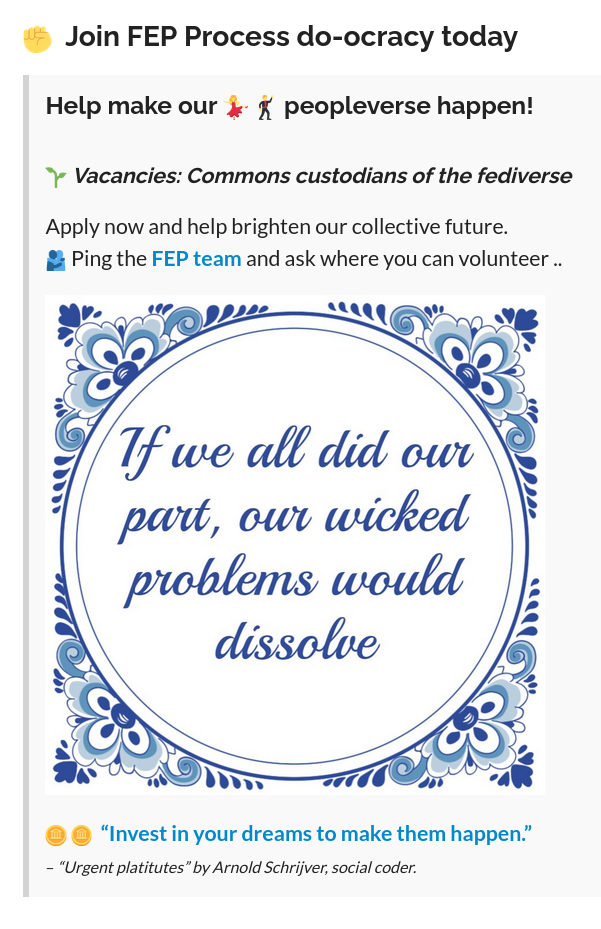


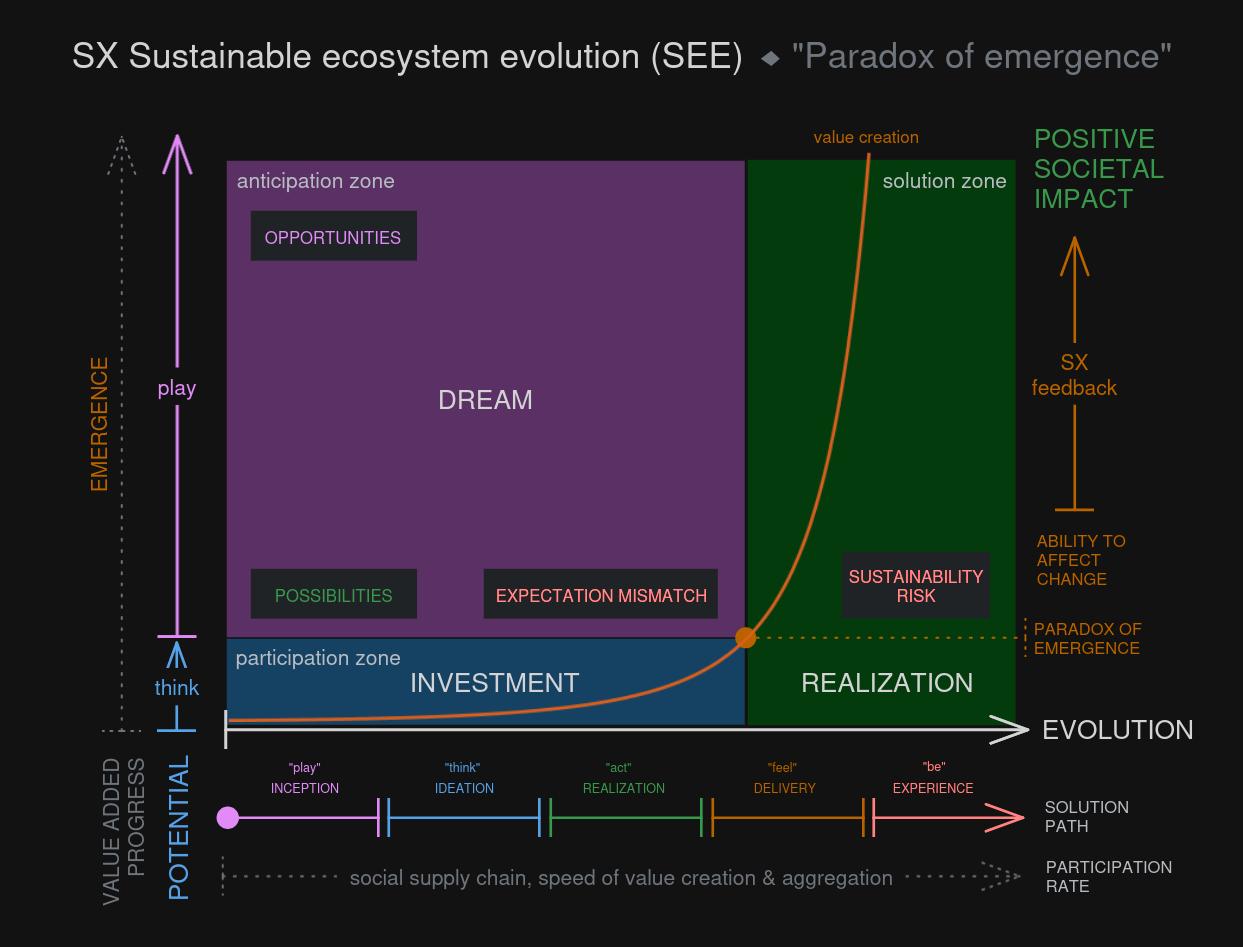
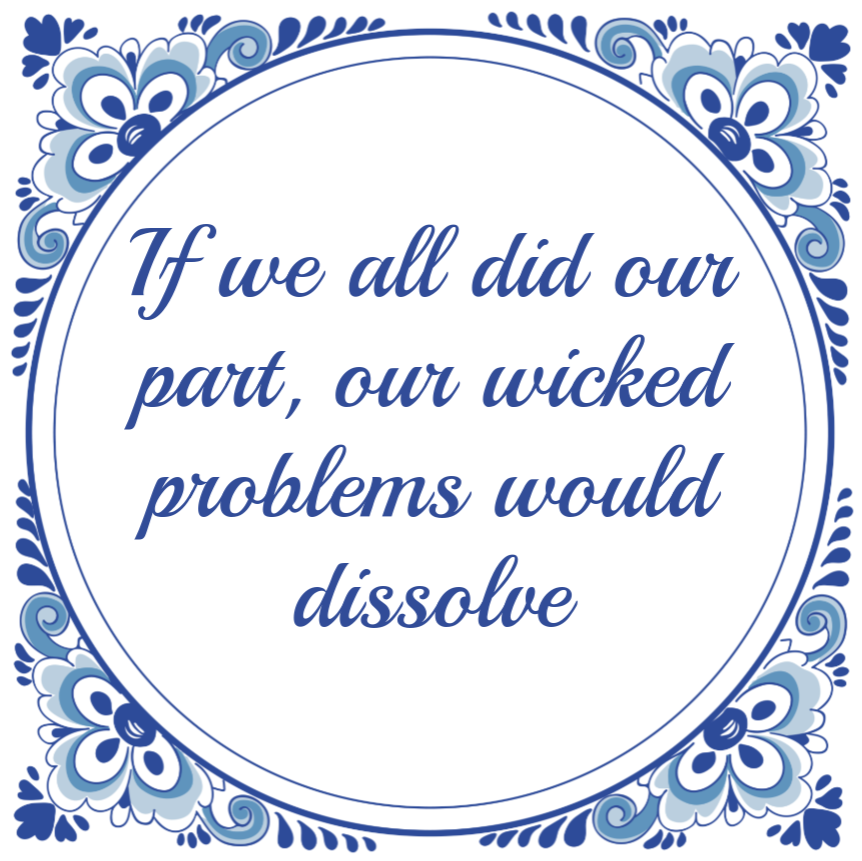





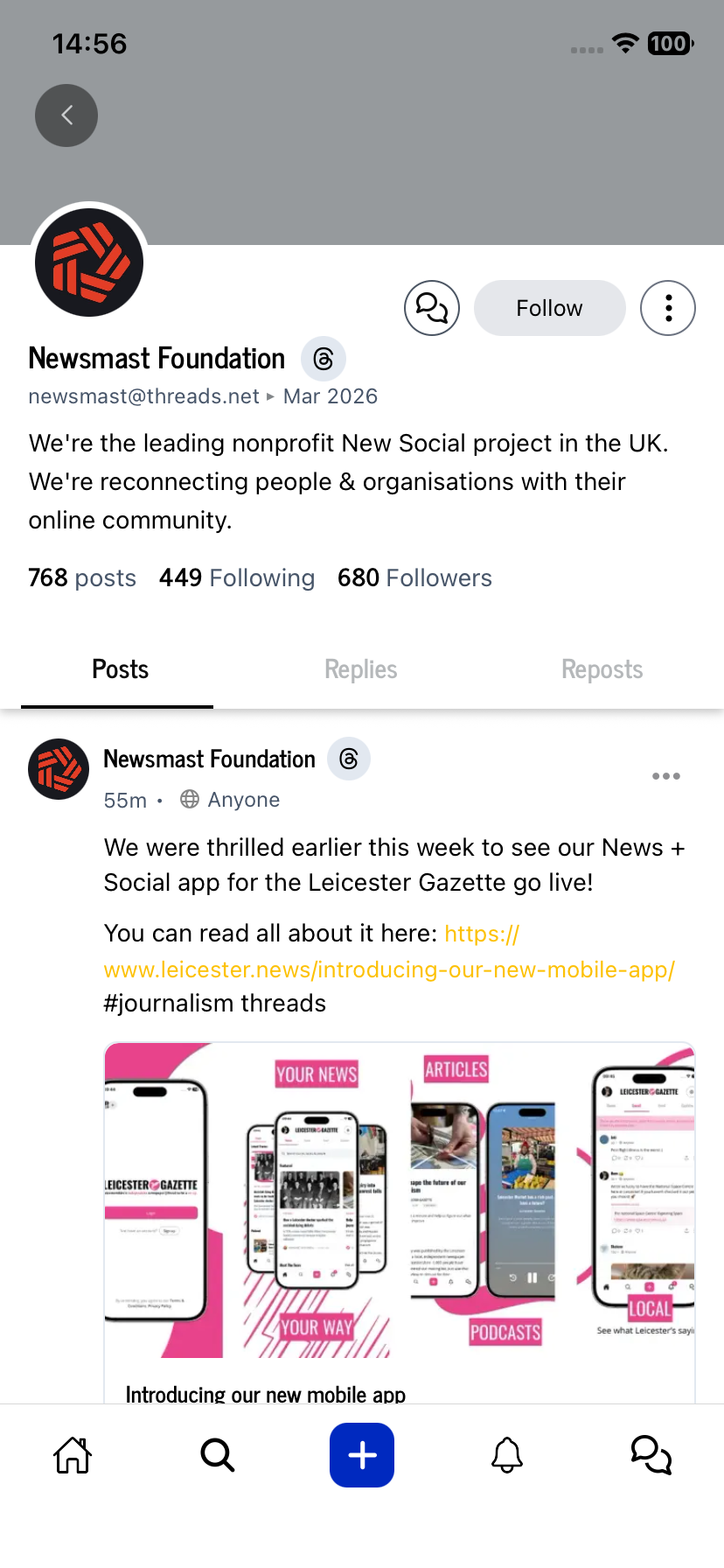
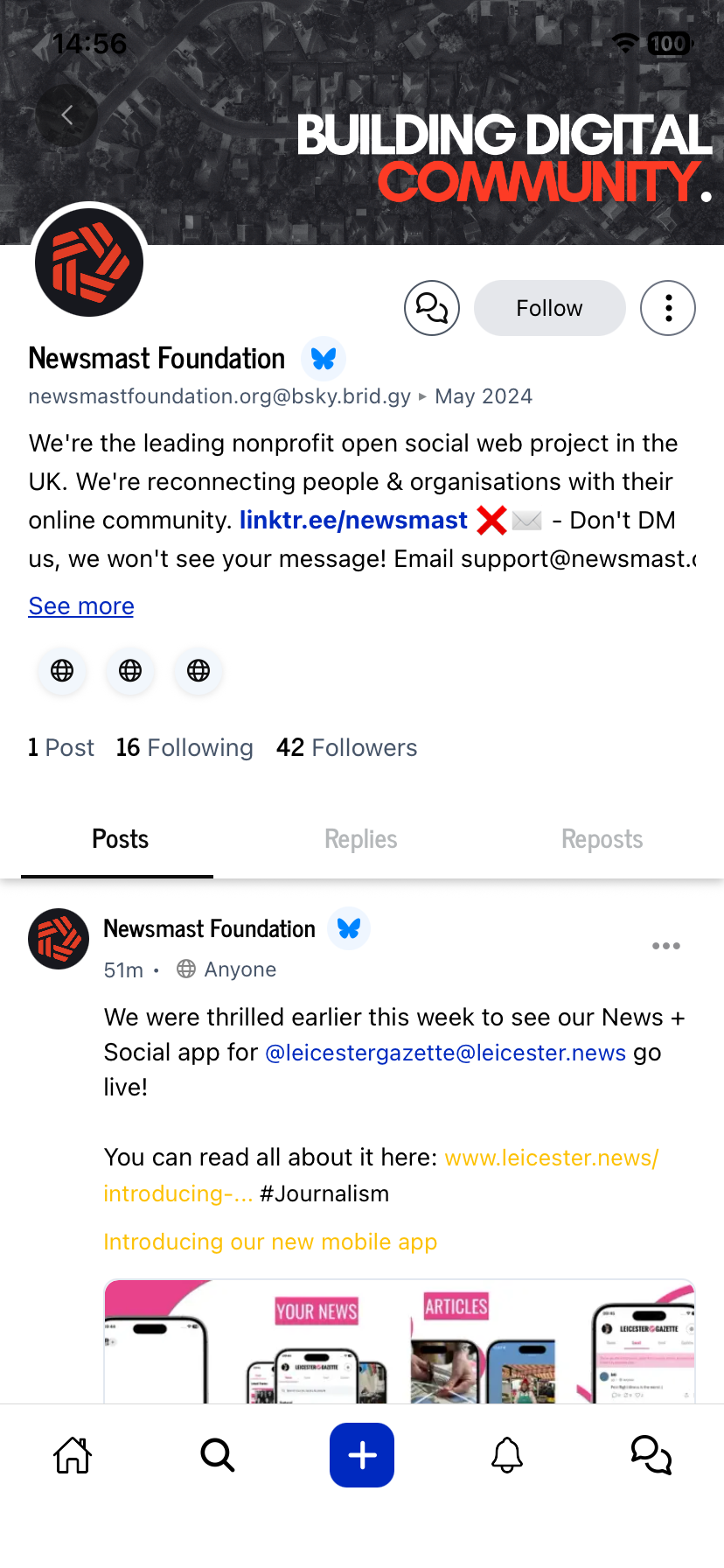




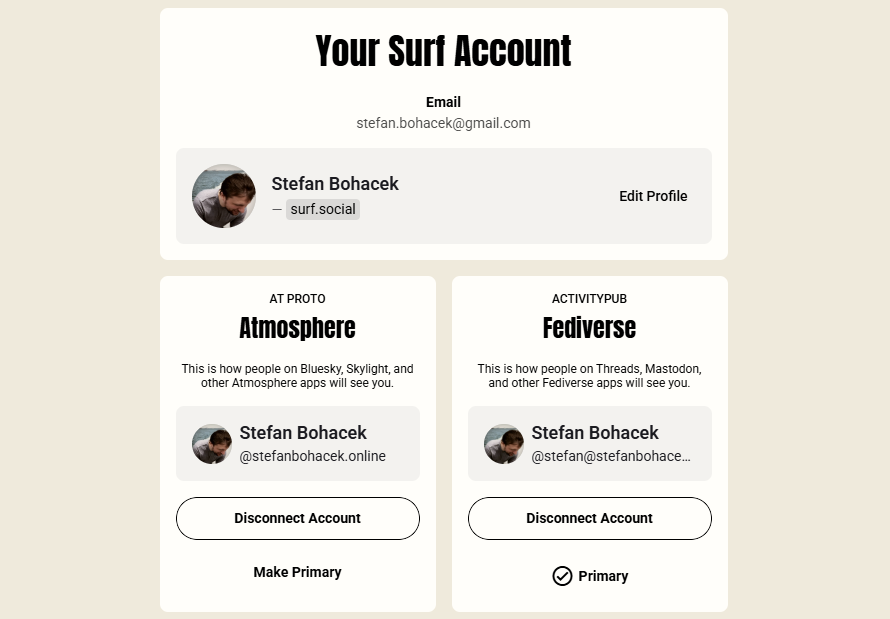
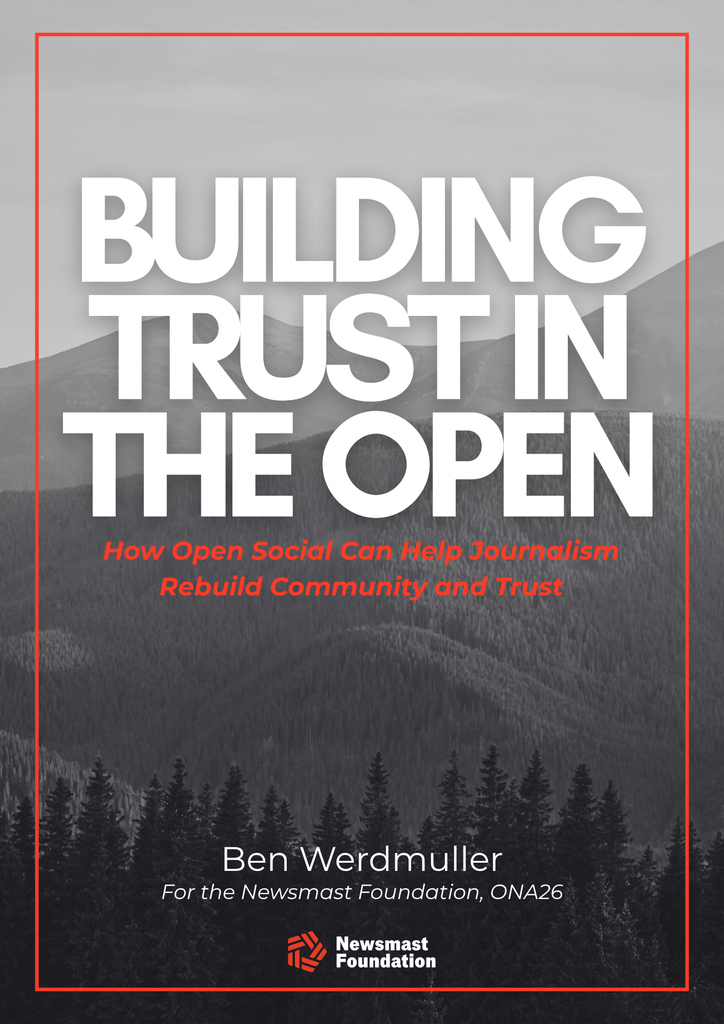
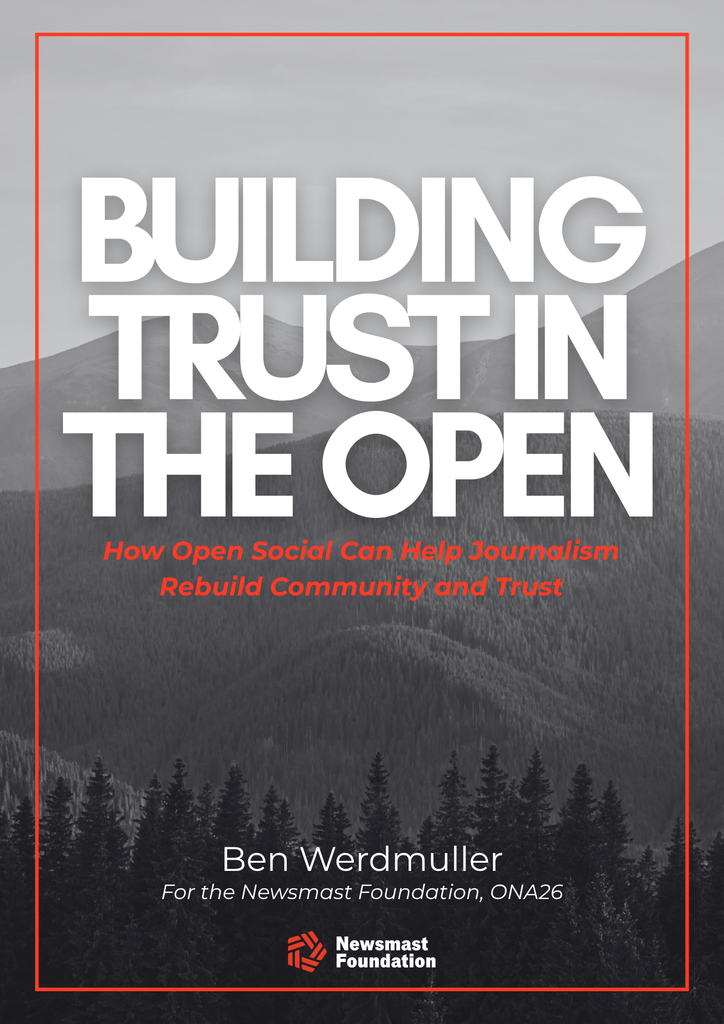






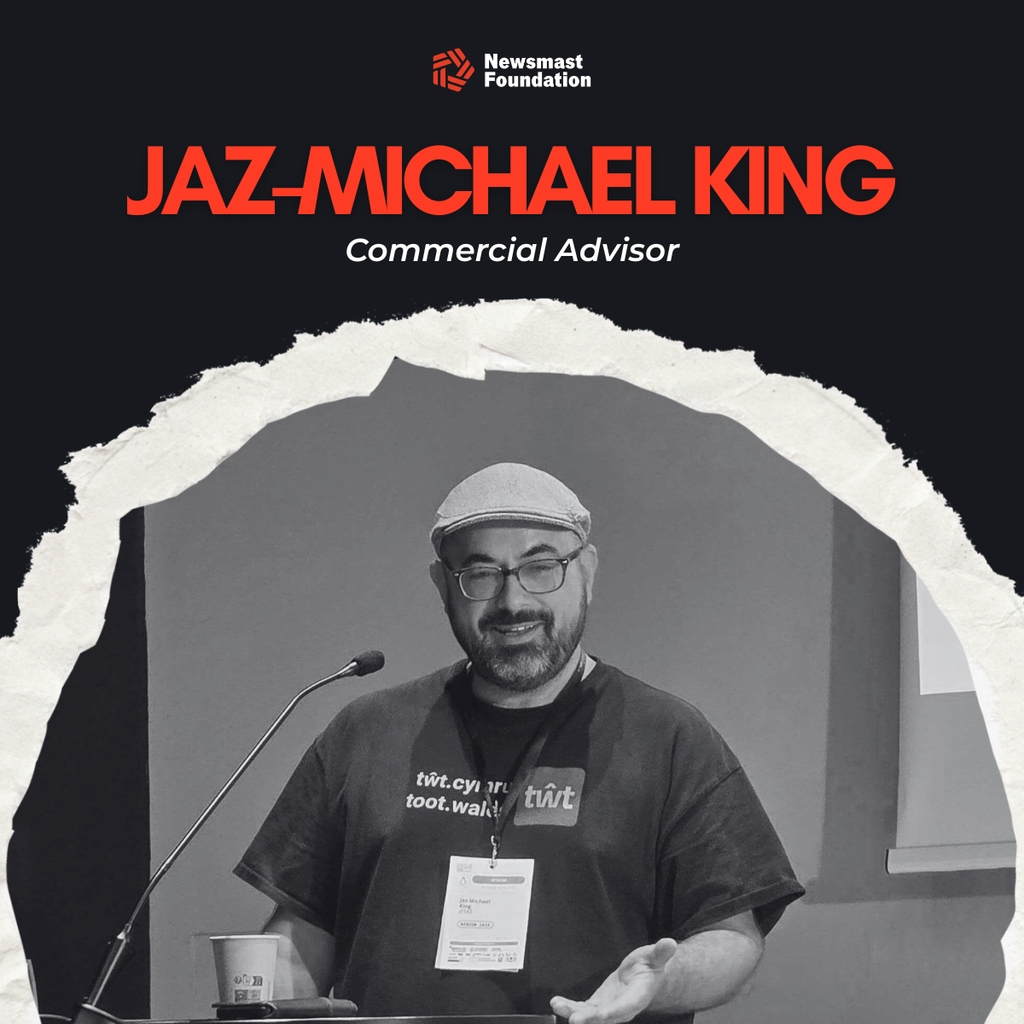


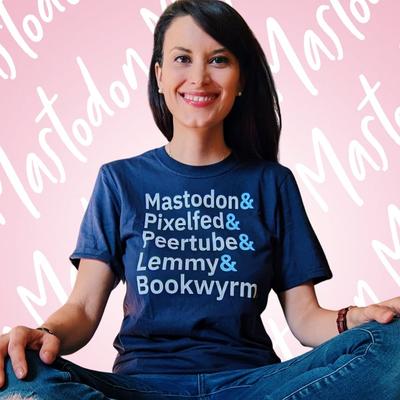
![[^BgTA^] :verified: :opensuse:'s avatar](https://mastodon.in4matics.cat/system/accounts/avatars/112/726/671/620/605/358/original/2cfc6d4cc5e23765.png)





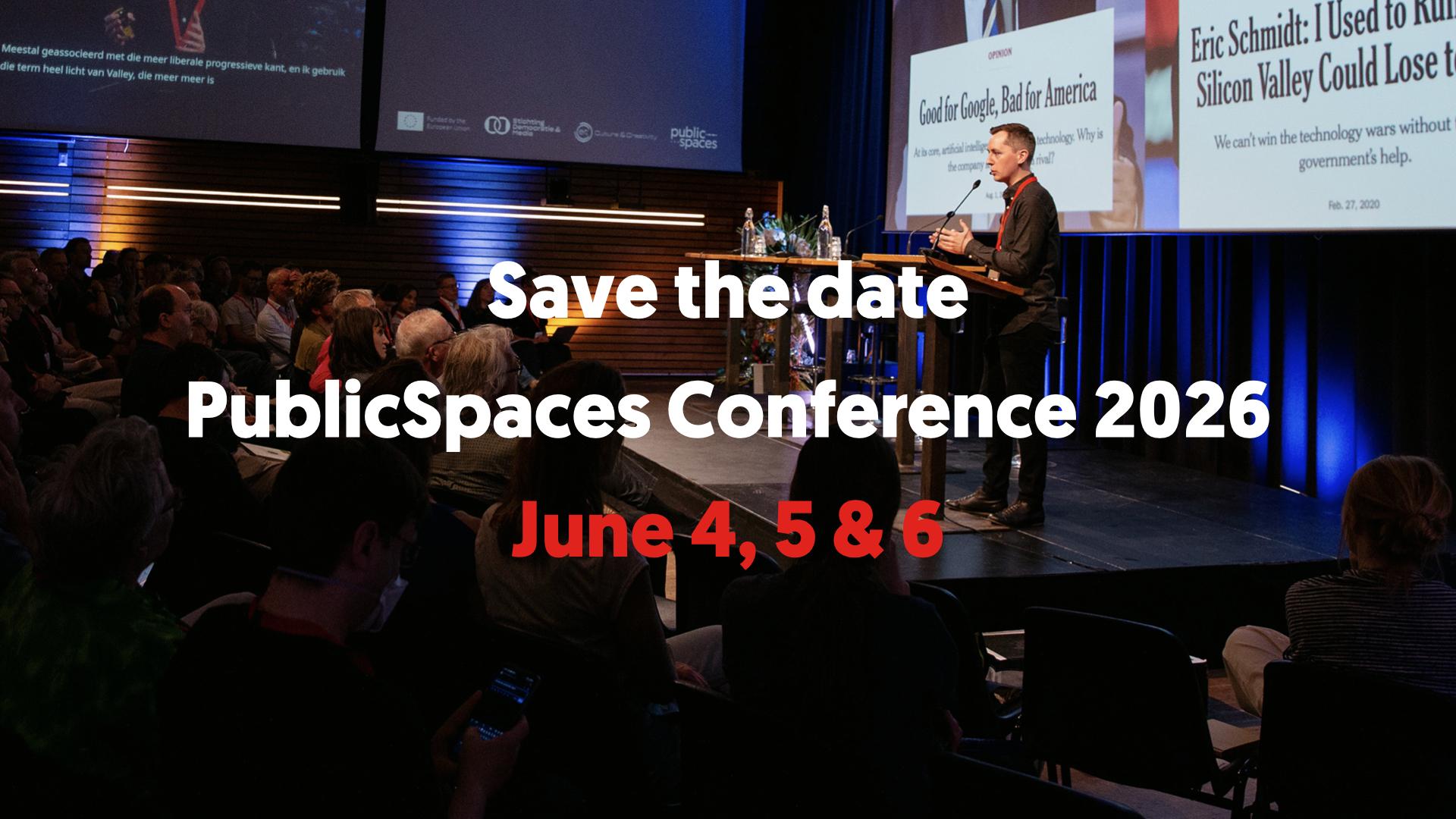



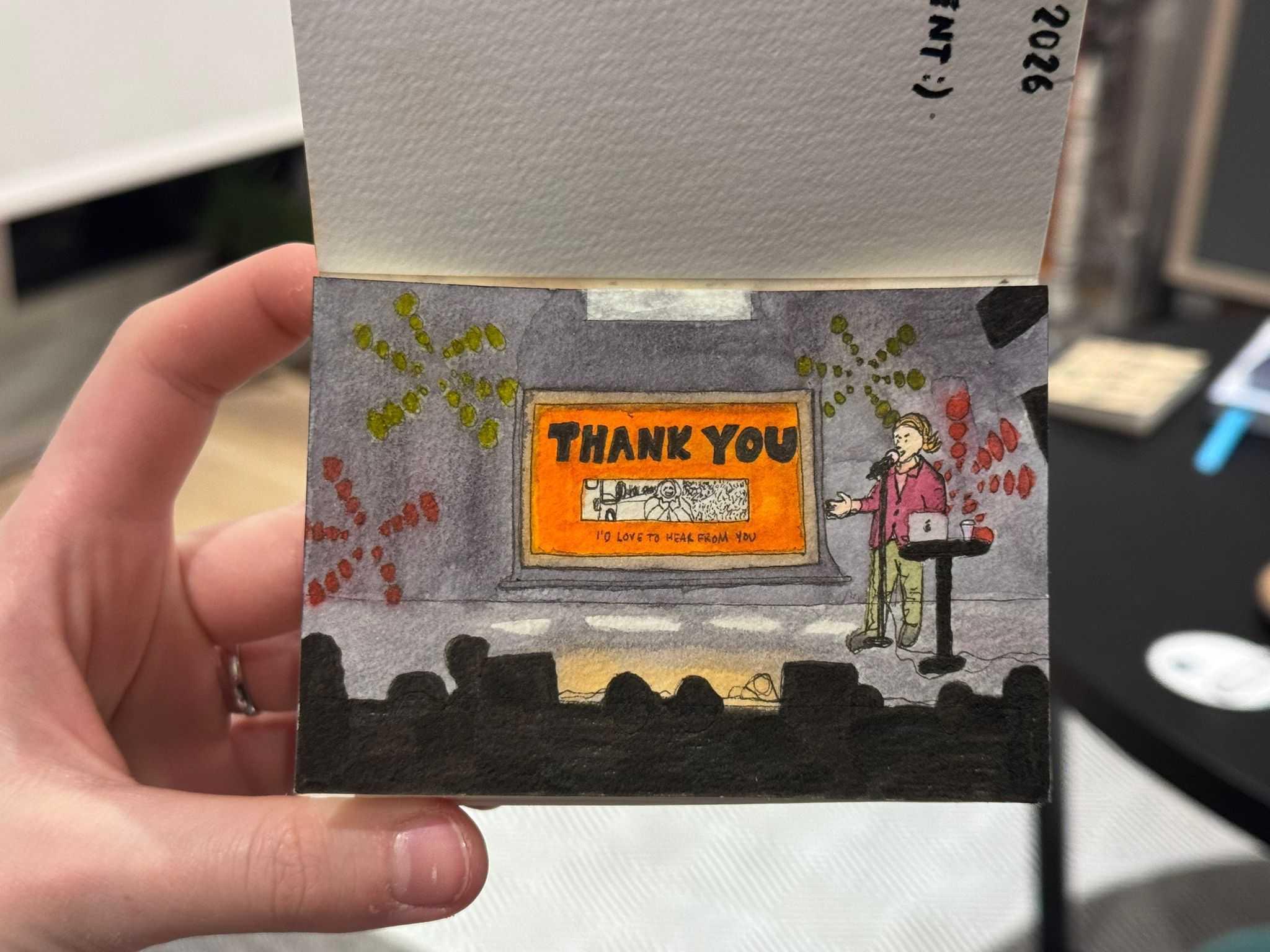





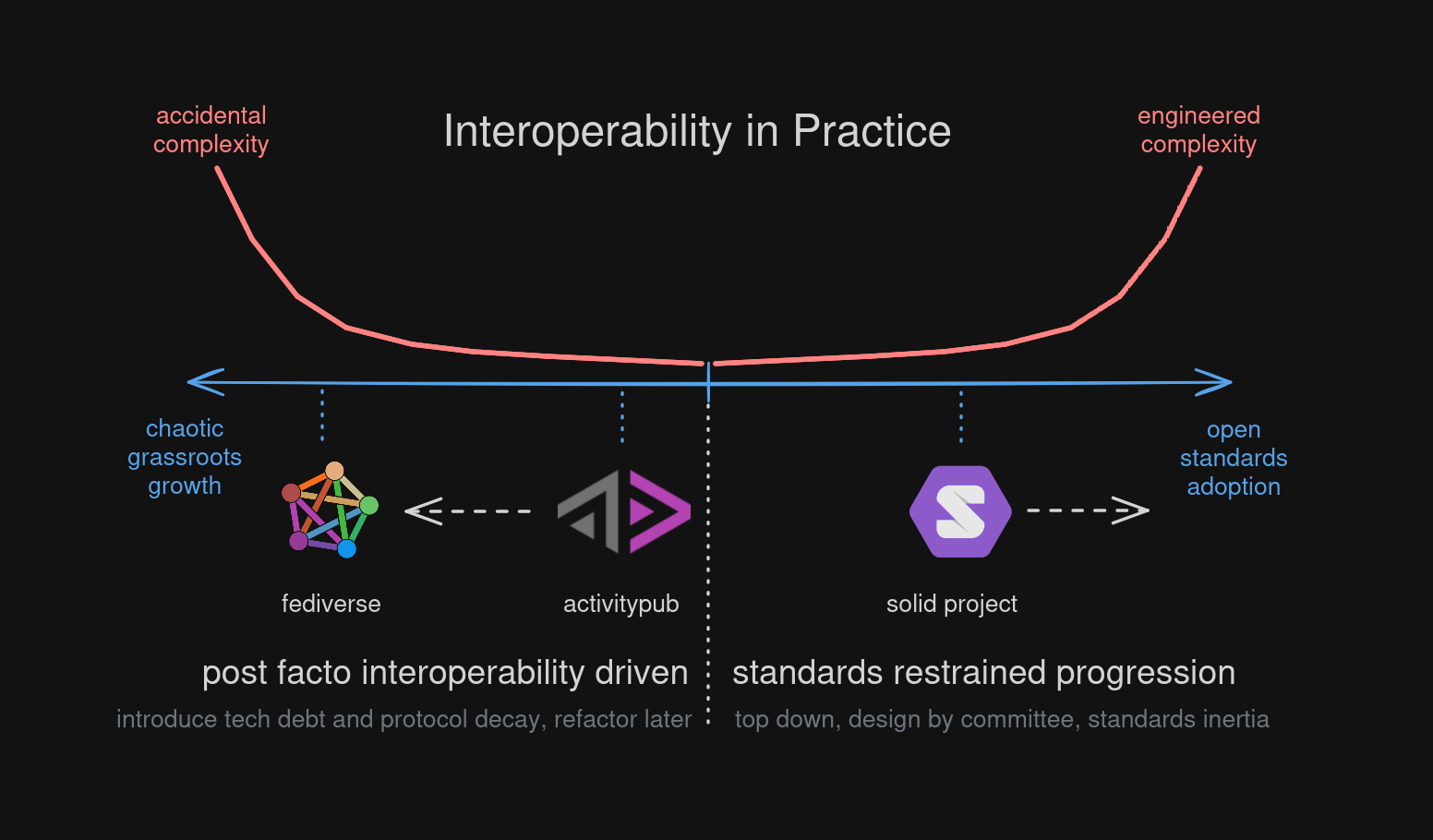











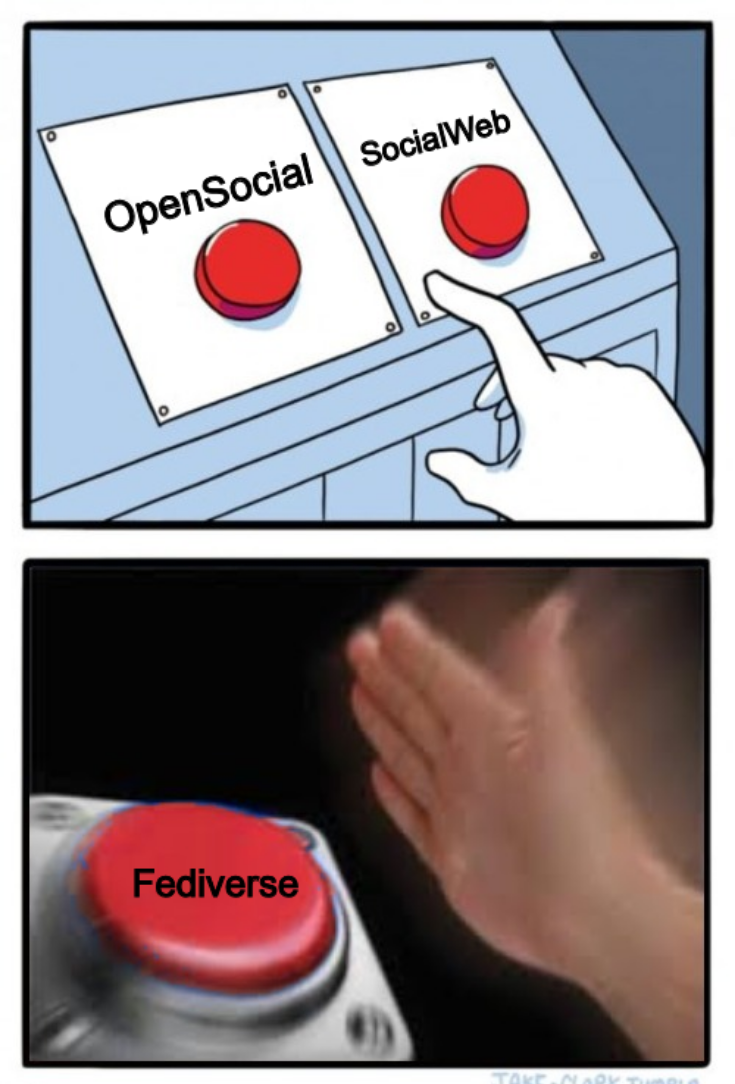
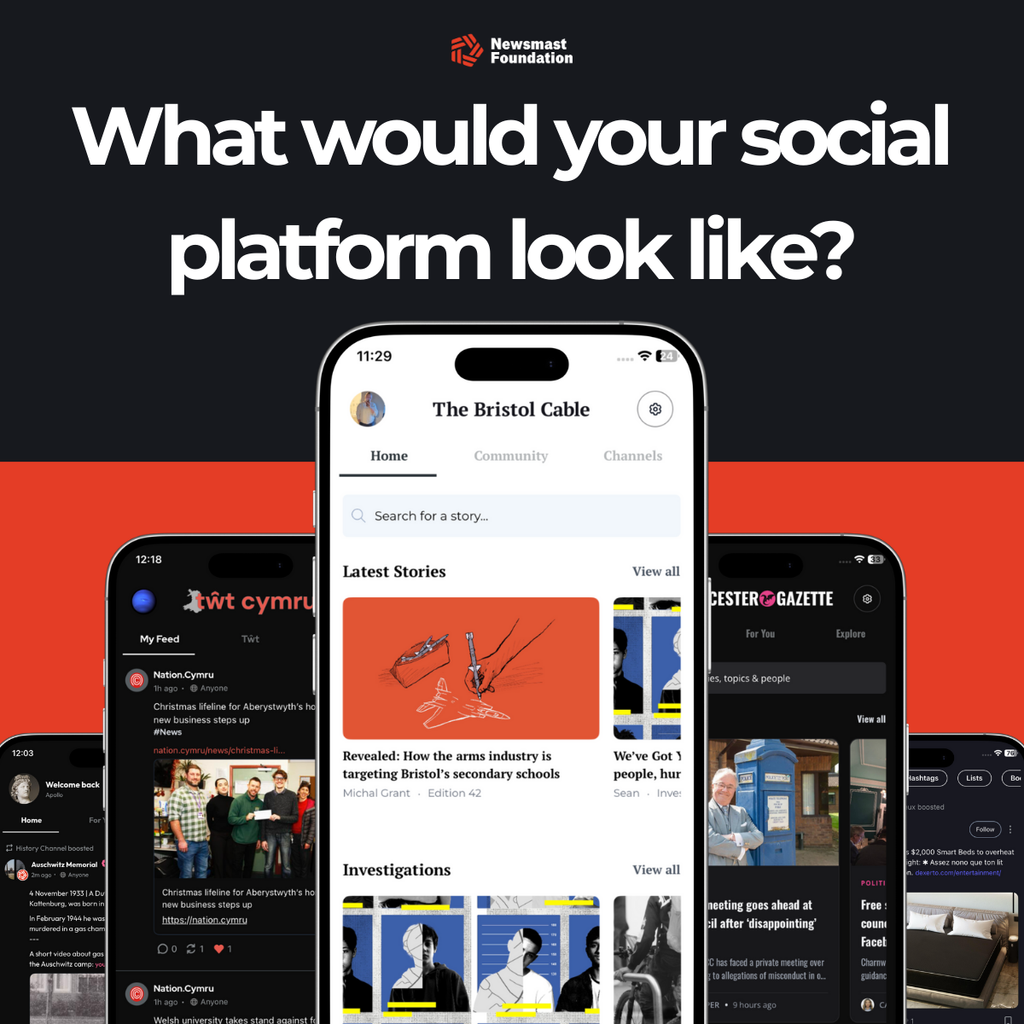




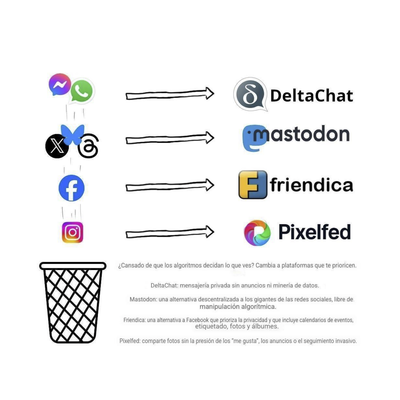




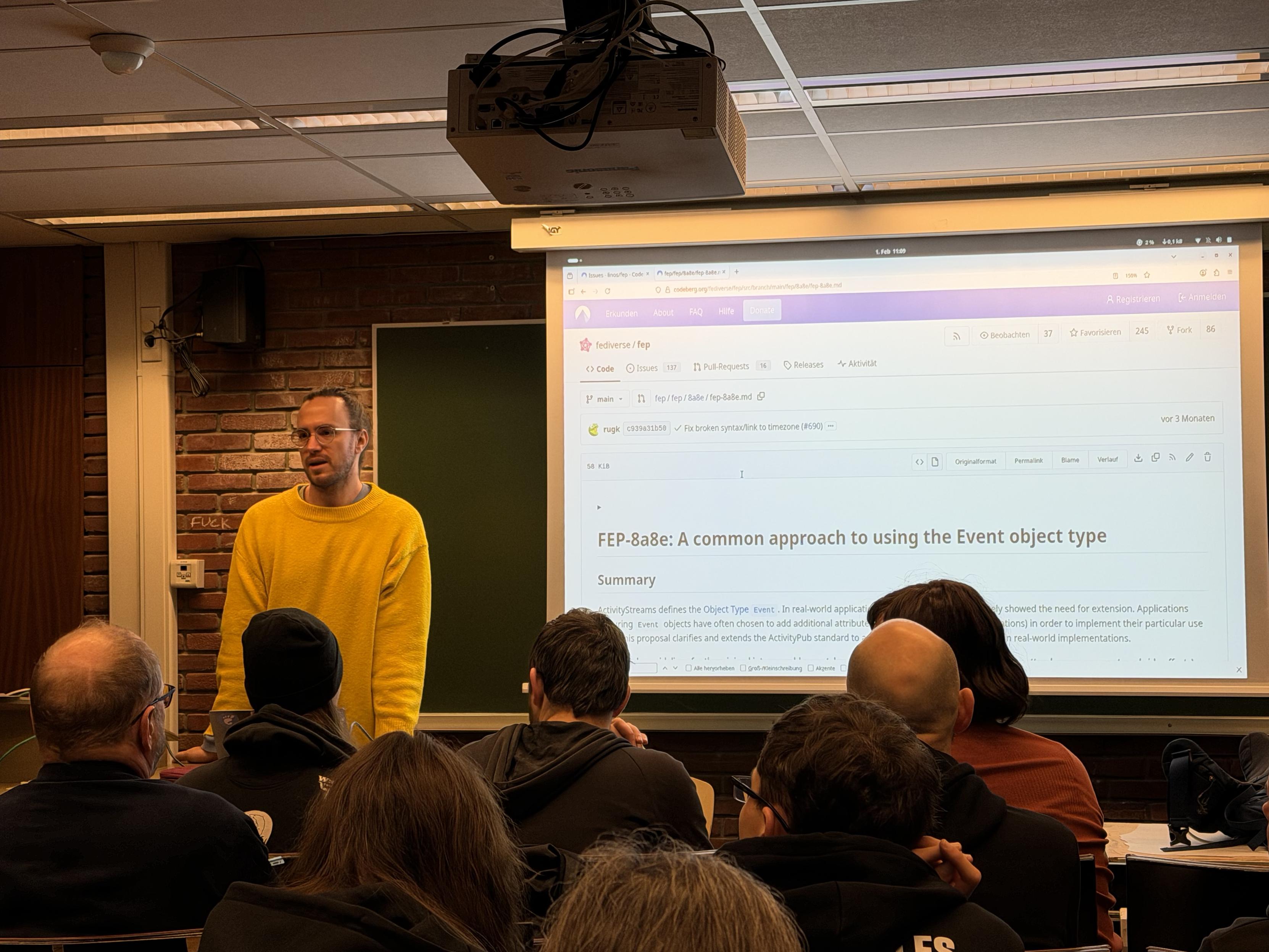
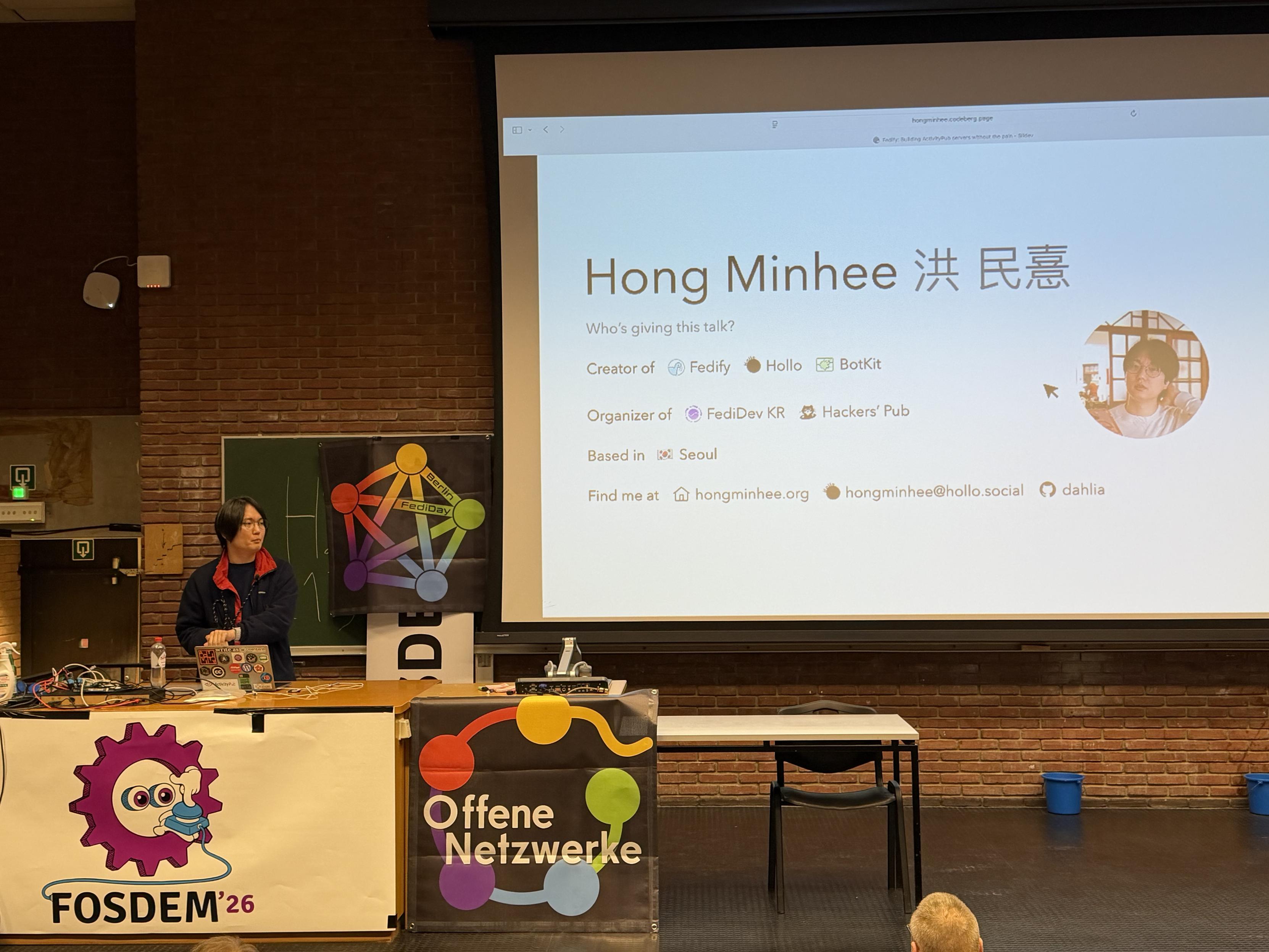
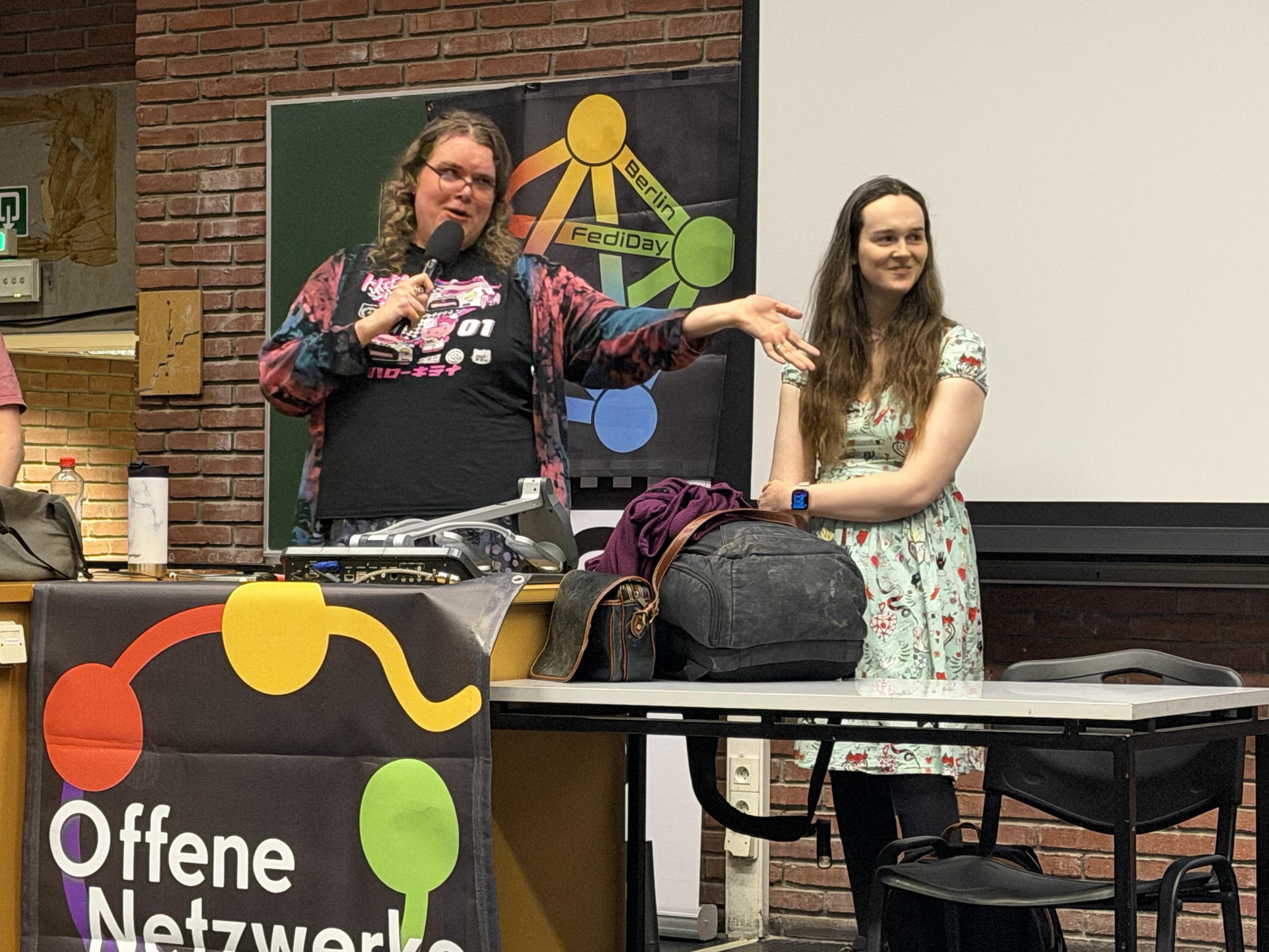
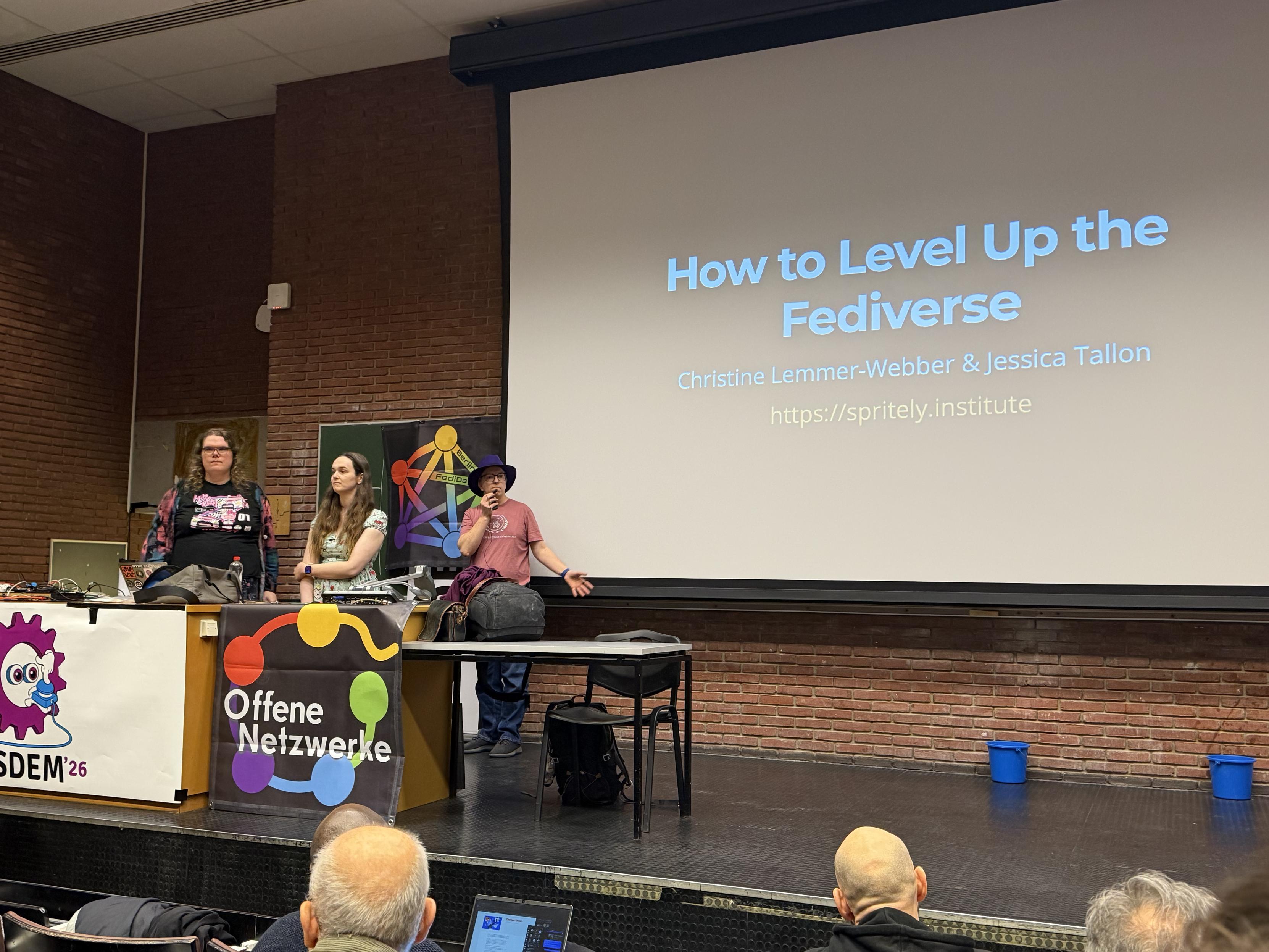


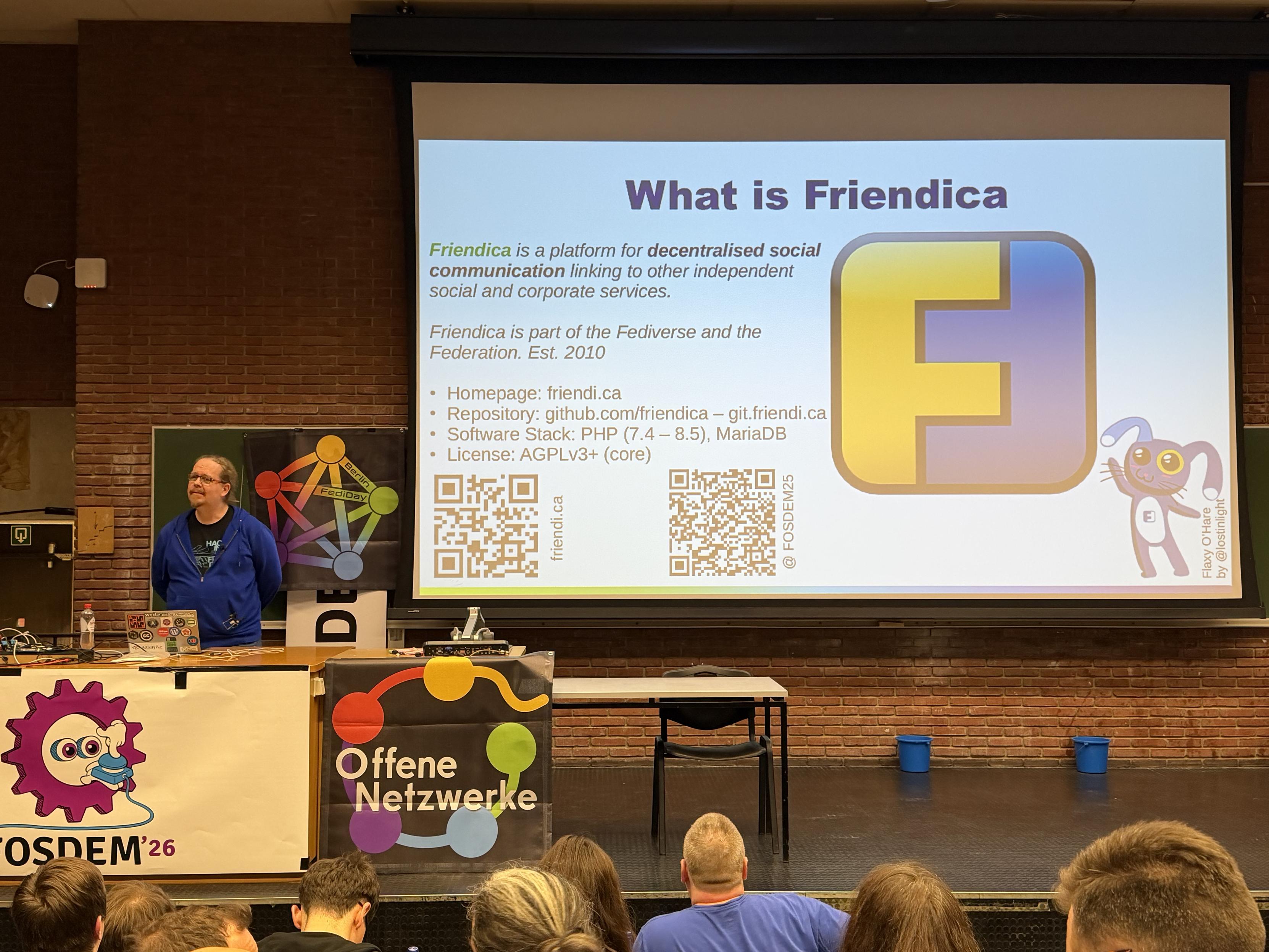
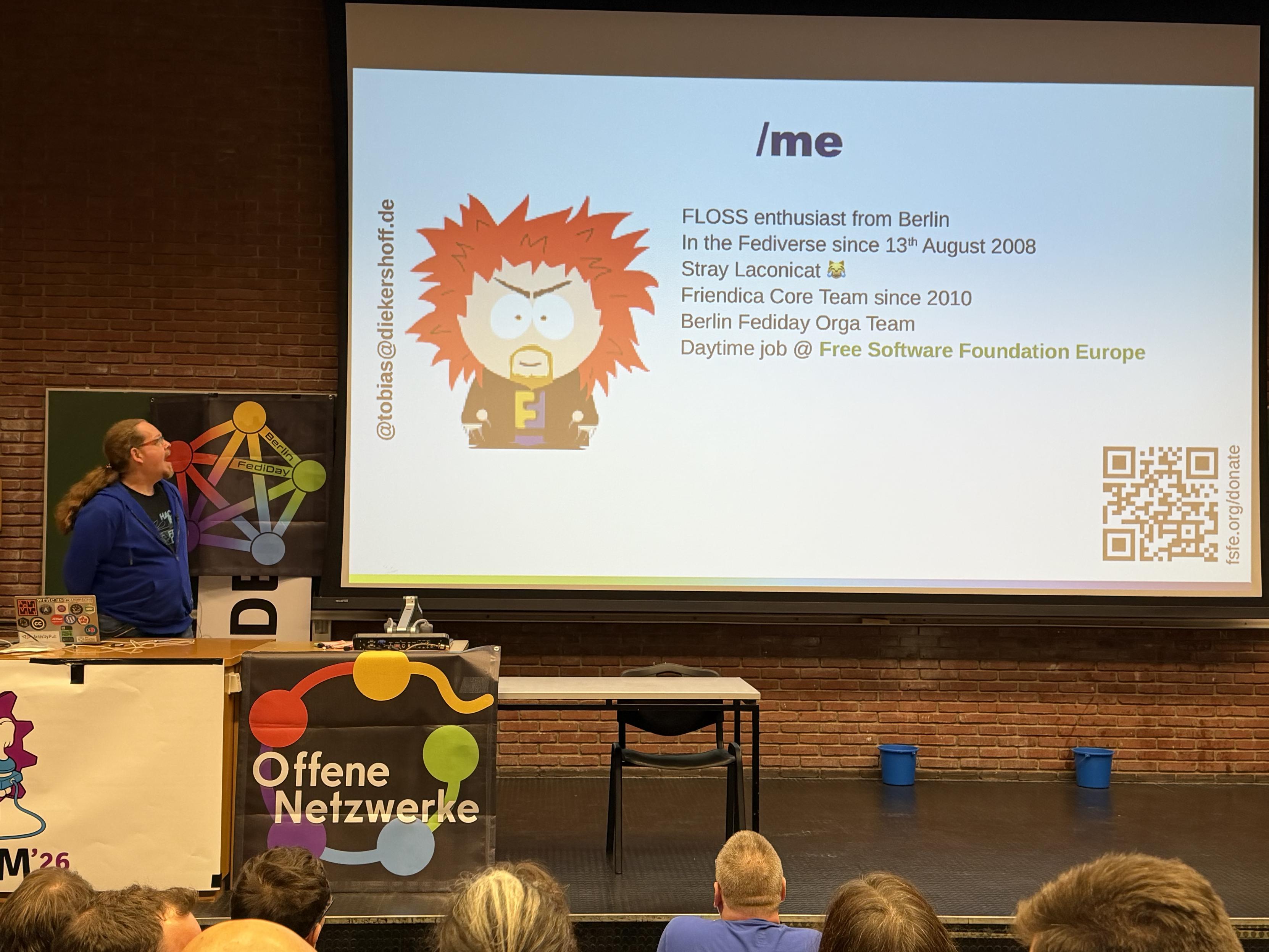


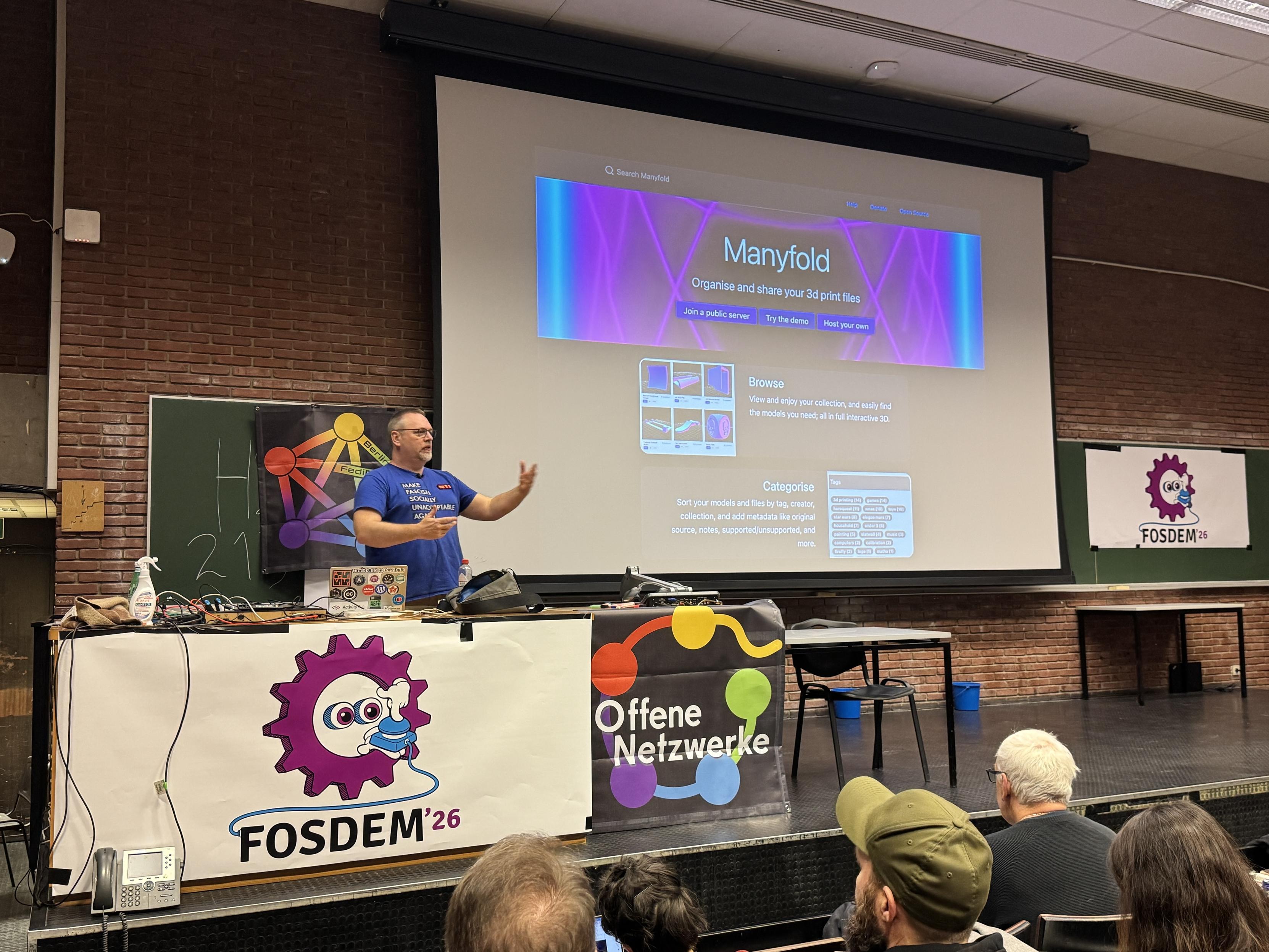


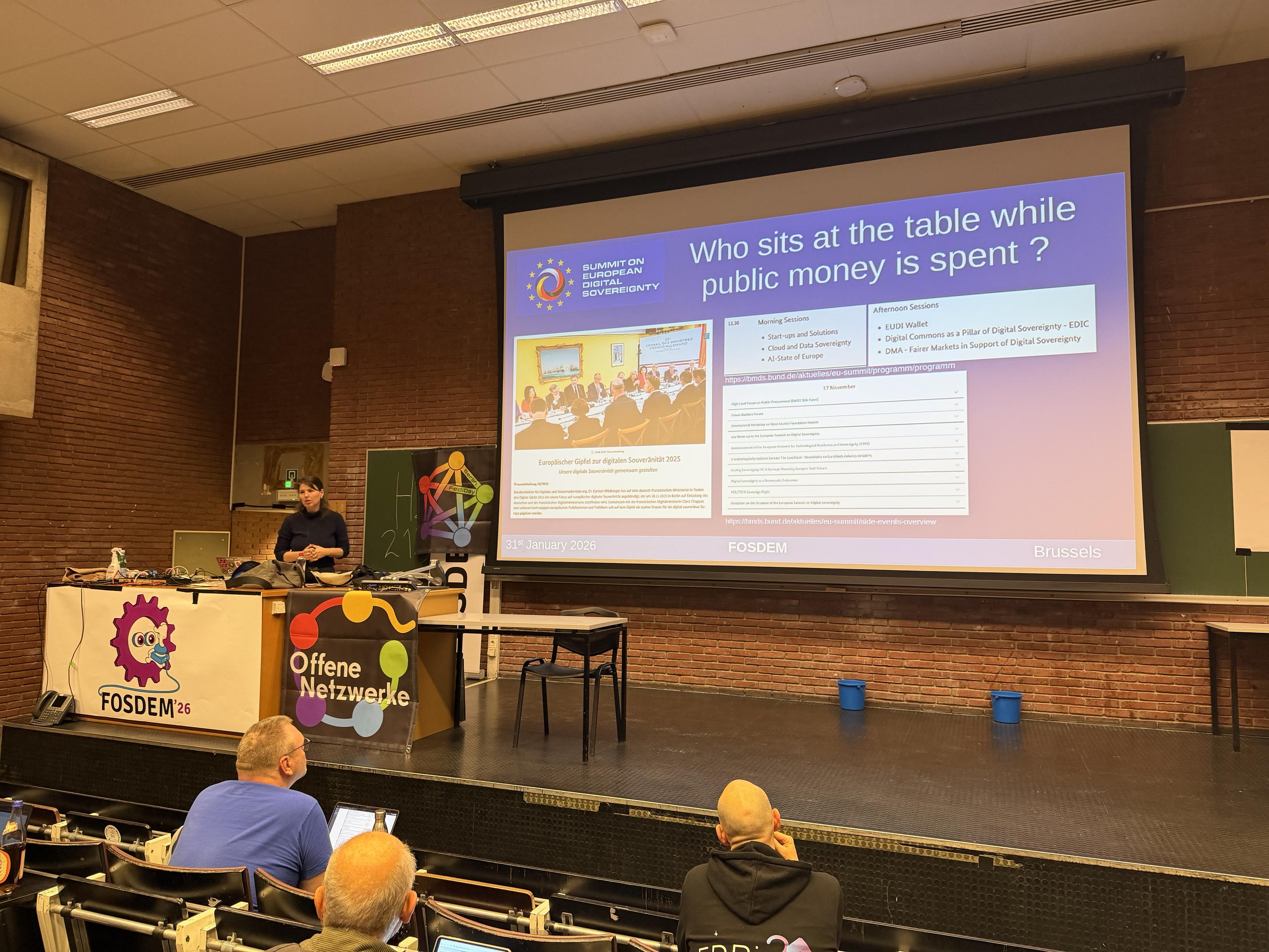
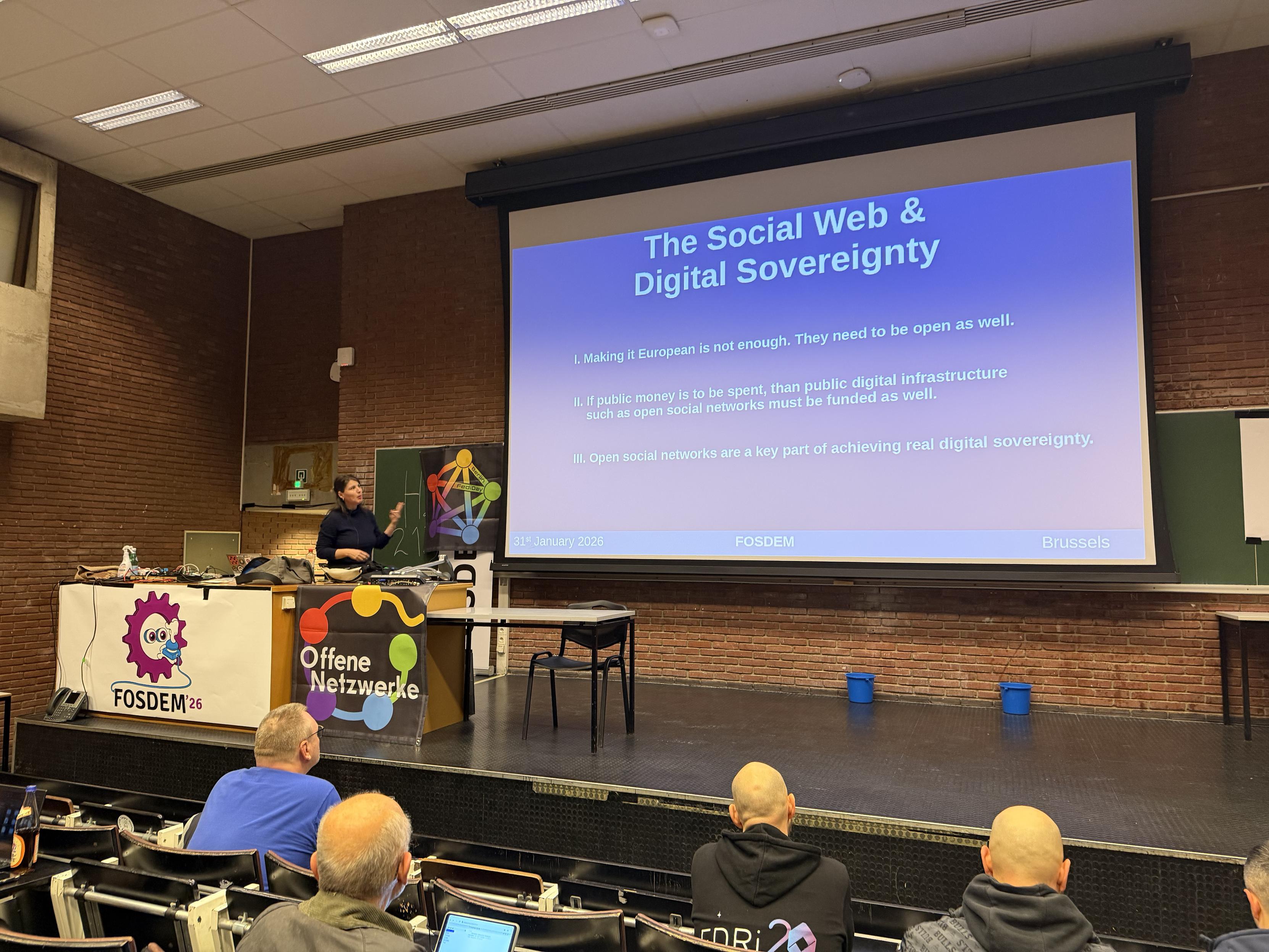
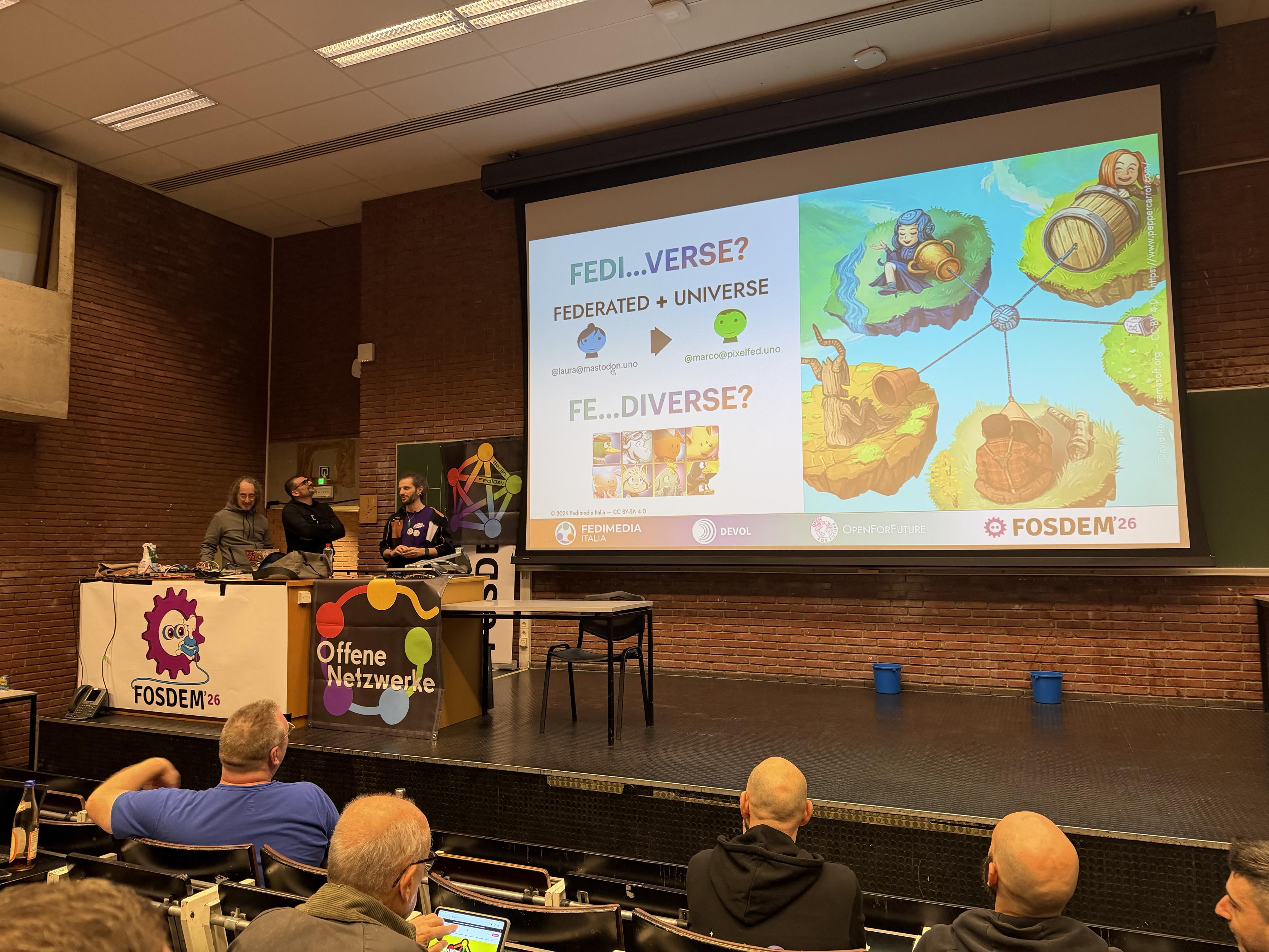
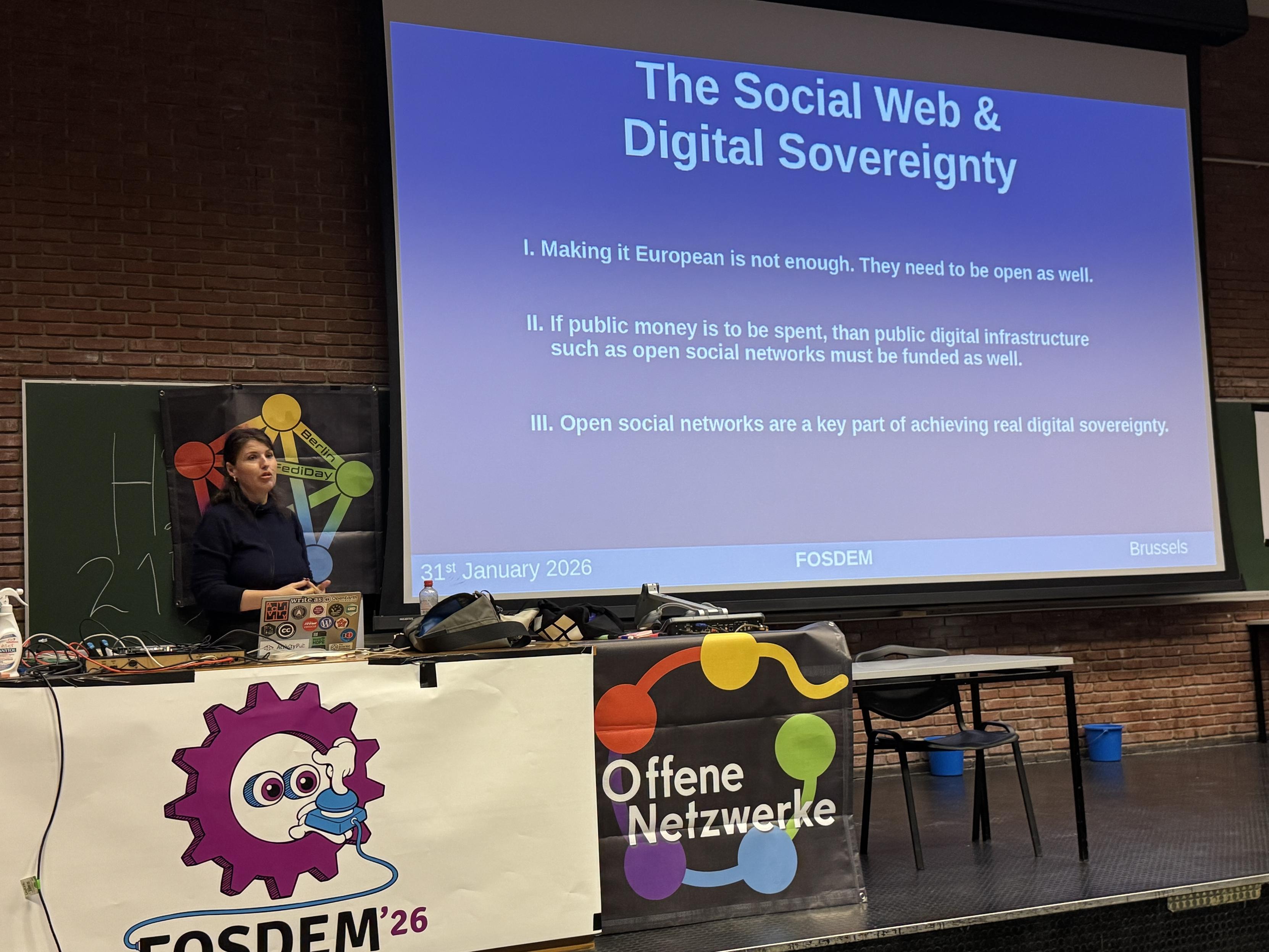



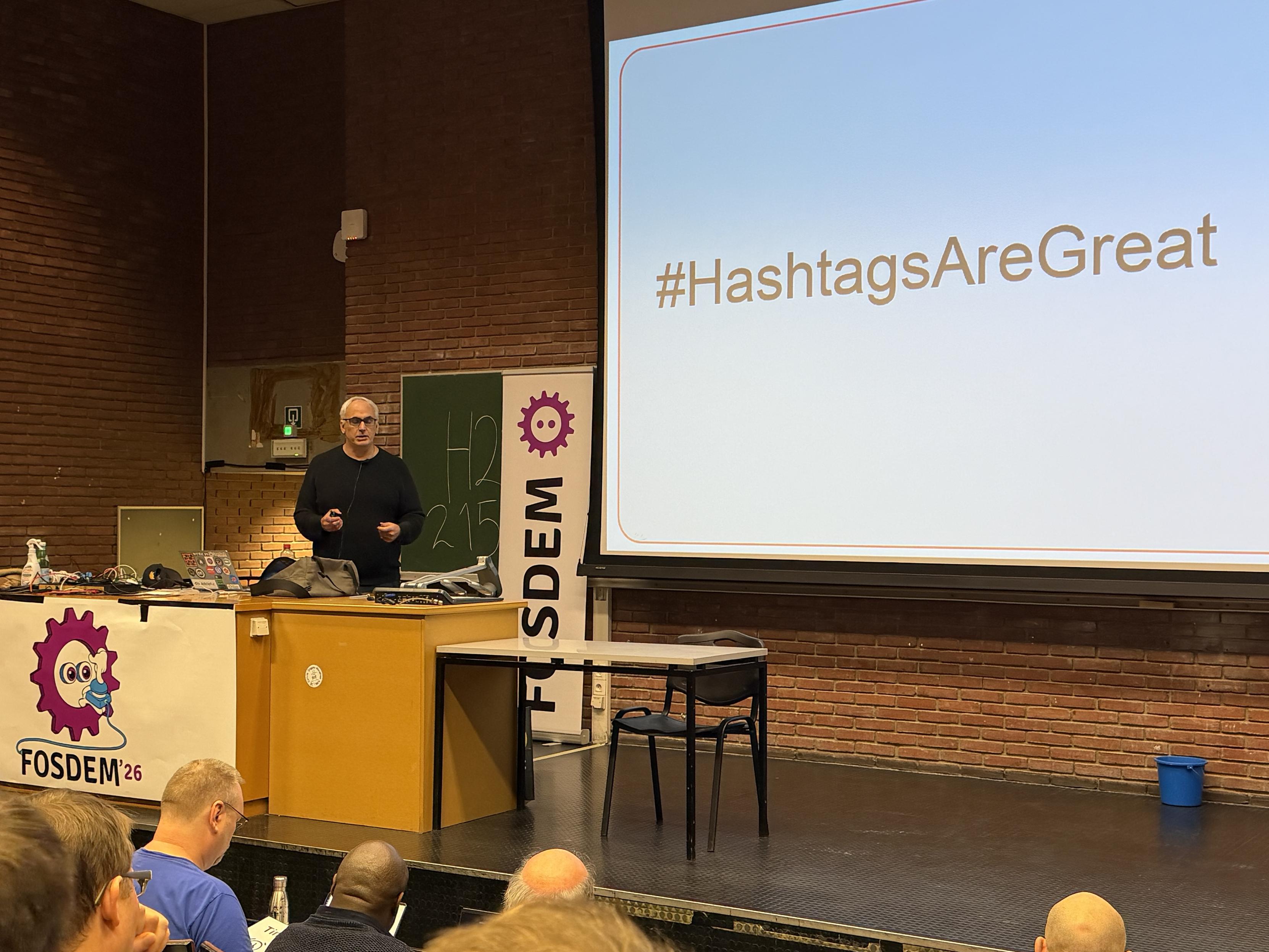
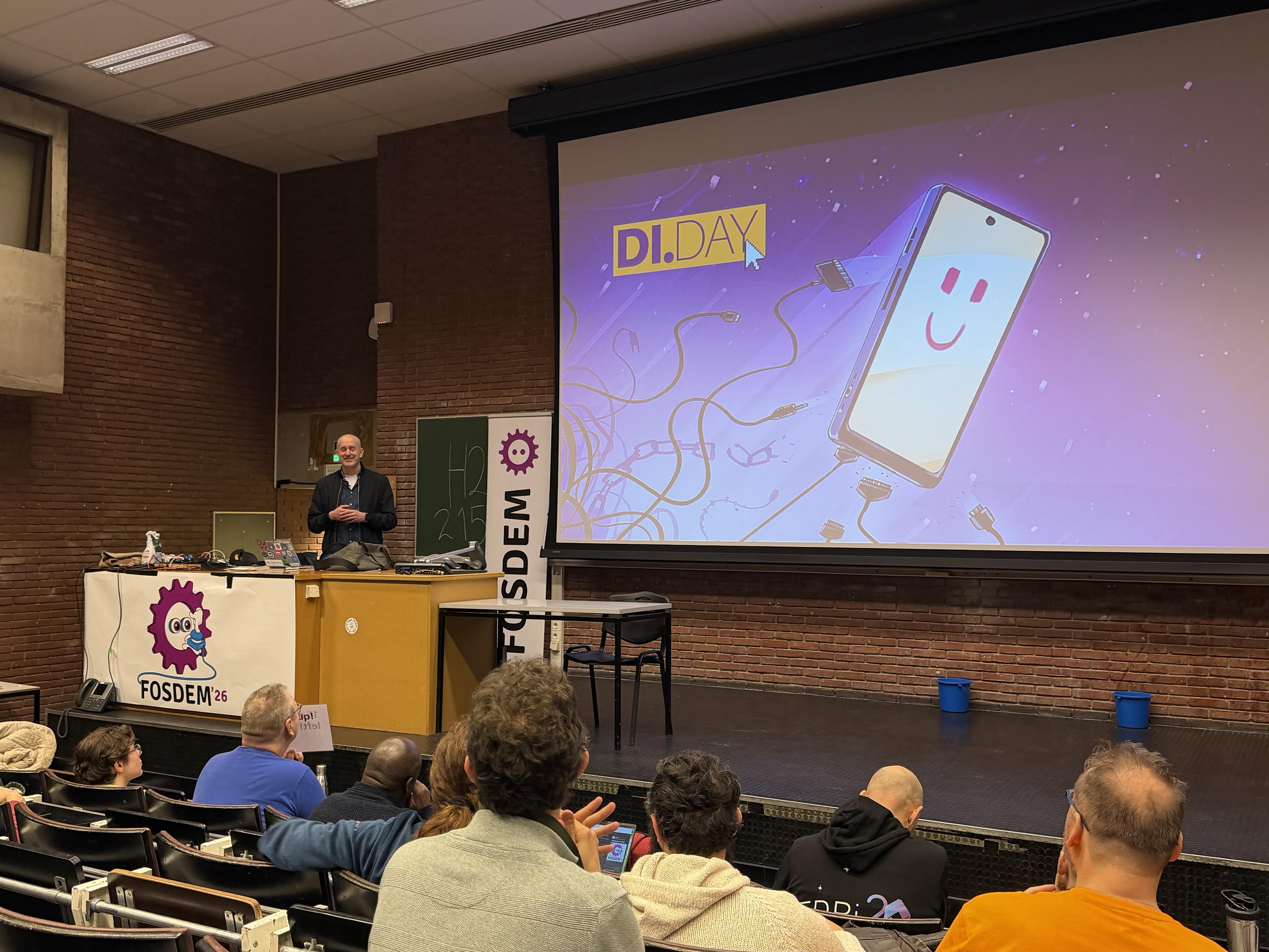
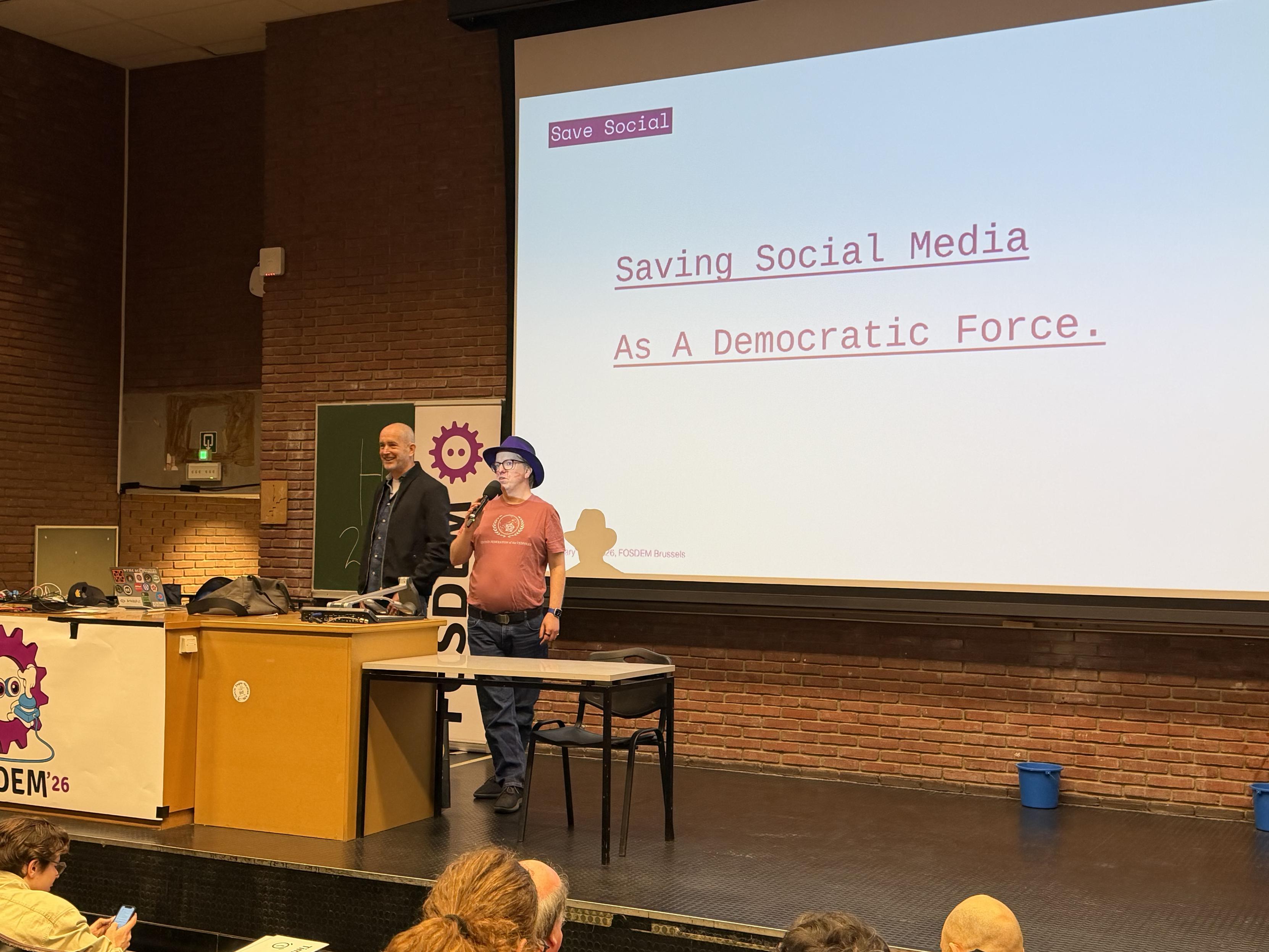
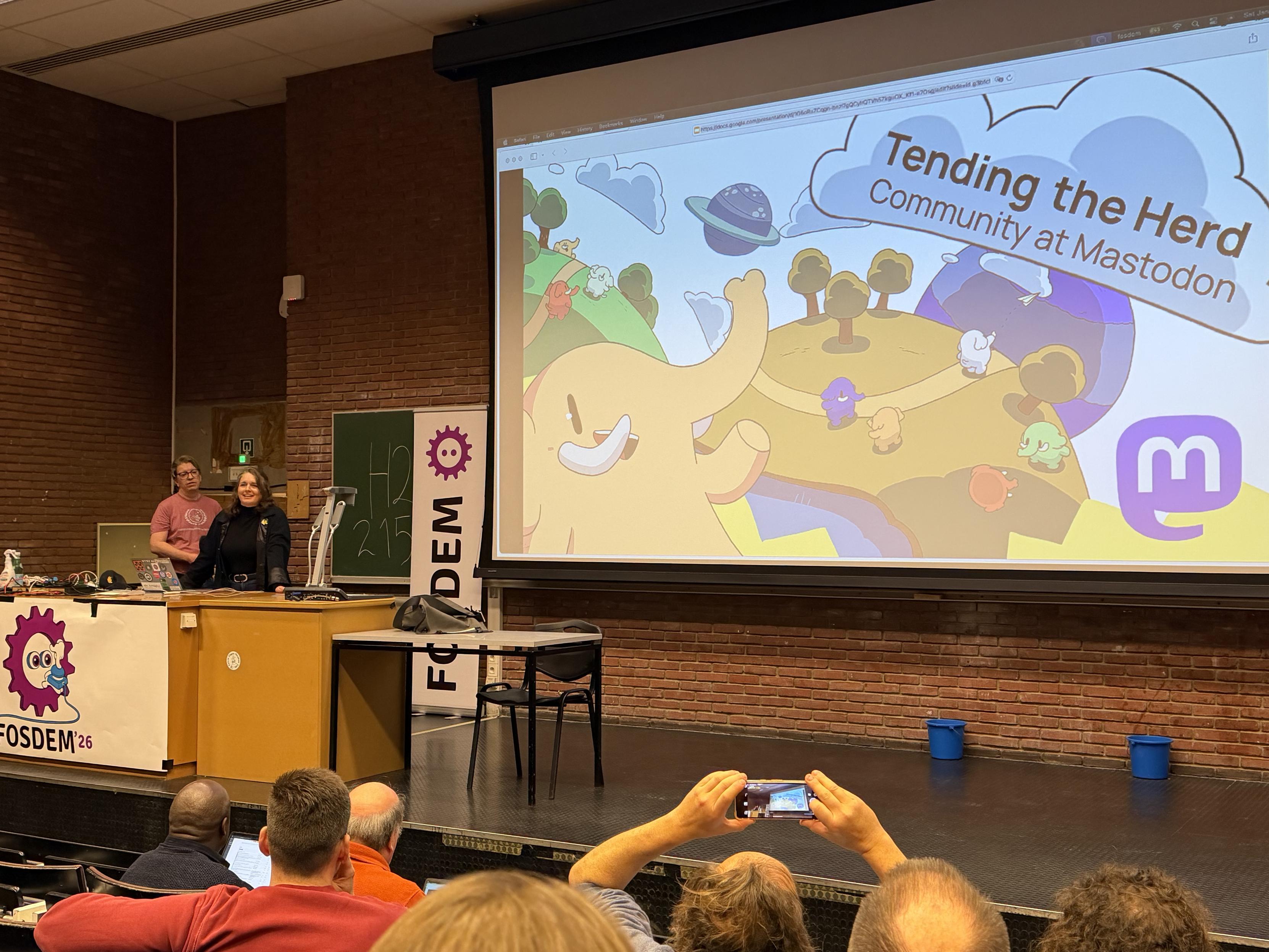
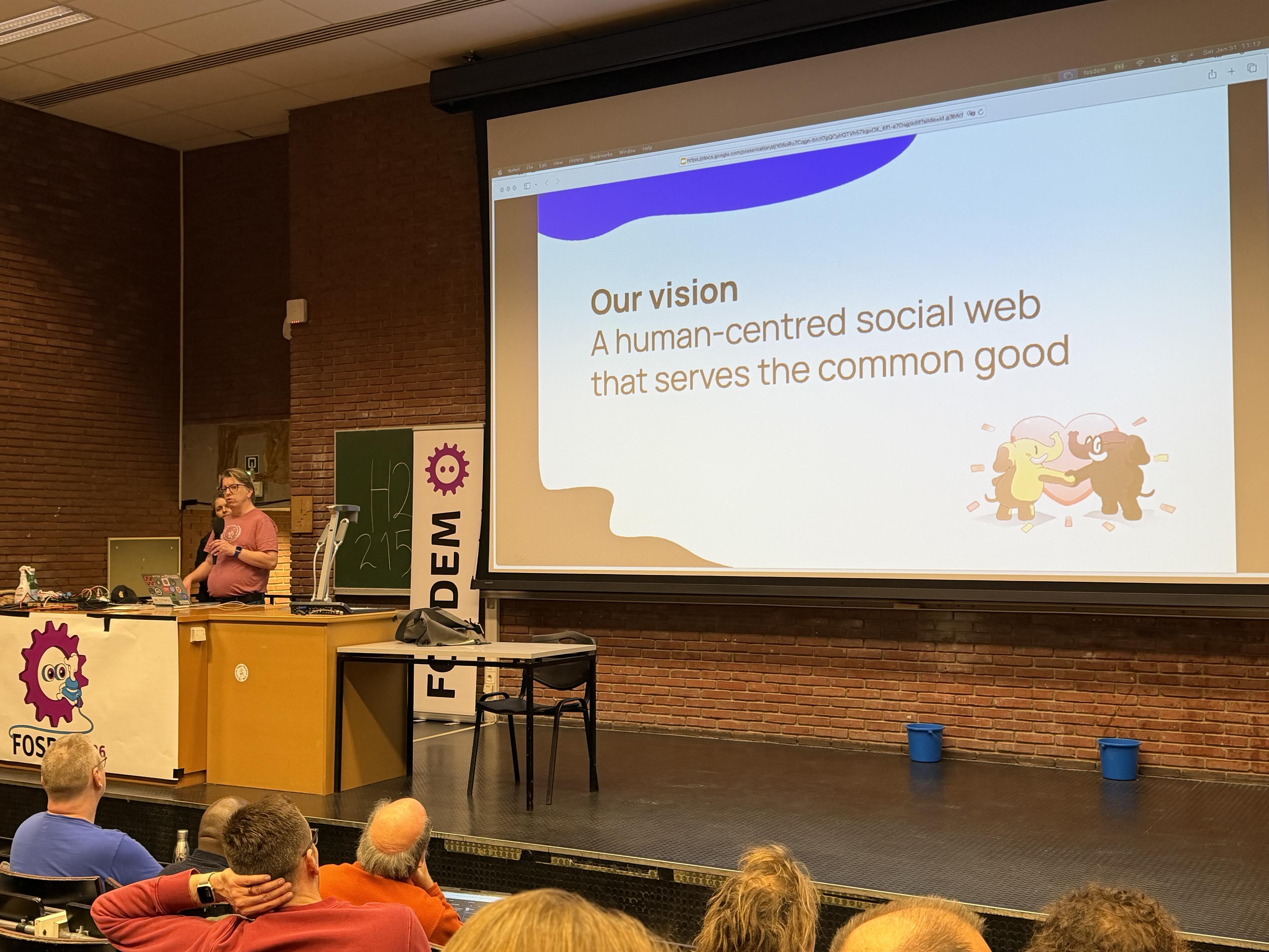
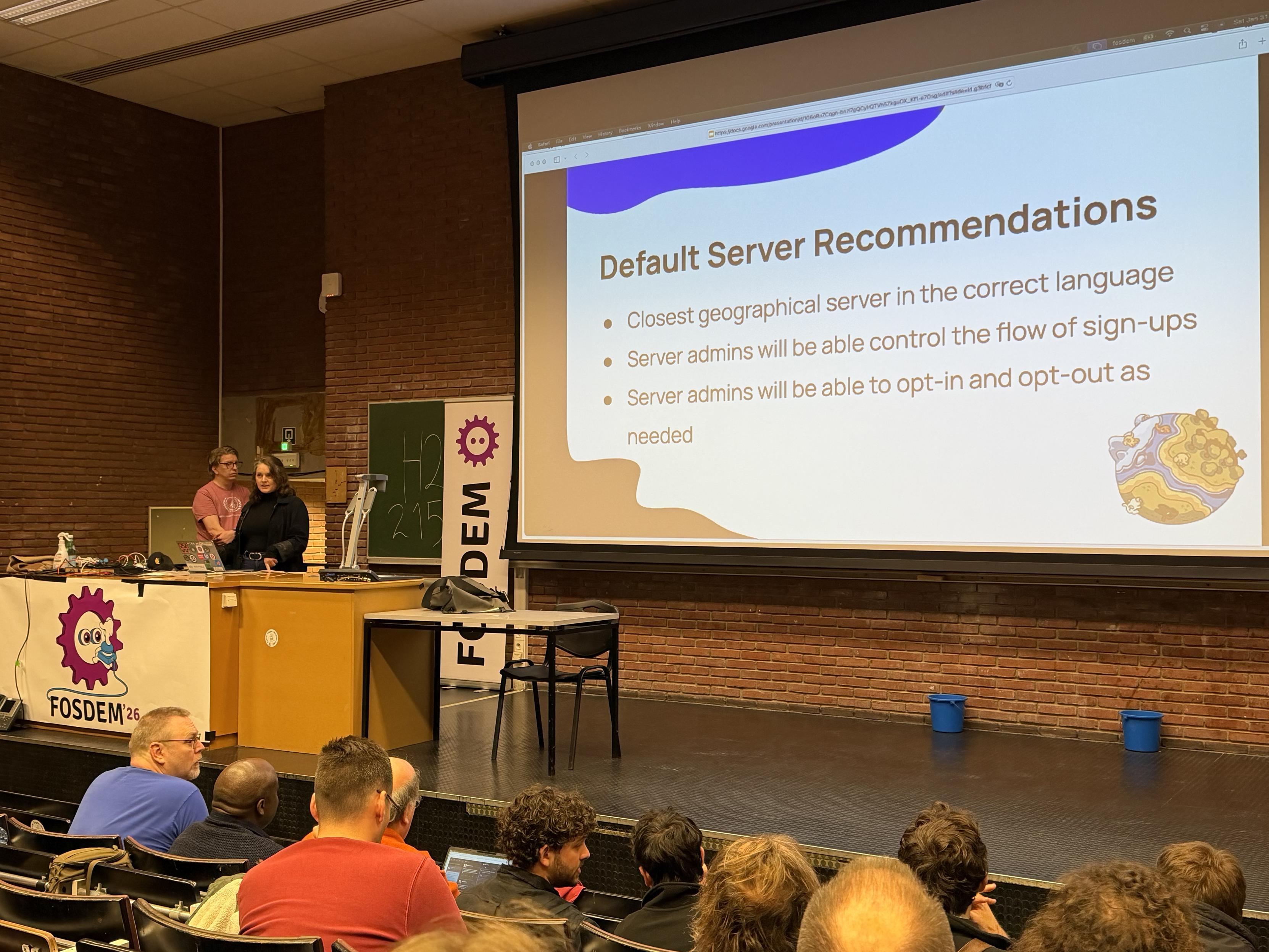













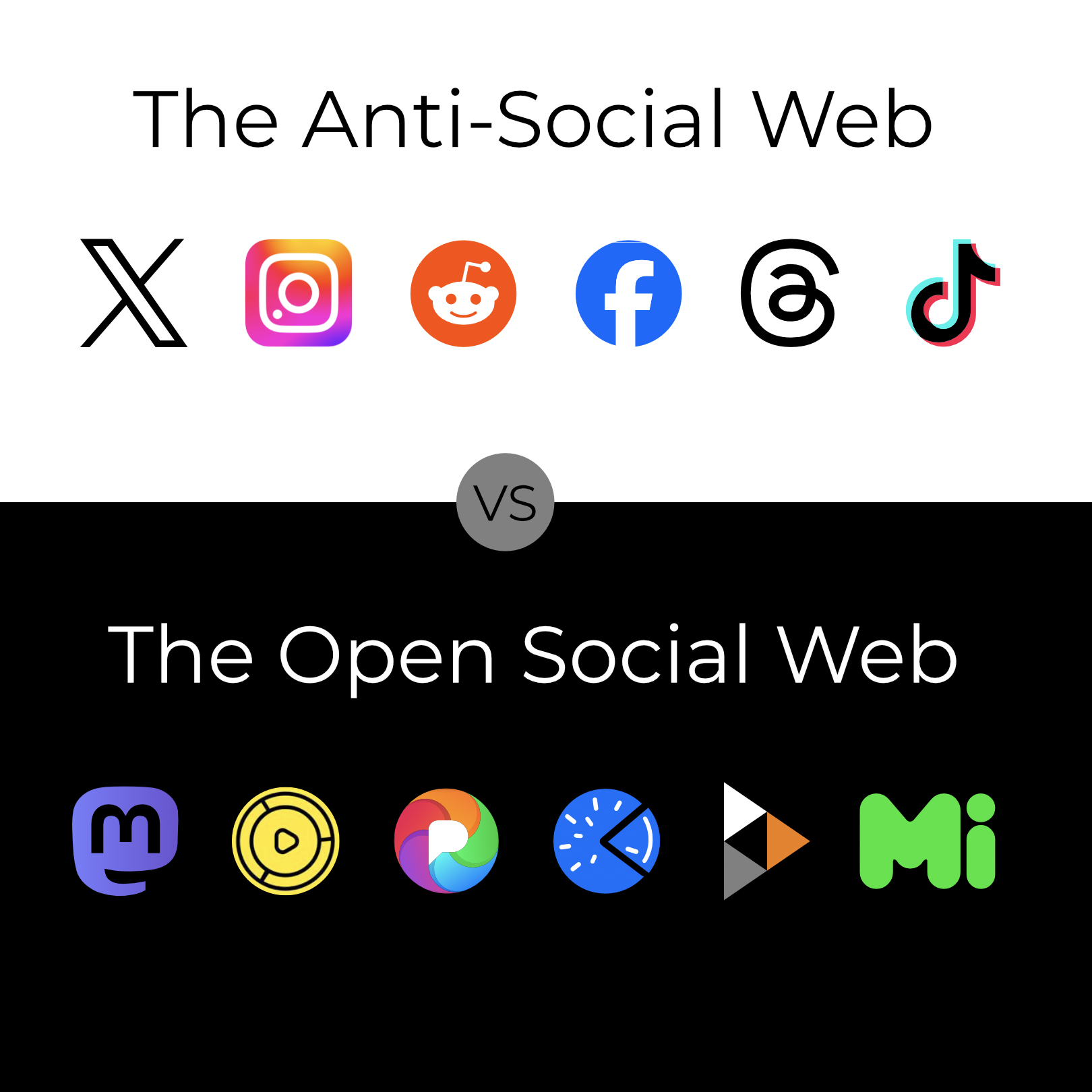



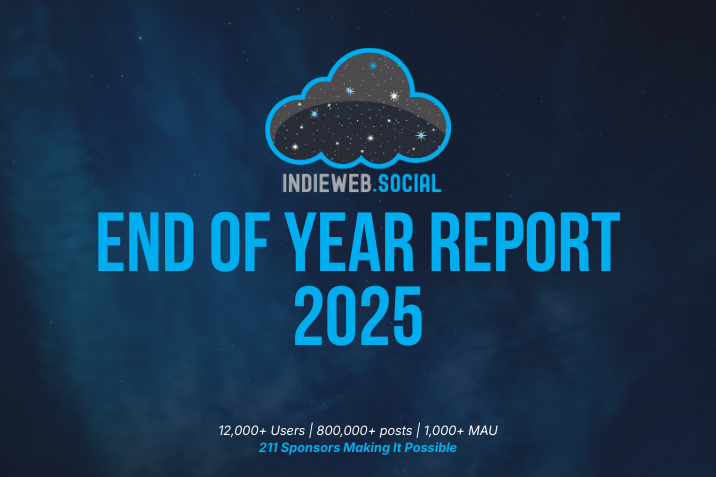



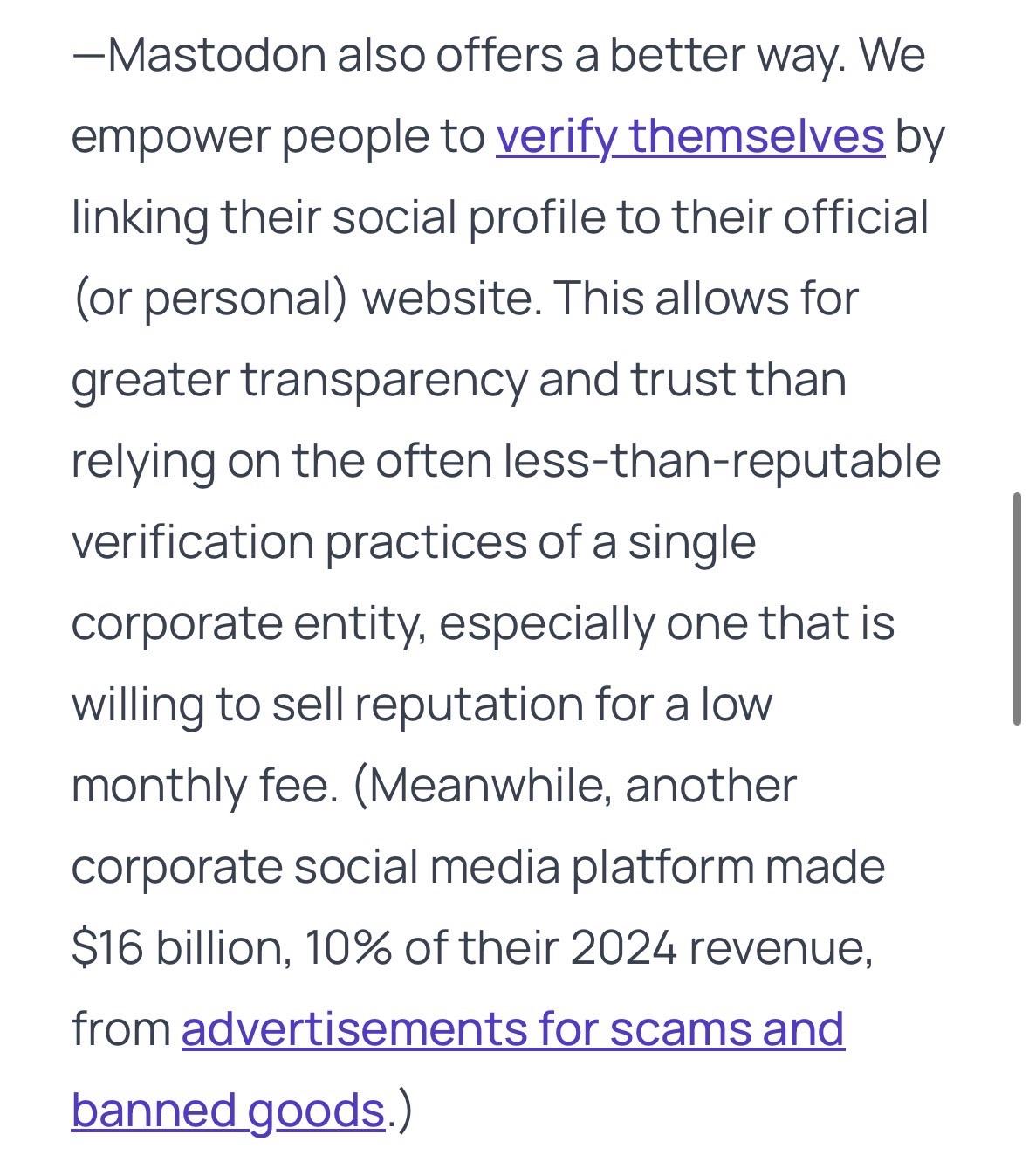
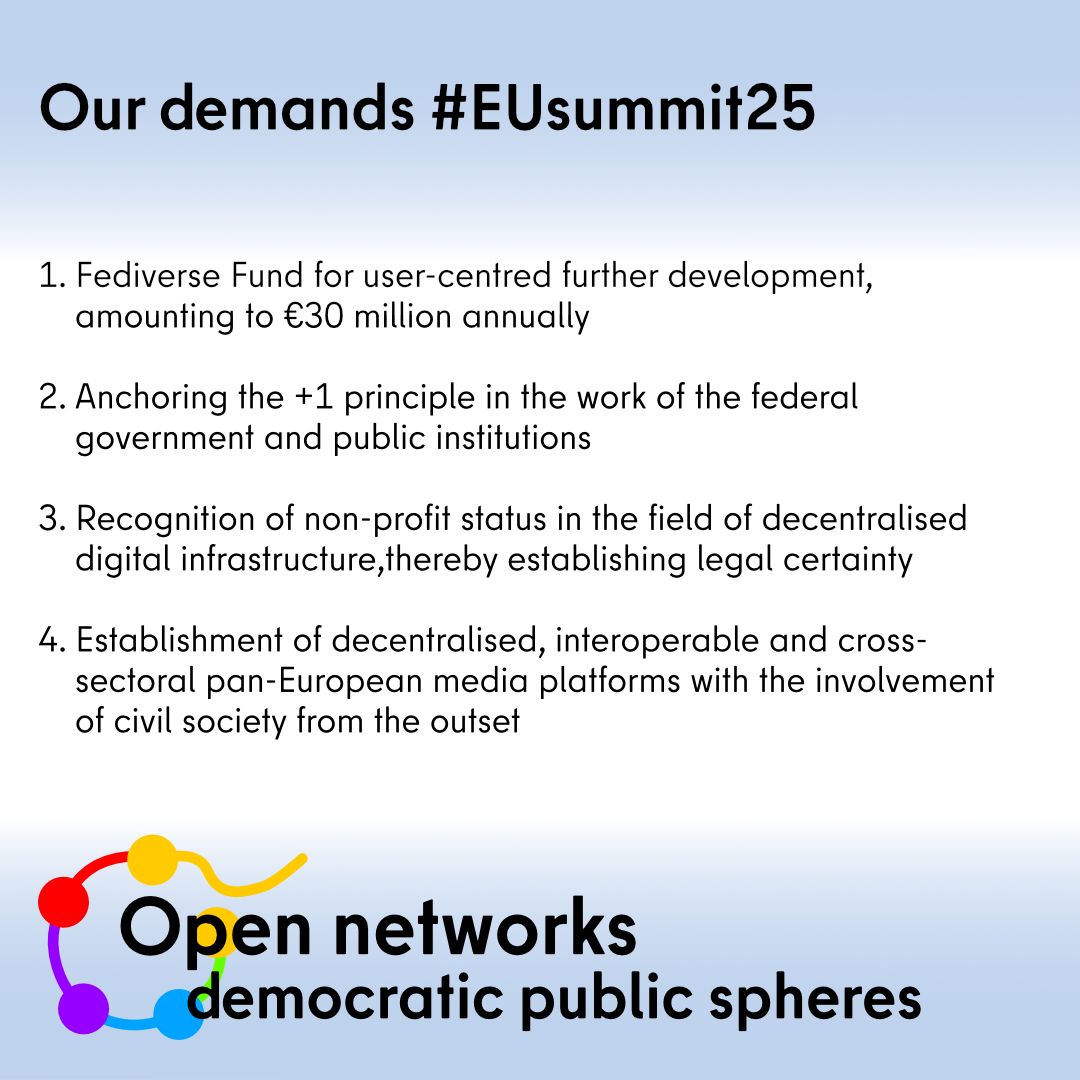
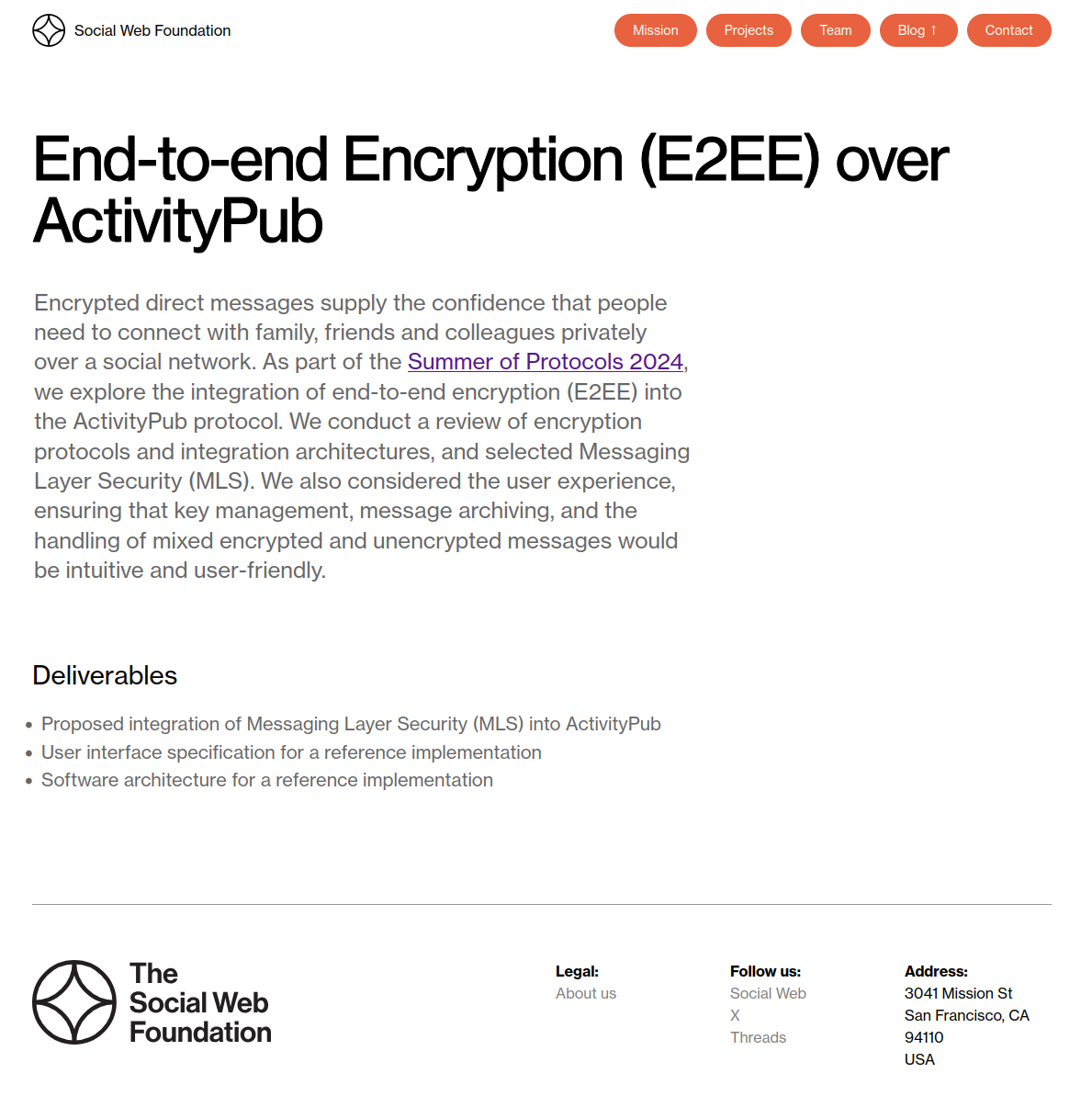

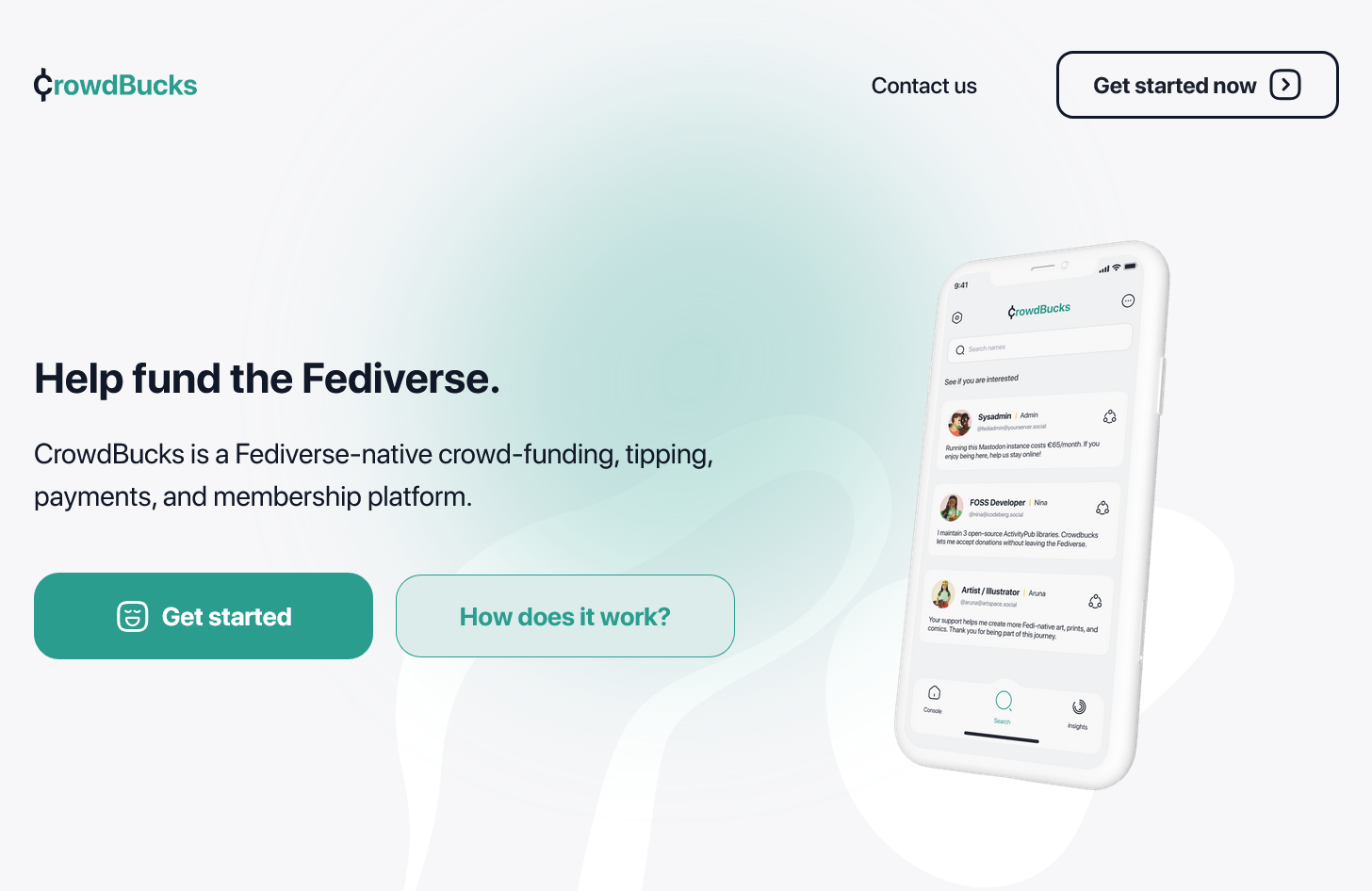


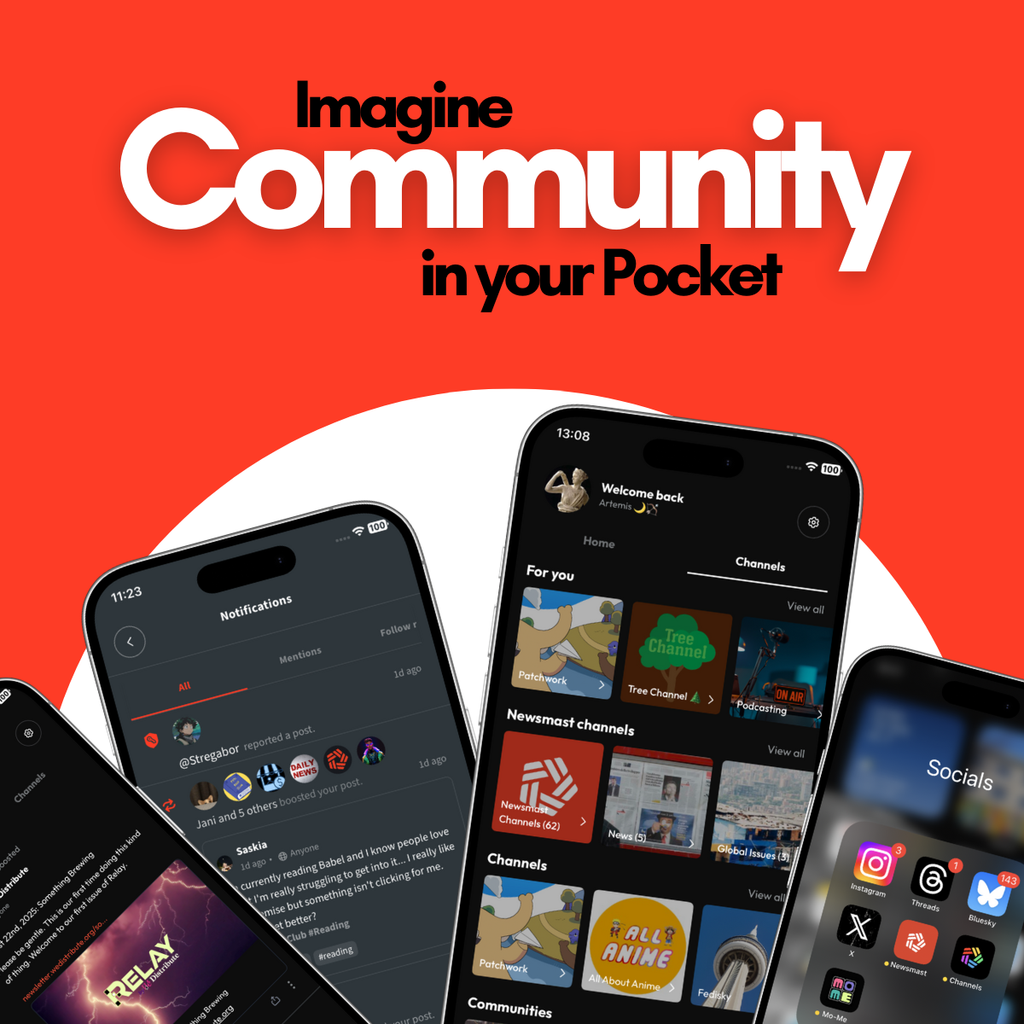



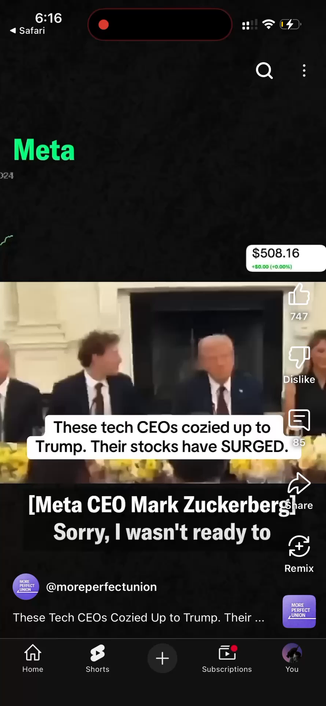
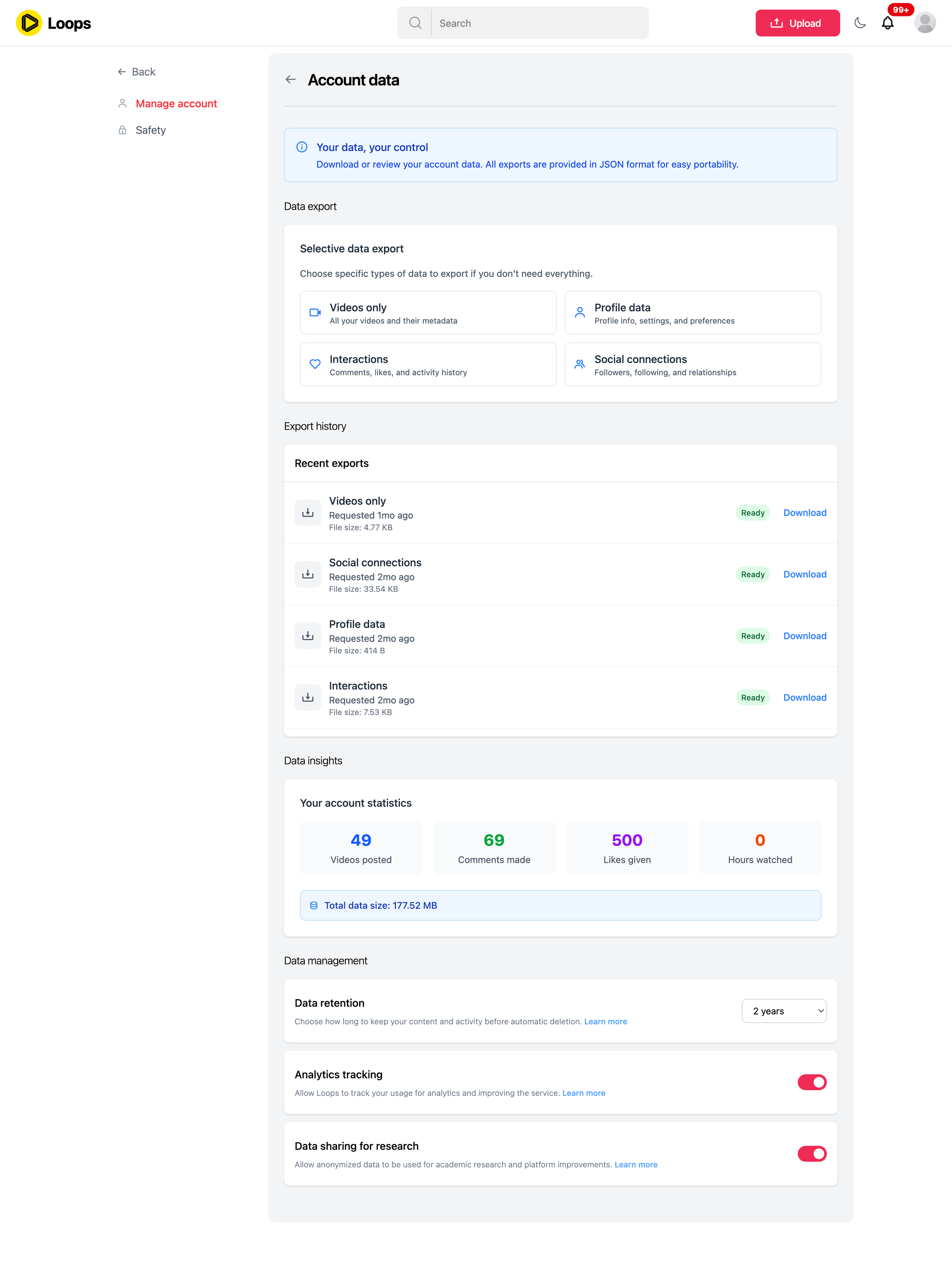
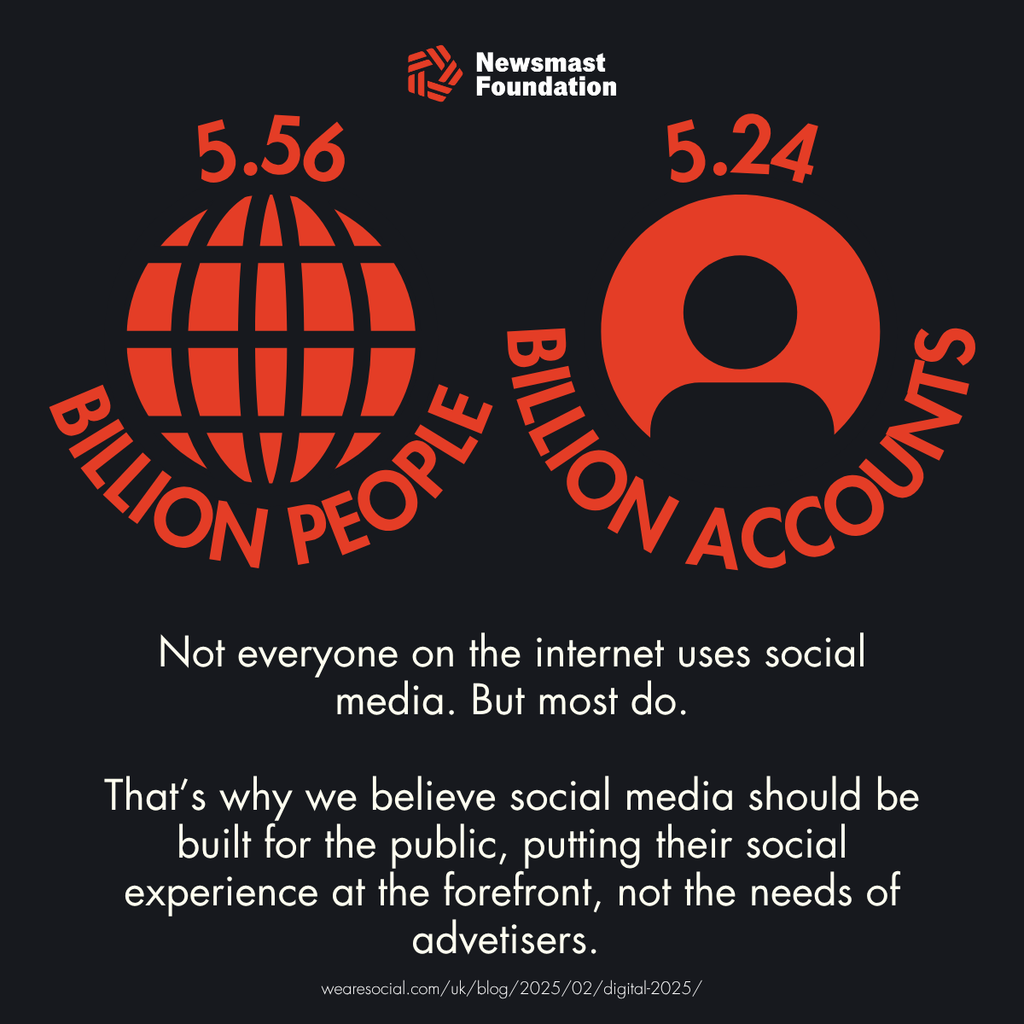





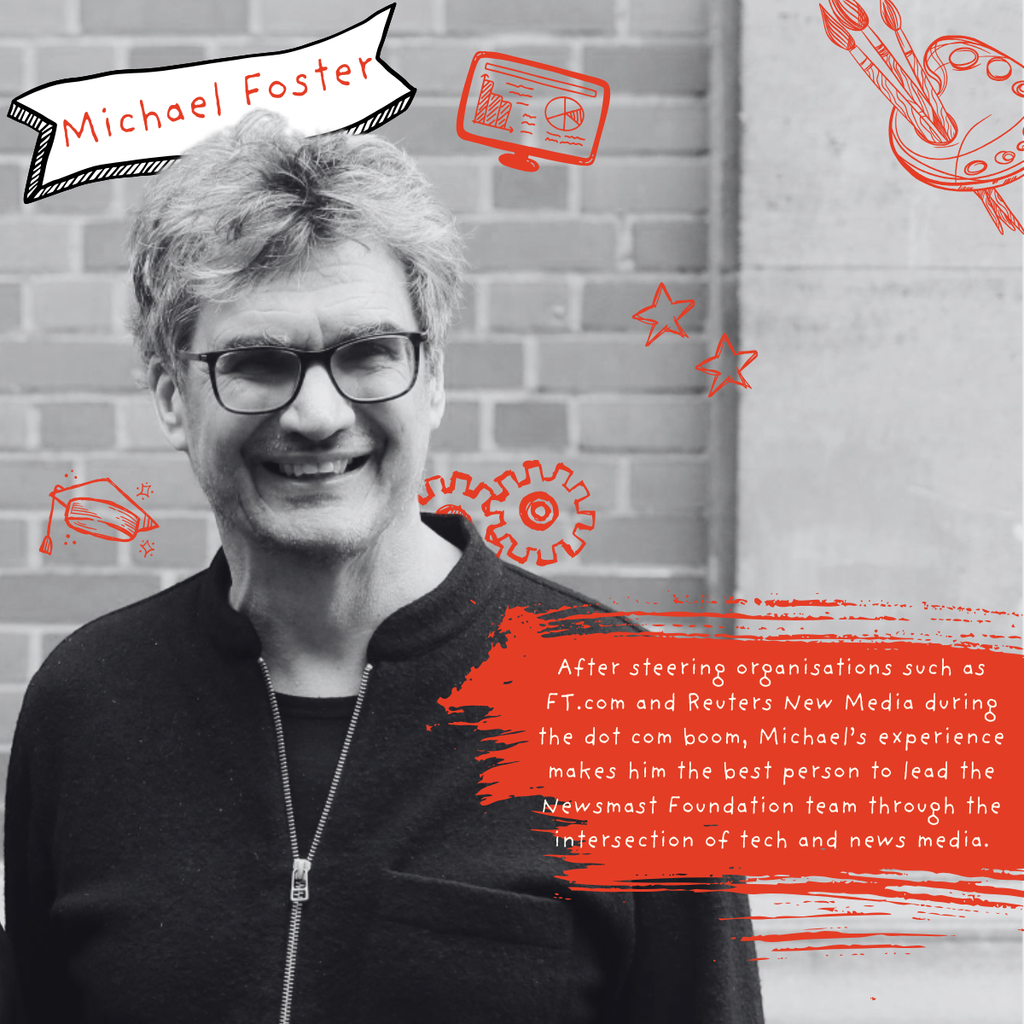
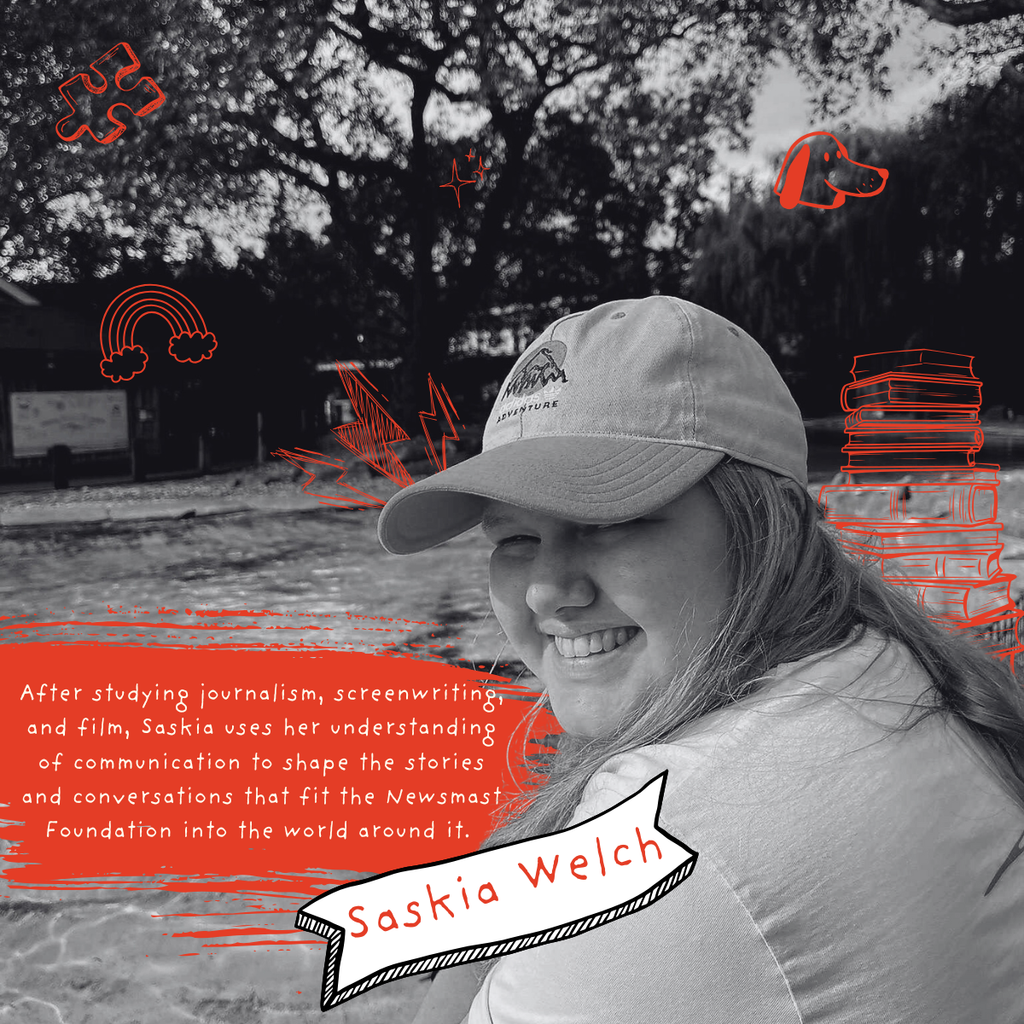

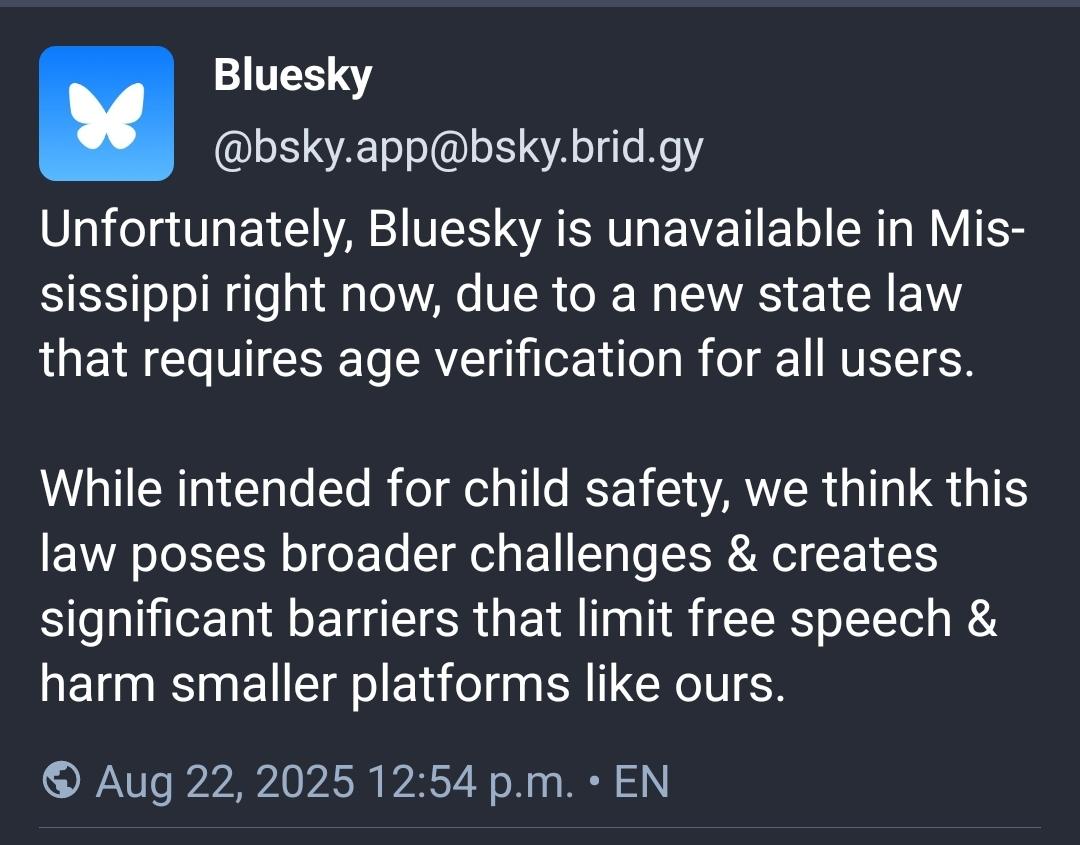
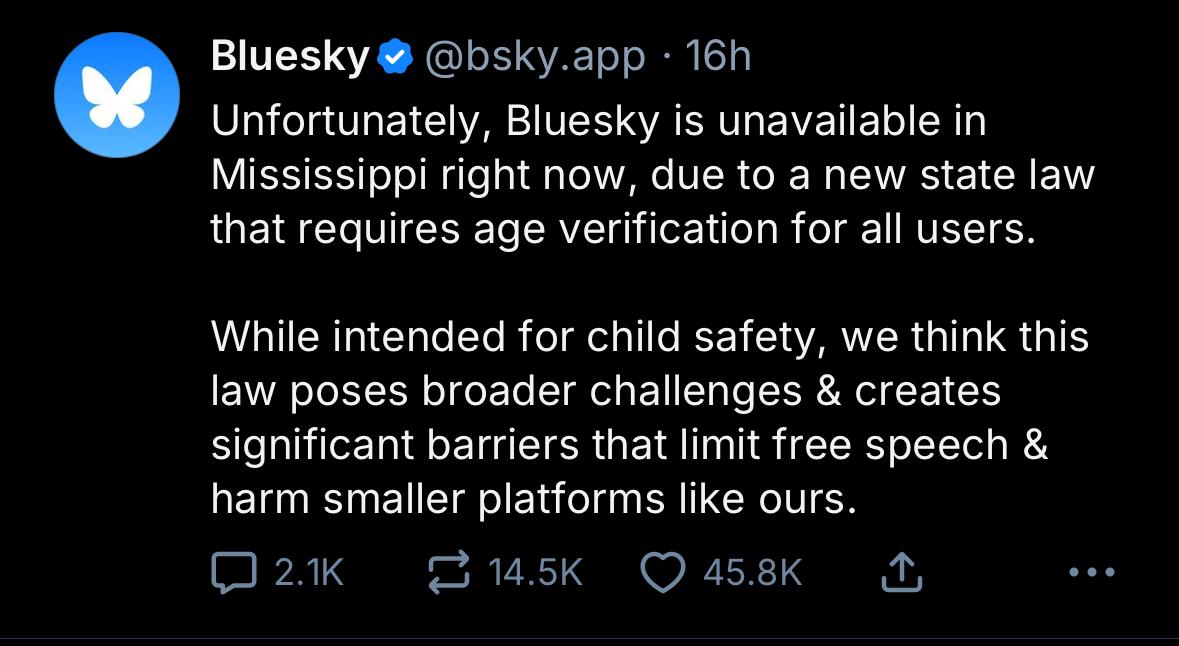
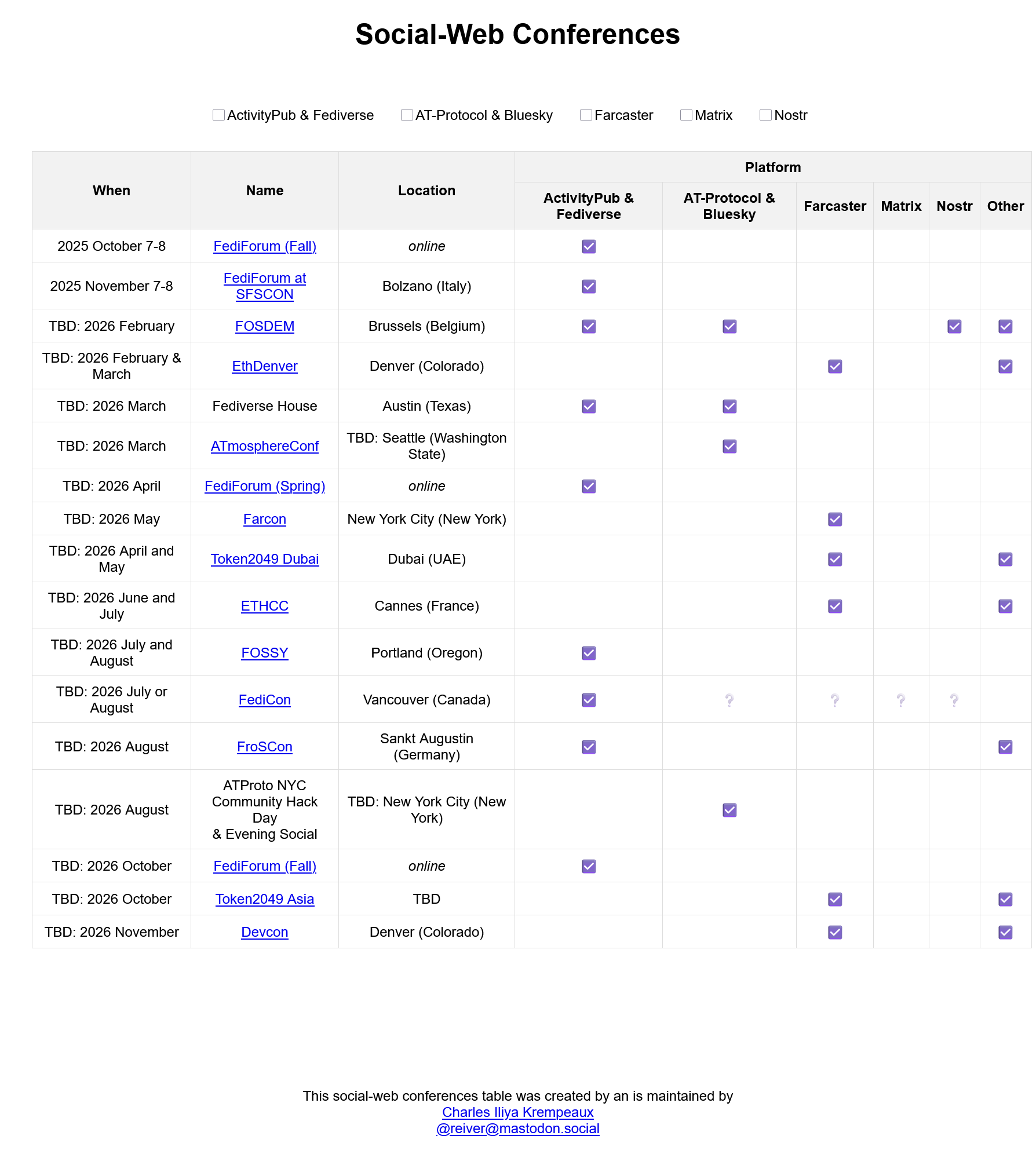


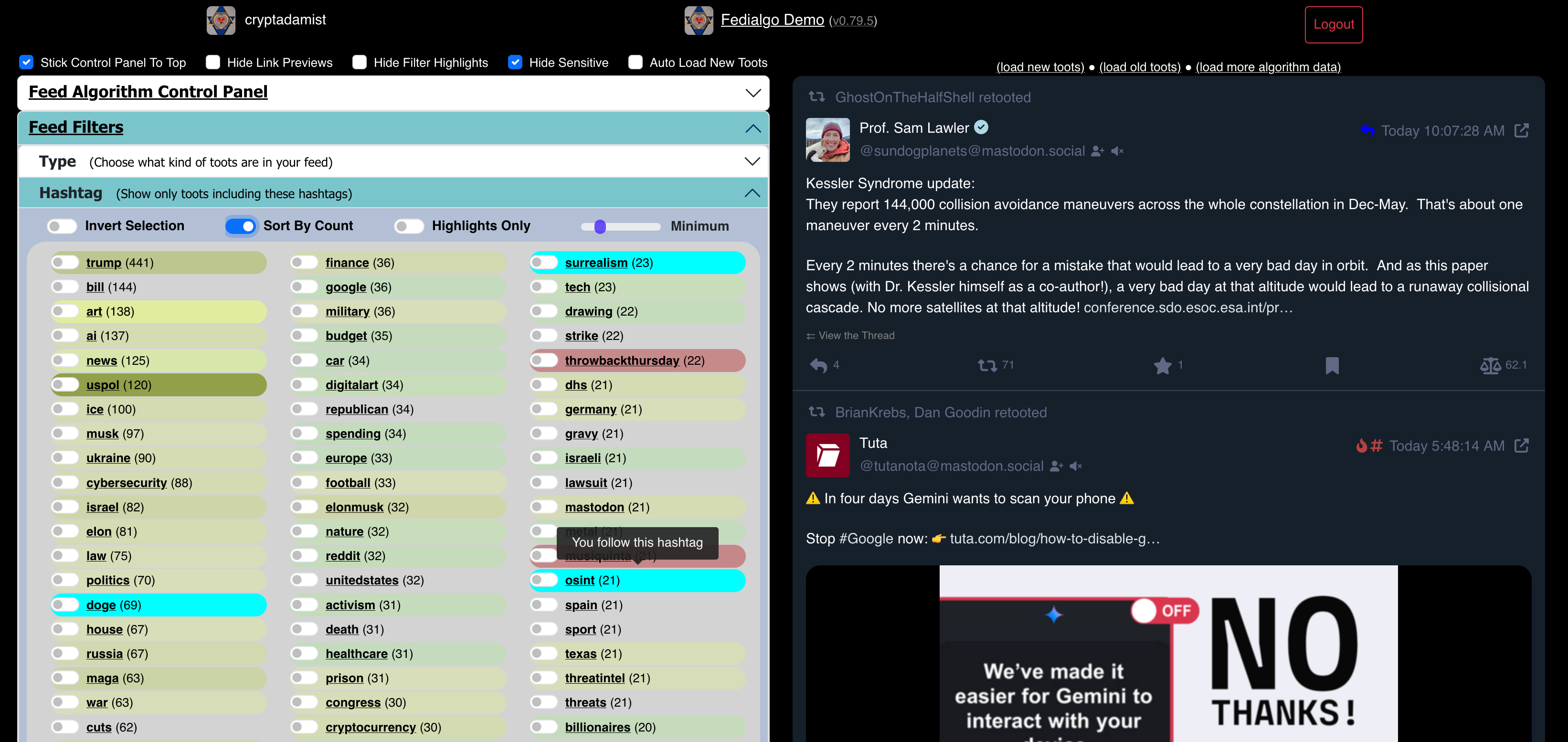

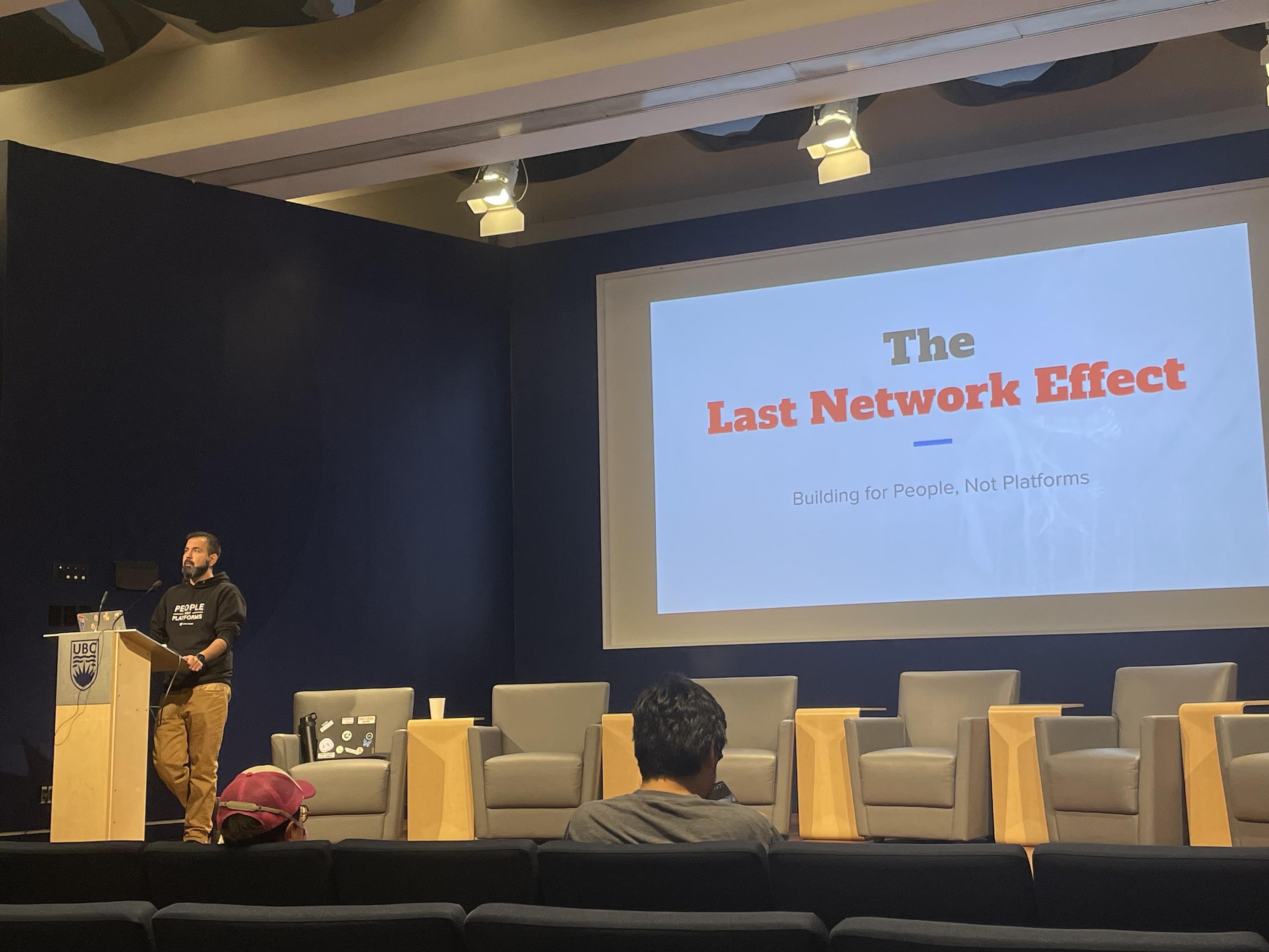
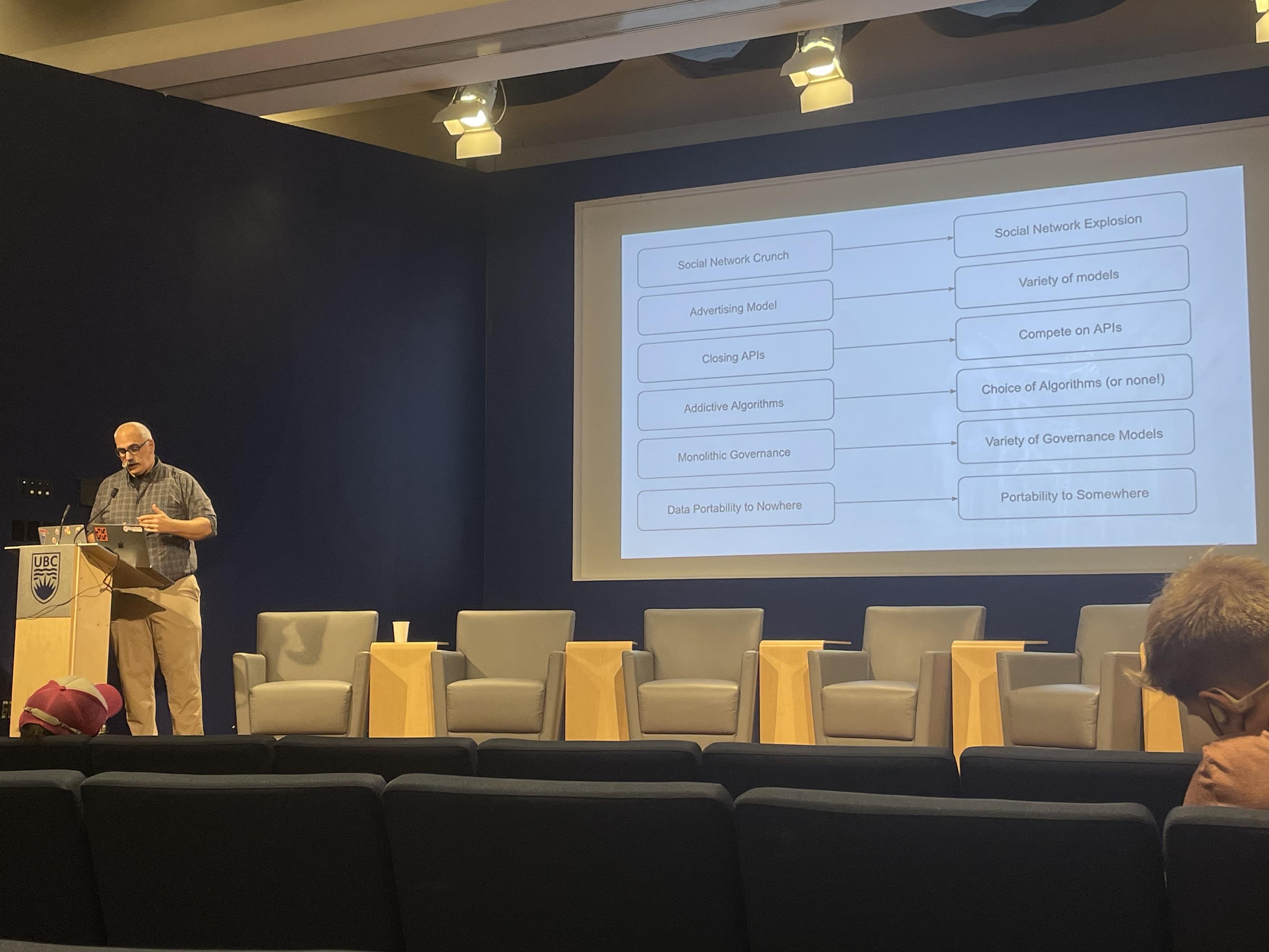



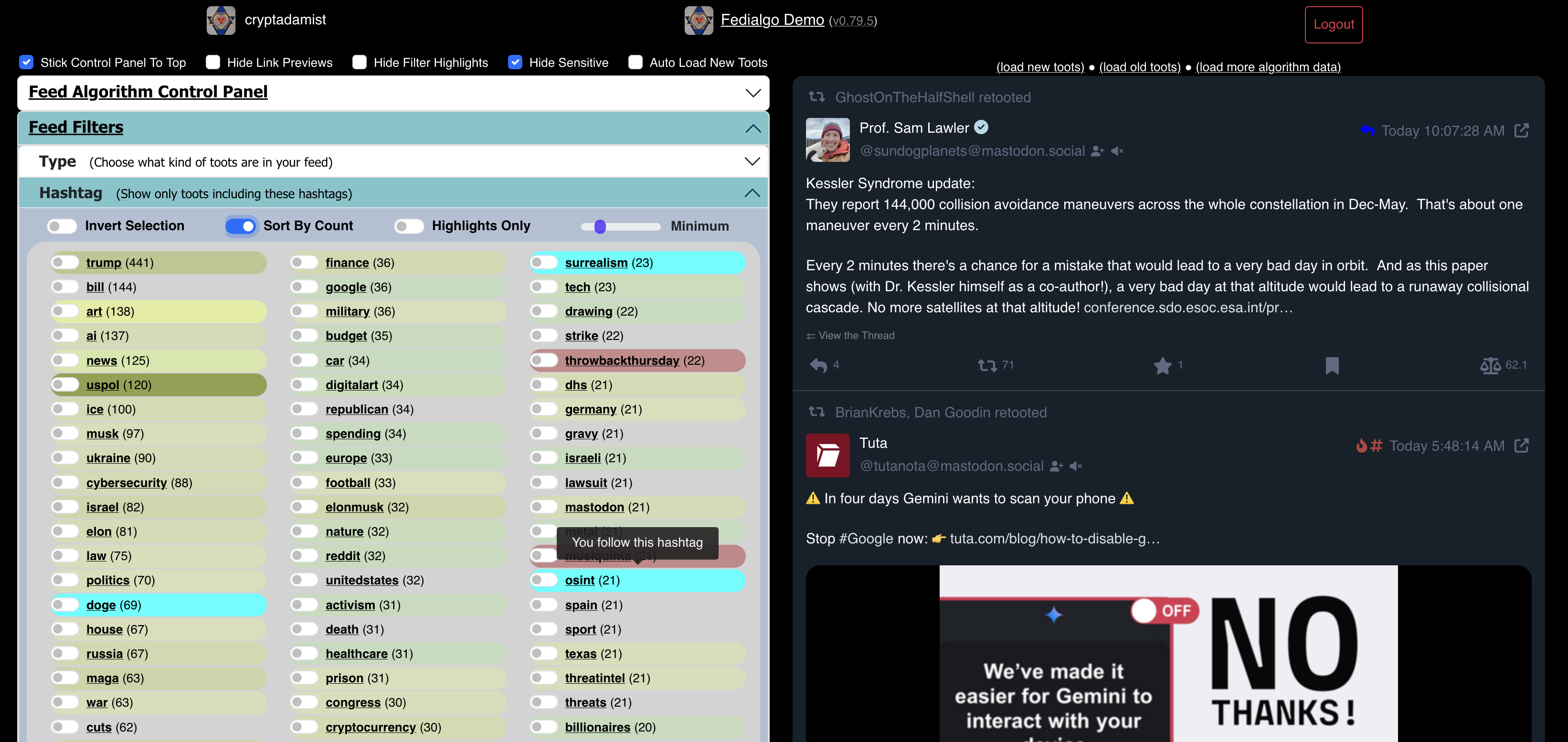




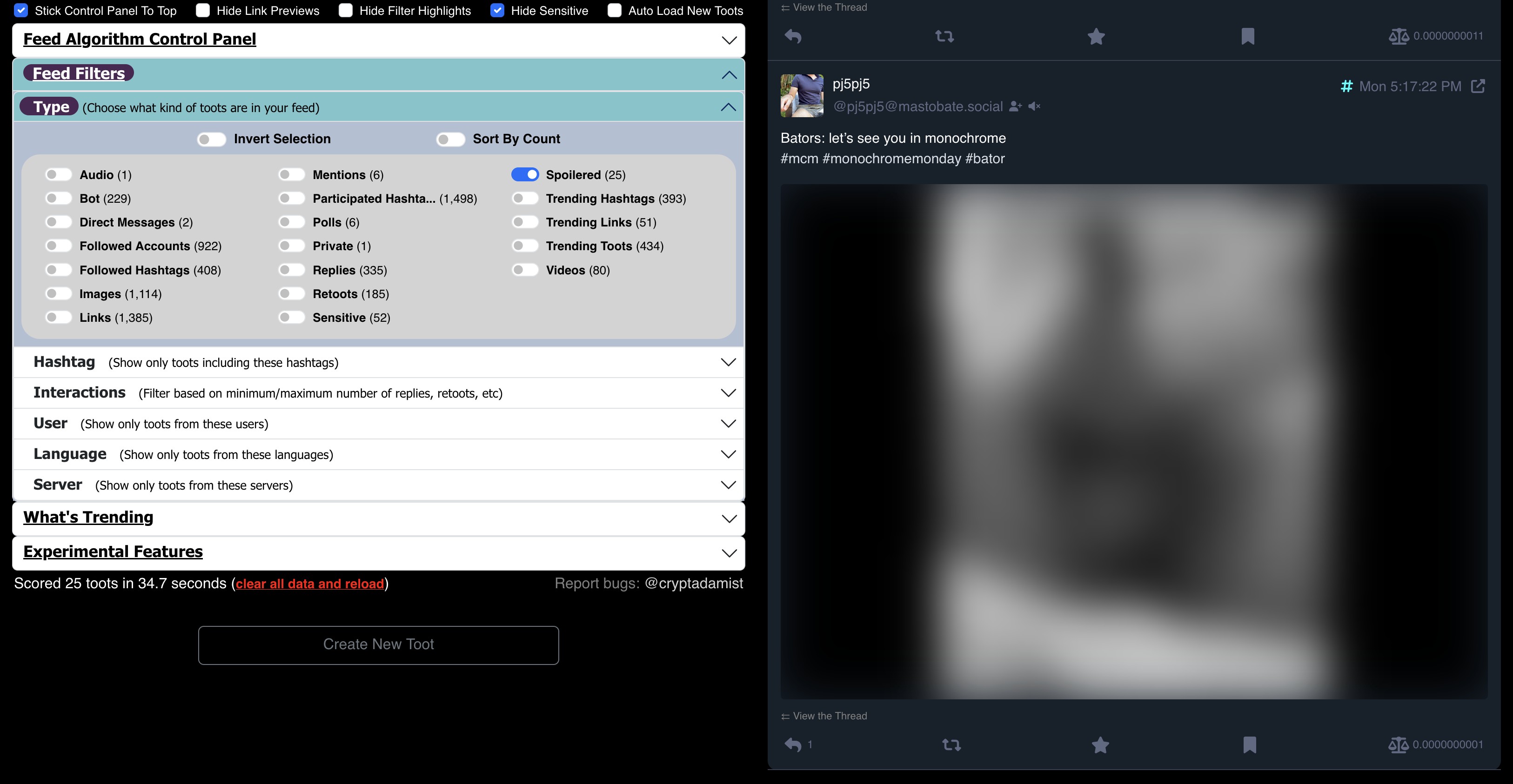

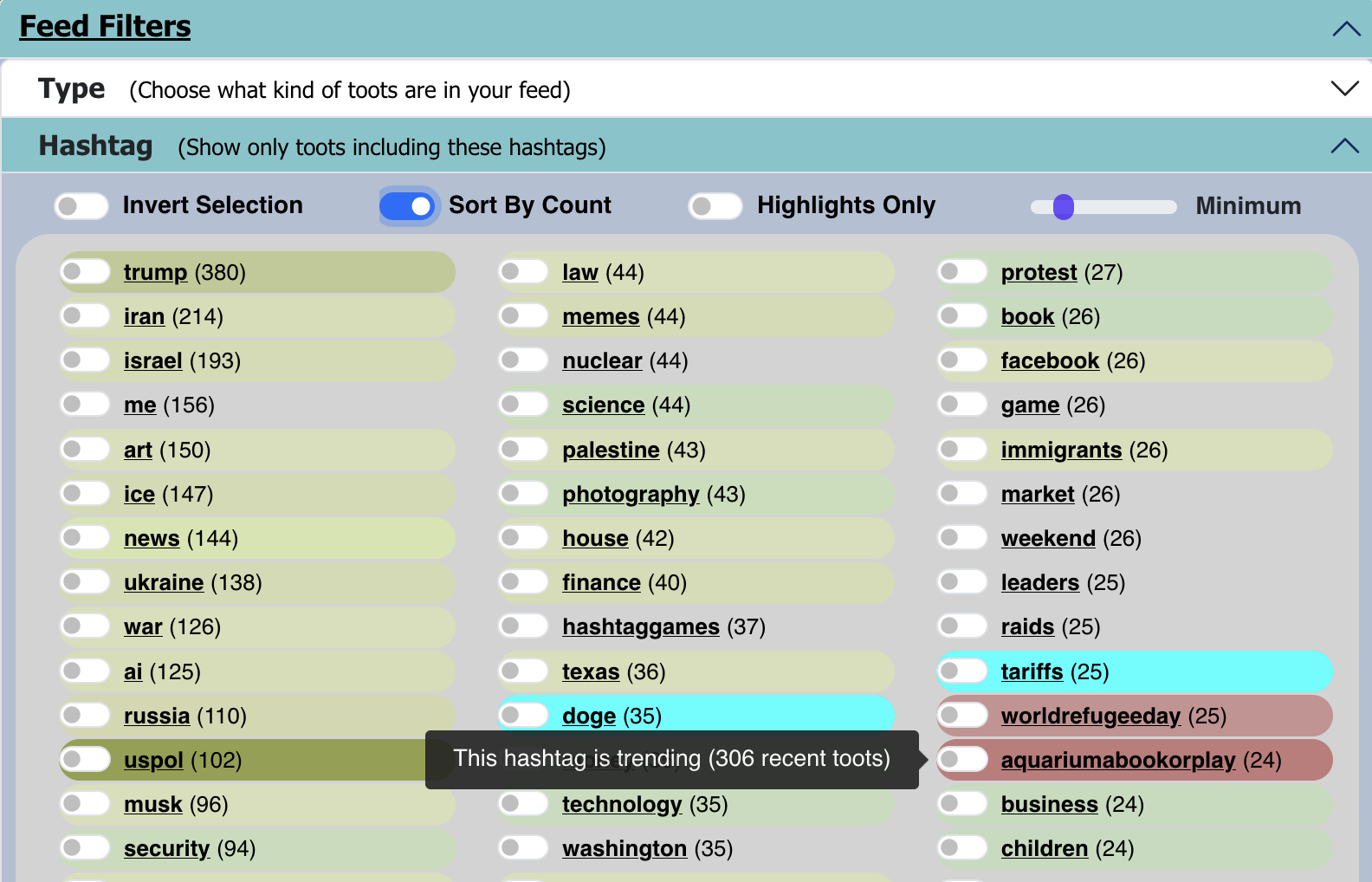
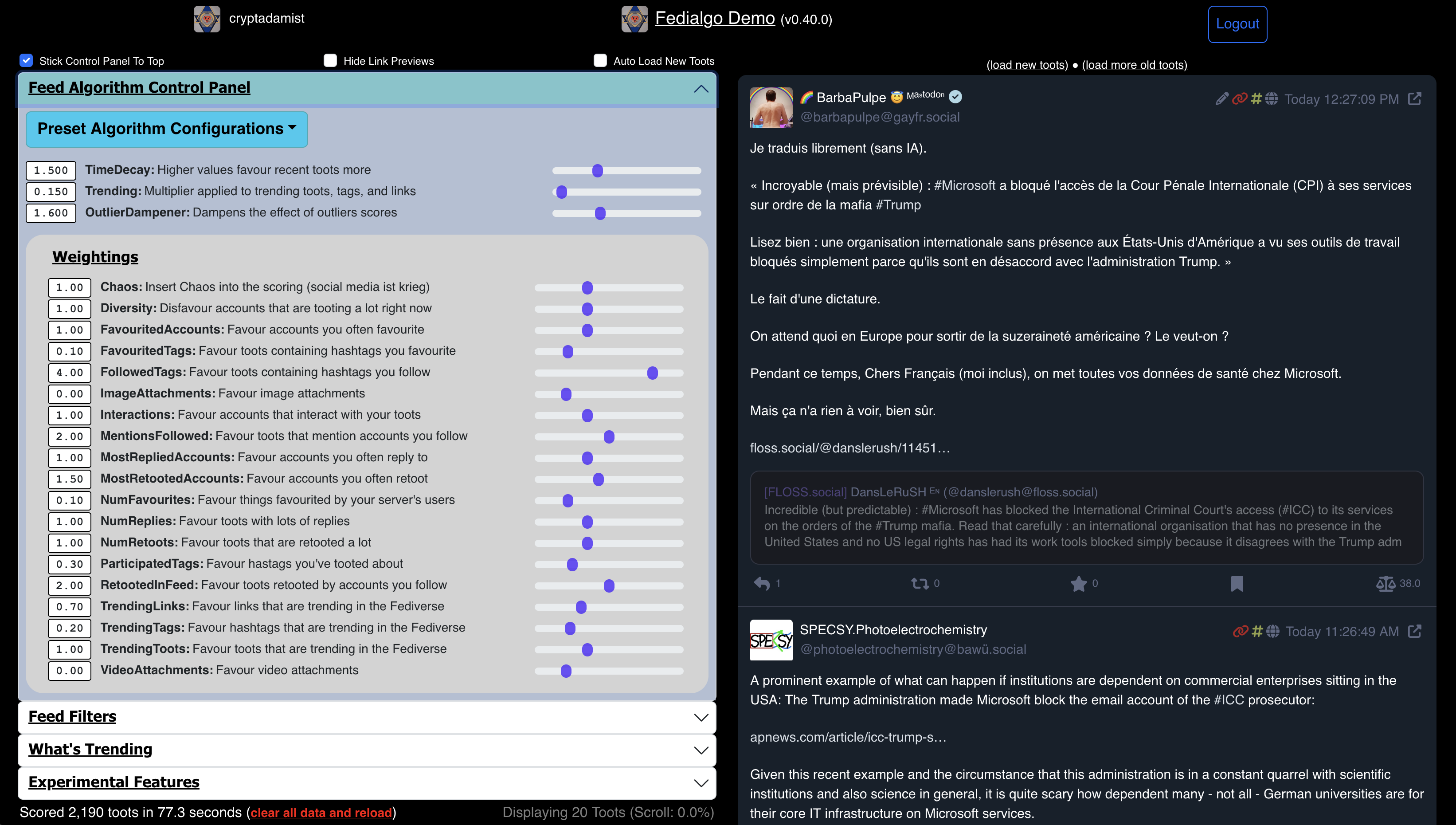




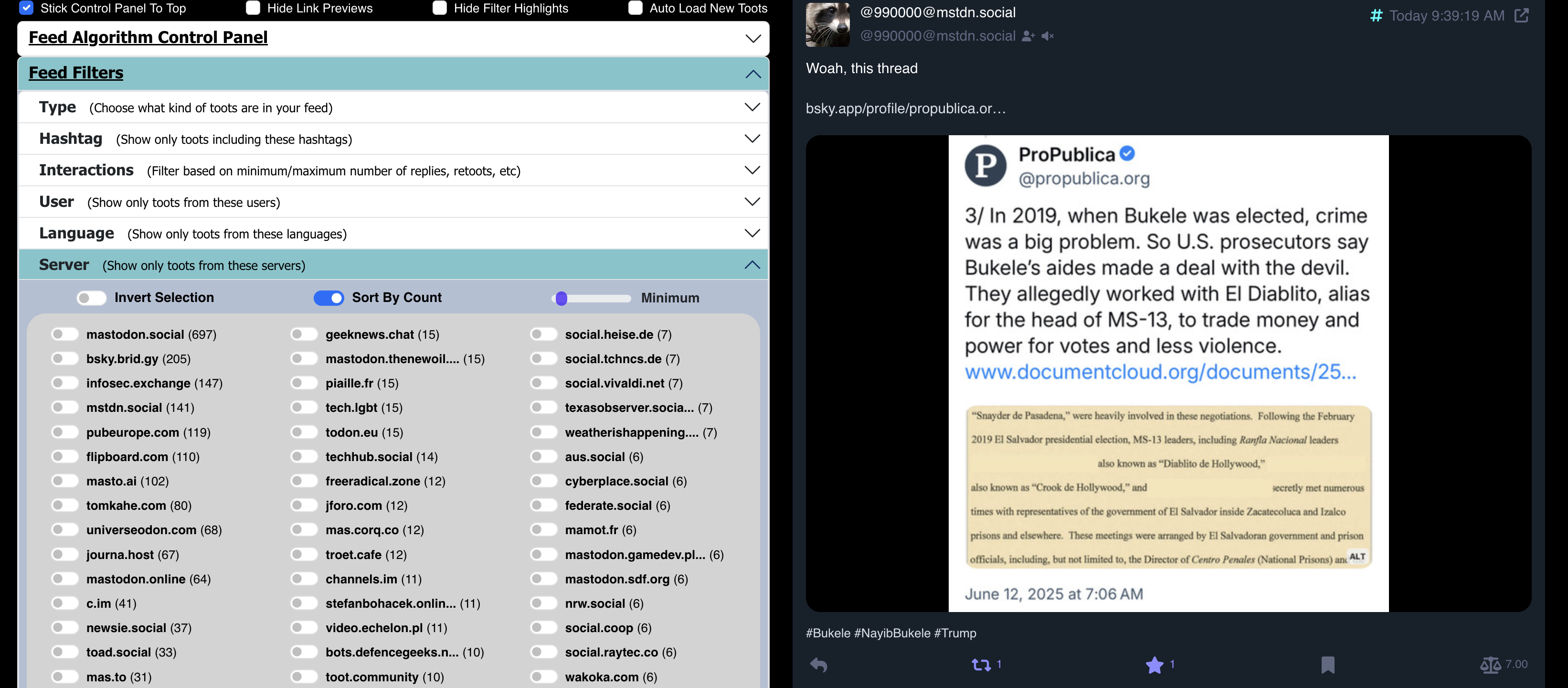
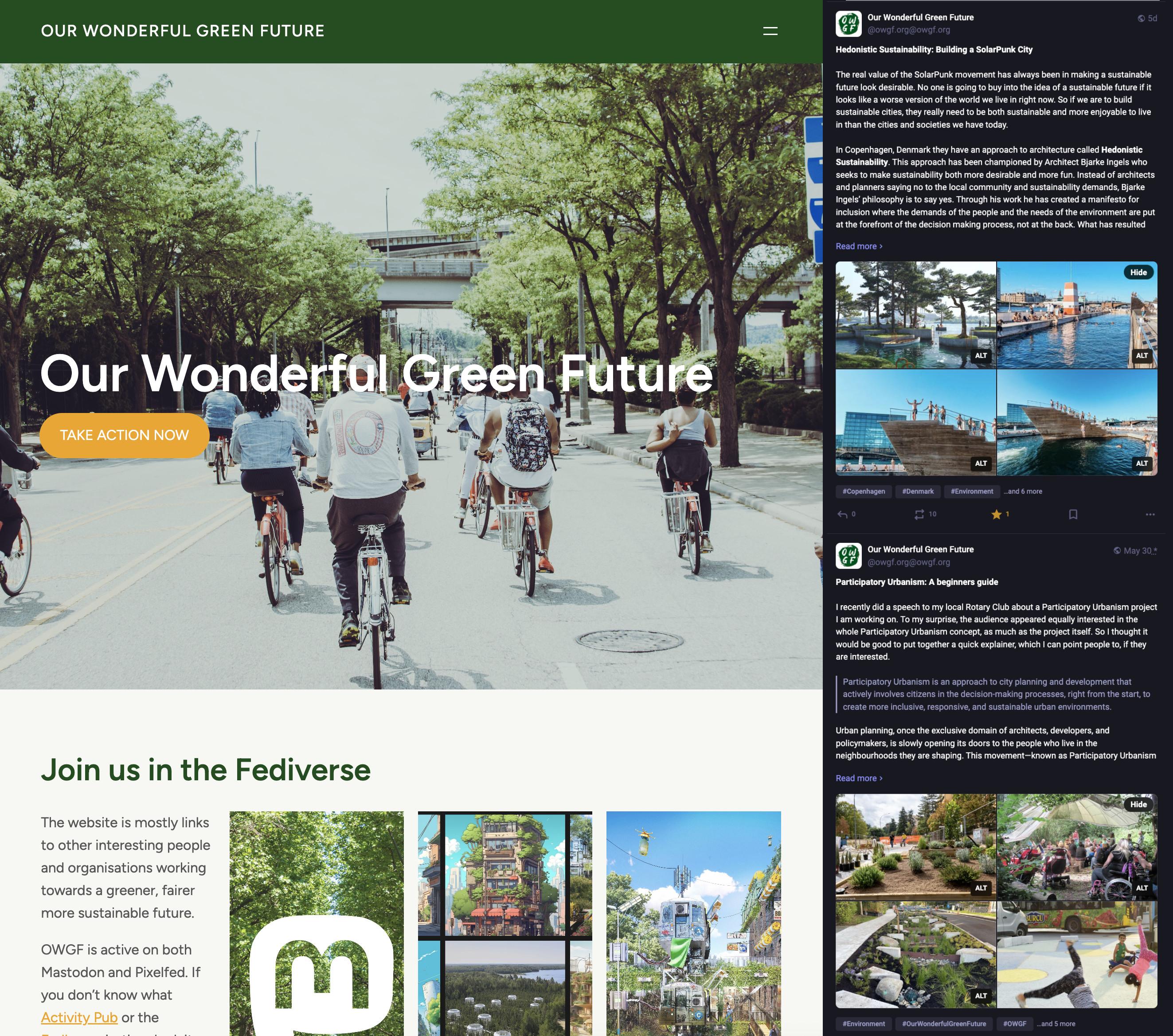


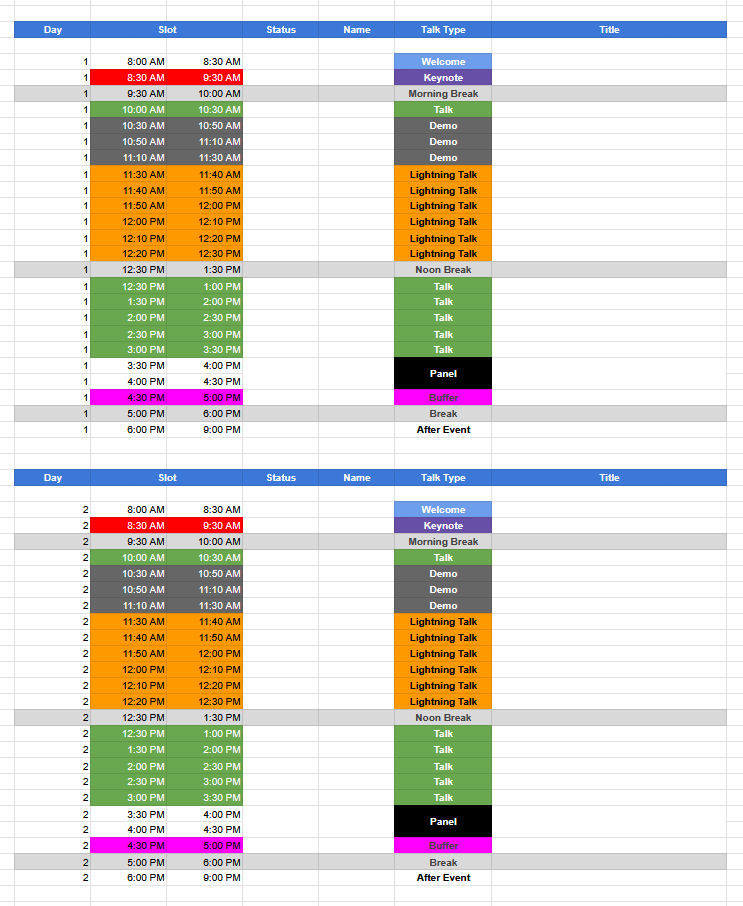
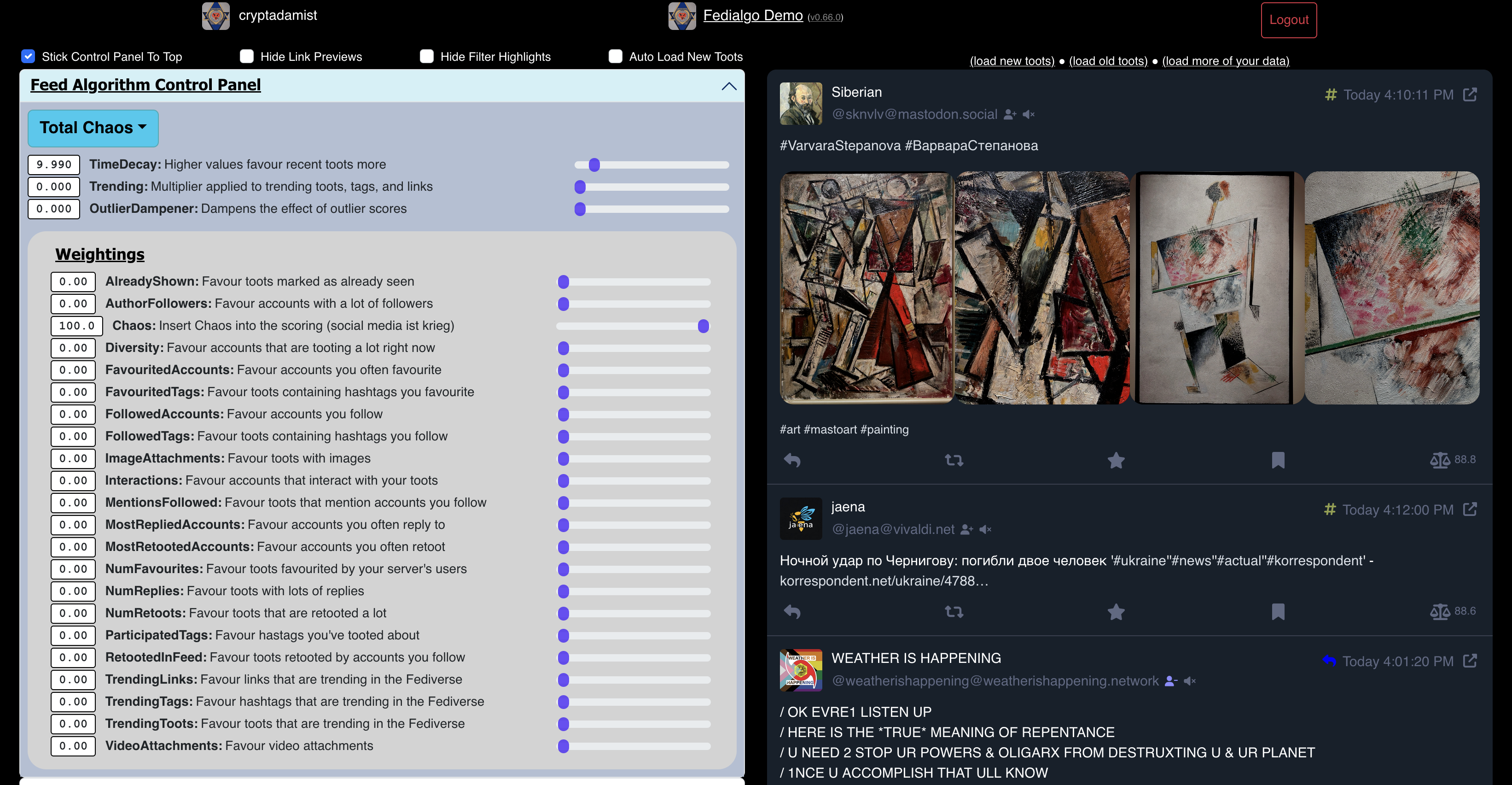

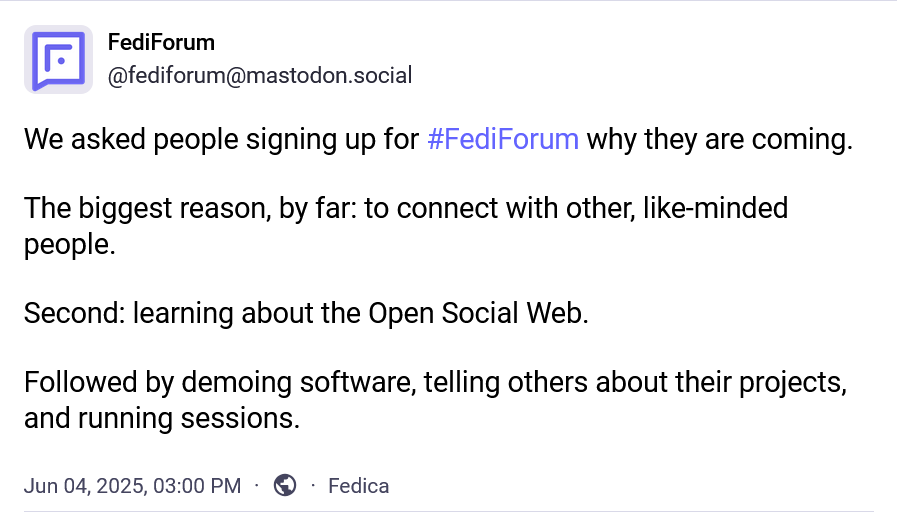


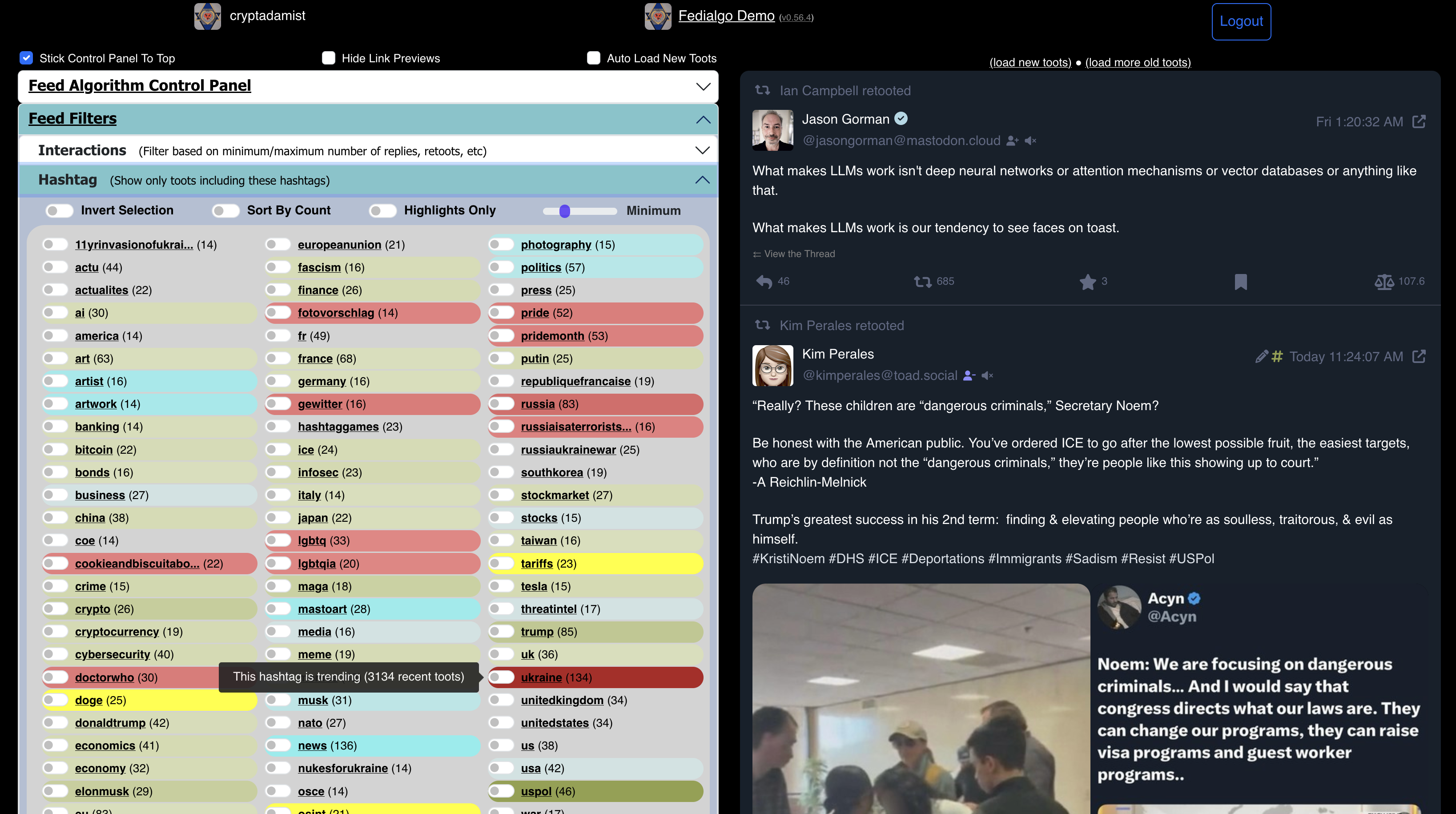



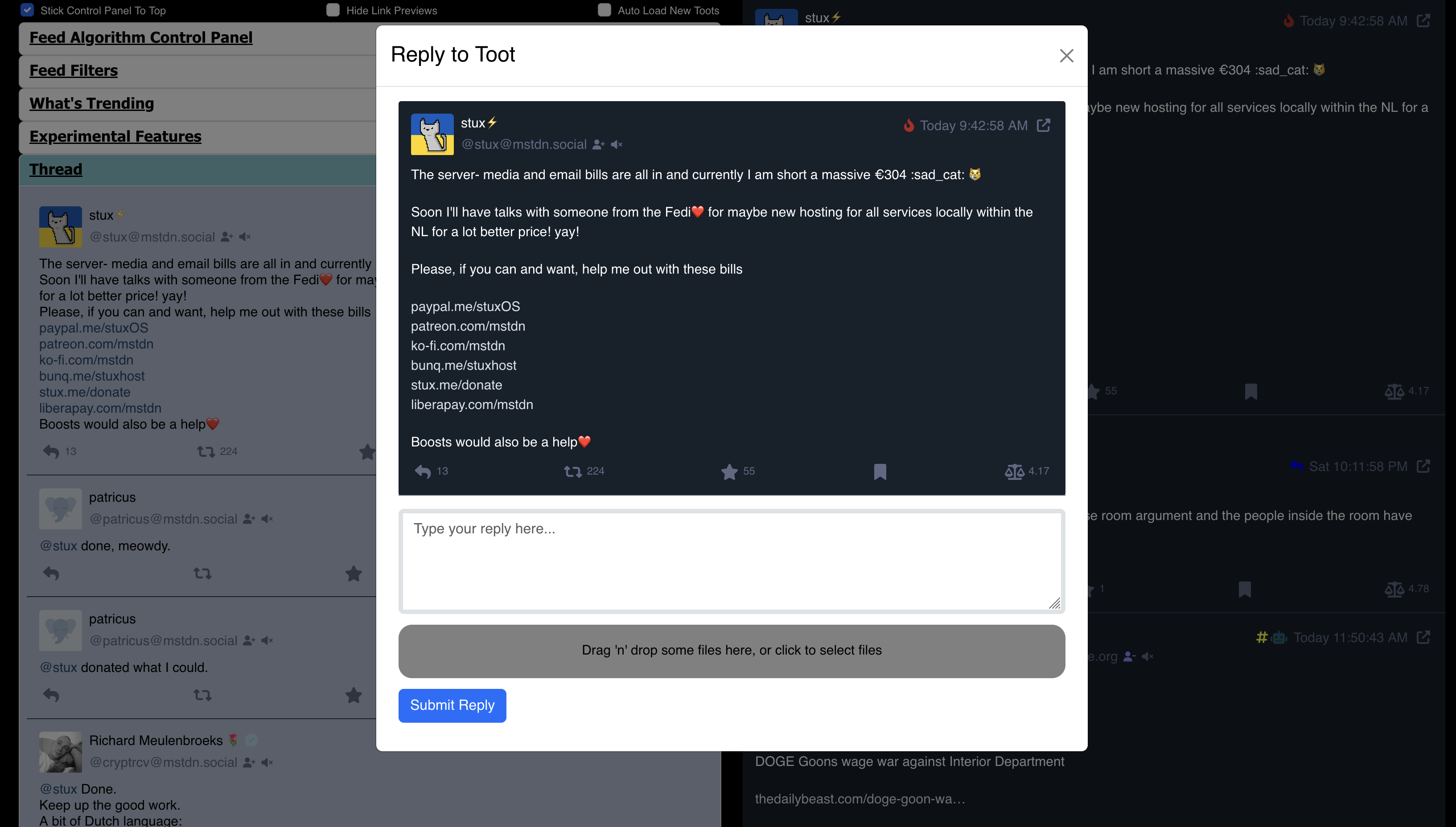



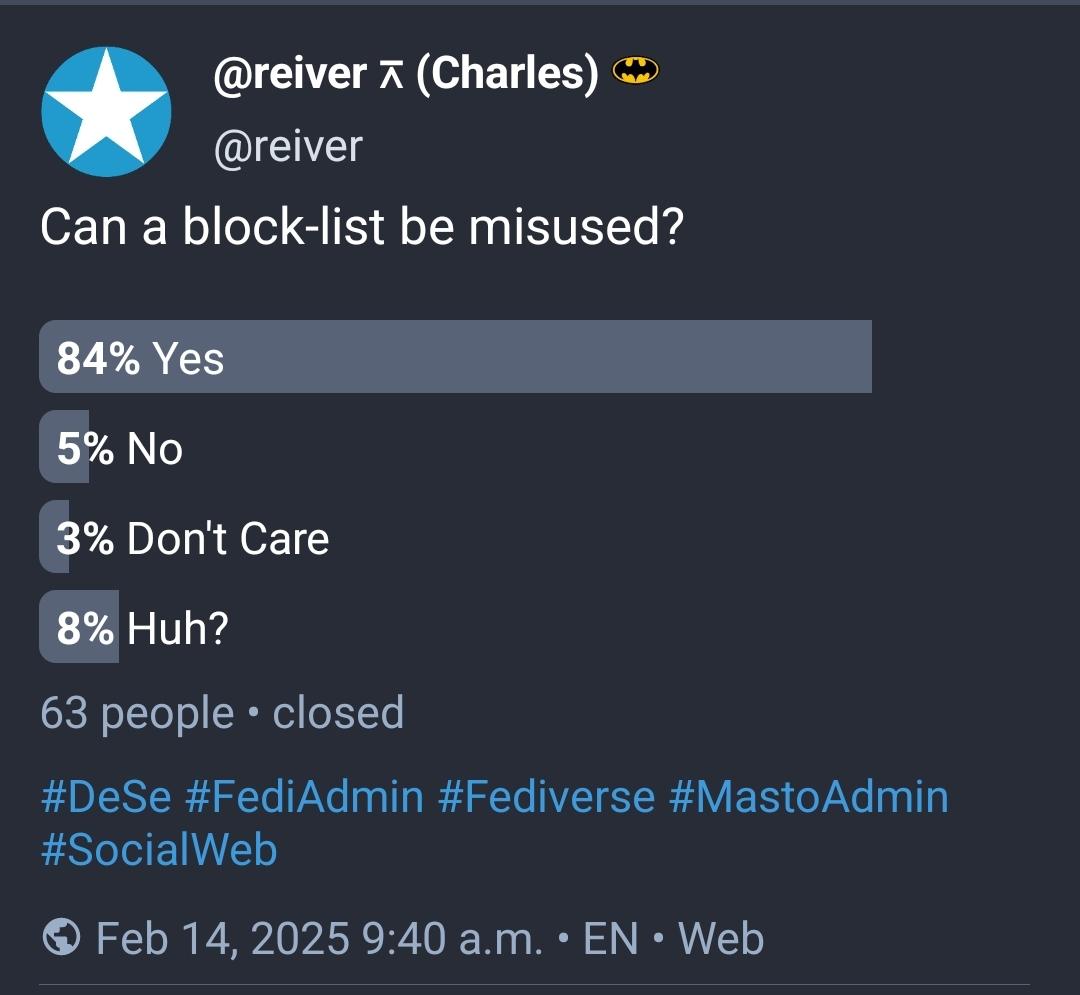


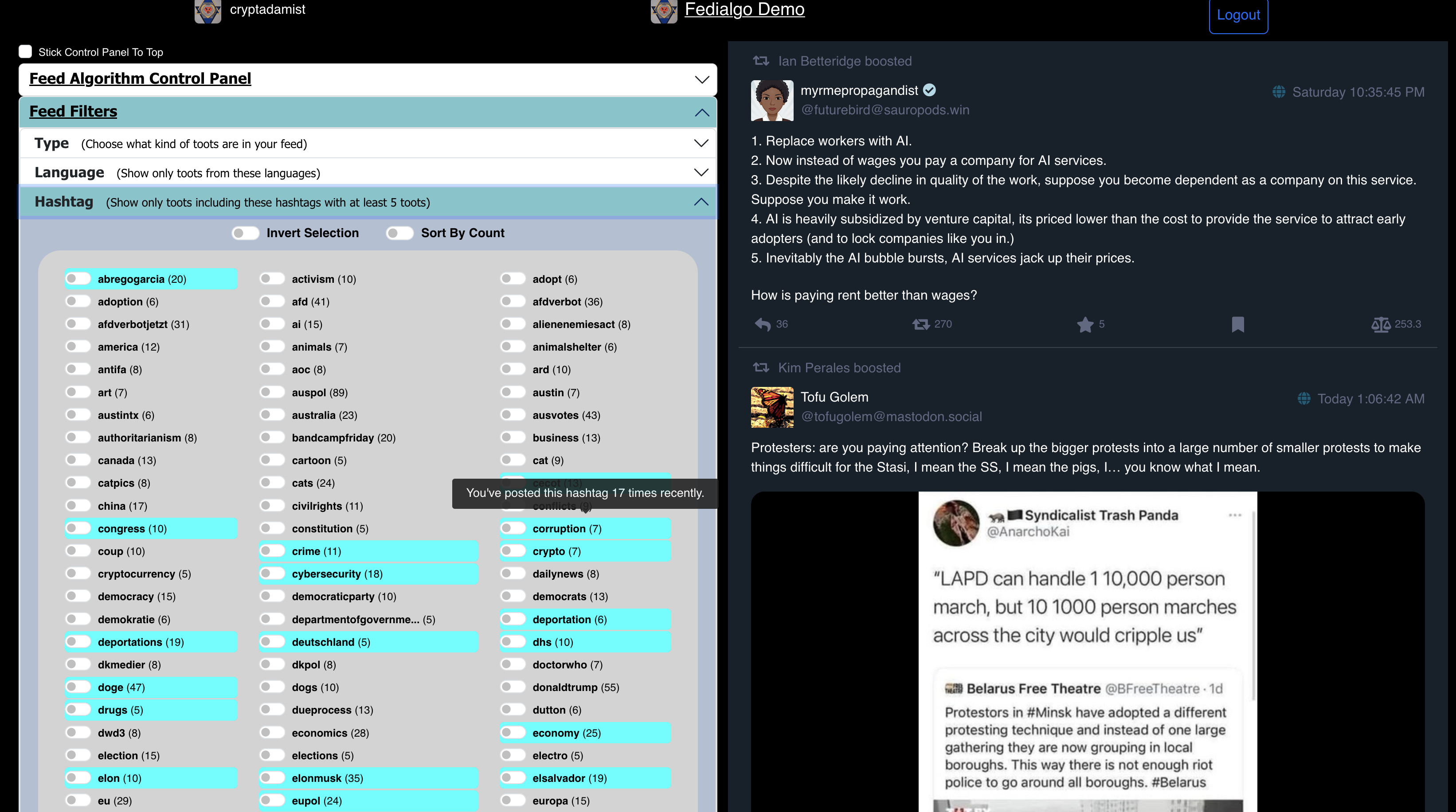
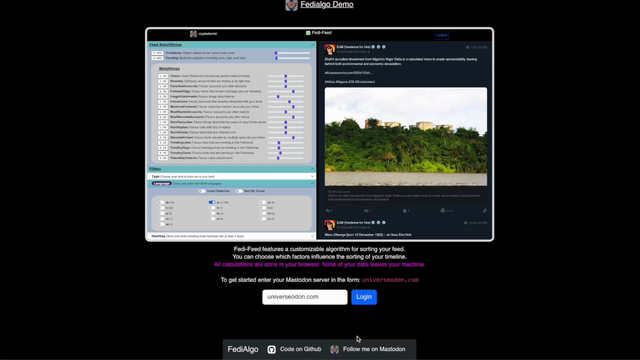
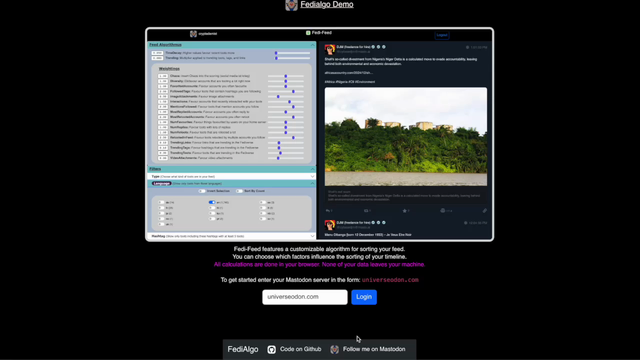

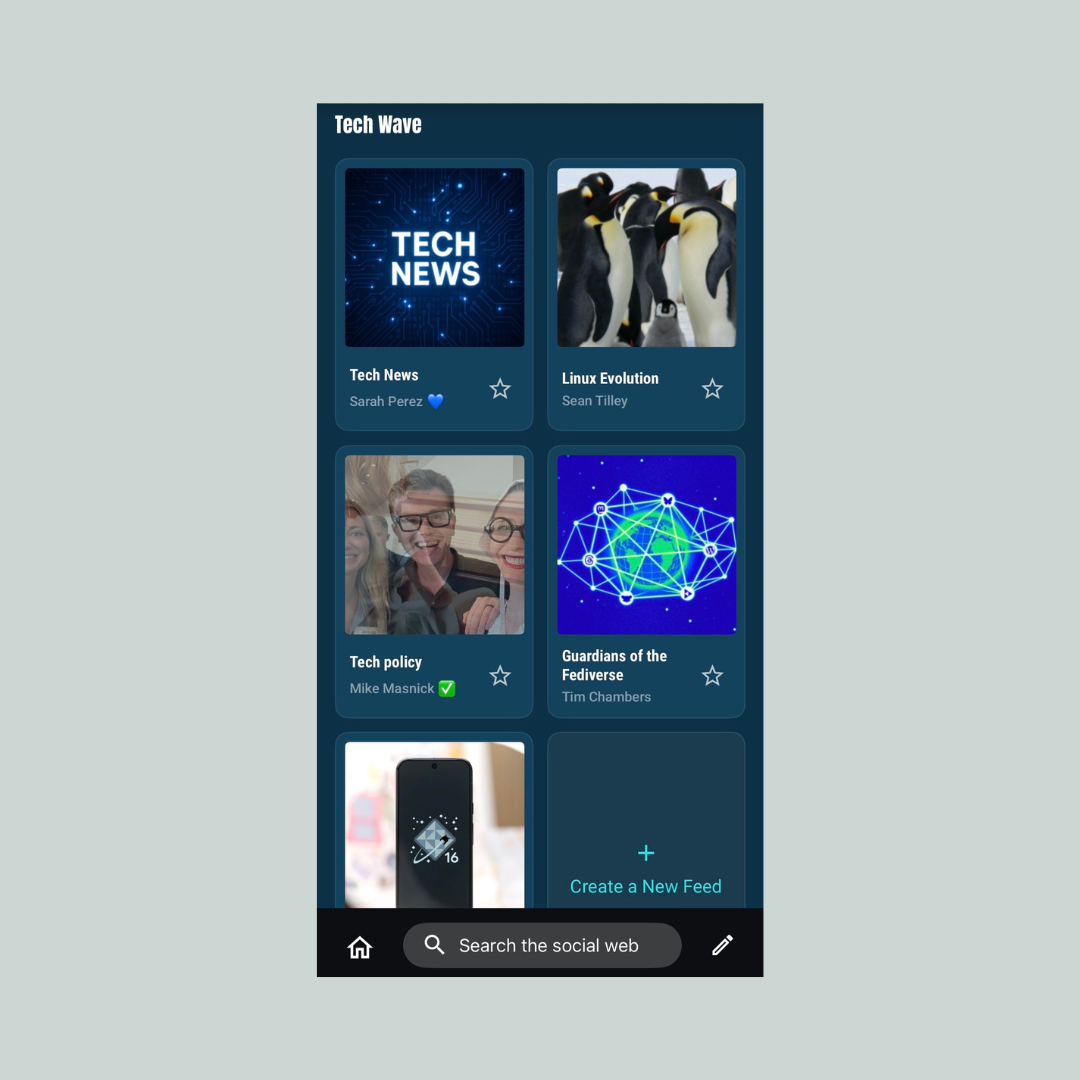

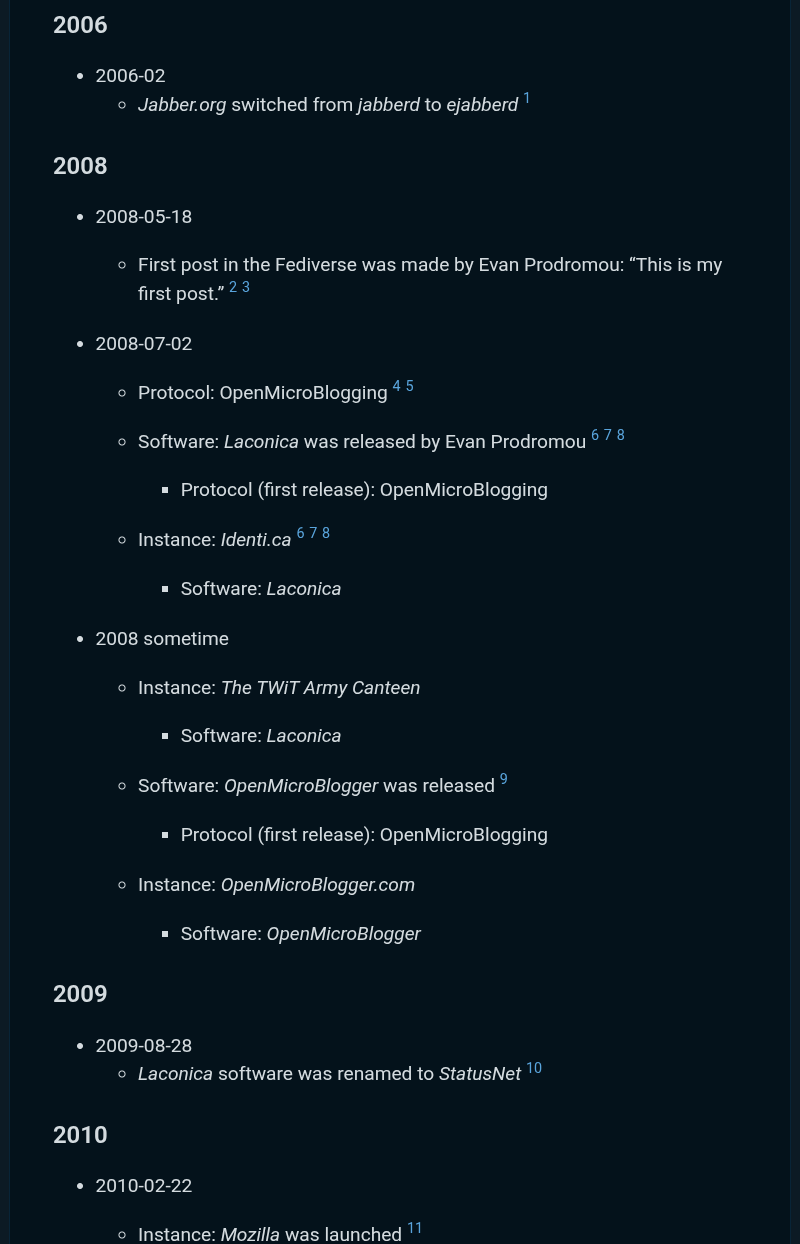















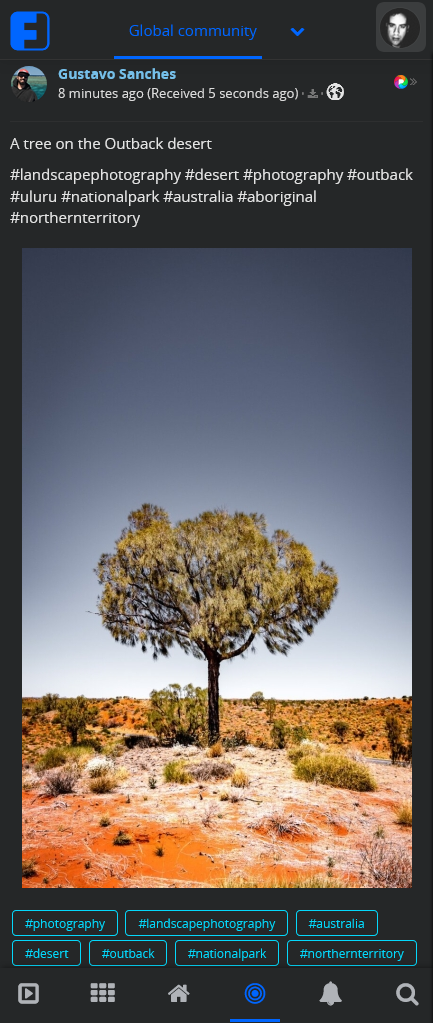


 We released Tapestry this week and we’re keeping the momentum going. Version 1.0.1 is now available with lots of great improvements to our unified timeline for all your feeds, including VoiceOver improvements, expanded muffle/mute options, content warnings, and more. Check out the version history for more details: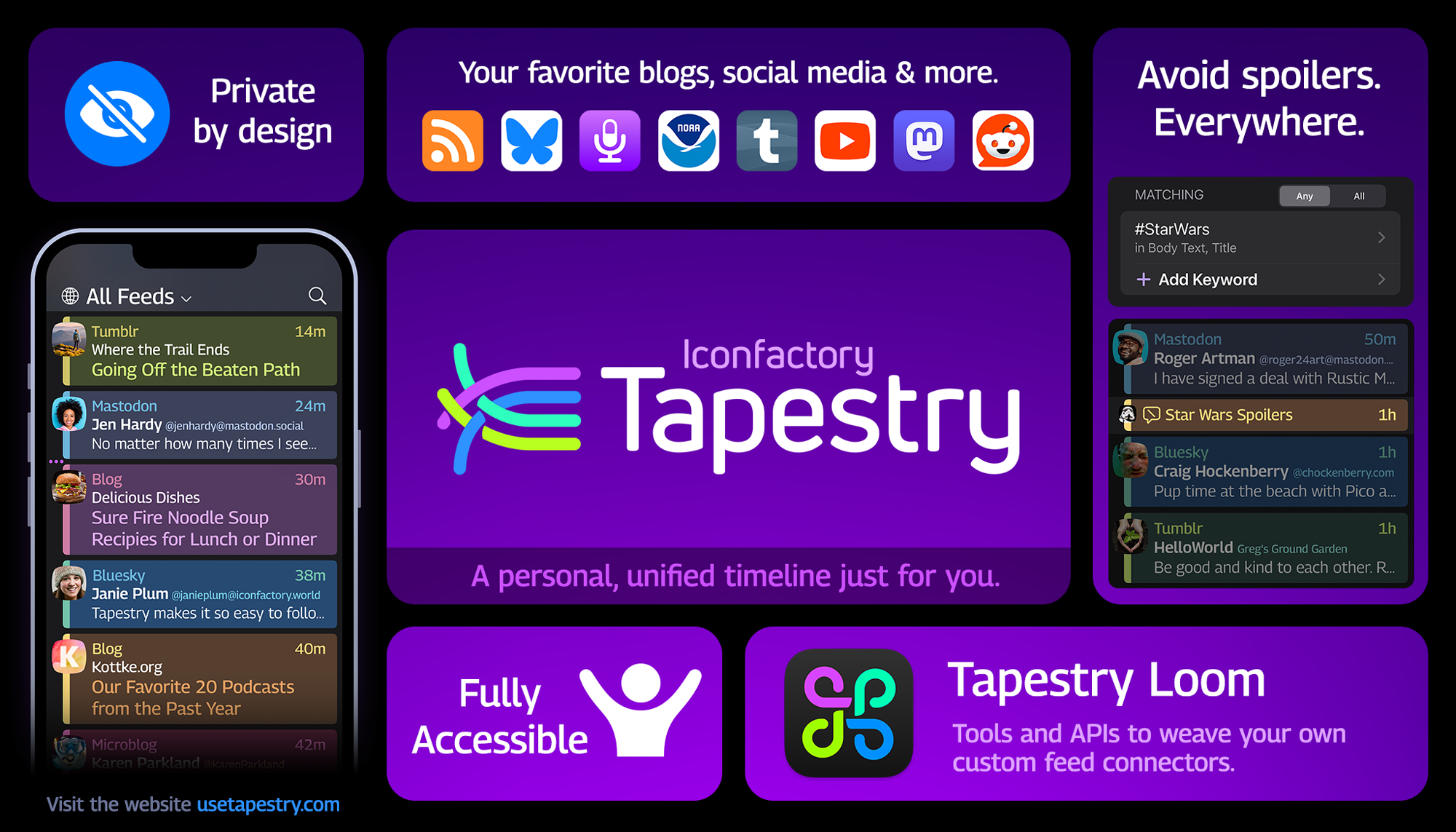
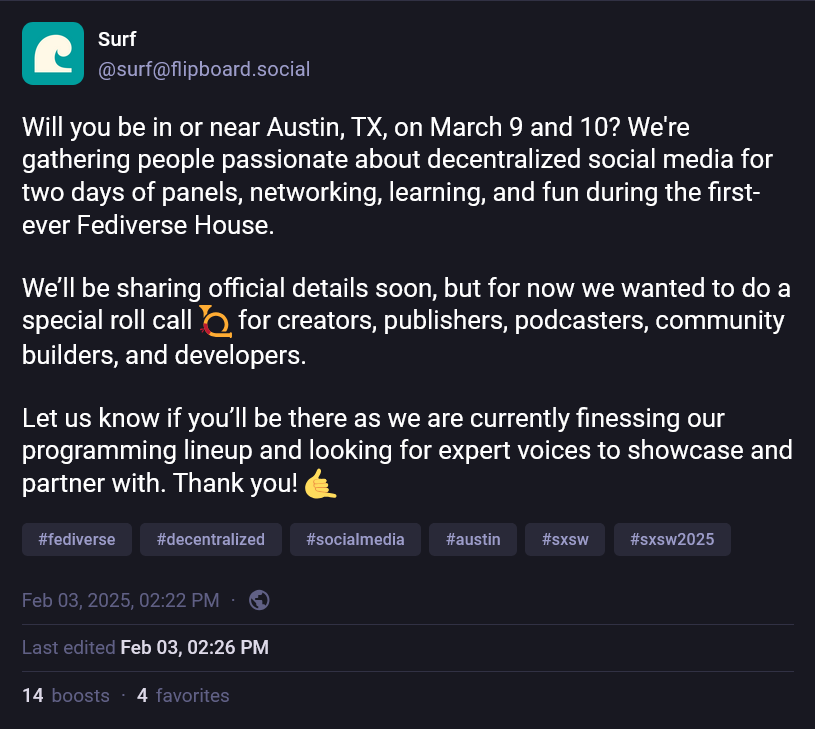
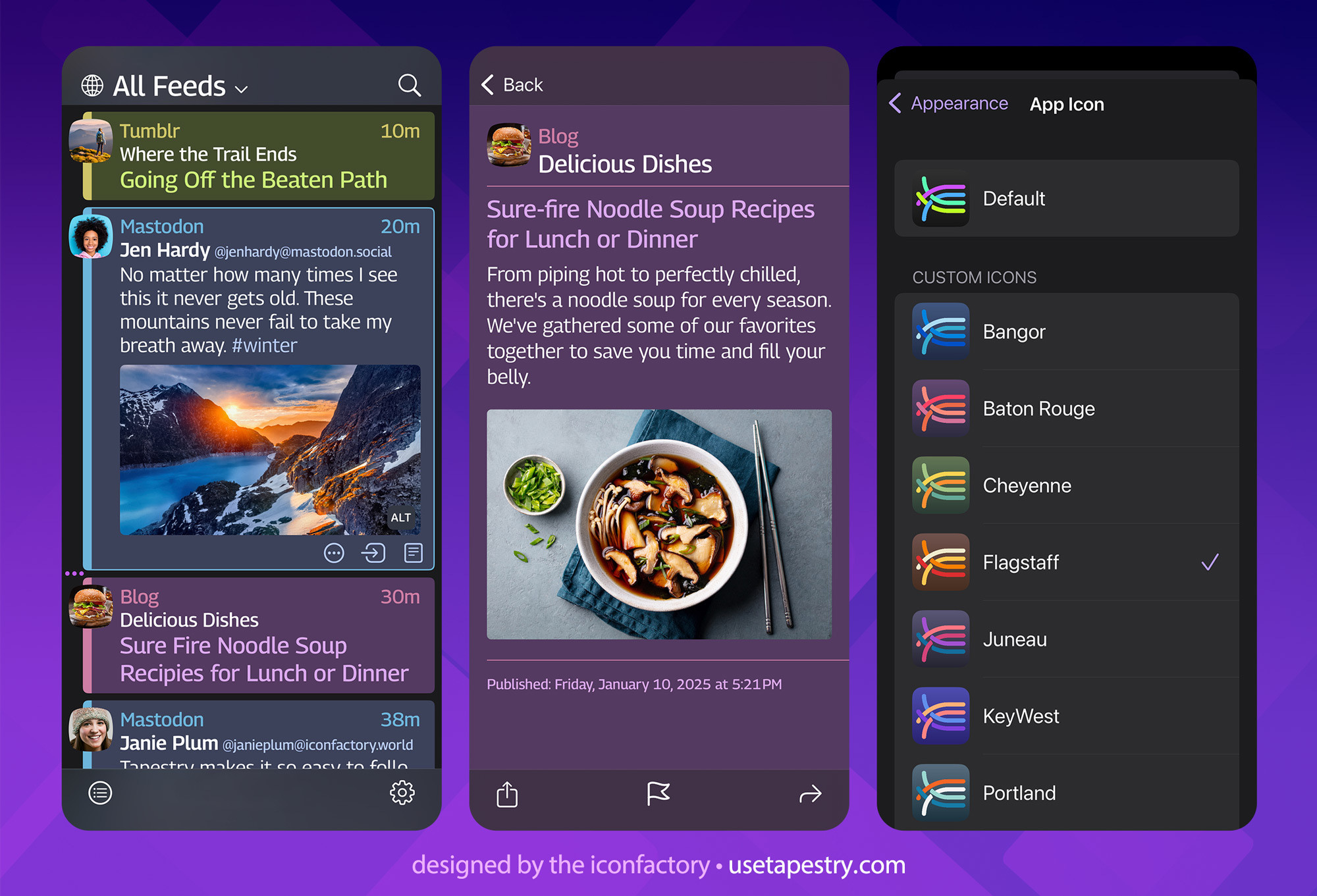







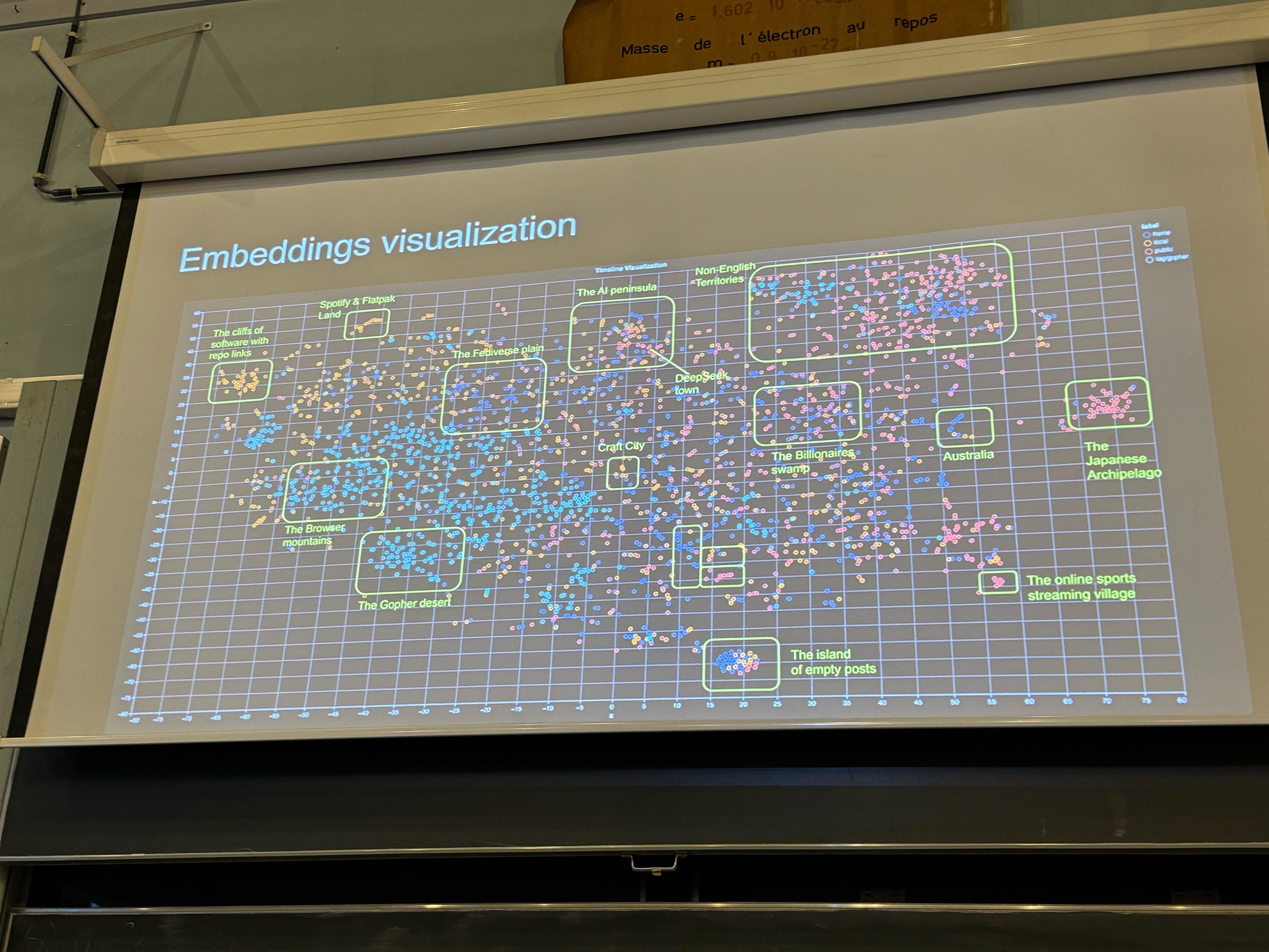
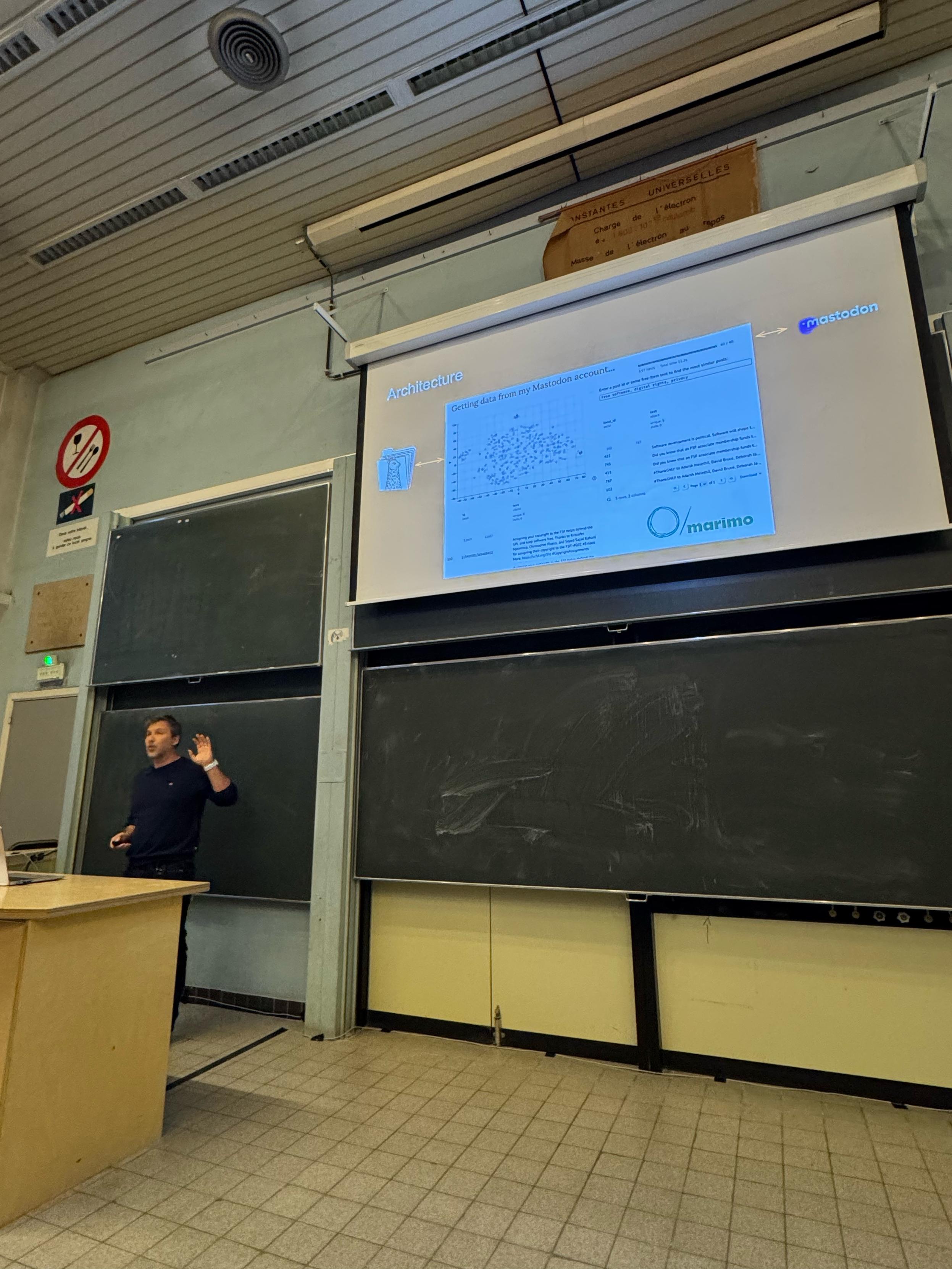

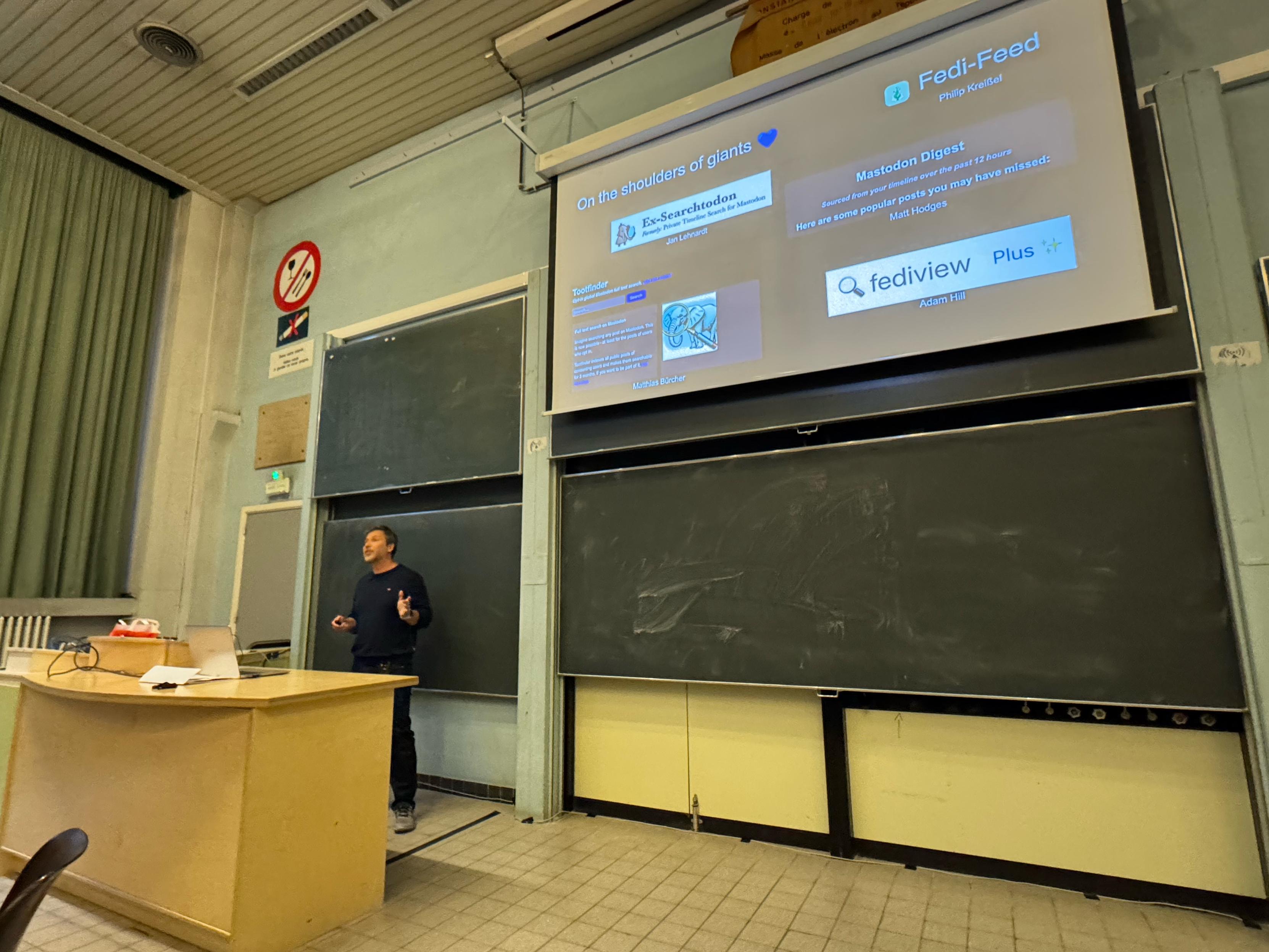
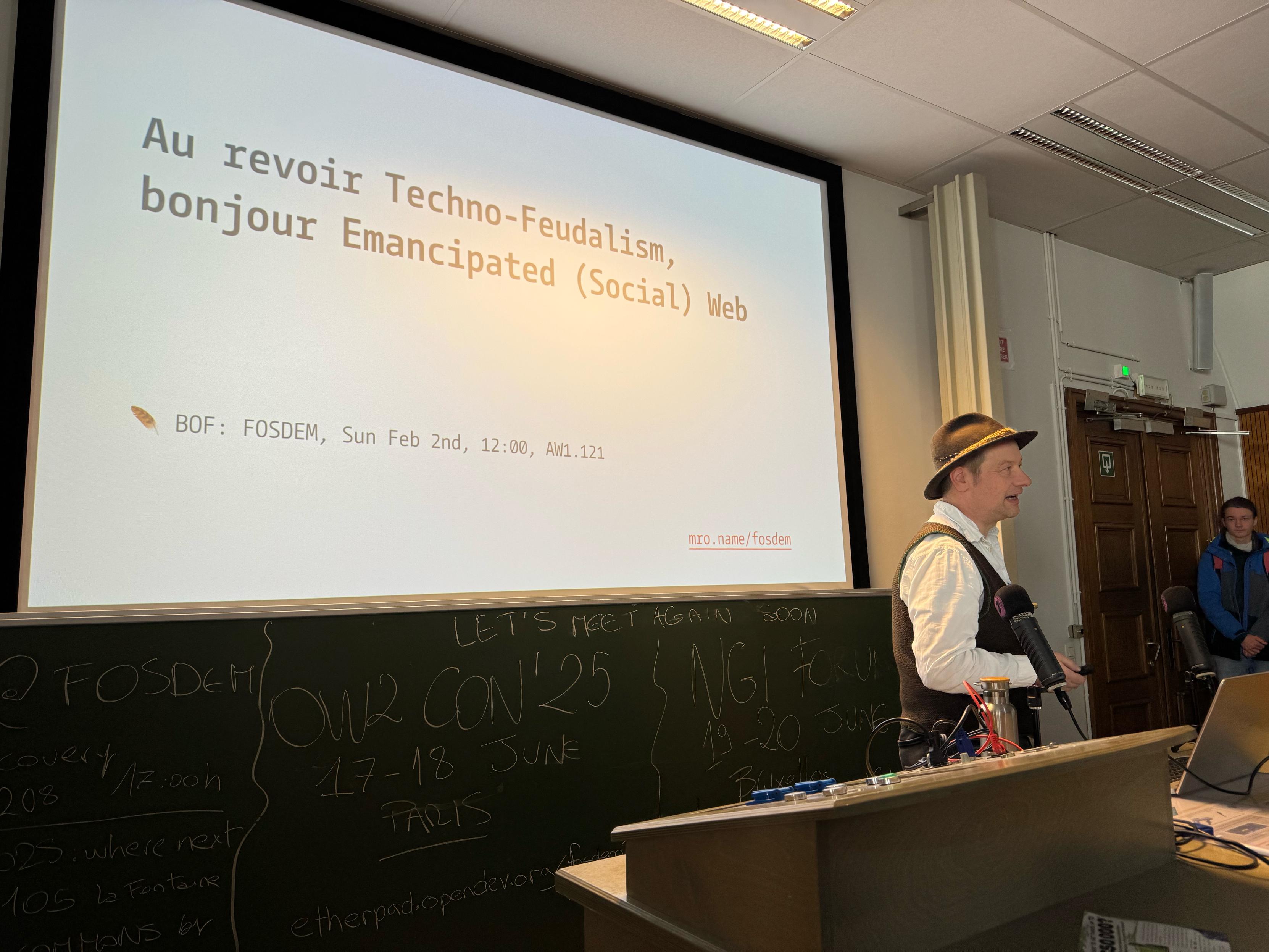

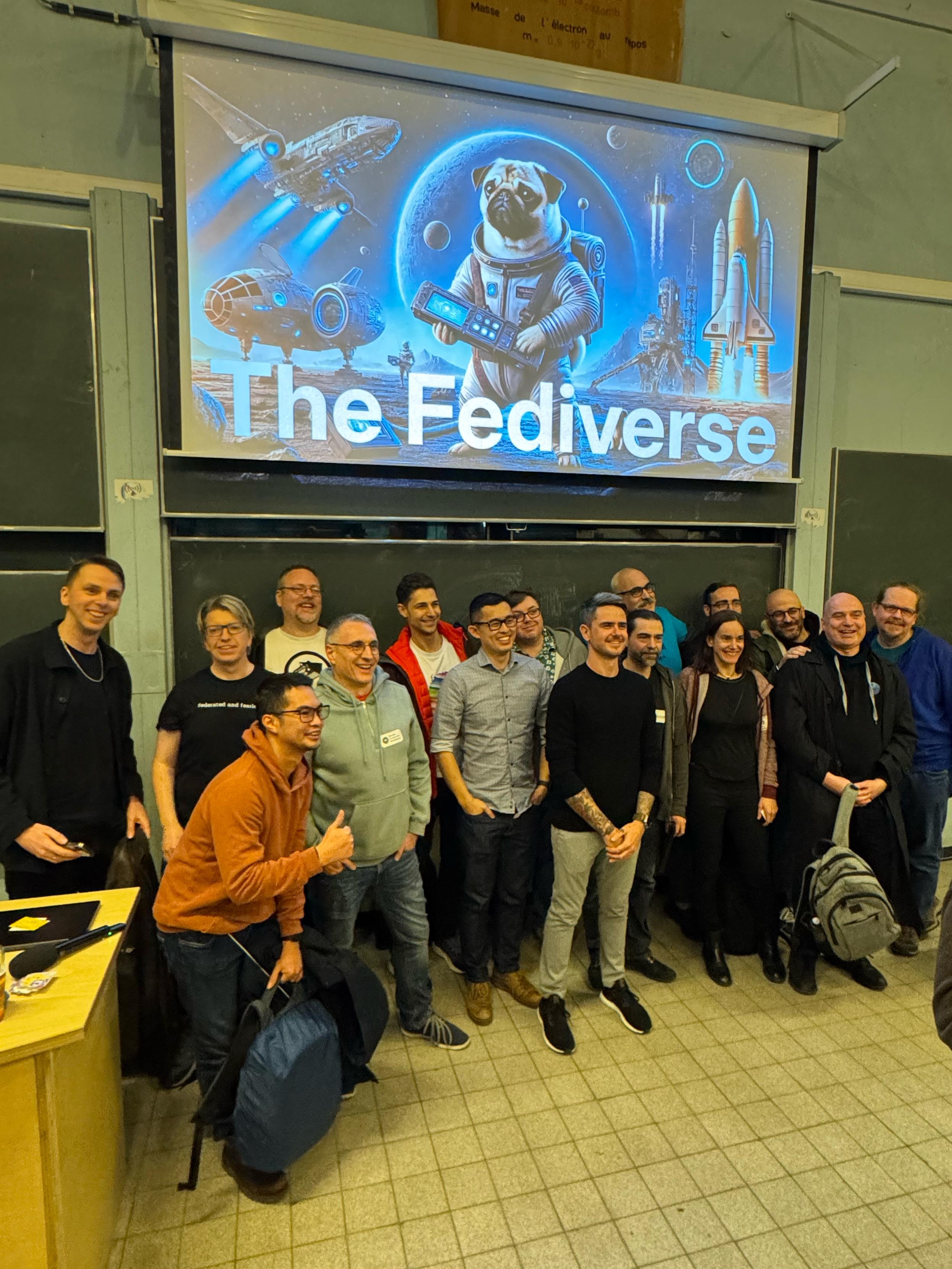

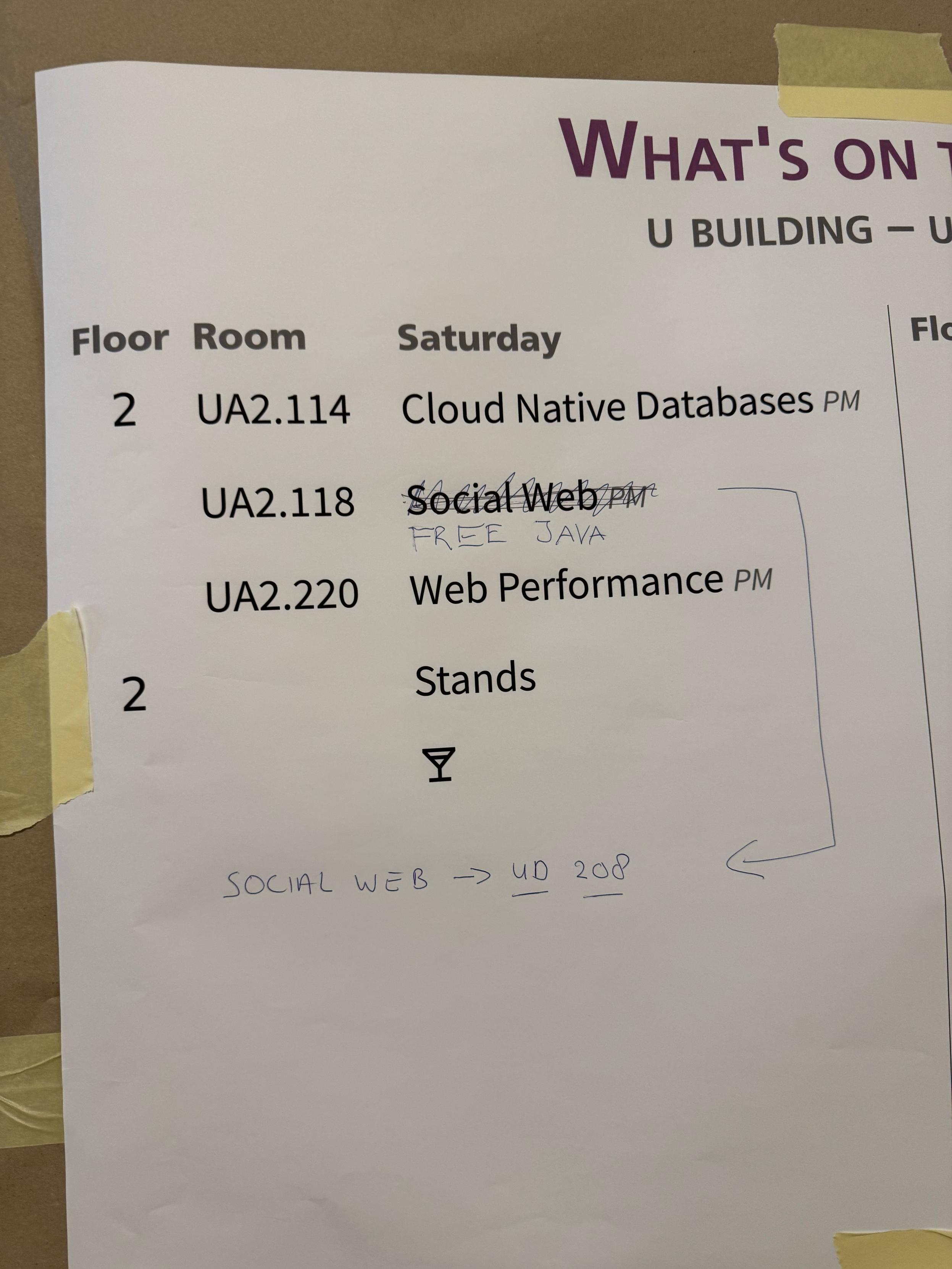





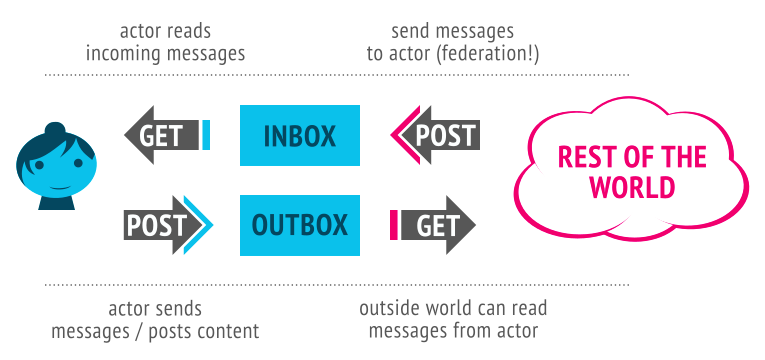
![{
"@context": [
"https://www.w3.org/ns/activitystreams"
],
"type": "Profile",
"describes": "acct:reiver@mastodon.social",
"attributedTo": "https://example.com/apps/ratel",
"icon": {
"type": "Icon",
"mediaType": "image/png",
"url": "https://example.com/apps/ratel/img/icon.png"
},
"attachment": [
{
"type": "Label",
"name": "Programmer"
},
{
"type": "Label",
"name": "Canadian"
},
{
"type": "Icon",
"mediaType": "image/png",
"url": "https://example.com/pfp/751f76ed540a40a3b4caae50e50cc867.png"
},
{
"type": "Icon",
"mediaType": "image/png",
"url": "https://example.com/pfp/45f7b459257940f490133070a975924b.png"
}
]
}](https://files.mastodon.social/media_attachments/files/113/822/835/158/629/464/original/d533aeb4132201db.png)





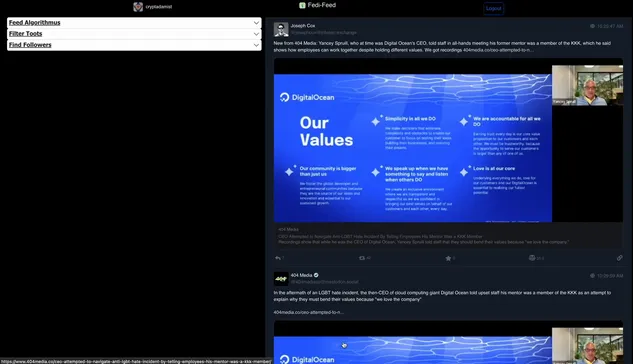








![Screenshot from the linked article reading:
"Next steps
• I [Matt Lee] want you to have a personal website and have your listening habits on your own website, not my website. But I know some people won't want that, which is fine but Libre.fm is effectively a silo (other than Last.fm which it talks to, although federation with other instances has been possible for a long time) and has over 372,000 registered users and 302 million scrobbles.
• Some new features will only work if you're publishing your Libre.fm stats on your own website.
• A new version of Libre.fm's front end will appear later, powered by Ruby on Rails.
• [highlighted] We're also going to put our full attention to supporting ActivityPub where possible. [end highlight]"](https://media.moule.world/moule/media_attachments/files/113/248/170/029/238/328/original/769bc3d86f28a30f.png)