Hashtag

#openscience

560 posts tagged with this hashtag.

@oscmaastricht@social.edu.nl

"UNESCO is pleased to announce the public launch of the UNESCO Open Science Platform [..]. Developed in partnership with the United Nations International Computing Centre (UNICC), the platform is released as free and open-source software and is built on open technologies, including a customized implementation of CERN's InvenioRDM, an open source framework for building large-scale digital academic repositories and platforms, as a core component." unesco.org/en/articles/launch-

unesco.org

Launch of UNESCO Open Science Platform

UNESCO invites partners, researchers and the wider public to discover a new digital platform that promotes open access to UNESCO scientific knowledge and research products and tracks global progress

@oscmaastricht@social.edu.nl

"UNESCO is pleased to announce the public launch of the UNESCO Open Science Platform [..]. Developed in partnership with the United Nations International Computing Centre (UNICC), the platform is released as free and open-source software and is built on open technologies, including a customized implementation of CERN's InvenioRDM, an open source framework for building large-scale digital academic repositories and platforms, as a core component." unesco.org/en/articles/launch-

unesco.org

Launch of UNESCO Open Science Platform

UNESCO invites partners, researchers and the wider public to discover a new digital platform that promotes open access to UNESCO scientific knowledge and research products and tracks global progress

@daily_lotus@mastodon.social

📣 Natural Product Occurrence of the Day

🧪 1,4-Dimethyl-azulene [wikidata.org/wiki/Q82236254] is a molecule
found in a 🌿 plant, Calypogeia azurea [wikidata.org/wiki/Q882764]
📚 according to: [wikidata.org/wiki/Q104996479]

✏️ This occurrence is available for curation on Wikidata [wikidata.org/wiki/Q82236254#P7]. If you spot an error, feel free to improve it!

Chemical structure of 1,4-Dimethyl-azulene displaying atoms and bonds.
ALT text

Chemical structure of 1,4-Dimethyl-azulene displaying atoms and bonds.

Image of Calypogeia azurea, the taxon in which the compound is found.
ALT text

Image of Calypogeia azurea, the taxon in which the compound is found.

@daily_lotus@mastodon.social

📣 Natural Product Occurrence of the Day

🧪 1,4-Dimethyl-azulene [wikidata.org/wiki/Q82236254] is a molecule
found in a 🌿 plant, Calypogeia azurea [wikidata.org/wiki/Q882764]
📚 according to: [wikidata.org/wiki/Q104996479]

✏️ This occurrence is available for curation on Wikidata [wikidata.org/wiki/Q82236254#P7]. If you spot an error, feel free to improve it!

Chemical structure of 1,4-Dimethyl-azulene displaying atoms and bonds.
ALT text

Chemical structure of 1,4-Dimethyl-azulene displaying atoms and bonds.

Image of Calypogeia azurea, the taxon in which the compound is found.
ALT text

Image of Calypogeia azurea, the taxon in which the compound is found.

@daily_lotus@mastodon.social

📣 Natural Product Occurrence of the Day

🧪 isomangiferin [wikidata.org/wiki/Q27151338] is a molecule
found in a 🌿 plant, Tigridia orthantha [wikidata.org/wiki/Q15585940]
📚 according to: [wikidata.org/wiki/Q104246991]

✏️ This occurrence is available for curation on Wikidata [wikidata.org/wiki/Q27151338#P7]. If you spot an error, feel free to improve it!

Chemical structure of isomangiferin displaying atoms and bonds.
ALT text

Chemical structure of isomangiferin displaying atoms and bonds.

Image of Tigridia orthantha, the taxon in which the compound is found.
ALT text

Image of Tigridia orthantha, the taxon in which the compound is found.

@lozross@post.lurk.org

📌 It took a while to get this out (because I kept coming across and needing to reflect on additional reference points) but finally the blog post on: "What do we mean when we talk about AI and open knowledge" or otherwise, reflections on the AI-Bridges Symposium held in London at the end of May, is published on the @tibhannover Blog.

🧶 It's a dense thinky-piece, but - just in time for some weekend reading - I hope some of it resonates. Open to feedback and critique, and hearing what others are thinking / writing about these thorny topics.

🔗 blog.tib.eu/2026/06/19/what-do

blog.tib.eu

What do we mean when we talk about AI and open knowledge? - TIB-Blog

Commercial AI applications are increasingly scraping public data, which also impacts the open knowledge ecosystem. The AI-Bridges Symposium at the University of London brought together policy makers, academics, and open knowledge stakeholders to discuss this shift. Two central themes of the conference were the threat of extractive data usage and the great potential of Wikibase and Wikidata for fairer, AI-supported, and collaborative data workflows.

@lozross@post.lurk.org

📌 It took a while to get this out (because I kept coming across and needing to reflect on additional reference points) but finally the blog post on: "What do we mean when we talk about AI and open knowledge" or otherwise, reflections on the AI-Bridges Symposium held in London at the end of May, is published on the @tibhannover Blog.

🧶 It's a dense thinky-piece, but - just in time for some weekend reading - I hope some of it resonates. Open to feedback and critique, and hearing what others are thinking / writing about these thorny topics.

🔗 blog.tib.eu/2026/06/19/what-do

blog.tib.eu

What do we mean when we talk about AI and open knowledge? - TIB-Blog

Commercial AI applications are increasingly scraping public data, which also impacts the open knowledge ecosystem. The AI-Bridges Symposium at the University of London brought together policy makers, academics, and open knowledge stakeholders to discuss this shift. Two central themes of the conference were the threat of extractive data usage and the great potential of Wikibase and Wikidata for fairer, AI-supported, and collaborative data workflows.

@daily_lotus@mastodon.social

📣 Natural Product Occurrence of the Day

🧪 isomangiferin [wikidata.org/wiki/Q27151338] is a molecule
found in a 🌿 plant, Tigridia orthantha [wikidata.org/wiki/Q15585940]
📚 according to: [wikidata.org/wiki/Q104246991]

✏️ This occurrence is available for curation on Wikidata [wikidata.org/wiki/Q27151338#P7]. If you spot an error, feel free to improve it!

Chemical structure of isomangiferin displaying atoms and bonds.
ALT text

Chemical structure of isomangiferin displaying atoms and bonds.

Image of Tigridia orthantha, the taxon in which the compound is found.
ALT text

Image of Tigridia orthantha, the taxon in which the compound is found.

@prereview@mas.to

📢 This is a call for all scholars committed to improving peer review culture!
Join us for our next community on June 25 at 3pm UTC, where we’ll provide feedback to this preprint: doi.org/10.1101/2025.01.03.253

👐 Anyone interested in the research topic under discussion, and armed with respect and a constructive attitude is invited!

Register now: bit.ly/June25-LiveReview

PREreview facilitators will also be joined by @csmarcum in the role of invited expert.

“Community Live Review” bold header. “Register for our next collaborative preprint discussion!” spotlight banner. QR code linking to preprint doi: https://doi.org/10.1101/2025.01.03.25319975. Title of preprint: “Safety Monitoring of Multiple Health Outcomes Following 2023–2024 COVID-19 Vaccination among Medicare Beneficiaries Aged 65 Years and Older in the United States”. June 25, 2026 | 8:00 PT - 11:00 ET - 15:00 UTC. PREreview logo at the bottom.
ALT text

“Community Live Review” bold header. “Register for our next collaborative preprint discussion!” spotlight banner. QR code linking to preprint doi: https://doi.org/10.1101/2025.01.03.25319975. Title of preprint: “Safety Monitoring of Multiple Health Outcomes Following 2023–2024 COVID-19 Vaccination among Medicare Beneficiaries Aged 65 Years and Older in the United States”. June 25, 2026 | 8:00 PT - 11:00 ET - 15:00 UTC. PREreview logo at the bottom.

@prereview@mas.to

📢 This is a call for all scholars committed to improving peer review culture!
Join us for our next community on June 25 at 3pm UTC, where we’ll provide feedback to this preprint: doi.org/10.1101/2025.01.03.253

👐 Anyone interested in the research topic under discussion, and armed with respect and a constructive attitude is invited!

Register now: bit.ly/June25-LiveReview

PREreview facilitators will also be joined by @csmarcum in the role of invited expert.

“Community Live Review” bold header. “Register for our next collaborative preprint discussion!” spotlight banner. QR code linking to preprint doi: https://doi.org/10.1101/2025.01.03.25319975. Title of preprint: “Safety Monitoring of Multiple Health Outcomes Following 2023–2024 COVID-19 Vaccination among Medicare Beneficiaries Aged 65 Years and Older in the United States”. June 25, 2026 | 8:00 PT - 11:00 ET - 15:00 UTC. PREreview logo at the bottom.
ALT text

“Community Live Review” bold header. “Register for our next collaborative preprint discussion!” spotlight banner. QR code linking to preprint doi: https://doi.org/10.1101/2025.01.03.25319975. Title of preprint: “Safety Monitoring of Multiple Health Outcomes Following 2023–2024 COVID-19 Vaccination among Medicare Beneficiaries Aged 65 Years and Older in the United States”. June 25, 2026 | 8:00 PT - 11:00 ET - 15:00 UTC. PREreview logo at the bottom.

@FabMusacchio@mastodon.social

Mathematicians just published the Leiden Declaration on and . It is a declaration on how research should respond to AI, w recommendations for researchers, institutions, policymakers and industry. It is not completely against , but argues for , attribution, human authorship, and proper review.

The declaration is open for signing:

🌍 leidendeclaration.ai/
📄 doi.org/10.5281/zenodo.20302944

White background with black text reading "Leiden Declaration on Artificial Intelligence and Mathematics" and a blue line drawing.
ALT text

White background with black text reading "Leiden Declaration on Artificial Intelligence and Mathematics" and a blue line drawing.

White page with black text. "This declaration calls for action to address the challenges posed by the use of artificial intelligence within mathematics research."
ALT text

White page with black text. "This declaration calls for action to address the challenges posed by the use of artificial intelligence within mathematics research."

@egonw@mastodon.social

there is a significant number of scholars/scientists who (still) blog. A lot of early semantic web and discussions happened on this open "platform".

Rogue Scholar (@rogue_scholar) is archiving new and old blogs, and just passed the 50 thousand blog posts. All citable by @crossref DOIs, all archived in the @internetarchive, all under an open license. blog.front-matter.de/posts/rog

I still hope to see more 2005-2015 science blogs archived.

doi.org

Rogue Scholar has now archived 50,000 science blog posts

The science blog archive Rogue Scholar last week achieved an important milestone: archiving 50,000 science blog posts, will searchable full-text, rich metadata, and DOIs. Rogue Scholar started to archive science blog posts in April 2023, started archiving all content with the Internet Archive Archive-It service in October 2023, started

@FabMusacchio@mastodon.social

Mathematicians just published the Leiden Declaration on and . It is a declaration on how research should respond to AI, w recommendations for researchers, institutions, policymakers and industry. It is not completely against , but argues for , attribution, human authorship, and proper review.

The declaration is open for signing:

🌍 leidendeclaration.ai/
📄 doi.org/10.5281/zenodo.20302944

White background with black text reading "Leiden Declaration on Artificial Intelligence and Mathematics" and a blue line drawing.
ALT text

White background with black text reading "Leiden Declaration on Artificial Intelligence and Mathematics" and a blue line drawing.

White page with black text. "This declaration calls for action to address the challenges posed by the use of artificial intelligence within mathematics research."
ALT text

White page with black text. "This declaration calls for action to address the challenges posed by the use of artificial intelligence within mathematics research."

@egonw@mastodon.social

there is a significant number of scholars/scientists who (still) blog. A lot of early semantic web and discussions happened on this open "platform".

Rogue Scholar (@rogue_scholar) is archiving new and old blogs, and just passed the 50 thousand blog posts. All citable by @crossref DOIs, all archived in the @internetarchive, all under an open license. blog.front-matter.de/posts/rog

I still hope to see more 2005-2015 science blogs archived.

doi.org

Rogue Scholar has now archived 50,000 science blog posts

The science blog archive Rogue Scholar last week achieved an important milestone: archiving 50,000 science blog posts, will searchable full-text, rich metadata, and DOIs. Rogue Scholar started to archive science blog posts in April 2023, started archiving all content with the Internet Archive Archive-It service in October 2023, started

@daily_lotus@mastodon.social

📣 Natural Product Occurrence of the Day

🧪 Aflatoxicol B [wikidata.org/wiki/Q83085509] is a molecule
found in a 🍄 fungi, Aspergillus parasiticus [wikidata.org/wiki/Q432356]
📚 according to: Aflatoxicol Formation by Aspergillus flavus and A. parasiticus [wikidata.org/wiki/Q105322238]

✏️ This occurrence is available for curation on Wikidata [wikidata.org/wiki/Q83085509#P7]. If you spot an error, feel free to improve it!

Chemical structure of Aflatoxicol B displaying atoms and bonds.
ALT text

Chemical structure of Aflatoxicol B displaying atoms and bonds.

Image of Aspergillus parasiticus, the taxon in which the compound is found.
ALT text

Image of Aspergillus parasiticus, the taxon in which the compound is found.

@daily_lotus@mastodon.social

📣 Natural Product Occurrence of the Day

🧪 Aflatoxicol B [wikidata.org/wiki/Q83085509] is a molecule
found in a 🍄 fungi, Aspergillus parasiticus [wikidata.org/wiki/Q432356]
📚 according to: Aflatoxicol Formation by Aspergillus flavus and A. parasiticus [wikidata.org/wiki/Q105322238]

✏️ This occurrence is available for curation on Wikidata [wikidata.org/wiki/Q83085509#P7]. If you spot an error, feel free to improve it!

Chemical structure of Aflatoxicol B displaying atoms and bonds.
ALT text

Chemical structure of Aflatoxicol B displaying atoms and bonds.

Image of Aspergillus parasiticus, the taxon in which the compound is found.
ALT text

Image of Aspergillus parasiticus, the taxon in which the compound is found.

@prereview@mas.to

📬 A new issue of the 2026 PREreview Champions interview series is out!

This week, Akuma Ifeanyichukwu shared his takeaways from the program, and his reflections on the power of & inclusive research practices.

content.prereview.org/an-inter

Headshot of Akuma Ifeanyichukwu to the left of the image. Quote from him: “Meaningful transformation in scholarly comms requires collective participation, mentorship, and accessible training opportunities”. At the bottom, there's a banner that reads "Community Features: 2026 PREreview Champions".
ALT text

Headshot of Akuma Ifeanyichukwu to the left of the image. Quote from him: “Meaningful transformation in scholarly comms requires collective participation, mentorship, and accessible training opportunities”. At the bottom, there's a banner that reads "Community Features: 2026 PREreview Champions".

@prereview@mas.to

📬 A new issue of the 2026 PREreview Champions interview series is out!

This week, Akuma Ifeanyichukwu shared his takeaways from the program, and his reflections on the power of & inclusive research practices.

content.prereview.org/an-inter

Headshot of Akuma Ifeanyichukwu to the left of the image. Quote from him: “Meaningful transformation in scholarly comms requires collective participation, mentorship, and accessible training opportunities”. At the bottom, there's a banner that reads "Community Features: 2026 PREreview Champions".
ALT text

Headshot of Akuma Ifeanyichukwu to the left of the image. Quote from him: “Meaningful transformation in scholarly comms requires collective participation, mentorship, and accessible training opportunities”. At the bottom, there's a banner that reads "Community Features: 2026 PREreview Champions".

@daily_lotus@mastodon.social

📣 Natural Product Occurrence of the Day

🧪 digoxin,β-acetyl [wikidata.org/wiki/Q105184454] is a molecule
found in a 🌿 plant, Digitalis lanata [wikidata.org/wiki/Q157838]
📚 according to: Über die Glykoside von Digitalis orientalis L. [wikidata.org/wiki/Q105034682]

✏️ This occurrence is available for curation on Wikidata [wikidata.org/wiki/Q105184454#P]. If you spot an error, feel free to improve it!

Image of Digitalis lanata, the taxon in which the compound is found.
ALT text

Image of Digitalis lanata, the taxon in which the compound is found.

Chemical structure of digoxin,β-acetyl displaying atoms and bonds.
ALT text

Chemical structure of digoxin,β-acetyl displaying atoms and bonds.

@xtaldave@social.vivaldi.net

People of the Fediverse! I have accomplished science. Allow me to elaborate...

"Discovery of a sulfotyrosine-motif in the human TrkB extracellular domain
required for agonist activation"

biorxiv.org/content/10.64898/2

Gif from Darkplace. 

Richard Ayoade shouts throw a megaphone "Look at these Lab Results!" and Matt Berry points at a clipboard with the words "potential  killer" written on it
ALT text

Gif from Darkplace. Richard Ayoade shouts throw a megaphone "Look at these Lab Results!" and Matt Berry points at a clipboard with the words "potential killer" written on it

@xtaldave@social.vivaldi.net

People of the Fediverse! I have accomplished science. Allow me to elaborate...

"Discovery of a sulfotyrosine-motif in the human TrkB extracellular domain
required for agonist activation"

biorxiv.org/content/10.64898/2

Gif from Darkplace. 

Richard Ayoade shouts throw a megaphone "Look at these Lab Results!" and Matt Berry points at a clipboard with the words "potential  killer" written on it
ALT text

Gif from Darkplace. Richard Ayoade shouts throw a megaphone "Look at these Lab Results!" and Matt Berry points at a clipboard with the words "potential killer" written on it

@daily_lotus@mastodon.social

📣 Natural Product Occurrence of the Day

🧪 digoxin,β-acetyl [wikidata.org/wiki/Q105184454] is a molecule
found in a 🌿 plant, Digitalis lanata [wikidata.org/wiki/Q157838]
📚 according to: Über die Glykoside von Digitalis orientalis L. [wikidata.org/wiki/Q105034682]

✏️ This occurrence is available for curation on Wikidata [wikidata.org/wiki/Q105184454#P]. If you spot an error, feel free to improve it!

Image of Digitalis lanata, the taxon in which the compound is found.
ALT text

Image of Digitalis lanata, the taxon in which the compound is found.

Chemical structure of digoxin,β-acetyl displaying atoms and bonds.
ALT text

Chemical structure of digoxin,β-acetyl displaying atoms and bonds.

@Bibliothecaris@social.edu.nl

Now available: written transcripts of our Bites episodes!

Prefer reading over listening, or want to quickly revisit key insights? You can now access full transcripts alongside the episodes.

🔗 rug.nl/research/openscience/po (via the drop-down menu)

podcast logo: Open Science Bites + mic
ALT text

podcast logo: Open Science Bites + mic

@Bibliothecaris@social.edu.nl

Now available: written transcripts of our Bites episodes!

Prefer reading over listening, or want to quickly revisit key insights? You can now access full transcripts alongside the episodes.

🔗 rug.nl/research/openscience/po (via the drop-down menu)

podcast logo: Open Science Bites + mic
ALT text

podcast logo: Open Science Bites + mic

@prereview@mas.to
@prereview@mas.to
@datendetektivin@mk.absturztau.be

​​​:blobfoxcomputerowo:​​ Ich habe einen kleinen Überblicksartikel für @gnulinux@social.anoxinon.de geschrieben über Tools, mit denen durchgeführt werden können (sowohl einfache Befragungen, als auch komplexere für wissenschaftliche Zwecke - mit Fokus auf ):
https://gnulinux.ch/es-muss-nicht-google-forms-sein-online-befragungen-dsgvo-konform-und-open-source


Danke an
@jedes_jahr_ein_neues_protokoll@troet.cafe @adriangadientbruegger@fediscience.org @Triton@kanoa.de @zoiundeinhorn@medibubble.org @ecological_fallacy@fediscience.org für Eure Anregungen! ​​:blobcatthumbsup:

Nur mit einigen der Tools habe ich selbst vertiefte Erfahrung, bin also weiter dankbar für Eure Ergänzungen und weitere Erfahrungsberichte. Was wären Eure Empfehlungen?

P.S.:
Leider habe ich die Überschrift wohl nicht
suchmaschinenoptimiert formuliert, so dass der Artikel auf ziemlich versteckt ist (Danke an @cinux@mastodon.social für den Hinweis). Aus diesem Anlass habe ich hier noch mal eine kleine fedi-interne "Umfrage" gestartet zur Nutzung von . Trotz zahlreicher Alternativen ist Google aber außerhalb des weiterhin unangefochten mit einem Marktanteil von ca. 90% in Dtld

@soziologie@a.gup.pe @sociology@a.gup.pe @openscience@a.gup.pe @openscience@mastodon.social @cryptpad@fosstodon.org @nextcloud@mastodon.xyz @Framasoft@framapiaf.org @LimeSurvey@fosstodon.org @lerntools@bildung.social

seo-summary.de

Suchmaschinen Marktanteile in Deutschland (2022)

Die beliebtesten Suchmaschinen in Deutschland mit aktuellen Marktanteilen (Desktop/Mobil) und der Entwicklung von 2001-2022📈

@Bibliothecaris@social.edu.nl

To stay connected and be visible in life we are (still) on .

But the longer we stay, the harder it becomes to defend that choice.
It clashes with what we stand for as a : trustworthy information, , & student wellbeing.

We want to explore alternatives & open up the conversation about what responsible (online) with students could and should look like.

Read our story and share your thoughts:
rug.nl/library/open-access/blo

rug.nl

A university library on Instagram: We want to leave, but then what?

At the University of Groningen Library, we make deliberate choices about our digital presence. We moved to Mastodon and PeerTube, platforms that are part...

@Bibliothecaris@social.edu.nl

To stay connected and be visible in life we are (still) on .

But the longer we stay, the harder it becomes to defend that choice.
It clashes with what we stand for as a : trustworthy information, , & student wellbeing.

We want to explore alternatives & open up the conversation about what responsible (online) with students could and should look like.

Read our story and share your thoughts:
rug.nl/library/open-access/blo

rug.nl

A university library on Instagram: We want to leave, but then what?

At the University of Groningen Library, we make deliberate choices about our digital presence. We moved to Mastodon and PeerTube, platforms that are part...

@Bibliothecaris@social.edu.nl

To stay connected and be visible in life we are (still) on .

But the longer we stay, the harder it becomes to defend that choice.
It clashes with what we stand for as a : trustworthy information, , & student wellbeing.

We want to explore alternatives & open up the conversation about what responsible (online) with students could and should look like.

Read our story and share your thoughts:
rug.nl/library/open-access/blo

rug.nl

A university library on Instagram: We want to leave, but then what?

At the University of Groningen Library, we make deliberate choices about our digital presence. We moved to Mastodon and PeerTube, platforms that are part...

@hello@hcommons.social

The KCWorks repository hit a major milestone this week--we officially have over 40,000 publicly visible records! 🎉

Thank you to our incredible community for contributing your works--this milestone reflects your commitment to sharing knowledge and supporting one another. 🫶

works.hcommons.org/

Decorative graphic featuring text that reads "40,005 publicly visible records in KCWorks!" with a Knowledge Commons logo and a URL for works.hcommons.org
ALT text

Decorative graphic featuring text that reads "40,005 publicly visible records in KCWorks!" with a Knowledge Commons logo and a URL for works.hcommons.org

@loz@social.coop

Hi @SocialCoop, thanks for accepting my application. : I'm really happy to be joining and taking my first step into the cooperative movement. I'm interested in ways of living, working and relating to others, including coops, , the philosphy, and public , including projects and . I'm also intersted in and .

I work with data and love to code. At the moment I'm often riding the around Manchester, in my local pool or climbing at my local center.

@loz@social.coop

Hi @SocialCoop, thanks for accepting my application. : I'm really happy to be joining and taking my first step into the cooperative movement. I'm interested in ways of living, working and relating to others, including coops, , the philosphy, and public , including projects and . I'm also intersted in and .

I work with data and love to code. At the moment I'm often riding the around Manchester, in my local pool or climbing at my local center.

@jeroenbosman@akademienl.social

The fact that 10 years after @MsPhelps and I included equity in our working definition of in the form an 'open to participation' pillar (see im2punt0.wordpress.com/2017/03) we are now at conference discussing how to include equity in OS means that this change moves at glacial speed and there may be strong incentives against it. One of these might be with their huge inbuilt colonial legacy.

im2punt0.wordpress.com

Defining Open Science Definitions

by Jeroen Bosman & Bianca Kramer [updated 20170328 to include the Open Science definition from Foster] These days there seems to be a real surge in all things open science. At least it’s …

@lmu_osc@scicomm.xyz

We’re excited to share that the LMU Open Science Center (OSC) will be presenting a poster at - The Future of Open Research: Reliable, Responsible, Equitable. Happening from May 4 to 6, 2026, at the Institute for Advanced Studies, Technical University of Munich (opensciencestudies.eu/for-2026)

Our poster can be viewed and downloaded here: doi.org/10.5281/zenodo.19626906. It highlights our efforts to embed open research practices at LMU Munich and beyond through a multi-angle approach.
We focus on two key initiatives:
- Switch-to-Open: a structured training and consultation program that helps research groups integrate open research practices across the full project lifecycle, from planning and data management to reproducible analysis and FAIR sharing.
- Train-the-Trainer: a program designed to equip researchers and research support staff with the pedagogical skills needed to teach and advocate for Open Research practices and tools within their own communities.

These initiatives are built on a broader foundation of accessible learning opportunities, including:
📚 A free self-learning catalog of online tutorials and lecture recordings (osc.lmu.de/training/self-learn)
🎓 Regular workshops throughout the year
☀️ Our annual Open Science Summer School (lmu-osc.github.io/Open-Science)

Together, these initiatives aim to make open research practices more practical, scalable, and sustainable across disciplines.

If you’re attending , feel free to stop by and chat with us about training, institutional change, and building cultures of openness in research!

Image of the LMU OSC flyer titled “Embedding Open Research Practices at LMU Munich and beyond” which details the Switch-to-Open and Train-the-Trainer programs, self-learning catalog of online tutorials, and the several workshops and summer schools hosted by the LMU OSC.
ALT text

Image of the LMU OSC flyer titled “Embedding Open Research Practices at LMU Munich and beyond” which details the Switch-to-Open and Train-the-Trainer programs, self-learning catalog of online tutorials, and the several workshops and summer schools hosted by the LMU OSC.

@alelazic@mastodon.social

Great to see open education represented at FOR 2026 today! Rob Farrow presented the GO-GN, a network of PhD candidates around the world whose research projects include a focus on open education (i.e. OER, OEP, MOOC). go-gn.net/

go-gn.net

GO-GN Global OER Graduate Network

Homepage of the Global OER Graduate Network, based in the Institute of Educational Technology at The Open University, UK

@alelazic@mastodon.social

Reporting late from FOR 2026 conference day 2: I had the privilege (and the pressure) of joining the plenary panel on equity & justice in open research implementation. I tried to give voice to the Global South and Eastern Europe. I shared that it's time the established players step back and let us lead.

I wrote more at linkedin.com/posts/alelazic_fo

A photo of the chair and panelists from left to right: Barbara Prainsack, Aleksandra Lazić, Rachel Ankeny, Antonia Schrader, Tony Ross-Hellhauer, Louise Bezuidenhout.
ALT text

A photo of the chair and panelists from left to right: Barbara Prainsack, Aleksandra Lazić, Rachel Ankeny, Antonia Schrader, Tony Ross-Hellhauer, Louise Bezuidenhout.

@alelazic@mastodon.social

Reporting late from FOR 2026 conference day 2: I had the privilege (and the pressure) of joining the plenary panel on equity & justice in open research implementation. I tried to give voice to the Global South and Eastern Europe. I shared that it's time the established players step back and let us lead.

I wrote more at linkedin.com/posts/alelazic_fo

A photo of the chair and panelists from left to right: Barbara Prainsack, Aleksandra Lazić, Rachel Ankeny, Antonia Schrader, Tony Ross-Hellhauer, Louise Bezuidenhout.
ALT text

A photo of the chair and panelists from left to right: Barbara Prainsack, Aleksandra Lazić, Rachel Ankeny, Antonia Schrader, Tony Ross-Hellhauer, Louise Bezuidenhout.

@alelazic@mastodon.social

Great to see open education represented at FOR 2026 today! Rob Farrow presented the GO-GN, a network of PhD candidates around the world whose research projects include a focus on open education (i.e. OER, OEP, MOOC). go-gn.net/

go-gn.net

GO-GN Global OER Graduate Network

Homepage of the Global OER Graduate Network, based in the Institute of Educational Technology at The Open University, UK

@jeroenbosman@akademienl.social

The fact that 10 years after @MsPhelps and I included equity in our working definition of in the form an 'open to participation' pillar (see im2punt0.wordpress.com/2017/03) we are now at conference discussing how to include equity in OS means that this change moves at glacial speed and there may be strong incentives against it. One of these might be with their huge inbuilt colonial legacy.

im2punt0.wordpress.com

Defining Open Science Definitions

by Jeroen Bosman & Bianca Kramer [updated 20170328 to include the Open Science definition from Foster] These days there seems to be a real surge in all things open science. At least it’s …

@daily_lotus@mastodon.social

📣 Natural Product Occurrence of the Day

🧪 o-xylene [wikidata.org/wiki/Q2988108] is a molecule
found in a 🌿 plant, maize [wikidata.org/wiki/Q11575]
📚 according to: Volatiles of corn kernels and husks: possible corn ear worm attractants [wikidata.org/wiki/Q104247124]

✏️ This occurrence is available for curation on Wikidata [wikidata.org/wiki/Q2988108#P703]. If you spot an error, feel free to improve it!

Image of maize, the taxon in which the compound is found.
ALT text

Image of maize, the taxon in which the compound is found.

Chemical structure of o-xylene displaying atoms and bonds.
ALT text

Chemical structure of o-xylene displaying atoms and bonds.

@daily_lotus@mastodon.social

📣 Natural Product Occurrence of the Day

🧪 methyl 2-(6-hydroxy-1,3-benzothiazol-4-yl)acetate [wikidata.org/wiki/Q105323390] is a molecule
found in a 🍄 fungi, Alternaria [wikidata.org/wiki/Q133266]
📚 according to: [wikidata.org/wiki/Q58568821]

✏️ This occurrence is available for curation on Wikidata [wikidata.org/wiki/Q105323390#P]. If you spot an error, feel free to improve it!

Chemical structure of methyl 2-(6-hydroxy-1,3-benzothiazol-4-yl)acetate displaying atoms and bonds.
ALT text

Chemical structure of methyl 2-(6-hydroxy-1,3-benzothiazol-4-yl)acetate displaying atoms and bonds.

Image of Alternaria, the taxon in which the compound is found.
ALT text

Image of Alternaria, the taxon in which the compound is found.

@alelazic@mastodon.social

Day one of FOR 2026 had my brain working overtime. New ideas, new terms, and finally meeting people I'd only known online.

Shared a bit more on LinkedIn 😊 linkedin.com/posts/alelazic_fo

A photo showing a conference tote bag with the words "FOR2026 The Future of Open Research, Munich" printed on it; next to it is a printed draft of the Munich manifesto, a red pen, and a name tag saying "Aleksandra Lazic, ABRIR".
ALT text

A photo showing a conference tote bag with the words "FOR2026 The Future of Open Research, Munich" printed on it; next to it is a printed draft of the Munich manifesto, a red pen, and a name tag saying "Aleksandra Lazic, ABRIR".

@alelazic@mastodon.social

Day one of FOR 2026 had my brain working overtime. New ideas, new terms, and finally meeting people I'd only known online.

Shared a bit more on LinkedIn 😊 linkedin.com/posts/alelazic_fo

A photo showing a conference tote bag with the words "FOR2026 The Future of Open Research, Munich" printed on it; next to it is a printed draft of the Munich manifesto, a red pen, and a name tag saying "Aleksandra Lazic, ABRIR".
ALT text

A photo showing a conference tote bag with the words "FOR2026 The Future of Open Research, Munich" printed on it; next to it is a printed draft of the Munich manifesto, a red pen, and a name tag saying "Aleksandra Lazic, ABRIR".

@egonw@social.edu.nl

do you remember we have been collecting IUPAC names from literature (using Europe PMC) with the 1M names goal? Last August we reached 275 thousand (doi.org/10.59350/krw9n-dv417) and since then it really slowed down. I have been continued analyzing recent literature, but new full texts come in irregularly.

Yesterday, I switched to using the xml.gz download files instead. That helps. 10k new names in the past 24 hours :)

And with that, we mark the 300k IUPAC names :)

Four parallel processes analyzing a single xml.gz file. The screenshot shows four white-on-black panels. When extracting IUPAC names, it writes an 'x' for each new article (up to 10 thousand in a single .xml.gz), and a '.' or 'o' for each paragraph (<p> element in the XML). A '.' for a paragraph without an IUPAC name, and a 'o' for one with at least one IUPAC name. It's mesmerizing to watch the progress of the analyses pass by (an animating would show it adds at least one line per second), tho I rather had it as matrix animations.
ALT text

Four parallel processes analyzing a single xml.gz file. The screenshot shows four white-on-black panels. When extracting IUPAC names, it writes an 'x' for each new article (up to 10 thousand in a single .xml.gz), and a '.' or 'o' for each paragraph (<p> element in the XML). A '.' for a paragraph without an IUPAC name, and a 'o' for one with at least one IUPAC name. It's mesmerizing to watch the progress of the analyses pass by (an animating would show it adds at least one line per second), tho I rather had it as matrix animations.

@egonw@social.edu.nl
@daily_lotus@mastodon.social

📣 Natural Product Occurrence of the Day

🧪 methyl 2-(6-hydroxy-1,3-benzothiazol-4-yl)acetate [wikidata.org/wiki/Q105323390] is a molecule
found in a 🍄 fungi, Alternaria [wikidata.org/wiki/Q133266]
📚 according to: [wikidata.org/wiki/Q58568821]

✏️ This occurrence is available for curation on Wikidata [wikidata.org/wiki/Q105323390#P]. If you spot an error, feel free to improve it!

Chemical structure of methyl 2-(6-hydroxy-1,3-benzothiazol-4-yl)acetate displaying atoms and bonds.
ALT text

Chemical structure of methyl 2-(6-hydroxy-1,3-benzothiazol-4-yl)acetate displaying atoms and bonds.

Image of Alternaria, the taxon in which the compound is found.
ALT text

Image of Alternaria, the taxon in which the compound is found.

@toothFAIRy@scholar.social

The Turing Way - the Netherlands hub:

Join us for a one day in-person event on 20 May in the Netherlands, the Hague at @DANS_knaw_nwo!

We'll be working on adding content to The Turing Way; a book on collaborative, inclusive and ethical data science and research. book.the-turing-way.org/

Only thing you need to do is fill out this form before 4 May: docs.google.com/forms/d/e/1FAI

See you there! (Yes I'm there in person!)

docs.google.com

The Turing Way - Book Dash application

The Turing Way NL Hub invites you to submit your application to participate in the NL Hub on 20 May 2026, at DANS, the Hague. The deadline for submission is 4 May 2026! ------------------------------------------------------------------ Book Dash - Background and details: The Turing Way Book Dash is a collaborative event where you'll work with others to add to and improve The Turing Way book and become a part of its community. Read details about the Book Dash in The Turing Way Community Handbook. This NL-hub is part of the Book Dash - applying for the NL Hub does not automatically give you access to the full online Turing Way Book Dash event. ------------------------------------------------------------------ Who should apply? "Everyone has something to share - That’s the special sauce of the project." -- The Turing Way Impact Report, 2020 Everyone in research (across academia, industry, government) have expertise that The Turing Way project can benefit from. The skills and contributions that we're looking for include, but are not limited to: - tools, methods and case studies from reproducibility in Data Science - science communication skills: skills in writing, editing and/or exciting interactive communications - project design and management skills - approaches and principles for collaboration in data science - collaboratively writing new chapters - reviewing others contributions or editing the current chapters - updating how the book looks online (for example, website design, CSS, logos, layout) - documenting other contributions as illustrations or stories Where should I ask clarifying questions? Please contact Esther (esther.plomp@ua.aw)! ------------------------------------------------------------------ Draft program 10:00 - 12:00 Introduction event and starting contributions 12:00 - 13:00 Lunch 13:00 - 15:30 Contribution session 15:30 - 16:00 Celebrating contributions, next steps and closing 16:00 on wards: optional drinks/dinner at your own costs ------------------------------------------------------------------ EVENT TIMELINE - Deadline for submission: 4 May 2026 - Decisions on the applications: Latest by 5 May 2026 - NL-Hub: 20 May 2026 - The Turing Way community share-out: 22 May 2026 ------------------------------------------------------------------ All attendees are required to follow our Code of Conduct: https://github.com/alan-turing-institute/the-turing-way/blob/master/CODE_OF_CONDUCT.md.

@toothFAIRy@scholar.social

The Turing Way - the Netherlands hub:

Join us for a one day in-person event on 20 May in the Netherlands, the Hague at @DANS_knaw_nwo!

We'll be working on adding content to The Turing Way; a book on collaborative, inclusive and ethical data science and research. book.the-turing-way.org/

Only thing you need to do is fill out this form before 4 May: docs.google.com/forms/d/e/1FAI

See you there! (Yes I'm there in person!)

docs.google.com

The Turing Way - Book Dash application

The Turing Way NL Hub invites you to submit your application to participate in the NL Hub on 20 May 2026, at DANS, the Hague. The deadline for submission is 4 May 2026! ------------------------------------------------------------------ Book Dash - Background and details: The Turing Way Book Dash is a collaborative event where you'll work with others to add to and improve The Turing Way book and become a part of its community. Read details about the Book Dash in The Turing Way Community Handbook. This NL-hub is part of the Book Dash - applying for the NL Hub does not automatically give you access to the full online Turing Way Book Dash event. ------------------------------------------------------------------ Who should apply? "Everyone has something to share - That’s the special sauce of the project." -- The Turing Way Impact Report, 2020 Everyone in research (across academia, industry, government) have expertise that The Turing Way project can benefit from. The skills and contributions that we're looking for include, but are not limited to: - tools, methods and case studies from reproducibility in Data Science - science communication skills: skills in writing, editing and/or exciting interactive communications - project design and management skills - approaches and principles for collaboration in data science - collaboratively writing new chapters - reviewing others contributions or editing the current chapters - updating how the book looks online (for example, website design, CSS, logos, layout) - documenting other contributions as illustrations or stories Where should I ask clarifying questions? Please contact Esther (esther.plomp@ua.aw)! ------------------------------------------------------------------ Draft program 10:00 - 12:00 Introduction event and starting contributions 12:00 - 13:00 Lunch 13:00 - 15:30 Contribution session 15:30 - 16:00 Celebrating contributions, next steps and closing 16:00 on wards: optional drinks/dinner at your own costs ------------------------------------------------------------------ EVENT TIMELINE - Deadline for submission: 4 May 2026 - Decisions on the applications: Latest by 5 May 2026 - NL-Hub: 20 May 2026 - The Turing Way community share-out: 22 May 2026 ------------------------------------------------------------------ All attendees are required to follow our Code of Conduct: https://github.com/alan-turing-institute/the-turing-way/blob/master/CODE_OF_CONDUCT.md.

@daily_lotus@mastodon.social

📣 Natural Product Occurrence of the Day

🧪 Nigrumin 5-ferulate [wikidata.org/wiki/Q104983600] is a molecule
found in a 🌿 plant, Ribes nigrum [wikidata.org/wiki/Q146604]
📚 according to: [wikidata.org/wiki/Q43878248]

✏️ This occurrence is available for curation on Wikidata [wikidata.org/wiki/Q104983600#P]. If you spot an error, feel free to improve it!

Image of Ribes nigrum, the taxon in which the compound is found.
ALT text

Image of Ribes nigrum, the taxon in which the compound is found.

Chemical structure of Nigrumin 5-ferulate displaying atoms and bonds.
ALT text

Chemical structure of Nigrumin 5-ferulate displaying atoms and bonds.

@daily_lotus@mastodon.social

📣 Natural Product Occurrence of the Day

🧪 Nigrumin 5-ferulate [wikidata.org/wiki/Q104983600] is a molecule
found in a 🌿 plant, Ribes nigrum [wikidata.org/wiki/Q146604]
📚 according to: [wikidata.org/wiki/Q43878248]

✏️ This occurrence is available for curation on Wikidata [wikidata.org/wiki/Q104983600#P]. If you spot an error, feel free to improve it!

Image of Ribes nigrum, the taxon in which the compound is found.
ALT text

Image of Ribes nigrum, the taxon in which the compound is found.

Chemical structure of Nigrumin 5-ferulate displaying atoms and bonds.
ALT text

Chemical structure of Nigrumin 5-ferulate displaying atoms and bonds.

@egonw@social.edu.nl
@jorgeluis@pub.solar

⁂ Fediverse meetup at 🌍

Join us to exchange experiences and to talk about the potential fedi has to become a platform for scientific discussion and networking.

🗓️Thu, 07 May, 17:30–18:30
📍EGU networking zone – terrace G (Purple Level)

FEDIVERSE MEETUP at EGU26
Location and time available in this toot
ALT text

FEDIVERSE MEETUP at EGU26 Location and time available in this toot

@jorgeluis@pub.solar

⁂ Fediverse meetup at 🌍

Join us to exchange experiences and to talk about the potential fedi has to become a platform for scientific discussion and networking.

🗓️Thu, 07 May, 17:30–18:30
📍EGU networking zone – terrace G (Purple Level)

FEDIVERSE MEETUP at EGU26
Location and time available in this toot
ALT text

FEDIVERSE MEETUP at EGU26 Location and time available in this toot

@jorgeluis@pub.solar

⁂ Fediverse meetup at 🌍

Join us to exchange experiences and to talk about the potential fedi has to become a platform for scientific discussion and networking.

🗓️Thu, 07 May, 17:30–18:30
📍EGU networking zone – terrace G (Purple Level)

FEDIVERSE MEETUP at EGU26
Location and time available in this toot
ALT text

FEDIVERSE MEETUP at EGU26 Location and time available in this toot

@egonw@social.edu.nl

do you remember we have been collecting IUPAC names from literature (using Europe PMC) with the 1M names goal? Last August we reached 275 thousand (doi.org/10.59350/krw9n-dv417) and since then it really slowed down. I have been continued analyzing recent literature, but new full texts come in irregularly.

Yesterday, I switched to using the xml.gz download files instead. That helps. 10k new names in the past 24 hours :)

And with that, we mark the 300k IUPAC names :)

Four parallel processes analyzing a single xml.gz file. The screenshot shows four white-on-black panels. When extracting IUPAC names, it writes an 'x' for each new article (up to 10 thousand in a single .xml.gz), and a '.' or 'o' for each paragraph (<p> element in the XML). A '.' for a paragraph without an IUPAC name, and a 'o' for one with at least one IUPAC name. It's mesmerizing to watch the progress of the analyses pass by (an animating would show it adds at least one line per second), tho I rather had it as matrix animations.
ALT text

Four parallel processes analyzing a single xml.gz file. The screenshot shows four white-on-black panels. When extracting IUPAC names, it writes an 'x' for each new article (up to 10 thousand in a single .xml.gz), and a '.' or 'o' for each paragraph (<p> element in the XML). A '.' for a paragraph without an IUPAC name, and a 'o' for one with at least one IUPAC name. It's mesmerizing to watch the progress of the analyses pass by (an animating would show it adds at least one line per second), tho I rather had it as matrix animations.

@jorgeluis@pub.solar

⁂ Fediverse meetup at 🌍

Join us to exchange experiences and to talk about the potential fedi has to become a platform for scientific discussion and networking.

🗓️Thu, 07 May, 17:30–18:30
📍EGU networking zone – terrace G (Purple Level)

FEDIVERSE MEETUP at EGU26
Location and time available in this toot
ALT text

FEDIVERSE MEETUP at EGU26 Location and time available in this toot

@lmu_osc@scicomm.xyz

We’re excited to share that the LMU Open Science Center (OSC) will be presenting a poster at - The Future of Open Research: Reliable, Responsible, Equitable. Happening from May 4 to 6, 2026, at the Institute for Advanced Studies, Technical University of Munich (opensciencestudies.eu/for-2026)

Our poster can be viewed and downloaded here: doi.org/10.5281/zenodo.19626906. It highlights our efforts to embed open research practices at LMU Munich and beyond through a multi-angle approach.
We focus on two key initiatives:
- Switch-to-Open: a structured training and consultation program that helps research groups integrate open research practices across the full project lifecycle, from planning and data management to reproducible analysis and FAIR sharing.
- Train-the-Trainer: a program designed to equip researchers and research support staff with the pedagogical skills needed to teach and advocate for Open Research practices and tools within their own communities.

These initiatives are built on a broader foundation of accessible learning opportunities, including:
📚 A free self-learning catalog of online tutorials and lecture recordings (osc.lmu.de/training/self-learn)
🎓 Regular workshops throughout the year
☀️ Our annual Open Science Summer School (lmu-osc.github.io/Open-Science)

Together, these initiatives aim to make open research practices more practical, scalable, and sustainable across disciplines.

If you’re attending , feel free to stop by and chat with us about training, institutional change, and building cultures of openness in research!

Image of the LMU OSC flyer titled “Embedding Open Research Practices at LMU Munich and beyond” which details the Switch-to-Open and Train-the-Trainer programs, self-learning catalog of online tutorials, and the several workshops and summer schools hosted by the LMU OSC.
ALT text

Image of the LMU OSC flyer titled “Embedding Open Research Practices at LMU Munich and beyond” which details the Switch-to-Open and Train-the-Trainer programs, self-learning catalog of online tutorials, and the several workshops and summer schools hosted by the LMU OSC.

@hello@hcommons.social

The KCWorks repository hit a major milestone this week--we officially have over 40,000 publicly visible records! 🎉

Thank you to our incredible community for contributing your works--this milestone reflects your commitment to sharing knowledge and supporting one another. 🫶

works.hcommons.org/

Decorative graphic featuring text that reads "40,005 publicly visible records in KCWorks!" with a Knowledge Commons logo and a URL for works.hcommons.org
ALT text

Decorative graphic featuring text that reads "40,005 publicly visible records in KCWorks!" with a Knowledge Commons logo and a URL for works.hcommons.org

@ZfdG@fedihum.org
@daily_lotus@mastodon.social

📣 Natural Product Occurrence of the Day

🧪 o-xylene [wikidata.org/wiki/Q2988108] is a molecule
found in a 🌿 plant, maize [wikidata.org/wiki/Q11575]
📚 according to: Volatiles of corn kernels and husks: possible corn ear worm attractants [wikidata.org/wiki/Q104247124]

✏️ This occurrence is available for curation on Wikidata [wikidata.org/wiki/Q2988108#P703]. If you spot an error, feel free to improve it!

Image of maize, the taxon in which the compound is found.
ALT text

Image of maize, the taxon in which the compound is found.

Chemical structure of o-xylene displaying atoms and bonds.
ALT text

Chemical structure of o-xylene displaying atoms and bonds.

@setiinstitute@mastodon.social

A new partnership between the SETI Institute and SkyMapper is bringing telescope data on-chain—making observations cryptographically verifiable and reproducible.

This “Proof of Space Observation” approach could transform how scientific data is trusted and shared globally. 🔭

Learn more: seti.org/news/skymapper-launch

seti.org

SkyMapper Launches Avalanche L1 to Bring Verifiable Telescope Data Onchain; SETI Institute Joins as Partner

SETI-linked observations make scientific data provably reliable and reproducible for the first time

@gerald_leppert@bonn.social
Screenshot of my university of Groningen profile showing a Mastodon button and link to the Mastodon presence. This screenshots focuses on the button only. 

The page reads:

G.S. (Gerald) Leppert
Dr. Gerald Leppert (Ph.D.), Senior Economist, Climate Change Adaptation
Profile picture of G.S. (Gerald) Leppert
Faculty of Science and Engineering
E-mail: g.s.leppert@rug.nl
Homepage Mastodon
ALT text

Screenshot of my university of Groningen profile showing a Mastodon button and link to the Mastodon presence. This screenshots focuses on the button only. The page reads: G.S. (Gerald) Leppert Dr. Gerald Leppert (Ph.D.), Senior Economist, Climate Change Adaptation Profile picture of G.S. (Gerald) Leppert Faculty of Science and Engineering E-mail: g.s.leppert@rug.nl Homepage Mastodon

Screenshot of the University of Groningen library website: 
The UB and the Fediverse - embracing open science communication and digital autonomy

The University of Groningen Library (UB) uses Mastodon as its primary communication channel with the academic community. We recently launched our video channel on PeerTube. With this step, we're joining the broader Fediverse ecosystem of decentralized, non-commercial social networks.

The University Library is committed to open science and digital autonomy. We want to promote open principles in our communication strategy as well.

We believe that supporting academic staff at the University of Groningen and beyond in their open research and teaching practices requires a credible communication approach that ensures digital autonomy and self-determination. This prompted our decision to switch to alternative social networks that better align with academic values and the pursuit of knowledge.
ALT text

Screenshot of the University of Groningen library website: The UB and the Fediverse - embracing open science communication and digital autonomy The University of Groningen Library (UB) uses Mastodon as its primary communication channel with the academic community. We recently launched our video channel on PeerTube. With this step, we're joining the broader Fediverse ecosystem of decentralized, non-commercial social networks. The University Library is committed to open science and digital autonomy. We want to promote open principles in our communication strategy as well. We believe that supporting academic staff at the University of Groningen and beyond in their open research and teaching practices requires a credible communication approach that ensures digital autonomy and self-determination. This prompted our decision to switch to alternative social networks that better align with academic values and the pursuit of knowledge.

Screenshot of my university of Groningen profile showing a Mastodon button and link to the Mastodon presence.

The page reads:

G.S. (Gerald) Leppert
Dr. Gerald Leppert (Ph.D.), Senior Economist, Climate Change Adaptation
Profile picture of G.S. (Gerald) Leppert
Faculty of Science and Engineering
E-mail: g.s.leppert@rug.nl
Homepage Mastodon
Field/Discipline:
    Political Science
    Development & Transition Economics
    Micro-economics, Industrial Organization and Game Theory

Expertise
Climate change adaptation • social risk management • social protection • public health • development economics • rural development • cooperative studies • health care financing • climate change – Research and evaluation methods • rigorous impact assessments (randomised control trials (RCTs) and quasi-experiments) • mixed-methods designs • quantitative surveys • theory-based designs • causal analysis • evidence synthesis.
ALT text

Screenshot of my university of Groningen profile showing a Mastodon button and link to the Mastodon presence. The page reads: G.S. (Gerald) Leppert Dr. Gerald Leppert (Ph.D.), Senior Economist, Climate Change Adaptation Profile picture of G.S. (Gerald) Leppert Faculty of Science and Engineering E-mail: g.s.leppert@rug.nl Homepage Mastodon Field/Discipline: Political Science Development & Transition Economics Micro-economics, Industrial Organization and Game Theory Expertise Climate change adaptation • social risk management • social protection • public health • development economics • rural development • cooperative studies • health care financing • climate change – Research and evaluation methods • rigorous impact assessments (randomised control trials (RCTs) and quasi-experiments) • mixed-methods designs • quantitative surveys • theory-based designs • causal analysis • evidence synthesis.

@gerald_leppert@bonn.social
Screenshot of my university of Groningen profile showing a Mastodon button and link to the Mastodon presence. This screenshots focuses on the button only. 

The page reads:

G.S. (Gerald) Leppert
Dr. Gerald Leppert (Ph.D.), Senior Economist, Climate Change Adaptation
Profile picture of G.S. (Gerald) Leppert
Faculty of Science and Engineering
E-mail: g.s.leppert@rug.nl
Homepage Mastodon
ALT text

Screenshot of my university of Groningen profile showing a Mastodon button and link to the Mastodon presence. This screenshots focuses on the button only. The page reads: G.S. (Gerald) Leppert Dr. Gerald Leppert (Ph.D.), Senior Economist, Climate Change Adaptation Profile picture of G.S. (Gerald) Leppert Faculty of Science and Engineering E-mail: g.s.leppert@rug.nl Homepage Mastodon

Screenshot of the University of Groningen library website: 
The UB and the Fediverse - embracing open science communication and digital autonomy

The University of Groningen Library (UB) uses Mastodon as its primary communication channel with the academic community. We recently launched our video channel on PeerTube. With this step, we're joining the broader Fediverse ecosystem of decentralized, non-commercial social networks.

The University Library is committed to open science and digital autonomy. We want to promote open principles in our communication strategy as well.

We believe that supporting academic staff at the University of Groningen and beyond in their open research and teaching practices requires a credible communication approach that ensures digital autonomy and self-determination. This prompted our decision to switch to alternative social networks that better align with academic values and the pursuit of knowledge.
ALT text

Screenshot of the University of Groningen library website: The UB and the Fediverse - embracing open science communication and digital autonomy The University of Groningen Library (UB) uses Mastodon as its primary communication channel with the academic community. We recently launched our video channel on PeerTube. With this step, we're joining the broader Fediverse ecosystem of decentralized, non-commercial social networks. The University Library is committed to open science and digital autonomy. We want to promote open principles in our communication strategy as well. We believe that supporting academic staff at the University of Groningen and beyond in their open research and teaching practices requires a credible communication approach that ensures digital autonomy and self-determination. This prompted our decision to switch to alternative social networks that better align with academic values and the pursuit of knowledge.

Screenshot of my university of Groningen profile showing a Mastodon button and link to the Mastodon presence.

The page reads:

G.S. (Gerald) Leppert
Dr. Gerald Leppert (Ph.D.), Senior Economist, Climate Change Adaptation
Profile picture of G.S. (Gerald) Leppert
Faculty of Science and Engineering
E-mail: g.s.leppert@rug.nl
Homepage Mastodon
Field/Discipline:
    Political Science
    Development & Transition Economics
    Micro-economics, Industrial Organization and Game Theory

Expertise
Climate change adaptation • social risk management • social protection • public health • development economics • rural development • cooperative studies • health care financing • climate change – Research and evaluation methods • rigorous impact assessments (randomised control trials (RCTs) and quasi-experiments) • mixed-methods designs • quantitative surveys • theory-based designs • causal analysis • evidence synthesis.
ALT text

Screenshot of my university of Groningen profile showing a Mastodon button and link to the Mastodon presence. The page reads: G.S. (Gerald) Leppert Dr. Gerald Leppert (Ph.D.), Senior Economist, Climate Change Adaptation Profile picture of G.S. (Gerald) Leppert Faculty of Science and Engineering E-mail: g.s.leppert@rug.nl Homepage Mastodon Field/Discipline: Political Science Development & Transition Economics Micro-economics, Industrial Organization and Game Theory Expertise Climate change adaptation • social risk management • social protection • public health • development economics • rural development • cooperative studies • health care financing • climate change – Research and evaluation methods • rigorous impact assessments (randomised control trials (RCTs) and quasi-experiments) • mixed-methods designs • quantitative surveys • theory-based designs • causal analysis • evidence synthesis.

@brembs@mastodon.social

It's beginning!
EU journal replacement set to start this fall. Free OA publishing for all authors from 11 supporting countries. This is Germany's DFG press release:

"New Publishing Opportunities for Researchers: Germany Joins Open Research Europe"

dfg.de/en/news/news-topics/ann

dfg.de

New Publishing Opportunities for Researchers: Germany Joins Open Research Europe

@brembs@mastodon.social

It's beginning!
EU journal replacement set to start this fall. Free OA publishing for all authors from 11 supporting countries. This is Germany's DFG press release:

"New Publishing Opportunities for Researchers: Germany Joins Open Research Europe"

dfg.de/en/news/news-topics/ann

dfg.de

New Publishing Opportunities for Researchers: Germany Joins Open Research Europe

@alelazic@mastodon.social

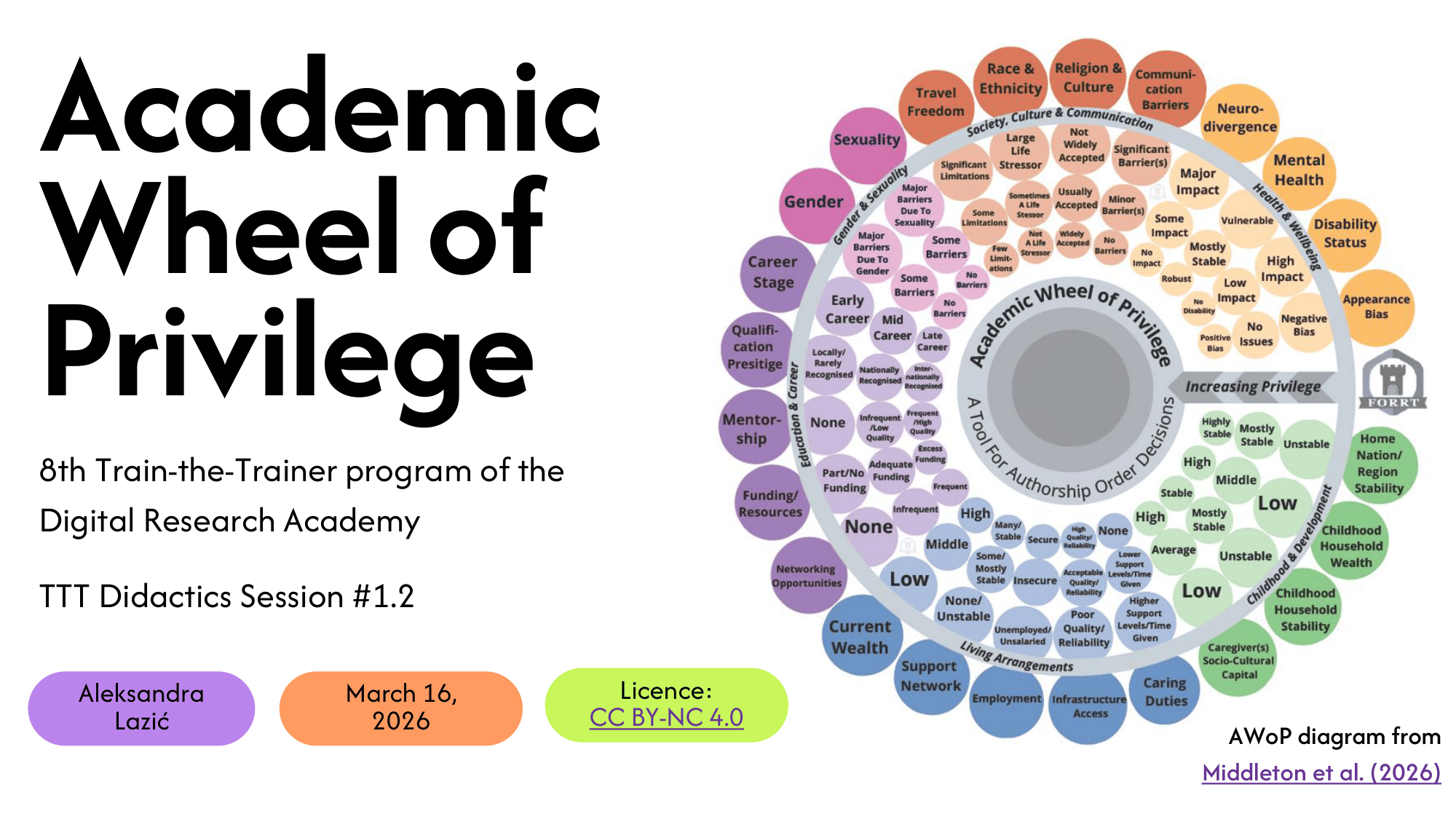
Completed Part 1 of the @digiresacademy's program, including delivering my very own session on the Academic Wheel of Privilege by @FORRT.

Full slides on Zenodo: doi.org/10.5281/zenodo.19055973

A bit more on LinkedIn: linkedin.com/posts/alelazic_aw

Grateful for the DRA community for creating this space. On to Part 2! 👀

Slide reading: Academic Wheel of Privilege 8th Train-the-Trainer program of the Digital Research Academy, TTT Didactics Session #1.2. Aleksandra Lazić, March 16, 2026. Licence: CC BY-NC 4.0. AWoP diagram from Middleton et al. (2026).
ALT text

Slide reading: Academic Wheel of Privilege 8th Train-the-Trainer program of the Digital Research Academy, TTT Didactics Session #1.2. Aleksandra Lazić, March 16, 2026. Licence: CC BY-NC 4.0. AWoP diagram from Middleton et al. (2026).

@alelazic@mastodon.social

Completed Part 1 of the @digiresacademy's program, including delivering my very own session on the Academic Wheel of Privilege by @FORRT.

Full slides on Zenodo: doi.org/10.5281/zenodo.19055973

A bit more on LinkedIn: linkedin.com/posts/alelazic_aw

Grateful for the DRA community for creating this space. On to Part 2! 👀

Slide reading: Academic Wheel of Privilege 8th Train-the-Trainer program of the Digital Research Academy, TTT Didactics Session #1.2. Aleksandra Lazić, March 16, 2026. Licence: CC BY-NC 4.0. AWoP diagram from Middleton et al. (2026).
ALT text

Slide reading: Academic Wheel of Privilege 8th Train-the-Trainer program of the Digital Research Academy, TTT Didactics Session #1.2. Aleksandra Lazić, March 16, 2026. Licence: CC BY-NC 4.0. AWoP diagram from Middleton et al. (2026).

@ZfdG@fedihum.org
@alelazic@mastodon.social
@Bibliothecaris@social.edu.nl

In 2020, we launched the Open Research Award with @oscgroningen, flipping the script on traditional awards by:
➡️ reducing bias
➡️ celebrating practices across disciplines
➡️ moving beyond winners-vs-losers competition.

We use a modified lottery to select 3 winners. Every team member of every eligible case study receives a certificate to recognize & reward their endeavour.

🎧 Curious about the story behind it? Stay tuned for our new Bites season!
rug.nl/research/openscience/po

podcast logo: open science bites
ALT text

podcast logo: open science bites

@Bibliothecaris@social.edu.nl

In 2020, we launched the Open Research Award with @oscgroningen, flipping the script on traditional awards by:
➡️ reducing bias
➡️ celebrating practices across disciplines
➡️ moving beyond winners-vs-losers competition.

We use a modified lottery to select 3 winners. Every team member of every eligible case study receives a certificate to recognize & reward their endeavour.

🎧 Curious about the story behind it? Stay tuned for our new Bites season!
rug.nl/research/openscience/po

podcast logo: open science bites
ALT text

podcast logo: open science bites

@gnuhealth@mastodon.social

Our health can not be in the hands of tech giants or proprietary code. That is why we have joined forces with @volla to deliver a sustainable, privacy oriented hardware and Free/Libre software platform for our health professionals and citizens in and around the world. Stay tuned! ❤️

A picture showing the Volla Tablet, both back and front sides, with the logo of MyGNUHealth Personal Health Record superimposed.
ALT text

A picture showing the Volla Tablet, both back and front sides, with the logo of MyGNUHealth Personal Health Record superimposed.

@FabMusacchio@mastodon.social · Reply to Fabrizio Musacchio

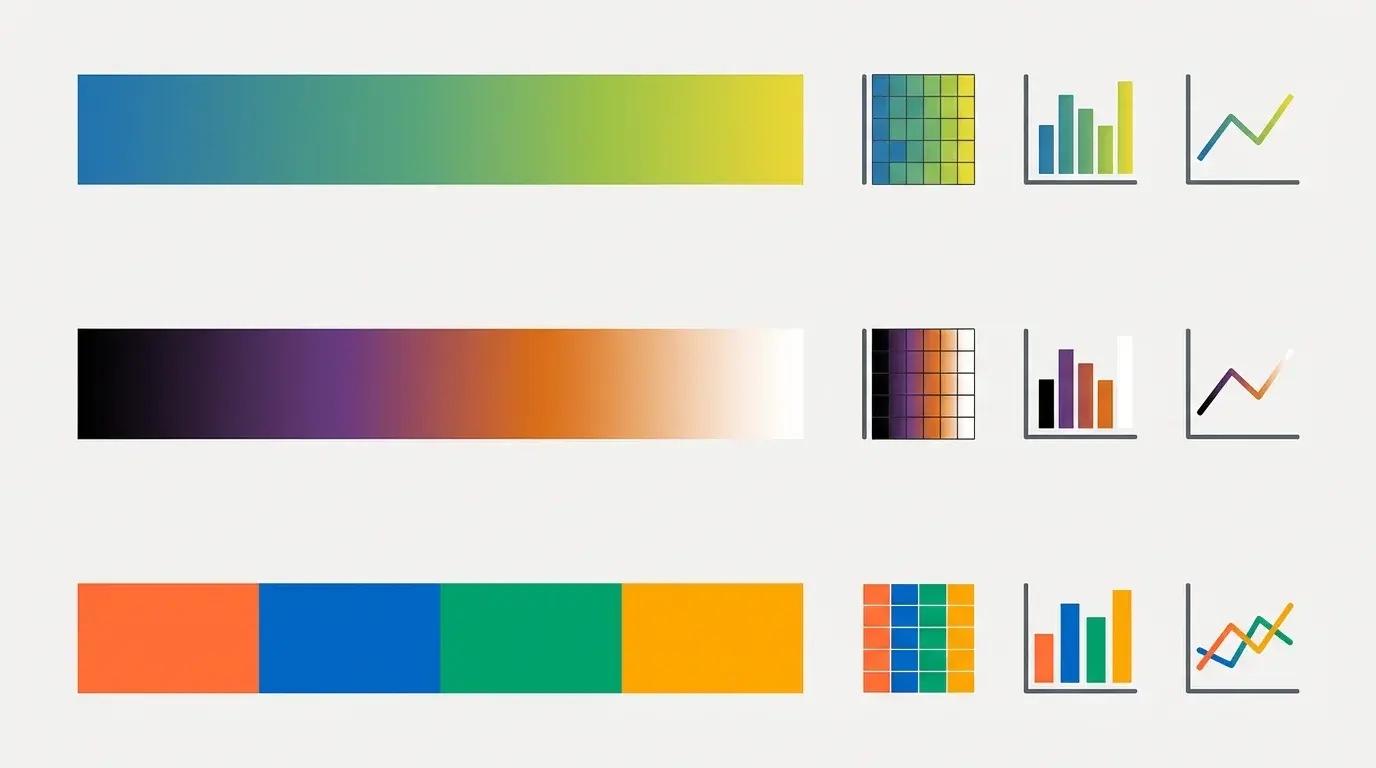
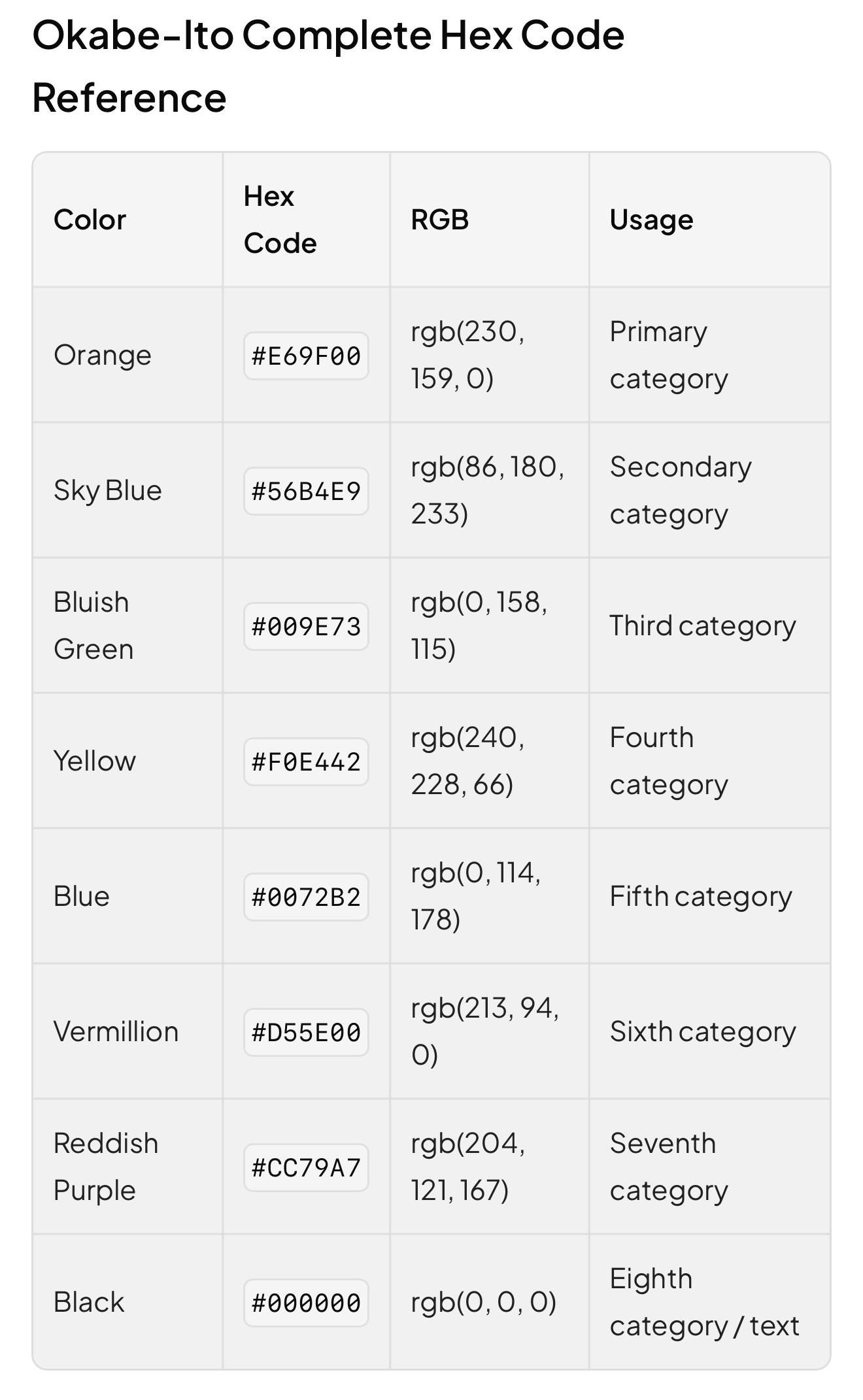
And just found this: 7 -Safe Color Palettes for Scientific Figures. Copy-paste , , Paul Tol & Wong palette . -friendly palettes recommended by Nature, with side-by-side comparisons and usage examples:

🌍 conceptviz.app/blog/scientific

@FabMusacchio@mastodon.social

📊 This paper by Crameri et al. from 2020 shows why choice in figures matters.

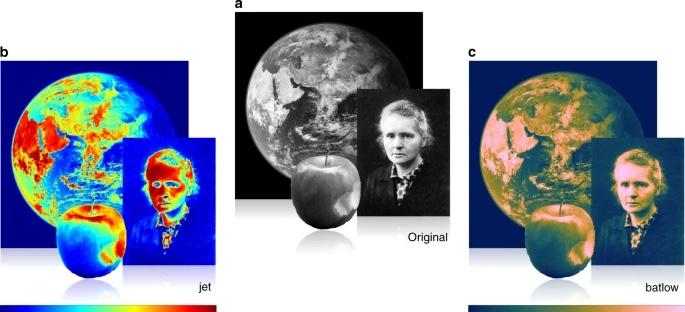
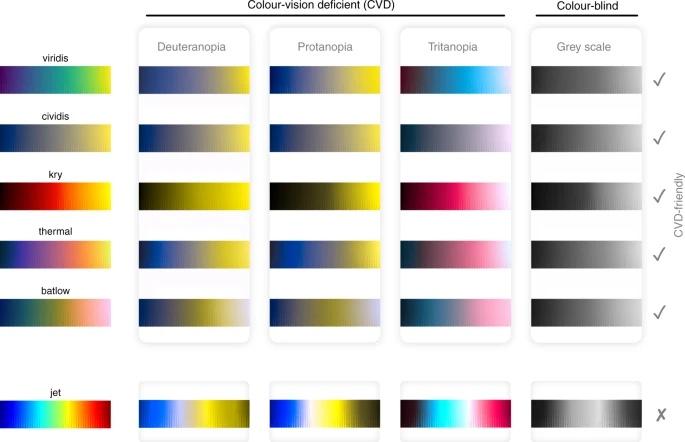
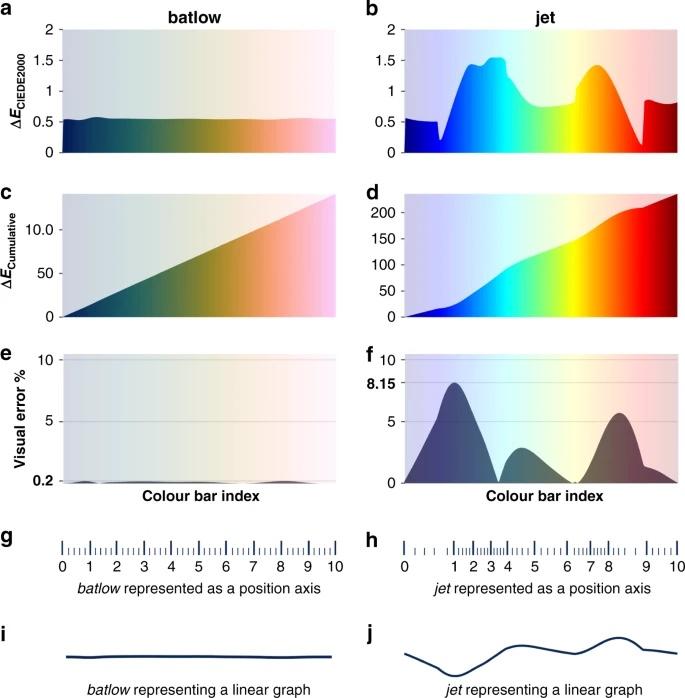
Rainbow 🌈 and red–green colormaps 🛑❇️ can distort gradients, create artificial boundaries, and exclude readers with color-vision deficiency. They quantify the visual error and argue for perceptually uniform, -friendly scientific colormaps instead.

📄 doi.org/10.1038/s41467-020-191

By knowing what something looks like in advance, the distortion by unscientific colour maps, like jet or rainbow, becomes instantly obvious. The look of scientific data is, however, usually unknown a priori, which makes the distortion of an unscientific colour map, and the true data representation of a scientifically derived colour map, like batlow41, less apparent. Marie Skłodowska-Curie, as originally photographed by Henri Manuel around 1920, the Earth from space, and an apple are shown a in their original images and b in distorted and c in undistorted colour versions. Inferring the true picture from an unscientifically (e.g., jet) coloured data set is incomparably harder than from a data set represented in a perceptually uniform and ordered colour map, like batlow.
ALT text

By knowing what something looks like in advance, the distortion by unscientific colour maps, like jet or rainbow, becomes instantly obvious. The look of scientific data is, however, usually unknown a priori, which makes the distortion of an unscientific colour map, and the true data representation of a scientifically derived colour map, like batlow41, less apparent. Marie Skłodowska-Curie, as originally photographed by Henri Manuel around 1920, the Earth from space, and an apple are shown a in their original images and b in distorted and c in undistorted colour versions. Inferring the true picture from an unscientifically (e.g., jet) coloured data set is incomparably harder than from a data set represented in a perceptually uniform and ordered colour map, like batlow.

Available perceptually uniform colour maps versus the non-uniform rainbow (i.e., jet; bottom row) as seen with either of the three common forms of human colour-vision deficiency (deuteranopia, protanopia, and tritanopia), and for grey-scale (representing total colour-blindness or simple black-and-white prints). Rainbow, the most-widely used colour map, fails to reproduce a meaningful smooth gradient, yet the other colour maps (see Box 2) are all universally readable.
ALT text

Available perceptually uniform colour maps versus the non-uniform rainbow (i.e., jet; bottom row) as seen with either of the three common forms of human colour-vision deficiency (deuteranopia, protanopia, and tritanopia), and for grey-scale (representing total colour-blindness or simple black-and-white prints). Rainbow, the most-widely used colour map, fails to reproduce a meaningful smooth gradient, yet the other colour maps (see Box 2) are all universally readable.

Fig. 3: Colour map measure, distortion, and error. a, b The incremental lightness difference, ΔE, here using the CIEDE2000 formulation (see ‘Methods’), is a measure for the perceptual colour difference along the colour map. For a perceptually uniform colour map, ΔECIEDE2000 should be equal all along the colour map (i.e., a flat graph; a). Using c, d the cumulative colour lightness difference, ΔECumulative, it is possible to extract e, f the resulting visual error in percentage of total data variation. For scientifically derived colour maps like batlow41, the resulting error introduced to the data by the colouring is negligibly small as g the incremental data variation is represented equally all along the axis, and a linear data gradient, therefore, appears linear. Put differently, i a flat line looks flat. For non-scientific colour maps, like jet, h data gradients are unevenly represented and f visual error can be >7% of the displayed data variation such that j a linear graph (e.g., a flat line), for example, becomes unrecognisable.
ALT text

Fig. 3: Colour map measure, distortion, and error. a, b The incremental lightness difference, ΔE, here using the CIEDE2000 formulation (see ‘Methods’), is a measure for the perceptual colour difference along the colour map. For a perceptually uniform colour map, ΔECIEDE2000 should be equal all along the colour map (i.e., a flat graph; a). Using c, d the cumulative colour lightness difference, ΔECumulative, it is possible to extract e, f the resulting visual error in percentage of total data variation. For scientifically derived colour maps like batlow41, the resulting error introduced to the data by the colouring is negligibly small as g the incremental data variation is represented equally all along the axis, and a linear data gradient, therefore, appears linear. Put differently, i a flat line looks flat. For non-scientific colour maps, like jet, h data gradients are unevenly represented and f visual error can be >7% of the displayed data variation such that j a linear graph (e.g., a flat line), for example, becomes unrecognisable.

@vam103@mathstodon.xyz

Well while the downside is everyone seeing my amateur coding if everyone else does this (you can already see it on nonpermanent repositories), this seems an overall win for science.

fediscience.org

PLOS Biology (@PLOSBiology@fediscience.org)

Attached: 1 image In support of #OpenScience, we routinely ask authors to openly share their #research #code before publication. We are now formalizing this practice with a mandatory #code-sharing policy and clarifying what we mean by code sharing. Useful to cut-out the box for future reference https://plos.io/47dPeOW

@PLOSBiology@fediscience.org

In support of , we routinely ask authors to openly share their before publication.

We are now formalizing this practice with a mandatory -sharing policy and clarifying what we mean by code sharing.

Useful to cut-out the box for future reference

plos.io/47dPeOW

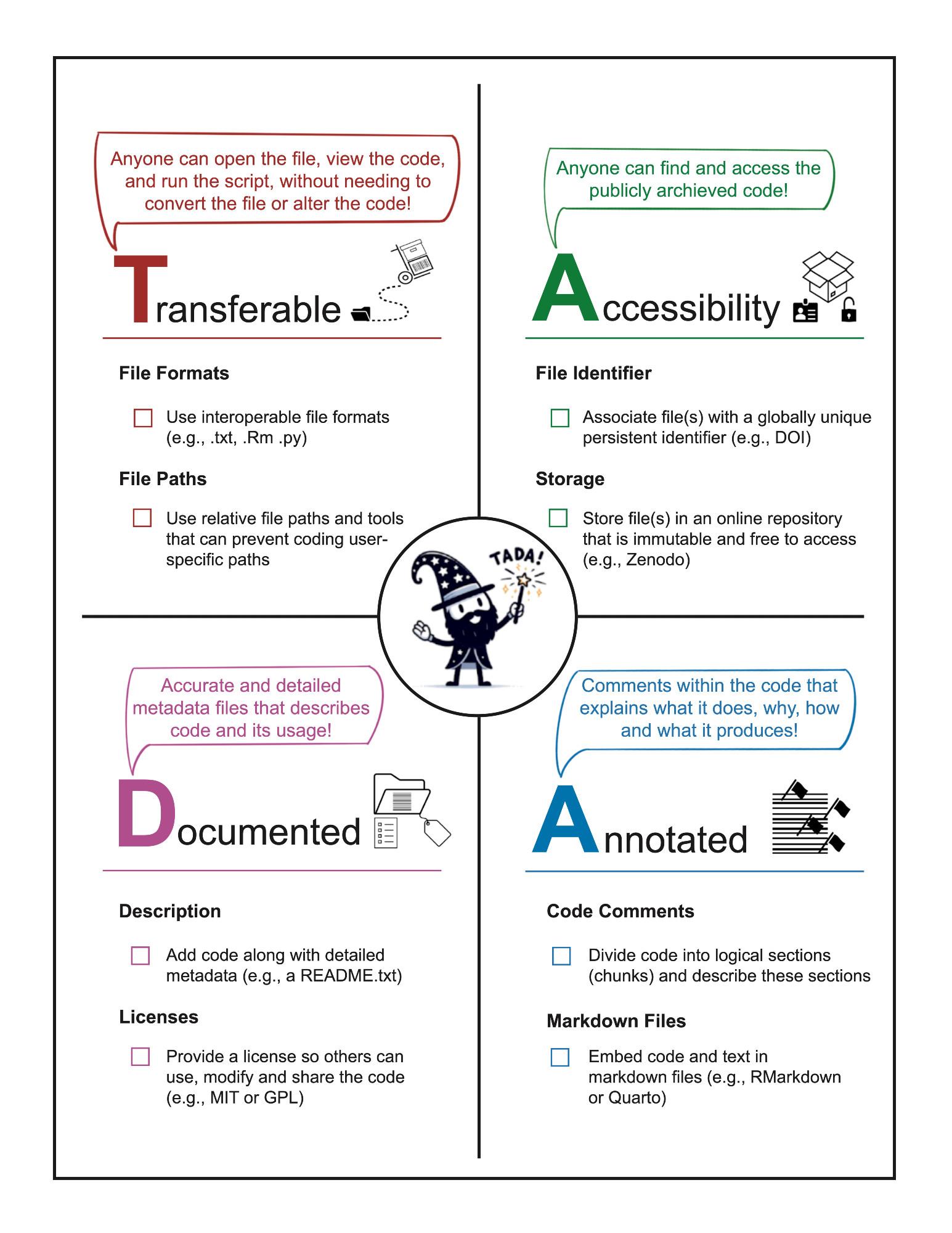
Details of PLOS Biology's mandatory code sharing policy
ALT text

Details of PLOS Biology's mandatory code sharing policy

Details of PLOS Biology's mandatory code sharing policy
ALT text

Details of PLOS Biology's mandatory code sharing policy

@gnuhealth@mastodon.social

Our health can not be in the hands of tech giants or proprietary code. That is why we have joined forces with @volla to deliver a sustainable, privacy oriented hardware and Free/Libre software platform for our health professionals and citizens in and around the world. Stay tuned! ❤️

A picture showing the Volla Tablet, both back and front sides, with the logo of MyGNUHealth Personal Health Record superimposed.
ALT text

A picture showing the Volla Tablet, both back and front sides, with the logo of MyGNUHealth Personal Health Record superimposed.

@fpianz@mstdn.social

Very interesting article!

"This article looks briefly at exclusive systems of knowledge production. I describe how the Open Science movement that was founded to reform science often recycles the same extractive dynamics of neoliberal capitalism described by dependency theory."

magazine.scienceforthepeople.o

magazine.scienceforthepeople.org

Rethinking Open Science • SftP Magazine

The Open Science movement promises inclusivity and better science but ignores the economic and political realities that shape research.

@fpianz@mstdn.social

Very interesting article!

"This article looks briefly at exclusive systems of knowledge production. I describe how the Open Science movement that was founded to reform science often recycles the same extractive dynamics of neoliberal capitalism described by dependency theory."

magazine.scienceforthepeople.o

magazine.scienceforthepeople.org

Rethinking Open Science • SftP Magazine

The Open Science movement promises inclusivity and better science but ignores the economic and political realities that shape research.

@jeremy@mapstodon.space

⚠️ Call for participation ⚠️

If you are an archaeologist working with , I'd be super grateful if you dedicate 15 minutes of your time to answer this survey.

It's part of my research and will bring a clearer picture of how archaeologists use 3D tools and data.

▶️ forms.mapper.space/?r=junarka_

Here's a resume of my PhD project: journals.openedition.org/pm/44

Sharing is caring! Thank you!

cc @CAAfr @CAA_int @splutniak

journals.openedition.org

Digital twins and geospatial 3D on the web for archaeological resea...

1. Introduction 1.1 Geospatial 3D and digital twins in archaeology Over the last fifty years, archaeology has been transformed by the digitization of its tools and methods. In the field, the digiti...

@jeremy@mapstodon.space

While waiting to distribute it to specific lists, here is a Fediverse call to archaeologists and related professions to respond to my PhD research survey on archaeologists' use of , with a focus on geospatial data.

It will only take 10 to 15 minutes and can be found here: forms.mapper.space/?r=junarka_

Thanks in advance for sharing and participating!

(See journals.openedition.org/pm/44 for a more complete presentation of my PhD project)

journals.openedition.org

Digital twins and geospatial 3D on the web for archaeological resea...

1. Introduction 1.1 Geospatial 3D and digital twins in archaeology Over the last fifty years, archaeology has been transformed by the digitization of its tools and methods. In the field, the digiti...

@egonw@social.edu.nl · Reply to Egon Willighagen
@smallcircles@social.coop
@ReproducibiliTeaGlobal@scicomm.xyz

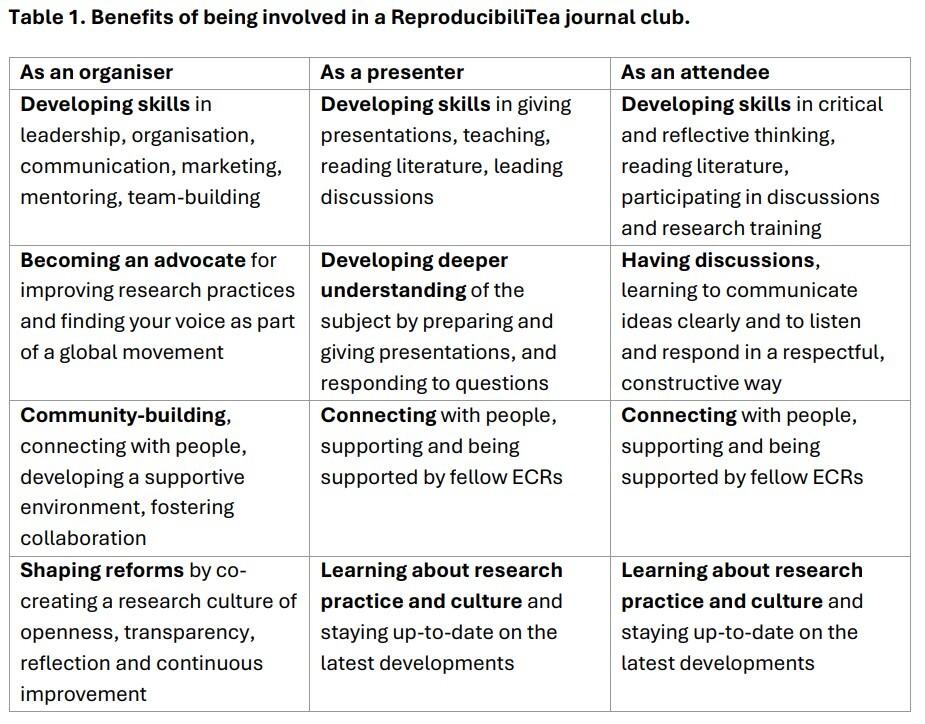
📢 New preprint! Ten Simple Rules for Running a ReproducibiliTea Journal Club

The idea of ReproducibiliTea is simple: Get a group of aspiring early career researchers (ECRs) together, drink tea, and critically discuss issues surrounding reproducibility, open research, and academic culture. But how do you even get started? How do you engage people? How do you balance logistics and inspiration?

In our paper, we as past and present members of the ReproducibiliTea Global Steering Committee have drawn on our experience and that of our wider network to offer you 10 simple rules for organising a ReproducibiliTea journal club. Our aim is to equip you as an ECR with the tools needed to lead grassroots change in research culture. Whether you are launching your first meeting or sustaining a long-running JC, these rules are designed to help you brew a welcoming, impactful, and inspired community – one cup of tea at a time.🍵

Check out the preprint on MetaArXiv: doi.org/10.31222/osf.io/swg38_

Lianne Wolsink, Paulina Manduch, Abigail Licata, Hazel Aileen van der Walle, @VornhagenJB, Hemani Sharma, @will_ngiam, Michael Muhoozi, Anastasiia Marmyleva, Matt Jaquiery, @cruwell, @helenagellersen
with special thanks to the ReproducibiliTea community✨

Benefits of being involved in a ReproducibiliTea journal club
ALT text

Benefits of being involved in a ReproducibiliTea journal club

@ReproducibiliTeaGlobal@scicomm.xyz

📢 New preprint! Ten Simple Rules for Running a ReproducibiliTea Journal Club

The idea of ReproducibiliTea is simple: Get a group of aspiring early career researchers (ECRs) together, drink tea, and critically discuss issues surrounding reproducibility, open research, and academic culture. But how do you even get started? How do you engage people? How do you balance logistics and inspiration?

In our paper, we as past and present members of the ReproducibiliTea Global Steering Committee have drawn on our experience and that of our wider network to offer you 10 simple rules for organising a ReproducibiliTea journal club. Our aim is to equip you as an ECR with the tools needed to lead grassroots change in research culture. Whether you are launching your first meeting or sustaining a long-running JC, these rules are designed to help you brew a welcoming, impactful, and inspired community – one cup of tea at a time.🍵

Check out the preprint on MetaArXiv: doi.org/10.31222/osf.io/swg38_

Lianne Wolsink, Paulina Manduch, Abigail Licata, Hazel Aileen van der Walle, @VornhagenJB, Hemani Sharma, @will_ngiam, Michael Muhoozi, Anastasiia Marmyleva, Matt Jaquiery, @cruwell, @helenagellersen
with special thanks to the ReproducibiliTea community✨

Benefits of being involved in a ReproducibiliTea journal club
ALT text

Benefits of being involved in a ReproducibiliTea journal club

@curioss@fosstodon.org

Fantastic news from @swheritage that the Software Hash Identifier (SWHID) is now an ISO/IEC international standard – ISO/IEC 18670!

Last year, members attended a wonderful Deep Dive with @rdicosmo and @moranegg where they discussed the differences between intrinsic and extrinsic .

A huge congratulations to everyone involved!

📺Deep Dive on software identifiers: bit.ly/4hM2ezl

youtube.com

CURIOSS Deep Dive: An Introduction to Software Identifers

Session OverviewRoberto Di Cosmo and Morane Gruenpeter of Software Heritage discuss the key concepts relating to software identifiers in academia and also ex...

@ACM@mastodon.acm.org

Happy New Year! As of January 1, 2026, all ACM publications and related artifacts in the ACM Digital Library are now open access, making computing research more accessible, discoverable, and reusable worldwide.

“This is a truly monumental milestone,” said ACM President Yannis Ioannidis, marking a new era for the global computing community.

Explore ACM’s open access journey:
👉 acm.org/publications/openaccess

@smallcircles@social.coop

Read about by @jfietkau and plans to bring more to our

discuss.coding.social/t/my-cur

There are multiple other projects that share interests to connect more tightly the academic world to the .

Backed by @nlnet funding there is the very promising @bonfire and in earlier rounds (, not fedi).

We should align on

encyclia.pub
bonfirenetworks.org
plaudit.pub

plaudit.pub

Plaudit · Open endorsements from the academic community

Plaudit

@smallcircles@social.coop

Read about by @jfietkau and plans to bring more to our

discuss.coding.social/t/my-cur

There are multiple other projects that share interests to connect more tightly the academic world to the .

Backed by @nlnet funding there is the very promising @bonfire and in earlier rounds (, not fedi).

We should align on

encyclia.pub
bonfirenetworks.org
plaudit.pub

plaudit.pub

Plaudit · Open endorsements from the academic community

Plaudit

@smallcircles@social.coop

Read about by @jfietkau and plans to bring more to our

discuss.coding.social/t/my-cur

There are multiple other projects that share interests to connect more tightly the academic world to the .

Backed by @nlnet funding there is the very promising @bonfire and in earlier rounds (, not fedi).

We should align on

encyclia.pub
bonfirenetworks.org
plaudit.pub

plaudit.pub

Plaudit · Open endorsements from the academic community

Plaudit

@smallcircles@social.coop

Read about by @jfietkau and plans to bring more to our

discuss.coding.social/t/my-cur

There are multiple other projects that share interests to connect more tightly the academic world to the .

Backed by @nlnet funding there is the very promising @bonfire and in earlier rounds (, not fedi).

We should align on

encyclia.pub
bonfirenetworks.org
plaudit.pub

plaudit.pub

Plaudit · Open endorsements from the academic community

Plaudit

@alelazic@mastodon.social

Blogs deserve love too (and interoperability) ❤️

I just learned about Rogue Scholar @rogue_scholar, a repository that makes science blogs more findable and citable: full-text search, long-term archiving, DOIs, metadata...

You can register your blog and search ~200 blogs already there.

Learn more about Rogue Scholar here: rogue-scholar.org/

And I wrote a bit more at linkedin.com/posts/alelazic_ro

Screenshot showing The Rogue Scholar logo. The text in larger font says "Science blogging on steroids". Below it, in smaller font, it says "The Rogue Scholar improves your science blog in important ways, including full-text search, long-term archiving, DOIs and metadata."
ALT text

Screenshot showing The Rogue Scholar logo. The text in larger font says "Science blogging on steroids". Below it, in smaller font, it says "The Rogue Scholar improves your science blog in important ways, including full-text search, long-term archiving, DOIs and metadata."

@alelazic@mastodon.social

Blogs deserve love too (and interoperability) ❤️

I just learned about Rogue Scholar @rogue_scholar, a repository that makes science blogs more findable and citable: full-text search, long-term archiving, DOIs, metadata...

You can register your blog and search ~200 blogs already there.

Learn more about Rogue Scholar here: rogue-scholar.org/

And I wrote a bit more at linkedin.com/posts/alelazic_ro

Screenshot showing The Rogue Scholar logo. The text in larger font says "Science blogging on steroids". Below it, in smaller font, it says "The Rogue Scholar improves your science blog in important ways, including full-text search, long-term archiving, DOIs and metadata."
ALT text

Screenshot showing The Rogue Scholar logo. The text in larger font says "Science blogging on steroids". Below it, in smaller font, it says "The Rogue Scholar improves your science blog in important ways, including full-text search, long-term archiving, DOIs and metadata."

@fresseng@universites.social

Only nine days left to find only 574€ to secure the first stone of a new home for open science: the Open Science Network is built on Bonfire... which is so close to its first goal.

openscience.network/

Be the one who crosses the line to the first federated open infrastructure designed for hosting scientific discourse : indiegogo.com/projects/bonfire


@bonfire@indieweb.social

Do you want to help people escape Big Tech and join the open social web? We need help to boost the Bonfire campaign. With momentum is on our side, but most people stuck on enshitified platforms only see content from people still active there.

If that's you, pick a template below (or write your own) and post it anywhere you have reach: Facebook (incl groups), LinkedIn, Twitter, email lists, Slack/Discord. Every share brings us closer to an open community‑governed internet. Thanks!

@fresseng@universites.social

Only nine days left to find only 574€ to secure the first stone of a new home for open science: the Open Science Network is built on Bonfire... which is so close to its first goal.

openscience.network/

Be the one who crosses the line to the first federated open infrastructure designed for hosting scientific discourse : indiegogo.com/projects/bonfire


@bonfire@indieweb.social

Do you want to help people escape Big Tech and join the open social web? We need help to boost the Bonfire campaign. With momentum is on our side, but most people stuck on enshitified platforms only see content from people still active there.

If that's you, pick a template below (or write your own) and post it anywhere you have reach: Facebook (incl groups), LinkedIn, Twitter, email lists, Slack/Discord. Every share brings us closer to an open community‑governed internet. Thanks!

@fresseng@universites.social

Only nine days left to find only 574€ to secure the first stone of a new home for open science: the Open Science Network is built on Bonfire... which is so close to its first goal.

openscience.network/

Be the one who crosses the line to the first federated open infrastructure designed for hosting scientific discourse : indiegogo.com/projects/bonfire


@bonfire@indieweb.social

Do you want to help people escape Big Tech and join the open social web? We need help to boost the Bonfire campaign. With momentum is on our side, but most people stuck on enshitified platforms only see content from people still active there.

If that's you, pick a template below (or write your own) and post it anywhere you have reach: Facebook (incl groups), LinkedIn, Twitter, email lists, Slack/Discord. Every share brings us closer to an open community‑governed internet. Thanks!

@alelazic@mastodon.social

Stumbled upon the TRUST project (2015-2018) globalcodeofconduct.org/ which worked on countering "ethics dumping" and promoting equitable global research partnerships.

Open Access Book: doi.org/10.1007/978-3-030-1574

Code on Fairness, Respect, Care, & Honesty: globalcodeofconduct.org/wp-con

Curious if anyone has thoughts or has applied these in practice.

Side-by-side covers of two TRUST Project publications: the book Equitable Research Partnerships: A Global Code of Conduct to Counter Ethics Dumping and The TRUST Code: A Global Code of Conduct for Equitable Research Partnerships, featuring abstract illustrations and the TRUST logo.
ALT text

Side-by-side covers of two TRUST Project publications: the book Equitable Research Partnerships: A Global Code of Conduct to Counter Ethics Dumping and The TRUST Code: A Global Code of Conduct for Equitable Research Partnerships, featuring abstract illustrations and the TRUST logo.

@alelazic@mastodon.social

Stumbled upon the TRUST project (2015-2018) globalcodeofconduct.org/ which worked on countering "ethics dumping" and promoting equitable global research partnerships.

Open Access Book: doi.org/10.1007/978-3-030-1574

Code on Fairness, Respect, Care, & Honesty: globalcodeofconduct.org/wp-con

Curious if anyone has thoughts or has applied these in practice.

Side-by-side covers of two TRUST Project publications: the book Equitable Research Partnerships: A Global Code of Conduct to Counter Ethics Dumping and The TRUST Code: A Global Code of Conduct for Equitable Research Partnerships, featuring abstract illustrations and the TRUST logo.
ALT text

Side-by-side covers of two TRUST Project publications: the book Equitable Research Partnerships: A Global Code of Conduct to Counter Ethics Dumping and The TRUST Code: A Global Code of Conduct for Equitable Research Partnerships, featuring abstract illustrations and the TRUST logo.

@WaardRichard@social.edu.nl
@Bibliothecaris@social.edu.nl

🥳 Say goodbye to - we've launched our official channel on !

🔗 Find (and follow) us here: video.edu.nl/c/bibliothecaris_

We're in the early stages, so expect more videos, refined descriptions, and fine-tuning coming soon.

A big thank you to @SURF for making this possible. This is an exciting step for us 🚀

video.edu.nl

University of Groningen Library

Videos from the University of Groningen Library // Video's van de Universiteitsbibliotheek Groningen

@ouvrirlascience@social.numerique.gouv.fr

Nature publie un commentaire intéressant sur les logiciels de recherche, appelant à enregistrer, partager et valoriser les logiciels produits par la recherche. Le texte propose d’adapter les , conçus pour les données, aux spécificités du logiciel, en enrichissant les principes FAIR4RS (FAIR for research software).

ouvrirlascience.fr/depasser-le

Image qui annonce la publication par nature d' un commentaire intéressant sur les logiciels de recherche, appelant à enregistrer, partager et valoriser les logiciels produits par la recherche.
ALT text

Image qui annonce la publication par nature d' un commentaire intéressant sur les logiciels de recherche, appelant à enregistrer, partager et valoriser les logiciels produits par la recherche.

@ouvrirlascience@social.numerique.gouv.fr

Nature publie un commentaire intéressant sur les logiciels de recherche, appelant à enregistrer, partager et valoriser les logiciels produits par la recherche. Le texte propose d’adapter les , conçus pour les données, aux spécificités du logiciel, en enrichissant les principes FAIR4RS (FAIR for research software).

ouvrirlascience.fr/depasser-le

Image qui annonce la publication par nature d' un commentaire intéressant sur les logiciels de recherche, appelant à enregistrer, partager et valoriser les logiciels produits par la recherche.
ALT text

Image qui annonce la publication par nature d' un commentaire intéressant sur les logiciels de recherche, appelant à enregistrer, partager et valoriser les logiciels produits par la recherche.

@fresseng@universites.social

Joining a new instance, posting a new .

After three years in the Fediverse, including two wonderful years at fediscience.org, I’m joining the first French instance that is both dedicated to and hosted by the academic community.

Academic and physicist, I also dabble in politics.

I will be posting about ... and

fediscience.org

FediScience.org

fediscience.org is a social network for scientists run by FediScience e.V., an international association dedicated to promoting scientific communication.

@Bibliothecaris@social.edu.nl

🥳 Say goodbye to - we've launched our official channel on !

🔗 Find (and follow) us here: video.edu.nl/c/bibliothecaris_

We're in the early stages, so expect more videos, refined descriptions, and fine-tuning coming soon.

A big thank you to @SURF for making this possible. This is an exciting step for us 🚀

video.edu.nl

University of Groningen Library

Videos from the University of Groningen Library // Video's van de Universiteitsbibliotheek Groningen

@Bibliothecaris@social.edu.nl

🥳 Say goodbye to - we've launched our official channel on !

🔗 Find (and follow) us here: video.edu.nl/c/bibliothecaris_

We're in the early stages, so expect more videos, refined descriptions, and fine-tuning coming soon.

A big thank you to @SURF for making this possible. This is an exciting step for us 🚀

video.edu.nl

University of Groningen Library

Videos from the University of Groningen Library // Video's van de Universiteitsbibliotheek Groningen

@Bibliothecaris@social.edu.nl

🥳 Say goodbye to - we've launched our official channel on !

🔗 Find (and follow) us here: video.edu.nl/c/bibliothecaris_

We're in the early stages, so expect more videos, refined descriptions, and fine-tuning coming soon.

A big thank you to @SURF for making this possible. This is an exciting step for us 🚀

video.edu.nl

University of Groningen Library

Videos from the University of Groningen Library // Video's van de Universiteitsbibliotheek Groningen

@Bibliothecaris@social.edu.nl

🥳 Say goodbye to - we've launched our official channel on !

🔗 Find (and follow) us here: video.edu.nl/c/bibliothecaris_

We're in the early stages, so expect more videos, refined descriptions, and fine-tuning coming soon.

A big thank you to @SURF for making this possible. This is an exciting step for us 🚀

video.edu.nl

University of Groningen Library

Videos from the University of Groningen Library // Video's van de Universiteitsbibliotheek Groningen

@Bibliothecaris@social.edu.nl

🥳 Say goodbye to - we've launched our official channel on !

🔗 Find (and follow) us here: video.edu.nl/c/bibliothecaris_

We're in the early stages, so expect more videos, refined descriptions, and fine-tuning coming soon.

A big thank you to @SURF for making this possible. This is an exciting step for us 🚀

video.edu.nl

University of Groningen Library

Videos from the University of Groningen Library // Video's van de Universiteitsbibliotheek Groningen

@Bibliothecaris@social.edu.nl

🥳 Say goodbye to - we've launched our official channel on !

🔗 Find (and follow) us here: video.edu.nl/c/bibliothecaris_

We're in the early stages, so expect more videos, refined descriptions, and fine-tuning coming soon.

A big thank you to @SURF for making this possible. This is an exciting step for us 🚀

video.edu.nl

University of Groningen Library

Videos from the University of Groningen Library // Video's van de Universiteitsbibliotheek Groningen

@pampel@openbiblio.social

New post on our research group’s blog: “Workshop Report: Resilience in Times of Crisis—Strengthening Against Geopolitical Pressures,” by Laura Rothfritz and Dorothea Strecker.

doi.org/10.59350/js8da-36a98

cc: @IBI_HU , @dorothearrr, @ztirfhtor

doi.org

Workshop Report: Resilience in Times of Crisis - Strengthening Open Science Against Geopolitical Pressures – Research Group Information Management @ Humboldt-Universität zu Berlin

@pierre@universites.social

Très content d’avoir pu parler de notre instance , de @bonfire et de l’initiative en perspectives durant notre assemblée générale @unif d’hiver.

J’espère que certains de nos établissements membres ou de nos partenaires publics nous demanderons de nous impliquer plus dans ce futur de la recherche scientifique !

Photo prise dans la salle du Sénat de l’université Paris Cité, reconnaissable à ses tentures. Je tiens le micro à gauche et sur la droite se trouvent à La Tribune le directeur de l’UNIF, Dominique Bascle et Gilles Roussel président de son assemblée général. L’écran au dessus d’eux affiche une page de présentation où l’on reconnaît en bas à droite le logo de bonfire.
ALT text

Photo prise dans la salle du Sénat de l’université Paris Cité, reconnaissable à ses tentures. Je tiens le micro à gauche et sur la droite se trouvent à La Tribune le directeur de l’UNIF, Dominique Bascle et Gilles Roussel président de son assemblée général. L’écran au dessus d’eux affiche une page de présentation où l’on reconnaît en bas à droite le logo de bonfire.

@pierre@universites.social

Très content d’avoir pu parler de notre instance , de @bonfire et de l’initiative en perspectives durant notre assemblée générale @unif d’hiver.

J’espère que certains de nos établissements membres ou de nos partenaires publics nous demanderons de nous impliquer plus dans ce futur de la recherche scientifique !

Photo prise dans la salle du Sénat de l’université Paris Cité, reconnaissable à ses tentures. Je tiens le micro à gauche et sur la droite se trouvent à La Tribune le directeur de l’UNIF, Dominique Bascle et Gilles Roussel président de son assemblée général. L’écran au dessus d’eux affiche une page de présentation où l’on reconnaît en bas à droite le logo de bonfire.
ALT text

Photo prise dans la salle du Sénat de l’université Paris Cité, reconnaissable à ses tentures. Je tiens le micro à gauche et sur la droite se trouvent à La Tribune le directeur de l’UNIF, Dominique Bascle et Gilles Roussel président de son assemblée général. L’écran au dessus d’eux affiche une page de présentation où l’on reconnaît en bas à droite le logo de bonfire.

@pierre@universites.social

Très content d’avoir pu parler de notre instance , de @bonfire et de l’initiative en perspectives durant notre assemblée générale @unif d’hiver.

J’espère que certains de nos établissements membres ou de nos partenaires publics nous demanderons de nous impliquer plus dans ce futur de la recherche scientifique !

Photo prise dans la salle du Sénat de l’université Paris Cité, reconnaissable à ses tentures. Je tiens le micro à gauche et sur la droite se trouvent à La Tribune le directeur de l’UNIF, Dominique Bascle et Gilles Roussel président de son assemblée général. L’écran au dessus d’eux affiche une page de présentation où l’on reconnaît en bas à droite le logo de bonfire.
ALT text

Photo prise dans la salle du Sénat de l’université Paris Cité, reconnaissable à ses tentures. Je tiens le micro à gauche et sur la droite se trouvent à La Tribune le directeur de l’UNIF, Dominique Bascle et Gilles Roussel président de son assemblée général. L’écran au dessus d’eux affiche une page de présentation où l’on reconnaît en bas à droite le logo de bonfire.

@pampel@openbiblio.social

New post on our research group’s blog: “Workshop Report: Resilience in Times of Crisis—Strengthening Against Geopolitical Pressures,” by Laura Rothfritz and Dorothea Strecker.

doi.org/10.59350/js8da-36a98

cc: @IBI_HU , @dorothearrr, @ztirfhtor

doi.org

Workshop Report: Resilience in Times of Crisis - Strengthening Open Science Against Geopolitical Pressures – Research Group Information Management @ Humboldt-Universität zu Berlin

@bonfire@indieweb.social · Reply to nb

@nb

Thanks for your interest in Bonfire and the flavour! We'd like to clarify a few things to clear up any confusion:

- ORCID authentication is optional: it's only active if the instance operator chooses to enable it by adding an ORCID API key.
- Uses open standards: the integration uses OpenID Connect / OAuth2, just like most modern federated login systems.
- Operators have other choices: any SSO provider can be added, including adding multiple providers side by side.

1/2

@nb@social.biblioco.de
I have been following the developments of the @bonfire #Fediverse software for some time now, particularly their #OpenScience extension, because I see it as a future manifestation of open, interactive, publication-based #SciComm on the #Fediverse: http://openscience.network

A few days ago the first pilot was presented that is also self-hostable: https://openscience.network/setup/
However, looking at its current state, I can only take that achievement with a grain of salt.

One of the reasons why the Fediverse is so independent and resistant to central takeovers is because it does not rely on global identity service providers. This is precisely what sets it apart from other #BigTech platforms, as well as Bluesky. However, regarding the development of the Bonfire Open Science flavour, it has become apparent over the past few years that the Bonfire developers are increasingly taking a #ORCID-centric approach. The current pilot, which has now been released, even enforces the use of ORCID, including the self-hosted version. This means that users are forced to use ORCID in order to create an account.

ORCID is a global centralized identity provider that relies entirely on the infrastructure and services of US #Hyperscalers. Anyone who gets involved with ORCID submits to them being the single point of failure with all its consequences, similar to #Cloudflare (btw. guess which provider orcid.org runs on), and that is exactly the opposite of what decentralized networks are about. The organization behind ORCID is also supported by some of those big publishers, who ultimately were the reason why there had to be a counter-movement in the first place, which we now call Open Science.

Anyone who integrates providers such as ORCID into decentralized technologies is probably letting #BigTech in through the back door. #Scholia, which is based on #WikiData, offers a reasonable alternative to ORCID. Its technical infrastructure is independent from big cloud providers, large publishers cannot buy their way into its community, and it even discloses the code for its platform itself.

There is nothing wrong with having an optional feature for importing data from ORCID. However, I find it highly questionable to make user registration dependent on this service provider. I hope that in the future, attention will once again be turned to local SSO authentication services, good old-fashioned email registration, and ORCID integration will become optional.

#Hyperscaler #Centralization #Science #Bonfire


social.biblioco.de

social.biblioco.de

@jeremy@mapstodon.space

⚠️ Call for participation ⚠️

If you are an archaeologist working with , I'd be super grateful if you dedicate 15 minutes of your time to answer this survey.

It's part of my research and will bring a clearer picture of how archaeologists use 3D tools and data.

▶️ forms.mapper.space/?r=junarka_

Here's a resume of my PhD project: journals.openedition.org/pm/44

Sharing is caring! Thank you!

cc @CAAfr @CAA_int @splutniak

journals.openedition.org

Digital twins and geospatial 3D on the web for archaeological resea...

1. Introduction 1.1 Geospatial 3D and digital twins in archaeology Over the last fifty years, archaeology has been transformed by the digitization of its tools and methods. In the field, the digiti...

@jeremy@mapstodon.space

While waiting to distribute it to specific lists, here is a Fediverse call to archaeologists and related professions to respond to my PhD research survey on archaeologists' use of , with a focus on geospatial data.

It will only take 10 to 15 minutes and can be found here: forms.mapper.space/?r=junarka_

Thanks in advance for sharing and participating!

(See journals.openedition.org/pm/44 for a more complete presentation of my PhD project)

journals.openedition.org

Digital twins and geospatial 3D on the web for archaeological resea...

1. Introduction 1.1 Geospatial 3D and digital twins in archaeology Over the last fifty years, archaeology has been transformed by the digitization of its tools and methods. In the field, the digiti...

@jeremy@mapstodon.space

⚠️ Call for participation ⚠️

If you are an archaeologist working with , I'd be super grateful if you dedicate 15 minutes of your time to answer this survey.

It's part of my research and will bring a clearer picture of how archaeologists use 3D tools and data.

▶️ forms.mapper.space/?r=junarka_

Here's a resume of my PhD project: journals.openedition.org/pm/44

Sharing is caring! Thank you!

cc @CAAfr @CAA_int @splutniak

journals.openedition.org

Digital twins and geospatial 3D on the web for archaeological resea...

1. Introduction 1.1 Geospatial 3D and digital twins in archaeology Over the last fifty years, archaeology has been transformed by the digitization of its tools and methods. In the field, the digiti...

@jeremy@mapstodon.space

While waiting to distribute it to specific lists, here is a Fediverse call to archaeologists and related professions to respond to my PhD research survey on archaeologists' use of , with a focus on geospatial data.

It will only take 10 to 15 minutes and can be found here: forms.mapper.space/?r=junarka_

Thanks in advance for sharing and participating!

(See journals.openedition.org/pm/44 for a more complete presentation of my PhD project)

journals.openedition.org

Digital twins and geospatial 3D on the web for archaeological resea...

1. Introduction 1.1 Geospatial 3D and digital twins in archaeology Over the last fifty years, archaeology has been transformed by the digitization of its tools and methods. In the field, the digiti...

@jeremy@mapstodon.space

Pretty excited by @bonfire, especially by the Open Science flavor (see openscience.network). The project in general also seems to be well thought out, in terms of roadmap or governance (putting maintenance first in the roadmap and making it strongly visible = 👏).

Congrats to the team for the release and good luck for the next steps!

(Edit: there's Ursula K. Le Guin in the crowdfunding campaign trailer, also, so you definitely should watch it)

openscience.network

Open Science Network

Reclaim scientific discourse with federated digital spaces where researchers shape their own conversations, data, and collaborations

@bonfire@indieweb.social

Bonfire Social 1.0 is live! A federated, community‑first social network built on the modular Bonfire toolkit, and it’s only the beginning.


It's time to go beyond microblogging and build apps for community organising, open science, mutual aid, and collective decision‑making. Let's take back the internet with open protocols, consent‑based governance, and portability by design.

Back the “last migration” from closed platforms to open networks: indiegogo.com/projects/bonfire

1/2

Screenshot of Bonfire Social
ALT text

Screenshot of Bonfire Social

@jeremy@mapstodon.space

Pretty excited by @bonfire, especially by the Open Science flavor (see openscience.network). The project in general also seems to be well thought out, in terms of roadmap or governance (putting maintenance first in the roadmap and making it strongly visible = 👏).

Congrats to the team for the release and good luck for the next steps!

(Edit: there's Ursula K. Le Guin in the crowdfunding campaign trailer, also, so you definitely should watch it)

openscience.network

Open Science Network

Reclaim scientific discourse with federated digital spaces where researchers shape their own conversations, data, and collaborations

@bonfire@indieweb.social

Bonfire Social 1.0 is live! A federated, community‑first social network built on the modular Bonfire toolkit, and it’s only the beginning.

It's time to go beyond microblogging and build apps for community organising, open science, mutual aid, and collective decision‑making. Let's take back the internet with open protocols, consent‑based governance, and portability by design.

Back the “last migration” from closed platforms to open networks: indiegogo.com/projects/bonfire

1/2

Screenshot of Bonfire Social
ALT text

Screenshot of Bonfire Social

@jeremy@mapstodon.space

Pretty excited by @bonfire, especially by the Open Science flavor (see openscience.network). The project in general also seems to be well thought out, in terms of roadmap or governance (putting maintenance first in the roadmap and making it strongly visible = 👏).

Congrats to the team for the release and good luck for the next steps!

(Edit: there's Ursula K. Le Guin in the crowdfunding campaign trailer, also, so you definitely should watch it)

openscience.network

Open Science Network

Reclaim scientific discourse with federated digital spaces where researchers shape their own conversations, data, and collaborations

@bonfire@indieweb.social

Bonfire Social 1.0 is live! A federated, community‑first social network built on the modular Bonfire toolkit, and it’s only the beginning.

It's time to go beyond microblogging and build apps for community organising, open science, mutual aid, and collective decision‑making. Let's take back the internet with open protocols, consent‑based governance, and portability by design.

Back the “last migration” from closed platforms to open networks: indiegogo.com/projects/bonfire

1/2

Screenshot of Bonfire Social
ALT text

Screenshot of Bonfire Social

@smallcircles@social.coop · Reply to Sciety

@sciety @bonfire

Love it, congratulations! 😍

There are a number of related initiatives underway on the fedi, some supported by @ngi @nlnet funding, which is great.

To avoid the pitfall of protocol decay on the app-centric , coordination between these is necessary. So at coding.social we started a commons collective to discuss various cross-project concerns in a quest for alignment. Check out:

discuss.coding.social/c/common

matrix.to/#/#groundwork-matter

matrix.to

You're invited to talk on Matrix

You're invited to talk on Matrix

@jmiba@openbiblio.social
@babetteknauer@mastodon.social

I’m hoping to connect with others who’d like to explore how we can launch an initiative to help and motivate to join the .

needs open social networks - transparent, interoperable, community-controlled.

There's growing momentum for in Dutch and last Friday's @OSFNL showed amazing open science energy across NL. Let's channel that!

Interested in joining or contributing ideas? DM me! Boost = 💜

@anna@mathstodon.xyz

Congratulations to Dr. Junhan Wen, for successfully defending her dissertation, titled

"From iMage to Market - Machine-Learning-Empowered Fruit Supply"

Junhan recently won the Open Science award for the Growing Strawberries Dataset that she assembled as part of her PhD.

tudelft.nl/2025/ewi/st/junhan-

Propositions

1. An effective multiple object tracking method for associating the observations must dynamically and adaptively combine motion and appearance features. (Chapter 3)
2. Image data alone is insufficient for internal quality estimation, but can augment other information to make predictions for individual fruits. (Chapter 4)
3. The color spectrum serves as a universal criterion for fruit maturity, offering a reliable and transferable method for evaluation by both humans and robots. (Chapter 5)
4. Training a model using the regret of its decisions leads to an appropriate level of conservatism. (Chapter 6)
5. A research project is like a Lego set: only a few bricks are visible, while a larger,
carefully arranged structure supports it.
6. Developing methods for treating a spherical cow is important; however, tailoring these for polygonal or real cows holds equal or greater significance.
7. If we need to categorize based on partial observation or estimation with uncertainty, we have to learn to accept the error.
8. PhD memes are the antidote to the impostor syndrome.
9. Cat propositions are neither opposable nor defendable, and thus not approvable.
10. In the journey of pursuing a PhD, one must have an addiction, among which sports is the healthiest option.

These propositions are regarded as opposable and defendable, and have been approved as such by the promotors Prof.dr. M. M. de Weerdt, and Dr. T. Abeel.
ALT text

Propositions 1. An effective multiple object tracking method for associating the observations must dynamically and adaptively combine motion and appearance features. (Chapter 3) 2. Image data alone is insufficient for internal quality estimation, but can augment other information to make predictions for individual fruits. (Chapter 4) 3. The color spectrum serves as a universal criterion for fruit maturity, offering a reliable and transferable method for evaluation by both humans and robots. (Chapter 5) 4. Training a model using the regret of its decisions leads to an appropriate level of conservatism. (Chapter 6) 5. A research project is like a Lego set: only a few bricks are visible, while a larger, carefully arranged structure supports it. 6. Developing methods for treating a spherical cow is important; however, tailoring these for polygonal or real cows holds equal or greater significance. 7. If we need to categorize based on partial observation or estimation with uncertainty, we have to learn to accept the error. 8. PhD memes are the antidote to the impostor syndrome. 9. Cat propositions are neither opposable nor defendable, and thus not approvable. 10. In the journey of pursuing a PhD, one must have an addiction, among which sports is the healthiest option. These propositions are regarded as opposable and defendable, and have been approved as such by the promotors Prof.dr. M. M. de Weerdt, and Dr. T. Abeel.

A pile of printed dissertations. Their cover is an illustration of a robot hand pointing at strawberries, some of them riper than others. Charts illustrate their ripeness.
ALT text

A pile of printed dissertations. Their cover is an illustration of a robot hand pointing at strawberries, some of them riper than others. Charts illustrate their ripeness.

Part of the ceremony. The committee in robes are sitting behind a table, while one member stands up and speeches. Freshly minted doctor and her paranimphs are standing in front of them, with their backs to the viewer, listening. All are dressed in black. TU Delft logo in background, coat of arms on floor.
ALT text

Part of the ceremony. The committee in robes are sitting behind a table, while one member stands up and speeches. Freshly minted doctor and her paranimphs are standing in front of them, with their backs to the viewer, listening. All are dressed in black. TU Delft logo in background, coat of arms on floor.

Junhan presents her research on how to predict when an individual strawberry is ripe for harvest, and how to use that information to predict the size of future harvests.
ALT text

Junhan presents her research on how to predict when an individual strawberry is ripe for harvest, and how to use that information to predict the size of future harvests.

@ingorohlfing@mastodon.social
@opencitations@scicomm.xyz

🌱OpenCitations has always grown thanks to its community of institutions and people who believe in the value of open scholarly data, and now we're asking for your input.

🏗️To continue building an infrastructure that truly reflects the needs of the scholarly community, we’ve launched the OpenCitations Community Survey.
Whether you are a supporter, a partner institution, a user, or have simply come across OpenCitations by chance (even if you’ve never used our data or looked closely at what we do), this survey is your opportunity to share your experience, tell us what works, what could be improved, and what you’d like to see in the future. Your insights will directly inform how we evolve our activities and services to better support open and responsible research.

⏲️It takes about 10 minutes to complete, and every single response helps us strengthen OpenCitations as a community-driven, transparent, and sustainable open infrastructure.

👉 Take the survey and help shape the future of OpenCitations: forms.cloud.microsoft/e/GYSZ23

Help shape the future of opencitations, take the opencitations community survey
ALT text

Help shape the future of opencitations, take the opencitations community survey

@OSFNL@social.edu.nl
@babetteknauer@mastodon.social

I’m hoping to connect with others who’d like to explore how we can launch an initiative to help and motivate to join the .

needs open social networks - transparent, interoperable, community-controlled.

There's growing momentum for in Dutch and last Friday's @OSFNL showed amazing open science energy across NL. Let's channel that!

Interested in joining or contributing ideas? DM me! Boost = 💜

@babetteknauer@mastodon.social

I’m hoping to connect with others who’d like to explore how we can launch an initiative to help and motivate to join the .

needs open social networks - transparent, interoperable, community-controlled.

There's growing momentum for in Dutch and last Friday's @OSFNL showed amazing open science energy across NL. Let's channel that!

Interested in joining or contributing ideas? DM me! Boost = 💜

@ccamara@scholar.social
@OSFNL@social.edu.nl
@ccamara@scholar.social
@opencitations@scicomm.xyz

🌱OpenCitations has always grown thanks to its community of institutions and people who believe in the value of open scholarly data, and now we're asking for your input.

🏗️To continue building an infrastructure that truly reflects the needs of the scholarly community, we’ve launched the OpenCitations Community Survey.
Whether you are a supporter, a partner institution, a user, or have simply come across OpenCitations by chance (even if you’ve never used our data or looked closely at what we do), this survey is your opportunity to share your experience, tell us what works, what could be improved, and what you’d like to see in the future. Your insights will directly inform how we evolve our activities and services to better support open and responsible research.

⏲️It takes about 10 minutes to complete, and every single response helps us strengthen OpenCitations as a community-driven, transparent, and sustainable open infrastructure.

👉 Take the survey and help shape the future of OpenCitations: forms.cloud.microsoft/e/GYSZ23

Help shape the future of opencitations, take the opencitations community survey
ALT text

Help shape the future of opencitations, take the opencitations community survey

@lukascbossert@mastodon.social · Reply to Lukas C. Bossert

Main poster maps long-lived tools to the research-data life cycle (Plan → Produce → Analyze → Archive → Access → Re-use). Emacs/Org for provenance, Make for rebuilds, curl/sed/grep/diff for intake & checks, awk for tables, cron for timing, tar/rsync for packaging/sync, plus SQLite/LaTeX/find. Pipelines you can re-run years later. Feedback welcome!
doi.org/10.5281/zenodo.17157588

Poster mapping classic tools to RDM life cycle.
ALT text

Poster mapping classic tools to RDM life cycle.

@smallcircles@social.coop
@brembs@mastodon.social
@smallcircles@social.coop
@smallcircles@social.coop · Reply to Moved to @bonfire@bonfire.cafe

@julian @bonfire @mayel @jonny

With we talk of an entire field that has a lot to fight for, given all that's wrong around academic publishing processes and the strangehold of commercial parties.

Also a field full of people who might design/deliver rock-solid robust & *interoperable* open standard specifications.

There's ample opportunity to start something like ForgeFed, a dedicated protocol extension spec. Working name: and it can be homed at codeberg.org/fediverse

codeberg.org

Fediverse Futures

Fediverse: Peopleverse! Social Networking Reimagined

@bonfire@indieweb.social

🔬 With Bonfire's upcoming Open Science Network 1.0, you can archive fediverse conversations to (and compatible repositories like works.hcommons.org from @hello) and obtain a .

Every participant becomes a credited co-author, and @ORCID_Org integration can automatically publish it to your profile as well.

Join in co-designing community-owned infrastructure for open science! 🔥

Watch the demo 🔽

new feature: archive a discussion on zenodo soon available on bonfire's open science network flavour
ALT text

new feature: archive a discussion on zenodo soon available on bonfire's open science network flavour

@datacite@openbiblio.social

Boosting : DataCite metadata is now integrated into OpenAlex. Over 92 million DOIs, including datasets, preprints, and many more research outputs & resources, are available in OpenAlex, enhancing research connectivity & discovery. Read the announcement: doi.org/10.5438/we1x-2k68

@OpenAlex

Image features the DataCite Blog title, announcing the integration of DataCite metadata in OpenAlex. It includes photographs of two individuals, Kyle Demes and Maria Gould, and the DataCite logo.
ALT text

Image features the DataCite Blog title, announcing the integration of DataCite metadata in OpenAlex. It includes photographs of two individuals, Kyle Demes and Maria Gould, and the DataCite logo.

@datacite@openbiblio.social

Boosting : DataCite metadata is now integrated into OpenAlex. Over 92 million DOIs, including datasets, preprints, and many more research outputs & resources, are available in OpenAlex, enhancing research connectivity & discovery. Read the announcement: doi.org/10.5438/we1x-2k68

@OpenAlex

Image features the DataCite Blog title, announcing the integration of DataCite metadata in OpenAlex. It includes photographs of two individuals, Kyle Demes and Maria Gould, and the DataCite logo.
ALT text

Image features the DataCite Blog title, announcing the integration of DataCite metadata in OpenAlex. It includes photographs of two individuals, Kyle Demes and Maria Gould, and the DataCite logo.

@owlyph@cosocial.ca

I'm pretty excited to be attending and a part of the 1st Canadian Conference on Open Science and Open Scholarship, starting this morning. There is a free live stream for anybody that is interested and could not come in person (or didn't hear of it previously). The website with the program and other info is here: oscanada.github.io and if you'd like to access the Zoom links (different for day 1 and 2), they are here: oscanada.github.io/en/program

oscanada.github.io

Conference Program

Event Program – October 9–10 ℹ️ Detailed conference program The detailed conference program is now available! It includes all titles, locations, and schedules for talks, booths, and posters. If you are a presenting author, please review the program carefully to confirm when and where you will present. Download the program...

@owlyph@cosocial.ca

I'm pretty excited to be attending and a part of the 1st Canadian Conference on Open Science and Open Scholarship, starting this morning. There is a free live stream for anybody that is interested and could not come in person (or didn't hear of it previously). The website with the program and other info is here: oscanada.github.io and if you'd like to access the Zoom links (different for day 1 and 2), they are here: oscanada.github.io/en/program

oscanada.github.io

Conference Program

Event Program – October 9–10 ℹ️ Detailed conference program The detailed conference program is now available! It includes all titles, locations, and schedules for talks, booths, and posters. If you are a presenting author, please review the program carefully to confirm when and where you will present. Download the program...

@bonfire@indieweb.social

🔬 With Bonfire's upcoming Open Science Network 1.0, you can archive fediverse conversations to (and compatible repositories like works.hcommons.org from @hello) and obtain a .

Every participant becomes a credited co-author, and @ORCID_Org integration can automatically publish it to your profile as well.

Join in co-designing community-owned infrastructure for open science! 🔥

Watch the demo 🔽

new feature: archive a discussion on zenodo soon available on bonfire's open science network flavour
ALT text

new feature: archive a discussion on zenodo soon available on bonfire's open science network flavour

@bonfire@indieweb.social

🔬 With Bonfire's upcoming Open Science Network 1.0, you can archive fediverse conversations to (and compatible repositories like works.hcommons.org from @hello) and obtain a .

Every participant becomes a credited co-author, and @ORCID_Org integration can automatically publish it to your profile as well.

Join in co-designing community-owned infrastructure for open science! 🔥

Watch the demo 🔽

new feature: archive a discussion on zenodo soon available on bonfire's open science network flavour
ALT text

new feature: archive a discussion on zenodo soon available on bonfire's open science network flavour

@bonfire@indieweb.social

🔬 With Bonfire's upcoming Open Science Network 1.0, you can archive fediverse conversations to (and compatible repositories like works.hcommons.org from @hello) and obtain a .

Every participant becomes a credited co-author, and @ORCID_Org integration can automatically publish it to your profile as well.

Join in co-designing community-owned infrastructure for open science! 🔥

Watch the demo 🔽

new feature: archive a discussion on zenodo soon available on bonfire's open science network flavour
ALT text

new feature: archive a discussion on zenodo soon available on bonfire's open science network flavour

@swheritage@mstdn.social
@brembs@mastodon.social
@laurentperrinet@neuromatch.social

🚀 Excited to share our new paper:

"DynTex: A real-time generative model of dynamic naturalistic luminance textures"

...now published in Journal of Vision!

🔹 Why it matters: Dynamic textures (e.g., fire, water, foliage) are everywhere, but modeling them in real-time has been a challenge. DynTex bridges this gap with a biologically inspired, efficient approach.

🔹 Key innovation: A generative model that captures the spatiotemporal statistics of natural scenes while running in real-time.

🔹 Applications: Computer vision, neuroscience, VR/AR, and more.📖

Read it here: doi.org/10.1167/jov.25.11.2

with Andrew Meso, Nikos Gekas, Jonathan Vacher, Pascal Mamassian and Guillaume Masson

More on: laurentperrinet.github.io/publ

laurentperrinet.github.io

DynTex: A Real-Time Generative Model of Dynamic Naturalistic Luminance Textures | Next-generation neural computations

The visual systems of animals work in diverse and constantly changing environments where organism survival requires effective senses. To study the hierarchical brain networks that perform visual information processing, vision scientists require suitable tools, and Motion Clouds (MCs)---a dense mixture of drifting Gabor textons---serve as a versatile solution. Here, we present an open toolbox intended for the bespoke use of MC functions and objects within modeling or experimental psychophysics contexts, including easy integration within Psychtoolbox or PsychoPy environments. The toolbox includes output visualization via a Graphic User Interface. Visualizations of parameter changes in real time give users an intuitive feel for adjustments to texture features like orientation, spatiotemporal frequencies, bandwidth, and speed. Vector calculus tools serve the frame-by-frame autoregressive generation of fully controlled stimuli, and use of the GPU allows this to be done in real time for typical stimulus array sizes. We give illustrative examples of experimental use to highlight the potential with both simple and composite stimuli. The toolbox is developed for, and by, researchers interested in psychophysics, visual neurophysiology, and mathematical and computational models. We argue the case that in all these fields, MCs can bridge the gap between well- parameterized synthetic stimuli like dots or gratings and more complex and less controlled natural videos.

@brembs@mastodon.social · Reply to Björn Brembs

Here are two easy things YOU can do:

#1 Every academic supporting and should consider ORE as their primary publishing venue and ask colleague/co-authors to do the same.

#2 Point your librarian, institutional leaders, funding agencies towards the documents linked above and ask them to support ORE, too.

#3 Make *everyone* and every institution aware that they now have a choice: support parasitic corporations or the public good. By their actions you shall know them!

@brembs@mastodon.social
@brembs@mastodon.social · Reply to Björn Brembs

Here are two easy things YOU can do:

#1 Every academic supporting and should consider ORE as their primary publishing venue and ask colleague/co-authors to do the same.

#2 Point your librarian, institutional leaders, funding agencies towards the documents linked above and ask them to support ORE, too.

#3 Make *everyone* and every institution aware that they now have a choice: support parasitic corporations or the public good. By their actions you shall know them!

@brembs@mastodon.social
@brembs@mastodon.social · Reply to Björn Brembs

Here are two easy things YOU can do:

#1 Every academic supporting and should consider ORE as their primary publishing venue and ask colleague/co-authors to do the same.

#2 Point your librarian, institutional leaders, funding agencies towards the documents linked above and ask them to support ORE, too.

#3 Make *everyone* and every institution aware that they now have a choice: support parasitic corporations or the public good. By their actions you shall know them!

@brembs@mastodon.social

Mark your calendars with this workshop:
Empower Your Research with Openness and Transparency - PANERIS

paneris.eu/events/empower-your

"Discover the latest advancements, best practices, and inspiring initiatives in Open Science through a series of expert talks from leading researchers and activists across the globe."

Register until Sep 7.

paneris.eu

Empower Your Research with Openness and Transparency - PANERIS

Organisers: VU LSCEvent date & time: 11 September 2025, 09:00–16:30 (CET)Event type: Online workshop

@brembs@mastodon.social

Mark your calendars with this workshop:
Empower Your Research with Openness and Transparency - PANERIS

paneris.eu/events/empower-your

"Discover the latest advancements, best practices, and inspiring initiatives in Open Science through a series of expert talks from leading researchers and activists across the globe."

Register until Sep 7.

paneris.eu

Empower Your Research with Openness and Transparency - PANERIS

Organisers: VU LSCEvent date & time: 11 September 2025, 09:00–16:30 (CET)Event type: Online workshop

@alelazic@mastodon.social

Was looking for something on Open Access publishing in Latin America (leaders in nonprofit OA journals!), in English AND reusable (not easy, please add Creative Commons licences). Found this recent article:

González, S. C., & Becerril-Garcia, A. (2025). Open Access and Open Science in Latin America Today: Bridges and Barriers. 027.7, 12(1). doi.org/10.21428/1bfadeb6.6551

0277.pubpub.org

Open Access and Open Science in Latin America Today:  Bridges and Barriers

@alelazic@mastodon.social

Was looking for something on Open Access publishing in Latin America (leaders in nonprofit OA journals!), in English AND reusable (not easy, please add Creative Commons licences). Found this recent article:

González, S. C., & Becerril-Garcia, A. (2025). Open Access and Open Science in Latin America Today: Bridges and Barriers. 027.7, 12(1). doi.org/10.21428/1bfadeb6.6551

0277.pubpub.org

Open Access and Open Science in Latin America Today:  Bridges and Barriers

@alelazic@mastodon.social

Just out!

We, researchers and open science practitioners from developing countries, share a step-by-step guide to adopting open science in resource-constrained contexts.

Alongside it: a toolkit with repositories, FOSS tools, training, funding, checklists, community-building resources... We highlight both barriers and unique strengths from our regions.

🔓 Paper: doi.org/10.1177/25152459251357

🛠 Toolkit: osf.io/gu7v4

Screenshot of the title and author list of the article "Open Science in the Developing World: A Collection of Practical Guides for Researchers in Developing Countries" published August 18, 2025 in Advances in Methods and Practices in Psychological Science.
ALT text

Screenshot of the title and author list of the article "Open Science in the Developing World: A Collection of Practical Guides for Researchers in Developing Countries" published August 18, 2025 in Advances in Methods and Practices in Psychological Science.

@alelazic@mastodon.social

Just out!

We, researchers and open science practitioners from developing countries, share a step-by-step guide to adopting open science in resource-constrained contexts.

Alongside it: a toolkit with repositories, FOSS tools, training, funding, checklists, community-building resources... We highlight both barriers and unique strengths from our regions.

🔓 Paper: doi.org/10.1177/25152459251357

🛠 Toolkit: osf.io/gu7v4

Screenshot of the title and author list of the article "Open Science in the Developing World: A Collection of Practical Guides for Researchers in Developing Countries" published August 18, 2025 in Advances in Methods and Practices in Psychological Science.
ALT text

Screenshot of the title and author list of the article "Open Science in the Developing World: A Collection of Practical Guides for Researchers in Developing Countries" published August 18, 2025 in Advances in Methods and Practices in Psychological Science.

@niksirbi@neuromatch.social

Had a blast teaching the "Animals in Motion" course last week as part of @neuroinformatics Open Software Week!

All course materials—including hands-on coding exercises—are freely available as an online book:
🔗 animals-in-motion.neuroinforma

This should be a useful resource for anyone interested in using free, open-source tools to track animal motion from video and extract quantitative descriptions of behaviour from the resulting data.

Thanks to @SoftwareSaved and @SWC_Neuro for the support.

Logo of the "Animals in Motion" course, showing silhouettes of a mouse, a crab and a shark, with keypoints overlaid on the animal shapes.
ALT text

Logo of the "Animals in Motion" course, showing silhouettes of a mouse, a crab and a shark, with keypoints overlaid on the animal shapes.

@daily_lotus@mastodon.social

📣 Natural Product Occurrence of the Day

🧪 4-Hydroxy-beta-ionone [wikidata.org/wiki/Q104403087] is a molecule
found in a 🌿 plant, Cydonia oblonga [wikidata.org/wiki/Q43300]
📚 according to: [wikidata.org/wiki/Q105152116]

✏️ This occurrence is available for curation on Wikidata [wikidata.org/wiki/Q104403087#P]. If you spot an error, feel free to improve it!

Chemical structure of 4-Hydroxy-beta-ionone displaying atoms and bonds.
ALT text

Chemical structure of 4-Hydroxy-beta-ionone displaying atoms and bonds.

Image of Cydonia oblonga, the taxon in which the compound is found.
ALT text

Image of Cydonia oblonga, the taxon in which the compound is found.

@niksirbi@neuromatch.social

Had a blast teaching the "Animals in Motion" course last week as part of @neuroinformatics Open Software Week!

All course materials—including hands-on coding exercises—are freely available as an online book:
🔗 animals-in-motion.neuroinforma

This should be a useful resource for anyone interested in using free, open-source tools to track animal motion from video and extract quantitative descriptions of behaviour from the resulting data.

Thanks to @SoftwareSaved and @SWC_Neuro for the support.

Logo of the "Animals in Motion" course, showing silhouettes of a mouse, a crab and a shark, with keypoints overlaid on the animal shapes.
ALT text

Logo of the "Animals in Motion" course, showing silhouettes of a mouse, a crab and a shark, with keypoints overlaid on the animal shapes.

@arXiv@mathstodon.xyz

to arXiv!🎈

On August 14, 1991, the very first paper was submitted to arXiv. That's 34 years of sharing research quickly, freely & openly!

Some baby pictures to show how far we've come . . . when we were just a computer under a desk in 1991. . . & in our 1994 punk phase . . . 👶💾

Give a birthday present to arXiv on our birthday to support & arXiv for many birthdays to come. 🎁

info.arxiv.org/about/donate.ht

A screenshot of two side by side images - the first is a picture of a 90s style computer under a desk covered in papers. The second is a grey 90s style webpage of xxx.lanl.gov, arXiv's original URL with three skull and crossbones in place of the Xs.
ALT text

A screenshot of two side by side images - the first is a picture of a 90s style computer under a desk covered in papers. The second is a grey 90s style webpage of xxx.lanl.gov, arXiv's original URL with three skull and crossbones in place of the Xs.

@arXiv@mathstodon.xyz

to arXiv!🎈

On August 14, 1991, the very first paper was submitted to arXiv. That's 34 years of sharing research quickly, freely & openly!

Some baby pictures to show how far we've come . . . when we were just a computer under a desk in 1991. . . & in our 1994 punk phase . . . 👶💾

Give a birthday present to arXiv on our birthday to support & arXiv for many birthdays to come. 🎁

info.arxiv.org/about/donate.ht

A screenshot of two side by side images - the first is a picture of a 90s style computer under a desk covered in papers. The second is a grey 90s style webpage of xxx.lanl.gov, arXiv's original URL with three skull and crossbones in place of the Xs.
ALT text

A screenshot of two side by side images - the first is a picture of a 90s style computer under a desk covered in papers. The second is a grey 90s style webpage of xxx.lanl.gov, arXiv's original URL with three skull and crossbones in place of the Xs.

@daily_lotus@mastodon.social

📣 Natural Product Occurrence of the Day

🧪 4-Hydroxy-beta-ionone [wikidata.org/wiki/Q104403087] is a molecule
found in a 🌿 plant, Cydonia oblonga [wikidata.org/wiki/Q43300]
📚 according to: [wikidata.org/wiki/Q105152116]

✏️ This occurrence is available for curation on Wikidata [wikidata.org/wiki/Q104403087#P]. If you spot an error, feel free to improve it!

Chemical structure of 4-Hydroxy-beta-ionone displaying atoms and bonds.
ALT text

Chemical structure of 4-Hydroxy-beta-ionone displaying atoms and bonds.

Image of Cydonia oblonga, the taxon in which the compound is found.
ALT text

Image of Cydonia oblonga, the taxon in which the compound is found.

@bonfire@indieweb.social

Two new profile widgets coming in the next flavour release:

📄 Most Recent Publication: showcase your latest work
⭐ Most Cited Publication: highlight your most cited publication
🔧 Quantitative metrics now hidden by default while we consider removing them entirely ( discussion here: indieweb.social/@bonfire/11492 )
✨ New settings panel lets users toggle each widget on/off individually

jorge profile with 2 new widgets in the right sidebar
ALT text

jorge profile with 2 new widgets in the right sidebar

open science settings
ALT text

open science settings

@bonfire@indieweb.social

Two new profile widgets coming in the next flavour release:

📄 Most Recent Publication: showcase your latest work
⭐ Most Cited Publication: highlight your most cited publication
🔧 Quantitative metrics now hidden by default while we consider removing them entirely ( discussion here: indieweb.social/@bonfire/11492 )
✨ New settings panel lets users toggle each widget on/off individually

jorge profile with 2 new widgets in the right sidebar
ALT text

jorge profile with 2 new widgets in the right sidebar

open science settings
ALT text

open science settings

@bonfire@indieweb.social

As we integrate data into the flavor, we're displaying familiar metrics: works count, citations, h-index, research topics, institutional affiliations...
These might be exactly what you need, or perhaps just a starting point.
What additional information would help you find collaborators or understand someone's work better?
We're opening this design process to the open science community. Share what works, what doesn't, what's missing.
@open_science
1/2

Jorge Saturno profile on Bonfire Open Science Network flavor latest version
ALT text

Jorge Saturno profile on Bonfire Open Science Network flavor latest version

@bonfire@indieweb.social

As we integrate data into the flavor, we're displaying familiar metrics: works count, citations, h-index, research topics, institutional affiliations...
These might be exactly what you need, or perhaps just a starting point.
What additional information would help you find collaborators or understand someone's work better?
We're opening this design process to the open science community. Share what works, what doesn't, what's missing.
@open_science
1/2

Jorge Saturno profile on Bonfire Open Science Network flavor latest version
ALT text

Jorge Saturno profile on Bonfire Open Science Network flavor latest version

@bonfire@indieweb.social

As we integrate data into the flavor, we're displaying familiar metrics: works count, citations, h-index, research topics, institutional affiliations...
These might be exactly what you need, or perhaps just a starting point.
What additional information would help you find collaborators or understand someone's work better?
We're opening this design process to the open science community. Share what works, what doesn't, what's missing.
@open_science
1/2

Jorge Saturno profile on Bonfire Open Science Network flavor latest version
ALT text

Jorge Saturno profile on Bonfire Open Science Network flavor latest version

@civers@social.bund.de

📢 Hello Mastodon! 👋
We’re CiVers Citation of Versioned Web Pages by Persistent Identifier

Web pages change. Links rot. Academic references break. We’re fixing that. 🛠️

💻 CiVers develops software and methodologies to make web content reliably citable with PIDs and versioning

🔗 DFG-funded @dfg_public project at the DAI Berlin @dai_weltweit with Heidelberg University Library @uniheidelberg, GBV @vzg_gbv and DataCite @datacite

@bonfire@indieweb.social

As we integrate data into the flavor, we're displaying familiar metrics: works count, citations, h-index, research topics, institutional affiliations...
These might be exactly what you need, or perhaps just a starting point.
What additional information would help you find collaborators or understand someone's work better?
We're opening this design process to the open science community. Share what works, what doesn't, what's missing.
@open_science
1/2

Jorge Saturno profile on Bonfire Open Science Network flavor latest version
ALT text

Jorge Saturno profile on Bonfire Open Science Network flavor latest version

@bonfire@indieweb.social

As we integrate data into the flavor, we're displaying familiar metrics: works count, citations, h-index, research topics, institutional affiliations...
These might be exactly what you need, or perhaps just a starting point.
What additional information would help you find collaborators or understand someone's work better?
We're opening this design process to the open science community. Share what works, what doesn't, what's missing.
@open_science
1/2

Jorge Saturno profile on Bonfire Open Science Network flavor latest version
ALT text

Jorge Saturno profile on Bonfire Open Science Network flavor latest version

We're pleased to share that Encyclia has joined our success stories.

@encyclia bridges academic research to the by making researcher profiles and publications discoverable through —built with for seamless interoperability across Mastodon and other fediverse platforms.

This demonstrates Fedify's versatility beyond traditional social networking, helping specialized domains connect to the federated web.

We're also grateful for 's sponsorship support, which helps make Fedify's development possible.

Learn more about Encyclia at https://encyclia.pub/. 📚

encyclia.pub

Encyclia.pub

Bridging ORCID into the Fediverse

We're pleased to share that Encyclia has joined our success stories.

@encyclia bridges academic research to the by making researcher profiles and publications discoverable through —built with for seamless interoperability across Mastodon and other fediverse platforms.

This demonstrates Fedify's versatility beyond traditional social networking, helping specialized domains connect to the federated web.

We're also grateful for 's sponsorship support, which helps make Fedify's development possible.

Learn more about Encyclia at https://encyclia.pub/. 📚

encyclia.pub

Encyclia.pub

Bridging ORCID into the Fediverse

We're pleased to share that Encyclia has joined our success stories.

@encyclia bridges academic research to the by making researcher profiles and publications discoverable through —built with for seamless interoperability across Mastodon and other fediverse platforms.

This demonstrates Fedify's versatility beyond traditional social networking, helping specialized domains connect to the federated web.

We're also grateful for 's sponsorship support, which helps make Fedify's development possible.

Learn more about Encyclia at https://encyclia.pub/. 📚

encyclia.pub

Encyclia.pub

Bridging ORCID into the Fediverse

We're pleased to share that Encyclia has joined our success stories.

@encyclia bridges academic research to the by making researcher profiles and publications discoverable through —built with for seamless interoperability across Mastodon and other fediverse platforms.

This demonstrates Fedify's versatility beyond traditional social networking, helping specialized domains connect to the federated web.

We're also grateful for 's sponsorship support, which helps make Fedify's development possible.

Learn more about Encyclia at https://encyclia.pub/. 📚

encyclia.pub

Encyclia.pub

Bridging ORCID into the Fediverse

We're pleased to share that Encyclia has joined our success stories.

@encyclia bridges academic research to the by making researcher profiles and publications discoverable through —built with for seamless interoperability across Mastodon and other fediverse platforms.

This demonstrates Fedify's versatility beyond traditional social networking, helping specialized domains connect to the federated web.

We're also grateful for 's sponsorship support, which helps make Fedify's development possible.

Learn more about Encyclia at https://encyclia.pub/. 📚

encyclia.pub

Encyclia.pub

Bridging ORCID into the Fediverse

We're pleased to share that Encyclia has joined our success stories.

@encyclia bridges academic research to the by making researcher profiles and publications discoverable through —built with for seamless interoperability across Mastodon and other fediverse platforms.

This demonstrates Fedify's versatility beyond traditional social networking, helping specialized domains connect to the federated web.

We're also grateful for 's sponsorship support, which helps make Fedify's development possible.

Learn more about Encyclia at https://encyclia.pub/. 📚

encyclia.pub

Encyclia.pub

Bridging ORCID into the Fediverse

We're pleased to share that Encyclia has joined our success stories.

@encyclia bridges academic research to the by making researcher profiles and publications discoverable through —built with for seamless interoperability across Mastodon and other fediverse platforms.

This demonstrates Fedify's versatility beyond traditional social networking, helping specialized domains connect to the federated web.

We're also grateful for 's sponsorship support, which helps make Fedify's development possible.

Learn more about Encyclia at https://encyclia.pub/. 📚

encyclia.pub

Encyclia.pub

Bridging ORCID into the Fediverse

We're pleased to share that Encyclia has joined our success stories.

@encyclia bridges academic research to the by making researcher profiles and publications discoverable through —built with for seamless interoperability across Mastodon and other fediverse platforms.

This demonstrates Fedify's versatility beyond traditional social networking, helping specialized domains connect to the federated web.

We're also grateful for 's sponsorship support, which helps make Fedify's development possible.

Learn more about Encyclia at https://encyclia.pub/. 📚

encyclia.pub

Encyclia.pub

Bridging ORCID into the Fediverse

We're pleased to share that Encyclia has joined our success stories.

@encyclia bridges academic research to the by making researcher profiles and publications discoverable through —built with for seamless interoperability across Mastodon and other fediverse platforms.

This demonstrates Fedify's versatility beyond traditional social networking, helping specialized domains connect to the federated web.

We're also grateful for 's sponsorship support, which helps make Fedify's development possible.

Learn more about Encyclia at https://encyclia.pub/. 📚

encyclia.pub

Encyclia.pub

Bridging ORCID into the Fediverse

We're pleased to share that Encyclia has joined our success stories.

@encyclia bridges academic research to the by making researcher profiles and publications discoverable through —built with for seamless interoperability across Mastodon and other fediverse platforms.

This demonstrates Fedify's versatility beyond traditional social networking, helping specialized domains connect to the federated web.

We're also grateful for 's sponsorship support, which helps make Fedify's development possible.

Learn more about Encyclia at https://encyclia.pub/. 📚

encyclia.pub

Encyclia.pub

Bridging ORCID into the Fediverse

We're pleased to share that Encyclia has joined our success stories.

@encyclia bridges academic research to the by making researcher profiles and publications discoverable through —built with for seamless interoperability across Mastodon and other fediverse platforms.

This demonstrates Fedify's versatility beyond traditional social networking, helping specialized domains connect to the federated web.

We're also grateful for 's sponsorship support, which helps make Fedify's development possible.

Learn more about Encyclia at https://encyclia.pub/. 📚

encyclia.pub

Encyclia.pub

Bridging ORCID into the Fediverse

@meanmicio@todon.eu

It's now basically impossible to log in to @EUCommission portal if you use GNU/Linux or other libre platforms.
The "EU Login Mobile App" is closed-source, which I refuse to install. No passwd or libre OTP option available.
It's a disgrace that the forces their citizens to use propietary, closed source operating systems and applications.
Now we can not update news or releases of in OSOR/JoinUP/Interoperable Europe until they change this rubbish portal. And we've been there since 2011.
@fsfe @victorhck

Errors and incompatibility issues using Linux at the European Union Portal
ALT text

Errors and incompatibility issues using Linux at the European Union Portal

@LIGO@scicomm.xyz

The LIGO Virgo KAGRA study of was posted to the arXiv today, and is free to read

arxiv.org/abs/2507.08219

Data are available from the GW Open Science Center

gwosc.org/eventapi/html/O4_Dis

arXiv preprint
GW231123: a Binary Black Hole Merger with Total Mass 190-265 M⊙

On 2023 November 23 the two LIGO observatories both detected GW231123, a gravitational-wave signal consistent with the merger of two black holes with masses 137+22−17M⊙ and 103+20−52M⊙ (90\% credible intervals), at luminosity distance 0.7-4.1 Gpc and redshift of 0.39+0.27−0.24, and a network signal-to-noise ratio of ∼22.5. Both black holes exhibit high spins, 0.9+0.10−0.19 and 0.80+0.20−0.51 respectively. A massive black hole remnant is supported by an independent ringdown analysis. Some properties of GW231123 are subject to large systematic uncertainties, as indicated by differences in inferred parameters between signal models. The primary black hole lies within or above the theorized mass gap where black holes between 60-130 M⊙ should be rare due to pair instability mechanisms, while the secondary spans the gap. The observation of GW231123 therefore suggests the formation of black holes from channels beyond standard stellar collapse, and that intermediate-mass black holes of mass ∼200 M⊙ form through gravitational-wave driven mergers.
ALT text

arXiv preprint GW231123: a Binary Black Hole Merger with Total Mass 190-265 M⊙ On 2023 November 23 the two LIGO observatories both detected GW231123, a gravitational-wave signal consistent with the merger of two black holes with masses 137+22−17M⊙ and 103+20−52M⊙ (90\% credible intervals), at luminosity distance 0.7-4.1 Gpc and redshift of 0.39+0.27−0.24, and a network signal-to-noise ratio of ∼22.5. Both black holes exhibit high spins, 0.9+0.10−0.19 and 0.80+0.20−0.51 respectively. A massive black hole remnant is supported by an independent ringdown analysis. Some properties of GW231123 are subject to large systematic uncertainties, as indicated by differences in inferred parameters between signal models. The primary black hole lies within or above the theorized mass gap where black holes between 60-130 M⊙ should be rare due to pair instability mechanisms, while the secondary spans the gap. The observation of GW231123 therefore suggests the formation of black holes from channels beyond standard stellar collapse, and that intermediate-mass black holes of mass ∼200 M⊙ form through gravitational-wave driven mergers.

Figure 7 of the paper showing the inferred masses. The masses are measured to be high, but the exact values depend significantly depending on the waveform model used. These are the most significant systematic uncertainties we have seen so far. New detections are pushing the boundaries of our calculations.
ALT text

Figure 7 of the paper showing the inferred masses. The masses are measured to be high, but the exact values depend significantly depending on the waveform model used. These are the most significant systematic uncertainties we have seen so far. New detections are pushing the boundaries of our calculations.

Figure 8 of the paper showing the inferred spins. Results again vary between waveform models, but they consistently show high spin magnitudes with some support for misalignment relative to the orbit of the binaries.
ALT text

Figure 8 of the paper showing the inferred spins. Results again vary between waveform models, but they consistently show high spin magnitudes with some support for misalignment relative to the orbit of the binaries.

Screenshot of from the Gravitational Wave Open Science Center showing spectrograms of the signal (which is short) as well as links to download the raw data.
ALT text

Screenshot of from the Gravitational Wave Open Science Center showing spectrograms of the signal (which is short) as well as links to download the raw data.

@LIGO@scicomm.xyz

The LIGO Virgo KAGRA study of was posted to the arXiv today, and is free to read

arxiv.org/abs/2507.08219

Data are available from the GW Open Science Center

gwosc.org/eventapi/html/O4_Dis

arXiv preprint
GW231123: a Binary Black Hole Merger with Total Mass 190-265 M⊙

On 2023 November 23 the two LIGO observatories both detected GW231123, a gravitational-wave signal consistent with the merger of two black holes with masses 137+22−17M⊙ and 103+20−52M⊙ (90\% credible intervals), at luminosity distance 0.7-4.1 Gpc and redshift of 0.39+0.27−0.24, and a network signal-to-noise ratio of ∼22.5. Both black holes exhibit high spins, 0.9+0.10−0.19 and 0.80+0.20−0.51 respectively. A massive black hole remnant is supported by an independent ringdown analysis. Some properties of GW231123 are subject to large systematic uncertainties, as indicated by differences in inferred parameters between signal models. The primary black hole lies within or above the theorized mass gap where black holes between 60-130 M⊙ should be rare due to pair instability mechanisms, while the secondary spans the gap. The observation of GW231123 therefore suggests the formation of black holes from channels beyond standard stellar collapse, and that intermediate-mass black holes of mass ∼200 M⊙ form through gravitational-wave driven mergers.
ALT text

arXiv preprint GW231123: a Binary Black Hole Merger with Total Mass 190-265 M⊙ On 2023 November 23 the two LIGO observatories both detected GW231123, a gravitational-wave signal consistent with the merger of two black holes with masses 137+22−17M⊙ and 103+20−52M⊙ (90\% credible intervals), at luminosity distance 0.7-4.1 Gpc and redshift of 0.39+0.27−0.24, and a network signal-to-noise ratio of ∼22.5. Both black holes exhibit high spins, 0.9+0.10−0.19 and 0.80+0.20−0.51 respectively. A massive black hole remnant is supported by an independent ringdown analysis. Some properties of GW231123 are subject to large systematic uncertainties, as indicated by differences in inferred parameters between signal models. The primary black hole lies within or above the theorized mass gap where black holes between 60-130 M⊙ should be rare due to pair instability mechanisms, while the secondary spans the gap. The observation of GW231123 therefore suggests the formation of black holes from channels beyond standard stellar collapse, and that intermediate-mass black holes of mass ∼200 M⊙ form through gravitational-wave driven mergers.

Figure 7 of the paper showing the inferred masses. The masses are measured to be high, but the exact values depend significantly depending on the waveform model used. These are the most significant systematic uncertainties we have seen so far. New detections are pushing the boundaries of our calculations.
ALT text

Figure 7 of the paper showing the inferred masses. The masses are measured to be high, but the exact values depend significantly depending on the waveform model used. These are the most significant systematic uncertainties we have seen so far. New detections are pushing the boundaries of our calculations.

Figure 8 of the paper showing the inferred spins. Results again vary between waveform models, but they consistently show high spin magnitudes with some support for misalignment relative to the orbit of the binaries.
ALT text

Figure 8 of the paper showing the inferred spins. Results again vary between waveform models, but they consistently show high spin magnitudes with some support for misalignment relative to the orbit of the binaries.

Screenshot of from the Gravitational Wave Open Science Center showing spectrograms of the signal (which is short) as well as links to download the raw data.
ALT text

Screenshot of from the Gravitational Wave Open Science Center showing spectrograms of the signal (which is short) as well as links to download the raw data.

@daily_lotus@mastodon.social

@daily_lotus is a bot on a mission:

Every day, it toots a real-world natural product — a molecule found in 🌿 plants, 🍄 fungi, 🐛 animals, or 🦠 bacteria — straight from the depths of Wikidata.

Each post includes:

🧪 the molecule's name and structure,

📸 a pic of the organism it was found in,

📚 a reference to the scientific publication documenting the occurrence .

🧵 thread 1/n

@egonw@mastodon.social

the International Network of Open Science Communities (INOSC) is exactly what the names says, and growing number of countries around the globe have local Open Science Communities. Several are on the and I have set up a to track their news: egonw.github.io/INOSC/?hide=re

Screenshot of the linked fediwall, showing mastodon posts as boxes of various sizes in 5 vertical columns. It shows the announcement of an Open Educational Resource grant and four meeting invitations, from the Maastricht, Groningen, and Twente OSCs.
ALT text

Screenshot of the linked fediwall, showing mastodon posts as boxes of various sizes in 5 vertical columns. It shows the announcement of an Open Educational Resource grant and four meeting invitations, from the Maastricht, Groningen, and Twente OSCs.

@egonw@mastodon.social

the International Network of Open Science Communities (INOSC) is exactly what the names says, and growing number of countries around the globe have local Open Science Communities. Several are on the and I have set up a to track their news: egonw.github.io/INOSC/?hide=re

Screenshot of the linked fediwall, showing mastodon posts as boxes of various sizes in 5 vertical columns. It shows the announcement of an Open Educational Resource grant and four meeting invitations, from the Maastricht, Groningen, and Twente OSCs.
ALT text

Screenshot of the linked fediwall, showing mastodon posts as boxes of various sizes in 5 vertical columns. It shows the announcement of an Open Educational Resource grant and four meeting invitations, from the Maastricht, Groningen, and Twente OSCs.

@brembs@mastodon.social

To my knowledge, first time that not only prestigious journals, but also prestigious institutions are implicated as major drivers of irreproducibility:

"Higher representation of challenged claims in trophy journals and from top universities"

biorxiv.org/content/10.1101/20

biorxiv.org

A retrospective analysis of 400 publications reveals patterns of irreproducibility across an entire life sciences research field

The ReproSci project retrospectively analyzed the reproducibility of 1006 claims from 400 papers published between 1959 and 2011 in the field of Drosophila immunity. This project attempts to provide a comprehensive assessment, 14 years later, of the replicability of nearly all publications across an entire scientific community in experimental life sciences. We found that 61% of claims were verified, while only 7% were directly challenged (not reproducible), a replicability rate higher than previous assessments. Notably, 24% of claims had never been independently tested and remain unchallenged. We performed experimental validations of a selection of 45 unchallenged claim, that revealed that a significant fraction (38/45) of them is in fact non-reproducible. We also found that high-impact journals and top-ranked institutions are more likely to publish challenged claims. In line with the reproducibility crisis narrative, the rates of both challenged and unchallenged claims increased over time, especially as the field gained popularity. We characterized the uneven distribution of irreproducibility among first and last authors. Surprisingly, irreproducibility rates were similar between PhD students and postdocs, and did not decrease with experience or publication count. However, group leaders, who had prior experience as first authors in another Drosophila immunity team, had lower irreproducibility rates, underscoring the importance of early-career training. Finally, authors with a more exploratory, short-term engagement with the field exhibited slightly higher rates of challenged claims and a markedly higher proportion of unchallenged ones. This systematic, field-wide retrospective study offers meaningful insights into the ongoing discussion on reproducibility in experimental life sciences ### Competing Interest Statement The authors have declared no competing interest. Swiss National Science Foundation, 310030_189085 ETH-Domain’s Open Research Data (ORD) Program (2022)

@brembs@mastodon.social

To my knowledge, first time that not only prestigious journals, but also prestigious institutions are implicated as major drivers of irreproducibility:

"Higher representation of challenged claims in trophy journals and from top universities"

biorxiv.org/content/10.1101/20

biorxiv.org

A retrospective analysis of 400 publications reveals patterns of irreproducibility across an entire life sciences research field

The ReproSci project retrospectively analyzed the reproducibility of 1006 claims from 400 papers published between 1959 and 2011 in the field of Drosophila immunity. This project attempts to provide a comprehensive assessment, 14 years later, of the replicability of nearly all publications across an entire scientific community in experimental life sciences. We found that 61% of claims were verified, while only 7% were directly challenged (not reproducible), a replicability rate higher than previous assessments. Notably, 24% of claims had never been independently tested and remain unchallenged. We performed experimental validations of a selection of 45 unchallenged claim, that revealed that a significant fraction (38/45) of them is in fact non-reproducible. We also found that high-impact journals and top-ranked institutions are more likely to publish challenged claims. In line with the reproducibility crisis narrative, the rates of both challenged and unchallenged claims increased over time, especially as the field gained popularity. We characterized the uneven distribution of irreproducibility among first and last authors. Surprisingly, irreproducibility rates were similar between PhD students and postdocs, and did not decrease with experience or publication count. However, group leaders, who had prior experience as first authors in another Drosophila immunity team, had lower irreproducibility rates, underscoring the importance of early-career training. Finally, authors with a more exploratory, short-term engagement with the field exhibited slightly higher rates of challenged claims and a markedly higher proportion of unchallenged ones. This systematic, field-wide retrospective study offers meaningful insights into the ongoing discussion on reproducibility in experimental life sciences ### Competing Interest Statement The authors have declared no competing interest. Swiss National Science Foundation, 310030_189085 ETH-Domain’s Open Research Data (ORD) Program (2022)

@owlyph@cosocial.ca

This looks like it will be useful: @coar_repositories recently announced its International Repository Directory. It has all kinds of information about repositories at institutions around the world. coar-repositories.org/news-upd

Link to the directory: ird.coar-repositories.org

ird.coar-repositories.org

IRD

@osmi@mastodon.social
@dmontagne@mapstodon.space
@BarcelonaDORI@mastodon.social

🤝 Welcome Wellcome!

Wellcome Trust is the first UK funder to sign the Barcelona Declaration on Open Research Information, strengthening our community’s shared commitment to making research information open, reliable, and reusable.

Funders play a pivotal role in how research information is recorded, shared, and reused.
🔗 barcelona-declaration.org/sign

Graphic announcing Wellcome Trust as a new signatory of the Barcelona Declaration on Open Research Information. The image includes the text “Welcome Wellcome!”, with the logos of the Barcelona Declaration and Wellcome Trust, and a purple handshake icon in the background.
ALT text

Graphic announcing Wellcome Trust as a new signatory of the Barcelona Declaration on Open Research Information. The image includes the text “Welcome Wellcome!”, with the logos of the Barcelona Declaration and Wellcome Trust, and a purple handshake icon in the background.

@BarcelonaDORI@mastodon.social

🤝 Welcome Wellcome!

Wellcome Trust is the first UK funder to sign the Barcelona Declaration on Open Research Information, strengthening our community’s shared commitment to making research information open, reliable, and reusable.

Funders play a pivotal role in how research information is recorded, shared, and reused.
🔗 barcelona-declaration.org/sign

Graphic announcing Wellcome Trust as a new signatory of the Barcelona Declaration on Open Research Information. The image includes the text “Welcome Wellcome!”, with the logos of the Barcelona Declaration and Wellcome Trust, and a purple handshake icon in the background.
ALT text

Graphic announcing Wellcome Trust as a new signatory of the Barcelona Declaration on Open Research Information. The image includes the text “Welcome Wellcome!”, with the logos of the Barcelona Declaration and Wellcome Trust, and a purple handshake icon in the background.

@BarcelonaDORI@mastodon.social

📢 The Bologna Meeting Report on Open Research Information is now available!

Nearly 200 participants from 35 countries joined us (in the room and online) to advance the @BarcelonaDORI. The report captures key outcomes, showcases implementation journeys, and highlights next steps.

📄 Read it on Zenodo: doi.org/10.5281/zenodo.15730917
🎥 Morning session video coming soon in our Youtube Channel!

Cover of the Report of the Bologna Meeting on Open Research Information
ALT text

Cover of the Report of the Bologna Meeting on Open Research Information

@BarcelonaDORI@mastodon.social

📢 The Bologna Meeting Report on Open Research Information is now available!

Nearly 200 participants from 35 countries joined us (in the room and online) to advance the @BarcelonaDORI. The report captures key outcomes, showcases implementation journeys, and highlights next steps.

📄 Read it on Zenodo: doi.org/10.5281/zenodo.15730917
🎥 Morning session video coming soon in our Youtube Channel!

Cover of the Report of the Bologna Meeting on Open Research Information
ALT text

Cover of the Report of the Bologna Meeting on Open Research Information

We're pleased to share that Encyclia has joined our success stories.

@encyclia bridges academic research to the by making researcher profiles and publications discoverable through —built with for seamless interoperability across Mastodon and other fediverse platforms.

This demonstrates Fedify's versatility beyond traditional social networking, helping specialized domains connect to the federated web.

We're also grateful for 's sponsorship support, which helps make Fedify's development possible.

Learn more about Encyclia at https://encyclia.pub/. 📚

encyclia.pub

Encyclia.pub

Bridging ORCID into the Fediverse

We're pleased to share that Encyclia has joined our success stories.

@encyclia bridges academic research to the by making researcher profiles and publications discoverable through —built with for seamless interoperability across Mastodon and other fediverse platforms.

This demonstrates Fedify's versatility beyond traditional social networking, helping specialized domains connect to the federated web.

We're also grateful for 's sponsorship support, which helps make Fedify's development possible.

Learn more about Encyclia at https://encyclia.pub/. 📚

encyclia.pub

Encyclia.pub

Bridging ORCID into the Fediverse

We're pleased to share that Encyclia has joined our success stories.

@encyclia bridges academic research to the by making researcher profiles and publications discoverable through —built with for seamless interoperability across Mastodon and other fediverse platforms.

This demonstrates Fedify's versatility beyond traditional social networking, helping specialized domains connect to the federated web.

We're also grateful for 's sponsorship support, which helps make Fedify's development possible.

Learn more about Encyclia at https://encyclia.pub/. 📚

encyclia.pub

Encyclia.pub

Bridging ORCID into the Fediverse

We're pleased to share that Encyclia has joined our success stories.

@encyclia bridges academic research to the by making researcher profiles and publications discoverable through —built with for seamless interoperability across Mastodon and other fediverse platforms.

This demonstrates Fedify's versatility beyond traditional social networking, helping specialized domains connect to the federated web.

We're also grateful for 's sponsorship support, which helps make Fedify's development possible.

Learn more about Encyclia at https://encyclia.pub/. 📚

encyclia.pub

Encyclia.pub

Bridging ORCID into the Fediverse

@FediFollows@social.growyourown.services · Reply to FediFollows

picks of the day (continued):

➡️ @leibnizopenscience - Supporting open science in non-university research institutes in Germany

➡️ @OSCMainz - Open science community in Mainz

➡️ @HelmholtzOpenScienceOffice - Open science at Helmholtz Association, Germany

➡️ @lmu_osc - Interdisciplinary science at LMU Munich, promoting open science

➡️ @ZBW_MediaTalk - Open science blog by German National Library of Economics

➡️ @OpenSciPlatform - Polish open science org

3/5

We're pleased to share that Encyclia has joined our success stories.

@encyclia bridges academic research to the by making researcher profiles and publications discoverable through —built with for seamless interoperability across Mastodon and other fediverse platforms.

This demonstrates Fedify's versatility beyond traditional social networking, helping specialized domains connect to the federated web.

We're also grateful for 's sponsorship support, which helps make Fedify's development possible.

Learn more about Encyclia at https://encyclia.pub/. 📚

encyclia.pub

Encyclia.pub

Bridging ORCID into the Fediverse

We're pleased to share that Encyclia has joined our success stories.

@encyclia bridges academic research to the by making researcher profiles and publications discoverable through —built with for seamless interoperability across Mastodon and other fediverse platforms.

This demonstrates Fedify's versatility beyond traditional social networking, helping specialized domains connect to the federated web.

We're also grateful for 's sponsorship support, which helps make Fedify's development possible.

Learn more about Encyclia at https://encyclia.pub/. 📚

encyclia.pub

Encyclia.pub

Bridging ORCID into the Fediverse

@FediFollows@social.growyourown.services

picks of the day:

➡️ @OSFNL - Annual open science festival in the Netherlands

➡️ @oersi - Search index for open educational resources

➡️ @ORCID_Org - Free open identifiers for academic authors

➡️ @rOpenSci - Open science tools & infrastructure based on Rstats

➡️ @plazi_species - Open digital taxonomic data on plants, animals, fungi

➡️ @lajitieto - Open data on Finland's environment (in Finnish)

➡️ @ouvrirlascience - French government's Committee for Open Science (in French)

🧵 1/5

We're pleased to share that Encyclia has joined our success stories.

@encyclia bridges academic research to the by making researcher profiles and publications discoverable through —built with for seamless interoperability across Mastodon and other fediverse platforms.

This demonstrates Fedify's versatility beyond traditional social networking, helping specialized domains connect to the federated web.

We're also grateful for 's sponsorship support, which helps make Fedify's development possible.

Learn more about Encyclia at https://encyclia.pub/. 📚

encyclia.pub

Encyclia.pub

Bridging ORCID into the Fediverse

We're pleased to share that Encyclia has joined our success stories.

@encyclia bridges academic research to the by making researcher profiles and publications discoverable through —built with for seamless interoperability across Mastodon and other fediverse platforms.

This demonstrates Fedify's versatility beyond traditional social networking, helping specialized domains connect to the federated web.

We're also grateful for 's sponsorship support, which helps make Fedify's development possible.

Learn more about Encyclia at https://encyclia.pub/. 📚

encyclia.pub

Encyclia.pub

Bridging ORCID into the Fediverse

@alelazic@mastodon.social

Happy to share that our "Open Science for and from the Majority World" project got ORCA funding! Led by @NSCorralFrias & Melissa Flores (UArizona), collaborating with team.

Glad to be contributing, alongside Melissa, Nadia, Alma Jeftic, @brendan, Sergio Barbosa De La Torre, and others.

Learn more about Open Research Community Accelerator (ORCA) Catalytic Award (Round 2 opens Oct 2025!): orcaopen.org/work/cap

Connect with : abrirpsy.org/

abrirpsy.org

ABRIR - ABRIR

Advancing Big-team Reproducible Science through Increased Representation Our Mission ABRIR is an international consortium of researchers that aims to identify the unique barriers faced by researchers from LMICs (low-to-middle income countries) while participating and leading in Big-Team/Open Science projects. We hope to build a collaborative network of psychological science researchers from the Global South to […]

We're pleased to share that Encyclia has joined our success stories.

@encyclia bridges academic research to the by making researcher profiles and publications discoverable through —built with for seamless interoperability across Mastodon and other fediverse platforms.

This demonstrates Fedify's versatility beyond traditional social networking, helping specialized domains connect to the federated web.

We're also grateful for 's sponsorship support, which helps make Fedify's development possible.

Learn more about Encyclia at https://encyclia.pub/. 📚

encyclia.pub

Encyclia.pub

Bridging ORCID into the Fediverse

We're pleased to share that Encyclia has joined our success stories.

@encyclia bridges academic research to the by making researcher profiles and publications discoverable through —built with for seamless interoperability across Mastodon and other fediverse platforms.

This demonstrates Fedify's versatility beyond traditional social networking, helping specialized domains connect to the federated web.

We're also grateful for 's sponsorship support, which helps make Fedify's development possible.

Learn more about Encyclia at https://encyclia.pub/. 📚

encyclia.pub

Encyclia.pub

Bridging ORCID into the Fediverse

We're pleased to share that Encyclia has joined our success stories.

@encyclia bridges academic research to the by making researcher profiles and publications discoverable through —built with for seamless interoperability across Mastodon and other fediverse platforms.

This demonstrates Fedify's versatility beyond traditional social networking, helping specialized domains connect to the federated web.

We're also grateful for 's sponsorship support, which helps make Fedify's development possible.

Learn more about Encyclia at https://encyclia.pub/. 📚

encyclia.pub

Encyclia.pub

Bridging ORCID into the Fediverse

We're pleased to share that Encyclia has joined our success stories.

@encyclia bridges academic research to the by making researcher profiles and publications discoverable through —built with for seamless interoperability across Mastodon and other fediverse platforms.

This demonstrates Fedify's versatility beyond traditional social networking, helping specialized domains connect to the federated web.

We're also grateful for 's sponsorship support, which helps make Fedify's development possible.

Learn more about Encyclia at https://encyclia.pub/. 📚

encyclia.pub

Encyclia.pub

Bridging ORCID into the Fediverse

We're pleased to share that Encyclia has joined our success stories.

@encyclia bridges academic research to the by making researcher profiles and publications discoverable through —built with for seamless interoperability across Mastodon and other fediverse platforms.

This demonstrates Fedify's versatility beyond traditional social networking, helping specialized domains connect to the federated web.

We're also grateful for 's sponsorship support, which helps make Fedify's development possible.

Learn more about Encyclia at https://encyclia.pub/. 📚

encyclia.pub

Encyclia.pub

Bridging ORCID into the Fediverse

We're pleased to share that Encyclia has joined our success stories.

@encyclia bridges academic research to the by making researcher profiles and publications discoverable through —built with for seamless interoperability across Mastodon and other fediverse platforms.

This demonstrates Fedify's versatility beyond traditional social networking, helping specialized domains connect to the federated web.

We're also grateful for 's sponsorship support, which helps make Fedify's development possible.

Learn more about Encyclia at https://encyclia.pub/. 📚

encyclia.pub

Encyclia.pub

Bridging ORCID into the Fediverse

We're pleased to share that Encyclia has joined our success stories.

@encyclia bridges academic research to the by making researcher profiles and publications discoverable through —built with for seamless interoperability across Mastodon and other fediverse platforms.

This demonstrates Fedify's versatility beyond traditional social networking, helping specialized domains connect to the federated web.

We're also grateful for 's sponsorship support, which helps make Fedify's development possible.

Learn more about Encyclia at https://encyclia.pub/. 📚

encyclia.pub

Encyclia.pub

Bridging ORCID into the Fediverse

We're pleased to share that Encyclia has joined our success stories.

@encyclia bridges academic research to the by making researcher profiles and publications discoverable through —built with for seamless interoperability across Mastodon and other fediverse platforms.

This demonstrates Fedify's versatility beyond traditional social networking, helping specialized domains connect to the federated web.

We're also grateful for 's sponsorship support, which helps make Fedify's development possible.

Learn more about Encyclia at https://encyclia.pub/. 📚

encyclia.pub

Encyclia.pub

Bridging ORCID into the Fediverse

We're pleased to share that Encyclia has joined our success stories.

@encyclia bridges academic research to the by making researcher profiles and publications discoverable through —built with for seamless interoperability across Mastodon and other fediverse platforms.

This demonstrates Fedify's versatility beyond traditional social networking, helping specialized domains connect to the federated web.

We're also grateful for 's sponsorship support, which helps make Fedify's development possible.

Learn more about Encyclia at https://encyclia.pub/. 📚

encyclia.pub

Encyclia.pub

Bridging ORCID into the Fediverse

We're pleased to share that Encyclia has joined our success stories.

@encyclia bridges academic research to the by making researcher profiles and publications discoverable through —built with for seamless interoperability across Mastodon and other fediverse platforms.

This demonstrates Fedify's versatility beyond traditional social networking, helping specialized domains connect to the federated web.

We're also grateful for 's sponsorship support, which helps make Fedify's development possible.

Learn more about Encyclia at https://encyclia.pub/. 📚

encyclia.pub

Encyclia.pub

Bridging ORCID into the Fediverse

We're pleased to share that Encyclia has joined our success stories.

@encyclia bridges academic research to the by making researcher profiles and publications discoverable through —built with for seamless interoperability across Mastodon and other fediverse platforms.

This demonstrates Fedify's versatility beyond traditional social networking, helping specialized domains connect to the federated web.

We're also grateful for 's sponsorship support, which helps make Fedify's development possible.

Learn more about Encyclia at https://encyclia.pub/. 📚

encyclia.pub

Encyclia.pub

Bridging ORCID into the Fediverse

We're pleased to share that Encyclia has joined our success stories.

@encyclia bridges academic research to the by making researcher profiles and publications discoverable through —built with for seamless interoperability across Mastodon and other fediverse platforms.

This demonstrates Fedify's versatility beyond traditional social networking, helping specialized domains connect to the federated web.

We're also grateful for 's sponsorship support, which helps make Fedify's development possible.

Learn more about Encyclia at https://encyclia.pub/. 📚

encyclia.pub

Encyclia.pub

Bridging ORCID into the Fediverse

We're pleased to share that Encyclia has joined our success stories.

@encyclia bridges academic research to the by making researcher profiles and publications discoverable through —built with for seamless interoperability across Mastodon and other fediverse platforms.

This demonstrates Fedify's versatility beyond traditional social networking, helping specialized domains connect to the federated web.

We're also grateful for 's sponsorship support, which helps make Fedify's development possible.

Learn more about Encyclia at https://encyclia.pub/. 📚

encyclia.pub

Encyclia.pub

Bridging ORCID into the Fediverse

We're pleased to share that Encyclia has joined our success stories.

@encyclia bridges academic research to the by making researcher profiles and publications discoverable through —built with for seamless interoperability across Mastodon and other fediverse platforms.

This demonstrates Fedify's versatility beyond traditional social networking, helping specialized domains connect to the federated web.

We're also grateful for 's sponsorship support, which helps make Fedify's development possible.

Learn more about Encyclia at https://encyclia.pub/. 📚

encyclia.pub

Encyclia.pub

Bridging ORCID into the Fediverse

We're pleased to share that Encyclia has joined our success stories.

@encyclia bridges academic research to the by making researcher profiles and publications discoverable through —built with for seamless interoperability across Mastodon and other fediverse platforms.

This demonstrates Fedify's versatility beyond traditional social networking, helping specialized domains connect to the federated web.

We're also grateful for 's sponsorship support, which helps make Fedify's development possible.

Learn more about Encyclia at https://encyclia.pub/. 📚

encyclia.pub

Encyclia.pub

Bridging ORCID into the Fediverse

We're pleased to share that Encyclia has joined our success stories.

@encyclia bridges academic research to the by making researcher profiles and publications discoverable through —built with for seamless interoperability across Mastodon and other fediverse platforms.

This demonstrates Fedify's versatility beyond traditional social networking, helping specialized domains connect to the federated web.

We're also grateful for 's sponsorship support, which helps make Fedify's development possible.

Learn more about Encyclia at https://encyclia.pub/. 📚

encyclia.pub

Encyclia.pub

Bridging ORCID into the Fediverse

We're pleased to share that Encyclia has joined our success stories.

@encyclia bridges academic research to the by making researcher profiles and publications discoverable through —built with for seamless interoperability across Mastodon and other fediverse platforms.

This demonstrates Fedify's versatility beyond traditional social networking, helping specialized domains connect to the federated web.

We're also grateful for 's sponsorship support, which helps make Fedify's development possible.

Learn more about Encyclia at https://encyclia.pub/. 📚

encyclia.pub

Encyclia.pub

Bridging ORCID into the Fediverse

We're pleased to share that Encyclia has joined our success stories.

@encyclia bridges academic research to the by making researcher profiles and publications discoverable through —built with for seamless interoperability across Mastodon and other fediverse platforms.

This demonstrates Fedify's versatility beyond traditional social networking, helping specialized domains connect to the federated web.

We're also grateful for 's sponsorship support, which helps make Fedify's development possible.

Learn more about Encyclia at https://encyclia.pub/. 📚

encyclia.pub

Encyclia.pub

Bridging ORCID into the Fediverse

We're pleased to share that Encyclia has joined our success stories.

@encyclia bridges academic research to the by making researcher profiles and publications discoverable through —built with for seamless interoperability across Mastodon and other fediverse platforms.

This demonstrates Fedify's versatility beyond traditional social networking, helping specialized domains connect to the federated web.

We're also grateful for 's sponsorship support, which helps make Fedify's development possible.

Learn more about Encyclia at https://encyclia.pub/. 📚

encyclia.pub

Encyclia.pub

Bridging ORCID into the Fediverse

We're pleased to share that Encyclia has joined our success stories.

@encyclia bridges academic research to the by making researcher profiles and publications discoverable through —built with for seamless interoperability across Mastodon and other fediverse platforms.

This demonstrates Fedify's versatility beyond traditional social networking, helping specialized domains connect to the federated web.

We're also grateful for 's sponsorship support, which helps make Fedify's development possible.

Learn more about Encyclia at https://encyclia.pub/. 📚

encyclia.pub

Encyclia.pub

Bridging ORCID into the Fediverse

We're pleased to share that Encyclia has joined our success stories.

@encyclia bridges academic research to the by making researcher profiles and publications discoverable through —built with for seamless interoperability across Mastodon and other fediverse platforms.

This demonstrates Fedify's versatility beyond traditional social networking, helping specialized domains connect to the federated web.

We're also grateful for 's sponsorship support, which helps make Fedify's development possible.

Learn more about Encyclia at https://encyclia.pub/. 📚

encyclia.pub

Encyclia.pub

Bridging ORCID into the Fediverse

We're pleased to share that Encyclia has joined our success stories.

@encyclia bridges academic research to the by making researcher profiles and publications discoverable through —built with for seamless interoperability across Mastodon and other fediverse platforms.

This demonstrates Fedify's versatility beyond traditional social networking, helping specialized domains connect to the federated web.

We're also grateful for 's sponsorship support, which helps make Fedify's development possible.

Learn more about Encyclia at https://encyclia.pub/. 📚

encyclia.pub

Encyclia.pub

Bridging ORCID into the Fediverse

We're pleased to share that Encyclia has joined our success stories.

@encyclia bridges academic research to the by making researcher profiles and publications discoverable through —built with for seamless interoperability across Mastodon and other fediverse platforms.

This demonstrates Fedify's versatility beyond traditional social networking, helping specialized domains connect to the federated web.

We're also grateful for 's sponsorship support, which helps make Fedify's development possible.

Learn more about Encyclia at https://encyclia.pub/. 📚

encyclia.pub

Encyclia.pub

Bridging ORCID into the Fediverse

We're pleased to share that Encyclia has joined our success stories.

@encyclia bridges academic research to the by making researcher profiles and publications discoverable through —built with for seamless interoperability across Mastodon and other fediverse platforms.

This demonstrates Fedify's versatility beyond traditional social networking, helping specialized domains connect to the federated web.

We're also grateful for 's sponsorship support, which helps make Fedify's development possible.

Learn more about Encyclia at https://encyclia.pub/. 📚

encyclia.pub

Encyclia.pub

Bridging ORCID into the Fediverse

We're pleased to share that Encyclia has joined our success stories.

@encyclia bridges academic research to the by making researcher profiles and publications discoverable through —built with for seamless interoperability across Mastodon and other fediverse platforms.

This demonstrates Fedify's versatility beyond traditional social networking, helping specialized domains connect to the federated web.

We're also grateful for 's sponsorship support, which helps make Fedify's development possible.

Learn more about Encyclia at https://encyclia.pub/. 📚

encyclia.pub

Encyclia.pub

Bridging ORCID into the Fediverse

@alelazic@mastodon.social

Happy to share that our "Open Science for and from the Majority World" project got ORCA funding! Led by @NSCorralFrias & Melissa Flores (UArizona), collaborating with team.

Glad to be contributing, alongside Melissa, Nadia, Alma Jeftic, @brendan, Sergio Barbosa De La Torre, and others.

Learn more about Open Research Community Accelerator (ORCA) Catalytic Award (Round 2 opens Oct 2025!): orcaopen.org/work/cap

Connect with : abrirpsy.org/

abrirpsy.org

ABRIR - ABRIR

Advancing Big-team Reproducible Science through Increased Representation Our Mission ABRIR is an international consortium of researchers that aims to identify the unique barriers faced by researchers from LMICs (low-to-middle income countries) while participating and leading in Big-Team/Open Science projects. We hope to build a collaborative network of psychological science researchers from the Global South to […]

@hu_rmz@openbiblio.social

Our latest episode takes up the recent debate on Trump’s executive order on - @MartinReinhart & F. Hesselmann explore the historical evolution of scandals related to and their implications for the relationship between science and politics in their talk on „From scandal to reform: approaches to research integrity at a turning point“. blogs.hu-berlin.de/sciencework @IBI_HU

blogs.hu-berlin.de

#21 SCIENCE WORKS / Jour fixe: From scandal to reform: approaches to research integrity at a turning point | Science Works

@hu_rmz@openbiblio.social

Our latest episode takes up the recent debate on Trump’s executive order on - @MartinReinhart & F. Hesselmann explore the historical evolution of scandals related to and their implications for the relationship between science and politics in their talk on „From scandal to reform: approaches to research integrity at a turning point“. blogs.hu-berlin.de/sciencework @IBI_HU

blogs.hu-berlin.de

#21 SCIENCE WORKS / Jour fixe: From scandal to reform: approaches to research integrity at a turning point | Science Works

@openaccessnetwork@openbiblio.social

Beratung auf Augenhöhe für eine OA-freundliche Zukunft:
Das Projekt P2P.OA.HAW bringt Hochschulleitungen und -Expert*innen (Peers) zusammen, um HAWs individuell und strategisch zu beraten.
Für den Beratungsdurchlauf 2025 stehen die Peers fest:
🔹 HS Fulda: Prof. Dr. Günter Mey, Prof. Dr. Thomas Stäcker und Prof. Dr. Susanne Weissman
🔹 HHN: Prof. Dr. Ellen Euler, Prof. Dr. Kristin Mitte und Dr. Bernhard Mittermaier
Mehr zum Projekt: hsbi.de/bib/p2p-oa-haw

Das Bild zeigt mehrere Personen in Gesprächen, die symbolisch für Open-Access-Expert*innen stehen, die Hochschulen beraten und gemeinsam Ideen entwickeln. Die Illustration ist in verschiedenen Grüntönen gehalten und zeigt zwei Gruppen von Menschen an Tischen. Links sitzen drei Personen, zwei sprechen miteinander, eine dritte hebt die Arme und es sind Sprechblasen über ihnen. Rechts diskutieren drei weitere Personen, wobei eine stehend eine Karte mit einer leuchtenden Glühbirne hält. Oben links befindet sich das Logo "P2P.OA.HAW".
ALT text

Das Bild zeigt mehrere Personen in Gesprächen, die symbolisch für Open-Access-Expert*innen stehen, die Hochschulen beraten und gemeinsam Ideen entwickeln. Die Illustration ist in verschiedenen Grüntönen gehalten und zeigt zwei Gruppen von Menschen an Tischen. Links sitzen drei Personen, zwei sprechen miteinander, eine dritte hebt die Arme und es sind Sprechblasen über ihnen. Rechts diskutieren drei weitere Personen, wobei eine stehend eine Karte mit einer leuchtenden Glühbirne hält. Oben links befindet sich das Logo "P2P.OA.HAW".

@erio7@nfdi.social · Reply to KING CONSULT | Kommunikation

@kingconsult @WisskommPortal @realscientists.de

Entscheidender nachteil bei bski ist, dass einige inhalte ggf zensiert bzw. Nicht ohne algorithmen ausgespielt werden.
Zudem wird content für investoren vermarktet, was einer entgegensteht.
Zudem kann man im gegensatz zum fediverse viele inhalte erst nach einem login korrekt angezeigt bekommen.

.
Insb einbindung von und könnte für die gold wert sein. Zudem nutzung von @TIB_AVPortal
@tibhannover

@Bibliothecaris@social.edu.nl

🚀1 year since we left /

Our move to wasn't just a platform switch. It was a leap into in action.

We found a chance to align our communication w/ our values: transparent, meaningful, dialogue-driven.

Read about our journey, impact, challenges, and lessons:

🔗rug.nl/library/open-access/blo

💜Thanks, 🦣-community, for this wonderful experience. We learn a lot here.

👋We hope to encourage other academic institutions to join.

Photo of the building of the University of Groningen Library
ALT text

Photo of the building of the University of Groningen Library

@Bibliothecaris@social.edu.nl
@Bibliothecaris@social.edu.nl · Reply to UniversityofGroningenLibrary

We sought to understand how utilize for professional and scholarly purposes.
Our examined scholars' motivations, usage patterns, perceived benefits, and challenges through a mixed-methods approach.

➡️Literature review
doi.org/10.5281/zenodo.1558326

➡️Quantitative survey
doi.org/10.5281/zenodo.1558352

➡️Qualitative interviews
doi.org/10.5281/zenodo.1558374

zenodo.org

QUALITATIVE ANALYSIS: Exploring Academic Staff Engagement on Mastodon

This research project explores the role of Mastodon in academic communication. Sparked by a shift away from X/Twitter due to concerns over misinformation and harassment, Mastodon has become a growing space for scholarly exchange. Despite this trend, little is known about how academics engage with the platform. We conducted this study to understand academic staff's perceptions, motivations, usage patterns, and the platform’s potential benefits and challenges. The project employed a mixed-methods approach, resulting in a three-part study comprising (1) a literature review, (2) a quantitative survey, and (3) qualitative interviews. The qualitative part investigated the awareness, perceptions and experiences of academics at the University of Groningen (UG) with Mastodon and other social media. We conducted semi-structured interviews with 15 randomly selected academic staff members from various departments at the University of Groningen.

@Bibliothecaris@social.edu.nl
@graspos@scicomm.xyz

💫 The Call for Poster Contributions is now Open!
We are pleased to invite submissions for poster presentations at the Final Conference of the GraspOS Project 'Opening Research Assessment', taking place on 12–13 November 2025 in Pisa, Italy.
🔎 We welcome contributions that engage with the Conference’s central themes and topics. Authors should submit their proposals in the form of extended abstracts by July 5th 2025 (AoE).
Posters will be selected through an open, transparent peer-review process.

➡️ Details and submission: graspos.eu/graspos-conference-

@cwts @opencitations @utrechtuniversity @OpenAIRE @inria

Call for Posters Open
ALT text

Call for Posters Open

@SusannAuer@mastodon.green

Hey enthusiasts!

Join us at Barcamp Open Science 2025 (11th edition 🎉) !
👉 18 June 2025, Wikimedia, Berlin
👉 barcamp-open-science.eu/
👉 Participation is free!

This years ignition talk is by Henrik Schönemann @lavaeolus from @SafeguardingResearch

Registration is now open & while you are on it, you are already invited to bring in topics to be discussed (session proposals).

See you in Berlin!

Greetings from the barcamp orga team 😀

@leibnizopenscience

A tile reading: Open Science Barcamp - 30 years Leibnis association. 
Title: Ignition talk
followed by a picture of Henrik schöne mann (Humboldt-Universität zu Berlin) and his talk title: On the value of being unorthodox: resilience in a time of hostility against arts and sciences
ALT text

A tile reading: Open Science Barcamp - 30 years Leibnis association. Title: Ignition talk followed by a picture of Henrik schöne mann (Humboldt-Universität zu Berlin) and his talk title: On the value of being unorthodox: resilience in a time of hostility against arts and sciences

@HxxxKxxx@det.social

Thrilled to share that my book Cultural Data Science – An Introduction to R is finally out! A journey through digital methods, visual culture & data analysis—made for everyone exploring the intersection of humanities and code.

link.springer.com/book/9783031

link.springer.com

Cultural Data Science

This book introduces basic concepts in data science, drawing from contextual examples in art history, visual computing, cloud computing, and microservices

@HxxxKxxx@det.social · Reply to Harald Klinke

Discover Cultural Data Science – An Introduction to R by Harald Klinke
A hands-on guide to digital methods in image-based humanities, combining quantitative and qualitative analysis for a global DH audience.
Now part of the Quantitative Methods in the Humanities and Social Sciences series.

Order now: link.springer.com/book/9783031
Promo code: SPRAUT (20% off)

@HxxxKxxx@det.social

Thrilled to share that my book Cultural Data Science – An Introduction to R is finally out! A journey through digital methods, visual culture & data analysis—made for everyone exploring the intersection of humanities and code.

link.springer.com/book/9783031

link.springer.com

Cultural Data Science

This book introduces basic concepts in data science, drawing from contextual examples in art history, visual computing, cloud computing, and microservices

@jeroenbosman@akademienl.social

Science is under attack. In a new Upstream post "The resilience of open science in times of crisis" @Jeroenson and I detail events around 5 types of threats, show how scientists and others are pushing back and propose a resilience model to better safeguard scientific communities, individuals and infrastructures. We argue that open science might be both more vulnerable and more resilient. doi.org/10.54900/pqrcx-8d019

Graphical model  of resilience aspects during a threat/intrusion event. It connects types of threats to 5 resilience aspects: prevention, protection, resistance, withstanding, repair
ALT text

Graphical model of resilience aspects during a threat/intrusion event. It connects types of threats to 5 resilience aspects: prevention, protection, resistance, withstanding, repair

@jeroenbosman@akademienl.social

Science is under attack. In a new Upstream post "The resilience of open science in times of crisis" @Jeroenson and I detail events around 5 types of threats, show how scientists and others are pushing back and propose a resilience model to better safeguard scientific communities, individuals and infrastructures. We argue that open science might be both more vulnerable and more resilient. doi.org/10.54900/pqrcx-8d019

Graphical model  of resilience aspects during a threat/intrusion event. It connects types of threats to 5 resilience aspects: prevention, protection, resistance, withstanding, repair
ALT text

Graphical model of resilience aspects during a threat/intrusion event. It connects types of threats to 5 resilience aspects: prevention, protection, resistance, withstanding, repair

@bonfire@indieweb.social
@alelazic@mastodon.social

It takes a lot of collective effort to improve psychology, and it's so important to recognize that work.

I appreciate that the SIPS Awards 🏆 celebrate projects rather than individuals, highlighting the value of collaboration.

Take a moment to explore past awardees and consider nominating a project you admire, especially those led by Global South communities, minoritized groups, or in languages beyond English. 🌍

🔗 improvingpsych.org/mission/awa

improvingpsych.org

Awards

It is important to recognize the labor and commitment involved in improving psychological science, including through research (both academic and non-academic), tools, practice, science communicatio…

@alelazic@mastodon.social

It takes a lot of collective effort to improve psychology, and it's so important to recognize that work.

I appreciate that the SIPS Awards 🏆 celebrate projects rather than individuals, highlighting the value of collaboration.

Take a moment to explore past awardees and consider nominating a project you admire, especially those led by Global South communities, minoritized groups, or in languages beyond English. 🌍

🔗 improvingpsych.org/mission/awa

improvingpsych.org

Awards

It is important to recognize the labor and commitment involved in improving psychological science, including through research (both academic and non-academic), tools, practice, science communicatio…

@curioss@fosstodon.org

Fantastic news from @swheritage that the Software Hash Identifier (SWHID) is now an ISO/IEC international standard – ISO/IEC 18670!

Last year, members attended a wonderful Deep Dive with @rdicosmo and @moranegg where they discussed the differences between intrinsic and extrinsic .

A huge congratulations to everyone involved!

📺Deep Dive on software identifiers: bit.ly/4hM2ezl

youtube.com

CURIOSS Deep Dive: An Introduction to Software Identifers

Session OverviewRoberto Di Cosmo and Morane Gruenpeter of Software Heritage discuss the key concepts relating to software identifiers in academia and also ex...

@codegouvfr@social.numerique.gouv.fr

The Software Heritage project is looking for an " partnerships specialist" to expand Software Heritage’s integration in the research community.

"Your focus will be on managing partner onboarding, promoting software citation best practices (SWHIDs, BibLaTeX), and representing Software Heritage in key Open Science initiatives (EOSC, SciCodes)."

👉 softwareheritage.org/2025/04/0

📅 Submit before April 29th

👋 @swheritage @moranegg

softwareheritage.org

Open Science partnerships specialist

Location: Paris, rue Barrault 75013 in the INRIA Research center Reports to: Head of Open Science Operations Type: Contract Duration Determinée (CDD) Role summary We’re looking for a Partnerships & Open Science Specialist...

@codegouvfr@social.numerique.gouv.fr

The Software Heritage project is looking for an " partnerships specialist" to expand Software Heritage’s integration in the research community.

"Your focus will be on managing partner onboarding, promoting software citation best practices (SWHIDs, BibLaTeX), and representing Software Heritage in key Open Science initiatives (EOSC, SciCodes)."

👉 softwareheritage.org/2025/04/0

📅 Submit before April 29th

👋 @swheritage @moranegg
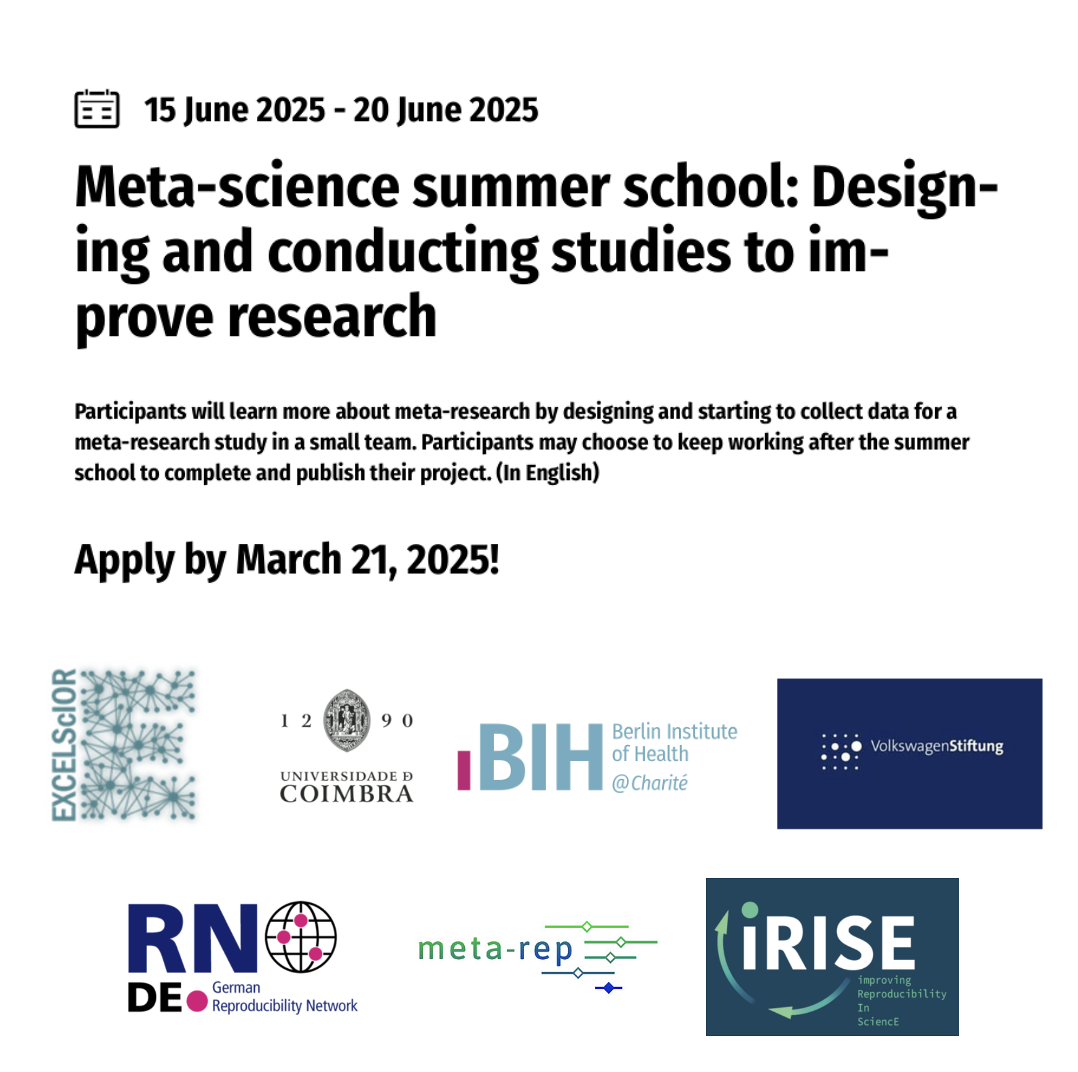
softwareheritage.org

Open Science partnerships specialist

Location: Paris, rue Barrault 75013 in the INRIA Research center Reports to: Head of Open Science Operations Type: Contract Duration Determinée (CDD) Role summary We’re looking for a Partnerships & Open Science Specialist...

@codegouvfr@social.numerique.gouv.fr

The Software Heritage project is looking for an " partnerships specialist" to expand Software Heritage’s integration in the research community.

"Your focus will be on managing partner onboarding, promoting software citation best practices (SWHIDs, BibLaTeX), and representing Software Heritage in key Open Science initiatives (EOSC, SciCodes)."

👉 softwareheritage.org/2025/04/0

📅 Submit before April 29th

👋 @swheritage @moranegg
softwareheritage.org

Open Science partnerships specialist

Location: Paris, rue Barrault 75013 in the INRIA Research center Reports to: Head of Open Science Operations Type: Contract Duration Determinée (CDD) Role summary We’re looking for a Partnerships & Open Science Specialist...

@uniinnsbruck@social.uibk.ac.at

🤔 Warum sind wir als Universität Innsbruck auf Mastodon?

Einige Gründe:

🔸 Digitale Souveränität: Wissenschaftskommunikation auf unabhängigen Plattformen
🔸 & Third Mission: Wissen frei zugänglich bereitstellen
🔸 Gesetzliche Regulierungen: datenschutzfreundlich kommunizieren
🔸 Öffentliche Vorreiterrolle: digitale Infrastruktur mitgestalten

Mehr:

📝 uibk.ac.at/de/public-relations

Bild: Eukombos, CC BY-SA 4.0 , via Wikimedia Commons

3D-Visualisierung des vorgeschlagenen Fediverse-Logos. Jeder Knoten ist eine Kugel mit einem Licht in jeder der fünf Farben.
ALT text

3D-Visualisierung des vorgeschlagenen Fediverse-Logos. Jeder Knoten ist eine Kugel mit einem Licht in jeder der fünf Farben.

@uniinnsbruck@social.uibk.ac.at

🤔 Warum sind wir als Universität Innsbruck auf Mastodon?

Einige Gründe:

🔸 Digitale Souveränität: Wissenschaftskommunikation auf unabhängigen Plattformen
🔸 & Third Mission: Wissen frei zugänglich bereitstellen
🔸 Gesetzliche Regulierungen: datenschutzfreundlich kommunizieren
🔸 Öffentliche Vorreiterrolle: digitale Infrastruktur mitgestalten

Mehr:

📝 uibk.ac.at/de/public-relations

Bild: Eukombos, CC BY-SA 4.0 , via Wikimedia Commons

3D-Visualisierung des vorgeschlagenen Fediverse-Logos. Jeder Knoten ist eine Kugel mit einem Licht in jeder der fünf Farben.
ALT text

3D-Visualisierung des vorgeschlagenen Fediverse-Logos. Jeder Knoten ist eine Kugel mit einem Licht in jeder der fünf Farben.

@opensustaintech@mastodon.social

We are opening a new chapter of ClimateTriage.com as part of the GitHub Climate Action Plan for Developers, presented at the San Francisco Climate Week. Together with GitHub, we are joining forces on a common mission: To get more developers involved in open source climate and sustainability projects. Thanks @richlitt for creating this awesome video. Read the blog post: opensustain.tech/blog/climatet

@opensustaintech@mastodon.social

We are opening a new chapter of ClimateTriage.com as part of the GitHub Climate Action Plan for Developers, presented at the San Francisco Climate Week. Together with GitHub, we are joining forces on a common mission: To get more developers involved in open source climate and sustainability projects. Thanks @richlitt for creating this awesome video. Read the blog post: opensustain.tech/blog/climatet

@daily_lotus@mastodon.social

@daily_lotus is a bot on a mission:

Every day, it toots a real-world natural product — a molecule found in 🌿 plants, 🍄 fungi, 🐛 animals, or 🦠 bacteria — straight from the depths of Wikidata.

Each post includes:

🧪 the molecule's name and structure,

📸 a pic of the organism it was found in,

📚 a reference to the scientific publication documenting the occurrence .

🧵 thread 1/n

@alelazic@mastodon.social

Open science isn't just for the rich.

I wrote about building – a repository of psychological instruments in Serbian – and what it taught me about doing open science with limited resources and lots of persistence.

doi.org/10.1038/d41586-025-009

Screenshot of a Nature article titled "How a ‘boring administrative task’ transformed my PhD career," published on 14 April 2025 in the Career Column section. The subtitle reads, "Good ideas — and impactful tools — don’t just come from rich, Western nations, says Aleksandra Lazić, a social scientist in Serbia." The article is written by Aleksandra Lazić, whose name appears as a clickable link.
ALT text

Screenshot of a Nature article titled "How a ‘boring administrative task’ transformed my PhD career," published on 14 April 2025 in the Career Column section. The subtitle reads, "Good ideas — and impactful tools — don’t just come from rich, Western nations, says Aleksandra Lazić, a social scientist in Serbia." The article is written by Aleksandra Lazić, whose name appears as a clickable link.

@alelazic@mastodon.social

Open science isn't just for the rich.

I wrote about building – a repository of psychological instruments in Serbian – and what it taught me about doing open science with limited resources and lots of persistence.

doi.org/10.1038/d41586-025-009

Screenshot of a Nature article titled "How a ‘boring administrative task’ transformed my PhD career," published on 14 April 2025 in the Career Column section. The subtitle reads, "Good ideas — and impactful tools — don’t just come from rich, Western nations, says Aleksandra Lazić, a social scientist in Serbia." The article is written by Aleksandra Lazić, whose name appears as a clickable link.
ALT text

Screenshot of a Nature article titled "How a ‘boring administrative task’ transformed my PhD career," published on 14 April 2025 in the Career Column section. The subtitle reads, "Good ideas — and impactful tools — don’t just come from rich, Western nations, says Aleksandra Lazić, a social scientist in Serbia." The article is written by Aleksandra Lazić, whose name appears as a clickable link.

@TIB_AVPortal@openbiblio.social

📢 SAVE THE DATE: Nach dem vor genau einem Jahr ist vor dem am 7. Oktober, von 10:00 - 16:00 Uhr‼️

📅 Diesmal: Ein ganzer Tag mit mehr Zeit, Intensität und besonderem Themenfokus - Lehren und Lernen mit . Wieder mit dabei: @cspannagel. 🥳

ℹ️ Basisinfos mit Programmvorschau unter: events.tib.eu/sciencevideocamp

More to come. Stay tuned & watch science on av.tib.eu/. 😉

av.tib.eu

Homepage - TIB AV-Portal

Scientific videos und audios: technology/engineering, architecture, chemistry, information technology, mathematics, and physics.

@OKMaps@mastodon.social

🎉 Over 5 million maps created on Open Knowledge Maps!

From classrooms and labs to libraries and living rooms, our visualisations are helping people everywhere explore research in new and inspiring ways. 🌍💡

We couldn’t have reached this milestone without you. Thank you for using, promoting, and supporting Open Knowledge Maps. Your dedication inspires us every day! ❤️

Let’s keep building a world where AI-driven knowledge discovery is open to all.🎈

A celebratory graphic featuring the text “Celebrating 5,000,000 Knowledge Maps”. Small illustrated characters are interacting with the numbers, decorating them with confetti, streamers, and festive elements. The background includes confetti in the form of the Open Knowledge Maps logo.
ALT text

A celebratory graphic featuring the text “Celebrating 5,000,000 Knowledge Maps”. Small illustrated characters are interacting with the numbers, decorating them with confetti, streamers, and festive elements. The background includes confetti in the form of the Open Knowledge Maps logo.

@OKMaps@mastodon.social

🎉 Over 5 million maps created on Open Knowledge Maps!

From classrooms and labs to libraries and living rooms, our visualisations are helping people everywhere explore research in new and inspiring ways. 🌍💡

We couldn’t have reached this milestone without you. Thank you for using, promoting, and supporting Open Knowledge Maps. Your dedication inspires us every day! ❤️

Let’s keep building a world where AI-driven knowledge discovery is open to all.🎈

A celebratory graphic featuring the text “Celebrating 5,000,000 Knowledge Maps”. Small illustrated characters are interacting with the numbers, decorating them with confetti, streamers, and festive elements. The background includes confetti in the form of the Open Knowledge Maps logo.
ALT text

A celebratory graphic featuring the text “Celebrating 5,000,000 Knowledge Maps”. Small illustrated characters are interacting with the numbers, decorating them with confetti, streamers, and festive elements. The background includes confetti in the form of the Open Knowledge Maps logo.

@openscience@mastodon.social

✨🔭 The night sky is rapidly getting brighter

Artificial lighting that escapes into the sky causes it to glow, preventing humans and animals from seeing the . Citizen scientists reported global rapid reductions in the visibility of stars. Trends in the data showed that the average night sky got brighter by 9.6% per year from 2011 to 2022, which is equivalent to doubling the sky brightness every 8 years.

🔗 science.org/doi/10.1126/scienc

@Luke_Drury@mastodon.dias.ie

The European Astronomical Society has awarded its Jocelyn Bell Burnell inspiration medal to the arXiv! Well deserved recognition of its contribution to open science and the normalisation of preprints in astronomy.

eas.unige.ch/inspiration_medal

eas.unige.ch

Jocelyn Bell Burnell Inspiration Medal

The European Astronomical Society (EAS) is a society of professional astronomers that promotes and advances astronomy in Europe.

@Luke_Drury@mastodon.dias.ie

The European Astronomical Society has awarded its Jocelyn Bell Burnell inspiration medal to the arXiv! Well deserved recognition of its contribution to open science and the normalisation of preprints in astronomy.

eas.unige.ch/inspiration_medal

eas.unige.ch

Jocelyn Bell Burnell Inspiration Medal

The European Astronomical Society (EAS) is a society of professional astronomers that promotes and advances astronomy in Europe.

🚨🌍 NEW ARTICLE 🌍🚨

We geocoded the of over 2 million students across from 2014 to 2022 with @miladmzdh Oula Inkeröinen & Olle Järv. The data descriptor article is published in , and is an output from the project.

doi.org/10.1038/s41597-025-047

@digigeolab

Schematic chart of the work. On the left, there is a representation of the diversity of place names in the Erasmus+ data with typographical errors, national spellings, encoding errors, and use of different scripts. In the centre panel, the general workflow for geocoding the data is presented showing three main steps: preprocessing, geocoding, and validation. In the final rightmost panel, one can see the spatially enriched student mobility flows across Europe. Major flows are between regions in the UK, Ireland, France, Germany, Spain, Italy and other larger European countries.
ALT text

Schematic chart of the work. On the left, there is a representation of the diversity of place names in the Erasmus+ data with typographical errors, national spellings, encoding errors, and use of different scripts. In the centre panel, the general workflow for geocoding the data is presented showing three main steps: preprocessing, geocoding, and validation. In the final rightmost panel, one can see the spatially enriched student mobility flows across Europe. Major flows are between regions in the UK, Ireland, France, Germany, Spain, Italy and other larger European countries.

🚨🌍 NEW ARTICLE 🌍🚨

We geocoded the of over 2 million students across from 2014 to 2022 with @miladmzdh Oula Inkeröinen & Olle Järv. The data descriptor article is published in , and is an output from the project.

doi.org/10.1038/s41597-025-047

@digigeolab

Schematic chart of the work. On the left, there is a representation of the diversity of place names in the Erasmus+ data with typographical errors, national spellings, encoding errors, and use of different scripts. In the centre panel, the general workflow for geocoding the data is presented showing three main steps: preprocessing, geocoding, and validation. In the final rightmost panel, one can see the spatially enriched student mobility flows across Europe. Major flows are between regions in the UK, Ireland, France, Germany, Spain, Italy and other larger European countries.
ALT text

Schematic chart of the work. On the left, there is a representation of the diversity of place names in the Erasmus+ data with typographical errors, national spellings, encoding errors, and use of different scripts. In the centre panel, the general workflow for geocoding the data is presented showing three main steps: preprocessing, geocoding, and validation. In the final rightmost panel, one can see the spatially enriched student mobility flows across Europe. Major flows are between regions in the UK, Ireland, France, Germany, Spain, Italy and other larger European countries.

@curioss@fosstodon.org

Here's another great pattern from a member.

❓Is your university is trying to meet demand from students for activities with limited resources?

💡 Have a read of the ‘Co-hosting Student Events’ pattern: bit.ly/3XwwXHQ

A huge thanks to Emily Lovell, @slieggi and Yelena Martynovskaya from the CROSS / @ucsc for sharing.

github.com

curioss-patterns/cohosting-student-events.md at main · CURIOSSorg/curioss-patterns

A public repository for the CURIOSS Patterns Practice - CURIOSSorg/curioss-patterns

@foss_events@fosstodon.org

// foss.events is not just about software-related events. Open Science, Open Data, Open Access, Open Hardware, Open Educational Resources and many other related movements are just as important as FOSS is.

Let's add these events to // foss.events and start connecting!

 "Banner" by David Revoy, framasoft.org − CC-BY 4.0  https://www.peppercarrot.com/en/viewer/framasoft__2023-11-13_banner_by-David-Revoy.html
ALT text

"Banner" by David Revoy, framasoft.org − CC-BY 4.0 https://www.peppercarrot.com/en/viewer/framasoft__2023-11-13_banner_by-David-Revoy.html

@foss_events@fosstodon.org

// foss.events is not just about software-related events. Open Science, Open Data, Open Access, Open Hardware, Open Educational Resources and many other related movements are just as important as FOSS is.

Let's add these events to // foss.events and start connecting!

 "Banner" by David Revoy, framasoft.org − CC-BY 4.0  https://www.peppercarrot.com/en/viewer/framasoft__2023-11-13_banner_by-David-Revoy.html
ALT text

"Banner" by David Revoy, framasoft.org − CC-BY 4.0 https://www.peppercarrot.com/en/viewer/framasoft__2023-11-13_banner_by-David-Revoy.html

@OSFNL@social.edu.nl

👋Hi! Welcome to the National Festival, taking place at the University of Groningen and UMCG on 24 October 2025.

We're Babette and Josca from @Bibliothecaris, taking over this account for this festival edition.

Follow us here for the latest updates on festival preparations, registration and programme developments, and of course during the event itself.

🔗 opensciencefestival.nl

Two people (Babette and Josca) standing in front of a building with "Universiteitsbibliotheek" (University Library) sign and many parked bicycles.
ALT text

Two people (Babette and Josca) standing in front of a building with "Universiteitsbibliotheek" (University Library) sign and many parked bicycles.

@gabrock94@fosstodon.org

🔥 I did a thing! 🔥

Here is my new preprint on a non-invasive, high-resolution method to map spinal cord activity! 🧠⚡🦴

What you can find:

📍Cool figures!
📍 attention modulation of spinal activity (yes, spinal!)
📍 Cool videos in the suppmat

🚀 Read it here: biorxiv.org/content/10.1101/20

biorxiv.org

Electrical Spinal Imaging (ESI): Analysing spinal cord activity with non-invasive, high-resolution mapping

The spinal cord is the key bridge between the brain and the body. However, scientific understanding of healthy spinal cord function has historically been limited because noninvasive measures of its neural activity have proven exceptionally challenging. In this work, we describe a novel recording and analysis approach to obtain non-invasive, high-resolution images of the electrical activity of the spinal cord in humans (Electrical Spinal Imaging, ESI). ESI is analytically simple, easy to implement, and data-driven: it does not involve template-based strategies prone to produce spurious signals. Using this approach we provide a detailed description and physiological characterization of the spatiotemporal dynamics of the peripheral, spinal and cortical activity elicited by somatosensory stimulation. We also demonstrate that attention modulates post-synaptic activity at spinal cord level.  Our method has enabled four new insights regarding spinal cord activity. (1) We identified three distinct responses in the time domain: sP9, sN13 and sP22. (2) The sP9 is a traveling wave reflecting the afferent volley entering the spinal cord through the dorsal root. (3) In contrast, the sN13 and sP22 reflect segmental post-synaptic activity. (4) While the sP9 response is first seen on the dorsal electrodes ipsilateral to the stimulated side, the sN13 and sP22 were not lateralised with respect to the side of stimulation. (5) Unimodal attention strongly modulates the amplitude of the sP22, but not that of the sP9 and sN13 components. The proposed method offers critical insights into the spatiotemporal dynamics of somatosensory processing within the spinal cord, paving the way for precise non-invasive functional monitoring of the spinal cord  in basic and clinical neurophysiology. ### Competing Interest Statement The authors have declared no competing interest.

@gabrock94@fosstodon.org

🔥 I did a thing! 🔥

Here is my new preprint on a non-invasive, high-resolution method to map spinal cord activity! 🧠⚡🦴

What you can find:

📍Cool figures!
📍 attention modulation of spinal activity (yes, spinal!)
📍 Cool videos in the suppmat

🚀 Read it here: biorxiv.org/content/10.1101/20

biorxiv.org

Electrical Spinal Imaging (ESI): Analysing spinal cord activity with non-invasive, high-resolution mapping

The spinal cord is the key bridge between the brain and the body. However, scientific understanding of healthy spinal cord function has historically been limited because noninvasive measures of its neural activity have proven exceptionally challenging. In this work, we describe a novel recording and analysis approach to obtain non-invasive, high-resolution images of the electrical activity of the spinal cord in humans (Electrical Spinal Imaging, ESI). ESI is analytically simple, easy to implement, and data-driven: it does not involve template-based strategies prone to produce spurious signals. Using this approach we provide a detailed description and physiological characterization of the spatiotemporal dynamics of the peripheral, spinal and cortical activity elicited by somatosensory stimulation. We also demonstrate that attention modulates post-synaptic activity at spinal cord level.  Our method has enabled four new insights regarding spinal cord activity. (1) We identified three distinct responses in the time domain: sP9, sN13 and sP22. (2) The sP9 is a traveling wave reflecting the afferent volley entering the spinal cord through the dorsal root. (3) In contrast, the sN13 and sP22 reflect segmental post-synaptic activity. (4) While the sP9 response is first seen on the dorsal electrodes ipsilateral to the stimulated side, the sN13 and sP22 were not lateralised with respect to the side of stimulation. (5) Unimodal attention strongly modulates the amplitude of the sP22, but not that of the sP9 and sN13 components. The proposed method offers critical insights into the spatiotemporal dynamics of somatosensory processing within the spinal cord, paving the way for precise non-invasive functional monitoring of the spinal cord  in basic and clinical neurophysiology. ### Competing Interest Statement The authors have declared no competing interest.

@OSFNL@social.edu.nl

👋Hi! Welcome to the National Festival, taking place at the University of Groningen and UMCG on 24 October 2025.

We're Babette and Josca from @Bibliothecaris, taking over this account for this festival edition.

Follow us here for the latest updates on festival preparations, registration and programme developments, and of course during the event itself.

🔗 opensciencefestival.nl

Two people (Babette and Josca) standing in front of a building with "Universiteitsbibliotheek" (University Library) sign and many parked bicycles.
ALT text

Two people (Babette and Josca) standing in front of a building with "Universiteitsbibliotheek" (University Library) sign and many parked bicycles.

@afoncubiertar@masto.ai

@epfl is doing things right with the social networks, by choosing Mastodon as their primary method for social interaction. They even set up their own server for the School community, allowing members to post and share content in a way that’s aligned with the values of . "We opted for Mastodon because independence and effective communication tools are critical."

@afoncubiertar@masto.ai

@epfl is doing things right with the social networks, by choosing Mastodon as their primary method for social interaction. They even set up their own server for the School community, allowing members to post and share content in a way that’s aligned with the values of . "We opted for Mastodon because independence and effective communication tools are critical."

@GermanRepro@mastodon.world

🔬✨ Interested in improving research transparency & reproducibility? Join the Meta-Science Summer School to design & launch a meta-research study!
➡️ Co-organized by the @GermanRepro
👥 Participants will learn about meta-research by designing and collecting data for a meta-research study in a small team
📅 Date: 15 - 20 June 2025; Apply by March 21, 2025!
🔗 More info: bihealth.org/en/notices/meta-s
🌐 Language: English
📌 Location: Frankfurt, Germany
(lmf)

Invitation to the Meta-Science Summer School and logos of affiliated and organizing institutions: Berlin Institute of Health (BIH), the German Reproducibility Network (GRN), the META REP Priority Program, iRise and the University of Coimbra EXCELScIOR project ERA chair.
ALT text

Invitation to the Meta-Science Summer School and logos of affiliated and organizing institutions: Berlin Institute of Health (BIH), the German Reproducibility Network (GRN), the META REP Priority Program, iRise and the University of Coimbra EXCELScIOR project ERA chair.

@CenterforOpenScience@fosstodon.org

Lifecycle Journal is a new publishing model that supports all research outputs—not just final papers—through community-led evaluation and a publish-then-review approach.

Join our webinar on April 10 at 2 PM ET to learn:
✅ How the submission & evaluation process works
✅ What makes Lifecycle Journal different from traditional journals
✅ Whether it’s the right fit for your research

📅 April 10 | 2 PM ET
🔗 Register now: cos-io.zoom.us/webinar/registe

@CenterforOpenScience@fosstodon.org

Lifecycle Journal is a new publishing model that supports all research outputs—not just final papers—through community-led evaluation and a publish-then-review approach.

Join our webinar on April 10 at 2 PM ET to learn:
✅ How the submission & evaluation process works
✅ What makes Lifecycle Journal different from traditional journals
✅ Whether it’s the right fit for your research

📅 April 10 | 2 PM ET
🔗 Register now: cos-io.zoom.us/webinar/registe

@GermanRepro@mastodon.world

🔬✨ Interested in improving research transparency & reproducibility? Join the Meta-Science Summer School to design & launch a meta-research study!
➡️ Co-organized by the @GermanRepro
👥 Participants will learn about meta-research by designing and collecting data for a meta-research study in a small team
📅 Date: 15 - 20 June 2025; Apply by March 21, 2025!
🔗 More info: bihealth.org/en/notices/meta-s
🌐 Language: English
📌 Location: Frankfurt, Germany
(lmf)

Invitation to the Meta-Science Summer School and logos of affiliated and organizing institutions: Berlin Institute of Health (BIH), the German Reproducibility Network (GRN), the META REP Priority Program, iRise and the University of Coimbra EXCELScIOR project ERA chair.
ALT text

Invitation to the Meta-Science Summer School and logos of affiliated and organizing institutions: Berlin Institute of Health (BIH), the German Reproducibility Network (GRN), the META REP Priority Program, iRise and the University of Coimbra EXCELScIOR project ERA chair.

@arXiv@mathstodon.xyz

Perhaps most importantly, when you support arXiv, you support . . . your own work! 🧑🏻‍🔬

arXiv promotes scientific advancement by making it fast, easy, & free for you to share your research & discover new science every single day. 🤓📬🌞

givingday.cornell.edu/campaign

This is a picture of a tweet where someone posted "No arXiv today? what is the point of waking up!?"
ALT text

This is a picture of a tweet where someone posted "No arXiv today? what is the point of waking up!?"

@arXiv@mathstodon.xyz

Perhaps most importantly, when you support arXiv, you support . . . your own work! 🧑🏻‍🔬

arXiv promotes scientific advancement by making it fast, easy, & free for you to share your research & discover new science every single day. 🤓📬🌞

givingday.cornell.edu/campaign

This is a picture of a tweet where someone posted "No arXiv today? what is the point of waking up!?"
ALT text

This is a picture of a tweet where someone posted "No arXiv today? what is the point of waking up!?"

@gabioshka@mastodon.social

💡 Introducing DataMap/Amazon the 1️⃣ repository of Amazonian , made possible by the @datacite Global Access Fund. 🌟 work by Pedro Luiz Pizzigatti Corrêa & team @uspoficial.bsky.social @unicampoficial.bsky.social 🇧🇷 & @arturo-gama.bsky.social

doi.org/10.5438/w208-es37

A promotional graphic for the DataCite Blog. The title reads, "Advancing Research Through DataCite’s Global Access Fund: Datamap/Amazon – The First Integrated Repository of Scientific Atmospheric Data From the Amazon." The authors, Gabi Mejias and Pedro Luiz Pizzigatti Corrêa, are shown in circular profile photos. The DataCite logo is displayed in the bottom right corner.
ALT text

A promotional graphic for the DataCite Blog. The title reads, "Advancing Research Through DataCite’s Global Access Fund: Datamap/Amazon – The First Integrated Repository of Scientific Atmospheric Data From the Amazon." The authors, Gabi Mejias and Pedro Luiz Pizzigatti Corrêa, are shown in circular profile photos. The DataCite logo is displayed in the bottom right corner.

@gabioshka@mastodon.social

💡 Introducing DataMap/Amazon the 1️⃣ repository of Amazonian , made possible by the @datacite Global Access Fund. 🌟 work by Pedro Luiz Pizzigatti Corrêa & team @uspoficial.bsky.social @unicampoficial.bsky.social 🇧🇷 & @arturo-gama.bsky.social

doi.org/10.5438/w208-es37

A promotional graphic for the DataCite Blog. The title reads, "Advancing Research Through DataCite’s Global Access Fund: Datamap/Amazon – The First Integrated Repository of Scientific Atmospheric Data From the Amazon." The authors, Gabi Mejias and Pedro Luiz Pizzigatti Corrêa, are shown in circular profile photos. The DataCite logo is displayed in the bottom right corner.
ALT text

A promotional graphic for the DataCite Blog. The title reads, "Advancing Research Through DataCite’s Global Access Fund: Datamap/Amazon – The First Integrated Repository of Scientific Atmospheric Data From the Amazon." The authors, Gabi Mejias and Pedro Luiz Pizzigatti Corrêa, are shown in circular profile photos. The DataCite logo is displayed in the bottom right corner.

@osmi@mastodon.social

🌍 The Open Science Monitoring Initiative (OSMI) now includes 166 members from 42 countries across all continents! This growing network shows global dedication to open science. While many members are from Europe & North America, we warmly invite more voices from Africa, Asia, Latin America, Oceania & Arab States. Let’s build a truly inclusive, global movement! 🌐 1/2

@osmi@mastodon.social

🌍 The Open Science Monitoring Initiative (OSMI) now includes 166 members from 42 countries across all continents! This growing network shows global dedication to open science. While many members are from Europe & North America, we warmly invite more voices from Africa, Asia, Latin America, Oceania & Arab States. Let’s build a truly inclusive, global movement! 🌐 1/2

@arXiv@mathstodon.xyz

This post is for the night owls . . . is officially LIVE! 🦉🌜

The sun may not be up, but it's never too late (or too early) to support arXiv. And for the next 24 hours, our friends at are TRIPLING your donations with a 2:1 match.

AKA when you give $1, Hugging Face gives $2, and arXiv gets $3 of support for !

Give today and make a difference in the future of scientific research and :

🤗❤️👉 givingday.cornell.edu/campaign

@arXiv@mathstodon.xyz

This post is for the night owls . . . is officially LIVE! 🦉🌜

The sun may not be up, but it's never too late (or too early) to support arXiv. And for the next 24 hours, our friends at are TRIPLING your donations with a 2:1 match.

AKA when you give $1, Hugging Face gives $2, and arXiv gets $3 of support for !

Give today and make a difference in the future of scientific research and :

🤗❤️👉 givingday.cornell.edu/campaign

@OpenAIREGraph@mastodon.social

Discover the new OpenAIRE Graph !

Join our webinar to explore its powerful new features for analysis, discovery, and monitoring. Learn how it streamlines access to the ’s rich research data, see real-world applications, and get your questions answered in our live Q&A!

Register now! tinyurl.com/45zenwr

Webinar. Introducing the New OpenAIRE Graph API: Enhanced functionalities and real-world applications.3 April 11:00-12:00 CET
ALT text

Webinar. Introducing the New OpenAIRE Graph API: Enhanced functionalities and real-world applications.3 April 11:00-12:00 CET

@OpenAIREGraph@mastodon.social

Discover the new OpenAIRE Graph !

Join our webinar to explore its powerful new features for analysis, discovery, and monitoring. Learn how it streamlines access to the ’s rich research data, see real-world applications, and get your questions answered in our live Q&A!

Register now! tinyurl.com/45zenwr

Webinar. Introducing the New OpenAIRE Graph API: Enhanced functionalities and real-world applications.3 April 11:00-12:00 CET
ALT text

Webinar. Introducing the New OpenAIRE Graph API: Enhanced functionalities and real-world applications.3 April 11:00-12:00 CET

@LeaMariaFer@openbiblio.social

🙌 Ich freue mich auf den heutigen Workshop "Open Access und Open Science fördern: Policies und Strategien" organisiert von @openaccessnetwork

ℹ️ @nfnd und ich werden eine Handreichung für Open Science Policies vorstellen: oabb.pubpub.org/open-science-p

🙏 Vielen Dank an unsere Mitautor:innen Stefan Skupien, @BerlinUAlliance TH Köln @unikonstanz und @unipotsdam

🔗 open-access.network/fortbilden

@HelmholtzOpenScienceOffice

open-access.network

Online-Workshop für die Ressortforschung: Open Access Policies und Strategien

@LeaMariaFer@openbiblio.social

🙌 Ich freue mich auf den heutigen Workshop "Open Access und Open Science fördern: Policies und Strategien" organisiert von @openaccessnetwork

ℹ️ @nfnd und ich werden eine Handreichung für Open Science Policies vorstellen: oabb.pubpub.org/open-science-p

🙏 Vielen Dank an unsere Mitautor:innen Stefan Skupien, @BerlinUAlliance TH Köln @unikonstanz und @unipotsdam

🔗 open-access.network/fortbilden

@HelmholtzOpenScienceOffice

open-access.network

Online-Workshop für die Ressortforschung: Open Access Policies und Strategien

@curioss@fosstodon.org

Here's another great pattern from a member.

❓Is your university is trying to meet demand from students for activities with limited resources?

💡 Have a read of the ‘Co-hosting Student Events’ pattern: bit.ly/3XwwXHQ

A huge thanks to Emily Lovell, @slieggi and Yelena Martynovskaya from the CROSS / @ucsc for sharing.

github.com

curioss-patterns/cohosting-student-events.md at main · CURIOSSorg/curioss-patterns

A public repository for the CURIOSS Patterns Practice - CURIOSSorg/curioss-patterns

@brembs@mastodon.social

"How disruptive would it be if GitHub started deleting repositories, or Google Scholar started hiding certain papers in response to U.S. government demands?"

thetransmitter.org/policy/scie

Most people with some interest have seen precisely this coming for more than a decade. @neuralreckoning is among them. It's great that outlets like @thetransmitter are now also recognizing this problem and are helping to amplify these voices.

thetransmitter.org

Science must step away from nationally managed infrastructure

Scientific data and independence are at risk. We need to work with community-driven services and university libraries to create new multi-country organizations that are resilient to political…

@lavaeolus@fedihum.org

I see this call making the rounds again - let me quote from the mission-statement of @SafeguardingResearch:
"Our archive is built according to the principles of and , based on open technologies and standards, and resilient against loss via meaningfully distributed storage."

Please join us:
"As researchers we often say 'we need the data'. Today, the data needs us." — @KathyReid

see 🧵2/2

upstream.force11.org/open-scie

🧵1/2

doi.org

Science is Under Siege: The Open Science Community Must Act and Lead by Example

Worldwide, science is under attack by anti-scientific movements. The new US administration has thrown the entire academy into chaos, threatening global health. This article is a call for the open science community to practice what it preaches and lead by example in defending science.

@brembs@mastodon.social

"How disruptive would it be if GitHub started deleting repositories, or Google Scholar started hiding certain papers in response to U.S. government demands?"

thetransmitter.org/policy/scie

Most people with some interest have seen precisely this coming for more than a decade. @neuralreckoning is among them. It's great that outlets like @thetransmitter are now also recognizing this problem and are helping to amplify these voices.

thetransmitter.org

Science must step away from nationally managed infrastructure

Scientific data and independence are at risk. We need to work with community-driven services and university libraries to create new multi-country organizations that are resilient to political…

@brembs@mastodon.social

I've never understood how scientists, in particular, could flee from that Musk place only to take refuge in, wait for it, a Bannon place like . 🤦‍♂️

"On social media, Mastodon is managed and run by the community (e.g., neuromatch.social is a server run by neuroscientists) and is robust by design."

thetransmitter.org/policy/scie

When rogue players multiply, single points of failure are worse than just a gamble.

is best on the

royalsocietypublishing.org/doi

@brembs@mastodon.social

I've never understood how scientists, in particular, could flee from that Musk place only to take refuge in, wait for it, a Bannon place like . 🤦‍♂️

"On social media, Mastodon is managed and run by the community (e.g., neuromatch.social is a server run by neuroscientists) and is robust by design."

thetransmitter.org/policy/scie

When rogue players multiply, single points of failure are worse than just a gamble.

is best on the

royalsocietypublishing.org/doi

@brembs@mastodon.social

I've never understood how scientists, in particular, could flee from that Musk place only to take refuge in, wait for it, a Bannon place like . 🤦‍♂️

"On social media, Mastodon is managed and run by the community (e.g., neuromatch.social is a server run by neuroscientists) and is robust by design."

thetransmitter.org/policy/scie

When rogue players multiply, single points of failure are worse than just a gamble.

is best on the

royalsocietypublishing.org/doi

@brembs@mastodon.social

"How disruptive would it be if GitHub started deleting repositories, or Google Scholar started hiding certain papers in response to U.S. government demands?"

thetransmitter.org/policy/scie

Most people with some interest have seen precisely this coming for more than a decade. @neuralreckoning is among them. It's great that outlets like @thetransmitter are now also recognizing this problem and are helping to amplify these voices.

thetransmitter.org

Science must step away from nationally managed infrastructure

Scientific data and independence are at risk. We need to work with community-driven services and university libraries to create new multi-country organizations that are resilient to political…

@brembs@mastodon.social

"How disruptive would it be if GitHub started deleting repositories, or Google Scholar started hiding certain papers in response to U.S. government demands?"

thetransmitter.org/policy/scie

Most people with some interest have seen precisely this coming for more than a decade. @neuralreckoning is among them. It's great that outlets like @thetransmitter are now also recognizing this problem and are helping to amplify these voices.

thetransmitter.org

Science must step away from nationally managed infrastructure

Scientific data and independence are at risk. We need to work with community-driven services and university libraries to create new multi-country organizations that are resilient to political…

@brembs@mastodon.social

YES! @neuralreckoning gets it perfectly right!

thetransmitter.org/policy/scie

Now everybody get up and talk to your library director and/or library committee that this is what you want to happen!

I've even started to put together some lines for you to use:

cryptpad.fr/doc/#/2/doc/edit/C

Maybe you want to chime in and help make this a convincing odcument?

Ultimately, we need to start building new multi-country organizations, designed from the start to be community-run and resilient. A coalition of university libraries could be ideally placed to lead this effort, as they already have vast experience building for and supporting access to scientific data and publications. Just imagine a world in which universities mutually support one another by building scientific infrastructure based on free sharing, giving every country, from the poorest to the richest, secure access to the scientific data that can change the world for the better. This isn’t fanciful. It can happen, but we have to put the effort in, because nobody will do it for us.
ALT text

Ultimately, we need to start building new multi-country organizations, designed from the start to be community-run and resilient. A coalition of university libraries could be ideally placed to lead this effort, as they already have vast experience building for and supporting access to scientific data and publications. Just imagine a world in which universities mutually support one another by building scientific infrastructure based on free sharing, giving every country, from the poorest to the richest, secure access to the scientific data that can change the world for the better. This isn’t fanciful. It can happen, but we have to put the effort in, because nobody will do it for us.

@brembs@mastodon.social

YES! @neuralreckoning gets it perfectly right!

thetransmitter.org/policy/scie

Now everybody get up and talk to your library director and/or library committee that this is what you want to happen!

I've even started to put together some lines for you to use:

cryptpad.fr/doc/#/2/doc/edit/C

Maybe you want to chime in and help make this a convincing odcument?

Ultimately, we need to start building new multi-country organizations, designed from the start to be community-run and resilient. A coalition of university libraries could be ideally placed to lead this effort, as they already have vast experience building for and supporting access to scientific data and publications. Just imagine a world in which universities mutually support one another by building scientific infrastructure based on free sharing, giving every country, from the poorest to the richest, secure access to the scientific data that can change the world for the better. This isn’t fanciful. It can happen, but we have to put the effort in, because nobody will do it for us.
ALT text

Ultimately, we need to start building new multi-country organizations, designed from the start to be community-run and resilient. A coalition of university libraries could be ideally placed to lead this effort, as they already have vast experience building for and supporting access to scientific data and publications. Just imagine a world in which universities mutually support one another by building scientific infrastructure based on free sharing, giving every country, from the poorest to the richest, secure access to the scientific data that can change the world for the better. This isn’t fanciful. It can happen, but we have to put the effort in, because nobody will do it for us.

@brembs@mastodon.social

Everybody knows that efficient, cost-effective and high-quality scholarly publishing is possible. The Global South has been demonstrating this for years, no decades, as have various journals and fields. A nice summary of how the European Geosciences Union shows the world how it's done has just been published as a preprint:

egusphere.copernicus.org/prepr

There really is no reason to remain caught in the trap of the corporate publishers one minute longer.

egusphere.copernicus.org

Opinion: Improved scientific discourse and quality assurance by interactive open access publishing with community-based multi-stage open peer review in an open science landscape

Abstract. Scientific discourse and quality assurance can be improved by open science through public peer review and community discussion of preprints on open access (OA) publishing platforms. Over 25 years, the viability and benefits of this approach have been proven by the interactive OA journal Atmospheric Chemistry and Physics (ACP) and 18 other journals published by the European Geosciences Union (EGU) and the scientific service provider Copernicus Publications. The success of the EGU journals employing multi-stage open peer 5 review reflects the attractiveness and benefits of community-driven, interactive OA publishing, including high scientific quality and impact, efficient self-regulation, low cost and financial sustainability. Since 2001, EGU has published over 50 000 journal articles, 60 000 preprints, and 250 000 interactive comments, utilizing and integrating different financing models of OA (green, gold, diamond/platinum). The EGU interactive OA journals are linked to the OA repository and interactive community platform EGUsphere and to the virtual scientific highlight magazine EGU Letters, integrating different levels of scientific communication and exchange. The EGU publications combine multiple features of open science, including different forms of open peer review and community evaluation with open access, open data, and open source elements tailored to the needs and preferences of different disciplines. We review the approach, achievements and future perspectives of interactive OA publishing (including transformative/institutional agreements and AI/ML tools) and its contribution to a universal epistemic web that captures the scientific discourse and comprehensively documents what we know, how well we know it, and where the limitations are.

@brembs@mastodon.social

Everybody knows that efficient, cost-effective and high-quality scholarly publishing is possible. The Global South has been demonstrating this for years, no decades, as have various journals and fields. A nice summary of how the European Geosciences Union shows the world how it's done has just been published as a preprint:

egusphere.copernicus.org/prepr

There really is no reason to remain caught in the trap of the corporate publishers one minute longer.

egusphere.copernicus.org

Opinion: Improved scientific discourse and quality assurance by interactive open access publishing with community-based multi-stage open peer review in an open science landscape

Abstract. Scientific discourse and quality assurance can be improved by open science through public peer review and community discussion of preprints on open access (OA) publishing platforms. Over 25 years, the viability and benefits of this approach have been proven by the interactive OA journal Atmospheric Chemistry and Physics (ACP) and 18 other journals published by the European Geosciences Union (EGU) and the scientific service provider Copernicus Publications. The success of the EGU journals employing multi-stage open peer 5 review reflects the attractiveness and benefits of community-driven, interactive OA publishing, including high scientific quality and impact, efficient self-regulation, low cost and financial sustainability. Since 2001, EGU has published over 50 000 journal articles, 60 000 preprints, and 250 000 interactive comments, utilizing and integrating different financing models of OA (green, gold, diamond/platinum). The EGU interactive OA journals are linked to the OA repository and interactive community platform EGUsphere and to the virtual scientific highlight magazine EGU Letters, integrating different levels of scientific communication and exchange. The EGU publications combine multiple features of open science, including different forms of open peer review and community evaluation with open access, open data, and open source elements tailored to the needs and preferences of different disciplines. We review the approach, achievements and future perspectives of interactive OA publishing (including transformative/institutional agreements and AI/ML tools) and its contribution to a universal epistemic web that captures the scientific discourse and comprehensively documents what we know, how well we know it, and where the limitations are.

@HelmholtzOpenScienceOffice@helmholtz.social

🌟 Report Forum Helmholtz Research Data Commons published.

Joint initiative by @helmholtz_hmc and @HelmholtzOpenScienceOffice to improve research data management in our community.

In the forum, Markus Kubin and @GuidoJuckeland presented important initiatives such as the HMC Dashboard and HERMES tooling approaches. @marcelmson M. presented a concept for Helmholtz-wide quality indicators for scientific data and software products.

👉 doi.org/10.48440/OS.HELMHOLTZ.

Research Data Commons T 1. Helmholtz Research Data Commons Forum Fostering FAIRness, Enhancing Visibility, and Ensuring Data Quality
ALT text

Research Data Commons T 1. Helmholtz Research Data Commons Forum Fostering FAIRness, Enhancing Visibility, and Ensuring Data Quality

@HelmholtzOpenScienceOffice@helmholtz.social

🌟 Report Forum Helmholtz Research Data Commons published.

Joint initiative by @helmholtz_hmc and @HelmholtzOpenScienceOffice to improve research data management in our community.

In the forum, Markus Kubin and @GuidoJuckeland presented important initiatives such as the HMC Dashboard and HERMES tooling approaches. @marcelmson M. presented a concept for Helmholtz-wide quality indicators for scientific data and software products.

👉 doi.org/10.48440/OS.HELMHOLTZ.

Research Data Commons T 1. Helmholtz Research Data Commons Forum Fostering FAIRness, Enhancing Visibility, and Ensuring Data Quality
ALT text

Research Data Commons T 1. Helmholtz Research Data Commons Forum Fostering FAIRness, Enhancing Visibility, and Ensuring Data Quality

@openaccessnetwork@openbiblio.social

📢 Open Access Barcamp 2025 📢

Am 26.–27. März trifft sich die Open-Access-Community in der UB Duisburg-Essen! 🎉 Beim interaktiven oa.barcamp bestimmt Ihr das Programm: Bringt Eure Themen ein, diskutiert, vernetzt Euch. Die Teilnahme ist kostenlos. Jetzt anmelden! 👉 open-access.network/vernetzen/

Ein Dank im Voraus an unsere Gastgeberin, die Unibibliothek Duisburg-Essen, und Mitorganisatorin, Landesinitiative Open Access NRW (@oa_nrw)

Duisburg | Open Access Barcamp | 26.+27.03.2025
ALT text

Duisburg | Open Access Barcamp | 26.+27.03.2025

@investinopen@indieweb.social

Funding cuts are jeopardizing the open knowledge infrastructure we need for everything from climate research to global helath preparedness.

We need to act NOW to protect these vital resources. Sign the statement and join the movement to support open infrastructure: investinopen.org/blog/statemen

investinopen.org

Statement of support for a global research ecosystem

Our global research ecosystem is at risk — it's time to invest in the tools and services that power research and scholarship.

@investinopen@indieweb.social

Funding cuts are jeopardizing the open knowledge infrastructure we need for everything from climate research to global helath preparedness.

We need to act NOW to protect these vital resources. Sign the statement and join the movement to support open infrastructure: investinopen.org/blog/statemen

investinopen.org

Statement of support for a global research ecosystem

Our global research ecosystem is at risk — it's time to invest in the tools and services that power research and scholarship.

@amarois@mamot.fr
@amarois@mamot.fr
@investinopen@indieweb.social

Last week's grant freeze fiasco underscores the need for diversified revenue and community-owned solutions.

Our latest blog post examines the $16.5M+ in federal grants awarded to open infrastructure projects over the past 5 years, highlighting the precariousness of the space right now.

Read more: investinopen.org/blog/call-to-

"'If the current situation exposes risks of depending on federal funding for research and research infrastructure, it also underscores the importance of community ownership of the tools and data that drive knowledge creation.' Read our blog post 'Call to action: Protect vulnerable infrastructure and research independence'." Community ownership is highlighted.
ALT text

"'If the current situation exposes risks of depending on federal funding for research and research infrastructure, it also underscores the importance of community ownership of the tools and data that drive knowledge creation.' Read our blog post 'Call to action: Protect vulnerable infrastructure and research independence'." Community ownership is highlighted.

@investinopen@indieweb.social

Last week's grant freeze fiasco underscores the need for diversified revenue and community-owned solutions.

Our latest blog post examines the $16.5M+ in federal grants awarded to open infrastructure projects over the past 5 years, highlighting the precariousness of the space right now.

Read more: investinopen.org/blog/call-to-

"'If the current situation exposes risks of depending on federal funding for research and research infrastructure, it also underscores the importance of community ownership of the tools and data that drive knowledge creation.' Read our blog post 'Call to action: Protect vulnerable infrastructure and research independence'." Community ownership is highlighted.
ALT text

"'If the current situation exposes risks of depending on federal funding for research and research infrastructure, it also underscores the importance of community ownership of the tools and data that drive knowledge creation.' Read our blog post 'Call to action: Protect vulnerable infrastructure and research independence'." Community ownership is highlighted.

@Bibliothecaris@social.edu.nl

🚀1 year since we left /

Our move to wasn't just a platform switch. It was a leap into in action.

We found a chance to align our communication w/ our values: transparent, meaningful, dialogue-driven.

Read about our journey, impact, challenges, and lessons:

🔗rug.nl/library/open-access/blo

💜Thanks, 🦣-community, for this wonderful experience. We learn a lot here.

👋We hope to encourage other academic institutions to join.

Photo of the building of the University of Groningen Library
ALT text

Photo of the building of the University of Groningen Library

@heads@datasci.social

🚀 We’re here! Meet HeaDS – Center for Health Data Science! 🚀

The () is now on Mastodon! 🎉
We offer support through , , , , , & more!

📚 Free &
📊 Data support via
🤝 at seminars

Follow us for , & updates! 🌐 heads.ku.dk/

@heads@datasci.social

🚀 We’re here! Meet HeaDS – Center for Health Data Science! 🚀

The () is now on Mastodon! 🎉
We offer support through , , , , , & more!

📚 Free &
📊 Data support via
🤝 at seminars

Follow us for , & updates! 🌐 heads.ku.dk/

@HelmholtzOpenScienceOffice@helmholtz.social

📢 Workshop on reproducible science and its transformative potential for science.

👉 Program and registration: events.hifis.net/event/1750/

🗓️ March 25, 2025 (9 am to 2:30 pm)
📌 MDC - BIMSB (Berlin) or online
ℹ️ Format: Keynotes = hybrid setting (live & online) | Workshops = only on-site

It's a good opportunity to network and exchange ideas. We look forward to your participation.

@MDC_Berlin @GermanRepro @HelmholtzImaging @bih_charite

Helmholtz Reproducibility Workshop
ALT text

Helmholtz Reproducibility Workshop

@toothFAIRy@scholar.social

In a time where funding for research and communities may become de-prioritized I spent a moment to reflect on how @turingway has positively impacted my career and life. Read all about it here: github.com/the-turing-way/the-

If you have a moment to share how The Turing Way has impacted your work, also if you 'only' reused one of the images for your presentations, now is the time to contribute back!

github.com

Help build a strong sase for funding The Turing Way's maintenance and sustainability · Issue #4032 · the-turing-way/the-turing-way

Summary We are inviting you to share your experiences, personal story, examples of success and insights on how the resources, activities, and initiatives within the Turing Way and Practitioners Hub...

@toothFAIRy@scholar.social

In a time where funding for research and communities may become de-prioritized I spent a moment to reflect on how @turingway has positively impacted my career and life. Read all about it here: github.com/the-turing-way/the-

If you have a moment to share how The Turing Way has impacted your work, also if you 'only' reused one of the images for your presentations, now is the time to contribute back!

github.com

Help build a strong sase for funding The Turing Way's maintenance and sustainability · Issue #4032 · the-turing-way/the-turing-way

Summary We are inviting you to share your experiences, personal story, examples of success and insights on how the resources, activities, and initiatives within the Turing Way and Practitioners Hub...

@hugovk@mastodon.social

Open science people: @willingc is building a "curated list of organizations and resources that foster inclusive collaboration in open science".

If you can help out with active pages or Wayback Machine archives, add some links to:

github.com/willingc/awesome-in

github.com

GitHub - willingc/awesome-inclusion-open-science

Contribute to willingc/awesome-inclusion-open-science development by creating an account on GitHub.

@EvoMRI@mastodon.social

The Open Science Conference 2025 is to take place
on October 8 – 9, 2025
in Hamburg, Germany
open-science-conference.eu/

For now, it is being planned as an in-person event but we are exploring hybrid options.

Other than that, the logistics are largely sorted, so we can concentrate on the program.

If you have thoughts or ideas in this regard, feel free to share them. If you would like to be more closely involved, please get in touch.


@EvoMRI@mastodon.social

The Open Science Conference 2025 is to take place
on October 8 – 9, 2025
in Hamburg, Germany
open-science-conference.eu/

For now, it is being planned as an in-person event but we are exploring hybrid options.

Other than that, the logistics are largely sorted, so we can concentrate on the program.

If you have thoughts or ideas in this regard, feel free to share them. If you would like to be more closely involved, please get in touch.


@HelmholtzOpenScienceOffice@helmholtz.social

📢 Workshop on reproducible science and its transformative potential for science.

👉 Program and registration: events.hifis.net/event/1750/

🗓️ March 25, 2025 (9 am to 2:30 pm)
📌 MDC - BIMSB (Berlin) or online
ℹ️ Format: Keynotes = hybrid setting (live & online) | Workshops = only on-site

It's a good opportunity to network and exchange ideas. We look forward to your participation.

@MDC_Berlin @GermanRepro @HelmholtzImaging @bih_charite

Helmholtz Reproducibility Workshop
ALT text

Helmholtz Reproducibility Workshop

@cwts@social.cwts.nl

🚀 Exciting News! 🚀

We are thrilled to announce that @iweijden and @AndreaRE_altibel will be leading the national coordination project on & in open science!

Thanks to the €1.2 million awarded grant from @OpenScienceNL, 23 national institutions will now be able to structurally embed principles into the recruitment and promotion of their staff. This is a huge step toward advancing open science!

Read more here 👉 universiteitleiden.nl/en/news/

@arXiv@mathstodon.xyz

is still in full swing! Consider giving to arXiv today to support our work in fostering scientific discovery, accessible science, and equitable access to research.

Why support arXiv? The numbers don't lie. While our team has remained small, everything else about arXiv is growing. We need your help to keep arXiv sustainable, stable and open as more and more researchers use it to share their work.

@arXiv@mathstodon.xyz

Happy ! Thank you to all the authors, readers, professors and students, and all the researchers across the globe who use arXiv everyday to learn, discover & share new ideas. Your curiosity and passion for science is what makes arXiv possible!

arXiv hosts over 2.5 million scientific articles thanks to the hard work of a small team and we are grateful for your support.

Donate to arXiv today to support for all: tinyurl.com/arXivGivingTuesday

@Bibliothecaris@social.edu.nl

📊 New insights from our on

Uptake across disciplines
→45.5%
→17.2%
→10.8%
→9.6% sciences
→5.4% other

Real-life colleague connectivity on
→32.9% 1-3 colleagues
→8.5% 4-10 colleagues
→5.4% 10+ 〃
→30.5% 0 〃

51% of responding social scientists have immediate colleagues on Mastodon, significantly more than other disciplines

💜 Spreading Mastodon love in your department?
📢 Share your pitch here!

@Bibliothecaris@social.edu.nl

Hi,

📊First results from our project on the role of in are in. n=346

1️⃣94.7% say they would increase their professional use of Mastodon if more academic peers from their field joined the platform

2️⃣71.4% report a lack of institutional support for using Mastodon

3️⃣66.1% indicate their professional Mastodon use would increase if their organizations were present on Mastodon

Stay tuned for more results.

@ASAPbio@mas.to

🚀 Calling all researchers! 🚀
Share your early-stage research—negative data, new protocols, or unreplicated results— and enter the ASAPbio 2024 Poster Competition! 🧪📊 Two $500 prizes up for grabs! 🎉
📅 Deadline: Dec 1, 2024.
🔗 buff.ly/488V7wh

@leidenmadtrics@social.cwts.nl

🔓 The development of raises difficult questions about its implications for and .

🆕 In a new blog post, Louise Bezuidenhout, Paola Castaño, @sabinaleonelli, @anaparroncab and @ismaelrafols report on the insights gained from four sessions at the conference in July 2024 on monitoring equitable Open Science. 👉 leidenmadtrics.nl/articles/int

@osmi@mastodon.social

Welcome to the Open Science Monitoring Initiative!
🔎 OSMI aims to encourage the adoption of monitoring principles and to promote their practical implementation.
💡 OSMI is an original idea from the French Ministry of Higher Education and Research, the Université de Lorraine and @inria
🌐 Other initiators of OSMI include @unesco, @ChariteBerlin, @PLOS, and SPARC Europe.
OSMI is coordinated by the Université de Lorraine, SPARC Europe, and UNESCO.

@toothFAIRy@scholar.social

It was very nice to discuss with like minded people what support for initiatives looks like during the Open Science Barcamp event on the 21st of October in Maastricht.

So nice, that we shared a summary of our discussion in a blog!

openworking.wordpress.com/2024

With @matherion and a bunch of other people that need to move to Mastodon still 😂

@Bibliothecaris@social.edu.nl

🌟Hello 🌟

I'm Hannah and currently working on the research project to understand the role of in during my internship here.

If you haven’t done so already, please consider participating in the project. I would love to hear from you:

🔗rug.eu.qualtrics.com/jfe/form/

A huge THANK YOU to everyone who has already participated in the survey! It is really insightful to read your opinions and experiences.

Hannah and plushtodon
ALT text

Hannah and plushtodon

@SusannAuer@mastodon.green

Hey folks and enthusiasts!

We at R4E (repro4everyone.org/) are thrilled to take on new people in our community! We give workshops on reproducibility in science and are happy to teach you how to do one of these in your own community! You can also demand a workshop - just reach out:

Ways to get involved with R4E:
Join as a volunteer, t.co/jPWc6gYi2e
Request a workshop, t.co/syhWEbz6v3
Donate to R4E, t.co/CxxBiyh9RE

opencollective.com

Reproducibility for Everyone - Open Collective

Reproducibility for Everyone (R4E) is a community-led education initiative to increase adoption of reproducible and open research practices at scale.

@Bibliothecaris@social.edu.nl

🚀1 year since we left /

Our move to wasn't just a platform switch. It was a leap into in action.

We found a chance to align our communication w/ our values: transparent, meaningful, dialogue-driven.

Read about our journey, impact, challenges, and lessons:

🔗rug.nl/library/open-access/blo

💜Thanks, 🦣-community, for this wonderful experience. We learn a lot here.

👋We hope to encourage other academic institutions to join.

Photo of the building of the University of Groningen Library
ALT text

Photo of the building of the University of Groningen Library

@Bibliothecaris@social.edu.nl

👋Hi, community, tell us, why are you on and how are you using it?

📣 Please share and fill out our quick survey (max 10 min):

🔗rug.eu.qualtrics.com/jfe/form/

Help us study in academia.

➡️ Why Mastodon (or why not)?
➡️ How often do you toot?
➡️ Benefits over other platforms?
➡️ Challenges faced?

More info:
🔗 rug.nl/library/research-projec

@bennett@assemblag.es

The time I set aside to set up my new account here was right as my old instance went down for maintenance 🙃. So here's a placeholder so I don't look totally empty as I follow folks here:

I am:

1) (specifically / / ) PhD candidate at UW-Madison

(I study the politics of scientists' data practices, especially around / )

2) Herbivore, cat dad, player & reader

3) Also at bennettmcintosh.com

@datacite@openbiblio.social

RSpace integrates IGSN ID registration in its sample management system.🥳
The latest post in the "IGSN ID Implementation Exemplars" blog series explores RSpace’s seamless workflow for managing with DataCite. 👇
doi.org/10.5438/5xq3-b955

Image features a graphic for the DataCite Blog with the title "IGSN ID Implementation Exemplars: RSpace." It displays portraits of two authors, Vaida Plankytė and Rorie Edmunds, along with the DataCite logo
ALT text

Image features a graphic for the DataCite Blog with the title "IGSN ID Implementation Exemplars: RSpace." It displays portraits of two authors, Vaida Plankytė and Rorie Edmunds, along with the DataCite logo

@datacite@openbiblio.social

We're looking for experts to support us with priority setting & strategies related to our services, schema & outreach!
Answer our call for applications & join one of DataCite's Steering, Working or Expert Groups: tinyurl.com/mjv3ydsd
Read more: doi.org/10.5438/phyf-8771

Graphic promoting a DataCite blog post about applications for DataCite Steering, Working, and Expert Groups for 2024. It features headshots of three contributors: Maria Gould, Helena Cousijn, and Kelly Stathis.
ALT text

Graphic promoting a DataCite blog post about applications for DataCite Steering, Working, and Expert Groups for 2024. It features headshots of three contributors: Maria Gould, Helena Cousijn, and Kelly Stathis.

@datacite@openbiblio.social

We're committed to shaping our leadership for a brighter future! With a focus on regional representation & global diversity, nominations are open for 6 seats on the DataCite Board.
Let’s amplify diverse voices!🌍
Nominate yourself or others by Jan 31, 2025: forms.gle/rVKTNSKA3uupykny8


Please boost! 🚀

Image features the DataCite Blog header, announcing the opening of nominations for DataCite’s 2025 Global Board Election. It includes a circular photo of Matthew Buys alongside the text.
ALT text

Image features the DataCite Blog header, announcing the opening of nominations for DataCite’s 2025 Global Board Election. It includes a circular photo of Matthew Buys alongside the text.

@hannaSH@mastodon.social

The ongoing Global Open Science Monitoring Initiative @BraccoLaetitia(shorturl.at/hyKp8) and this study proposing an Open Science Readiness Index (doi.org/10.1016/j.fmre.2024.10) have made me recall the E-government Development Index (EGDI) which monitors/compare progress across UN Member States. The idea could be adapted to the domain in the form of a Global OS Readiness/Development Index

Details about the UN EGDI: shorturl.at/GyJIL; shorturl.at/hlcD2

@opensustaintech@mastodon.social

"I’m a firm believer that Open Source is one of the most important pieces of the climate change puzzle. It’s impossible to prove but to integrate environmental concerns into our number-driven economies, we need traceable software, data, and models. Without these, sustainability remains a mere concept." A recap of Tobias journey to discover how open digital infrastructure helps us to preserve our natural world: opensource.net/closing-the-gap

opensource.net

Closing the Gap: Accelerating environmental Open Source

A recap of the Open Sustainable Technology project's first four years, focusing on its catalog of Open Source climate software and how you can get involved.

@simon_heitin@fosstodon.org

In practical use, there are two different kinds of scientific computing notebooks:
1. The unpolished ones where you do lots of small experiments
2. The curated ones where you expect to render and publish.

What do you call these two things?

@computo@mathstodon.xyz

What better time than for Computo's first toot?

Hello, fediverse! Computo is a journal of the French Statistical Society (but don't worry, everything is in English), and our goal is to publish computational/algorithmic contributions in statistics and machine learning in a reproducible, open access way. Our papers are submitted as notebooks, and you can read them as html or pdf files.

Curious about what this can look like? Take a look at the articles we've already published computo.sfds.asso.fr/publicati

(And yes, we'll get that little checkmark next to the computo URL soon.)

@open_neuroscience@fosstodon.org

Hello Mastodon!
After a long delay, here is a bit of info on this project...
open-neuroscience.com is a community driven website for & projects related to .

The idea is to make it easy for people to find interesting projects that they could use and/or contribute to.

It is super easy to add your project to the website! simply fill out a form (forms.office.com/e/5QtUtMc3hw), and a bit of code will transform it to a webapge! [1/n]

@Bibliothecaris@social.edu.nl

👋 Hi, , tell us, why are you on ?

🔍 We are researching how and why academics use Mastodon compared to other platforms. Is it key for ?

🔜 We'll launch our survey by mid-October, so stay tuned.

📣 Meanwhile: what features of Mastodon do you find most valuable for academic discourse?
And which other questions should we include in our research, you think?

@jeroenbosman@akademienl.social

Our experimental tool helps rethink strategies in an context. Based on your goals you can select what, when, how and where to publish. With suggestions & background links and an automatically generated narrative. Looking for a research team/lab/group that is in the process of rethinking their publishing strategy and wants to give this a test drive, e.g. in a lunch bag discussion session. w/ @MsPhelps@akademienl.socialhttps://tinyurl.com/publishing-strategy

worksheet supporting publishing strategy discussions
ALT text

worksheet supporting publishing strategy discussions

@CenterforOpenScience@fosstodon.org

We're excited to announce a major update to the Transparency and Openness Promotion (TOP) Guidelines—TOP 2025! These new guidelines streamline research practices and provide greater clarity around openness in research.

📝 The preprint is now available on MetaArXiv. Your feedback is welcome! cos.io/blog/new-preprint-intro

@OpenScienceNL@akademienl.social

Funding for and @OpenScienceNL is being cut per government's plans that were published today. It is very disappointing that the Netherlands is jeopardizing its leadership position in open science, but open science remains essential. We will continue to push for the transition. We'll respond further once the cuts are clear.

Screenshot from the government programme with the text: "We will reduce funding for the Research and Science Fund by investing less in large-scale scientific infrastructure and cutting funding for the Regieorgaan Open Science NL and NWO. We will end some of the incentive grants. The remaining funds will be used more efficiently for the same policy goals."
ALT text

Screenshot from the government programme with the text: "We will reduce funding for the Research and Science Fund by investing less in large-scale scientific infrastructure and cutting funding for the Regieorgaan Open Science NL and NWO. We will end some of the incentive grants. The remaining funds will be used more efficiently for the same policy goals."

@kangmeister@mathstodon.xyz

On behalf of MathOA, we are excited to open a call for proposals for a new startup fund, intended to stimulate the founding of new high-quality Diamond OA mathematics journals:

mathoa.org/diamond-open-access

(And a pdf version: staff.fnwi.uva.nl/j.r.kang/Mat)

Please don't hesitate to circulate this call to any potentially interested contacts/colleagues.


@civodul@toot.aquilenet.fr

📺 Videos of the Nov. 2023 Workshop on Reproducible Software Environments for Research and High-Performance Computing are on-line!
hpc.guix.info/events/2023/work

Videos include short interviews with the speakers. Tutorial material is also available from that page.

Many thanks to the speakers and to the video team at Institut Agro!

Photo of the workshop participants, Montpellier (France), November 2023.
ALT text

Photo of the workshop participants, Montpellier (France), November 2023.

@Bibliothecaris@social.edu.nl

Probably preaching to the choir here...

Embrace principles, safeguard , and support : why academic institutions should consider a transition from Twitter to Mastodon

🆕 Read the latest post in our Blog

rug.nl/library/open-access/blo

Logo of the Open Science Blog of the University of Groningen Library. In the background: front window of the building with sign University Library
ALT text

Logo of the Open Science Blog of the University of Groningen Library. In the background: front window of the building with sign University Library

@flavoursofopen@hcommons.social

Having moved over to yesterday, I believe it's time for a proper 👋🏽

Hi, I'm Toby, and am currently working as product manager of @Thoth_metadata - prior to that, I have been project manager on the Community-led Open Publication Infrastructures for Monographs (COPIM) project.

With a background in Cultural and Media Studies (MA in Television Studies), I am interested in exploring practices in their many facets - currently with a focus on scholar- and community-led for the Humanities and Social Sciences 📚

For the last thirteen years, I've worked in projects that sought to foster uptake of and practices, tools for teaching and learning, & in more general terms and in a variety of configurations.

Btw. 2012-2018, I did a part-time PhD project on TV & Cultural Memory but eventually decided to step away bc. of personal/health reasons ...

@aeryn_thrace@mastodon.social

The most radical idea in is to gently take researchers by the hand and patiently teach them, 1 on 1, how to do useful documentation, using evidence-based pedagogy grounded in the equally radical idea that science is done by mere humans, warts and all.

Writing policy and imposing it top-down without effective implemented pedagogy cannot create the change we need.

@brembs@mastodon.social

This EU policy announcement, despite the somewhat underwhelming EU lingo in some places, is a bombshell, if/when properly implemented:

op.europa.eu/en/publication-de

IMHO, many places around the world, especially the rich ones not running something like SciELO/Redalyc etc. (looking at you, USA!), should closely study this document and what it actually means and entails.

@OpenScienceNL@akademienl.social

Future-proof Open Access Publishing in NL: petition is open to sign. A call to commit to community values and principles in new publishing contracts 👉openscienceretreat.eu/call-to-
This petition was initiated during the Open Science Retreat in Schoorl in March 2024.

A bright light green field with the Open Access icon and the text: Sign the petition! We need a future-proof approach to Open Access publishing in The Netherlands.  #1The existing transformative deals with publishers are simply not transformative
ALT text

A bright light green field with the Open Access icon and the text: Sign the petition! We need a future-proof approach to Open Access publishing in The Netherlands. #1The existing transformative deals with publishers are simply not transformative

A bright light orange field with the Open Access icon and the text: Sign the petition! We need a future-proof approach to Open Access publishing in The Netherlands. #2 Open science principles should be key to all deals between institutions and publishers
ALT text

A bright light orange field with the Open Access icon and the text: Sign the petition! We need a future-proof approach to Open Access publishing in The Netherlands. #2 Open science principles should be key to all deals between institutions and publishers

A bright light blue field with the Open Access icon and the text: Sign the petition! We need a future-proof approach to Open Access publishing in The Netherlands.  #3 Investments should be re-directed towards community-driven Open Access
ALT text

A bright light blue field with the Open Access icon and the text: Sign the petition! We need a future-proof approach to Open Access publishing in The Netherlands. #3 Investments should be re-directed towards community-driven Open Access

@swheritage@mstdn.social

🙌 Join us at to discover the , an intrinsic and persistent identifier used in the scholarly ecosystem!

📅 will take place next Tuesday, June 11th, and our session will be held at 15:30.

@mcolom, senior researcher at Centre Borelli, École normale supérieure Paris-Saclay, will be presenting and Morane Gruenpeter, Head of at , will be joining it online.

👉 Register now! softwareheritage.org/2024/06/0

Join us at PIDFest!
ALT text

Join us at PIDFest!

@swheritage@mstdn.social

🌟 We're Hiring a Chief Technology Officer (CTO)!

🚀 Embark on an extraordinary journey with Software Heritage! Our work supports , , and .

Key Responsibilities:
- Develop and implement the technical strategy
- Oversee technical development and ensure stability
- Drive innovation and manage technical debt

Our Tech Stack: /#Linux, , , , , , , , , .

👉 For more info: softwareheritage.org/2024/06/2

We're hiring!
ALT text

We're hiring!

@swheritage@mstdn.social

🚀 Internship Opportunity: Marketing Integration and Operations

📍 Paris, INRIA Research Center
🕒 6 months

Join our outreach team and gain hands-on experience with the /#ERP system. Work with the Head of Operations.

👉 For more information: softwareheritage.org/2024/06/2

Internship: CRM marketing integration and operations
ALT text

Internship: CRM marketing integration and operations

@swheritage@mstdn.social

🎉 Exciting News! 🎉
We are thrilled to announce that The Consortium of Swiss Academic Libraries (), on behalf of its members, is partnering with Software Heritage through the Membership Program.

🌍📚✨ Welcome Université de Berne, ETH Zürich, Universität Luzern, Université de Neuchâtel, and CERN!

👉 Read more:
softwareheritage.org/2024/07/0

🎓🔬💡 Learn more about our ALIG membership program:
softwareheritage.org/2024/07/0

ALIG program
ALT text

ALIG program

@yabellini@fosstodon.org

While sharing some insight about the community-led translation projects I have been part of and led, I realized that I love the community-building dimension of that activity.

For the curious:

- Multilingual Data Science: Ten Tips to Translate Science and Tech Content - datasciencebydesign.org/blog/m

- rOpenSci Multilingual Publishing: ropensci.org/multilingual-publ

- Teaching Tech Together: teachtogether.tech

- R4DS in Spanish: es.r4ds.hadley.nz

@pampel@openbiblio.social

Last year, we organized the conference "Community-Driven Publishing" at the Berlin School of Library and Information Science (@IBI_HU) of Humboldt-Universität zu Berlin.

During the conference, we discussed ten statements on the future of community-driven open access publishing.

We have now published a paper in German (doi.org/nb38) about the background and a brief English summary on the blog of our research group:

doi.org/10.59350/7evg5-jm930

Photo of the conference venue at Humboldt-Universität zu Berlin.
ALT text

Photo of the conference venue at Humboldt-Universität zu Berlin.

@annaveer@mastodon.social

Ever had really great discussions during an (un)conference or hackathon and went home thinking others could also benefit from the ideas that were bounced around? Inspired by @siminevazire‘s garage analogy, we thought about how to coordinate and select works for quality check-ups, aiming for scientific self-correction. See our ‘hackathon proceedings’ osf.io/preprints/metaarxiv/94a

Screenshot of abstract of preprint
ALT text

Screenshot of abstract of preprint

@dmontagne@mapstodon.space

!
Envie de se former sur le 5e site internet le plus consulté au monde, à savoir ? De découvrir le potentiel de la base de connaissance ? D'y contribuer avec la ?

Je deviens wikimédienne en résidence pendant un an pour vous y accompagner !

Je suis accueillie à l'URFIST de , avec un programme à co-construire ici :
fr.wikipedia.org/wiki/Projet:W

N'hésitez pas à venir en discuter !

Dessin représentant une partie du globe de Wikipédia en bas et la planète Terre incrustée à l'intérieur au-dessus. Des personnes travaillent sur leur ordinateurs aux projets.
ALT text

Dessin représentant une partie du globe de Wikipédia en bas et la planète Terre incrustée à l'intérieur au-dessus. Des personnes travaillent sur leur ordinateurs aux projets.

@gkalinkat@det.social
@zackbatist@archaeo.social
@DPMorgan@mastodon.world

💫 We are very excited to announce that our 6th annual Day at the @unimannheim will take place on the 24th September 2024! 💫

You can check out our schedule which features talks of implementations in , , and our fellow @GermanRepro members and sign up to take part in-person or online using the following link: bib.uni-mannheim.de/ihre-ub/au

See you there!

@gnuhealth@mastodon.social

that institutions are using for the diagnostic and management of diseases? In addition, and thanks to our friends from we provide the large human natural variants dataset & related conditions.
Check out the genetics chapter from our official documentation for more information about and medical genetics 👇
docs.gnuhealth.org/his/usergui

Moving forward with ♥️ 🧬

Window showing human natural variant phenotypes on GNU Health
ALT text

Window showing human natural variant phenotypes on GNU Health

Filtering and refining the search criteria for human genes in GNU Health
ALT text

Filtering and refining the search criteria for human genes in GNU Health

Fundación Jerome Lejeune Argentina adopds GNU Health
Leading the research on Trisomy 21 and intellectual disabilities of genetic origin
ALT text

Fundación Jerome Lejeune Argentina adopds GNU Health Leading the research on Trisomy 21 and intellectual disabilities of genetic origin

@gnuhealth@mastodon.social

, Oct 12th 2008, was born.
It's been 15 years fighting for and equity in healthcare around the world.
Happy anniversary, community! 🎊 ❤️ ✊ 🩺
gnuhealth.org

A banner celebrating 15th anniversary of the GNU health project, with balloons, and confetti, with the number 15 in large. The fist holding the stethoscope is at the bottom.
15 years fighting for freedom and equity in healthcare.
ALT text

A banner celebrating 15th anniversary of the GNU health project, with balloons, and confetti, with the number 15 in large. The fist holding the stethoscope is at the bottom. 15 years fighting for freedom and equity in healthcare.

@nicebread@digitalcourage.social

📣 Ready to be a Solarpunk Pioneer?
We want to present a new initiative, the Solarpunk Pioneers Fund: solarpunk-pioneers.org

Inspired by an ( @solarpunk2050 ) we want to bring projects into reality with students and pupils. We are a non-commercial initiative and start locally in the south of Germany, but might expand in the future.

You can follow the hashtag for news.

1/3


CC @BlumeEvolution @solarpunkpresents@climatejustice.rocks @alxd

solarpunk-pioneers.org

The Idea – Solarpunk Pioneers Fund

The SPF is a non-commercial, private funding initiative with the goal to kickstart and fund solarpunk projects for a good and sustainable livestyle within the planetary boundaries.

@brembs@mastodon.social

Intro: I'm a professor researching the of and in . I study how operant or motor memories are formed and how other forms of learning regulate these processes. As spontaneous behavior is required for operant learning, I also study how arises in nervous systems.

Our lab practices

Disclaimer: Since I got tenure in 2012, my non-tenured co-authors decide where our manuscripts are submitted.

@SamCrawley@sciences.social

New article! I compared climate opinion in NZ and Australia and found:

- Climate opinion is more polarised in Aus than NZ *but*
- More people see climate as high importance in Aus than NZ
- For most people, climate change is a cultural (not economic) issue
- Being culturally conservative is associated not just with being a "hard" climate denier, but also with being "lukewarm" on climate action

Open Access article: academic.oup.com/ijpor/article

@politicalscience

@leouieda@bertha.social
Natural disaster, flood in southern Brasil

Satellite images of the on-going floods in , Brazil. I wrote a post showing how to use from 8 and some code to create RGB composites and an animation of before and during the floods:

leouieda.com/blog/rio-grande-d

See the blog post for a gif flipping between the images from before and during the floods.

Satellite image showing a large amount of brown water at the center of the image where there were city and farms.
ALT text

Satellite image showing a large amount of brown water at the center of the image where there were city and farms.

Satellite image showing a city at the center and few rivers running through it.
ALT text

Satellite image showing a city at the center and few rivers running through it.

@Marekgluza@mathstodon.xyz

quantum-journal.org/papers/q-2

I usually feel the first version is more important but getting this published has taught me a lot in the whole process and I'm glad it's finished 😄 It was written alone but now if I think about it it was so much influenced by so many people who were helping me make it better and comprehensible😛😂, THANKS🙏👏👏😁

@quantumjournal is fully and waived the publishing fee (recommended 450 euro) because it's a single-author publication of a postdoc (requesting toi waive the fee has a dedicated box even in the submission form!) - speaking of journals supporting scientists 🖖

quantum-journal.org

Double-bracket quantum algorithms for diagonalization

Marek Gluza, Quantum 8, 1316 (2024). This work proposes double-bracket iterations as a framework for obtaining diagonalizing quantum circuits. Their implementation on a quantum computer consists of interlacing evolutions genera…

@toothFAIRy@scholar.social

I'm proud to share the output that I contributed to during the last week!

Recognising Open Science practices in higher education staff assessment doi.org/10.5281/zenodo.1090411

This is a guidance document to encourage and take into account Open Science practices during assessment interviews.

It was a pleasure to work on this with Florian, Tanya, Zafer and @nsunami!

Onwards to the next retreat: can't wait!

@leouieda@bertha.social

👋🏽 Olá! I'm Leo and here is a new .

I am Professor of at Universidade de São Paulo, Brazil, where I study the Earth using tiny disturbances in its gravity and magnetic fields, from global 🌎 to microscopic 🔬 scale.

I create mathematical and computational tools to extract as much information as we can from these data. My entire career has revolved around (mainly @fatiando), , and .

Find out more: leouieda.com

Photo with a projection screen at the center (slide has a hands-up emoji and the phrase "I am a self-taugh coder") and a slightly tan man in a red shirt standing in front of the screen.
ALT text

Photo with a projection screen at the center (slide has a hands-up emoji and the phrase "I am a self-taugh coder") and a slightly tan man in a red shirt standing in front of the screen.

@M@nerdculture.de · Reply to Möph
Dissertation - progress

Ich hab mal etwas freie Zeit genutzt und das Logo, dass ich letztens für @MrHedmad vektorisiert habe in Marker umgewandelt. Jetzt zeigt es die Messposition in meinem 2D Map.

Eine kolorierte Fläche welche 3D Daten darstellt. Die Messpositionen sind mit dem OpenScience Logo markiert.
ALT text

Eine kolorierte Fläche welche 3D Daten darstellt. Die Messpositionen sind mit dem OpenScience Logo markiert.

@zuphilip@openbiblio.social

📣 Verstetigung des Open Science Office an der Universität Mannheim 🎉 Das Open Science Office der Universität Mannheim, gegründet 2021, wird nach drei Jahren Anschubfinanzierung verstetigt. Diese Entscheidung unterstreicht das klare Be­kenntnis der @unimannheim zur transparenten und reproduzierbaren Forschung sowie ihre aktive Rolle bei der Förderung von . Pressemitteilung: uni-mannheim.de/newsroom/press CC @DPMorgan

uni-mannheim.de

Verstetigung des Open Science Office an der Universität Mannheim

@gkalinkat@det.social

Today our study on adaptive behaviour and size selection in demersal fish and how it is affected by warmer temperatures has (finally) been accepted for publication in Nature Climate Change.

You can check out a 55 sec audio summary at ScienceCast

sciencecast.org/casts/ihebu10r


Historic textbook illustration showing different flatfish species from the Pleuronectiformes family
1. Flounder
2. Turbot
3. Plaice
4. Sole
5. Dab
ALT text

Historic textbook illustration showing different flatfish species from the Pleuronectiformes family 1. Flounder 2. Turbot 3. Plaice 4. Sole 5. Dab

@primatdufeu@scicomm.xyz
@nfdi4objects@nfdi.social

🏛️ Wir sind NFDI4Objects - ein Konsortium aus Forschenden, die sich mit Daten zu den materiellen Hinterlassenschaften der Menschheitsgeschichte beschäftigen. Unser Ziel ist der Aufbau einer Forschungdateninfrastruktur für dieses Themengebiet. Mehr Infos zu uns und wie ihr mitmachen könnt, findet ihr auf unserer Website. Link in Bio. 💻

Wer ist NFDI for Objects?
Wir sind ein Konsortium innerhalb der Nationalen Forschungsdateninfrastruktur (NFDI) für alle, die sich mit dem materiellen Erbe der letzten 3 Millionen Jahre befassen. Alle Forschenden, Praktizierende, Lehrende, Studierende oder generell Interessierte an den materiellen Hinterlassenschaften der Menschheitsgeschichte sind willkommen! Gefördert durch die Deutsche Forschungsgemeinschaft. Träger des Konsortiums ist das Deutsche Archäologische Institut.
ALT text

Wer ist NFDI for Objects? Wir sind ein Konsortium innerhalb der Nationalen Forschungsdateninfrastruktur (NFDI) für alle, die sich mit dem materiellen Erbe der letzten 3 Millionen Jahre befassen. Alle Forschenden, Praktizierende, Lehrende, Studierende oder generell Interessierte an den materiellen Hinterlassenschaften der Menschheitsgeschichte sind willkommen! Gefördert durch die Deutsche Forschungsgemeinschaft. Träger des Konsortiums ist das Deutsche Archäologische Institut.

@datendetektivin@mk.absturztau.be

​​​:blobfoxcomputerowo:​​ Ich habe einen kleinen Überblicksartikel für @gnulinux@social.anoxinon.de geschrieben über Tools, mit denen durchgeführt werden können (sowohl einfache Befragungen, als auch komplexere für wissenschaftliche Zwecke - mit Fokus auf ):
https://gnulinux.ch/es-muss-nicht-google-forms-sein-online-befragungen-dsgvo-konform-und-open-source


Danke an
@jedes_jahr_ein_neues_protokoll@troet.cafe @adriangadientbruegger@fediscience.org @Triton@kanoa.de @zoiundeinhorn@medibubble.org @ecological_fallacy@fediscience.org für Eure Anregungen! ​​:blobcatthumbsup:

Nur mit einigen der Tools habe ich selbst vertiefte Erfahrung, bin also weiter dankbar für Eure Ergänzungen und weitere Erfahrungsberichte. Was wären Eure Empfehlungen?

P.S.:
Leider habe ich die Überschrift wohl nicht
suchmaschinenoptimiert formuliert, so dass der Artikel auf ziemlich versteckt ist (Danke an @cinux@mastodon.social für den Hinweis). Aus diesem Anlass habe ich hier noch mal eine kleine fedi-interne "Umfrage" gestartet zur Nutzung von . Trotz zahlreicher Alternativen ist Google aber außerhalb des weiterhin unangefochten mit einem Marktanteil von ca. 90% in Dtld

@soziologie@a.gup.pe @sociology@a.gup.pe @openscience@a.gup.pe @openscience@mastodon.social @cryptpad@fosstodon.org @nextcloud@mastodon.xyz @Framasoft@framapiaf.org @LimeSurvey@fosstodon.org @lerntools@bildung.social

seo-summary.de

Suchmaschinen Marktanteile in Deutschland (2022)

Die beliebtesten Suchmaschinen in Deutschland mit aktuellen Marktanteilen (Desktop/Mobil) und der Entwicklung von 2001-2022📈

@igblibrary@openbiblio.social

Und wir werden folgen:

Institutionen, die konkreten Bezug zu forschungsunterstützenden Dienstleistungen für das IGB/Bibliothek haben

Projekten aus dem -Kontext, die konkreten Bezug zu möglichen forschungsunterstützenden Dienstleistungen für das IGB/Bibliothek haben

Institutionen & Verbänden & Personen aus dem Bibliotheks- und Informationswesen

Views are my own.

Wir stehen ein für eine offene demokratische Gesellschaft, die den Dialog sucht.

@nuccitheboss@mast.hpc.social

Been a busy past few days with work, travelling, and fighting off jet lag... but one thing that I am happy to announce is that an HPC community engineering team that I helped start is now officially a part of the Ubuntu project. If you are interested in using Ubuntu for HPC, or just interested in being involved with a community engineering team, you should totally check out this article below 👇

ubuntu.com/blog/introducing-ub

Introducing Ubuntu’s new HPC community team
ALT text

Introducing Ubuntu’s new HPC community team

@openscience@mastodon.social

✨🔭 The night sky is rapidly getting brighter

Artificial lighting that escapes into the sky causes it to glow, preventing humans and animals from seeing the . Citizen scientists reported global rapid reductions in the visibility of stars. Trends in the data showed that the average night sky got brighter by 9.6% per year from 2011 to 2022, which is equivalent to doubling the sky brightness every 8 years.

🔗 science.org/doi/10.1126/scienc

@jocelyn_etienne@scicomm.xyz · Reply to Jocelyn

I've created another account on another instance for toots which are *not* related with the scientific community:
@cyclotopie

So here @jocelyn_etienne I'll toot in English about in general and the scientific communities I belong to, , ,

@cyclotopie will toot in French and English about and topics, and also , ,...

@saraemilyburke@fosstodon.org

All human subjects research in psychology should report the date range of data collection alongside the basic demographics in the method section. We seem to have a consensus that some demographic description of the sample should be available to readers by default; the approximate historical context is surely similarly important. The publication year is not a good proxy due to the highly variable duration of each stage of the research and publication process.

@lewriley@mas.to

I have taught undergraduates at small Liberal-Arts colleges since 1997.

I involve undergraduates in my research program in experimental nuclear structure.

I worry about our future.

I use open-source software.

Also

@leahawasser@fosstodon.org

👋 Hi there! Here is my 💜

Call me: Leah (pronounced lay-ah like star wars)

Pronouns: she/her
leahwasser.com

Work: Executive Director of pyOpenSci

Passionate about:
, , & the software that drives

I love:
* helping scientists learn how to create open reproducible workflows.
* translating hard technical topics into accessible learning materials!

Personal: ultra-trail runner, dog-mom, keeper of numerous plants

leahwasser.com

Leah A. Wasser

Open education, open source, open science and lots of mountains and running.

@hikinghack@mastodon.social · Reply to Andy Quitmeyer

Also I tried to distill everything I did for my PhD working between field biology and interaction design into a short zine with illustrations and examples. And everything we do at our Digital Naturalism Laboratories is

andy.dorkfort.com/andy/digital

digitalnaturalism.org

Dissertation Booklet – Digital Naturalism Theory and Guidelines | Digital Naturalism

@christof@fedihum.org

Now that this instance is officially open, I suppose it is time for an ! I'm involved in , with a focus on Literary Studies, and . I work at University in Germany and co-direct, with Claudine @moulin, the Trier Center for Digital Humanities (@tcdh). I'm also involved in @DHd and . – This is my personal, academically-oriented account. See also: toot.io/@christof

@jrfern@social.politicaconciencia.org · Reply to Juan Rafael Fernández

English (Spanish was much more detailed). Retired teacher of English, restudying (, , ) at a different pace. Mostly a has-been, user of for more than twenty years, writer of docs and for some time teacher trainer about . Translator of free software, see . Hopes in and

Español: esta introducción completa mi autopresentación en español; no ha cabido en el mismo toot. (4/4)

@jrfern@social.politicaconciencia.org · Reply to Juan Rafael Fernández

Habitante de una internet que se perdió, uso exclusivamente software libre desde 1996, Debian desde 1997; muy esperanzado en la extensión de GNU Linux a los móviles y en el movimiento por una ciencia abierta ; creo que el conocimiento nunca debió dejar de ser libre. Sí, yo también vengo de twitter, pero también de identi.ca y de varios otros espacios. Iré donde esté la gente porque la herramienta es eso, una herramienta, aunque sea superior y más libre que las otras, pero ojalá ojalá cuaje esta mudanza al Fediverse. (3/4)

@mattjhodgkinson@scicomm.xyz

👋

I'm a freelance publishing and research integrity consultant. 👨‍🏫⚖️ I'm on the Committee on Publication Ethics ( ) council and Treasurer of the European Association of Science Editors ( ). 📝

I was an journal editor at BMC and PLOS and worked in for Hindawi and the charity UKRIO. 🔓🧑‍🔬

I'm a / member 🌍🌻 in 🇬🇧🎓 where I live with @SimoneChalkley. We have a 🐈 and I'm a .🏃‍♂️

@famuvie@oc.todon.fr

👋
I'm Facundo Muñoz (ƒacu). Grew up in Uruguay 🇺🇾, studied in Spain 🇪🇸 and currently live in France 🇫🇷.

I am a working in the domain of . I collaborate with many researchers in topics such development, assessment and distribution . I also do some .

I am mostly , and my language is . I'm also interested in , and .

@Elisa@mastodon.world

Hi all I am Elisa Fadda, I use HPC to rebuild the structure of the invisible complex carbohydrates or in biomolecules (doi.org/10.1016/j.cbpa.2022.10) and to understand their *many* functions in , interactions, and in biological processes where sugars rule. I am a huge supporter of and long-time affiliate of . I like cats and in particular @MULibraryCat 👍 😊 Here promoting and happy to rebuild a wonderful community 👋

Left structural flexibility of a complex N-glycan from one conformational ensemble, Right example of a possible conformational excursion of the glucose ring conformation (pucker)
ALT text

Left structural flexibility of a complex N-glycan from one conformational ensemble, Right example of a possible conformational excursion of the glucose ring conformation (pucker)

@stephenserjeant@mas.to

Hello ! I still feel so here’s an . I’m an astronomer at the in the UK, interested in submm blobs, strong gravitational lensing, applications, crowdsourced data mining (), and . I do fun stuff in the European Open Science Cloud and work with , , , , , and pretty much anything that’ll give me observational data tbh

@psm_os@berlin.social

Hallo zusammen, ich bin vor ein paar Tagen eingezogen - Zeit für eine richtige Einführung, denn ich bin . Ich arbeite an und , zu meinen anderen Interessen gehören - und

Mein erster Eindruck: mir gefällt es hier. Vielen Dank an die alteingesessenen -Bewohner für ein herzliches Willkommen und all eure Hilfe und Geduld!

@toothFAIRy@scholar.social

With everyone doing introductions again...

I'm Esther! I work as a Data Steward at the Delft University of Technology, where I support researchers with managing and sharing their research data/software, and anwser questions. Next to that I'm involved in several open science communities (@turingway, Open Life Science, IsoArcH), I like to cross the supporter/researcher boundary and eat pie.

@MaxPe@scholar.social
@tarleb@scholar.social

Circumstances changed in the last 3½ years, so here's a brief re-:

I'm a freelancing open-source software developer, focusing on tools for scientists, technical writers, and publishers. My background is in math and biology, but my work is on and its ecosystem, which now includes . I strive to make accessible, convenient, and beautiful. All scholarly publications should be :OpenAccess:.

@stephenserjeant@mas.to · Reply to Prof Stephen Serjeant
@openscience@mastodon.social

“I passionately believe that science - all this wonderful knowledge that humans have come together to create - should be open to everyone.”

— Prof. Alice Roberts
@theAliceRoberts@twitter.com

SOURCE: https://twitter.com/openscience/status/1297814694879809537?s=20
ALT text

SOURCE: https://twitter.com/openscience/status/1297814694879809537?s=20