#async

洪 民憙 (Hong Minhee) :nonbinary:'s avatar
洪 民憙 (Hong Minhee) :nonbinary:

@hongminhee@hollo.social

0.9.0 is here!

This release brings /await support to parsers. Now you can validate input against external resources—databases, APIs, Git repositories—directly at parse time, with full type safety.

The new @optique/git package showcases this: validate branch names, tags, and commit SHAs against an actual Git repo, complete with shell completion suggestions.

Other highlights:

  • Hidden option support for deprecated/internal flags
  • Numeric choices in choice()
  • Security fix for shell completion scripts

Fully backward compatible—your existing parsers work unchanged.

https://github.com/dahlia/optique/discussions/75

洪 民憙 (Hong Minhee) :nonbinary:'s avatar
洪 民憙 (Hong Minhee) :nonbinary:

@hongminhee@hollo.social

0.9.0 is here!

This release brings /await support to parsers. Now you can validate input against external resources—databases, APIs, Git repositories—directly at parse time, with full type safety.

The new @optique/git package showcases this: validate branch names, tags, and commit SHAs against an actual Git repo, complete with shell completion suggestions.

Other highlights:

  • Hidden option support for deprecated/internal flags
  • Numeric choices in choice()
  • Security fix for shell completion scripts

Fully backward compatible—your existing parsers work unchanged.

https://github.com/dahlia/optique/discussions/75

洪 民憙 (Hong Minhee) :nonbinary:'s avatar
洪 民憙 (Hong Minhee) :nonbinary:

@hongminhee@hollo.social

0.9.0 is here!

This release brings /await support to parsers. Now you can validate input against external resources—databases, APIs, Git repositories—directly at parse time, with full type safety.

The new @optique/git package showcases this: validate branch names, tags, and commit SHAs against an actual Git repo, complete with shell completion suggestions.

Other highlights:

  • Hidden option support for deprecated/internal flags
  • Numeric choices in choice()
  • Security fix for shell completion scripts

Fully backward compatible—your existing parsers work unchanged.

https://github.com/dahlia/optique/discussions/75

洪 民憙 (Hong Minhee)'s avatar
洪 民憙 (Hong Minhee)

@hongminhee@hackers.pub

I recently added sync/async mode support to Optique, a type-safe CLI parser for TypeScript. It turned out to be one of the trickier features I've implemented—the object() combinator alone needed to compute a combined mode from all its child parsers, and TypeScript's inference kept hitting edge cases.

What is Optique?

Optique is a type-safe, combinatorial CLI parser for TypeScript, inspired by Haskell's optparse-applicative. Instead of decorators or builder patterns, you compose small parsers into larger ones using combinators, and TypeScript infers the result types.

Here's a quick taste:

import { object } from "@optique/core/constructs";
import { argument, option } from "@optique/core/primitives";
import { string, integer } from "@optique/core/valueparser";
import { run } from "@optique/run";

const cli = object({
  name: argument(string()),
  count: option("-n", "--count", integer()),
});

// TypeScript infers: { name: string; count: number | undefined }
const result = run(cli);  // sync by default

The type inference works through arbitrarily deep compositions—in most cases, you don't need explicit type annotations.

How it started

Lucas Garron (@lgarron) opened an issue requesting async support for shell completions. He wanted to provide Tab-completion suggestions by running shell commands like git for-each-ref to list branches and tags.

// Lucas's example: fetching Git branches and tags in parallel
const [branches, tags] = await Promise.all([
  $`git for-each-ref --format='%(refname:short)' refs/heads/`.text(),
  $`git for-each-ref --format='%(refname:short)' refs/tags/`.text(),
]);

At first, I didn't like the idea. Optique's entire API was synchronous, which made it simpler to reason about and avoided the “async infection” problem where one async function forces everything upstream to become async. I argued that shell completion should be near-instantaneous, and if you need async data, you should cache it at startup.

But Lucas pushed back. The filesystem is a database, and many useful completions inherently require async work—Git refs change constantly, and pre-caching everything at startup doesn't scale for large repos. Fair point.

What I needed to solve

So, how do you support both sync and async execution modes in a composable parser library while maintaining type safety?

The key requirements were:

  • parse() returns T or Promise<T>
  • complete() returns T or Promise<T>
  • suggest() returns Iterable<T> or AsyncIterable<T>
  • When combining parsers, if any parser is async, the combined result must be async
  • Existing sync code should continue to work unchanged

The fourth requirement is the tricky one. Consider this:

const syncParser = flag("--verbose");
const asyncParser = option("--branch", asyncValueParser);

// What's the type of this?
const combined = object({ verbose: syncParser, branch: asyncParser });

The combined parser should be async because one of its fields is async. This means we need type-level logic to compute the combined mode.

Five design options

I explored five different approaches, each with its own trade-offs.

Option A: conditional types with mode parameter

Add a mode type parameter to Parser and use conditional types:

type Mode = "sync" | "async";

type ModeValue<M extends Mode, T> = M extends "async" ? Promise<T> : T;

interface Parser<M extends Mode, TValue, TState> {
  parse(context: ParserContext<TState>): ModeValue<M, ParserResult<TState>>;
  // ...
}

The challenge is computing combined modes:

type CombineModes<T extends Record<string, Parser<any, any, any>>> =
  T[keyof T] extends Parser<infer M, any, any>
    ? M extends "async" ? "async" : "sync"
    : never;

Option B: mode parameter with default value

A variant of Option A, but place the mode parameter first with a default of "sync":

interface Parser<M extends Mode = "sync", TValue, TState> {
  readonly $mode: M;
  // ...
}

The default value maintains backward compatibility—existing user code keeps working without changes.

Option C: separate interfaces

Define completely separate Parser and AsyncParser interfaces with explicit conversion:

interface Parser<TValue, TState> { /* sync methods */ }
interface AsyncParser<TValue, TState> { /* async methods */ }

function toAsync<T, S>(parser: Parser<T, S>): AsyncParser<T, S>;

Simpler to understand, but requires code duplication and explicit conversions.

Option D: union return types for suggest() only

The minimal approach. Only allow suggest() to be async:

interface Parser<TValue, TState> {
  parse(context: ParserContext<TState>): ParserResult<TState>;  // always sync
  suggest(context: ParserContext<TState>, prefix: string):
    Iterable<Suggestion> | AsyncIterable<Suggestion>;  // can be either
}

This addresses the original use case but doesn't help if async parse() is ever needed.

Option E: fp-ts style HKT simulation

Use the technique from fp-ts to simulate Higher-Kinded Types:

interface URItoKind<A> {
  Identity: A;
  Promise: Promise<A>;
}

type Kind<F extends keyof URItoKind<any>, A> = URItoKind<A>[F];

interface Parser<F extends keyof URItoKind<any>, TValue, TState> {
  parse(context: ParserContext<TState>): Kind<F, ParserResult<TState>>;
}

The most flexible approach, but with a steep learning curve.

Testing the idea

Rather than commit to an approach based on theoretical analysis, I created a prototype to test how well TypeScript handles the type inference in practice. I published my findings in the GitHub issue:

Both approaches correctly handle the “any async → all async” rule at the type level. (…) Complex conditional types like ModeValue<CombineParserModes<T>, ParserResult<TState>> sometimes require explicit type casting in the implementation. This only affects library internals. The user-facing API remains clean.

The prototype validated that Option B (explicit mode parameter with default) would work. I chose it for these reasons:

  • Backward compatible: The default "sync" keeps existing code working
  • Explicit: The mode is visible in both types and runtime (via a $mode property)
  • Debuggable: Easy to inspect the current mode at runtime
  • Better IDE support: Type information is more predictable

How CombineModes works

The CombineModes type computes whether a combined parser should be sync or async:

type CombineModes<T extends readonly Mode[]> = "async" extends T[number]
  ? "async"
  : "sync";

This type checks if "async" is present anywhere in the tuple of modes. If so, the result is "async"; otherwise, it's "sync".

For combinators like object(), I needed to extract modes from parser objects and combine them:

// Extract the mode from a single parser
type ParserMode<T> = T extends Parser<infer M, unknown, unknown> ? M : never;

// Combine modes from all values in a record of parsers
type CombineObjectModes<T extends Record<string, Parser<Mode, unknown, unknown>>> =
  CombineModes<{ [K in keyof T]: ParserMode<T[K]> }[keyof T][]>;

Runtime implementation

The type system handles compile-time safety, but the implementation also needs runtime logic. Each parser has a $mode property that indicates its execution mode:

const syncParser = option("-n", "--name", string());
console.log(syncParser.$mode);  // "sync"

const asyncParser = option("-b", "--branch", asyncValueParser);
console.log(asyncParser.$mode);  // "async"

Combinators compute their mode at construction time:

function object<T extends Record<string, Parser<Mode, unknown, unknown>>>(
  parsers: T
): Parser<CombineObjectModes<T>, ObjectValue<T>, ObjectState<T>> {
  const parserKeys = Reflect.ownKeys(parsers);
  const combinedMode: Mode = parserKeys.some(
    (k) => parsers[k as keyof T].$mode === "async"
  ) ? "async" : "sync";

  // ... implementation
}

Refining the API

Lucas suggested an important refinement during our discussion. Instead of having run() automatically choose between sync and async based on the parser mode, he proposed separate functions:

Perhaps run(…) could be automatic, and runSync(…) and runAsync(…) could enforce that the inferred type matches what is expected.

So we ended up with:

  • run(): automatic based on parser mode
  • runSync(): enforces sync mode at compile time
  • runAsync(): enforces async mode at compile time
// Automatic: returns T for sync parsers, Promise<T> for async
const result1 = run(syncParser);  // string
const result2 = run(asyncParser);  // Promise<string>

// Explicit: compile-time enforcement
const result3 = runSync(syncParser);  // string
const result4 = runAsync(asyncParser);  // Promise<string>

// Compile error: can't use runSync with async parser
const result5 = runSync(asyncParser);  // Type error!

I applied the same pattern to parse()/parseSync()/parseAsync() and suggest()/suggestSync()/suggestAsync() in the facade functions.

Creating async value parsers

With the new API, creating an async value parser for Git branches looks like this:

import type { Suggestion } from "@optique/core/parser";
import type { ValueParser, ValueParserResult } from "@optique/core/valueparser";

function gitRef(): ValueParser<"async", string> {
  return {
    $mode: "async",
    metavar: "REF",
    parse(input: string): Promise<ValueParserResult<string>> {
      return Promise.resolve({ success: true, value: input });
    },
    format(value: string): string {
      return value;
    },
    async *suggest(prefix: string): AsyncIterable<Suggestion> {
      const { $ } = await import("bun");
      const [branches, tags] = await Promise.all([
        $`git for-each-ref --format='%(refname:short)' refs/heads/`.text(),
        $`git for-each-ref --format='%(refname:short)' refs/tags/`.text(),
      ]);
      for (const ref of [...branches.split("\n"), ...tags.split("\n")]) {
        const trimmed = ref.trim();
        if (trimmed && trimmed.startsWith(prefix)) {
          yield { kind: "literal", text: trimmed };
        }
      }
    },
  };
}

Notice that parse() returns Promise.resolve() even though it's synchronous. This is because the ValueParser<"async", T> type requires all methods to use async signatures. Lucas pointed out this is a minor ergonomic issue. If only suggest() needs to be async, you still have to wrap parse() in a Promise.

I considered per-method mode granularity (e.g., ValueParser<ParseMode, SuggestMode, T>), but the implementation complexity would multiply substantially. For now, the workaround is simple enough:

// Option 1: Use Promise.resolve()
parse(input) {
  return Promise.resolve({ success: true, value: input });
}

// Option 2: Mark as async and suppress the linter
// biome-ignore lint/suspicious/useAwait: sync implementation in async ValueParser
async parse(input) {
  return { success: true, value: input };
}

What it cost

Supporting dual modes added significant complexity to Optique's internals. Every combinator needed updates:

  • Type signatures grew more complex with mode parameters
  • Mode propagation logic had to be added to every combinator
  • Dual implementations were needed for sync and async code paths
  • Type casts were sometimes necessary in the implementation to satisfy TypeScript

For example, the object() combinator went from around 100 lines to around 250 lines. The internal implementation uses conditional logic based on the combined mode:

if (combinedMode === "async") {
  return {
    $mode: "async" as M,
    // ... async implementation with Promise chains
    async parse(context) {
      // ... await each field's parse result
    },
  };
} else {
  return {
    $mode: "sync" as M,
    // ... sync implementation
    parse(context) {
      // ... directly call each field's parse
    },
  };
}

This duplication is the cost of supporting both modes without runtime overhead for sync-only use cases.

Lessons learned

Listen to users, but validate with prototypes

My initial instinct was to resist async support. Lucas's persistence and concrete examples changed my mind, but I validated the approach with a prototype before committing. The prototype revealed practical issues (like TypeScript inference limits) that pure design analysis would have missed.

Backward compatibility is worth the complexity

Making "sync" the default mode meant existing code continued to work unchanged. This was a deliberate choice. Breaking changes should require user action, not break silently.

Unified mode vs per-method granularity

I chose unified mode (all methods share the same sync/async mode) over per-method granularity. This means users occasionally write Promise.resolve() for methods that don't actually need async, but the alternative was multiplicative complexity in the type system.

Designing in public

The entire design process happened in a public GitHub issue. Lucas, Giuseppe, and others contributed ideas that shaped the final API. The runSync()/runAsync() distinction came directly from Lucas's feedback.

Conclusion

This was one of the more challenging features I've implemented in Optique. TypeScript's type system is powerful enough to encode the “any async means all async” rule at compile time, but getting there required careful design work and prototyping.

What made it work: conditional types like ModeValue<M, T> can bridge the gap between sync and async worlds. You pay for it with implementation complexity, but the user-facing API stays clean and type-safe.

Optique 0.9.0 with async support is currently in pre-release testing. If you'd like to try it, check out PR #70 or install the pre-release:

npm  add       @optique/core@0.9.0-dev.212 @optique/run@0.9.0-dev.212
deno add --jsr @optique/core@0.9.0-dev.212 @optique/run@0.9.0-dev.212

Feedback is welcome!

洪 民憙 (Hong Minhee)'s avatar
洪 民憙 (Hong Minhee)

@hongminhee@hackers.pub

I recently added sync/async mode support to Optique, a type-safe CLI parser for TypeScript. It turned out to be one of the trickier features I've implemented—the object() combinator alone needed to compute a combined mode from all its child parsers, and TypeScript's inference kept hitting edge cases.

What is Optique?

Optique is a type-safe, combinatorial CLI parser for TypeScript, inspired by Haskell's optparse-applicative. Instead of decorators or builder patterns, you compose small parsers into larger ones using combinators, and TypeScript infers the result types.

Here's a quick taste:

import { object } from "@optique/core/constructs";
import { argument, option } from "@optique/core/primitives";
import { string, integer } from "@optique/core/valueparser";
import { run } from "@optique/run";

const cli = object({
  name: argument(string()),
  count: option("-n", "--count", integer()),
});

// TypeScript infers: { name: string; count: number | undefined }
const result = run(cli);  // sync by default

The type inference works through arbitrarily deep compositions—in most cases, you don't need explicit type annotations.

How it started

Lucas Garron (@lgarron) opened an issue requesting async support for shell completions. He wanted to provide Tab-completion suggestions by running shell commands like git for-each-ref to list branches and tags.

// Lucas's example: fetching Git branches and tags in parallel
const [branches, tags] = await Promise.all([
  $`git for-each-ref --format='%(refname:short)' refs/heads/`.text(),
  $`git for-each-ref --format='%(refname:short)' refs/tags/`.text(),
]);

At first, I didn't like the idea. Optique's entire API was synchronous, which made it simpler to reason about and avoided the “async infection” problem where one async function forces everything upstream to become async. I argued that shell completion should be near-instantaneous, and if you need async data, you should cache it at startup.

But Lucas pushed back. The filesystem is a database, and many useful completions inherently require async work—Git refs change constantly, and pre-caching everything at startup doesn't scale for large repos. Fair point.

What I needed to solve

So, how do you support both sync and async execution modes in a composable parser library while maintaining type safety?

The key requirements were:

  • parse() returns T or Promise<T>
  • complete() returns T or Promise<T>
  • suggest() returns Iterable<T> or AsyncIterable<T>
  • When combining parsers, if any parser is async, the combined result must be async
  • Existing sync code should continue to work unchanged

The fourth requirement is the tricky one. Consider this:

const syncParser = flag("--verbose");
const asyncParser = option("--branch", asyncValueParser);

// What's the type of this?
const combined = object({ verbose: syncParser, branch: asyncParser });

The combined parser should be async because one of its fields is async. This means we need type-level logic to compute the combined mode.

Five design options

I explored five different approaches, each with its own trade-offs.

Option A: conditional types with mode parameter

Add a mode type parameter to Parser and use conditional types:

type Mode = "sync" | "async";

type ModeValue<M extends Mode, T> = M extends "async" ? Promise<T> : T;

interface Parser<M extends Mode, TValue, TState> {
  parse(context: ParserContext<TState>): ModeValue<M, ParserResult<TState>>;
  // ...
}

The challenge is computing combined modes:

type CombineModes<T extends Record<string, Parser<any, any, any>>> =
  T[keyof T] extends Parser<infer M, any, any>
    ? M extends "async" ? "async" : "sync"
    : never;

Option B: mode parameter with default value

A variant of Option A, but place the mode parameter first with a default of "sync":

interface Parser<M extends Mode = "sync", TValue, TState> {
  readonly $mode: M;
  // ...
}

The default value maintains backward compatibility—existing user code keeps working without changes.

Option C: separate interfaces

Define completely separate Parser and AsyncParser interfaces with explicit conversion:

interface Parser<TValue, TState> { /* sync methods */ }
interface AsyncParser<TValue, TState> { /* async methods */ }

function toAsync<T, S>(parser: Parser<T, S>): AsyncParser<T, S>;

Simpler to understand, but requires code duplication and explicit conversions.

Option D: union return types for suggest() only

The minimal approach. Only allow suggest() to be async:

interface Parser<TValue, TState> {
  parse(context: ParserContext<TState>): ParserResult<TState>;  // always sync
  suggest(context: ParserContext<TState>, prefix: string):
    Iterable<Suggestion> | AsyncIterable<Suggestion>;  // can be either
}

This addresses the original use case but doesn't help if async parse() is ever needed.

Option E: fp-ts style HKT simulation

Use the technique from fp-ts to simulate Higher-Kinded Types:

interface URItoKind<A> {
  Identity: A;
  Promise: Promise<A>;
}

type Kind<F extends keyof URItoKind<any>, A> = URItoKind<A>[F];

interface Parser<F extends keyof URItoKind<any>, TValue, TState> {
  parse(context: ParserContext<TState>): Kind<F, ParserResult<TState>>;
}

The most flexible approach, but with a steep learning curve.

Testing the idea

Rather than commit to an approach based on theoretical analysis, I created a prototype to test how well TypeScript handles the type inference in practice. I published my findings in the GitHub issue:

Both approaches correctly handle the “any async → all async” rule at the type level. (…) Complex conditional types like ModeValue<CombineParserModes<T>, ParserResult<TState>> sometimes require explicit type casting in the implementation. This only affects library internals. The user-facing API remains clean.

The prototype validated that Option B (explicit mode parameter with default) would work. I chose it for these reasons:

  • Backward compatible: The default "sync" keeps existing code working
  • Explicit: The mode is visible in both types and runtime (via a $mode property)
  • Debuggable: Easy to inspect the current mode at runtime
  • Better IDE support: Type information is more predictable

How CombineModes works

The CombineModes type computes whether a combined parser should be sync or async:

type CombineModes<T extends readonly Mode[]> = "async" extends T[number]
  ? "async"
  : "sync";

This type checks if "async" is present anywhere in the tuple of modes. If so, the result is "async"; otherwise, it's "sync".

For combinators like object(), I needed to extract modes from parser objects and combine them:

// Extract the mode from a single parser
type ParserMode<T> = T extends Parser<infer M, unknown, unknown> ? M : never;

// Combine modes from all values in a record of parsers
type CombineObjectModes<T extends Record<string, Parser<Mode, unknown, unknown>>> =
  CombineModes<{ [K in keyof T]: ParserMode<T[K]> }[keyof T][]>;

Runtime implementation

The type system handles compile-time safety, but the implementation also needs runtime logic. Each parser has a $mode property that indicates its execution mode:

const syncParser = option("-n", "--name", string());
console.log(syncParser.$mode);  // "sync"

const asyncParser = option("-b", "--branch", asyncValueParser);
console.log(asyncParser.$mode);  // "async"

Combinators compute their mode at construction time:

function object<T extends Record<string, Parser<Mode, unknown, unknown>>>(
  parsers: T
): Parser<CombineObjectModes<T>, ObjectValue<T>, ObjectState<T>> {
  const parserKeys = Reflect.ownKeys(parsers);
  const combinedMode: Mode = parserKeys.some(
    (k) => parsers[k as keyof T].$mode === "async"
  ) ? "async" : "sync";

  // ... implementation
}

Refining the API

Lucas suggested an important refinement during our discussion. Instead of having run() automatically choose between sync and async based on the parser mode, he proposed separate functions:

Perhaps run(…) could be automatic, and runSync(…) and runAsync(…) could enforce that the inferred type matches what is expected.

So we ended up with:

  • run(): automatic based on parser mode
  • runSync(): enforces sync mode at compile time
  • runAsync(): enforces async mode at compile time
// Automatic: returns T for sync parsers, Promise<T> for async
const result1 = run(syncParser);  // string
const result2 = run(asyncParser);  // Promise<string>

// Explicit: compile-time enforcement
const result3 = runSync(syncParser);  // string
const result4 = runAsync(asyncParser);  // Promise<string>

// Compile error: can't use runSync with async parser
const result5 = runSync(asyncParser);  // Type error!

I applied the same pattern to parse()/parseSync()/parseAsync() and suggest()/suggestSync()/suggestAsync() in the facade functions.

Creating async value parsers

With the new API, creating an async value parser for Git branches looks like this:

import type { Suggestion } from "@optique/core/parser";
import type { ValueParser, ValueParserResult } from "@optique/core/valueparser";

function gitRef(): ValueParser<"async", string> {
  return {
    $mode: "async",
    metavar: "REF",
    parse(input: string): Promise<ValueParserResult<string>> {
      return Promise.resolve({ success: true, value: input });
    },
    format(value: string): string {
      return value;
    },
    async *suggest(prefix: string): AsyncIterable<Suggestion> {
      const { $ } = await import("bun");
      const [branches, tags] = await Promise.all([
        $`git for-each-ref --format='%(refname:short)' refs/heads/`.text(),
        $`git for-each-ref --format='%(refname:short)' refs/tags/`.text(),
      ]);
      for (const ref of [...branches.split("\n"), ...tags.split("\n")]) {
        const trimmed = ref.trim();
        if (trimmed && trimmed.startsWith(prefix)) {
          yield { kind: "literal", text: trimmed };
        }
      }
    },
  };
}

Notice that parse() returns Promise.resolve() even though it's synchronous. This is because the ValueParser<"async", T> type requires all methods to use async signatures. Lucas pointed out this is a minor ergonomic issue. If only suggest() needs to be async, you still have to wrap parse() in a Promise.

I considered per-method mode granularity (e.g., ValueParser<ParseMode, SuggestMode, T>), but the implementation complexity would multiply substantially. For now, the workaround is simple enough:

// Option 1: Use Promise.resolve()
parse(input) {
  return Promise.resolve({ success: true, value: input });
}

// Option 2: Mark as async and suppress the linter
// biome-ignore lint/suspicious/useAwait: sync implementation in async ValueParser
async parse(input) {
  return { success: true, value: input };
}

What it cost

Supporting dual modes added significant complexity to Optique's internals. Every combinator needed updates:

  • Type signatures grew more complex with mode parameters
  • Mode propagation logic had to be added to every combinator
  • Dual implementations were needed for sync and async code paths
  • Type casts were sometimes necessary in the implementation to satisfy TypeScript

For example, the object() combinator went from around 100 lines to around 250 lines. The internal implementation uses conditional logic based on the combined mode:

if (combinedMode === "async") {
  return {
    $mode: "async" as M,
    // ... async implementation with Promise chains
    async parse(context) {
      // ... await each field's parse result
    },
  };
} else {
  return {
    $mode: "sync" as M,
    // ... sync implementation
    parse(context) {
      // ... directly call each field's parse
    },
  };
}

This duplication is the cost of supporting both modes without runtime overhead for sync-only use cases.

Lessons learned

Listen to users, but validate with prototypes

My initial instinct was to resist async support. Lucas's persistence and concrete examples changed my mind, but I validated the approach with a prototype before committing. The prototype revealed practical issues (like TypeScript inference limits) that pure design analysis would have missed.

Backward compatibility is worth the complexity

Making "sync" the default mode meant existing code continued to work unchanged. This was a deliberate choice. Breaking changes should require user action, not break silently.

Unified mode vs per-method granularity

I chose unified mode (all methods share the same sync/async mode) over per-method granularity. This means users occasionally write Promise.resolve() for methods that don't actually need async, but the alternative was multiplicative complexity in the type system.

Designing in public

The entire design process happened in a public GitHub issue. Lucas, Giuseppe, and others contributed ideas that shaped the final API. The runSync()/runAsync() distinction came directly from Lucas's feedback.

Conclusion

This was one of the more challenging features I've implemented in Optique. TypeScript's type system is powerful enough to encode the “any async means all async” rule at compile time, but getting there required careful design work and prototyping.

What made it work: conditional types like ModeValue<M, T> can bridge the gap between sync and async worlds. You pay for it with implementation complexity, but the user-facing API stays clean and type-safe.

Optique 0.9.0 with async support is currently in pre-release testing. If you'd like to try it, check out PR #70 or install the pre-release:

npm  add       @optique/core@0.9.0-dev.212 @optique/run@0.9.0-dev.212
deno add --jsr @optique/core@0.9.0-dev.212 @optique/run@0.9.0-dev.212

Feedback is welcome!

洪 民憙 (Hong Minhee)'s avatar
洪 民憙 (Hong Minhee)

@hongminhee@hackers.pub

I recently added sync/async mode support to Optique, a type-safe CLI parser for TypeScript. It turned out to be one of the trickier features I've implemented—the object() combinator alone needed to compute a combined mode from all its child parsers, and TypeScript's inference kept hitting edge cases.

What is Optique?

Optique is a type-safe, combinatorial CLI parser for TypeScript, inspired by Haskell's optparse-applicative. Instead of decorators or builder patterns, you compose small parsers into larger ones using combinators, and TypeScript infers the result types.

Here's a quick taste:

import { object } from "@optique/core/constructs";
import { argument, option } from "@optique/core/primitives";
import { string, integer } from "@optique/core/valueparser";
import { run } from "@optique/run";

const cli = object({
  name: argument(string()),
  count: option("-n", "--count", integer()),
});

// TypeScript infers: { name: string; count: number | undefined }
const result = run(cli);  // sync by default

The type inference works through arbitrarily deep compositions—in most cases, you don't need explicit type annotations.

How it started

Lucas Garron (@lgarron) opened an issue requesting async support for shell completions. He wanted to provide Tab-completion suggestions by running shell commands like git for-each-ref to list branches and tags.

// Lucas's example: fetching Git branches and tags in parallel
const [branches, tags] = await Promise.all([
  $`git for-each-ref --format='%(refname:short)' refs/heads/`.text(),
  $`git for-each-ref --format='%(refname:short)' refs/tags/`.text(),
]);

At first, I didn't like the idea. Optique's entire API was synchronous, which made it simpler to reason about and avoided the “async infection” problem where one async function forces everything upstream to become async. I argued that shell completion should be near-instantaneous, and if you need async data, you should cache it at startup.

But Lucas pushed back. The filesystem is a database, and many useful completions inherently require async work—Git refs change constantly, and pre-caching everything at startup doesn't scale for large repos. Fair point.

What I needed to solve

So, how do you support both sync and async execution modes in a composable parser library while maintaining type safety?

The key requirements were:

  • parse() returns T or Promise<T>
  • complete() returns T or Promise<T>
  • suggest() returns Iterable<T> or AsyncIterable<T>
  • When combining parsers, if any parser is async, the combined result must be async
  • Existing sync code should continue to work unchanged

The fourth requirement is the tricky one. Consider this:

const syncParser = flag("--verbose");
const asyncParser = option("--branch", asyncValueParser);

// What's the type of this?
const combined = object({ verbose: syncParser, branch: asyncParser });

The combined parser should be async because one of its fields is async. This means we need type-level logic to compute the combined mode.

Five design options

I explored five different approaches, each with its own trade-offs.

Option A: conditional types with mode parameter

Add a mode type parameter to Parser and use conditional types:

type Mode = "sync" | "async";

type ModeValue<M extends Mode, T> = M extends "async" ? Promise<T> : T;

interface Parser<M extends Mode, TValue, TState> {
  parse(context: ParserContext<TState>): ModeValue<M, ParserResult<TState>>;
  // ...
}

The challenge is computing combined modes:

type CombineModes<T extends Record<string, Parser<any, any, any>>> =
  T[keyof T] extends Parser<infer M, any, any>
    ? M extends "async" ? "async" : "sync"
    : never;

Option B: mode parameter with default value

A variant of Option A, but place the mode parameter first with a default of "sync":

interface Parser<M extends Mode = "sync", TValue, TState> {
  readonly $mode: M;
  // ...
}

The default value maintains backward compatibility—existing user code keeps working without changes.

Option C: separate interfaces

Define completely separate Parser and AsyncParser interfaces with explicit conversion:

interface Parser<TValue, TState> { /* sync methods */ }
interface AsyncParser<TValue, TState> { /* async methods */ }

function toAsync<T, S>(parser: Parser<T, S>): AsyncParser<T, S>;

Simpler to understand, but requires code duplication and explicit conversions.

Option D: union return types for suggest() only

The minimal approach. Only allow suggest() to be async:

interface Parser<TValue, TState> {
  parse(context: ParserContext<TState>): ParserResult<TState>;  // always sync
  suggest(context: ParserContext<TState>, prefix: string):
    Iterable<Suggestion> | AsyncIterable<Suggestion>;  // can be either
}

This addresses the original use case but doesn't help if async parse() is ever needed.

Option E: fp-ts style HKT simulation

Use the technique from fp-ts to simulate Higher-Kinded Types:

interface URItoKind<A> {
  Identity: A;
  Promise: Promise<A>;
}

type Kind<F extends keyof URItoKind<any>, A> = URItoKind<A>[F];

interface Parser<F extends keyof URItoKind<any>, TValue, TState> {
  parse(context: ParserContext<TState>): Kind<F, ParserResult<TState>>;
}

The most flexible approach, but with a steep learning curve.

Testing the idea

Rather than commit to an approach based on theoretical analysis, I created a prototype to test how well TypeScript handles the type inference in practice. I published my findings in the GitHub issue:

Both approaches correctly handle the “any async → all async” rule at the type level. (…) Complex conditional types like ModeValue<CombineParserModes<T>, ParserResult<TState>> sometimes require explicit type casting in the implementation. This only affects library internals. The user-facing API remains clean.

The prototype validated that Option B (explicit mode parameter with default) would work. I chose it for these reasons:

  • Backward compatible: The default "sync" keeps existing code working
  • Explicit: The mode is visible in both types and runtime (via a $mode property)
  • Debuggable: Easy to inspect the current mode at runtime
  • Better IDE support: Type information is more predictable

How CombineModes works

The CombineModes type computes whether a combined parser should be sync or async:

type CombineModes<T extends readonly Mode[]> = "async" extends T[number]
  ? "async"
  : "sync";

This type checks if "async" is present anywhere in the tuple of modes. If so, the result is "async"; otherwise, it's "sync".

For combinators like object(), I needed to extract modes from parser objects and combine them:

// Extract the mode from a single parser
type ParserMode<T> = T extends Parser<infer M, unknown, unknown> ? M : never;

// Combine modes from all values in a record of parsers
type CombineObjectModes<T extends Record<string, Parser<Mode, unknown, unknown>>> =
  CombineModes<{ [K in keyof T]: ParserMode<T[K]> }[keyof T][]>;

Runtime implementation

The type system handles compile-time safety, but the implementation also needs runtime logic. Each parser has a $mode property that indicates its execution mode:

const syncParser = option("-n", "--name", string());
console.log(syncParser.$mode);  // "sync"

const asyncParser = option("-b", "--branch", asyncValueParser);
console.log(asyncParser.$mode);  // "async"

Combinators compute their mode at construction time:

function object<T extends Record<string, Parser<Mode, unknown, unknown>>>(
  parsers: T
): Parser<CombineObjectModes<T>, ObjectValue<T>, ObjectState<T>> {
  const parserKeys = Reflect.ownKeys(parsers);
  const combinedMode: Mode = parserKeys.some(
    (k) => parsers[k as keyof T].$mode === "async"
  ) ? "async" : "sync";

  // ... implementation
}

Refining the API

Lucas suggested an important refinement during our discussion. Instead of having run() automatically choose between sync and async based on the parser mode, he proposed separate functions:

Perhaps run(…) could be automatic, and runSync(…) and runAsync(…) could enforce that the inferred type matches what is expected.

So we ended up with:

  • run(): automatic based on parser mode
  • runSync(): enforces sync mode at compile time
  • runAsync(): enforces async mode at compile time
// Automatic: returns T for sync parsers, Promise<T> for async
const result1 = run(syncParser);  // string
const result2 = run(asyncParser);  // Promise<string>

// Explicit: compile-time enforcement
const result3 = runSync(syncParser);  // string
const result4 = runAsync(asyncParser);  // Promise<string>

// Compile error: can't use runSync with async parser
const result5 = runSync(asyncParser);  // Type error!

I applied the same pattern to parse()/parseSync()/parseAsync() and suggest()/suggestSync()/suggestAsync() in the facade functions.

Creating async value parsers

With the new API, creating an async value parser for Git branches looks like this:

import type { Suggestion } from "@optique/core/parser";
import type { ValueParser, ValueParserResult } from "@optique/core/valueparser";

function gitRef(): ValueParser<"async", string> {
  return {
    $mode: "async",
    metavar: "REF",
    parse(input: string): Promise<ValueParserResult<string>> {
      return Promise.resolve({ success: true, value: input });
    },
    format(value: string): string {
      return value;
    },
    async *suggest(prefix: string): AsyncIterable<Suggestion> {
      const { $ } = await import("bun");
      const [branches, tags] = await Promise.all([
        $`git for-each-ref --format='%(refname:short)' refs/heads/`.text(),
        $`git for-each-ref --format='%(refname:short)' refs/tags/`.text(),
      ]);
      for (const ref of [...branches.split("\n"), ...tags.split("\n")]) {
        const trimmed = ref.trim();
        if (trimmed && trimmed.startsWith(prefix)) {
          yield { kind: "literal", text: trimmed };
        }
      }
    },
  };
}

Notice that parse() returns Promise.resolve() even though it's synchronous. This is because the ValueParser<"async", T> type requires all methods to use async signatures. Lucas pointed out this is a minor ergonomic issue. If only suggest() needs to be async, you still have to wrap parse() in a Promise.

I considered per-method mode granularity (e.g., ValueParser<ParseMode, SuggestMode, T>), but the implementation complexity would multiply substantially. For now, the workaround is simple enough:

// Option 1: Use Promise.resolve()
parse(input) {
  return Promise.resolve({ success: true, value: input });
}

// Option 2: Mark as async and suppress the linter
// biome-ignore lint/suspicious/useAwait: sync implementation in async ValueParser
async parse(input) {
  return { success: true, value: input };
}

What it cost

Supporting dual modes added significant complexity to Optique's internals. Every combinator needed updates:

  • Type signatures grew more complex with mode parameters
  • Mode propagation logic had to be added to every combinator
  • Dual implementations were needed for sync and async code paths
  • Type casts were sometimes necessary in the implementation to satisfy TypeScript

For example, the object() combinator went from around 100 lines to around 250 lines. The internal implementation uses conditional logic based on the combined mode:

if (combinedMode === "async") {
  return {
    $mode: "async" as M,
    // ... async implementation with Promise chains
    async parse(context) {
      // ... await each field's parse result
    },
  };
} else {
  return {
    $mode: "sync" as M,
    // ... sync implementation
    parse(context) {
      // ... directly call each field's parse
    },
  };
}

This duplication is the cost of supporting both modes without runtime overhead for sync-only use cases.

Lessons learned

Listen to users, but validate with prototypes

My initial instinct was to resist async support. Lucas's persistence and concrete examples changed my mind, but I validated the approach with a prototype before committing. The prototype revealed practical issues (like TypeScript inference limits) that pure design analysis would have missed.

Backward compatibility is worth the complexity

Making "sync" the default mode meant existing code continued to work unchanged. This was a deliberate choice. Breaking changes should require user action, not break silently.

Unified mode vs per-method granularity

I chose unified mode (all methods share the same sync/async mode) over per-method granularity. This means users occasionally write Promise.resolve() for methods that don't actually need async, but the alternative was multiplicative complexity in the type system.

Designing in public

The entire design process happened in a public GitHub issue. Lucas, Giuseppe, and others contributed ideas that shaped the final API. The runSync()/runAsync() distinction came directly from Lucas's feedback.

Conclusion

This was one of the more challenging features I've implemented in Optique. TypeScript's type system is powerful enough to encode the “any async means all async” rule at compile time, but getting there required careful design work and prototyping.

What made it work: conditional types like ModeValue<M, T> can bridge the gap between sync and async worlds. You pay for it with implementation complexity, but the user-facing API stays clean and type-safe.

Optique 0.9.0 with async support is currently in pre-release testing. If you'd like to try it, check out PR #70 or install the pre-release:

npm  add       @optique/core@0.9.0-dev.212 @optique/run@0.9.0-dev.212
deno add --jsr @optique/core@0.9.0-dev.212 @optique/run@0.9.0-dev.212

Feedback is welcome!

Jan :rust: :ferris:

@janriemer@floss.social

hotpath.rs

hotpath.rs/

Simple with memory and data-flow insights - quickly find and bottlenecks.

Repo:

github.com/pawurb/hotpath-rs

Jan :rust: :ferris:

@janriemer@floss.social

hotpath.rs

hotpath.rs/

Simple with memory and data-flow insights - quickly find and bottlenecks.

Repo:

github.com/pawurb/hotpath-rs

Guy Langston's avatar
Guy Langston

@guylangston@dotnet.social

These deep-dive videos are a treasure!

"Cancellation Tokens with Stephen Toub"
youtube.com/watch?v=h1GvSPaRQ-U

Guy Langston's avatar
Guy Langston

@guylangston@dotnet.social

These deep-dive videos are a treasure!

"Cancellation Tokens with Stephen Toub"
youtube.com/watch?v=h1GvSPaRQ-U

Orhun Parmaksız 👾's avatar
Orhun Parmaksız 👾

@orhun@fosstodon.org

New TUI dropped for managing SSH connections! 🔥

🌀 **TermiRs** — A modern & async SSH client.

⚡ Connect, browse, transfer files, manage ports and import from ~/.ssh/config.

🦀 Written in Rust & built with @ratatui_rs

⭐ GitHub: github.com/caelansar/termirs

Orhun Parmaksız 👾's avatar
Orhun Parmaksız 👾

@orhun@fosstodon.org

New TUI dropped for managing SSH connections! 🔥

🌀 **TermiRs** — A modern & async SSH client.

⚡ Connect, browse, transfer files, manage ports and import from ~/.ssh/config.

🦀 Written in Rust & built with @ratatui_rs

⭐ GitHub: github.com/caelansar/termirs

Orhun Parmaksız 👾's avatar
Orhun Parmaksız 👾

@orhun@fosstodon.org

New TUI dropped for managing SSH connections! 🔥

🌀 **TermiRs** — A modern & async SSH client.

⚡ Connect, browse, transfer files, manage ports and import from ~/.ssh/config.

🦀 Written in Rust & built with @ratatui_rs

⭐ GitHub: github.com/caelansar/termirs

Natalie's avatar
Natalie

@natkr@hachyderm.io

Decided to write a tutorial..ish..thing? on " beyond just the `async fn`". A short post turned into a way too long one turned into the start of a series... but at least it's a beginning.

natkr.com/2025-04-10-async-fro

Ivan Enderlin 🦀's avatar
Ivan Enderlin 🦀

@hywan@fosstodon.org

`async-std` has been discontinued, crates.io/crates/async-std.

The authors suggest to use `smol` instead, which is a great advice! crates.io/crates/smol

Chris Krycho's avatar
Chris Krycho

@chriskrycho@mastodon.social

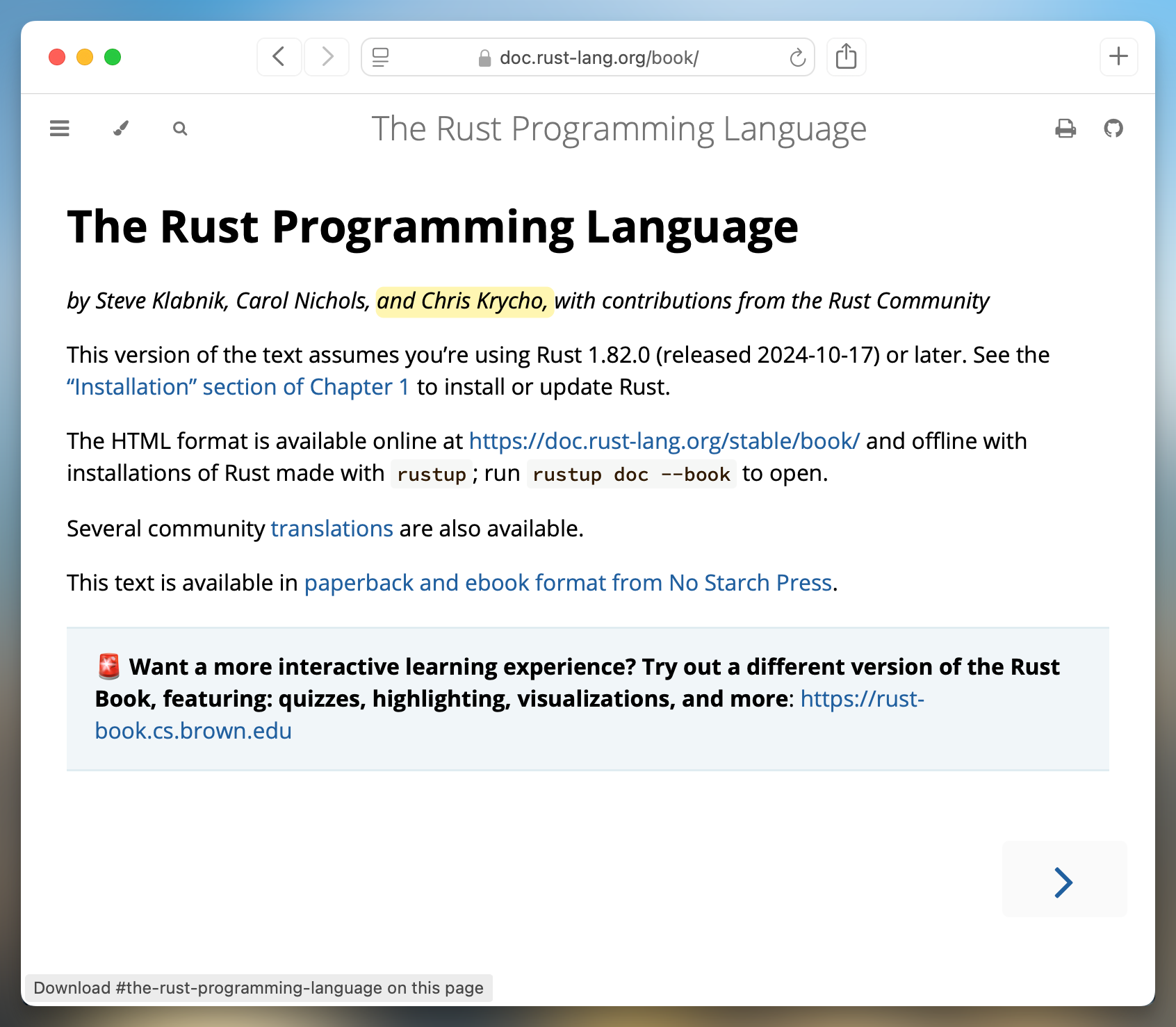
At a personal/professional level, having gotten to help *ship* this thing, by doing prepping the Book for the Edition and delivering a new (now stable! Go read it!) chapter on programming in was huge.

This is never going to stop being amazing to me.

Screenshot of the landing page for The Rust Programming Language book, featuring its normal text; the authors list includes “and Chris Krycho”, highlighted in yellow.
ALT text detailsScreenshot of the landing page for The Rust Programming Language book, featuring its normal text; the authors list includes “and Chris Krycho”, highlighted in yellow.
:rss: Qiita - 人気の記事's avatar
:rss: Qiita - 人気の記事

@qiita@rss-mstdn.studiofreesia.com

async/await を使った非同期処理の基本
qiita.com/kikotkk/items/abe9a3

iroh's avatar
iroh

@n0iroh@mastodon.social

We also wrote down some frustrations on recently: iroh.computer/blog/async-rust-

Lukas Valenta's avatar
Lukas Valenta

@lvalenta@mastodon.social

Have you ever tried using AsyncPublisher? I have. And some of its behavior has surprised me. I looked into it in-depth in my newest article, where I show how to use its behavior for your advantage, as well as how to get around its limitations. As you will see, some aspects can quite differ from observing publisher in Combine.

cleevio.com/blog/the-not-so-eq