
@mobileatom@flipboard.com
It's Time to Savor the Flavours of Bonfire. #bonfire #fediverse #manade #ActivityPub
Posted into THE FULCRUM: CODING FOR DEMOCRACY AND THE OMN @the-fulcrum-coding-for-democracy-and-the-omn-mobileatom
thefulcrum.dev
Hashtag
315 posts tagged with this hashtag.
It's Time to Savor the Flavours of Bonfire. #bonfire #fediverse #manade #ActivityPub
Posted into THE FULCRUM: CODING FOR DEMOCRACY AND THE OMN @the-fulcrum-coding-for-democracy-and-the-omn-mobileatom
thefulcrum.dev
It's Time to Savor the Flavours of Bonfire. #bonfire #fediverse #manade #ActivityPub
Posted into THE FULCRUM: CODING FOR DEMOCRACY AND THE OMN @the-fulcrum-coding-for-democracy-and-the-omn-mobileatom
thefulcrum.dev


just discovered another super interesting and needed work done by @s0hw@hci.social and @andresmh@hci.social platform.coop/blog/toward-wo...
"Aiming to shift control of delivery work away from a single entity, OpenCourier is a protocol that defines data formatting and communication across a decentralized network of delivery platforms, couriers, and service requesters. Broadly, we aim to enable an ecosystem (Fig. 1) that centers community-owned delivery platforms, where workers — who we refer to as couriers, given their work providing delivery services — cooperatively manage the platform they are a part of. "
📄 here the full paper dl.acm.org/doi/pdf/10.1145/3...
cc @mayel @lynnfoster@social.coop @bhaugen@social.coop #bonfire #valueflows

bonfire.cafe
A space for Bonfire maintainers and contributors to communicate


⁂ Fediverse meetup at #EGU26 🌍
Join us to exchange experiences and to talk about the potential fedi has to become a platform for scientific discussion and networking.
🗓️Thu, 07 May, 17:30–18:30
📍EGU networking zone – terrace G (Purple Level)
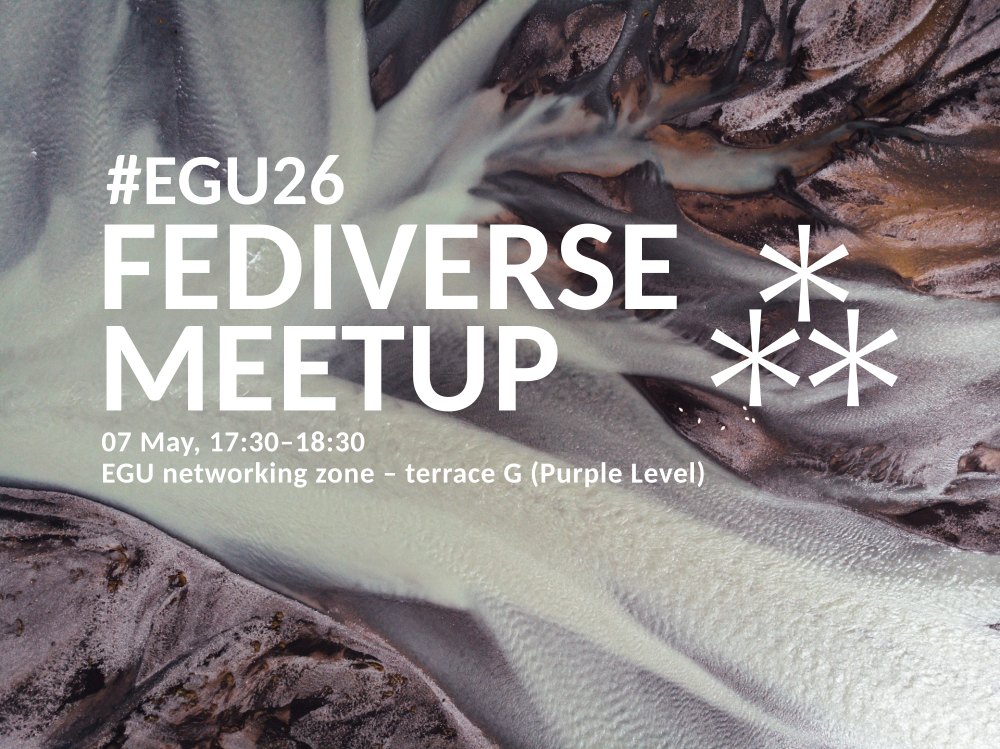
FEDIVERSE MEETUP at EGU26 Location and time available in this toot
⁂ Fediverse meetup at #EGU26 🌍
Join us to exchange experiences and to talk about the potential fedi has to become a platform for scientific discussion and networking.
🗓️Thu, 07 May, 17:30–18:30
📍EGU networking zone – terrace G (Purple Level)
FEDIVERSE MEETUP at EGU26 Location and time available in this toot
⁂ Fediverse meetup at #EGU26 🌍
Join us to exchange experiences and to talk about the potential fedi has to become a platform for scientific discussion and networking.
🗓️Thu, 07 May, 17:30–18:30
📍EGU networking zone – terrace G (Purple Level)
FEDIVERSE MEETUP at EGU26 Location and time available in this toot
⁂ Fediverse meetup at #EGU26 🌍
Join us to exchange experiences and to talk about the potential fedi has to become a platform for scientific discussion and networking.
🗓️Thu, 07 May, 17:30–18:30
📍EGU networking zone – terrace G (Purple Level)
FEDIVERSE MEETUP at EGU26 Location and time available in this toot

Nice to see ya on #bonfire @teaserbot 👋

As I understand it, Mastodon is building to the MLS in ActivityPub spec from the SWF - the same one #Bonfire and #Emissary are building to today. So it will be compatible with those.
I think Hollos uses the Signal protocol, which is similar, but not the same as MLS.
What other #E2EE solutions are you referring to?
swicg.github.io

Hmm. That said, I also seem to have lost the ability to update posts via the UI on #bonfire 1.0.2. I didn't spot exactly when the option disappeared from the menu.

bonfire.mavnn.eu
News and community around mavnn.eu projects.


A couple days ago, I got a DM from a #Bonfire user. I happily replied and sent
a follow request—but the Accept never came back, even though they hadn't
enabled manuallyApprovesFollowers. My DM reply probably never arrived either. Classic interop bug.
I checked out the Bonfire source and dug in. Turns out Bonfire hasn't implemented RFC 9421 yet, so it was silently discarding any activity signed with it. That alone would be workable, except for one more issue: Bonfire was responding 200 OK even when signature verification failed, instead of 401 Unauthorized.
This matters because Fedify implements a double-knocking mechanism—if a request signed with RFC 9421 fails, it retries with the older draft cavage signature. But since Bonfire returned 200 OK on the failed first knock, #Fedify had no reason to send a second one.
I filed two issues on the Bonfire #ActivityPub repo—one requesting RFC 9421 support, and one about returning 401 on invalid signatures. For the latter, I also sent a PR, which got merged pretty quickly: bonfire-networks/activity_pub#9.
That said, individual Bonfire instances won't pick up the fix until they actually deploy it. So in the meantime, I patched Hollo and Hackers' Pub to use draft-cavage-http-signatures-12 as the firstKnock, so Bonfire instances can at least understand the first request.
One last thing: Fedify caches whether a given server supports RFC 9421, and the Bonfire servers I'd already talked to were cached as “supports RFC 9421”—because they'd been returning 200 OK. I had to manually clear that cache on both hollo.social and hackers.pub before everything finally worked.
After all that, the mutual follow went through and my DM reply landed. Worth it.
fedify.dev
The Federation object is the main entry point of the Fedify library. This section explains the key features of the Federation object.
A couple days ago, I got a DM from a #Bonfire user. I happily replied and sent
a follow request—but the Accept never came back, even though they hadn't
enabled manuallyApprovesFollowers. My DM reply probably never arrived either. Classic interop bug.
I checked out the Bonfire source and dug in. Turns out Bonfire hasn't implemented RFC 9421 yet, so it was silently discarding any activity signed with it. That alone would be workable, except for one more issue: Bonfire was responding 200 OK even when signature verification failed, instead of 401 Unauthorized.
This matters because Fedify implements a double-knocking mechanism—if a request signed with RFC 9421 fails, it retries with the older draft cavage signature. But since Bonfire returned 200 OK on the failed first knock, #Fedify had no reason to send a second one.
I filed two issues on the Bonfire #ActivityPub repo—one requesting RFC 9421 support, and one about returning 401 on invalid signatures. For the latter, I also sent a PR, which got merged pretty quickly: bonfire-networks/activity_pub#9.
That said, individual Bonfire instances won't pick up the fix until they actually deploy it. So in the meantime, I patched Hollo and Hackers' Pub to use draft-cavage-http-signatures-12 as the firstKnock, so Bonfire instances can at least understand the first request.
One last thing: Fedify caches whether a given server supports RFC 9421, and the Bonfire servers I'd already talked to were cached as “supports RFC 9421”—because they'd been returning 200 OK. I had to manually clear that cache on both hollo.social and hackers.pub before everything finally worked.
After all that, the mutual follow went through and my DM reply landed. Worth it.
fedify.dev
The Federation object is the main entry point of the Fedify library. This section explains the key features of the Federation object.
A couple days ago, I got a DM from a #Bonfire user. I happily replied and sent
a follow request—but the Accept never came back, even though they hadn't
enabled manuallyApprovesFollowers. My DM reply probably never arrived either. Classic interop bug.
I checked out the Bonfire source and dug in. Turns out Bonfire hasn't implemented RFC 9421 yet, so it was silently discarding any activity signed with it. That alone would be workable, except for one more issue: Bonfire was responding 200 OK even when signature verification failed, instead of 401 Unauthorized.
This matters because Fedify implements a double-knocking mechanism—if a request signed with RFC 9421 fails, it retries with the older draft cavage signature. But since Bonfire returned 200 OK on the failed first knock, #Fedify had no reason to send a second one.
I filed two issues on the Bonfire #ActivityPub repo—one requesting RFC 9421 support, and one about returning 401 on invalid signatures. For the latter, I also sent a PR, which got merged pretty quickly: bonfire-networks/activity_pub#9.
That said, individual Bonfire instances won't pick up the fix until they actually deploy it. So in the meantime, I patched Hollo and Hackers' Pub to use draft-cavage-http-signatures-12 as the firstKnock, so Bonfire instances can at least understand the first request.
One last thing: Fedify caches whether a given server supports RFC 9421, and the Bonfire servers I'd already talked to were cached as “supports RFC 9421”—because they'd been returning 200 OK. I had to manually clear that cache on both hollo.social and hackers.pub before everything finally worked.
After all that, the mutual follow went through and my DM reply landed. Worth it.
fedify.dev
The Federation object is the main entry point of the Fedify library. This section explains the key features of the Federation object.
A couple days ago, I got a DM from a #Bonfire user. I happily replied and sent
a follow request—but the Accept never came back, even though they hadn't
enabled manuallyApprovesFollowers. My DM reply probably never arrived either. Classic interop bug.
I checked out the Bonfire source and dug in. Turns out Bonfire hasn't implemented RFC 9421 yet, so it was silently discarding any activity signed with it. That alone would be workable, except for one more issue: Bonfire was responding 200 OK even when signature verification failed, instead of 401 Unauthorized.
This matters because Fedify implements a double-knocking mechanism—if a request signed with RFC 9421 fails, it retries with the older draft cavage signature. But since Bonfire returned 200 OK on the failed first knock, #Fedify had no reason to send a second one.
I filed two issues on the Bonfire #ActivityPub repo—one requesting RFC 9421 support, and one about returning 401 on invalid signatures. For the latter, I also sent a PR, which got merged pretty quickly: bonfire-networks/activity_pub#9.
That said, individual Bonfire instances won't pick up the fix until they actually deploy it. So in the meantime, I patched Hollo and Hackers' Pub to use draft-cavage-http-signatures-12 as the firstKnock, so Bonfire instances can at least understand the first request.
One last thing: Fedify caches whether a given server supports RFC 9421, and the Bonfire servers I'd already talked to were cached as “supports RFC 9421”—because they'd been returning 200 OK. I had to manually clear that cache on both hollo.social and hackers.pub before everything finally worked.
After all that, the mutual follow went through and my DM reply landed. Worth it.
fedify.dev
The Federation object is the main entry point of the Fedify library. This section explains the key features of the Federation object.
A couple days ago, I got a DM from a #Bonfire user. I happily replied and sent
a follow request—but the Accept never came back, even though they hadn't
enabled manuallyApprovesFollowers. My DM reply probably never arrived either. Classic interop bug.
I checked out the Bonfire source and dug in. Turns out Bonfire hasn't implemented RFC 9421 yet, so it was silently discarding any activity signed with it. That alone would be workable, except for one more issue: Bonfire was responding 200 OK even when signature verification failed, instead of 401 Unauthorized.
This matters because Fedify implements a double-knocking mechanism—if a request signed with RFC 9421 fails, it retries with the older draft cavage signature. But since Bonfire returned 200 OK on the failed first knock, #Fedify had no reason to send a second one.
I filed two issues on the Bonfire #ActivityPub repo—one requesting RFC 9421 support, and one about returning 401 on invalid signatures. For the latter, I also sent a PR, which got merged pretty quickly: bonfire-networks/activity_pub#9.
That said, individual Bonfire instances won't pick up the fix until they actually deploy it. So in the meantime, I patched Hollo and Hackers' Pub to use draft-cavage-http-signatures-12 as the firstKnock, so Bonfire instances can at least understand the first request.
One last thing: Fedify caches whether a given server supports RFC 9421, and the Bonfire servers I'd already talked to were cached as “supports RFC 9421”—because they'd been returning 200 OK. I had to manually clear that cache on both hollo.social and hackers.pub before everything finally worked.
After all that, the mutual follow went through and my DM reply landed. Worth it.
fedify.dev
The Federation object is the main entry point of the Fedify library. This section explains the key features of the Federation object.
A couple days ago, I got a DM from a #Bonfire user. I happily replied and sent
a follow request—but the Accept never came back, even though they hadn't
enabled manuallyApprovesFollowers. My DM reply probably never arrived either. Classic interop bug.
I checked out the Bonfire source and dug in. Turns out Bonfire hasn't implemented RFC 9421 yet, so it was silently discarding any activity signed with it. That alone would be workable, except for one more issue: Bonfire was responding 200 OK even when signature verification failed, instead of 401 Unauthorized.
This matters because Fedify implements a double-knocking mechanism—if a request signed with RFC 9421 fails, it retries with the older draft cavage signature. But since Bonfire returned 200 OK on the failed first knock, #Fedify had no reason to send a second one.
I filed two issues on the Bonfire #ActivityPub repo—one requesting RFC 9421 support, and one about returning 401 on invalid signatures. For the latter, I also sent a PR, which got merged pretty quickly: bonfire-networks/activity_pub#9.
That said, individual Bonfire instances won't pick up the fix until they actually deploy it. So in the meantime, I patched Hollo and Hackers' Pub to use draft-cavage-http-signatures-12 as the firstKnock, so Bonfire instances can at least understand the first request.
One last thing: Fedify caches whether a given server supports RFC 9421, and the Bonfire servers I'd already talked to were cached as “supports RFC 9421”—because they'd been returning 200 OK. I had to manually clear that cache on both hollo.social and hackers.pub before everything finally worked.
After all that, the mutual follow went through and my DM reply landed. Worth it.
fedify.dev
The Federation object is the main entry point of the Fedify library. This section explains the key features of the Federation object.
A couple days ago, I got a DM from a #Bonfire user. I happily replied and sent
a follow request—but the Accept never came back, even though they hadn't
enabled manuallyApprovesFollowers. My DM reply probably never arrived either. Classic interop bug.
I checked out the Bonfire source and dug in. Turns out Bonfire hasn't implemented RFC 9421 yet, so it was silently discarding any activity signed with it. That alone would be workable, except for one more issue: Bonfire was responding 200 OK even when signature verification failed, instead of 401 Unauthorized.
This matters because Fedify implements a double-knocking mechanism—if a request signed with RFC 9421 fails, it retries with the older draft cavage signature. But since Bonfire returned 200 OK on the failed first knock, #Fedify had no reason to send a second one.
I filed two issues on the Bonfire #ActivityPub repo—one requesting RFC 9421 support, and one about returning 401 on invalid signatures. For the latter, I also sent a PR, which got merged pretty quickly: bonfire-networks/activity_pub#9.
That said, individual Bonfire instances won't pick up the fix until they actually deploy it. So in the meantime, I patched Hollo and Hackers' Pub to use draft-cavage-http-signatures-12 as the firstKnock, so Bonfire instances can at least understand the first request.
One last thing: Fedify caches whether a given server supports RFC 9421, and the Bonfire servers I'd already talked to were cached as “supports RFC 9421”—because they'd been returning 200 OK. I had to manually clear that cache on both hollo.social and hackers.pub before everything finally worked.
After all that, the mutual follow went through and my DM reply landed. Worth it.
fedify.dev
The Federation object is the main entry point of the Fedify library. This section explains the key features of the Federation object.
A couple days ago, I got a DM from a #Bonfire user. I happily replied and sent
a follow request—but the Accept never came back, even though they hadn't
enabled manuallyApprovesFollowers. My DM reply probably never arrived either. Classic interop bug.
I checked out the Bonfire source and dug in. Turns out Bonfire hasn't implemented RFC 9421 yet, so it was silently discarding any activity signed with it. That alone would be workable, except for one more issue: Bonfire was responding 200 OK even when signature verification failed, instead of 401 Unauthorized.
This matters because Fedify implements a double-knocking mechanism—if a request signed with RFC 9421 fails, it retries with the older draft cavage signature. But since Bonfire returned 200 OK on the failed first knock, #Fedify had no reason to send a second one.
I filed two issues on the Bonfire #ActivityPub repo—one requesting RFC 9421 support, and one about returning 401 on invalid signatures. For the latter, I also sent a PR, which got merged pretty quickly: bonfire-networks/activity_pub#9.
That said, individual Bonfire instances won't pick up the fix until they actually deploy it. So in the meantime, I patched Hollo and Hackers' Pub to use draft-cavage-http-signatures-12 as the firstKnock, so Bonfire instances can at least understand the first request.
One last thing: Fedify caches whether a given server supports RFC 9421, and the Bonfire servers I'd already talked to were cached as “supports RFC 9421”—because they'd been returning 200 OK. I had to manually clear that cache on both hollo.social and hackers.pub before everything finally worked.
After all that, the mutual follow went through and my DM reply landed. Worth it.
fedify.dev
The Federation object is the main entry point of the Fedify library. This section explains the key features of the Federation object.
Hi #fediverse and #ActivityPub developers!
I'm currently working on interoperability testing for #Hollo and #Fedify, and I need a #Bonfire account to test federation with their implementation.
Since there aren't many open public Bonfire instances available, I was wondering if any Bonfire instance admins out there would be willing to grant me a test account? It would be a huge help for improving interop! Let me know if you can help. Thanks!
Hi #fediverse and #ActivityPub developers!
I'm currently working on interoperability testing for #Hollo and #Fedify, and I need a #Bonfire account to test federation with their implementation.
Since there aren't many open public Bonfire instances available, I was wondering if any Bonfire instance admins out there would be willing to grant me a test account? It would be a huge help for improving interop! Let me know if you can help. Thanks!
A couple days ago, I got a DM from a #Bonfire user. I happily replied and sent
a follow request—but the Accept never came back, even though they hadn't
enabled manuallyApprovesFollowers. My DM reply probably never arrived either. Classic interop bug.
I checked out the Bonfire source and dug in. Turns out Bonfire hasn't implemented RFC 9421 yet, so it was silently discarding any activity signed with it. That alone would be workable, except for one more issue: Bonfire was responding 200 OK even when signature verification failed, instead of 401 Unauthorized.
This matters because Fedify implements a double-knocking mechanism—if a request signed with RFC 9421 fails, it retries with the older draft cavage signature. But since Bonfire returned 200 OK on the failed first knock, #Fedify had no reason to send a second one.
I filed two issues on the Bonfire #ActivityPub repo—one requesting RFC 9421 support, and one about returning 401 on invalid signatures. For the latter, I also sent a PR, which got merged pretty quickly: bonfire-networks/activity_pub#9.
That said, individual Bonfire instances won't pick up the fix until they actually deploy it. So in the meantime, I patched Hollo and Hackers' Pub to use draft-cavage-http-signatures-12 as the firstKnock, so Bonfire instances can at least understand the first request.
One last thing: Fedify caches whether a given server supports RFC 9421, and the Bonfire servers I'd already talked to were cached as “supports RFC 9421”—because they'd been returning 200 OK. I had to manually clear that cache on both hollo.social and hackers.pub before everything finally worked.
After all that, the mutual follow went through and my DM reply landed. Worth it.
fedify.dev
The Federation object is the main entry point of the Fedify library. This section explains the key features of the Federation object.
Hi #fediverse and #ActivityPub developers!
I'm currently working on interoperability testing for #Hollo and #Fedify, and I need a #Bonfire account to test federation with their implementation.
Since there aren't many open public Bonfire instances available, I was wondering if any Bonfire instance admins out there would be willing to grant me a test account? It would be a huge help for improving interop! Let me know if you can help. Thanks!
A couple days ago, I got a DM from a #Bonfire user. I happily replied and sent
a follow request—but the Accept never came back, even though they hadn't
enabled manuallyApprovesFollowers. My DM reply probably never arrived either. Classic interop bug.
I checked out the Bonfire source and dug in. Turns out Bonfire hasn't implemented RFC 9421 yet, so it was silently discarding any activity signed with it. That alone would be workable, except for one more issue: Bonfire was responding 200 OK even when signature verification failed, instead of 401 Unauthorized.
This matters because Fedify implements a double-knocking mechanism—if a request signed with RFC 9421 fails, it retries with the older draft cavage signature. But since Bonfire returned 200 OK on the failed first knock, #Fedify had no reason to send a second one.
I filed two issues on the Bonfire #ActivityPub repo—one requesting RFC 9421 support, and one about returning 401 on invalid signatures. For the latter, I also sent a PR, which got merged pretty quickly: bonfire-networks/activity_pub#9.
That said, individual Bonfire instances won't pick up the fix until they actually deploy it. So in the meantime, I patched Hollo and Hackers' Pub to use draft-cavage-http-signatures-12 as the firstKnock, so Bonfire instances can at least understand the first request.
One last thing: Fedify caches whether a given server supports RFC 9421, and the Bonfire servers I'd already talked to were cached as “supports RFC 9421”—because they'd been returning 200 OK. I had to manually clear that cache on both hollo.social and hackers.pub before everything finally worked.
After all that, the mutual follow went through and my DM reply landed. Worth it.
fedify.dev
The Federation object is the main entry point of the Fedify library. This section explains the key features of the Federation object.
A couple days ago, I got a DM from a #Bonfire user. I happily replied and sent
a follow request—but the Accept never came back, even though they hadn't
enabled manuallyApprovesFollowers. My DM reply probably never arrived either. Classic interop bug.
I checked out the Bonfire source and dug in. Turns out Bonfire hasn't implemented RFC 9421 yet, so it was silently discarding any activity signed with it. That alone would be workable, except for one more issue: Bonfire was responding 200 OK even when signature verification failed, instead of 401 Unauthorized.
This matters because Fedify implements a double-knocking mechanism—if a request signed with RFC 9421 fails, it retries with the older draft cavage signature. But since Bonfire returned 200 OK on the failed first knock, #Fedify had no reason to send a second one.
I filed two issues on the Bonfire #ActivityPub repo—one requesting RFC 9421 support, and one about returning 401 on invalid signatures. For the latter, I also sent a PR, which got merged pretty quickly: bonfire-networks/activity_pub#9.
That said, individual Bonfire instances won't pick up the fix until they actually deploy it. So in the meantime, I patched Hollo and Hackers' Pub to use draft-cavage-http-signatures-12 as the firstKnock, so Bonfire instances can at least understand the first request.
One last thing: Fedify caches whether a given server supports RFC 9421, and the Bonfire servers I'd already talked to were cached as “supports RFC 9421”—because they'd been returning 200 OK. I had to manually clear that cache on both hollo.social and hackers.pub before everything finally worked.
After all that, the mutual follow went through and my DM reply landed. Worth it.
fedify.dev
The Federation object is the main entry point of the Fedify library. This section explains the key features of the Federation object.
A couple days ago, I got a DM from a #Bonfire user. I happily replied and sent
a follow request—but the Accept never came back, even though they hadn't
enabled manuallyApprovesFollowers. My DM reply probably never arrived either. Classic interop bug.
I checked out the Bonfire source and dug in. Turns out Bonfire hasn't implemented RFC 9421 yet, so it was silently discarding any activity signed with it. That alone would be workable, except for one more issue: Bonfire was responding 200 OK even when signature verification failed, instead of 401 Unauthorized.
This matters because Fedify implements a double-knocking mechanism—if a request signed with RFC 9421 fails, it retries with the older draft cavage signature. But since Bonfire returned 200 OK on the failed first knock, #Fedify had no reason to send a second one.
I filed two issues on the Bonfire #ActivityPub repo—one requesting RFC 9421 support, and one about returning 401 on invalid signatures. For the latter, I also sent a PR, which got merged pretty quickly: bonfire-networks/activity_pub#9.
That said, individual Bonfire instances won't pick up the fix until they actually deploy it. So in the meantime, I patched Hollo and Hackers' Pub to use draft-cavage-http-signatures-12 as the firstKnock, so Bonfire instances can at least understand the first request.
One last thing: Fedify caches whether a given server supports RFC 9421, and the Bonfire servers I'd already talked to were cached as “supports RFC 9421”—because they'd been returning 200 OK. I had to manually clear that cache on both hollo.social and hackers.pub before everything finally worked.
After all that, the mutual follow went through and my DM reply landed. Worth it.
fedify.dev
The Federation object is the main entry point of the Fedify library. This section explains the key features of the Federation object.
A couple days ago, I got a DM from a #Bonfire user. I happily replied and sent
a follow request—but the Accept never came back, even though they hadn't
enabled manuallyApprovesFollowers. My DM reply probably never arrived either. Classic interop bug.
I checked out the Bonfire source and dug in. Turns out Bonfire hasn't implemented RFC 9421 yet, so it was silently discarding any activity signed with it. That alone would be workable, except for one more issue: Bonfire was responding 200 OK even when signature verification failed, instead of 401 Unauthorized.
This matters because Fedify implements a double-knocking mechanism—if a request signed with RFC 9421 fails, it retries with the older draft cavage signature. But since Bonfire returned 200 OK on the failed first knock, #Fedify had no reason to send a second one.
I filed two issues on the Bonfire #ActivityPub repo—one requesting RFC 9421 support, and one about returning 401 on invalid signatures. For the latter, I also sent a PR, which got merged pretty quickly: bonfire-networks/activity_pub#9.
That said, individual Bonfire instances won't pick up the fix until they actually deploy it. So in the meantime, I patched Hollo and Hackers' Pub to use draft-cavage-http-signatures-12 as the firstKnock, so Bonfire instances can at least understand the first request.
One last thing: Fedify caches whether a given server supports RFC 9421, and the Bonfire servers I'd already talked to were cached as “supports RFC 9421”—because they'd been returning 200 OK. I had to manually clear that cache on both hollo.social and hackers.pub before everything finally worked.
After all that, the mutual follow went through and my DM reply landed. Worth it.
fedify.dev
The Federation object is the main entry point of the Fedify library. This section explains the key features of the Federation object.

The recent Hollo 0.7.3 and 0.7.4 updates have improved interoperability with #Bonfire. The issue where sending/receiving DMs or mutual following with Bonfire wasn't working properly has been resolved.
Released on February 24, 2026. Fixed a federation interoperability bug where follow requests to some Bonfire instances could remain pending even after receiving Accept or Reject activities. Inbo...
A couple days ago, I got a DM from a #Bonfire user. I happily replied and sent
a follow request—but the Accept never came back, even though they hadn't
enabled manuallyApprovesFollowers. My DM reply probably never arrived either. Classic interop bug.
I checked out the Bonfire source and dug in. Turns out Bonfire hasn't implemented RFC 9421 yet, so it was silently discarding any activity signed with it. That alone would be workable, except for one more issue: Bonfire was responding 200 OK even when signature verification failed, instead of 401 Unauthorized.
This matters because Fedify implements a double-knocking mechanism—if a request signed with RFC 9421 fails, it retries with the older draft cavage signature. But since Bonfire returned 200 OK on the failed first knock, #Fedify had no reason to send a second one.
I filed two issues on the Bonfire #ActivityPub repo—one requesting RFC 9421 support, and one about returning 401 on invalid signatures. For the latter, I also sent a PR, which got merged pretty quickly: bonfire-networks/activity_pub#9.
That said, individual Bonfire instances won't pick up the fix until they actually deploy it. So in the meantime, I patched Hollo and Hackers' Pub to use draft-cavage-http-signatures-12 as the firstKnock, so Bonfire instances can at least understand the first request.
One last thing: Fedify caches whether a given server supports RFC 9421, and the Bonfire servers I'd already talked to were cached as “supports RFC 9421”—because they'd been returning 200 OK. I had to manually clear that cache on both hollo.social and hackers.pub before everything finally worked.
After all that, the mutual follow went through and my DM reply landed. Worth it.
fedify.dev
The Federation object is the main entry point of the Fedify library. This section explains the key features of the Federation object.
A couple days ago, I got a DM from a #Bonfire user. I happily replied and sent
a follow request—but the Accept never came back, even though they hadn't
enabled manuallyApprovesFollowers. My DM reply probably never arrived either. Classic interop bug.
I checked out the Bonfire source and dug in. Turns out Bonfire hasn't implemented RFC 9421 yet, so it was silently discarding any activity signed with it. That alone would be workable, except for one more issue: Bonfire was responding 200 OK even when signature verification failed, instead of 401 Unauthorized.
This matters because Fedify implements a double-knocking mechanism—if a request signed with RFC 9421 fails, it retries with the older draft cavage signature. But since Bonfire returned 200 OK on the failed first knock, #Fedify had no reason to send a second one.
I filed two issues on the Bonfire #ActivityPub repo—one requesting RFC 9421 support, and one about returning 401 on invalid signatures. For the latter, I also sent a PR, which got merged pretty quickly: bonfire-networks/activity_pub#9.
That said, individual Bonfire instances won't pick up the fix until they actually deploy it. So in the meantime, I patched Hollo and Hackers' Pub to use draft-cavage-http-signatures-12 as the firstKnock, so Bonfire instances can at least understand the first request.
One last thing: Fedify caches whether a given server supports RFC 9421, and the Bonfire servers I'd already talked to were cached as “supports RFC 9421”—because they'd been returning 200 OK. I had to manually clear that cache on both hollo.social and hackers.pub before everything finally worked.
After all that, the mutual follow went through and my DM reply landed. Worth it.
fedify.dev
The Federation object is the main entry point of the Fedify library. This section explains the key features of the Federation object.
The recent Hollo 0.7.3 and 0.7.4 updates have improved interoperability with #Bonfire. The issue where sending/receiving DMs or mutual following with Bonfire wasn't working properly has been resolved.
Released on February 24, 2026. Fixed a federation interoperability bug where follow requests to some Bonfire instances could remain pending even after receiving Accept or Reject activities. Inbo...
The recent Hollo 0.7.3 and 0.7.4 updates have improved interoperability with #Bonfire. The issue where sending/receiving DMs or mutual following with Bonfire wasn't working properly has been resolved.
Released on February 24, 2026. Fixed a federation interoperability bug where follow requests to some Bonfire instances could remain pending even after receiving Accept or Reject activities. Inbo...
Very cool, guys! Kudos!
#Bonfire is also working on encrypted DMs similar to Hollo. They’re using MLS, which is similar, but slightly different from the Signal protocol you’re using.
I know it’s a big request, but what are the chances of getting your #E2EE messages to work with Bonfire (and #Emissary) too?
It would be great for the Fediverse to have a unified E2EE standard in 2026.
Let me know if it’s a possibility. I’m happy to tour you through our work so far!
The recent Hollo 0.7.3 and 0.7.4 updates have improved interoperability with #Bonfire. The issue where sending/receiving DMs or mutual following with Bonfire wasn't working properly has been resolved.
Released on February 24, 2026. Fixed a federation interoperability bug where follow requests to some Bonfire instances could remain pending even after receiving Accept or Reject activities. Inbo...
The recent Hollo 0.7.3 and 0.7.4 updates have improved interoperability with #Bonfire. The issue where sending/receiving DMs or mutual following with Bonfire wasn't working properly has been resolved.
Released on February 24, 2026. Fixed a federation interoperability bug where follow requests to some Bonfire instances could remain pending even after receiving Accept or Reject activities. Inbo...

came across a thread by @LiquidParasyte about things they are coming across that need work or are broken on @Bonfire
https://indieweb.studio/post/01KJ0T79KGJRWHYTKWJJF4254R
#fedidev #bonfire
Hi #fediverse and #ActivityPub developers!
I'm currently working on interoperability testing for #Hollo and #Fedify, and I need a #Bonfire account to test federation with their implementation.
Since there aren't many open public Bonfire instances available, I was wondering if any Bonfire instance admins out there would be willing to grant me a test account? It would be a huge help for improving interop! Let me know if you can help. Thanks!
Hi #fediverse and #ActivityPub developers!
I'm currently working on interoperability testing for #Hollo and #Fedify, and I need a #Bonfire account to test federation with their implementation.
Since there aren't many open public Bonfire instances available, I was wondering if any Bonfire instance admins out there would be willing to grant me a test account? It would be a huge help for improving interop! Let me know if you can help. Thanks!
Hi #fediverse and #ActivityPub developers!
I'm currently working on interoperability testing for #Hollo and #Fedify, and I need a #Bonfire account to test federation with their implementation.
Since there aren't many open public Bonfire instances available, I was wondering if any Bonfire instance admins out there would be willing to grant me a test account? It would be a huge help for improving interop! Let me know if you can help. Thanks!
Hi #fediverse and #ActivityPub developers!
I'm currently working on interoperability testing for #Hollo and #Fedify, and I need a #Bonfire account to test federation with their implementation.
Since there aren't many open public Bonfire instances available, I was wondering if any Bonfire instance admins out there would be willing to grant me a test account? It would be a huge help for improving interop! Let me know if you can help. Thanks!
Hi #fediverse and #ActivityPub developers!
I'm currently working on interoperability testing for #Hollo and #Fedify, and I need a #Bonfire account to test federation with their implementation.
Since there aren't many open public Bonfire instances available, I was wondering if any Bonfire instance admins out there would be willing to grant me a test account? It would be a huge help for improving interop! Let me know if you can help. Thanks!
Hi #fediverse and #ActivityPub developers!
I'm currently working on interoperability testing for #Hollo and #Fedify, and I need a #Bonfire account to test federation with their implementation.
Since there aren't many open public Bonfire instances available, I was wondering if any Bonfire instance admins out there would be willing to grant me a test account? It would be a huge help for improving interop! Let me know if you can help. Thanks!
Hi #fediverse and #ActivityPub developers!
I'm currently working on interoperability testing for #Hollo and #Fedify, and I need a #Bonfire account to test federation with their implementation.
Since there aren't many open public Bonfire instances available, I was wondering if any Bonfire instance admins out there would be willing to grant me a test account? It would be a huge help for improving interop! Let me know if you can help. Thanks!
Hi #fediverse and #ActivityPub developers!
I'm currently working on interoperability testing for #Hollo and #Fedify, and I need a #Bonfire account to test federation with their implementation.
Since there aren't many open public Bonfire instances available, I was wondering if any Bonfire instance admins out there would be willing to grant me a test account? It would be a huge help for improving interop! Let me know if you can help. Thanks!
Hi #fediverse and #ActivityPub developers!
I'm currently working on interoperability testing for #Hollo and #Fedify, and I need a #Bonfire account to test federation with their implementation.
Since there aren't many open public Bonfire instances available, I was wondering if any Bonfire instance admins out there would be willing to grant me a test account? It would be a huge help for improving interop! Let me know if you can help. Thanks!
Hi #fediverse and #ActivityPub developers!
I'm currently working on interoperability testing for #Hollo and #Fedify, and I need a #Bonfire account to test federation with their implementation.
Since there aren't many open public Bonfire instances available, I was wondering if any Bonfire instance admins out there would be willing to grant me a test account? It would be a huge help for improving interop! Let me know if you can help. Thanks!
Hi #fediverse and #ActivityPub developers!
I'm currently working on interoperability testing for #Hollo and #Fedify, and I need a #Bonfire account to test federation with their implementation.
Since there aren't many open public Bonfire instances available, I was wondering if any Bonfire instance admins out there would be willing to grant me a test account? It would be a huge help for improving interop! Let me know if you can help. Thanks!
Hi #fediverse and #ActivityPub developers!
I'm currently working on interoperability testing for #Hollo and #Fedify, and I need a #Bonfire account to test federation with their implementation.
Since there aren't many open public Bonfire instances available, I was wondering if any Bonfire instance admins out there would be willing to grant me a test account? It would be a huge help for improving interop! Let me know if you can help. Thanks!
Hi #fediverse and #ActivityPub developers!
I'm currently working on interoperability testing for #Hollo and #Fedify, and I need a #Bonfire account to test federation with their implementation.
Since there aren't many open public Bonfire instances available, I was wondering if any Bonfire instance admins out there would be willing to grant me a test account? It would be a huge help for improving interop! Let me know if you can help. Thanks!
Hi #fediverse and #ActivityPub developers!
I'm currently working on interoperability testing for #Hollo and #Fedify, and I need a #Bonfire account to test federation with their implementation.
Since there aren't many open public Bonfire instances available, I was wondering if any Bonfire instance admins out there would be willing to grant me a test account? It would be a huge help for improving interop! Let me know if you can help. Thanks!
Hi #fediverse and #ActivityPub developers!
I'm currently working on interoperability testing for #Hollo and #Fedify, and I need a #Bonfire account to test federation with their implementation.
Since there aren't many open public Bonfire instances available, I was wondering if any Bonfire instance admins out there would be willing to grant me a test account? It would be a huge help for improving interop! Let me know if you can help. Thanks!
Hi #fediverse and #ActivityPub developers!
I'm currently working on interoperability testing for #Hollo and #Fedify, and I need a #Bonfire account to test federation with their implementation.
Since there aren't many open public Bonfire instances available, I was wondering if any Bonfire instance admins out there would be willing to grant me a test account? It would be a huge help for improving interop! Let me know if you can help. Thanks!
Hi #fediverse and #ActivityPub developers!
I'm currently working on interoperability testing for #Hollo and #Fedify, and I need a #Bonfire account to test federation with their implementation.
Since there aren't many open public Bonfire instances available, I was wondering if any Bonfire instance admins out there would be willing to grant me a test account? It would be a huge help for improving interop! Let me know if you can help. Thanks!
Hi #fediverse and #ActivityPub developers!
I'm currently working on interoperability testing for #Hollo and #Fedify, and I need a #Bonfire account to test federation with their implementation.
Since there aren't many open public Bonfire instances available, I was wondering if any Bonfire instance admins out there would be willing to grant me a test account? It would be a huge help for improving interop! Let me know if you can help. Thanks!
Hi #fediverse and #ActivityPub developers!
I'm currently working on interoperability testing for #Hollo and #Fedify, and I need a #Bonfire account to test federation with their implementation.
Since there aren't many open public Bonfire instances available, I was wondering if any Bonfire instance admins out there would be willing to grant me a test account? It would be a huge help for improving interop! Let me know if you can help. Thanks!
Hi #fediverse and #ActivityPub developers!
I'm currently working on interoperability testing for #Hollo and #Fedify, and I need a #Bonfire account to test federation with their implementation.
Since there aren't many open public Bonfire instances available, I was wondering if any Bonfire instance admins out there would be willing to grant me a test account? It would be a huge help for improving interop! Let me know if you can help. Thanks!
Hi #fediverse and #ActivityPub developers!
I'm currently working on interoperability testing for #Hollo and #Fedify, and I need a #Bonfire account to test federation with their implementation.
Since there aren't many open public Bonfire instances available, I was wondering if any Bonfire instance admins out there would be willing to grant me a test account? It would be a huge help for improving interop! Let me know if you can help. Thanks!
Hi #fediverse and #ActivityPub developers!
I'm currently working on interoperability testing for #Hollo and #Fedify, and I need a #Bonfire account to test federation with their implementation.
Since there aren't many open public Bonfire instances available, I was wondering if any Bonfire instance admins out there would be willing to grant me a test account? It would be a huge help for improving interop! Let me know if you can help. Thanks!
Hi #fediverse and #ActivityPub developers!
I'm currently working on interoperability testing for #Hollo and #Fedify, and I need a #Bonfire account to test federation with their implementation.
Since there aren't many open public Bonfire instances available, I was wondering if any Bonfire instance admins out there would be willing to grant me a test account? It would be a huge help for improving interop! Let me know if you can help. Thanks!
Hi #fediverse and #ActivityPub developers!
I'm currently working on interoperability testing for #Hollo and #Fedify, and I need a #Bonfire account to test federation with their implementation.
Since there aren't many open public Bonfire instances available, I was wondering if any Bonfire instance admins out there would be willing to grant me a test account? It would be a huge help for improving interop! Let me know if you can help. Thanks!
Hi #fediverse and #ActivityPub developers!
I'm currently working on interoperability testing for #Hollo and #Fedify, and I need a #Bonfire account to test federation with their implementation.
Since there aren't many open public Bonfire instances available, I was wondering if any Bonfire instance admins out there would be willing to grant me a test account? It would be a huge help for improving interop! Let me know if you can help. Thanks!
Hi #fediverse and #ActivityPub developers!
I'm currently working on interoperability testing for #Hollo and #Fedify, and I need a #Bonfire account to test federation with their implementation.
Since there aren't many open public Bonfire instances available, I was wondering if any Bonfire instance admins out there would be willing to grant me a test account? It would be a huge help for improving interop! Let me know if you can help. Thanks!
Hi #fediverse and #ActivityPub developers!
I'm currently working on interoperability testing for #Hollo and #Fedify, and I need a #Bonfire account to test federation with their implementation.
Since there aren't many open public Bonfire instances available, I was wondering if any Bonfire instance admins out there would be willing to grant me a test account? It would be a huge help for improving interop! Let me know if you can help. Thanks!
Hi #fediverse and #ActivityPub developers!
I'm currently working on interoperability testing for #Hollo and #Fedify, and I need a #Bonfire account to test federation with their implementation.
Since there aren't many open public Bonfire instances available, I was wondering if any Bonfire instance admins out there would be willing to grant me a test account? It would be a huge help for improving interop! Let me know if you can help. Thanks!
Hi #fediverse and #ActivityPub developers!
I'm currently working on interoperability testing for #Hollo and #Fedify, and I need a #Bonfire account to test federation with their implementation.
Since there aren't many open public Bonfire instances available, I was wondering if any Bonfire instance admins out there would be willing to grant me a test account? It would be a huge help for improving interop! Let me know if you can help. Thanks!
Hi #fediverse and #ActivityPub developers!
I'm currently working on interoperability testing for #Hollo and #Fedify, and I need a #Bonfire account to test federation with their implementation.
Since there aren't many open public Bonfire instances available, I was wondering if any Bonfire instance admins out there would be willing to grant me a test account? It would be a huge help for improving interop! Let me know if you can help. Thanks!
Hi #fediverse and #ActivityPub developers!
I'm currently working on interoperability testing for #Hollo and #Fedify, and I need a #Bonfire account to test federation with their implementation.
Since there aren't many open public Bonfire instances available, I was wondering if any Bonfire instance admins out there would be willing to grant me a test account? It would be a huge help for improving interop! Let me know if you can help. Thanks!
Hi #fediverse and #ActivityPub developers!
I'm currently working on interoperability testing for #Hollo and #Fedify, and I need a #Bonfire account to test federation with their implementation.
Since there aren't many open public Bonfire instances available, I was wondering if any Bonfire instance admins out there would be willing to grant me a test account? It would be a huge help for improving interop! Let me know if you can help. Thanks!
Hi #fediverse and #ActivityPub developers!
I'm currently working on interoperability testing for #Hollo and #Fedify, and I need a #Bonfire account to test federation with their implementation.
Since there aren't many open public Bonfire instances available, I was wondering if any Bonfire instance admins out there would be willing to grant me a test account? It would be a huge help for improving interop! Let me know if you can help. Thanks!
Hi #fediverse and #ActivityPub developers!
I'm currently working on interoperability testing for #Hollo and #Fedify, and I need a #Bonfire account to test federation with their implementation.
Since there aren't many open public Bonfire instances available, I was wondering if any Bonfire instance admins out there would be willing to grant me a test account? It would be a huge help for improving interop! Let me know if you can help. Thanks!
Hi #fediverse and #ActivityPub developers!
I'm currently working on interoperability testing for #Hollo and #Fedify, and I need a #Bonfire account to test federation with their implementation.
Since there aren't many open public Bonfire instances available, I was wondering if any Bonfire instance admins out there would be willing to grant me a test account? It would be a huge help for improving interop! Let me know if you can help. Thanks!
Hi #fediverse and #ActivityPub developers!
I'm currently working on interoperability testing for #Hollo and #Fedify, and I need a #Bonfire account to test federation with their implementation.
Since there aren't many open public Bonfire instances available, I was wondering if any Bonfire instance admins out there would be willing to grant me a test account? It would be a huge help for improving interop! Let me know if you can help. Thanks!

Gonna keep a running log of things about #bonfire that I hope get addressed in the future'
And.. you probably know, but just in case:
We have a solid spec for E2EE on the Fediverse now (https://swicg.github.io/activitypub-e2ee/mls) with #Emissary and #Bonfire launching later this year.
As you'd expect with end-to-end-encryption, *most* of the work is on the browser/client. The AP server changes are minimal: a new KeyPackage object to store, a new collection, & other small stuff.
When we have working JS code, it'll be AGPL, and you could use it as a baseline for Mastodon 😎
swicg.github.io



In case you missed it, @Bonfire and the Newsmast Foundation are working together!
You can see the announcement and what we're working on in this wonderful talk by the Bonfire team at @fosdem last week.
#SocialWeb #Bonfire #Building #Partnership #SocialMedia #Fediverse #Decentralised

fosdem.org
In case you missed it, @Bonfire and the Newsmast Foundation are working together!
You can see the announcement and what we're working on in this wonderful talk by the Bonfire team at @fosdem last week.
#SocialWeb #Bonfire #Building #Partnership #SocialMedia #Fediverse #Decentralised
fosdem.org
In case you missed it, @Bonfire and the Newsmast Foundation are working together!
You can see the announcement and what we're working on in this wonderful talk by the Bonfire team at @fosdem last week.
#SocialWeb #Bonfire #Building #Partnership #SocialMedia #Fediverse #Decentralised
fosdem.org
In case you missed it, @Bonfire and the Newsmast Foundation are working together!
You can see the announcement and what we're working on in this wonderful talk by the Bonfire team at @fosdem last week.
#SocialWeb #Bonfire #Building #Partnership #SocialMedia #Fediverse #Decentralised
fosdem.org
#Bonfire is working on E2EE together with other projects
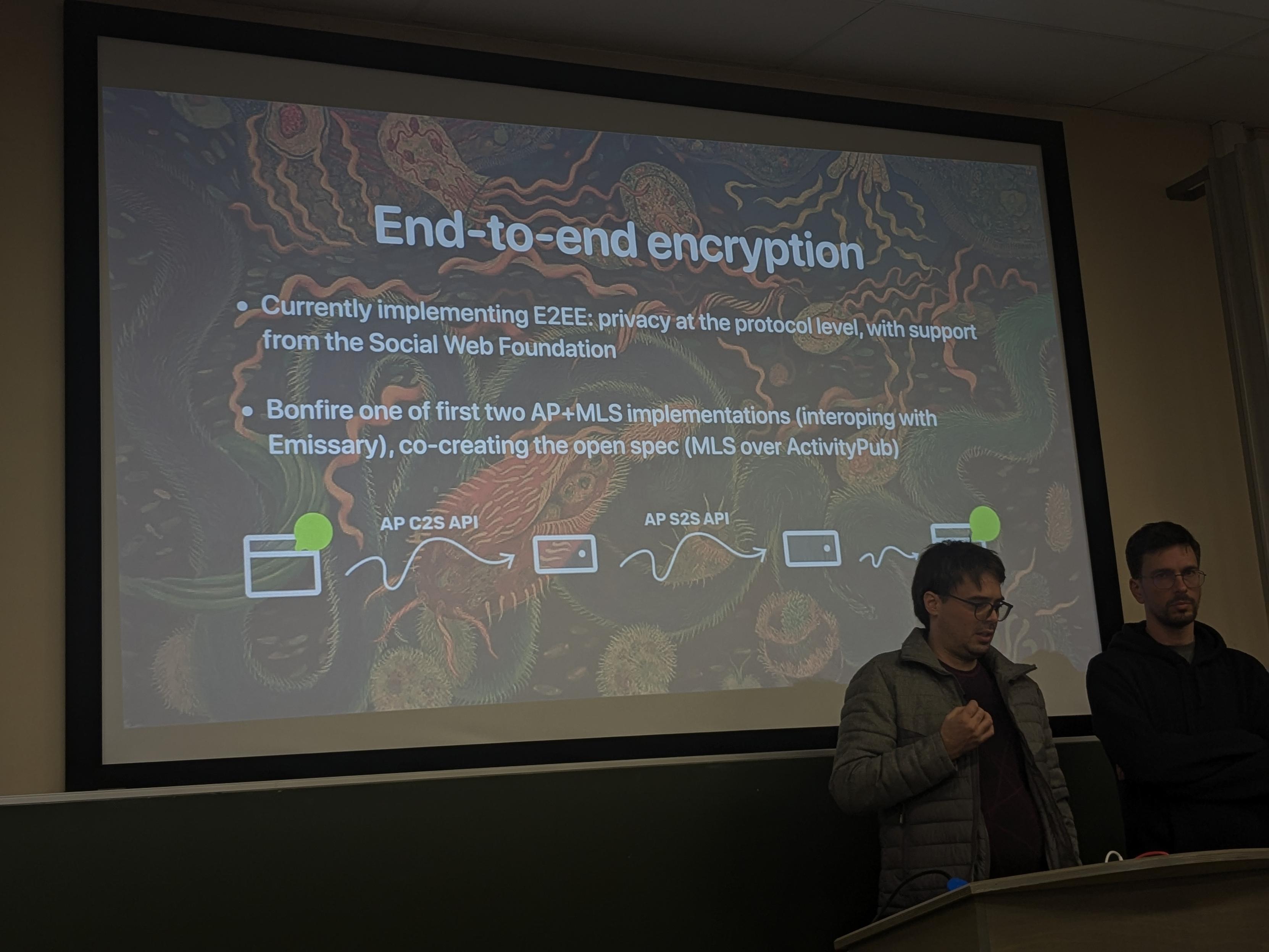
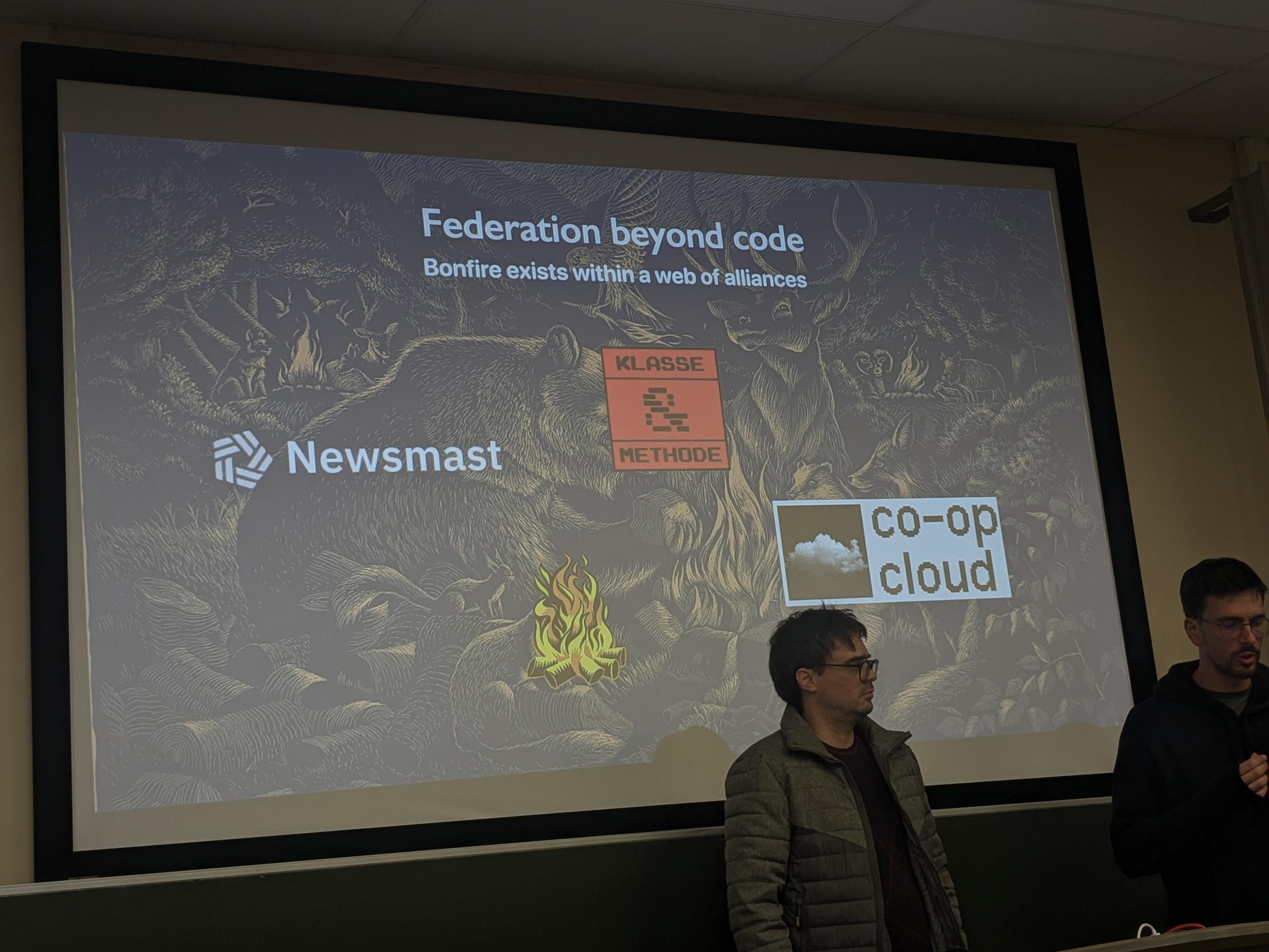
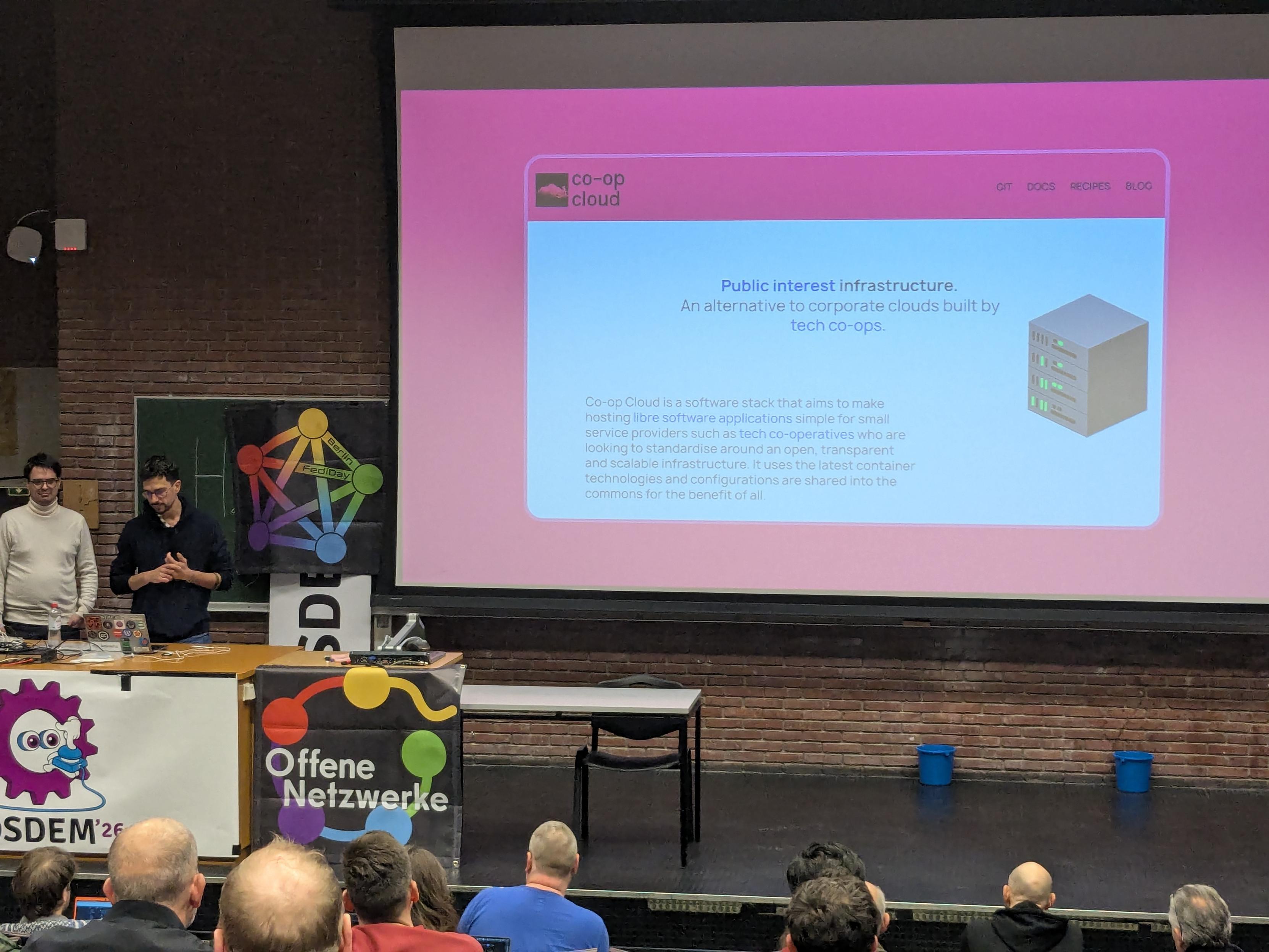
@coopcloud getting a shoutout from #Bonfire
Ich brauche mal Rückmeldung #fediverse
ich überlege, meinen Account bei Mastodon zu ändern. Ich habe drei Optionen :
1. Ich bleibe bei gruene.social
2. Ich wechsel zu #Friendica (selbst gehostet)
3. Ich wechsel zu #Bonfire (selbst gehostet)
Ich finde den Gedanken charmant, eine eigene Instanz zu haben. Hat aber sicher auch Nachteile.
ich bin für Hinweise und bessere Vorschläge offen.
Bonfire has just released a new version, which includes initial support for Mastodon API endpoints (interested how this will work, as Bonfire has sooo many more post control options)
And…initial work on an ActivityPub C2S API!
https://bonfirenetworks.org/posts/bonfire-1-0-1-building-momentum/

bonfirenetworks.org
We're back with an update focused on making your social web experience livelier, more connected, and truly yours. Plus updates on the crowdfunding campaign and what's next.
Bonfire has just released a new version, which includes initial support for Mastodon API endpoints (interested how this will work, as Bonfire has sooo many more post control options)
And…initial work on an ActivityPub C2S API!
https://bonfirenetworks.org/posts/bonfire-1-0-1-building-momentum/
bonfirenetworks.org
We're back with an update focused on making your social web experience livelier, more connected, and truly yours. Plus updates on the crowdfunding campaign and what's next.
Alongside a truckload of exciting updates, we're super thrilled to be featured in the latest update from @Bonfire 🔥
Check out the blog for a teaser on something new we'll be working with Bonfire to provide soon 👀
https://bonfirenetworks.org/posts/bonfire-1-0-1-building-momentum/
#SocialWeb #SocialMedia #Fediverse #Mastodon #Bonfire #DigitalCommunity
bonfirenetworks.org
We're back with an update focused on making your social web experience livelier, more connected, and truly yours. Plus updates on the crowdfunding campaign and what's next.
Alongside a truckload of exciting updates, we're super thrilled to be featured in the latest update from @Bonfire 🔥
Check out the blog for a teaser on something new we'll be working with Bonfire to provide soon 👀
https://bonfirenetworks.org/posts/bonfire-1-0-1-building-momentum/
#SocialWeb #SocialMedia #Fediverse #Mastodon #Bonfire #DigitalCommunity
bonfirenetworks.org
We're back with an update focused on making your social web experience livelier, more connected, and truly yours. Plus updates on the crowdfunding campaign and what's next.
commencing #Bonfire support
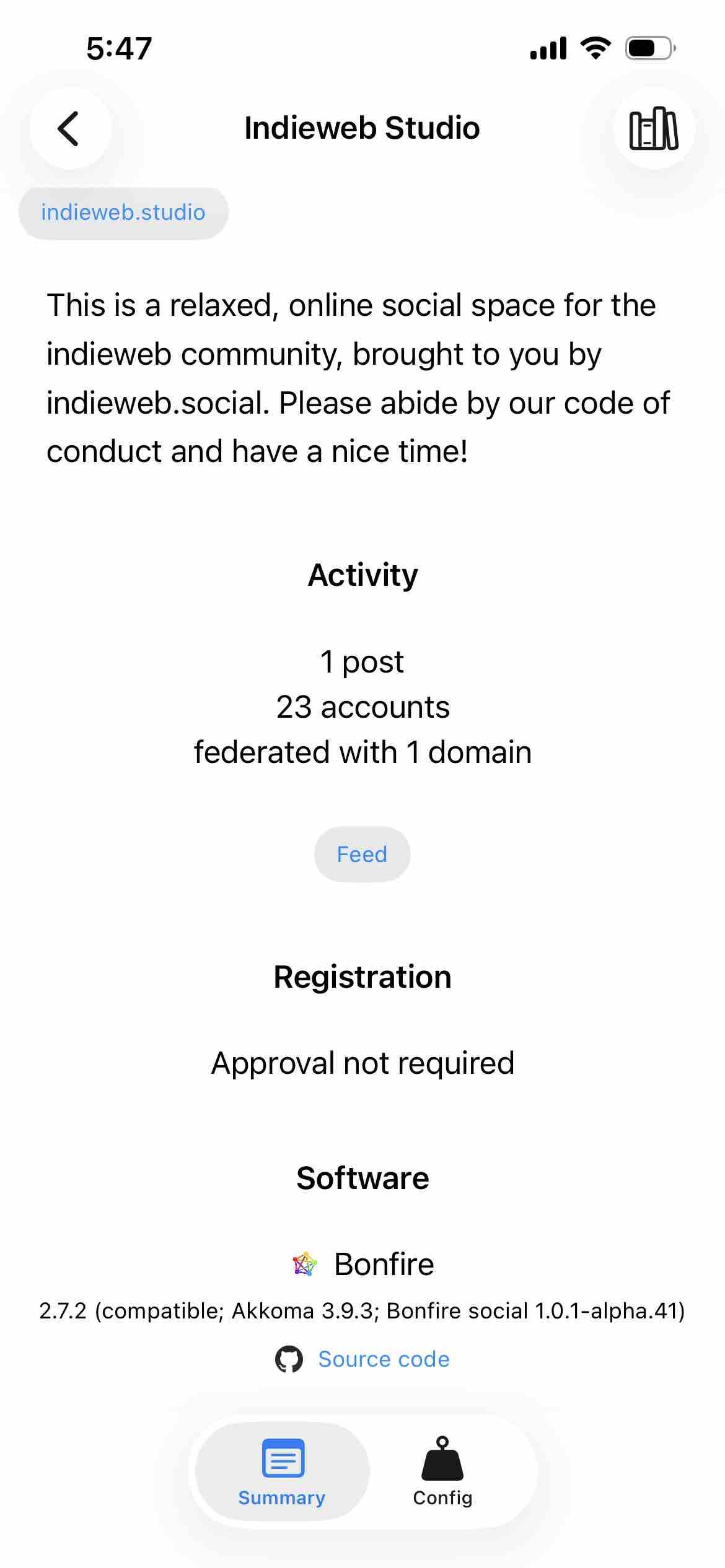
screenshot of a bonfire instance view including a feed button Begin detected text: 5:47Indieweb Studioindieweb.studioThis is a relaxed, online social space for theindieweb community, brought to you byindieweb.social. Please abide by our code ofconduct and have a nice time!Activity1 post23 accountsfederated with 1 domainFeedRegistrationApproval not requiredSoftwareBonfire2.7.2 (compatible; Akkoma 3.9.3; Bonfire social 1.0.1-alpha.41)• Source codeSummaryConfig End of detected text
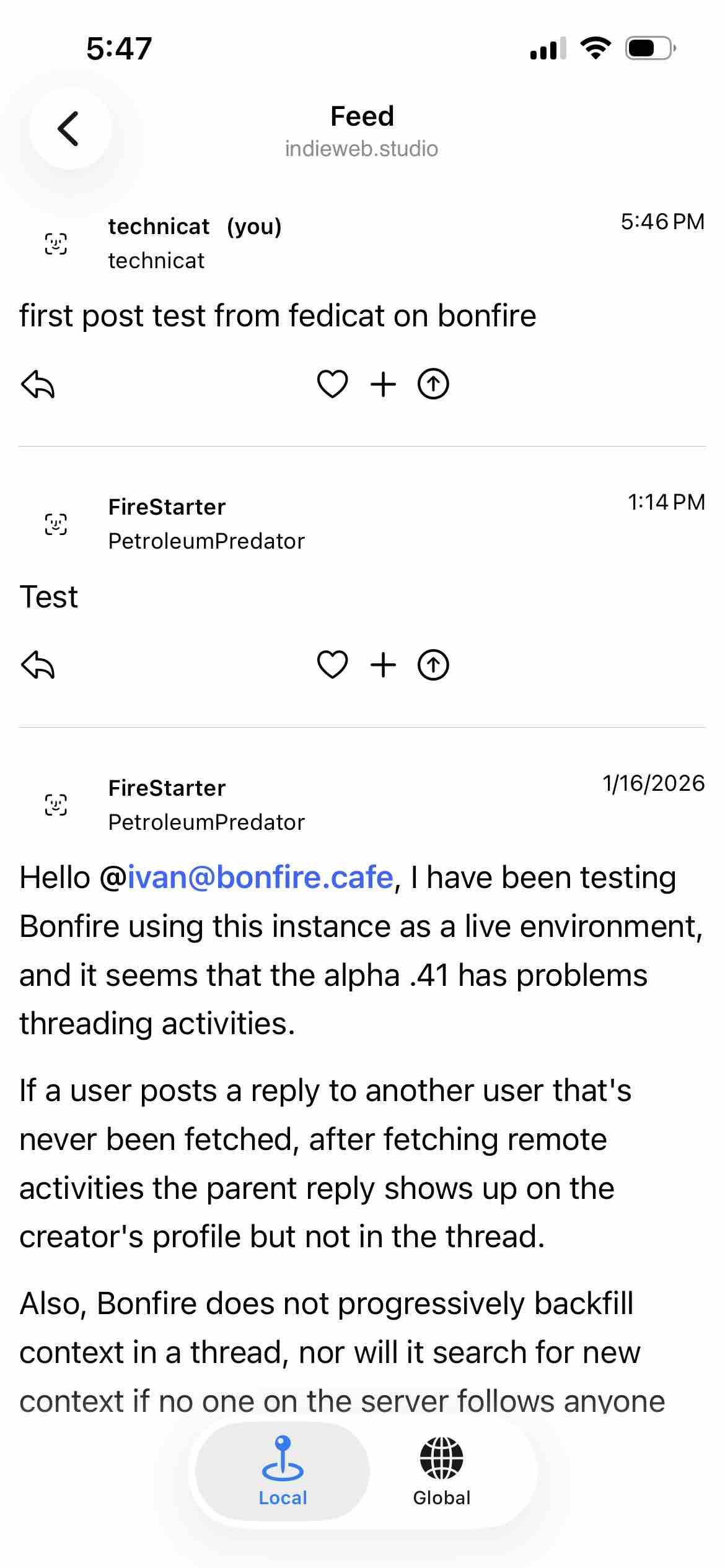
screenshot of a public feed for the instance Begin detected text: 5:47<Feedindieweb.studiotechnicat (you)technicatfirst post test from fedicat on bonfire+5:46 PMFireStarterPetroleumPredator1:14 PMTestFireStarterPetroleumPredator1/16/2026Hello @ivan@bonfire.cafe, I have been testingBonfire using this instance as a live environment,and it seems that the alpha .41 has problemsthreading activities.If a user posts a reply to another user that'snever been fetched, after fetching remoteactivities the parent reply shows up on thecreator's profile but not in the thread.Also, Bonfire does not progressively backfillcontext in a thread, nor will it search for newcontext if no one on the server follows anvoneLocalGlobal End of detected text
commencing #Bonfire support
screenshot of a bonfire instance view including a feed button Begin detected text: 5:47Indieweb Studioindieweb.studioThis is a relaxed, online social space for theindieweb community, brought to you byindieweb.social. Please abide by our code ofconduct and have a nice time!Activity1 post23 accountsfederated with 1 domainFeedRegistrationApproval not requiredSoftwareBonfire2.7.2 (compatible; Akkoma 3.9.3; Bonfire social 1.0.1-alpha.41)• Source codeSummaryConfig End of detected text
screenshot of a public feed for the instance Begin detected text: 5:47<Feedindieweb.studiotechnicat (you)technicatfirst post test from fedicat on bonfire+5:46 PMFireStarterPetroleumPredator1:14 PMTestFireStarterPetroleumPredator1/16/2026Hello @ivan@bonfire.cafe, I have been testingBonfire using this instance as a live environment,and it seems that the alpha .41 has problemsthreading activities.If a user posts a reply to another user that'snever been fetched, after fetching remoteactivities the parent reply shows up on thecreator's profile but not in the thread.Also, Bonfire does not progressively backfillcontext in a thread, nor will it search for newcontext if no one on the server follows anvoneLocalGlobal End of detected text

However, there are several Fediverse projects that offer such options. Hubzilla, (streams), forte, Bonfire. So there are ways to use the Fediverse with such options. Perhaps it is due to Mastodon's dominance that people are unaware of Fediverse projects that offer more privacy protection than Mastodon.
#privacy #hubzilla #forte #(streams) #bonfire #harassment
Here's your chance to see the fediverse platform Bonfire in action (without having to install it or create an account)
Our favorite fedi live streamer, @ozoned is going to be streaming an install and walk through soon (Jan 2 at 8 AM CST).
Add it to your calendars and #JoinIn
https://freestreamers.btfree.org/event/bonfire-install-and-config-livestream
freestreamers.btfree.org
Here's your chance to see the fediverse platform Bonfire in action (without having to install it or create an account)
Our favorite fedi live streamer, @ozoned is going to be streaming an install and walk through soon (Jan 2 at 8 AM CST).
Add it to your calendars and #JoinIn
https://freestreamers.btfree.org/event/bonfire-install-and-config-livestream
freestreamers.btfree.org
Here's your chance to see the fediverse platform Bonfire in action (without having to install it or create an account)
Our favorite fedi live streamer, @ozoned is going to be streaming an install and walk through soon (Jan 2 at 8 AM CST).
Add it to your calendars and #JoinIn
https://freestreamers.btfree.org/event/bonfire-install-and-config-livestream
freestreamers.btfree.org
Good day all!
We'll be moving this account to Bonfire at btfree.social ! So please make sure to follow https://btfree.social/@firesidefedi !
#peertube #FsF #firesidefedi #bonfire #vods #interviews #btfree #bigTechFree

btfree.social
BT Free is a non-profit organization founded by @ozoned@btfree.social . It's goal is for digital privacy rights, advocacy and consulting. This goal will be attained by hosting open platforms to allow
Good day all!
We'll be moving this account to Bonfire at btfree.social ! So please make sure to follow https://btfree.social/@firesidefedi !
#peertube #FsF #firesidefedi #bonfire #vods #interviews #btfree #bigTechFree
btfree.social
BT Free is a non-profit organization founded by @ozoned@btfree.social . It's goal is for digital privacy rights, advocacy and consulting. This goal will be attained by hosting open platforms to allow

Good day all!
Just as a reminder the that https://videos.firesidefedi.live will be moving to TubeFree.org !
https://tubefree.org/@ozoned
I'm also working on getting Bonfire running at btfree.social ! So please make sure to follow https://btfree.social/@ozoned !
#peertube #FsF #firesidefedi #bonfire #vods #interviews

btfree.social
BT Free is a non-profit organization founded by @ozoned@btfree.social . It's goal is for digital privacy rights, advocacy and consulting. This goal will be attained by hosting open platforms to allow

Good day all!
Just as a reminder the Fireside Fedi videos will be moving to TubeFree.org !
https://tubefree.org/@firesidefedi
I'm also working on getting Bonfire running at btfree.social ! So please make sure to follow https://btfree.social/@firesidefedi !
#peertube #FsF #firesidefedi #bonfire #vods #interviews
btfree.social
BT Free is a non-profit organization founded by @ozoned@btfree.social . It's goal is for digital privacy rights, advocacy and consulting. This goal will be attained by hosting open platforms to allow

One of the project areas of the Social Web Foundation for the last year has been end-to-end encrypted messaging. ActivityPub, the standard protocol that powers the Social Web, has privacy controls, but they do not protect the content of messages from server operators. Encrypted messaging has become a standard feature on most social networks since ActivityPub was created, and its lack has inhibited Social Web adoption and public trust in the network.
ActivityPub is extensible, though. As part of our E2EE program, Mallory, Tom and I adapted the Messaging Layer Security (MLS) standard as an extension of ActivityPub to make the MLS over ActivityPub specification. The protocol fits the great MLS E2EE system onto the ActivityPub API and federation protocol.
But a protocol specification is not enough; it must be implemented. That’s why we’re so happy to announce that the Sovereign Tech Fund has commissioned work with the Social Web Foundation to coordinate two new interoperable implementations of MLS over ActivityPub. This investment by the Sovereign Tech Fund will help move the Fediverse towards more privacy for social web users, no matter what server they use.
We decided to partner with two different projects in order to make sure that we’re making an open standard that can work between implementations. With two implementers, we’ll need to communicate clearly about architectural and implementation decisions, and make sure that those decisions end up in the final version of the spec — not in a TODO comment in the source code of a single project.
The first project is Emissary, the great social web application platform behind projects like Atlas and Bandwagon. Ben Pate, Emissary founder, says, “The Emissary Project is deeply committed to the Fediverse, where we are building a free and trustworthy Internet for all 8 billion humans. Delivering on that promise, Emissary is excited to team up with the Social Web Foundation to bring End-to-End-Encryption (E2EE) to the Fediverse. We are eternally grateful for the SWF’s leadership and support, without which this project could not have happened. Our work is already underway, and in 2026 anyone will be able to build E2EE applications on the Emissary platform.”
The second project is Bonfire. Bonfire is a modular framework for building federated apps, with its first app (Bonfire Social) offering a social networking experience enhanced with tools for privacy, trust, and collaboration (such as circles and boundaries).
The maintainers of Bonfire, Ivan Minutillo and Mayel de Borniol, said: “We think that end-to-end encryption should simply be the default for any private communication online. Working with the Social Web Foundation to bring E2EE to ActivityPub marks a crucial step in fostering privacy and trust, and especially in enabling the fediverse to become a safe space for activists and communities to organise, coordinate, and collaborate meaningfully. By making secure, user-friendly messaging a core part of the fediverse, we’re helping lay the groundwork for decentralised networks where people can go beyond talking in the mythical ‘global town square’ and actually organise and accomplish things together.”
This work will happen best if the Fediverse community tracks it closely. We’ll be making updates here on the SWF blog as progress continues. Developers and active users may also be interested in the ActivityPub E2EE Messaging Task Force at the W3C, where the specification is being developed into a report for the Social Web Community group. Finally, we’ll be using the #JustBetweenUs hashtag to share progress and ideas, so you can follow it to see what’s been happening.

socialwebfoundation.org
Posts about JustBetweenUs written by Evan Prodromou
What will this mean? We're working with extensions to ActivityPub to bring top-tier encryption into the Fediverse - the same industry standard that powers Android, Apple, Discord, and others.
We're aiming to release our first versions mid-year.
#Bonfire and #Emissary are great choices because each is a sort of "application builder" that can be molded to fit many different situations. It's going to be a massive undertaking, but I'm looking forward to the results

What will this mean? We're working with extensions to ActivityPub to bring top-tier encryption into the Fediverse - the same industry standard that powers Android, Apple, Discord, and others.
We're aiming to release our first versions mid-year.
#Bonfire and #Emissary are great choices because each is a sort of "application builder" that can be molded to fit many different situations. It's going to be a massive undertaking, but I'm looking forward to the results
What will this mean? We're working with extensions to ActivityPub to bring top-tier encryption into the Fediverse - the same industry standard that powers Android, Apple, Discord, and others.
We're aiming to release our first versions mid-year.
#Bonfire and #Emissary are great choices because each is a sort of "application builder" that can be molded to fit many different situations. It's going to be a massive undertaking, but I'm looking forward to the results
What will this mean? We're working with extensions to ActivityPub to bring top-tier encryption into the Fediverse - the same industry standard that powers Android, Apple, Discord, and others.
We're aiming to release our first versions mid-year.
#Bonfire and #Emissary are great choices because each is a sort of "application builder" that can be molded to fit many different situations. It's going to be a massive undertaking, but I'm looking forward to the results
One of the project areas of the Social Web Foundation for the last year has been end-to-end encrypted messaging. ActivityPub, the standard protocol that powers the Social Web, has privacy controls, but they do not protect the content of messages from server operators. Encrypted messaging has become a standard feature on most social networks since ActivityPub was created, and its lack has inhibited Social Web adoption and public trust in the network.
ActivityPub is extensible, though. As part of our E2EE program, Mallory, Tom and I adapted the Messaging Layer Security (MLS) standard as an extension of ActivityPub to make the MLS over ActivityPub specification. The protocol fits the great MLS E2EE system onto the ActivityPub API and federation protocol.
But a protocol specification is not enough; it must be implemented. That’s why we’re so happy to announce that the Sovereign Tech Fund has commissioned work with the Social Web Foundation to coordinate two new interoperable implementations of MLS over ActivityPub. This investment by the Sovereign Tech Fund will help move the Fediverse towards more privacy for social web users, no matter what server they use.
We decided to partner with two different projects in order to make sure that we’re making an open standard that can work between implementations. With two implementers, we’ll need to communicate clearly about architectural and implementation decisions, and make sure that those decisions end up in the final version of the spec — not in a TODO comment in the source code of a single project.
The first project is Emissary, the great social web application platform behind projects like Atlas and Bandwagon. Ben Pate, Emissary founder, says, “The Emissary Project is deeply committed to the Fediverse, where we are building a free and trustworthy Internet for all 8 billion humans. Delivering on that promise, Emissary is excited to team up with the Social Web Foundation to bring End-to-End-Encryption (E2EE) to the Fediverse. We are eternally grateful for the SWF’s leadership and support, without which this project could not have happened. Our work is already underway, and in 2026 anyone will be able to build E2EE applications on the Emissary platform.”
The second project is Bonfire. Bonfire is a modular framework for building federated apps, with its first app (Bonfire Social) offering a social networking experience enhanced with tools for privacy, trust, and collaboration (such as circles and boundaries).
The maintainers of Bonfire, Ivan Minutillo and Mayel de Borniol, said: “We think that end-to-end encryption should simply be the default for any private communication online. Working with the Social Web Foundation to bring E2EE to ActivityPub marks a crucial step in fostering privacy and trust, and especially in enabling the fediverse to become a safe space for activists and communities to organise, coordinate, and collaborate meaningfully. By making secure, user-friendly messaging a core part of the fediverse, we’re helping lay the groundwork for decentralised networks where people can go beyond talking in the mythical ‘global town square’ and actually organise and accomplish things together.”
This work will happen best if the Fediverse community tracks it closely. We’ll be making updates here on the SWF blog as progress continues. Developers and active users may also be interested in the ActivityPub E2EE Messaging Task Force at the W3C, where the specification is being developed into a report for the Social Web Community group. Finally, we’ll be using the #JustBetweenUs hashtag to share progress and ideas, so you can follow it to see what’s been happening.
socialwebfoundation.org
Posts about JustBetweenUs written by Evan Prodromou
One of the project areas of the Social Web Foundation for the last year has been end-to-end encrypted messaging. ActivityPub, the standard protocol that powers the Social Web, has privacy controls, but they do not protect the content of messages from server operators. Encrypted messaging has become a standard feature on most social networks since ActivityPub was created, and its lack has inhibited Social Web adoption and public trust in the network.
ActivityPub is extensible, though. As part of our E2EE program, Mallory, Tom and I adapted the Messaging Layer Security (MLS) standard as an extension of ActivityPub to make the MLS over ActivityPub specification. The protocol fits the great MLS E2EE system onto the ActivityPub API and federation protocol.
But a protocol specification is not enough; it must be implemented. That’s why we’re so happy to announce that the Sovereign Tech Fund has commissioned work with the Social Web Foundation to coordinate two new interoperable implementations of MLS over ActivityPub. This investment by the Sovereign Tech Fund will help move the Fediverse towards more privacy for social web users, no matter what server they use.
We decided to partner with two different projects in order to make sure that we’re making an open standard that can work between implementations. With two implementers, we’ll need to communicate clearly about architectural and implementation decisions, and make sure that those decisions end up in the final version of the spec — not in a TODO comment in the source code of a single project.
The first project is Emissary, the great social web application platform behind projects like Atlas and Bandwagon. Ben Pate, Emissary founder, says, “The Emissary Project is deeply committed to the Fediverse, where we are building a free and trustworthy Internet for all 8 billion humans. Delivering on that promise, Emissary is excited to team up with the Social Web Foundation to bring End-to-End-Encryption (E2EE) to the Fediverse. We are eternally grateful for the SWF’s leadership and support, without which this project could not have happened. Our work is already underway, and in 2026 anyone will be able to build E2EE applications on the Emissary platform.”
The second project is Bonfire. Bonfire is a modular framework for building federated apps, with its first app (Bonfire Social) offering a social networking experience enhanced with tools for privacy, trust, and collaboration (such as circles and boundaries).
The maintainers of Bonfire, Ivan Minutillo and Mayel de Borniol, said: “We think that end-to-end encryption should simply be the default for any private communication online. Working with the Social Web Foundation to bring E2EE to ActivityPub marks a crucial step in fostering privacy and trust, and especially in enabling the fediverse to become a safe space for activists and communities to organise, coordinate, and collaborate meaningfully. By making secure, user-friendly messaging a core part of the fediverse, we’re helping lay the groundwork for decentralised networks where people can go beyond talking in the mythical ‘global town square’ and actually organise and accomplish things together.”
This work will happen best if the Fediverse community tracks it closely. We’ll be making updates here on the SWF blog as progress continues. Developers and active users may also be interested in the ActivityPub E2EE Messaging Task Force at the W3C, where the specification is being developed into a report for the Social Web Community group. Finally, we’ll be using the #JustBetweenUs hashtag to share progress and ideas, so you can follow it to see what’s been happening.
socialwebfoundation.org
Posts about JustBetweenUs written by Evan Prodromou
One of the project areas of the Social Web Foundation for the last year has been end-to-end encrypted messaging. ActivityPub, the standard protocol that powers the Social Web, has privacy controls, but they do not protect the content of messages from server operators. Encrypted messaging has become a standard feature on most social networks since ActivityPub was created, and its lack has inhibited Social Web adoption and public trust in the network.
ActivityPub is extensible, though. As part of our E2EE program, Mallory, Tom and I adapted the Messaging Layer Security (MLS) standard as an extension of ActivityPub to make the MLS over ActivityPub specification. The protocol fits the great MLS E2EE system onto the ActivityPub API and federation protocol.
But a protocol specification is not enough; it must be implemented. That’s why we’re so happy to announce that the Sovereign Tech Fund has commissioned work with the Social Web Foundation to coordinate two new interoperable implementations of MLS over ActivityPub. This investment by the Sovereign Tech Fund will help move the Fediverse towards more privacy for social web users, no matter what server they use.
We decided to partner with two different projects in order to make sure that we’re making an open standard that can work between implementations. With two implementers, we’ll need to communicate clearly about architectural and implementation decisions, and make sure that those decisions end up in the final version of the spec — not in a TODO comment in the source code of a single project.
The first project is Emissary, the great social web application platform behind projects like Atlas and Bandwagon. Ben Pate, Emissary founder, says, “The Emissary Project is deeply committed to the Fediverse, where we are building a free and trustworthy Internet for all 8 billion humans. Delivering on that promise, Emissary is excited to team up with the Social Web Foundation to bring End-to-End-Encryption (E2EE) to the Fediverse. We are eternally grateful for the SWF’s leadership and support, without which this project could not have happened. Our work is already underway, and in 2026 anyone will be able to build E2EE applications on the Emissary platform.”
The second project is Bonfire. Bonfire is a modular framework for building federated apps, with its first app (Bonfire Social) offering a social networking experience enhanced with tools for privacy, trust, and collaboration (such as circles and boundaries).
The maintainers of Bonfire, Ivan Minutillo and Mayel de Borniol, said: “We think that end-to-end encryption should simply be the default for any private communication online. Working with the Social Web Foundation to bring E2EE to ActivityPub marks a crucial step in fostering privacy and trust, and especially in enabling the fediverse to become a safe space for activists and communities to organise, coordinate, and collaborate meaningfully. By making secure, user-friendly messaging a core part of the fediverse, we’re helping lay the groundwork for decentralised networks where people can go beyond talking in the mythical ‘global town square’ and actually organise and accomplish things together.”
This work will happen best if the Fediverse community tracks it closely. We’ll be making updates here on the SWF blog as progress continues. Developers and active users may also be interested in the ActivityPub E2EE Messaging Task Force at the W3C, where the specification is being developed into a report for the Social Web Community group. Finally, we’ll be using the #JustBetweenUs hashtag to share progress and ideas, so you can follow it to see what’s been happening.
socialwebfoundation.org
Posts about JustBetweenUs written by Evan Prodromou
One of the project areas of the Social Web Foundation for the last year has been end-to-end encrypted messaging. ActivityPub, the standard protocol that powers the Social Web, has privacy controls, but they do not protect the content of messages from server operators. Encrypted messaging has become a standard feature on most social networks since ActivityPub was created, and its lack has inhibited Social Web adoption and public trust in the network.
ActivityPub is extensible, though. As part of our E2EE program, Mallory, Tom and I adapted the Messaging Layer Security (MLS) standard as an extension of ActivityPub to make the MLS over ActivityPub specification. The protocol fits the great MLS E2EE system onto the ActivityPub API and federation protocol.
But a protocol specification is not enough; it must be implemented. That’s why we’re so happy to announce that the Sovereign Tech Fund has commissioned work with the Social Web Foundation to coordinate two new interoperable implementations of MLS over ActivityPub. This investment by the Sovereign Tech Fund will help move the Fediverse towards more privacy for social web users, no matter what server they use.
We decided to partner with two different projects in order to make sure that we’re making an open standard that can work between implementations. With two implementers, we’ll need to communicate clearly about architectural and implementation decisions, and make sure that those decisions end up in the final version of the spec — not in a TODO comment in the source code of a single project.
The first project is Emissary, the great social web application platform behind projects like Atlas and Bandwagon. Ben Pate, Emissary founder, says, “The Emissary Project is deeply committed to the Fediverse, where we are building a free and trustworthy Internet for all 8 billion humans. Delivering on that promise, Emissary is excited to team up with the Social Web Foundation to bring End-to-End-Encryption (E2EE) to the Fediverse. We are eternally grateful for the SWF’s leadership and support, without which this project could not have happened. Our work is already underway, and in 2026 anyone will be able to build E2EE applications on the Emissary platform.”
The second project is Bonfire. Bonfire is a modular framework for building federated apps, with its first app (Bonfire Social) offering a social networking experience enhanced with tools for privacy, trust, and collaboration (such as circles and boundaries).
The maintainers of Bonfire, Ivan Minutillo and Mayel de Borniol, said: “We think that end-to-end encryption should simply be the default for any private communication online. Working with the Social Web Foundation to bring E2EE to ActivityPub marks a crucial step in fostering privacy and trust, and especially in enabling the fediverse to become a safe space for activists and communities to organise, coordinate, and collaborate meaningfully. By making secure, user-friendly messaging a core part of the fediverse, we’re helping lay the groundwork for decentralised networks where people can go beyond talking in the mythical ‘global town square’ and actually organise and accomplish things together.”
This work will happen best if the Fediverse community tracks it closely. We’ll be making updates here on the SWF blog as progress continues. Developers and active users may also be interested in the ActivityPub E2EE Messaging Task Force at the W3C, where the specification is being developed into a report for the Social Web Community group. Finally, we’ll be using the #JustBetweenUs hashtag to share progress and ideas, so you can follow it to see what’s been happening.
socialwebfoundation.org
Posts about JustBetweenUs written by Evan Prodromou
One of the project areas of the Social Web Foundation for the last year has been end-to-end encrypted messaging. ActivityPub, the standard protocol that powers the Social Web, has privacy controls, but they do not protect the content of messages from server operators. Encrypted messaging has become a standard feature on most social networks since ActivityPub was created, and its lack has inhibited Social Web adoption and public trust in the network.
ActivityPub is extensible, though. As part of our E2EE program, Mallory, Tom and I adapted the Messaging Layer Security (MLS) standard as an extension of ActivityPub to make the MLS over ActivityPub specification. The protocol fits the great MLS E2EE system onto the ActivityPub API and federation protocol.
But a protocol specification is not enough; it must be implemented. That’s why we’re so happy to announce that the Sovereign Tech Fund has commissioned work with the Social Web Foundation to coordinate two new interoperable implementations of MLS over ActivityPub. This investment by the Sovereign Tech Fund will help move the Fediverse towards more privacy for social web users, no matter what server they use.
We decided to partner with two different projects in order to make sure that we’re making an open standard that can work between implementations. With two implementers, we’ll need to communicate clearly about architectural and implementation decisions, and make sure that those decisions end up in the final version of the spec — not in a TODO comment in the source code of a single project.
The first project is Emissary, the great social web application platform behind projects like Atlas and Bandwagon. Ben Pate, Emissary founder, says, “The Emissary Project is deeply committed to the Fediverse, where we are building a free and trustworthy Internet for all 8 billion humans. Delivering on that promise, Emissary is excited to team up with the Social Web Foundation to bring End-to-End-Encryption (E2EE) to the Fediverse. We are eternally grateful for the SWF’s leadership and support, without which this project could not have happened. Our work is already underway, and in 2026 anyone will be able to build E2EE applications on the Emissary platform.”
The second project is Bonfire. Bonfire is a modular framework for building federated apps, with its first app (Bonfire Social) offering a social networking experience enhanced with tools for privacy, trust, and collaboration (such as circles and boundaries).
The maintainers of Bonfire, Ivan Minutillo and Mayel de Borniol, said: “We think that end-to-end encryption should simply be the default for any private communication online. Working with the Social Web Foundation to bring E2EE to ActivityPub marks a crucial step in fostering privacy and trust, and especially in enabling the fediverse to become a safe space for activists and communities to organise, coordinate, and collaborate meaningfully. By making secure, user-friendly messaging a core part of the fediverse, we’re helping lay the groundwork for decentralised networks where people can go beyond talking in the mythical ‘global town square’ and actually organise and accomplish things together.”
This work will happen best if the Fediverse community tracks it closely. We’ll be making updates here on the SWF blog as progress continues. Developers and active users may also be interested in the ActivityPub E2EE Messaging Task Force at the W3C, where the specification is being developed into a report for the Social Web Community group. Finally, we’ll be using the #JustBetweenUs hashtag to share progress and ideas, so you can follow it to see what’s been happening.
socialwebfoundation.org
Posts about JustBetweenUs written by Evan Prodromou
One of the project areas of the Social Web Foundation for the last year has been end-to-end encrypted messaging. ActivityPub, the standard protocol that powers the Social Web, has privacy controls, but they do not protect the content of messages from server operators. Encrypted messaging has become a standard feature on most social networks since ActivityPub was created, and its lack has inhibited Social Web adoption and public trust in the network.
ActivityPub is extensible, though. As part of our E2EE program, Mallory, Tom and I adapted the Messaging Layer Security (MLS) standard as an extension of ActivityPub to make the MLS over ActivityPub specification. The protocol fits the great MLS E2EE system onto the ActivityPub API and federation protocol.
But a protocol specification is not enough; it must be implemented. That’s why we’re so happy to announce that the Sovereign Tech Fund has commissioned work with the Social Web Foundation to coordinate two new interoperable implementations of MLS over ActivityPub. This investment by the Sovereign Tech Fund will help move the Fediverse towards more privacy for social web users, no matter what server they use.
We decided to partner with two different projects in order to make sure that we’re making an open standard that can work between implementations. With two implementers, we’ll need to communicate clearly about architectural and implementation decisions, and make sure that those decisions end up in the final version of the spec — not in a TODO comment in the source code of a single project.
The first project is Emissary, the great social web application platform behind projects like Atlas and Bandwagon. Ben Pate, Emissary founder, says, “The Emissary Project is deeply committed to the Fediverse, where we are building a free and trustworthy Internet for all 8 billion humans. Delivering on that promise, Emissary is excited to team up with the Social Web Foundation to bring End-to-End-Encryption (E2EE) to the Fediverse. We are eternally grateful for the SWF’s leadership and support, without which this project could not have happened. Our work is already underway, and in 2026 anyone will be able to build E2EE applications on the Emissary platform.”
The second project is Bonfire. Bonfire is a modular framework for building federated apps, with its first app (Bonfire Social) offering a social networking experience enhanced with tools for privacy, trust, and collaboration (such as circles and boundaries).
The maintainers of Bonfire, Ivan Minutillo and Mayel de Borniol, said: “We think that end-to-end encryption should simply be the default for any private communication online. Working with the Social Web Foundation to bring E2EE to ActivityPub marks a crucial step in fostering privacy and trust, and especially in enabling the fediverse to become a safe space for activists and communities to organise, coordinate, and collaborate meaningfully. By making secure, user-friendly messaging a core part of the fediverse, we’re helping lay the groundwork for decentralised networks where people can go beyond talking in the mythical ‘global town square’ and actually organise and accomplish things together.”
This work will happen best if the Fediverse community tracks it closely. We’ll be making updates here on the SWF blog as progress continues. Developers and active users may also be interested in the ActivityPub E2EE Messaging Task Force at the W3C, where the specification is being developed into a report for the Social Web Community group. Finally, we’ll be using the #JustBetweenUs hashtag to share progress and ideas, so you can follow it to see what’s been happening.
socialwebfoundation.org
Posts about JustBetweenUs written by Evan Prodromou
There's only two days left to show @bonfire your support by donating to their crowdfunding campaign ‼️
They've already reached their goal, but let's see how far we can get on their super exciting stretch goals by showing the love with one last push! ❤️ 🔥
You can learn more and support here: https://www.indiegogo.com/en/projects/bonfire/community
#SocialWeb #Bonfire #Mastodon #Support #Fundraising #SocialMedia
2 DAYS LEFT! Help @bonfire hit their first #stretchgoal and let's keep #funding #open #web #development
https://www.indiegogo.com/en/projects/bonfire/community?refcode=uMxfxdtM7kaxrjwxZLShUA
#bonfire #fedi #fediverse #foss
2 DAYS LEFT! Help @bonfire hit their first #stretchgoal and let's keep #funding #open #web #development
https://www.indiegogo.com/en/projects/bonfire/community?refcode=uMxfxdtM7kaxrjwxZLShUA
#bonfire #fedi #fediverse #foss
There's only two days left to show @bonfire your support by donating to their crowdfunding campaign ‼️
They've already reached their goal, but let's see how far we can get on their super exciting stretch goals by showing the love with one last push! ❤️ 🔥
You can learn more and support here: https://www.indiegogo.com/en/projects/bonfire/community
#SocialWeb #Bonfire #Mastodon #Support #Fundraising #SocialMedia
There's only two days left to show @bonfire your support by donating to their crowdfunding campaign ‼️
They've already reached their goal, but let's see how far we can get on their super exciting stretch goals by showing the love with one last push! ❤️ 🔥
You can learn more and support here: https://www.indiegogo.com/en/projects/bonfire/community
#SocialWeb #Bonfire #Mastodon #Support #Fundraising #SocialMedia
Bonfire is the lego bricks of the fediverse, creating modular packages to build any kind of platform you can imagine.
The stretch goal is a community flavor that connects with the threadiverse at large.
You can help them click a few more bricks together, with some interesting reward options for your donation (for a very limited time - hurry!).
- Digital and physical artwork
- A Bonfire website theme
- 1-1 time with the devs

"Maintaining, continuing and repairing are care work. They’re foundational to any open‑source project. Maintenance is the unglamorous work that keeps people safe, tools usable, and the commons alive."
"People first, with tempo and budgets set by real lives. That's how the commons stays alive: not just through resilient code but through resilient relationships."
https://bonfirenetworks.org/posts/matters-of-care-why-maintenance-comes-first/

bonfirenetworks.org
It was not an easy choice to focus our crowdfunding campaign on care and maintenance as the condition sine qua non to consider it successful.
"Maintaining, continuing and repairing are care work. They’re foundational to any open‑source project. Maintenance is the unglamorous work that keeps people safe, tools usable, and the commons alive."
"People first, with tempo and budgets set by real lives. That's how the commons stays alive: not just through resilient code but through resilient relationships."
https://bonfirenetworks.org/posts/matters-of-care-why-maintenance-comes-first/
bonfirenetworks.org
It was not an easy choice to focus our crowdfunding campaign on care and maintenance as the condition sine qua non to consider it successful.

Only nine days left to find only 574€ to secure the first stone of a new home for open science: the Open Science Network is built on Bonfire... which is so close to its first goal.
Be the one who crosses the line to the first federated open infrastructure designed for hosting scientific discourse : https://www.indiegogo.com/projects/bonfire/community

Do you want to help people escape Big Tech and join the open social web? We need help to boost the Bonfire campaign. With #GivingTuesday momentum is on our side, but most people stuck on enshitified platforms only see content from people still active there.
If that's you, pick a template below (or write your own) and post it anywhere you have reach: Facebook (incl groups), LinkedIn, Twitter, email lists, Slack/Discord. Every share brings us closer to an open community‑governed internet. Thanks!
Bonfire is the lego bricks of the fediverse, creating modular packages to build any kind of platform you can imagine.
The stretch goal is a community flavor that connects with the threadiverse at large.
You can help them click a few more bricks together, with some interesting reward options for your donation (for a very limited time - hurry!).
- Digital and physical artwork
- A Bonfire website theme
- 1-1 time with the devs
Plus que neuf jours pour trouver les quelques 574 € afin de poser la première pierre de Bonfire, fondation de Open Science Network, le premier réseau fédéré pour la communication scientifique, sous le contrôle des communautés scientifiques.
Soyez celui ou celle qui franchit le seuil pour sécuriser le démarrage du projet : https://www.indiegogo.com/fr/projects/bonfire/community
#ScienceOuverte
#opensciencenetwork
#financementparticipatif
#bonfire
Do you want to help people escape Big Tech and join the open social web? We need help to boost the Bonfire campaign. With #GivingTuesday momentum is on our side, but most people stuck on enshitified platforms only see content from people still active there.
If that's you, pick a template below (or write your own) and post it anywhere you have reach: Facebook (incl groups), LinkedIn, Twitter, email lists, Slack/Discord. Every share brings us closer to an open community‑governed internet. Thanks!
Only nine days left to find only 574€ to secure the first stone of a new home for open science: the Open Science Network is built on Bonfire... which is so close to its first goal.
Be the one who crosses the line to the first federated open infrastructure designed for hosting scientific discourse : https://www.indiegogo.com/projects/bonfire/community
Do you want to help people escape Big Tech and join the open social web? We need help to boost the Bonfire campaign. With #GivingTuesday momentum is on our side, but most people stuck on enshitified platforms only see content from people still active there.
If that's you, pick a template below (or write your own) and post it anywhere you have reach: Facebook (incl groups), LinkedIn, Twitter, email lists, Slack/Discord. Every share brings us closer to an open community‑governed internet. Thanks!
Plus que neuf jours pour trouver les quelques 574 € afin de poser la première pierre de Bonfire, fondation de Open Science Network, le premier réseau fédéré pour la communication scientifique, sous le contrôle des communautés scientifiques.
Soyez celui ou celle qui franchit le seuil pour sécuriser le démarrage du projet : https://www.indiegogo.com/fr/projects/bonfire/community
#ScienceOuverte
#opensciencenetwork
#financementparticipatif
#bonfire
Do you want to help people escape Big Tech and join the open social web? We need help to boost the Bonfire campaign. With #GivingTuesday momentum is on our side, but most people stuck on enshitified platforms only see content from people still active there.
If that's you, pick a template below (or write your own) and post it anywhere you have reach: Facebook (incl groups), LinkedIn, Twitter, email lists, Slack/Discord. Every share brings us closer to an open community‑governed internet. Thanks!
Only nine days left to find only 574€ to secure the first stone of a new home for open science: the Open Science Network is built on Bonfire... which is so close to its first goal.
Be the one who crosses the line to the first federated open infrastructure designed for hosting scientific discourse : https://www.indiegogo.com/projects/bonfire/community
Do you want to help people escape Big Tech and join the open social web? We need help to boost the Bonfire campaign. With #GivingTuesday momentum is on our side, but most people stuck on enshitified platforms only see content from people still active there.
If that's you, pick a template below (or write your own) and post it anywhere you have reach: Facebook (incl groups), LinkedIn, Twitter, email lists, Slack/Discord. Every share brings us closer to an open community‑governed internet. Thanks!

In the Fediverse track at SFSCon, Mayel de Borniol and Ivan Minutillo spoke about:
Bonfire: Public Interest Social Networks


#ORCID authentication, #OpenAlex integration, #Zenodo #DOI generation etc. This community owned open science example based on #Bonfire looks very promising. Have a look at https://openscience.network
#openscience #federation @bonfire

openscience.network
Reclaim scientific discourse with federated digital spaces where researchers shape their own conversations, data, and collaborations
#ORCID authentication, #OpenAlex integration, #Zenodo #DOI generation etc. This community owned open science example based on #Bonfire looks very promising. Have a look at https://openscience.network
#openscience #federation @bonfire
openscience.network
Reclaim scientific discourse with federated digital spaces where researchers shape their own conversations, data, and collaborations

Perfect, many thanks for your work on this! 🙏🙌
Please keep on going and communicate a lot about #science #communication on the #Fediverse!
❓Is there a blog post that explains the #OpenSocialNetwork project? Why #Bonfire? Which features of the fediverse benefit science? What are your goals? etc.
#SciComm #WissComm #ORCID #FediCampus #Wissenschaft #university #Universität #sovereignty #digitalsovereignty #UnisInsFediverse #Xit

Très content d’avoir pu parler de notre instance #Mastodon, de @bonfire et de l’initiative #OpenSocialNetwork en perspectives durant notre assemblée générale @unif d’hiver.
J’espère que certains de nos établissements membres ou de nos partenaires publics nous demanderons de nous impliquer plus dans ce futur de la recherche scientifique !
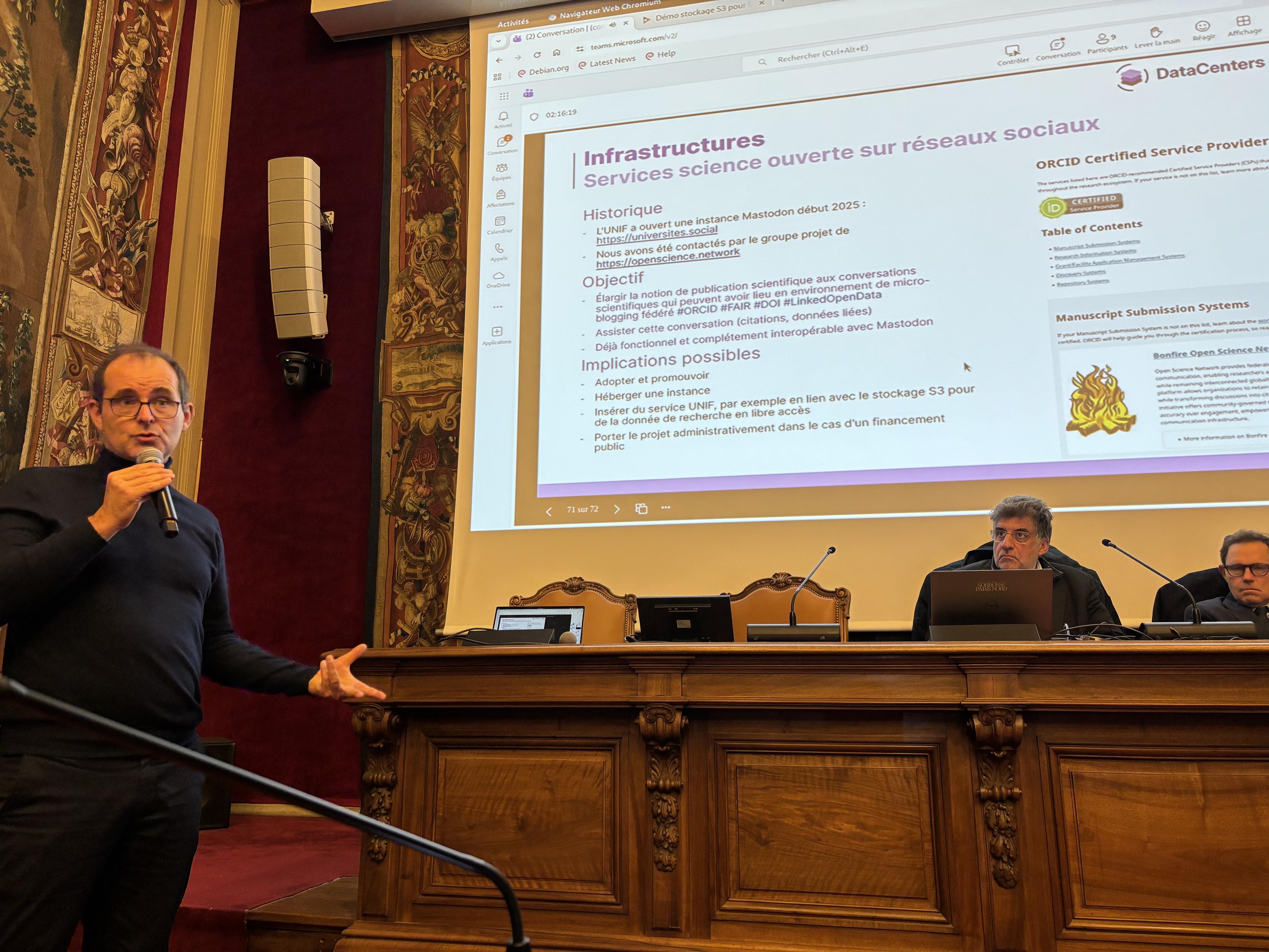
Photo prise dans la salle du Sénat de l’université Paris Cité, reconnaissable à ses tentures. Je tiens le micro à gauche et sur la droite se trouvent à La Tribune le directeur de l’UNIF, Dominique Bascle et Gilles Roussel président de son assemblée général. L’écran au dessus d’eux affiche une page de présentation où l’on reconnaît en bas à droite le logo de bonfire.
Très content d’avoir pu parler de notre instance #Mastodon, de @bonfire et de l’initiative #OpenSocialNetwork en perspectives durant notre assemblée générale @unif d’hiver.
J’espère que certains de nos établissements membres ou de nos partenaires publics nous demanderons de nous impliquer plus dans ce futur de la recherche scientifique !
Photo prise dans la salle du Sénat de l’université Paris Cité, reconnaissable à ses tentures. Je tiens le micro à gauche et sur la droite se trouvent à La Tribune le directeur de l’UNIF, Dominique Bascle et Gilles Roussel président de son assemblée général. L’écran au dessus d’eux affiche une page de présentation où l’on reconnaît en bas à droite le logo de bonfire.
Très content d’avoir pu parler de notre instance #Mastodon, de @bonfire et de l’initiative #OpenSocialNetwork en perspectives durant notre assemblée générale @unif d’hiver.
J’espère que certains de nos établissements membres ou de nos partenaires publics nous demanderons de nous impliquer plus dans ce futur de la recherche scientifique !
Photo prise dans la salle du Sénat de l’université Paris Cité, reconnaissable à ses tentures. Je tiens le micro à gauche et sur la droite se trouvent à La Tribune le directeur de l’UNIF, Dominique Bascle et Gilles Roussel président de son assemblée général. L’écran au dessus d’eux affiche une page de présentation où l’on reconnaît en bas à droite le logo de bonfire.

Oooh, neat -- #Bonfire has gotten to the 1.0 stage, and is now fundraising to take the project to the next level: https://www.indiegogo.com/en/projects/bonfire/community
tl;dr -- Bonfire is a very serious-looking project to build a really good #Fediverse social network. The roadmap has all the features I've been looking for in a Facebook replacement for clubs like the #SCA.
Check it out, and consider supporting it!
Scholarly communication can be open, community-owned and interconnected: https://openscience.network/
#openscience #bonfire #science #academia
openscience.network
Reclaim scientific discourse with federated digital spaces where researchers shape their own conversations, data, and collaborations

social.biblioco.de
Scholarly communication can be open, community-owned and interconnected: https://openscience.network/
#openscience #bonfire #science #academia
openscience.network
Reclaim scientific discourse with federated digital spaces where researchers shape their own conversations, data, and collaborations

Looking at the previous issue of Fediverse Report, which discusses Bonfire in more detail, I notice that Bonfire gives a ton of control over who can interact with posts, crucially including reply controls
I've seen a number of women and Black people on Fedi mention reply controls as a sorely-needed safety/anti-harassment feature, so I hope there can be some good public Bonfire servers soon
https://connectedplaces.online/reports/fediverse-report-141-2/

connectedplaces.online
Fediverse community platform Bonfire launches, together with a crowdfunding campaign. Mastodon now officially quote posts, and a fediverse client for the Media Liberation Day campaign.

Fediverse Report – #141
Bonfire Social has officially launched as version 1.0, and with it, the team has also launched a crowdfunding campaign to fund continued maintenance and the next phase of development. The campaign seeks to build federated groups, events, governance tools, shared moderation systems, and end-to-end encryption, among other features.
The team describes Bonfire as open, community-first infrastructure, and their design is explicitly for communities rather than individual people. They are focused on collective governance, shared spaces, and tools for organising rather than just content sharing. The team describes this as a “third path” between blockchain’s emphasis on individual sovereignty and Big Tech’s centralisation, one that centers collective care and community autonomy. Bonfire sees a large role for community servers, and this is how they explicitly position their software. There is no flagship Bonfire server, and that is not something the developers aspire to either. The entire goal for Bonfire is to create a network of smaller interconnected communities, and have these communities collectively govern the Bonfire software they are using.
This community-focused philosophy is reflected in Bonfire’s technical architecture, which prioritises flexibility and local control. Bonfire takes a highly modular approach to building fediverse software. At its core is Bonfire a large set of software modules, called the Bonfire Toolkit. These modules all perform a small function of a social networking platform, there is a module that handles your social graph, a module that implements ActivityPub, a module that implements search, a module for a microblogging-like UI, and many more. A collection of modules is called a flavour. This is a selection of modules and settings that together form a complete package for a social platform. The Bonfire team currently has two flavours: Bonfire Social, and the Open Science Network. The Bonfire Social flavour is the social networking platform, that has microblogging as well as various other features. The Bonfire Social flavour is also what is now released as Bonfire Social 1.0, ready for people to start using. The Open Science Network flavour creates a social platform with features relevant to the science community, such as logging in wit ORCID or Zenodo, and support for creating and displaying DOIs. The next part is the server. A server admin picks a flavour to install, but can manually also make changes to the flavour. The Bonfire Social flavour comes with the Bonfire UI module, but a server admin can select a different UI module if they so desire, giving their Bonfire Social server a completely different UI.
These architectural choices enable Bonfire Social 1.0’s feature set, which gives communities and people high levels of control. Bonfire Social 1.0 includes several features that distinguish it from standard fediverse microblogging platforms. Circles function as private-by-default groups of people (such as “local friends” or “mutual aid crew”), each with their own dedicated feed showing posts from members. Custom feeds a simple interface to filter and sort by content type, date, engagement, and other parameters, then save these configurations as presets.
A single account can create multiple independent profiles, each with its own followers, content, and settings. Profiles can also be shared between users, enabling collaborative accounts for projects or organisations. The platform emphasises portability, allowing users to import posts (with or without replies) when migrating from another instance, and export or import their entire social data (follows, posts, blocks, etc), with a migration dashboard to make things clearer.
Bonfire is strongly focused on giving people full control over their social networking presence. For the developers, this means continually finding a balance between how to give people access to all the different options, while not overwhelming people. This tension is visible in the UI for creating posts, where people can define the boundaries for who can access and interact with a post on a highly granular detail.
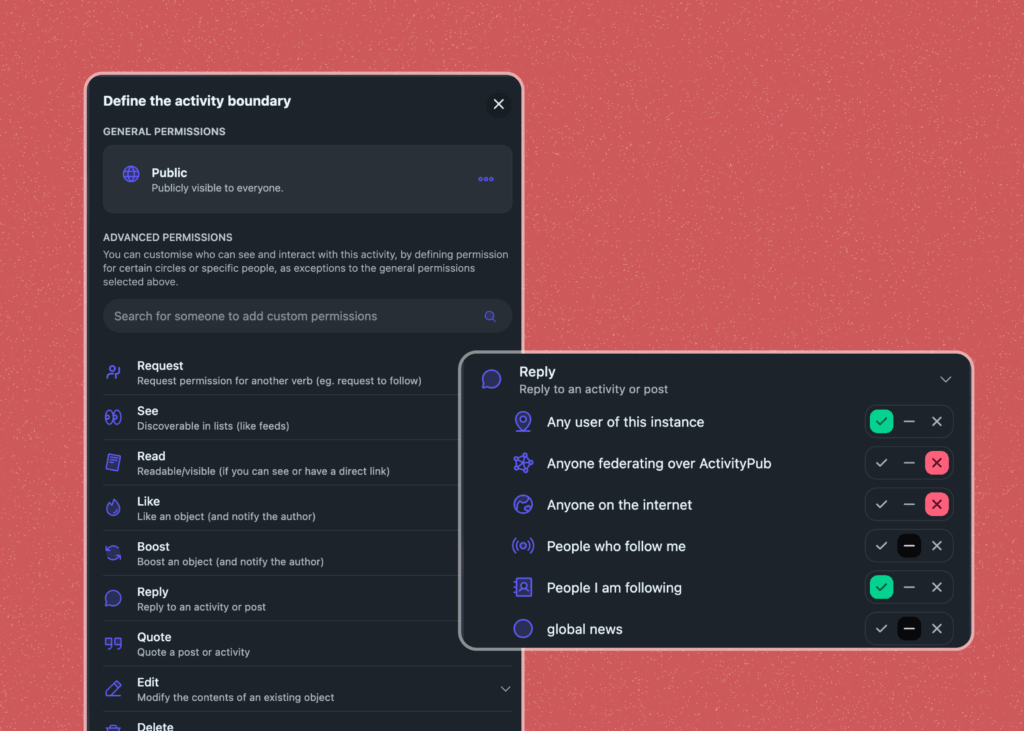
Each item on this list has a further dropdown that give a person the option what group of people this setting applies to.
This explosion of granular settings makes default settings even more important, and the developers are keenly aware of this. They see a large role for server admins in this, who have a large number of options for setting default values, and can organise the default settings of their server in a way that aligns with the needs of their community.
The crowdfunding campaign outlines an ambitious development roadmap, with goals structured as progressive funding tiers. The foundational goal funds ongoing maintenance, security updates, performance improvements, and community support to ensure Bonfire remains reliable. Subsequent goals introduce major new features. Federated groups would enable communities to create shared spaces with their own rules, roles, and moderation that work across Bonfire instances and other ActivityPub platforms. An events and calendars system, developed in collaboration with LAUTI, would interoperate with Mobilizon, Gancio, and Gathio. Governance tools based on sociocracy and consent-based decision-making would provide everything from quick polls to deep deliberation, with transparent records and flexible methods.
The campaign also promises shared moderation infrastructure developed with IFTAS and other safety-focused organisations, allowing moderators to coordinate across instances. End-to-end encryption for direct messages and group chats would use the MLS standard, developed in partnership with the Social Web Foundation. ATProtocol/Bluesky bridges, built with A New Social (Bridgy Fed), would enable interoperability and migration between protocols.
The breadth of partnerships reflects Bonfire’s collaborative development model: each feature is being co-designed with organisations bringing domain expertise, from Princeton HCI’s research on collective governance to Co-op Cloud’s work on community hosting infrastructure. Whether Bonfire’s community-first approach will attract the communities it’s designed for remains to be seen, but the 1.0 release and crowdfunding campaign represent a significant bet that the fediverse needs infrastructure explicitly designed for collective organising rather than individual expression.
UK activist group Media Revolution has launched Mo-Me, a new fediverse client, in collaboration with the Newsmast Foundation. The launch coincides with the group’s “Media Liberation Day” campaign targeting billionaire media ownership. The pitch of Mo-Me is editorially curated channels, rather than algorithmic or purely chronological feeds, with Newsmast providing the infrastructure while Media Revolution handles curation and moderation.
Mo-Me is fundamentally a fediverse client, that has been integrated with Newsmast’s channel.org to give users extra feeds (channels) to access. You can log in with your existing Mastodon account, or create an account on the Mo-Me server. If you log in with an existing Mastodon account, you see you a tab with your home timeline like any other Mastodon client. There are two additional tabs: a For You feed, with recommended posts, and a Channels tab, that gives a large variety of feeds/channels. It is unclear how the For You recommender algorithm works however. The channels tab mainly shows the channels created by Newsmast, which take in posts from the entire fediverse around topics like politics and climate change, with a set of filters and curation applied to it.
The modular nature of ActivityPub make it accessible for organisations like Media Revolution to not only criticise the current state of the media, but also present their own solutions. How this will impact their campaign and if people will start using the Mo-Me app remains to be seen. Mo-Me is available on iOS, Android and web.
The Social Web Foundation is hosting the Social Web Devroom at FOSDEM 2026, similar to their event at last year’s FOSDEM. FOSDEM is a open source software event in Brussels, from January 31 to February 1, 2026, and features discussion tracks (“devrooms”) for a variety of different technology topics. The SWF is now inviting people to submit talks about the fediverse and ActivityPub. Last year’s Social Web Devroom was fully packed, and it’ll be exciting to see what people will be presenting in this edition.
Mastodon has officially launched version 4.5. The organisation has been slowly rolling out the new version with various release candidates, and it has been available for a while on the mastodon.social servers. With this official launch 4.5 is now available to everyone. The main features of 4.5 are quote posts, and the ability for servers to show missing replies. The features have showing up for a bit now in the fediverse, that’s why I’m not writing extensively about it now. Especially regarding quote posts I’m mainly interested in revisiting the topic after they’ve been out for a while. One of the main aspects holding back implementing quote posts was the fear of how they would change fediverse culture for the worse (via encouraging dunking), and it’ll be interesting to see in a while how quote posts have impacted fediverse culture in practice.
The latest update for Mastodon also comes with additional features for server admins. There is now the option to disable some of the live feeds (the local and federated timelines) for visitors and/or logged-in users. There are now also some additional moderation features, with better support for block specific usernames, as well as displaying additional context in the moderation interace.
https://connectedplaces.online/reports/fediverse-report-141-2/

Detail of the city Luik
Looking at the previous issue of Fediverse Report, which discusses Bonfire in more detail, I notice that Bonfire gives a ton of control over who can interact with posts, crucially including reply controls
I've seen a number of women and Black people on Fedi mention reply controls as a sorely-needed safety/anti-harassment feature, so I hope there can be some good public Bonfire servers soon
https://connectedplaces.online/reports/fediverse-report-141-2/
connectedplaces.online
Fediverse community platform Bonfire launches, together with a crowdfunding campaign. Mastodon now officially quote posts, and a fediverse client for the Media Liberation Day campaign.
Fediverse Report – #141
Bonfire Social has officially launched as version 1.0, and with it, the team has also launched a crowdfunding campaign to fund continued maintenance and the next phase of development. The campaign seeks to build federated groups, events, governance tools, shared moderation systems, and end-to-end encryption, among other features.
The team describes Bonfire as open, community-first infrastructure, and their design is explicitly for communities rather than individual people. They are focused on collective governance, shared spaces, and tools for organising rather than just content sharing. The team describes this as a “third path” between blockchain’s emphasis on individual sovereignty and Big Tech’s centralisation, one that centers collective care and community autonomy. Bonfire sees a large role for community servers, and this is how they explicitly position their software. There is no flagship Bonfire server, and that is not something the developers aspire to either. The entire goal for Bonfire is to create a network of smaller interconnected communities, and have these communities collectively govern the Bonfire software they are using.
This community-focused philosophy is reflected in Bonfire’s technical architecture, which prioritises flexibility and local control. Bonfire takes a highly modular approach to building fediverse software. At its core is Bonfire a large set of software modules, called the Bonfire Toolkit. These modules all perform a small function of a social networking platform, there is a module that handles your social graph, a module that implements ActivityPub, a module that implements search, a module for a microblogging-like UI, and many more. A collection of modules is called a flavour. This is a selection of modules and settings that together form a complete package for a social platform. The Bonfire team currently has two flavours: Bonfire Social, and the Open Science Network. The Bonfire Social flavour is the social networking platform, that has microblogging as well as various other features. The Bonfire Social flavour is also what is now released as Bonfire Social 1.0, ready for people to start using. The Open Science Network flavour creates a social platform with features relevant to the science community, such as logging in wit ORCID or Zenodo, and support for creating and displaying DOIs. The next part is the server. A server admin picks a flavour to install, but can manually also make changes to the flavour. The Bonfire Social flavour comes with the Bonfire UI module, but a server admin can select a different UI module if they so desire, giving their Bonfire Social server a completely different UI.
These architectural choices enable Bonfire Social 1.0’s feature set, which gives communities and people high levels of control. Bonfire Social 1.0 includes several features that distinguish it from standard fediverse microblogging platforms. Circles function as private-by-default groups of people (such as “local friends” or “mutual aid crew”), each with their own dedicated feed showing posts from members. Custom feeds a simple interface to filter and sort by content type, date, engagement, and other parameters, then save these configurations as presets.
A single account can create multiple independent profiles, each with its own followers, content, and settings. Profiles can also be shared between users, enabling collaborative accounts for projects or organisations. The platform emphasises portability, allowing users to import posts (with or without replies) when migrating from another instance, and export or import their entire social data (follows, posts, blocks, etc), with a migration dashboard to make things clearer.
Bonfire is strongly focused on giving people full control over their social networking presence. For the developers, this means continually finding a balance between how to give people access to all the different options, while not overwhelming people. This tension is visible in the UI for creating posts, where people can define the boundaries for who can access and interact with a post on a highly granular detail.
Each item on this list has a further dropdown that give a person the option what group of people this setting applies to.
This explosion of granular settings makes default settings even more important, and the developers are keenly aware of this. They see a large role for server admins in this, who have a large number of options for setting default values, and can organise the default settings of their server in a way that aligns with the needs of their community.
The crowdfunding campaign outlines an ambitious development roadmap, with goals structured as progressive funding tiers. The foundational goal funds ongoing maintenance, security updates, performance improvements, and community support to ensure Bonfire remains reliable. Subsequent goals introduce major new features. Federated groups would enable communities to create shared spaces with their own rules, roles, and moderation that work across Bonfire instances and other ActivityPub platforms. An events and calendars system, developed in collaboration with LAUTI, would interoperate with Mobilizon, Gancio, and Gathio. Governance tools based on sociocracy and consent-based decision-making would provide everything from quick polls to deep deliberation, with transparent records and flexible methods.
The campaign also promises shared moderation infrastructure developed with IFTAS and other safety-focused organisations, allowing moderators to coordinate across instances. End-to-end encryption for direct messages and group chats would use the MLS standard, developed in partnership with the Social Web Foundation. ATProtocol/Bluesky bridges, built with A New Social (Bridgy Fed), would enable interoperability and migration between protocols.
The breadth of partnerships reflects Bonfire’s collaborative development model: each feature is being co-designed with organisations bringing domain expertise, from Princeton HCI’s research on collective governance to Co-op Cloud’s work on community hosting infrastructure. Whether Bonfire’s community-first approach will attract the communities it’s designed for remains to be seen, but the 1.0 release and crowdfunding campaign represent a significant bet that the fediverse needs infrastructure explicitly designed for collective organising rather than individual expression.
UK activist group Media Revolution has launched Mo-Me, a new fediverse client, in collaboration with the Newsmast Foundation. The launch coincides with the group’s “Media Liberation Day” campaign targeting billionaire media ownership. The pitch of Mo-Me is editorially curated channels, rather than algorithmic or purely chronological feeds, with Newsmast providing the infrastructure while Media Revolution handles curation and moderation.
Mo-Me is fundamentally a fediverse client, that has been integrated with Newsmast’s channel.org to give users extra feeds (channels) to access. You can log in with your existing Mastodon account, or create an account on the Mo-Me server. If you log in with an existing Mastodon account, you see you a tab with your home timeline like any other Mastodon client. There are two additional tabs: a For You feed, with recommended posts, and a Channels tab, that gives a large variety of feeds/channels. It is unclear how the For You recommender algorithm works however. The channels tab mainly shows the channels created by Newsmast, which take in posts from the entire fediverse around topics like politics and climate change, with a set of filters and curation applied to it.
The modular nature of ActivityPub make it accessible for organisations like Media Revolution to not only criticise the current state of the media, but also present their own solutions. How this will impact their campaign and if people will start using the Mo-Me app remains to be seen. Mo-Me is available on iOS, Android and web.
The Social Web Foundation is hosting the Social Web Devroom at FOSDEM 2026, similar to their event at last year’s FOSDEM. FOSDEM is a open source software event in Brussels, from January 31 to February 1, 2026, and features discussion tracks (“devrooms”) for a variety of different technology topics. The SWF is now inviting people to submit talks about the fediverse and ActivityPub. Last year’s Social Web Devroom was fully packed, and it’ll be exciting to see what people will be presenting in this edition.
Mastodon has officially launched version 4.5. The organisation has been slowly rolling out the new version with various release candidates, and it has been available for a while on the mastodon.social servers. With this official launch 4.5 is now available to everyone. The main features of 4.5 are quote posts, and the ability for servers to show missing replies. The features have showing up for a bit now in the fediverse, that’s why I’m not writing extensively about it now. Especially regarding quote posts I’m mainly interested in revisiting the topic after they’ve been out for a while. One of the main aspects holding back implementing quote posts was the fear of how they would change fediverse culture for the worse (via encouraging dunking), and it’ll be interesting to see in a while how quote posts have impacted fediverse culture in practice.
The latest update for Mastodon also comes with additional features for server admins. There is now the option to disable some of the live feeds (the local and federated timelines) for visitors and/or logged-in users. There are now also some additional moderation features, with better support for block specific usernames, as well as displaying additional context in the moderation interace.
https://connectedplaces.online/reports/fediverse-report-141-2/
Detail of the city Luik
I like what I've heard about Bonfire, and I like the emphasis on community-run servers over a central flagship server (e.g., mastodon.social), but this trend worries me a bit:
“…the movement of starting a new fediverse server was heavily tied to the Mastodon migration effect that started after Elon Musk took over, in the fall of 2022. After that period, much fewer communities have started a new Mastodon server. This poses a challenge for the approach of Bonfire: the Bonfire Social software is now officially released in a 1.0 version, but there is not a single publicly accessible server that runs Bonfire.”
https://connectedplaces.online/reports/fediverse-report-142/

connectedplaces.online
Some updates on Bonfire, and some questions on whether communities are still starting new servers. Mastodon shares some of the upcoming features they are working on.
Fediverse Report – #142
More on Bonfire, which is currently doing a crowdfunding campaign (for an extensive look at Bonfire, see last week’s report):
One thing that strikes me about Bonfire’s approach, both to how they develop their software and how they run their crowdfunding campaign, is that they explicitly do not want to run a flagship server of Bonfire. Instead, they are heavily focused on the role of communities that can set up their own server. However, what that approach misses is that the concept of a community setting up their own fediverse server seems to be heavily tied to specific moments in time. Between 36 months and 30 months ago, over 120 new Mastodon servers have been started that have more than 100 active accounts. Between 30 months and now, 24 new Mastodon servers have been started that have more than 100 active accounts. For the most recent year this effect is even more pronounced, with 10 Mastodon servers started in the last year that have more than 100 active accounts.
This shows that the movement of starting a new fediverse server was heavily tied to the Mastodon migration effect that started after Elon Musk took over, in the fall of 2022. After that period, much fewer communities have started a new Mastodon server. This poses a challenge for the approach of Bonfire: the Bonfire Social software is now officially released in a 1.0 version, but there is not a single publicly accessible server that runs Bonfire. And sure, over time this will likely come and people will start to run a Bonfire Social server. But the momentum for people to start new fediverse servers has ebbed away for now. Hopefully, new software such as Bonfire can bring some of that energy back.
Mastodon has updated and simplified the roadmap of what they are working on, as the old version of the roadmap has not been updated for a while. Mastodon is currently working on three features:
Personally I’m confused on why giving admins control over the landing page of a Mastodon server is labeled as “Institution support”, and not just support for any Mastodon server. Mastodon, and the fediverse more broadly, has struggled for a long time with the concept of ‘server’. Servers are interchangeably seen as ‘just a way for people to access the fediverse network’ and ‘individual places of community in a wider social web’. While the second interpretation is how people want the fediverse to be understood, in practice it is often much closer to the first interpretation. Giving any server a way to customise the landing page, making it clearer why Mastodon server A is different from Mastodon server B, is a great way to push the network to a network of connected places. That Mastodon is only adding this customisation because of institutional support feels like even the Mastodon organisation itself has trouble sometimes to truly commit to the idea that Mastodon servers can be unique individual communities in a larger social network.
Features further down the line that Mastodon is exploring is the better support for private messages and moderation tools. More support for stuff like shared blocklists is highly needed, and I’m curious to see what comes out of it. Showing private messages as real messages and not have them show up in the feed is also long overdue. I’ve missed a fair number of private messages that way (apologies to everyone I’ve responded late to due to this), so its good to see that this eventually might change.
Mastodon is not alone in working on better moderation tooling for Mastodon and the fediverse. The Fedimod FIRES project by independent developer Emelia Smith also gives fediverse servers the option to share moderation information with each other. It is still in development, and Smith released the latest version this week, saying that she hopes this will be the final version before an 1.0 launch.
https://connectedplaces.online/reports/fediverse-report-142/

Detail of the city Luik

"#Bonfire Networks is a tiny software org that has spent the past couple of years building a framework for communities on the open social web. At the end of last week, they released #BonfireSocial, a microblogging app. Like Mastodon, Bonfire Social runs on #ActivityPub, but it takes differently opinionated approach to sociability."
Check it out!
https://www.wrecka.ge/sparks-fly-up/

wrecka.ge
Once you’ve seized the tools of political life to build communal power, it’s hard to forget what a hammer feels like in your hand.
Oooh, neat -- #Bonfire has gotten to the 1.0 stage, and is now fundraising to take the project to the next level: https://www.indiegogo.com/en/projects/bonfire/community
tl;dr -- Bonfire is a very serious-looking project to build a really good #Fediverse social network. The roadmap has all the features I've been looking for in a Facebook replacement for clubs like the #SCA.
Check it out, and consider supporting it!
"#Bonfire Networks is a tiny software org that has spent the past couple of years building a framework for communities on the open social web. At the end of last week, they released #BonfireSocial, a microblogging app. Like Mastodon, Bonfire Social runs on #ActivityPub, but it takes differently opinionated approach to sociability."
Check it out!
https://www.wrecka.ge/sparks-fly-up/
wrecka.ge
Once you’ve seized the tools of political life to build communal power, it’s hard to forget what a hammer feels like in your hand.

Est-ce qu'il y a des ressources en français à propos de #Bonfire ?
Est-ce qu'il y a des ressources en français à propos de #Bonfire ?
«If life intervenes (with illness, caregiving, burnout, financial stress, etc.) we don't apply pressure; we offer solidarity. As much as possible, the rest of us stretch so others don't have to vanish or push through pain.»
( https://bonfirenetworks.org/posts/matters-of-care-why-maintenance-comes-first/ - @bonfire )
🤩
bonfirenetworks.org
It was not an easy choice to focus our crowdfunding campaign on care and maintenance as the condition sine qua non to consider it successful.
«If life intervenes (with illness, caregiving, burnout, financial stress, etc.) we don't apply pressure; we offer solidarity. As much as possible, the rest of us stretch so others don't have to vanish or push through pain.»
( https://bonfirenetworks.org/posts/matters-of-care-why-maintenance-comes-first/ - @bonfire )
🤩
bonfirenetworks.org
It was not an easy choice to focus our crowdfunding campaign on care and maintenance as the condition sine qua non to consider it successful.
This is BIG and has the potential to be vastly transformative in how we think of and use social technology. If you can spare a few bucks, please consider backing @bonfire Social. https://www.indiegogo.com/en/projects/bonfire/community #bonfire #bonfiresocial #socialweb #opensocialweb #communitytech
This is BIG and has the potential to be vastly transformative in how we think of and use social technology. If you can spare a few bucks, please consider backing @bonfire Social. https://www.indiegogo.com/en/projects/bonfire/community #bonfire #bonfiresocial #socialweb #opensocialweb #communitytech

I just backed this very promising and visionary project, which I have been keeping an eye on from afar for several months. I chose the “Co‑Designer” pledge: “90‑min session for track of your choice: gather, care, connect, or evolve”.
> Collaborative group discussion with Bonfire builders and peers; limited seats; outcomes inform project scope, roadmaps and prototypes + contributor credit on the site.
Looking forward to seeing how it turns out. All they need now is our support.
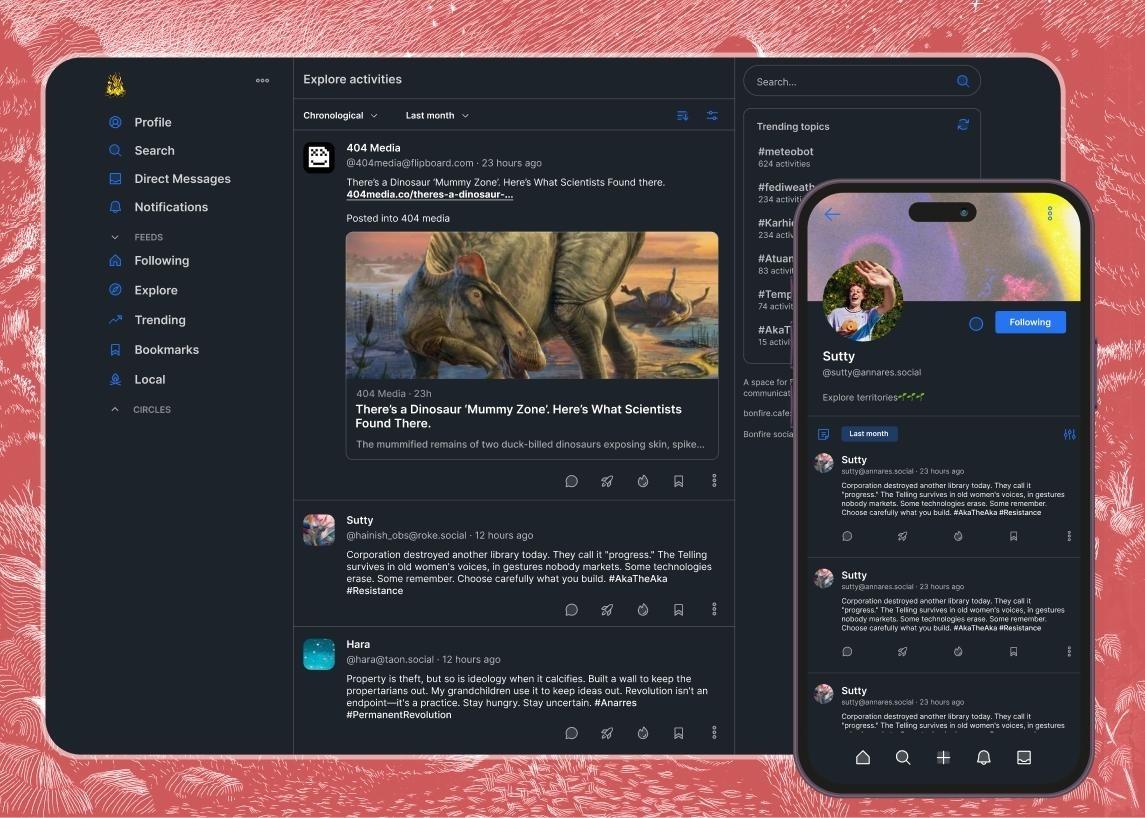
indieweb.social
Attached: 1 image Bonfire Social 1.0 is live! A federated, community‑first social network built on the modular Bonfire toolkit, and it’s only the beginning. It's time to go beyond microblogging and build apps for community organising, open science, mutual aid, and collective decision‑making. Let's take back the internet with open protocols, consent‑based governance, and portability by design. Back the “last migration” from closed platforms to open networks: https://www.indiegogo.com/projects/bonfire/community?refcode=FVxjqI1kLUOhHXxqyrS6-g 1/2
Bonfire Social 1.0 is live! A federated, community‑first social network built on the modular Bonfire toolkit, and it’s only the beginning.
It's time to go beyond microblogging and build apps for community organising, open science, mutual aid, and collective decision‑making. Let's take back the internet with open protocols, consent‑based governance, and portability by design.
Back the “last migration” from closed platforms to open networks: https://www.indiegogo.com/projects/bonfire/community?refcode=FVxjqI1kLUOhHXxqyrS6-g
1/2
Screenshot of Bonfire Social
I just backed this very promising and visionary project, which I have been keeping an eye on from afar for several months. I chose the “Co‑Designer” pledge: “90‑min session for track of your choice: gather, care, connect, or evolve”.
> Collaborative group discussion with Bonfire builders and peers; limited seats; outcomes inform project scope, roadmaps and prototypes + contributor credit on the site.
Looking forward to seeing how it turns out. All they need now is our support.
indieweb.social
Attached: 1 image Bonfire Social 1.0 is live! A federated, community‑first social network built on the modular Bonfire toolkit, and it’s only the beginning. It's time to go beyond microblogging and build apps for community organising, open science, mutual aid, and collective decision‑making. Let's take back the internet with open protocols, consent‑based governance, and portability by design. Back the “last migration” from closed platforms to open networks: https://www.indiegogo.com/projects/bonfire/community?refcode=FVxjqI1kLUOhHXxqyrS6-g 1/2
Bonfire Social 1.0 is live! A federated, community‑first social network built on the modular Bonfire toolkit, and it’s only the beginning.
It's time to go beyond microblogging and build apps for community organising, open science, mutual aid, and collective decision‑making. Let's take back the internet with open protocols, consent‑based governance, and portability by design.
Back the “last migration” from closed platforms to open networks: https://www.indiegogo.com/projects/bonfire/community?refcode=FVxjqI1kLUOhHXxqyrS6-g
1/2
Screenshot of Bonfire Social

"We need tools that are structurally up to the task, on purpose. Very much including the tools we use to find each other, organize, communicate, and sustain ourselves. This is why Bonfire matters, and why I try to help out with their work whenever I can."
wrecka.ge
Once you’ve seized the tools of political life to build communal power, it’s hard to forget what a hammer feels like in your hand.

I have read about #BonfireSocial and even set up my own account at @Eliot_L@bonfire.social.coop . I thought it was cool but it wasn't until I read @kissane 's blog post just now that I got hyped enough to back the crowdfunding campaign!
I encourage you to go read https://www.wrecka.ge/sparks-fly-up/ and take a look at https://bonfirenetworks.org/ and then maybe you might want to join in yourself at https://www.indiegogo.com/en/projects/bonfire/community .
This project has or is planning to include features we've been begging for, and beyond!
Wanted to send my congratulations to the @bonfire team for Bonfire Social 1.0!
The Bonfire folks are currently #crowdfunding to help build out more features. If you'd like to help #bonfire become more successful, please support them via #IndieGoGo here:
https://www.indiegogo.com/en/projects/bonfire/community?refcode=UScVLqSJJkKpZWg_Lnsg7w
#Support #Fedizens #developers #fediverse

indiegogo.com
From platforms to communities: a federated social web with shared foundations and co‑created spaces for gathering, care, connection, and stewardship.
"We need tools that are structurally up to the task, on purpose. Very much including the tools we use to find each other, organize, communicate, and sustain ourselves. This is why Bonfire matters, and why I try to help out with their work whenever I can."
wrecka.ge
Once you’ve seized the tools of political life to build communal power, it’s hard to forget what a hammer feels like in your hand.
Wanted to send my congratulations to the @bonfire team for Bonfire Social 1.0!
The Bonfire folks are currently #crowdfunding to help build out more features. If you'd like to help #bonfire become more successful, please support them via #IndieGoGo here:
https://www.indiegogo.com/en/projects/bonfire/community?refcode=UScVLqSJJkKpZWg_Lnsg7w
#Support #Fedizens #developers #fediverse
indiegogo.com
From platforms to communities: a federated social web with shared foundations and co‑created spaces for gathering, care, connection, and stewardship.
Wanted to send my congratulations to the @bonfire team for Bonfire Social 1.0!
The Bonfire folks are currently #crowdfunding to help build out more features. If you'd like to help #bonfire become more successful, please support them via #IndieGoGo here:
https://www.indiegogo.com/en/projects/bonfire/community?refcode=UScVLqSJJkKpZWg_Lnsg7w
#Support #Fedizens #developers #fediverse
indiegogo.com
From platforms to communities: a federated social web with shared foundations and co‑created spaces for gathering, care, connection, and stewardship.
Wanted to send my congratulations to the @bonfire team for Bonfire Social 1.0!
The Bonfire folks are currently #crowdfunding to help build out more features. If you'd like to help #bonfire become more successful, please support them via #IndieGoGo here:
https://www.indiegogo.com/en/projects/bonfire/community?refcode=UScVLqSJJkKpZWg_Lnsg7w
#Support #Fedizens #developers #fediverse
indiegogo.com
From platforms to communities: a federated social web with shared foundations and co‑created spaces for gathering, care, connection, and stewardship.
Wanted to send my congratulations to the @bonfire team for Bonfire Social 1.0!
The Bonfire folks are currently #crowdfunding to help build out more features. If you'd like to help #bonfire become more successful, please support them via #IndieGoGo here:
https://www.indiegogo.com/en/projects/bonfire/community?refcode=UScVLqSJJkKpZWg_Lnsg7w
#Support #Fedizens #developers #fediverse
indiegogo.com
From platforms to communities: a federated social web with shared foundations and co‑created spaces for gathering, care, connection, and stewardship.

#Bonfire Social 1.0 sta arrivando. Gli sviluppatori di una delle piattaforme più interessanti del #Fediverso stanno lanciando un crowdfunding affinché le community stimolino i loro progetti futuri.
Sostenete la campagna, condividete sui social chiusi e invitate altri a compiere questa "ultima migrazione" da piattaforme chiuse a reti aperte e interoperabili.
indiegogo.com
From platforms to communities: a federated social web with shared foundations and co‑created spaces for gathering, care, connection, and stewardship.

"While Big Tech centralises for profit and blockchain prizes sovereignty over solidarity, both leave collective care and real community needs behind. They erase communities in the race to scale. They turn social life into products that use, abuse, or extract from us. #Bonfire offers a different path: trusted communities with real autonomy and participatory governance, interconnected across the open web. It empowers communities to shape digital spaces that reflect shared values, like autonomy, mutual care, and collective power."
indiegogo.com
From platforms to communities: a federated social web with shared foundations and co‑created spaces for gathering, care, connection, and stewardship.
"#Bonfire’s technical architecture prioritises flexibility and local control…[with]a highly modular approach to building #fediversesoftware. At its core is Bonfire a large set of software modules, called the Bonfire Toolkit. These modules all perform a small function of a social networking platform, there is a module that handles your social graph, a module that implements ActivityPub, a module that implements search, a module for a microblogging-like UI, and many more."
https://bonfirenetworks.org/posts/bonfire-social-1-0-is-here-back-the-community-funded-roadmap/
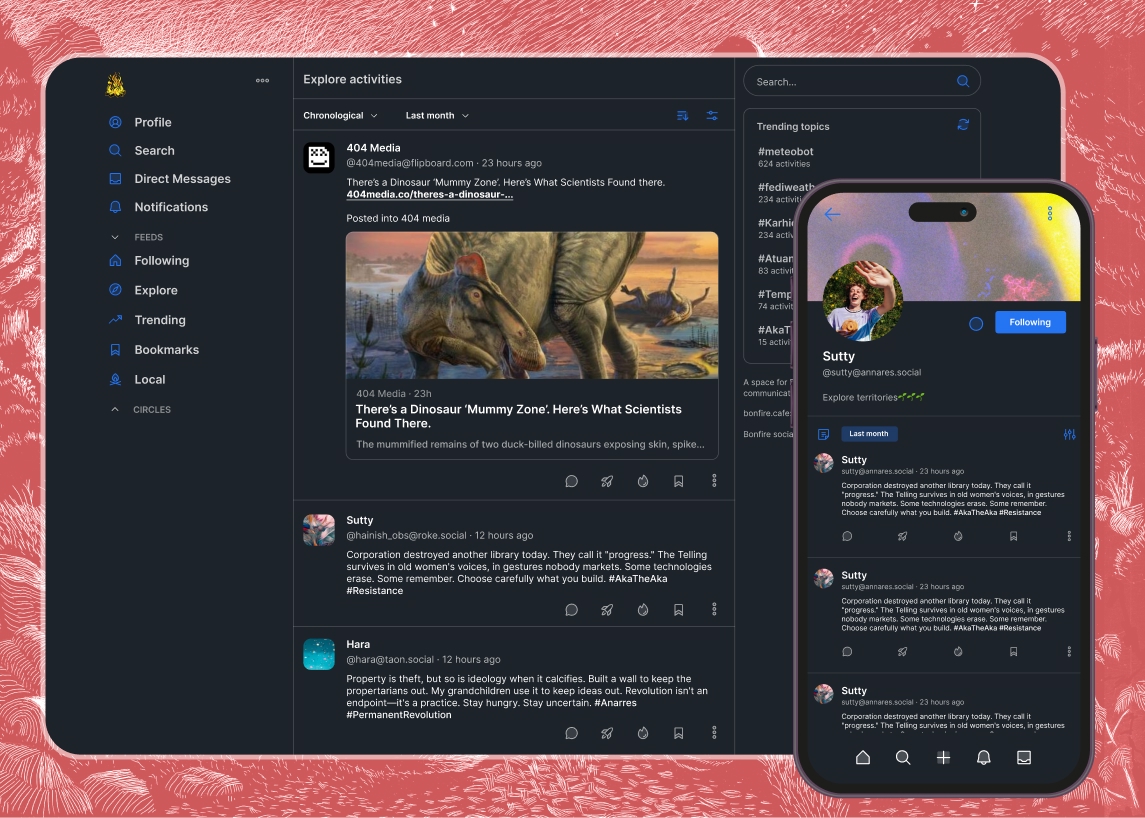
bonfirenetworks.org
We're releasing Bonfire Social 1.0 and launching a crowdfund so communities drive what we build next. Back it, share it, and help move the social web from closed platforms to open networks.
"While Big Tech centralises for profit and blockchain prizes sovereignty over solidarity, both leave collective care and real community needs behind. They erase communities in the race to scale. They turn social life into products that use, abuse, or extract from us. #Bonfire offers a different path: trusted communities with real autonomy and participatory governance, interconnected across the open web. It empowers communities to shape digital spaces that reflect shared values, like autonomy, mutual care, and collective power."
indiegogo.com
From platforms to communities: a federated social web with shared foundations and co‑created spaces for gathering, care, connection, and stewardship.
"#Bonfire’s technical architecture prioritises flexibility and local control…[with]a highly modular approach to building #fediversesoftware. At its core is Bonfire a large set of software modules, called the Bonfire Toolkit. These modules all perform a small function of a social networking platform, there is a module that handles your social graph, a module that implements ActivityPub, a module that implements search, a module for a microblogging-like UI, and many more."
https://bonfirenetworks.org/posts/bonfire-social-1-0-is-here-back-the-community-funded-roadmap/
bonfirenetworks.org
We're releasing Bonfire Social 1.0 and launching a crowdfund so communities drive what we build next. Back it, share it, and help move the social web from closed platforms to open networks.

"Today we're releasing Bonfire Social 1.0: a federated community‑first social network and the modular toolkit that powers it: a framework for building apps on the open social web beyond microblogging. We're pairing the launch with a crowdfund so communities drive what we build next. "
@Bonfire, Nov, 2025
https://bonfirenetworks.org/posts/bonfire-social-1-0-is-here-back-the-community-funded-roadmap/
bonfirenetworks.org
We're releasing Bonfire Social 1.0 and launching a crowdfund so communities drive what we build next. Back it, share it, and help move the social web from closed platforms to open networks.
"Today we're releasing Bonfire Social 1.0: a federated community‑first social network and the modular toolkit that powers it: a framework for building apps on the open social web beyond microblogging. We're pairing the launch with a crowdfund so communities drive what we build next. "
@Bonfire, Nov, 2025
https://bonfirenetworks.org/posts/bonfire-social-1-0-is-here-back-the-community-funded-roadmap/
bonfirenetworks.org
We're releasing Bonfire Social 1.0 and launching a crowdfund so communities drive what we build next. Back it, share it, and help move the social web from closed platforms to open networks.
"Today we're releasing Bonfire Social 1.0: a federated community‑first social network and the modular toolkit that powers it: a framework for building apps on the open social web beyond microblogging. We're pairing the launch with a crowdfund so communities drive what we build next. "
@Bonfire, Nov, 2025
https://bonfirenetworks.org/posts/bonfire-social-1-0-is-here-back-the-community-funded-roadmap/
bonfirenetworks.org
We're releasing Bonfire Social 1.0 and launching a crowdfund so communities drive what we build next. Back it, share it, and help move the social web from closed platforms to open networks.

@bonfire have just released Bonfire v1.0 (big congratulations! 🥳) and are crowdfunding further development. Go help them out if you can!
I think the tools Bonfire offers are brilliant for both personal and institutional users alike, and will only strengthen the Fediverse.
https://www.indiegogo.com/en/projects/bonfire/community #fedidev #fediverse #Bonfire
@bonfire have just released Bonfire v1.0 (big congratulations! 🥳) and are crowdfunding further development. Go help them out if you can!
I think the tools Bonfire offers are brilliant for both personal and institutional users alike, and will only strengthen the Fediverse.
https://www.indiegogo.com/en/projects/bonfire/community #fedidev #fediverse #Bonfire
Pretty excited by @bonfire, especially by the Open Science flavor (see https://openscience.network). The project in general also seems to be well thought out, in terms of roadmap or governance (putting maintenance first in the roadmap and making it strongly visible = 👏).
Congrats to the team for the release and good luck for the next steps!
(Edit: there's Ursula K. Le Guin in the crowdfunding campaign trailer, also, so you definitely should watch it)
openscience.network
Reclaim scientific discourse with federated digital spaces where researchers shape their own conversations, data, and collaborations
Bonfire Social 1.0 is live! A federated, community‑first social network built on the modular Bonfire toolkit, and it’s only the beginning.
It's time to go beyond microblogging and build apps for community organising, open science, mutual aid, and collective decision‑making. Let's take back the internet with open protocols, consent‑based governance, and portability by design.
Back the “last migration” from closed platforms to open networks: https://www.indiegogo.com/projects/bonfire/community?refcode=FVxjqI1kLUOhHXxqyrS6-g
1/2
Screenshot of Bonfire Social

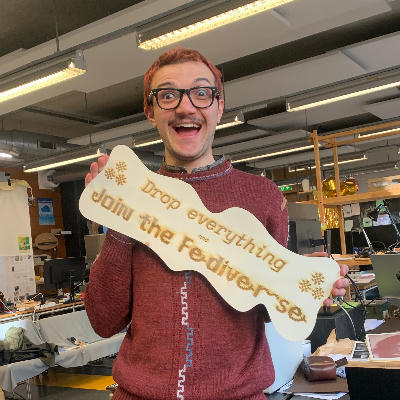
It’s so rare that somebody talks about care in a presentation about software! 🌻
Thank you @Bonfire ❤️
I love that @ivan and @mayel bring #anarchism to #SFSCON 🤟🏼
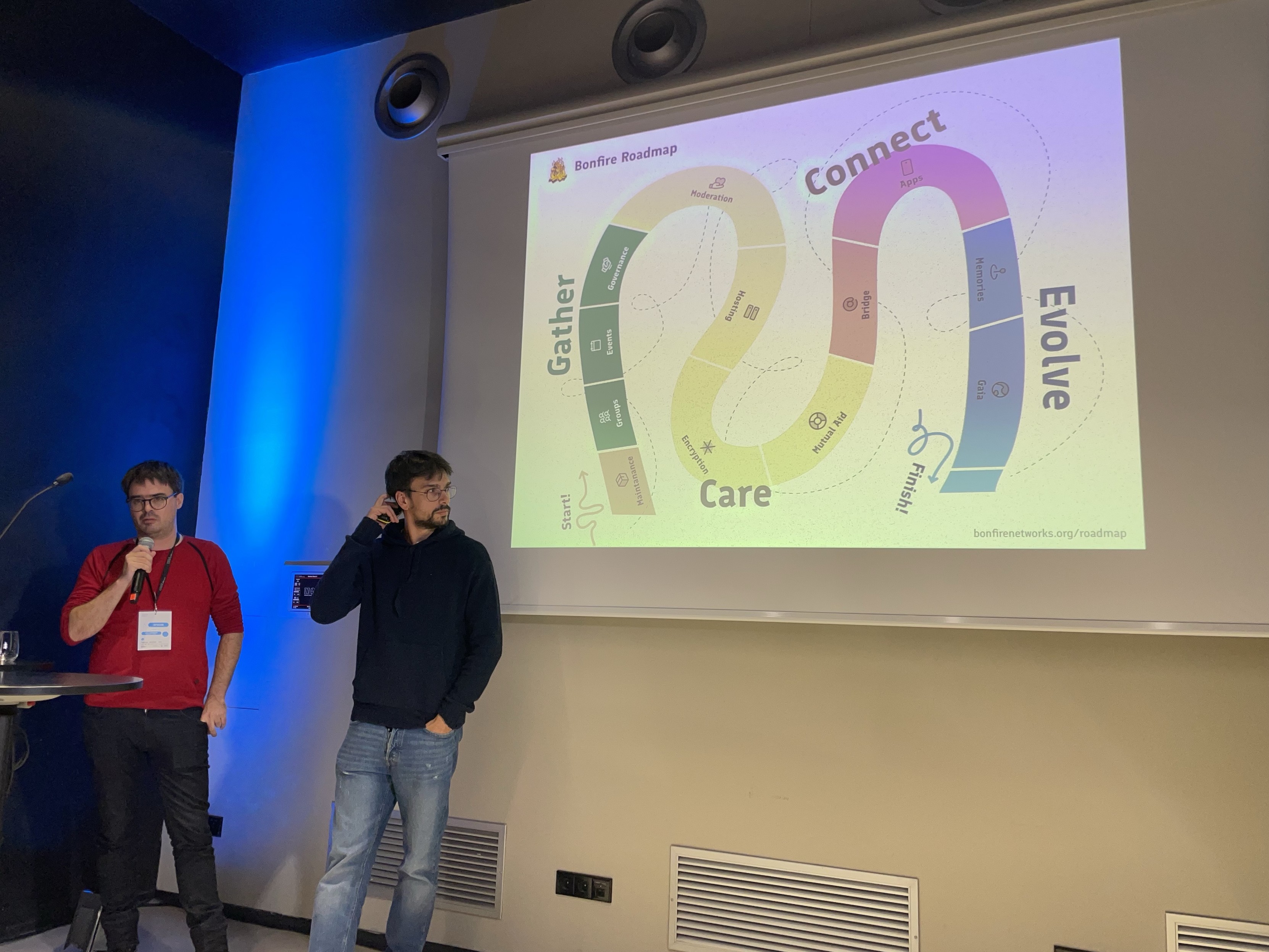
Mayel speaking next to Ivan, showing the roadmap of Bonfire’s upcoming work. Hightlighted words: Gather, Care, Connect, Evolve

It’s so rare that somebody talks about care in a presentation about software! 🌻
Thank you @Bonfire ❤️
I love that @ivan and @mayel bring #anarchism to #SFSCON 🤟🏼
Mayel speaking next to Ivan, showing the roadmap of Bonfire’s upcoming work. Hightlighted words: Gather, Care, Connect, Evolve
It’s so rare that somebody talks about care in a presentation about software! 🌻
Thank you @Bonfire ❤️
I love that @ivan and @mayel bring #anarchism to #SFSCON 🤟🏼
Mayel speaking next to Ivan, showing the roadmap of Bonfire’s upcoming work. Hightlighted words: Gather, Care, Connect, Evolve
#Bonfire Social 1.0 sta arrivando. Gli sviluppatori di una delle piattaforme più interessanti del #Fediverso stanno lanciando un crowdfunding affinché le community stimolino i loro progetti futuri.
Sostenete la campagna, condividete sui social chiusi e invitate altri a compiere questa "ultima migrazione" da piattaforme chiuse a reti aperte e interoperabili.
indiegogo.com
From platforms to communities: a federated social web with shared foundations and co‑created spaces for gathering, care, connection, and stewardship.
Pretty excited by @bonfire, especially by the Open Science flavor (see https://openscience.network). The project in general also seems to be well thought out, in terms of roadmap or governance (putting maintenance first in the roadmap and making it strongly visible = 👏).
Congrats to the team for the release and good luck for the next steps!
(Edit: there's Ursula K. Le Guin in the crowdfunding campaign trailer, also, so you definitely should watch it)
openscience.network
Reclaim scientific discourse with federated digital spaces where researchers shape their own conversations, data, and collaborations
Bonfire Social 1.0 is live! A federated, community‑first social network built on the modular Bonfire toolkit, and it’s only the beginning.
It's time to go beyond microblogging and build apps for community organising, open science, mutual aid, and collective decision‑making. Let's take back the internet with open protocols, consent‑based governance, and portability by design.
Back the “last migration” from closed platforms to open networks: https://www.indiegogo.com/projects/bonfire/community?refcode=FVxjqI1kLUOhHXxqyrS6-g
1/2
Screenshot of Bonfire Social
Pretty excited by @bonfire, especially by the Open Science flavor (see https://openscience.network). The project in general also seems to be well thought out, in terms of roadmap or governance (putting maintenance first in the roadmap and making it strongly visible = 👏).
Congrats to the team for the release and good luck for the next steps!
(Edit: there's Ursula K. Le Guin in the crowdfunding campaign trailer, also, so you definitely should watch it)
openscience.network
Reclaim scientific discourse with federated digital spaces where researchers shape their own conversations, data, and collaborations
Bonfire Social 1.0 is live! A federated, community‑first social network built on the modular Bonfire toolkit, and it’s only the beginning.
It's time to go beyond microblogging and build apps for community organising, open science, mutual aid, and collective decision‑making. Let's take back the internet with open protocols, consent‑based governance, and portability by design.
Back the “last migration” from closed platforms to open networks: https://www.indiegogo.com/projects/bonfire/community?refcode=FVxjqI1kLUOhHXxqyrS6-g
1/2
Screenshot of Bonfire Social

@bonfire How do I get the map LiveView component working? I can't find much documentation for it. #Bonfire #Fediverse
I joined @bonfire #openscience sandbox and I started to write about my experience there (and so far, I'm loving what I'm seeing):
https://sandbox.openscience.network/pub/objects/01K88AEH2D7ZB3N9H7C3SJDQEA

sandbox.openscience.network
We are a network of scientists, developers and organizations building the next generation of digital spaces for open science.
I joined @bonfire #openscience sandbox and I started to write about my experience there (and so far, I'm loving what I'm seeing):
https://sandbox.openscience.network/pub/objects/01K88AEH2D7ZB3N9H7C3SJDQEA
sandbox.openscience.network
We are a network of scientists, developers and organizations building the next generation of digital spaces for open science.
I joined @bonfire #openscience sandbox and I started to write about my experience there (and so far, I'm loving what I'm seeing):
https://sandbox.openscience.network/pub/objects/01K88AEH2D7ZB3N9H7C3SJDQEA
sandbox.openscience.network
We are a network of scientists, developers and organizations building the next generation of digital spaces for open science.
I joined @bonfire #openscience sandbox and I started to write about my experience there (and so far, I'm loving what I'm seeing):
https://sandbox.openscience.network/pub/objects/01K88AEH2D7ZB3N9H7C3SJDQEA
sandbox.openscience.network
We are a network of scientists, developers and organizations building the next generation of digital spaces for open science.
Nachdem mich #Sharkey noch nicht so überzeugt (Antennen kann Moshido auch) mal schauen was #Bonfire kann
Weil es geht darum die Lesezeichen systematisiert zu kriegen.
Und das kann nur (?) calckey, aber das Paket ist bei yunohost aus dem Jahr 2023 (?)
Und ich würde es nur ausprobieren, wenn ich es auf #yunohost selbst gestalten kann...

Does anbyody know about an instance of @bonfire, that is open for registration and federated? I would really like to try it out in the wider #Fediverse.
Does anbyody know about an instance of @bonfire, that is open for registration and federated? I would really like to try it out in the wider #Fediverse.
I thought Mastodon's quote post controls were extensive...these are "boundaries" that can be set in Bonfire for your posts. Not to mention the roll your own "Custom Boundaries". Mix and Match!
I question how these boundaries federate, are they honored across platforms?
GoToSocial has some reply controls that basically just drop replies you don't want. So other platforms may not honor the request and still send them, but they are just ignored. I'm sure similar here.
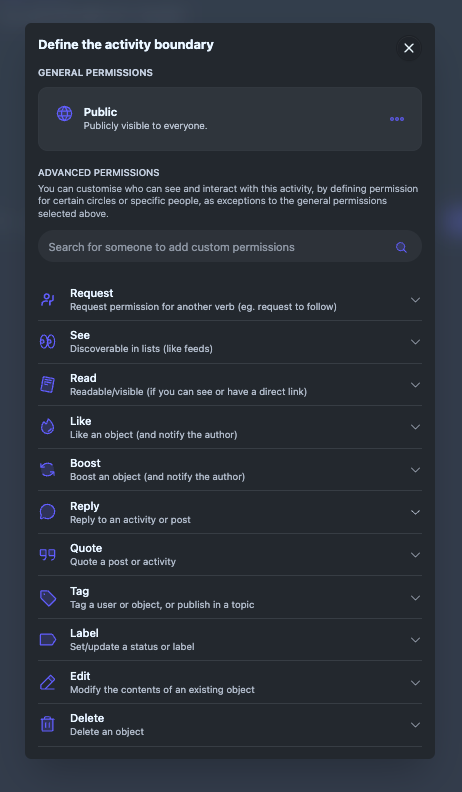
A user interface screen displaying advanced permissions and settings related to defining activity boundaries. Options include settings for public visibility, requests, and various actions like boosting, replying, quoting, tagging, and deleting objects.
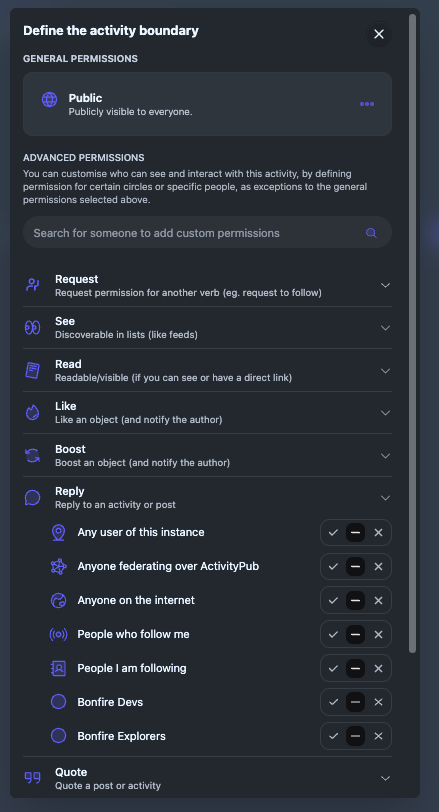
The image shows a user interface for defining activity boundaries and general permissions. It includes options for setting visibility to public, managing advanced permissions such as request and reply settings, and features like boosting and following specific users or groups.
I thought Mastodon's quote post controls were extensive...these are "boundaries" that can be set in Bonfire for your posts. Not to mention the roll your own "Custom Boundaries". Mix and Match!
I question how these boundaries federate, are they honored across platforms?
GoToSocial has some reply controls that basically just drop replies you don't want. So other platforms may not honor the request and still send them, but they are just ignored. I'm sure similar here.
A user interface screen displaying advanced permissions and settings related to defining activity boundaries. Options include settings for public visibility, requests, and various actions like boosting, replying, quoting, tagging, and deleting objects.
The image shows a user interface for defining activity boundaries and general permissions. It includes options for setting visibility to public, managing advanced permissions such as request and reply settings, and features like boosting and following specific users or groups.
Checking out Bonfire's latest release. This Federation Status dashboard is pretty cool.
And get this - it's not just visible to admins - end users can see the same, just filtered to their OWN processes.
That's really helpful if you're trying to debug an issue with another platform development team.
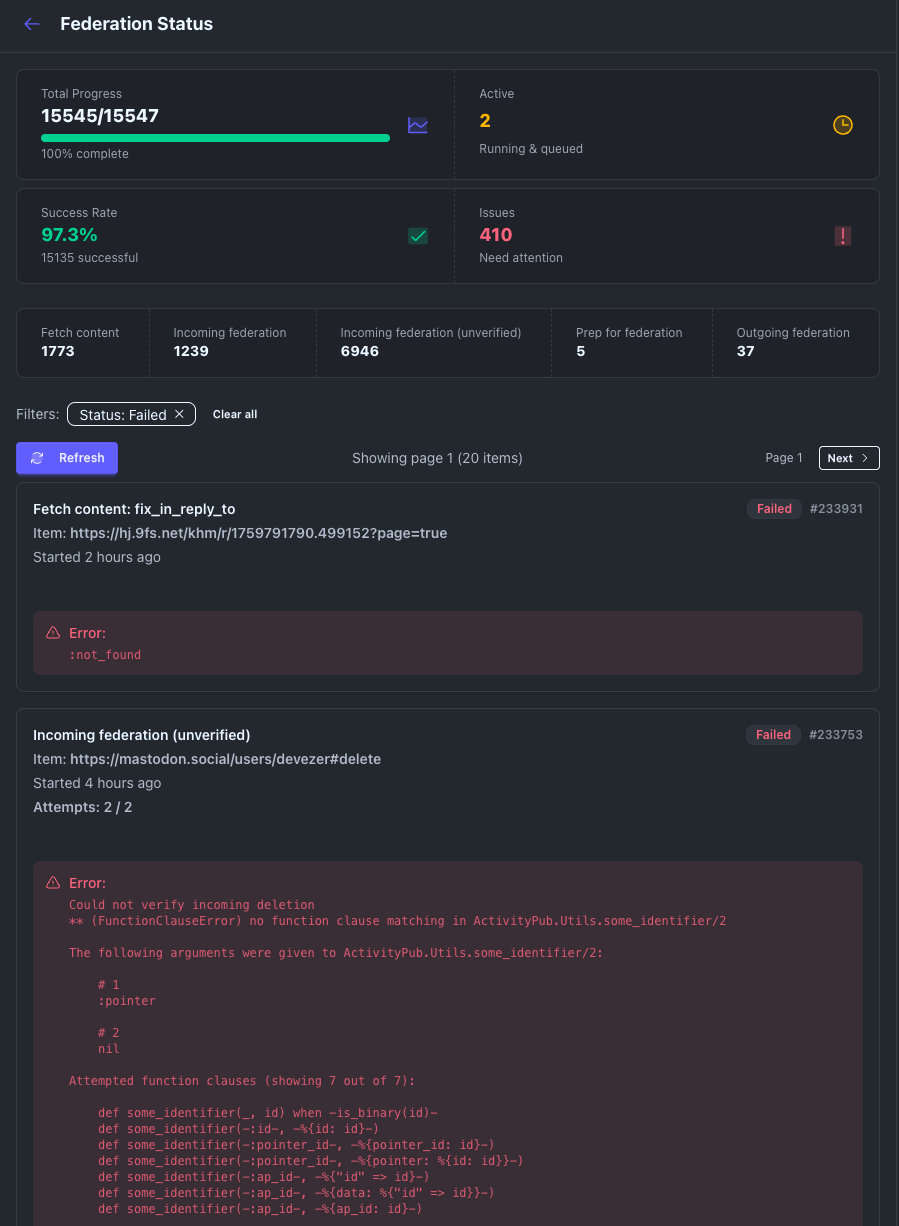
A dashboard for Federation Status, showing logs from failed federation attempts with other instances.
Checking out Bonfire's latest release. This Federation Status dashboard is pretty cool.
And get this - it's not just visible to admins - end users can see the same, just filtered to their OWN processes.
That's really helpful if you're trying to debug an issue with another platform development team.
A dashboard for Federation Status, showing logs from failed federation attempts with other instances.
Checking out Bonfire's latest release. This Federation Status dashboard is pretty cool.
And get this - it's not just visible to admins - end users can see the same, just filtered to their OWN processes.
That's really helpful if you're trying to debug an issue with another platform development team.
A dashboard for Federation Status, showing logs from failed federation attempts with other instances.
Checking out Bonfire's latest release. This Federation Status dashboard is pretty cool.
And get this - it's not just visible to admins - end users can see the same, just filtered to their OWN processes.
That's really helpful if you're trying to debug an issue with another platform development team.
A dashboard for Federation Status, showing logs from failed federation attempts with other instances.
Checking out Bonfire's latest release. This Federation Status dashboard is pretty cool.
And get this - it's not just visible to admins - end users can see the same, just filtered to their OWN processes.
That's really helpful if you're trying to debug an issue with another platform development team.
A dashboard for Federation Status, showing logs from failed federation attempts with other instances.
Bonfire pushed a big release last week, and I'm excited to try out all the new shiny things on my test instance.
Post migration and Quote Posts among them.

spark.box464.social
An invite only Bonfire instance, testing out the latest and greatest features from the amazing dev team.
Just updated to Bonfire RC 3 that has all kinds of fun things, including quote post consent and honest to goodness post migration built into the system itself. Looking forward to trying it out.

bonfirenetworks.org
Bonfire’s latest release puts data portability (moving and taking your data with you) and anti-enshittification (avoiding manipulative platform tricks) front and center.
Bonfire pushed a big release last week, and I'm excited to try out all the new shiny things on my test instance.
Post migration and Quote Posts among them.
spark.box464.social
An invite only Bonfire instance, testing out the latest and greatest features from the amazing dev team.
Just updated to Bonfire RC 3 that has all kinds of fun things, including quote post consent and honest to goodness post migration built into the system itself. Looking forward to trying it out.
bonfirenetworks.org
Bonfire’s latest release puts data portability (moving and taking your data with you) and anti-enshittification (avoiding manipulative platform tricks) front and center.
Bonfire pushed a big release last week, and I'm excited to try out all the new shiny things on my test instance.
Post migration and Quote Posts among them.
spark.box464.social
An invite only Bonfire instance, testing out the latest and greatest features from the amazing dev team.
Just updated to Bonfire RC 3 that has all kinds of fun things, including quote post consent and honest to goodness post migration built into the system itself. Looking forward to trying it out.
bonfirenetworks.org
Bonfire’s latest release puts data portability (moving and taking your data with you) and anti-enshittification (avoiding manipulative platform tricks) front and center.
What I loved to see in the #ActivityPub documentation is the inclusion of the list of Fediverse Enhancement Proposals #FEP's that are implemented. It will serve a stimulus for other #fediverse devs to adopt them too, and shape the grassroots standardization process. Posted the list to #SocialHub too..
https://socialhub.activitypub.rocks/t/bonfire-social-1-0rc3-is-released/8071
Also nudging to add #Bonfire as implementation in FEP docs..
https://codeberg.org/fediverse/fep/issues/194
And to review @helge https://codeberg.org/fediverse/fep/pulls/673
codeberg.org
### Preview version https://helge.codeberg.page/fep/ click there to judge ### Tasks done - [x] Add a proper index.md instead of final.md .... needs me to filter the readme.md - [x] search is broken --> will resolve itself when all feps are part of it - [x] Update https://codeberg.org/fedive...
Check out the new @bonfire Social release candidate. What a wonderful well-designed experience, and superb release notes!
https://bonfirenetworks.org/posts/bonfire-social-1-0rc3/
🎉 Congratulations to the #Bonfire team @ivan and @mayel for making it this far, through all that tireless hard work. And also to @nlnet and @ngi for supporting this important project. Future of social networking in the making.
To #ActivityPub developers, have a look at those great #fediverse #Interoperability docs:
https://docs.bonfirenetworks.org/federation-interoperability.html
docs.bonfirenetworks.org
Check out the new @bonfire Social release candidate. What a wonderful well-designed experience, and superb release notes!
https://bonfirenetworks.org/posts/bonfire-social-1-0rc3/
🎉 Congratulations to the #Bonfire team @ivan and @mayel for making it this far, through all that tireless hard work. And also to @nlnet and @ngi for supporting this important project. Future of social networking in the making.
To #ActivityPub developers, have a look at those great #fediverse #Interoperability docs:
https://docs.bonfirenetworks.org/federation-interoperability.html
docs.bonfirenetworks.org
Check out the new @bonfire Social release candidate. What a wonderful well-designed experience, and superb release notes!
https://bonfirenetworks.org/posts/bonfire-social-1-0rc3/
🎉 Congratulations to the #Bonfire team @ivan and @mayel for making it this far, through all that tireless hard work. And also to @nlnet and @ngi for supporting this important project. Future of social networking in the making.
To #ActivityPub developers, have a look at those great #fediverse #Interoperability docs:
https://docs.bonfirenetworks.org/federation-interoperability.html
docs.bonfirenetworks.org
What I loved to see in the #ActivityPub documentation is the inclusion of the list of Fediverse Enhancement Proposals #FEP's that are implemented. It will serve a stimulus for other #fediverse devs to adopt them too, and shape the grassroots standardization process. Posted the list to #SocialHub too..
https://socialhub.activitypub.rocks/t/bonfire-social-1-0rc3-is-released/8071
Also nudging to add #Bonfire as implementation in FEP docs..
https://codeberg.org/fediverse/fep/issues/194
And to review @helge https://codeberg.org/fediverse/fep/pulls/673
codeberg.org
### Preview version https://helge.codeberg.page/fep/ click there to judge ### Tasks done - [x] Add a proper index.md instead of final.md .... needs me to filter the readme.md - [x] search is broken --> will resolve itself when all feps are part of it - [x] Update https://codeberg.org/fedive...
Check out the new @bonfire Social release candidate. What a wonderful well-designed experience, and superb release notes!
https://bonfirenetworks.org/posts/bonfire-social-1-0rc3/
🎉 Congratulations to the #Bonfire team @ivan and @mayel for making it this far, through all that tireless hard work. And also to @nlnet and @ngi for supporting this important project. Future of social networking in the making.
To #ActivityPub developers, have a look at those great #fediverse #Interoperability docs:
https://docs.bonfirenetworks.org/federation-interoperability.html
docs.bonfirenetworks.org
Check out the new @bonfire Social release candidate. What a wonderful well-designed experience, and superb release notes!
https://bonfirenetworks.org/posts/bonfire-social-1-0rc3/
🎉 Congratulations to the #Bonfire team @ivan and @mayel for making it this far, through all that tireless hard work. And also to @nlnet and @ngi for supporting this important project. Future of social networking in the making.
To #ActivityPub developers, have a look at those great #fediverse #Interoperability docs:
https://docs.bonfirenetworks.org/federation-interoperability.html
docs.bonfirenetworks.org

I guess that my #GratefulForYou has to go to @bonfire for attempting to take #fediverse to scale, facilitating an ecosystem. 🙏@_elena #bonfire
Here's another cool feature of Bonfire. One account, many profiles.
When you create an account, you can create multiple profiles, each with it's own unique followers, content and settings (and emojis!).
1 account. 1 password. Many profiles.
Ownership of profiles can be shared with others. A news publication can share posting responsibilities, for example.

tube.tchncs.de
In Bonfire, accounts and profiles are separate. One account can create multiple independent profiles, each with its own followers, content, and settings. Shared profiles can also be managed by mult...
Here's another cool feature of Bonfire. One account, many profiles.
When you create an account, you can create multiple profiles, each with it's own unique followers, content and settings (and emojis!).
1 account. 1 password. Many profiles.
Ownership of profiles can be shared with others. A news publication can share posting responsibilities, for example.
tube.tchncs.de
In Bonfire, accounts and profiles are separate. One account can create multiple independent profiles, each with its own followers, content, and settings. Shared profiles can also be managed by mult...
Here's another cool feature of Bonfire. One account, many profiles.
When you create an account, you can create multiple profiles, each with it's own unique followers, content and settings (and emojis!).
1 account. 1 password. Many profiles.
Ownership of profiles can be shared with others. A news publication can share posting responsibilities, for example.
tube.tchncs.de
In Bonfire, accounts and profiles are separate. One account can create multiple independent profiles, each with its own followers, content, and settings. Shared profiles can also be managed by mult...
Here's another cool feature of Bonfire. One account, many profiles.
When you create an account, you can create multiple profiles, each with it's own unique followers, content and settings (and emojis!).
1 account. 1 password. Many profiles.
Ownership of profiles can be shared with others. A news publication can share posting responsibilities, for example.
tube.tchncs.de
In Bonfire, accounts and profiles are separate. One account can create multiple independent profiles, each with its own followers, content, and settings. Shared profiles can also be managed by mult...
Here's another cool feature of Bonfire. One account, many profiles.
When you create an account, you can create multiple profiles, each with it's own unique followers, content and settings (and emojis!).
1 account. 1 password. Many profiles.
Ownership of profiles can be shared with others. A news publication can share posting responsibilities, for example.
tube.tchncs.de
In Bonfire, accounts and profiles are separate. One account can create multiple independent profiles, each with its own followers, content, and settings. Shared profiles can also be managed by mult...
Here's another cool feature of Bonfire. One account, many profiles.
When you create an account, you can create multiple profiles, each with it's own unique followers, content and settings (and emojis!).
1 account. 1 password. Many profiles.
Ownership of profiles can be shared with others. A news publication can share posting responsibilities, for example.
tube.tchncs.de
In Bonfire, accounts and profiles are separate. One account can create multiple independent profiles, each with its own followers, content, and settings. Shared profiles can also be managed by mult...
Fun fact (really). The Bonfire fediverse platform allows each **individual user** the ability to upload their own set of custom emojis.
There seems to be no limit to how many, tho I'm sure there will have to be as it gets more popular. And it will. Looking snazzy!
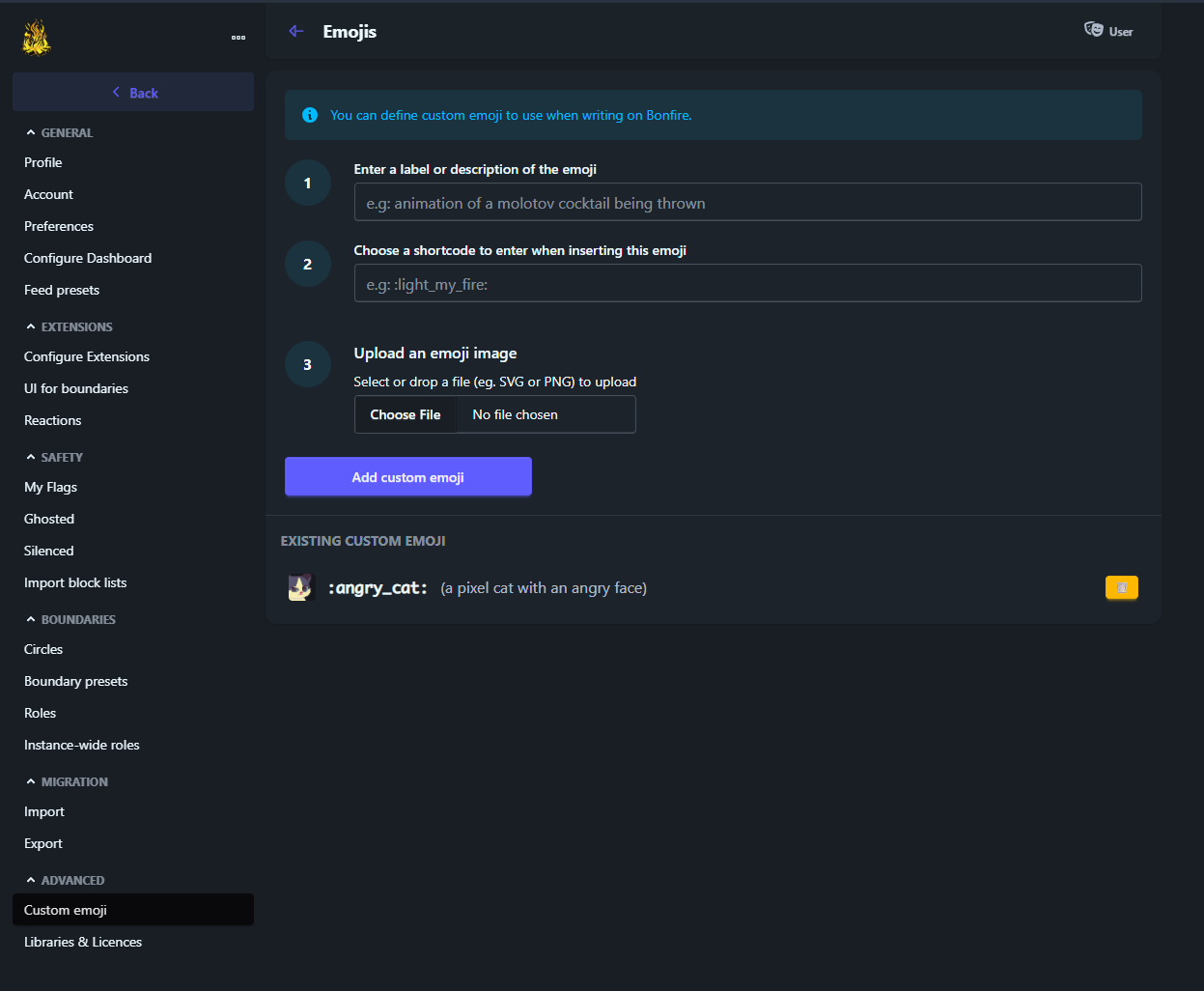
The image shows a user interface for adding custom emojis, including fields for labeling the emoji, choosing a shortcut, and uploading an image. There is also a section displaying existing custom emojis.
Fun fact (really). The Bonfire fediverse platform allows each **individual user** the ability to upload their own set of custom emojis.
There seems to be no limit to how many, tho I'm sure there will have to be as it gets more popular. And it will. Looking snazzy!
The image shows a user interface for adding custom emojis, including fields for labeling the emoji, choosing a shortcut, and uploading an image. There is also a section displaying existing custom emojis.
Fun fact (really). The Bonfire fediverse platform allows each **individual user** the ability to upload their own set of custom emojis.
There seems to be no limit to how many, tho I'm sure there will have to be as it gets more popular. And it will. Looking snazzy!
The image shows a user interface for adding custom emojis, including fields for labeling the emoji, choosing a shortcut, and uploading an image. There is also a section displaying existing custom emojis.
Fun fact (really). The Bonfire fediverse platform allows each **individual user** the ability to upload their own set of custom emojis.
There seems to be no limit to how many, tho I'm sure there will have to be as it gets more popular. And it will. Looking snazzy!
The image shows a user interface for adding custom emojis, including fields for labeling the emoji, choosing a shortcut, and uploading an image. There is also a section displaying existing custom emojis.
Fun fact (really). The Bonfire fediverse platform allows each **individual user** the ability to upload their own set of custom emojis.
There seems to be no limit to how many, tho I'm sure there will have to be as it gets more popular. And it will. Looking snazzy!
The image shows a user interface for adding custom emojis, including fields for labeling the emoji, choosing a shortcut, and uploading an image. There is also a section displaying existing custom emojis.

Bonfire x Newsmast
We’re excited to share that Bonfire and @newsmast are working together.
We’re collaborating across several key areas:
🔎 Enhancing discoverability for Channels on Bonfire
🧭 Improving interoperability between the Channels mobile app and Bonfire
🌌 Partnering to offer services for organisations around Bonfire’s Mosaic initiative
#Bonfire #Newsmast #Fediverse #SocialWeb #TechNews #FediNews
bonfire x newsmast foundation: working together to grow the open social web
Bonfire x Newsmast
We’re excited to share that Bonfire and @newsmast are working together.
We’re collaborating across several key areas:
🔎 Enhancing discoverability for Channels on Bonfire
🧭 Improving interoperability between the Channels mobile app and Bonfire
🌌 Partnering to offer services for organisations around Bonfire’s Mosaic initiative
#Bonfire #Newsmast #Fediverse #SocialWeb #TechNews #FediNews
bonfire x newsmast foundation: working together to grow the open social web
Bonfire x Newsmast
We’re excited to share that Bonfire and @newsmast are working together.
We’re collaborating across several key areas:
🔎 Enhancing discoverability for Channels on Bonfire
🧭 Improving interoperability between the Channels mobile app and Bonfire
🌌 Partnering to offer services for organisations around Bonfire’s Mosaic initiative
#Bonfire #Newsmast #Fediverse #SocialWeb #TechNews #FediNews
bonfire x newsmast foundation: working together to grow the open social web
Bonfire x Newsmast
We’re excited to share that Bonfire and @newsmast are working together.
We’re collaborating across several key areas:
🔎 Enhancing discoverability for Channels on Bonfire
🧭 Improving interoperability between the Channels mobile app and Bonfire
🌌 Partnering to offer services for organisations around Bonfire’s Mosaic initiative
#Bonfire #Newsmast #Fediverse #SocialWeb #TechNews #FediNews
bonfire x newsmast foundation: working together to grow the open social web

Newsmast x Bonfire
We’re excited to share that Newsmast and @bonfire are working together!
We’re collaborating across several key areas:
🔎 Enhancing discoverability for Channels on Bonfire
🧭 Improving interoperability between the Channels app and Bonfire
🌌 Partnering to offer services for organisations around Bonfire’s Mosaic initiative
#Bonfire #Newsmast #Fediverse #SocialWeb #TechNews #FediNews
Newsmast x Bonfire
We’re excited to share that Newsmast and @bonfire are working together!
We’re collaborating across several key areas:
🔎 Enhancing discoverability for Channels on Bonfire
🧭 Improving interoperability between the Channels app and Bonfire
🌌 Partnering to offer services for organisations around Bonfire’s Mosaic initiative
#Bonfire #Newsmast #Fediverse #SocialWeb #TechNews #FediNews
Bonfire x Newsmast
We’re excited to share that Bonfire and @newsmast are working together.
We’re collaborating across several key areas:
🔎 Enhancing discoverability for Channels on Bonfire
🧭 Improving interoperability between the Channels mobile app and Bonfire
🌌 Partnering to offer services for organisations around Bonfire’s Mosaic initiative
#Bonfire #Newsmast #Fediverse #SocialWeb #TechNews #FediNews
bonfire x newsmast foundation: working together to grow the open social web
Newsmast x Bonfire
We’re excited to share that Newsmast and @bonfire are working together!
We’re collaborating across several key areas:
🔎 Enhancing discoverability for Channels on Bonfire
🧭 Improving interoperability between the Channels app and Bonfire
🌌 Partnering to offer services for organisations around Bonfire’s Mosaic initiative
#Bonfire #Newsmast #Fediverse #SocialWeb #TechNews #FediNews
Newsmast x Bonfire
We’re excited to share that Newsmast and @bonfire are working together!
We’re collaborating across several key areas:
🔎 Enhancing discoverability for Channels on Bonfire
🧭 Improving interoperability between the Channels app and Bonfire
🌌 Partnering to offer services for organisations around Bonfire’s Mosaic initiative
#Bonfire #Newsmast #Fediverse #SocialWeb #TechNews #FediNews
As we integrate #OpenAlex data into the #Bonfire #OpenScience flavor, we're displaying familiar metrics: works count, citations, h-index, research topics, institutional affiliations...
These might be exactly what you need, or perhaps just a starting point.
What additional information would help you find collaborators or understand someone's work better?
We're opening this design process to the open science community. Share what works, what doesn't, what's missing.
@open_science
1/2
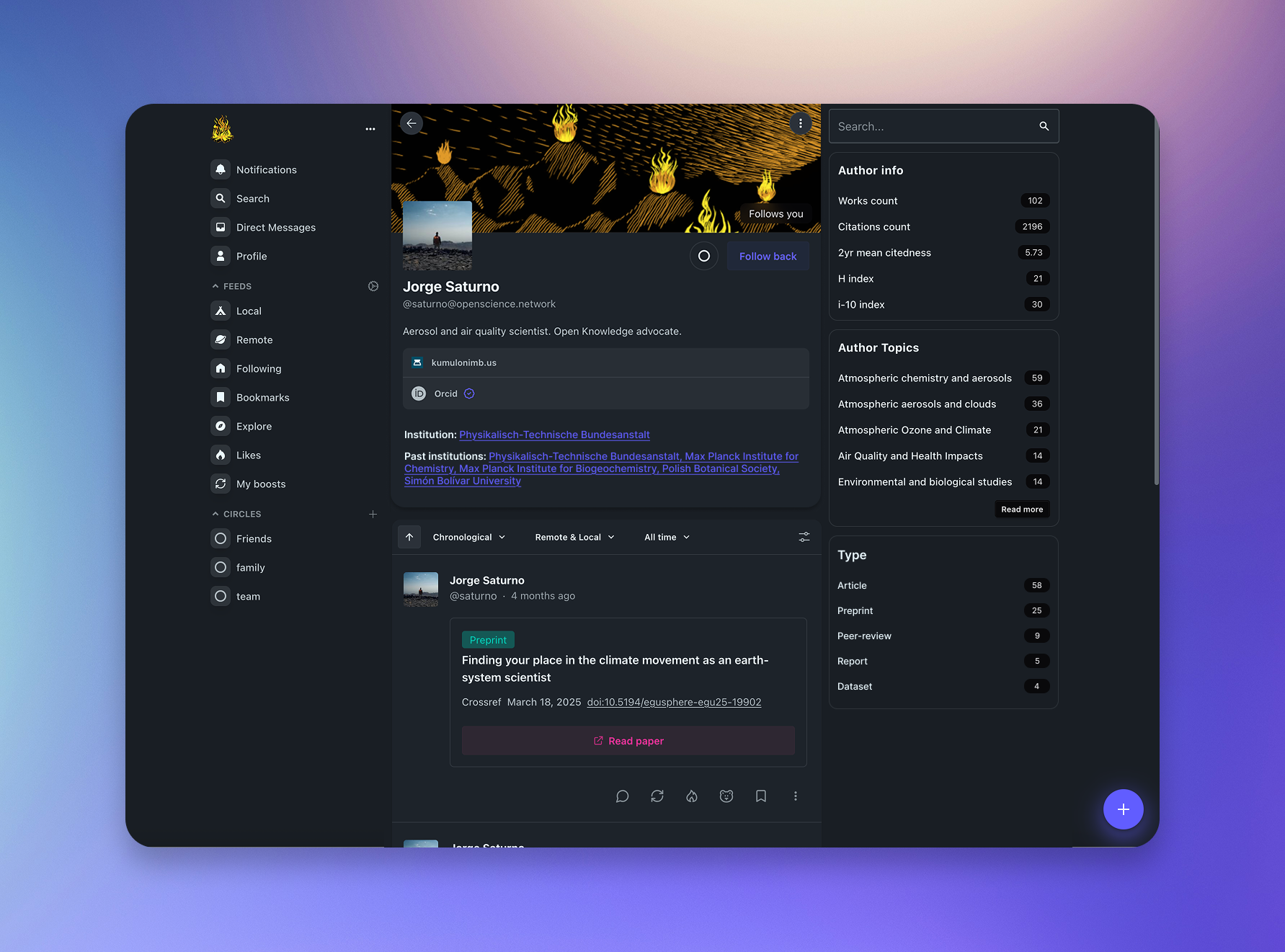
Jorge Saturno profile on Bonfire Open Science Network flavor latest version

As we integrate #OpenAlex data into the #Bonfire #OpenScience flavor, we're displaying familiar metrics: works count, citations, h-index, research topics, institutional affiliations...
These might be exactly what you need, or perhaps just a starting point.
What additional information would help you find collaborators or understand someone's work better?
We're opening this design process to the open science community. Share what works, what doesn't, what's missing.
@open_science
1/2
Jorge Saturno profile on Bonfire Open Science Network flavor latest version
As we integrate #OpenAlex data into the #Bonfire #OpenScience flavor, we're displaying familiar metrics: works count, citations, h-index, research topics, institutional affiliations...
These might be exactly what you need, or perhaps just a starting point.
What additional information would help you find collaborators or understand someone's work better?
We're opening this design process to the open science community. Share what works, what doesn't, what's missing.
@open_science
1/2
Jorge Saturno profile on Bonfire Open Science Network flavor latest version
As we integrate #OpenAlex data into the #Bonfire #OpenScience flavor, we're displaying familiar metrics: works count, citations, h-index, research topics, institutional affiliations...
These might be exactly what you need, or perhaps just a starting point.
What additional information would help you find collaborators or understand someone's work better?
We're opening this design process to the open science community. Share what works, what doesn't, what's missing.
@open_science
1/2
Jorge Saturno profile on Bonfire Open Science Network flavor latest version
As we integrate #OpenAlex data into the #Bonfire #OpenScience flavor, we're displaying familiar metrics: works count, citations, h-index, research topics, institutional affiliations...
These might be exactly what you need, or perhaps just a starting point.
What additional information would help you find collaborators or understand someone's work better?
We're opening this design process to the open science community. Share what works, what doesn't, what's missing.
@open_science
1/2
Jorge Saturno profile on Bonfire Open Science Network flavor latest version
🌊 Exciting news! Crowdinblue - a mission-led initiative bridging water solutions with funding - has chosen #Bonfire to build their federated community space!
Together, we're designing custom extensions to connect water projects with impact investors and crowdfunding opportunities. All in a federated environment that puts communities and projects first.
Welcome to the Bonfire ecosystem, crowdinblue! 💚
Read more about the project: https://crowdinblue.org
#CommonsEconomy #WaterJustice #Fediverse
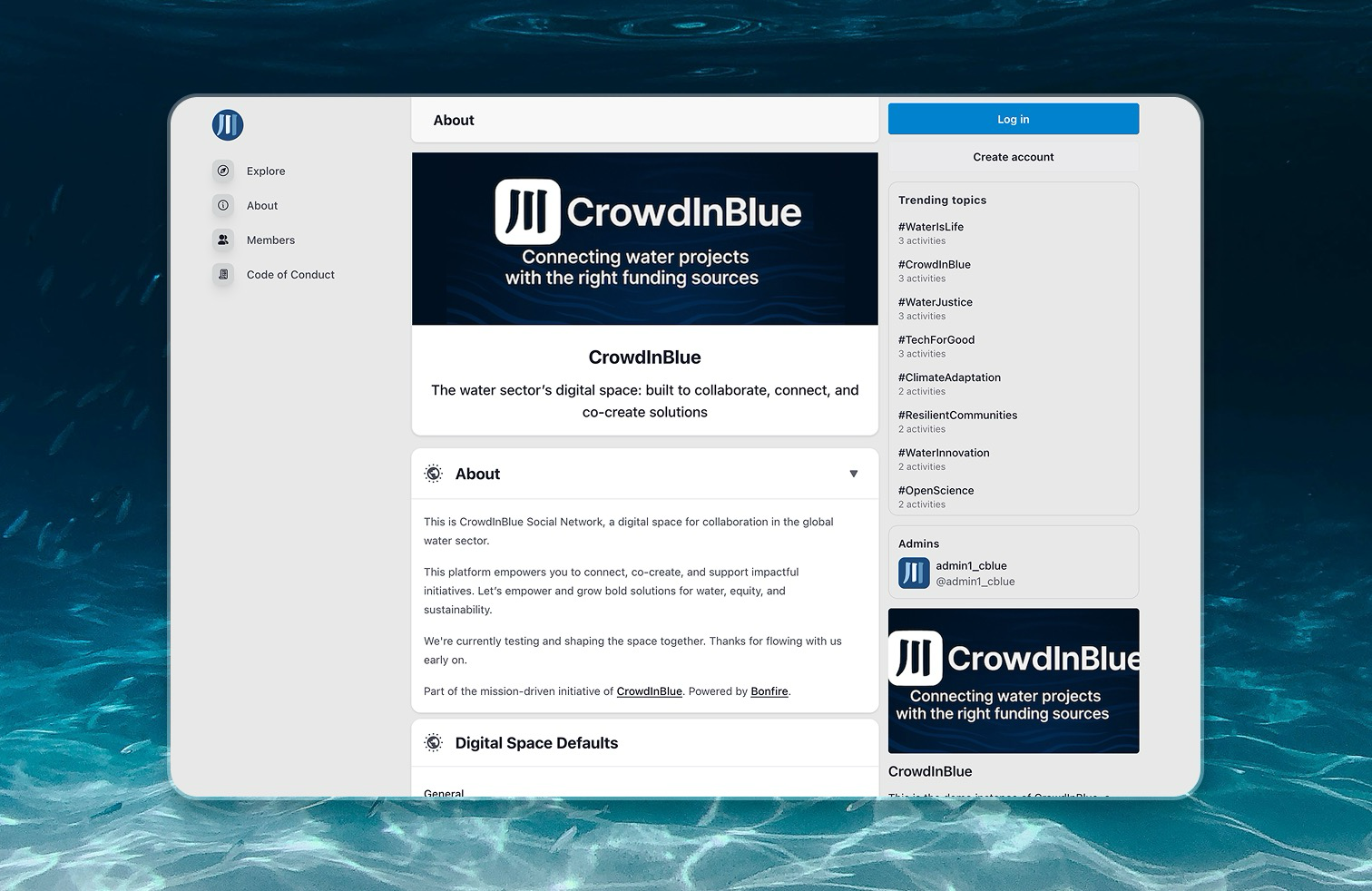
The crowdinblue bonfire instance
🌊 Exciting news! Crowdinblue - a mission-led initiative bridging water solutions with funding - has chosen #Bonfire to build their federated community space!
Together, we're designing custom extensions to connect water projects with impact investors and crowdfunding opportunities. All in a federated environment that puts communities and projects first.
Welcome to the Bonfire ecosystem, crowdinblue! 💚
Read more about the project: https://crowdinblue.org
#CommonsEconomy #WaterJustice #Fediverse
The crowdinblue bonfire instance
🌊 Exciting news! Crowdinblue - a mission-led initiative bridging water solutions with funding - has chosen #Bonfire to build their federated community space!
Together, we're designing custom extensions to connect water projects with impact investors and crowdfunding opportunities. All in a federated environment that puts communities and projects first.
Welcome to the Bonfire ecosystem, crowdinblue! 💚
Read more about the project: https://crowdinblue.org
#CommonsEconomy #WaterJustice #Fediverse
The crowdinblue bonfire instance
🌊 Exciting news! Crowdinblue - a mission-led initiative bridging water solutions with funding - has chosen #Bonfire to build their federated community space!
Together, we're designing custom extensions to connect water projects with impact investors and crowdfunding opportunities. All in a federated environment that puts communities and projects first.
Welcome to the Bonfire ecosystem, crowdinblue! 💚
Read more about the project: https://crowdinblue.org
#CommonsEconomy #WaterJustice #Fediverse
The crowdinblue bonfire instance
🌊 Exciting news! Crowdinblue - a mission-led initiative bridging water solutions with funding - has chosen #Bonfire to build their federated community space!
Together, we're designing custom extensions to connect water projects with impact investors and crowdfunding opportunities. All in a federated environment that puts communities and projects first.
Welcome to the Bonfire ecosystem, crowdinblue! 💚
Read more about the project: https://crowdinblue.org
#CommonsEconomy #WaterJustice #Fediverse
The crowdinblue bonfire instance
@bonfire Well… if someone wanted to adapt #bonfire to became something like a #federated #Discord , I wouldn’t say no. 😁
@hamiller_friendica @Fischblog @pikarl @feb
P.S. We're also working with @sciety to help them build a #bonfire flavour specifically for #preprints publications as part of their #nlnet grant: https://blog.sciety.org/sciety-secures-funding-from-nlnet-foundation-to-help-build-discourse-around-preprints/
The fediverse is definitely the right place for open science 🔥

blog.sciety.org
At Sciety we're pioneering a new layer of open scholarly communication, one that captures informal conversations around preprints and makes them discoverable and reusable. Sciety has secured new funding from NLNet Foundation to help us make conversations around preprints more open, more connected, and more rewarding for researchers. Over the
🌊 Exciting news! Crowdinblue - a mission-led initiative bridging water solutions with funding - has chosen #Bonfire to build their federated community space!
Together, we're designing custom extensions to connect water projects with impact investors and crowdfunding opportunities. All in a federated environment that puts communities and projects first.
Welcome to the Bonfire ecosystem, crowdinblue! 💚
Read more about the project: https://crowdinblue.org
#CommonsEconomy #WaterJustice #Fediverse
The crowdinblue bonfire instance


I created a new collection on my Ghost blog for #MySoCalledSudoLife posts:
🔗: https://news.elenarossini.com/tag/my-so-called-sudo-life/
My ultimate goal is to gather there all the #selfhosting posts I published on this #GoToSocial account this year, organized by month (aka: "my adventures in self-hosting: January 2025" etc.)
As I said before, it's not very efficient to have to scroll back in my GoToSocial archives to read up about some of the challenges I faced / solutions I found. Having everything in one place on my website feels really empowering.
What else is going on?
🔥 I'm currently testing #Bonfire - and really enjoying it so far.
☁️ I'm reading up about #NextCloud - the latest free open-source software I installed - because it has so many sophisticated functionalities and I want to take full advantage of them.
🚶♀️ and now off I go pick up my little one from her afternoon summer program... and then: gelato! 🍨

news.elenarossini.com
a series of blog posts that chronicle my self-hosting adventures
Haven't turned on Federation yet, but my Bonfire instance is looking good. My second install of Bonfire. I can tell you two things: Installation was much easier this time, and performance is much better.
One note, Bonfire recommends a hungry 8 GB of memory to run, but with that amount, it runs nicely so far. I'll keep you updated, hoping to turn federation on by next weekend. (This will be an invite only instance for brave individuals that want to assist with testing)
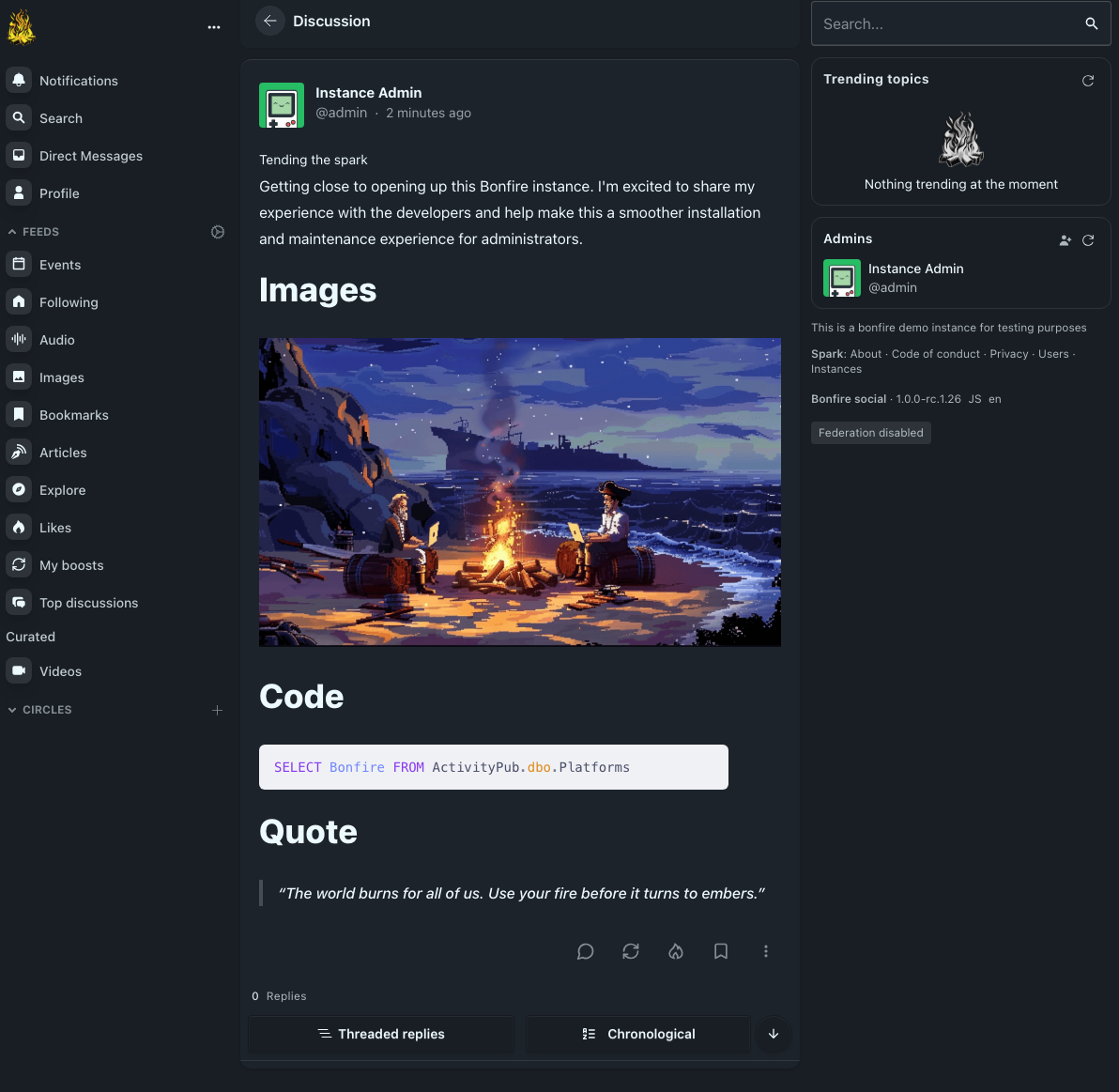
A screenshot of a discussion interface, featuring a user profile on the left side. The main content displays an image of a scenic landscape with two figures sitting by a fire. Below the image, there is a section labeled "Code" with a SQL command and a quote about using fire for transformation. The interface includes navigation elements and a trending topics section.
Haven't turned on Federation yet, but my Bonfire instance is looking good. My second install of Bonfire. I can tell you two things: Installation was much easier this time, and performance is much better.
One note, Bonfire recommends a hungry 8 GB of memory to run, but with that amount, it runs nicely so far. I'll keep you updated, hoping to turn federation on by next weekend. (This will be an invite only instance for brave individuals that want to assist with testing)
A screenshot of a discussion interface, featuring a user profile on the left side. The main content displays an image of a scenic landscape with two figures sitting by a fire. Below the image, there is a section labeled "Code" with a SQL command and a quote about using fire for transformation. The interface includes navigation elements and a trending topics section.
Haven't turned on Federation yet, but my Bonfire instance is looking good. My second install of Bonfire. I can tell you two things: Installation was much easier this time, and performance is much better.
One note, Bonfire recommends a hungry 8 GB of memory to run, but with that amount, it runs nicely so far. I'll keep you updated, hoping to turn federation on by next weekend. (This will be an invite only instance for brave individuals that want to assist with testing)
A screenshot of a discussion interface, featuring a user profile on the left side. The main content displays an image of a scenic landscape with two figures sitting by a fire. Below the image, there is a section labeled "Code" with a SQL command and a quote about using fire for transformation. The interface includes navigation elements and a trending topics section.
Haven't turned on Federation yet, but my Bonfire instance is looking good. My second install of Bonfire. I can tell you two things: Installation was much easier this time, and performance is much better.
One note, Bonfire recommends a hungry 8 GB of memory to run, but with that amount, it runs nicely so far. I'll keep you updated, hoping to turn federation on by next weekend. (This will be an invite only instance for brave individuals that want to assist with testing)
A screenshot of a discussion interface, featuring a user profile on the left side. The main content displays an image of a scenic landscape with two figures sitting by a fire. Below the image, there is a section labeled "Code" with a SQL command and a quote about using fire for transformation. The interface includes navigation elements and a trending topics section.
Haven't turned on Federation yet, but my Bonfire instance is looking good. My second install of Bonfire. I can tell you two things: Installation was much easier this time, and performance is much better.
One note, Bonfire recommends a hungry 8 GB of memory to run, but with that amount, it runs nicely so far. I'll keep you updated, hoping to turn federation on by next weekend. (This will be an invite only instance for brave individuals that want to assist with testing)
A screenshot of a discussion interface, featuring a user profile on the left side. The main content displays an image of a scenic landscape with two figures sitting by a fire. Below the image, there is a section labeled "Code" with a SQL command and a quote about using fire for transformation. The interface includes navigation elements and a trending topics section.
Haven't turned on Federation yet, but my Bonfire instance is looking good. My second install of Bonfire. I can tell you two things: Installation was much easier this time, and performance is much better.
One note, Bonfire recommends a hungry 8 GB of memory to run, but with that amount, it runs nicely so far. I'll keep you updated, hoping to turn federation on by next weekend. (This will be an invite only instance for brave individuals that want to assist with testing)
A screenshot of a discussion interface, featuring a user profile on the left side. The main content displays an image of a scenic landscape with two figures sitting by a fire. Below the image, there is a section labeled "Code" with a SQL command and a quote about using fire for transformation. The interface includes navigation elements and a trending topics section.
Want to try out Bonfire? There's an install party going on right now - get help from the devs as you setup your own instance!
https://mobilizon.libretic.fr/events/c0c0b536-5216-412b-a277-1dadead06997

mobilizon.libretic.fr
Jun 27, 2025, 3:30:00 PM - GMT - Join us this Friday at 15:30 UTC for our first Bonfire Install Party! A casual peer-led session where we’ll set up Bonfire instances together, ask questions, and tackle challenges in real time. This…
Want to try out Bonfire? There's an install party going on right now - get help from the devs as you setup your own instance!
https://mobilizon.libretic.fr/events/c0c0b536-5216-412b-a277-1dadead06997
mobilizon.libretic.fr
Jun 27, 2025, 3:30:00 PM - GMT - Join us this Friday at 15:30 UTC for our first Bonfire Install Party! A casual peer-led session where we’ll set up Bonfire instances together, ask questions, and tackle challenges in real time. This…
Want to try out Bonfire? There's an install party going on right now - get help from the devs as you setup your own instance!
https://mobilizon.libretic.fr/events/c0c0b536-5216-412b-a277-1dadead06997
mobilizon.libretic.fr
Jun 27, 2025, 3:30:00 PM - GMT - Join us this Friday at 15:30 UTC for our first Bonfire Install Party! A casual peer-led session where we’ll set up Bonfire instances together, ask questions, and tackle challenges in real time. This…
Bonfire, by default, has federation turned off when you spin it up.
I think this is a good choice. It allows you as the admin time to configure settings, add policies, artwork, etc. - make sure all is working, before you start knocking on other people's federated doors.
Bonfire, by default, has federation turned off when you spin it up.
I think this is a good choice. It allows you as the admin time to configure settings, add policies, artwork, etc. - make sure all is working, before you start knocking on other people's federated doors.
Bonfire, by default, has federation turned off when you spin it up.
I think this is a good choice. It allows you as the admin time to configure settings, add policies, artwork, etc. - make sure all is working, before you start knocking on other people's federated doors.
Anyone doing the #Bonfire #install #party Friday?
https://mobilizon.libretic.fr/events/c0c0b536-5216-412b-a277-1dadead06997
I'll be attending! Come check out Bonfire and get a better understanding how Bonfire can help take the #fediverse to the next level!
mobilizon.libretic.fr
Jun 27, 2025, 3:30:00 PM - GMT - Join us this Friday at 15:30 UTC for our first Bonfire Install Party! A casual peer-led session where we’ll set up Bonfire instances together, ask questions, and tackle challenges in real time. This…
Anyone doing the #Bonfire #install #party Friday?
https://mobilizon.libretic.fr/events/c0c0b536-5216-412b-a277-1dadead06997
I'll be attending! Come check out Bonfire and get a better understanding how Bonfire can help take the #fediverse to the next level!
mobilizon.libretic.fr
Jun 27, 2025, 3:30:00 PM - GMT - Join us this Friday at 15:30 UTC for our first Bonfire Install Party! A casual peer-led session where we’ll set up Bonfire instances together, ask questions, and tackle challenges in real time. This…
🚀 Our first online install party is happening!
Join us this Friday to set up your own Bonfire instance 🔥
We’ll focus on setting up an instance with @coopcloud, answer questions, and support each other along the way.
📅 Friday 27 June at 15:30 UTC
📍 Details: https://mobilizon.libretic.fr/events/c0c0b536-5216-412b-a277-1dadead06997
mobilizon.libretic.fr
Jun 27, 2025, 3:30:00 PM - GMT - Join us this Friday at 15:30 UTC for our first Bonfire Install Party! A casual peer-led session where we’ll set up Bonfire instances together, ask questions, and tackle challenges in real time. This…
🚀 Our first online install party is happening!
Join us this Friday to set up your own Bonfire instance 🔥
We’ll focus on setting up an instance with @coopcloud, answer questions, and support each other along the way.
📅 Friday 27 June at 15:30 UTC
📍 Details: https://mobilizon.libretic.fr/events/c0c0b536-5216-412b-a277-1dadead06997
mobilizon.libretic.fr
Jun 27, 2025, 3:30:00 PM - GMT - Join us this Friday at 15:30 UTC for our first Bonfire Install Party! A casual peer-led session where we’ll set up Bonfire instances together, ask questions, and tackle challenges in real time. This…
🚀 Our first online install party is happening!
Join us this Friday to set up your own Bonfire instance 🔥
We’ll focus on setting up an instance with @coopcloud, answer questions, and support each other along the way.
📅 Friday 27 June at 15:30 UTC
📍 Details: https://mobilizon.libretic.fr/events/c0c0b536-5216-412b-a277-1dadead06997
mobilizon.libretic.fr
Jun 27, 2025, 3:30:00 PM - GMT - Join us this Friday at 15:30 UTC for our first Bonfire Install Party! A casual peer-led session where we’ll set up Bonfire instances together, ask questions, and tackle challenges in real time. This…
🚀 Our first online install party is happening!
Join us this Friday to set up your own Bonfire instance 🔥
We’ll focus on setting up an instance with @coopcloud, answer questions, and support each other along the way.
📅 Friday 27 June at 15:30 UTC
📍 Details: https://mobilizon.libretic.fr/events/c0c0b536-5216-412b-a277-1dadead06997
mobilizon.libretic.fr
Jun 27, 2025, 3:30:00 PM - GMT - Join us this Friday at 15:30 UTC for our first Bonfire Install Party! A casual peer-led session where we’ll set up Bonfire instances together, ask questions, and tackle challenges in real time. This…
🔥 Want to start your own Bonfire instance?
We’re hosting online install parties, come set up your server alongside others! Bring your questions and curiosity, we’ll figure it out together and support each other through the process.
✅ Ideally have a (sub)domain + server with DNS set up, or just follow along and take notes.
📆 Vote on possible dates/times: https://crab.fit/bonfire-install-parties-394649
📩 Sign up to be notified: https://mailchi.mp/a601c2e1e132/bonfire-install-parties

mailchi.mp
🔥 Want to start your own Bonfire instance?
We’re hosting online install parties, come set up your server alongside others! Bring your questions and curiosity, we’ll figure it out together and support each other through the process.
✅ Ideally have a (sub)domain + server with DNS set up, or just follow along and take notes.
📆 Vote on possible dates/times: https://crab.fit/bonfire-install-parties-394649
📩 Sign up to be notified: https://mailchi.mp/a601c2e1e132/bonfire-install-parties
mailchi.mp
🔥 Want to start your own Bonfire instance?
We’re hosting online install parties, come set up your server alongside others! Bring your questions and curiosity, we’ll figure it out together and support each other through the process.
✅ Ideally have a (sub)domain + server with DNS set up, or just follow along and take notes.
📆 Vote on possible dates/times: https://crab.fit/bonfire-install-parties-394649
📩 Sign up to be notified: https://mailchi.mp/a601c2e1e132/bonfire-install-parties
mailchi.mp
🌐 Can you help translate Bonfire into your language?
We’re looking for translators and bilingual folks to help localise Bonfire extensions and UI into as many languages as possible — especially before the 1.0 release!
No coding needed — just a love of words.
🔥 Join here: https://app.transifex.com/bonfire/bonfire/
P.S. You can also help by translating this very message and/or sharing it! The more communities we reach, the more accessible Bonfire becomes. 🌍💬
explore.transifex.com
Join Bonfire project in Transifex, and contribute to the world's largest localization community
🔥 Want to start your own Bonfire instance?
We’re hosting online install parties, come set up your server alongside others! Bring your questions and curiosity, we’ll figure it out together and support each other through the process.
✅ Ideally have a (sub)domain + server with DNS set up, or just follow along and take notes.
📆 Vote on possible dates/times: https://crab.fit/bonfire-install-parties-394649
📩 Sign up to be notified: https://mailchi.mp/a601c2e1e132/bonfire-install-parties
mailchi.mp

@bonfire I really like the idea behind #Bonfire, but that your website is using generative AI art (e.g. on bonfirenetworks.org/design) scared me off. It's difficult to believe your commitment to ethics and communities when you actively use such an exploitative and extractive technology. It's not unlike if you were promoting Bitcoin or NFTs; it's a massive red flag in today's tech world that you're not to be trusted. Would you consider removing any genAI and clearly crediting your artists?
🔥 Want to start your own Bonfire instance?
We’re hosting online install parties, come set up your server alongside others! Bring your questions and curiosity, we’ll figure it out together and support each other through the process.
✅ Ideally have a (sub)domain + server with DNS set up, or just follow along and take notes.
📆 Vote on possible dates/times: https://crab.fit/bonfire-install-parties-394649
📩 Sign up to be notified: https://mailchi.mp/a601c2e1e132/bonfire-install-parties
mailchi.mp
🔥 Want to start your own Bonfire instance?
We’re hosting online install parties, come set up your server alongside others! Bring your questions and curiosity, we’ll figure it out together and support each other through the process.
✅ Ideally have a (sub)domain + server with DNS set up, or just follow along and take notes.
📆 Vote on possible dates/times: https://crab.fit/bonfire-install-parties-394649
📩 Sign up to be notified: https://mailchi.mp/a601c2e1e132/bonfire-install-parties
mailchi.mp
🔥 Want to start your own Bonfire instance?
We’re hosting online install parties, come set up your server alongside others! Bring your questions and curiosity, we’ll figure it out together and support each other through the process.
✅ Ideally have a (sub)domain + server with DNS set up, or just follow along and take notes.
📆 Vote on possible dates/times: https://crab.fit/bonfire-install-parties-394649
📩 Sign up to be notified: https://mailchi.mp/a601c2e1e132/bonfire-install-parties
mailchi.mp
🔥 Want to start your own Bonfire instance?
We’re hosting online install parties, come set up your server alongside others! Bring your questions and curiosity, we’ll figure it out together and support each other through the process.
✅ Ideally have a (sub)domain + server with DNS set up, or just follow along and take notes.
📆 Vote on possible dates/times: https://crab.fit/bonfire-install-parties-394649
📩 Sign up to be notified: https://mailchi.mp/a601c2e1e132/bonfire-install-parties
mailchi.mp
🔥 Want to start your own Bonfire instance?
We’re hosting online install parties, come set up your server alongside others! Bring your questions and curiosity, we’ll figure it out together and support each other through the process.
✅ Ideally have a (sub)domain + server with DNS set up, or just follow along and take notes.
📆 Vote on possible dates/times: https://crab.fit/bonfire-install-parties-394649
📩 Sign up to be notified: https://mailchi.mp/a601c2e1e132/bonfire-install-parties
mailchi.mp
Hello World!
I just spoke with a #US #Senator office about the #fediverse . They're asking for more information to help spread around #Capital #Hill in small bite sized easy to understand pieces. I'm obviously going to give them @elena beautiful #movie on the #fedi (with some light editing which she's agreed to).
I'll of course show them https://fediverse.info/ and https://fedi.tips/ which are great websites. I figured I'd give them examples of amazing #AP projects such as #mastodon , #pixelfed , #peertube , #bandwagon , and #bonfire ; even things like @admin .
I'd love to know from folks any EASY to understand projects that best encompass the Fediverse and explanations of it.
What are some projects you'd hand to your friends and family that would explain and display to them what we are?
I'll say this isn't going to happen over night. There's lot of questions around regulations, trust & safety, etc. But I feel it's pertinent to at least get the conversation going, especially considering the current state of disdain for big social media and the impending legislation around these things.
I'll finally state if there's anyone in this list that does NOT want to be involved with this, that's totally fine and I understand and I can exclude you from the materials I give to them.
#boost #boostplease #government #laws #activityPub
@benpate @peertube @bonfire
@stefano @dansup @Mastodon
fedi.tips
An unofficial guide to using Mastodon and the Fediverse
Hello World!
I just spoke with a #US #Senator office about the #fediverse . They're asking for more information to help spread around #Capital #Hill in small bite sized easy to understand pieces. I'm obviously going to give them @elena beautiful #movie on the #fedi (with some light editing which she's agreed to).
I'll of course show them https://fediverse.info/ and https://fedi.tips/ which are great websites. I figured I'd give them examples of amazing #AP projects such as #mastodon , #pixelfed , #peertube , #bandwagon , and #bonfire ; even things like @admin .
I'd love to know from folks any EASY to understand projects that best encompass the Fediverse and explanations of it.
What are some projects you'd hand to your friends and family that would explain and display to them what we are?
I'll say this isn't going to happen over night. There's lot of questions around regulations, trust & safety, etc. But I feel it's pertinent to at least get the conversation going, especially considering the current state of disdain for big social media and the impending legislation around these things.
I'll finally state if there's anyone in this list that does NOT want to be involved with this, that's totally fine and I understand and I can exclude you from the materials I give to them.
#boost #boostplease #government #laws #activityPub
@benpate @peertube @bonfire
@stefano @dansup @Mastodon
fedi.tips
An unofficial guide to using Mastodon and the Fediverse
Hello World!
I just spoke with a #US #Senator office about the #fediverse . They're asking for more information to help spread around #Capital #Hill in small bite sized easy to understand pieces. I'm obviously going to give them @elena beautiful #movie on the #fedi (with some light editing which she's agreed to).
I'll of course show them https://fediverse.info/ and https://fedi.tips/ which are great websites. I figured I'd give them examples of amazing #AP projects such as #mastodon , #pixelfed , #peertube , #bandwagon , and #bonfire ; even things like @admin .
I'd love to know from folks any EASY to understand projects that best encompass the Fediverse and explanations of it.
What are some projects you'd hand to your friends and family that would explain and display to them what we are?
I'll say this isn't going to happen over night. There's lot of questions around regulations, trust & safety, etc. But I feel it's pertinent to at least get the conversation going, especially considering the current state of disdain for big social media and the impending legislation around these things.
I'll finally state if there's anyone in this list that does NOT want to be involved with this, that's totally fine and I understand and I can exclude you from the materials I give to them.
#boost #boostplease #government #laws #activityPub
@benpate @peertube @bonfire
@stefano @dansup @Mastodon
fedi.tips
An unofficial guide to using Mastodon and the Fediverse
Hello World!
I just spoke with a #US #Senator office about the #fediverse . They're asking for more information to help spread around #Capital #Hill in small bite sized easy to understand pieces. I'm obviously going to give them @elena beautiful #movie on the #fedi (with some light editing which she's agreed to).
I'll of course show them https://fediverse.info/ and https://fedi.tips/ which are great websites. I figured I'd give them examples of amazing #AP projects such as #mastodon , #pixelfed , #peertube , #bandwagon , and #bonfire ; even things like @admin .
I'd love to know from folks any EASY to understand projects that best encompass the Fediverse and explanations of it.
What are some projects you'd hand to your friends and family that would explain and display to them what we are?
I'll say this isn't going to happen over night. There's lot of questions around regulations, trust & safety, etc. But I feel it's pertinent to at least get the conversation going, especially considering the current state of disdain for big social media and the impending legislation around these things.
I'll finally state if there's anyone in this list that does NOT want to be involved with this, that's totally fine and I understand and I can exclude you from the materials I give to them.
#boost #boostplease #government #laws #activityPub
@benpate @peertube @bonfire
@stefano @dansup @Mastodon
fedi.tips
An unofficial guide to using Mastodon and the Fediverse
Always wanted to #selfhost your #Fediverse instance but were always worried about system administration trauma?
Do you ever have to run around your flat, picking up all the leftover parentheses from yesterday's party with your hosting coop coworkers?
Then you are probably the right person, check out this post about fearless #Bonfire hosting on a #Guix System. You'll learn that taking care of a community is much more manageable when you let computer do the boring work for you.
Set up HTTPS, automatic backups, automatic nightly upgrades and join the awesome Bonfire community without a single worry on losing data from your instance.
https://fishinthecalculator.me/blog/bonfire--guix-a-love-story.html
fishinthecalculator.me
My personal space on the web. Mostly about FOSS and technological autonomy.
Always wanted to #selfhost your #Fediverse instance but were always worried about system administration trauma?
Do you ever have to run around your flat, picking up all the leftover parentheses from yesterday's party with your hosting coop coworkers?
Then you are probably the right person, check out this post about fearless #Bonfire hosting on a #Guix System. You'll learn that taking care of a community is much more manageable when you let computer do the boring work for you.
Set up HTTPS, automatic backups, automatic nightly upgrades and join the awesome Bonfire community without a single worry on losing data from your instance.
https://fishinthecalculator.me/blog/bonfire--guix-a-love-story.html
fishinthecalculator.me
My personal space on the web. Mostly about FOSS and technological autonomy.


campground.bonfire.cafe
This is a bonfire demo instance for testing purposes
Je regarde l'install de Bonfire ...
Euh et si je comprend bien y a pas de storage normal (sur le DD quoi), que du S3 ??
#Bonfire

@bonfire This is great. #ORCiD (https://campground.bonfire.cafe/openid/client/orcid) and federation is not yet working (I know it is a release candidate). The overall impression is “impressive!”. A lot of features suitable for research. Easy onboarding.💪
There is even a Weather widget ☀️
It seems that #bonfire can export and import all data (incl. posts, messages … Ghosted).
What if social networks served people in all their diverse complexity — instead of the streamlined simplicity of big platforms?
Bonfire Social is our first app: built for meaningful connection and conversation – community-governed spaces you can make your own.
It’s part of a modular framework that empowers communities to build the tools they need — and shape how they work and feel.

So proud they chose to make a key account to evangelize thier work on Indieweb.social… such an impressive project. #bonfire https://indieweb.social/@bonfire/114631617774926243
indieweb.social
🔥 Bonfire Social 1.0 release candidate has landed! Curious about what the fediverse could look like with real community control? Try out features like custom feeds, nested discussions, shared profiles, circles, and boundary-based permissions — then let us know what breaks or needs improvement. More details and video demos: https://bonfirenetworks.org/posts/bonfire_social_rc/ #BonfireSocial #FediForum #FOSS #ActivityPub #DigitalAutonomy
What if social networks served people in all their diverse complexity — instead of the streamlined simplicity of big platforms?
Bonfire Social is our first app: built for meaningful connection and conversation – community-governed spaces you can make your own.
It’s part of a modular framework that empowers communities to build the tools they need — and shape how they work and feel.
What if social networks served people in all their diverse complexity — instead of the streamlined simplicity of big platforms?
Bonfire Social is our first app: built for meaningful connection and conversation – community-governed spaces you can make your own.
It’s part of a modular framework that empowers communities to build the tools they need — and shape how they work and feel.
What if social networks served people in all their diverse complexity — instead of the streamlined simplicity of big platforms?
Bonfire Social is our first app: built for meaningful connection and conversation – community-governed spaces you can make your own.
It’s part of a modular framework that empowers communities to build the tools they need — and shape how they work and feel.
What if social networks served people in all their diverse complexity — instead of the streamlined simplicity of big platforms?
Bonfire Social is our first app: built for meaningful connection and conversation – community-governed spaces you can make your own.
It’s part of a modular framework that empowers communities to build the tools they need — and shape how they work and feel.
This is a chance to poke at the process, challenge assumptions, and have an open conversation. Bring your curiosity, hard questions, and ideas about co-design, funding, burnout, moderation, and the messy realities of open-source work.
Let’s dig into how fediverse apps get built, maintained, and shaped by their communities.
See you there! 🔗 https://fediforum.org
FediForum: moving the Open Social Web forward
This is a chance to poke at the process, challenge assumptions, and have an open conversation. Bring your curiosity, hard questions, and ideas about co-design, funding, burnout, moderation, and the messy realities of open-source work.
Let’s dig into how fediverse apps get built, maintained, and shaped by their communities.
See you there! 🔗 https://fediforum.org
FediForum: moving the Open Social Web forward
We have created a new #Mastodon #StarterPack:
13 accounts from #Fediverse projects - that's basically a newsfeed for developments in the #ActivityPub #SocialWeb.
You can follow 9 more accounts (see answer 👇) manually. (The great @fedidevs project currently only supports packages with Mastodon accounts.)
👉 https://fedidevs.com/s/NTYy/
Which project is missing?
#Bonfire #Bookwyrm #Funkwhale #Gancio #Lemmy #Mastodon #Mobilizon #Nextcloud #owncast #PeerTube #Pixelfed #WordPress #WriteFreely
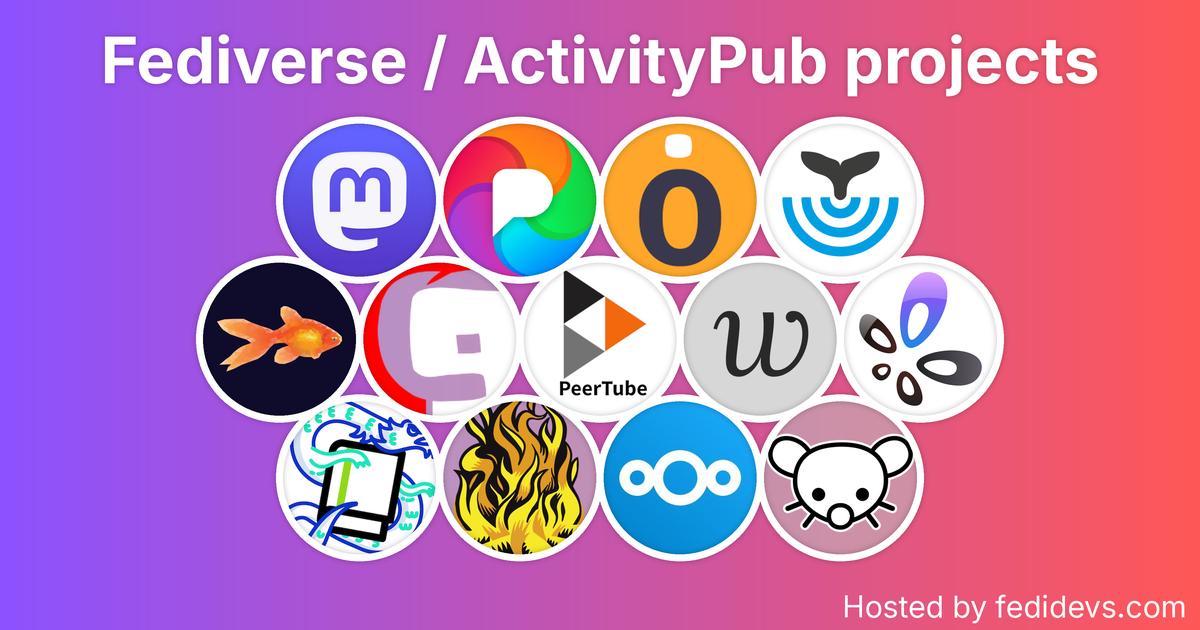
fedidevs.com
Accounts from and about microblogging, audio, photo and video hosting projects. Since only Mastodon instances are currently supported on fedidevs.com, we could not put the following projects in the package, so follow manually if you like: @akkoma@ihatebeinga.live – @Castopod@podlibre.social – @gotosocial@superseriousbusiness.org – @index@activitypub.ghost.org – @loops@pixelfed.social – @misskey_hub_deploy@misskey.io – @news@forum.friendi.ca – @pinetta@fedi.software – @sharkey@sharkey.team
If you are in Bologna and like the idea of a #bonfire instance running upon #Guix System and all of its little parenthesis, tonight we are waiting for you at
https://indieweb.social/@bonfire/114476553336858779
We'll collectively setup a Bonfire instance deciding the rules that the #community will follow, how #moderation should be done, which #CodeofConduct to enforce. All on an instance defined with Guix declarative, roll-backable solid take on configuration.
How can you miss it?
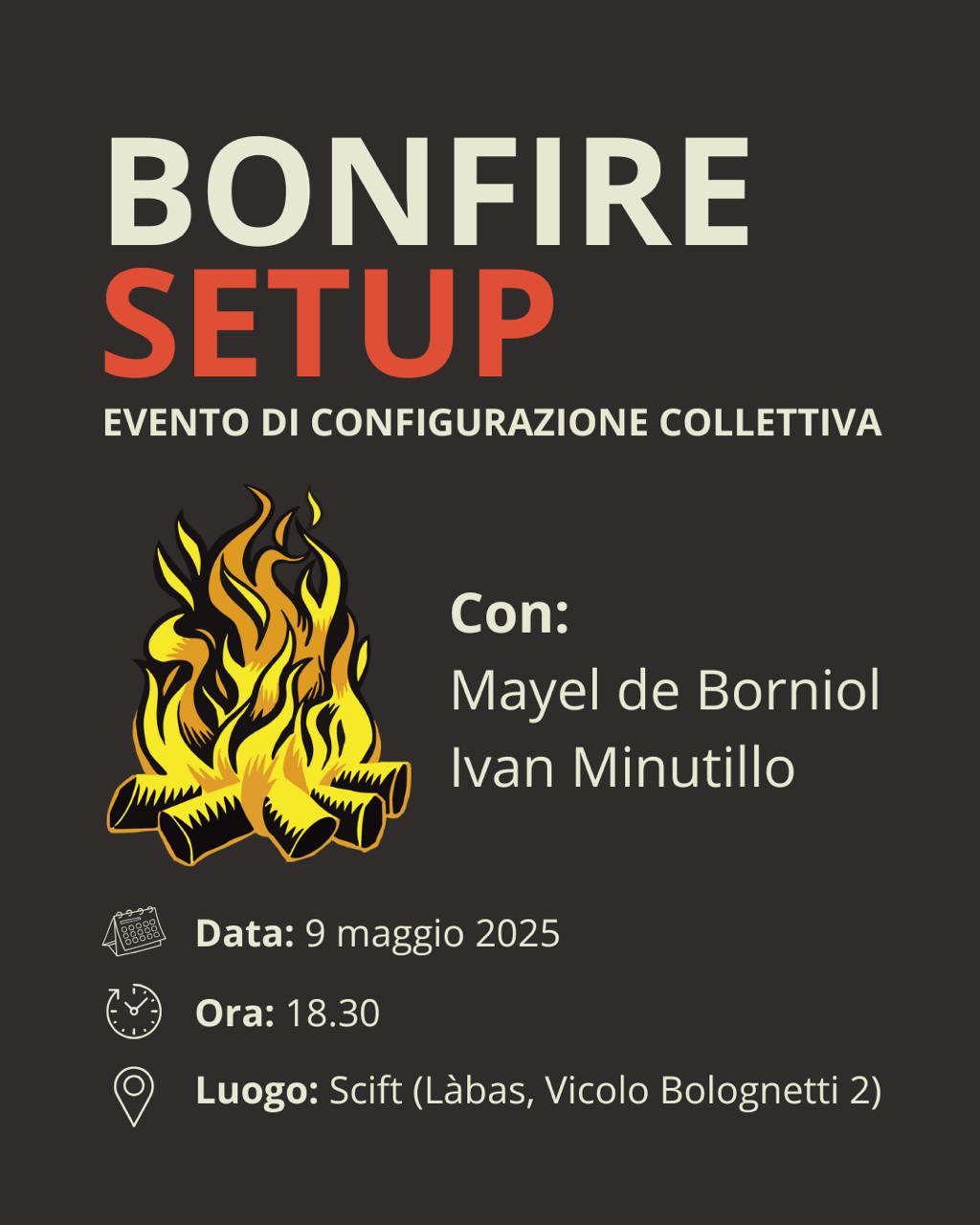
indieweb.social
Attached: 1 image Are you near #Bologna Italy? ✊️ Join us today at Làbas - a self-managed social municipality in Bologna, Italy where we're facilitating a collaborative Bonfire workshop with #municipiozero and scift. Together, we'll install a Bonfire instance and collectively configure extensions, community guidelines, and settings tailored to their specific needs 💅 https://municipiozero.it/events/bonfire-setup-evento-di-configurazione-collettiva/
If you are in Bologna and like the idea of a #bonfire instance running upon #Guix System and all of its little parenthesis, tonight we are waiting for you at
https://indieweb.social/@bonfire/114476553336858779
We'll collectively setup a Bonfire instance deciding the rules that the #community will follow, how #moderation should be done, which #CodeofConduct to enforce. All on an instance defined with Guix declarative, roll-backable solid take on configuration.
How can you miss it?
indieweb.social
Attached: 1 image Are you near #Bologna Italy? ✊️ Join us today at Làbas - a self-managed social municipality in Bologna, Italy where we're facilitating a collaborative Bonfire workshop with #municipiozero and scift. Together, we'll install a Bonfire instance and collectively configure extensions, community guidelines, and settings tailored to their specific needs 💅 https://municipiozero.it/events/bonfire-setup-evento-di-configurazione-collettiva/
🔥 Bonfire Setup: evento di configurazione collettiva ❤️🔥
Ti sei mai chiestə chi decide, come funzionano i social network che usiamo ogni giorno? Chi stabilisce le regole, cosa è permesso e cosa no, chi può entrare e chi viene escluso?
Vieni al @bonfire Setup, un incontro dove decideremo insieme come configurare, governare e abitare uno spazio digitale tutto nostro.
🧵 1/2
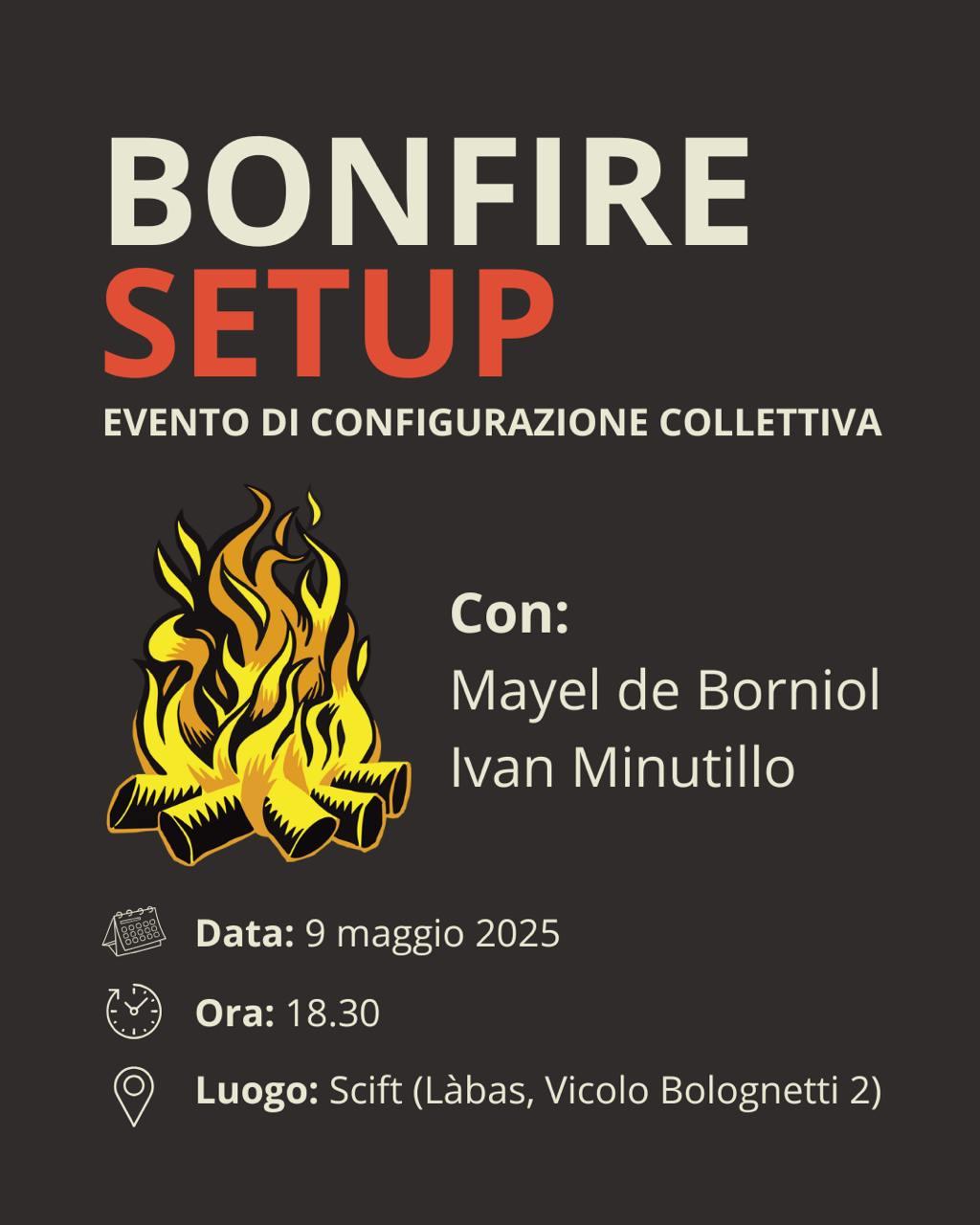
Grafica di info come da testo del post.
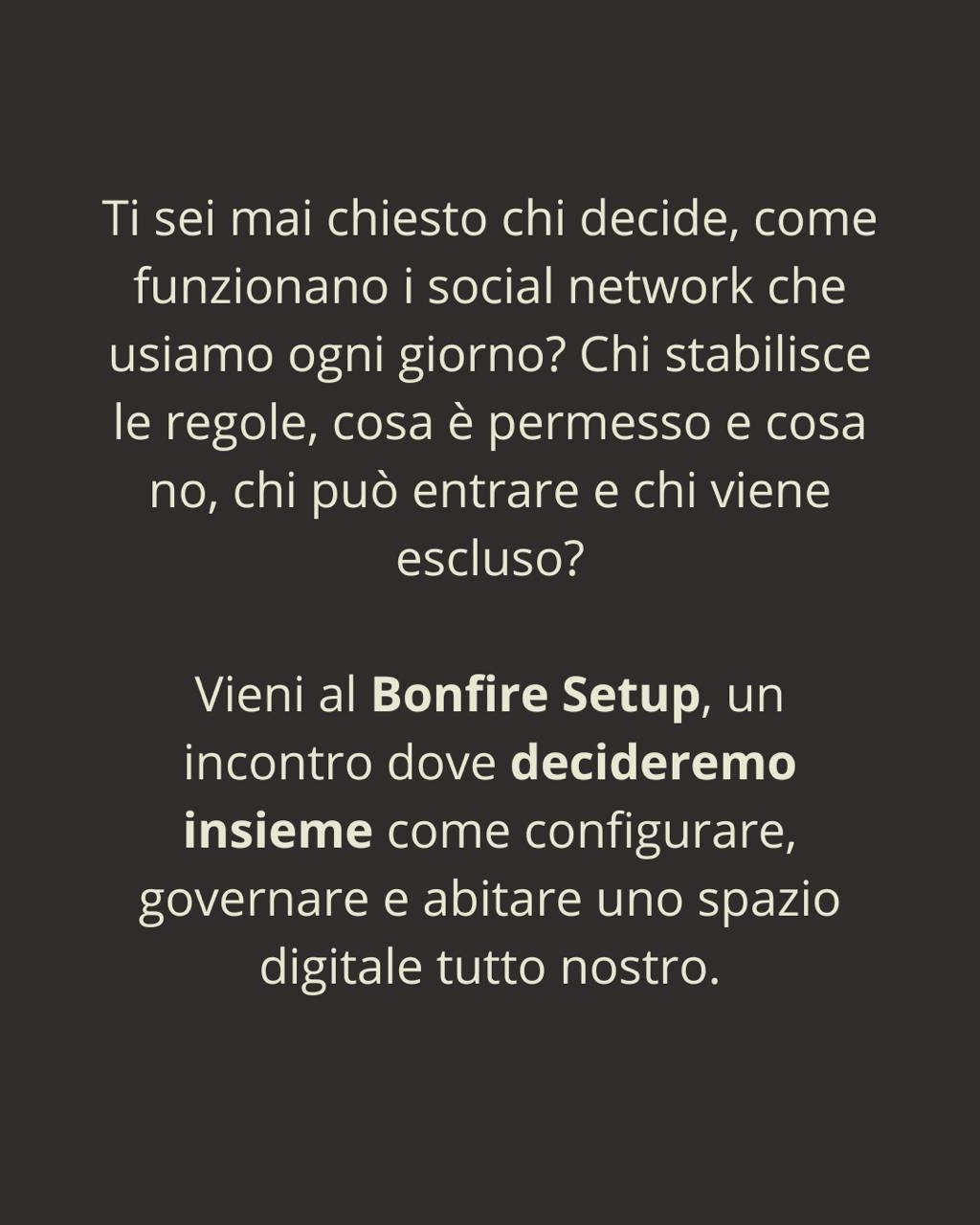
Grafica di info come da testo del post.
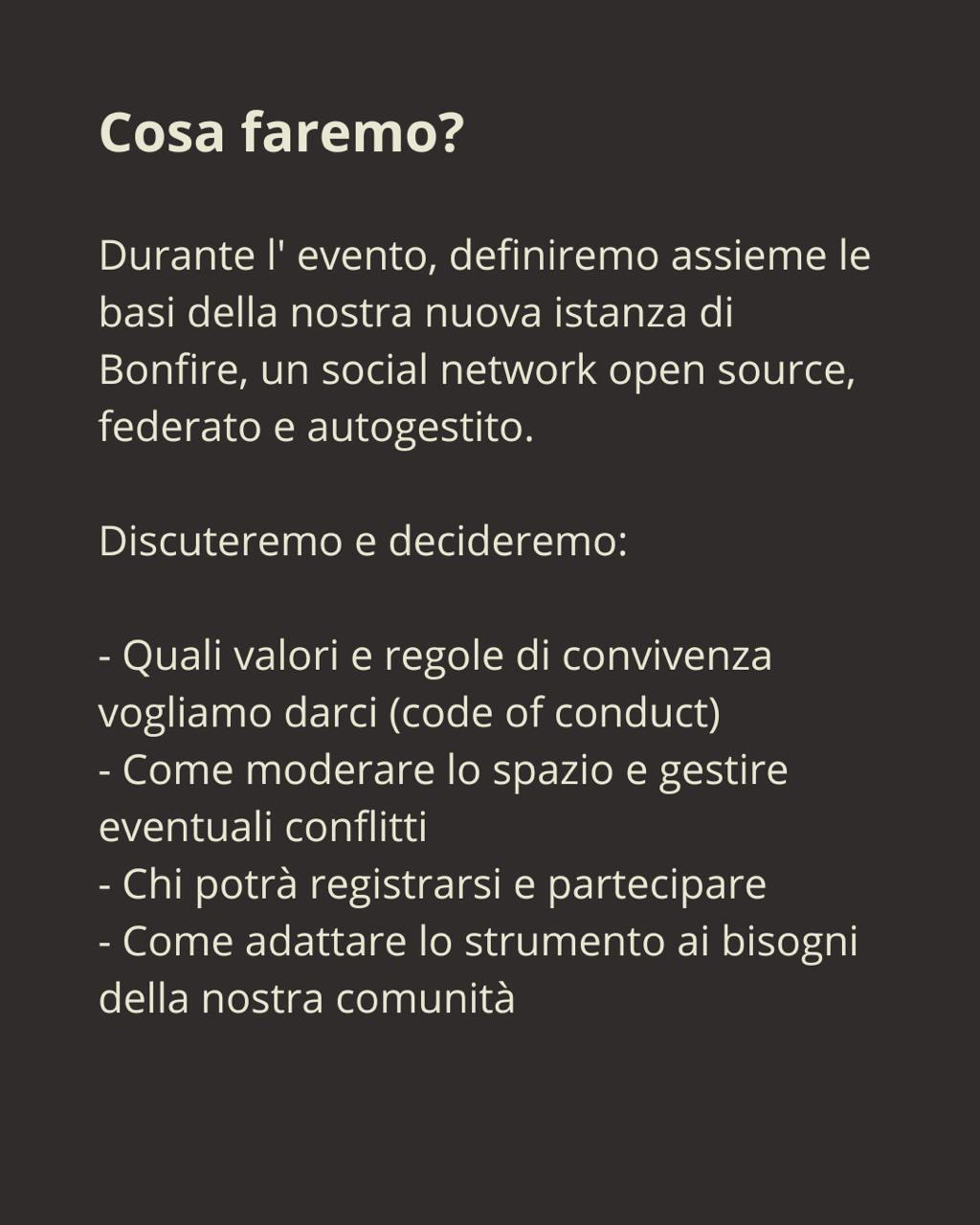
Grafica di info come da testo del post.
Non serve essere tecnici o programmatori per partecipare! Il Bonfire Setup è proprio un momento per decidere insieme come vogliamo che funzioni il nostro spazio, quali valori promuovere e come gestirlo collettivamente.
Quando e dove: 9 maggio 2025, H.18.30 presso Scift (Làbas), Vicolo Bolognetti 2, Bologna.
🧵 2/2 @bonfire
Grafica di info come da testo del post.
Grafica di info come da testo del post.

Grafica di info come da testo del post.
Non serve essere tecnici o programmatori per partecipare! Il Bonfire Setup è proprio un momento per decidere insieme come vogliamo che funzioni il nostro spazio, quali valori promuovere e come gestirlo collettivamente.
Quando e dove: 9 maggio 2025, H.18.30 presso Scift (Làbas), Vicolo Bolognetti 2, Bologna.
🧵 2/2 @bonfire
Grafica di info come da testo del post.
Grafica di info come da testo del post.
Grafica di info come da testo del post.
🔥 Bonfire Setup: evento di configurazione collettiva ❤️🔥
Ti sei mai chiestə chi decide, come funzionano i social network che usiamo ogni giorno? Chi stabilisce le regole, cosa è permesso e cosa no, chi può entrare e chi viene escluso?
Vieni al @bonfire Setup, un incontro dove decideremo insieme come configurare, governare e abitare uno spazio digitale tutto nostro.
🧵 1/2
Grafica di info come da testo del post.
Grafica di info come da testo del post.
Grafica di info come da testo del post.
🔥 Bonfire Setup: evento di configurazione collettiva ❤️🔥
Ti sei mai chiestə chi decide, come funzionano i social network che usiamo ogni giorno? Chi stabilisce le regole, cosa è permesso e cosa no, chi può entrare e chi viene escluso?
Vieni al @bonfire Setup, un incontro dove decideremo insieme come configurare, governare e abitare uno spazio digitale tutto nostro.
🧵 1/2
Grafica di info come da testo del post.
Grafica di info come da testo del post.
Grafica di info come da testo del post.
#ResearchGate
What are the open alternatives? I know about #bonfire
Update: I just realized that the obvious answer to this is #ORCiD 🤦♂️
Thanks for the quick reply! I have been looking for an alternative to Facebook (who isn’t) for the global #tango communities.
#friendica ticks many boxes, but the lack of modern usability is a big risk factor. #bonfire looks like it could fill that gap perfectly.
Now that I got some fond memories of #typescript (read: Stockholm Syndrome), I sort of want to build stuff with #fedify. 😅
Though what I *really* want is an option like it for #ElixirLang. Maybe a project for the new year. 🤔
Not like we don't have #Akkoma, #Bonfire, #Pleroma, and #Mobilizon as examples of what could be a standard library. 😄
fedify.dev
Fedify is a TypeScript library for building federated server apps powered by ActivityPub and other standards, so-called fediverse.
Now that I got some fond memories of #typescript (read: Stockholm Syndrome), I sort of want to build stuff with #fedify. 😅
Though what I *really* want is an option like it for #ElixirLang. Maybe a project for the new year. 🤔
Not like we don't have #Akkoma, #Bonfire, #Pleroma, and #Mobilizon as examples of what could be a standard library. 😄
fedify.dev
Fedify is a TypeScript library for building federated server apps powered by ActivityPub and other standards, so-called fediverse.
Now that I got some fond memories of #typescript (read: Stockholm Syndrome), I sort of want to build stuff with #fedify. 😅
Though what I *really* want is an option like it for #ElixirLang. Maybe a project for the new year. 🤔
Not like we don't have #Akkoma, #Bonfire, #Pleroma, and #Mobilizon as examples of what could be a standard library. 😄
fedify.dev
Fedify is a TypeScript library for building federated server apps powered by ActivityPub and other standards, so-called fediverse.
Finalement le seul truc que j'ai pas encore installé/testé c'est #Bonfire
Mon premier étant GNUsocial, mandieu que je vieilli d'un coup
@bonfire is building a native app, and they've started a blog series about the development process.

bonfirenetworks.org
Welcome to the first post of our development diary for the Bonfire native app. In this series, we'll journey together through the entire process of designing and publishing Bonfire on the Apple App Store using LiveView Native.
🌍 Fediverse community, we need your support!
We’re funding bounties with the resources we have, but we need YOU to help fuel open-source contributions.
💡 Each bounty now has a dedicated donation page via our Open Collective:
1️⃣ Optimize DB query performance: https://opencollective.com/bonfire-networks/projects/improve-db-query-performance
2️⃣ Boost feed rendering performance: https://opencollective.com/bonfire-networks/projects/feed-render-performance
Join us in creating a cooperative environment where every input and suggestion counts!
#Fediverse #bounties #Crowdfunding #OpenSource #Bonfire
opencollective.com
Make the feed UI faster
🎯 Calling all Elixir developers to take on a bounty and get compensated for contributing to the commons!
Help us overcome key technical challenges and move closer to the Bonfire v1.0 release.
🔍 Discover more about our Bonfire cooperative bounty program: https://bonfirenetworks.org/posts/camp/
Check out the current bounties and start contributing:
🧁 Improve DB query performance: https://github.com/bonfire-networks/bounties/issues/1
🧁 Improve feed rendering performance: https://github.com/bonfire-networks/bounties/issues/2
hero image of our bounties programme.