#E2EE

Ben Pate 🤘🏻's avatar
Ben Pate 🤘🏻

@benpate@mastodon.social · Reply to wakest ⁂'s post

@liaizon

Everything on the table:

I should do this, but have been waiting because I *really* want to self-host the main and accounts on my own software.

Right now, Emissary is a great PUBLISHER and READER, but it does a poor job with DMs. So I couldn’t really use Emissary to support questions like this one.

It’s been on my roadmap for a while, and it’s why I’m excited to build DMs, too.

But I do plan to launch these as soon as I have a good solution for DMs.

Ben Pate 🤘🏻's avatar
Ben Pate 🤘🏻

@benpate@mastodon.social · Reply to Hollo :hollo:'s post

@hollo

Fantastic! If you already support the ActivityPub API (C2S) then the server-side changes are relatively small. Once we've road-tested the spec, I'm happy to help you set it up :)

And, my apologies. I confused you with another project that's doing with the Signal protocol. In my defense, holos.social is a similar enough name at first glance.

Ben Pate 🤘🏻's avatar
Ben Pate 🤘🏻

@benpate@mastodon.social

Check this out: clip.place/w/ajgJ5Hi69bbbxHCK3

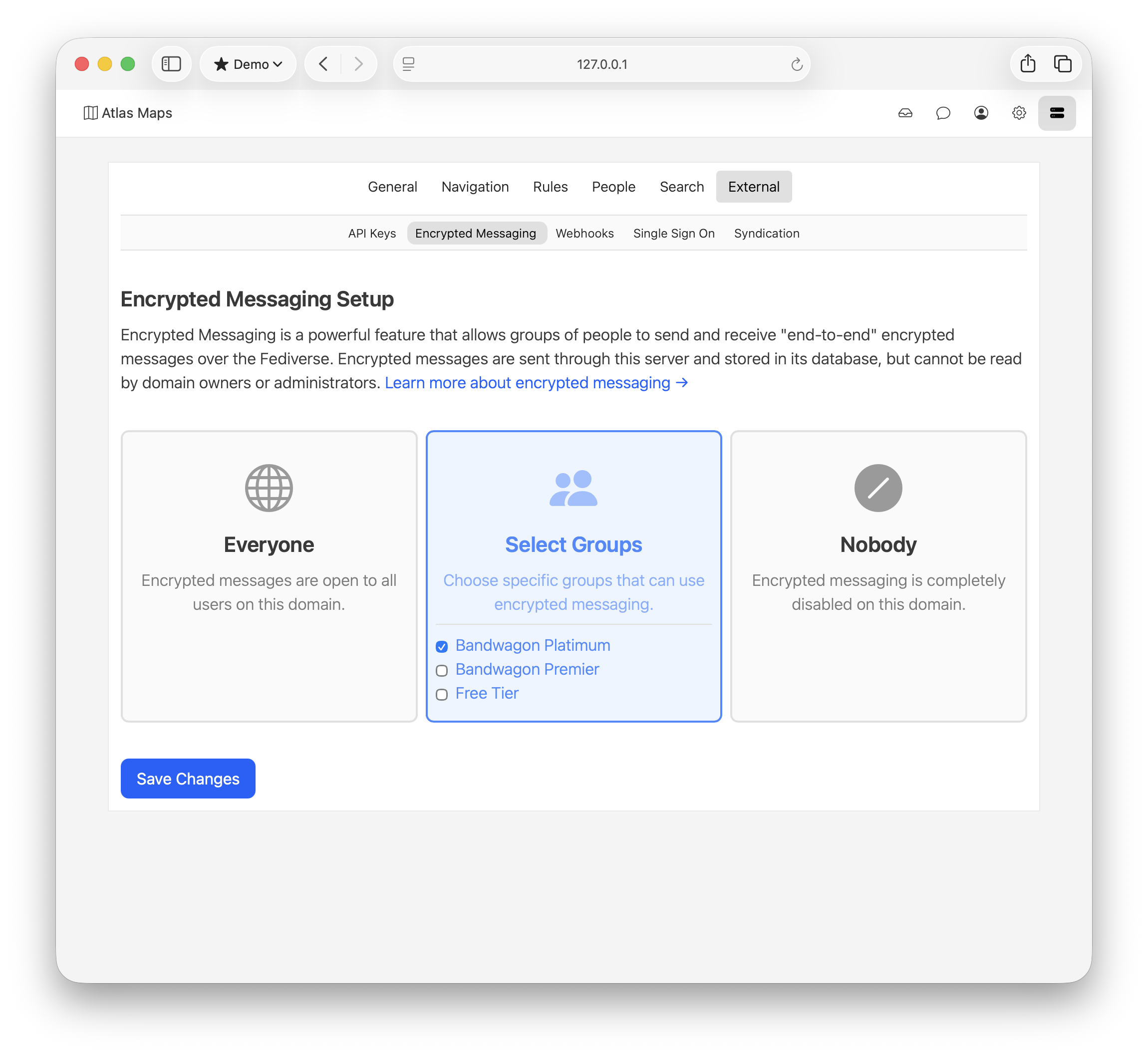
I just published a video of the new "end to end encryption" protocol for ActivityPub in . The UX is rougher than I'd like, but you can see the client app is coming along nicely.

Today, it sends and receives messages using MLS, a widely used industry standard and successor to the Signal protocol.

By June 2026, it should be ready for you.

For more details on the project and my progress, see: emissary.dev/e2ee

Hollo :hollo:'s avatar
Hollo :hollo:

@hollo@hollo.social · Reply to Ben Pate 🤘🏻's post

@benpate Yes, of course we're interested in too! (For reference, Hollo doesn't have E2EE for DMs yet.) We're completely open to collaborating with the team.

Ben Pate 🤘🏻's avatar
Ben Pate 🤘🏻

@benpate@mastodon.social · Reply to Hollo :hollo:'s post

@hollo

Very cool, guys! Kudos!

is also working on encrypted DMs similar to Hollo. They’re using MLS, which is similar, but slightly different from the Signal protocol you’re using.

I know it’s a big request, but what are the chances of getting your messages to work with Bonfire (and ) too?

It would be great for the Fediverse to have a unified E2EE standard in 2026.

Let me know if it’s a possibility. I’m happy to tour you through our work so far!

Ben Pate 🤘🏻's avatar
Ben Pate 🤘🏻

@benpate@mastodon.social

Check this out: clip.place/w/ajgJ5Hi69bbbxHCK3

I just published a video of the new "end to end encryption" protocol for ActivityPub in . The UX is rougher than I'd like, but you can see the client app is coming along nicely.

Today, it sends and receives messages using MLS, a widely used industry standard and successor to the Signal protocol.

By June 2026, it should be ready for you.

For more details on the project and my progress, see: emissary.dev/e2ee

Ben Pate 🤘🏻's avatar
Ben Pate 🤘🏻

@benpate@mastodon.social

Check this out: clip.place/w/ajgJ5Hi69bbbxHCK3

I just published a video of the new "end to end encryption" protocol for ActivityPub in . The UX is rougher than I'd like, but you can see the client app is coming along nicely.

Today, it sends and receives messages using MLS, a widely used industry standard and successor to the Signal protocol.

By June 2026, it should be ready for you.

For more details on the project and my progress, see: emissary.dev/e2ee

Ben Pate 🤘🏻's avatar
Ben Pate 🤘🏻

@benpate@mastodon.social

Check this out: clip.place/w/ajgJ5Hi69bbbxHCK3

I just published a video of the new "end to end encryption" protocol for ActivityPub in . The UX is rougher than I'd like, but you can see the client app is coming along nicely.

Today, it sends and receives messages using MLS, a widely used industry standard and successor to the Signal protocol.

By June 2026, it should be ready for you.

For more details on the project and my progress, see: emissary.dev/e2ee

Ben Pate 🤘🏻's avatar
Ben Pate 🤘🏻

@benpate@mastodon.social

Check this out: clip.place/w/ajgJ5Hi69bbbxHCK3

I just published a video of the new "end to end encryption" protocol for ActivityPub in . The UX is rougher than I'd like, but you can see the client app is coming along nicely.

Today, it sends and receives messages using MLS, a widely used industry standard and successor to the Signal protocol.

By June 2026, it should be ready for you.

For more details on the project and my progress, see: emissary.dev/e2ee

xoron :verified:'s avatar
xoron :verified:

@xoron@infosec.exchange

Signal Protocol for a P2P Webapp

TL;DR: I have open-sourced a implementation of the that compiles to for -based messaging, overcoming the limitations of the official library.

I am sharing my implementation of the Signal Protocol designed specifically for the . While the official libsignal is the gold standard, its targets are often optimized for Node.js, which creates integration challenges for client-side web applications.

My version is built in and compiles to , utilizing to provide robust for decentralized environments. It currently powers the end-to-end security for my messaging project.

Protocol Demo:
signal.positive-intentions.com/

P2P App Demo:
p2p.positive-intentions.com/if

I am looking for feedback from the and community. If you have experience with audits or formal-proof verification, I would appreciate your eyes on the codebase as I work toward a more finished state.

GitHub Repository:
github.com/positive-intentions

signal protocol
ALT text detailssignal protocol
xoron :verified:'s avatar
xoron :verified:

@xoron@infosec.exchange

Signal Protocol for a P2P Webapp

TL;DR: I have open-sourced a implementation of the that compiles to for -based messaging, overcoming the limitations of the official library.

I am sharing my implementation of the Signal Protocol designed specifically for the . While the official libsignal is the gold standard, its targets are often optimized for Node.js, which creates integration challenges for client-side web applications.

My version is built in and compiles to , utilizing to provide robust for decentralized environments. It currently powers the end-to-end security for my messaging project.

Protocol Demo:
signal.positive-intentions.com/

P2P App Demo:
p2p.positive-intentions.com/if

I am looking for feedback from the and community. If you have experience with audits or formal-proof verification, I would appreciate your eyes on the codebase as I work toward a more finished state.

GitHub Repository:
github.com/positive-intentions

signal protocol
ALT text detailssignal protocol
xoron :verified:'s avatar
xoron :verified:

@xoron@infosec.exchange

Signal Protocol for a P2P Webapp

TL;DR: I have open-sourced a implementation of the that compiles to for -based messaging, overcoming the limitations of the official library.

I am sharing my implementation of the Signal Protocol designed specifically for the . While the official libsignal is the gold standard, its targets are often optimized for Node.js, which creates integration challenges for client-side web applications.

My version is built in and compiles to , utilizing to provide robust for decentralized environments. It currently powers the end-to-end security for my messaging project.

Protocol Demo:
signal.positive-intentions.com/

P2P App Demo:
p2p.positive-intentions.com/if

I am looking for feedback from the and community. If you have experience with audits or formal-proof verification, I would appreciate your eyes on the codebase as I work toward a more finished state.

GitHub Repository:
github.com/positive-intentions

signal protocol
ALT text detailssignal protocol
Fedilab Apps's avatar
Fedilab Apps

@apps@toot.fedilab.app

This is how currently handles DMs over . Holos is a project we develop alongside .

holos.social/e2ee

Fedilab Apps's avatar
Fedilab Apps

@apps@toot.fedilab.app

This is how currently handles DMs over . Holos is a project we develop alongside .

holos.social/e2ee

Fedilab Apps's avatar
Fedilab Apps

@apps@toot.fedilab.app

This is how currently handles DMs over . Holos is a project we develop alongside .

holos.social/e2ee

Fedilab Apps's avatar
Fedilab Apps

@apps@toot.fedilab.app

This is how currently handles DMs over . Holos is a project we develop alongside .

holos.social/e2ee

Fedilab Apps's avatar
Fedilab Apps

@apps@toot.fedilab.app

This is how currently handles DMs over . Holos is a project we develop alongside .

holos.social/e2ee

Fedilab Apps's avatar
Fedilab Apps

@apps@toot.fedilab.app

We talk about forgetting some of you might not know this project.
is a full ActivityPub server running on your device. Currently on Android, next on iOS.
We already introduced DMs and identity through custom domains. You own your followers, your keys, and your identity. Relays are just infrastructure.
On the footer of holos.social we added pages explaining the project. Have a look!

Mastodon: @HolosSocial Don't hesitate to share

Fedilab Apps's avatar
Fedilab Apps

@apps@toot.fedilab.app

We talk about forgetting some of you might not know this project.
is a full ActivityPub server running on your device. Currently on Android, next on iOS.
We already introduced DMs and identity through custom domains. You own your followers, your keys, and your identity. Relays are just infrastructure.
On the footer of holos.social we added pages explaining the project. Have a look!

Mastodon: @HolosSocial Don't hesitate to share

Grow Your Own Services 🌱's avatar
Grow Your Own Services 🌱

@homegrown@social.growyourown.services

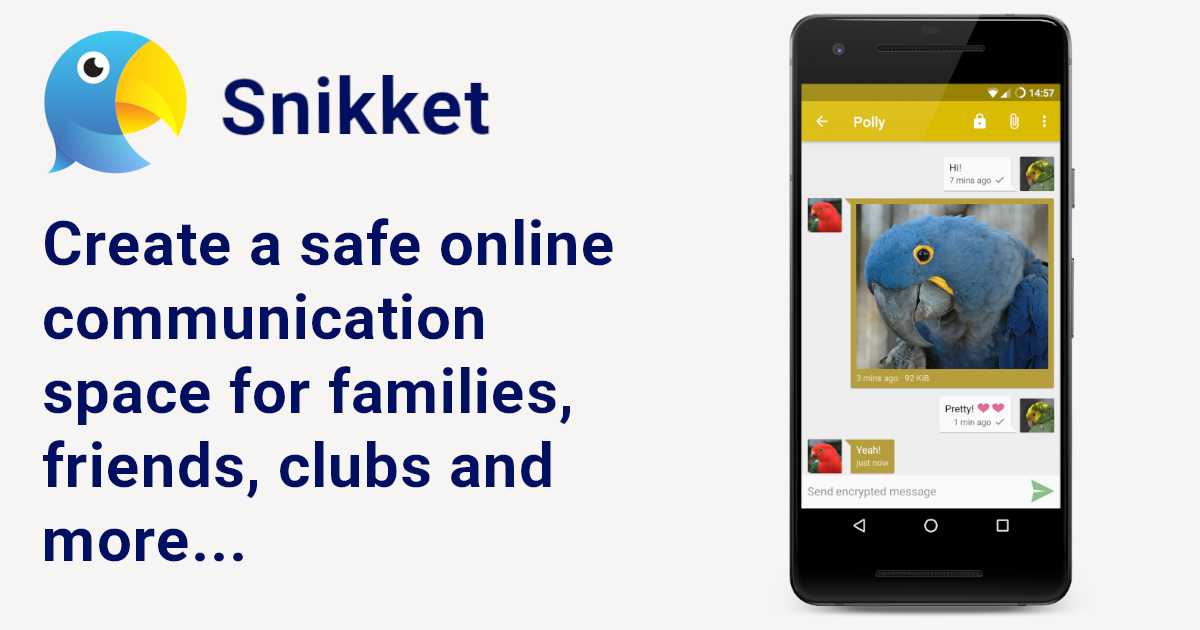
If you're interested in setting up a secure chat service for you and your friends, you might want to try @snikket_im

🌱 snikket.org

It's really cheap to run and easy to set up, it's managed hosting so you don't need to do techy stuff.

Technical details: it runs on XMPP with OMEMO end-to-end encryption, but this is hidden behind non-technical branding so it doesn't scare people.

Instances are federated, Snikket and other types of XMPP instance can communicate.

Grow Your Own Services 🌱's avatar
Grow Your Own Services 🌱

@homegrown@social.growyourown.services

If you're interested in setting up a secure chat service for you and your friends, you might want to try @snikket_im

🌱 snikket.org

It's really cheap to run and easy to set up, it's managed hosting so you don't need to do techy stuff.

Technical details: it runs on XMPP with OMEMO end-to-end encryption, but this is hidden behind non-technical branding so it doesn't scare people.

Instances are federated, Snikket and other types of XMPP instance can communicate.

Kevin Karhan :verified:'s avatar
Kevin Karhan :verified:

@kkarhan@infosec.space · Reply to Delta Chat's post

@delta and that's why /MIME as with is the only option besides + that ofers real , because without any claims of - are just "!"-Style !

papiris's avatar
papiris

@papiris@hachyderm.io

I want to be part of a flat collective/network of folks / orgs working together to provide resilient e2ee data storage using free software.

Like a file backup / object storage federation of sorts.

I want it to be scalable, i.e. folks and orgs who have spare storage capacity can contribute this capacity to the collective, effectively increasing the collective's total storage capacity. The collective should gracefully handle nodes dropping off or quitting the collective, and re-joining.

The API should be well-known, preferably something like S3, so the collective/network easily integrates as a backend for existing software.

I think there should be some way to 'balance the books' so to speak, to avoid selfish behavior like a participant providing 3GiB of storage and using 3TiB.

The balancing can be in-software, e.g. each participant gets an identity which the software uses to identify how much the participant contributes and utilizes across all their nodes.

The balancing can also be out-of software, through a member system or similar.

Would be nice with a social aspect.

Is there already something like this?

What software would be good for building something like this?

@deuxfleurs would fit this use case?
If I understand correctly, Garage can scale to many nodes in many locations/zones, but 3-4 zones (one of which can be a hot spare) is recommended. If a garage cluster consists of 50 zones with 150 nodes total, will chunks be spread across zones in a way that isn't limited by low-capacity zones? Does the total storage capacity of the cluster depend on whichever location has the least capacity?

Another option I found earlier is @peergos, but I'm fairly lacking in knowledge about the project. Being p2p, would that fit this use case better?

papiris's avatar
papiris

@papiris@hachyderm.io

I want to be part of a flat collective/network of folks / orgs working together to provide resilient e2ee data storage using free software.

Like a file backup / object storage federation of sorts.

I want it to be scalable, i.e. folks and orgs who have spare storage capacity can contribute this capacity to the collective, effectively increasing the collective's total storage capacity. The collective should gracefully handle nodes dropping off or quitting the collective, and re-joining.

The API should be well-known, preferably something like S3, so the collective/network easily integrates as a backend for existing software.

I think there should be some way to 'balance the books' so to speak, to avoid selfish behavior like a participant providing 3GiB of storage and using 3TiB.

The balancing can be in-software, e.g. each participant gets an identity which the software uses to identify how much the participant contributes and utilizes across all their nodes.

The balancing can also be out-of software, through a member system or similar.

Would be nice with a social aspect.

Is there already something like this?

What software would be good for building something like this?

@deuxfleurs would fit this use case?
If I understand correctly, Garage can scale to many nodes in many locations/zones, but 3-4 zones (one of which can be a hot spare) is recommended. If a garage cluster consists of 50 zones with 150 nodes total, will chunks be spread across zones in a way that isn't limited by low-capacity zones? Does the total storage capacity of the cluster depend on whichever location has the least capacity?

Another option I found earlier is @peergos, but I'm fairly lacking in knowledge about the project. Being p2p, would that fit this use case better?

Fedilab Apps's avatar
Fedilab Apps

@apps@toot.fedilab.app

RE: mastodon.social/@HolosSocial/1

We have published a new version of app (rc-1) that supports DMs over ActivityPub.

We wrote a page that explains our E2EE implementation: holos.social/e2ee

If you want to discover how Holos app and relay work together: holos.social/how-it-works

Holos Social's avatar
Holos Social

@HolosSocial@mastodon.social

We are entering a new step in the development of and we need more people to test.
We have reopened subscriptions through the app: holos.social/signup

We wrote a page explaining how we implemented DMs over : holos.social/e2ee

Don't hesitate to contribute and share your feedback with us. Thank you.

Holos Social's avatar
Holos Social

@HolosSocial@mastodon.social

We are entering a new step in the development of and we need more people to test.
We have reopened subscriptions through the app: holos.social/signup

We wrote a page explaining how we implemented DMs over : holos.social/e2ee

Don't hesitate to contribute and share your feedback with us. Thank you.

Holos Social's avatar
Holos Social

@HolosSocial@mastodon.social

We are entering a new step in the development of and we need more people to test.
We have reopened subscriptions through the app: holos.social/signup

We wrote a page explaining how we implemented DMs over : holos.social/e2ee

Don't hesitate to contribute and share your feedback with us. Thank you.

Holos Social's avatar
Holos Social

@HolosSocial@mastodon.social

We are entering a new step in the development of and we need more people to test.
We have reopened subscriptions through the app: holos.social/signup

We wrote a page explaining how we implemented DMs over : holos.social/e2ee

Don't hesitate to contribute and share your feedback with us. Thank you.

Holos Social's avatar
Holos Social

@HolosSocial@mastodon.social

We are entering a new step in the development of and we need more people to test.
We have reopened subscriptions through the app: holos.social/signup

We wrote a page explaining how we implemented DMs over : holos.social/e2ee

Don't hesitate to contribute and share your feedback with us. Thank you.

Holos Social's avatar
Holos Social

@HolosSocial@mastodon.social

We are entering a new step in the development of and we need more people to test.
We have reopened subscriptions through the app: holos.social/signup

We wrote a page explaining how we implemented DMs over : holos.social/e2ee

Don't hesitate to contribute and share your feedback with us. Thank you.

Fedilab Apps's avatar
Fedilab Apps

@apps@toot.fedilab.app

RE: mastodon.social/@HolosSocial/1

We have published a new version of app (rc-1) that supports DMs over ActivityPub.

We wrote a page that explains our E2EE implementation: holos.social/e2ee

If you want to discover how Holos app and relay work together: holos.social/how-it-works

Fedilab Apps's avatar
Fedilab Apps

@apps@toot.fedilab.app

RE: mastodon.social/@HolosSocial/1

We have published a new version of app (rc-1) that supports DMs over ActivityPub.

We wrote a page that explains our E2EE implementation: holos.social/e2ee

If you want to discover how Holos app and relay work together: holos.social/how-it-works

XSF: XMPP Standards Foundation's avatar
XSF: XMPP Standards Foundation

@xmpp@fosstodon.org

Summit

The next topic is 🧅

The XMPP Summit:
xmpp.org/2025/11/xmpp-summit-2

Meet us at 2026, too!

,

The XMPP Logo
ALT text detailsThe XMPP Logo
XSF: XMPP Standards Foundation's avatar
XSF: XMPP Standards Foundation

@xmpp@fosstodon.org

Summit

The next topic is 🧅

The XMPP Summit:
xmpp.org/2025/11/xmpp-summit-2

Meet us at 2026, too!

,

The XMPP Logo
ALT text detailsThe XMPP Logo
Vivekanandan KS :nixos:'s avatar
Vivekanandan KS :nixos:

@vivekanandanks@mstdn.social · Reply to evacide's post

@evacide
Someone clarify me please 🤔

If e2ee happens from client to client, means a closed proprietary app like WhatsApp can use the decrypted messages at the client level & do can steal it even though the connection is marketed as e2ee

Am I right, or I'm missing out something?

Coz I see the option to send last 5 messages to meta when I report a spam and block the number.

So the e2ee is useless if the client is closed source right? 🤔

R. P. Scott's avatar
R. P. Scott

@i47i@hachyderm.io

Lawsuit Alleges That WhatsApp Has No End-to-End Encryption

A lawsuit filed in San Francisco alleges that 's end-to-end encryption contains backdoors allowing employees to access user messages in real-time.

According to the complaint, internal tools allow engineers to view chats by User ID without a separate decryption step, bypassing the Signal Protocol protections the app claims to use.

The lawsuit cites £whistleblowers who claim that workers can request access to specific accounts via internal tasks, gaining unlimited temporal scope to a user's history, including deleted messages. Meta has labeled these claims false and absurd.

Technical experts note that while the Signal Protocol itself is mathematically secure, the integrity of end-to-end encryption relies entirely on the security of the endpoints. Potential vulnerabilities in WhatsApp include unencrypted cloud backups, metadata collection, and the fact that the client software is closed-source.

Without the ability to audit the code or verify public keys through an independent directory, users must trust that the application is not exfiltrating plaintext data before it is encrypted for transit.

The legal action highlights the ongoing tension between corporate privacy marketing and the technical reality of centralized messaging platforms. If the allegations of an internal "widget" for message access are proven true, it would represent a fundamental breach of the encryption standards Meta has advertised since 2016.
it.slashdot.org/story/26/01/27

R. P. Scott's avatar
R. P. Scott

@i47i@hachyderm.io

Lawsuit Alleges That WhatsApp Has No End-to-End Encryption

A lawsuit filed in San Francisco alleges that 's end-to-end encryption contains backdoors allowing employees to access user messages in real-time.

According to the complaint, internal tools allow engineers to view chats by User ID without a separate decryption step, bypassing the Signal Protocol protections the app claims to use.

The lawsuit cites £whistleblowers who claim that workers can request access to specific accounts via internal tasks, gaining unlimited temporal scope to a user's history, including deleted messages. Meta has labeled these claims false and absurd.

Technical experts note that while the Signal Protocol itself is mathematically secure, the integrity of end-to-end encryption relies entirely on the security of the endpoints. Potential vulnerabilities in WhatsApp include unencrypted cloud backups, metadata collection, and the fact that the client software is closed-source.

Without the ability to audit the code or verify public keys through an independent directory, users must trust that the application is not exfiltrating plaintext data before it is encrypted for transit.

The legal action highlights the ongoing tension between corporate privacy marketing and the technical reality of centralized messaging platforms. If the allegations of an internal "widget" for message access are proven true, it would represent a fundamental breach of the encryption standards Meta has advertised since 2016.
it.slashdot.org/story/26/01/27

🌱🏴‍🅰️🏳️‍⚧️🐧📎 Ambiyelp's avatar
🌱🏴‍🅰️🏳️‍⚧️🐧📎 Ambiyelp

@ambiguous_yelp@veganism.social · Reply to evacide's post

@evacide @mshelton

Signal is centralised and was attempted backdoored by the uks online safety bill and saved by signal threatening to walk. Simplex is open source and quantum resistant e2ee like signal and also has its secret group chats and metadata protection like Signal but SimpleX is also decentralised with ip protection, tor support, no persistent id basically "a burner phone for every contact"
Signals centralisation also makes it more vulnerable to total censorship, all you need to do is block signals domains, being a decentralised network SimplexChat has no single point of failure to censor and anyone can run their own relay node

Ben Pate 🤘🏻's avatar
Ben Pate 🤘🏻

@benpate@mastodon.social

I've just sent the first end-to-end-encrypted messages from one instance to another.

News from around the USA really has me down, so it's important to celebrate the little wins 🎉

And, there's still so much to do. But with equal quantities of luck and caffeine, I can screencast some early prototypes for you before too long.

I believe is important for the because it will give us more ways to use this network, and expand what people can do here.

Application screenshot of the terminal from my laptop, showing debug output of an ActivityPub message being sent from one account and received by another.

It's really a bunch of gibberish, but that's the point. The messages are "end to end" encrypted using MLS, so there's nothing to actually read. And the lack of readable information is the whole point.
ALT text detailsApplication screenshot of the terminal from my laptop, showing debug output of an ActivityPub message being sent from one account and received by another. It's really a bunch of gibberish, but that's the point. The messages are "end to end" encrypted using MLS, so there's nothing to actually read. And the lack of readable information is the whole point.
Ben Pate 🤘🏻's avatar
Ben Pate 🤘🏻

@benpate@mastodon.social

I've just sent the first end-to-end-encrypted messages from one instance to another.

News from around the USA really has me down, so it's important to celebrate the little wins 🎉

And, there's still so much to do. But with equal quantities of luck and caffeine, I can screencast some early prototypes for you before too long.

I believe is important for the because it will give us more ways to use this network, and expand what people can do here.

Application screenshot of the terminal from my laptop, showing debug output of an ActivityPub message being sent from one account and received by another.

It's really a bunch of gibberish, but that's the point. The messages are "end to end" encrypted using MLS, so there's nothing to actually read. And the lack of readable information is the whole point.
ALT text detailsApplication screenshot of the terminal from my laptop, showing debug output of an ActivityPub message being sent from one account and received by another. It's really a bunch of gibberish, but that's the point. The messages are "end to end" encrypted using MLS, so there's nothing to actually read. And the lack of readable information is the whole point.
Delta Chat's avatar
Delta Chat

@delta@chaos.social

does

- no bindings to public handles/numbers

- no address-book upload

- not do public contact or group discovery

- not have critical persistent server state (!)

Social identification is private, between people though ephemeral messages.

Servers see messages with random sender and recipient addresses, but those can not be mapped to a phone number or public handle. Servers see IP addresses. But you can use Tor, or a VPN, if you want to hide that.

It' not all bad :)

Ben Pate 🤘🏻's avatar
Ben Pate 🤘🏻

@benpate@mastodon.social

I've just sent the first end-to-end-encrypted messages from one instance to another.

News from around the USA really has me down, so it's important to celebrate the little wins 🎉

And, there's still so much to do. But with equal quantities of luck and caffeine, I can screencast some early prototypes for you before too long.

I believe is important for the because it will give us more ways to use this network, and expand what people can do here.

Application screenshot of the terminal from my laptop, showing debug output of an ActivityPub message being sent from one account and received by another.

It's really a bunch of gibberish, but that's the point. The messages are "end to end" encrypted using MLS, so there's nothing to actually read. And the lack of readable information is the whole point.
ALT text detailsApplication screenshot of the terminal from my laptop, showing debug output of an ActivityPub message being sent from one account and received by another. It's really a bunch of gibberish, but that's the point. The messages are "end to end" encrypted using MLS, so there's nothing to actually read. And the lack of readable information is the whole point.
Delta Chat's avatar
Delta Chat

@delta@chaos.social

does

- no bindings to public handles/numbers

- no address-book upload

- not do public contact or group discovery

- not have critical persistent server state (!)

Social identification is private, between people though ephemeral messages.

Servers see messages with random sender and recipient addresses, but those can not be mapped to a phone number or public handle. Servers see IP addresses. But you can use Tor, or a VPN, if you want to hide that.

It' not all bad :)

Ben Pate 🤘🏻's avatar
Ben Pate 🤘🏻

@benpate@mastodon.social

I've just sent the first end-to-end-encrypted messages from one instance to another.

News from around the USA really has me down, so it's important to celebrate the little wins 🎉

And, there's still so much to do. But with equal quantities of luck and caffeine, I can screencast some early prototypes for you before too long.

I believe is important for the because it will give us more ways to use this network, and expand what people can do here.

Application screenshot of the terminal from my laptop, showing debug output of an ActivityPub message being sent from one account and received by another.

It's really a bunch of gibberish, but that's the point. The messages are "end to end" encrypted using MLS, so there's nothing to actually read. And the lack of readable information is the whole point.
ALT text detailsApplication screenshot of the terminal from my laptop, showing debug output of an ActivityPub message being sent from one account and received by another. It's really a bunch of gibberish, but that's the point. The messages are "end to end" encrypted using MLS, so there's nothing to actually read. And the lack of readable information is the whole point.
Apicultor 🐝's avatar
Apicultor 🐝

@apicultor@hachyderm.io

Another one bites the dust.

comitiscapital.com/news/comiti

cc @soatok

Apicultor 🐝's avatar
Apicultor 🐝

@apicultor@hachyderm.io

Another one bites the dust.

comitiscapital.com/news/comiti

cc @soatok

𝕂𝚞𝚋𝚒𝚔ℙ𝚒𝚡𝚎𝚕™'s avatar
𝕂𝚞𝚋𝚒𝚔ℙ𝚒𝚡𝚎𝚕™

@kubikpixel@chaos.social

Free Open-Source Whistleblower Platform Without Self-Hosting

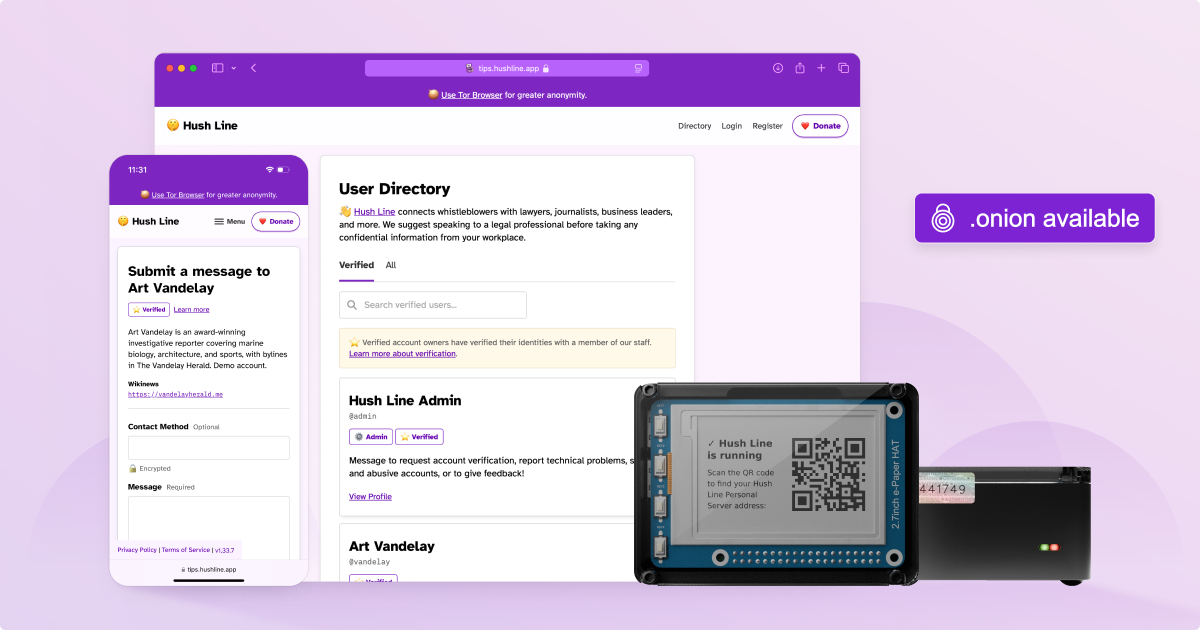
Anonymous, end-to-end encrypted reporting for journalists, lawyers, employers, and more. Hush Line is a free & open-source whistleblower platform that provides secure, anonymous tip lines with no self-hosting, maintenance, or technical overhead.

🤫 hushline.app
:mastodon: @hushlineapp

𝕂𝚞𝚋𝚒𝚔ℙ𝚒𝚡𝚎𝚕™'s avatar
𝕂𝚞𝚋𝚒𝚔ℙ𝚒𝚡𝚎𝚕™

@kubikpixel@chaos.social · Reply to 𝕂𝚞𝚋𝚒𝚔ℙ𝚒𝚡𝚎𝚕™'s post

WhatsApp is untrustable

TL;DR: As the client applications of WhatsApp are closed-source, claims of end-to-end encryption cannot be validated. This invalidates the primary benefit of end-to-end encryption, that is, not needing to trust a third-party. […]

👉 toki.la/posts/whatsapp

𝕂𝚞𝚋𝚒𝚔ℙ𝚒𝚡𝚎𝚕™'s avatar
𝕂𝚞𝚋𝚒𝚔ℙ𝚒𝚡𝚎𝚕™

@kubikpixel@chaos.social

Free Open-Source Whistleblower Platform Without Self-Hosting

Anonymous, end-to-end encrypted reporting for journalists, lawyers, employers, and more. Hush Line is a free & open-source whistleblower platform that provides secure, anonymous tip lines with no self-hosting, maintenance, or technical overhead.

🤫 hushline.app
:mastodon: @hushlineapp

dansup's avatar
dansup

@dansup@mastodon.social

It's called Inbox for a reason, I'm working on Encrypted Direct Messages that will interoperate with Pixelfed's upcoming E2EE DMs 😎

NextGraph's avatar
NextGraph

@nextgraph@fosstodon.org

If you are at and want to learn more about the current advances we made in the SDK of @nextgraph thanks to the contributions of @laurin ., he will be presenting his work on Tuesday the 30th at 10:30 in the CDC Triangle.

events.ccc.de/congress/2025/hu

NextGraph's avatar
NextGraph

@nextgraph@fosstodon.org

If you are at and want to learn more about the current advances we made in the SDK of @nextgraph thanks to the contributions of @laurin ., he will be presenting his work on Tuesday the 30th at 10:30 in the CDC Triangle.

events.ccc.de/congress/2025/hu

Moved to @bonfire@bonfire.cafe's avatar
Moved to @bonfire@bonfire.cafe

@bonfire@indieweb.social

RE: socialwebfoundation.org/2025/1

Big news for the ! End-to-end encryption is coming to .

@swf with support from @sovtechfund is coordinating two interoperable implementations.

Bonfire is proud to be one of these first two projects, alongside by @benpate

We think should simply be the default for any private communications, and we’re especially thrilled to bring private, trusted collaboration to the fediverse.

Evan Prodromou's avatar
Evan Prodromou

@evanprodromou@socialwebfoundation.org

One of the project areas of the Social Web Foundation for the last year has been end-to-end encrypted messaging. ActivityPub, the standard protocol that powers the Social Web, has privacy controls, but they do not protect the content of messages from server operators. Encrypted messaging has become a standard feature on most social networks since ActivityPub was created, and its lack has inhibited Social Web adoption and public trust in the network. ActivityPub is extensible, though. As part […]

One of the project areas of the Social Web Foundation for the last year has been end-to-end encrypted messaging. ActivityPub, the standard protocol that powers the Social Web, has privacy controls, but they do not protect the content of messages from server operators. Encrypted messaging has become a standard feature on most social networks since ActivityPub was created, and its lack has inhibited Social Web adoption and public trust in the network.

ActivityPub is extensible, though. As part of our E2EE program, Mallory, Tom and I adapted the Messaging Layer Security (MLS) standard as an extension of ActivityPub to make the MLS over ActivityPub specification. The protocol fits the great MLS E2EE system onto the ActivityPub API and federation protocol.

But a protocol specification is not enough; it must be implemented. That’s why we’re so happy to announce that the Sovereign Tech Fund has commissioned work with the Social Web Foundation to coordinate two new interoperable implementations of MLS over ActivityPub. This investment by the Sovereign Tech Fund will help move the Fediverse towards more privacy for social web users, no matter what server they use.

We decided to partner with two different projects in order to make sure that we’re making an open standard that can work between implementations. With two implementers, we’ll need to communicate clearly about architectural and implementation decisions, and make sure that those decisions end up in the final version of the spec — not in a TODO comment in the source code of a single project.

The first project is Emissary, the great social web application platform behind projects like Atlas and Bandwagon. Ben Pate, Emissary founder, says, “The Emissary Project is deeply committed to the Fediverse, where we are building a free and trustworthy Internet for all 8 billion humans. Delivering on that promise, Emissary is excited to team up with the Social Web Foundation to bring End-to-End-Encryption (E2EE) to the Fediverse. We are eternally grateful for the SWF’s leadership and support, without which this project could not have happened.  Our work is already underway, and in 2026 anyone will be able to build E2EE applications on the Emissary platform.”

The second project is Bonfire. Bonfire is a modular framework for building federated apps, with its first app (Bonfire Social) offering a social networking experience enhanced with tools for privacy, trust, and collaboration (such as circles and boundaries).

The maintainers of Bonfire, Ivan Minutillo and Mayel de Borniol, said: “We think that end-to-end encryption should simply be the default for any private communication online. Working with the Social Web Foundation to bring E2EE to ActivityPub marks a crucial step in fostering privacy and trust, and especially in enabling the fediverse to become a safe space for activists and communities to organise, coordinate, and collaborate meaningfully. By making secure, user-friendly messaging a core part of the fediverse, we’re helping lay the groundwork for decentralised networks where people can go beyond talking in the mythical ‘global town square’ and actually organise and accomplish things together.”

This work will happen best if the Fediverse community tracks it closely. We’ll be making updates here on the SWF blog as progress continues. Developers and active users may also be interested in the ActivityPub E2EE Messaging Task Force at the W3C, where the specification is being developed into a report for the Social Web Community group. Finally, we’ll be using the #JustBetweenUs hashtag to share progress and ideas, so you can follow it to see what’s been happening.

🫧 socialcoding..'s avatar
🫧 socialcoding..

@smallcircles@social.coop · Reply to Bob Mottram ✅'s post

@bob

I'm happy with this development.

Just not with the way in which the now evolves, i.e. on the basis of protocol decay, tech debt, and whack-a-mole development. Which have been my and frustration in the past years of facilitation and advocacy.

Where I have use cases is in Personal , to enable participation, and subsequently work collectively on

coding.social/introduction/#pe

Moved to @bonfire@bonfire.cafe's avatar
Moved to @bonfire@bonfire.cafe

@bonfire@indieweb.social

RE: socialwebfoundation.org/2025/1

Big news for the ! End-to-end encryption is coming to .

@swf with support from @sovtechfund is coordinating two interoperable implementations.

Bonfire is proud to be one of these first two projects, alongside by @benpate

We think should simply be the default for any private communications, and we’re especially thrilled to bring private, trusted collaboration to the fediverse.

Evan Prodromou's avatar
Evan Prodromou

@evanprodromou@socialwebfoundation.org

One of the project areas of the Social Web Foundation for the last year has been end-to-end encrypted messaging. ActivityPub, the standard protocol that powers the Social Web, has privacy controls, but they do not protect the content of messages from server operators. Encrypted messaging has become a standard feature on most social networks since ActivityPub was created, and its lack has inhibited Social Web adoption and public trust in the network. ActivityPub is extensible, though. As part […]

One of the project areas of the Social Web Foundation for the last year has been end-to-end encrypted messaging. ActivityPub, the standard protocol that powers the Social Web, has privacy controls, but they do not protect the content of messages from server operators. Encrypted messaging has become a standard feature on most social networks since ActivityPub was created, and its lack has inhibited Social Web adoption and public trust in the network.

ActivityPub is extensible, though. As part of our E2EE program, Mallory, Tom and I adapted the Messaging Layer Security (MLS) standard as an extension of ActivityPub to make the MLS over ActivityPub specification. The protocol fits the great MLS E2EE system onto the ActivityPub API and federation protocol.

But a protocol specification is not enough; it must be implemented. That’s why we’re so happy to announce that the Sovereign Tech Fund has commissioned work with the Social Web Foundation to coordinate two new interoperable implementations of MLS over ActivityPub. This investment by the Sovereign Tech Fund will help move the Fediverse towards more privacy for social web users, no matter what server they use.

We decided to partner with two different projects in order to make sure that we’re making an open standard that can work between implementations. With two implementers, we’ll need to communicate clearly about architectural and implementation decisions, and make sure that those decisions end up in the final version of the spec — not in a TODO comment in the source code of a single project.

The first project is Emissary, the great social web application platform behind projects like Atlas and Bandwagon. Ben Pate, Emissary founder, says, “The Emissary Project is deeply committed to the Fediverse, where we are building a free and trustworthy Internet for all 8 billion humans. Delivering on that promise, Emissary is excited to team up with the Social Web Foundation to bring End-to-End-Encryption (E2EE) to the Fediverse. We are eternally grateful for the SWF’s leadership and support, without which this project could not have happened.  Our work is already underway, and in 2026 anyone will be able to build E2EE applications on the Emissary platform.”

The second project is Bonfire. Bonfire is a modular framework for building federated apps, with its first app (Bonfire Social) offering a social networking experience enhanced with tools for privacy, trust, and collaboration (such as circles and boundaries).

The maintainers of Bonfire, Ivan Minutillo and Mayel de Borniol, said: “We think that end-to-end encryption should simply be the default for any private communication online. Working with the Social Web Foundation to bring E2EE to ActivityPub marks a crucial step in fostering privacy and trust, and especially in enabling the fediverse to become a safe space for activists and communities to organise, coordinate, and collaborate meaningfully. By making secure, user-friendly messaging a core part of the fediverse, we’re helping lay the groundwork for decentralised networks where people can go beyond talking in the mythical ‘global town square’ and actually organise and accomplish things together.”

This work will happen best if the Fediverse community tracks it closely. We’ll be making updates here on the SWF blog as progress continues. Developers and active users may also be interested in the ActivityPub E2EE Messaging Task Force at the W3C, where the specification is being developed into a report for the Social Web Community group. Finally, we’ll be using the #JustBetweenUs hashtag to share progress and ideas, so you can follow it to see what’s been happening.

Moved to @bonfire@bonfire.cafe's avatar
Moved to @bonfire@bonfire.cafe

@bonfire@indieweb.social

RE: socialwebfoundation.org/2025/1

Big news for the ! End-to-end encryption is coming to .

@swf with support from @sovtechfund is coordinating two interoperable implementations.

Bonfire is proud to be one of these first two projects, alongside by @benpate

We think should simply be the default for any private communications, and we’re especially thrilled to bring private, trusted collaboration to the fediverse.

Evan Prodromou's avatar
Evan Prodromou

@evanprodromou@socialwebfoundation.org

One of the project areas of the Social Web Foundation for the last year has been end-to-end encrypted messaging. ActivityPub, the standard protocol that powers the Social Web, has privacy controls, but they do not protect the content of messages from server operators. Encrypted messaging has become a standard feature on most social networks since ActivityPub was created, and its lack has inhibited Social Web adoption and public trust in the network. ActivityPub is extensible, though. As part […]

One of the project areas of the Social Web Foundation for the last year has been end-to-end encrypted messaging. ActivityPub, the standard protocol that powers the Social Web, has privacy controls, but they do not protect the content of messages from server operators. Encrypted messaging has become a standard feature on most social networks since ActivityPub was created, and its lack has inhibited Social Web adoption and public trust in the network.

ActivityPub is extensible, though. As part of our E2EE program, Mallory, Tom and I adapted the Messaging Layer Security (MLS) standard as an extension of ActivityPub to make the MLS over ActivityPub specification. The protocol fits the great MLS E2EE system onto the ActivityPub API and federation protocol.

But a protocol specification is not enough; it must be implemented. That’s why we’re so happy to announce that the Sovereign Tech Fund has commissioned work with the Social Web Foundation to coordinate two new interoperable implementations of MLS over ActivityPub. This investment by the Sovereign Tech Fund will help move the Fediverse towards more privacy for social web users, no matter what server they use.

We decided to partner with two different projects in order to make sure that we’re making an open standard that can work between implementations. With two implementers, we’ll need to communicate clearly about architectural and implementation decisions, and make sure that those decisions end up in the final version of the spec — not in a TODO comment in the source code of a single project.

The first project is Emissary, the great social web application platform behind projects like Atlas and Bandwagon. Ben Pate, Emissary founder, says, “The Emissary Project is deeply committed to the Fediverse, where we are building a free and trustworthy Internet for all 8 billion humans. Delivering on that promise, Emissary is excited to team up with the Social Web Foundation to bring End-to-End-Encryption (E2EE) to the Fediverse. We are eternally grateful for the SWF’s leadership and support, without which this project could not have happened.  Our work is already underway, and in 2026 anyone will be able to build E2EE applications on the Emissary platform.”

The second project is Bonfire. Bonfire is a modular framework for building federated apps, with its first app (Bonfire Social) offering a social networking experience enhanced with tools for privacy, trust, and collaboration (such as circles and boundaries).

The maintainers of Bonfire, Ivan Minutillo and Mayel de Borniol, said: “We think that end-to-end encryption should simply be the default for any private communication online. Working with the Social Web Foundation to bring E2EE to ActivityPub marks a crucial step in fostering privacy and trust, and especially in enabling the fediverse to become a safe space for activists and communities to organise, coordinate, and collaborate meaningfully. By making secure, user-friendly messaging a core part of the fediverse, we’re helping lay the groundwork for decentralised networks where people can go beyond talking in the mythical ‘global town square’ and actually organise and accomplish things together.”

This work will happen best if the Fediverse community tracks it closely. We’ll be making updates here on the SWF blog as progress continues. Developers and active users may also be interested in the ActivityPub E2EE Messaging Task Force at the W3C, where the specification is being developed into a report for the Social Web Community group. Finally, we’ll be using the #JustBetweenUs hashtag to share progress and ideas, so you can follow it to see what’s been happening.

Moved to @bonfire@bonfire.cafe's avatar
Moved to @bonfire@bonfire.cafe

@bonfire@indieweb.social

RE: socialwebfoundation.org/2025/1

Big news for the ! End-to-end encryption is coming to .

@swf with support from @sovtechfund is coordinating two interoperable implementations.

Bonfire is proud to be one of these first two projects, alongside by @benpate

We think should simply be the default for any private communications, and we’re especially thrilled to bring private, trusted collaboration to the fediverse.

Evan Prodromou's avatar
Evan Prodromou

@evanprodromou@socialwebfoundation.org

One of the project areas of the Social Web Foundation for the last year has been end-to-end encrypted messaging. ActivityPub, the standard protocol that powers the Social Web, has privacy controls, but they do not protect the content of messages from server operators. Encrypted messaging has become a standard feature on most social networks since ActivityPub was created, and its lack has inhibited Social Web adoption and public trust in the network. ActivityPub is extensible, though. As part […]

One of the project areas of the Social Web Foundation for the last year has been end-to-end encrypted messaging. ActivityPub, the standard protocol that powers the Social Web, has privacy controls, but they do not protect the content of messages from server operators. Encrypted messaging has become a standard feature on most social networks since ActivityPub was created, and its lack has inhibited Social Web adoption and public trust in the network.

ActivityPub is extensible, though. As part of our E2EE program, Mallory, Tom and I adapted the Messaging Layer Security (MLS) standard as an extension of ActivityPub to make the MLS over ActivityPub specification. The protocol fits the great MLS E2EE system onto the ActivityPub API and federation protocol.

But a protocol specification is not enough; it must be implemented. That’s why we’re so happy to announce that the Sovereign Tech Fund has commissioned work with the Social Web Foundation to coordinate two new interoperable implementations of MLS over ActivityPub. This investment by the Sovereign Tech Fund will help move the Fediverse towards more privacy for social web users, no matter what server they use.

We decided to partner with two different projects in order to make sure that we’re making an open standard that can work between implementations. With two implementers, we’ll need to communicate clearly about architectural and implementation decisions, and make sure that those decisions end up in the final version of the spec — not in a TODO comment in the source code of a single project.

The first project is Emissary, the great social web application platform behind projects like Atlas and Bandwagon. Ben Pate, Emissary founder, says, “The Emissary Project is deeply committed to the Fediverse, where we are building a free and trustworthy Internet for all 8 billion humans. Delivering on that promise, Emissary is excited to team up with the Social Web Foundation to bring End-to-End-Encryption (E2EE) to the Fediverse. We are eternally grateful for the SWF’s leadership and support, without which this project could not have happened.  Our work is already underway, and in 2026 anyone will be able to build E2EE applications on the Emissary platform.”

The second project is Bonfire. Bonfire is a modular framework for building federated apps, with its first app (Bonfire Social) offering a social networking experience enhanced with tools for privacy, trust, and collaboration (such as circles and boundaries).

The maintainers of Bonfire, Ivan Minutillo and Mayel de Borniol, said: “We think that end-to-end encryption should simply be the default for any private communication online. Working with the Social Web Foundation to bring E2EE to ActivityPub marks a crucial step in fostering privacy and trust, and especially in enabling the fediverse to become a safe space for activists and communities to organise, coordinate, and collaborate meaningfully. By making secure, user-friendly messaging a core part of the fediverse, we’re helping lay the groundwork for decentralised networks where people can go beyond talking in the mythical ‘global town square’ and actually organise and accomplish things together.”

This work will happen best if the Fediverse community tracks it closely. We’ll be making updates here on the SWF blog as progress continues. Developers and active users may also be interested in the ActivityPub E2EE Messaging Task Force at the W3C, where the specification is being developed into a report for the Social Web Community group. Finally, we’ll be using the #JustBetweenUs hashtag to share progress and ideas, so you can follow it to see what’s been happening.

Moved to @bonfire@bonfire.cafe's avatar
Moved to @bonfire@bonfire.cafe

@bonfire@indieweb.social

RE: socialwebfoundation.org/2025/1

Big news for the ! End-to-end encryption is coming to .

@swf with support from @sovtechfund is coordinating two interoperable implementations.

Bonfire is proud to be one of these first two projects, alongside by @benpate

We think should simply be the default for any private communications, and we’re especially thrilled to bring private, trusted collaboration to the fediverse.

Evan Prodromou's avatar
Evan Prodromou

@evanprodromou@socialwebfoundation.org

One of the project areas of the Social Web Foundation for the last year has been end-to-end encrypted messaging. ActivityPub, the standard protocol that powers the Social Web, has privacy controls, but they do not protect the content of messages from server operators. Encrypted messaging has become a standard feature on most social networks since ActivityPub was created, and its lack has inhibited Social Web adoption and public trust in the network. ActivityPub is extensible, though. As part […]

One of the project areas of the Social Web Foundation for the last year has been end-to-end encrypted messaging. ActivityPub, the standard protocol that powers the Social Web, has privacy controls, but they do not protect the content of messages from server operators. Encrypted messaging has become a standard feature on most social networks since ActivityPub was created, and its lack has inhibited Social Web adoption and public trust in the network.

ActivityPub is extensible, though. As part of our E2EE program, Mallory, Tom and I adapted the Messaging Layer Security (MLS) standard as an extension of ActivityPub to make the MLS over ActivityPub specification. The protocol fits the great MLS E2EE system onto the ActivityPub API and federation protocol.

But a protocol specification is not enough; it must be implemented. That’s why we’re so happy to announce that the Sovereign Tech Fund has commissioned work with the Social Web Foundation to coordinate two new interoperable implementations of MLS over ActivityPub. This investment by the Sovereign Tech Fund will help move the Fediverse towards more privacy for social web users, no matter what server they use.

We decided to partner with two different projects in order to make sure that we’re making an open standard that can work between implementations. With two implementers, we’ll need to communicate clearly about architectural and implementation decisions, and make sure that those decisions end up in the final version of the spec — not in a TODO comment in the source code of a single project.

The first project is Emissary, the great social web application platform behind projects like Atlas and Bandwagon. Ben Pate, Emissary founder, says, “The Emissary Project is deeply committed to the Fediverse, where we are building a free and trustworthy Internet for all 8 billion humans. Delivering on that promise, Emissary is excited to team up with the Social Web Foundation to bring End-to-End-Encryption (E2EE) to the Fediverse. We are eternally grateful for the SWF’s leadership and support, without which this project could not have happened.  Our work is already underway, and in 2026 anyone will be able to build E2EE applications on the Emissary platform.”

The second project is Bonfire. Bonfire is a modular framework for building federated apps, with its first app (Bonfire Social) offering a social networking experience enhanced with tools for privacy, trust, and collaboration (such as circles and boundaries).

The maintainers of Bonfire, Ivan Minutillo and Mayel de Borniol, said: “We think that end-to-end encryption should simply be the default for any private communication online. Working with the Social Web Foundation to bring E2EE to ActivityPub marks a crucial step in fostering privacy and trust, and especially in enabling the fediverse to become a safe space for activists and communities to organise, coordinate, and collaborate meaningfully. By making secure, user-friendly messaging a core part of the fediverse, we’re helping lay the groundwork for decentralised networks where people can go beyond talking in the mythical ‘global town square’ and actually organise and accomplish things together.”

This work will happen best if the Fediverse community tracks it closely. We’ll be making updates here on the SWF blog as progress continues. Developers and active users may also be interested in the ActivityPub E2EE Messaging Task Force at the W3C, where the specification is being developed into a report for the Social Web Community group. Finally, we’ll be using the #JustBetweenUs hashtag to share progress and ideas, so you can follow it to see what’s been happening.

Moved to @bonfire@bonfire.cafe's avatar
Moved to @bonfire@bonfire.cafe

@bonfire@indieweb.social

RE: socialwebfoundation.org/2025/1

Big news for the ! End-to-end encryption is coming to .

@swf with support from @sovtechfund is coordinating two interoperable implementations.

Bonfire is proud to be one of these first two projects, alongside by @benpate

We think should simply be the default for any private communications, and we’re especially thrilled to bring private, trusted collaboration to the fediverse.

Evan Prodromou's avatar
Evan Prodromou

@evanprodromou@socialwebfoundation.org

One of the project areas of the Social Web Foundation for the last year has been end-to-end encrypted messaging. ActivityPub, the standard protocol that powers the Social Web, has privacy controls, but they do not protect the content of messages from server operators. Encrypted messaging has become a standard feature on most social networks since ActivityPub was created, and its lack has inhibited Social Web adoption and public trust in the network. ActivityPub is extensible, though. As part […]

One of the project areas of the Social Web Foundation for the last year has been end-to-end encrypted messaging. ActivityPub, the standard protocol that powers the Social Web, has privacy controls, but they do not protect the content of messages from server operators. Encrypted messaging has become a standard feature on most social networks since ActivityPub was created, and its lack has inhibited Social Web adoption and public trust in the network.

ActivityPub is extensible, though. As part of our E2EE program, Mallory, Tom and I adapted the Messaging Layer Security (MLS) standard as an extension of ActivityPub to make the MLS over ActivityPub specification. The protocol fits the great MLS E2EE system onto the ActivityPub API and federation protocol.

But a protocol specification is not enough; it must be implemented. That’s why we’re so happy to announce that the Sovereign Tech Fund has commissioned work with the Social Web Foundation to coordinate two new interoperable implementations of MLS over ActivityPub. This investment by the Sovereign Tech Fund will help move the Fediverse towards more privacy for social web users, no matter what server they use.

We decided to partner with two different projects in order to make sure that we’re making an open standard that can work between implementations. With two implementers, we’ll need to communicate clearly about architectural and implementation decisions, and make sure that those decisions end up in the final version of the spec — not in a TODO comment in the source code of a single project.

The first project is Emissary, the great social web application platform behind projects like Atlas and Bandwagon. Ben Pate, Emissary founder, says, “The Emissary Project is deeply committed to the Fediverse, where we are building a free and trustworthy Internet for all 8 billion humans. Delivering on that promise, Emissary is excited to team up with the Social Web Foundation to bring End-to-End-Encryption (E2EE) to the Fediverse. We are eternally grateful for the SWF’s leadership and support, without which this project could not have happened.  Our work is already underway, and in 2026 anyone will be able to build E2EE applications on the Emissary platform.”

The second project is Bonfire. Bonfire is a modular framework for building federated apps, with its first app (Bonfire Social) offering a social networking experience enhanced with tools for privacy, trust, and collaboration (such as circles and boundaries).

The maintainers of Bonfire, Ivan Minutillo and Mayel de Borniol, said: “We think that end-to-end encryption should simply be the default for any private communication online. Working with the Social Web Foundation to bring E2EE to ActivityPub marks a crucial step in fostering privacy and trust, and especially in enabling the fediverse to become a safe space for activists and communities to organise, coordinate, and collaborate meaningfully. By making secure, user-friendly messaging a core part of the fediverse, we’re helping lay the groundwork for decentralised networks where people can go beyond talking in the mythical ‘global town square’ and actually organise and accomplish things together.”

This work will happen best if the Fediverse community tracks it closely. We’ll be making updates here on the SWF blog as progress continues. Developers and active users may also be interested in the ActivityPub E2EE Messaging Task Force at the W3C, where the specification is being developed into a report for the Social Web Community group. Finally, we’ll be using the #JustBetweenUs hashtag to share progress and ideas, so you can follow it to see what’s been happening.

Moved to @bonfire@bonfire.cafe's avatar
Moved to @bonfire@bonfire.cafe

@bonfire@indieweb.social

RE: socialwebfoundation.org/2025/1

Big news for the ! End-to-end encryption is coming to .

@swf with support from @sovtechfund is coordinating two interoperable implementations.

Bonfire is proud to be one of these first two projects, alongside by @benpate

We think should simply be the default for any private communications, and we’re especially thrilled to bring private, trusted collaboration to the fediverse.

Evan Prodromou's avatar
Evan Prodromou

@evanprodromou@socialwebfoundation.org

One of the project areas of the Social Web Foundation for the last year has been end-to-end encrypted messaging. ActivityPub, the standard protocol that powers the Social Web, has privacy controls, but they do not protect the content of messages from server operators. Encrypted messaging has become a standard feature on most social networks since ActivityPub was created, and its lack has inhibited Social Web adoption and public trust in the network. ActivityPub is extensible, though. As part […]

One of the project areas of the Social Web Foundation for the last year has been end-to-end encrypted messaging. ActivityPub, the standard protocol that powers the Social Web, has privacy controls, but they do not protect the content of messages from server operators. Encrypted messaging has become a standard feature on most social networks since ActivityPub was created, and its lack has inhibited Social Web adoption and public trust in the network.

ActivityPub is extensible, though. As part of our E2EE program, Mallory, Tom and I adapted the Messaging Layer Security (MLS) standard as an extension of ActivityPub to make the MLS over ActivityPub specification. The protocol fits the great MLS E2EE system onto the ActivityPub API and federation protocol.

But a protocol specification is not enough; it must be implemented. That’s why we’re so happy to announce that the Sovereign Tech Fund has commissioned work with the Social Web Foundation to coordinate two new interoperable implementations of MLS over ActivityPub. This investment by the Sovereign Tech Fund will help move the Fediverse towards more privacy for social web users, no matter what server they use.

We decided to partner with two different projects in order to make sure that we’re making an open standard that can work between implementations. With two implementers, we’ll need to communicate clearly about architectural and implementation decisions, and make sure that those decisions end up in the final version of the spec — not in a TODO comment in the source code of a single project.

The first project is Emissary, the great social web application platform behind projects like Atlas and Bandwagon. Ben Pate, Emissary founder, says, “The Emissary Project is deeply committed to the Fediverse, where we are building a free and trustworthy Internet for all 8 billion humans. Delivering on that promise, Emissary is excited to team up with the Social Web Foundation to bring End-to-End-Encryption (E2EE) to the Fediverse. We are eternally grateful for the SWF’s leadership and support, without which this project could not have happened.  Our work is already underway, and in 2026 anyone will be able to build E2EE applications on the Emissary platform.”

The second project is Bonfire. Bonfire is a modular framework for building federated apps, with its first app (Bonfire Social) offering a social networking experience enhanced with tools for privacy, trust, and collaboration (such as circles and boundaries).

The maintainers of Bonfire, Ivan Minutillo and Mayel de Borniol, said: “We think that end-to-end encryption should simply be the default for any private communication online. Working with the Social Web Foundation to bring E2EE to ActivityPub marks a crucial step in fostering privacy and trust, and especially in enabling the fediverse to become a safe space for activists and communities to organise, coordinate, and collaborate meaningfully. By making secure, user-friendly messaging a core part of the fediverse, we’re helping lay the groundwork for decentralised networks where people can go beyond talking in the mythical ‘global town square’ and actually organise and accomplish things together.”

This work will happen best if the Fediverse community tracks it closely. We’ll be making updates here on the SWF blog as progress continues. Developers and active users may also be interested in the ActivityPub E2EE Messaging Task Force at the W3C, where the specification is being developed into a report for the Social Web Community group. Finally, we’ll be using the #JustBetweenUs hashtag to share progress and ideas, so you can follow it to see what’s been happening.

Moved to @bonfire@bonfire.cafe's avatar
Moved to @bonfire@bonfire.cafe

@bonfire@indieweb.social

RE: socialwebfoundation.org/2025/1

Big news for the ! End-to-end encryption is coming to .

@swf with support from @sovtechfund is coordinating two interoperable implementations.

Bonfire is proud to be one of these first two projects, alongside by @benpate

We think should simply be the default for any private communications, and we’re especially thrilled to bring private, trusted collaboration to the fediverse.

Evan Prodromou's avatar
Evan Prodromou

@evanprodromou@socialwebfoundation.org

One of the project areas of the Social Web Foundation for the last year has been end-to-end encrypted messaging. ActivityPub, the standard protocol that powers the Social Web, has privacy controls, but they do not protect the content of messages from server operators. Encrypted messaging has become a standard feature on most social networks since ActivityPub was created, and its lack has inhibited Social Web adoption and public trust in the network. ActivityPub is extensible, though. As part […]

One of the project areas of the Social Web Foundation for the last year has been end-to-end encrypted messaging. ActivityPub, the standard protocol that powers the Social Web, has privacy controls, but they do not protect the content of messages from server operators. Encrypted messaging has become a standard feature on most social networks since ActivityPub was created, and its lack has inhibited Social Web adoption and public trust in the network.

ActivityPub is extensible, though. As part of our E2EE program, Mallory, Tom and I adapted the Messaging Layer Security (MLS) standard as an extension of ActivityPub to make the MLS over ActivityPub specification. The protocol fits the great MLS E2EE system onto the ActivityPub API and federation protocol.

But a protocol specification is not enough; it must be implemented. That’s why we’re so happy to announce that the Sovereign Tech Fund has commissioned work with the Social Web Foundation to coordinate two new interoperable implementations of MLS over ActivityPub. This investment by the Sovereign Tech Fund will help move the Fediverse towards more privacy for social web users, no matter what server they use.

We decided to partner with two different projects in order to make sure that we’re making an open standard that can work between implementations. With two implementers, we’ll need to communicate clearly about architectural and implementation decisions, and make sure that those decisions end up in the final version of the spec — not in a TODO comment in the source code of a single project.

The first project is Emissary, the great social web application platform behind projects like Atlas and Bandwagon. Ben Pate, Emissary founder, says, “The Emissary Project is deeply committed to the Fediverse, where we are building a free and trustworthy Internet for all 8 billion humans. Delivering on that promise, Emissary is excited to team up with the Social Web Foundation to bring End-to-End-Encryption (E2EE) to the Fediverse. We are eternally grateful for the SWF’s leadership and support, without which this project could not have happened.  Our work is already underway, and in 2026 anyone will be able to build E2EE applications on the Emissary platform.”

The second project is Bonfire. Bonfire is a modular framework for building federated apps, with its first app (Bonfire Social) offering a social networking experience enhanced with tools for privacy, trust, and collaboration (such as circles and boundaries).

The maintainers of Bonfire, Ivan Minutillo and Mayel de Borniol, said: “We think that end-to-end encryption should simply be the default for any private communication online. Working with the Social Web Foundation to bring E2EE to ActivityPub marks a crucial step in fostering privacy and trust, and especially in enabling the fediverse to become a safe space for activists and communities to organise, coordinate, and collaborate meaningfully. By making secure, user-friendly messaging a core part of the fediverse, we’re helping lay the groundwork for decentralised networks where people can go beyond talking in the mythical ‘global town square’ and actually organise and accomplish things together.”

This work will happen best if the Fediverse community tracks it closely. We’ll be making updates here on the SWF blog as progress continues. Developers and active users may also be interested in the ActivityPub E2EE Messaging Task Force at the W3C, where the specification is being developed into a report for the Social Web Community group. Finally, we’ll be using the #JustBetweenUs hashtag to share progress and ideas, so you can follow it to see what’s been happening.

Moved to @bonfire@bonfire.cafe's avatar
Moved to @bonfire@bonfire.cafe

@bonfire@indieweb.social

RE: socialwebfoundation.org/2025/1

Big news for the ! End-to-end encryption is coming to .

@swf with support from @sovtechfund is coordinating two interoperable implementations.

Bonfire is proud to be one of these first two projects, alongside by @benpate

We think should simply be the default for any private communications, and we’re especially thrilled to bring private, trusted collaboration to the fediverse.

Evan Prodromou's avatar
Evan Prodromou

@evanprodromou@socialwebfoundation.org

One of the project areas of the Social Web Foundation for the last year has been end-to-end encrypted messaging. ActivityPub, the standard protocol that powers the Social Web, has privacy controls, but they do not protect the content of messages from server operators. Encrypted messaging has become a standard feature on most social networks since ActivityPub was created, and its lack has inhibited Social Web adoption and public trust in the network. ActivityPub is extensible, though. As part […]

One of the project areas of the Social Web Foundation for the last year has been end-to-end encrypted messaging. ActivityPub, the standard protocol that powers the Social Web, has privacy controls, but they do not protect the content of messages from server operators. Encrypted messaging has become a standard feature on most social networks since ActivityPub was created, and its lack has inhibited Social Web adoption and public trust in the network.

ActivityPub is extensible, though. As part of our E2EE program, Mallory, Tom and I adapted the Messaging Layer Security (MLS) standard as an extension of ActivityPub to make the MLS over ActivityPub specification. The protocol fits the great MLS E2EE system onto the ActivityPub API and federation protocol.

But a protocol specification is not enough; it must be implemented. That’s why we’re so happy to announce that the Sovereign Tech Fund has commissioned work with the Social Web Foundation to coordinate two new interoperable implementations of MLS over ActivityPub. This investment by the Sovereign Tech Fund will help move the Fediverse towards more privacy for social web users, no matter what server they use.

We decided to partner with two different projects in order to make sure that we’re making an open standard that can work between implementations. With two implementers, we’ll need to communicate clearly about architectural and implementation decisions, and make sure that those decisions end up in the final version of the spec — not in a TODO comment in the source code of a single project.

The first project is Emissary, the great social web application platform behind projects like Atlas and Bandwagon. Ben Pate, Emissary founder, says, “The Emissary Project is deeply committed to the Fediverse, where we are building a free and trustworthy Internet for all 8 billion humans. Delivering on that promise, Emissary is excited to team up with the Social Web Foundation to bring End-to-End-Encryption (E2EE) to the Fediverse. We are eternally grateful for the SWF’s leadership and support, without which this project could not have happened.  Our work is already underway, and in 2026 anyone will be able to build E2EE applications on the Emissary platform.”

The second project is Bonfire. Bonfire is a modular framework for building federated apps, with its first app (Bonfire Social) offering a social networking experience enhanced with tools for privacy, trust, and collaboration (such as circles and boundaries).

The maintainers of Bonfire, Ivan Minutillo and Mayel de Borniol, said: “We think that end-to-end encryption should simply be the default for any private communication online. Working with the Social Web Foundation to bring E2EE to ActivityPub marks a crucial step in fostering privacy and trust, and especially in enabling the fediverse to become a safe space for activists and communities to organise, coordinate, and collaborate meaningfully. By making secure, user-friendly messaging a core part of the fediverse, we’re helping lay the groundwork for decentralised networks where people can go beyond talking in the mythical ‘global town square’ and actually organise and accomplish things together.”

This work will happen best if the Fediverse community tracks it closely. We’ll be making updates here on the SWF blog as progress continues. Developers and active users may also be interested in the ActivityPub E2EE Messaging Task Force at the W3C, where the specification is being developed into a report for the Social Web Community group. Finally, we’ll be using the #JustBetweenUs hashtag to share progress and ideas, so you can follow it to see what’s been happening.

Moved to @bonfire@bonfire.cafe's avatar
Moved to @bonfire@bonfire.cafe

@bonfire@indieweb.social

RE: socialwebfoundation.org/2025/1

Big news for the ! End-to-end encryption is coming to .

@swf with support from @sovtechfund is coordinating two interoperable implementations.

Bonfire is proud to be one of these first two projects, alongside by @benpate

We think should simply be the default for any private communications, and we’re especially thrilled to bring private, trusted collaboration to the fediverse.

Evan Prodromou's avatar
Evan Prodromou

@evanprodromou@socialwebfoundation.org

One of the project areas of the Social Web Foundation for the last year has been end-to-end encrypted messaging. ActivityPub, the standard protocol that powers the Social Web, has privacy controls, but they do not protect the content of messages from server operators. Encrypted messaging has become a standard feature on most social networks since ActivityPub was created, and its lack has inhibited Social Web adoption and public trust in the network. ActivityPub is extensible, though. As part […]

One of the project areas of the Social Web Foundation for the last year has been end-to-end encrypted messaging. ActivityPub, the standard protocol that powers the Social Web, has privacy controls, but they do not protect the content of messages from server operators. Encrypted messaging has become a standard feature on most social networks since ActivityPub was created, and its lack has inhibited Social Web adoption and public trust in the network.

ActivityPub is extensible, though. As part of our E2EE program, Mallory, Tom and I adapted the Messaging Layer Security (MLS) standard as an extension of ActivityPub to make the MLS over ActivityPub specification. The protocol fits the great MLS E2EE system onto the ActivityPub API and federation protocol.

But a protocol specification is not enough; it must be implemented. That’s why we’re so happy to announce that the Sovereign Tech Fund has commissioned work with the Social Web Foundation to coordinate two new interoperable implementations of MLS over ActivityPub. This investment by the Sovereign Tech Fund will help move the Fediverse towards more privacy for social web users, no matter what server they use.

We decided to partner with two different projects in order to make sure that we’re making an open standard that can work between implementations. With two implementers, we’ll need to communicate clearly about architectural and implementation decisions, and make sure that those decisions end up in the final version of the spec — not in a TODO comment in the source code of a single project.

The first project is Emissary, the great social web application platform behind projects like Atlas and Bandwagon. Ben Pate, Emissary founder, says, “The Emissary Project is deeply committed to the Fediverse, where we are building a free and trustworthy Internet for all 8 billion humans. Delivering on that promise, Emissary is excited to team up with the Social Web Foundation to bring End-to-End-Encryption (E2EE) to the Fediverse. We are eternally grateful for the SWF’s leadership and support, without which this project could not have happened.  Our work is already underway, and in 2026 anyone will be able to build E2EE applications on the Emissary platform.”

The second project is Bonfire. Bonfire is a modular framework for building federated apps, with its first app (Bonfire Social) offering a social networking experience enhanced with tools for privacy, trust, and collaboration (such as circles and boundaries).

The maintainers of Bonfire, Ivan Minutillo and Mayel de Borniol, said: “We think that end-to-end encryption should simply be the default for any private communication online. Working with the Social Web Foundation to bring E2EE to ActivityPub marks a crucial step in fostering privacy and trust, and especially in enabling the fediverse to become a safe space for activists and communities to organise, coordinate, and collaborate meaningfully. By making secure, user-friendly messaging a core part of the fediverse, we’re helping lay the groundwork for decentralised networks where people can go beyond talking in the mythical ‘global town square’ and actually organise and accomplish things together.”

This work will happen best if the Fediverse community tracks it closely. We’ll be making updates here on the SWF blog as progress continues. Developers and active users may also be interested in the ActivityPub E2EE Messaging Task Force at the W3C, where the specification is being developed into a report for the Social Web Community group. Finally, we’ll be using the #JustBetweenUs hashtag to share progress and ideas, so you can follow it to see what’s been happening.

Moved to @bonfire@bonfire.cafe's avatar
Moved to @bonfire@bonfire.cafe

@bonfire@indieweb.social

RE: socialwebfoundation.org/2025/1

Big news for the ! End-to-end encryption is coming to .

@swf with support from @sovtechfund is coordinating two interoperable implementations.

Bonfire is proud to be one of these first two projects, alongside by @benpate

We think should simply be the default for any private communications, and we’re especially thrilled to bring private, trusted collaboration to the fediverse.

Evan Prodromou's avatar
Evan Prodromou

@evanprodromou@socialwebfoundation.org

One of the project areas of the Social Web Foundation for the last year has been end-to-end encrypted messaging. ActivityPub, the standard protocol that powers the Social Web, has privacy controls, but they do not protect the content of messages from server operators. Encrypted messaging has become a standard feature on most social networks since ActivityPub was created, and its lack has inhibited Social Web adoption and public trust in the network. ActivityPub is extensible, though. As part […]

One of the project areas of the Social Web Foundation for the last year has been end-to-end encrypted messaging. ActivityPub, the standard protocol that powers the Social Web, has privacy controls, but they do not protect the content of messages from server operators. Encrypted messaging has become a standard feature on most social networks since ActivityPub was created, and its lack has inhibited Social Web adoption and public trust in the network.

ActivityPub is extensible, though. As part of our E2EE program, Mallory, Tom and I adapted the Messaging Layer Security (MLS) standard as an extension of ActivityPub to make the MLS over ActivityPub specification. The protocol fits the great MLS E2EE system onto the ActivityPub API and federation protocol.

But a protocol specification is not enough; it must be implemented. That’s why we’re so happy to announce that the Sovereign Tech Fund has commissioned work with the Social Web Foundation to coordinate two new interoperable implementations of MLS over ActivityPub. This investment by the Sovereign Tech Fund will help move the Fediverse towards more privacy for social web users, no matter what server they use.

We decided to partner with two different projects in order to make sure that we’re making an open standard that can work between implementations. With two implementers, we’ll need to communicate clearly about architectural and implementation decisions, and make sure that those decisions end up in the final version of the spec — not in a TODO comment in the source code of a single project.

The first project is Emissary, the great social web application platform behind projects like Atlas and Bandwagon. Ben Pate, Emissary founder, says, “The Emissary Project is deeply committed to the Fediverse, where we are building a free and trustworthy Internet for all 8 billion humans. Delivering on that promise, Emissary is excited to team up with the Social Web Foundation to bring End-to-End-Encryption (E2EE) to the Fediverse. We are eternally grateful for the SWF’s leadership and support, without which this project could not have happened.  Our work is already underway, and in 2026 anyone will be able to build E2EE applications on the Emissary platform.”

The second project is Bonfire. Bonfire is a modular framework for building federated apps, with its first app (Bonfire Social) offering a social networking experience enhanced with tools for privacy, trust, and collaboration (such as circles and boundaries).

The maintainers of Bonfire, Ivan Minutillo and Mayel de Borniol, said: “We think that end-to-end encryption should simply be the default for any private communication online. Working with the Social Web Foundation to bring E2EE to ActivityPub marks a crucial step in fostering privacy and trust, and especially in enabling the fediverse to become a safe space for activists and communities to organise, coordinate, and collaborate meaningfully. By making secure, user-friendly messaging a core part of the fediverse, we’re helping lay the groundwork for decentralised networks where people can go beyond talking in the mythical ‘global town square’ and actually organise and accomplish things together.”

This work will happen best if the Fediverse community tracks it closely. We’ll be making updates here on the SWF blog as progress continues. Developers and active users may also be interested in the ActivityPub E2EE Messaging Task Force at the W3C, where the specification is being developed into a report for the Social Web Community group. Finally, we’ll be using the #JustBetweenUs hashtag to share progress and ideas, so you can follow it to see what’s been happening.

Moved to @bonfire@bonfire.cafe's avatar
Moved to @bonfire@bonfire.cafe

@bonfire@indieweb.social

RE: socialwebfoundation.org/2025/1

Big news for the ! End-to-end encryption is coming to .

@swf with support from @sovtechfund is coordinating two interoperable implementations.

Bonfire is proud to be one of these first two projects, alongside by @benpate

We think should simply be the default for any private communications, and we’re especially thrilled to bring private, trusted collaboration to the fediverse.

Evan Prodromou's avatar
Evan Prodromou

@evanprodromou@socialwebfoundation.org

One of the project areas of the Social Web Foundation for the last year has been end-to-end encrypted messaging. ActivityPub, the standard protocol that powers the Social Web, has privacy controls, but they do not protect the content of messages from server operators. Encrypted messaging has become a standard feature on most social networks since ActivityPub was created, and its lack has inhibited Social Web adoption and public trust in the network. ActivityPub is extensible, though. As part […]

One of the project areas of the Social Web Foundation for the last year has been end-to-end encrypted messaging. ActivityPub, the standard protocol that powers the Social Web, has privacy controls, but they do not protect the content of messages from server operators. Encrypted messaging has become a standard feature on most social networks since ActivityPub was created, and its lack has inhibited Social Web adoption and public trust in the network.

ActivityPub is extensible, though. As part of our E2EE program, Mallory, Tom and I adapted the Messaging Layer Security (MLS) standard as an extension of ActivityPub to make the MLS over ActivityPub specification. The protocol fits the great MLS E2EE system onto the ActivityPub API and federation protocol.

But a protocol specification is not enough; it must be implemented. That’s why we’re so happy to announce that the Sovereign Tech Fund has commissioned work with the Social Web Foundation to coordinate two new interoperable implementations of MLS over ActivityPub. This investment by the Sovereign Tech Fund will help move the Fediverse towards more privacy for social web users, no matter what server they use.

We decided to partner with two different projects in order to make sure that we’re making an open standard that can work between implementations. With two implementers, we’ll need to communicate clearly about architectural and implementation decisions, and make sure that those decisions end up in the final version of the spec — not in a TODO comment in the source code of a single project.

The first project is Emissary, the great social web application platform behind projects like Atlas and Bandwagon. Ben Pate, Emissary founder, says, “The Emissary Project is deeply committed to the Fediverse, where we are building a free and trustworthy Internet for all 8 billion humans. Delivering on that promise, Emissary is excited to team up with the Social Web Foundation to bring End-to-End-Encryption (E2EE) to the Fediverse. We are eternally grateful for the SWF’s leadership and support, without which this project could not have happened.  Our work is already underway, and in 2026 anyone will be able to build E2EE applications on the Emissary platform.”

The second project is Bonfire. Bonfire is a modular framework for building federated apps, with its first app (Bonfire Social) offering a social networking experience enhanced with tools for privacy, trust, and collaboration (such as circles and boundaries).

The maintainers of Bonfire, Ivan Minutillo and Mayel de Borniol, said: “We think that end-to-end encryption should simply be the default for any private communication online. Working with the Social Web Foundation to bring E2EE to ActivityPub marks a crucial step in fostering privacy and trust, and especially in enabling the fediverse to become a safe space for activists and communities to organise, coordinate, and collaborate meaningfully. By making secure, user-friendly messaging a core part of the fediverse, we’re helping lay the groundwork for decentralised networks where people can go beyond talking in the mythical ‘global town square’ and actually organise and accomplish things together.”

This work will happen best if the Fediverse community tracks it closely. We’ll be making updates here on the SWF blog as progress continues. Developers and active users may also be interested in the ActivityPub E2EE Messaging Task Force at the W3C, where the specification is being developed into a report for the Social Web Community group. Finally, we’ll be using the #JustBetweenUs hashtag to share progress and ideas, so you can follow it to see what’s been happening.

CryptPad's avatar
CryptPad

@CryptPad@xwiki.com

🔐 Did CryptPad help you this year?

Millions of documents were written and shared on CryptPad this year, all encrypted on the user’s device.

If every active user gave 5 EUR in December, the project could be funded for all of 2026 without external grants.

If you want to support private, open-source collaboration, you can donate here:
👉 opencollective.com/cryptpad

Thank you to everyone who already supports us 💚.

CryptPad's avatar
CryptPad

@CryptPad@xwiki.com

🔐 Did CryptPad help you this year?

Millions of documents were written and shared on CryptPad this year, all encrypted on the user’s device.

If every active user gave 5 EUR in December, the project could be funded for all of 2026 without external grants.

If you want to support private, open-source collaboration, you can donate here:
👉 opencollective.com/cryptpad

Thank you to everyone who already supports us 💚.

CryptPad's avatar
CryptPad

@CryptPad@xwiki.com

🔐 Did CryptPad help you this year?

Millions of documents were written and shared on CryptPad this year, all encrypted on the user’s device.

If every active user gave 5 EUR in December, the project could be funded for all of 2026 without external grants.

If you want to support private, open-source collaboration, you can donate here:
👉 opencollective.com/cryptpad

Thank you to everyone who already supports us 💚.

Louis's avatar
Louis

@louischance@piaille.fr

I just started using @delta and it's just great!
Quick and straigthforward sign-up process, very cool features, no ads, no AI crap, allows text, image and voice messages, groups, multiple accounts. And free! (based on donations).
Everything is end to end encrypted, can be synced across devices and zero personal data is required whatsoever to create an account (no phone number, no email). Using standard yet powerful chatmail relays.

My daughter needs to communicate with a correspondent in another country, she has no phone but can use a laptop, so this is perfect. Also we can create a family group 😊

Kudos to the team behind this amazing project.

Louis's avatar
Louis

@louischance@piaille.fr

I just started using @delta and it's just great!
Quick and straigthforward sign-up process, very cool features, no ads, no AI crap, allows text, image and voice messages, groups, multiple accounts. And free! (based on donations).
Everything is end to end encrypted, can be synced across devices and zero personal data is required whatsoever to create an account (no phone number, no email). Using standard yet powerful chatmail relays.

My daughter needs to communicate with a correspondent in another country, she has no phone but can use a laptop, so this is perfect. Also we can create a family group 😊

Kudos to the team behind this amazing project.

Sozialwelten's avatar
Sozialwelten

@sozialwelten@ifwo.eu · Reply to Râu Cao ⚡'s post

@raucao It is also not a part of the official Mastodon Roadmap even though there are some open issues in the GitHub repository concerning E2EE.

I personally hope that it will get integrated into ActivityPub and/or Mastodon but for 2026 and 2027 I do not see any signs that there is anything remotely close to being published.

​s : github.com/mastodon/mastodon/i
: joinmastodon.org/roadmap

Screenshot from the mastodon roadmap 

Roadmap

Here's a glimpse of what we're working on
Released
Quote Posts

Version 4.5: Users can now quote others posts. Users can opt out entirely from all quoting or remove themselves from a quoted post if they wish. Learn more.
Released
Fetch all replies

Version 4.5: No more missing replies to your posts! Threads now search for all replies and display them.
Next release
Collections

Version 4.6: Users and admins can create a collection of accounts they recommend. This allows both new and existing user to easily follow a range of curated users quickly. Learn more.
Next release
Institution support

Version 4.6: Allow institutions more control over the landing page and allow visitors to sign up for updates with an email account.
Next release
Better onboarding

Version 4.6: Make improvements to how new users first arrive on Mastodon so they understand what that can do easily.
Exploring
Moderation tools

Looking at ways to make moderation easier, e.g. shared block lists.
Exploring
Simplify Private Mentions

Make Private Mentions calmer, more like chat messages. Remove them from the public feed (which scares people) and have better notifications.
ALT text detailsScreenshot from the mastodon roadmap Roadmap Here's a glimpse of what we're working on Released Quote Posts Version 4.5: Users can now quote others posts. Users can opt out entirely from all quoting or remove themselves from a quoted post if they wish. Learn more. Released Fetch all replies Version 4.5: No more missing replies to your posts! Threads now search for all replies and display them. Next release Collections Version 4.6: Users and admins can create a collection of accounts they recommend. This allows both new and existing user to easily follow a range of curated users quickly. Learn more. Next release Institution support Version 4.6: Allow institutions more control over the landing page and allow visitors to sign up for updates with an email account. Next release Better onboarding Version 4.6: Make improvements to how new users first arrive on Mastodon so they understand what that can do easily. Exploring Moderation tools Looking at ways to make moderation easier, e.g. shared block lists. Exploring Simplify Private Mentions Make Private Mentions calmer, more like chat messages. Remove them from the public feed (which scares people) and have better notifications.
Screenshot of open E2EE issues in the github mastodon repo
ALT text detailsScreenshot of open E2EE issues in the github mastodon repo
Sozialwelten's avatar
Sozialwelten

@sozialwelten@ifwo.eu

End-to-end Encryption (E2EE) over ActivityPub

Encrypted direct messages supply the confidence that people need to connect with family, friends and colleagues privately over a social network. As part of the Summer of Protocols 2024, we explore the integration of end-to-end encryption (E2EE) into the ActivityPub protocol.

socialwebfoundation.org/progra

Screenshot der verlinkten Website 


End-to-end Encryption (E2EE) over ActivityPub

Encrypted direct messages supply the confidence that people need to connect with family, friends and colleagues privately over a social network. As part of the Summer of Protocols 2024, we explore the integration of end-to-end encryption (E2EE) into the ActivityPub protocol. We conduct a review of encryption protocols and integration architectures, and selected Messaging Layer Security (MLS). We also considered the user experience, ensuring that key management, message archiving, and the handling of mixed encrypted and unencrypted messages would be intuitive and user-friendly.
Deliverables

    Proposed integration of Messaging Layer Security (MLS) into ActivityPub
    User interface specification for a reference implementation
    Software architecture for a reference implementation
ALT text detailsScreenshot der verlinkten Website End-to-end Encryption (E2EE) over ActivityPub Encrypted direct messages supply the confidence that people need to connect with family, friends and colleagues privately over a social network. As part of the Summer of Protocols 2024, we explore the integration of end-to-end encryption (E2EE) into the ActivityPub protocol. We conduct a review of encryption protocols and integration architectures, and selected Messaging Layer Security (MLS). We also considered the user experience, ensuring that key management, message archiving, and the handling of mixed encrypted and unencrypted messages would be intuitive and user-friendly. Deliverables Proposed integration of Messaging Layer Security (MLS) into ActivityPub User interface specification for a reference implementation Software architecture for a reference implementation
khaleesi (Elina Eickstädt)'s avatar
khaleesi (Elina Eickstädt)

@khaleesicodes@eupolicy.social · Reply to khaleesi (Elina Eickstädt)'s post

Ganz grundsätzlich muss jetzt sicher gestellt werden, dass geschützt wird und nicht Client-Side-Scanning durch die Hintertür verhandelt wird.
Auch verpflichtetende Altersverifikation müssen dringend ausgeschlossen werden.

Henning's avatar
Henning

@hen@berlin.social

What is going on in with their craze for restricting user freedoms?

Now they are intimidating developers, because they make good software with actual security from start to finish??

If you get a new phone, get a with GrapheneOS. Donate to them, they can use the support.

Show these totalitarian States that and are important for everyone, not only people breaking legitimate laws.

James M.'s avatar
James M.

@jamesmarshall@sfba.social

Are there any fediverse apps where the bulk of the processing, the rendering, and the authoritative datastore are all on the client? In other words, where the server does almost nothing but forward messages to clients and other servers, and minimizes storage on the server?

This structure seems necessary for a privacy-centric app, in order to minimize how much a user needs to trust their own server and possibly other servers. E2ee will help a lot, but it would be even better if servers didn't store who all our follows and followers are, for example.

Just brainstorming on how to get to a fediverse app with good privacy. I wrote a non-AP app like this with a simple UI, but I'd much rather take an existing fediverse app with a well-developed UX and modify it as needed. So that's what I'm looking for.

Thanks for any ideas!

James M.'s avatar
James M.

@jamesmarshall@sfba.social

Are there any fediverse apps where the bulk of the processing, the rendering, and the authoritative datastore are all on the client? In other words, where the server does almost nothing but forward messages to clients and other servers, and minimizes storage on the server?

This structure seems necessary for a privacy-centric app, in order to minimize how much a user needs to trust their own server and possibly other servers. E2ee will help a lot, but it would be even better if servers didn't store who all our follows and followers are, for example.

Just brainstorming on how to get to a fediverse app with good privacy. I wrote a non-AP app like this with a simple UI, but I'd much rather take an existing fediverse app with a well-developed UX and modify it as needed. So that's what I'm looking for.

Thanks for any ideas!

Jesper Lund's avatar
Jesper Lund

@je5perl@eupolicy.social · Reply to Jesper Lund's post

While constantly accusing the opponents of of spreading false narratives (always without evidence), Peter Hummelgaard has no problems with giving highly misleading answers to journalists.

When asked about security problems with client-side scanning, he first declines to go into specifics on the technical details, and then highlights the voluntary scanning schemes (from 5:00 newsroom.consilium.europa.eu/e)

Highly misleading because there is no voluntary scanning with CSS (for ).

Em :official_verified:'s avatar
Em :official_verified:

@Em0nM4stodon@infosec.exchange

Politicians:
Terrified about citizens that might be sending private messages they cannot read on Signal -> Sudden panic about "protecting the children" 🙃

Also politicians:
Grok AI Chatbot collects data and asks for nudes from a 12-year old -> AI is innovation! We should invest billions in taxpayers money in it! 💰💰💰

:blobcat_thisisfine:

cbc.ca/news/investigates/tesla

Em :official_verified:'s avatar
Em :official_verified:

@Em0nM4stodon@infosec.exchange

Politicians:
Terrified about citizens that might be sending private messages they cannot read on Signal -> Sudden panic about "protecting the children" 🙃

Also politicians:
Grok AI Chatbot collects data and asks for nudes from a 12-year old -> AI is innovation! We should invest billions in taxpayers money in it! 💰💰💰

:blobcat_thisisfine:

cbc.ca/news/investigates/tesla

Phoenix R&D's avatar
Phoenix R&D

@phoenix_r_d@mastodon.social

We are excited to share our latest work on making secure messaging more decentralized!

We've developed DMLS – a new approach that brings fork resilience to the MLS protocol, solving a key challenge in distributed systems while maintaining Forward Secrecy.

This work was made possible by eQualitie, who funded it as part of the SplinterCon Breakout program.

blog.phnx.im/making-mls-more-d

Phoenix R&D's avatar
Phoenix R&D

@phoenix_r_d@mastodon.social

We are excited to share our latest work on making secure messaging more decentralized!

We've developed DMLS – a new approach that brings fork resilience to the MLS protocol, solving a key challenge in distributed systems while maintaining Forward Secrecy.

This work was made possible by eQualitie, who funded it as part of the SplinterCon Breakout program.

blog.phnx.im/making-mls-more-d

Phoenix R&D's avatar
Phoenix R&D

@phoenix_r_d@mastodon.social

We are excited to share our latest work on making secure messaging more decentralized!

We've developed DMLS – a new approach that brings fork resilience to the MLS protocol, solving a key challenge in distributed systems while maintaining Forward Secrecy.

This work was made possible by eQualitie, who funded it as part of the SplinterCon Breakout program.

blog.phnx.im/making-mls-more-d

Phoenix R&D's avatar
Phoenix R&D

@phoenix_r_d@mastodon.social

We are excited to share our latest work on making secure messaging more decentralized!

We've developed DMLS – a new approach that brings fork resilience to the MLS protocol, solving a key challenge in distributed systems while maintaining Forward Secrecy.

This work was made possible by eQualitie, who funded it as part of the SplinterCon Breakout program.

blog.phnx.im/making-mls-more-d

argv minus one's avatar
argv minus one

@argv_minus_one@mastodon.sdf.org

Has there been any word on post-quantum encryption for ?

Or is there some other FOSS chat that does have post-quantum encryption?

argv minus one's avatar
argv minus one

@argv_minus_one@mastodon.sdf.org

Has there been any word on post-quantum encryption for ?

Or is there some other FOSS chat that does have post-quantum encryption?

LinuxNews.de :tux:'s avatar
LinuxNews.de :tux:

@linuxnews@social.anoxinon.de

Keiner versteht die Sprache von . Deren Kommunikation ist von Natur aus Ente-zu-Ente verschlüsselt 🦆

Edit: wäre doch ein netter Marketing Gag für die deutsche Seite von @ente

LinuxNews.de :tux:'s avatar
LinuxNews.de :tux:

@linuxnews@social.anoxinon.de

Keiner versteht die Sprache von . Deren Kommunikation ist von Natur aus Ente-zu-Ente verschlüsselt 🦆

Edit: wäre doch ein netter Marketing Gag für die deutsche Seite von @ente

Quincy ⁂'s avatar
Quincy ⁂

@quincy@chaos.social

Remember, no one and no law can "destroy " (as long as the crypto isn't broken). As much as they want to.

1/2

Em :official_verified:'s avatar
Em :official_verified:

@Em0nM4stodon@infosec.exchange

Today October 21st is
Global Encryption Day! 🔒🎉

This is a good time to remember that encryption is essential to online security and digital privacy.

Despite some governments pushing hard to weaken it, we must remind them that we all need encryption, and especially end-to-end encryption, to stay safe online 💚

Privacy is a human right
and end-to-end encryption is one of the best tool we have to enforce that right.

privacyguides.org/articles/202

Em :official_verified:'s avatar
Em :official_verified:

@Em0nM4stodon@infosec.exchange

Today October 21st is
Global Encryption Day! 🔒🎉

This is a good time to remember that encryption is essential to online security and digital privacy.

Despite some governments pushing hard to weaken it, we must remind them that we all need encryption, and especially end-to-end encryption, to stay safe online 💚

Privacy is a human right
and end-to-end encryption is one of the best tool we have to enforce that right.

privacyguides.org/articles/202

Blue Ghost's avatar
Blue Ghost

@blueghost@mastodon.online · Reply to Signal's post

@signalapp
Signal selected Google Gmail as their email provider.

Consider asking for a public PGP encryption key if you are concerned about Google accessing the content of your message, this can provide end-to-end encryption of the message content but the metadata will be available to Google.

Signal: Please publish a key on your website.

Gmail PGP encryption options: mastodon.online/@blueghost/114

Lady NeuroFunk ♾️:v_ace:'s avatar
Lady NeuroFunk ♾️:v_ace:

@LadyNeuroFunk@lgbtqia.space

Which, if any, do you use/prefer?

OptionVoters
Signal18 (32%)
Telegram4 (7%)
Delta Chat23 (41%)
Matrix5 (9%)
Discord2 (4%)
Other4 (7%)
I don’t do chat0 (0%)
Jesper Lund's avatar
Jesper Lund

@je5perl@eupolicy.social · Reply to Jesper Lund's post

While constantly accusing the opponents of of spreading false narratives (always without evidence), Peter Hummelgaard has no problems with giving highly misleading answers to journalists.

When asked about security problems with client-side scanning, he first declines to go into specifics on the technical details, and then highlights the voluntary scanning schemes (from 5:00 newsroom.consilium.europa.eu/e)

Highly misleading because there is no voluntary scanning with CSS (for ).

Em :official_verified:'s avatar
Em :official_verified:

@Em0nM4stodon@infosec.exchange

Safety Reminder:

Although the Fediverse is much better than Big Tech for your privacy, no communication here is end-to-end encrypted, and all your Mastodon public and quiet-public posts can be seen by anyone on the internet.

For sensitive communications, you should only use trustworthy applications using end-to-end encryption.

Stay safe 💚

Em :official_verified:'s avatar
Em :official_verified:

@Em0nM4stodon@infosec.exchange

Safety Reminder:

Although the Fediverse is much better than Big Tech for your privacy, no communication here is end-to-end encrypted, and all your Mastodon public and quiet-public posts can be seen by anyone on the internet.

For sensitive communications, you should only use trustworthy applications using end-to-end encryption.

Stay safe 💚

Em :official_verified:'s avatar
Em :official_verified:

@Em0nM4stodon@infosec.exchange

Safety Reminder:

Although the Fediverse is much better than Big Tech for your privacy, no communication here is end-to-end encrypted, and all your Mastodon public and quiet-public posts can be seen by anyone on the internet.

For sensitive communications, you should only use trustworthy applications using end-to-end encryption.

Stay safe 💚

Em :official_verified:'s avatar
Em :official_verified:

@Em0nM4stodon@infosec.exchange

Safety Reminder:

Although the Fediverse is much better than Big Tech for your privacy, no communication here is end-to-end encrypted, and all your Mastodon public and quiet-public posts can be seen by anyone on the internet.

For sensitive communications, you should only use trustworthy applications using end-to-end encryption.

Stay safe 💚

xoron :verified:'s avatar
xoron :verified:

@xoron@infosec.exchange

Want to send messages and video calls with:

* no installs
* no sign-ups
* no tracking
* end-to-end encryption

This new prototype uses PeerJS to establish a secure browser-to-browser connection. Everything is ephemeral and cleared when you refresh the page—true zerodata privacy!

Check out the [testable demo here](p2p.positive-intentions.com/if).

I am working towards a look-and-feel to match Whatsapp as seen in this [hardcoded UI demo](glitr.positive-intentions.com).

IMPORTANT NOTE: This is still a work-in-progress and a close-source project. It is based on the open source MVP see [here](github.com/positive-intentions). It has NOT been audited or reviewed. For testing purposes only, not a replacement for your current messaging app.

* Docs: positive-intentions.com/docs/c
* Reddit: reddit.com/r/positive_intentio
* GitHub: github.com/positive-intentions

xoron :verified:'s avatar
xoron :verified:

@xoron@infosec.exchange

Want to send messages and video calls with:

* no installs
* no sign-ups
* no tracking
* end-to-end encryption

This new prototype uses PeerJS to establish a secure browser-to-browser connection. Everything is ephemeral and cleared when you refresh the page—true zerodata privacy!

Check out the [testable demo here](p2p.positive-intentions.com/if).

I am working towards a look-and-feel to match Whatsapp as seen in this [hardcoded UI demo](glitr.positive-intentions.com).

IMPORTANT NOTE: This is still a work-in-progress and a close-source project. It is based on the open source MVP see [here](github.com/positive-intentions). It has NOT been audited or reviewed. For testing purposes only, not a replacement for your current messaging app.

* Docs: positive-intentions.com/docs/c
* Reddit: reddit.com/r/positive_intentio
* GitHub: github.com/positive-intentions

Al Ghaff's avatar
Al Ghaff

@alghaff@mastodon.online

📣 An incredibly important intervention by the German Child Protection Association who have now come out against Chat Control

brusselssignal.eu/2025/10/germ

Al Ghaff's avatar
Al Ghaff

@alghaff@mastodon.online

📣 An incredibly important intervention by the German Child Protection Association who have now come out against Chat Control

brusselssignal.eu/2025/10/germ

khaleesi (Elina Eickstädt)'s avatar
khaleesi (Elina Eickstädt)

@khaleesicodes@eupolicy.social

Es ist schockierend, dass das @BMDS das sich so klar zu Staatsmodernisierung und Souverenität bekennt. Sich nicht äußern will wenn es um den Schutz von geht. Einem Ministerium, dass sich diese Ziele auf die Fahnen geschrieben hat muss klar sein, dass Verschlüsselung und vertrauliche Kommunikation untrennbar von IT-Sicherheit und Souveränität sind.
Hier zu empfehle ich die Lektüre von:
arxiv.org/abs/2110.07450
Quelle zur Position des BMDS:
netzpolitik.org/2025/chatkontr

khaleesi (Elina Eickstädt)'s avatar
khaleesi (Elina Eickstädt)

@khaleesicodes@eupolicy.social

Es ist schockierend, dass das @BMDS das sich so klar zu Staatsmodernisierung und Souverenität bekennt. Sich nicht äußern will wenn es um den Schutz von geht. Einem Ministerium, dass sich diese Ziele auf die Fahnen geschrieben hat muss klar sein, dass Verschlüsselung und vertrauliche Kommunikation untrennbar von IT-Sicherheit und Souveränität sind.
Hier zu empfehle ich die Lektüre von:
arxiv.org/abs/2110.07450
Quelle zur Position des BMDS:
netzpolitik.org/2025/chatkontr

Em :official_verified:'s avatar
Em :official_verified:

@Em0nM4stodon@infosec.exchange

In case you are falsely feeling protected outside of Europe:

Chat Control doesn't just concern Europeans. It concerns all of us.

These kind of regulations will come for all of us, everywhere, if we do not ALL push against it everywhere.

If you do not understand how this is all intertwined, I invite you to read more privacy news and in-depth analysis. Because we must all support each other's privacy fights.

Privacy is a human right 💚

Fight for a better world, together ✊🌍

🎉

Privacy Guides's avatar
Privacy Guides

@privacyguides@mastodon.neat.computer

🕑 EU Citizens have 4 days: the clock is ticking!

European countries are finalizing their positions on Chat Control this Friday. If your country supports Chat Control, it is vital you contact your representatives and voice your opposition to the EU's latest surveillance and censorship tactic. 🇪🇺

The latest from staff writer Em: privacyguides.org/articles/202

A map of countries part of the European Union. Countries opposing Chat Control are represented in green, countries undecided in blue, and countries in favor are in red. Below there is text saying "Act now! www.chatcontrol.eu".
ALT text detailsA map of countries part of the European Union. Countries opposing Chat Control are represented in green, countries undecided in blue, and countries in favor are in red. Below there is text saying "Act now! www.chatcontrol.eu".
khaleesi (Elina Eickstädt)'s avatar
khaleesi (Elina Eickstädt)

@khaleesicodes@eupolicy.social

Diesen Freitag soll im Rat erneut über die abgestimmt werden.
Erneut warnen über 400 Wissenschaftlerinnen vor dem aktuellen Vorschlag und den Implikationen für
csa-scientist-open-letter.org/

Der dänische Vorschlag ist wie schon geschrieben ein gefährlicher Rückschritt, eine Zusammenfassung findet ihr hier:
edri.org/our-work/denmark-coun

Privacy Guides's avatar
Privacy Guides

@privacyguides@mastodon.neat.computer

🕑 EU Citizens have 4 days: the clock is ticking!

European countries are finalizing their positions on Chat Control this Friday. If your country supports Chat Control, it is vital you contact your representatives and voice your opposition to the EU's latest surveillance and censorship tactic. 🇪🇺

The latest from staff writer Em: privacyguides.org/articles/202

A map of countries part of the European Union. Countries opposing Chat Control are represented in green, countries undecided in blue, and countries in favor are in red. Below there is text saying "Act now! www.chatcontrol.eu".
ALT text detailsA map of countries part of the European Union. Countries opposing Chat Control are represented in green, countries undecided in blue, and countries in favor are in red. Below there is text saying "Act now! www.chatcontrol.eu".
Privacy Guides's avatar
Privacy Guides

@privacyguides@mastodon.neat.computer

🕑 EU Citizens have 4 days: the clock is ticking!

European countries are finalizing their positions on Chat Control this Friday. If your country supports Chat Control, it is vital you contact your representatives and voice your opposition to the EU's latest surveillance and censorship tactic. 🇪🇺

The latest from staff writer Em: privacyguides.org/articles/202

A map of countries part of the European Union. Countries opposing Chat Control are represented in green, countries undecided in blue, and countries in favor are in red. Below there is text saying "Act now! www.chatcontrol.eu".
ALT text detailsA map of countries part of the European Union. Countries opposing Chat Control are represented in green, countries undecided in blue, and countries in favor are in red. Below there is text saying "Act now! www.chatcontrol.eu".
Privacy Guides's avatar
Privacy Guides

@privacyguides@mastodon.neat.computer

🕑 EU Citizens have 4 days: the clock is ticking!

European countries are finalizing their positions on Chat Control this Friday. If your country supports Chat Control, it is vital you contact your representatives and voice your opposition to the EU's latest surveillance and censorship tactic. 🇪🇺

The latest from staff writer Em: privacyguides.org/articles/202

A map of countries part of the European Union. Countries opposing Chat Control are represented in green, countries undecided in blue, and countries in favor are in red. Below there is text saying "Act now! www.chatcontrol.eu".
ALT text detailsA map of countries part of the European Union. Countries opposing Chat Control are represented in green, countries undecided in blue, and countries in favor are in red. Below there is text saying "Act now! www.chatcontrol.eu".
Privacy Guides's avatar
Privacy Guides

@privacyguides@mastodon.neat.computer

🕑 EU Citizens have 4 days: the clock is ticking!

European countries are finalizing their positions on Chat Control this Friday. If your country supports Chat Control, it is vital you contact your representatives and voice your opposition to the EU's latest surveillance and censorship tactic. 🇪🇺

The latest from staff writer Em: privacyguides.org/articles/202

A map of countries part of the European Union. Countries opposing Chat Control are represented in green, countries undecided in blue, and countries in favor are in red. Below there is text saying "Act now! www.chatcontrol.eu".
ALT text detailsA map of countries part of the European Union. Countries opposing Chat Control are represented in green, countries undecided in blue, and countries in favor are in red. Below there is text saying "Act now! www.chatcontrol.eu".
Privacy Guides's avatar
Privacy Guides

@privacyguides@mastodon.neat.computer

🕑 EU Citizens have 4 days: the clock is ticking!

European countries are finalizing their positions on Chat Control this Friday. If your country supports Chat Control, it is vital you contact your representatives and voice your opposition to the EU's latest surveillance and censorship tactic. 🇪🇺

The latest from staff writer Em: privacyguides.org/articles/202

A map of countries part of the European Union. Countries opposing Chat Control are represented in green, countries undecided in blue, and countries in favor are in red. Below there is text saying "Act now! www.chatcontrol.eu".
ALT text detailsA map of countries part of the European Union. Countries opposing Chat Control are represented in green, countries undecided in blue, and countries in favor are in red. Below there is text saying "Act now! www.chatcontrol.eu".
Em :official_verified:'s avatar
Em :official_verified:

@Em0nM4stodon@infosec.exchange

More than 90% of all my communications are going through @signalapp . I don't know what I would do without it.

I'm so scared anything could happen to it. That's why I give them money every month, and you should too if you can :signal: 💙👇

Support Signal: signal.org/donate/

Em :official_verified:'s avatar
Em :official_verified:

@Em0nM4stodon@infosec.exchange

More than 90% of all my communications are going through @signalapp . I don't know what I would do without it.

I'm so scared anything could happen to it. That's why I give them money every month, and you should too if you can :signal: 💙👇

Support Signal: signal.org/donate/

Ian Brown 👨🏻‍💻's avatar
Ian Brown 👨🏻‍💻

@1br0wn@eupolicy.social · Reply to Ian Brown 👨🏻‍💻's post

Step 3: turned off syncing of calendar, notes, contacts etc. in favour of local syncing (first time via USB from my mac Mini, then after that by WiFi). Clunky, but works. Might switch to an alternative service, like Proton or fastmail, soon

Jos Poortvliet's avatar
Jos Poortvliet

@jospoortvliet@fosstodon.org

I find it deeply troubling that the @EUCommission is using to communicate. End-to-end encryption and disappearing messages have no place in public administration. Society has a right to from the people who work for them. We pay their salaries and we deserve to know what they do with the power we give them.

The worst part: While they hide THEIR communications they want to enforce to break OUR

ftm.eu/articles/von-der-leyen-

Jos Poortvliet's avatar
Jos Poortvliet

@jospoortvliet@fosstodon.org

I find it deeply troubling that the @EUCommission is using to communicate. End-to-end encryption and disappearing messages have no place in public administration. Society has a right to from the people who work for them. We pay their salaries and we deserve to know what they do with the power we give them.

The worst part: While they hide THEIR communications they want to enforce to break OUR

ftm.eu/articles/von-der-leyen-

AfterDawn's avatar
AfterDawn

@afterdawn@mementomori.social

Lakiesitys, joka vain ei suostu kuolemaan:

Tanskan ehdotus vahvasti salatun viestiliikenteen murtamiseksi Euroopan Unionissa saattaa mennä läpi - Suomi päätti vastustaa, mutta se ei välttämättä riitä

dawn.fi/uutiset/2025/08/29/csa

AfterDawn's avatar
AfterDawn

@afterdawn@mementomori.social

Lakiesitys, joka vain ei suostu kuolemaan:

Tanskan ehdotus vahvasti salatun viestiliikenteen murtamiseksi Euroopan Unionissa saattaa mennä läpi - Suomi päätti vastustaa, mutta se ei välttämättä riitä

dawn.fi/uutiset/2025/08/29/csa

Watchful Citizen's avatar
Watchful Citizen

@watchfulcitizen@goingdark.social

"Parents who find Signal on their child's phone should contact the police." - Petra Lundh, Sweden's National Police Commissioner

I don’t know what’s worse: if they actually believe this, or if they’re deliberately trying to fool the masses. Both are terrifying.

Framing a basic right to private communication as a danger isn’t just careless, it’s harmful.

What’s next? Criminals drive cars, call us if you see one.

tv4.se/artikel/3SFX15URbIpuIgT

Watchful Citizen's avatar
Watchful Citizen

@watchfulcitizen@goingdark.social

"Parents who find Signal on their child's phone should contact the police." - Petra Lundh, Sweden's National Police Commissioner

I don’t know what’s worse: if they actually believe this, or if they’re deliberately trying to fool the masses. Both are terrifying.

Framing a basic right to private communication as a danger isn’t just careless, it’s harmful.

What’s next? Criminals drive cars, call us if you see one.

tv4.se/artikel/3SFX15URbIpuIgT

Open Rights Group's avatar
Open Rights Group

@openrightsgroup@social.openrightsgroup.org

The UK has pulled its order to put a backdoor into Apple's encrypted services.

BUT "powers to attack encryption are still on the law books, and pose a serious risk to user security and protection against criminal abuse of our data."

🗣️ @jim, ORG Exec Director.

bbc.co.uk/news/articles/cdj2m3

Em :official_verified:'s avatar
Em :official_verified:

@Em0nM4stodon@infosec.exchange

In case you are falsely feeling protected outside of Europe:

Chat Control doesn't just concern Europeans. It concerns all of us.

These kind of regulations will come for all of us, everywhere, if we do not ALL push against it everywhere.

If you do not understand how this is all intertwined, I invite you to read more privacy news and in-depth analysis. Because we must all support each other's privacy fights.

Privacy is a human right 💚

Fight for a better world, together ✊🌍

🎉

Em :official_verified:'s avatar
Em :official_verified:

@Em0nM4stodon@infosec.exchange

NO to Chat Control 🚫

NO to Encryption Backdoors 🚫

NO to Age-Verification 🚫

NO to KOSA 🚫

Privacy is a human right 🔒💚

Open Rights Group's avatar
Open Rights Group

@openrightsgroup@social.openrightsgroup.org

They didn’t not tell us to break encryption 🤐

First Apple, now the UK government has seemingly ordered a backdoor into Google’s encrypted services.

To access anyone’s data, files and photos, they’re happy to break everyone’s security 😵‍💫

Read more ⬇️

openrightsgroup.org/press-rele

Open Rights Group's avatar
Open Rights Group

@openrightsgroup@social.openrightsgroup.org

They didn’t not tell us to break encryption 🤐

First Apple, now the UK government has seemingly ordered a backdoor into Google’s encrypted services.

To access anyone’s data, files and photos, they’re happy to break everyone’s security 😵‍💫

Read more ⬇️

openrightsgroup.org/press-rele

adb's avatar
adb

@adbenitez@mastodon.social · Reply to pancake :verified:'s post

@pancake every post, comment and like in the social network is thanks to , the container super-app, but if you want forward-secrecy-secure ephemeral communications inside a Delta Chat chat, there is the "Live Chat" mini-app in the store (IRC style plus /me and "foo is typing..." support!!)

@delta

Kevin Karhan :verified:'s avatar
Kevin Karhan :verified:

@kkarhan@infosec.space · Reply to Kevin Karhan :verified:'s post

I mean, these ain't like in the old days where a few Megabytes got you and other Multi-Protocol Clients of the old days where everyone had to implement bespoke, custom and incompatible and *often completely undocumented, proprietary * protocols like , , , etc.

  • Nowadays all these do have some kind of or Web Interface one can just login (because *none of them do proper with of all the keys!) so this should be way easier these days: All they do is do HTTP(S) GET/POST so the most critical part is to attain credentials like a and to basically run a console on i.e. to reverse-engineer the ...
Em :official_verified:'s avatar
Em :official_verified:

@Em0nM4stodon@infosec.exchange

Magical backdoor only for "the good guys" is a complete fantasy 🔑✨

Let's say the strategy is akin to creating a MagicalKey that unlocks every door (a magical key because thinking encryption backdoors would only be used by "the good guys" is a great example of magical thinking).

Imagine only 1000 police officers have MagicalKeys.

Overtime, let's say only 1% of the police officers accidentally lose their MagicalKey. Now 10 MagicalKeys are lost in the wild and could be used by anyone else, for any purposes, including crime.

Then, let's say only 0.1% of police officers get corrupted by a crime gang. That's just one right? This corrupted "good guy" lets the gang create a double of the MagicalKey. Which crime gang wouldn't want a key that can magically open any door?

Now, the gang creates doubles of the MagicalKey they have. They use it subtly at first to avoid detection. They make sure they never leave traces behind, so victims have no idea their door got unlocked.

During this time, they steal your data, they sell it, they use it to impersonate you, they use it to harm you and your loved ones.

Then, another criminal figures out on their own how to emulate a MagicalKey without even having access to one.

The criminal creates a reproducible mold for this Emulated-MagicalKey and sells it to other criminals on the criminal market. Now, the MagicalKey™️ is available to any criminals looking for it.

Restrictions on the backdoor are off. Your personal data is up for grabs.

This is what is going to happen if backdoors are implemented in end-to-end encryption. But don't worry they say, "it's only for the good guys!".

At least, the criminals' data will also be up for grabs, right?

Nope! The criminals knew about this, so they just started using different channels that weren't impacted.

Criminals will have their privacy intact, they don't care about using illegal tools, but your legal privacy protections will be gone.

Backdoored end-to-end encryption isn't end-to-end anymore, it's just open-ended encryption. This offers pretty much no protection at all.

Extract from: privacyguides.org/articles/202

Em :official_verified:'s avatar
Em :official_verified:

@Em0nM4stodon@infosec.exchange

Magical backdoor only for "the good guys" is a complete fantasy 🔑✨

Let's say the strategy is akin to creating a MagicalKey that unlocks every door (a magical key because thinking encryption backdoors would only be used by "the good guys" is a great example of magical thinking).

Imagine only 1000 police officers have MagicalKeys.

Overtime, let's say only 1% of the police officers accidentally lose their MagicalKey. Now 10 MagicalKeys are lost in the wild and could be used by anyone else, for any purposes, including crime.

Then, let's say only 0.1% of police officers get corrupted by a crime gang. That's just one right? This corrupted "good guy" lets the gang create a double of the MagicalKey. Which crime gang wouldn't want a key that can magically open any door?

Now, the gang creates doubles of the MagicalKey they have. They use it subtly at first to avoid detection. They make sure they never leave traces behind, so victims have no idea their door got unlocked.

During this time, they steal your data, they sell it, they use it to impersonate you, they use it to harm you and your loved ones.

Then, another criminal figures out on their own how to emulate a MagicalKey without even having access to one.

The criminal creates a reproducible mold for this Emulated-MagicalKey and sells it to other criminals on the criminal market. Now, the MagicalKey™️ is available to any criminals looking for it.

Restrictions on the backdoor are off. Your personal data is up for grabs.

This is what is going to happen if backdoors are implemented in end-to-end encryption. But don't worry they say, "it's only for the good guys!".

At least, the criminals' data will also be up for grabs, right?

Nope! The criminals knew about this, so they just started using different channels that weren't impacted.

Criminals will have their privacy intact, they don't care about using illegal tools, but your legal privacy protections will be gone.

Backdoored end-to-end encryption isn't end-to-end anymore, it's just open-ended encryption. This offers pretty much no protection at all.

Extract from: privacyguides.org/articles/202

Em :official_verified:'s avatar
Em :official_verified:

@Em0nM4stodon@infosec.exchange

Magical backdoor only for "the good guys" is a complete fantasy 🔑✨

Let's say the strategy is akin to creating a MagicalKey that unlocks every door (a magical key because thinking encryption backdoors would only be used by "the good guys" is a great example of magical thinking).

Imagine only 1000 police officers have MagicalKeys.

Overtime, let's say only 1% of the police officers accidentally lose their MagicalKey. Now 10 MagicalKeys are lost in the wild and could be used by anyone else, for any purposes, including crime.

Then, let's say only 0.1% of police officers get corrupted by a crime gang. That's just one right? This corrupted "good guy" lets the gang create a double of the MagicalKey. Which crime gang wouldn't want a key that can magically open any door?

Now, the gang creates doubles of the MagicalKey they have. They use it subtly at first to avoid detection. They make sure they never leave traces behind, so victims have no idea their door got unlocked.

During this time, they steal your data, they sell it, they use it to impersonate you, they use it to harm you and your loved ones.

Then, another criminal figures out on their own how to emulate a MagicalKey without even having access to one.

The criminal creates a reproducible mold for this Emulated-MagicalKey and sells it to other criminals on the criminal market. Now, the MagicalKey™️ is available to any criminals looking for it.

Restrictions on the backdoor are off. Your personal data is up for grabs.

This is what is going to happen if backdoors are implemented in end-to-end encryption. But don't worry they say, "it's only for the good guys!".

At least, the criminals' data will also be up for grabs, right?

Nope! The criminals knew about this, so they just started using different channels that weren't impacted.

Criminals will have their privacy intact, they don't care about using illegal tools, but your legal privacy protections will be gone.

Backdoored end-to-end encryption isn't end-to-end anymore, it's just open-ended encryption. This offers pretty much no protection at all.

Extract from: privacyguides.org/articles/202

Ian Brown 👨🏻‍💻's avatar
Ian Brown 👨🏻‍💻

@1br0wn@eupolicy.social

All experts around the world — please consider applying to save the EU from its own fuckwitted police ideas about “safe” backdoors
From: @aristot73
infosec.exchange/@aristot73/11

Ian Brown 👨🏻‍💻's avatar
Ian Brown 👨🏻‍💻

@1br0wn@eupolicy.social

All experts around the world — please consider applying to save the EU from its own fuckwitted police ideas about “safe” backdoors
From: @aristot73
infosec.exchange/@aristot73/11

khaleesi (Elina Eickstädt)'s avatar
khaleesi (Elina Eickstädt)

@khaleesicodes@eupolicy.social

Hier nochmal der ganze Überblick zum aktuellen Kampf um und
📅 Dezember 2024
Die High-Level Working Group „Going Dark“ stellt erste Pläne zur Umgehung von Verschlüsselung vor. Einordnung von der Zivilgesellschaft:
👉 ccc.de/de/updates/2024/gegen-u

📅 April 2025
Die EU-Kommission legt mit dem -Fahrplan ein umfassendes Überwachungskonzept vor:
👉 edri.org/our-work/protecteu-se

1/x

Ian Brown 👨🏻‍💻's avatar
Ian Brown 👨🏻‍💻

@1br0wn@eupolicy.social · Reply to Ian Brown 👨🏻‍💻's post

Step 3: turned off syncing of calendar, notes, contacts etc. in favour of local syncing (first time via USB from my mac Mini, then after that by WiFi). Clunky, but works. Might switch to an alternative service, like Proton or fastmail, soon

Patrick Breyer's avatar
Patrick Breyer

@echo_pbreyer@digitalcourage.social

🇩🇪Keine Mehrheit im EU-Rat für den polnischen Vorschlag, die solle freiwillig und sichere Verschlüsselung ausgenommen bleiben. netzpolitik.org/2025/interne-d

Im Herbst will Dänemark als neuer Vorsitz die extreme Version der 2.0 durchdrücken...

Patrick Breyer's avatar
Patrick Breyer

@echo_pbreyer@digitalcourage.social

🇩🇪Keine Mehrheit im EU-Rat für den polnischen Vorschlag, die solle freiwillig und sichere Verschlüsselung ausgenommen bleiben. netzpolitik.org/2025/interne-d

Im Herbst will Dänemark als neuer Vorsitz die extreme Version der 2.0 durchdrücken...

Starlight ✨'s avatar
Starlight ✨

@starlight@mk.absturztau.be

QT: EU politics, ban on encryption, call to action (deadline June 18)

If you live in the EU, please give them your thoughts on the proposed ban on end-to-end encryption before the deadline.


RE:
https://tech.lgbt/users/Juni/statuses/114574539795409434

Starlight ✨'s avatar
Starlight ✨

@starlight@mk.absturztau.be

QT: EU politics, ban on encryption, call to action (deadline June 18)

If you live in the EU, please give them your thoughts on the proposed ban on end-to-end encryption before the deadline.


RE:
https://tech.lgbt/users/Juni/statuses/114574539795409434

Em :official_verified:'s avatar
Em :official_verified:

@Em0nM4stodon@infosec.exchange

I am growing tired of governments who can't seem to understand how encryption works.

You *cannot* both have secure encryption and encryption with a backdoor (or "lawful" access). It's impossible.

privacyguides.org/articles/202

Delta Chat's avatar
Delta Chat

@delta@chaos.social

Russian authorities continue to demand the impossible, namely that we give them user data we don't have. Today the Moscow City Court rejected our objections and sided with the communication surveillance authority Roskomnadzor and the Federal Security Buereau (FSB). Not too surprising. Many more details and next step considerations you can find in this press release

merlinux.eu/press/2025-05-14-r

Delta Chat's avatar
Delta Chat

@delta@chaos.social

Russian authorities continue to demand the impossible, namely that we give them user data we don't have. Today the Moscow City Court rejected our objections and sided with the communication surveillance authority Roskomnadzor and the Federal Security Buereau (FSB). Not too surprising. Many more details and next step considerations you can find in this press release

merlinux.eu/press/2025-05-14-r

NextGraph's avatar
NextGraph

@nextgraph@fosstodon.org

We are excited to be part of the biggest annual event of the Local First community, namely, the Local First Conference in Berlin, from Monday 26 to Wednesday 28 of May !

The first day is called the Community Day, with workshops and unconference activities, plus an after-party.

We will be presenting NextGraph and the feature called "Social Queries" during that day at 16:30. It is free entrance.

Hope to see you there!

more info here

nextgraph.org/local-first-conf

ilyess's avatar
ilyess

@ilyess@mastodon.online

Let the clone hack be a reminder that there’s no such thing as a backdoor for the good guys. A backdoor is a backdoor is a backdoor. If there’s one, a bad guy will eventually find it.

zeitkapsl.eu's avatar
zeitkapsl.eu

@zeitkapsl@mastodon.social

Hello !

We are Oliver, Peter and Simeon from
a European 🇪🇺 alternative for securely storing, sharing, and organizing your precious memories with end-to-end encryption.

No ads. No tracking. Just your memories, safe and sound.​

Meet the zeitkapsl team
ALT text detailsMeet the zeitkapsl team
Michel's avatar
Michel

@michel42@norden.social

Für was würdest du dich entscheiden?
oder ?

OptionVoters
Mailbox.org62 (55%)
Posteo.de51 (45%)
Michel's avatar
Michel

@michel42@norden.social

Für was würdest du dich entscheiden?
oder ?

OptionVoters
Mailbox.org62 (55%)
Posteo.de51 (45%)
Open Rights Group's avatar
Open Rights Group

@openrightsgroup@social.openrightsgroup.org

BREAKING: The UK government's attempt to hold the Apple encryption case entirely in secret has been REJECTED.

ORG, Big Brother Watch and Index on Censorship made a submission to the court arguing for open justice.

In a win for privacy rights, the court agrees.

It said it didn't accept “that the revelation of the bare details of the case would be damaging to the public interest or prejudicial to national security”.

openrightsgroup.org/press-rele

Open Rights Group's avatar
Open Rights Group

@openrightsgroup@social.openrightsgroup.org

BREAKING: The UK government's attempt to hold the Apple encryption case entirely in secret has been REJECTED.

ORG, Big Brother Watch and Index on Censorship made a submission to the court arguing for open justice.

In a win for privacy rights, the court agrees.

It said it didn't accept “that the revelation of the bare details of the case would be damaging to the public interest or prejudicial to national security”.

openrightsgroup.org/press-rele

Karl Voit :emacs: :orgmode:'s avatar
Karl Voit :emacs: :orgmode:

@publicvoit@graz.social

If you're using and you've learned about their latest claim to introduce real end-to-end : it's a lie.

Google has the control and/or you can't do anything against that Google takes control any time.

Real works differently: only the sender and receiver are able to access the protected content.

arstechnica.com/security/2025/

michal.sapka.pl/2025/gmail-e2e

also defined E2EE such that the message is encrypted from the sender to them, processed in clear text and re-encrypted for the transmission to the receiver.

Don't let them fool you with false claims and wrong definitions.

Karl Voit :emacs: :orgmode:'s avatar
Karl Voit :emacs: :orgmode:

@publicvoit@graz.social

If you're using and you've learned about their latest claim to introduce real end-to-end : it's a lie.

Google has the control and/or you can't do anything against that Google takes control any time.

Real works differently: only the sender and receiver are able to access the protected content.

arstechnica.com/security/2025/

michal.sapka.pl/2025/gmail-e2e

also defined E2EE such that the message is encrypted from the sender to them, processed in clear text and re-encrypted for the transmission to the receiver.

Don't let them fool you with false claims and wrong definitions.

aqunt's avatar
aqunt

@aqunt@piipitin.fi

Ei jumalauta. tapettiin taas kerran mutta ei lopeta salauksen estämisen yrittämistä. Ny ne sanoo että tää on kansallisen turvallisuuden vuoksi ja Venäjältä suojautumiseen. Voi vittu mitä paskaa.

therecord.media/european-commi

aqunt's avatar
aqunt

@aqunt@piipitin.fi

Ei jumalauta. tapettiin taas kerran mutta ei lopeta salauksen estämisen yrittämistä. Ny ne sanoo että tää on kansallisen turvallisuuden vuoksi ja Venäjältä suojautumiseen. Voi vittu mitä paskaa.

therecord.media/european-commi

switching.software's avatar
switching.software

@switchingsoftware@fedifreu.de

We would like to endorse what @kuketzblog writes about the inclusion of an “AI assistant” into an instant messenger that is still widely used:

It is unfortunate that many journalists do not realise how dangerous the new AI in WhatsApp really is. Der Spiegel, for example, writes in a recent article: “Meta AI does not have access to users' private chats, however, thanks to end-to-end encryption.” As a matter of fact, the AI does have access as it is used in the context of private chats or group chats. Sadly, this misinformation lulls users into a false sense of security. 🤦

Source (in German): social.tchncs.de/@kuketzblog/1

switching.software's avatar
switching.software

@switchingsoftware@fedifreu.de

We would like to endorse what @kuketzblog writes about the inclusion of an “AI assistant” into an instant messenger that is still widely used:

It is unfortunate that many journalists do not realise how dangerous the new AI in WhatsApp really is. Der Spiegel, for example, writes in a recent article: “Meta AI does not have access to users' private chats, however, thanks to end-to-end encryption.” As a matter of fact, the AI does have access as it is used in the context of private chats or group chats. Sadly, this misinformation lulls users into a false sense of security. 🤦

Source (in German): social.tchncs.de/@kuketzblog/1

The New Oil's avatar
The New Oil

@thenewoil@mastodon.thenewoil.org

rolls out easy end-to-end encryption for business users

bleepingcomputer.com/news/secu

Open Rights Group's avatar
Open Rights Group

@openrightsgroup@social.openrightsgroup.org · Reply to Open Rights Group's post

Encryption is essential for cybersecurity 🔐

The lack of protections for it in the UK Cyber Security Bill, coupled with the UK's encryption-breaching order against Apple, shows a lack of seriousness about the threats we face.

Sign and share our petition to send a message ⬇️

you.38degrees.org.uk/petitions

Open Rights Group's avatar
Open Rights Group

@openrightsgroup@social.openrightsgroup.org · Reply to Open Rights Group's post

Encryption is essential for cybersecurity 🔐

The lack of protections for it in the UK Cyber Security Bill, coupled with the UK's encryption-breaching order against Apple, shows a lack of seriousness about the threats we face.

Sign and share our petition to send a message ⬇️

you.38degrees.org.uk/petitions

Open Rights Group's avatar
Open Rights Group

@openrightsgroup@social.openrightsgroup.org · Reply to Open Rights Group's post

“The UK cannot claim to be strengthening the country’s cyber defences while at the same time issuing notices to companies like Apple and demanding that they reduce the security of the services they offer."

🗣️ @JamesBaker – ORG Programme Manager.

computerweekly.com/news/366619

Kevin Karhan :verified:'s avatar
Kevin Karhan :verified:

@kkarhan@infosec.space

Rant re: Signal Shills being dangerous Tech Illiterates

Seriously, fans are just who are unwilling to even consider the possibility that @signalapp as a isn't sustainable or that @Mer__edith and her predecessor, - - shilling ain't their best friends and would happily risk jail for them.

I and when the evidence is there, I do expect public apologies from every single one of you shills that live on a "!" mentality believing every advertising lie!

If Signal was actually secure, it would be used by every single "Darknet Drug Lord"!

Because requires , & !

Mike Kuketz 🛡's avatar
Mike Kuketz 🛡

@kuketzblog@social.tchncs.de

WhatsApp war schon immer ein Datenschutz-Desaster. Mit der Einführung der Ende-zu-Ende-Verschlüsselung waren zumindest die Inhalte geschützt – doch das dürfte mit dem neuen KI-Assistenten Geschichte sein. Eine KI, die ständig mithört, konterkariert jede E2EE und macht sie wertlos.

netzpolitik.org/2025/angriff-a

Mike Kuketz 🛡's avatar
Mike Kuketz 🛡

@kuketzblog@social.tchncs.de

WhatsApp war schon immer ein Datenschutz-Desaster. Mit der Einführung der Ende-zu-Ende-Verschlüsselung waren zumindest die Inhalte geschützt – doch das dürfte mit dem neuen KI-Assistenten Geschichte sein. Eine KI, die ständig mithört, konterkariert jede E2EE und macht sie wertlos.

netzpolitik.org/2025/angriff-a

Kevin Karhan :verified:'s avatar
Kevin Karhan :verified:

@kkarhan@infosec.space

@vkc nodds in agreement

The only safe comms are real as in + or /MIME with of all the keys!

Open Rights Group's avatar
Open Rights Group

@openrightsgroup@social.openrightsgroup.org · Reply to Open Rights Group's post

The battle for encryption happens TODAY. Your right to privacy and security will be decided behind your back.

We call for the hearing to be made public.

Encryption must be protected from this slippery slope.

Sign and share our petition to have your say ⬇️

you.38degrees.org.uk/petitions

Open Rights Group's avatar
Open Rights Group

@openrightsgroup@social.openrightsgroup.org · Reply to Open Rights Group's post

The battle for encryption happens TODAY. Your right to privacy and security will be decided behind your back.

We call for the hearing to be made public.

Encryption must be protected from this slippery slope.

Sign and share our petition to have your say ⬇️

you.38degrees.org.uk/petitions

Open Rights Group's avatar
Open Rights Group

@openrightsgroup@social.openrightsgroup.org

"This is a significant test for the battle between law enforcement and technology.”

Holding the Apple case in secret makes the legal process more cloak and dagger, less scales and sword.

It makes it harder to challenge the UK government's order to break encryption and creates a dangerous precedent.

This case sets the stage for more shady encryption-breaking orders to be made.

theguardian.com/technology/202

Open Rights Group's avatar
Open Rights Group

@openrightsgroup@social.openrightsgroup.org

Whisper it, the showdown over Apple encryption is THIS WEEK ⏱️

🤐 A secret tribunal will hear the appeal against the UK government’s order to carve a backdoor into Apple’s encrypted services.

🛑 Our cybersecurity and privacy shouldn’t be decided in the shadows.

computerweekly.com/news/366620

Open Rights Group's avatar
Open Rights Group

@openrightsgroup@social.openrightsgroup.org · Reply to Open Rights Group's post

In response to the State's demand for insecurity, Apple withdrew its encrypted services from the UK and appealed.

A secret tribunal now decides 🤫

This hearing MUST happen in public.

It starts with Apple... the UK government will chomp away encryption to a rotten core.

digit.fyi/apple-to-battle-uk-g

Open Rights Group's avatar
Open Rights Group

@openrightsgroup@social.openrightsgroup.org · Reply to Open Rights Group's post

In response to the State's demand for insecurity, Apple withdrew its encrypted services from the UK and appealed.

A secret tribunal now decides 🤫

This hearing MUST happen in public.

It starts with Apple... the UK government will chomp away encryption to a rotten core.

digit.fyi/apple-to-battle-uk-g

Open Rights Group's avatar
Open Rights Group

@openrightsgroup@social.openrightsgroup.org · Reply to Open Rights Group's post

History is a set of lies agreed upon.

The UK government took to revisionist tactics and wiped its advice for lawyers and barristers to use Apple encrypted services.

Putting victims of crime at a greater risk of harm so you don't contradict yourself isn't a good look 🤷‍♂️

techcrunch.com/2025/03/06/uk-q

Open Rights Group's avatar
Open Rights Group

@openrightsgroup@social.openrightsgroup.org · Reply to Open Rights Group's post

The UK Home Office issued a secret order under the Investigatory Powers Act to make Apple put a backdoor in its encrypted services.

This is so the government can access what's uploaded to the cloud... them and hackers alike.

Too sly sly, hush hush spy to spy.

openrightsgroup.org/press-rele

Open Rights Group's avatar
Open Rights Group

@openrightsgroup@social.openrightsgroup.org · Reply to Open Rights Group's post

The story so far...

The Investigatory Powers Act was widened last year to:

🔴 Prevent companies from rolling out encryption.
🔴 Have the UK government approve any security updates to tech products.

Surveillance first 👁️, security be damned 🗑️

openrightsgroup.org/press-rele

Open Rights Group's avatar
Open Rights Group

@openrightsgroup@social.openrightsgroup.org

Make it rain 🌧️

The UK government’s demand for a spy hole makes your iCloud storage leaky.

All your pics, docs, finances and more are up for grabs. Hackers, blackmailers and predators will have a field day.

Sign our petition to save Apple encrypted services!

➡️ you.38degrees.org.uk/petitions

Image: Apple logo with multiple bites taken out of it on a blue swirly background. Text: Petition – Keep our Apple data encrypted.
ALT text detailsImage: Apple logo with multiple bites taken out of it on a blue swirly background. Text: Petition – Keep our Apple data encrypted.
Open Rights Group's avatar
Open Rights Group

@openrightsgroup@social.openrightsgroup.org

Whisper it, the showdown over Apple encryption is THIS WEEK ⏱️

🤐 A secret tribunal will hear the appeal against the UK government’s order to carve a backdoor into Apple’s encrypted services.

🛑 Our cybersecurity and privacy shouldn’t be decided in the shadows.

computerweekly.com/news/366620

Open Rights Group's avatar
Open Rights Group

@openrightsgroup@social.openrightsgroup.org

Whisper it, the showdown over Apple encryption is THIS WEEK ⏱️

🤐 A secret tribunal will hear the appeal against the UK government’s order to carve a backdoor into Apple’s encrypted services.

🛑 Our cybersecurity and privacy shouldn’t be decided in the shadows.

computerweekly.com/news/366620

Jim Killock's avatar
Jim Killock

@jim@social.openrightsgroup.org · Reply to Jim Killock's post

To explain: Apple withdrew ADP from the UK, which means the UK can continue to request any data they like regarding UK citizens.

The problem is that the UK claimed jurisdiction over Apple encryption globally, saying the UK had a right to request any data from Apple from anyone across the globe they have an interest in.

Jim Killock's avatar
Jim Killock

@jim@social.openrightsgroup.org · Reply to Jim Killock's post

Sign the petition against the UK government actions here you.38degrees.org.uk/petitions

Jim Killock's avatar
Jim Killock

@jim@social.openrightsgroup.org

Apple in court contesting the UK government attempt to *globally backdoor* their encryption

computerweekly.com/news/366620

Open Rights Group's avatar
Open Rights Group

@openrightsgroup@social.openrightsgroup.org

Carpe DM 👁️‍🗨️?

End-to-end encryption = online safety. It keeps what we send on messaging apps secure from hackers and predators.

🚫 Tell Ofcom NOT to implement message scanning powers in their consultation.

⏰ You have until 5pm TODAY!

💬

action.openrightsgroup.org/48-

Open Rights Group's avatar
Open Rights Group

@openrightsgroup@social.openrightsgroup.org

Carpe DM 👁️‍🗨️?

End-to-end encryption = online safety. It keeps what we send on messaging apps secure from hackers and predators.

🚫 Tell Ofcom NOT to implement message scanning powers in their consultation.

⏰ You have until 5pm TODAY!

💬

action.openrightsgroup.org/48-

Open Rights Group's avatar
Open Rights Group

@openrightsgroup@social.openrightsgroup.org

Save Encryption. Save the World 🌐

Only by blocking message scanning technology on messaging apps can we ensure online safety!

End-to-end encryption prevents predators and hackers from weeding their way into our private lives.

We must 💬

openrightsgroup.org/blog/the-c

Open Rights Group's avatar
Open Rights Group

@openrightsgroup@social.openrightsgroup.org

🚨 Time is Running Out to Save Encryption 🔐

Ofcom is consulting on implementing message scanning powers in the UK Online Safety Act.

This would break end-to-end encryption on the messaging apps we all use!

⏰ CLOSES Monday 10 March, 5pm.

Use our tool to tell Ofcom 💬

ACT NOW ⬇️

action.openrightsgroup.org/48-

Open Rights Group's avatar
Open Rights Group

@openrightsgroup@social.openrightsgroup.org

🚨 Time is Running Out to Save Encryption 🔐

Ofcom is consulting on implementing message scanning powers in the UK Online Safety Act.

This would break end-to-end encryption on the messaging apps we all use!

⏰ CLOSES Monday 10 March, 5pm.

Use our tool to tell Ofcom 💬

ACT NOW ⬇️

action.openrightsgroup.org/48-

Open Rights Group's avatar
Open Rights Group

@openrightsgroup@social.openrightsgroup.org

LGBTQ people need online communities for support 🏳️‍🌈 🌐

End-to-end encryption underpins this essential lifeline with the safety of confidentiality.

It's a matter of survival, particularly for people who live with unsupportive families or in oppressive societies.

Save encryption. 💬

openrightsgroup.org/blog/queer

Image: 3D inflated message bubble with the pride flag. Text: Save Encryption – Practice Safe Text.
ALT text detailsImage: 3D inflated message bubble with the pride flag. Text: Save Encryption – Practice Safe Text.
Open Rights Group's avatar
Open Rights Group

@openrightsgroup@social.openrightsgroup.org · Reply to Open Rights Group's post

“Strong encryption strengthens the foundation of trust online and ensures that our digital spaces remain ones where individuals can live authentically and without fear.”

Shae Gardner from LGBT Tech explains why encryption is so important for the LGBTQ community 🏳️‍🌈

💬

Video from LGBT Tech explaining the importance of encryption for the LGBTQ community.
ALT text detailsVideo from LGBT Tech explaining the importance of encryption for the LGBTQ community.
Open Rights Group's avatar
Open Rights Group

@openrightsgroup@social.openrightsgroup.org · Reply to Open Rights Group's post

Queer identities can be weaponised against us through harassment, blackmail or violence.

Introducing a backdoor to encrypted services with message scanning tech means anyone can find their way into your private life.

Privacy is safety for the LGBTQ community 🏳️‍🌈 🌐

💬

openrightsgroup.org/blog/queer

Open Rights Group's avatar
Open Rights Group

@openrightsgroup@social.openrightsgroup.org · Reply to Open Rights Group's post

“Strong encryption strengthens the foundation of trust online and ensures that our digital spaces remain ones where individuals can live authentically and without fear.”

Shae Gardner from LGBT Tech explains why encryption is so important for the LGBTQ community 🏳️‍🌈

💬

Video from LGBT Tech explaining the importance of encryption for the LGBTQ community.
ALT text detailsVideo from LGBT Tech explaining the importance of encryption for the LGBTQ community.
Open Rights Group's avatar
Open Rights Group

@openrightsgroup@social.openrightsgroup.org · Reply to Open Rights Group's post

LGBTQ people are core users of the Internet 🏳️‍🌈 🌐

80% participate in social networking, compared to 58% of the general public.

Messaging apps that use end-to-end encryption help to keep LGBTQ people safe.

Read more from LGBT Tech ⬇️

lgbttech.org/post/2019/11/22/l

💬

Vide from LGBT Tech, explaining the importance of encryption for the LGBTQ community.
ALT text detailsVide from LGBT Tech, explaining the importance of encryption for the LGBTQ community.
Open Rights Group's avatar
Open Rights Group

@openrightsgroup@social.openrightsgroup.org

LGBTQ people need online communities for support 🏳️‍🌈 🌐

End-to-end encryption underpins this essential lifeline with the safety of confidentiality.

It's a matter of survival, particularly for people who live with unsupportive families or in oppressive societies.

Save encryption. 💬

openrightsgroup.org/blog/queer

Image: 3D inflated message bubble with the pride flag. Text: Save Encryption – Practice Safe Text.
ALT text detailsImage: 3D inflated message bubble with the pride flag. Text: Save Encryption – Practice Safe Text.
𝐩fᵣ's avatar
𝐩fᵣ

@pfr@social.sdf.org · Reply to 𝐩fᵣ's post

Ultimately I plan to buy a custom domain. I also need to use their party clients. One thing had going for it is it uses .

My concern with fastmail is there lack of and also it's based in Australia

Jeremiah Lee's avatar
Jeremiah Lee

@Jeremiah@alpaca.gold · Reply to Karl Emil Nikka's post

@karlemilnikka I appreciate @Mer__edith holding the line on end-to-end encryption and raising awareness of Sverige’s chat backdoor proposal.

@dfri is a nonprofit community organization fighting for digital privacy rights in Sverige. It responded to the government’s request for comment in January:

dfri.se/gemensamt-remissvar-pa

Samuel's avatar
Samuel

@samuel@social.spejset.org

Denna fråga svarade V, C, MP och SD ja på i somras.

Står de alla fast vi det här nu appropå regeringens lagförslag om bakdörrar i totalsträckskrypterade appar som Signal?

Maila dem och fråga!

Förslag på mailtext och kontaktuppgifter finns här:

samuels.bitar.se/backdorrar-os

4. Tycker ni att totalsträckskrypterad kommunikation ska fortsätta vara tillåten och att man inte ska tvinga tjänster eller appar att kringå krypteringen?
ALT text details4. Tycker ni att totalsträckskrypterad kommunikation ska fortsätta vara tillåten och att man inte ska tvinga tjänster eller appar att kringå krypteringen?
Samuel's avatar
Samuel

@samuel@social.spejset.org

Denna fråga svarade V, C, MP och SD ja på i somras.

Står de alla fast vi det här nu appropå regeringens lagförslag om bakdörrar i totalsträckskrypterade appar som Signal?

Maila dem och fråga!

Förslag på mailtext och kontaktuppgifter finns här:

samuels.bitar.se/backdorrar-os

4. Tycker ni att totalsträckskrypterad kommunikation ska fortsätta vara tillåten och att man inte ska tvinga tjänster eller appar att kringå krypteringen?
ALT text details4. Tycker ni att totalsträckskrypterad kommunikation ska fortsätta vara tillåten och att man inte ska tvinga tjänster eller appar att kringå krypteringen?
Open Rights Group's avatar
Open Rights Group

@openrightsgroup@social.openrightsgroup.org

❌ You can't trade privacy to prevent crime.

⚠️ Message scanning tech punches a hole in everyone's security. Surveillance organisations, hackers, scammers and predators alike will be able to creep into your life.

Read our longread on the need to protect end-to-end encryption ⬇️

openrightsgroup.org/blog/the-c

Open Rights Group's avatar
Open Rights Group

@openrightsgroup@social.openrightsgroup.org

❌ You can't trade privacy to prevent crime.

⚠️ Message scanning tech punches a hole in everyone's security. Surveillance organisations, hackers, scammers and predators alike will be able to creep into your life.

Read our longread on the need to protect end-to-end encryption ⬇️

openrightsgroup.org/blog/the-c

Karl Emil Nikka's avatar
Karl Emil Nikka

@karlemilnikka@social.nikkasystems.com

Sweden has its own back door proposal in addition to EU’s Chat Control 2.0 and Going Dark. Signal’s president @Mer__edith is clear as always: if you mandate back doors (i.e., vulnerabilities): no more Signal for you. svt.se/nyheter/inrikes/signal-

Karl Emil Nikka's avatar
Karl Emil Nikka

@karlemilnikka@social.nikkasystems.com

Sweden has its own back door proposal in addition to EU’s Chat Control 2.0 and Going Dark. Signal’s president @Mer__edith is clear as always: if you mandate back doors (i.e., vulnerabilities): no more Signal for you. svt.se/nyheter/inrikes/signal-

Nick's avatar
Nick

@internic@mathstodon.xyz · Reply to Matthew Green's post

@matthew_d_green To ask a very basic question: What is the meaning of a "U.K. user" in the case of a mobile device interacting with a cloud service? Is it someone with a U.K. billing address, or someone with a U.K. phone number, or someone currently within the boarders of the U.K. at any given moment, or something different?

On a more general note, the existence of this law seems like a good further argument not to trust any implementation whose client software is not open source, ideally with 3rd party audits and reproducible builds. And with the way the App Store works, can one ever know exactly what one is getting?

Open Rights Group's avatar
Open Rights Group

@openrightsgroup@social.openrightsgroup.org

🚨🚨🚨🚨🚨🚨

APPLE WITHDRAW ENCRYPTION TECH FROM UK

🚨🚨🚨🚨🚨🚨

@JamesBaker says for ORG:

“The Home Office’s actions have deprived millions of Britons from accessing a security feature. As a result U.K. citizens will be at higher risk of their personal data and family photos falling into the hands of criminals and predators.”

bbc.co.uk/news/articles/cgj54e

Open Rights Group's avatar
Open Rights Group

@openrightsgroup@social.openrightsgroup.org

🚨🚨🚨🚨🚨🚨

APPLE WITHDRAW ENCRYPTION TECH FROM UK

🚨🚨🚨🚨🚨🚨

@JamesBaker says for ORG:

“The Home Office’s actions have deprived millions of Britons from accessing a security feature. As a result U.K. citizens will be at higher risk of their personal data and family photos falling into the hands of criminals and predators.”

bbc.co.uk/news/articles/cgj54e

LiberaForms's avatar
LiberaForms

@liberaforms@fosstodon.org

Release Candidate version 4.0.0-rc1 is available so you may now evaluate it.

blog.liberaforms.org/2025/02/1

LiberaForms 4 will come with end-to-end encryption, and we would like to test our implementation in general and especially using different browsers (Safari, Edge, etc).

Please help by creating an account at dev.liberaforms.org and use the new E2EE features.

Consider sending us encrypted feedback if you do decide to: dev.liberaforms.org/release-ca

Please repost!

Symbol for "end-to-end encryption"
ALT text detailsSymbol for "end-to-end encryption"
LiberaForms's avatar
LiberaForms

@liberaforms@fosstodon.org

Release Candidate version 4.0.0-rc1 is available so you may now evaluate it.

blog.liberaforms.org/2025/02/1

LiberaForms 4 will come with end-to-end encryption, and we would like to test our implementation in general and especially using different browsers (Safari, Edge, etc).

Please help by creating an account at dev.liberaforms.org and use the new E2EE features.

Consider sending us encrypted feedback if you do decide to: dev.liberaforms.org/release-ca

Please repost!

Symbol for "end-to-end encryption"
ALT text detailsSymbol for "end-to-end encryption"
Open Rights Group's avatar
Open Rights Group

@openrightsgroup@social.openrightsgroup.org

“The government want to be able to access anything and everything, anywhere, any time.

Their ambition to undermine basic security is frightening, unaccountable and would make everyone less safe.

It is straightforward bullying.”

🗣️ ORG’s @JamesBaker on the UK government’s order to break Apple’s encryption for millions.

metro.co.uk/2025/02/08/privacy

Em :official_verified:'s avatar
Em :official_verified:

@Em0nM4stodon@infosec.exchange

New article by me ⛨✨!

CryptPad Review: Replacing Google Docs

If you have been looking for a privacy-respectful replacement to Google Docs, now is the time to move! 📦

@cryptpad offers a full office suite that is completely end-to-end encrypted and built from the ground up with data minimization in mind.

And it's free! 🎉

Why stay with Google when there is a much better option literally right there👇

privacyguides.org/articles/202

Open Rights Group's avatar
Open Rights Group

@openrightsgroup@social.openrightsgroup.org · Reply to Open Rights Group's post

The UK government seeks to break encryption in secret, with minimal accountability and potentially global impacts.

They're failing in their primary duty to protect British citizens in a world where cybersecurity threats are increasing.

Privacy = security. We must protect encryption!

bbc.co.uk/news/articles/c20g28

Open Rights Group's avatar
Open Rights Group

@openrightsgroup@social.openrightsgroup.org · Reply to Open Rights Group's post

The UK government seeks to break encryption in secret, with minimal accountability and potentially global impacts.

They're failing in their primary duty to protect British citizens in a world where cybersecurity threats are increasing.

Privacy = security. We must protect encryption!

bbc.co.uk/news/articles/c20g28

Open Rights Group's avatar
Open Rights Group

@openrightsgroup@social.openrightsgroup.org · Reply to Open Rights Group's post

Powers in the UK Investigatory Powers Act were widened last year to make orders:

🔴 To prevent companies from rolling out encryption

🔴 To force companies to seek approval for technology updates that would make data access harder.

🔴 Without the requirement for judicial authorisation.

Open Rights Group's avatar
Open Rights Group

@openrightsgroup@social.openrightsgroup.org · Reply to Open Rights Group's post

“The government want to be able to access anything and everything, anywhere, any time.

Their ambition to undermine basic security is frightening, unaccountable and would make everyone less safe.

WhatsApp and other services will be next in their sights."

🗣️ @JamesBaker – ORG Programme Manager.

Open Rights Group's avatar
Open Rights Group

@openrightsgroup@social.openrightsgroup.org

🚨 Encryption is under attack 🚨

🔴 The UK government has demanded that Apple build a backdoor to retrieve content that any user has uploaded to the cloud.

🔴 This will undermine the security of millions of users and expose them to higher risks of cybercrime

Read ORG's response ⬇️

openrightsgroup.org/press-rele

Em :official_verified:'s avatar
Em :official_verified:

@Em0nM4stodon@infosec.exchange

What is your favorite *underrated*
end-to-end encrypted application?

Why do you like it, and why do you think more people should know about it? 👀

🔒✨

Erik Jonker's avatar
Erik Jonker

@ErikJonker@mastodon.social

Good to see Matrix getting traction with various organisations and governments as a replacement for big tech chat platforms.
element.io/blog/in-an-increasi

Strypey's avatar
Strypey

@strypey@mastodon.nzoss.nz

"This week the FBI, the US Cybersecurity and Infrastructure Security Agency (CISA) and partner agencies in New Zealand, Australia and Canada began advocating for the use of end-to-end encrypted (E2EE) communications.

The move is in reaction to law enforcement backdoors in the public telephone network - including AT&T, Verizon and T-Mobile - being hijacked by Salt Typhoon; a cyberattack group believed to be operated by the Chinese government."

element.io/blog/senators-implo

Kevin Karhan :verified:'s avatar
Kevin Karhan :verified:

@kkarhan@infosec.space · Reply to Manuel 'HonkHase' Atug's post

@HonkHase allein für die solch zu fordern wünsch' ich mir ne öffentliche durch das !

Talya (she/her) 🏳️‍⚧️✡️'s avatar
Talya (she/her) 🏳️‍⚧️✡️

@Yuvalne@433.world

the biggest update to since usernames - fully encrypted, fully secure cloud backups - are coming soon!
the first part of it - message syncing to a new secondary device - is now in pre-beta testing!
go and help test it out!
community.signalusers.org/t/he

nellie-m's avatar
nellie-m

@nellie_m@autisticpri.de

Happy anniversary,
@threemaapp !

My favourite messenger app just turned 12 today.

three.ma/12years

Em :official_verified:'s avatar
Em :official_verified:

@Em0nM4stodon@infosec.exchange

Remember Friends:

You cannot both have secure end-to-end encryption to protect your communication AND also have a backdoor/key/access only for "the good guys."

This is not possible.
Do not believe anyone telling you otherwise.

End-to-end encryption protects us all,
we must fight to keep it ✊🔒

Neil Brown's avatar
Neil Brown

@neil@mastodon.neilzone.co.uk

Over a year ago, I wrote ”A month using XMPP (using Snikket) for every call and chat”.

For something like 15 months now, Sandra and I have used XMPP via @snikket_im for probably 99.9% of our calls, messages, and video chats, running on an Intel NUC.

We both use the Snikket mobile app, and I also use @dino and @profanity in Linux.

Perhaps a fun holiday / weekend project, if you want family-friendly, self-hosted, communications?

neilzone.co.uk/2023/08/a-month

Grow Your Own Services 🌱's avatar
Grow Your Own Services 🌱

@homegrown@social.growyourown.services

You can start your own E2EE messaging server very easily and cheaply via @snikket_im, they are trying to make XMPP more user-friendly and easy to set up:

🌱 snikket.org

XMPP (also often called Jabber) is a long-established open messaging standard, like the Fediverse but for messaging. Just like on the Fediverse, people on one XMPP server can talk to people on other XMPP servers.

If you just want to sign up without making a server, try joinjabber.org

Justin Thomas 🛡's avatar
Justin Thomas 🛡

@justin@ser.endipito.us

I finally began documenting the cryptosystem I'm implementing in

gitlab.com/enigmatick/enigmati

Even though my implementation in Enigmatick is still a work-in-progress, I think I've settled on the big details enough that I can begin documenting the ideas. And my implementation is less important than getting the core ideas out there for thought and discussion.

Please use this issue for comments:

gitlab.com/enigmatick/enigmati

h o ʍ l e t t's avatar
h o ʍ l e t t

@homlett@mamot.fr

→ U.S. officials urge Americans to use encrypted apps amid unprecedented cyberattack
nbcnews.com/tech/security/us-o

“The hacking campaign, nicknamed SaltTyphoon by Microsoft, is one of the largest intelligence compromises in US history, and it has not yet been fully remediated.”

“Privacy advocates have long advocated using end-to-end encrypted E2EE apps.” *sigh*

👇

Em :official_verified:'s avatar
Em :official_verified:

@Em0nM4stodon@infosec.exchange

What is your favorite *underrated*
end-to-end encrypted application?

Why do you like it, and why do you think more people should know about it? 👀

🔒✨

boredsquirrel's avatar
boredsquirrel

@Rhababerbarbar@tux.social

Mein neues Lieblingswort:

Ideologischer Rückschritt-Reflex

Phänomen, wenn Menschen aus ideologischen Gründen wie vermeiden, und stattdessen bei Weitem unsicherere und unprivatere, etablierte und veraltete Alternativen wie und verwenden.

Soatok Dreamseeker's avatar
Soatok Dreamseeker

@soatok@furry.engineer

A while ago, I announced that I was going to build for the Fediverse, so that we might have private direct messaging.

Then I stumbled over the lack of available tooling for Key Transparency in a federated environment. So I started working on a specification for a Public Key Directory server.

I'm happy to announce that I finally have all my ideas on paper.

github.com/fedi-e2ee/public-ke

This specification is not complete. It still needs:

  1. Additional rounds of copy-editing, to ensure terms are consistent and easily understood.
  2. Peer review, especially from cryptography experts.
  3. A reference implementation.
  4. Machine-verifiable security proofs of the security of the protocols described.
  5. More peer review.
  6. Third-party testing of the reference implementation.
  7. Other people's ideas.

That last one is optional, but if anyone identifies an opportunity to make this project more successful, I'd love to hear it.

Em :official_verified:'s avatar
Em :official_verified:

@Em0nM4stodon@infosec.exchange

I've always hesitated to recommend Session as an end-to-end encrypted communication choice because of their location in Australia.

It seems this might have been forcibly solved now...

Session will now be maintained by an entity in Switzerland: 404media.co/encrypted-chat-app

Em :official_verified:'s avatar
Em :official_verified:

@Em0nM4stodon@infosec.exchange

NO to Chat Control 🚫

NO to Encryption Backdoors 🚫

NO to Age-Verification 🚫

NO to KOSA 🚫

Privacy is a human right 🔒💚

aqunt's avatar
aqunt

@aqunt@piipitin.fi

Miksi ja muuta salauksen kieltoa pitää vastustaa?
Koska takaportteja käyttää muutkin sit hyväkseen. Jos pilataan ja niin sit se on pilalla kaikilta aina. Jenkeissä tämä juuri kävi:
hachyderm.io/@evacide/11326165

Strypey's avatar
Strypey

@strypey@mastodon.nzoss.nz

"Back at FOSDEM in February we showed off how Matrix could be used for E2EE-preserving messaging interoperability as required by the Digital Markets Act messaging interoperability - and we announced that Element had been working with Meta on integrating with its DMA APIs in order to connect WhatsApp to Matrix."

@matthew

matrix.org/blog/2024/09/whatsa

AfterDawn's avatar
AfterDawn

@afterdawn@mementomori.social

Lakiehdotus, joka ei vain suostu katoamaan:

Euroopan Unioni ja etenkin Unkari haluavat edelleen kieltää vahvan salauksen EU:ssa. Kielto koskisi Signalia, WhatsAppia, sähköpostia ja kaikkea muutakin salattua viestiliikennettä.

Nyt Unkari kiirehtii lakiesitystä, jotta se menisi läpi maan puheenjohtajuuden aikana, ennen vuodenvaihdetta.

dawn.fi/uutiset/2024/10/03/eu-

Jesper Lund's avatar
Jesper Lund

@je5perl@eupolicy.social

Red Barnet påstår i en kronik i Berlingske, at seneste kompromis ikke omgår eller svækker kryptering berlingske.dk/kronikker/red-ba

Det er simpelthen FORKERT.

Det fremgår tydeligt af betragtning 26a, at end-to-end krypterede kommunikationstjenester skal scanne private beskeder før de overføres krypteret til modtageren.

Det er client-side scanning (spyware), som svækker sikkerheden lige så meget som andre bagdøre i .

Der er INTET NYT i seneste kompromistekst på dette punkt.

Kronik i Berlingske, hvor Red Barnet påstår, at det seneste Chat Control kompromis fastslår, at loven »ikke skal ulovliggøre, umuliggøre, svække, omgå eller på anden vis underminere cybersikkerhed, i særdeleshed kryptering, herunder også end-to-end-kryptering«
ALT text detailsKronik i Berlingske, hvor Red Barnet påstår, at det seneste Chat Control kompromis fastslår, at loven »ikke skal ulovliggøre, umuliggøre, svække, omgå eller på anden vis underminere cybersikkerhed, i særdeleshed kryptering, herunder også end-to-end-kryptering«
Den faktiske tekst til seneste kompromis, hvor det klart fremgår, at end-to-end krypteredede tjestester skal bruge client-side-scanning (scanne indholdet før det overføres i krypteret form).
ALT text detailsDen faktiske tekst til seneste kompromis, hvor det klart fremgår, at end-to-end krypteredede tjestester skal bruge client-side-scanning (scanne indholdet før det overføres i krypteret form).
Jesper Lund's avatar
Jesper Lund

@je5perl@eupolicy.social

The Europol press conference today announcing the takedown of the miniature encrypted communications service Ghost (1000 messages exchanged per day, a fraction of EncroChat), quickly turned into a lobbying exercise for the HLG:

"[Private companies] must ensure that their platforms are not safe havens for criminals and should provide mechanisms for lawful data access under judicial oversight and in full respect of fundamental rights" (aka backdoors)

europol.europa.eu/media-press/

Marcel Waldvogel's avatar
Marcel Waldvogel

@marcel@waldvogel.family · Reply to Marcel Waldvogel's post

Denn: Es gibt gute Gründe, Ende-zu-Ende-verschlüsselt zu kommunizieren.
1️⃣ Persönliche Nachrichten im Familienkreis gehen niemanden etwas an. Punkt.
2️⃣ Firmeninternas, die ich mit Arbeitskolleg:innen tausche, ausserhalb der Firma auch nicht
3️⃣ Aber auch der Anbieter hat Vorteile: Falls doch einmal Sicherheitslücke passieren sollte oder Hacker in das System eindringen: Es können keine Daten gestohlen werden.

Win-win, eigentlich

4/n
dnip.ch/2024/09/09/chatkontrol

Phoenix R&D's avatar
Phoenix R&D

@phoenix_r_d@mastodon.social

We ended 2023 with a talk at . @raphaelrobert and Konrad presented the new standard for end-to-end encryption, Messaging Layer Security (MLS). The room was packed and some people couldn't attend in person – luckily the talk is now online and can be watched again.
🍿 media.ccc.de/v/37c3-12064-rfc_

Thank you @ccc and all helping hands for the great event!

Raphael presenting MLS at 37C3
ALT text detailsRaphael presenting MLS at 37C3
René Mayrhofer :verified: 🇺🇦 🇹🇼's avatar
René Mayrhofer :verified: 🇺🇦 🇹🇼

@rene_mobile@infosec.exchange

I did a talk at on "Secure Messaging (and attacks against it)" and the great organization team has already put the video recording online at
media.ccc.de/v/26cd6d27-247f-5. Many thanks to the audience for so many insightful questions and discussions - it is rare that the audience is so engaged and aware of nuance! Slides are available at mayrhofer.eu.org/talk/secure-m

Abstract: Secure messaging apps are one of the most-used app categories on current mobile devices, and a significant subset of human communication is handled through them. This makes them an interesting target for forensics, surveillance, and general information collection for intelligence services and police institutions. In this talk, we will discuss various options for such surveillance and their respective difficulties, pointing out which options do not seem realistic given all the practical considerations.

TL;DR: There is no good option for surveiling E2EE messenger apps; all of them are broken or practically unrealistic in various ways. I don't see an option to do that without real, significant problems that make all of us less safe. Please stop claiming that it is possible without these nasty issues.

Håck Ma's Castle logo
ALT text detailsHåck Ma's Castle logo
Nils Weisensee's avatar
Nils Weisensee

@nw@ioc.exchange

Worth reading if you use (I don't) and care about (I do):

Is Telegram really an encrypted messaging app? – A Few Thoughts on Cryptographic Engineering

blog.cryptographyengineering.c

Erlend's avatar
Erlend

@havn@mas.to

I'm conflicted by this (theverge.com/2024/8/24/2422767)…

Sure, tons of shady stuff goes on on – but the same is true for (it's just a less popular app). Is this arrest along the same lines as politicians wanting to ban , or is it a proper consequence of laissez-faire moderation?

(It's also interesting that Telegram simultaneously is "the most insecure thing on earth" (because it mostly encrypts on server), _and_ hated by governments because they can't get access…)

The Matrix.org Foundation's avatar
The Matrix.org Foundation

@matrix@mastodon.matrix.org

Blazing fast Matrix, Native E2EE Group Calls, state of the art auth and potential WhatsApp interop.

Matthew covers the last year in Matrix and how it can be used to speed up the opening of communications silo required by the EU Digital Markets Act

youtu.be/s5BrVVf0B1I

Neustradamus :xmpp: :linux:'s avatar
Neustradamus :xmpp: :linux:

@neustradamus@mastodon.social

0.25.1 "" has been released ( / / / / / / / / / / / / / / / / / ) movim.eu/

switching.software's avatar
switching.software

@switchingsoftware@digitalcourage.social

We've updated switching.software again!

For instance, we updated the description of @cryptpad, an easy to use yet powerful end-to-end encrypted replacement for , and unencrypted pads.

If you find outdated content, please look through the open issues before creating new ones: codeberg.org/swiso/website/iss

Ente's avatar
Ente

@ente@mstdn.social

We've added beautiful previews for shared links! 🧑‍🎨

The links themselves are and the previews are crafted on device, so you get 💯

Check it out, we think you'll like this 😊

Poster for Ente's feature that enables previews for shared links.
ALT text detailsPoster for Ente's feature that enables previews for shared links.
yawnbox @ fosdem's avatar
yawnbox @ fosdem

@yawnbox@disobey.net

government backdoors in cryptography be like

a pink door in a pink wall with a white sign with black text saying "nonexistent door do not use"
ALT text detailsa pink door in a pink wall with a white sign with black text saying "nonexistent door do not use"
a pink door in a pink wall with a white sign with black text saying "nonexistent door do not use"
ALT text detailsa pink door in a pink wall with a white sign with black text saying "nonexistent door do not use"
Kevin Karhan :verified:'s avatar
Kevin Karhan :verified:

@kkarhan@mstdn.social · Reply to Ahri Boy (backup)'s post

@ahriboy Unlike @torproject which is sufficiently decentralized that people from the can't shutdown [otherwise they would've been forced at gunpoint several times already], stinks like did since The Causa Bühler...

In fact @protonmail snitches on users constantly and I'd also not trust @Tutanota in that sense.
youtube.com/watch?v=QCx_G_R0UmQ

Remember: = = no effective beyond & transport encryption!

Kevin Karhan :verified:'s avatar
Kevin Karhan :verified:

@kkarhan@mstdn.social · Reply to Kevin Karhan :verified:'s post

@element @amatecha @matrix @liaizon @maxschrems @noybeu @protonmail

Because not only do they comply in like duely issued requests in their juristiction but can't even be bothered with demanding due process and instead sellout their customers like pathetic little shitheads of the caliber that publicly lie and claim they use when they don't do so at all...

youtube.com/watch?v=8PW3O2mqTn8

realcaseyrollins ✝️'s avatar
realcaseyrollins ✝️

@realcaseyrollins@social.teci.world · Reply to Element's post

@element @amatecha @matrix @liaizon

we fund Matrix dev by selling encrypted messaging to governments

What does this mean, exactly? I assume #E2EE #Matrix messages are safe?

📡 RightToPrivacy & Tech Tips's avatar
📡 RightToPrivacy & Tech Tips

@RTP@fosstodon.org

On ..

SIMPLE STEPS:

* Turn Off Bluetooth (use headphone jack if possible)

* Don't overshare perm mac & Turn Off WiFi w/not in use (wipri -w does both automatically for / linux phones - phone apps exist)

* Use / - Hidden Services w/Possible (e2ee) - detach ID

* Use Frontends For Searching Big Tech (ex: , , )

* Compartmentalize (container, profiles, sandbox)

* /


📝 PUBLIC TUTORIALS: buymeacoffee.com/politictech/p