naturzukunft
@naturzukunft2026@mastodon.social
@silverpill@mitra.social
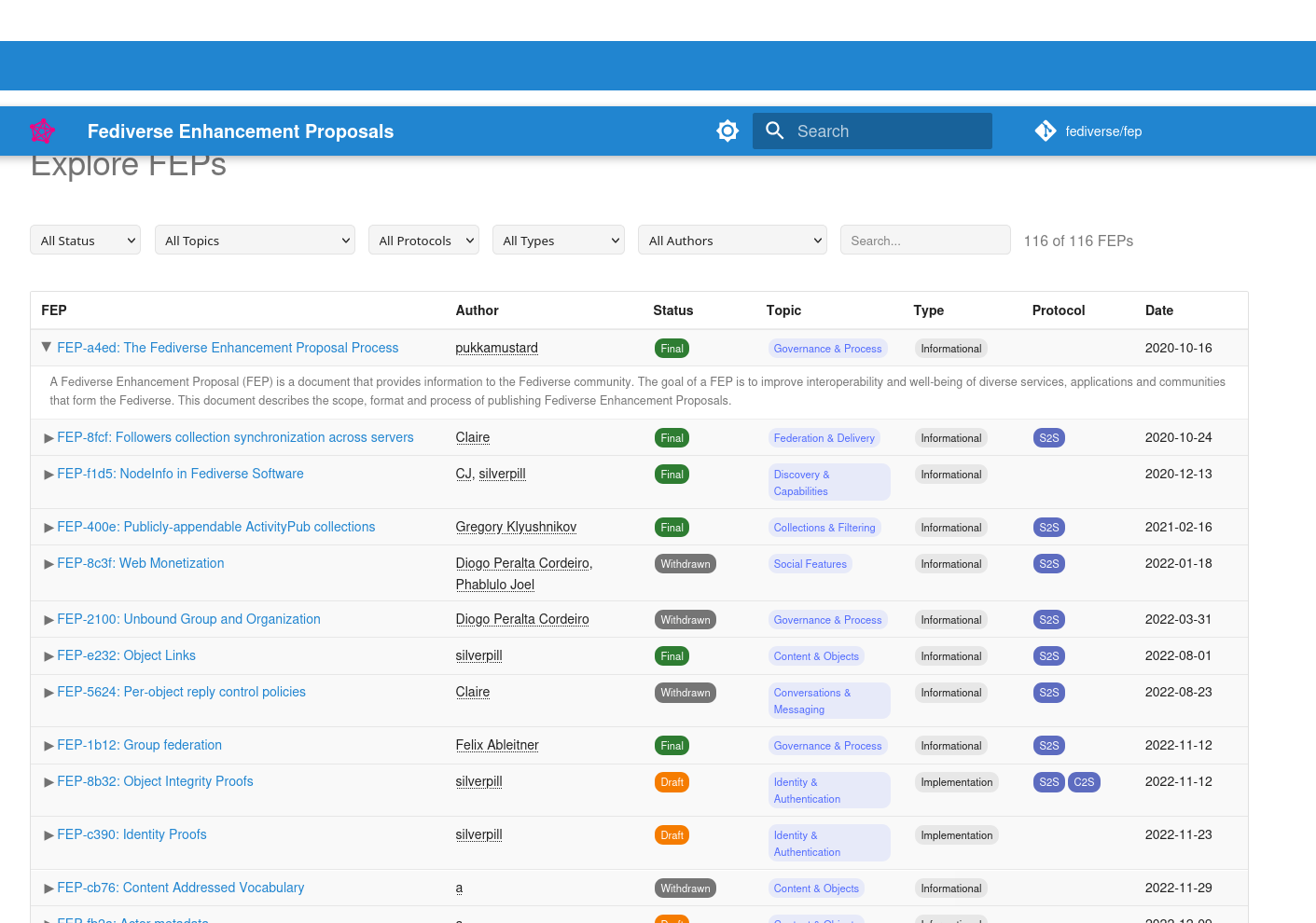
FEP website now displays the number of implementations for each implementable proposal:
https://fediverse.codeberg.page/fep/final/
These numbers are based on the information that authors provide in the "Implementations" section of a proposal.
By default, proposals are informational, so authors need to opt in by adding type: implementation to the metadata block.
@silverpill@mitra.social
FEP website now displays the number of implementations for each implementable proposal:
https://fediverse.codeberg.page/fep/final/
These numbers are based on the information that authors provide in the "Implementations" section of a proposal.
By default, proposals are informational, so authors need to opt in by adding type: implementation to the metadata block.
@silverpill@mitra.social
FEP website now displays the number of implementations for each implementable proposal:
https://fediverse.codeberg.page/fep/final/
These numbers are based on the information that authors provide in the "Implementations" section of a proposal.
By default, proposals are informational, so authors need to opt in by adding type: implementation to the metadata block.
@silverpill@mitra.social
Recently, there was a discussion about generic #ActivityPub servers. Several people claimed that they were working on one, but it turned out that their "generic" servers only support activities defined in the ActivityPub specification. Such a server shouldn't be called generic. It is not difficult to build, neither it is an interesting concept because competing protocols (e.g. Nostr) already offer much more.
I've been writing a #FEP that describes how to build a real generic server. It is not finished yet, but I feel like now is a good time to publish it:
FEP-fc48: Generic ActivityPub server
This kind of server:
- Can process any object type, and can process non-standard activities like EmojiReact.
- Compatible with FEP-ae97 clients.
- Does not require JSON-LD.
I attempted to implement it when I was researching security properties of FEP-ae97 API: https://codeberg.org/silverpill/fep-ae97-server. Back then I didn't know what to do with side effects, but now I think that we can simply force clients to specify them.
@silverpill@mitra.social
Recently, there was a discussion about generic #ActivityPub servers. Several people claimed that they were working on one, but it turned out that their "generic" servers only support activities defined in the ActivityPub specification. Such a server shouldn't be called generic. It is not difficult to build, neither it is an interesting concept because competing protocols (e.g. Nostr) already offer much more.
I've been writing a #FEP that describes how to build a real generic server. It is not finished yet, but I feel like now is a good time to publish it:
FEP-fc48: Generic ActivityPub server
This kind of server:
- Can process any object type, and can process non-standard activities like EmojiReact.
- Compatible with FEP-ae97 clients.
- Does not require JSON-LD.
I attempted to implement it when I was researching security properties of FEP-ae97 API: https://codeberg.org/silverpill/fep-ae97-server. Back then I didn't know what to do with side effects, but now I think that we can simply force clients to specify them.
@toddsundsted@epiktistes.com
Before creating and publishing FEDERATION.md for #ktistec I wanted to understand what existing practice looked like across the Fediverse.
FEP-67ff describes the requirements of the FEDERATION.md file in loose terms and provides a non-normative template. I scraped the URLs of FEDERATION.md files from FEP-67ff itself and confirmed I could fetch them. The FEP listed 30 accessible projects (31 total, but one project—FIRM—does not appear to exist).
If a file had a section with the heading "Supported FEPs" per the non-normative template, I only looked there for supported FEPs. Otherwise I scanned the entire document.
Implemented FEPs, ranked by the number of implementations that attest support, are:
FEP Name # ---- --------------------------------------------------------- -- 67ff FEDERATION.md 18 f1d5 NodeInfo in Fediverse Software 16 8b32 Object Integrity Proofs 7 044f Consent-respecting quote posts 7 2677 Identifying the Application Actor 7 e232 Object Links 6 1b12 Group federation 6 3b86 Activity Intents 6 521a Representing actor's public keys 5 2c59 Discovery of a Webfinger address from an ActivityPub actor 5 7888 Demystifying the context property 5 5feb Search indexing consent for actors 5 4adb Dereferencing identifiers with webfinger 4 d556 Server-Level Actor Discovery Using WebFinger 4 fb2a Actor metadata 4 ef61 Portable Objects 4 8fcf Followers collection synchronization across servers 4 844e Capability discovery 4 7628 Move actor 3 61cf The OpenWebAuth Protocol 3 c390 Identity Proofs 3 400e Publicly-appendable ActivityPub collections 3 c0e0 Emoji reactions 3 0151 NodeInfo in Fediverse Software (2025 edition) 3 fffd Proxy Objects 2 f228 Backfilling conversations 2 fe34 Origin-based security model 2 eb48 Hashtags 2 171b Conversation Containers 2 a5c5 Web Syndication Methods 2
There are obvious flaws in the methodology. Or maybe in the data. Only 18 out of the 30 projects I could access had a FEDERATION.md that attested FEDERATION.md support. Only 19 mentioned "FEDERATION.md". Only 21 mentioned "67ff". The remaining projects clearly did support FEP-67ff—the file itself was evidence. (FEDERATION.md is not meant to be machine readable—there's an issue about that).
It was more difficult to rank implemented federation protocols. I extracted keywords from documents with a "Supported federation protocols and standards" section and created a dictionary of terms. If a file had a section with the heading "Supported federation protocols and standards", I only looked there. Otherwise I scanned the entire document.
Feature # ---------------- -- activitypub 26 webfinger 24 http_signatures 21 nodeinfo 19 json_ld 2 ld_signatures 2 ostatus 2 authorized_fetch 1 atproto 1
If time allows, I'm going to try to rank these documents by "utility", though I haven't yet determined the exact metric. These documents clearly provide valuable information, but their lack of standardization makes them harder to analyze systematically.
@silverpill@mitra.social
Recently, there was a discussion about generic #ActivityPub servers. Several people claimed that they were working on one, but it turned out that their "generic" servers only support activities defined in the ActivityPub specification. Such a server shouldn't be called generic. It is not difficult to build, neither it is an interesting concept because competing protocols (e.g. Nostr) already offer much more.
I've been writing a #FEP that describes how to build a real generic server. It is not finished yet, but I feel like now is a good time to publish it:
FEP-fc48: Generic ActivityPub server
This kind of server:
- Can process any object type, and can process non-standard activities like EmojiReact.
- Compatible with FEP-ae97 clients.
- Does not require JSON-LD.
I attempted to implement it when I was researching security properties of FEP-ae97 API: https://codeberg.org/silverpill/fep-ae97-server. Back then I didn't know what to do with side effects, but now I think that we can simply force clients to specify them.
@silverpill@mitra.social
Recently, there was a discussion about generic #ActivityPub servers. Several people claimed that they were working on one, but it turned out that their "generic" servers only support activities defined in the ActivityPub specification. Such a server shouldn't be called generic. It is not difficult to build, neither it is an interesting concept because competing protocols (e.g. Nostr) already offer much more.
I've been writing a #FEP that describes how to build a real generic server. It is not finished yet, but I feel like now is a good time to publish it:
FEP-fc48: Generic ActivityPub server
This kind of server:
- Can process any object type, and can process non-standard activities like EmojiReact.
- Compatible with FEP-ae97 clients.
- Does not require JSON-LD.
I attempted to implement it when I was researching security properties of FEP-ae97 API: https://codeberg.org/silverpill/fep-ae97-server. Back then I didn't know what to do with side effects, but now I think that we can simply force clients to specify them.

@hongminhee@hollo.social
There's now a proper rendered web interface for FEPs at https://fediverse.codeberg.page/fep/fep/*/, which is much nicer to read than the raw Markdown source on Codeberg. But the canonical permalink, https://w3id.org/fep/*, still redirects to the Markdown file rather than the rendered page.
Would it make sense to update the w3id.org redirect to point to the rendered version instead? It seems like the better experience for anyone following a FEP link, and arguably what a “permanent” link should resolve to—something human-readable.
I'm not sure who manages the w3id.org/fep/ redirect configuration. (It lives in the perma-id/w3id.org GitHub repo, so it would just be a PR, but I'd want to get community consensus first rather than just send one in unilaterally.)
@silverpill@mitra.social
Recently, there was a discussion about generic #ActivityPub servers. Several people claimed that they were working on one, but it turned out that their "generic" servers only support activities defined in the ActivityPub specification. Such a server shouldn't be called generic. It is not difficult to build, neither it is an interesting concept because competing protocols (e.g. Nostr) already offer much more.
I've been writing a #FEP that describes how to build a real generic server. It is not finished yet, but I feel like now is a good time to publish it:
FEP-fc48: Generic ActivityPub server
This kind of server:
- Can process any object type, and can process non-standard activities like EmojiReact.
- Compatible with FEP-ae97 clients.
- Does not require JSON-LD.
I attempted to implement it when I was researching security properties of FEP-ae97 API: https://codeberg.org/silverpill/fep-ae97-server. Back then I didn't know what to do with side effects, but now I think that we can simply force clients to specify them.
@silverpill@mitra.social
Recently, there was a discussion about generic #ActivityPub servers. Several people claimed that they were working on one, but it turned out that their "generic" servers only support activities defined in the ActivityPub specification. Such a server shouldn't be called generic. It is not difficult to build, neither it is an interesting concept because competing protocols (e.g. Nostr) already offer much more.
I've been writing a #FEP that describes how to build a real generic server. It is not finished yet, but I feel like now is a good time to publish it:
FEP-fc48: Generic ActivityPub server
This kind of server:
- Can process any object type, and can process non-standard activities like EmojiReact.
- Compatible with FEP-ae97 clients.
- Does not require JSON-LD.
I attempted to implement it when I was researching security properties of FEP-ae97 API: https://codeberg.org/silverpill/fep-ae97-server. Back then I didn't know what to do with side effects, but now I think that we can simply force clients to specify them.
@silverpill@mitra.social
Recently, there was a discussion about generic #ActivityPub servers. Several people claimed that they were working on one, but it turned out that their "generic" servers only support activities defined in the ActivityPub specification. Such a server shouldn't be called generic. It is not difficult to build, neither it is an interesting concept because competing protocols (e.g. Nostr) already offer much more.
I've been writing a #FEP that describes how to build a real generic server. It is not finished yet, but I feel like now is a good time to publish it:
FEP-fc48: Generic ActivityPub server
This kind of server:
- Can process any object type, and can process non-standard activities like EmojiReact.
- Compatible with FEP-ae97 clients.
- Does not require JSON-LD.
I attempted to implement it when I was researching security properties of FEP-ae97 API: https://codeberg.org/silverpill/fep-ae97-server. Back then I didn't know what to do with side effects, but now I think that we can simply force clients to specify them.

@hongminhee@hollo.social
There's now a proper rendered web interface for FEPs at https://fediverse.codeberg.page/fep/fep/*/, which is much nicer to read than the raw Markdown source on Codeberg. But the canonical permalink, https://w3id.org/fep/*, still redirects to the Markdown file rather than the rendered page.
Would it make sense to update the w3id.org redirect to point to the rendered version instead? It seems like the better experience for anyone following a FEP link, and arguably what a “permanent” link should resolve to—something human-readable.
I'm not sure who manages the w3id.org/fep/ redirect configuration. (It lives in the perma-id/w3id.org GitHub repo, so it would just be a PR, but I'd want to get community consensus first rather than just send one in unilaterally.)

@hongminhee@hollo.social
There's now a proper rendered web interface for FEPs at https://fediverse.codeberg.page/fep/fep/*/, which is much nicer to read than the raw Markdown source on Codeberg. But the canonical permalink, https://w3id.org/fep/*, still redirects to the Markdown file rather than the rendered page.
Would it make sense to update the w3id.org redirect to point to the rendered version instead? It seems like the better experience for anyone following a FEP link, and arguably what a “permanent” link should resolve to—something human-readable.
I'm not sure who manages the w3id.org/fep/ redirect configuration. (It lives in the perma-id/w3id.org GitHub repo, so it would just be a PR, but I'd want to get community consensus first rather than just send one in unilaterally.)

@hongminhee@hollo.social
There's now a proper rendered web interface for FEPs at https://fediverse.codeberg.page/fep/fep/*/, which is much nicer to read than the raw Markdown source on Codeberg. But the canonical permalink, https://w3id.org/fep/*, still redirects to the Markdown file rather than the rendered page.
Would it make sense to update the w3id.org redirect to point to the rendered version instead? It seems like the better experience for anyone following a FEP link, and arguably what a “permanent” link should resolve to—something human-readable.
I'm not sure who manages the w3id.org/fep/ redirect configuration. (It lives in the perma-id/w3id.org GitHub repo, so it would just be a PR, but I'd want to get community consensus first rather than just send one in unilaterally.)
@toddsundsted@epiktistes.com
Before creating and publishing FEDERATION.md for #ktistec I wanted to understand what existing practice looked like across the Fediverse.
FEP-67ff describes the requirements of the FEDERATION.md file in loose terms and provides a non-normative template. I scraped the URLs of FEDERATION.md files from FEP-67ff itself and confirmed I could fetch them. The FEP listed 30 accessible projects (31 total, but one project—FIRM—does not appear to exist).
If a file had a section with the heading "Supported FEPs" per the non-normative template, I only looked there for supported FEPs. Otherwise I scanned the entire document.
Implemented FEPs, ranked by the number of implementations that attest support, are:
FEP Name # ---- --------------------------------------------------------- -- 67ff FEDERATION.md 18 f1d5 NodeInfo in Fediverse Software 16 8b32 Object Integrity Proofs 7 044f Consent-respecting quote posts 7 2677 Identifying the Application Actor 7 e232 Object Links 6 1b12 Group federation 6 3b86 Activity Intents 6 521a Representing actor's public keys 5 2c59 Discovery of a Webfinger address from an ActivityPub actor 5 7888 Demystifying the context property 5 5feb Search indexing consent for actors 5 4adb Dereferencing identifiers with webfinger 4 d556 Server-Level Actor Discovery Using WebFinger 4 fb2a Actor metadata 4 ef61 Portable Objects 4 8fcf Followers collection synchronization across servers 4 844e Capability discovery 4 7628 Move actor 3 61cf The OpenWebAuth Protocol 3 c390 Identity Proofs 3 400e Publicly-appendable ActivityPub collections 3 c0e0 Emoji reactions 3 0151 NodeInfo in Fediverse Software (2025 edition) 3 fffd Proxy Objects 2 f228 Backfilling conversations 2 fe34 Origin-based security model 2 eb48 Hashtags 2 171b Conversation Containers 2 a5c5 Web Syndication Methods 2
There are obvious flaws in the methodology. Or maybe in the data. Only 18 out of the 30 projects I could access had a FEDERATION.md that attested FEDERATION.md support. Only 19 mentioned "FEDERATION.md". Only 21 mentioned "67ff". The remaining projects clearly did support FEP-67ff—the file itself was evidence. (FEDERATION.md is not meant to be machine readable—there's an issue about that).
It was more difficult to rank implemented federation protocols. I extracted keywords from documents with a "Supported federation protocols and standards" section and created a dictionary of terms. If a file had a section with the heading "Supported federation protocols and standards", I only looked there. Otherwise I scanned the entire document.
Feature # ---------------- -- activitypub 26 webfinger 24 http_signatures 21 nodeinfo 19 json_ld 2 ld_signatures 2 ostatus 2 authorized_fetch 1 atproto 1
If time allows, I'm going to try to rank these documents by "utility", though I haven't yet determined the exact metric. These documents clearly provide valuable information, but their lack of standardization makes them harder to analyze systematically.
@toddsundsted@epiktistes.com
Before creating and publishing FEDERATION.md for #ktistec I wanted to understand what existing practice looked like across the Fediverse.
FEP-67ff describes the requirements of the FEDERATION.md file in loose terms and provides a non-normative template. I scraped the URLs of FEDERATION.md files from FEP-67ff itself and confirmed I could fetch them. The FEP listed 30 accessible projects (31 total, but one project—FIRM—does not appear to exist).
If a file had a section with the heading "Supported FEPs" per the non-normative template, I only looked there for supported FEPs. Otherwise I scanned the entire document.
Implemented FEPs, ranked by the number of implementations that attest support, are:
FEP Name # ---- --------------------------------------------------------- -- 67ff FEDERATION.md 18 f1d5 NodeInfo in Fediverse Software 16 8b32 Object Integrity Proofs 7 044f Consent-respecting quote posts 7 2677 Identifying the Application Actor 7 e232 Object Links 6 1b12 Group federation 6 3b86 Activity Intents 6 521a Representing actor's public keys 5 2c59 Discovery of a Webfinger address from an ActivityPub actor 5 7888 Demystifying the context property 5 5feb Search indexing consent for actors 5 4adb Dereferencing identifiers with webfinger 4 d556 Server-Level Actor Discovery Using WebFinger 4 fb2a Actor metadata 4 ef61 Portable Objects 4 8fcf Followers collection synchronization across servers 4 844e Capability discovery 4 7628 Move actor 3 61cf The OpenWebAuth Protocol 3 c390 Identity Proofs 3 400e Publicly-appendable ActivityPub collections 3 c0e0 Emoji reactions 3 0151 NodeInfo in Fediverse Software (2025 edition) 3 fffd Proxy Objects 2 f228 Backfilling conversations 2 fe34 Origin-based security model 2 eb48 Hashtags 2 171b Conversation Containers 2 a5c5 Web Syndication Methods 2
There are obvious flaws in the methodology. Or maybe in the data. Only 18 out of the 30 projects I could access had a FEDERATION.md that attested FEDERATION.md support. Only 19 mentioned "FEDERATION.md". Only 21 mentioned "67ff". The remaining projects clearly did support FEP-67ff—the file itself was evidence. (FEDERATION.md is not meant to be machine readable—there's an issue about that).
It was more difficult to rank implemented federation protocols. I extracted keywords from documents with a "Supported federation protocols and standards" section and created a dictionary of terms. If a file had a section with the heading "Supported federation protocols and standards", I only looked there. Otherwise I scanned the entire document.
Feature # ---------------- -- activitypub 26 webfinger 24 http_signatures 21 nodeinfo 19 json_ld 2 ld_signatures 2 ostatus 2 authorized_fetch 1 atproto 1
If time allows, I'm going to try to rank these documents by "utility", though I haven't yet determined the exact metric. These documents clearly provide valuable information, but their lack of standardization makes them harder to analyze systematically.
@toddsundsted@epiktistes.com
Before creating and publishing FEDERATION.md for #ktistec I wanted to understand what existing practice looked like across the Fediverse.
FEP-67ff describes the requirements of the FEDERATION.md file in loose terms and provides a non-normative template. I scraped the URLs of FEDERATION.md files from FEP-67ff itself and confirmed I could fetch them. The FEP listed 30 accessible projects (31 total, but one project—FIRM—does not appear to exist).
If a file had a section with the heading "Supported FEPs" per the non-normative template, I only looked there for supported FEPs. Otherwise I scanned the entire document.
Implemented FEPs, ranked by the number of implementations that attest support, are:
FEP Name # ---- --------------------------------------------------------- -- 67ff FEDERATION.md 18 f1d5 NodeInfo in Fediverse Software 16 8b32 Object Integrity Proofs 7 044f Consent-respecting quote posts 7 2677 Identifying the Application Actor 7 e232 Object Links 6 1b12 Group federation 6 3b86 Activity Intents 6 521a Representing actor's public keys 5 2c59 Discovery of a Webfinger address from an ActivityPub actor 5 7888 Demystifying the context property 5 5feb Search indexing consent for actors 5 4adb Dereferencing identifiers with webfinger 4 d556 Server-Level Actor Discovery Using WebFinger 4 fb2a Actor metadata 4 ef61 Portable Objects 4 8fcf Followers collection synchronization across servers 4 844e Capability discovery 4 7628 Move actor 3 61cf The OpenWebAuth Protocol 3 c390 Identity Proofs 3 400e Publicly-appendable ActivityPub collections 3 c0e0 Emoji reactions 3 0151 NodeInfo in Fediverse Software (2025 edition) 3 fffd Proxy Objects 2 f228 Backfilling conversations 2 fe34 Origin-based security model 2 eb48 Hashtags 2 171b Conversation Containers 2 a5c5 Web Syndication Methods 2
There are obvious flaws in the methodology. Or maybe in the data. Only 18 out of the 30 projects I could access had a FEDERATION.md that attested FEDERATION.md support. Only 19 mentioned "FEDERATION.md". Only 21 mentioned "67ff". The remaining projects clearly did support FEP-67ff—the file itself was evidence. (FEDERATION.md is not meant to be machine readable—there's an issue about that).
It was more difficult to rank implemented federation protocols. I extracted keywords from documents with a "Supported federation protocols and standards" section and created a dictionary of terms. If a file had a section with the heading "Supported federation protocols and standards", I only looked there. Otherwise I scanned the entire document.
Feature # ---------------- -- activitypub 26 webfinger 24 http_signatures 21 nodeinfo 19 json_ld 2 ld_signatures 2 ostatus 2 authorized_fetch 1 atproto 1
If time allows, I'm going to try to rank these documents by "utility", though I haven't yet determined the exact metric. These documents clearly provide valuable information, but their lack of standardization makes them harder to analyze systematically.
@benpate@mastodon.social · Reply to Ben Pate 🤘🏻's post
Hey #FediDev gang.. Do you think this is the right way to guide people from personal/organizational websites into the #Fediverse?
Some of this is defined in #FEP3b86. Some of it exists today in #Emissary (and the #oStatus "remote follow") some is being built by @dansup as #WebIntents, and some is just scribbles on paper.
If there's interest, I'm happy to write up the rest of this as an additional #FEP
@benpate@mastodon.social · Reply to Ben Pate 🤘🏻's post
Hey #FediDev gang.. Do you think this is the right way to guide people from personal/organizational websites into the #Fediverse?
Some of this is defined in #FEP3b86. Some of it exists today in #Emissary (and the #oStatus "remote follow") some is being built by @dansup as #WebIntents, and some is just scribbles on paper.
If there's interest, I'm happy to write up the rest of this as an additional #FEP
@julian@fietkau.social
FEP drafting: Am I using “side effects” here the same way as other ActivityPub developers? I've seen the term used a bunch in casual conversation, but my personal understanding of it is kinda fuzzy.
@julian@fietkau.social
FEP drafting: Am I using “side effects” here the same way as other ActivityPub developers? I've seen the term used a bunch in casual conversation, but my personal understanding of it is kinda fuzzy.
@silverpill@mitra.social · Reply to bengo's post
@silverpill@mitra.social
FEP-0151: NodeInfo in Fediverse Software (2025 edition)
I added the "Implementations" section and a reference to FEP-844e:
https://codeberg.org/fediverse/fep/pulls/741
There are 3 independent implementations now. Since this is a "2025 edition", and 2025 is about to end, I think the FEP should be finalized.
If you have any suggestions, please comment here, on SocialHub, or create an issue.
@silverpill@mitra.social
FEP-0151: NodeInfo in Fediverse Software (2025 edition)
I added the "Implementations" section and a reference to FEP-844e:
https://codeberg.org/fediverse/fep/pulls/741
There are 3 independent implementations now. Since this is a "2025 edition", and 2025 is about to end, I think the FEP should be finalized.
If you have any suggestions, please comment here, on SocialHub, or create an issue.
@silverpill@mitra.social
FEP-0151: NodeInfo in Fediverse Software (2025 edition)
I added the "Implementations" section and a reference to FEP-844e:
https://codeberg.org/fediverse/fep/pulls/741
There are 3 independent implementations now. Since this is a "2025 edition", and 2025 is about to end, I think the FEP should be finalized.
If you have any suggestions, please comment here, on SocialHub, or create an issue.
@silverpill@mitra.social
FEP-0151: NodeInfo in Fediverse Software (2025 edition)
I added the "Implementations" section and a reference to FEP-844e:
https://codeberg.org/fediverse/fep/pulls/741
There are 3 independent implementations now. Since this is a "2025 edition", and 2025 is about to end, I think the FEP should be finalized.
If you have any suggestions, please comment here, on SocialHub, or create an issue.
@jonny@neuromatch.social
Here's another #FEP for representing torrents on activitypub :)
short, sweet, and with a reference implementation and tests!
towards a federated bittorrent tracker with #sciop !
PR: https://codeberg.org/fediverse/fep/pulls/714
Discussion: https://socialhub.activitypub.rocks/t/fep-d8c8-bittorrent-torrent-objects/8309 (or this thread)
@jonny@neuromatch.social
Here's another #FEP for representing torrents on activitypub :)
short, sweet, and with a reference implementation and tests!
towards a federated bittorrent tracker with #sciop !
PR: https://codeberg.org/fediverse/fep/pulls/714
Discussion: https://socialhub.activitypub.rocks/t/fep-d8c8-bittorrent-torrent-objects/8309 (or this thread)
@jonny@neuromatch.social
Here's another #FEP for representing torrents on activitypub :)
short, sweet, and with a reference implementation and tests!
towards a federated bittorrent tracker with #sciop !
PR: https://codeberg.org/fediverse/fep/pulls/714
Discussion: https://socialhub.activitypub.rocks/t/fep-d8c8-bittorrent-torrent-objects/8309 (or this thread)
@jonny@neuromatch.social
Here's another #FEP for representing torrents on activitypub :)
short, sweet, and with a reference implementation and tests!
towards a federated bittorrent tracker with #sciop !
PR: https://codeberg.org/fediverse/fep/pulls/714
Discussion: https://socialhub.activitypub.rocks/t/fep-d8c8-bittorrent-torrent-objects/8309 (or this thread)
@jonny@neuromatch.social
Here's another #FEP for representing torrents on activitypub :)
short, sweet, and with a reference implementation and tests!
towards a federated bittorrent tracker with #sciop !
PR: https://codeberg.org/fediverse/fep/pulls/714
Discussion: https://socialhub.activitypub.rocks/t/fep-d8c8-bittorrent-torrent-objects/8309 (or this thread)
@jonny@neuromatch.social
Here's another #FEP for representing torrents on activitypub :)
short, sweet, and with a reference implementation and tests!
towards a federated bittorrent tracker with #sciop !
PR: https://codeberg.org/fediverse/fep/pulls/714
Discussion: https://socialhub.activitypub.rocks/t/fep-d8c8-bittorrent-torrent-objects/8309 (or this thread)
@jonny@neuromatch.social
Here's another #FEP for representing torrents on activitypub :)
short, sweet, and with a reference implementation and tests!
towards a federated bittorrent tracker with #sciop !
PR: https://codeberg.org/fediverse/fep/pulls/714
Discussion: https://socialhub.activitypub.rocks/t/fep-d8c8-bittorrent-torrent-objects/8309 (or this thread)
@jonny@neuromatch.social
Here's another #FEP for representing torrents on activitypub :)
short, sweet, and with a reference implementation and tests!
towards a federated bittorrent tracker with #sciop !
PR: https://codeberg.org/fediverse/fep/pulls/714
Discussion: https://socialhub.activitypub.rocks/t/fep-d8c8-bittorrent-torrent-objects/8309 (or this thread)
@jonny@neuromatch.social
Here's another #FEP for representing torrents on activitypub :)
short, sweet, and with a reference implementation and tests!
towards a federated bittorrent tracker with #sciop !
PR: https://codeberg.org/fediverse/fep/pulls/714
Discussion: https://socialhub.activitypub.rocks/t/fep-d8c8-bittorrent-torrent-objects/8309 (or this thread)
@silverpill@mitra.social
The #FEP website built by @helge is now online:
https://fediverse.codeberg.page/fep/
Enjoy!
RE: https://mymath.rocks/objects/dad3deb4-a29d-4df3-a017-ae5700a387f3
@helge@mymath.rocks
Good morning Fediverse. It's sunny outside.
Also the perfect day for codeberg pages to have some downtime, see create static site is merged. Coincidences are weird.
@silverpill@mitra.social
The #FEP website built by @helge is now online:
https://fediverse.codeberg.page/fep/
Enjoy!
RE: https://mymath.rocks/objects/dad3deb4-a29d-4df3-a017-ae5700a387f3
@helge@mymath.rocks
Good morning Fediverse. It's sunny outside.
Also the perfect day for codeberg pages to have some downtime, see create static site is merged. Coincidences are weird.
@silverpill@mitra.social
The #FEP website built by @helge is now online:
https://fediverse.codeberg.page/fep/
Enjoy!
RE: https://mymath.rocks/objects/dad3deb4-a29d-4df3-a017-ae5700a387f3
@helge@mymath.rocks
Good morning Fediverse. It's sunny outside.
Also the perfect day for codeberg pages to have some downtime, see create static site is merged. Coincidences are weird.
@jonny@neuromatch.social
Alright it's late and i need to go to bed, but here's a draft FEP to do full account migration with posts and whatever other kinda objects you want to bring with you. It's a trivial expansion of existing ActivityPub/streams systems and supports gradual migration as it's implemented and after an account migration. It should be possible to migrate pretty much everything this way, both private and public objects.
criticism, feedback, revisions, etc. welcome - i don't think this is a "final version" and there are certainly things i overlooked.
https://codeberg.org/fediverse/fep/pulls/692
#MoveAllPosts #FediDev #FEP #FEP_1580 #FullMigration #AccountMigration
@jonny@neuromatch.social
Alright it's late and i need to go to bed, but here's a draft FEP to do full account migration with posts and whatever other kinda objects you want to bring with you. It's a trivial expansion of existing ActivityPub/streams systems and supports gradual migration as it's implemented and after an account migration. It should be possible to migrate pretty much everything this way, both private and public objects.
criticism, feedback, revisions, etc. welcome - i don't think this is a "final version" and there are certainly things i overlooked.
https://codeberg.org/fediverse/fep/pulls/692
#MoveAllPosts #FediDev #FEP #FEP_1580 #FullMigration #AccountMigration
@jonny@neuromatch.social
Alright it's late and i need to go to bed, but here's a draft FEP to do full account migration with posts and whatever other kinda objects you want to bring with you. It's a trivial expansion of existing ActivityPub/streams systems and supports gradual migration as it's implemented and after an account migration. It should be possible to migrate pretty much everything this way, both private and public objects.
criticism, feedback, revisions, etc. welcome - i don't think this is a "final version" and there are certainly things i overlooked.
https://codeberg.org/fediverse/fep/pulls/692
#MoveAllPosts #FediDev #FEP #FEP_1580 #FullMigration #AccountMigration
@jonny@neuromatch.social
Alright it's late and i need to go to bed, but here's a draft FEP to do full account migration with posts and whatever other kinda objects you want to bring with you. It's a trivial expansion of existing ActivityPub/streams systems and supports gradual migration as it's implemented and after an account migration. It should be possible to migrate pretty much everything this way, both private and public objects.
criticism, feedback, revisions, etc. welcome - i don't think this is a "final version" and there are certainly things i overlooked.
https://codeberg.org/fediverse/fep/pulls/692
#MoveAllPosts #FediDev #FEP #FEP_1580 #FullMigration #AccountMigration
@jonny@neuromatch.social
Alright it's late and i need to go to bed, but here's a draft FEP to do full account migration with posts and whatever other kinda objects you want to bring with you. It's a trivial expansion of existing ActivityPub/streams systems and supports gradual migration as it's implemented and after an account migration. It should be possible to migrate pretty much everything this way, both private and public objects.
criticism, feedback, revisions, etc. welcome - i don't think this is a "final version" and there are certainly things i overlooked.
https://codeberg.org/fediverse/fep/pulls/692
#MoveAllPosts #FediDev #FEP #FEP_1580 #FullMigration #AccountMigration
@jonny@neuromatch.social
Alright it's late and i need to go to bed, but here's a draft FEP to do full account migration with posts and whatever other kinda objects you want to bring with you. It's a trivial expansion of existing ActivityPub/streams systems and supports gradual migration as it's implemented and after an account migration. It should be possible to migrate pretty much everything this way, both private and public objects.
criticism, feedback, revisions, etc. welcome - i don't think this is a "final version" and there are certainly things i overlooked.
https://codeberg.org/fediverse/fep/pulls/692
#MoveAllPosts #FediDev #FEP #FEP_1580 #FullMigration #AccountMigration
@jonny@neuromatch.social
Alright it's late and i need to go to bed, but here's a draft FEP to do full account migration with posts and whatever other kinda objects you want to bring with you. It's a trivial expansion of existing ActivityPub/streams systems and supports gradual migration as it's implemented and after an account migration. It should be possible to migrate pretty much everything this way, both private and public objects.
criticism, feedback, revisions, etc. welcome - i don't think this is a "final version" and there are certainly things i overlooked.
https://codeberg.org/fediverse/fep/pulls/692
#MoveAllPosts #FediDev #FEP #FEP_1580 #FullMigration #AccountMigration
@jonny@neuromatch.social
Alright it's late and i need to go to bed, but here's a draft FEP to do full account migration with posts and whatever other kinda objects you want to bring with you. It's a trivial expansion of existing ActivityPub/streams systems and supports gradual migration as it's implemented and after an account migration. It should be possible to migrate pretty much everything this way, both private and public objects.
criticism, feedback, revisions, etc. welcome - i don't think this is a "final version" and there are certainly things i overlooked.
https://codeberg.org/fediverse/fep/pulls/692
#MoveAllPosts #FediDev #FEP #FEP_1580 #FullMigration #AccountMigration
@jonny@neuromatch.social
Alright it's late and i need to go to bed, but here's a draft FEP to do full account migration with posts and whatever other kinda objects you want to bring with you. It's a trivial expansion of existing ActivityPub/streams systems and supports gradual migration as it's implemented and after an account migration. It should be possible to migrate pretty much everything this way, both private and public objects.
criticism, feedback, revisions, etc. welcome - i don't think this is a "final version" and there are certainly things i overlooked.
https://codeberg.org/fediverse/fep/pulls/692
#MoveAllPosts #FediDev #FEP #FEP_1580 #FullMigration #AccountMigration
@lyegesp@masto.es
💡 Proposal for ActivityPub: FediStamp
What if any federated platform (Mastodon, WordPress, Pixelfed, PeerTube, WriteFreely...) could offer automatic certification of original content?
When publishing a poem, article, photo or video, you check "Certify original content" and the system gives you:
🔗 A public verifiable link to the registry
📄 A .fedistamp file as permanent proof
✅ A visible badge (Certified content) with clickable link
🧩 Metadata embedded in ActivityPub that travels with each share
Example: I publish a poem on Mastodon, enable the option, and instantly get my ✓ certified proof of authorship.
👉 This doesn't replace copyright (which already protects you), but strengthens it with technical evidence of authorship and date.
⚡ Key points:
Only registers the content hash (no cryptocurrency, just authorship certification).
Free.
Opt-in: you choose what to certify.
Automatic protection for creators across the federated ecosystem, without relying on centralized platforms.
I'm not a programmer, just a writer who sees the need. If someone technical sees merit and feasibility, go ahead.
#ActivityPub #Fediverse #FediStamp #FEP #ActivityPubDev #Mastodon #WordPress #Pixelfed #PeerTube #Creators #OpenSource #DigitalRights #OpenProposal
@lyegesp@masto.es
💡 Proposal for ActivityPub: FediStamp
What if any federated platform (Mastodon, WordPress, Pixelfed, PeerTube, WriteFreely...) could offer automatic certification of original content?
When publishing a poem, article, photo or video, you check "Certify original content" and the system gives you:
🔗 A public verifiable link to the registry
📄 A .fedistamp file as permanent proof
✅ A visible badge (Certified content) with clickable link
🧩 Metadata embedded in ActivityPub that travels with each share
Example: I publish a poem on Mastodon, enable the option, and instantly get my ✓ certified proof of authorship.
👉 This doesn't replace copyright (which already protects you), but strengthens it with technical evidence of authorship and date.
⚡ Key points:
Only registers the content hash (no cryptocurrency, just authorship certification).
Free.
Opt-in: you choose what to certify.
Automatic protection for creators across the federated ecosystem, without relying on centralized platforms.
I'm not a programmer, just a writer who sees the need. If someone technical sees merit and feasibility, go ahead.
#ActivityPub #Fediverse #FediStamp #FEP #ActivityPubDev #Mastodon #WordPress #Pixelfed #PeerTube #Creators #OpenSource #DigitalRights #OpenProposal
@stefan@stefanbohacek.online
Any #GoToSocial developers, or anyone else who might know what the hold-up with publishing the FEP for reply controls is, interested in chiming in?
@silverpill@mitra.social
https://lists.w3.org/Archives/Public/public-swicg/2025Oct/0001.html
SocialCG people want to make their own FEP repository on GitHub where authors will be required to sign a CLA.
I'd like to make it clear: this is not associated with the original FEP repository. The #FEP process is meant to be open to everyone, and I will do everything I can to stop any attempts to introduce CLAs there.
@silverpill@mitra.social
https://lists.w3.org/Archives/Public/public-swicg/2025Oct/0001.html
SocialCG people want to make their own FEP repository on GitHub where authors will be required to sign a CLA.
I'd like to make it clear: this is not associated with the original FEP repository. The #FEP process is meant to be open to everyone, and I will do everything I can to stop any attempts to introduce CLAs there.
@silverpill@mitra.social
https://lists.w3.org/Archives/Public/public-swicg/2025Oct/0001.html
SocialCG people want to make their own FEP repository on GitHub where authors will be required to sign a CLA.
I'd like to make it clear: this is not associated with the original FEP repository. The #FEP process is meant to be open to everyone, and I will do everything I can to stop any attempts to introduce CLAs there.
@daniel@gultsch.social
[View Orginal URL] is a bug in the federation model.
https://spectra.video/w/72dbS6nFMwrgEtRb5h3Sk2
Great talk by @julian. Thank you!
@daniel@gultsch.social
[View Orginal URL] is a bug in the federation model.
https://spectra.video/w/72dbS6nFMwrgEtRb5h3Sk2
Great talk by @julian. Thank you!
@silverpill@mitra.social
FEP-9098: Custom emojis has been published.
@silverpill@mitra.social
FEP-9098: Custom emojis has been published.
@silverpill@mitra.social
FEP-9098: Custom emojis has been published.
@silverpill@mitra.social
FEP-9098: Custom emojis has been published.
@silverpill@mitra.social
Two upcoming changes in the #FEP process:
- Withdrawing stale proposals. If a proposal remains inactive for 2 years, its status is changed to WITHDRAWN. Previously, the period was 1 year after submission, and facilitators were supposed to contact authors before withdrawing (that didn't work well).
- Implementation tracking. If a proposal has type: implementation attribute, we will automatically count list items in the "Implementations" section and display that number somewhere (probably in README). If your proposal is implementable, I recommend adding type: implementation attribute to it. Also, don't forget to mention implementations if they exist - this information is very important.
@silverpill@mitra.social
Two upcoming changes in the #FEP process:
- Withdrawing stale proposals. If a proposal remains inactive for 2 years, its status is changed to WITHDRAWN. Previously, the period was 1 year after submission, and facilitators were supposed to contact authors before withdrawing (that didn't work well).
- Implementation tracking. If a proposal has type: implementation attribute, we will automatically count list items in the "Implementations" section and display that number somewhere (probably in README). If your proposal is implementable, I recommend adding type: implementation attribute to it. Also, don't forget to mention implementations if they exist - this information is very important.
@silverpill@mitra.social
Two upcoming changes in the #FEP process:
- Withdrawing stale proposals. If a proposal remains inactive for 2 years, its status is changed to WITHDRAWN. Previously, the period was 1 year after submission, and facilitators were supposed to contact authors before withdrawing (that didn't work well).
- Implementation tracking. If a proposal has type: implementation attribute, we will automatically count list items in the "Implementations" section and display that number somewhere (probably in README). If your proposal is implementable, I recommend adding type: implementation attribute to it. Also, don't forget to mention implementations if they exist - this information is very important.
@fedizen@mastodon.social
»#PostQuantumPrivacy for #PostPlatformInternet. — #Fediverse pilots: #ActivityPub with #Dilithiumsignatures. While #Mastodon and other ActivityPub servers still use #RSA-#HTTP-#Signatures by default, developers in the #SocialHub community are working on a #FEP (Fediverse Enhancement Proposal) to clarify signature processing and accommodate #quantumsafealgorithms.« https://hackernoon.com/post-quantum-privacy-for-post-platform-internet?Fedizen.EU #Fedizen #Fediverse #ActivityPub #News
@silverpill@mitra.social
FEP-521a: Representing actor's public keys has been finalized!
https://codeberg.org/fediverse/fep/src/branch/main/fep/521a/fep-521a.md
@silverpill@mitra.social
FEP-521a: Representing actor's public keys has been finalized!
https://codeberg.org/fediverse/fep/src/branch/main/fep/521a/fep-521a.md
@silverpill@mitra.social
FEP-844e: Capability discovery has been published to the FEP repository:
https://codeberg.org/fediverse/fep/src/branch/main/fep/844e/fep-844e.md
I already use it to signal RFC-9421 support. An anonymous Application object is added to actors:
{
"generator": {
"type": "Application",
"implements": [
{
"name": "RFC-9421: HTTP Message Signatures",
"href": "https://datatracker.ietf.org/doc/html/rfc9421"
}
]
}
}
All important information is embedded, so additional HTTP requests are not necessary.
@silverpill@mitra.social
FEP-844e: Capability discovery has been published to the FEP repository:
https://codeberg.org/fediverse/fep/src/branch/main/fep/844e/fep-844e.md
I already use it to signal RFC-9421 support. An anonymous Application object is added to actors:
{
"generator": {
"type": "Application",
"implements": [
{
"name": "RFC-9421: HTTP Message Signatures",
"href": "https://datatracker.ietf.org/doc/html/rfc9421"
}
]
}
}
All important information is embedded, so additional HTTP requests are not necessary.
@silverpill@mitra.social
FEP-844e: Capability discovery has been published to the FEP repository:
https://codeberg.org/fediverse/fep/src/branch/main/fep/844e/fep-844e.md
I already use it to signal RFC-9421 support. An anonymous Application object is added to actors:
{
"generator": {
"type": "Application",
"implements": [
{
"name": "RFC-9421: HTTP Message Signatures",
"href": "https://datatracker.ietf.org/doc/html/rfc9421"
}
]
}
}
All important information is embedded, so additional HTTP requests are not necessary.
@silverpill@mitra.social
FEP-844e: Capability discovery has been published to the FEP repository:
https://codeberg.org/fediverse/fep/src/branch/main/fep/844e/fep-844e.md
I already use it to signal RFC-9421 support. An anonymous Application object is added to actors:
{
"generator": {
"type": "Application",
"implements": [
{
"name": "RFC-9421: HTTP Message Signatures",
"href": "https://datatracker.ietf.org/doc/html/rfc9421"
}
]
}
}
All important information is embedded, so additional HTTP requests are not necessary.
@silverpill@mitra.social
FEP-844e: Capability discovery has been published to the FEP repository:
https://codeberg.org/fediverse/fep/src/branch/main/fep/844e/fep-844e.md
I already use it to signal RFC-9421 support. An anonymous Application object is added to actors:
{
"generator": {
"type": "Application",
"implements": [
{
"name": "RFC-9421: HTTP Message Signatures",
"href": "https://datatracker.ietf.org/doc/html/rfc9421"
}
]
}
}
All important information is embedded, so additional HTTP requests are not necessary.
@grishka@mastodon.social
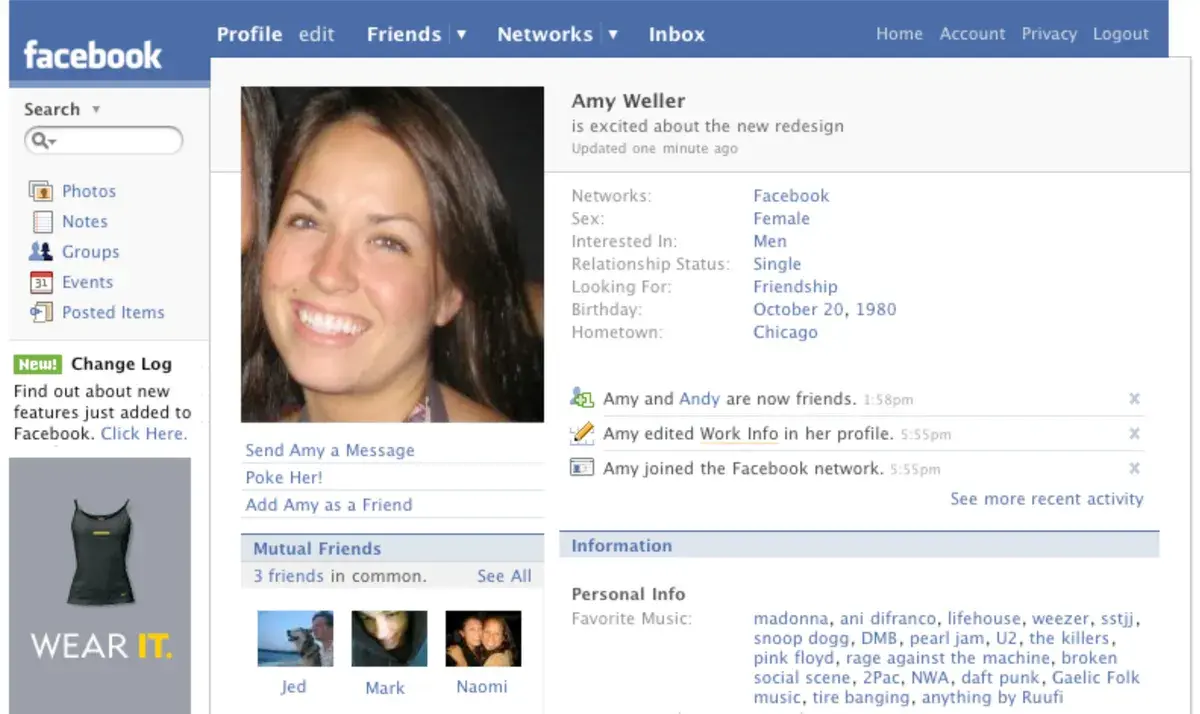
I wrote a #FEP about actor statuses. Yeah, those things near the name that Facebook had in 2007.
https://codeberg.org/fediverse/fep/src/branch/main/fep/82f6/fep-82f6.md
@grishka@mastodon.social
I wrote a #FEP about actor statuses. Yeah, those things near the name that Facebook had in 2007.
https://codeberg.org/fediverse/fep/src/branch/main/fep/82f6/fep-82f6.md
@grishka@mastodon.social
I wrote a #FEP about actor statuses. Yeah, those things near the name that Facebook had in 2007.
https://codeberg.org/fediverse/fep/src/branch/main/fep/82f6/fep-82f6.md
@silverpill@mitra.social
Started writing a new FEP:
FEP-0151: NodeInfo in Fediverse Software (2025 edition)
Mentioned some best practices. What else should be added there?
@silverpill@mitra.social
Started writing a new FEP:
FEP-0151: NodeInfo in Fediverse Software (2025 edition)
Mentioned some best practices. What else should be added there?
@silverpill@mitra.social
Started writing a new FEP:
FEP-0151: NodeInfo in Fediverse Software (2025 edition)
Mentioned some best practices. What else should be added there?
@silverpill@mitra.social
Started writing a new FEP:
FEP-0151: NodeInfo in Fediverse Software (2025 edition)
Mentioned some best practices. What else should be added there?
@silverpill@mitra.social
Started writing a new FEP:
FEP-0151: NodeInfo in Fediverse Software (2025 edition)
Mentioned some best practices. What else should be added there?
@richiekhoo@hachyderm.io
As we consider ways to implement #ActivityPub into our FOSS Community Calendar Ecosystem platform Koalagator, I've been looking over the differing specs for how to specify the event object schema.
Have any other folk wrestled with this?Asking before I get arms deep in this stuff.
For those playing at home...
---
Schema.org - Event
Schema.org is a collaborative, community activity with a mission to create, maintain, and promote schemas for structured data on the Internet.
-----
W3C Activity Vocabulary - Event
This specification describes the Activity vocabulary. It is intended to be used in the context of the ActivityStreams 2.0 format and provides a foundational vocabulary for activity structures, and specific activity types.
https://www.w3.org/TR/activitystreams-vocabulary/#dfn-event
----
Fediverse Enhancement Proposal
FEP-8a8e: A common approach to using the Event object type
ActivityStreams defines the Object Type Event. In real-world applications, the event object immediately showed the need for extension. Applications featuring Event objects have often chosen to add additional attributes and clarifications (i.e., interpretations) in order to implement their particular use case. This proposal clarifies and extends the ActivityPub standard to address the needs that have arisen in real-world implementations.
https://codeberg.org/linos/fep/src/branch/fep-8a8e/fep/8a8e/fep-8a8e.md
---
[HTML] Microformats - h-event
People are using microformats to mark up profiles, posts, events and other data on their personal sites, enabling developers to build applications which use this data in useful and interesting ways.
https://microformats.org/wiki/h-event
---
iCalendar Standard (RFC 5545)
iCalendar was first defined as a standard as RFC 2445 in 1998 by the Internet Engineering Task Force (IETF). Today, iCalendar is used to import and synchronize events on various platforms, including smart phones, computer and web applications.
https://icalendar.org/the-icalendar-standard-2.html
#EventObjectSchema
#Calendar #Standards #WebStandards #W3C #Microformats #FEP #FediverseEnhancementProposals #iCal #iCalendar #FOSS #WebDevelopment #WebDesign #RubyOnRails #Rails #Mastodon #Dev #Developer #OpenStandards
@silverpill@mitra.social
I am working on a new revision of FEP-8b32:
https://codeberg.org/fediverse/fep/pulls/527
There are many editorial changes, such as replacing Controller Documents with Controlled Identifiers, new implementation (apsig), and one new requirement:
>The identifier of the verification method MUST have the same origin as the identifier of the secured document, or have a different origin, but with an established cross-origin trust relationship to the identifier of the secured document.
This is related to today's FEP-fe34 update and should cover all possible uses of integrity proofs, including regular objects signed with DID keys, and portable objects (FEP-ef61). I expect that all existing implementations of FEP-8b32 already meet this new requirement, but if not, please let me know. I'll keep this PR open / WIP for a couple of days.
@silverpill@mitra.social
FEP-fe34 "Origin-based security model" has been updated:
https://codeberg.org/fediverse/fep/pulls/526
There is a new section discussing cross-origin relationships. Some use cases require bypassing of same-origin policy, and in such situations confirmations of both authorities are required. One interesting example is FEP-c390: Identity Proofs, where trust is established by verification of complementary claims made by an HTTP authority (actor document) and DID authority (identity proof document).
I also added the definition of "authentication":
>Authentication is the process of verifying the origin of an object.
And the definition of "authorization":
>Authorization is the process of verfying permission to create, read, update or delete an object.
@silverpill@mitra.social
FEP-fe34 "Origin-based security model" has been updated:
https://codeberg.org/fediverse/fep/pulls/526
There is a new section discussing cross-origin relationships. Some use cases require bypassing of same-origin policy, and in such situations confirmations of both authorities are required. One interesting example is FEP-c390: Identity Proofs, where trust is established by verification of complementary claims made by an HTTP authority (actor document) and DID authority (identity proof document).
I also added the definition of "authentication":
>Authentication is the process of verifying the origin of an object.
And the definition of "authorization":
>Authorization is the process of verfying permission to create, read, update or delete an object.
@silverpill@mitra.social
FEP-fe34 "Origin-based security model" has been updated:
https://codeberg.org/fediverse/fep/pulls/526
There is a new section discussing cross-origin relationships. Some use cases require bypassing of same-origin policy, and in such situations confirmations of both authorities are required. One interesting example is FEP-c390: Identity Proofs, where trust is established by verification of complementary claims made by an HTTP authority (actor document) and DID authority (identity proof document).
I also added the definition of "authentication":
>Authentication is the process of verifying the origin of an object.
And the definition of "authorization":
>Authorization is the process of verfying permission to create, read, update or delete an object.
@silverpill@mitra.social
I am working on a new revision of FEP-8b32:
https://codeberg.org/fediverse/fep/pulls/527
There are many editorial changes, such as replacing Controller Documents with Controlled Identifiers, new implementation (apsig), and one new requirement:
>The identifier of the verification method MUST have the same origin as the identifier of the secured document, or have a different origin, but with an established cross-origin trust relationship to the identifier of the secured document.
This is related to today's FEP-fe34 update and should cover all possible uses of integrity proofs, including regular objects signed with DID keys, and portable objects (FEP-ef61). I expect that all existing implementations of FEP-8b32 already meet this new requirement, but if not, please let me know. I'll keep this PR open / WIP for a couple of days.
@silverpill@mitra.social
FEP-fe34 "Origin-based security model" has been updated:
https://codeberg.org/fediverse/fep/pulls/526
There is a new section discussing cross-origin relationships. Some use cases require bypassing of same-origin policy, and in such situations confirmations of both authorities are required. One interesting example is FEP-c390: Identity Proofs, where trust is established by verification of complementary claims made by an HTTP authority (actor document) and DID authority (identity proof document).
I also added the definition of "authentication":
>Authentication is the process of verifying the origin of an object.
And the definition of "authorization":
>Authorization is the process of verfying permission to create, read, update or delete an object.
@silverpill@mitra.social
I am working on a new revision of FEP-8b32:
https://codeberg.org/fediverse/fep/pulls/527
There are many editorial changes, such as replacing Controller Documents with Controlled Identifiers, new implementation (apsig), and one new requirement:
>The identifier of the verification method MUST have the same origin as the identifier of the secured document, or have a different origin, but with an established cross-origin trust relationship to the identifier of the secured document.
This is related to today's FEP-fe34 update and should cover all possible uses of integrity proofs, including regular objects signed with DID keys, and portable objects (FEP-ef61). I expect that all existing implementations of FEP-8b32 already meet this new requirement, but if not, please let me know. I'll keep this PR open / WIP for a couple of days.
@silverpill@mitra.social
FEP-fe34 "Origin-based security model" has been updated:
https://codeberg.org/fediverse/fep/pulls/526
There is a new section discussing cross-origin relationships. Some use cases require bypassing of same-origin policy, and in such situations confirmations of both authorities are required. One interesting example is FEP-c390: Identity Proofs, where trust is established by verification of complementary claims made by an HTTP authority (actor document) and DID authority (identity proof document).
I also added the definition of "authentication":
>Authentication is the process of verifying the origin of an object.
And the definition of "authorization":
>Authorization is the process of verfying permission to create, read, update or delete an object.
@silverpill@mitra.social
FEP-fe34 "Origin-based security model" has been updated:
https://codeberg.org/fediverse/fep/pulls/526
There is a new section discussing cross-origin relationships. Some use cases require bypassing of same-origin policy, and in such situations confirmations of both authorities are required. One interesting example is FEP-c390: Identity Proofs, where trust is established by verification of complementary claims made by an HTTP authority (actor document) and DID authority (identity proof document).
I also added the definition of "authentication":
>Authentication is the process of verifying the origin of an object.
And the definition of "authorization":
>Authorization is the process of verfying permission to create, read, update or delete an object.
@yoginho@spore.social
Our latest #PushingTheBoundaries online discussion is out!
Check it out at:
https://youtu.be/0zeIlfv5srg
We talk to Kate Nave about her book "A Drive To Survive."
https://mitpress.mit.edu/9780262551328/a-drive-to-survive
Bioenactivism and why the free-energy principle (#FEP) does not explain life.
@yoginho@spore.social
Our latest #PushingTheBoundaries online discussion is out!
Check it out at:
https://youtu.be/0zeIlfv5srg
We talk to Kate Nave about her book "A Drive To Survive."
https://mitpress.mit.edu/9780262551328/a-drive-to-survive
Bioenactivism and why the free-energy principle (#FEP) does not explain life.
@silverpill@mitra.social
Updating "FEP-f06f: Object observers": https://codeberg.org/fediverse/fep/pulls/512
I was thinking about managing a thread with #ActivityPub client and realized that observer actors would need to be created with Create(Application) activity where actor is user's primary actor (the one created during the registration).
This is unusual, but should work. Primary actors can't be created this way because the actor property of Create activity can't refer to a not yet created actor.
@silverpill@mitra.social
Updating "FEP-f06f: Object observers": https://codeberg.org/fediverse/fep/pulls/512
I was thinking about managing a thread with #ActivityPub client and realized that observer actors would need to be created with Create(Application) activity where actor is user's primary actor (the one created during the registration).
This is unusual, but should work. Primary actors can't be created this way because the actor property of Create activity can't refer to a not yet created actor.
@silverpill@mitra.social
How to subscribe to a thread?
Several days ago FEP-efda: Followable objects was published. I don't like this solution because ActivityPub spec only talks about "following" in the context of actors, and the proposed "proxy-following" mechanism forces us to change some well-established practices.
So here is an alternative: FEP-f06f: Object observers.
Object observer is an actor that can be followed to receive object updates. If conversation thread is a collection, its observer will broadcast Add and Remove activities that have thread collection as their target. Observer's followers will have an up-to-date view of the thread.
@silverpill@mitra.social
How to subscribe to a thread?
Several days ago FEP-efda: Followable objects was published. I don't like this solution because ActivityPub spec only talks about "following" in the context of actors, and the proposed "proxy-following" mechanism forces us to change some well-established practices.
So here is an alternative: FEP-f06f: Object observers.
Object observer is an actor that can be followed to receive object updates. If conversation thread is a collection, its observer will broadcast Add and Remove activities that have thread collection as their target. Observer's followers will have an up-to-date view of the thread.
@silverpill@mitra.social
How to subscribe to a thread?
Several days ago FEP-efda: Followable objects was published. I don't like this solution because ActivityPub spec only talks about "following" in the context of actors, and the proposed "proxy-following" mechanism forces us to change some well-established practices.
So here is an alternative: FEP-f06f: Object observers.
Object observer is an actor that can be followed to receive object updates. If conversation thread is a collection, its observer will broadcast Add and Remove activities that have thread collection as their target. Observer's followers will have an up-to-date view of the thread.
@silverpill@mitra.social
How to subscribe to a thread?
Several days ago FEP-efda: Followable objects was published. I don't like this solution because ActivityPub spec only talks about "following" in the context of actors, and the proposed "proxy-following" mechanism forces us to change some well-established practices.
So here is an alternative: FEP-f06f: Object observers.
Object observer is an actor that can be followed to receive object updates. If conversation thread is a collection, its observer will broadcast Add and Remove activities that have thread collection as their target. Observer's followers will have an up-to-date view of the thread.
@silverpill@mitra.social
How to subscribe to a thread?
Several days ago FEP-efda: Followable objects was published. I don't like this solution because ActivityPub spec only talks about "following" in the context of actors, and the proposed "proxy-following" mechanism forces us to change some well-established practices.
So here is an alternative: FEP-f06f: Object observers.
Object observer is an actor that can be followed to receive object updates. If conversation thread is a collection, its observer will broadcast Add and Remove activities that have thread collection as their target. Observer's followers will have an up-to-date view of the thread.
@silverpill@mitra.social
All implementations of FEP-521a are implementations of Controlled Identifiers spec.
#fep #fep_521a #ActivityPub #ControlledIdentifiers
RE: https://w3c.social/users/w3c/statuses/113947371169653222
@w3c@w3c.social
The Verifiable Credentials Working Group invites implementations of the following Candidate Recommendation Snapshot: Controlled Identifiers (CIDs) v1.0.
A controlled identifier document contains cryptographic material and lists service endpoints for the purposes of verifying cryptographic proofs from, and interacting with, the controller of an identifier.
https://www.w3.org/news/2025/w3c-invites-implementations-of-controlled-identifiers-cids-v1-0/
@silverpill@mitra.social
All implementations of FEP-521a are implementations of Controlled Identifiers spec.
#fep #fep_521a #ActivityPub #ControlledIdentifiers
RE: https://w3c.social/users/w3c/statuses/113947371169653222
@w3c@w3c.social
The Verifiable Credentials Working Group invites implementations of the following Candidate Recommendation Snapshot: Controlled Identifiers (CIDs) v1.0.
A controlled identifier document contains cryptographic material and lists service endpoints for the purposes of verifying cryptographic proofs from, and interacting with, the controller of an identifier.
https://www.w3.org/news/2025/w3c-invites-implementations-of-controlled-identifiers-cids-v1-0/
@silverpill@mitra.social
All implementations of FEP-521a are implementations of Controlled Identifiers spec.
#fep #fep_521a #ActivityPub #ControlledIdentifiers
RE: https://w3c.social/users/w3c/statuses/113947371169653222
@w3c@w3c.social
The Verifiable Credentials Working Group invites implementations of the following Candidate Recommendation Snapshot: Controlled Identifiers (CIDs) v1.0.
A controlled identifier document contains cryptographic material and lists service endpoints for the purposes of verifying cryptographic proofs from, and interacting with, the controller of an identifier.
https://www.w3.org/news/2025/w3c-invites-implementations-of-controlled-identifiers-cids-v1-0/
@scott@codejournal.dev
did:plc:12345 did:nomad:12345@silverpill@mitra.social
FEP-2277: ActivityPub core types has been submitted to the FEP repository.
I made several changes based on the feedback, but they are minor. There are parallel discussions at W3C GitHub, where I was told that core types don't exist, or don't matter, but this is obviously wrong, because many requirements in AP and AS depend on definitions of "collection", "activity" and other core types. Classification of objects based on their properties still seems to be the best solution.
Also, due to an uncertainty about the future of SocialHub (where many accounts are going to be suspended soon), I didn't create a discussion topic there. If you have any suggestions or feedback, please reply here or open an issue at https://codeberg.org/silverpill/feps/issues.
@silverpill@mitra.social
FEP-2277: ActivityPub core types has been submitted to the FEP repository.
I made several changes based on the feedback, but they are minor. There are parallel discussions at W3C GitHub, where I was told that core types don't exist, or don't matter, but this is obviously wrong, because many requirements in AP and AS depend on definitions of "collection", "activity" and other core types. Classification of objects based on their properties still seems to be the best solution.
Also, due to an uncertainty about the future of SocialHub (where many accounts are going to be suspended soon), I didn't create a discussion topic there. If you have any suggestions or feedback, please reply here or open an issue at https://codeberg.org/silverpill/feps/issues.
@silverpill@mitra.social
FEP-2277: ActivityPub core types has been submitted to the FEP repository.
I made several changes based on the feedback, but they are minor. There are parallel discussions at W3C GitHub, where I was told that core types don't exist, or don't matter, but this is obviously wrong, because many requirements in AP and AS depend on definitions of "collection", "activity" and other core types. Classification of objects based on their properties still seems to be the best solution.
Also, due to an uncertainty about the future of SocialHub (where many accounts are going to be suspended soon), I didn't create a discussion topic there. If you have any suggestions or feedback, please reply here or open an issue at https://codeberg.org/silverpill/feps/issues.
@silverpill@mitra.social
I've made some changes to FEP-521a: https://codeberg.org/fediverse/fep/pulls/482
- Many changes due to a rename of Controller Documents specification to Controlled Identifiers.
- Using https://www.w3.org/ns/cid/v1 context in example. I haven't tried it myself yet, but it works in JSON-LD playground.
- Key ID and actor ID are now recommended to have same origin.
@silverpill@mitra.social
I've made some changes to FEP-521a: https://codeberg.org/fediverse/fep/pulls/482
- Many changes due to a rename of Controller Documents specification to Controlled Identifiers.
- Using https://www.w3.org/ns/cid/v1 context in example. I haven't tried it myself yet, but it works in JSON-LD playground.
- Key ID and actor ID are now recommended to have same origin.
@silverpill@mitra.social
I've made some changes to FEP-521a: https://codeberg.org/fediverse/fep/pulls/482
- Many changes due to a rename of Controller Documents specification to Controlled Identifiers.
- Using https://www.w3.org/ns/cid/v1 context in example. I haven't tried it myself yet, but it works in JSON-LD playground.
- Key ID and actor ID are now recommended to have same origin.
@silverpill@mitra.social
FEP-2277: ActivityPub core types (pre-draft)
https://codeberg.org/silverpill/feps/src/branch/main/2277/fep-2277.md
where I make a case for non-overlapping core types and duck typing
@silverpill@mitra.social
FEP-2277: ActivityPub core types (pre-draft)
https://codeberg.org/silverpill/feps/src/branch/main/2277/fep-2277.md
where I make a case for non-overlapping core types and duck typing
@silverpill@mitra.social
FEP-2277: ActivityPub core types (pre-draft)
https://codeberg.org/silverpill/feps/src/branch/main/2277/fep-2277.md
where I make a case for non-overlapping core types and duck typing
@silverpill@mitra.social
FEP-2277: ActivityPub core types (pre-draft)
https://codeberg.org/silverpill/feps/src/branch/main/2277/fep-2277.md
where I make a case for non-overlapping core types and duck typing
@silverpill@mitra.social
Working on polls and writing a new #FEP
https://codeberg.org/silverpill/feps/src/branch/main/9967/fep-9967.md
@silverpill@mitra.social
Working on polls and writing a new #FEP
https://codeberg.org/silverpill/feps/src/branch/main/9967/fep-9967.md
@silverpill@mitra.social
Working on polls and writing a new #FEP
https://codeberg.org/silverpill/feps/src/branch/main/9967/fep-9967.md
@silverpill@mitra.social
"FEP-171b: Conversation Containers" finally has been published:
https://codeberg.org/fediverse/fep/src/branch/main/fep/171b/fep-171b.md
Conversation Containers are conceptually very similar to FEP-1b12: activities are sent to a conversation owner, who manages the conversation and synchronizes it between participants. Differences are mostly superficial and may disappear in the future.
@silverpill@mitra.social
FEP-fe34: Origin-based security model has been published. It supersedes FEP-c7d3: Ownership and describes authentication of ActivityPub objects in simpler terms.
I think ownership is still useful for authorization and access control, so that part was copied from FEP-c7d3.
@JsonCulverhouse@flipboard.social · Reply to Børge's post
yes, this is a pain. What you are describing is basically a "quote post" which mastodon does not support.
There are other services that do support via #fep-e232
https://codeberg.org/fediverse/fep/src/branch/main/fep/e232/fep-e232.md
@silverpill@mitra.social
FEP-c7d3 had a major update: https://codeberg.org/fediverse/fep/pulls/387
Now it covers all aspects of ownership, including ownership transfer, and provides a comprehensive authentication and authorization framework for ActivityPub implementers.
@silverpill@mitra.social
FEP-c0e0: Emoji reactions
https://codeberg.org/fediverse/fep/src/branch/main/fep/c0e0/fep-c0e0.md
>This document describes how emoji reactions are implemented in ActivityPub network.
@mauve@mastodon.mauve.moe
Hey folks into #ActivityPub and #p2p / #dweb tech. We've got a new #FEP in the works to bridge between the two worlds based on the work we've been doing at @distributed
Come check it out and let us know what you think and if you'd like to implement it yourselves!
@frogzone@wizard.casa
i woke up today thinking about something thats been bothering me a lot about :butterfedy1: :butterfedy2: :butterfedy3: fedi, the timeline, it gets drowned by ultra shortform discussions, i dont want to mute anyone because many discussions are great, but i just want something that rotates through everyone i follow in a given time period, eg "give me one post from everyone in the past 6 hours".
the difficulty is coming up with a good "interval time" ie. what if the last "hour" is the most important or, "2 hours" or past "day" ....how to pick this meaningful intervalTime. i'm still in bed thinking about this. Then i realize that the interval time is WHATEVER MY AVERAGE POSTING RATE IS over the day. So if in the past 24 hours I post 1 post per 4 hours then the intervalTime ought be 4 hours. So give me one post from everyone i follow in the past 4 hours.... after that is exhausted? 8 hours, so excluding the posts already shown, cycle through every person i follow who has posted in the past 8 hours, then 12 etc
this way, when i return to :butterfedyC: #fediverse after a break, i can quickly see the latest from everyone i follow, but as i post on :butterfedyA: fedi the interval time will shorten and i'll see things in a more compressed timeframe. The key is to get these intervals right.... maybe 1day.... POST.... 15hrs.... POST.... 9hr POST.... 5 POST.... 3hrs this seems like a good way to go.... after 4 posts the interval is down to 3hrs???
i dont believe likes should affect the intervalTime, boosts maybe can be taken as if the booster made that toot at that time, so if the post ur boosting is from 2 years ago, then it doesn't affect intervaltime.
do you like this idea? what to call this sort of timeline....? Rotary....? Rounded? Cyclic.......??? who knows but i def think i'd benefita lot from a timeline like this.